HAL Id: tel-02988295
https://tel.archives-ouvertes.fr/tel-02988295
Submitted on 4 Nov 2020
HAL is a multi-disciplinary open access
archive for the deposit and dissemination of
sci-entific research documents, whether they are
pub-lished or not. The documents may come from
teaching and research institutions in France or
abroad, or from public or private research centers.
L’archive ouverte pluridisciplinaire HAL, est
destinée au dépôt et à la diffusion de documents
scientifiques de niveau recherche, publiés ou non,
émanant des établissements d’enseignement et de
recherche français ou étrangers, des laboratoires
publics ou privés.
restrictive and constrained environment
Moises Nuñez Ochoa
To cite this version:
Moises Nuñez Ochoa. Adaptive MAC protocol for self-deployment of WSNs in restrictive and
con-strained environment. Mobile Computing. Université Grenoble Alpes [2020-..], 2020. English. �NNT :
2020GRALM016�. �tel-02988295�
Pour obtenir le grade de
DOCTEUR DE L’UNIVERSITÉ DE GRENOBLE
Spécialité : Informatique
Arrêté ministériel : 25 mai 2016
Présentée par
Moisés Nuñez Ochoa
Thèse dirigée par Andrzej Duda
et coencadrée par Mickael Maman
préparée au sein de
CEA-Leti Grenoble (France),
Laboratoire d’Informatique de Grenoble (LIG),
et de l’École Doctorale Mathématiques, Sciences et Technologies de
l’Information, Informatique (EDMSTII).
Protocole
adaptatif
pour
un
auto-déploiement de réseaux de capteurs dans
un environnement contraignant
Thèse soutenue publiquement le 17 juin 2020,
devant le jury composé de :
M. Vivien Quéma
Professeur, Grenoble INP / ENSIMAG, Président
M. Alexandre Guitton
Professeur, Université Clermont Auvergne, ISIMA, Rapporteur
M. Razvan Stanica
Professeur, INSA Lyon, CITI Lab, INRIA, Rapporteur
Mme. Christelle Caillouet
Professeure, Université Côte d’Azur, I3S Lab, INRIA, Examinatrice
M. Andrzej Duda
Professeur, Université Grenoble Alpes, LIG Lab, Directeur de thèse
M. Mickael Maman (invité)
This work would not have been possible without the help of many interesting people who guided and in-spired me. I would like to express my gratitude to all people who have contributed to the success of this thesis.
First, I would like to express my appreciation to my supervisor, Mickael Maman. I am really thankful for his support and guidance in my research. I would like to thank him for the encouragement, kindness, and patience. I would also like to thank my thesis director, Andrzej Duda, for his advice and guidance.
I would like to thank the jury members, Prof. Alexandre Guitton, Prof. Razvan Stanica, Prof. Christelle Caillouet, and Prof. Vivien Quéma, for reviewing and evaluating my manuscript. Their expert insights have helped me to improve my thesis.
I would like to thank my colleagues in STSF/DRT/CEA-Leti and Drakkar/LIG, for the friendly working environment and facilities to complete my thesis.
Furthermore, I would like to thank my friends for their support, encouragement, kindness, and all the fun we have during the period of my thesis work.
I would like to thank my family for their understanding, continuous encouragement, and support. Thank you for being interested and thinking I did something with the Internet and computers.
I would also like to thank FONDECYT-CONCYTEC of the Peruvian government for the funding. Finally, I would like to thank all those who contributed from near or far to this work. ¡Muchas gracias!
WSN (Wireless Sensor Networks) frequently deployed in harsh environments need to be autonomous with optimized lifetime, reliable connectivity, and robust to interference. The objective of this thesis is to make WSN deployments easier in harsh environments by self-deploying and adapting these networks to the con-text.
In this thesis, we started by comparing LPWAN technologies and we focused on LoRa offering several degrees of freedom on its communication parameters and making a good candidate for adaptive networks.
Five contributions have been achieved throughout this work.
In the first contribution, we analytically investigated the energy efficiency for different network topologies to improve energy consumption by adapting LoRa communication parameters in star and mesh topologies. The impact on energy consumption of the network density and network coverage is also investigated.
The second contribution is the development of a LoRa network simulator based on WSNet, an event-driven simulator for large scale WSN. It implements the required communication protocol layers and sim-ulates the network behavior with a high level of accuracy. In that sense, we integrated new features of transceivers such as LoRa Semtech and reconfiguration functionalities in the WSNet simulator.
In the third contribution , we investigated performance and limitations of LoRa networks by taking into account only the Physical layer and by including the protocol ADR (Adaptive Data Rate) proposed by Lo-RaWAN. First, we investigated LoRa deployments of nodes with homogeneous parameters. This investiga-tion allows us to obtain the performance of each spreading factor individually to calculate their capacity for each network size assuring a given packet delivery ratio. Second, we investigated LoRa deployments of nodes with heterogeneous parameters. This investigation explores more spreading factor allocation proto-cols to improve network performance by exploiting LoRa physical layer features such as spreading factor quasi-orthogonality. Finally, we investigated in detail performance analysis of the spreading factor alloca-tion protocol based on the link budget that corresponds to ADR of the LoRaWAN under steady-state as-sumptions. This analysis allows us to understand the impact of allocating the spreading factor using ADR on the network performance in several aspects: (i) network deployment, (ii) environment, (iii) multiple channels, and (iv) bidirectional communications.
In the fourth contribution, we propose enhancements by allocating spreading factors optimally to im-prove reliability and fairness taking into account deployment constraints and exploiting LoRa properties. The objective is to avoid the strong impact of the network deployment on network performance. We pro-posed several strategies to deploy LoRa networks by adapting the parameter spreading factor at the initial-ization when all nodes join the network. We also proposed improvements to the classical spreading factor allocation, the ADR mechanism that depends on the network deployment impacting the network perfor-mance. They improve the network capacity and transmission quality in terms of packet delivery ratio.
In the last contribution, we proposed a strategy to self-deploy LoRa networks by adapting the spreading factor parameter over time when nodes join progressively the network. The strategy is based on the link, network, and distribution metrics of previous joined devices to set up the configuration of joining end-devices to self-deploy LoRa networks according to the context. We can use current network performance metrics to configure an end-device joining the network.
Contents
Contents 5
List of Figures 7
Introduction
11
.1 Context . . . 11
.2 Scope and Motivation . . . 12
.3 Contributions . . . 14
.4 Outline . . . 17
I State of the Art
19
1 – LPWAN and LORA 21 1.1 LPWAN Technologies . . . 221.2 LoRa Technology . . . 27
1.3 LoRaWAN . . . 34
1.4 LoRa Deployment Discussion . . . 41
1.5 Link and Topology Adaptation Discussion . . . 43
1.6 Methodology . . . 45
II Contributions
47
2 – Is LoRa a Good Candidate for Adaptive Networks? 49 2.1 Methodology and System Model . . . 502.2 LoRa Adaptation in Star Topology . . . 51
2.3 LoRa Adaptation in Mesh Topology . . . 54
2.4 Network Topology Impact: Star vs Mesh . . . 57
3 – Performance and Limitations of Large Scale LoRa Networks 61 3.1 System Model and Methodology . . . 63
3.2 Deployments of Nodes with Homogeneous Communication Parameters . . . 67
3.3 Deployments of Nodes with Heterogeneous Communication Parameters . . . 71
3.4 ADR Performance Evaluation . . . 77
3.5 Network Densification and Topology Adaptation . . . 86
4 – Efficient Spreading Factor Allocation in Massive Access LoRa Multi Gateway Adaptive Networks 95 4.1 Enhanced Link Adaptation . . . 96
4.2 ELA Performance Evaluation . . . 98
4.3 Enhanced Link and Topology Adaptation . . . 105
4.4 Nodes Progressively Joining Network . . . 109
Conclusion
123
List of Figures
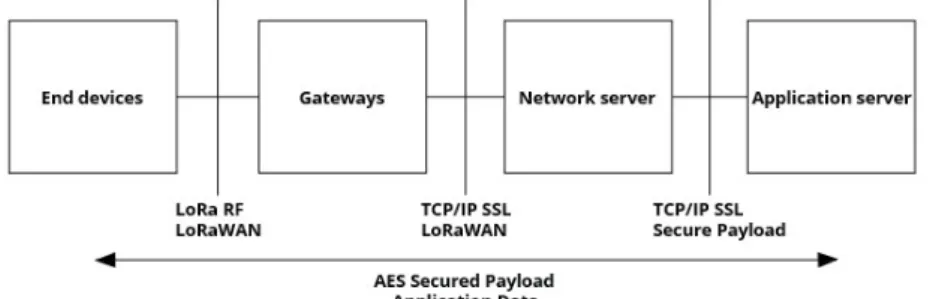
1.1 LoRa Architecture. . . 27
1.2 (a) Instantaneous frequency of an up-chirp. (b) Multiplication of the up-chirp by complex conjugate (down-chirp). (c) Coding a down-chirp, it encodes 1 symbol (SD is the Symbol Du-ration and BW the bandwidth). . . 29
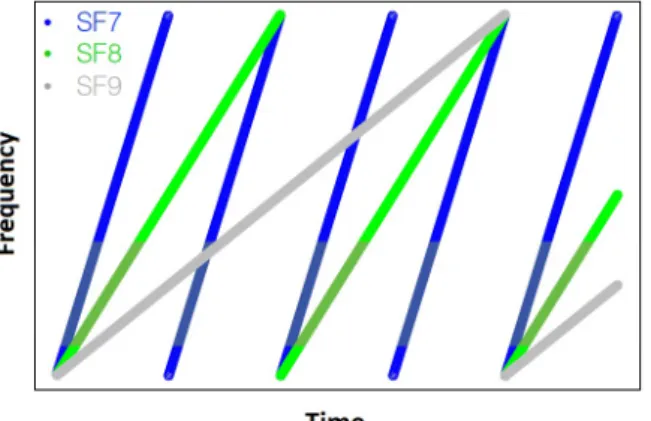
1.3 Chirps at different SF s. . . 29
1.4 Decoded symbols of a LoRa received signal. . . 30
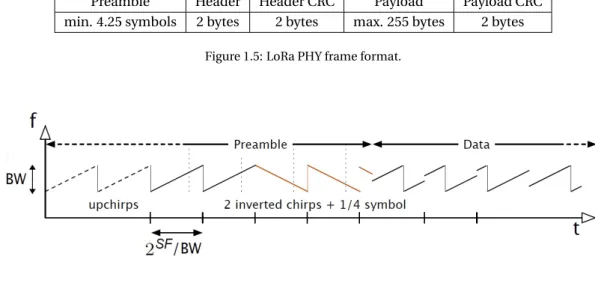
1.5 LoRa PHY frame format. . . 30
1.6 LoRa Preamble. . . 30
1.7 Bit error rate for LoRa. CR=45. . . 32
1.8 Uplink frame format. . . 35
1.9 Downlink frame format. . . 36
1.10 Downlink receive windows. . . 36
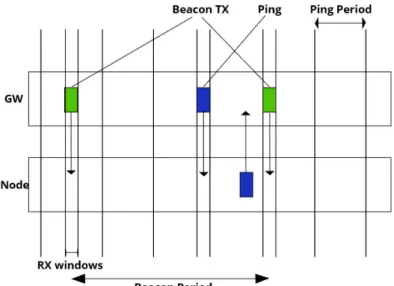
1.11 Class B reception window. . . 37
1.12 Class C reception window. . . 37
1.13 MAC frame format. . . 37
1.14 Downlink FCtrl fields. . . 38
1.15 Uplink FCtrl fields. . . 38
1.16 ADR mechanism at the end-device. . . 39
1.17 ADR mechanism at the network. . . 40
1.18 Methodology to adapt the network. . . 45
2.1 Star topology. . . 51
2.2 Energy consumption for various configurations of SF and Ptxin star topology. BW is set to 125 kHz and CR to4 5. . . 52
2.3 Spreading factor and transmitted power adaptation strategy. Bandwidth is fixed to 125 kHz. . . 53
2.4 Optimal energy consumption for various values of bandwidth: 125 kHz, 250 kHz, and 500 kHz in the star topology. . . 53
2.5 (SF, Ptx, BW) adaptation strategy. . . 54
2.6 Mesh topology. . . 54
2.7 Energy consumption of the mesh topology depending on inter-relay distance d when distance D between the sender node and the sink is set to 10 km. . . . 55
2.8 Energy consumption depending on d for various ranges D. . . 56
2.9 Energy consumption depending on range D for various inter-relay distances d. . . 57
2.10 (SF, Ptx) adaptation strategy. . . 57
2.11 Energy consumption in star and mesh topologies. . . 58
2.12 Topology adaptation strategy. . . 58
3.1 Deployment in circular area of R = Dmax(SFi). . . 64
3.2 Deployment in a room of 100 m x 100 m (FoF scenario). . . 64
3.3 Uniform deployment in circular area of R = Dmax(SFi). . . 65
3.4 Non uniform deployments in circular areas. . . 65
3.5 Placement of 1, 3, 7, and 9 GWs. . . 66
3.6 PDR for homogeneous deployments as a function of the number of devices generating a 50-Byte packet each 60 s. . . 68
3.7 Network Throughput for homogeneous deployments as a function of the number of devices generating a 50-Byte packet each 60 s. . . 69
3.8 PDR for homogeneous deployments of 10000 nodes. . . 70
3.9 Network Throughput for homogeneous deployment of 10000 nodes. . . 71
3.11 PDR of homogeneous and heterogeneous deployments as a function of the number of devices
generating a 50-Byte packet each 60 s. . . 73
3.12 Spreading Factor distribution for heterogeneous deployments. . . 74
3.13 Network throughput for homogeneous and heterogeneous deployments as a function of the number of devices generating a 50-Byte packet each 60 s. . . 75
3.14 PDR for homogeneous and heterogeneous deployments for 10000 nodes. . . 76
3.15 Network throughput for homogeneous and heterogeneous deployments of 10000 nodes. . . . 77
3.16 Impact of dense deployment on PDR for the ADR strategy. . . 78
3.17 Impact of dense deployment on throughput for the ADR strategy. . . 79
3.18 PDR achieved by ADR and the decomposition of PDR into each SF: MG_1_ADR_SF i repre-sents PDR of nodes that use SFi. Packets every 60 s, nodes uniformly distributed in a disk of radius Dmax(SF12) = 6.1 km. . . 80
3.19 PDR in the FoF environment for the ADR strategy. . . 81
3.20 Throughput in FoF environment for ADR strategy. . . 82
3.21 PDR of ADR using single and multiple channels. . . 83
3.22 Throughput of ADR using single and multiple channels. . . 84
3.23 Impact of the downlink transmissions on PDR of ADR for single and multiple channels. . . 85
3.24 Impact of the downlink transmissions on throughput of ADR for single and multiple channels. 86 3.25 Uniform deployments of 1000 nodes in a Multi-GW network, nodes configured with SF6 (con-figuration denoted by MG3SF6, MG7SF6and MG9SF6) . . . 87
3.26 Network PDR for Multi-GW deployments in a disk of Dmax(SF12) radius. . . 88
3.27 Network throughput for Multi-GW deployments in a disk of Dmax(SF12) radius. . . 89
3.28 Network PDR for Multi-GW MG7,9SF i , for different SFi configurations of 100 and 1000 nodes. 90 3.29 Multi-GW strategy. . . 90
3.30 Network PDR for Multi-GW ADR deployments in a disk of radius equal to Dmax(SF12). . . 91
3.31 Network throughput for Multi-GW ADR deployments in a disk of radius equal to Dmax(SF12). 92 3.32 Network PDR of MGjADR strategies for different number of GWs. . . 92
4.1 Comparison of 3 link adaptation strategies for devices generating a packet each 60 s in a disk of radius Dmax(SF6). . . 98
4.2 PDR of ELA in uniform and dense deployments. . . 99
4.3 Throughput of ELA in uniform and dense deployments. . . 100
4.4 PDR of ELA in the FoF environment. . . 101
4.5 Throughput of ELA in the FoF environment. . . 101
4.6 PDR of ELA using single and multiple channels. . . 102
4.7 Throughput of ELA using single and multiple channels. . . 103
4.8 Impact of the downlink transmission on PDR of ELA for single and multiple channels. . . 104
4.9 Impact of the downlink transmission on throughput of ELA for single and multiple channels. . 105
4.10 Network PDR for Multi-GW ADR and ELA deployments in a disk of radius equal to Dmax(SF12). 107 4.11 Network throughput for Multi-GW ADR and ELA deployments in a disk of radius equal to Dmax(SF12). . . 108
4.12 Network PDR of MGjADR and MGjELA strategies for different number of GWs. . . 109
4.13 Multi-GW ELA (MGjELA) strategy. . . 109
4.14 ELNDA(α = 1, β = 1) for the closest and the best GW. . . 112
4.15 PDR of ELNDA for α = 0, α = 1 and β = 1, and ADR in uniform deployment scenarios of 1, 3, 9 GWs. . . 113
4.16 PDR of ELNDA for α = 0, α = 1 and β = 1, and ADR in dense deployment scenarios of 1, 3, and 9 GWs. . . 114
4.17 PDR of ELNDA for α = 0 : 0.1 : 1 and β = 1 in 9 GWs uniform deployment. . . 115
4.18 PDR of ELNDA for α = 0 : 0.1 : 1 and β = 1 in 9 GWs dense deployment. . . 115
4.19 PDR comparison of ELNDA (α = 0.8,β = 0−0.5−1) and ADR in a uniform deployment scenario of 9 GWs. . . 116
4.20 PDR comparison of ELNDA (α = 0.8,β = 0 − 0.5 − 1) and ADR in a dense deployment scenario of 9 GWs. . . 117
4.21 PDR of ADR, ELNDA(β = 0), ELNDA (β = 1), and dynamic β in dense deployment scenarios of 9GWs. . . 118
Introduction
Context
During the last years, the number of connected devices has grown exponentially reaching tens of billions [1][2] and overtaking the global population [3]. There are more connected devices than people. In fact, the IoT (Internet of Things) applications [4][5], such as Smart Cities and Smart Homes, are connecting more devices than ever before (massive IoT) increasing the density and scale of the sensor deployments (large-scale) [6][7][8]. These deployments are composed of things capable to sense the environment, commu-nicate with other things, and make intelligent decisions. Wireless networks are required to connect these things providing robust and energy-efficient operations while covering wider geographical areas. Things are expected to operate for a longer period (five to ten years) without any maintenance as they are typi-cally battery-powered, and also to cover large areas [9]. Traditional technologies such as cellular (2G, 3G, and 4G) and non-cellular (short-range Bluetooth, and Zigbee) are not fully suitable to face this growth rate and the deployment problems involved. On the one hand, cellular technologies offer good throughput and communication range but they consume energy reducing the battery lifetime of the devices. On the other hand, non-cellular Bluetooth, and Zigbee technologies offer good battery lifetime but limited communica-tion range and throughput.
In this context, LPWAN (Low Power Wide Area Network) has emerged as an alternative to traditional technologies [5][10] providing low power connectivity and low data rate while covering large areas through a simple network topology [11]. In the literature, several studies have reviewed different LPWAN technolo-gies among standardization activities: IEEE (Institute of Electrical and Electronics Engineers), IETF (Internet
Engineering Task Force), 3GPP (3rd Generation Partnership Project), ETSI (European Telecommunications Standards Institute) as well as industrial activities: LORA(Long Range) alliance, Weightless-SIG, Dash7 al-liance [11]. They can be divided into networks based on cellular infrastructure [9][12], networks with third-party infrastructure [13], and autonomous networks without any third-party infrastructure [14]. The first group, NB-IOT (Narrow Band Internet of Things) [12], LTE-M (Long Term Evolution for Machines) [15][16], EC-GSM (Extended Coverage - Global System for Mobile) [17] raised intensive research to overcome heavy interference problems due to a new massive wave of IoT devices in addition to the already densely popu-lated existing cellular network. The second group includes proprietary networks and service providers such as Ingenu [18], SigFox [13], and Weightless [19]. The last group includes the LORAtechnology, which is an open-source technology that enables autonomous network set-up at low cost [9].
LPWAN aims to accommodate the IoT demand [20], more particularly to connect WSN (Wireless Sensor
Networks). These networks composed of sensor devices and gateways are characterized by the following
constraints: critical energy on the side of the sensors, critical communication range, susceptibility to in-terference, and infrequent transmissions of small data. The principal problems in WSN deployments are coverage and connectivity. Furthermore, WSN deployments need to be autonomously operational without manual instructions to minimize maintenance costs. The network should self-deploy and adapt its config-urations according to environment changes, due to interference, for example, to optimize a performance indicator such as power consumption or the packet delivery ratio. In the self-deployment approach, the network can take into account the environment by measuring link quality indicators or metrics. Then, it analyzes these metrics to make a decision. Finally, it applies this decision of re-configuring the network to optimize its performance, e.g., reliability and energy efficiency.
Among the LPWAN technologies we will focus on the LORAtechnology because it presents several ad-vantages for adaptive networks to self-deploy WSN. These adad-vantages are the degrees of freedom of its communication parameters, the adaptation flexibility, the maturity of the solution, the openness of the technology, and the robustness to interference thanks to its chirp spread spectrum modulation. LORA networks have been largely deployed for private networks (like smart buildings [21], smart cities [22], smart agriculture [23], smart meters [24], smart islands [25], smart golf course [26], smart water quality
monitoring [27][28][29][30], and smart air quality monitoring [31][32][33]) thanks to its low-cost and its subscription-less feature, reducing large-scale deployment costs. However, LORAhas presented several challenges [34][35][36][37] in terms of: network scalability and adaptation to use cases with high conges-tion. Several solutions have been proposed to deal with these problems. They can be divided in two cate-gories: link adaptation and network densification strategies. Furthermore, none of these studies have eval-uated both strategies with all the network parameters such as device configuration heterogeneity, network topology, deployment density and traffic intensity. In this thesis, we evaluate these strategies using an accu-rate simulator taking into account the quasi-orthogonality of the spreading factors, gateway capture effect, and realistic use of the spectrum considering the time-frequency dependency of the communications.
Scope and Motivation
This thesis has been developed within the Wireless Communications Department at CEA-Leti and the Drakkar Group at Grenoble Informatics Laboratory.
This work is performed in the context of WSN frequently deployed in harsh environments. These net-works need to be autonomous with optimized lifetime, reliable connectivity, and robust to interference. In that sense, the objective of this thesis is to ensure the Internet of Things communication with high relia-bility, energy-efficiency, and robust to interference by exploiting a new generation of transceivers, such as LORASemtech transceivers, within a communication protocol stack. Moreover, this thesis aims to make wireless sensor network deployments easier in harsh environments by self-deploying these networks and adapting to the context. In this thesis, we will focus on a static approach in the context of network de-ployment automation. We will propose a protocol to detect, characterize, and adapt the radio transceiver parameters to optimize the link budget and increase the reliability taking into account the constraints of coverage and connectivity of the WSN, as well as capacities and limitations of the LORAtechnology.
To achieve the objectives of the thesis, we decided to follow a simulation approach using the WSNET (Wireless Sensor Networks Simulator) that is an event-driven simulator for large scale WSN. We followed this approach rather than real test-beds because it is more practical for implementing and testing the adap-tive protocols to self-deploy WSN. The real implementation constraint of large scale deployments is the cost that would involve the deployment of thousands of devices. Note that at the beginning of this thesis there were a limited number of LORAsimulators. We decided to use and improve the WSNETsimulator because it implements the required communication protocol layers and simulates the network behavior with a high level of accuracy. In that sense, we integrate new features of transceivers such as LORASemtech and reconfiguration functionalities in the WSNETsimulator. Thus, we developed additional more realistic models such as the model of the LORAPHY (physical) layer to exploit spatial reuse and the orthogonality of spreading factors. Moreover, a MAC (Medium Access Control) layer model in a star topology or a star of star topology was developed to evaluate the impact of the protocol on the network performance.
This work extends the knowledge about LPWAN technologies, more specifically, the LORAtechnology in large scale deployments, its performance, limitations, and flexibility for adaptive networks. This thesis aims to answer the self-deployment issues of WSN by adapting the network to improve its performance. It addresses the following research questions:
Question 1:
What are the different LPWAN technologies? What are their advantages and limitations? There are several LPWAN technologies composed of various implementations and protocols. They could be proprietary or open-source that principally share some characteristics such as operation on small inexpensive batteries for years, and operating range typically of kilometers. However, a physical limitation to achieve long-range and low consumption is the small data size and data rate. More specifically, we would like to know about the adaptability of its communication parameters, scalability, and coverage. These ques-tions will be answered in Chapter 1.Question 2:
How flexible is the LORAtechnology for adaptive networks? What are the degrees of free-dom of the LORAtechnology? Is there an interest for energy saving?Among the existing LPWAN technologies, we are looking for the most suitable one for adaptive net-works. It seems that the LORAtechnology could be a good candidate to focus on due to the degrees of freedom of its communication parameters. We would like to know how flexible this technology is, by taking into account energy consumption constraints, deployment density of end-devices, and the communica-tion coverage. The LORAtechnology is characterized by low power consumption, long communication range, and massive access deployments. In Chapter 2 of this thesis we theoretically analyze the impact on the energy consumption of varying LORAcommunication parameters such as the transmission power, the spreading factor of the modulation, the bandwidth, and deployment.
Question 3:
What are the performance and limitations of LORAtechnology for massive access of end-devices? What is the impact of varying its communication parameters? What are the weaknesses of LO -RAWAN and the Adaptive Data Rate?We analyze performance and limitations of LORAtechnology by simulation taking into account more realistic hypothesis such as the constraints of the network implementation and deployment . We would like to know the limitations of the LORAtechnology in massive access deployments. They involve interfer-ence and packet collision problems that need to be considered. Thus, we analyze performance in terms of reliability and throughput through accurate simulations using the WSNETsimulator. Furthermore, we would like to know the limitations of the ADR (Adaptive Data Rate) mechanism proposed by LORAWAN to improve it taking into account: the capacity of each spreading factor, the orthogonality of spreading fac-tors, the traffic intensity, multiple channels, bi-directional communication (uplink and downlink), multiple gateways, different environments, etc. These questions will be answered in Chapter 3.
Question 4:
How to improve the performance and reliability of LORAnetworks? How to adapt its com-munication parameters? How to efficiently deploy LORAnetworks depending on the context?We look for improving LORAperformance because the ADR is not appropriate to the context, nor to the massive number of nodes, nor to the access with multiple gateways. Through a simulation approach, we are going to focus on supporting a massive number of end-devices while still providing good packet delivery ratio and communication range by adapting the LORAcommunication parameters, more particularly the spreading factor. To deal with these requirements, we propose two types of solutions: link adaptation and network densification. We propose solutions for single-gateway scenarios and multi-gateway scenarios by adapting the spreading factor at the initialization of the network operation when all nodes join the network. These questions will be answered in the first part of Chapter 4.
Question 5:
How to self-deploy LORAnetworks by adapting its communication parameters over time when end-devices progressively join the network?The LORAtechnology aims to connect a massive number of end-devices sharing the limited spectrum. The massive access problem involves two aspects: link coordination and resource allocation. Massive de-ployments require link coordination through MAC protocols to avoid collisions. We are going to focus on the resource allocation of the communication parameters. Varying LORAcommunication parameters re-sult in different transmission qualities. Thus, efficiently allocating resources to end-devices based on the deployed environment improves massive access, scalability, and reliability. We are going to allocate spread-ing factors to end-devices followspread-ing the self-deployment approach: measurspread-ing metrics, analyzspread-ing to take a decision, and applying the decision to allocate the optimal spreading factor to end-devices. Furthermore, we propose a solution to improve the LORAWAN adaptive data rate mechanism in a more realistic scenario by adapting the spreading factor over time when nodes progressively join the network. Note that in this ap-proach new nodes joining the network are configured without modifying the nodes that already joined the network. This approach is more realistic because there are several private LORAnetworks already deployed and we do not have access to modify the node’s configuration of those networks. However, we can measure the current network performance and based on that we can configure a node joining our network. These questions will be answered in the second part of Chapter 4.
Contributions
We present five contributions organized into three axes addressing the above questions. The first axis in-cludes Contribution 1 where we theoretically analyze the LORAtechnology flexibility for adaptive networks. We propose adaptation strategies for saving energy. The second axis includes the LORAsimulator based on WSNETthat is the Contribution 2: we developed several modules considering the characteristics of the LORASemtech transceivers and the LORAWAN protocol. Finally, the third axis is based on the analysis of the simulation results including Contributions 3, 4, and 5. They are the following: performance and lim-itation analysis of LORAnetworks for massive access devices, an improvement on performance through spreading factor allocation strategies, and adaptation strategy to self deploy LORAnetworks in more realis-tic scenarios. Our principal contributions are listed below:
Contribution 1:
Analyzing LORAtechnology for adaptive networks. Evaluating the flexibility of its communication parameters. Theoretically showing the interest of LORAfor energy saving. Proposing adap-tation strategies of its communication parameters for energy saving.We analytically investigate the energy efficiency for different network topologies to improve energy con-sumption by adapting LORAcommunication parameters in star and mesh topologies. The impact on en-ergy consumption of the network density and network coverage is also investigated. We implemented an analytical model in MATLABaccording to the LORAWAN specification and technical documents.
Contribution 2:
Developing and implementing a LORAsimulator based on WSNET.We use an accurate and realistic WSNET-based simulator [38] written in C / Modern C++ under CeCILL free license. WSNETis a modular event-driven wireless network simulator that implements the required communication protocol layers and simulates the network behavior with a high level of accuracy. We have extended the simulator in several aspects (e.g., spectrum use, interference, capture effect) to take into ac-count flexibility and specificity of the LORAPHY / MAC layers.
Contribution 3:
Analysing performance and limitation of LORAnetwork deployments for massive access of end-devices. Showing the impact of varying its communication parameters for different network sizes and different traffic intensities.The first part of this contribution is the investigation of LORAnetwork deployments of nodes with ho-mogeneous communication parameters. This investigation allows us to obtain the performance of each spreading factor individually to calculate their capacity for each network size assuring a given packet deliv-ery ratio. This individual spreading factor performance allows us to understand advantages and limitations, and also to propose more allocation protocols using different spreading factors. The second part of this contribution is the investigation of LORAnetwork deployments of nodes with heterogeneous communica-tion parameters. This investigacommunica-tion explores more spreading factor allocacommunica-tion protocols to improve network performance by exploiting LORAphysical layer features such as spreading factor quasi-orthogonality. These spreading factor allocation protocols configure nodes: (i) according to their link budget like the ADR of the LORAWAN specification, (ii) randomly, and (iii) aiming at an equal number of nodes per spreading factor. The final part of this contribution is the detailed performance analysis of the spreading factor allocation protocol based on the link budget that corresponds to the ADR of the LORAWAN under steady-state as-sumptions. This analysis allows us to understand the impact of allocating the spreading factor using ADR on the network performance in several aspects: (i) network deployment, (ii) environment, (iii) multiple channels, and (iv) bidirectional communications. We evaluate all these aspects under the same assump-tions. Capabilities and limitations are clarified to investigate more optimal allocation protocols exploiting principally the individual capacity of each spreading factor and their quasi-orthogonality to improve the ratio of received packets.
Contribution 4:
Improving the performance of LORAnetworks through efficient spreading factor al-locations. Proposing network deployment strategies to make LORAdeployments easier depending on the context.Improvements are proposed because the network deployment should not have a strong impact on net-work performance. We propose several strategies to deploy LORAnetworks by adapting the parameter
spreading factor at the initialization when all nodes join the network. We propose improvements to the classical spreading factor allocation and to the adaptive data rate mechanism that depends on the network deployment impacting the network performance: (i) enhanced link adaptation, and (ii) joint link and topol-ogy adaptation strategies. They improve the network capacity and transmission quality in terms of packet delivery ratio.
Contribution 5:
Proposing adaptation strategies to self-deploy LORAnetworks over time when end-devices progressively join the network.We propose a strategy to self-deploy LORAnetworks by adapting the spreading factor parameter over time when nodes progressively join the network. We propose a progressively joining strategy based on the link, network, and distribution metrics of previous joined end-devices to set up the configuration of joining end-devices to self-deploy LORAnetworks according to the context. Note that we have no influence on the configuration of the end-devices that already joined the network because there could be other private LORAnetworks deployed on the same geographical area as our LORAnetwork. However, we can use current network performance metrics to configure an end-device joining the network.
Contributions Beyond the State of the Art
Given the state of the art, several insights and strategies were proposed for link adaptation and topology adaptation. In this thesis, we perform a global evaluation of different communication parameters using the radio LoRa technology. The research challenges in LoRa deployments can be divided into five categories: (i) energy consumption, (ii) communication range, (iii) multiple access, (iv) error correction, and (v) security. Among these categories, this thesis investigates (i), (ii), and (iii).
Error correction is not considered in this thesis. However, it is important to notice that corrupted packets due to channel effects or environmental conditions can be overtaken with two types of solutions [9]: (i) channel coding and (ii) interference cancellation. These solutions could improve performance by decoding even corrupted messages. Security is also a major issue, but this thesis does not consider it. Nevertheless, note that several investigations are been carried out.
Energy consumption:
Energy consumption is a major challenge for LoRa networks. Nodes are expected to have 5 to 10 years of life time with minimal maintenance. Consumption can be due to (i) micro-controller operations and (ii) wire-less transmissions. LoRa consumes wire-less energy by directly using the bandwidth for transmitting a signal and employing light MAC protocols. However, nodes consume more power due to unavoidable circumstances like network deployment constraints (nodes located far from the gateway), network topology, and collisions followed by re-transmissions.
From the literature, authors identified that generating carrier signals is the most power consumption operation. They also identified that LoRa is able to receive weak signals but decoding them depends on the signal SNR and the minimum SNR that the receiver can demodulate. They suggest to place more gateways and to allocate dynamically the transmitted power to face energy consumption issues. However, note that no performance analysis (neither theoretical nor by simulation) have been made on energy consumption.
In this thesis, more particularly in Chapter 2, we address the energy consumption problem exploiting the flexibility of several radio LoRa parameters and not only the transmitted power. These parameters are: (i) the transmitted power, (ii) the spreading factor, and (iii) the bandwidth. We analytically investigate en-ergy consumption due to LoRa wireless transmissions and receptions varying these radio parameters for different network topologies (star and mesh). Indeed, we investigate what parameter should be adapted to optimize energy consumption and the different trade-offs when changing a parameter. For example, decreasing the spreading factor and the transmitted power may reduce energy consumption but we need to clarify which variation better optimizes energy consumption. We may gain in energy consumption but
communication range is reduced. Hence, the impact of the network density and network coverage are in-vestigated to propose adaptation strategies to adapt the LoRa radio parameters and network topology.
Communication range:
Estimating the coverage of LoRa networks is also a challenge. LoRa deployments aim to include several scenarios and use cases. We have to take into account diverse deployment conditions and propagation loss to improve the network coverage. Attenuated signals below a given threshold may be detected by the gateways but not decoded. Thus, the communication range could be improved with new techniques for decoding these signals, placing more gateways, or with multi-hop communications.
From the literature, authors performed test-bed measurements [9][39] and proposed solutions to improve the communication range of sparse deployments. They also proposed new hardware to extend coverage and battery lifetime. They gave some insights found from experimental measurements. They suggest to place more gateways to increase network density. However, note that at the moment when we started this thesis, no analysis had been made about network deployment with multiple gateways. Moreover, only the star topology was considered for LoRa deployments, which may be improved using mesh topologies by increasing communication range through relay nodes.
In this thesis, we theoretically investigate the communication range and energy consumption of trans-mitting and receiving packets through some relay nodes (multi-hop communication) by adapting the radio LoRa parameters. We improve the communication range using a mesh topology and we evaluate energy consumption depending on the network coverage. Moreover, we propose an adaptation strategy to switch from the star topology to the mesh topology depending on the communication range and network density. Passing to the mesh topology allows to reach longer distances. This thesis also investigates the impact of different environments (e.g. factory of the future), network topologies, multiple gateway (adding gateways increases the network coverage and the network performance), the minimum number of gateways required to cover the whole area of deployment, and their positioning. We propose strategies giving the number of required gateways to cover and assure a given reliability for a given network size. These strategies make LoRa deployments easier.
Multiple access:
Connecting a massive number of devices is also a major issue. It is expected that LoRa networks connect thousand of devices sharing the limited spectrum. Multiple access involves several problems and they can be divided into two groups according to the literature: (i) Link coordination and (ii) Resource allocation. The first one aims to coordinate transmissions using MAC protocols to avoid collisions. The second one aims to allocate resources reasonably to devices depending on the deployment constraints to improve scalability and massive access. When we talk about resources, we mean the radio LoRa parameters: T P (transmission power), SF (spreading factor), BW (bandwidth), channel, which affect the transmission quality.
From the literature, authors suggested to take advantage of new LoRa gateways able to receive pack-ets with different SF s in the same channel simultaneously to improve packet delivery [40]. They also recommend further investigation varying transmission parameters according to the deployment environ-ment. They investigated several solutions, but most of them only considered homogeneous communica-tion parameters of devices. There are some solucommunica-tions [41][42][43][44][45][46][47][48] considering hetero-geneous communication parameters allocating SF s with the ADR mechanism for example. However, they did not consider the fact that SF s are not completely orthogonal. In fact, SF s are quasi-orthogonal, there is rejection between signals with different SF on the same channel. Furthermore, the ADR mechanism has drawbacks and does not exploit all the potential of the LoRa technology, more specifically the quasi-orthogonality of SF s. Densifying the network by increasing the gateways may improve network perfor-mance but it increases collisions because the number of devices using low SF s increases, saturating these low SF s. Thus, the ADR mechanism needs to be improved through fairer SF allocation depending on the environment and deployment constraints.
In this thesis, we investigate performance of LoRa deployments connecting a massive number of devices and different traffic intensities. To do this, we investigate the capacity of each SF depending on the traffic and the number of end-devices. Then, we investigate multiple access of end-devices with heterogeneous parameters taking into account that SF s are not fully orthogonal. Co-channel rejection of different SF s is considered in our interference model in WSNet allowing more accurate simulation results. Thus, we inves-tigate heterogeneous communication parameters of devices and how they impact performance. Indeed, we explore several SF allocation strategies to self-adapt the network. We aim to allocate optimally the SF s considering the packet delivery ratio and throughput as performance metrics. Furthermore, we investigate in detail the ADR performance showing the impact of the deployment, and its drawbacks when over-using and under-using SF s to improve it.
Outline
This thesis is organized into two parts: (i) state of the art and (ii) contributions. The first part presents the state of the art of the LPWAN technologies in the context of IoT and WSN. It presents the existing solutions and a table comparison. Furthermore, we present the LORAtechnology, its characteristics, the LORAWAN protocol, and the reasons why we have chosen it for adaptive networks. Moreover, we present the related work of LORAdeployments, link and topology adaptation, and a discussion of the general methodology followed in this thesis. The second part presents our contributions divided into three chapters: 2, 3, and 4. This thesis is organized as follows:
Part I, Chapter 1: LPWAN and L
OR
A.
This chapter investigates the LPWAN landscape of thetechnologies and protocols to understand features, challenges, and flexibility for adaptive networks. There are several LPWAN technologies such as LORA, SigFox, NB-IoT, Ingenu, 802.11.ah, etc. Among these tech-nologies, LORAtechnology and the LORAWAN specifications are presented in detail. Indeed, we analyze the degrees of freedom of the LORAtechnology to adapt the network. We define the methodology for the investigation of network deployment through theoretical studies, simulations, or real measurements. This chapter also presents the related work on two major issues: (i) LORAnetwork deployments for which we detail work using experimental measurements or simulations, the LORAevaluation and its limits and the LORAnetwork deployment strategies. (ii) LORAadaptation for which we present the link and the topology adaptation.
Part II, Chapter 2: Is L
OR
Atechnology a good candidate for adaptive networks?
Thischapter investigates the degrees of freedom of LORAcommunication parameters to understand the trade-offs and challenges when adapting its parameters such as the transmitted power, the spreading factor, the bandwidth, the coding rate, and the topology of the deployment. This chapter focuses on the investigation of energy consumption and the communication range as network performance indicators to decide if LORA is an appropriate technology for adaptive networks. Thus, we analytically investigate the energy efficiency for different network topologies to improve energy consumption by adapting LORAcommunication param-eters in star and mesh topologies. The impact on energy consumption of the network density and network coverage is also investigated. We show the flexibility of LORAparameters to pursue the investigation in adaptive networks.
Part II, Chapter 3: Performance and limitations of large scale L
OR
Anetworks.
Thischapter evaluates the performance and limitations of massive access LORAnetworks for different applica-tion cases and traffic intensities. We also analyze the impact of varying the communicaapplica-tion parameters. These analyses are done in the same simulation and under the same assumptions. Indeed, we analyze: (i) the capacity of each spreading factor in homogeneous deployments, (ii) the impact of the orthogonality of the spreading factors in heterogeneous deployments, (iii) the performance of the ADR, (iv) the impact of different environments, (v) the impact of using multiple channels, (vi) the impact of the downlink commu-nication, and (vii) the network densification, i.e. multiple gateways.
We analyze the performance of LORAdeployment of end-devices with homogeneous and heterogeneous communication parameters to propose and evaluate spreading factor allocation strategies. Moreover, we analyze the impact of the network deployment, i.e., uniform and dense deployment of end-devices. Fur-thermore, we analyze the limitations of the adaptive data rate of LORAWAN showing the trade-offs between over-used and under-used spreading factors. Another addressed important issue is the analysis of the im-pact of the environment, especially in a FOF (Factory of the Future) environment. The impact of multiple channels is also analyzed as well as the degradation of the packet delivery ratio due to downlink transmis-sions. Finally, we analyze the impact of improving the network density by placing multiple gateways in LORAdeployments of end-devices with homogeneous communication parameters. This analysis allows us to improve performance taking advantage of the spectrum spatial reuse and to propose an adaptation strategy giving the number of gateways needed to assure a certain level of reliability for given network size. This adaptation strategy limits the number of covered nodes per gateway serving them with better packet delivery ratio, especially in large scale deployments.
Part II, Chapter 4: Efficient spreading factor allocation in massive access L
OR
Amulti-ple gateway adaptive networks.
In this chapter, we look for improving the performance of LORA massive access networks allocating efficiently the spreading factor to end-devices and increasing the net-work density of the infrastructure by placing more gateways in the right way. We propose improvement to the adaptive data rate mechanism of LORAWAN: (i) the ELA (Enhanced Link Adaptation) algorithm and (ii) the MGELA (Multiple Gateway Enhanced Link and Topology Adaptation). Moreover, we propose network deployment strategies to make LORAdeployments easier depending on the context, e.g. the network size. Performance evaluation of ELA is also presented: it investigates the impact of the network deployment, the pathloss environment, multiple channels, downlink communications, and multiple gateways. Further-more, we propose adaptation strategies to self-deploy LORAnetworks over time when end-devices progres-sively join the network. We analyze the impact of these adaptation strategies on network performance, in uniform and dense deployments. Whatever the environment is our strategy will exploit the capacity of each spreading factor and the quasi-orthogonality of them in every gateway taking into account realistic estimated metrics based on network performance measurements. Note that there are imperfections when estimating the metrics to decide the network configuration.Conclusion and future directions.
We started by comparing different LPWANs to focus on the LoRa technology. It offers several degrees of freedom on its communication parameters making it a good candi-date for adaptive networks. Then, we theoretically evaluated energy consumption of LoRa networks show-ing the interest to focus on LoRa for adaptive networks and we also proposed adaptation strategies. Next, we investigated performance and limitations of LoRa networks identifying drawbacks of ADR. This inves-tigation allowed us to propose enhancements by allocating SF optimally to improve reliability and fairness taking into account deployment constraints and exploiting LoRa properties. This thesis is only a first step in LoRa adaptive networks. Future research is necessary in mesh networks, machine learning techniques for parameter allocation, experimental validation of our proposals, optimal placement of the gateways, band-width adaptation, and coding rate adaptation, to adapt a network deployment.LPWAN and L
R
Contents
1.1 LPWAN Technologies . . . . 22 1.1.1 LORA . . . 22 1.1.2 SIGFOX . . . 23 1.1.3 Ingenu . . . 23 1.1.4 NB-IoT . . . 24 1.1.5 IEEE 802.11ah . . . 24 1.1.6 LPWAN Comparison . . . 25 1.2 LoRa Technology . . . . 27 1.2.1 Architecture . . . 27 1.2.2 Communication Bands . . . 28 1.2.3 Chirp Spread Spectrum Modulation . . . 28 1.2.4 LoRa Frame Structure . . . 30 1.2.5 LoRa Transceiver . . . 31 1.2.6 Reliability, Interference, and Collision . . . 33 1.2.7 Properties of LoRa . . . 34 1.3 LoRaWAN . . . . 34 1.3.1 MAC Layer . . . 35 1.3.1.1 Class A . . . 35 1.3.1.2 Class B . . . 36 1.3.1.3 Class C . . . 37 1.3.2 MAC Frame Format . . . 37 1.3.3 Adaptive Data Rate (ADR) . . . 38 1.4 LoRa Deployment Discussion . . . . 41 1.4.1 Real LoRa Deployments . . . 41 1.4.2 From Experimental Measurements to Simulations . . . 41 1.4.3 LoRa Evaluation and Limits . . . 41 1.4.4 LoRa Network Deployment Strategies . . . 42 1.5 Link and Topology Adaptation Discussion . . . . 43 1.5.1 Link Adaptation . . . 43 1.5.2 Topology Adaptation . . . 44 1.6 Methodology . . . . 45Introduction
This chapter investigates the competitive landscape of LPWAN technologies and protocols to understand features, challenges, and flexibility for adaptive networks. We present the details of the LORAtechnology and the LORAWAN specification. Thus, we look for a technology offering flexibility and degrees of freedom of its communication parameters to focus on.
This chapter also focuses on the state of the art of LORAtechnology. Mainly, it presents related work of the LORAdeployments divided in four parts: (i) the real LORAdeployments, (ii) the LORAnetwork de-ployments of both experimental measurements and simulations, (iii) the LORAevaluation and limits, and (iv) the LORAnetwork deployment strategies. Moreover it presents the related work of the LORA adapta-tion: (i) the link and (ii) the topology adaptation. Finally, we present the methodology of the investigation of network deployments in this thesis, i.e., through (i) theoretical studies, (ii) simulations, or (iii) real mea-surements.
1.1 LPWAN Technologies
LPWAN technologies are promising for the Internet of low power, low cost, and low throughput things [11] offering long range and long battery life time. They achieve a long range and low power at the cost of lower data rate. Several applications for smart cities, smart metering, environmental monitoring, logistics, agriculture, etc. require infrequent and small amount of data and longer battery life time of devices covering large areas. Thus, many LPWAN technologies generated interest for these applications. In this section, we highlight the most important LPWAN technologies.
1.1.1
L
O
R
A
LORAis a proprietary technology that modulates signals using a spread spectrum technique [49] developed and commercialized by Semtech [50]. It uses unlicensed ISM (Industrial, Scientific and Medical) bands: (i) the EU863-870 MHz and the EU433 MHz bands in Europe and some countries in Africa and Middle East, (ii) the US902-928 MHz band in North America and South America, (iii) the AS920-923 MHz band in Japan, South Korea, and some countries in Asia, (iv) the CN470-510 MHz and CN779-787 MHz bands in China, (v) the AU915-928 MHz band in Australia, and (vi) the IN865-867 MHz band in India. The LORAtechnology also uses the 2.4 GHz band for smart homes and wearable IoT applications. Its physical layer is based on the CSS (Chirp Spread Spectrum) modulation. The CSS spreads a narrow band signal over a wider band resulting in a noise-like signal enabling resilience to interference and noise. LORAsupports multiple SF (Spreading Factors) trading off data rate and communication range. High SFs achieve long ranges but low data rates. Low SFs achieve high data rates but short ranges. Typical values of BW (Bandwidth) are 125, 250, and 500 kHz but smaller bandwidths like 62.5, 31.25, 15.625, and 7.8125 kHz are also allowed in the LORAspecification. LoRa can use several channels, i.e., frequency diversity. In Europe, ETSI regulations allow 14 dBm as the maximum TX(Transmit Power) with exception of the g3 (869.4–869.65 MHz) band that allows 27 dBm. In North America it allows a TXup to 30 dBm (typically 20 dBm). The LORAtechnology allows a MCL (Maximum Coupling Loss) of 150 dB (sensitivity of -136 dBm and TXof 14 dBm). The LORA link budget allows communication ranges of tens of kilometers (typically 5-15 km) depending on the sur-rounding environment, the TXof nodes, the SF, the BW, etc. The packet size depends on the SF with a maximum size between 59-230 Bytes for high and low SF respectively. In Europe the DC (Duty Cycle) is regulated by the ETSI EN300.220 standard [51]. This standard defines the DC of the following sub-bands: (i) 1% in g (863.0–868.0 MHz), (ii) 1% in g1 (868.0–868.6 MHz), (iii) 0.1% in g2 (868.7–869.2 MHz), (iv) 10% in g3 (869.4–869.65 MHz), and (v) 1% in g4 (869.7–870.0 MHz). LORAallows bidirectional communications where uplink (i.e., from nodes to gateways) transmissions are predominant. The TTN (The Things Network) is a public community network. It has a Fair Access Policy that limits the uplink time on air to 30 s per day per node and the downlink messages to 10 messages per day per node. The data rate goes from 290 b/s to 37.5 kb/s depending on the SF, the BW, and the CR (Coding Rate). Thus, e.g. the TTN policy approximately allows 23 packets of 50 Bytes per day per node using SF12(2816 packets of 50 Bytes per day per node using SF6). The power consumption varies according to the output power and the supply current: (i) 0.2-1 µA in
Sleep mode, (ii) 1.5 µA in Idle mode, (iii) 1.6-1.8 mA in Standby mode, (iv) 10.3-12.6 mA in Receive mode, and (v) 20-120 mA in Transmit mode. A LORAgateway is able to receive simultaneously multiple transmis-sions using different spreading factors providing a third degree of diversity along with time and frequency. LORAallows a star of stars topology, a transmitted packet is received by all gateways in the range improving reception diversity (redundancy). Duplicate packets are eliminated in the backend system. However, multi-ple gateways may increase costs. The access protocol in LORAis the simple access method ALOHA. Several commercial and industrial partners formed a group called LORAAlliance proposing LoRaWAN which is an open standard defining upper layers. Note that LoRa denotes the physical layer while LoRaWAN denotes the MAC layer. The adaptability of this technology is based on the degrees of freedom of its parameters: (i) the TX, (ii) the SF, (iii) the BW, (iv) the CR, (v) and the topology (star, star of stars, and mesh). Note that LoRa at 2.4 GHz allows bandwidths of 203, 406, 812, and 1625 kHz. It increases data rates up to 202 kb/s (with SF5, 1625 kHz, and 4/5 of CR).
1.1.2 SIGFOX
SIGFOX is a service provider for IoT and offers end-to-end connectivity based on a patented technology. It uses unlicensed ISM bands: (i) the RC1 868-878.6 MHz band in Europe, Middle East and Africa, (ii) the RC2 902.1375-904.6625 MHz band in North America and Brazil, (iii) the RC3 922.3-923.5 MHz band in Japan, (iv) the RC4 920.1375-922.6625 MHz band in Latin America and Asia Pacific, (v) the RC5 922-923.4 MHz band in South Korea, (vi) the RC6 865-867 MHz band in India, and (vii) a draft of the RC7 868.8-869.1 MHz band in Russia. It uses a BPSK (Binary Phase Shift Keying) modulation in a UNB (Ultra Narrow Band) of 100 Hz. With an ultra narrow band, noise levels are low, receiver sensitivity is high and energy consumption is low. SIGFOX allows 10 µW - 100 mW of TX. Its typical MCL is 156 dB for receiver sensitivity of -136 dBm and TX of 20 dBm. The SIGFOX link budget allows communication range of tens of kilometers depending on the environment (e.g., 3-10 km and 30-50 km in urban and rural environments respectively). The packet size is fixed to 12 bytes upstream and 8 bytes downstream. In Europe the DC is 1 % limiting the number of uplink messages per day to 140. SIGFOX is predominantly using uplink communication with limited downlink ca-pability. The data rate is limited to 100 b/s limiting the use cases. At the beginning, SIGFOX only supported uplink communications, but then it evolved to bidirectional asymmetric communication. Downlink com-munications are limited to few packets per day (4 messages of 8 bytes per day). The power consumption depends on the supply current: (i) < 4 µA in Sleep mode, (ii) < 49 mA in Transmit mode (TXof 14 dBm), and (iii) 10 mA in Receive mode. The SIGFOX network is based on a star topology and requires an operator to carry the traffic. The access protocol in SIGFOX is an ALOHA-based protocol operating in a range of ran-dom frequency and time without having any knowledge of the channel state. Time frequency diversity and redundant transmissions improve reliability even it acknowledgements for uplinks are not supported. The frequency diversity consists of transmitting multiple times over different channels randomly selected, e.g., in Europe, the 868 MHz band is divided into 400 channels of 100 Hz [52]. The adaptability of this technology depends on the degrees of freedom of its parameters: (i) only the TX.
1.1.3 Ingenu
Ingenu is a proprietary technology. It is known as On Ramp Wireless. Contrarily to other proprietary tech-nologies, it operates in the 2.4 GHz ISM band leaving aside better propagation properties in sub GHz band but benefiting from more relax regulations on spectrum [53]. Ingenu uses a patented RPMA (Random Phase
Multiple Access) [54]. The RPMA enables multiple transmitters to share a single time slot. However, it first increases time slot duration then scatters the channel by adding a random delay to each transmitter reduc-ing overlappreduc-ing and increasreduc-ing SNR (Signal Noise Ratio). Gateways use multiple demodulators to decode the signals arriving at different times in a slot. The BW required is 1 MHz supporting up to 40 channels si-multaneously. Ingenu allows up to 20 dBm of TX. The RPMA offers high receiver sensitivity (-142 dBm) and 168 dB of the link budget [53]. Thus, Ingenu allows communication ranges depending on the environment, e.g., 1-3 km and 25-50 km in urban and rural environments respectively. The packet size is flexible (6 Bytes to 10 kBytes). Ingenu has no DC as it leverages the 2.4 GHz ISM band. This technology provides bidirec-tional communications, all messages are acknowledged. The data rate is 624 kb/s for uplink and 156 kb/s for downlink per sector assuming 8 channels access point. The current consumption of an access point is
350 mA maximum (290 mA typical). The Ingenu network is based on a star topology but a tree topology is also supported with an RPMA extender. The access protocol used by Ingenu is the LBT
(Listen-Before-Talk). Ingenu claims high scalability adding more access points without disrupting current capacity. The
adaptability of this technology depends on the degrees of freedom of its parameters: (i) TXand the (ii) data rate.
1.1.4 NB-IoT
Narrow Band IoT is a cellular IoT technology standardized by 3GPP. It can coexist with LTE (Long Term
Evo-lution) and GSM (Global System for Mobile) cellular technologies in licensed frequency bands depending
on the region. In Europe, it uses: B3 (1800 MHz), B8 (900 MHz), and B20 (800 MHz) bands. In North Amer-ica, it uses: B4 (1700 MHz), B12 (700 MHz), B26 (850 MHz), B66 (1700 MHz), and B71 (600 MHz) bands. In Asia Pacific: B1 (2100 MHz), B3 (1800 MHz), B5 (850 MHz), B8 (900 MHz), B18 (850 MHz), B20 (800 MHz), B26 (850 MHz), and B28 (700 MHz) bands. In Middle East and North Africa: B8 (900 MHz) and B20 (800 MHz) bands. In Sub Saharan Africa: B3 (1800 MHz) and B8 (900 MHz) bands. In Latin America: B2 (1900 MHz), B3 (1800 MHz), B5 (850 MHz), and B28 (700 MHz) bands. NB-IOT uses SC-FDMA (Single Carrier Frequency Division Multiple Access) in uplink communications and OFDMA (Orthogonal Frequency Divi-sion Multiple Access) in downlink communications [55]. Similarly to GSM and LTE, NB-IOT uses 200 kHz of BW as a resource block. Only a software upgrade in the existing LTE infrastructure is necessary to support this technology. The maximum TXis 20 dBm. NB-IOT aims at 164 dBm of the link budget for long cover-age. The communication range depends on the environment (e.g., 1-5 km and 10-15 km in urban and rural environments respectively). Its packet size is 125 bytes for uplink and 85 bytes for downlink. There is no DC limitations. NB-IOT provides bidirectional communications. The data rate is 250 kb/s with multitone configuration and 20 kb/s with single tone configuration. The power consumption depends on the supply current: (i) 4 µA in Sleep mode, (ii) 5 mA in Idle mode, (iii) 220 mA in Transmit mode, and (iv) 20 mA in Receive mode. The NB-IOT network is based on a star topology. It uses a time slotted synchronous pro-tocol. Improvement of NB-IoT continues with new releases by 3GPP. They plan to extend this technology for localization and multicast services, mobility, and further technical details to enhance applications [56]. NB-IOT claims to serve 50 thousand nodes per gateway with the potential of scaling up by adding more carriers [11]. The adaptability of this technology depends on its degrees of freedom: (i) TXand the (ii) data rate.
1.1.5 IEEE 802.11ah
IEEE 802.11ah is is an extension of the IEEE 802.11 standard to meet IoT application requirements [57]. This standard extends the communication range and improve energy efficiency. It was proposed by the TGAH (Task Group AH) and TIG (Topic Interest Group) in LRLP (Long Range Low Power). It proposes the PHY and MAC layers based on IEEE 802.11ac reducing some control frames and the MAC header length. It also introduces OFDM (Orthogonal Frequency Division Multiple) and MIMO (Multiple Input Multiple Output) technologies [58]. In the sub 1 GHz ISM band, it specifies the following bands: (i) 863-868 MHZ in Europe, (ii) 902-928 MHz in USA, (iii) 755-787 MHz in China, (iv) 916.5-927.5 MHz in Japan, (v) 917.5-923.5 MHz in Korea, and (vi) 866-869 MHz and 920-925 MHz in Singapore. In the PHY layer, this standard defines different channel widths (1 MHz, 2 MHz, 4 MHz, 8 MHz, and 16 MHz). Channelization depends on the country regulations. There are several MCS (Modulation & Coding Scheme) operating with different bandwidths and coding rates. Modulation could be BPSK, QPSK (Quadrature Phase-Shift Keying) and QAM (Quadrature
Amplitude Modulation). The TXdepends on the country’s regulations: 10 mW-1000 mW. Its typical link
budget is 126 dB (e.g., sensitivity of -126 dBm). This link budget allows communication ranges up to 1 km outdoor. The packet size could be up to 7991 bytes without aggregation and up to 65536 bytes with aggregation. In Europe (the g 863-870 MHz band), the DC is limited to 2.8 % but devices can implement LBT and AFA (Adaptive Frequency Agility) mechanisms. IEEE 802.11ah provides bidirectional communications. The data rate varies from 150 kb/s up to 346.66 Mb/s in both uplink and downlink. Table 1.1 shows the data rate for different BW and different types of MCS. The typical current consumption is: (i) 300 mA in Transmit mode and (ii) 50 mA in Receive mode. Its typical network topology is star. In the MAC layer, this standard adopts a grouping-based Medium Access Control protocol in order to reduce contention overhead, support
advanced power saving mechanism, and throughput enhancement. Sensors are divided in several groups and the channel access time is divided in beacon intervals, each interval is divided in a number of equal duration RAW (Restricted Access Window) slots. Then, each RAW is assigned to a group of sensors, the only group allowed to access RAW, reducing collision probability [59]. The adaptability of this technology depends on its degrees of freedom: (i) TX, (ii) BW, (iii) MCS, and (iv) CR.
Table 1.1: Data rate in Mb/s for the IEEE 802.11ah standard [60].
PHY characteristics MCS Bandwidth
Modulation Coding Rate 1MHz 2MHz 4MHz 8MHz 16MHz BPSK 1/2 & 2x repetition MC S0 0.30 0.65 1.35 2.93 5.85 BPSK 1/2 MC S1 0.60 1.30 2.70 5.85 11.70 QPSK 1/2 MC S2 0.90 1.95 4.05 8.78 17.55 QPSK 3/4 MC S3 1.20 2.60 5.40 11.70 23.40 16-QAM 1/2 MC S4 1.80 3.90 8.10 17.55 35.10 16-QAM 3/4 MC S5 2.40 5.20 10.80 23.40 46.80 64-QAM 2/3 MC S6 2.70 5.85 12.15 26.33 52.65 64-QAM 3/4 MC S7 3.00 6.50 13.50 29.25 58.50 64-QAM 5/6 MC S8 3.60 7.80 16.20 35.10 70.20 256-QAM 3/4 MC S9 4.00 - 18.00 39.00 78.00 256-QAM 5/6 MC S10 0.15 - - -
-1.1.6
LPWAN Comparison
LoRa, SIGFOX, NB-IoT, Ingenu and IEEE 802.11ah are the leading LPWAN technologies competing for large-scale IoT deployments. Mekki et al. [56] showed that LoRa and SIGFOX are advantageous in terms of battery life time and cost. Meanwhile, NB-IoT is advantageous in terms of no DC restrictions and synchronous pro-tocols. We compare these leading technologies in terms of quality of service, battery life time, scalability, network coverage, the deployment model, and adaptability. Furthermore Table 1.2 shows an overview com-paring the LPWAN technologies. UL refers to uplink and DL referes to downlink communications.
• Quality of service: LoRa, SIGFOX, Ingenu and IEEE 802.11ah operate using unlicensed bands. LoRa and SIGFOX use asynchronous communication protocols. However, NB-IoT seems to provide better quality of service due to the use of licensed bands and LTE-based synchronous protocols. This im-provement comes with an expensive cost of licensed LTE spectrum for the operators. Ingenu provides good uplink rate but it is relatively high pricing.
• Battery life time: Nodes are in sleep mode most of the time in these technologies, reducing energy consumption. However, NB-IoT (220 mA), Ingenu (290 mA) and IEEE 802.11ah (300 mA) consume more energy than LoRa (20-120 mA) and SIGFOX (49 mA).
• Scalability: All these technologies support a massive number of devices. They exploit the diversity of the channel, time, and space. However, NB-IoT and Ingenu claim high scalability connecting up to 100 thousand and 384 thousand nodes, respectively. LoRa depends on the application use case and SIGFOX is limited to 140 messages per day per node. IEEE 802.11ah connects up to 8191 devices per access point.
• Network coverage: Ingenu and NB-IoT offer the longest Link Budget (168 dB and 164 dB) covering 1-5 km in urban and 10-50 km in rural areas. LoRa and SIGFOX offer 150 dB and 156 dB of Link Budget covering 2-10 km in urban and 15-50 km in rural areas. IEEE 802.11ah offers the lowest Link Budget (126 dB) covering up to 1 km outdoor.
• Deployment model: LoRa, SIGFOX and Ingenu are mature technologies under commercialisation in several cities around the world. However, NB-IoT and IEEE 802.11ah are under standardisation and starting to be deployed. A major advantage of the LoRa technology is its flexibility offering local as well as public network deployments, contrary to SIGFOX and NB-IoT.
• Adaptability: It is the degrees of freedom of the parameters. LoRa offers the highest adaptability (TX, SF, BW, CR, and topology). IEEE 802.11ah also offers high adaptability but it is limited in coverage.
CHA PTER 1. L P W A N AND L O
Standard LoRa SIGFOX Ingenu NB-IoT IEEE 802.11ah
Frequency Band ISM sub-GHz + 2.4 GHz ISM sub-GHz ISM 2.4 GHz Licensed LTE band ISM sub-GHz
Modulation CSS, FSK DBPSK, GFSK RPMA-DSSS OFDMA, SC-FDMA OFDMA
Channel Width 125, 250, 500 kHz + 7.8, 15.6, 31.25, 62.5 kHz + 200, 400, 800, 1600 kHz @ 2.4 GHz 100 Hz 1 MHz (40 channels) 200 kHz 1,2,4,8,16 MHz
Transmit Power EU: max. 14 dBm,
US: max. 30 dBm -20 to 20 dBm up to 20 dBm up to 20 dBm 0-30 dBm Link Budget 150 dB 156 dB 168 dB 164 dB 126 dB Range 2-5 km urban 15 km rural 3-10 km urban 30-50 km rural 1-3 km urban 25-50 km rural 1-5 km urban 10-15 km rural up to 1 km outdoor
Packet Size max. 59-230 bytes 12 bytes UL
8 bytes DL flexible (6 to 10 kbytes) 125 bytes UL 85 bytes DL up to 7991 bytes without aggregation up to 65535 bytes with aggregation
Bidirectional yes, UL predominant no, limited DL yes yes yes
Data Rate 290 b/s to 37.5 b/s
UL: 100 b/s to 140 messages per day
DL: max. 4 messages per day
UL: 624 kb/s DL: 156 kb/s (assuming 8 channels AP) up to 250 kb/s with multitone configuration 150 kb/s - 346.66 Mb/s Power Consumption sleep: 0.2-1 µA idle: 1.5 µA standby: 1.6-1.8 mA Rx: 10.3-12.6 mA Tx: 20-120 mA sleep: 4 µA Rx: 10 mA Tx: 49 mA typical 290 mA sleep: 4 µA idle: 5 mA Rx: 20 mA Tx: 220 mA typical Rx: 50 mA Tx: 300 mA Devices per
Access Point depends up to 1 M
up to 384000
per sector up to 100 k 8191
Topology star of star star star star star
Protocol Access ALOHA ALOHA LBT, slotted LBT, slotted RAW mechanism
Governing Body LoRa Alliance SIGFOX Ingenu 3GPP IEEE
Degrees of Freedom Tx, BW, SF, CR, topology Tx Tx, data rate Tx, data rate Tx, BW, MCS, CR
![Table 1.1: Data rate in Mb/s for the IEEE 802.11ah standard [60].](https://thumb-eu.123doks.com/thumbv2/123doknet/14589245.729956/26.892.233.683.266.448/table-data-rate-mb-s-ieee-ah-standard.webp)