HAL Id: tel-02947050
https://tel.archives-ouvertes.fr/tel-02947050
Submitted on 23 Sep 2020
HAL is a multi-disciplinary open access
archive for the deposit and dissemination of sci-entific research documents, whether they are pub-lished or not. The documents may come from teaching and research institutions in France or abroad, or from public or private research centers.
L’archive ouverte pluridisciplinaire HAL, est destinée au dépôt et à la diffusion de documents scientifiques de niveau recherche, publiés ou non, émanant des établissements d’enseignement et de recherche français ou étrangers, des laboratoires publics ou privés.
quantification : Application to study Organic Matter
preservation in Jurassic sediments
Anabel Aboussou
To cite this version:
Anabel Aboussou. New Rock-Eval method for Pyritic and Organic Sulphur quantification : Applica-tion to study Organic Matter preservaApplica-tion in Jurassic sediments. Earth Sciences. Sorbonne Université, 2018. English. �NNT : 2018SORUS529�. �tel-02947050�
Sorbonne Université
ED 398 : Géosciences, ressources naturelles et environnement
IFP Energies nouvelles (IFPEN) / Géofluides et rochesNew Rock-Eval method for
Pyritic and Organic Sulphur quantification:
Application to study Organic Matter preservation
in Jurassic sediments.
By Anabel ABOUSSOU
Doctoral thesis in Geosciences
Supervised by Thomas WAGNER and Bruno GARCIA
Presented and publicly defended on 17/12/2018
To a jury composed of:
Armelle RIBOULLEAU, Senior Lecturer at the University of Lille Reviewer Mohammed BOUSSAFIR, Senior Lecturer at the University of Orleans Reviewer
François BAUDIN, Professor at Sorbonne University Examiner
François GELIN, Research Engineer / Project Manager at Total Examiner Thomas WAGNER, Professor at Heriot-Watt University - Lyell Centre Co-Director Bruno GARCIA, Research Engineer / Project Manager at IFPEN Co-Director Christian MÄRZ, Associate Professor at the University of Leeds Guest scientist Violaine LAMOUREUX-VAR, Research Engineer / Project Manager at IFPEN Guest scientist
I
A mes très chers parents, Aucune dédicace, aucun mot ne pourrait exprimer à leur juste valeur l’amour que je vous porte. Loin de vous, votre soutien, votre amour et vos encouragements m’ont toujours donné la force de persévérer et d’avancer dans la vie. Merci d’être mes parents
II
Acknowledgements
I would like to express my gratitude to all my supervisors: Professor Thomas Wagner (Heriot Watt University-Lyell centre), Dr Bruno Garcia (IFPEN), Dr Christian März (University of Leeds), Dr Violaine Lamoureux-Var (IFPEN), Dr Isabelle Kowalewski (IFPEN) and Dr Brigitte Doligez (IFPEN). I am very thankful for the opportunity they give me to work on this project and for their guidance during the entire PhD. This paper would not be possible without their invaluable contributions, for which I am deeply indebted.
Special mention to Professor Thomas Wagner and Christian März for welcoming me during my 5 months visit at the Lyell centre of Heriot Watt University and University of Leeds, as well as for their helpful advices during the entire PhD.
It would be remiss of me not to acknowledge the outstanding technical and scientific assistance provided by several people at IFP Energies nouvelles (France), Institute of Petroleum Engineering of Heriot-Watt University (United Kingdom) and Institut des sciences de la Terre de Paris (ISTeP) - Sorbonne Université (France) namely Daniel Pillot, Herman Ravelojaona, Dr Jim Buckman, Dr Johann Schnyder, Geremie Letort, Said Youssouf, Patience Ekambas, Dr Eric Kohler, Isabelle Clemençon, Dr Benjamin Bruneau and Matthieu Mascle.
I would like to greet members of the IFPEN Geoscience department and those of the Lyell centre of Heriot Watt University as well as my fellow PhD students from these two sites, for the enthusiastic collaboration and the enjoyable work atmosphere.
I am very grateful to my two reviewers, Dr Armelle Riboulleau and Dr Mohammed Boussafir, and members of my jury, Professor François Baudin and Dr François Gelin, who kindly agreed to judge this work. Anyone working in the field of Organic Geochemistry owes a great debt to these leading researchers, whose presence in my jury is the best honours I can have.
Finally, many thanks to my family and all my friends who have been very supportive during the entire PhD. Without you all, it would not have been possible to juggle the extensive work which this PhD entailed.
I especially thank my parents, my brother and my partner for their unfailing support throughout the duration of this PhD.
III
Abstract
This study was focused on development of the new Rock-Eval 7S which presents the same functionalities as the current version (Rock-Eval 6), complemented by a system of sulphur detection during the two phases of the analysis: pyrolysis phase and oxidation phase. The main goal of this PhD was to provide and highlight different carbon and sulphur Rock-Eval 7S parameters which can be used to describe OM preservation in marine sediments. The longer-term perspective of this project being to lay the scientific foundation to apply Rock-Eval 7S carbon and sulphur parameters as routine descriptors in basin models.
To reach the main goal of this PhD, developing and validating new analytical method for sulphur speciation and quantification was required. Rock-Eval 7S calibration for total sulphur (STotal) quantification was done first, followed by characterization of Rock-Eval 7S signals of different sulphur species found in marine sediments (pyritic sulphur: SPyrite; organic sulphur: SOrganic; sulphates: SSulphate and elemental sulphur: SElemental). These phases decompose at different specific ranges of temperatures, except SPyrite and SOrganic. Indeed, during the pyrolysis phase, PyrolysisSPyrite and PyrolysisSOrganic can be distinguished from each other and quantified separately because they are represented by two distinct sulphur peaks. However, during the oxidation phase, OxidationSPyrite and OxidationSOrganic are covered by one single peak. This limits the Rock-Eval 7S direct quantification of SPyrite and SOrganic, two essential parameters to study OM preservation and paleoenvironmental conditions in marine sediments. Indeed, SPyrite vs TOC relationships can be used as indicators of bottom water oxygenation, which is an important environmental controlling factor of OM preservation. And, the SOrganic parameter informs about OM sulfurization degree, an important OM preservation mechanism.
Therefore, an analytical method for SPyrite and SOrganic quantification using Rock-Eval 7S was developed. Knowing that with Rock-Eval 7S we can quantify PyrolysisSPyrite, the strategy was to study of pyrite thermal transformation during Rock-Eval 7S pyrolysis and its interaction with OM and minerals commonly found in organic rich marine sediments. The aim being to estimate the total SPyrite from the PyrolysisSPyrite, and then deduce the total SOrganic.
This new Rock-Eval 7S method was validated using a set of organic rich marine sediment samples from the Grey Shale Member (North-Yorkshire, UK), Kimmeridge Clay Fm. (Dorset, UK) and a set of sedimentary mixtures with known SPyrite and SOrganic contents (sedimentary rocks containing only SOrganic + pyrite). The results obtained show that the new Rock-Eval 7S method provides an satisfying quantification of both SPyrite and SOrganic.
IV
The new Rock-Eval 7S method for SPyrite and SOrganic quantification, developed and validated in this study, was then applied to study of OM preservation in Jurassic sediments. Three Jurassic sedimentary sections were studied, Dorset section (KCF), North-Yorkshire section (Grey Shale Member) and Somerset section (Blue Lias Fm.). Indeed, only with a rapid Rock-Eval 7S analysis, we obtained relevant carbon and sulphur parameters, including TOC, STotal; SPyrite and SOrganic, that were used as indicators of paleoenvironmental conditions which impacted the OM preservation, such as bottom water oxygenation and OM sulfurization degree.
This advanced Rock-Eval 7S methodology, the first quick, efficient and reliable quantitative method that allows direct quantification of SPyrite and SOrganic in a single analysis, provides important analytical advantages including: (i) rapid analysis time (2 hours per sample); (ii) no chemical preparation steps, which are laborious and hazardous due to the use of strong acids; (iii) automatic analysis; and (iv) simultaneous quantification of organic/inorganic carbon and organic/inorganic sulphur in a single run.
In addition to its application to better understand and parameterise OM preservation, the new Rock-Eval 7S method for SPyrite and SOrganic quantification has numerous potential applications and opportunities. Indeed, this method can provide useful data for a wide range of applications including petroleum exploration and production, paleoenvironmental/paleoclimate reconstruction, coal exploration and production, and soil pollution.
V
Résumé
Cette étude a consisté au développement du nouveau Rock-Eval 7S possédant les mêmes fonctionnalités que la version actuelle (Rock-Eval 6) couplée à un système de détection du soufre pendant les deux phases de l’analyse (pyrolyse et oxydation). Le but principal de cette étude a été de définir et de mettre en évidence différents paramètres Rock-Eval 7S, carbone et soufre, nécessaires à l’étude de la préservation de la matière organique dans les sédiments marins. La perspective à long terme de ce projet étant d’établir les bases scientifiques en vue de l’utilisation des paramètres Rock-Eval 7S comme descripteurs de préservation de la matière organique dans les logiciels de modélisation de bassin.
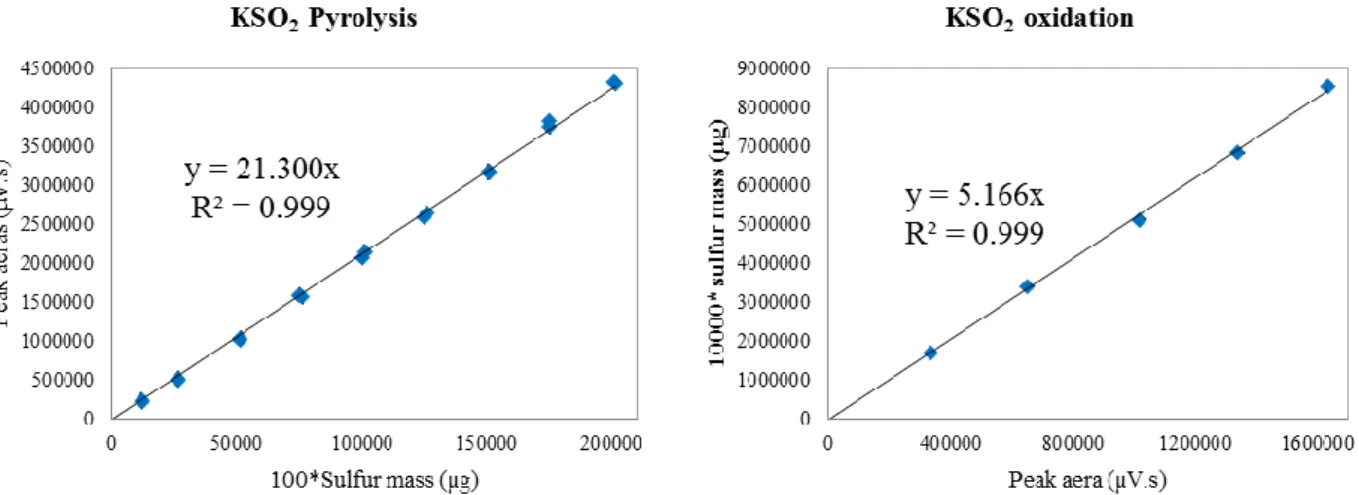
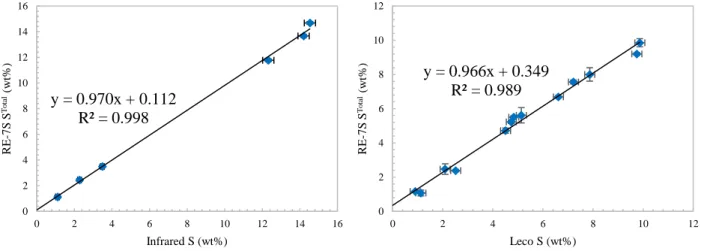
Le développement et la validation d’une nouvelle méthode de spéciation et de quantification du soufre a été nécessaire pour répondre au but principal de cette étude. Cela a consisté en plusieurs étapes. Dans un premier temps, la calibration du Rock-Eval 7S pour la quantification du soufre total (STotal) a été effectuée. Deux coefficients de calibration, KSO2-pyrolyse et KSO2-oxydation, pour chacune des phases de l'analyse Rock-Eval 7S, ont été déterminés. Les résultats obtenus avec ces nouveaux coefficients de calibration montrent que le Rock-Eval 7S fournit une quantification précise du STotal.
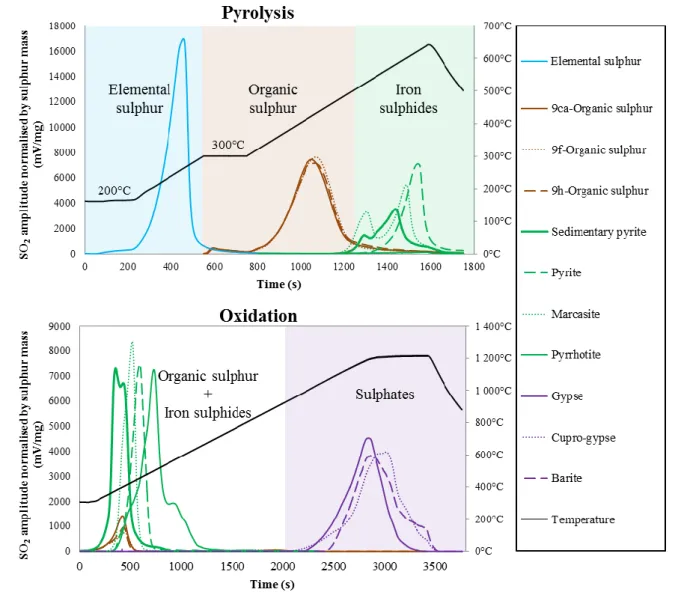
Par la suite, le signal des différentes d’espèces de soufre rencontrées dans les sédiments marins (soufre pyritique : SPyrite, soufre organique : SOrganic, sulfates : SSulphates et soufre natif : SElemental) a été caractérisé avec le Rock-Eval 7S. Chaque espèce de soufre se décompose à des gammes de températures spécifiques, à l'exception du SPyrite et du SOrganic. En effet, pendant la phase de pyrolyse, le SPyrite et le SOrganic de pyrolyse peuvent être distingués et quantifiés séparément car ils sont représentés par deux pics distincts. Cependant, pendant la phase d'oxydation, le SPyrite et le SOrganic se décomposent aux mêmes gammes de températures. Cela limite donc la quantification directe du SPyrite et du SOrganic avec le Rock-Eval 7S, qui sont deux importants paramètres pour l’étude de la préservation de la matière organique. En effet, les relations entre SPyrite et Carbone Organique Total (COT) peuvent être utilisées comme indicateurs de l'oxygénation de la colonne d’eau, un facteur environnemental important pour la préservation de la matière organique. De plus, le paramètre SOrganic renseigne sur le degré de sulfuration de la matière organique, un important mécanisme de préservation de la matière organique.
Par conséquent, une méthode pour la quantification du SPyrite et du SOrganic avec le Rock-Eval 7S a été développée. Sachant qu'avec le Rock-Eval 7S on peut quantifier le SPyrite de pyrolyse (PyrolysisSPyrite), la stratégie a donc été d'étudier la transformation thermique de la pyrite pendant la phase
VI
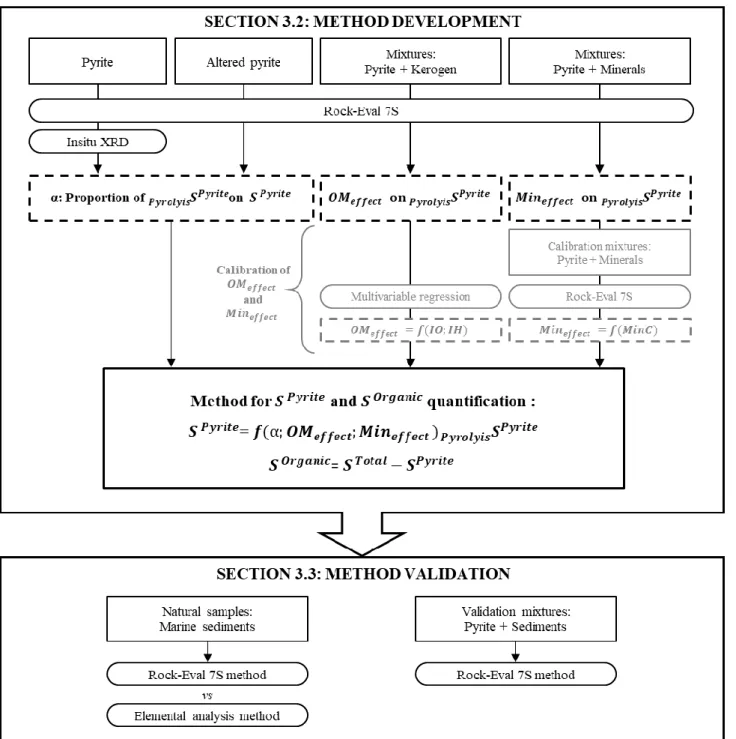
pyrolyse du Rock-Eval 7S et son interaction avec la matière organique et les minéraux communément présents dans les sédiments marins riches en organique. Le but étant d'estimer la quantité totale de SPyrite à partir du SPyrite de pyrolyse, et ensuite déduire la quantité totale de SOrganic. Les formules suivantes ont été définies pour la quantification de SPyrite et de SOrganic dans les sédiments marins riches en matière organique :
𝑆𝑃𝑦𝑟𝑖𝑡𝑒 = (1 + 𝛽 + 𝛾)
𝛼 .𝑃𝑦𝑟𝑜𝑙𝑦𝑠𝑖𝑠𝑆 𝑃𝑦𝑟𝑖𝑡𝑒
𝑆𝑂𝑟𝑔𝑎𝑛𝑖𝑐 = 𝑆𝑡𝑜𝑡𝑎𝑙−𝑆𝑃𝑦𝑟𝑖𝑡𝑒
Dans ces formules, le facteur α représente le pourcentage de SPyrite libéré pendant la phase de pyrolyse. Les facteurs β et γ sont des facteurs de correction qui visent à prendre en compte la quantité de SPyrite de pyrolyse piégée dans la matière organique et dans la matrice minérale pendant la phase de pyrolyse.
Cette nouvelle méthode Rock-Eval 7S a été validée sur une série de sédiments provenant du Grey Shale Member (Toarcien, North-Yorkshire, Royaume-Uni) et de la Kimmeridge Clay Fm. (Tithonien-Kimmeridgien, Dorset, Royaume-Uni) ainsi que sur une série de mélanges sédimentaires synthétiques avec des teneurs fixées et connues en SPyrite et SOrganic (mélanges de roches sédimentaires ne contenant que du SOrganic + pyrite). Les résultats obtenus montrent que la nouvelle méthode Rock-Eval 7S permet une quantification précise du SPyrite et du SOrganic.
La nouvelle méthode Rock-Eval 7S pour la quantification du SPyrite et du SOrganic, développée et validée dans cette étude, a ensuite été utilisée pour aider à la description de la préservation de la matière organique dans des sédiments marins. Trois sections sédimentaires ont été étudiées : la section du Dorset (Tithonien-Kimmeridgien, Kimmeridge Clay Fm), la section du North-Yorkshire (Toarcien, Grey Shale Member) et la section du Somerset (Hettangien-Sinemurien, Blue Lias Fm.). En effet, l’analyse Rock-Eval 7S d'échantillons de ces formations sédimentaires nous a permis d’obtenir de pertinents paramètres carbone et soufre, principalement le COT, le STotal, le SPyrite et le SOrganic, qui ont été utilisés comme indicateurs de conditions paléo-environnementales impactant la préservation de la matière organique tels que l’oxygénation de la colonne d’eau et le degré de sulfuration de la matière organique.
Cette méthode Rock-Eval 7S, la première méthode rapide, efficace et fiable permettant la quantification directe du SPyrite et du SOrganic en une seule analyse, offre des avantages analytiques importants : i) le cout temps d'analyse (2 heures par échantillon) ; ii) l’absence d'étapes de préparation chimique laborieuses et dangereuses en raison de l'utilisation d'acides forts ; iii) les analyses
VII
automatisées; et iv) la quantification simultanée du carbone organique/inorganique et du soufre organique/inorganique en une seule analyse.
En plus de son application dans l’étude de la préservation de la matière organique, cette nouvelle méthode Rock-Eval 7S pour la quantification du SPyrite et du SOrganic a de nombreuses autres applications potentielles. En effet, cette méthode peut fournir des données utiles pour un large éventail d'applications, telles que : (i) l'exploration et la production pétrolières, (ii) la reconstruction paléoenvironnementale et paléoclimatique, (iii) l'exploration et la production du charbon et (vi) la pollution des sols.
VIII
List of publications
Aboussou, A., Lamoureux-Var, V., Pillot, D., Kowalewski, I., Garcia, B., Wagner, T., März C. (writing in progress). Pyritic and organic sulphur quantification in organic rich marine sediments using Rock-Eval 7S.
Aboussou, A., Lamoureux-Var, V., Wagner, T., Pillot, D., Kowalewski, I., März C., Garcia, B., Doligez, B. (2018). Pyritic sulphur and organic sulphur quantification in organic rich sediment using Rock-Eval. 1st EAGE/IFPEN Conference on Sulphur Risk Management in E&P, Rueil-Malmaison, 2018.
Aboussou, A., Lamoureux-Var, V., Wagner, T., Pillot, D., Kowalewski, I., März C., Garcia, B., Doligez, B. (2018). Application of an advanced method for pyritic and organic sulphur quantification to organic rich marine sediments. 80th European Association of Geoscientists and Engineers Conference and Exhibition: EAGE, Copenhagen, 2018.
Aboussou, A., Lamoureux-Var, V., Pillot, D., Kowalewski, I., Garcia, B., Wagner, T., März C. (2018). Procédé pour la quantification du soufre pyritique et du soufre organique d’un échantillon de roche (Perfectionnement). Pending patent FR 18/56.042.
Aboussou, A., Lamoureux-Var, V., Wagner, T., Pillot, D., Buckman, J., März C., Kowalewski, I., Doligez, B., Garcia, B. (2017). Advanced sulphur speciation and quantification in marine shales: emerging perspectives from Jurassic North Yorkshire black shale. 28th International Meeting on Organic Geochemistry: IMOG, Florence, 2017.
Aboussou, A., Lamoureux-Var, V., Pillot, D., Kowalewski, I., Doligez, B., Garcia, B., Wagner, T., Buckman, J., März C. (2017). Procédé pour la quantification du soufre pyritique et du soufre organique d’un échantillon de roche. Pending patent FR 17/58.413.
Aboussou, A., Lamoureux-Var, V., Pillot, D., Letort, G., Garcia, B., D., Kowalewski, I., Doligez, B. (2016). Développement d’une méthode de spéciation et de quantification des différents composés soufrés contenus dans les roches mères marines avec un Rock-Eval 6 couplé à un système d’analyse du soufre. 3rd French Researcher in Organic Geochemistry Conference and Exhibition: FROG, Poitiers, 2016.
IX
Table of contents
Acknowledgements ... II Abstract ... III Résumé ... V List of publications ... VIII Table of contents ... IX List of figures ... XIII List of tables ... XV List of abbreviations ... XVI
Chapter 1: INTRODUCTION ... 1
1.1- POTENTIAL APPLICATIONS OF A NEW METHOD FOR PYRITIC SULPHUR AND ORGANIC SULPHUR QUANTIFICATION USING ROCK-EVAL 7S ... 3
1.1.1- Petroleum exploration and production ... 3
1.1.2- Paleoenvironmental/Paleoclimate reconstruction ... 3
1.1.3- Coal exploration and production ... 4
1.1.4- Soil pollution ... 4
1.2- OM PRESERVATION IN MARINE SEDIMENTS: THE LINK TO GEOCHEMICAL PROPERTIES OF CARBON AND SULPHUR ... 5
1.2.1- Environmental factors controlling OM preservation in marine sediments ... 5
1.2.2- Overview of the different mechanisms of OM preservation in marine environments ... 7
1.2.3- Formation of sulphur species in marine sediments ... 10
1.2.4- Geochemical properties of carbon and sulphur as descriptors of OM preservation in marine environments ... 13
1.3- ROCK-EVAL 7S ... 15
1.3.1- Rock-Eval 7S principle ... 15
1.3.2- Rock-Eval 7S sulphur speciation: state of the art ... 19
1.4- PHD OBJECTIVES ... 20
1.4.1- First objective: Developing and validating new analytical methodology on Rock-Eval 7S for sulphur quantification and speciation ... 20
1.4.2- Second objective: Using Rock-Eval 7S carbon and sulphur parameters as descriptors of OM preservation ... 20
X
2.1- INTRODUCTION ... 22
2.2- ROCK-EVAL 7S STotal CALIBRATION ... 23
2.2.1- Samples ... 23
2.2.2- Methodology ... 24
2.2.3- STotal calibration results ... 26
2.3- ROCK-EVAL 7S CHARACTERISATION OF THE MAIN TYPES OF SULPHUR SPECIES FOUND IN MARINE SEDIMENTS ... 28
2.3.1- Samples and methodology ... 28
2.3.2- Rock-Eval 7S characterisation of the main sulphur species found in marine sediments ... 32
2.4- CONCLUSIONS ... 35
Chapter 3: PYRITIC AND ORGANIC SULPHUR QUANTIFICATION IN ORGANIC RICH MARINE SEDIMENTS USING ROCK-EVAL 7S ... 36
3.1- CHAPTER INTRODUCTION ... 36
3.2- DEVELOPMENT OF A NEW METHOD FOR PYRITIC SULPHUR AND ORGANIC SULPHUR QUANTIFICATION USING ROCK-EVAL 7S ... 39
3.2.1- Introduction ... 39
3.2.2- Samples and methods ... 39
3.2.3- Results ... 43
3.2.4- Discussions ... 54
3.2.5- Conclusions ... 61
3.3- VALIDATION OF THE NEW ROCK-EVAL 7S METHODOLOGY FOR PYRITIC SULPHUR AND ORGANIC SULPHUR QUANTIFICATION ON ORGANIC RICH SEDIMENTS ... 63
3.3.1- Introduction ... 63
3.3.2- Samples and methods ... 63
3.3.3- Results and discussions ... 68
3.3.4- Conclusions ... 74
3.4- CHAPTER CONCLUSIONS ... 75
Chapter 4: APPLICATION OF ROCK-EVAL 7S TO THE DESCRIPTION OF OM PRESERVATION OF JURASSIC BLACK SHALES FROM NORTH YORKSHIRE, DORSET AND SOMERSET ... 76
4.1-INTRODUCTION ... 76
4.2- METHODOLOGY ... 78
XI
4.2.2- North Yorkshire section: Grey Shale Member ... 79
4.2.3- Somerset section: Blue Lias ... 79
4.3- ROCK EVAL 7S RESULTS ... 80
4.3.1- Dorset section: Kimmeridge Clay Formation (Appendix J and N) ... 82
4.3.2- North Yorkshire section: Grey Shale Member (Appendix J and N) ... 84
4.3.3- Somerset section: Blue Lias (Appendix J and N) ... 86
4.4- CONTRIBUTION OF NEW ROCK-EVAL 7S DATA IN THE DESCRIPTION OF OM PRESERVATION ... 89
4.4.1- Dorset section: Kimmeridge Clay Formation ... 89
4.2.2- North Yorkshire section: Grey Shale Member ... 90
4.2.3- Somerset section: Blue Lias ... 91
4.5- CONCLUSIONS ... 92
Chapter 5: SUMMARY AND OUTLOOK ... 93
5.1-SUMMARY ... 93
5.2-OUTLOOK ... 95
5.2.1- Development of Rock-Eval 7S for SPyrite and SOrganic quantification ... 95
5.2.2- Using the Rock-Eval 7S carbon and sulphur properties as descriptors of OM preservation in DIONISOS sedimentary basin model ... 95
APPENDIX ... 98
Appendix A: Rock-Eval 7S sulphur calibration (SO2 signals of Elemental sulphur and B2323 coal samples) ... 98
Appendix B: Rock-Eval 7S sulphur calibration: Determination of the KSO2 coefficients ... 100
Appendix C: Rock-Eval 7S sulphur calibration: Assessment of the calibration coefficients ... 101
Appendix D: SO2 pyrolysis sulphur signals (Altered pyrite vs Normal pyrite) ... 102
Appendix E: Rock-Eval 7S signals Type II and Type III Kerogens, Pyrite and mixtures “Pyrite + Kerogens” ... 103
Appendix F: Rock-Eval 7S results of mixture “Pure igneous pyrite + Kerogen”: Raw data ... 104
Appendix G: Rock-Eval 7S results of mixture “Pure igneous pyrite + Kerogen”: Processed data ... 106
Appendix H: Rock-Eval 7S results of mixture “Pure igneous pyrite + Mineral”... 108
Appendix I: Rock-Eval 7S CO2 signal of mixtures “Pyrite + carbonates” ... 110
Appendix J: SPyrite and SOrganic quantification using Rock-Eval 7S ... 111
Appendix K: SPyrite and SOrganic quantification using elemental analysis method ... 116
XII
Appendix M: XRD Characterisation ... 120
Appendix N: Basic Rock-Eval 7S parameters ... 122
Appendix O: Rock-Eval 7S standard deviation estimation for less than 10 analysis ... 124
XIII
List of figures
Figure 1. 1 : Conceptual biochemical and geochemical changes undergone by living OM (top) as it is preserved and condensed as kerogen (bottom). Diagram is modified from Curiale and Curtis (2016) .... 9 Figure 1. 2 : A diagrammatic representation of the principal processes allowing pyrite (green pathway) and organo-sulphur (red pathway) formation ... 12 Figure 1. 3 : Rock-Eval 7S principle using the total sulphur temperature program ... 18 Figure 1. 4 : Example of sulphur detection with Rock-Eval 7S ... 19
Figure 2. 1: Cross plot of sulphur masses and the corresponding peak areas obtained during pyrolysis and oxidation phases of Rock-Eval 7S ... 27 Figure 2. 2: Comparison of the determination of STotal contents: Rock-Eval 7S vs Infrared (Orbagnoux samples) and RE 7S vs LECO (North Yorkshire samples) ... 28 Figure 2. 3: Composite graph presenting a synthesis of Rock-Eval 7S signals of the different types of sulphur species found in marine sediments ... 34
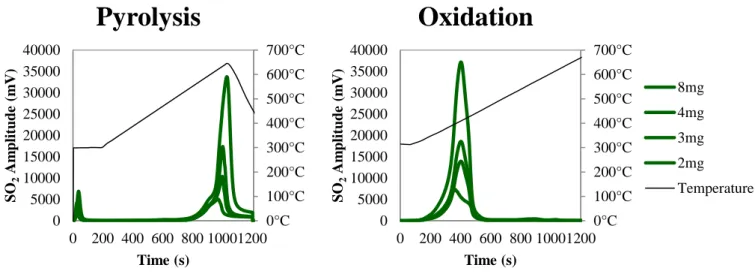
Figure 3. 1: Flow chart presenting the different sections of chapter 3 and the strategy applied in each section. (Pyrite = Pure igneous pyrite)... 38 Figure 3. 2: Rock-Eval 7S SO2 signals of different masses of pure igneous pyrite ... 43 Figure 3. 3: Rock-Eval 7S response linearity between the areas of the SO2 peak and the sample mass of pyrite ... 44 Figure 3. 4: In-situ XRD analyses of a pure igneous pyrite sample simulating the conditions created during Rock-Eval 7S analysis ... 45 Figure 3. 5: 5a) Rock-Eval 7S sulphur signals of mixtures (pure igneous pyrite + type II kerogen), of the pure igneous pyrite and of type II kerogen sample. 5b) Rock-Eval 7S sulphur signal of mixtures (pure igneous pyrite + type III kerogen), of the pure igneous pyrite and of type III kerogen sample. S. P.: sulphur peaks ... 48 Figure 3. 6: Evolution of the OMeffect in function of the Hydrogen Index (HI) and in function of the Oxygen Index (OI) ... 49 Figure 3. 7: Rock-Eval 7S sulphur signal of pyrite sample and sulphur signal of mixtures pure igneous pyrite + silicate minerals. S. P. (sulphur peaks)... 51 Figure 3. 8: Rock-Eval 7S sulphur signal of pyrite sample and sulphur signal of mixtures pure igneous “pyrite + carbonate minerals”. S. P. (sulphur peaks) ... 52
Figure 3. 9: Mineffect on the amount of PyrolysisSPyrite released during Rock-Eval 7S pyrolysis phase for each mineral ... 53
XIV
Figure 3. 10: The OMeffect obtained by the analysis of mixtures “pyrite + kerogen” vs OMeffect predicted from HI and OI ... 58 Figure 3. 11: Mineffect vs MinC calibration curves corresponding to minimal, mean and maximal
Mineffect calibration mixtures ... 60 Figure 3. 12: Comparison of Rock-Eval 7S and elemental analysis in the quantification of the STotal content of the organic rich marine sediment samples ... 69 Figure 3. 13: Comparison of Rock-Eval 7S method and elemental analysis method in the quantification of the SPyrite content of the organic rich marine sediment samples ... 70 Figure 3. 14: Comparison of Rock-Eval 7S method and elemental analysis method in the quantification of the SOrganic content of the organic rich marine sediment samples ... 70 Figure 3. 15: Comparison of Rock-Eval 7S method and elemental analysis method in the quantification of the SOrganic content of the organic rich marine sediment samples without samples presenting
misscorrélation between both method for STotal and SPyrite sulphur quantification ... 71 Figure 3. 16: Rock-Eval 7S sulphur signals of the selected sedimentary rocks from Orbagnoux Fm. (O), Phosphoria Fm. (P) and Limagne Fm. (L). S.P.: Sulphur peak ... 72 Figure 3. 17: Comparison between STotal content of the mixtures “sedimentary rocks + pyrite” obtained with Rock-Eval 7S and the expected STotal content. ... 73 Figure 3. 18: Comparison between SPyrite content of the mixtures “sedimentary rocks + pyrite” obtained with the Rock-Eval 7S method and the expected SPyrite content. ... 73 Figure 3. 19: Comparison between SOrganic content of the mixtures “sedimentary rocks + pyrite”
obtained with the Rock-Eval 7S method and the expected SOrganic content. ... 74
Figure 4. 1: HI vs IO diagram (Espitalie et al., 1986)allowing characterisation of OM type in the
different studied sections ... 81 Figure 4. 2: Rock-Eval 7S sulphur parameters vs TOC for the Dorset section. Dashed line: Normal marine C/S relationship (Berner, 1982) ... 83 Figure 4. 3: Rock-Eval 7S sulphur parameters vs TOC for the North-Yorkshire section. Dashed line: Normal marine C/S relationship (Berner, 1982) ... 85 Figure 4. 3: Rock-Eval 7S sulphur parameters vs TOC for the Somerset section. Dashed line: Normal marine C/S relationship (Berner, 1982) ... 88
XV
List of tables
Table 2. 1 : Masses of sulphur in reference samples ... 25
Table 2. 2: XRD and elemental analysis samples characterisation ... 31
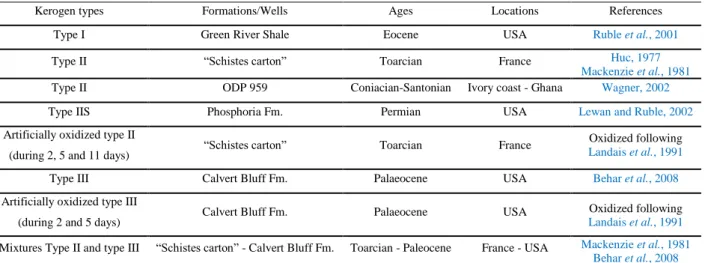
Table 3. 1: Kerogen samples used in mixtures of “pure igneous pyrite+ kerogen” ... 41
Table 3. 2: Mineral samples used in mixtures of “pure igneous pyrite+ minerals” ... 41
Table 3. 3: Rock-Eval 7S results of sulphur content of the pure igneous pyrite sample ... 45
Table 3. 4: Rock-Eval 7S results of sulphur content of the altered pyrite samples vs the unaltered pyrite sample ... 46
Table 3. 5: Basic Rock-Eval parameters of the selected samples ... 65
Table 3. 6: Sedimentary rock samples used in mixtures “sedimentary rocks + pyrite”, their weights and total sulphur contents. Pyrite weights used in the mixtures “sedimentary rocks + pyrite” and its total sulphur content. ... 66
XVI
List of abbreviations
• OM: Organic Matter
• BSR: Bacterial Sulphate Reduction • STotal: Total sulphur
• SPyrite: Pyritic sulphur • SOrganic: Organic sulphur
• PyrolysisSPyrite: Pyrolysis pyritic sulphur • OxidationSPyrite: Oxidation pyritic sulphur • PyrolysisSOrganic: Pyrolysis organic sulphur • OxidationSOrganic: Oxidation organic sulphur • OMeffect: Organic matter effect
1
Chapter 1: INTRODUCTION
A petroleum system corresponds to a sedimentary basin, or part of a sedimentary basin that typically includes different core elements: source rock; carrier system; reservoir rock; seal or cap rock; and structural or stratigraphic trap. In addition to these elements, a petroleum system is defined by the occurrence and timing of processes leading to accumulation and preservation of oil and gas in reservoir units. A better knowledge of petroleum systems is of great importance for the exploration and production of new resources, as has been shown in the discovery of many new hydrocarbon occurrences and in improved production from existing ones (Huc, 2013). Studying the origin and development of any active petroleum system, specifically the processes leading to source rock formation and evolution, is essential and fundamental for oil and gas exploration strategies.
This PhD project entitled “New Rock-Eval method for Pyritic and Organic Sulphur quantification: Application to study Organic Matter preservation in Jurassic sediments”, aims to contribute to a better understanding of source rock formation, by the use of carbon and sulphur paleo-environmental descriptors, based on the novel technology of Rock-Eval 7S, to improve the characterisation of organic matter (OM) source and preservation in Jurassic sediments. The longer-term perspective of this project is to lay the scientific foundation to apply Rock-Eval 7S carbon and sulphur parameters as routine descriptors in sedimentary basin models.
To provide the different carbon and sulphur parameters that can be used for this purpose, developing and validating a new analytical method for sulphur speciation and quantification using Rock-Eval 7S is primary required. The development of this Rock-Eval 7S method faces different challenges: (i) mineral sulphur and organic sulphur peak convolution and (ii) chemical reactions involving and modifying the original sulphur compounds. These different challenges will be addressed in this PhD project in order to establish an analytical method for mineral and organic sulphur quantification using Rock-Eval 7S.
Therefore, this PhD project has two the main targets (i) developing and validating a new analytical method on the using Rock-Eval 7S for quantifying mineral and organic sulphur in organic rich sediments and, (ii) identifying Rock-Eval 7S derived-descriptors to support the description and parameterisation of OM preservation in marine sediments.
Sulphur characterization has become essential given that the new Petroleum Exploration and Production targets which are often rich in sulphur and because of the sulphur environmental standard of
2
refining products which have become increasing drastic. Moreover, there is currently no existing laboratory instrument on the market that allows the fast quantification of both organic and mineral sulphur in a single analysis. Therefore, this PhD project provides a good framework to improve greatly the interest of the Rock-Eval 7S technology. With this perspective, the Rock-Eval 7S technology could provide fast, cost-effective and detailed characterization of organic carbon and sulphur in natural samples (shale, soils, etc.) and anthropogenic products (e.g. waste), urgently needed in the strategic investigation of fossil fuel resources (e.g. unconventionals), soil carbon stocks, and environmental pollution sites.
3
1.1- POTENTIAL APPLICATIONS OF A NEW METHOD FOR PYRITIC
SULPHUR AND ORGANIC SULPHUR QUANTIFICATION USING
ROCK-EVAL 7S
1.1.1- Petroleum exploration and production
1.1.1.1- Source rock characterisation
The new method for pyritic sulphur (SPyrite) and organic sulphur (SOrganic) quantification using Rock-Eval 7S, by specifically quantifying the amount of organically bound sulphur (SOrganic) presents in source rocks, gives important information to improve Rock-Eval source rock characterisation (Espitalie
et al., 1986; Lafargue et al., 1998; Behar et al., 2001). For instance, the SOrganic /TOC ratio can be used, in addition to the classical diagrams for characterisation of source rock kerogen type (HI vs OI or HI vs Tmax), to define type IS (Sinninghe Damsté et al., 1993), type IIS (Orr, 1986) and type IIIS (Sinninghe Damsté et al., 1992) kerogens, which are respectively lacustrine, marine and terrestrial kerogen types presenting high SOrganic /TOC ratios.
1.1.1.2- Reservoir characterisation
The new method for SPyrite and SOrganic quantification provides additional information to improve the current Rock-Eval characterisation of reservoir rocks (Espitalie et al., 1986; Lafargue et al., 1998). Indeed, by differentiating the amount of SPyrite to the amount of SOrganic, this new method contributes to characterisation of the geochemical and petrophysical attributes of conventional and unconventional reservoir rocks. This method can be helpful, for instance, in the evaluation of the risk of H2S generation, during steam or hot water injection in reservoir rocks, knowing that reactions which induce H2S generation, such as aquathermolysis and pyrite oxidation, depend on the availability of SPyrite and SOrganic in reservoirs (Hutcheon, 1998; Lamoureux-Var and Lorant, 2005).
1.1.2- Paleoenvironmental/Paleoclimate reconstruction
Sulphur concentration in sediments and its partitioning between SPyrite and SOrganic is dependent on a host of environmental variables, including dissolve sulphate concentrations, reactive iron availability, redox conditions, and OM quantity and quality (Raiswell and Berner, 1985; Raiswell et al., 1988; Canfield, 1989; Mossmann et al., 1991; Lyons and Berner, 1992; Zaback and Pratt, 1992;
4
Henneke et al., 1997; Lyons, 1997; Passier et al., 1997; Filley et al., 2002; Werne et al., 2004). And, these environmental variables, allowing SPyrite and SOrganic formation in sediments, potentially provide links with terrestrial environmental and climatic conditions (Russell and Werne, 2009; Zeng et al., 2013). Therefore, this new SPyrite and SOrganic quantification method using Rock-Eval 7S produces very useful data to support the paleoenvironment reconstruction as well as paleoclimate reconstruction. One example application of the using of the new method for SPyrite and SOrganic quantification to help paleoenvironmental reconstruction will be presented in the next chapter.
1.1.3- Coal exploration and production
Despite advances in renewable and gas resources, coal is, and will remain for the foreseeable future, a major source of energy worldwide. Indeed, in U.S., the Energy Information Administration predicts that coal will provide the majority of fuel for the generation of electricity continue up to at least 2035 (Energy Information Administration 2012, 2012).
Like all sedimentary OM, coal contains sulphur in a wide array of forms, solubility, and concentrations, SPyrite and SOrganic being the main constituents (Bauer et al., 2014). The sulphur content and its distribution represent an important parameter in the evaluation of coal resources. Indeed, depending on the way sulphur occurs in energy resources, a strong influence on the operational, environmental, and economic performance of handling and utilizing processes of coal is expected (Bauer et al., 2014). For instance, the knowledge of the sulphur species in coal is required to determine the suitability of a particular coal treatment or cleaning strategy (Machado et al., 2011). Furthermore, process issues such as fouling behaviour in the boiler, deactivation of catalysts, or promotion of high temperature corrosion of equipment may occur and are strongly related to the sulphur speciation (Speight, 2005). Therefore, extension of this new method for SPyrite and SOrganic quantification using Rock-Eval 7S for coal exploration and production will be of great importance and this will require further analytical developments.
1.1.4- Soil pollution
Soil is a prime recipient for sulphur species emitted from power plants, industrial processes, vehicular transport, domestic sources (mainly from the burning of fossil fuels), mining etc. Many sulphur species can exist in soils, including SPyrite and SOrganic (Guo et al., 2015) and they are at the
5
origin of soil acidification and pollution. For instance, pyrite in soils, and especially those at surface, exposed to atmospheric oxygen and moisture and aided by bacteria, can undergo a series of oxidation and hydrolysis reactions, which produce sulphuric acid solution and mobile metal sulphates penetrating and acidifying the soil profile (e.g. Williamson and Johnson, 1981; Kelly and Wood, 2000), with the consequent risk for groundwater sources (Burgos et al., 2013).The new method for SPyrite and SOrganic quantification using Rock-Eval 7S can be a complementary analysis to other existing analysis for characterisation of soil pollution such as ICP-OES; infrared or gas chromatographic analyses. Indeed, this new method using Rock-Eval 7S will allow rapid screening of a large number of samples, thus helping to identify the samples that are worthy of additional study. However, further analytical development improvements may be needed before the application of this new method for soil characterisation.
1.2- OM PRESERVATION IN MARINE SEDIMENTS: THE LINK TO
GEOCHEMICAL PROPERTIES OF CARBON AND SULPHUR
The principal source of OM in marine sediments is phytoplankton. Phytoplankton is composed of unicellular photosynthetic algae, including diatoms and dinoflagellates. Their chemical components are predominantly proteins (long chains of amino-acids), carbohydrates (sugars), and lipids (Baudin et
al., 2007). However, it is also possible to find OM from terrestrial sources in marine sediments, brought to the oceans by rivers and wind in either dissolved or particulate form. This terrestrial OM is mainly composed of the remains of vascular plants, pollens and spores, or degradation products from soil OM, which remains a large unknown (Baudin et al., 2007).
1.2.1- Environmental factors controlling OM preservation in marine sediments
A large part of the marine OM produced in the surface ocean is degraded by the metabolic action of bacteria and animals which transform reduced organic carbon into oxidised mineral carbon. The OM that escapes this degradation is buried and preserved in sediments. The factors governing the preservation of OM in marine sediments have been the subject of numerous decades of studies which demonstrate empirical relationships between organic carbon burial and different environmental factors (Demaison and Moore, 1980; Emerson, 1984).
Bottom water oxygen concentration is known to be one principal factor of OM preservation in sediments. Indeed, it is commonly accepted that enhanced preservation of OM in marine sediments is
6
related to deposition in anoxic/euxinic waters (Demaison and Moore, 1980; Emerson, 1984) compared to oxic waters. The oxic waters corresponding to well oxygenated waters, the anoxic waters being oxygen-depleted to non-oxygenated waters. At the far end of the redox scale are euxinic waters, representing anoxic conditions with free hydrogen sulphide (H2S) in the water column. The role of bottom water oxygenation on OM preservation can be explained by the fact that the aerobic degradation processes are known to be more efficient than the anaerobic degradation processes (Claypool and Kaplan, 1974; Baudin et al., 2007). However, some studies have not shown any clear-cut and systematic relationship between bottom water concentrations and OM preservation in marine sediments (Betts and Holland, 1991; Calvert and Pedersen, 1992; Canfield, 1994), suggesting that oxygen bottom water concentrations are not necessarily the correct metric to examine OM preservation.
Other evidence supports the conclusion that the primary production of OM in the photic zone is the key factor controlling OM accumulation in marine sediments. For instance, Calvert and Pedersen (1992) suggest that high primary production provides a first-order control on the accumulation of organic-rich facies in sediments.
The rain rate of OM has also been demonstrated to be a factor of OM preservation. Indeed, the study of seafloor recycling of OM in Santa Monica Basin in California shows that the carbon burial rates are primarily controlled by the flux of organic carbon through the water column (Jahnke, 1990).
Finally, according to Müller and Suess (1979), Betts and Holland (1991) and Canfield (1994), another main controlling factor of OM preservation is bulk sedimentation rate. For instance, Canfield (1994) showed that at high rates of deposition, such as near continental margins, little difference is found in preservation despite varying bottom-water oxygen.
A study of Hartnett et al. (1998) demonstrated that all these environmental factors (bottom-water oxygen content, primary production rate, rain rate of organic carbon, and overall sedimentation rate) influence the oxygen exposure time of OM at the seafloor adding another direct control on sedimentary organic carbon preservation. Indeed, an increase in either primary production rate or organic carbon rain rate will increase sediment oxygen demand. The consequent steepening of the oxygen gradient will lead to a shallower oxygen penetration depth and decreased oxygen exposure time. Likewise, variations in the mineral sedimentation rate will affect the rate at which material moves through the oxic horizon at/near the sediment surface, further altering oxygen exposure time. Finally, if all other factors remain constant, changes in the bottom-water oxygen concentration will affect oxygen exposure time. The correlation between these other parameters and organic carbon preservation (Jahnke, 1990; Betts and Holland, 1991; Calvert and Pedersen, 1992) probably reflects their individual influence on oxygen exposure time rather than a direct influence on organic carbon burial.
7
1.2.2- Overview of the different mechanisms of OM preservation in marine environments
1.2.2.1- Degradation-recondensation
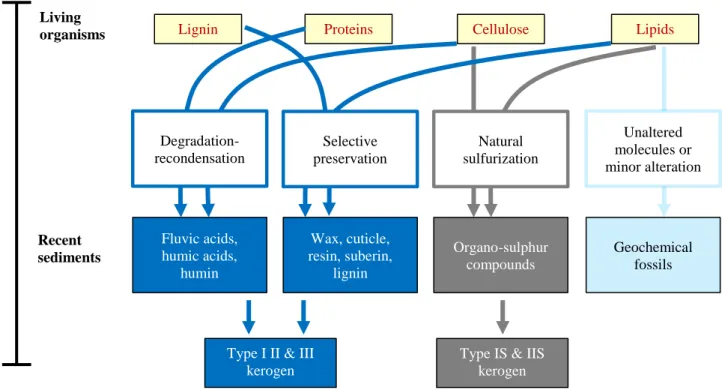
The process of degradation-recondensation of OM (Figure 1. 1) is considered to be quantitatively the principal mechanism of OM preservation (Tissot and Welte, 1978; Larter et al., 1979). It includes the degradation of biological polymers (biopolymers) such as proteins and polysaccharides (polymeric carbohydrates), leading to the production of a variety of labile biological monomers, for example amino acids, simple sugars, or fatty acids (Burdige and Gardner, 1998). These labile organic components are then recombined into more refractory compounds by complex condensation reactions. The common condensation reaction is named ‘geopolymerisation’ or ‘humification’, a general term for the process by which humic substances form. These humic substances are considered to be amorphous and hydrophilic, and refractory with respect to both chemical and biological degradation (Burdige, 2007). One well-studied example of geopolymerisation is the Maillard reaction. This reaction allows the formation of refractory compounds, known as melanoidins, by a sugar-amino acid condensation reaction (Rashid, 1985), and it has been observed that synthetic melanoidins produced in the laboratory show some similarity to marine humic substances (Frimmel et al., 1988).
1.2.2.2- Selective preservation
This term describes the selective preservation (Figure 1. 1) of part of vascular plants and algae through their production of lignins and highly aliphatic macromolecular material which is insoluble, non-hydrolyzable, and resistant to biological degradation (Leeuw and Largeau, 1993; Gelin et al., 1999). These refractory molecules include (Burdige, 2007)
❖ Algaenans: algal cell wall components consisting of long-chain aliphatic compounds with hydroxyl or ester functional groups.
❖ Cutans: nonhydrolyzable components of the cuticles of higher plants. ❖ Lignins: class of phenolic compounds found exclusively in vascular plants.
They likely represent a very small fraction of the initial biomass produced by marine and terrestrial organisms. However, as they are selectively preserved, they are concentrated in the sedimentary OM pool during diagenesis (Tegelaar et al., 1989).
8 1.2.2.3- Physical protection of OM
OM can be physically protected by both inorganic and organic matrices. It has been observed in many studies that OM is preferentially associated with fine-grained sediment particles (clay minerals) (Premuzic et al., 1982; Keil et al., 1994; Mayer, 1994). However, the role of these fine-grained sediment particles in OM preservation is not fully understood. Based on observations from different studies (Hedges and Keil, 1995; Ransom et al., 1997; Mayer, 1999; Bock and Mayer, 2000; Arnarson and Keil, 2001; Kennedy and Wagner, 2011; Kennedy et al., 2014), OM-mineral interactions appear to involve physical protection of the OM in small mesopores, either on mineral surfaces or in between mineral grains. For instance, a covariation of mineral surface area (MSA) and TOC across multiple scales of variability was observed by Kennedy and Wagner (2011) and Kennedy et al. (2014) suggesting an influence on organic carbon burial by detrital clay minerals controlled MSA. Concerning OM physical protection by organic matrix, it would occur through encapsulation of reactive OM within insoluble, hydrolysis-resistant organic matrices such as algaenans (Knicker, 2004).
In addition to that, Lalonde et al. (2012) determined, using an iron reduction method previously applied to soils, the amount of organic carbon associated with reactive iron phases in sediments of various mineralogies collected from a wide range of depositional environments. Their results suggest that associations between organic carbon and iron can promote the preservation of organic carbon in sediments.
1.2.2.4- Natural sulfurization
Natural sulfurization (Figure 1. 1), by creating sulphur-bounds between the organic molecules, leads to the formation of a sulphur rich organic residue that has a lower susceptibility to be degraded (Sinninghe Damste and Leeuw, 1990). It is the chemical process by which organo-sulphur compounds are formed through the incorporation of inorganic sulphur into functionalized lipids and carbohydrates (Aycard et al., 2003). This mechanism is enhanced in marine anoxic-euxinic environments, where the lack of oxygen leads bacteria to use dissolved sulphate (SO42-) as electron acceptor to oxidize low molecular weight organic compounds (Canfield, 1994). This process, called bacterial sulphate reduction (BSR), permits the formation of hydrogen sulphide, as illustrated in the following equation involving formaldehyde (CH2O):
2CH2O + SO42- ➔ H2S + 2HCO3- (Westrich, 1983)
Hydrogen sulphide (H2S) is the principal sulphide product of BSR, but it is possible to form other sulphides and polysulphides via the partial oxidation of this hydrogen sulphide (Vairavamurthy et
9
reacts first with iron to form iron sulphides, such as pyrite. The remaining sulphide is then incorporated into OM to form organo-sulphur compounds. In this classical view, significant sulfurization of OM can only occur if iron minerals have not reacted with all sulphides present (Tribovillard et al., 2015). A direct way of incorporation of dissolved sulphates into OM (assimilatory sulphate reduction) has also been identified. But this process is considered secondary compared to the incorporation of sulphides and polysulphides (Vairavamurthy et al., 1995).
It is interesting to note that, in certain depositional environments, sulfurization can outcompete pyrite formation. Indeed, in the uppermost surface sediments of organic-rich, sulphide-dominated marine sedimentary systems, sulfurization of labile organic compounds, such as humic acids (Francois, 1987; Ferdelman, 1988; Ferdelman et al., 1991), can precede the formation of pyrite (Mossmann et al., 1991; Vairavamurthy et al., 1992; Vairavamurthy et al., 1995; Filley et al., 2002; Werne et al., 2008; Riedinger et al., 2017).
Figure 1. 1 : Conceptual biochemical and geochemical changes undergone by living OM (top) as it is preserved and condensed as kerogen (bottom). Diagram is modified from Curiale and Curtis (2016)
Lignin Proteins Cellulose Lipids
Fluvic acids, humic acids, humin Wax, cuticle, resin, suberin, lignin
Type I II & III kerogen
Type IS & IIS kerogen Geochemical fossils Depo sit a nd dia g enesi s Living organisms Recent sediments Organo-sulphur compounds Degradation-recondensation Unaltered molecules or minor alteration Natural sulfurization Selective preservation
10
1.2.3- Formation of sulphur species in marine sediments
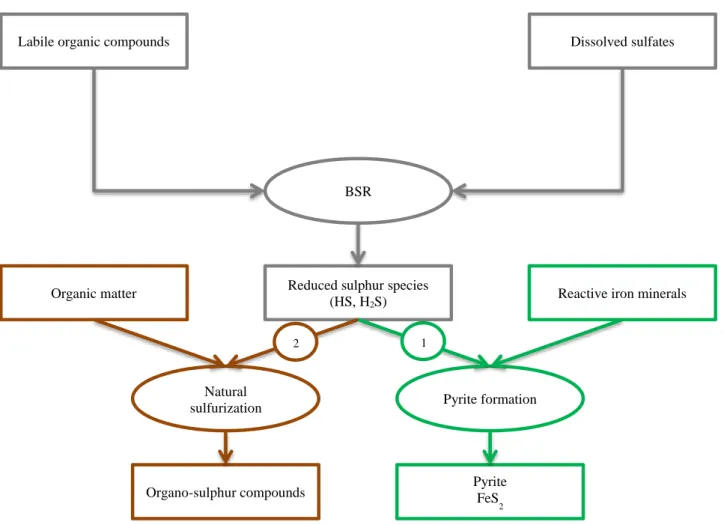
Marine sediments commonly contain solid-phase sulphur species. This is due to the fact that oceans represent one of the largest reserves of sulphur in the form of dissolved sulphate (SO42-) and the principal output of this sulphur, following a range of biogeochemical reactions or evaporation, is sedimentation (Vairavamurthy et al., 1995). Excluding sulphate minerals like gypsum that directly precipitate from evaporating seawater, two principal types of sulphur species are dominant in marine sediments, pyrite and organo-sulphur compounds, both containing sulphur in its reduced form. A diagrammatic representation of the principal processes allowing their formation is presented in Figure 1. 2.
1.2.3.1- Pyrite
Sedimentary pyrite (FeS2) forms by reaction of reduced sulphur species (HS-, H2S) with reactive iron (Berner, 1970; Vairavamurthy et al., 1995; Baudin et al., 2007). The reduced sulphur species are produced by bacterial sulphate reduction (BSR), a process which can only occur under anoxic conditions in marine waters or sediments. Due to the lack of oxygen in the environments, sulphate-reducing bacteria use dissolved sulphate as electron acceptor to oxidize low molecular weight organic compounds, releasing reduced sulphur species (HS-, H2S) (Canfield, 1994). Reactive iron or reduced iron is formed via the reduction of iron oxide principally provided from terrigenous supply to the marine environment (Berner, 1984). Two principal types of pyrite particles can be found in marine sediments, framboids and euheudral crystals (Love and Amstutz, 1966). Framboid pyrite formation is generally thought to occur through the formation of metastable iron sulphides, such as greigite (Fe3S4) and mackinawite (FeS) (Sweeney and Kaplan, 1973; Morse and Cornwell, 1987; Baudin et al., 2007; Hunger and Benning, 2007), whereas euhedral pyrite would be formed via direct precipitation (Giblin and Howarth, 1984). Pyrite formation, both framboids and euheudral crystals, occurs generally within the sediment during early diagenesis (diagenetic pyrite). Moreover, in euxinic marine basins, pyrite can also form in the water column (syngenetic pyrite) as well as below the sediment-water interface (Raiswell and Berner, 1985; Wilkin and Barnes, 1997). Syngenetic pyrite particles are characteristically smaller and less variable in size relative to diagenetic pyrite particles, reflecting shorter average growth periods due to hydrodynamic instability in the water column (Wilkin and Barnes, 1997).
Other trace metals, such as copper (Cu), lead (Pb), zinc (Zn), can co-precipitate together with iron sulphide minerals or form their own stable metal sulphides during early diagenesis (Jacobs et al., 1985; Huerta-Diaz and Morse, 1990). It is therefore possible to find in marine sediments some traces of other sulphide minerals such as chalco-pyrite (CuFeS2), galena (PbS), or sphalerite ((Zn,Fe)S).
11 1.2.3.2-Organo-sulphur compounds
The formation of organo-sulphur compounds is the second output of sulphur from the marine column water (Berner and Raiswell, 1983). This process, called natural sulfurization, occurs via two basic pathways, assimilatory and dissimilatory (Vairavamurthy et al., 1995; Werne et al., 2008).
• Assimilatory pathway:
This pathway describes the direct incorporation of dissolved sulphates into the organic matter followed by its reduction to sulphides. This assimilatory sulphate reduction is done by autotrophic organisms, for example, algae in the photic zone of the water column and chemosynthetic bacteria in hydrothermal systems. It is believed that organo-sulphur compounds formed in this way are quantitatively negligible, due principally to the fact that most of the assimilatory sulphur is contained in proteinaceaous substances, which hardly survive degradation to the later stages of diagenesis.
• Dissimilatory pathway:
This more prominent process for organo-sulphur compound formation occurs, like pyrite formation, during early diagenesis and under anoxic-euxinic conditions. This mechanism involves the reduction of dissolved sulphate via BSR. It is commonly assumed that the reduced sulphur species produced (HS-, H2S) are firstly used for pyrite formation in the presence of reactive iron minerals, and the remaining reduced sulphur species are incorporated between the organic molecules (intermolecular sulphur incorporation) and into the organic molecules (intramolecular sulphur incorporation) to form organo-sulphur compounds. However, recent works (Mossmann et al., 1991; Vairavamurthy et al., 1992; Vairavamurthy et al., 1995; Filley et al., 2002; Werne et al., 2008; Riedinger et al., 2017) have shown that the generally accepted paradigm of reactive iron minerals outcompeting organic molecules in the presence of dissolved sulphide does not necessarily hold true. As shown by Poulton et al. (2004), iron minerals have different reaction half-lives with dissolved sulphide even under ideal, experimental conditions, while some organic molecules are more susceptible to fast sulfurization than previously thought (Raven et al., 2016a).
Different molecular structures of organo-sulphur compounds are found in marine sediment kerogens (Sinninghe Damsté et al., 1988; Uteyev, 2011):
❖ Sulphides and poly-sulphides: Their formation is related to intermolecular sulfurization which corresponds to the formation of (poly-) sulphide between organic molecules.
❖ Thiols: Thiols are characterized by the presence of an R-SH functional group in their molecular
12
❖ Thiophenes: The formation of the thiophene molecular group is due to intramolecular incorporation of sulphur into a cyclic or aromatic organic molecular structure.
Figure 1. 2 : A diagrammatic representation of the principal processes allowing pyrite (green pathway) and organo-sulphur (red pathway) formation
1.2.3.3-Other sulphur species • Sulphates:
Sulphate minerals only precipitate in closed basins with a negative water balance, where water input is reduced and the evaporation rate is significant (Vairavamurthy et al., 1995). The common sulphate minerals in marine shale are gypsum (CaSO4, 2H2O) and anhydrite (CaSO4) (Jensen et al., 1998), but also barite (BaSO4). Barite is an ubiquitous sulphate mineral in marine sediments which is formed throughout the oceanic water column in association with decaying OM and biogenic debris (Dehairs et al., 1980; Bishop, 1988; Dymond et al., 1992; Arndt et al., 2009). It can also undergo diagenetic redistribution in reducing sediment columns (Von-Breymann et al., 1992; Stamatakis and Hein, 1993; Griffith and Paytan, 2012; Henkel et al., 2012). Syngenetic or diagenetic barium sulphate
Labile organic compounds Dissolved sulfates
BSR
Reduced sulphur species (HS, H2S)
Pyrite FeS
2
Reactive iron minerals Organic matter
Organo-sulphur compounds Natural
sulfurization Pyrite formation
13
can be relatively well-preserved and abundant in marine shales, and can co-occur with pyrite and organic S compounds (Baudin et al., 2007), but it is often concentrated in diagenetic fronts that can be easily recognised (Torres et al., 1996; Riedinger et al., 2006).
• Elemental sulphur:
Elemental sulphur deposits are commonly, but not invariably associated with sulphate minerals. Microbial sulphate reduction is, indeed, considered to be the key process for the precipitation of elemantal sulphur (Davis and Kirkland, 1970; Anadón et al., 1992; Peckmann et al., 1999). Elemental sulphur is not stable in most marine sediments given that it is highly transformed into sulphate or sulphide by organisms such as bacteria (Canfield and Raiswell, 1999; Philippot et al., 2007).
1.2.4- Geochemical properties of carbon and sulphur as descriptors of OM preservation in marine environments
Carbon and sulphur occurrences in marine sedimentary depositional environments can be used as indicators of paleoenvironmental conditions responsible of OM preservation in sediments. Indeed, OM preservation in marine sediments is controlled by numerous environmental factors, such as bottom-water oxygen content, primary production, rain rate of organic carbon and overall sedimentation. Carbon and sulphur relationships have proved useful in the characterisation of marine sedimentary depositional environments. For instance, a relationship between total or pyritic sulphur (S) and organic carbon (C) called “normal marine” sediments (those accumulating under oxygenated water masses) was established in numerous studies (Berner, 1970; Sweeney, 1972; Goldhaber and Kaplan, 1974; Berner, 1982). Their results show that sediments from normal oxygenated waters are characterized by a C/S ratio of 2.8. Samples presenting lower ratios (C/S< 2.8) reflect euxinic environments (Leventhal, 1983; Raiswell and Berner, 1985; Leventhal, 1987). Samples presenting much higher ratios (C/S>5) were found in non-marine freshwater sediments (Berner and Raiswell, 1984).
Many researchers have used C vs. S plots to help characterize ancient depositional environments (Anderson et al., 1987; Leventhal, 1987; Suits et al., 1993; Riboulleau et al., 2003; Rimmer et al., 2004). However, some problems have been noted in using this relationship in iron-poor rocks, such as carbonates and sandstones, where the complete sulfidization of iron may limit the total solid-phase mineral sulphide content of the rock (Berner, 1984; Pratt, 1984). Also, in rapidly accumulating organic-rich sediments, where the amount of dissolved sulphate can become exhausted and limit the formation of pyrite, a linear C vs. S relationship is not always observed (Murray et al.,
14
1978; Devol and Ahmed, 1981). Other problems in the interpretation of C vs. S can arise if the amount of metabolizable organic carbon is limited (Raiswell and Berner, 1985), OM has been lost by heating (Raiswell and Berner, 1986), or unusual water chemistry is present (Tuttle and Goldhaber, 1993).
Organic sulphur occurrences in sediments is indicator of OM sulfurization, an important OM preservation mechanism. Indeed, in marine anoxic-euxinic environments, natural sulfurization can play a significant role in organic carbon preservation (Sinninghe Damsté et al., 1988; Sinninghe Damste and Leeuw, 1990). For instance, Boussafir et al. (1995) found, using transmission electron microscopy, that sulfurization of OM does play an important role in the preservation of OM in Kimmeridge Clay Formation sediments (Dorset, UK). The impact of natural sulfurization on OM preservation has been observed by Lückge et al. (2002) who show that sulfurization of OM prevents its further decomposition in sediments from the continental margin of Pakistan. The role of natural sulfurization on OM preservation was also observed by Tribovillard et al. (2015) in their comparative study of two Jurassic sediment successions (Boulonnais, France). In this study, the enhanced OM preservation of one formation compared to a second has been attributed to differences in natural sulfurization controlled by differences in reactive iron availability. However, other studies, conducted on anoxic sediments from the Cariaco Basin (Venezuela) (Aycard et al., 2003) and on the anoxic formation from Kössen (Hungary) (Vetö et al., 2000), where natural sulfurization is enhanced, show no positive correlation between organo-sulphur compound concentrations and the preservation of OM. In these studies, the OM preservation was not essentially attributed to natural sulfurization but was attributed to the mechanism of degradation-recondensation (Aycard et al., 2003) and to high primary productivity (Vetö
et al., 2000).
Carbon and sulphur occurrences in sediments can be indicators of bottom water oxygenation, an important environmental controlling factor of OM preservation, and OM sulfurization, an important OM preservation mechanism. This requires relevant carbon and sulphur parameters, such as: Total Organic Carbon (TOC); Hydrogen Index (HI); Oxygen Index; OM maturity (Tmax); total sulphur (STotal); pyritic sulphur (SPyrite); and organic sulphur (SOrganic). These different carbon and sulphur parameters will be determined using Rock-Eval 7S, a new model of Rock-Eval technologies. Indeed, this new facility permits the analysis of sulphur species in addition to organic and inorganic carbon determination. With Rock-Eval 7S, the combined variations of carbon and sulphur parameters in rocks can be quantified rapidly (on average 2 hours) and simultaneously in a large number of samples. The Rock-Eval 7S principles are described in the following section.
15
1.3- ROCK-EVAL 7S
1.3.1- Rock-Eval 7S principle
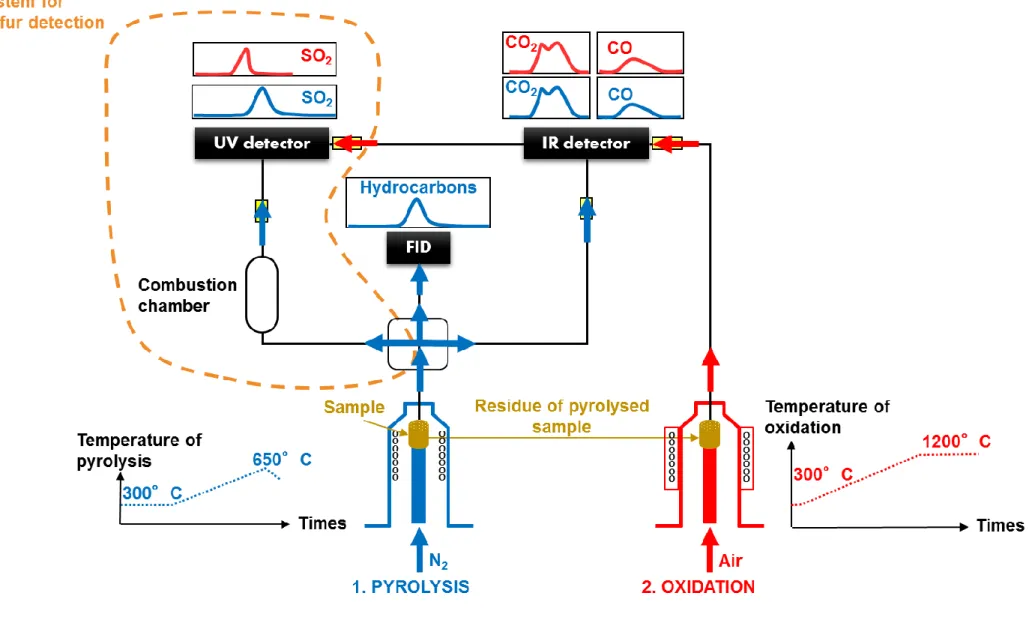
Being developed by IFP Energies nouvelles and Vinci-Technologies, the Rock-Eval 7S is the latest model of Rock-Eval technology. It has the same functionalities as the current version (Rock-Eval 6), complemented by a new system adapted for sulphur detection (Figure 1. 3). The Rock-Eval 7S method can be used on a wide range of rock and oil types, such as source rocks, reservoir rocks, recent sediments, crude oils and petroleum distillates. This analytical method can be summarized in two main stages, a pyrolysis followed by an oxidation (Figure 1. 3).
1.3.1.1- Pyrolysis stage
During the pyrolysis stage, the sample is heated under a flux of nitrogen, according to a pre-determined temperature program. The temperature can be raised from 100°C to 800°C at different heating rates, from 1°C/min to 50°C/min. The pyrolysis effluents are separated in three parts. One part is carried to a Flame Ionization Detector (FID) for the quantification of hydrocarbons. Another part is carried to an Infrared detector (IR) for the quantification of CO2 and CO. The last part passes through a combustion chamber where the reduced sulphur effluents are oxidized into SO2. This SO2 effluent is then measured by an Ultra-Violet detector (UV).
1.3.1.2- Oxidation stage
After the pyrolysis stage, the residue of the sample is transferred into an oxidation oven, where it is heated under a flux of air, following a predefined temperature program. The temperature can be raised from 100°C to 1200°C with different heating rates, from 1°C/min to 50°C/min. It is important to note that above 750°C the flux of air is replaced by a flux of nitrogen to initiate sulphate thermal degradation. The released CO and CO2 are continuously measured using the IR detector. The released sulphur effluents, being already in oxidized form (SO2), are directly recorded by the UV detector.
1.3.1.3- Rock-Eval parameters
By combining the measurement gathered during pyrolysis and oxidation, the Rock-Eval 7S provides the same peaks for carbon as the Rock-Eval 6, together with additional sulphur peaks:
16
❖ S1 and S2 (mg/g rock): The free and the potential hydrocarbons released during the pyrolysis phase.
❖ S3CO (mg/g rock): The CO from organic sources released during the pyrolysis phase.
❖ S3’CO (mg/g rock): The CO from organic and mineral sources released during the pyrolysis phase.
❖ S3CO2 (mg/g rock): The CO2 from organic sources released during the pyrolysis phase. ❖ S3’CO2 (mg/g rock): The CO2 from mineral sources released during the pyrolysis phase. ❖ SO2 pyrolysis (mg/g rock): The SO2 measured during the pyrolysis phase.
❖ S4CO (mg/g rock): The CO from organic sources released during the oxidation phase. ❖ S4CO2 (mg/g rock): The CO2 from organic sources released during the oxidation phase. ❖ S5 (mg/g rock): The CO2 from mineral sources released during the oxidation phase. ❖ SO2 oxidation (mg/g rock): The SO2 measured during the oxidation phase.
From these different signals, various parameters can be defined (Lafargue et al., 1998; Behar et
al., 2001). The main parameters are:
❖ Maturity Index (Tmax):
𝑇𝑚𝑎𝑥➔ 𝑇𝑒𝑚𝑝𝑒𝑟𝑎𝑡𝑢𝑟𝑒 𝑎𝑡 𝑡ℎ𝑒 𝑚𝑎𝑥𝑖𝑚𝑢𝑚 𝑜𝑓 𝑝𝑒𝑎𝑘 𝑆2 (°𝐶) ❖ Production Index (PI):
𝑃𝐼 = 𝑆1 (𝑆1 + 𝑆2) ❖ Hydrogen Index (HI):
𝐻𝐼 = 100 ∗ 𝑆2
𝑇𝑂𝐶 (𝑚𝑔 𝐻𝐶/𝑔 𝑇𝑂𝐶) ❖ Oxygen Index (IO):
𝑂𝐼 = [100 ∗ 𝑆3𝐶𝑂2
𝑇𝑂𝐶 ] (𝑚𝑔 𝐶𝑂2/𝑔 𝑇𝑂𝐶)
❖ Total Organic Carbon (TOC):
𝑇𝑂𝐶 = 𝑃𝐶 + 𝑅𝐶 (𝑤𝑡%) 𝑃𝐶: 𝑃𝑦𝑟𝑜𝑙𝑦𝑠𝑒𝑑 𝑜𝑟𝑔𝑎𝑛𝑖𝑐 𝐶𝑎𝑟𝑏𝑜𝑛 = [(𝑆1 + 𝑆2) ∗ 0.083] + [(𝑆3𝐶𝑂 +𝑆3′𝐶𝑂 2 ) ∗ 12 280] + [𝑆3𝐶𝑂2∗ 12 440] 𝑅𝐶: 𝑅𝑒𝑚𝑎𝑖𝑛𝑖𝑛𝑔 𝑜𝑟𝑔𝑎𝑛𝑖𝑐 𝐶𝑎𝑟𝑏𝑜𝑛 = [𝑆4𝐶𝑂2∗ 12 440] + [𝑆4𝐶𝑂 ∗ 12 280]
17 ❖ Mineral Carbon (MinC):
𝑀𝑖𝑛𝐶 = 𝑃𝑦𝑟𝑜𝑀𝑖𝑛𝐶 + 𝑂𝑥𝑖𝑀𝑖𝑛𝐶 (𝑤𝑡%) 𝑃𝑦𝑟𝑜𝑀𝑖𝑛𝐶 = [𝑆3 ’𝐶𝑂2∗ 12 440] + [ 𝑆3′𝐶𝑂 2 ∗ 12 280] 𝑂𝑥𝑖𝑀𝑖𝑛𝐶 = [𝑆5 ∗ 12 440]
18
19
1.3.2- Rock-Eval 7S sulphur speciation: state of the art
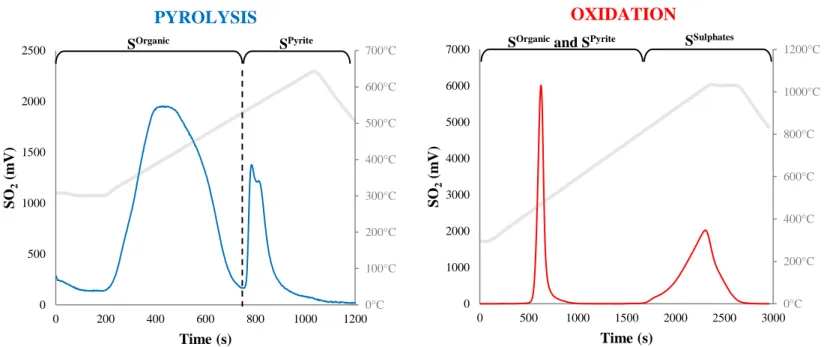
Rock-Eval 7S analysis provides two SO2 profiles as functions of temperature and time (Figure 1. 4). The first one results from the pyrolysis phase and the second one from the oxidation phase. Combining these two profiles, it is possible to quantify the STotal content of the sample. This technique allows discrimination between various sulphur compounds, such as labile sulphur released during pyrolysis and refractory sulphur released during oxidation. Figure 1. 4 is an example of the SO2 Rock-Eval 7S signal of a sample from a source rock formation in Limagne (France) where most of the sulphur compounds can be identified:
❖ SOrganic: Organic reduced sulphur;
❖ SPyrite: Inorganic reduced sulphur (sulphide minerals like pyrite); ❖ SSulphates: Inorganic oxidised sulphur (sulphates minerals like gypsum).
However, for the complete speciation of all different sulphur compounds in a sample, further improvements must be made, especially for the distinction between SOrganic and SPyrite. Indeed, concerning the SO2 signal in pyrolysis, it is possible to discriminate PyrolysisSOrganic and PyrolysisSPyrite because they generate two distinct peaks (Figure 1. 4). In contrast, in the oxidation phase, OxidationSOrganic and OxidationSPyrite are represented within the same SO2 peak (Figure 1. 4). To quantify the different type of sulphur compounds with Rock-Eval 7S, it is therefore necessary to better resolve the organic-pyritic sulphur peak in the oxidation phase.
Figure 1. 4 : Example of sulphur detection with Rock-Eval 7S
PYROLYSIS OXIDATION 0°C 100°C 200°C 300°C 400°C 500°C 600°C 700°C 0 500 1000 1500 2000 2500 0 200 400 600 800 1000 1200 SO 2 (m V) Time (s) SOrganic SPyrite 0°C 200°C 400°C 600°C 800°C 1000°C 1200°C 0 1000 2000 3000 4000 5000 6000 7000 0 500 1000 1500 2000 2500 3000 SO 2 (m V) Time (s)