RESEARCH OUTPUTS / RÉSULTATS DE RECHERCHE
Author(s) - Auteur(s) :
Publication date - Date de publication :
Permanent link - Permalien :
Rights / License - Licence de droit d’auteur :
Bibliothèque Universitaire Moretus Plantin
Institutional Repository - Research Portal
Dépôt Institutionnel - Portail de la Recherche
researchportal.unamur.be
University of Namur
Virtues and potentialities of the Fourier transform method for electronic structure calculations of 1-D periodic systems at the Hartree-Fock level and beyond
Delhalle, Joseph; Fripiat, Joseph; Harris, Frank
Published in:
International Journal of Quantum Chemistry
Publication date: 2002
Document Version
Early version, also known as pre-print
Link to publication
Citation for pulished version (HARVARD):
Delhalle, J, Fripiat, J & Harris, F 2002, 'Virtues and potentialities of the Fourier transform method for electronic structure calculations of 1-D periodic systems at the Hartree-Fock level and beyond', International Journal of Quantum Chemistry, vol. 90, pp. 1326-1333.
General rights
Copyright and moral rights for the publications made accessible in the public portal are retained by the authors and/or other copyright owners and it is a condition of accessing publications that users recognise and abide by the legal requirements associated with these rights. • Users may download and print one copy of any publication from the public portal for the purpose of private study or research. • You may not further distribute the material or use it for any profit-making activity or commercial gain
• You may freely distribute the URL identifying the publication in the public portal ? Take down policy
If you believe that this document breaches copyright please contact us providing details, and we will remove access to the work immediately and investigate your claim.
published in Int. J. Quantum Chem. Ref: International Journal of Quantum Chemistry : 90, 1326 (2002)
Virtues and potentialities of the Fourier transform method
for electronic structure calculations of 1D periodic
systems at the Hartree-Fock level and beyond.
Joseph Delhalle (a)
, Joseph G. Fripiat (b)
, Frank E. Harris (c)
(a) Laboratoire Interdisciplinaire de Spectroscopie Electronique and (b) Laboratoire de Chimie Théorique Appliquée
Facultés Universitaires Notre-Dame de la Paix Rue de Bruxelles 61, B-5000 Namur, Belgium
(c) Department of Physics, University of Utah, Salt Lake City, UT 84112 and Quantum Theory Project, University of Florida, P.O. Box 118435, Gainesville, FL 32611, USA
Abstract
A major challenge in electronic structure calculations of extended systems is to compute to appropriate accuracy the lattice sums arising in the various ab initio formalisms. Unsatisfactory convergence of all or some of these contributions can lead to such imbalance in the matrix elements that total energy, hence most stable structure, and other more sensitive properties such as force constants cannot be computed. The purpose of this paper is to point out the intrinsic virtues of the Fourier transform method for handling accurately the lattice sums arising in Hartree-Fock and many-body approaches such as MP2. The infinite chain of Be atoms, (-Be-)∞, is used to illustrate some of the points addressed in the present contribution. Even in this simple system it is seen that direct-space methods do not permit the exchange energy sum to be converged sufficiently to permit computations near the equilibrium lattice spacing. However, the Fourier transform method enables identification of the equilibrium configuration in a stable and accurate fashion.
Key words: Restricted Hartree-Fock, MP2, direct space, Fourier space, polymers, band structure, lattice summations.
Correspondence to : Joseph Delhalle e-mail: [email protected]
2
1. Introduction
With present-day experimental advances, chain-like compounds can be organized to a point where model systems with one-dimensional (1D) periodicity are appropriate. Important questions range from the interpretation of spectroscopic measurements to the design of new structures and/or organizations for which interesting properties can be calculated with the aim of engineering them in actual materials. An adequate level of theory is critical to achieve a proper description for large classes of systems. Currently the most popular method for purely theoretical calculations of the electronic structure of extended systems is density functional theory (DFT), which is relatively inexpensive, but includes electron correlation approximately and suffers from a lack of systematic ways to improve the results. In that respect, methodologies based on the Hartree-Fock theory and beyond (many-body perturbation theory, many-body Green’s functions, etc.) remain the most consistent approaches. For example, early theoretical calculations conducted at the Hartree-Fock level have predicted the possibility of getting information on the primary and secondary structures of the polymer chains forming the first layers of a substrate [1]. However, subsequent studies based on more elaborated theories have called attention to the danger of relying on the simplified model of primary ionization lines, particularly in conjugated systems, and the need to develop suitable levels of theory [2-5]. In recent works, several authors also mention that structures and properties such as band gaps or ionization potentials of extended conjugated systems require an adequate account of electron correlation, as in MP2 [6]. A. Damin et al [7], in their study on the coverage of CO on the regular MgO (001) surface, conclude that a proper description of binding energy requires dispersive contributions. These examples and others not cited here stress the need for efforts to master the points that make Hartree-Fock based methods difficult to apply.
As pointed out by Suhai et al [8], Hartree-Fock calculations on periodic systems using extended atomic basis sets are prone to numerical instabilities due to errors caused by improper lattice sum truncations. These instabilities may appear at relatively large eigenvalues (> 10-5
) of the overlap matrices and are not related to a linear dependence in the basis sets. Considerable attention has been devoted to the calculation of the classical coulomb contributions to the Fock matrix elements and efficient methods have been designed for their calculation in both the direct [9,10] and Fourier spaces [11-18]. However, Hartree-Fock exchange contributions, improperly considered as rapidly decaying with respect to the number
3
of interacting cells, can also create instability problems. The purpose of this paper is to show how sensitive the optimum lattice parameter of the chain of beryllium atoms is to the accuracy of the exchange contributions. It also stresses the fact that the Fourier transform approach provides a way to perform accurate calculations not only at the Hartree-Fock level, but also beyond.
2. The RHF LCAO Matrix Elements for Systems with 1D Periodicity
In the RHF approximation, the electronic wave function is an antisymmetrized product built from one-electron Bloch basis orbitals bp( )
k,r ,bp
( )
k,r = (2N +1) −1/ 2 ei 2πkmχp m=− N N∑
(
r− R(
p + mez)
a0)
= (2N +1)−1/2 ei2πkmχpm m= −N N∑
( )
r (1)with N → ∞ ; p and the vector Rp (in units of the cell length a0) denote the label and the
position of the atomic orbitalχpin the reference cell, k is a wave number in the range [-1/2,1/2] in units of 2π
a0
, and a0 is the cell length. The RHF orbitals ϕn
( )
k,r are of the formϕn
k,r
( )
= bp( )
k,rCpn(k)p
∑
(2)and the coefficients Cpn(k) are the eigenvectors of the Fock matrix, whose elements Fpq(k) can
be written
Fpq
( )
k = Tpq( )
k + Vpq( )
k + Jpq( )
k + Xpq( )
k . (3) Here Tpq( )
k , Vpq( )
k , Jpq( )
k and Xpq( )
k are respectively the kinetic, electron-nuclear attraction, electron-electron repulsion and exchange contributions to Fpq( )
k . Properties of the RHF wave function can be expressed in terms of its density matrixPpq
( )
k = Cpn*
n
∑
( )
k Cqn( )
k (4)where the sum is over the occupied spin orbitals. Details of the formulation are well known; a full discussion in the notation used here is in a previous paper from our group [17].
4
As briefly mentioned in the introduction, schemes have been designed in direct space to calculate Tpq
( )
k , Vpq( )
k and Jpq( )
k to satisfactory accuracy. In particular, the conditionally converging lattice summations for the electrostatic contributions to the Fock matrix elements,Vpq
( )
k + Jpq( )
k , are usually obtained with sufficient accuracy via a multipole expansion [9,10]. Attempts to implement similar expansions to accurately evaluate the exchange contributions have thus far not been successful.3. The Exchange Matrix Elements,
Xpq( ), in Direct Space
kThe purpose of this section is to give a brief account of the present situation regarding the computation of the exchange matrix elements Xpq
( )
k in direct space, and to illustrate some of the difficulties faced in minimizing the total energy of an infinite chain of beryllium atoms, (-Be-)∞, with respect to the lattice parameter a0.3.1. DIRECT SPACE CALCULATION OF Xpq
( )
kIn direct space, the exchange contributions,Xpq
( )
k , to the Fock matrix are computed directly as expressed in Eqs. (5) to (8), i.e. :Xpq
( )
k = ei 2πkm m= −∞ ∞∑
Xpq0m (5) with Xpq0m = −1 2m'= −∞ ∞∑
m ''= −∞ ∞∑
Prs0,m '−m − m'' r,s∑
⎛ ⎝ ⎜ p0m 'sm+ m''r qm⎞ ⎠ ⎟ (6) where Prs0,m '−m − m'is the finite Fourier transform of the LCAO density matrix element Prs( )
k' ,Prs0,m '−m − m'' = dk'e− i2π m'− m −m"( )k' BZ
∫
Prs( )
k' (7) and p 0 s m ' r m+ m'' q m ⎛⎝ ⎜ ⎞ ⎠ ⎟ a multicenter bielectronic integral,
p 0 s m ' r m+ m'' q m ⎛ ⎝ ⎜ ⎞ ⎠ ⎟ =
∫∫
dr1dr2χp 0* r1( )
χs m' r1( )
r1− r2 −1 χr m+m "* r 2( )
χq m r2( )
. (8) In practice, the summations over m, m' and m" run from –N to +N, where N rarely exceeds 30 because of the large computational effort required for the multicenter integrals entering the5
definition of Xpq0m. The two factors inXpq0m, Prs0,m '−m − m''and p 0 s m ' r m+ m'' q m ⎛
⎝ ⎜ ⎞ ⎠ ⎟ , each depend on the
summation index m. The ultimate convergence of the series and the resulting properties are thus determined by the decay of these two quantities as m tends to infinity. For a given m, the summations over m' and m'' converge exponentially and usually do not present numerical
difficulties. However, in p 0 s m ' r m+ m'' q m ⎛
⎝ ⎜ ⎞ ⎠ ⎟ the value of m is a measure of the separation of the
center of charge of the two distributions, and the contribution of the bielectronic integral toXpq0mdecays only as m−1. This factor alone is not sufficient for the series in Eq. (5) to converge to a finite value. Thus, the factors Prs0,m '−m − m''are crucial for the global convergence of the series. In the case of systems with fully occupied bands, the density matrix elements
Prs
0,m'− m −m ''
decay exponentially with increasing m . But the actual rate of decay depends on
the nature of the system under study and can be surprisingly slow. Situations with partially filled bands are extreme from that point of view; the Prs
0,m'− m −m ''
decrease like m−1 leading to an overall m−2convergence. This brief analysis stresses the fact that situations of slow decay are likely to induce numerical instabilities in the course of the calculations as will be seen in the case of the infinite chain of beryllium atoms, (-Be-)∞.
3.2. TOTAL ENERGY MINIMIZATION WITH RESPECT TO a0 FOR (-Be-)∞.
The calculations reported here have been carried out with the PLH program [19,20], a direct-space implementation of the RHF LCAO formalism. Since the study case will be compared in section 4 with results obtained with the Fourier approach using a prototype program (FTCHAIN) [16-18] presently limited to s-type Gaussian functions, 2p functions have been simulated by a distributed basis set of s-type functions (DSGF). Accordingly, three s-type atomic functions are centered on the Be atom using the same contraction scheme (exponents and contraction coefficients) as in the standard 3-21G basis. Each p-type orbital is represented by two identical s-type Gaussian functions symmetrically centered about the nucleus, at distances corresponding to the position of the maximum of Be 2p orbital in the 3-21G basis set (0.1304 nm) with exponent equal to 0.3 bohr-2
. In the PLH program, the Brillouin-zone integrations are carried out by a Filon procedure that adaptively refines the mesh until convergence is reached.
6
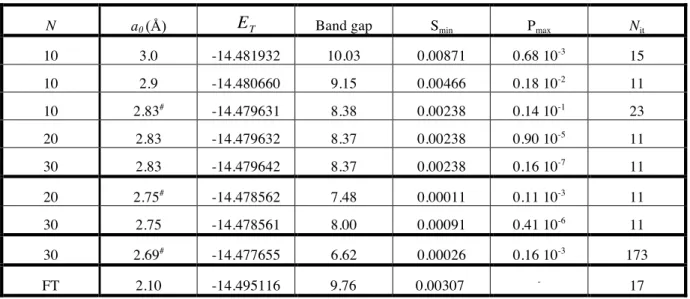
Using this basis, we attempted to find the lattice parameter a0 that minimizes the total
energy ET. Calculations were made for summation limits N=10, 20, and 30, as shown in
Table 1. At N=10, numerical instabilities made it impossible to obtain reliable results for a0 <
2.83 Å, far larger than the minimum-energy lattice parameter (at 2.10 Å, as shown by the calculations to be discussed in the next section). Increasing N to 20 enabled stable calculations to be extended only to a0 = 2.75 Å, while at N=30 we could reach a0 = 2.69 Å. It
was not possible to increase N beyond 30 because of current limits in the PLH program. Additional understanding of the source of the numerical difficulties is provided by the other data in Table 1: the band gap, the smallest eigenvalue of the overlap matrix (Smin), the
largest density matrix coefficient connecting cells 0 and N (Pmax), and the number of SCF
iterations Nit needed to reach convergence (to a threshold of ≤ 10 −6
) in the density matrix elements. Looking first at the calculations for a0=2.83 Å, the smallest a0 for which we can
compare results for N=10, 20, and 30, we note little change in Smin, while Pmax decreases
significantly as N increases. These observations indicate that the numerical problem is not linear dependence, but a lack of convergence of the lattice sums. This situation may be identified as a pseudo linear dependency. Indeed, none of the table entries for Smin is smaller
than 10-4
, while true linear dependencies, with double precision calculations, are usually diagnosed for eigenvalues of the overlap matrix smaller than 10-7 [8].
With the current version of the PLH program, it is clearly impractical to increase N until convergence can be attained at the equilibrium distance, as this would require evaluation of astronomical numbers of computationally intensive multicenter bielectronic integrals. That such a situation already arises for a deceptively simple model system, (-Be-)∞, described with a limited basis set including only moderately diffuse functions, points to the need for efficient procedures to calculate all contributions to the Fock matrix elements. Furthermore, systems with smaller band gaps and more complex unit cells than the chain of beryllium atoms constitute more difficult and more interesting challenges.
4. The Exchange Matrix Elements,
Xpq( ), in Fourier Space
kIn this section, the procedure for evaluating the Fock matrix elements in Fourier space is briefly described and results on the optimization on the beryllium chain are also provided for comparison.
7
4.1. FOURIER SPACE CALCULATION OF Xpq
( )
kIn the Fourier space approach [11-12], Xpq
( )
k assumes the form [17]Xpq
( )
k =− 1 2 dk' Prs r,s∑
( )
k' Xpsrq(
k− k';k',k)
−1/2 1/2∫
(9) where Xpsrq(
k;k',k")
= 1 πa0 dq0 q0 2 + k − n(
)
2 Sps(
k',qk− n)
Srq(
k",−qk− n)
∫
n= −∞ ∞∑
(10)with q02 = qx2+ qy2 and qk− n= q
(
x,qy,k− n)
. The generalized overlap integrals Spq( )
k,q arising in Eq. (10) are defined as:Spq
( )
k,q = dvbp * k,r( )
bq( )
k,r exp i 2π a0 q.r ⎛ ⎝ ⎜ ⎞ ⎠ ⎟∫
= exp 2(
πikm)
m=−∞ ∞∑
dvχp 0 r( )
χq m r( )
exp i2π a0 q.r ⎛ ⎝ ⎜ ⎞ ⎠ ⎟∫
= exp 2(
πikm)
m=−∞ ∞∑
Spq m q( )
(11)The Fourier transform concentrates near the origin of the q-space most of the problematic features of the exchange which can then be dealt with formally and practically. In the case of Gaussian basis sets, it is possible to develop accurate summation procedures based on a combination of the Poisson summation formula and the Ewald method.
For Bloch functions, Eq. (1), restricted to s-type atomic orbitals, the exchange terms become : Xpsrq
(
k;k',k")
= 1 πa0 Sps (x,y ) Srq (x,y ) IX(
k;k',k")
τ 0+ IX(
k;k',k")
∞ τ ⎧ ⎨ ⎪ ⎩ ⎪ ⎫ ⎬ ⎪ ⎭ ⎪ (12) with8 Ix
(
k;k',k")
τ0= 2π
3/2 exp 2πim' k'
(
)
exp 2πim"k"(
)
S(z )ps,m'Srq ,m"(z) m "
∑
m '∑
× exp 2πimk(
)
m∑
× 1 γ F0 π2 γ Gps m' − G rq m"− me z(
)
2 ⎛ ⎝ ⎜ ⎞ ⎠ ⎟ − 1 γ + τ F0 π2 γ + τ Gps m '− G rq m "− me z(
)
2 ⎛ ⎝ ⎜ ⎞ ⎠ ⎟ ⎧ ⎨ ⎪ ⎩ ⎪ ⎫ ⎬ ⎪ ⎭ ⎪ (13) and Ix(
k;k',k")
∞τ =π S(z )ps(
k',m+ k)
Srq(z )(
k",− m + k(
)
)
m∑
×exp 2πi m + k(
(
)
(
Gps,z0 − Grq,z0)
)
×K0(
γ + τ)
(
m+ k)
2,π 2 G ps,0− Grq ,0(
)
2 γ +τ(
)
⎛ ⎝ ⎜ ⎜ ⎞ ⎠ ⎟ ⎟ (14)The value of τ is chosen in such a way that the summations in Eqs. (13) and (14) converge optimally, i.e.
τ=π−γ if 0<γ ≤π
otherwise,
τ = 0
Quantities S(x,y )pq , Spq,zm , S( )pqz
( )
k,k' , γ, and Gmpq are defined as follows:S(x,y )pq = π αp +αq ⎛ ⎝ ⎜ ⎞ ⎠ ⎟ exp − αpαq αp +αq Rp,x − Rq,x
(
)
2 + R(
p,y− Rq,y)
2 ⎛ ⎝ ⎞ ⎠ a0 2 ⎛ ⎝ ⎜ ⎞ ⎠ ⎟ (15) Spq,zm = π αp +αq ⎛ ⎝ ⎜ ⎞ ⎠ ⎟ 1/ 2 exp − αpαq αp+αq Rp,z − Rq,z − m(
)
2 a02 ⎛ ⎝ ⎜ ⎞ ⎠ ⎟ (16) S( )pqz( )
k,k' = exp 2πim k + αq αp+αq k' ⎛ ⎝ ⎜ ⎞ ⎠ ⎟ ⎛ ⎝ ⎜ ⎞ ⎠ ⎟ m=−∞ ∞∑
Spq,zm (17) γ =π2 a02 1 αp +αs +α 1 r+αq ⎛ ⎝ ⎜ ⎞ ⎠ ⎟ (18)9 Gmpq=αpRp +αq
(
Rq + mez)
αp+αq = Gpq,0 + Gpq,z m ez (19)F0(x) and K0(x,y) are respectively functions related to the error function [22] and the
incomplete Bessel function [23] :
F0
( )
x = 1 2 π xerf( )
x (20) K0( )
x, y = exp −xt − y t ⎛ ⎝ ⎞ ⎠ 1 ∞∫
dtt (21)Thanks to recently developed efficient algorithms to evaluate incomplete Bessel functions
Kn
( )
x,y [24,25], new in the field of quantum chemistry, it has become possible to carry out the exchange lattice summations to great accuracy and without approximations of the kind needed in the multipole expansion.4.2. TOTAL ENERGY MINIMIZATION WITH RESPECT TO a0 FOR (-Be-)∞.
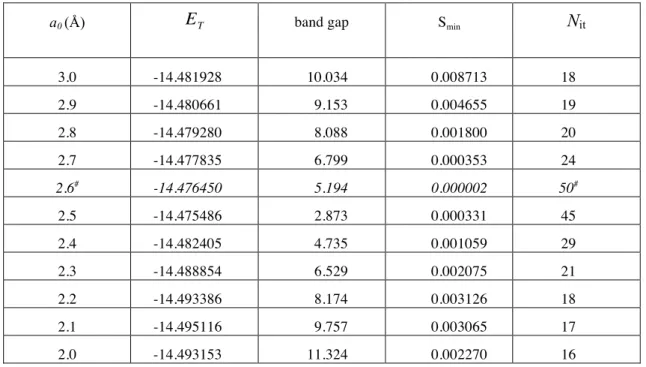
Fourier space calculations have been carried out with the FTCHAIN prototype program. We used the same basis set as in the direct-space calculations and 32 k-points of integration have been used to sum over the states in the Brillouin zone, Eq. (9). In Table 2 are listed the values of a0, ET, the band gap, Smin, the smallesteigenvalue of the overlap matrix, and Nit, the
number of SCF iterations needed to achieve convergence. From the values in Table 2, it is observed that all calculations, except at 2.6 Å, have converged for acceptable numbers of SCF iterations. The minimum in ET is attained for a0 equal to 2.10 Å, and the present results are
consistent with an earlier calculation in which we reported an energy ET =-14.487927 hartree
at a0 = 2.32 Å [21]. During the scan over the values of a0 from 3.0 to 2.0 Å, we note that Smin
attained values as small as 0.3×10⁻³without affecting the minimization process. In fact, the FTCHAIN program remains stable and yields meaningful results for Smin as small as
0.2×10⁻⁶. The basis functions simulating p orbitals have the interesting feature that they generate a near linear dependency at approximately a0 = 2.6 Å, leading to difficulty in
obtaining SCF convergence. Nevertheless, the value of ET remained close to those obtained
for the neighboring values of a0 (Table 2). This is evidence for the accuracy attained in
10
5. Möller-Plesset Many-Body Perturbation Theory (MBPT)
It is obvious that accuracy similar to that needed for RHF calculations will be required for many-body approaches such as the second-order Möller-Plesset Many-Body Perturbation Theory (MP2).
The derivation of the MP2 correction to the Restricted Hartree-Fock energy for an infinite system is available in the literature [26-28].
For a closed-shell system, the second order correction E(2) per unit cell is :
E(2) = dk1 dk2 dk4 Qij;ab T k 1,k4 + k2− k1;k2,k4
(
)
εi( )
k1 +εj(
T k(
4 + k2− k1)
)
−εa( )
k2 −εb( )
k4 ⎧ ⎨ ⎪ ⎩ ⎪ ⎫ ⎬ ⎪ ⎭ ⎪ a,b∑
i, j∑
−1/2 1/2∫
−1/2 1/2∫
−1/ 2 1/ 2∫
(22)where i, j, and a, b respectively denote occupied and unoccupied spatial orbitals. T(k) is a function that brings the variable k back to the first Brillouin zone by a translation in the reciprocal space when necessary.
The quantity Qij;abT
(
k1,k3;k2,k4)
is :Qij;abT
(
k1,k3;k2,k4)
=2 Qij;ab(
k1,k3;k2,k4)
2− Re Q(
ij;ab*(
k1,k3;k2,k4)
Qij ;ba(
k1,k3;k4,k2)
)
(23) with Qij;ab(
k1,k3;k2,k4)
= Cpi * k1( )
Crj * k3( )
Cqa( )
k2 Csb( )
k4 m3,m4= −∞ ∞∑
m2=−∞ ∞∑
r,s∑
p,q∑
× p0 q m2 r m3 s m4+m3 ⎛ ⎝ ⎜ ⎞ ⎠ ⎟ exp 2(
πi k(
2m2+ k4m4 + m3(
k4− k3)
)
)
(24)Applying the Fourier transformation,
f r
( )
[ ]
T q( )
= fT q( )
= dr f r∫
( )
exp i 2π a0 q⋅ r ⎛ ⎝ ⎜ ⎞ ⎠ ⎟ (25) to this expression and taking into account the lattice orthogonality relation,exp 2
(
πi k − q(
z)
m3)
m"=−∞ ∞∑
= δ k − q(
z− n)
n= −∞ ∞∑
(26)11 Qij;ab
(
k1,k3;k2,k4)
= 1 πa0 Cpi* k 1( )
Cqa( )
k2 Crj* k 3( )
Csb( )
k4 r,s∑
p,q∑
× dq q02 + k(
4 − k3 − n)
2(
)
Spq k2,qk 4−k3− n(
)
Srs k4,−qk 4− k3−n(
)
∫
n= −∞ ∞∑
(27)Using the same notation as for the exchange term, this becomes
Qij;ab
(
k1,k3;k2,k4)
= C*pi( )
k1 Cqa( )
k2 r,s∑
p,q∑
Crj*( )
k3 Csb( )
k4 Xpqrs(
k4 − k3;k2,k4)
(28) where the terms Xpqrs(k;k2,k4) are defined by Eq. (10).The behavior of Eq. (27) as q0 approaches zero is better understood by dividing it into two
contributions. The first contribution, Eq. (29), includes all terms in the summation over n except that for which (k4-k3-n) = 0:
Qij;ab( )I k 1,k3;k2,k4
(
)
= 1 πa0 C*pi k 1( )
Cqa( )
k2 Crj* k 3( )
Csb( )
k4 r,s∑
p,q∑
n= −∞ k4−k3− n≠ 0 ∞∑
× dq0 q02 + k 4 − k3− n(
)
2 Spq(
k2,qk4−k3−n)
Srs(
k4,−qk4− k3−n)
∫
(29)and raises no problem when q0 → 0.
The remaining term, that for which (k4-k3-n)=0, is
Qij;ab( )II
(
k1,k3;k2,k4)
= 1 πa0 Cpi * k1( )
Cqa( )
k2 Crj*( )
k3 Csb( )
k4 r,s∑
p,q∑
× dq0 q02 Spq(
k2,q0)
Srs(
k4,−q0)
∫
(30)apparently diverges as q0→ 0. However, the orthogonality condition on the canonical
polymeric orbitals contributes to remove the singular behavior.
The most important point with respect to Eqs (29) and (30) is that they exhibit forms similar to those found for exchange and, accordingly, are amenable to the same procedure for lattice summation. This forms the basis of a contribution to be published [29].
12
6. Conclusion and perspectives
The purpose of this paper is to point out that accurate calculations of the lattice sums are essential to get stable and meaningful results. Even an extremely simple system with 1D periodicity, the infinite chain of beryllium atoms treated at the 3-21G level, requires this kind of attention. In that respect, the Fourier representation method appears to be capable of handling with the necessary accuracy all the terms, including exchange and correlation corrections found in MP2, needed for stable results. At the Hartree-Fock level, it has already been shown that this method can be turned into a very effective scheme [16-18]. However, it still awaits further development before it can be proposed for general use, including implementation for atomic functions of non zero angular momentum and the MP2 option.
Acknowledgements
The calculations reported were carried out at the Namur Scientific Computing Facility with the financial support of the FNRS-FRFC, and the "Loterie Nationale" (convention n° 2.4519.97). JD acknowledges the financial support of the Belgian National Interuniversity Research Program on “quantum size effects in nanostructure materials” (IUAP n° P5/01). FEH gratefully acknowledges financial support from the U.S. National Science Foundation, grant DMR-9980015 and also the hospitality extended to him at FUNDP, Namur. JGF thanks the FNRS for a travel grant (V 3/5/121-ILF.9615, 2000-2001) which has made possible a recent stay at QTP.
References
1. Delhalle, J.; Deleuze, M. J. Mol Struct (Theochem) 1992, 261, 187 and refs therein. 2. Deleuze, M.; Denis, J.P.; Delhalle, J.; Pickup, B.T. J. Phys Chem 1993, 97, 5115. 3. Deleuze, M.; Cederbaum, L.S. Phys Rev B 1995, 53, 13326.
4. Deleuze, M. Adv Quantum Chem 1999, 35, 77 and refs. therein. 5. Sun, J.Q.; Bartlett, R.J. Phys Rev Lett 1996, 77, 3669.
6. Ayala, P.Y.; Kudin, K.N.; Scuseria, G.E. J. Chem. Phys. 2001, 115, 9698. 7. Damin, A.; Dovesi, R.; Zecchina, A.; Ugliengo, P. Surface Sci. 2001, 479, 255. 8. Suhai, S.; Bagus, P.S.; Ladik, J. Chem. Phys. Letters 1982, 68, 467.
9. Piela, L.; Delhalle, J. Int. J. Quantum Chem 1978, 13, 605.
10. Delhalle, J.; Piela, L.; Brédas, J.L.; André, J.M. Phys. Rev. B 1980, 22, 6254-6267. 11. Harris, F.E.; Monkhorst, H.J. Phys Rev B 1970, 2, 4400.
12. Harris, F.E. J. Chem Phys 1972, 56, 4422.
13. Delhalle, J.; Harris, F.E. Theor Chim Acta 1978, 48, 127. 14. Delhalle, J.; Harris, F.E. Phys Rev B 1985, 31, 6755.
15. Delhalle, J.; Cizek, J.; Flamant, I.; Calais, J.L.; Fripiat, J.G. J Chem Phys 1994, 101, 10717.
13
16. Flamant, I. Ph.D. Dissertation, Fourier Space Restricted Hartree-Fock Method for the
Electronic Structure Calculation of Stereoregular Polymers; Presses Universitaires de
Namur, University of Namur, 1998.
17. Flamant, I.; Fripiat, J.G.; Delhalle, J.; Harris, F.E. Theor Chem Acc, 2000, 104, 350. 18. Fripiat, J.G.; Flamant, I.; Harris, F.E.; Delhalle, J. Int. J. Quantum Chem 2000, 80,
856.
19. André, J. M.; Mosley, D. H. ; Champagne, B.; Delhalle, J. ; Fripiat, J. G.; Brédas, J. L.; Vanderveken, D. J. ; Vercauteren, D. P. in Methods and Techniques in
Computational Chemistry (METECC-94), Clementi, E (Ed); Stef: Cagliari, 1993; vol.
B, pp. 423-480.
20. Fripiat, J.G. ; Champagne, B.; Castet, F. ; Poulsen, T.D. ; Mosley, D.H.; Brédas, J.L. ; Bodart, V.; Delhalle, J.; Vercauteren, D.P.; André, J.M. PLH-2000, Facultés Universitaires N.D. de la Paix , B-5000 Namur, Belgium.
21. Delhalle, J.; Fripiat, J.G.; Harris, F.E. Int. J. Quantum Chem, accepted.
22. Shavitt, I. Methods in Computational Physics, Alder, B.; Fernbach, S.; Rotenberg, M. (Eds); Academic Press : New York, 1963, pp 1-45.
23. Agrest, M.N.; Maksimov, M.S. Theory of Incomplete Cylindrical Functions and their
Applications, Springer: Berlin, 1971.
24. Harris, F.E. Int J Quantum Chem 1997, 63, 913. 25. Harris, F.E. Int J Quantum Chem 1998, 70, 623.
26. Suhai S.; Ladik, J. J. Phys. C: Solid State Phys. 1982, 15, 4327. 27. Suhai, S. Phys.Rev. B 1983, 27, 3506.
28. Sun, Jun-Qiang; Bartlett, R.J. J. Chem. Phys. 1996, 104, 8553. 29. Fripiat, J.G.; Delhalle, J.; Harris, F.E. to be published.
14
Table 1: Values of the lattice parameter a0 reached during total energy minimization using the
PLH program with N interacting cells in the exchange contributions. ET (hartree); band gap
(eV); Smin, the smallest eigenvalue of the overlap matrix S(k); Pmax, the the LCAO density
matrix element of largest absolute value at cell N; and Nit, the number of iterative cycles
needed to reach convergence (10-6
).
N a0 (Å) ET Band gap Smin Pmax Nit
10 3.0 -14.481932 10.03 0.00871 0.68 10-3 15 10 2.9 -14.480660 9.15 0.00466 0.18 10-2 11 10 2.83# -14.479631 8.38 0.00238 0.14 10-1 23 20 2.83 -14.479632 8.37 0.00238 0.90 10-5 11 30 2.83 -14.479642 8.37 0.00238 0.16 10-7 11 20 2.75# -14.478562 7.48 0.00011 0.11 10-3 11 30 2.75 -14.478561 8.00 0.00091 0.41 10-6 11 30 2.69# -14.477655 6.62 0.00026 0.16 10-3 173 FT 2.10 -14.495116 9.76 0.00307 - 17
15
Table 2 : Total energy, ET (hartree), band gap (eV), the smallest overlap eigenvalue Smin, and
the number of SCF iterations Nit, as a function of the cell parameter a0 (in Å) obtained with
the FT-RHF method.
a0 (Å) ET band gap Smin Nit
3.0 -14.481928 10.034 0.008713 18 2.9 -14.480661 9.153 0.004655 19 2.8 -14.479280 8.088 0.001800 20 2.7 -14.477835 6.799 0.000353 24 2.6# -14.476450 5.194 0.000002 50# 2.5 -14.475486 2.873 0.000331 45 2.4 -14.482405 4.735 0.001059 29 2.3 -14.488854 6.529 0.002075 21 2.2 -14.493386 8.174 0.003126 18 2.1 -14.495116 9.757 0.003065 17 2.0 -14.493153 11.324 0.002270 16
# : The SCF process has not converged to 10-6
. After 50 iterations, the largest difference in density matrix elements between two iterations is 10-3