PEOPLE’S DEMOCRATIC REPUBLIC OF ALGERIA
MINISTRY OF HIGHER EDUCATION AND SCIENTIFIC RESEARCH UNIVERSITY OF DJILALI LIABES – SIDI BEL ABBES
FACULTY OF LETTERS, LANGUAGES AND ARTS DEPARTMENT OF LITERATURE AND ENGLISH
Presented by: Supervised by:
Mr. Ahmed Hichem GHEMBAZA Prof. Fewzia BEDJAOUI Jury Members:
Dr. Bel Abbas OUERRED (Prof) President (UDL Sidi Bel Abbes) Dr. Fewzia BEDJAOUI (Prof) Supervisor (UDL Sidi Bel Abbes) Dr. Mohamed MELLOUK (Prof) Internal Examiner (UDL Sidi Bel Abbes) Dr. Hafida HAMZAOUI (Prof) External Examiner (University of Tlemcen) Dr. Radia BENYELLES (MC-A) External Examiner (University of Tlemcen) Dr. Ghouti HADJOUI (MC-A) External Examiner (University of Tlemcen)
Academic Year: 2015-2016
PRAGMATICS VERSUS AFFECT IN EFL LEARNING
CONTEXT
Thesis Submitted to the Department of English in Candidacy for the Degree of Doctorat in Didactics of Specialisms
II DEDICATIONS To my dear parents To my beloved wife To my lovely children
Alaȃ Lina and Mohamed El Amine
III
ACKNOWLEDGEMENTS
I am deeply grateful to my teacher and supervisor Prof. Fewzia BEDJAOUI for her extremely invaluable assistance and guidance without which this work would not have been achieved. In addition to her distinguished patience and very sincere commitment that have accompanied her supervising contributions, I have learnt a lot from her outstanding academic works and experience, and for which I am immensely indebted.
Heartfelt thanks go to the honourable members of the jury: Prof. Bel Abbas OUERRED, Prof. Mohamed MELLOUK, Prof. Hafida HAMZAOUI, Dr. Radia BENYELLES and Dr. Ghouti HADJOUI for having accepted to read and assess my thesis. Undoubtedly, their valuable comments and suggestions will help me get more insights into my present work and future research projects as well.
I would like to express my deep gratitude to my friends Mr. Abdellah BARAKA, Dr. Djamel BENADLA, Mr. Mohamed HADJI and Prof. Iryna SEKRET whose initial encouragement and ongoing support and friendship have been quite invaluable.
Heartfelt thanks go also to my dear and lovely parents, brothers, sisters and my caring wife for their extreme and paramount support to me during the realisation of the present work.
IV
LIST OF ACCRONYMS
BC: Brown Corpus
BNC: British National Corpus CA: Corpus Approach
CC: Collins Corpus
CCP: Cross-Cultural Pragmatics
CEFRL: Common European Framework of Reference for Languages CF: Corrective Feedback
CIC: Cambridge International Corpus CLT: Communicative Language Teaching
C-MELT: Corpus of the Meetings of English Language Teachers CNP: Communication Needs Processor
COBUILD: Collins and Birmingham University International Language Database CP: Cooperative Principle
DCT: Discourse Completion Tasks DRPT: Discourse Role-Play Tasks DSAT: Discourse Self-Assessment Tasks EFL: English as a Foreign Language EM: Extrinsic Motivation
ESL: English as a Second Language ESP: English for Specific Purposes FTA: Face Threatening Acts HCC: High-Context Culture
HLT: Humanistic Language Teaching IC: Intercultural Competence
IM: Intrinsic Motivation IP: Interlanguage Pragmatics
ITE: Institut Technique d‟Enseignement JTS: Jefferson Transcription System
V LCC: Low-Context Culture
LCIE: Limerick Corpus of Irish English LCN: Longman Corpus Network LL: Language Laboratory
LLCSE: London-Lund Corpus of Spoken English LOBC: Lancaster-Oslo/ Bergen Corpus
MDCT: Multiple-choice Discourse Completion Tasks MI: Multiple Intelligences
NLP: Neuro-Linguistic Programming OCE: Oral Comprehension and Expression ODCT: Oral Discourse Completion Tasks OEC: Oxford English Corpus
RPSA: Role-Play Self-Assessments SAT: Speech Act Theory
SETT: Self- Evaluation of Teacher Talk SE: Self Esteem
ST: Small Talk
SYSE: Second Year Students of English TBLT: Task Based Language Teaching TTA: Teacher Turn Allocation
VI LISTS OF TABLES
Table 1.1: Time Allowance for the OCE Unit within the License Curricula... Table 1.2: OCE Syllabi as Designed by Teachers at the Department... of English -University of Saida
Table 1.3: Talk as Interaction: Features and Skills... Table 1.4: Talk as Transaction: Features and Skills... Table 1.5: Talk as Performance: Features and Skills... Table 1.6: Speaking Test Format... Table 1.7: EFL First Year Curriculum Subject Matters... Table 1.8: EFL Second Year Curriculum Subject Matters... Table 2.1: Display and Performance Indexes... Table 2.2: Four levels of joint action in communicative acts……… Table 2.3: Top 25 Most Frequent Words in the BNC and LCIE... Table 2.4: Ten Most Frequent 2-word, 3-word and 4-word Units in LCIE...
Results per million Words
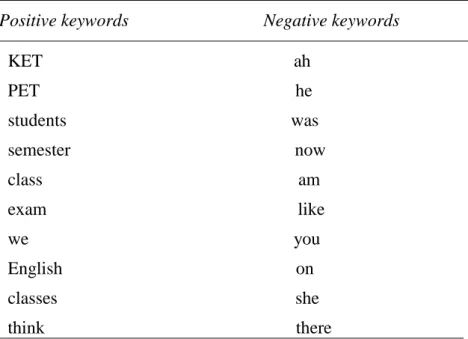
Table 2.5: Top Ten Positive and Negative Keywords when Comparing... C-MELT and LCIE
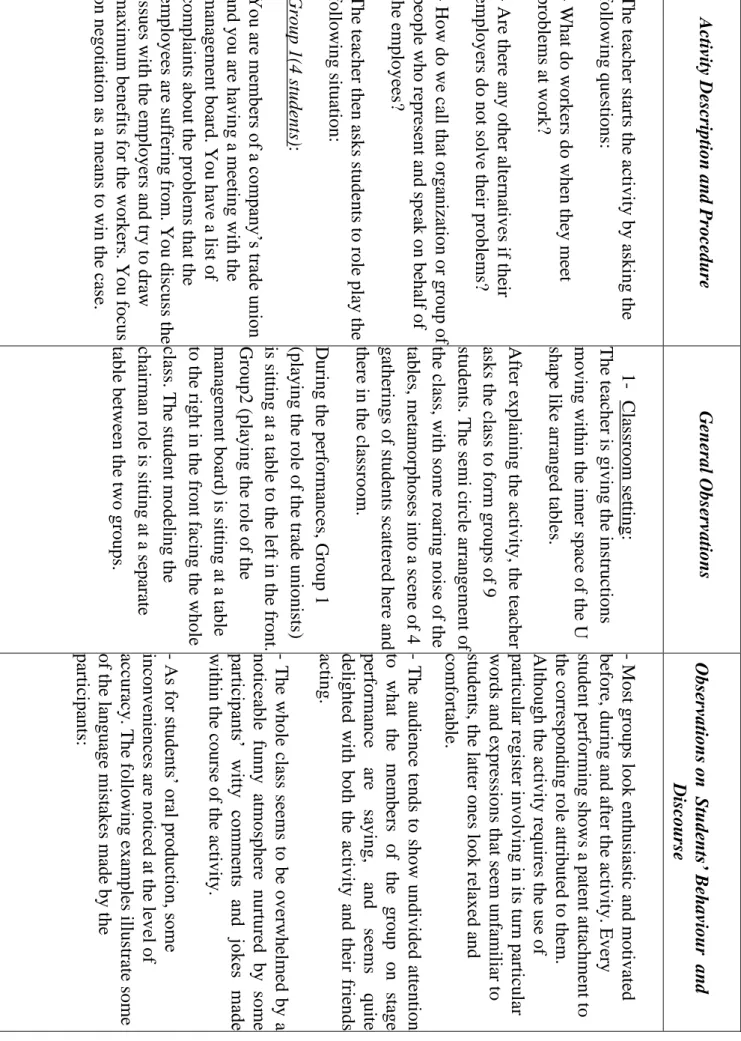
Table 4.1: The Blue Star Hotel Activity Observation Grid……….. Table 4.2: Guess which is True Activity Observation Grid………... Table 4.3: Free Topic Discussion Activity Observation Grid……….……… Table 4.4: Strategies of Apologizing ... Table 4.5: Respondents‟ Apologising Strategies Used in Each Situation... Table 4.6: Respondents‟ Preferred Apologising Strategies in the Entire DCT... Table 4.7: Strategies of Requesting... Table 4.8: Respondents‟ Preferred Requesting Strategies in the Entire DCT... Table 4.9: The Trade Union Claims Activity Observation Grid………...
13 14 19 20 21 32 40-1 42 65 66 73 74 75 141-2 144 146 148 153 154 156 161 163-4
VII
Table 4.10: Free Speech Acts Activity Observation Grid………..……. Table 4.11: Conversational Analysis Grid Based on Grice‟s CP .……….. Table 4.12: Students‟ Interactional Failures in Relation to the Gricean CP……...…… Table 4.13: Teachers‟ Perspectives on Students‟ OCE Skills... Table 4.14: OCE Teachers‟ Evaluation of their Students‟ Oral Abilities... Table 5.1: Hall‟s (1976) HCC versus LCC………..
166-7 172 173-5 179 180 219
VIII
LIST OF FIGURES
Figure 1.1: Teacher‟s Roles... Figure 1.2: Difficulty strategies in Learning Speaking... Figure 1.3: Targeted Items during a Listening Task... Figure 1.4: Three-part Listening Sequence and Corresponding Required Skills... Figure 2.1: Brown and Levinson‟s (1987) Strategies for Performing FTAs... Figure 2.2: Politeness 1 in Watts‟ (2003) Model... Figure 3.1: Causes Analysis within the Attribution Theory... Figure 3.2: Wenden‟s (1990) Classification of Attitudes... Figure 3.3: Factors Influencing Language Anxiety... Figure 3.4: Cognitive and Affective Functioning in Meaning Construction... Figure 3.5: The Affective Filter... Figure 3.6: Defining autonomy: the capacity to take control over learning... Figure 5.1: Worksheet Entry Form from the Database………. Figure 5.2: Typical Sequencing of a Task-Based Activity………..
Figure 5.3: Correlates of and views on the Term Culture………... Figure 5.4: Hall‟s (1976) Cultural Iceberg Model……….
Figure 5.5: World Cultures Classification according to Hall (1976)………... 23 33 36 37 92 95 107 109 116 120 124 131 195 198 213 215 220
IX
LIST OF DIAGRAMS
Diagram 4.1: Apologizing strategies Used in Situation 1... Diagram 4.2: Apologizing strategies Used in Situation 2... Diagram 4.3: Apologizing Strategies Used in Situation 3... Diagram 4.4: Apologizing Strategies Used in Situation 4... Diagram 4.5: Apologizing Strategies Used in Situation 5……….………… Diagram 4.6: Apologizing Strategies Used in Situation 6………..…………. Diagram 4.7: Apologizing Strategies Used in Situation 7………..
149 149 150 151 151 152 152
X
LIST OF PIE-CHARTS
Pie-chart 4.1: Request Strategies Used in Situation 1... Pie-chart 4.2: Request Strategies Used in Situation 2... Pie-chart 4.3: Request Strategies Used in Situation 3... Pie-chart 4.4: Request Strategies Used in Situation 4... Pie-chart 4.5: Request Strategies Used in Situation 5... Pie-chart 4.6: Request Strategies Used in Situation 6... Pie-chart 4.7: Request Strategies Used in Situation 7... Pie-chart 4.8: Request Strategies Used in Situation 8...
157 157 158 158 159 159 160 160
XI TABLE OF CONTENTS Dedications………. Acknowledgements……….…………. List of Acronyms...……….…………. List of Tables………... List of Figures……….………….……… List of Diagrams………..….... List of Pie-Charts………... Table of Contents……… Abstract………..………... GENERAL INTRODUCTION...
CHAPTER ONE: DESCRIPTION OF THE LEARNING/TEACHING SITUATION OF THE ORAL SKILLS AND RESEARCH METHODOLOGY 1.1 Introduction... 1.2 Learning and Teaching EFL in Algeria... 1.3 Present Oral Skills Situation at University Level... 1.3.1 The Oral Skills within LMD System... 1.3.2 OCE Unit Time Allowance... 1.3.3 Content of OCE Classes...
1.3.4 The Language Laboratory... 1.3.4.1 Comparing...
1.3.4.2 Privacy... 1.3.4.3 Individual Attention... 1.3.4.4 Learner Training... 1.3.4.5 Learner Motivation...
1.3.5 Students’ Expectations and Needs ... 1.4 Description of the Oral Skills:... 1.4.1 Speaking:... II III IV VI VIII IX X XI XX 01 10 10 12 12 13 13 15 15 15 15 15 15 16 16 17
XII 1.4.1.1 Speaking as a Skill ... 1.4.1.1.1 Clustering... 1.4.1.1.2 Redundancy... 1.4.1.1.3 Reduced Forms... 1.4.1.1.4 Performance Variables... 1.4.1.1.5 Colloquial Language... 1.4.1.1.6 Rate of Delivery... 1.4.1.1.7 Stress, Rhythm and Intonation... 1.4.1.1.8 Interaction... 1.4.1.2 Functions of Speaking... 1.4.1.2.1 Talk as Interaction... 1.4.1.2.2 Talk as Transaction... 1.4.1.2.3 Talk as Performance... 1.4.1.3 Fluency and Accuracy in Speaking... 1.4.1.4 Teacher‟s Roles... 1.4.2 Listening:... 1.4.2.1 Listening as a Skill ... 1.4.2.1.1 Listening as Comprehension... 1.4.2.1.2 Listening as Acquisition... 1.4.2.2 Types of Listening... 1.4.2.3 Listening Processes... 1.4.2.3.1 Bottom-up Processing... 1.4.2.3.2 Top-down Processing... 1.5 Teaching the Oral Skills... 1.5.1 Teaching Speaking... 1.5.1.1 Importance of Teaching Speaking... 1.5.1.2 Teacher Turn Allocation Behaviour... 1.5.1.3 Managing Classroom Life... 1.5.1.4 Evaluating Students‟ Speaking Performance... 1.5.1.5 Difficulty Strategies in Learning Speaking... 17 17 17 17 18 18 18 18 18 18 18 19 21 22 23 24 24 24 25 25 26 27 27 28 28 28 29 29 30 33
XIII
1.5.2 Teaching Listening...34
1.5.2.1 Importance of Teaching Listening...34
1.5.2.3 Students‟ Levels and Listening...35
1.5.2.4 Listening Skills and Principles...36
1.6 Research Methodology and Tools...38
1.6.1 Aim of the Study...38
1.6.2 Informants of the Study...39
1.6.2.1 Students...39
1.6.2.2 Teachers...43
1.6.3 Research Instruments………...….43
1.6.3.1 Observation……….…43
1.6.3.2 Discourse Completion Tasks………... 1.6.3.3 Audio Recorded Role Plays………....45
1.6.3.4 Teacher Questionnaire……… 1.6.4 Difficulties Encountered in the Study...46
1.7 Conclusion...47
Notes to Chapter One...49
CHAPTER TWO: A REVIEW OF PRAGMATICS IN EFL LEARNING CONTEXT 2.1 Introduction: ... 2.2 Defining Pragmatics: ... 2.3 Fields of Pragmatics:... 2.3.1 Speech Acts ... 2.3.1.1Commissive………..……… 2.3.1.2Declarative……… 2.3.1.3 Directive………...………...…….58 2.3.1.4 Representative... 2.3.1.5 Expressive………..…58 34 34 35 36 38 38 39 39 43 43 43 44 45 46 46 47 49 52 52 56 56 57 58 58 58 58
XIV 2.3.2 Implicature... 2.3.2.1 Quantity... 2.3.2.2 Quality... 2.3.2.3 Relevance... 2.3.2.4 Manner... 2.3.3 Presupposition ... 2.3.4 Reference... 2.3.5 Deixis ... 2.4 Pragmatics of Language Performance ... 2.5 Pragmatics and Corpora: ... 2.5.1 Types and Examples of Corpora:... 2.5.2 Corpus Linguistics ... 2.5.3 Corpus Linguistics and the Study of Pragmatics... 2.5.4 The Corpus Approach ... 2.5.5 Studying Pragmatics through Corpus Linguistics ... 2.5.5.1 Word Frequency Lists... 2.5.5.2 Keyword Lists...
2.6 Foreign Language Teaching and Pragmatics:... 2.7 Testing and Evaluating Pragmatic Skills: ... 2.8 Pragmatics and Culture:... 2.8.1 Pragmatic Competence and Cultural Variation:... 2.8.2 The Pragmatics of Cross-cultural Communication:... 2.8.2.1 When to Talk ... 2.8.2.2 What to Say ... 2.8.2.3 Pacing and Pausing... 2.8.2.4 Listenership... 2.8.2.5 Intonation... 2.8.2.6 Formulaicity... 2.8.2.7 Indirectness...
2.8.2.8 Cohesion and Coherence ... 58 59 59 59 59 60 61 62 63 66 67 68 69 70 71 72 74 76 79 80 80 84 84 85 86 86 87 88 88 89
XV
2.9 Pragmatics and the Notion of Politeness... 2.9.1 Politeness in Brown’s and Levinson’s (1978) Model... 2.9.1.1 Say Nothing: do not Perform the FTA... 2.9.1.2 Off Record... 2.9.1.3 Bald on Record... 2.9.1.4 Positive Politeness... 2.9.1.5 Negative Politeness... 2.9.2 Politeness in Watts’ (2003) Model... 2.10 Conclusion ... Notes to Chapter Two ...
CHAPTER THREE: AFFECTIVE CONSIDERATIONS IN EFL LEARNING AND TEACHING
3.1 Introduction………....………... 3.2 Affect in Foreign Language Learning Context…...…………....…………... 3.2.1 Why Affect?... 3.2.2Students’ Personality and Psychological Traits... 3.2.2.1 Motivation ………...…... 3.2.2.2 Attitudes ... 3.2.2.3 Self-Esteem……….……….…... 3.2.2.4 Anxiety……….….……... 3.2.2.4.1 Tolerance of Ambiguity………...…... 3.2.2.4.2 Self-Esteem………... 3.2.2.4.3 Test Anxiety………...…………... 3.2.2.4.4 Beliefs ………...………....…... 3.2.2.4.5 Risk Taking ………...………... 3.2.2.4.6 Competitiveness………..………... 3.2.2.4.7 Identity and Culture Shock………... 3.2.2.4.8 Instructor-Learner Interactions………....…………... 90 90 92 93 93 93 93 94 96 97 100 100 102 103 104 108 110 112 113 114 114 114 115 115 115 116
XVI
3.2.2.5 Extroversion/ Introversion... 3.3 Learning Styles: when Affect Meets Cognition... 3.4 On the Notion of classroom Interaction ………...…….... 3.4.1 Language Input ………...
3.4.2 Negotiation of Meaning...
3.4.3 Teacher Feedback………..…...…... 3.4.4 Affective Filter Hypothesis ………...……….…...…... 3.5 Teacher’s Affective Modelling and Strategies...……...………….…...…... 3.5.1 Affective Modelling ... 3.5.2 Reflection……....……….…...…... 3.5.3 Facilitation……....……….….…... 3.5.3.1 Initiation……….…... 3.5.3.2 Observation…………...………...…... 3.5.3.3 Response………..………...….…... 3.5.4 Autonomy Enhancement……….………... 3.6 Affect and Students Diversity...
3.7 Conclusion………...………..……...
Notes to Chapter Three...………..……….….…...
CHAPTER FOUR: STUDENTS’ PRAGMATIC COMPETENCE AND
PSYCHOLOGICAL INTERFERENCE: ANALYSIS AND INTERPRETATIONS
4.1 Introduction:... 4.2 Analysis of the OCE Observation Grids... (Pre-Pragmatic Instruction Phase)
4.2.1 Procedure... 4.2.2 Results...
4.2.2.1 The Blue Star Hotel Activity... 4.2.2.2 Guess which is True Activity... 117 118 120 121 122 122 123 124 124 125 127 128 128 129 130 132 134 135 139 139 139 140 140 143
XVII
4.2.2.3 Free Topic Discussion Activity...
4.3 Analysis of the DCT of Apologising: ... 4.3.1 Procedure... 4.3.2 Results... 4.4 Analysis of the DCT of Requesting:... 4.4.1 Procedure... 4.4.2 Results... 4.5 Analysis of the OCE Observation Grid... (Post-Pragmatic Instruction Phase)
4.5.1 Procedure... 4.5.2 Results...
4.5.2.1 The Trade Union Meeting Activity... 4.5.2.2 Free Speech Acts Activity...
4.6 Analysis of the Audio Recorded Plays:... 4.6.1 Procedure ... 4.6.2 Results... 4.7 Analysis of the Teacher Questionnaire:... 4.7.1 Procedure...
4.7.1.1 Section one: Teachers‟ Profile Information……….. 4.7.1.2 Section two: Teachers‟ Perspectives on their Students‟ ……...………… Oral Production
4.7.1.3 Section three: the Oral Skills in Relation to ... Culture and Pragmatics
4.7.1.4 Section four: Suggestions... 4.7.2 Results... 4.7.2.1 Section one... 4.7.2.2 Section two... 4.7.2.3 Section three... 4.7.2.4 Section four... 145 147 147 147 155 155 156 162 162 162 162 165 168 169 169 176 177 177 177 177 177 177 177 178 180 181
XVIII
4.8 Discussion and Interpretation of the main Results: ... 4.9 Conclusion:... Notes to Chapter Four...
CHAPTER FIVE: THE ORAL SKILLS BETWEEN PRAGMATIC AND AFFECTIVE CONCERNS: RECOMMENDATIONS AND SUGGESTIONS
5.1 Introduction... 5.2 Considerations in Teaching the Oral Skills...
5.2.1 Linguistic and Communicative Concerns... 5.2.1.1„Small Talk‟: towards an Accurate and Fluent...
Speaking Performance
5.2.1.2 Task-based Language Teaching... 5.2.2 Affective Concerns... 5.2.2.1 Motivational Instructions………...
5.2.2.2 Building up a Learning Community in the Classroom…………...
5.2.2.3 Supporting Students‟ Self-Confidence………... 5.2.2.4 Creating a Positive Classroom Climate……….
5.3 The Role of L1: towards Pragmatic Competence Development... 5.4Teaching Pragmatics in the EFL Classrooms... 5.4.1 Teachability of Pragmatics... 5.4.2 Brock and Nagasaka’s (2005) SURE Process in Teaching Pragmatics... 5.4.2.1 See……….………. 5.4.2.2 Use ………. 5.4.2.3 Review... 5.4.2.4 Experience...
5.5 Pragmatics and Cultural Awareness in the EFL Classroom... 5.5.1 The Self as Cultural………... 5.5.2 The Elements of Culture... 183 186 187 191 192 192 193 196 198 199 200 200 201 202 204 204 205 206 207 208 209 209 212 213
XIX
5.5.3 Intercultural phenomena………....…………. 5.5.4 Particular Cultures………... 5.5.5 Acquiring Strategies for Culture Learning... 5.5.5.1Conducting Topic-oriented Activity... 5.5.5.2Taking Activity Logs... 5.5.5.3 Selecting Authentic Materials... 5.5.5.4 Employing Prediction...
5.6 Designing an OCE Syllabus... 5.6.1 Stages of Syllabus Design... 5.6.1.1 Needs Analysis... 5.6.1.2 Content Specification... 5.6.1.3 Syllabus Organization... 5.6.2 ICT and Electronic Corpora in Syllabus Design………. 5.6.2.1 Presentation... 5.6.2.2 Information-Getting... 5.6.2.3Composing...
5.7 The Oral Skills: a Matter of Priority... 5.8 Conclusion... Notes to Chapter Five... GENERAL CONCLUSION………..………… BIBLIOGRAPHY………... LIST OF APPENDICES... APPENDIX 1: Discourse Completion Task of Apologising... APPENDIX 2: Discourse Completion Task of Requesting……….. APPENDIX 3: Jefferson Transcription System Notation... APPENDIX 4: Transcription of the Audio Recorded Plays... APPENDIX 5: Teachers‟ Questionnaire...
216 218 221 224 224 224 225 226 227 229 229 230 231 231 231 232 233 235 236 237 244 253 254 256 258 260 284
XX ABSTRACT
Quite fundamental to learning a foreign language is attaining appropriate aptitude to use it adequately for meaningful communicative ends. In this respect, the mastery of the oral skills is, for many learners, a prime objective to meet. As far as English as a Foreign Language (EFL) context is concerned, teaching oral communication has traditionally been a relatively challenging activity. This is because of the various individual differences and learning styles students represent on the one hand, and the complexity of the target language itself on the other hand.
The present doctoral thesis sheds lights on the dimension of pragmatics in EFL oral skills learning and teaching. The study undertaken with regard to this concern aims to analyse 2nd year students of English, University of Saida, pragmatic competence in oral comprehension and expression classes. It also attempts to explore the effects of the integration of pragmatic instructions in the oral class in relation to affective considerations. Another research issue is cast upon the very teaching practices that can enhance adequate pragmatic skills among students.
In order to address the practical issues mentioned above, the present study depends on a research methodology that stresses the deployment of observation, Discourse Completion Tasks (DCTs), audio recorded role playing and a questionnaire as main data collection instruments. Within the course of the investigating process, the researcher uses two speech acts realisation models highlighted by Azis (2012) following Blum-Kulka & Olstain (1989) and Grice‟s (1975) cooperative principle in an attempt to give some relevant scaffolding to the analysis and interpretation of the findings.
The obtained results show that 2nd year students of English exhibit a relatively inappropriate pragmatic competence with regard to speech acts formulation and conversational maxims. From another angle, the introduction of pragmatic instructions in the oral class, for a limited period, proved to foster students‟ interest and involvement but was not quite sufficient to develop their pragmatic skills. The suggestions provided in relation to these findings stress the need for integrating pragmatics teaching within the EFL curriculum in general and the oral comprehension and expression syllabus in particular. Therefore, more pertinent practices are called for especially devising classroom assignments that hinge upon the linguistic, communicative and cultural features of the target language. Yet, such pedagogical orientation emphasises sufficient exposure to the subject matter so as to help students attain optimum oral proficiency, to some extent.
1 GENERAL INTRODUCTION
Commonly thought of as an essential means of communication, language is widely portrayed as a vital tool by which people ensure and maintain social relationships within their communities whether at local level or international one. The growth of globalization then with its multifaceted features, mainly economic ones, has made the need for foreign languages learning, and in particular English, a major issue. As far as the Algerian context is concerned, English as the second foreign language (for French is the first foreign language) is taught within the national educational system through middle school and high school levels; and at the university level where both forms: General English and English for Specific Purposes (ESP) are dealt with. However, because of its growing significance in both instructive and professional areas, English has turned to become the foreign language people want to learn the most in Algeria.
Yet, one may recall the very controversial question, which has always been reiterated in relation to different pedagogical contexts, as whether or not the adopted methods and approaches to teaching English as a Foreign Language (EFL) can meet the desired learning outcomes. Teaching the oral skills then at university level, for instance, makes no exception from the very fact that strategies and techniques need to be attentively reconsidered. While the primary objective of oral language instructions is to make students able to use the target language adequately in different communicative settings, students tend to consistently exhibit limited speaking abilities even at relatively advanced stages of studies (Third Year, Master1 and Master 2). This is in spite of the fact that Oral Comprehension and Expression (OCE) unit is taught through a communicative approach which, according to many experts and practitioners, is believed to be the most adequate approach to foster students‟ skills in using the target language for conversational ends.
Undoubtedly, the notion of students‟ affectivity in EFL contexts has been given undivided attention particularly when it comes to OCE teaching. However, still deficiencies are noticed at the level of students‟ spoken discourse which tends to be relatively dysfunctional in terms of both fluency and accuracy. Yet, the mentioned communicative issues are patently noticeable in contexts where students are to use the target language in real-life like situations that require some control of social
2 conversational skills. Such a concern may raise the very question of pragmatics and EFL teaching at university level. Worth to note in this respect that English language teaching (ELT) in Algeria has traditionally been dealt with in relation to linguistic criteria relating to grammar and lexicon, and communicative ones stressing the very construct of communicative competence. Yet, little or almost no interest was cast upon the exploration of the target language pragmatic features; which can serve as a practical illustration to teach the different communicative functions of the target language in a variety of situations; and which may eventually raise students‟ awareness of how language actually operates within the three-facet dimension of speaker, interlocutor and context.
The aim of the present research paper is threefold. Firstly, it tries to investigate students‟ pragmatic competence when using the target language in OCE classes at the department of English – University of Dr. Moulay Tahar - Saida. Secondly, it attempts to discern the effects of pragmatics instructions on students‟ affect related conditions and their pragmatic skills as well. Thirdly, it seeks to pinpoint some practical OCE teaching strategies that may help develop students‟ pragmatic competence.
In essence, and being guided by the above concerns the researcher asks the following questions to orient the present research work:
1- Do 2nd year students of English have appropriate pragmatic competence when using the target language orally?
2- What would the introduction of pragmatics instructions bring to classroom interaction in OCE classes?
3- Which pedagogical practices can OCE teachers focus on so as to develop their students‟ pragmatic skills in the target language?
Within the very same flow of thoughts, the investigation and analysis process covered through the present study aims at supplying some arguments to support the following research hypotheses:
1- 2nd year students may exhibit a relatively low pragmatic competence when using the target language orally.
2- Introducing instructions in pragmatics within the OCE class may produce positive affect among students leading eventually to optimum pragmatic competence.
3 3- OCE teachers may focus on the use of authentic English language materials that stress the functional aspects of the target language in order to help students develop their pragmatic competence.
A sample of 95 students was targeted to carry out the present research work. The researcher has opted for the second year level, because at this stage students are supposed to have acquired the basic communicative skills necessary for undertaking meaningful conversational activities.
Yet, it is important to note that, within the context of the present study, investigating the sample‟s pragmatic competence is delimited to the analysis of speech acts realization and conversational maxims with reference to Austen‟s (1962) Speech Act Theory and Grice‟s (1975) Cooperative Principle respectively. The motivation behind such a delimitation orientation lies on the fact that, for the researcher, the criteria described above are not only salient elements in pragmatics studies, but also quite relevant to students‟ communicative needs in EFL instruction situations.
Therefore, and with the very purpose of collecting data as to the strategies students use to realize particular speech acts; the researcher has utilized two Discourse Completion Tasks (DCT). Yet, audio recorded role plays have served as a basic support for getting data about the same sample‟s conversational skills in relation to Grice‟s (1975) analysis model. From another parameter, an observational practice has allowed the researcher to procure more information on students‟ pragmatic skills and also their affective predispositions in particular oral assignments. OCE teachers‟ perspectives on appropriate pedagogical practices that may foster students‟ communicative, and mainly pragmatic, abilities in using the target language along with other relevant teaching concerns have been explored through a semi structured questionnaire used, as a final research tool, at the concluding phase of the investigation process.
On a more basic level, this thesis addresses the very issue of integrating specific instructions in pragmatics when teaching the oral skills. Yet, suspecting that attributing task-based speaking activities revolving around actual language use in relation to some strictly delineated contexts may trigger students‟ attitudes either positively or negatively; the researcher has devoted some room for the observation and analysis of students‟ affective behaviours mainly motivation and language anxiety. Therefore, one may say that the present thesis may reflect some degree of importance for it attempts to explore the
4 very notion of pragmatics in oral language use, on the one hand, and the relative role of students‟ psychological factors in conditioning their learning behaviour, on the other hand. The researcher expects that the present research work will offer some new practical insights into teaching the oral skills at university level in general, and help students become pragmatically competent speakers of the target language in particular. For this purpose, the present thesis is structured into five chapters the contents of which revolve around the very key-concerns of the research problematic.
Chapter One gives, through its first section, a brief overview of EFL teaching and learning in Algeria before describing the pedagogical context of OCE unit at Dr. Moulay Tahar University of Saida. In this respect, an important section covers the actual oral skills situation focussing on the subject matter within the LMD system, its time allowance, content issues, the language laboratory and students‟ needs and expectations. Another part of the chapter delineates the key characteristics of the two intertwined skills of listening and speaking and some corresponding concerns as to the teaching of the skills in question. A final section then gives room to methodological issues where a description of some related elements, like the population of the study and the various research tools, is provided.
Chapter Two encompasses a number of some relevant theoretical matters linked to the notion of pragmatics and foreign language teaching. It provides a range of definitions associated to the concept in question and delineates its related fields mainly speech acts, implicature, presupposition, reference and deixis. The chapter gives some attention to the role of language corpora in the study of pragmatics. Yet, it illustrates what a corpus is about and provides a description of the different existing types of corpora. Emphasis in this chapter is also cast upon pragmatics and foreign language teaching with reference to students‟ pragmatic competence and its two facets being pragmalinguistic and sociopragmatic competencies. Accordingly, the importance of implementing specific pragmatic instructions in the EFL class is stressed so as to reason the fact that developing students‟ communicative skills cannot be achieved through mere exposure to the target language, or sole grammatical drills which in their turn cannot lead to effective oral communication. Another section then explores some relevant practices as to testing and evaluating learners‟ pragmatic skills before describing the inextricable link between pragmatics and culture. Some details then about pragmatic competence and cultural
5 variation along with the pragmatics of cross-cultural communication are provided so as to
better understand the different criteria and principles involved in natural language use.
This theoretical chapter concludes with illustrating the relevance of politeness norms to pragmatics and language use in particular conversational contexts.
Being concerned with redressing the balance between the chapters of the present thesis, the researcher has designed a second theoretical part to cover the notion of students‟ affect in foreign language learning. Chapter three then consists of a review of the literature exploring classroom interaction and the dimension of affect in EFL teaching and learning. It highlights the very psychological aspects of the individual learner which may subsume a cluster of some relevant factors such as motivation, attitudes, anxiety, culture shock... The latter traits are believed to be reliable indicators of language learning success or failure. On a more basic level, the chapter provides, in a pedagogical context, a theoretical analysis of the triangulation between classroom interaction, learners‟ affective variables and affective teaching strategies of the oral skills.
Chapter Four, which represents the empirical part of the present study, subsumes the analytical procedures followed throughout this work to support the research problematic within this thesis. It describes a two-phase investigative process encompassing the pre-pragmatic instruction stage and the post- pragmatic instruction one. Each experimental practice is described in some details with regard to the research tools, procedure and main results. With the aim of measuring 2nd year students‟ pragmatic competence, an observational practice has been undertaken within OCE classes. In the same respect, two DCTs concerned with the acts of apologizing and requesting have been administered to the same sample. The results are presented and discussed before dealing with the second experimental phase in which a second observational study has been undertaken to measure students‟ motivation and other affective agents related to speech production. Yet, and most importantly this phase tries to investigate the effects of pragmatic instruction on the sample communicative competence development. Therefore, an extra research instrument being audio recorded role-playing has been utilized to collect more relevant data as to the same concern. The chapter covers also the teachers‟ perspectives on effective practices related to fostering EFL students‟ pragmatic abilities within the OCE context. A semi-structured questionnaire then has been used and the main results shown and discussed.
6 On the basis of the main findings explored in Chapter Four and the theoretical supports covered in Chapters Two and Three, and with regard to the research questions and hypotheses, the final chapter deals with a range of some remedial practices related to teaching the oral skills at university level. The recommendations and suggestions that this chapter provides are concerned with six main dimensions that have fundamental implications for the context of the present study. These subsume linguistic competence development, students‟ psychological conditions and affective teaching strategies, the role of L1 and pragmatic competence development, cultural awareness raising instructions, OCE syllabus design within ICTs (Information and Communication Technologies) perspectives and sequencing within the oral skills instruction process.
As far as developing students‟ linguistic competence is concerned, the researcher offers some practical strategies like „small talk‘ and Task-based Language Teaching (TBLT) that may help improve students‟ speech accuracy level. Affective modelling and strategies dealing with learners‟ motivation and classroom environment, for instance, are illustrated and given some attention with the very purpose of reasoning the fact that affect is an important element which needs to be given full consideration in the practice of foreign language teaching and learning. Enhancing OCE students‟ pragmatic skills, being the core matter of the present research work, is extensively explored through reconsidering the use of L1 in the foreign language classroom. Yet, more emphasis is put on other practical strategies, as covering the teachability of pragmatics and in particular the SURE (See, Use, Review and Experience) steps in developing students‟ pragmatic awareness. Considerable room, however, is given to teaching culture in the EFL class as part of the pragmatic instructing process. Some speaking assignments then related to issues like high/low context culture and intercultural understanding and communication are clearly delineated. Finally, Chapter Five points to the importance of carefully respecting some norms and criteria, notably while designing an OCE syllabus. Students‟ needs analysis, content specification and organization then are stressed in this respect. Last, but not least, the advantages of integrating ICT and specific electronic corpora in syllabus design are illustrated before explaining why it would be a good teaching orientation to delay the practice of speaking at early stages and encourage in lieu of it more listening assignment. The conclusion tries to open new avenues of research as this theme has nurtured debateful issues on language learning and teaching.
CHAPTER ONE:
DESCRIPTION OF THE LEARNING/TEACHING SITUATION
OF THE ORAL SKILLS AND RESEARCH METHODOLOGY
7
CHAPTER ONE
DESCRIPTION OF THE LEARNING/TEACHING SITUATION OF THE ORAL SKILLS AND RESEARCH METHODOLOGY
1.1 Introduction... 1.2 Learning and Teaching EFL in Algeria... 1.3 Present Oral Skills Situation at University Level... 1.3.1 The Oral Skills within LMD System...
1.3.2 OCE Unit Time Allowance... 1.3.3 Content of OCE Classes... 1.3.4 The Language Laboratory... 1.3.4.1 Comparing...
1.3.4.2 Privacy... 1.3.4.3 Individual Attention... 1.3.4.4 Learner Training... 1.3.4.5 Learner Motivation...
1.3.5 Students’ Expectations and Needs ... 1.4 Description of the Oral Skills... 1.4.1 Speaking... 1.4.1.1 Speaking as a Skill ... 1.4.1.1.1 Clustering... 1.4.1.1.2 Redundancy... 1.4.1.1.3 Reduced Forms... 1.4.1.1.4 Performance Variables... 1.4.1.1.5 Colloquial Language... 1.4.1.1.6 Rate of Delivery... 1.4.1.1.7 Stress, Rhythm and Intonation... 1.4.1.1.8 Interaction... 1.4.1.2 Functions of Speaking... 1.4.1.2.1 Talk as Interaction... 1.4.1.2.2 Talk as Transaction... 1.4.1.2.3 Talk as Performance... 10 10 12 12 13 13 15 15 15 15 15 15 16 16 17 17 17 17 17 18 18 18 18 18 18 18 19
8 1.4.1.3 Fluency and Accuracy in Speaking... 1.4.1.4 Teacher‟s Roles... 1.4.2 Listening... 1.4.2.1 Listening as a Skill ... 1.4.2.1.1 Listening as Comprehension... 1.4.2.1.2 Listening as Acquisition... 1.4.2.2 Types of Listening... 1.4.2.3 Listening Processes... 1.4.2.3.1 Bottom-up Processing... 1.4.2.3.2 Top-down Processing... 1.5 Teaching the Oral Skills... 1.5.1 Teaching Speaking... 1.5.1.1 Importance of Teaching Speaking... 1.5.1.2 Teacher Turn Allocation Behaviour... 1.5.1.3 Managing Classroom Life... 1.5.1.4 Evaluating Students‟ Speaking Performance... 1.5.1.5 Difficulty Strategies in Learning Speaking...
1.5.2 Teaching Listening... 1.5.2.1 Importance of Teaching Listening... 1.5.2.3 Students‟ Levels and Listening... 1.5.2.4 Listening Skills and Principles...
1.6 Research Methodology and Tools... 1.6.1 Aim of the Study... 1.6.2 Informants of the Study... 1.6.2.1 Students...
1.6.2.2 Teachers...
1.6.3 Research Instruments………. 1.6.3.1 Observation……….
1.6.3.2 Discourse Completion Tasks………. 1.6.3.3 Audio Recorded Role Plays………... 1.6.3.4 Teacher Questionnaire……….
1.6.4 Difficulties Encountered in the Study... 21 22 23 24 24 24 25 25 26 27 27 28 28 28 29 29 30 33 34 34 35 36 38 38 39 39 43 43 43 44 45 46
9 1.7 Conclusion... Notes to Chapter One...
46 47
10 CHAPTER ONE
DESCRIPTION OF THE LEARNING/TEACHING SITUATION OF THE ORAL SKILLS AND RESEARCH METHODOLOGY
1.1 Introduction:
EFL teaching and learning perspectives within the newly introduced LMD system constitute some of the raising controversies as far as curricula and teaching objectives are concerned. Oral Comprehension and Expression (OCE) unit, which is the core of this section, is an important field of study where many pedagogical practices and facts are to be reconsidered. The present chapter then analyses the general situation of the oral skills giving attention to both teachers‟ and learners‟ roles in a time of widespread renewal and change of approaches, objectives and teaching/ learning materials.
The researcher provides first a brief review of the teaching and learning of EFL in Algeria before tackling a second point which explores a descriptive account of the present situation of the oral skills at Saida University – Department of English. As for the OCE, being part of the Fundamental Unit in the third and fourth semester of second year English curriculum, a description of the speaking and listening skills is provided in a third section focussing on their different facets within the EFL learning and teaching process. Definitions and delineations then of main terms and concepts as to both listening and speaking are explored in relation to pedagogical dimensions. The final part of the chapter is devoted to describing some methodological concerns related to the present research work. It covers the main aim of the study, the sample and the research instruments along with other related issues.
1.2 Learning and Teaching EFL in Algeria:
Undoubtedly English language has gained recently undivided attention and prolific interest among people in the whole world. Some want to learn the language to speak it and so communicate effectively within the target language community. Others want to learn it because of professional ends especially when working in a multilingual and multicultural business environment. Some other individuals are attracted by the language and desire to study it just because they enjoy speaking and understanding it.
11 As far as Algeria is concerned, the introduction of English language dates to the 1960s where it was first included in middle school educational curricula. Miscellaneous approaches then and techniques have been used with the very aim of reaching optimum educational results. More attention then was given to English teacher training programmes starting from the ITE (Institut Technique d‟Enseignement) where focus was on middle and secondary school teaching practices.
Yet, the ITE did not last for a long time and teacher training has become one of the major issues and objectives of the Algerian university. Within both the recently faded classical system and the newly introduced LMD system teacher training has always witnessed entirely challenging concerns as to pedagogical practices and students‟ learning outcome.
Worth to mention however, that students may exhibit different learning objectives that are determined by what they want to achieve once they master the language. Many students then want to study English for a Specific Purpose (ESP) where the focus of study is on medical or business English or any other technical language register. ESP is taught at different university levels as part of a given discipline‟s curriculum as it is the case with law, medicine, electronics, mechanics, business...etc.
English for Academic Purposes (EAP) is another field of interest that attracts students who want to study the language in order to register in an English speaking university or college or to deal with English-language academic texts as suggested by Harmer (2010). Yet, EAP in Algeria is not as highly demanded and focused on as ESP or General English because of the escalating growth of globalisation which is making of the world a huge open stock market of job opportunities. In this respect, the mastery of technical English is thought to be one of the most effective intellectual keys for success.
Worth to note, however, that EFL is not taught and learned only in state schools and universities. Starting from 2001 private language schools (1) in Algeria have become an important setting where many people register for classes of general English and mainly business or technical English. Yet, what is important to be observed is that the private language schools in question are better equipped than state ones and even some universities. In addition to the reduced number of learners per class and the use of highly sophisticated materials, some of these private schools offer native English speaking
12 teachers-tuition whether be it for small group learning or one-to-one sessions; and this is for many learners considered to be sufficiently motivating.
Yet, private schools delineation is not the core matter in this chapter. Focus is rather on EFL teaching and learning at university level and in particular the teaching of the oral skills which is indeed one of the facets of the research problematic of the present study. The next section then offers a review of some relevant issues related to teaching the listening and speaking skills along with some considerations as to their implementation and role in the learning teaching process.
1.3 Present Oral Skills Situation at University Level:
It has become an axiomatic fact that almost all foreign language learners tend to be interested in learning the oral skills. This is because they believe that the mastery of any language lays first on the mastery of the oral abilities of both reception and production being listening and speaking respectively. As far as university context is concerned, curricula designers seem to pay undivided attention to the skills in question. Yet, deficiencies as to time allowance and content issues are quite noticeable to language teaching practitioners especially within the newly introduced LMD era.
1.3.1 The Oral Skills within LMD System:
With the progressive fade of the classical system, EFL curricula have witnessed considerable changes in terms of syllabi design and objectives. Credits, pedagogical units and continuous evaluation along with other new concerns have built up the different facets of the LMD system. Some skills which used to be taught in separate syllabi, like those of listening and speaking, are being now dealt with in one distinct unit, as it is the case of OCE.
As far as the mentioned subject matter is concerned, students are supposed to practise listening in S1 then speaking in S2; then again in S3, S4, S5 and S6 in the same alternate process.
13 1.3.2 OCE Unit Time Allowance:
As mentioned previously above, the OCE as part of the Fundamental Unit (2) is designed for the learning of the oral skills of listening and speaking. Such practical matter is dealt with starting from the first year, which covers S1 and S2, and concluded in the third year covering S5 and S6. As for the OCE time allowance for each semester, a slight difference is to be observed as shown on the table below:
First Year Second Year Third Year S1 S2 S3 S4 S5 S6 T ime A llotted f or e ach S es sion per W ee k 1h 30 1h 30 1h 30 1h 30 1h 30 1h 30 1h 30 1h 30 1h 30 1h 30 1h30 T otal per W ee k
3 hours 4h 30 3 hours 3 hours 1h 30 1h 30
Table 1.1: Time Allowance for OCE within the License Curricula
The table above demonstrates the allotted time to OCE during licence instruction phase. It is important to notice then the derisory time allotted to OCE which does not permit at all to reach the teaching objectives planned in the syllabi, nor does it help students meet their needs and expectations.
1.3.3 Content of OCE Classes:
Although no official common syllabi are designed to approach the teaching of the oral skills, most if not all teachers of OCE agree on some relevant common ground. Different techniques and methods then are used in classes to deal with different oral tasks the content of which varies from a level to another as displayed in the following table:
14 Table 1.2: OCE Syllabi as Designed by Teachers at the Department of English - University of Saida
This table shows the unofficially designed OCE syllabi for 1st year and 2nd year levels.
Contents of the OCE Subject Matter
F ir st Y ear S1 Listening: -Introducing people
-Studying abroad (University setting) -Travelling abroad (Airport setting) -Natural catastrophes
-Holidays
-Western cultural aspects (Traditions, habits and Christmas Day)
S2
Speaking: -Retelling jokes
-Retelling personnel stories -Keyword dialogues -Showing directions
-Card-swapping discussion -Guess the mime
-Team guessing games -Dialogue role playing
Se co nd Y ear S3 Listening:
-News from the BBC (Video projection)
-Documentaries from the BBC (Video projection) -Talk shows from the BBC (Video projection) Speaking:
-Dialogue role playing - Debates
-Topic discussion -Proverbs interpretation
-For or against the motion debates -Presentations (Free topics )
S4
Speaking: Performing plays
15 1.3.4 The Language Laboratory:
An important teaching material designed for FL streams at the Faculty of Letters, Languages and Arts (University of Dr. Moulay Tahar- Saida) is the language laboratory (LL) The use of such technological teaching aid allows students to benefit from a native-speaking exposure to the target language, which in its turn contributes to enhance the development of students‟ both receptive and productive skills.
Students of English, starting from the first year, have the opportunity to study listening and phonetics modules in the LL, a requirement which offers them many advantages portrayed by Harmer (2001) through the following elements:
1.3.4.1 Comparing:
Using audio tracks and headphones helps students compare their utterances with the correct pronunciation provided in the audio passages. Such comparison can raise students‟ awareness of both the phonological and phonetic systems of the English language.
1.3.4.2 Privacy:
The LL can grant a kind of privacy to students since everyone is connected to their headphones, microphones and computers and can work without being distracted by what other students are doing.
1.3.4.3 Individual Attention:
Sometimes speaking individually to a particular student on the part of the teacher may create negative attitudes on other students. Yet, in a laboratory such problem can be avoided: the teacher can give individual instructions or attention using the computer console.
1.3.4.4 Learner Training:
The teacher can train their students notice the different features of spoken English through listening to native speaking audio passages. The teacher‟s role in this phase consists of helping and assisting students with low listening abilities. Such a practice may foster optimum listening and speaking abilities.
1.3.4.5 Learner Motivation:
As far as students‟ motivation and autonomy are concerned, the LL is reported to be a favourite environment for learners who prefer working on their own. The teacher‟s guidance and control are present, though (Harmer, 2001).
16 Yet, while the use of the LL at the Faculty of Letters, Languages and Arts has become the source of intrinsic motivation for most EFL students, the limited number of seats available opposed to the overcrowded classes may turn it to a source of de-motivation and frustration. Thus, it seems to be quite necessary to reconsider both time allowance and grouping criteria when designing instructions for language classes.
1.3.5 Students’ Expectations and Needs:
Learners‟ needs and expectations are relevant elements that contribute, to a great extent, in the teaching/learning process. According to Chan (2001) learners often tend to be aware of their own abilities and weaknesses and know what language skills they need to learn the most.
A growing body of interest in studying EFL, on the part of Baccalaureate holders, has become widely felt during the last 15 years. What is attention-catching is the fact that many students studying for preparing a particular degree in specific streams like engineering, medicine, politics, history and so on tend to pursue, at the same time, studies for the preparation of a Licence of English degree.
Such a desire to study English is interpreted by students themselves as the necessity to master the language that without which diplomas cannot serve to achieve optimum objectives for the long term. As far as EFL students are concerned, the same motivation behind studying English is expressed, thing which can give us an idea about their actual needs and expectations which may be interpreted as an instrumental orientation, a type of motivation, in learning English.
As it will be mentioned in details later in Chapter 3, developing optimum proficiency level in speaking English is one of the most important needs pointed to by students. Besides, an awareness of the importance of technology in the learning/teaching process can be noticed among students who stress the necessity of implementing more technological means as main pedagogical supports.
1.4 Description of the Oral Skills:
The present part of the chapter aims at describing some relevant aspects and characteristics of the oral skills which subsume the active process of oral production and, the conventionally supposed to be the passive process of listening.
17 1.4.1 Speaking:
1.4.1.1 Speaking as a Skill:
In FL learning context learners give more attention to the speaking skill, which they consider the gauge of their English proficiency level. Preparing foreign language learners to use the target language in an appropriate way is quite a difficult task. Knowledge about a language does not mean actual ability to use it. If our students learn some of the grammatical rules of English, or even a wide range of vocabulary, the task of oral production still remains challenging. Students need to know how to use that knowledge to produce sentences and adapt them to different speech situations and contexts. They need to learn the skills of oral expression.
As pointed to by Harmer (2001) the spoken production of language requires a number of elements. The most important ones are:
- Connected Speech which includes assimilation, elision, contraction and linking.
- Expressive devices which consist of the use of changing pitch and stress of utterances, modifying the speed and volume and employing some non-verbal means like body gestures and facial expressions to show how the speaker feels.
- Negotiation Language which subsumes a range of expression by which the individual speaker seeks for clarification while listening to someone talking. It also covers a number of phrases with which the speaker can structure their discourse in order to be understood by the listeners especially when giving a presentation.
We must point out to a relative difficulty of the speaking skill that we can attribute to the following characteristics of the spoken discourse:
1.4.1.1.1 Clustering:
Fluent speech production is done through phrasing and not by a word- by- word utterance.
1.4.1.1.2 Redundancy:
Learners tend to have recourse to the redundant aspect of language in an attempt to convey clearer messages.
1.4.1.1.3 Reduced Forms:
The teaching of some phonetic aspects of spoken English such as elisions, reduced vowels, contractions, etc…represents some difficulties to students. Students who are not acquainted with colloquial contractions are reported to develop a mediocre
18 quality of speaking mainly characterised by an unnatural and bookish style
(Brown, 2000). 1.4.1.1.4 Performance Variables:
An important aspect of the target language is hesitation phenomena. Speaking is often accompanied with the use of fillers like uh, um, well, you know, etc…
1.4.1.1.5 Colloquial Language:
Students are also to practise and be aware of the different features of colloquial language mainly words, idioms and phrases.
1.4.1.1.6 Rate of Delivery:
It is the speed with which the fluent speech is delivered. 1.4.1.1.7 Stress, Rhythm and Intonation:
As far as the English pronunciation is concerned, stress; rhythm and intonation play an important role in conveying particular messages.
1.4.1.1.8 Interaction:
The creativity of conversational negotiation can not take place without the element of interaction.
Teaching conversation, then, requires not only instructions in language knowledge but also instructions in skill development. It is worth noting, however, that knowledge and skill are two distinct elements of conversation. While knowledge can be learned through memorization, only a skill can be acquired through imitation and practice, Martin Bygate (1988).
1.4.1.2 Functions of Speaking:
As an oral medium of communication, speaking subsumes a number of functions that cover different features and skills. Richards (2006) describes three main functions of speaking: talk as interaction, talk as transaction and talk as performance (3).
1.4.1.2.1 Talk as interaction:
It refers to people‟s everyday conversations which serve social functions. Exchanging greetings, engaging in small talks, recounting personal recent experiences etc…are what individual speakers do with the main aim of being friendly and establishing “a comfortable zone of interaction with others” (Richards, 2006). What counts here is the way speakers wish to present themselves to each other and not the message they want to convey. Such social interactive activity can be casual or formal according to the pragmatic
19 contexts the individual speakers are in. Talk as interaction encompasses different features and skills illustrated in the following table:
Talk as Interaction
Features Skills
- Has a primarily social function - Reflects role relationships - Reflects the speaker‟s identity - May be formal or casual
- Uses conversational conventions - Reflects degrees of politeness - Employs many generic words - Uses conversational register - Is jointly constructed
- Opening and closing conversations - Choosing topics
- Making small-talk
- Recounting personal incidents and experiences
- Turn-taking
- Using adjacency-pairs - Interrupting
- Reacting to others
Table 1.3: Talk as Interaction: Features and Skills (Adapted from Richards: 2006)
The table above displays the different features and skills of talk as interaction.
1.4.1.2.2 Talk as transaction:
It stands for the content of the message the individual speakers convey to each other. The central focus here is the message of the speech and the extent to which the speaker is accurate and understood, and not the social interactive work of individuals. Talk as transactions encompasses two main types: one being contexts in which information are given and received without paying attention to accuracy as far as the content of what is said is understood (asking for directions in the street for instance). The second type
20 consists of talks through which individuals wish to obtain services or goods (exp: checking in a hotel). Talk as transaction covers different features and skills illustrated in the following table and it will be interesting to deal with these particularities to some extent in the chapter devoted to the analysis of the corpora.
Talk as Transaction Features Skills
- It has a primarily information focus
- The main focus is the message and not the participants
- Participants employ
communication strategies to make themselves understood - Possible use of frequent questions, repetitions and comprehension checks
- There may be negotiation and digression
- Linguistic accuracy is not always important
- Explaining a need or intention - Describing something - Asking questions - Confirming information - Justifying an opinion - Making suggestions - Clarifying understanding - Making comparisons - Agreeing and disagreeing
Table 1.4: Talk as Transaction: Features and Skills (Adapted from Richards: 2006)
21 1.4.1.2.3 Talk as performance:
It consists of talk through which an individual speaker delivers information before a particular audience (speeches, presentations, giving a lecture, giving reports, conducting a class debate etc…). It is worth to mention, however, that a talk as a performance is closer to written language than conversational one, and is evaluated on the basis of its effectiveness and impact it leaves on the audience taking into account, in addition to meaning, both form and accuracy which are emphasised on more than in the case of talk as interaction or transaction (Jones, 1996 and Richards, 2006). The following table illustrates the different features and skills involved in talk as performance:
Talk as Performance
Features Skills
- Focus is on both message and audience
- It reflects organisation and sequencing
- Form and accuracy are important - Language is more like written language
- It is often in the form of monologue
- Using an appropriate format - Presenting information in an appropriate sequence
- Maintaining audience engagement - Using correct pronunciation and grammar
- Creating an effect on the audience - Using appropriate vocabulary
- Using appropriate opening and closing
Table 1.5: Talk as Performance: Features and Skills (Adapted from Richards: 2006)