HAL Id: insu-00562481
https://hal-insu.archives-ouvertes.fr/insu-00562481
Submitted on 3 Mar 2021
HAL is a multi-disciplinary open access
archive for the deposit and dissemination of
sci-entific research documents, whether they are
pub-lished or not. The documents may come from
teaching and research institutions in France or
abroad, or from public or private research centers.
L’archive ouverte pluridisciplinaire HAL, est
destinée au dépôt et à la diffusion de documents
scientifiques de niveau recherche, publiés ou non,
émanant des établissements d’enseignement et de
recherche français ou étrangers, des laboratoires
publics ou privés.
Multipoint concentration statistics for transport in
stratified random velocity fields
Marco Dentz, Jesus Carrera, Diego Bolster, Tanguy Le Borgne
To cite this version:
Marco Dentz, Jesus Carrera, Diego Bolster, Tanguy Le Borgne. Multipoint concentration statistics
for transport in stratified random velocity fields. Physical Review E : Statistical, Nonlinear, and
Soft Matter Physics, American Physical Society, 2009, 80, pp.036306. �10.1103/PhysRevE.80.036306�.
�insu-00562481�
Multipoint concentration statistics for transport in stratified random velocity fields
Marco Dentz
*
and Jesus CarreraInstitute of Environmental Assessment and Water Research (IDÆA-CSIC), 08034 Barcelona, Spain Diogo Bolster
Department of Geotechnical Engineering and Geosciences, Technical University of Catalonia (UPC), 08034 Barcelona, Spain Tanguy Le Borgne
Géosciences Rennes, UMR 6118, CNRS, Université de Rennes 1, 35042 Rennes, France 共Received 12 May 2009; revised manuscript received 17 July 2009; published 11 September 2009兲 We determine the full multipoint concentration statistics for superdiffusive transport in a steady stratified random velocity field. Using a Lagrangian approach, we derive explicit analytical expressions for the multi-point moments of concentration and specifically for the concentration variance, which is a measure for con-centration uncertainty. The multipoint concon-centration moments are fully characterized by the Lagrangian mean velocity and by the one and two particle velocity correlations. While the relative variance at the center of mass of the mean concentration is constant, it increases exponentially with time and distance from the center of mass. This implies that small concentration values are particularly uncertain, which can pose a serious practical concern as these are typically the earliest and latest to arrive at a point.
DOI:10.1103/PhysRevE.80.036306 PACS number共s兲: 47.60.⫺i, 92.40.Kf, 05.60.⫺k, 05.10.Gg
I. INTRODUCTION
Observed transport behavior in fluctuating environments is often anomalous. That is, the distribution of a transported quantity cannot be described by the classical advection dis-persion equation共e.g., 关1–4兴兲. Even when transport may
fol-low the advection-dispersion equation on a “local” scale, the effective large scale transport in natural environments does not. Spatiotemporal fluctuations can have a dual effect. On one hand, they act on the mean transport behavior and lead to effective transport dynamics that are different from their local scale counterpart. On the other hand, they introduce uncertainty due to limited knowledge on the fluctuation de-tails. Oftentimes the only possible description of the fluctu-ating environment is statistical. Given such a statistical de-scription, the transport behavior can be modeled by a stochastic approach. The latter provides a straightforward framework for both the quantification of the effective, mean transport behavior and the related uncertainty.
A series of applications require the quantification of both heterogeneity induced effective large scale transport and un-certainty. These include the safety assessment of geological hazardous waste facilities共e.g., 关5,6兴兲, groundwater
manage-ment共e.g., 关7,8兴兲 and carbon sequestration in geological
me-dia 共e.g., 关9,10兴兲. Another potential application is the
move-ment of objects on the ocean surface and transport in turbulent and chaotic flows 共e.g., 关11兴兲. Capturing the
influ-ence of heterogeneity can often be achieved by stochastic or spatial averaging over the local scale transport problem. In more general terms, one can perform a dimensional reduc-tion or projecreduc-tion of the local scale processes. Such averag-ing implies a loss of information, which in general leads to a non-Markovianity property of the projected process 共e.g.,
关12兴兲. Furthermore, spatial heterogeneity induces fluctuations
about this mean behavior, which can be quantified by the ensemble variance of the distribution density c共x,t兲, which is defined by
c
2共x,t兲 = 关c共x,t兲 − c¯共x,t兲兴2, 共1兲 where the overbar denotes the ensemble average, c¯共x,t兲 is
the mean concentration. For transport in heterogeneous po-rous media the concentration variance has been studied in, e.g., Refs.关13–16兴 and is of general interest for transport in
spatially fluctuating flow fields because it gives valuable in-formation on the mixing properties of a passive scalar共e.g., 关11,17,18兴兲. In principle, the complete characterization of the
process requires the knowledge of the full multipoint statis-tics of concentration. The latter have been looked at by using PDF 共probability density functions兲—methods in, e.g., Refs. 关11,19,20兴. Frequently, the analysis of the concentration
vari-ance and the multipoint statistics is limited to perturbation theory and to so-called assumed PDF methods共e.g., 关11,15兴兲.
Here we present a nonperturbative, exact study of the multipoint concentration statistics for transport in a stratified random velocity field. The specific model under consider-ation has been introduced by关21兴 to study dispersion
mecha-nism in heterogeneous porous media. Since then, this model has been subject to intense research共e.g., 关3,22–25兴兲 because
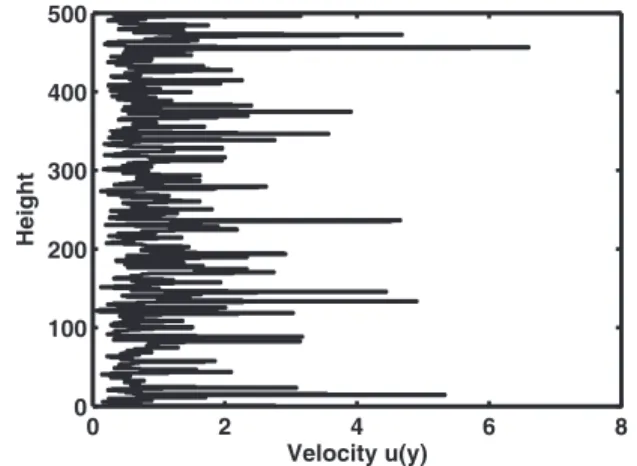
it provides a relatively simple but nontrivial model to study the possible mechanisms that lead to superdiffusive behavior 共i.e., a superlinear growth of the spatial variance兲 in hetero-geneous media in particular and stratified random velocity fields in general. This model can be regarded as an approxi-mation to aquifers characterized by vertical stratification of-ten observed in geological media 关26,27兴. Figure1 shows a realization of the type of velocity fields under consideration in this paper. Previously,关28兴 showed that effective transport
in such a velocity field is non-Markovian and described by a Gaussian concentration distribution. Here we extend this *[email protected]
work and derive explicit expressions for the n-point mo-ments of concentration.
II. MODEL
Transport of a passive scalar g共x,t兩x2
⬘
兲 in a stratified flow field u共x2兲 can be described by the advection diffusion equa-tion g共x,t兩x2⬘
兲 t = − u共x2兲 g共x,t兩x2⬘
兲 x1 + D 2g共x,t兩x 2⬘
兲 x22 , 共2兲where the coordinate vector is given by x =共x1, x2兲T; D is the diffusion coefficient. For simplicity, we restrict this study to an infinite d = 2 dimensional domain with no diffusion in the flow direction. The following analysis can be easily extended to more than two spatial dimensions and longitudinal diffu-sion. The spatial density g共x,t兩x2
⬘
兲 and its gradients at infin-ity are zero. The initial distribution is given by g共x,t = t0兩x2⬘
兲=␦共x1兲␦共x2− x2⬘
兲 共which means that g共x,t=t0兩x2⬘
兲 can be regarded as a Greens function兲. The stratified flow fieldu共x2兲 is a realization of a stationary spatial Gaussian random process 兵u共x2兲其 characterized by the constant ensemble mean velocity uE= E关u共x2兲兴 and correlation of the velocity fluctuations u
⬘
共x2兲=u共x2兲−uE, which is CE共x2− x2⬘
兲 = E关u⬘
共x2兲u⬘
共x2⬘
兲兴. The notation E关·兴 stands for the ensemble average.We consider now an ensemble of initial plumes that are distributed vertically according to共x2兲; 共x2兲 is normalized to one, its variance is denoted by a2. For aⰇ1, it is assumed to have the scaling form
共x2兲 ⬃ 1
af
冉
x2a
冊
, 共3兲where f共0兲 is constant. Sampling the ensemble of concen-tration distributions along the vertical and taking the limit of
a→⬁ gives the mean concentration
c ¯共x1,t兲 = lim a→⬁ 1 a
冕
−⬁ ⬁ dx2⬘
f冉
x2⬘
a冊
c共x1,t兩x2⬘
兲, 共4兲where we defined the projected concentration
c共x1,t兩x2
⬘
兲 ⬅冕
−⬁⬁
dx2g共x,t兩x2
⬘
兲. 共5兲The mean squared concentration is defined accordingly by
c2共x 1,t兲 = lim a→⬁ 1 a
冕
−⬁ ⬁ dx2⬘
f冉
x2⬘
a冊
c共x1,t兩x2⬘
兲 2. 共6兲This averaging procedure is equivalent to performing the ensemble average over the concentration distribution evolv-ing from a point injection because the random shear flow is assumed to be an ergodic random field共recall aⰇ1兲. In the following we derive explicit expressions for the multipoint moments of concentration in general and for the concentra-tion variancec
2共x
1, t兲=c2共x1, t兲−c¯共x1, t兲2in particular.
III. ENSEMBLE STATISTICS
Here we want to determine explicit equations for the evo-lution of the n-point statistics of the ensemble of projected concentration densities 兵c共x1, t兩x2
⬘
兲其. The n-point density ofc共x1, t兩x2
⬘
兲 is defined by n共y,t兲 ⬅ lim a→⬁ 1 a冕
−⬁ ⬁ dx2⬘
f冉
x2⬘
a冊
兿
i=1 n c共x1共i兲,t兩x2⬘
兲. 共7兲 where y =共x1共1兲, . . . , x1共n兲兲T. The simplest and most commonly used, statistical characteristics of 兵c共x1, t兩x2⬘
兲其 are its mean value共4兲, which is c¯共x1, t兲=1共x1, t兲 and its variance 共1兲. Thelatter is defined in terms of1共x1, t兲 and2共x1共1兲, x1共2兲, t兲 as
c
2共x
1,t兲 =2共x1,x1,t兲 −1共x1,t兲2. 共8兲 Let us begin by defining the “raw” n-point density
n共x共1兲, . . . ,x共n兲,t兩x2
⬘
兲 =兿
i=1 n
g共x共i兲,t兩x2
⬘
兲, 共9兲 which satisfies the transport equationn共x共1兲, . . . ,x共n兲,t兩x2
⬘
兲 t = −兺
i=1 n冋
u共x2共i兲兲 x1共i兲 − D 2 x2共i兲2册
⫻n共x共1兲, . . . ,x共n兲,t兩x2⬘
兲. 共10兲 The initial condition is n共x共1兲, . . . , x共n兲, t = t0兩x2⬘
兲 =兿i=1n ␦共x1共i兲兲␦共x2共i兲− x2⬘
兲. The n-point moment of concentration then is given by n共y,t兩x2⬘
兲 = lim a→⬁ 1 a冕
−⬁ ⬁ dx2⬘
f冉
x2⬘
a冊
⫻冕
−⬁ ⬁ dnx2共x共1兲, . . . ,x共n兲,t兩x2⬘
兲. 共11兲 Equation 共10兲 is a 2n-dimensional Fokker-Planckequa-tion. It is exactly equivalent to the following system of Langevin equations共e.g., 关29兴兲,
0 2 4 6 8 0 100 200 300 400 500 Velocity u(y) Height
FIG. 1. A sample realization of the considered random velocity field.
DENTZ et al. PHYSICAL REVIEW E 80, 036306共2009兲
dX1共i兲共t兩x2
⬘
兲 dt = uE+ u⬘
关X2 共i兲共t兩x 2⬘
兲兴, dX2共i兲共t兩x2⬘
兲 dt = 共i兲共t兲 共12兲 for i = 1 , . . . , n. The共i兲共t兲 denote Gaussian white noises with zero mean and correlation具共i兲共t兲共j兲共t⬘
兲典=␦ij2D␦共t−t⬘
兲. Theangular brackets denote the white noise average. The initial particle positions at time t = t0are given by关X1共i兲共t0兲,X2共i兲共t0兲兴 =共0,x2
⬘
兲 for i=1, ... ,n. The raw n-point density in this framework is given by 共x共1兲, . . . ,x共n兲,t兩x⬘
兲 =兿
i=1 n 具␦关x共i兲− X共i兲共t兩x 2⬘
兲兴典. 共13兲 Inserting Eq. 共13兲 into Eq. 共11兲, we obtain for the n-pointdensity n共y,t兩x2
⬘
兲 =冕
−⬁ ⬁ dx2⬘
共x2⬘
兲兿
i=1 n 具␦关x1共i兲− X1共i兲共t兩x2⬘
兲兴典. 共14兲 A. AveragingNow consider the n-dimensional system of Langevin equations,
dYi共t兲
dt = uE+i共t兲 共15兲
for i = 1 , . . . , n, where the initial positions are Yi共t=t0兲=0 and the noise is defined byi共t兲=u
⬘
关X2共i兲共t兩x2⬘
兲兴. The noise has the same distribution as u⬘
共y兲, which here is a Gaussian random field. Thus,i共t兲 is uniquely defined by its mean and variance具i共t兲典= lim a→⬁ 1 a
冕
−⬁ ⬁ dx2⬘
f冉
x2⬘
a冊
具u⬘
关X2 共i兲共t兩x 2⬘
兲兴典, 共16兲 具i共t兲j共t⬘
兲典= lim a→⬁ 1 a冕
−⬁ ⬁ dx2⬘
f冉
x2⬘
a冊
⫻具u
⬘
关X2共i兲共t兩x2⬘
兲兴u⬘
关X2共j兲共t⬘
兩x2⬘
兲兴典, 共17兲 where 具·典 denotes the noise average. Making use of the ergodicity of u⬘
共x2兲, we obtain that 具共t兲典= 0 and共e.g., 关28兴兲具i共t兲i共t
⬘
兲典=冕
−⬁ ⬁ dx2CE共x 2兲G共x2,t − t⬘
兩0兲, 共18兲 具i共t兲j共t⬘
兲典=冕
−⬁ ⬁ dx2冕
−⬁ ⬁ dx2⬘
CE共x2− x⬘
2兲G共x2,t兩0兲G共x2⬘
,t⬘
兩0兲, 共19兲 where i⫽ j; G共x2, t兩x2⬘
兲 is the Green function for diffusion in vertical direction G共x2,t兩x2⬘
兲 = 1冑
4Dtexp冋
− 共x2− x2⬘
兲2 4Dt册
. 共20兲 This is the marginal particle distribution in vertical direction. The n-point density共14兲 can now be written in terms of then-dimensional correlated random walk共15兲 as
n共y,t兩x2
⬘
兲 =冓
兿
i=1 n ␦关x1共i兲− Yi共t兲兴冔
. 共21兲B. Explicit solutions for the n-point density
Discretizing Eq.共15兲 in time, we obtain
Y共tN+兲 = Y共tN兲 + uE+共tN兲 共22兲
with the constant time incrementand discrete time tN= N;
we defined the n-dimensional vector uE=共uE, . . . , uE兲T. The
random walk 共22兲 has the sharp initial position Yi共tN0兲=0.
The random force共tN兲 kicks in at time tN0. In order to make
the process well defined, for tN⬍tN0we consider the process
deterministic or driven by white noise. Thus, for tN⬎tN0the
evolution of Yi共tN兲兴 does not depend on the system states
previous to tN0. The stochastic process given by the series of
random velocities兵i共tl兲其l=N0
⬁ can be described by its charac-teristic function 共兵共tl兲其兲 共e.g., 关29兴兲. For the
multi-Gaussian correlated processes 共t兲=关1共t兲, ... ,n共t兲兴, it is
given by 共兵共tl兲其兲 = exp
冋
− 1 2兺
ll⬘ ij=1兺
n i共tl兲Cij L共t l,tl⬘兲j共tl⬘兲册
, 共23兲where from Eqs. 共18兲 and 共19兲 we define the Lagrangian
velocity correlation Cij
L共t,t
⬘
兲⬅具i共t兲j共t
⬘
兲典; 兵i共tn兲其 denotethe Fourier variables conjugate to兵i共tn兲其. In order to derive
an explicit expression for n共y,t兲 we perform a
Fourier-transform of Eq.共21兲, which in discrete time gives
˜n共k,tN兲 = 具exp关ik · Y共tn兲兴典, 共24兲
where k =共k1, . . . , kn兲T is the n-dimensional wave vector.
From Eq.共22兲 we obtain for the n-dimensional trajectory Y共tN兲 =
兺
l=N0 N−1 uE+兺
l=N0 N−1 共tl兲. 共25兲Inserting this into Eq.共24兲, and performing the noise
av-erage gives ˜n共k,tN兲 = exp关ik · uE兴共兵共ti兲 = k其 i=N0 N−1 ;兵共ti兲 = 0其iⱖN兲. 共26兲 At large times, tNⰇ, we take the limit to continuous
time. Thus, from Eqs.共23兲 and 共26兲
˜n共k,t兲 = exp
冋
− k ·冕
0
t−t0
dt
⬘
D共t⬘
兲k + ik · uE册
, 共27兲where we have defined the time dependent dispersion coef-ficients Dij共t兲 =
冕
0 t dt⬘
Cij L共t,t⬘
兲. 共28兲n共y,t兲 =
exp关− 共y − uEt兲−2共t − t0兲/2共y − uEt兲兴
冑
共2兲ndet2共t − t0兲 , 共29兲 where2共t兲 is the tensor of trajectory variances
2共t兲 = 2
冕
0t
dt
⬘
D共t⬘
兲. 共30兲 and−2共t兲 its inverse.C. Concentration variance
The most commonly used measures of uncertainty are the mean and variance. The concentration variance has been fre-quently studied for transport in heterogeneous porous media 共e.g., 关13–15,30,31兴兲 in both Eulerian and Lagrangian
mod-eling frameworks. Oftentimes, these studies are limited to perturbation theory in the velocity fluctuations. We focus here on the concentration mean and variance as indicators of uncertainty and the self-averaging properties of concentra-tion 共e.g., 关1兴兲. From Eq. 共29兲, we obtain for the
concentra-tion variance共8兲 the compact expression
c 2共x 1,t兲 = c¯共x1,t兲2 ⫻
冢
exp再
关x1− uE共t − t0兲兴2 12 2 114 +122 112冎
冑
1 −124 /114 − 1冣
, 共31兲 where the mean concentration is given by关28兴c ¯共x1,t兲 = exp
再
−关x1− uE共t − t0兲兴 2 2112冎
冑
2112 . 共32兲 In the case of a delta-correlation in the 2-direction, that isCE共x
2兲=u2l␦共x2兲 with u2 the variance of the velocity field
and l its correlation length, the dispersion coefficients are 共e.g., 关21,32,33兴兲
Dii共t兲 =
u2D
冑
冑
t/D, Dij共t兲 = 共冑
2 − 1兲Dii共t兲. 共33兲We define the diffusion time scale D= l2/D. Inserting Eq.
共33兲 into Eq. 共31兲, we obtain for the relative variance
c 2共x 1,t兲 c ¯共x1,t兲2 = exp
再
关x1− uE共t − t0兲兴2冑
2 − 1 2冑
2112冎
冑
2冑
2 − 2 − 1. 共34兲 At the center of mass, the relative concentration variance is constant and given by c2关uE共t−t0兲,t兴c
¯关uE共t−t0兲,t兴2⬇0.1. The concentration
variance decreases exponentially with time and distance from the center of mass of the mean concentration. The rela-tive variance, in contrast, increases exponentially with time at positions that do not coincide with the center of mass of the mean distribution, because 112 ⬀共t−t0兲3/2 in Eq. 共34兲. Furthermore, the relative variance increases exponentially
with distance from the mean center of mass, which implies that small concentrations are particularly uncertain. In par-ticular, these observations imply that the concentration is not self-averaging.
From the outset such a behavior is not completely unex-pected because the dispersion behavior in infinitely extended stratified media has been found to be non-self-averaging ei-ther. This is indicated by the fact that the variance of the center of mass fluctuations of the plume, as quantified by the two-particle variance 122 共t兲, increases superdiffusively with time. The latter marks the difference between two dispersion measures which are called the ensemble and effective disper-sion coefficients 共e.g., 关32,34兴兲. While for transport in
non-stratified divergence-free random velocity fields, the two dis-persion measures converge in the asymptotic long time limit, for stratified media they are always different关32兴. In fact, the
relative variance as expressed by Eq.共31兲 would tend to zero
if the two-particle variance12共t兲2tended to zero. For a con-fined stratified medium this may be the case.
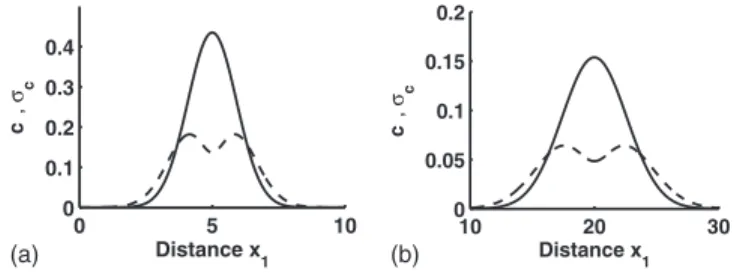
Figure 2shows the mean concentration c¯共x1, t兲 and stan-dard deviation c共x1, t兲 at t=500D and t = 2⫻103D. Note
the double peak in the standard deviation, which indicates that the region of maximum uncertainty and maximum aver-age concentration do not coincide. The general shapes of the curves change proportionally in time 共reflecting the fact that the ratio between D11共t兲 and D12共t兲 is constant兲.
D. Numerical simulations
The explicit analytical expression共31兲 for the
concentra-tion variance is compared to Monte Carlo simulaconcentra-tions. We use particle tracking simulations in two-dimensional random shear flow. The simulated flow field is organized in layers of constant thickness l. The velocity within each layer is con-stant, drawn from a Gaussian distribution with unit mean and variance. For transverse scales much larger than the thick-ness of a layer, the correlation is approximately delta 共e.g., 关33兴兲. Solute transport is simulated by random walk particle
tracking. Initial positions are uniformly distributed along a vertical line source, whose length is 104l. Within each stra-tum 103 particles are released, which gives a total of 107 simulated particle trajectories. Averages are then taken over the projected partial distributions that evolve from the strata. The implementation of the particle tracking method is de-scribed in detail in 关35兴. Equivalently, we considered
aver-ages over particle distributions consisting of 103 particles evolving from point sources in 104 different realizations of
0 5 10 0 0.1 0.2 0.3 0.4 Distance x 1 c , σc 10 20 30 0 0.05 0.1 0.15 0.2 Distance x1 c , σc (b) (a)
FIG. 2. Evolution of the mean concentration 共solid兲 and vari-ance共dashed兲 at two times 共a兲 t=500Dand共b兲 t=2⫻103Dfor a
variance ofu2= 1.
DENTZ et al. PHYSICAL REVIEW E 80, 036306共2009兲
the flow field. The results are identical as a consequence of the ergodicity of the random velocity field. In the following, we present only the results obtained for a long line source in a single realization.
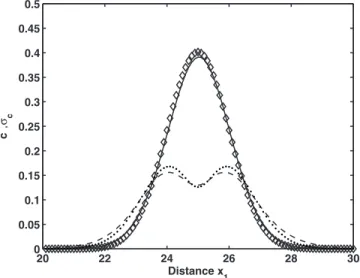
A comparison of the results from the numerical simula-tions and the corresponding analytical solusimula-tions are shown in Fig.3. As one can see, the analytical and numerical solutions are in good agreement, which is not surprising as the derived expressions for the multipoint concentration moments are ex-act for an infinite medium. Several other simulations varying the modeling parameters were run, yielding similar results. Note that the mean concentration obtained by numerical simulations agrees almost perfectly with the predicted behav-ior, while for the variance there are slight deviations. This can be traced back to the fact that the latter is much more sensitive to noise.
IV. SUMMARY AND CONCLUSIONS
We present a Lagrangian methodology for deriving the multipoint concentration statistics in Gaussian distributed random shear flow and determine explicit expressions for the multipoint concentration moments. The specific model under consideration has been frequently considered in the literature to study non-Fickian diffusion and the resulting effective particle densities共e.g., 关3,21,22,24,25,28兴兲. In fact, the
effec-tive dispersion coefficient evolves anomalously with the square root of time. In a stochastic modeling approach, the mean concentration distribution of a solute is defined by en-semble averaging of the concentration distribution originat-ing from an instantaneous point injection in one realization of the random flow field.
Alternatively, for an ergodic random flow field, the mean behavior can be obtained by considering transport in a single
realization for a solute that originates from a line source perpendicular to the stratification that is much larger than the characteristic scale of flow stratification. In this case the mean behavior is obtained by projecting the partial plumes evolving from points along the vertical line source and aver-aging of the source distribution 关28兴. The vertical particle
movements describe a Brownian motion and are independent of the longitudinal movement. Thus the effective distribution is given by the product of the vertically projected effective density and a Gaussian density representing the vertical dis-tribution. Therefore, it is sufficient to focus on the vertical projection of the effective particle distribution. Dentz et al. 关28兴 showed that the effective, or mean, particle movements
can be represented by a correlated random walk, where the noise correlation is uniquely defined by the Lagrangian ve-locity correlation function. The mean particle distribution is then given by the density of this random walk. Being a cor-related random walk, the process is non-Markovian. Here we extend this methodology to determine the full concentration statistics as given by the explicit analytical expressions for the multipoint moments of the concentration distribution. This yields a full statistical characterization of the non-Markovian effective particle dynamics. We obtain multi-Gaussian distribution densities for the n-point densities. These are completely characterized by 共i兲 the mean particle velocity,共ii兲 the single particle velocity correlation, and 共iii兲 the two-particle velocity correlation.
We then study the concentration variance as a simple measure for the uncertainty of concentration values and for the self-averaging properties of the particle distribution. The concentration variance is characterized by a double peak and decreases with time and distance from the center of mass. The relative concentration, in contrast, increases both with distance from the mean center of mass and time. This implies that the low concentration values are particularly uncertain, or in other words, that the low probabilities of finding a particle at a given position at a given time, are very uncer-tain. The relative variance is constant at the center of mass of the mean distribution which indicates that the probability of the bulk of the particles, or the highest concentration, is sub-ject to a basically constant uncertainty.
These results have some practical relevance because ex-perimentally determined concentration values and particle densities are often obtained as space and/or time averages and the observed mean behavior is often found to be super-diffusive. The presented work considers a model that gives some insight in the mechanism that can lead to such behavior and provides a methodology to quantify uncertainty and in fact the full concentration statistics.
In conclusion, by focusing on a relatively simple random flow model, this work sheds some new light and provides novel insights on the features and possible limitations of sto-chastic transport models in random flows. The presented methodology and the results obtained may have some impact for risk assessment studies and extreme value analysis.
20 22 24 26 28 30 0 0.05 0.1 0.15 0.2 0.25 0.3 0.35 0.4 0.45 0.5 Distance x 1 c , σ c
FIG. 3. A comparison between the numerical concentration共-兲 and standard deviation共- -兲 against the analytical values of concen-tration 共〫兲 and standard deviation 共·兲 for u2= 1 and t = 2.5 ⫻105
关1兴 J. P. Bouchaud and A. Georges, Phys. Rep. 195, 127 共1990兲. 关2兴 B. Berkowitz, A. Cortis, M. Dentz, and H. Scher, Rev.
Geo-phys. 44, RG2003共2006兲.
关3兴 W. R. Young and S. Jones, Phys. Fluids A 3, 1087 共1991兲. 关4兴 E. Frey and K. Kroy, Ann. Phys. 14, 20 共2005兲.
关5兴 J. Carrera, J. Contam. Hydrol. 13, 23 共1993兲.
关6兴 B. Berkowitz and H. Scher, Transp. Porous Media 42, 241 共2001兲.
关7兴 D. Tartakovsky, Geophys. Res. Lett. 34, L05404 共2007兲. 关8兴 D. Bolster, M. Barahona, M. Dentz, D. Fernandez-Garcia, X.
Sanchez-Vila, P. Trinchero, C. Valhondo, and D. M. Tartak-ovsky, Water Resour. Res. 45, W06413共2009兲.
关9兴 J. A. Neufeld and H. E. Huppert, J. Fluid Mech. 625, 353 共2009兲.
关10兴 D. Bolster, M. Dentz, and J. Carrera, Water Resour. Res. 45, W05408共2009兲.
关11兴 S. Pope, Turbulent Flows 共Cambridge University Press, Cam-bridge, England, 2000兲.
关12兴 R. Kubo, M. Toda, and N. Hashitsume, Statistical Physics II, Non-Equilibrium Statistical Mechanics共Springer-Verlag, Ber-lin, Heidelberg, 1991兲.
关13兴 V. Kapoor and L. W. Gelhar, Water Resour. Res. 30, 1775 共1994兲.
关14兴 V. Kapoor and P. K. Kitanidis, Water Resour. Res. 34, 1181 共1998兲.
关15兴 V. Kapoor and P. K. Kitanidis, Stoch. Hydrol. Hydraul. 11, 397共1997兲.
关16兴 W. Graham and D. McLaughlin, Water Resour. Res. 25, 215 共1989兲.
关17兴 S. Fedotov, M. Ihme, and H. Pitsch, Phys. Rev. E 71, 016310 共2005兲.
关18兴 Z. Warhaft, Annu. Rev. Fluid Mech. 32, 203 共2000兲. 关19兴 E. Caroni and V. Fiorotto, Transp. Porous Media 59, 19
共2005兲.
关20兴 O. A. Cirpka, R. L. Schwede, J. Luo, and M. Dentz, J. Contam. Hydrol. 98, 61共2008兲.
关21兴 G. Matheron and G. de Marsily, Water Resour. Res. 16, 901 共1980兲.
关22兴 J. P. Bouchaud, A. Georges, J. Koplik, A. Provata, and S. Redner, Phys. Rev. Lett. 64, 2503共1990兲.
关23兴 S. Redner, Physica A 168, 551 共1990兲.
关24兴 G. Zumofen, J. Klafter, and A. Blumen, Phys. Rev. A 42, 4601 共1990兲.
关25兴 S. N. Majumdar, Phys. Rev. E 68, 050101共R兲 共2003兲. 关26兴 O. Güven, F. Molz, and J. G. Melville, Water Resour. Res. 20,
1337共1984兲.
关27兴 A. Fiori and G. Dagan, Transp. Porous Media 47, 81 共2002兲. 关28兴 M. Dentz, T. LeBorgne, and J. Carrera, Phys. Rev. E 77,
020101共R兲 共2008兲.
关29兴 H. Risken, The Fokker-Planck Equation 共Springer, Heidelberg, New York, 1996兲.
关30兴 A. Fiori and G. Dagan, J. Contam. Hydrol. 45, 139 共2000兲. 关31兴 E. Morales-Casique, S. P. Neuman, and A. Guadagnini, Adv.
Water Resour. 29, 1238共2005兲.
关32兴 M. Clincy and H. Kinzelbach, J. Phys. A 34, 7141 共2001兲. 关33兴 V. Zavala-Sánchez, M. Dentz, and X. Sanchez-Vila, Adv.
Wa-ter Resour. 32, 635共2008兲.
关34兴 M. Dentz, H. Kinzelbach, S. Attinger, and W. Kinzelbach, Wa-ter Resour. Res. 36, 3591共2000兲.
关35兴 T. Le Borgne, J. R. De Dreuzy, P. Davy, and O. Bour, Water Resour. Res. 43, W02419共2007兲.
DENTZ et al. PHYSICAL REVIEW E 80, 036306共2009兲