HAL Id: insu-03229725
https://hal-insu.archives-ouvertes.fr/insu-03229725
Submitted on 19 May 2021
HAL is a multi-disciplinary open access
archive for the deposit and dissemination of
sci-entific research documents, whether they are
pub-lished or not. The documents may come from
teaching and research institutions in France or
abroad, or from public or private research centers.
L’archive ouverte pluridisciplinaire HAL, est
destinée au dépôt et à la diffusion de documents
scientifiques de niveau recherche, publiés ou non,
émanant des établissements d’enseignement et de
recherche français ou étrangers, des laboratoires
publics ou privés.
driven by surfacesediment characteristics?
Justine Louis, Laurent Jeanneau, Françoise Andrieux-Loyer, Gérard Gruau,
Florian Caradec, Nathalie Lebris, Marion Chorin, Emilie Jardé, Emilie
Rabiller, Christophe Petton, et al.
To cite this version:
Justine Louis, Laurent Jeanneau, Françoise Andrieux-Loyer, Gérard Gruau, Florian Caradec, et
al.. Are benthic nutrient fluxes from intertidal mudflats driven by surfacesediment characteristics?.
Comptes Rendus Géoscience, Elsevier Masson, In press, �10.5802/crgeos.57�. �insu-03229725�
Jardé, Emilie Rabiller, Christophe Petton, Guillaume Bouger, Patrice
Petitjean and Anniet M. Laverman
Are benthic nutrient fluxes from intertidal mudflats driven by surface
sediment characteristics?
Volume 1, issue 0 (0000), p. 000-000 <https://doi.org/10.5802/crgeos.57>
© Académie des sciences, Paris and the authors, 2021.
Some rights reserved.
This article is licensed under the
Creative Commons Attribution 4.0 International License.
http://creativecommons.org/licenses/by/4.0/
LesComptes Rendus. Géoscience — Sciences de la Planète sont membres du Centre Mersenne pour l’édition scientifique ouverte
0000, 1, n 0, p. 000-000
https://doi.org/10.5802/crgeos.57
Original Article — Hydrology, Environment
Are benthic nutrient fluxes from intertidal mudflats
driven by surface sediment characteristics?
Justine Louis
∗, a, Laurent Jeanneau
b, Françoise Andrieux-Loyer
c, Gérard Gruau
b,
Florian Caradec
c, Nathalie Lebris
a, Marion Chorin
a, Emilie Jardé
b, Emilie Rabiller
c,
Christophe Petton
b, Guillaume Bouger
a, Patrice Petitjean
band Anniet M. Laverman
aaCentre National de la Recherche Scientifique (CNRS), ECOBIO – UMR 6553,
Université de Rennes 1, 35042 Rennes, France
bCentre National de la Recherche Scientifique (CNRS), Géosciences Rennes – UMR
6118, Université de Rennes 1, 35042 Rennes, France
cIfremer, DYNECO PELAGOS, ZI Pointe du Diable, 29280 Plouzané, France
E-mails: [email protected] (J. Louis), [email protected]
(L. Jeanneau), [email protected] (F. Andrieux-Loyer),
[email protected] (G. Gruau), [email protected] (F. Caradec), [email protected] (N. Lebris), [email protected] (M. Chorin), [email protected] (E. Jardé), [email protected] (E. Rabiller), [email protected] (C. Petton),
[email protected] (G. Bouger), [email protected] (P. Petitjean), [email protected] (A. M. Laverman)
Abstract. A broad sampling program was carried out in the spring of 2019 on the Brittany coast to
assess how the surface sediment characteristics drive the benthic effluxes of ammonium (NH+4) and
phosphate (PO4) from intertidal mudflats. A total of 200 sediment samples were characterized by
their porosity, grain-size, elemental composition and pigment contents, as well as the benthic fluxes of NH+4 and PO4determined by core incubations. The results showed that (1) a high phaeopigment
and iron-bound phosphorus content (Fe-P) and a low porosity were significantly related to the high PO4flux, and (2) a high porosity and the TN:Org-P ratio in the sediment organic matter (SOM) were
related to the high NH+4 flux. This indicated that PO4fluxes would be more driven by the redox
status of the sediment through the desorption of Fe-P under specific anoxic conditions during the algal decomposition. NH+
4 fluxes would be more driven by high NH+4 recycling rates from SOM
mineralization and high sediment–water exchanges, enhancing the diffusion of NH+4to the overlying
water. The present study allowed to highlight the large variability in the benthic nutrient fluxes at the regional scale, as a result of the connections between microbial (SOM mineralization), chemical (adsorption–desorption) and physical (diffusion) processes.
Keywords. Benthic nutrient fluxes, Coastal sediment, Organic matter, Spatial variability, Diffusive
transport, Microbial and chemical processes.
Manuscript received 14th December 2020, revised 31st March 2021, accepted 27th April 2021.
arine and coastal marine ecosystems [Perrot et al., 2014, Pinay et al., 2018]. The subsequent decay of the macroalgal biomass has harmful environmen-tal consequences through changes in the microbial and macrofaunal food web in the sediment [Davoult et al., 2017, García-Robledo et al., 2008, Hardison et al., 2013, Valiela et al., 1997] and an accumulation of toxic hydrogen sulfide [Nedergaard et al., 2002]. Even though river nutrient loading, especially N, is the main cause of green tides [e.g. Perrot et al., 2014], coastal sediments could be an additional source of nutrients for macroalgae, thus contributing to eu-trophication [Sundbäck et al., 2003, Engelsen et al., 2008, Robertson and Savage, 2018]. For example, it has been shown that benthic nutrient effluxes could supply up to 55–100% and 30–70% of the N and P re-quirement, respectively, needed to initiate the growth of filamentous green algal mats in shallow microtidal embayments on the west coast of Sweden [Sundbäck et al., 2003].
In order to improve our understanding of coastal eutrophication, mathematical models have been de-veloped by coupling hydro-biogeochemical and eco-logical mechanisms [Le Moal et al., 2019 and refer-ences therein]. Models such as the “Mars-Ulves” [Per-rot et al., 2014] and “ECO-MARS3D” models [Mé-nesguen et al., 2019] predict fine-scale algal blooms based on nutrient loading from rivers, pelagic nutri-ent cycling and the primary production of a coastal system, whereas the benthic compartment is repre-sented in less detail. Currently, a constant benthic flux of N and P is used to take the nutrient exchanges between the sediment and bottom waters into ac-count, but this remains limited due to the lack of suitable data for a given area. Determining the spa-tial variability of the benthic nutrient fluxes requires a large analytical effort, and may be high according
ganic matter (SOM), and (3) the physical properties of the sediment [e.g. Ait Ballagh et al., 2020, Arndt et al., 2013, Dauwe et al., 2001 and references therein; Khalil et al., 2018, Middelburg et al., 1996]. Redox conditions, driven by electron acceptor availability in the porewater, control the microbially mediated pro-cesses in N and P cycling [Capone et al., 2008 and references therein; Paytan and McLaughlin, 2007, Sundby et al., 1992] and the adsorption–desorption processes of PO4 onto iron oxides [Andrieux-Loyer
et al., 2008, 2014, Krom and Berner, 1980, Rozan et al., 2002].
The composition of SOM is influenced by a mix-ture of organic matter (OM) inputs from both au-tochthonous (e.g. microphytobenthos and sediment-attached bacteria) and allochthonous sources (e.g. algal and vascular plant detritus from terrestrial and marine origins). It is generally accepted that a high contribution of algal biomass relative to terres-trial detritus in the SOM composition enhances its biodegradability [e.g. Arndt et al., 2013]. Two mark-ers can be used to assess the labile OM flux in sed-iment: the chla and phaeopigment contents in sur-face sediment. They are good tracers of OM pro-duced by photosynthetic organisms [Dell’Anno et al., 2002]. Whereas the chla content in surface sedi-ment would be mainly related to the microphytoben-thos biomass, the content of its breakdown product, phaeopigment, would indicate the sedimentation of phytoplankton and macroalgal detritus from the wa-ter column [Therkildsen and Lomstein, 1993].
The SOM composition may also be characterized by the elemental C:N:P ratios. The C:N ratio is widely used to discriminate the sources of OM in the sur-face sediment [e.g. Dubois et al., 2012, Galois et al., 2000, Gu et al., 2017]. Typically, C:N values > 20 can be used to distinguish terrestrial higher plants
from macrophytes (from 10 to 20) and phytoplankton (from 6 to 10) [Dubois et al., 2012, Liénart et al., 2017, Meyers, 1994]. Therefore, it is assumed that when the C:N ratio is lower, the organic matter is more easily biodegradable [Enríquez et al., 1993]. Conversely, the N:P ratio in SOM is not commonly used to describe the origin and biodegradability of SOM. Neverthe-less, an increase in the N:P ratio in the surface sed-iment could reflect the enrichment of OM via the de-cay of macroalgae, as observed in the eutrophic la-goon of Venice [Sfriso et al., 1988].
Physical sediment properties, such as the grain-size distribution and porosity, also affect SOM miner-alization and the transport processes of solutes, and thus benthic fluxes. Fine-grained sediment, reflect-ing a high proportion of clay minerals, may prevent the microbially mediated OM degradation through a physical protection of the OM [e.g. Arndt et al., 2013 and references therein; Rasheed et al., 2003]. Porosity, which is generally inversely related to grain-size [Meade, 1966], is a key parameter driving the sediment–water exchanges of solutes, including dif-fusion, advection and bio-irrigation [Boudreau, 1996, 1997]. Therefore, a high porosity could, for example, enhance the diffusive fluxes across the sediment– water interface.
The present study was based on the hypothesis that benthic nutrient fluxes may be directly related to the sedimentary characteristics. Two previous stud-ies carried out in temperate estuarstud-ies showed rela-tionships between NH+
4/PO4 fluxes and markers of
the SOM composition [Clavero et al., 2000, Cowan and Boynton, 1996]. The nutrient fluxes were posi-tively correlated with the chla content along the axis of Chesapeake Bay, USA [Cowan and Boynton, 1996], and negatively correlated with the C:N ratio in the seasonal study carried out in the Palmones River es-tuary in southern Spain [Clavero et al., 2000]. There-fore, the C:N ratio and chla content may be effec-tive proxies of the NH+
4 and PO4fluxes. However, the
sedimentary characteristics were not ranked in these previous studies, and the effects of the environmen-tal conditions (e.g. the temperature of bottom water), known to affect both the diffusion and metabolic ac-tivities of benthic bacteria [Arndt et al., 2013 and ref-erences therein], were not discerned from those of the SOM composition [Clavero et al., 2000].
The aim of the present study was to investigate the relationships between benthic nutrient fluxes and
the surface sediment characteristics from intertidal mudflats. Our objective was to answer the following questions: (1) What are the main drivers of benthic nutrient fluxes? (2) Are these drivers similar with re-gards to the NH+
4 and PO4fluxes? (3) Does the SOM
composition have a predominant role compared to the physical properties of the sediment, and (4) Can the sedimentary properties be used as efficient tools to predict NH+4 and PO4fluxes?
To this end, a broad sediment sampling campaign was carried out in the spring of 2019 on the Brittany coast (France). Since the 1970s, the Brittany coast has been particularly affected by green tides; this timeline coincides with changes in agricultural prac-tices and an increase in anthropogenic nitrogen load-ing in the watersheds [Morand and Briand, 1996]. Many surface and subsurface waters in Brittany have nitrate concentrations which exceed the European Community 50 mg·L−1drinking standard.
A total of 200 sediment samples collected from 45 sites were analyzed for their NH+4 and PO4fluxes as
well as their physical properties and chemical com-position. This sampling strategy allowed to inves-tigate a range of sedimentary characteristics while maintaining similar climatic conditions. The surface sediments were characterized by their porosity and grain-size, as well as their carbon, nitrogen, total phosphorus, chla and phaeopigment contents. In ad-dition, organic phosphorus (Org-P) and iron oxide-bound phosphorus (Fe-P) were distinguished from the total phosphorus pool.
2. Materials and methods
2.1. Study sites and sampling
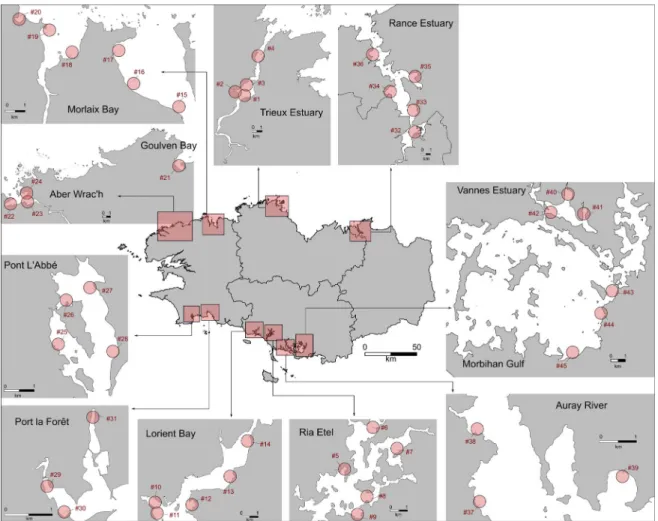
The study sites were located in macrotidal mud-flats in Brittany (north-western France) under eutrophic conditions where green algae mats are observed (https://bretagne-environnement.fr/ donnees-algues-vertes-bretagne). The mudflats that we selected for our study are the mudflats that are regularly monitored as part of the green tide moni-toring programs set up by the Loire-Bretagne Water Agency (CEVA, final report, 2015). Over the sam-pling period (between mid-April to mid-June 2019), the tidal range fluctuated from 2 to 9 m. Overall, 200 sediment samples were collected from 45 sites (Figure 1, Table S1) at mid–low tide. Sediment cores were sampled with a PVC core (diameter = 6 cm,
Figure 1. Location of mudflats (n = 12) and sites of sampling (n = 45) in spring (April until June) 2019.
See the list of sites and sampling plan in Supplementary annex Table 1.
h = 20 cm) in the upper 10 cm sediment layer for
the benthic flux measurements, and another core (diameter = 9 cm, h = 5 cm) was sampled in or-der to analyze the surface sediment characteristics (Figure S1). For the benthic flux measurements, the cores were incubated in the dark directly on site in a mobile laboratory under controlled temperature (19 ± 2 °C) within one hour following sampling (see below). Based on the sample collected using the PVC core with a height of 5 cm, an aliquot of the wet sediment, with a known volume and weight, was maintained at 4 °C and used to determine the poros-ity. The remaining sediment was frozen at −20 °C in order to analyze the pigment content (chla and phaeopigment), phosphorus speciation, elemental composition and grain-size.
2.2. Benthic fluxes
The cores were incubated in the dark during 4 hours for the NH+4and PO4efflux measurements. The
over-lying water was replaced by 150 mL of nutrient-free artificial seawater ([NaCl] = 33 g·L−1, [NaHCO3] =
0.2 g·L−1, pH ≈ 8) and gently aerated by bubbling in order to preserve the redox conditions of the sedi-ment. Two 0.2µm-filtered water samples were col-lected in the overlying water after 2 h and 4 h of incu-bation and stored at refrigerator temperature (4 °C) for less than three days prior to the nutrient anal-ysis. The NH+4, PO4, NO−2 and NO−3 concentrations
in the overlying water were measured with the col-orimetric method using an automated photometric analyzer Gallery™, with a detection limit of 0.9, 0.2,
0.07 and 3.6µM, respectively. All of the NO−
2and NO−3
concentration measurements were below the detec-tion limit.
The NH+4 and PO4 fluxes across the sediment–
water interface were accessed by using the change in the molar concentration of the solute in the known volume of overlying water as a function of incuba-tion time and the surface area of the sediment core [Aller et al., 1985]. If the rate of nutrient release from the sediment did not follow a linear trend over the incubation period, only the first sample was con-sidered in the flux estimation. This was the case for PO4when the exchanges between the sediment and
water reached an equilibrium state after two hours of incubation, in general, due to the re-adsorption onto particles [Sundby et al., 1992]. Note that these fluxes were conducted under standardized condi-tions (temperature, aeration) and therefore consid-ered as potential fluxes.
All of the values are reported in Supplementary Table S1.
2.3. Analysis of the sedimentary characteristics
The porosity was calculated by drying a previously weighed wet aliquot sediment at 60 °C. The water loss, determined by mass difference, and the sedi-ment density set at 2.55 were used to calculate the porosity [Krom and Berner, 1980]. The particle-size distribution (<2 mm) was measured using a laser diffraction instrument (Malvern Mastersizer). The particles were classified as either sand (63–2000µm), silt (3–63µm) or clay (<3µm) fractions [e.g. Keil and Hedges, 1993, Pye and Blott, 2004]. “Mud” is defined as the sum of the clay and silt particles. The percent-age of mud was used as a sedimentary parameter thereafter.
The pigment content (chla and phaeopigment) was measured in freeze-dried sediment (0.5–1 g) ex-tracted in 90% acetone (10 mL) in the dark (18– 20 h) at 4 °C. Each sample was previously gen-tly ground using an agate pestle and mortar. After centrifugation, the chla and phaeopigment contents were measured in the supernatant using the spec-trophotometric method of Lorenzen [1967] at 665 and 750 nm (Uvikon spectrophotometer), and ex-pressed inµg·g−1of dry sediment. The detection
lim-its of the chla and phaeopigment contents were 2.7 and 12.9µg·g−1, respectively.
The total organic carbon and nitrogen (TOC and TN) contents were determined using an element ana-lyzer (FLASH™ 2000 OEA). An aliquot of freeze-dried and crushed sediment was acid-treated with 2N HCl to remove the carbonate and was subsequently rinsed with deionized water. After centrifugation, the carbonate-free sample was dried at 60 °C, and ground before being placed into a tin capsule for the TOC analysis. A second aliquot without an acidification treatment was used to determine the TN analysis.
The iron oxide-bound P (Fe-P) content was deter-mined using a Dithionite-Bicarbonate solution [Rut-tenberg, 1992], as described in Andrieux-Loyer et al. [2008]. The total P (Ptot) content was determined
us-ing a 1 mol·L−1 HCl treatment overnight after
sedi-ment ignition at 550 °C (4 h), while the inorganic P content refers to the sum of the P-forms (Fe-bound P, Ca-bound P and detrital P), that was extracted with 1 mol·L−1 HCl before sediment ignition
[As-pila et al., 1976]. The organic P (Org-P) content was then quantified by calculating the difference between the total P and inorganic P contents [Andrieux-Loyer et al., 2008]. The phosphorus-form extracts were sub-sequently analyzed using segmented flow analysis (SFA) [Aminot and Kérouel, 2007]. The Org-P and Fe-P represented the pool of potentially bioavailable Fe-P.
The TOC, TN, Ptot, Org-P and Fe-P contents were
expressed as the mass of the carbon, nitrogen and phosphorus in the total dry mass of the sediment.
The C:N and TN:Org-P ratios (mol:mol) in SOM were calculated from the TOC, TN and Org-P con-tents.
All of the values are reported in Supplementary Table S1.
2.4. Statistical analysis
Pearson’s correlation matrix was calculated to estab-lish the pairwise correlations between the sedimen-tary characteristics of the sediment. The relation-ships between the benthic nutrient fluxes and the sedimentary characteristics were assessed through multiple linear regressions. To better predict NH+ 4
and PO4fluxes, two models were built by multiple
linear regression (MLR) using a stepwise selection procedure based on the Akaike information criterion (AIC). To ensure that the multi-collinearity did not skew our results, the variance inflation factors (VIF) were measured. None of the VIF values were higher
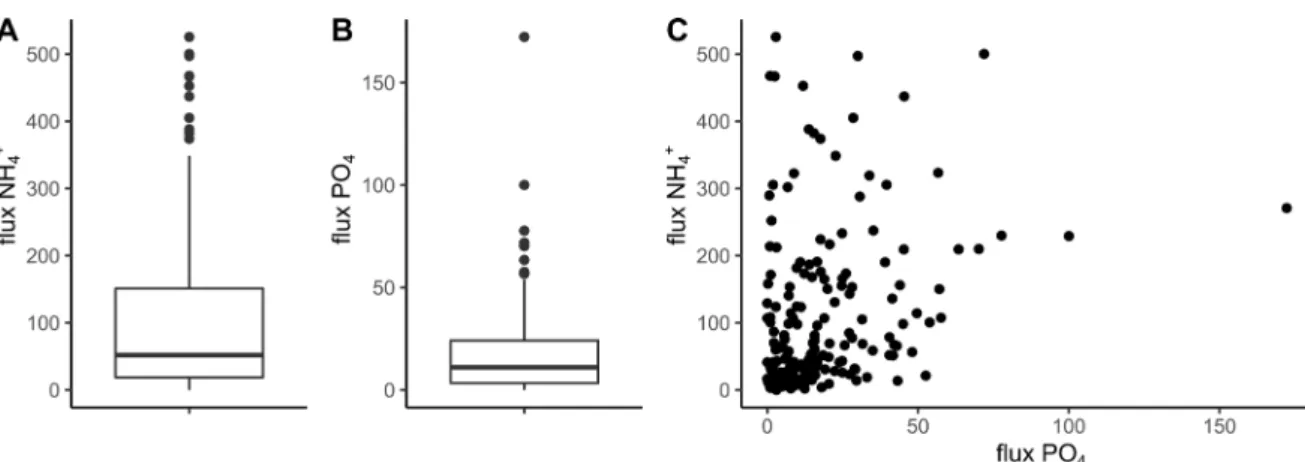
Figure 2. Boxplot of NH+4 (A) and PO4 (B) effluxes, and NH+4 effluxes versus PO4 effluxes (C) in
µmol·m−2·h−1. Within the boxes, medians are the black lines. First and third quartiles are hinges,
out-liers are black dots.
than 3 (a threshold value was set at 5). In addition, when the selected variables had a Pearson’s correla-tion higher than 0.7 between them, we checked that there was no interaction effect in the model. To iden-tify the main drivers of the benthic nutrient fluxes by MLR, the data were normalized beforehand, and a p-value < 0.05 for the F -test was used to consider a significant effect of one predictor variable on the model. In addition to the calculation of AIC, the K-fold cross validation was run to evaluate the perfor-mance of each model built by linear regressions. The data set was split into 10 folds. In order to compare two means, a Student’s t -test was performed when the sample size (n) was higher than 30. Each statis-tical analysis was performed using the R-studio soft-ware. The “aod”, “car” and “caret” packages were used to calculate AIC and VIF and to perform the k-fold cross validation, respectively. The “lm”, “step” and “scale” functions were used to perform the linear re-gressions, the stepwise selection procedure by MLR and the database normalization, respectively.
3. Results
3.1. Benthic nutrient fluxes
Taking the entire data set into account, the average NH+4and PO4fluxes were 101±117µmol·m−2·h−1and
17 ± 20µmol·m−2·h−1, respectively. Over 50% of the
NH+4 fluxes ranged from 19 and 151µmol·m−2·h−1,
with values up to 526 µmol·m−2·h−1 (Figure 2A).
With regards to the PO4 fluxes, 50% of the data
ranged from 3 and 24µmol·m−2·h−1, with a
maxi-mum flux of 172µmol·m−2·h−1(Figure 2B). In gen-eral, the PO4fluxes were lower than those of NH+4.
Over 50% of the N:P flux ratios ranged from 2 to 12, with values up to 765. The large variability in the ratios of the N:P fluxes reflects a weak correlation be-tween the NH+4 and PO4fluxes (Pearson’s coefficient
= 0.31, p-value < 0.05) (Figure 2C). The lowest N:P flux ratios (N:P ≤ 2) were significantly explained by high PO4fluxes (mean = 25µmol·m−2·h−1) and low
NH+4 fluxes (31 µmol·m−2·h−1) (Student’s t -test for one sample, p-value < 0.05). The highest ratios for the N:P fluxes (N:P ≥ 12) were significantly explained by low PO4fluxes (mean = 7µmol·m−2·h−1) and high
NH+4 fluxes (192µmol·m−2·h−1) (Student’s t -test for one sample, p-value < 0.05) (Figure S2).
The variability of both NH+4 and PO4fluxes at the
regional scale allowed to distinguish the locations where the sediment presented the highest aver-age effluxes of nutrient. For the NH+
4 effluxes, they
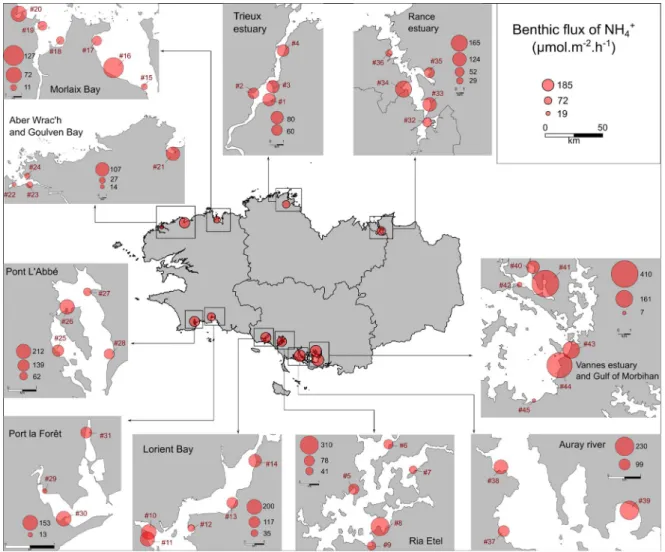
were Gulf of Morbihan (mean: 185µmol·m−2·h−1), Vannes Estuary (mean: 173 µmol·m−2·h−1) and Auray River (mean: 162 µmol·m−2·h−1)
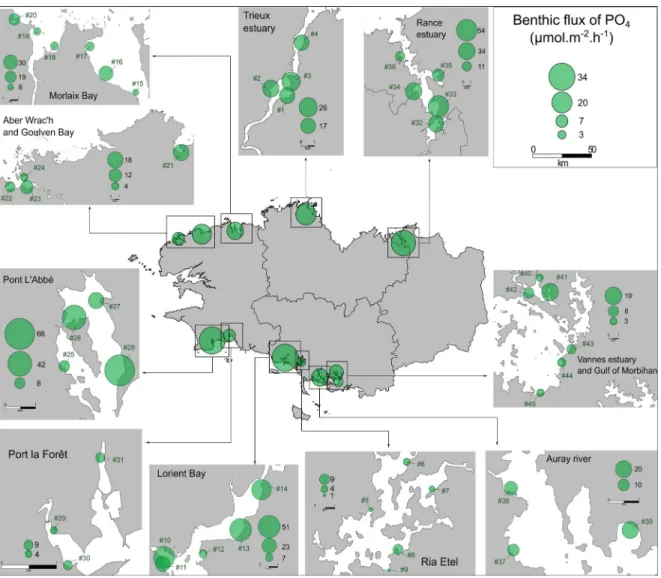
(Fig-ure 3). For the PO4 effluxes, they were Lorient
Bay (mean: 34 µmol·m−2·h−1), Pont L’Abbé (mean:
34 µmol·m−2·h−1) and Rance Estuary (mean: 30µmol·m−2·h−1) (Figure 4). By contrast, the three locations which presented the lowest average effluxes of NH+4 were Aber Wrac’h (mean: 19µmol·m−2·h−1),
La Forêt (mean: 79 µmol·m−2·h−1) (Figure 3), and
those with the lowest average effluxes of PO3−4 were Ria Etel (mean: 3 µmol·m−2·h−1), Gulf of Morbi-han (mean: 4 µmol·m−2·h−1) and Port la Forêt (mean: 7 µmol·m−2·h−1) (Figure 4). A high spatial
variability of these fluxes was also observed be-tween the sampling sites of the same location (Fig-ures 3 and 4, Table S1). For example, in the Gulf of Morbihan, the lowest effluxes of NH+4 were
mea-sured at the site #45 (7.3 ± 1.4 µmol·m−2·h−1),
whereas the site #44 presented large effluxes of NH+4(388.6 ± 189.5µmol·m−2·h−1) (Figure 3).
3.2. Surface sediment characteristics
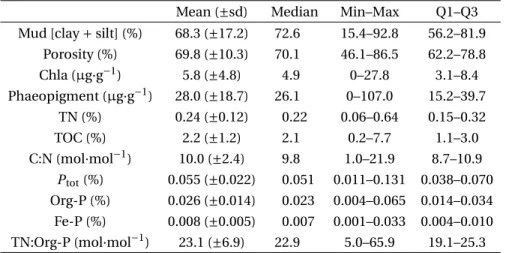
The distribution and pairwise correlations with Pear-son’s coefficient for the surface sediment character-istics measured in the present study are presented in Tables 1 and 2.
The particle-size distribution of the samples indi-cates that the median grain-size (D50) ranged from 16 to 519µm. With an average mud content of 68.3 ±
17.2% for all of the samples, the clay and silt par-ticles represented 4.7 ± 2.1 and 63.6 ± 15.4% of the particle-size distribution, respectively. According to the ternary diagram based on the sand/mud ratios proposed by Flemming [2000], a large proportion of the surface sediments collected in the present study were classified as sandy mud (38%) and slightly sandy mud (49%). As expected, the mud content was pos-itively correlated with the porosity of the sediment (Pearson’s coefficient = 0.82, p-value < 0.05). The average porosity was 69.8 ± 10.3% with values that ranged from 46 to 87%.
The mud content was also positively correlated with the TOC (Pearson’s coefficient = 0.64, p-value < 0.05), TN (Pearson’s coefficient = 0.73, p-value < 0.05) and Org-P contents (Pearson’s coefficient = 0.72, p-value < 0.05) in the surface sediment. The TOC, TN and Org-P contents averaged 2.2 ± 1.2%, 0.24±0.12% and 0.026±0.014%, respectively. With an average Ptot content of 0.055 ± 0.022%, the amount
of Org-P was 45 ± 12% of the Ptotcontent compared
to 14 ± 6% for the Fe-P (average content of 0.008 ± 0.005%).
The C:N and TN:Org-P ratios in the SOM averaged 10.0 ± 2.4 and 23.1 ± 6.9, respectively. The C:N ratios reached up to 21.9 with half of the values ranging from 8.7 to 10.9. The highest values corresponded to
the sediment samples collected in the Goulven Bay (mean = 17.8 ± 3.9).
The accumulation of OM from the algal biomass (which included microphytobenthos, pelagic phyto-plankton, macroalgae) in the surface sediment was described by the chla and phaeopigment contents, with a mean value of 5.8 ± 4.8 and 28 ± 18.7µg·g−1of
dry sediment, respectively. The chla and phaeopig-ment contents were positively correlated with the TOC, TN and Org-P contents (Pearson’s coefficient > 0.6, p-value < 0.05).
3.3. Relationships
between
the
sedimentary
parameters and benthic nutrient fluxes
The stepwise multiple linear regression (MLR) al-lowed to select the best combination of sedimentary characteristics to predict the NH+4 and PO4 fluxes.
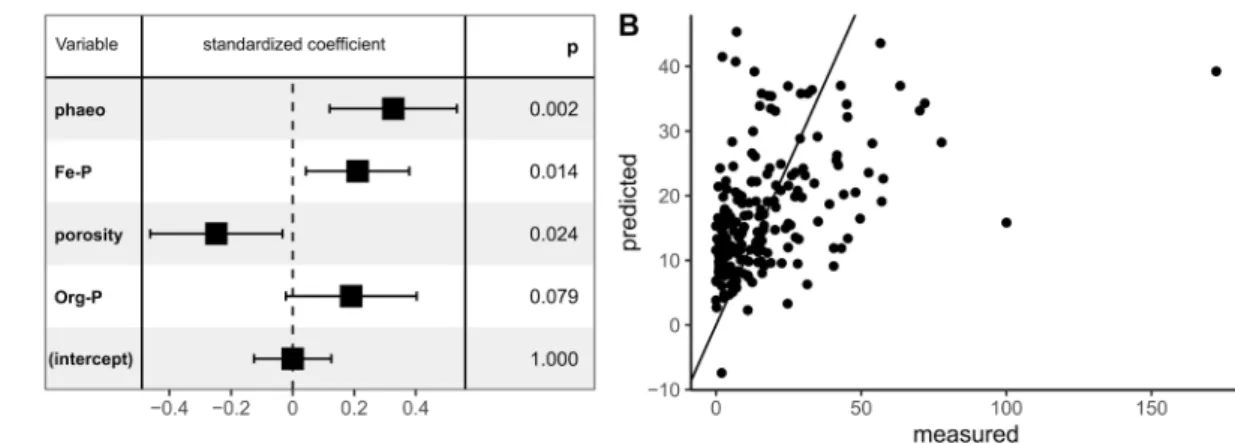
With regards to the PO4flux, the parameters selected
by the final MLR model were the phaeopigment, Fe-P and Org-Fe-P contents, and the porosity (Figure 5). Whereas the PO4flux was positively and significantly
correlated with the phaeopigment and Fe-P contents (p-value < 0.05), it was negatively and significantly correlated with the porosity (p-value < 0.05). In ad-dition, a positive relationship was observed between the Org-P content and the PO4flux, despite a less
sig-nificant effect (p-value = 0.079). To predict the NH+4
flux, the porosity, chla content and C:N and TN:Org-P ratios in the SOM were selected by the final MLR model (Figure 6). The porosity, as well as the TN:Org-P ratio and chla content, were positively correlated with the NH+4flux. In contrast, a negative relationship was observed between the C:N ratio and the NH+ 4
flux. The parameter with the highest significant ef-fect was porosity (p-value < 0.001), followed by the TN:Org-P ratio (p-value = 0.01). The chla content and C:N ratio presented a less significant relationship with the NH+
4 flux (p-value > 0.05).
The accuracy of the prediction remained low for both models, with only 18 and 24% of the NH+4 and PO4flux variations explained, respectively.
4. Discussion
In the present study, 75% of the NH+4 and PO4fluxes
were below 151 and 24µmol·m−2·h−1, respectively.
These measurements were within the range found in previous studies carried out in Brittany and other
Figure 3. Spatial variability of the NH+
4effluxes (µmol·m−2·h−1) from the sediment collected on 45 sites
in Brittany (France). The values represent the average flux of NH+4 for each sampling site and for each intertidal area as a whole (n = 12).
European intertidal mudflats during the spring pe-riod, from either incubation in the dark or porewater nutrient profiles (Table 3). Higher values were also measured in our work, reaching 526µmol·m−2·h−1
for NH+4 and 172 µmol·m−2·h−1 for PO4.
Signifi-cant differences in the benthic nutrient fluxes were observed between the sampling locations (Table S1). For example, the mouth of the Penzé River (sites #18 and #19) presented an average NH+4 flux of 25 ± 16 µmol·m−2·h−1, whereas this value was 162 ± 132 µmol·m−2·h−1 in the Auray River (sites
#37, #38 and #39) (Figure 3). These results are in agreement with the NH+4fluxes observed in the same areas by Lerat et al. [1990] and Andrieux-Loyer et al.
[2014] (Table 3). Thus, our broad sampling program emphasized the variability of NH+4 and PO4fluxes at
the regional scale. Considering these large variations in NH+4and PO4fluxes, using an average benthic flux
on the regional scale does not seem appropriate for environmental modeling and management at a local scale. This requires the availability of data over a given area [Le Moal et al., 2019], which may be facil-itated by the use of proxies. In this work, we explored the possibility of using sediment characteristics for the quantification of NH+
4 and PO4 fluxes. These
parameters were identified via a modeling approach using a stepwise Multiple Linear Regression (MLR). One of the questions asked here was whether or not
Figure 4. Spatial variability of the PO4effluxes (µmol·m−2·h−1) from the sediment collected on 45 sites
in Brittany (France). The values represent the average flux of PO4for each sampling site and for each
intertidal area as a whole (n = 12).
the benthic nutrient fluxes were controlled by the same sedimentary parameters. The present study showed no correlation between NH+4 and PO4fluxes
from sediments covering a range of 200 sampling sites. The main sedimentary parameters driving the NH+4 fluxes were different from those driving PO4
fluxes.
4.1. What are the main parameters of surface
sediment driving the PO
4fluxes?
Four parameters were selected via the final MLR model in order to predict the PO4 fluxes: porosity,
phaeopigment content, Fe-P content and Org-P con-tent. Among the four selected parameters, the corre-lation between the Org-P content and the PO4flux
was not significant (F -test p-value > 0.05). Therefore, the porosity, phaeopigment and Fe-P contents were considered as the key variables for predicting PO4
fluxes.
The parameter presenting the most significant positive correlation for the PO4 fluxes was the
phaeopigment content (F -test p-value = 0.002). The phaeopigment content is an indicator of algal biomass detritus in the SOM composition [Dell’Anno et al., 2002, Therkildsen and Lomstein, 1993]. In the
Org-P (%) 0.026 (±0.014) 0.023 0.004–0.065 0.014–0.034 Fe-P (%) 0.008 (±0.005) 0.007 0.001–0.033 0.004–0.010 TN:Org-P (mol·mol−1) 23.1 (±6.9) 22.9 5.0–65.9 19.1–25.3 Molar C:N and TN:Org-P ratios were calculated from TOC, TN and Org-P content. Q1 and Q3 represent the 25th and 75th percentile respectively.
Table 2. Pearson’s correlation matrix
Porosity chla Phaeo TN TOC C:N Org-P Fe-P TN:Org-P Mud 0.82 0.44 0.70 0.73 0.64 0.30 0.72 0.54 −0.20 Porosity 0.57 0.76 0.87 0.78 0.35 0.73 0.54 −0.04 chla 0.64 0.66 0.62 0.26 0.60 0.45 −0.04 Phaeo 0.86 0.79 0.31 0.70 0.53 0.04 TN 0.91 0.32 0.82 0.58 −0.02 TOC 0.66 0.75 0.58 −0.02 C:N 0.31 0.33 −0.05 Org-P 0.65 −0.48 Fe-P −0.23
Bold values were coefficients ≥ 0.70. “mud” represents the percentage contribu-tion of clay and silt particles (diameter < 0.63µm). “chla”, “phaeo”, “TOC”, “TN”, “Org-P” and “Fe-P” corresponds to the content of chlorophyll a, phaeopigment, total organic carbon, total nitrogen, total phosphorus, organic phosphorus and phosphorus associated with iron oxides respectively in the upper 5 cm of sedi-ment. Molar C:N and TN:Org-P ratios were calculated from TOC, TN and Org-P content.
present study, the significant and positive correla-tions between the phaeopigment content and that of the TOC, TN and Org-P contents indicated that the organic matter was enriched in the surface sed-iment due to the accumulation of algal detritus. In the Auray River (Brittany, France), Andrieux-Loyer et al. [2014] also observed that the increase in the phaeopigment, TOC, TN and Org-P contents in the
surface sediment was fueled by the occurrence of green macroalgae. An accumulation of algal OM most likely results in intense SOM mineralization, leading to both oxygen depletion in porewater and a shift in anaerobic mineralization from iron to sulfate reduction thereby enabling iron-sulfide formation [Lehtoranta et al., 2009]. Under these anoxic condi-tions, the adsorption of PO4onto iron oxides would
Figure 5. Parameters selected during the stepwise selection procedure by multiple linear regression
(MLR) to predict PO4 flux (A). The effect of each parameter on the model was characterized by the
standardized coefficient and its significance by the pvalueof F -test. The fitted values of PO4flux by the
model were plotted versus PO4fluxes measured by core incubations (µmol·m−2·h−1) (B). The straight
line represents the slope 1:1.
Figure 6. Parameters selected during the stepwise selection procedure by multiple linear regression
(MLR) to predict NH+
4 flux (A). The effect of each parameter on the model was characterized by the
standardized coefficient and its significance by the pvalueof F -test. The fitted values of NH+4 flux by the
model were plotted versus NH+
4 fluxes measured by core incubations (µmol·m−2·h−1) (B). The straight
line represents the slope 1:1.
be less efficient, increasing the upward diffusion of PO4 from the sediment [Ekholm and Lehtoranta,
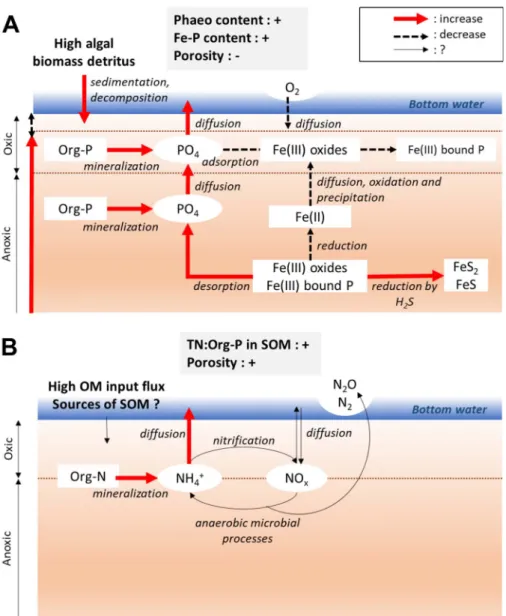
2012 and references therein; Lehtoranta et al., 2009, Rozan et al., 2002]. Thus, surface sediment that is rich in algal detritus would be a more effective source of PO4due to the creation of anoxic conditions and the
subsequent desorption of P (Figure 7A). The solubi-lization of Fe-P has been shown to be a main pro-cess in PO4release in overlying water from sulfidic
sediments during macroalgal blooms [Rozan et al., 2002]. Consequently, sediment that is rich in Fe-P would represent a potentially bioavailable source of P under anoxic conditions. This is in good agreement with our results which identify the Fe-P content as the second main driver, and which was positively correlated with the PO4flux.
In contrast to the previous variables, porosity, the third main driver, was negatively correlated with
Brittany, France July 1985 21 2 Lerat et al. [1990] Marennes-Oléron
Bay, France
Core incubation March 1999 June 1999 138 ± 75∗ 58 ± 25∗ Laima et al. [2002] Rågårdsvik and Bassholmen, Sweden
Core incubation April–June 2000 <70 <5 Sundbäck and Miles [2002] Palmones River, Spain Opaque PVC benthic chamber
May 1997 187 ± 18∗ 1 ± 2∗ Clavero et al. [2000] All incubations were carried out in the dark. NH+4and PO4fluxes are expressed asµmol·m−2·h−1. *When
daily flux was converted into hour assuming a 24 h-period.
the PO4flux. An increase in porosity favors the
dif-fusion of solutes through the sediment [Boudreau, 1996], and as a result, a positive effect on the PO4
fluxes could be expected due to an upward diffusion from the sediment. On the other hand, high poros-ity may also improve the oxygen diffusion across the sediment–water interface [House, 2003]. The ferrous ion (Fe2+) oxidation followed by the re-precipitation of iron oxides at the oxygenated interface, would in-crease the adsorption sites for PO4 [e.g. Krom and
Berner, 1980, Gunnars et al., 2002, Mayer and Jarrell, 2000, Zhang et al., 2010]. This may limit the release of PO4 into the overlying water, thereby explaining
the negative correlation between the porosity and the PO4flux observed in the present study.
4.2. What are the main parameters of surface
sediment driving the NH
+4fluxes?
The parameters selected by the final MLR model for predicting the NH+4 fluxes were the porosity, the TN:Org-P ratio, the chla content and the C:N ratio. Only the porosity and TN:Org-P ratio had a signif-icant effect (F -test p-value < 0.05), and were thus
considered as the key variables for predicting NH+4 fluxes.
Contrary to the PO4flux, the NH+4 flux was
pos-itively correlated with the porosity. When sediment has a high porosity, this likely enhances the diffu-sion of solutes across the sediment–water interface [Boudreau, 1996] including that of NH+4. As discussed above, an increase in porosity could also enhance the oxygen diffusion at the sediment–water interface. This may favor the oxidation of NH+
4by nitrifying
mi-croorganisms, and could therefore increase the ef-fluxes of oxidized nitrogen species (NOx) at the
ex-pense of NH+4 [Capone et al., 2008 and references therein]. In the present study, the impact of nitrifi-cation on the NH+4 fluxes seemed to be negligible as there was neither a negative effect of the porosity on the NH+4 fluxes nor a release of NOx in the overlying
water ([NOx] < detection limit) (Figure 7B).
Conse-quently, the enhanced oxygen diffusion in the upper layer of the sediment due to the increase in porosity would poorly impact the efflux of NH+4in contrast to
that of PO4. This could be explained by the fact that
abiotic Fe2+oxidation, fueling the precipitation of Fe-P, would be faster and less oxygen-limited compared to NH+4oxidation [Canavan et al., 2006].
Figure 7. Stimulation of PO4effluxes by an increase in phaeopigment and Fe-P content, and a decrease in
porosity of surface sediment. A high algal biomass detritus and a low porosity decrease the oxic surface layer of sediment, and modify the anaerobic microbial reduction. This enhances the solubilization of Fe(III)-bound P, and avoids the re-adsorption of PO4on Fe(III) oxides at the interface sediment–water (A).
Stimulation of NH+4effluxes by an increase in TN:Org-P and porosity of surface sediment. Mineralization of SOM rich in N enhances the regeneration of NH+4 in sediment. NH+4 is released to overlying water by diffusion during the core incubation, which largely depends on porosity of sediment. Other changes in microbial N transformations in sediment cannot be stated here (B). Bottom water: nutrient-free and oxygenated artificial seawater used during the core incubations.
The positive correlation observed between the porosity and the NH+
4 flux might also be explained
by the fact that the sediments with higher porosity would be also associated with higher OM input flux,
through the positive and significant correlation ob-served between the porosity and e.g. the TOC content (Table 2). Indeed, an increase in the deposition of OM in the sediment, supported by the river export of fine
of the SOM. SOM that is rich in both N and eas-ily biodegradable compounds enhances the produc-tion of NH+
4 in the sediment via SOM
mineraliza-tion [Capone et al., 2008 and references therein], re-leasing NH+4 into the overlying water (Figure 7B). In coastal systems, the SOM composition depends on a large variability of marine and terrigenous sources of OM [e.g. Carlier et al., 2008, Cook et al., 2004, Dubois et al., 2012]. As a result, the variability of the TN:Org-P ratio in the SOM observed in the present study may be controlled by different OM sources. An increase in the TN:Org-P ratio in the SOM ra-tio could indicate an accumulara-tion of macroalgae in coastal systems. Such a relationship has been ob-served in the Venetian lagoon during the spring and summer [Sfriso et al., 1988]. An increase in this ra-tio could also reflect an anthropogenic N input from riverine particulate matter. This was based on imbal-ances in the N:P ratio observed in watersheds in pre-vious studies, which depend on industrial and agri-cultural activities, and the management policy [Ar-buckle and Downing, 2001, Bouwman et al., 2017, Carpenter et al., 1998, Guenther et al., 2015, Sardans et al., 2012].
4.3. Sedimentary proxies: a good tool to predict
NH
+4
and PO
4fluxes?
We hypothesized that the chla content and the C:N ratio, i.e. tracers of labile OM input fluxes explain the spatial variability in benthic nutrient fluxes and therefore allowing them to be used as proxies. Such correlations between these two parameters and the NH+4and PO4fluxes were shown by Cowan and
Boyn-ton [1996] and Clavero et al. [2000]. In the present study, the chla content and the C:N ratio were se-lected by the final MLR model of the NH+4 flux,
benthic nutrient fluxes to the sedimentary composi-tion.
In the present study, the stepwise MLR allowed to select the best combinations of parameters to pre-dict NH+
4 and PO4fluxes. Nevertheless, only 18 and
24% of NH+
4and PO4flux variations respectively were
explained by our modeling approach. This highlights the difficulty to determine the controls on the ben-thic nutrient fluxes by sedimentary proxies in the intertidal mudflats at the regional scale where the rate deposition of particulate matter is influenced by river discharges, tidal fluctuations and anthro-pogenic pressures [Bauer et al., 2013].
In addition, the contribution of biological pa-rameters was not considered in the present work, which could explain the weak accuracy of prediction for both models of NH+
4 and PO4 fluxes. The NH+4
and PO4 fluxes may be impacted by bioturbation,
through particle reworking and burrow ventilation by the benthic macrofauna [Kristensen et al., 2012]. Bioturbation enhances the solute exchanges between the porewater and the overlying water, affects the re-mobilization of burial OM, and modifies the redox conditions [Graf and Rosenberg, 1997, Welsh, 2003, Kristensen et al., 2012]. The stimulation of NH+4 and PO4 fluxes varies according to the density, the
bur-rowing depth, the ventilation of the benthic macro-fauna, and the specific-site conditions (e.g. sediment components, nutrient concentrations in porewater). The study carried out in four European estuaries by Nizzoli et al. [2007] has shown that the early stage of sediment colonization by the polychaete Nereis spp. stimulated the NH+4 effluxes in all geographical areas (from 1.5 to 4-fold higher) and promoted the sedi-ment to act either as a sink or a source of PO4
accord-ing to the site-specific conditions. This thus leads to shifts in the magnitude of effluxes and ratios of N:P
fluxes which depend on the spatial variability of en-vironmental conditions.
5. Conclusion
The broad sediment sampling carried out at the re-gional scale in the present study has allowed to de-termine the main parameters of the surface sediment driving the NH+
4 and PO4 fluxes. The results have
shown that (1) high phaeopigment and iron-bound phosphorus (Fe-P) contents and a low porosity were related to a high PO4flux, and (2) a high porosity and
TN:Org-P ratio in the SOM were related to a high NH+ 4
flux. The PO4fluxes would be more driven by the
re-dox status of the sediment through the desorption of Fe-P under specific anoxic conditions during the al-gal decomposition. The NH+
4 fluxes would be more
driven by high NH+
4 recycling rates from SOM
min-eralization and high sediment–water exchanges, en-hancing the diffusion of NH+4 to the overlying
wa-ter. The present work has highlighted that the in-teractions between the SOM composition and phys-ical properties in the sediment exert a control on the benthic fluxes. This reflects the connections be-tween the microbial (SOM mineralization), chemi-cal (adsorption–desorption) and physichemi-cal (diffusion) processes (Figure 7). We focussed on the surface sedi-ment characteristics in order to assess the pertinence of these parameters for use as proxies of the NH+4and PO4fluxes. It has underlined that the NH+4 and PO4
fluxes are partially explained by these sedimentary parameters, and we suggest that the spatial variabil-ity of the biological parameters should be considered in future investigations. In addition, in order to bet-ter understand the effect of SOM on benthic nutrient fluxes, the sources of OM in the sediment need to be better discerned in a future work using stable isotope and biomolecular analysis.
Acknowledgments
This work was funded by Loire-Bretagne Wa-ter Agency and the Regional Council of Brittany (France). It was carried out as a part of the IMPRO research project. The authors would like to thank O. Jambon and C. Roose-Amsaleg for their assistance in the field. The CEVA, the Syndicat Mixte EPTB Rance-Fremur, the Pays de Guingamp, the Syndicat Mixte des Bassins du Haut-Léon, the Syndicat des
Eaux du Bas-Léon, Lorient-Agglomération, the Syn-dicat Mixte du SAGE Ouest-Cornouaille (OUESCO), Concarneau-Cornouaille-Agglomération, the Syndi-cat Mixte de la Ria d’Etel (SMRE) and the SyndiSyndi-cat Mixte du Loc’h et du Sal (SMLS) are acknowledged for their help in preparing the field campaign. The au-thors would also like to thank O. Lebeau (Plateforme Isotopes Stables, IUEM) and Marie-Claire Perello (EPOC, University of Bordeaux) for the elemental and particle-size analyses, respectively. S. Mullin is acknowledged for carefully checking the English content. The authors would also like to thank C. Rabouille for his constructive comments and sugges-tions in order to improve the quality of the paper.
Supplementary data
Supporting information for this article is available on the journal’s website under https://doi.org/10.5802/ crgeos.57 or from the author.
References
Ait Ballagh, F. E., Rabouille, C., Andrieux-Loyer, F., Soetaert, K., Elkalay, K., and Khalil, K. (2020). Spatio-temporal dynamics of sedimentary phos-phorus along two temperate eutrophic estuaries: A data-modelling approach. Cont. Shelf Res., 193, ar-ticle no. 104037.
Aller, R. C., Mackin, J. E., Ullman, W. J., Wang, C.-H., Tsai, S.-M., Jin, C., Sui, Y.-N., and Hong, J.-Z. (1985). Early chemical diagenesis, sediment-water solute exchange, and storage of reactive or-ganic matter near the mouth of the Changjiang, East China Sea. Cont. Shelf Res., 4, 227–251. Aminot, A. and Kérouel, R. (2007). Dosage
automa-tique des nutriments dans les eaux marines : Au-tomated determination of nutrients in marine wa-ters. In Méthodes d’analyse en milieu marin, page 188. Ifremer.
Andrieux-Loyer, F., Azandegbé, A., Caradec, F., Philip-pon, X., Kérouel, R., Youenou, A., and Nicolas, J.-L. (2014). Impact of Oyster farming on diagenetic processes and the phosphorus cycle in two estu-aries (Brittany, France). Aquat. Geochem., 20, 573– 611.
Andrieux-Loyer, F., Philippon, X., Bally, G., Kérouel, R., Youenou, A., and Le Grand, J. (2008). Phos-phorus dynamics and bioavailability in sediments
Aspila, K., Agemian, H. Y., and Chau, A. S. (1976). A semi-automated method for the determination of inorganic, organic and total phosphate in sedi-ments. Analyst, 101, 187–197.
Bauer, J. E., Cai, W.-J., Raymond, P. A., Bianchi, T. S., Hopkinson, C. S., and Regnier, P. A. G. (2013). The changing carbon cycle of the coastal ocean.
Na-ture, 504, 61–70.
Boudreau, B. P. (1996). A method-of-lines code for carbon and nutrient diagenesis in aquatic sedi-ments. Comput. Geosci., 22, 479–496.
Boudreau, B. P. (1997). Diagenetic Models and Their
Implementation: Modelling Transport and Reac-tions in Aquatic Sediments. Springer, Berlin,
Hei-delberg.
Bouwman, A. F., Beusen, A. H. W., Lassaletta, L., van Apeldoorn, D. F., van Grinsven, H. J. M., Zhang, J., and van Ittersum, M. K. (2017). Lessons from temporal and spatial patterns in global use of N and P fertilizer on cropland. Sci. Rep., 7, article no. 40366.
Canavan, R. W., Slomp, C. P., Jourabchi, P., Van Cap-pellen, P., Laverman, A. M., and van den Berg, G. A. (2006). Organic matter mineralization in sedi-ment of a coastal freshwater lake and response to salinization. Geochim. Cosmochim. Acta, 70, 2836– 2855.
Capone, D. G., Bronk, D. A., Mulholland, M. R., and Carpenter, E. J. (2008). Nitrogen in the Marine Environment. Elsevier.
Carlier, A., Riera, P., Amouroux, J.-M., Bodiou, J.-Y., Desmalades, M., and Grémare, A. (2008). Food web structure of two Mediterranean lagoons under varying degree of eutrophication. J. Sea Res., 60, 264–275.
Carpenter, S. R., Caraco, N. F., Correll, D. L., Howarth, R. W., Sharpley, A. N., and Smith, V. H. (1998).
Non-J. (2004). Carbon and nitrogen cycling on inter-tidal mudflats of a temperate Australian estuary. III. Sources of organic matter. Mar. Ecol. Prog. Ser., 280, 55–72.
Cowan, J. L. W. and Boynton, W. R. (1996). Sediment-water oxygen and nutrient exchanges along the longitudinal axis of chesapeake bay: seasonal pat-terns, controlling factors and ecological signifi-cance. Estuaries, 19, 562–580.
Dauwe, B., Middelburg, J., and Herman, P. (2001). Effect of oxygen on the degradability of organic matter in subtidal and intertidal sediments of the North Sea area. Mar. Ecol. Prog. Ser., 215, 13–22. Davoult, D., Surget, G., Stiger-Pouvreau, V., Noisette,
F., Riera, P., Stagnol, D., Androuin, T., and Poupart, N. (2017). Multiple effects of a Gracilaria vermicu-lophylla invasion on estuarine mudflat function-ing and diversity. Mar. Environ. Res., 131, 227–235. Dell’Anno, A., Mei, M. L., Pusceddu, A., and Danovaro, R. (2002). Assessing the trophic state and eutrophication of coastal marine sys-tems: a new approach based on the biochemical composition of sediment organic matter. Mar. Pollut. Bull., 44, 611–622.
Dubois, S., Savoye, N., Grémare, A., Plus, M., Charlier, K., Beltoise, A., and Blanchet, H. (2012). Origin and composition of sediment organic matter in a coastal semi-enclosed ecosystem: An elemental and isotopic study at the ecosystem space scale.
J. Mar. Syst., 94, 64–73.
Ekholm, P. and Lehtoranta, J. (2012). Does control of soil erosion inhibit aquatic eutrophication? J.
Env-iron. Manage., 93, 140–146.
Engelsen, A., Hulth, S., Pihl, L., and Sundbäck, K. (2008). Benthic trophic status and nutrient fluxes in shallow-water sediments. Estuar. Coast. Shelf
Enríquez, S., Duarte, C. M., and Sand-Jensen, K. (1993). Patterns in decomposition rates among photosynthetic organisms: the importance of de-tritus C:N:P content. Oecologia, 94, 457–471. Flemming, B. W. (2000). A revised textural
classifi-cation of gravel-free muddy sediments on the ba-sis of ternary diagrams. Cont. Shelf Res., 20, 1125– 1137.
Galois, R., Blanchard, G., Seguignes, M., Huet, V., and Joassard, L. (2000). Spatial distribution of sediment particulate organic matter on two estuarine inter-tidal mudflats: a comparison between Marennes-Oléron Bay (France) and the Humber Estuary (UK).
Cont. Shelf Res., 20, 1199–1217.
García-Robledo, E., Corzo, A., de Lomas, J., and van Bergeijk, S. (2008). Biogeochemical effects of macroalgal decomposition on intertidal mi-crobenthos: a microcosm experiment. Mar. Ecol.
Prog. Ser., 356, 139–151.
Gladyshev, M. I. and Gubelit, Y. I. (2019). Green tides: new consequences of the eutrophication of natural waters (invited review). Contemp. Probl. Ecol., 12, 109–125.
Graf, G. and Rosenberg, R. (1997). Bioresuspension and biodeposition: a review. J. Mar. Syst., 11, 269– 278.
Gu, Y.-G., Ouyang, J., Ning, J.-J., and Wang, Z.-H. (2017). Distribution and sources of organic carbon, nitrogen and their isotopes in surface sediments from the largest mariculture zone of the eastern Guangdong coast, South China. Mar. Pollut. Bull., 120, 286–291.
Guenther, M., Araújo, M., Flores-Montes, M., Gonzalez-Rodriguez, E., and Neumann-Leitão, S. (2015). Eutrophication effects on phyto-plankton size-fractioned biomass and produc-tion at a tropical estuary. Mar. Pollut. Bull., 91, 537–547.
Gunnars, A., Blomqvist, S., Johansson, P., and An-dersson, C. (2002). Formation of Fe(III) oxyhy-droxide colloids in freshwater and brackish seawa-ter, with incorporation of phosphate and calcium.
Geochim. Cosmochim. Acta, 66, 745–758.
Hardison, A. K., Canuel, E. A., Anderson, I. C., To-bias, C. R., Veuger, B., and Waters, M. N. (2013). Microphytobenthos and benthic macroalgae de-termine sediment organic matter composition in shallow photic sediments. Biogeosciences, 10,
5571–5588.
House, W. A. (2003). Factors influencing the extent and development of the oxic zone in sediments.
Biogeochemistry, 63, 317–334.
Keil, R. G. and Hedges, J. I. (1993). Sorption of organic matter to mineral surfaces and the preservation of organic matter in coastal marine sediments. Chem.
Geol., 107, 385–388.
Khalil, K., Laverman, A. M., Raimonet, M., and Rabouille, C. (2018). Importance of nitrate reduc-tion in benthic carbon mineralizareduc-tion in two eu-trophic estuaries: modeling, observations and lab-oratory experiments. Mar. Chem., 199, 24–36. Kristensen, E., Penha-Lopes, G., Delefosse, M.,
Valde-marsen, T., Quintana, C., and Banta, G. (2012). What is bioturbation? The need for a precise def-inition for fauna in aquatic sciences. Mar. Ecol.
Prog. Ser., 446, 285–302.
Krom, M. D. and Berner, R. A. (1980). Adsorption of phosphate in anoxic marine sediments1: Ad-sorption of phosphate. Limnol. Oceanogr., 25, 797– 806.
Laima, M., Brossard, D., Sauriau, P.-G., Girard, M., Richard, P., Gouleau, D., and Joassard, L. (2002). The influence of long emersion on biota, ammo-nium fluxes and nitrification in intertidal sedi-ments of Marennes-Oléron Bay, France. Mar.
En-viron. Res., 53, 381–402.
Le Moal, M., Gascuel-Odoux, C., Ménesguen, A., Sou-chon, Y., Étrillard, C., Levain, A., Moatar, F., Pan-nard, A., Souchu, P., Lefebvre, A., and Pinay, G. (2019). Eutrophication: A new wine in an old bot-tle? Sci. Total Environ., 651, 1–11.
Lehtoranta, J., Ekholm, P., and Pitkänen, H. (2009). Coastal eutrophication thresholds: a matter of sed-iment microbial processes. AMBIO: A J. Human
Environ., 38, 303–308.
Lerat, Y. (1990). Cycles annuels de la matière or-ganique et des éléments nutritifs dans les sédi-ments d’un écosystème côtier (baie de Morlaix, France) interactions avec le compartiment pélag-ique. Thèse de Doctorat en Chimie Marine, Uni-versité de Bretagne Occidentale. Brest.
Lerat, Y., Lasserre, P., and le Corre, P. (1990). Seasonal changes in pore water concentrations of nutrients and their diffusive fluxes at the sediment-water interface. J. Exp. Mar. Biol. Ecol., 135, 135–160. Liénart, C., Savoye, N., Bozec, Y., Breton, E., Conan, P.,
David, V., Feunteun, E., Grangeré, K., Kerhervé, P., Lebreton, B., Lefebvre, S., L’Helguen, S., Mousseau,
Pineau, P., Petit, F., Pujo-Pay, M., Rimelin-Maury, P., and Sultan, E. (2017). Dynamics of particulate organic matter composition in coastal systems: A spatio-temporal study at multi-systems scale.
Progr. Oceanogr., 156, 221–239.
Lorenzen, C. J. (1967). Determination of chlorophyll and pheo-pigments: spectrophotometric equa-tions 1. Limnol. Oceanogr., 12, 343–346.
Mayer, T. D. and Jarrell, W. M. (2000). Phosphorus sorption during iron(II) oxidation in the presence of dissolved silica. Water Res., 34, 3949–3956. Meade, R. H. (1966). Factors influencing the early
stages of the compaction of clays and sands— review. SEPM JSR, 36. https://doi.org/10.1306/ 74D71604-2B21-11D7-8648000102C1865D. Ménesguen, A., Dussauze, M., Dumas, F., Thouvenin,
B., Garnier, V., Lecornu, F., and Répécaud, M. (2019). Ecological model of the Bay of Biscay and English Channel shelf for environmental sta-tus assessment part 1: Nutrients, phytoplankton and oxygen. Ocean Model., 133, 56–78.
Meyers, P. A. (1994). Preservation of elemental and isotopic source identification of sedimentary or-ganic matter. Chem. Geol., 114, 289–302.
Middelburg, J., Klaver, G., Nieuwenhuize, J., Wiele-maker, A., de Haas, W., Vlug, T., and van der Nat, J. (1996). Organic matter mineralization in inter-tidal sediments along an estuarine gradient. Mar.
Ecol. Prog. Ser., 132, 157–168.
Morand, P. and Briand, X. (1996). Excessive growth of macroalgae: a symptom of environmental distur-bance. Botanica Marina, 39, 491–516.
Nedergaard, R. I., Risgaard-Petersen, N., and Finster, K. (2002). The importance of sulfate reduction as-sociated with Ulva lactuca thalli during decompo-sition: a mesocosm experiment. J. Exp. Mar. Biol.
Ecol., 275, 15–29.
management. J. Mar. Syst., 132, 38–53.
Pinay, G., Gascuel, C., Ménesguen, A., Souchon, Y., Moal, M. L., Levain, A., Étrillard, C., Moatar, F., Pan-nard, A., and Souchu, P. (2018). L’eutrophisation:
Manifestations, causes, conséquences et prédictibil-ité. Editions Quae.
Pye, K. and Blott, S. J. (2004). Particle size analysis of sediments, soils and related particulate materi-als for forensic purposes using laser granulometry.
Forensic Sci. Int., 144, 19–27.
Rasheed, M., Badran, M. I., and Huettel, M. (2003). Influence of sediment permeability and mineral composition on organic matter degradation in three sediments from the Gulf of Aqaba, Red Sea.
Estuar. Coast. Shelf Sci., 57, 369–384.
Robertson, B. P. and Savage, C. (2018). Mud-entrained macroalgae utilise porewater and overlying water column nutrients to grow in a eutrophic intertidal estuary. Biogeochemistry, 139, 53–68.
Rozan, T. F., Taillefert, M., Trouwborst, R. E., Glazer, B. T., Ma, S., Herszage, J., Valdes, L. M., Price, K. S., and Luther III, G. W. (2002). Iron-sulfur-phosphorus cycling in the sediments of a shallow coastal bay: Implications for sediment nutrient re-lease and benthic macroalgal blooms. Limnol. Oceanogr., 47, 1346–1354.
Ruttenberg, K. C. (1992). Development of a sequen-tial extraction method for different forms of phos-phorus in marine sediments. Limnol. Oceanogr., 37, 1460–1482.
Sardans, J., Rivas-Ubach, A., and Peñuelas, J. (2012). The C:N:P stoichiometry of organisms and ecosys-tems in a changing world: A review and perspec-tives. Perspect. Plant Ecol. Evol. Syst., 14, 33–47. Sfriso, A., Pavoni, B., Marcomini, A., and Orio, A. A.
(1988). Annual variations of nutrients in the La-goon of Venice. Mar. Pollut. Bull., 19, 54–60.
Smith, V. H., Tilman, G. D., and Nekola, J. C. (1999). Eutrophication: impacts of excess nutrient inputs on freshwater, marine, and terrestrial ecosystems.
Environ. Pollut., 100, 179–196.
Sundbäck, K. and Miles, A. (2002). Role of microphy-tobenthos and denitrification for nutrient turnover in embayments with floating macroalgal mats: a spring situation. Aquat. Microb. Ecol., 30, 91–101. Sundbäck, K., Miles, A., Hulth, S., Pihl, L., Engström,
P., Selander, E., and Svenson, A. (2003). Importance of benthic nutrient regeneration during initiation of macroalgal blooms in shallow bays. Mar. Ecol.
Prog. Ser., 246, 115–126.
Sundby, B., Gobeil, C., Silverberg, N., and Alfonso, M. (1992). The phosphorus cycle in coastal marine sediments. Limnol. Oceanogr., 37, 1129–1145. Therkildsen, M. S. and Lomstein, B. A. (1993).
Sea-sonal variation in net benthic C-mineralization in a shallow estuary. FEMS Microbiol. Ecol., 12, 131– 142.
Valiela, I., McClelland, J., Hauxwell, J., Behr, P. J., Hersh, D., and Foreman, K. (1997). Macroalgal blooms in shallow estuaries: controls and ecophys-iological and ecosystem consequences. Limnol.
Oceanogr., 42, 1105–1118.
Welsh, D. T. (2003). It’s a dirty job but someone has to do it: The role of marine benthic macrofauna in organic matter turnover and nutrient recycling to the water column. Chem. Ecol., 19, 321–342. Zhang, L., Gu, X., Fan, C., Shang, J., Shen, Q., Wang,
Z., and Shen, J. (2010). Impact of different ben-thic animals on phosphorus dynamics across the sediment-water interface. J. Environ. Sci., 22,