Crosslinks: Improving course connectivity
using online open educational resources
The MIT Faculty has made this article openly available. Please share how this access benefits you. Your story matters.
Citation Miller, Haynes, Karen Willcox, and Luwen Huang. "Crosslinks: Improving Course Connectivity Using Online Open Educational Resources." The Bridge, vol. 43, no. 3, 2016, pp. 38-45.
As Published https://www.nae.edu/19582/Bridge/162252/162625.aspx
Publisher National Academy of Sciences
Version Original manuscript
Citable link http://hdl.handle.net/1721.1/117022
Terms of Use Creative Commons Attribution-Noncommercial-Share Alike
Crosslinks: Improving course connectivity
using online open educational resources
Haynes Miller, Karen Willcox, Luwen Huang
The structure of the modern university and the resulting curricular compromises can make it difficult for students to perceive the relationships between the various courses they take, and to integrate their knowledge and skills in a useful way. In this paper we will describe a tool we have developed to help our students cope with this challenge. A student progressing through a university curriculum often experiences a lack of
connectivity. For example, third-year courses tend to abruptly start assuming facility with methods learned as a first-semester freshman, and, as textbook ownership declines,1
the problem of refreshing old knowledge gets more complicated. Conversely, first-year course lecturers often assume either that the material is intrinsically interesting (as it often is for them), or that the students know in advance how important it will later become in their studies. MIT is one example of an institution where these problems occur. Even though MIT is a STEM-oriented institution with a specified collection of core science courses constituting part of the General Institute Requirement and taken (or examined out of) in one form or another by all students, such disconnects are often observed, especially in the transition from core science classes to downstream engineering classes.
Open Educational Resources, freely available on the web, offer a remedy, and students do frequently make use of Google searches and Wikipedia entries. But the range of Open Educational Resources (OER) available to a university student today is bewildering, perhaps nowhere more than in science and technology. A Google search on “eigenvalue learn,” for example, produces 574,000 results, of widely varying quality and relevance and typically without any explicit connection with the actual course material a student has seen.
The authors have sought to address this dual problem of lack of connectivity and
profusion of resources by creating the “Crosslinks” web-based application. In this paper we describe Crosslinks – its rationale, its features, and its history. While the motivations to build this application were originally independent of OpenCourseWare (OCW), Crosslinks now demonstrates an interesting approach to curating OER resources with a specific audience – students looking to refresh or connect topics – in mind.
The Crosslinks website is openly available, at crosslinks.mit.edu, and we invite readers to explore it on their own. It is viewable by the world, and editable by anyone with MIT authentication credentials.
1 See Rebecca Griffiths and Nancy Marron, Open Educational Resources: Nearing a Tipping Point?, this issue.
1. What is Crosslinks?
Crosslinks is a network that represents the relationships among topics and that connects topics to Open Educational Resources. The nodes in the Crosslinks networks are topics. The links in the Crosslinks network represent prerequisite relationships between topics. Each topic has a Crosslinks webpage, which is structured in a uniform way. Figure 1 shows a snapshot of the Crosslinks page for the topic INTEGRATION BY PARTS. After a
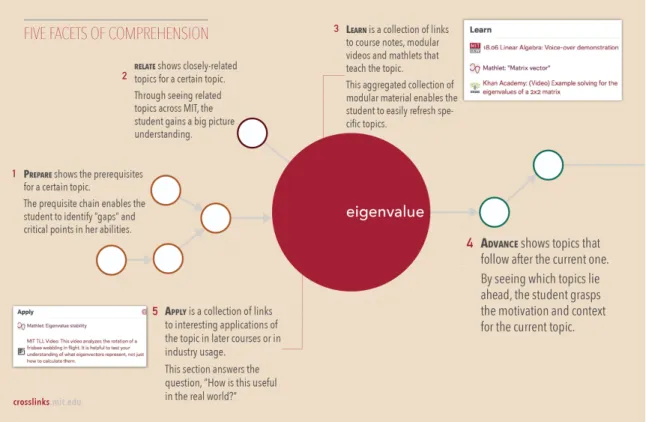
brief phrase describing the concept, along with links to external definitions (such as those in Wolfram MathWorld or Wikipedia), the Crosslinks page provides a set of links related to the topic. As shown in Figures 1 and 2, these links are grouped under five headings, each describing a different function of an educational resource:
• Prepare : prerequisite topics for review
• Learn : resources where the topic might first be learned • Relate : closely related topics
• Advance : other Crosslinks pages that refer back to this one • Apply : examples that use the topic in context.
Figure 1: Links on each Crosslinks topic page are organized into five categories, each representing a different facet of learning.
Figure 2: The Crosslinks page for each topic includes a brief description of the topic and then links to OERs and to other topics, organized by the five sections of Prepare, Learn, Relate, Advance and Apply.
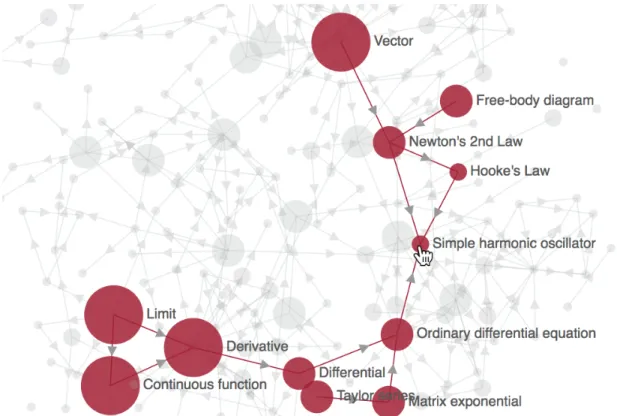
In populating the Crosslinks topics, we focused on basic concepts that tend to be taught in one subject, or by one department, and used in other follow-on subjects, frequently in other departments. As of the writing of this article, Crosslinks contained 340 topics from 18 subjects across six departments at MIT. The resulting topic network can be visualized as in Figure 3. In the figure, each node represents a topic in the Crosslinks collection. The size of the node indicates the number of topics that link back to this node; thus, the larger the node, the more foundational is the topic in the Crosslinks collection. The links
between nodes indicate Prepare-Learn prerequisite relationships. In the example depicted, a mouse-over the topic SIMPLE HARMONIC OSCILLATOR highlights the path of
prerequisite topics: SIMPLE HARMONIC OSCILLATOR depends on ORDINARY DIFFERENTIAL EQUATION, HOOKE’S LAW, and NEWTON’S 2ND LAW, which in turn depend on other
topics, tracing all the way back to the topics of LIMIT, VECTOR, and TAYLOR SERIES.
This example illustrates an important aspect of the Crosslinks project. There are multiple possible representations and interpretations of the learning pathways. The linkages in Crosslinks represent the views of the student contributors, which are often – but not always – formed by the particular way in which a topic is presented in their classes. At MIT, the simple harmonic oscillator is the foundation of the mathematics subject 18.03 Ordinary Differential Equations. But vectors enter only tangentially (and normally); the matrix exponential is not directly connected to the mathematics of the harmonic
oscillator, and while it is certainly an important part of the course it is not introduced by means of the Taylor series. In contrast, a follow-on engineering class in dynamics or control might link these topics together in different ways. For example, engineering classes often do introduce the matrix exponential using the Taylor series. The student’s ultimate view of the linkages is thus some synthesis of their varied learning experiences. In some cases, we found that faculty and students did not agree on the linkages
represented in Crosslinks. Rather than worrying about Crosslinks becoming a vehicle to publishing learning pathways that are “wrong,” we view this as an opportunity to explore student conceptions and misconceptions about the relationships among topics. It is also an excellent opportunity for faculty to discover connections across topics inferred by students, which, as disciplinary practitioners, we perhaps did not appreciate. This point does however emphasize the need for some faculty curation and oversight to help vet the Crosslinks content. As with any wiki, the development of Crosslinks depends upon contributions from all levels of expertise.
A related challenge occurred in the creation of the topic description. In our initial
implementation, we created this piece of material (all other Crosslinks content is external links). This proved to be quite difficult and contentious – and indeed it revealed a number of student misconceptions. In the current Crosslinks implementation, for this brief
description we quote the lead sentence from the corresponding Wikipedia entry or some other authoritative source.
Figure 2: In the Crosslinks network, nodes are topics and links indicate prerequisite relationships between topics. The highlighted path shows the topics on which SIMPLE HARMONIC OSCILLATOR depends.
2. Crosslinks conception and design
The origins of Crosslinks can be traced back to sustained efforts by the first two authors to better connect mathematics and engineering material taught across departments at MIT. Miller had taught the basic ordinary differential equations class 18.03 for several years. This subject was taken by around 85% of MIT undergraduates and by virtually all engineering majors. Miller felt strongly that communication with the engineering faculty was essential to make this class worth the enormous effort it took to run it. This
communication had to go both ways: he asked engineers what parts of the subject were particularly important to them as they taught courses listing 18.03 as a prerequisite, and he sought good examples to use to enliven the mathematics subject. Conversely, it was important that these same faculty know what was actually covered in 18.03, and how, in order to meet their students where they were as they began to take engineering subjects. Willcox, upon joining the MIT faculty as an assistant professor, was alarmed at an apparent lack of mathematical preparation of her aerospace engineering students and a lack of awareness of her faculty colleagues of what and how was taught in prerequisite mathematics subjects. She set about organizing a study of the flow of mathematical topics from the mathematics courses into and through the aerospace engineering major.2
The Crosslinks project emerged from a collaboration between us.
2 Willcox, K. and Bounova, G. “Mathematics in Engineering: Identifying, Enhancing and Linking the Implicit Mathematics Curriculum” Proceedings of ASEE Annual Conference, Salt Lake City, UT, June 2004.
The Crosslinks project was officially launched in 2010, thanks to support from an MIT Alumni Funds Grant. The founding Crosslinks team comprised Miller, Willcox, Heidi Burgiel, a professor of Mathematics at Bridgewater State University who was on
sabbatical leave at OCW, and Chad Lieberman, a former MIT undergraduate who was at the time working with Willcox as a graduate student.
The initial design of Crosslinks was informed by several principles: • The primary target audience was our own residential students.
• While initial motivation was drawn by connecting our own classes in ordinary differential equations and aerospace engineering, we envisioned the list of topics to grow to also cover other aspects of the curriculum.
• We did not want to get into the business of producing new explanatory text; we wanted to use existing material.
• Similarly, we did not intend to create any new learning resources; we simply wanted to link to existing OER.
• Links included in Crosslinks needed to be relatively stable, rather than transient links that would come and go with the semesters.
• The technical implementation needed a low barrier to editing, as a way to encourage sustained student contributions.
With these principles in mind, it was clear that MIT OCW offered a wealth of resources to which Crosslinks pages can link, along with a broad coverage of classes and
departments across the MIT curriculum. These links include both “Learn” resources that explain Crosslinks topics (often occurring in foundational mathematics and physics classes) and “Apply” resources that demonstrate downstream applications (often occurring in engineering classes).
This initial phase of the project resulted in a Confluence Wiki. The page structure was very much as portrayed above. It came online in the fall of 2011. Advertised by posters around campus and in classrooms, it attracted substantial student usage but almost no student contributions. We hypothesize two reasons for the lack of student input. First, and most obviously, the Wiki authoring module was very hard to use. But we think a second factor was in play: Students are very conscious of issues of standing. Were they really in a position to identify some word as a bone fide “topic,” and to identify authoritative links connected with this topic? Apparently the student consensus was, “no.” This led us to a model where we hired undergraduate students as research assistants to help populate the Crosslinks site. Throughout its six-year history, Crosslinks has benefited from a fantastic team of undergraduate research assistants3
, who have created, populated and linked most of the Crosslinks collection. To this day almost all of the entries in Crosslinks have been provided by hired staff, with just a few entries but many more relationships amongst topics created spontaneously by students.
3 Danielle Hicks, Adarsh Jeewajee, Carmela Lao, Czarina Lao, Katherine Nazemi, Emma Nelson and Jenny Sui
To address the concern over the Wiki authoring module, we restructured Crosslinks’ technical architecture. Huang joined the Crosslinks team in 2014 as technology lead, funded by a grant from the Lord Foundation. Crosslinks was reengineered with the goal of student user experience – improving the user interface experience for students accessing resources and also the experience for students contributing content. These design requirements led to the restructuring of Crosslinks as a front-end application (web-based and mobile-responsive) that fetches content data from RESTful web APIs.4
Content data was restructured to be model-based, where topics and topic linkages were stored in a backend service created by the MIT Office of Digital Learning (ODL). This enabled a much more scalable and simplified authoring experience – content was dynamically retrieved from the cloud, and edits were saved back to the cloud. Users could easily select from topics, create linkages and organize topics by subjects.. To discover user difficulties and reduce user interface friction, user experience research was conducted with students, faculty and ODL content experts (“MITx fellows”). Iterative rounds of usability interviews, focus groups and user testing led to the redesigned form and layout as seen in Figure 2. Beyond resulting in marked improvement in student engagement and feedback, the technical restructuring also enabled later implementation of clickstream analytics on individual topics and resulting insight on how students navigate and contribute to Crosslinks.
As time went on, student Crosslinks editors pressed to include material outside of OCW, especially in topics for which OCW material was lacking or deemed by the students to be less useful than other OERs available online. As a result, the Crosslinks collection
includes references to other resources outside of OCW. The Khan Academy videos provide a stable, high-quality set of links. Wikipedia and Wolfram MathWorld, which are both already heavily used by students, are particularly useful in providing links in the brief topic definition. Other outside references are included in the cases that suitable OCW resources didn’t exist, the resource was accurate and of high quality, and there was reason to believe that the link was fairly stable.
Throughout its six-year history, Crosslinks has benefited immensely from collaborations with the MIT Office of Digital Learning Strategic Engineering Initiatives team: Jeff Merriman, Cole Shaw, and Peter Wilkins; and from discussions with Dipa Shah at the MIT Teaching and Learning Lab. In an exciting new development, in March 2016, MIT OCW embedded links to Crosslinks for every OCW course page that has its resources linked as Learn and Apply links within Crosslinks. Users can now browse an OCW course page, navigate to Crosslinks to see the topics covered in that course, see the resource links associated with that course, and navigate to the OERs. This integration5
demonstrates how Crosslinks can be used as a plug-in to an OER repository and enable navigation of OER resources..
3. Crosslinks usage
4 https://en.wikipedia.org/wiki/Representational_state_transfer 5 Carried out by OCW team members Joe Martis and Curtis Newton.
Crosslinks implements custom clickstream analytics on top of the Crosslinks network and five sections to track how users interact with topics and resources. Individual clicks on topics and resources are logged for every visitor session, so that granular interactions can be analyzed on the learner level.
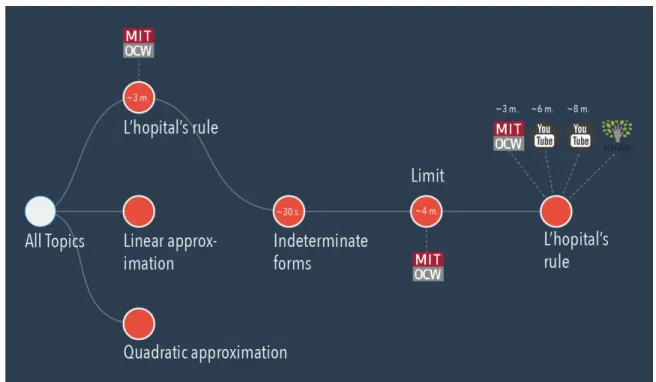
Figure 4: An illustrated path of a user’s clickstream showing the topics visited, resources accessed, and time spent per interaction.
Shown in Figure 4 is a somewhat simplified typical student pathway through Crosslinks. The student first visits the All Topics page, then simultaneously opens up new tabs on
L’HOPITAL’S RULE, LINEAR APPROXIMATION and QUADRATIC APPROXIMATION. The
student accesses the MIT OCW resource and spends three minutes on the topic page before clicking to INDETERMINATE FORMS. There, the student spends 30 seconds, and then
clicks to LIMIT, where the student accesses another MIT OCW resource and spends four
minutes. The student finally clicks back to L’HOPITAL’S RULE and accesses the MIT
OCW resource, YouTube videos, and Khan Academy video for three minutes, six minutes and eight minutes respectively.
These pathways recorded by the custom clickstream analytics enable fine-grained analysis of learner interaction with digital resources. For example, there may be certain sequences of topics that are accessed more frequently than others. As another example, some resources may be consistently more popular than others, but only when accessed in a particular sequence of topics. In the future, these findings can help inform instructional designers and instructors who need to compose programs from OER, and for institutional administrators who need to survey the landscape of their digital resources.
4. Conclusion
As OERs continue to proliferate online, structured ways to visualize and navigate OERs will become more important in order to facilitate their use. Learners, instructional designers and course authors need efficient access to resources. The Crosslinks project provides one way to organize access to OERs, one designed to fulfill the specific goal of helping our students better appreciate the links between the various subjects they study at MIT. The design specifications allowed us to populate most of the site using student workers. Our early vision was that this is a resource “Authored by MIT students for MIT students,” like Wikipedia relying on peer curation to expand and maintain accuracy. Whether Crosslinks reaches that state is still open to question. But in the meanwhile it is providing a valuable resource for our students.