HAL Id: halshs-01584077
https://halshs.archives-ouvertes.fr/halshs-01584077
Submitted on 8 Sep 2017HAL is a multi-disciplinary open access archive for the deposit and dissemination of sci-entific research documents, whether they are pub-lished or not. The documents may come from teaching and research institutions in France or abroad, or from public or private research centers.
L’archive ouverte pluridisciplinaire HAL, est destinée au dépôt et à la diffusion de documents scientifiques de niveau recherche, publiés ou non, émanant des établissements d’enseignement et de recherche français ou étrangers, des laboratoires publics ou privés.
Quantifiers in Dan-Gw��taa (South Mande)
Valentin Vydrin
To cite this version:
Valentin Vydrin. Quantifiers in Dan-Gw��taa (South Mande). Denis Paperno, Edward L. Keenan. Handbook of quantifiers in natural language: Volume II., 2, Springer, pp.203-280, 2017, Handbook of Quantifiers in Natural Language:, 978-3-319-44328-7, 978-3-319-44330-0. �10.1007/978-3-319-44330-0�. �halshs-01584077�
Quantifiers in Dan-Gwɛɛtaa (South Mande)
Valentin VydrinINALCO — LLACAN (CNRS, UMR-8135)
1. Introduction
Dan (South Mande < Southeastern Mande < Mande < Niger-Congo) is a macrolanguage spoken in Côte d’Ivoire, Liberia and Guinea by about 1,600,000 people (2012, my evaluation). In Liberia, Dan are known under the name of Gio; in Côte d’Ivoire they are most often referred to as Yakuba (Yacouba). Since the 1960s, two language norms are being elaborated in Côte d’Ivoire: Western Dan, based on the Blo dialect, and Eastern Dan, based on the Gwɛɛtaa dialect (sousprefecture of Santa, prefecture of Biancouma, Tonkpi province).
In the present paper, I am going to deal with the data of the latter variety. The data have been collected by me mainly in 2013-2014 on the basis of E. Keenan’s The Q book questionnaire; the universal quantfiers’ section was also inspired by Tatevosov’s (2002) study. My corpus of natural and elicited Dan-Gwɛɛtaa texts in the Toolbox format has been abundantly used as well.1
In Section 2, background data on the Dan-Gwɛɛtaa phonology and morphosyntax is presented, which is intended to facilitate understanding of the subsequent sections. In Section 3, core quantifiers are discussed: generalized existential, generalized universal, proportional, morphosyntactically complex. In Section 4, “selected topics” of “The Q book questionnaire” are dealt with: comparative quantifiers, “type 2 quantifiers”, distributive numerals, mass quantifiers and naiscent noun classifiers, existential constructions, bare quantifiers, quantifiers’ scope ambiguities, expression of the meaning ‘only’. In the same section is represented the phenomenon of conversion of D-quantifiers into A-quantifiers with pre-verbial verbs. In Section 5, a summary table of A-quantifiers in Dan-Gwɛɛtaa is given.
2. Background information on Dan-Gwɛɛtaa 2.1. Segmental phonology
Dan-Gwɛɛtaa has 12 oral vowels, 9 nasal vowels, and one defective vowel ŋ.
Oral vowels Nasal vowels
Front Back non-labial
Back labial Front Back non-labial Back labial i ɯ u ŋ ɯ e ɤ o ɛ ʌ ɔ ɛ ʌ ɔ æ a ɒ ɒ
Phonetically long vowels are interpreted as combinations of two identical vowels (rather than long phonemes). There is a trend to phonologization of the mid-closed [ұ] triggered by morphologically conditioned alternation of tones.2 /ŋ/ is a vowel of a limited distribution: it can appear in the feet of the types CVŋ, CVVŋ, ŋ, but not *Cŋ. Nasalization is marked by a lower tilde, in order to leave space above the letter for tonal diacritics.
Consonants
1
In August 2014, the size of this corpus was about 22,000 words. The corpus is constantly growing, for which reason it is difficult to give a more precise figure. Examples from the corpus are provided with references [in brackets]; examples elicitated especially for this study are left without reference.
2 In Dan-Gwɛɛtaa, mid-closed vowels, /e, ɤ, o/, are realized as more closed allophones, [ɩ, ұ, ʋ] under extra-high tone, cf. / / [w gu n n u construction). Among the abovementioned allophones, ұ seems to be on the way to phonogization: so, the neutral aspect form of the verb ɤ [ ұ ] ‘to be afraid’, ɤ , is normally pronounced identically to the verb ɤ ‘to get up early in the morning’ (in both lexical and neutral aspect form). However, some informants can hear the difference between the latter forms (probably, under the influence of the neighbouring dialect of Tee, where the contrast in question seems to be phonological).
Labial Dental Palatal Velar Velar labialized Labiovelar Voiceless stops p t k kw kp Voiced stops b d g gw gb Voiceless fricatives f s Voiced fricatives v z Implosives/sonants ɓ ɗ y w Lateral sonant l
In a nasal foot, any consonant is nasalized; the nasalization is especially prominent for the phonemes /ɓ, ɗ, y, w, gb/ which are represented in this case by their allophones [m, n, ɲ , gm]. Foot-internal -l- is realized as [-r-] when preceded by dental or palatal consonants, and as [-l-] after labial and velar consonants.
2.2. Suprasegmental phonology: tones
There are five level tones: – extra-high: ‘scabies’,
– high: ‘you (pl.)’, the negative imperfective series of pronominal predicative markers, – mid: ‘you (pl.)’, the prospective series of pronominal predicative markers,
– low: ‘to scratch’ (a conjoint construction form), – extra-low: ‘reed’.
There are three modulated tones (all are available on single vowels), they are less frequent than level ones:
– high-falling: gbɛ ‘dog’, – mid-falling:d ‘hunger’,
– extra-high – falling: ɗ ‘extremely ancient’.
Grammatical tones (tonal morphemes) substitute the lexical tone of a word (pɔ ‘to dig’ pɔ ‘to dig’, the neutral aspect) or are suffixed ( pɔ ‘to dig’, the infinitive).
2.3. Syllabic structures allowed in Dan are: V, CV, C1С2V. The only consonant admissible in
the C2 position is /l/, it cannot be preceded by
ɗ,
gw-, l-, v-, y-.The main rhythmical unit is metric foot. The types of feet attested in Dan are: V (including ŋ), CV, CVV, CVŋ, CVVV, CVVŋ, ClV, ClVV, ClVŋ. A foot is characterized by nasal harmony, restrictions on vowel combinations, restrictions on tonal combinations.
2.4. Basic syntax
2.4.1. The basic word order in a simple verbal sentence is (S) PPM (DO) V (X), where S is for the subject, PPM is for the pronominal predicative markers (or auxiliaries, see 2.9), DO is for direct object, V is for verbal predicate, X is for the indirect/oblique object or circumstant. Dan is a null-subject language (explicit presence of a null-subject NP is unnecessary, for the null-subject is indexed in the PPM). Presence of a DO makes a verb transitive; if the DO position is void, the verb is intransitive.
2.4.2. Non-verbal sentences are formed with copulae ɓɯ , ɓ , ɗɛ , ɗɤ (identification, negative identification, presentative, equative) and with PPM (negative identification, locative, qualitative, equative; on PPM, see 2.9.).
Identification, S ɓɯ ‘it is S’ (if the object referred by S is in the range of visibility), S ɓ ‘it is S’ (S is outside the range of visibility). One of the equative sentence type, S ɓɯ OO ‘S is OO’ (OO is for Oblique object), can be regarded as a variety of the identification sentence.
Negative identification, (S) NEG.IPFV ɓɯ ‘it is not S’. Presentative sentence, S ɗɛ ‘here is S’.
In the (affirmative) identification and the presentative sentences, a subject is obligatory and a PPM is missing; all other sentence types in Dan contain a PPM.
Locative sentence, (S) EXI X ‘S is located in X’, the negative counterpart: (S) NEG.IPFV X. Apart from the locative, many other meanings are expressed by this sentence type as well: possessive, equative, physical and psychological states, etc.
Qualitative sentence, (S) EXI ADJ, negative counterpart: (S) NEG.IPFV ADJ. In non-autonomous clauses, EXI are replaced with JNT.
2.5. Noun
Nouns are subdivided into the classes of nouns proper and “locative nouns”. The latter have an emergent inflectional category of case, the former have none.
2.5.1. Locative nouns come from a fusion with postpositions; therefore, they are used in the circumstant function without postpositions (unlike the noun proper). Six morphological cases can be singled out, with a great deal of irregularity in their formation. In more detail, see (Vydrin 2011).
This distinction is valid for both the nouns proper and the locative nouns; it manifests itself in a possessive NP where the possessor (the dependent word) is a person. If the head (the possessum) is a free noun, it is connected to the possessor noun by a connective word (a postposition) ɓ : (1) ɓ ɗʌ -ɗu
NOM.M POSS child-PL ‘Gbato’s children’.
Ɓ is most often replaced by gɔ if the NP appears in the circumstant function:
(2) n gɔ kɔ ɔ ɗɤ
1SG.NSBJ POSS.LOC house.LOC ‘at my home’.
If the possessed noun is relational, there is no connective word: dʌ ‘Gbato’s father’. Most of body part names and kinship terms belong to the class of relational nouns, however, there are some important exceptions: ɗʌ ‘child’, bɛ ɛ ‘nephew, niece (sister’s child)’, u ‘hair (head hair)’, fʌ ‘sweat’ are free nouns, while ɓ ŋ ‘child’ (a synonym of ɗʌ ), ‘body hair’, ‘urine’ are relational.
2.5.3. Standard plural marker is -ɗu which follows the noun. The majority of locative nouns have no plural forms in the oblique cases. The plural marker ɗu at the same time expresses the definiteness.
The plural marker appears preferably with nouns for humans and big (identifiable) animals; it is less used (although, by no means, not prohibited) with names for small animals and inanimate objects whose basic form remains thus neutral to the opposition of singular and plural. On the other hand, plural marker is compatible with mass and liquid nouns, in which case a semantic shift is observed towards the meanings “portions of the substance” (evidently, a distributive meaning, (3)) or “sorts of” (4):
(3) ŋ ŋ -sɯ -ɗu
liana.sp. water viscous.substance-ADJ-PL ‘bowls of sauce of the liana "zan"’ [e4:20].
(4) Bɤ ɤ -ɗu kɔ dɔ , kʌ ɗ .
mud-PL 3PL.JNT house build 3SG INSTR 3PL.IPFV.NEG do so.CLOSE ‘One does not build a house with such sorts of mud’ [f180:7].
With most names of physiological substances and excretions (yɔ ɔ ‘blood’, g ‘excrement’, ‘urine’3), -ɗu may also express the meaning of emphatic plural (‘a great quantity of’):
(5) Ɓɛ yɔ ɔ -ɗu .
human blood-PL 3PL.EXI earth.SUB
(a) ‘There is a great deal of man’s blood on the earth’, or (b) ‘There is blood of several/many persons/animals on the earth’ [f181:1].
A non-numerative expressive meaning of the plural marker should be mentioned: when followed by the universal quantifier g , it may mean ‘and besides’, ‘on the top of everything’ (6). (6) -ɗu g kʌ .
NOM.M-PL all.3SG.PRF do old
‘On the top of everything, Jean has grown old’ (litt.: ‘All the Jeans have grown old’).
2.6. Adjectives
Syntactic functions characteristic of adjectives are: – noun modifier in an attributive NP:
(7) Yʌ ŋ g yɤ fʌ g ɓɛ ɓ . sun.CMM difficult 3SG.EXI sweat bone arrive\NEUT human on ‘Hot sun makes one sweat’ [d162:6].
– predicate in a postpositionless construction:
(8) kɔ yɤ kpʌ ʌ kpʌ ʌ .
1SG.NSBJ hand.CMM 3SG.EXI numb ‘My hand is numb’ [d163:7].
– predicate in a postpositional construction: (9) gɛ yɤ .
3SG.NSBJ foot 3SG.EXI bare with ‘He is barefoot’ [d162:13].
In most cases, both predicative uses of adjectives are more or less equivalent, and sometimes, there are some subtile differences. See in more detail (Vydrin 2007, 2010).
3
For the adjectives, there are semi-regular derivative models for plural and intensive meaning based on reduplication, modification of tones, suffixation and transfixation.
All adjectives have a selective form derived by the suffix –sɯ (homonymous to the gerund suffix and the adjectivizing suffix).
2.7. Determiners, numerals
Determiners is a heterogeneous (by their syntactic behavior) class of semi-auxiliary words which occupy normally rightmost position in a NP. Among determiners, there are articles, focus and contrastive topic markers, quantifiers. On the grammaticalization of demonstrative adverbs to the definite article and demonstrative pronoun/determiner, see 2.10.4.
Cardinal numerals are determiners, they follow the noun. Nouns modified by numerals appear in their single form, and by default, no plural marker is used after the numeral: ɛ ‘two months’. About the context where a numeral is followed by the plural marker, cf. 3.1.1.1.
Ordinal numbers are adjectives. They are derived by the suffix -ɗ (sɔ ɔ ɗ -ɗ ‘the fifth’). Only ‘first’ has a suppletive form, blɛ ɛ sɯ .
2.8. NP structure
The basic word order in a NP is as follows (optional elements are in brackets): (N2 (– Atr – Det)) – N1 – (Atr –Det)
In a genitive-like construction, the head noun follows the dependent one. Genitive constructions are of two types: (a) unmarked: ɗɯ (lit. ‘cassava-tree’) ‘cassava stalk’, and (b) head-marked, where the syntactic connection is marked on the head noun by an extra-low tone: ɗɯ ‘cassava plant’. To the class of genitive-like NPs belong the postpositional NP, where the connection between the constituents is marked by a postposition: ɗ ɤ ɤ ɓ g ŋ g (lit.: ‘raffia.palm – on – caterpillar’) ‘raffia palm caterpillar’. Possessive NP (ɗ ɓ ɗ ‘village chief’s knife’) can be also regarded as a variety of the postpositional NP.
In an attributive construction, the head word precedes the dependent one: gbɛ <dog black> ‘black dog’. In the attributive constructions, determiners (plural marker, definite article, etc.) normally follow the dependent word: gbɛ -ɗu ‘black dogs’, gbɛ ɓ ‘the black dog’. Rather atypically of Mande languages, the plural marker can optionally follow the head word (gbɛ -ɗu ‘black dogs’) or appear in both positions (gbɛ -ɗu -ɗu ‘black dogs’); both strategies are subject to numerous lexical restrictions.
The coordinative NP is constructed with coordinative pronouns, cf. 2.10.
2.9. Pronominal predicative markers (PPM) are auxiliaries (but by no means auxiliary verbs!)
stemming from the fusion of personal pronouns in the subjective function with post-subject auxiliary elements (predicative markers). A PPM appears as a head word of a VP, it is necessarily present in any verbal sentence (while the subject may be null); it is also obligatory in most types of non-verbal utterances. A PPM expresses (alone or in combination with grammatical tones on the verb, verbal suffixes and auxiliary verbs) various TAM meanings and polarity.
Table 1. Pronominal predicative markers (auxiliaries) in Dan-Gwɛɛtaa
Singular Plural Dual Plural
Person, gloss 1 2 3
Logo-phoric 1 ex-clusive inclusive inclu-sive 2 3 Logo-phoric
Existential EXI /ɯ yɤ /yɤ ɤ
Conjoint JNT /ɯ Ø/ɤ /yɤ ɤ Perfect PRF ɓ ɓ Prospective PROS ɓ ɓ yɤ ɤ – – Imperative IMP – Ø/ɓɤ – – – – – Subjunctive SBJV /ɯ Ø/yɤ ɤ Presumptive PRES ɓ ɓ – – Negative imperfective NEG.IPFV ɓ ɓ – – Negative perfective NEG.PFV ɓ ɓ – – Prohibitive PROH ɓ ɓ – –
2.10. Pronouns, Articles, Adverbs
2.10.1. Personal pronouns
Table 2. Personal pronouns in Dan-Gwɛɛtaa
Singular Plural Dual Plural
Person 1 2 3 Refle -xive 1 exclusiv e inclusiv e inclusive 2 3 Refle -xive Non-subject /ɯ /ø ɤ ɗu Possessive ɓ ɯ ɓ ɓ ɤ ɓ ɗ Autonomou s ɓ ɓ yɤ – – Contrastive ɓ ŋ ɓ yɤ ɤ – – Simple co-ordinative –
... ɗu – (... ɗu ) ... ɗu ... ɗu –
Fused co-ordinative
–
ɗu – ɗu ) ɗu ɗu –
Co-ordina-tive porte-manteau yɛ ŋ / yɛ ŋ 1&3 kɛ ŋ / kɛ ŋ 2&3 wɛ ŋ / wɛ ŋ 3&3 – yɛ ŋ ɗu (1&3)+ 3 kwɛ ŋ / kwɛ ŋ 1&2 kwɛ ŋ / kwɛ ŋ ɗu (1&2)+3 kɛ ŋ / kɛ ŋ ɗu (2&3)+ 3 wɛ ŋ / wɛ ŋ ɗu (3&3)+ 3 –
Non-subject pronouns appear in any argument position, with the exception of subject; they can also appear as the dependent member of a genitive-like noun construction. It can be modified by an adjective, in which case the pronoun has a generic meaning (10, 11).
(10) Kɤ ɓ wʌ ʌ g ɗɛ ŋ , ɓ
that that.2SG.SBJV>2SG.NSBJ POSS money loose 1SG.NEG.PFV ɗ wɛ ɛ ɗu
go 3SG.NSBJ other give\INF
‘If you loose your money, I won't give other’ [e4:10].
(11) -ɗ ɓ g , ɗɔ .
3NSBJ –PL.POSS sheep 3SG.PRF die 3PL.PRF 3SG.NSBJ new buy ‘Their sheep has died, they have bought a new one’.
The 3SG non-subject pronoun is on the way of grammaticalization as a prepositional definite article (all other determinants in Dan are postpositional) (12).
(12) Ɓ ŋ ɤ ɤ wɔ yɤ kʌ n kɔ ...
1SG.CNTR self 3SG.NSBJ matter 3SG.EXI RETR 1SG.NSBJ astonish ‘The matter astonished me...’ [D w ].
2.10.2. Interrogative pronouns are used for special questions: ‘who?’, ɓʌ ‘what?’, ɗɛ ‘how many? how much?’, ɓɛ ɛ ‘which?’, ɓɛ ‘where?’. As a rule, they occupy the same position as the substituted word, however, an interrogative pronoun (or a NP containing such a pronoun) can also be realized in leftmost position (which is often connected with relativization), in most cases a resumptive pronoun occupies its syntactic position:
(13) Ɓʌ i ɤ ɯ i yɤ ŋ ?
what REL 2SG.JNT 3SG.NSBJ see.JNT road on ‘What have you seen on the road?’
2.10.3. Demonstrative pronouns, definte articles and adverbs
There are five demonstrative adverbs differentiated according to different parameters: yɤ and indicate a place near the speaker or on equal distance from the speaker and the addressee, within the limits of visibility. Ɓ indicates a place near the addressee, within or outside the visibility of the speaker. Ɓɯ stands for a place outside the visibility of both participants of the communication, which can be described, but not indicated, or designates a movement from the deictic center, with an indefinite final point. T ɗɤ (the intensive form is ɗɤ ) designates a remote object at the limit of visibility or just beyond, it is necessarily accompanied by an indication by hand or by finger.
has undergone grammaticalization into a demonstrative pronoun, and a definite article has evolved from the adverb ɓ . In both cases, a relativization construction is involved, and the relativisation marker can be always restituted in a slow pronunciation:
(14a) kɔ ɤ ɤ /ɓ (14b) kɔ (ɤ ɤ ) /ɓ house REL 3SG.JNT here there house REL 3SG.JNT this ART ‘house which is here/there (near the addressee)’ ‘this house/ the house’.
Another definite article is ɗɔ ɔ . It is used exactly as ɓ , but it is characterized by a limited geographical distribution; unlike ɓ , it seems to be used only in the Gwɛɛtaa dialect. Still another definite article is preceding the defined NP. It results from grammaticalization of the non-subject 3 sg. pronoun and expresses a situative definiteness (“the object may be even not yet mentioned, but it is defined by the general context”).
2.10.4. Other adverbs
There are two productive derivative suffixes of adverbs, -ɗɤ and - ~ -ɓ .
The former one is homonymous to the suffix of the locative case of locative nouns (most probably, both suffixes are etymologically identical). However, the great majority of the -ɗɤ -adverbs are non-motivated, i.e., corresponding suffixless stems are lacking in Dan-Gwɛɛtaa.
The variants of the other suffix go back to two dummy verbs, and ɓ which are practically always interchangeable in Dan-Gwɛɛtaa. – -adverbs go back to adjectives and determiners. The mechanism of this derivation is certainly connected to the very frequently used strategy of focalization of verbs through their nominalization: a content verb can be fronted and converted into a morphologically unmarked verbal noun, while the verbal position is occupied by the dummy verb or ɓ (15a, b).
(15a) Yɤ ɤ tɛ ɛ d blɯ gwʌ gɯ . 3SG.EXI REFL.SG friend push\NEUT stone in ‘He pushed his friend to the stones’ [f4:13].
(15b) Yɤ ɤ tɛ ɛ blɯ ɗʌ gwʌ gɯ .
3SG.EXI REFL.SG friend push FOC 3SG.NSBJ do\JNT stone in ‘What he did is to push his friend on the stones’ [f4:12].
The nominalized verb can have nominal modifiers, as in (16).
(16) ɗu pɛ pɛ ɤ -’ , yɤ
NOM.M 3SG.PRF come each REL.3SG.JNT-3SG.NSBJ. do\JNT 3SG.EXI pʌ ɗɔ .
thing buy\NEUT
‘Every time Gbato comes, he buys something’ (litt.: ‘Every comingi that Gbato does iti, he buys
a thing’).
It is very much in the logic of the Dan-Gwɛɛtaa language that determiners frequently used with nominalized verbs end by merging with the dummy verb which brings forth a subsequent reinterpretation of – /-ɓ as an adverbial suffix, while the verbal noun is again recursively reinterpreted as a verb.
2.11. Verb
2.11.1. Nominalizations
There are following means of nominalization in Dan-Gwɛɛtaa:
— a name of the result of action formed with the suffix -ɗ (homonymous to several other suffixes) which also serves a means of phrasal nominalization;
— a gerund, formed with the marker -sɯ following the verbal stem or the postposition closing the verbal phrase (in the latter case, it serves a means of phrasal nominalization, and the verb acquires an extralow tone which serves a nominalization marker, cf. below). The gerund is used as a verbal noun and as a participle (in the attributive construction);
— a supin formed with the suffix – ; — a masdar formed with the suffix -ɗɛ ;
— an extralow grammatical tone on the verbal root marking nominalization with the retention of the post-verbal arguments.
2.11.2. Reduplication
There are two types of verbal reduplication in Dan-Gwɛɛtaa, full and partial.
The first type implies a complete reduplication of a verbal stem (the preverb included, the inflexional suffixes not included; the tonal contour is maintained). This reduplication expresses pluractionality (repetition of the action and/or plurality of the direct object/subject of intransitive verb), cf. (17a, b).
(17a) ɓ ʌ ʌ ɗ . NOM.M 3SG.PRF wound extinguish ‘Gbato has washed a wound with warm water’. (17b) ɓ ʌ ʌ -ɗu ɗ -ɗ .
NOM.M 3SG.PRF wound extinguish-extingush ‘Gbato has washed (numerous) wounds with warm water’.
In the second case, only the vowel of the verb is copied, so that it becomes triple: g ‘to pull’ g , gɔ ɔ ‘to wrestle’ gɔ ɔ ɔ , ɗ ʌ ʌ ‘to walk’ ɗ ʌ ʌ ʌ . The partial reduplication has an intensive meaning: ‘to pull’ ‘to pull with a force and for a long time’; ‘to wrestle’ ‘to wrestle with intensity’; ‘to walk’ ‘to walk excessively’ (about a prostitute; or about a child who is never seen at home).
Both types of reduplication concern only a minority of verbs (about a third of the entire list each).
2.12. Focalization strategies
1) The main means of contrastive focalization is the particle ɗʌ (with a dialectal variant ɗɯ ). It follows the focalized NP which is fronted. There are two kinds of fronting: the focalized NP can be brought to the sentence-initial position (see ex. (18), where the focalized NP is co-referent with the DO expressed by a resumptive pronoun), or fronted within its argumental position (see ex. (19), where the focalized NP is followed immediately by the resumptive pronoun in the DO position).
(18) dʌ i ɗʌ ɤ i ɗɛ i tɔ .
3SG.NSBJ father FOC 3SG.JNT 3SG.NSBJ call\JNT 3SG.NSBJ name with ‘It is his father he adressed by name (once)’ [e16:13].
(19) Yɤ ɓ ŋg i ɗʌ i ɓɤ .
3SG.EXI mango unripe.fruit FOC 3SG.NSBJ eat\NEUT ‘It is an unripe mango he has eaten’ [e11:9].
To focalize a verb, the following procedure is used: the verb is nominalized (through conversion), and the NP with the nominalized verb as a head is focalized and put in the position of a DO of the dummy verb or ɓ (see (15b)).
2) There is a specialized series of personal pronouns (“the autonoumous series”, see 2.10) whose primary function is the focalization.
There are two suffixes of selectivity: -ɗ is added to adjectives, and the “actual selectivity” suffix –sɯ is added to nouns or adjectives. In both cases, forms with such suffixes are obligatorily followed by the focalization particle ɗʌ .
2.13. Relativization
There are two relativization strategies.
1) Correlative strategy: a full-fledged relativized NP, followed by the relative conjunction ɤ (sometimes kɤ ), appears in the leftmost position in the subordinated clause. The relativized NP is resumed in its own syntactical position in the subordinated clause by a PPM or a non-subject pronoun; it is resumed again, by a PPM or a non-subject pronoun, in the main clause. The relative clause can be put either to the left of the main clause (20), or embedded into the main clause (21); in the latter case we have a typologically rare clause-internal correlative strategy typical of South Mande languages (see in particular Nikitina 2012). If the relative clause precedes the main clause, the relativized NP can be repeated in the main clause (22), necessarily with a definite article (let us remember that the construction “noun + definite article” is in Dan-Gwɛɛtaa also a reduced relative clause); such a repetition produces an emphatic effect.
(20) [Wɯ i ɤ -sɯ ] yɤ ɯ ɗu
meat REL.3SG.JNT smell-ADJ with CONS 2SG.JNT come\JNT
i ?!
3SG.NSBJ with Q
‘But how, you have brought a meat that stinks?!’ [e5:9].
(21) Yɤ ɓɛ ɛ n ɗɛ [n i ɤ gbɤ
3SG.EXI beg\NEUT 1SG.NSBJ before 1SG.NSBJ theft REL 3SG.NSBJ son
ɤ ɓ ɓ ] i wɔ gɯ .
3SG.JNT 3SG.NSBJ remove\JNT ART 3SG.NSBJ matter\IZF in
‘He is imploring me about the matter of a theft commited by his son against me’ [e10:1].
(22) [Ɗ ʌ ɤ ɓlɯ ], ɗ ʌ ɓ
woman REL. 3SG.JNT rice boil\JNT 1SG.EXI woman ART
dɔ .
‘The very woman who has cooked rice, I know her’ [f187:6].
2) Left-side relativization: the relativized noun is preceded by a nominalized verb (the nominalization is marked by an extra-low tone on the verb if it is separated from the relativized noun by a OO or circumstant; otherwise, the nominalization remains morphologically unmarked). The relative clause appears in a reduced form; pronominalized subject and direct object are omitted.
3. Core quantfiers
3.1. Generalized Existential (Intersective) Quantifiers
3.1.1. D-quantifiers
The basic strategies for the expression of existential quantification are:
— bare NP that can express indiscriminately singular, plural or mass meanings (it can be said that the bare form has a neutral number meaning). The plural marker ɗu is normally not used if the plural meaning is already expressed by a numeral or another determiner; with names of pair body parts; most often, it is not used with names of inanimate objects, insects or small animals (percieved as “lacking individual identity”); in fact, ɗu expresses jointly the meanings of plurality and referentiality (see in more detail 2.6.2.). A bare NP in the subject position controls most often a singular PPM, although a semantic agreement by number is also possible (a bare NP may control a plural PPM).
— a NP with definite articles ɓ , ɗɔ ɔ (to the right of the NP) or (to the left of the NP), see 2.10.3.
— indefinite determiner ɓ appears in practically all indefinite and negative contexts, in particular:
a) specific unknown:
(23) Ɓɛ ɓ ɗu ɯ wɔ gɯ .
human certain 3SG.PRF come 2SG.NSBJ affair in ‘Someone came after you’.
b) interrogative context:
(24) Ɓɛ ɓ wɔ dɔ ɗɛ ɓ ɗ dɛ ɛ ? human certain 3SG.PRF affaire know that 2SG.PROS go today ‘Does anybody know that you are leaving today?’
c) conditional:
(25) Ɓ ɓ ɤ -g - ʌ ŋ dɔ ɓɛ 2SG.PROS 1SG.POSS iron-bone-horse borrowing put human
ɓ ɓ , pɤ n .
certain on 3SG.NSBJ say 1SG.NSBJ eye.COM ‘If you are going to lend my bike to anybody, tell me’.
d) indirect negation (the negation is in the main clause, and the indefinite determiner is in the dependent clause):
(26) n ɗɛ ɓɛ ɓ
3SG.NEG.IPFV 1SG.NSBJ eye.COM that human certain 3SG.PRF ɗu .
come
‘I don’t think that anybody has come’.
e) clause depending on implicitly negative verb:
(27) zɒ ɒ ɗɛ ɓɛ NOM.M 3SG.PRF deny that 3SG.NEG.PFV see human ɓ ɓ .
certain on road on
‘Gbato has denied (falsely) he had met anybody on the road’.
f) in the typical context “specific known”, ɓ appears in the expression ɓ ɤ ɓɯ , litt. ‘certain who is there’ (28).
(28) Ɓɛ ɓ ɤ ɓɯ yɤ pɤ
human certain REL.3SG.JNT there 3SG.EXI 3SG.NSBJ say\NEUT
yɤ ɤ n ɗ sɯ .
3SG.PROS 1SG.NSBJ daughter take
‘Someone (“certain person who is there”) says, he is going to marry my daughter’.
About the expression of the negative universal meaning by ɓ and its usage in the free choice contexts, see 3.2.1.6.
ɓ is not allowed in only two contexts typical for indeterminate pronouns in other languages: — non-specific irreal; in this case, the noun is used without determiners:
(29) g ɗ -ɗʌ . 1SG.NSBJ give knife-DIM with ‘Give me any whatever knife (you have)’.
— a standard for comparison, in which case the NP is used either in its plural form ((30b), the plural marker ɗu being, in fact, a determiner too), or with the universal determiner g (30a).
(30a) Yɤ ŋ sɯ ɤ ɤ ɤ
3SG.EXI running take\NEUT 3SG.JNT pass\JNT with REFL.SG ɓ g .
age-mate all on
‘He runs faster than all his age-mates’, or
(30b) Yɤ ŋ sɯ ɤ ɤ ɤ
3SG.EXI running take\NEUT 3SG.JNT pass\JNT with REFL.SG ɓ -ɗu .
age-mate-PL on
‘He runs faster than his age-mates’.
Numerals ɛ ʌ g ɤ ɔ ɔ ɗ ɒ ɒ ɒ ɒ ɛ g ɤ ɒ ɒ ŋ ɒ ɒ ŋ ɤ g ɒ ɒ ŋ ɤ g ɛ ɒ ɒ ŋ ɤ g g ɒ ɒ ŋ ɛ ɒ ɒ ŋ ɛ ɤ g ɒ ɒ ŋ ɛ ɤ g ɛ ʌ ɒ ɒ ŋ g ɒ ɒ ŋ ɤ ɒ ɒ ŋ ɤ ʌ ŋ ʌ ŋ ɛ g ɯ g ɯ ɛ g ɯ ɒ ɒ ŋ 100 000 gblɯ kʌ ŋ g ɯ ɓɛ ɛ
As it was mentioned in 2.7, cardinal numerals function as determiners. A noun with a numeral normally lacks plural marking or any other determiner: pʌ g ‘three things’. On the other hand, a numeral can have a plural marker, in which case it acquires an ‘exactly’ interpretation (it can be regarded as contrastive focalization of the numeral):
(31) P s -ɗu ɓɛ g -ɗu u . policeman-PL 3PL.PRF thief three-PL catch
‘The policemen caught exactly three thieves’ (the context: One knows that three thieves have fled a prison. One learns that, later on, the police have caught thieves. It is not clear whether these are the same thieves or not, but the number of the thieves is the same as of those who had fled) [f181:3].
A noun determined by a numeral can appear with a definite article. More precisely, in this case we have a leftside transposition of the noun with the article, with its substitution by a resumptive pronoun which is determined by the numeral (32). The construction has a partitive meaning.
(32) ɓ sɔ ɔ ɗ ɗɛ ŋ . policemen ART 3SG.NSBJ five 3PL.PRF loose ‘Among the policemen, five have got lost’.
Other existential quantifiers in Dan-Gwɛɛtaa also follow the noun. The meaning of ‘several’, ‘a couple of’, ‘a few’ is expressed by the morphologically complex determiners ɗʌ ɓ <child/diminutive marker-some> (33) and sɛ ɛ ɗʌ ɓ <small-some> (34), the latter includes however a semantic component of evaluation, ‘less than expected’. With uncountable nouns, it expresses the meaning ‘a small quantity of’.
(33) kʌ ʌ ɗʌ ɓ ɗɔ . NOM.M 3SG.PRF hoe a.little buy ‘Gbato has bought several hoes’.
(34) kʌ ʌ /ɓlɯ sɛ ɛ ɗʌ ɓ ɗɔ . NOM.M PRF hoe/rice small other buy
‘Gbato has bought several hoes’/‘Gbato has bought a small quanitity of rice’.
Ɗʌ ɓ can be followed by the plural marker which seems to produce no effect on the semantics of the construction:
(35) kʌ ʌ ɗʌ ɓ -ɗu ɗɔ . ‘Gbato has bought several hoes’.
Interrogatives: the cardinal meaning ‘how many? how much?’ is expressed by the determiner
ɗɛ , and the intersective meaning ‘which?’ by ɓɛ ɛ . The determiners are often followed by the focalization particle ɗʌ (36, 37), although this is not obligatory (38, 39).
(36) Ɓ ɗɛ ɗʌ ɗ blɛ ɛ gɔ ?
sheep how.many FOC 3PL.JNT save\JNT dry.season PP ‘How many sheep have survived the dry season?’
(37) ŋ ɗʌ ɓɛ ɛ ɗʌ g ɓɛ ? formation child which FOC 3PL.JNT examination pass\JNT ‘Which students have passed the exam?’
(38) Yɤ kʌ ɤ - ɗɤ ɓ , ɗʌ ɗɛ
CONS.3SG.JNT do 3SG.JNT-3SG.NSBJ do\JNT so.REM there child how.many
ɤ ɯ gɔ ?
3SG.JNT 2SG.NSBJ PP
‘And so, how many children have you got?’ [Sumaoro].
(39) Wɔ dɔ ɔ dɔ ɔ sɯ ɓɛ ɛ ɤ gɯ ? matter clinging which 3SG.JNT go.up\JNT 3SG.NSBJ in here ‘What is the very sticky matter that he is stuck in?’ [e2:16].
When used in the adverbial function, ɗɛ stops to be a quantifier; it expresses instead the meanings ‘why?’ and ‘how?’.
Value judgement D-quantifiers
Morphologically simple modifiers are: gbɛ ‘many’ (40) and also ‘enough, sufficient’ (41), kɛ ɛ ~ ‘few’ ((31), probably, from the noun kɛ ɛ ‘hull, peel, shell’), sɛ ɛ ɗʌ ‘few’ (also ‘small’, the latter meaning being a default one).
(40) Ɓɛ gbɛ ɗ gblɯ ɓ , ɓɛ kɛ ɛ ɗʌ ɗu .
human many 3PL.PRF go war on human several FOC 3PL.JNT come\JNT ‘Many people have gone to the war, few have come back’.
(41) yʌ kʌ ɓɛ gbɛ sɯ kɤ ɓ zɯ -ɓ .
1PL.EXCL.PRF worker many take that 3PL.SBJV field new bottom-remove ‘We have hired enough workers to launch a new plantation’.
‘few, rare’ (42) results from reduplication (accompanied by a tonal modification) of the numeral ‘one’. Its semantics has evolved from a distributive meaning ‘one by one’. When following a pluralized NP (in which case we have a construction with a partitive meaning), d has a non-value judgement meaning ‘certains, some’ (43).
(42) Ɓɛ ɗʌ ɗɤ ɓɛ ɓ dɔ - human rare FOC 3PL.JNT go\JNT thief ART know-INF ‘Few are those who know the thief’ [f154:10].
(43) Yɤ ɓɛ -ɗu dɔ .
3SG.EXI human-PL rare know\NEUT ‘He knows certains among the people’.
A value judgment meaning “few” can be also rendered by an expression with a negatively polarized item (NPI) tɤ ŋ ɓ ɯ (which could be dubitatively translated as ‘multitude’) appearing only in negative sentences (44) and in subordinate clauses whose main clauses are negative (45a) to express the meaning of ‘a couple, a small number’. In other contexts typical of NPI (general question (45b); conditional sentences) tɤ ŋ ɓ ɯ is not allowed.
(44) -` ɤ ŋ gbɛ ɗɔ , kɛ ɛ
1SG.EXI-3SG.NSBJ at 1SG.SBJV machete numerous buy\JNT but
ŋ tɤ ŋ ɓ ɯ gɔ .
‘I wanted to buy many machetes from him, but he had only a couple’.
(45a) n ɗɛ
3SG.NEG.IPFV 1SG.NSBJ eyes.COM that NOM.M yɤ ɗɤ kʌ ʌ tɤ ŋ ɓ ɯ ɗɔ -
3SG.EXI go\NEUT hoe multitude buy-INF ‘I doubt that Jean would buy many hoes’.
(45b) * yɤ ɗɤ kʌ ʌ tɤ ŋ ɓ ɯ ɗɔ - ? NOM.M 3SG.EXI go\NEUT hoe multitude buy-INF Q ‘Will Jean buy many hoes?’
The quantifier gbɛ can add the plural marker, in which case the quantifier acquires an intensive meaning: blɯ kʌ ɓɛ gbɛ -ɗu ‘very many hunters’.
3.1.2. A-quantifiers
The cardinal numerals can be used in the post-verbal (adverbial) position to express a multiplicative meaning (46, 47).
(46) Ɓ ɯ ɓ ɗ ʌ ɓ . 1SG.PRF see 2SG.NSBJ POSS woman on one ‘I have seen your wife once’.
(47) sɔ ɔ zʌ g . 3SG.PRF cane.rat kill three
‘He has killed cane rats thrice (in his life)’ [d85:15].
Other determiners that can function as both D- and A-quantifiers are gbɛ ‘much’ (48), sɛ ɛ ɗʌ ‘little’ (49), and ‘occasionally, from time to time, with intervals’ (50).
(48) Ɗʌ -ɗu g - ʌ gbɛ kɔ ɓ . child-PL 3PL.EXI yell-DUR much house behind ‘Children yell much behind the house’.
(49) ɓ ɗɛ ŋ -ɗu pʌ ɓɤ sɛ ɛ ɗʌ . 2SG.NSBJ POSS guest-PL 3PL.EXI thing eat\NEUT little ‘Your guests eat little’.
(50) gbɤ blɛ ɛ sɯ yɤ n ɗɛ ɤ ɤ kɛ ɛ
1SG.NSBJ son first.ADJ 3SG.EXI 1SG.NSBJ call\NEUT often.INT but
ɓɛ dɔ ɤ yɤ n ɗɛ .
human put 3SG.NSBJ at 3SG.EXI 1SG.NSBJ call\NEUT from.time.to.time ‘My first son calls me often, and the next one calls me from time to time’.
Ɗʌ ɓ ~ ɗʌ ɓ ɓ ‘a little’ is derived from the D-quantifier ɗʌ ɓ by the means of the adverbial suffix - ~ -ɓ (cf. in more detail 2.10.4). It expresses only the meaning of low intensity of action (or quality), and has no meaning of ‘small number of actions’ (that could be expected, taken into account the meaning of the original D-quantifier).
(51) ɓ yɤ ɗʌ ɓ ɓ .
3SG.NSBJ POSS cow 3SG.EXI white a.little ‘His cow is whitish’ [f157:10].
Other cardinal A-quantifiers are:
— ʌ ɤ can express both low frequency (‘sometimes, from time to time’) and high frequency of events (‘often’), cf. (52). In order to remove the ambiguity, one can combine ʌ by the adverb , and the combination of both adverbs expresses the meaning ‘from time to time, rarely’, cf. (53);
— ʌ ʌ ~ ɤ ɤ ‘often, frequently’ can be regarded as a reduplicated form of ʌ . Unlike the latter, ʌ ʌ is not ambiguous and refers only to the events of a high frequency, cf. (54);
— d ‘completely, utterly’ ‘often’ (55), ‘for a long time’ (56) and ‘a lot, in a great number’ (57). This lexeme also has non-quantifying modal meanings ‘very, very much’, ‘seriously’, ‘well’, ‘certainly’, ‘truly, indeed’. It is derived by the adverbial suffix from the determinant ‘self’.
1SG.EXI 1SG.NSBJ human-PL greeting-remove\NEUT sometimes ‘I visit my relatives from time to time/often’.
(53) gbɤ yɤ yʌ kʌ ɓ ʌ .
2SG.NSBJ son 3SG.EXI work do\NEUT field.LOC sometimes one.by.one ‘Your son works in the field rarely/from time to time’.
(54) Sʌ ʌ yɤ tɔ ʌ ʌ .
sparrowhawk 3SG.EXI 1PL.EXCL.NSBJ chicken steal\NEUT often ‘A sparrowhawk often steals our chickens’.
(55) Kɛ ɛ -kʌ -g ɓ yɤ ɓɔ - . threat-do-mask ART 3SG.EXI appear\NEUT true-ADV ‘This attacker mask appears often’ [e11:4].
(56) Yɤ dɔ n gɔ - ɗ ɤ . 3SG.EXI put\NEUT 1SG.NSBJ PP true-ADV yesterday ‘Yesterday he waited for me for a long time’ [f9:15].
(57) yɤ dɤ ŋ ɗ ɤ -sɯ ɤ gɔ
NOM.M 3SG.EXI trap set-GER with REFL.SG POSS.LOC ɗɛ ŋ ɗɤ - .
hamlet.LOC true-ADV
‘Kese has set traps a lot in his remote field’ [e18:15].
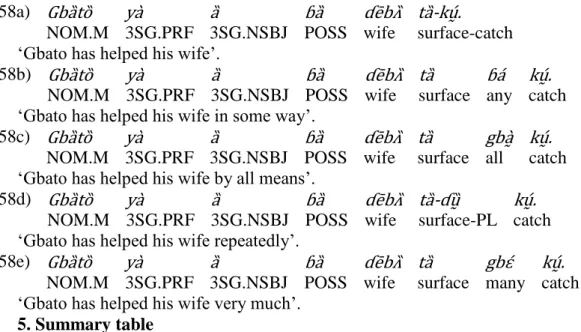
A syntaxically complex A-quantifier ʌ tɤ ŋ ɓ -ɗu gɯ <sometimes-time-certain-PL-in> expresses the meaning ‘often’ (however, less frequently than gbɛ , the latter may designate that events happen practically without intervals, while ʌ tɤ ŋ ɓ -ɗu gɯ implies intervals).
(58) Ɓ ɗʌ -ɗu n ɓ ʌ tɤ ŋ
1SG.POSS child-PL 3PL.EXI appear\NEUT 1SG.NSBJ on sometimes time ɓ -ɗu gɯ .
certain-PL in
My childen visit me often : .
A syntaxically complex NPI quantifier tɤ ŋ gɯ <time in> is used in negative sentences and expresses the meaning ‘(too) few, insufficiently’ (59, 60).4 It is not allowed in other contexts typical of NPI elements (general question; dependent clause with a negation in the matrix clause, etc.). (59) Ɓɛ tɤ ŋ gɯ .
human 3SG.NEG.IPFV time in ‘People are too few’ [f158:5b].
(60) Ɗ tɤ ŋ gɯ . rain 3SG.NEG.PFV rain time in ‘It rained insufficiently’.
3.2. Generalized universal (Co-intersective) Quantifiers
3.2.1. Universal D-Quantifiers
There are two determiners expressing universal quantifying meanings, g which is an “all-type” modifier, and pɛ pɛ ~ pɛ ɛ which is a distributive (“every/each-“all-type”) modifier. Apart from this, universal meanings can be expressed by two syntactically complex quantifiers: a reduplication of the determined noun with the connective morpheme (primarily a free choice meaning), and the expression ɤ ɗɤ (distributive and free choice meanings). Certain combinations of these means are also possible. Besides, meanings contiguous to universal quantification are expressed by some constructions with the indefinite determinanant ɓ .
In this section, the semantics and contexts of use of these means will be analysed in more detail. 3.2.1.1. g is the default universal “all-type” quantifier capable to appear also, marginally, in distributive and free choice contexts. It is used mainly as a determinant of a NP which can be pronominalized, in which case we have a partitive construction (61a).
(61a) Ɗɔ ɔ kwʌ ʌ -ɗɤ , ɤ ɤ ɗɔ ɔ gu sʌ , kʌ market-LOC fish market be.PST\NEUT good 1SG.EXI RETR
4
If the noun tɤ ŋ has a nominal or pronominal dependent to the left, it is interpreted in a non-idiomatic way, ‘in the time of X’.
g ɗɔ .
3SG.NSBJ all buy\NEUT
‘In the market, fish was not expensive, I bought it all’.
The determined NP can be sometimes (not always!) omitted, cf. (61b). (61b) Ɗɔ ɔ ʌ ʌ -ɗɤ , ɤ ɤ ɗɔ ɔ gu ʌ ,
market-LOC fish market be.PST\NEUT good 1SG.EXI ʌ g ɗɔ .
RETR all buy\NEUT
‘In the market, fish was not expensive, I bought all’.
In (61a), the referent object (fish) is definite (a particular lot of fish is meant), while in (61b) it appears more vague.
The NP determined by g may have a plural marker ɗu which ifluences the semantics of quantifier (see below).
When followed by the predicative marker of the perfect series 3SG or 3PL , it optionally fuses with them producing the form g .
(62) B g ɓ . darkness all.3SG.PRF put yere ‘It has got quite dark there’ [D w 12].5
(63) Ɓɛ g dɔ gɛ ɛ ŋ ɗɤ . human all.3PL.PRF stand fixedly
‘Everyone was striken by stupor (after springing to one’s feet)’ [B182:5]. 3.2.1.1.1. CMP-quantification
expresses the meaning ‘entire, whole’ when the determined NP is single and definite. The definiteness can be expressed by various means, such as the definite article ɓ (64), the demonstrative determiner (65a), a possessor (66).
(64) Ɗɛ kpɒ ɒ ɤ ŋ gɯ ɓ ɗ ʌ
day four between NOM.M POSS woman 3SG.PRF ɗɯ ɓ g gɤ .
treee ART all burn
‘During four days, Gbato’s wife burnt the entire tree’. (65a) Ɓ kɔ g g .
1SG.PRF house this all daub ‘I have daubed all this house’.
(66) Ɗ ʌ ɓ yɔ g ɤ ɗɛ g ɓ . woman ART 3SG.PRF oil daub REFL.SG place all on ‘The woman has smeared her entire body with oil’.
If the NP determined by g has no definiteness markers, both CMP and collective readings are possible (65b).
(65b) Ɓ kɔ g g . 1SG.PRF house all smear
(i) ‘I have daubed the entire house’ or (ii) ‘I have daubed all the houses’.
The CMP meaning is also available if the subject NP designs a complex object, contains no plural marker -ɗu , and the auxiliary (co-referent with the subject) is singular:
(67) Pɤ ɗɛ g gɤ . village.CMM all 3SG.PRF burn ‘The entire village has burnt’.
Cf. example (68) where a NP with similar characteristics appears in a position other than that of a subject (therefore, no auxiliary is available to remove the ambiguity), which makes the collective reading the only one possible.
(68) u ɓ ɗ wɔ wɔ kɔ ɗ g . prefect 3SG.PRF affair lie family all on ‘The prefect has punished all families’.
5
In the example 62 g expresses a high degree of intensity. This meaning seems to be reserved to this particular expression (‘quite dark’), it does not appear in other similar contexts.
Single object nouns may require a noun classifier word in order to express the CMP meaning of g : g ‘carcass, body’ (69a), bɤ ɤ ‘one bunch’ (69b), ɓɛ ‘fruit’ (70a):
(69a) tɔ g g ɓɤ . NOM.M 3SG.PRF chicken body all eat ‘Gbato has eaten the entire chicken’.
(69b) tɔ bɤ ɤ g ɓɤ . NOM.M 3SG.PRF chicken bunch one all eat id.
(70a) Ɗ ɗ ɓɛ ɤ g yɤ wʌ ʌ kʌ ŋ
pineapple fruit REL.3SG.JNT here 3SG.NSBJ all 3SG.EXI money hundred .
one
‘The price of the entire pineapple is 500 francs’.
The wholeness meaning can be emphasized through adding a gerundive expression ɗɤ -sɯ , lit. ‘remaining so’ (ɗɤ ‘so’ is an adverbial; in Dan-Gwɛɛtaa the gerundive marker -sɯ is normally added to the verb, and when a verb has an adverbial, to the adverbial):
(70b) Ɗ ɗ ɓɛ ɤ g
pineapple fruit REL.3SG.JNT here 3SG.NSBJ all remain\NMLZ ɗɤ -sɯ yɤ wʌ ʌ kʌ ŋ .
so.REM-GER 3SG.EXI money hundred one ‘The price of the complete pineapple is 500 francs’.
3.2.1.1.2. Universal quantification of referent sets, the collective meaning (DEF- and
INDEF-quantification
The collective meaning of g is realized when the preceding NP has no definiteness marker (with some exceptions, see below). If the NP appears in the subject position, the co-referent auxiliary is necessarily plural (otherwise, the CMP reading is preferable). If the NP designates a set of objects with clearly defined limits, it normally has a plural marker -ɗu and expresses a definite universal meaning, cf. (71a). If it refers to a set with vague limits, the plural marker is absent (71b), and the indefinite universal meaning is expressed.
(71a) Ɗ ʌ -ɗu g ɗu kwʌ ʌ ɗɤ . woman-PL all 3PL.PRF come RECP.LOC
‘All the women gathered’ (e.g., all the members of an association). (71b) Ɗ ʌ g ɗu kwʌ ʌ ɗɤ .
woman all 3PL.PRF come RECP.LOC ‘All women gathered’.
In the former case, the limits of the group are clearcut (all the members of the association are known, and it is easy to establish that nobody is absent), and in the latter case, they are vague (it may be all women of a village, and some “natural” absentees, e. g. sick or too old people, can be easily disregarded).
Thus, if the plural marker of the subject noun in (72a) is omitted (?gɔ g ɯ ɯ ), the resulting sentence is hardly acceptable, as far as the space of the house where the elder entered defines the limits of the group of the men (“those who are in the house”).
(72a) Gɔ -ɗu g wlɯ ɯ kɤ pɤ -dʌ
male-PL all 3PL.PRF rise still village-father 3SG.PRF kɔ ɔ -ɗɤ .
go.up house-LOC
‘All the men rose when the elder entered the house’.
To the contrary, in (72b) the referent group is represented by the men of a village, and the limits of this set are vague: evidently, there may be some disabled or sick people who belong to the class of the men of the village but they will hardly go to the war, and therefore are disregarded. As a result, the subject NP carries no plural marker.
(72b) Gɔ g wlɯ ɯ . male all 3PL.PRF rise
In the sentence (73), the referent group is “all those who are present at the moment of the accident”. The absence of the plural marker on the subject ɓɛ is indicative of the fact the group is perceived as open6.
(73) Yɤ ɓɛ g g bɔ -sɯ ɓ . CONS human all 3PL.JNT put\JNT crying pass-GER on ‘Then everybody started crying’ [ ʌ ].
In certain contexts the opposition of definiteness (i.e., the clearcut or vague nature of its limits) seems to be irrelevant for the referent group, in such cases the presence or absence of the plural marker is optional (74a, b).
(74a) g zʌ . leopard 3SG.PRF cow all kill ‘A leopard killed all the cows’.
(74b) -ɗu g ʌ ‘id’.
Inanimate nouns realizing their wholeness meaning with count words (cf. 69, 70) represent a special case. When count words are missing, g with such nouns expresses the collective meaning, and when the plural marker is missing, the noun is definite, and the auxiliary is singular (75). 7 (75) Ɗ ɗ g yɤ wʌ ʌ kʌ ŋ .
pineapple this 3SG.NSBJ all 3SG.EXI money hundred one ‘The price of all these pineapples is 500 francs’.
Although the plural marker ɗu expresses at the same time the meaning of definiteness, it is not incompatible with the definite article ɓ (76), however no NP with both a plural marker and an article followed by the universal quantifier g appears in my corpus.
(76) -gɯ -ɓɛ -ɗu ɓ kʌ -
prison-in-human\IZF-PL ART 3PL.EXI RETR flee\NEUT road this-3SG.NSBJ .
on
‘The prisoners fled away by this road’.
3.2.1.1.3. Quantifier g with uncountable nouns
In Dan-Gwɛɛtaa most of mass and liquid nouns have alternative readings (realized when the plural marker is added, cf. 2.6.3) ‘sort of X’ and ‘a recepient of X’. Used with the quantor g , these nouns without plural marker and definiteness markers designate the entireness of the quantity available:
(77) g ɓɯ . NOM.M 3SG.PRF water all drink ‘Gbato has drunk all the water’.
(78) ɓ ɗʌ sɔ g ɗ - u . 2SG.NSBJ POSS child 3SG.PRF cloth all dirt-catch ‘Your child has dirtied all the clothes’.
(79) ɓlɯ g . 1PL.EXCL.PRF rice all cut ‘We have mowed all the rice’.
If such a NP appears in the subject position, it is resumed by a singular auxiliary: (80) g .
coffee all 3SG.PRF spoil ‘All the coffee has spoilt’.
3.2.1.1.4. The distributive meaning of g
constructions with distributive and collective meanings do not differ formally, they depend on the general context. The referent group can be definite (if the NP has the plural marker ɗu , as in
6
However, it should be mentioned that the use of the word ɓɛ ‘man, human’ without plural marker in combination with g is preferable even in the contexts where, according to the general rule, one would expect -ɗu . This particularity should be probably explained through lexicalization.
7
The subject NP looks like a left-dislocated topic, however, this interpretation is not necessarily correct. In fact, the demonstrative determiner stems from a demonstrative adverb used in a non-verbal relative clause (see 2.10.3.), and it is necessarily followed by a 3SG nonsubject resumptive pronoun (it can be elided, but its structural slot is there). Therefore, in the synchrony, this construction can be viewed as sufficiently grammaticalized and non-topical.
(81, 82b)), in which case we have a partitive construction, or indefinite (withouth plural marker, cf. (82a)).
(81) Pɤ -ɗu g gɤ . village-PL all 3PL.PRF burn
‘All the villages (of the canton) have burnt (one by one)’.
(82a) g ɗu pɤ ɗɛ g gɯ yɤ 1PL.EXCL.EXI stop\NEUT village.CMM all in CONS
gɔ .
1PL.EXCL.JNT vehicle prepare\JNT
‘We stopped in each village to repair the car’.
(82b) g ɗu pɤ ɗɛ -ɗu g gɯ yɤ 1PL.EXCL.EXI stop\NEUT village.CMM-PL all in CONS
gɔ .
1PL.EXCL.JNT vehicle prepare\JNT
‘We stopped in each village (without exception) to repair the car’.
In (81) the distributive meaning is combined with partitive (‘all of the villages’). If the plural marker is removed (Pɤ g gɤ ), we get a collective reading with a reference to an indefinite group with vague limits: ‘villages have burnt all at once, and the group of the villages which have burnt is not predefined’.
In (82b), the situation is represented in a way that the travellers stopped punctiliously in every village they met, in order to delve into raparation works, so that the entire set of the villages was brought into play. (82a) interpretes the situation in a more realistic way: the travellers stopped many times, however, the speaker does not pretend that each village on the road was marked this way.
If necessary, the distributive meaning can be reinforced lexically, through the abovementioned adverb in its distributive meaning ‘one by one’.
(83) Ɗ ɗ (ɓɛ ) g sɯ kɤ ɯ g . pineapple fruit all take one.by.one that 2SG.SBJV 3SG.NSBJ see (Here is a pile of pineapples, some are rotten.) ‘Take each pineapple and examine it’. 3.2.1.1.5. Generic quantification
g -constructions for generic quantification are formally similar to those for INDEF-quantification. Normally, the NP defined by g has no plural marker, and when it occupies the subject position, the plural auxiliary is used.
(84) ɗʌ g ɓɔ g ɓ . cat all 3PL.EXI appear\NEUT leopard on ‘All cats resemble leopard’.
(85) ɗʌ g ɓɔ kwʌ ʌ . cat all 3PL.EXI appear\NEUT RECP.SUB ‘All cats are alike (resemble each other)’.
(86a) Ɓʌ ŋ g ɗɔ ɔ dɔ ɓɛ -ɗu . Jula all 3PL.EXI merchant-PL with ‘All Jula8 are merchants’.
Sometimes a generic reading is allowed for a NP with the plural marker (86b, 87), however, it coexists with a specific (definite) interpretation which is preferable.
(86b) Ɓʌ ŋ -ɗu g ɗɔ ɔ dɔ ɓɛ -ɗu . Jula-PL all 3PL.EXI merchant-PL with
‘All Jula are merchants’, two interpretations: (i) all the Jula who are included into a particular group of people are merchants; (ii) all Jula of the world are merchants.
(87) Wɯ ɗɔ yɤ ɗʌ (-ɗu ) g kʌ . meat desire 3SG.EXI child(-PL) all do\NEUT
‘All children like meat’, with two interpretations: (i) all the children who are in the group in question; (ii) all children of the world.
3.2.1.1.6. g in the free choice context
When the free choice meaning (‘any’) is expressed, the NP defined by g carries no plural marker (88), and when this NP occupies the subject position, the auxiliary is singular (89, 90).
(88) Ɗʌ ɤ yɤ ɗɤ ɓɛ g
child REL.3SG.JNT here 3SG.EXI go\NEUT human all
8
sʌ ʌ -ɓ -
tiredness-remove-INF
‘This child will tire anyone’.
(89) Wɯ g yɤ ɓɤ -pʌ . meat all 3SG.EXI eat-thing\IZF with ‘Any meat is edible’.
(90) Ɓɛ g yɤ ɓɔ ɔ ɓ ɤ yʌ
human all 3SG.EXI can\NEUT 3SG.NSBJ on 3SG.JNT work ɓ kʌ .
ART do\JNT
‘Any person can do this job’.
The singular auxiliary is the most remarkable feature of the free choice construction with g distinguishing it from the DEF- and GEN-constructions. For example, the singular auxiliary allows the free choice reading in (91a).
(91a) Ɗ ʌ g yɤ -sɯ . woman all 3SG.EXI untruth-ADJ ‘Any woman is a liar’.
If the singular auxiliary is replaced by the plural one, the meaning of the construction is generic. (91b) Ɗ ʌ g -sɯ .
woman all 3PL.EXI untruth-ADJ ‘All women are liars’.
So, a singular form of the auxiliary excludes all other interpretation, apart from the free choice one, the inverse is not true: a plural form of the auxiliary does not necessarily exclude the free choice reading in an appropriate context, cf. (92).
(92) Ɗɔ ɔ -ɗɔ -ɓɛ g ɗɤ -
market-buy-human\IZF all 3PL.EXI go\NEUT-3SG.NSBJ
pɤ - ɯ ɓ ɗɔ ɔ yɤ g .
say-INF 2SG.NSBJ POSS market 3SG.EXI difficult ‘Any buyer will tell you that your goods are overpriced’.
If the semantics of the predicate (e.g., a reciprocal one) implies necessarily more than one participant, the plural auxiliary and even a plural marker on the subject NP may be obligatory and compatible with the free choice meaning (93).
(93) Tɒ ɒ ŋ ʌ -ɗu g gɯ - .
friend-PL all 3PL.EXI PL.REFL RECP.CMM voice inside-hear\NEUT ‘Friends always understand each other’ (any couple of friends).
Lexical means, such as the noun ‘sort’, can be brought to play in order to avoid ambiguity in favour of the free choice interpretation (94).
(94) Yɤ yʌ g kʌ . 3SG.EXI work sort all do\NEUT
(Context: Jean horribly needs money.) ‘He catches at any job’.
Among all the contexts where the free choice meaning can be expected on typological grounds (Tatevosov 2002, 147-155), g expresses it in the following ones: modal probability (88, 90, 92), non-prospective future and habitual (94), generic (91a, 93).
3.2.1.1.7. Summary: formal means and semantics of the g -construction
Table 3. Semantics of the g -construction in relation with the character of the NP and the choice of the auxiliary
Semantics of the construction Form of the NP Auxiliary
Quantification of definite groups, collective meaning (DEF-quantification)
plural (-ɗu ) plural
Distributive meaning, definite plural plural plural
Quantification of indefinite (referent) groups, collective meaning (INDEF-quantification)
singular plural
Distributive meaning, indefinite group singular plural
Quantification of generic sets (GEN-quantification) singular plural
Free choice meaning singular singular (plural
allowed) Wholeness (CMP-quantification) singular, definite; count singular
words
Uncountable nouns (masses, liquids) singular singular
3.2.1.2. pɛ pɛ ~ pɛ ɛ , a distributive modifier
Among both variants of the determiner, in my corpus the full one (pɛ pɛ ) is much more frequent than the shorter one.
Most often, pɛ pɛ appears together with g (see in detail 3.2.1.3); in this section, however, an autonomous use of pɛ pɛ (without g ) will be dealt with. pɛ pɛ has a distributive meaning, and it can also appear in the free choice contexts (both meanings being pretty close, they are sometimes
difficult to delemit).
The NP determined by pɛ pɛ may have or miss the plural marker ɗu , and when this NP occupies the subject position, the auxiliary may be plural or singular. These factors seem to be independent of the semantics of the construction (unlike the g -construction), they are rather determined by general rules of the expression of plural in Dan-Gwɛɛtaa: for the names of human beings, the plural marker ɗu is rather obligatory; for the animals it is optional (for big “individualizable” animals it is preferable); for small animals and insects, as well as inanimate nouns, it is rarely used. If a subject NP has a marker ɗu , or if it represented by a coordinative construction, the auxiliary is obligatorily plural; otherwise, more complex rules are brought into play.9
3.2.1.2.1. The distributive meaning of pɛ pɛ
Most often, the distributed set to which refers the NP determined by pɛ pɛ has indeterminate meaning (95), sometimes generic (96).
(95) Ɗ ɗ ɓɛ pɛ pɛ sɯ kɤ ɯ g . pineapple fruit every take that 2SG.SBJV 3SG.NSBJ look ‘Take every pineapple and examine it’ (every pineapple that you find). (96) Ɓʌ ŋ (-ɗu ) pɛ pɛ ɗɔ ɔ dɔ ɓɛ .
Jula(-PL) every 3PL.EXI merchant с ‘Every Jula is a merchant’.
However, one can found in natural texts some instances of NP with a reference to semantically definite grops with clear limits (97).
(97) Ɓ sɛ , g ŋ sɛ ɤ ɤ sɛ ,
Man land.CMM Biancouma.LOC land.CMM 3SG.and Sipilou land.CMM
-ɗu ɓ bɛ yɤ -sɯ Gwɛ ɛ
3SG.NSBJ-PL POSS writing 3SG.EXI put-GER with Gwɛɛtaa voice gɯ , yɤ pɛ pɛ ɤ ɗʌ ŋ sɛ gɯ , in CONS voice every REL.3SG.JNT Danane land.CMM in
-ɗu ɓ ɗɤ gɯ .
3SG.NSBJ-PL property be Blo voice in
‘The departments of Man, Biancouma, Sipilou have their writing in the Gwɛɛtaa dialect, and each of those who are in the Danane department, their writing is in the Blo dialect’ [Pamɛ1_1w n_ta ng.014].
3.2.1.2.2. Use of pɛ pɛ in free choice contexts
Among all the contexts where one would expect the free choice meaning on the typological grounds (Tatevosov 2002, 147-155), constructions with pɛ pɛ realize it only in two ones, habitual (98-100) and generic (101-103).
(98) yɤ pɛ pɛ ɓɯ .
NOM.M 3SG.EXI water every drink\NEUT ‘Gbato drinks any water’.
In this particular case, noun appears in its countable meaning ‘sort of water’; see 2.6.3 about such a semantic shift of mass and liquid nouns in the pluralizing context.
(99) Yɤ yʌ pɛ pɛ kʌ . 3SG.EXI job every do\NEUT ‘He catches on any job’.
9
(100) Ɓ ɗʌ gblɯ yɤ ɤ - ʌ , yɤ 1SG.POSS child stomach 3SG.EXI pass-DUR 3SG.EXI
yɤ pʌ pɛ pɛ ɤ ɗ .
remain\NEUT 3SG.EXI thing every rise\NEUT REFL.SG mouth ‘My child has diarrhea often, (because) he puts everything in his mouth’. (101) Wɯ pɛ pɛ yɤ ɓɤ -pʌ .
meat every 3SG.EXI eat-thing\IZF с ‘Any meat is edible’.
(102) ɗʌ pɛ pɛ yɤ kpɤ ŋ ɯ . cat every 3SG.EXI sly ‘Any cat is sly’.
(103) Ɓɛ pɛ pɛ g -ɓɛ . human every 3PL.EXI death-human\IZF with ‘Any human is mortal’.
The determiner pɛ pɛ is inherently distributive, it does not appear with collective predicates. 3.2.1.3. Combination of g and pɛ pɛ : an emphasis
Both determiners can go together, in any order: g ɛ pɛ or pɛ pɛ g (in natural texts the sequence g ɛ pɛ seems to be preferable, while pɛ pɛ g is used more rarely and is percieved as more fanciful). In this combination, pɛ pɛ looses its individualization function and becomes an intensifier of g communicating the meaning of completeness: ‘all without exception’, ‘altogether’. (104) g pɛ pɛ ɓɯ .
NOM.M 3SG.PRF water all every drink ‘Gbato has drunk all the water’ (nothing is left). (105) ɗɔ yɤ gɔ g pɛ pɛ kʌ .
wine desire 3SG.EXI male all every do\NEUT ‘All the men (without exception) like palm wine’.
This “heavy” form tends to erode its intensive meaning, so that some people use g in combination with pɛ pɛ more often than alone10
, as in (106).
(106) ɓ yɤ pʌ -ɗu ɓ ɤ -ɗu g pɛ pɛ immediately CONS thing-PL ART REL.3SG.NSBJ-PL all every ɤ slɔ ɔ
3SG.JNT find
‘Immediately, all these things that were found...’ [Dɯ wɔ ].11
The usages of the combination g ɛ pɛ are the same as those of g alone; in any case, I have not found any divergence.
3.2.1.4. Reduplication with the connective morpheme ( -reduplication): the free choice
meaning
3.2.1.4.1. The structure and the syntax of the -reduplication construction
The noun undergoes a full reduplication, and the connective element is inserted between the reduplicands.
(107) Ɓɛ ɓɛ ɤ ɗu ,
human any human REL.3SG.JNT come\JNT 1SG.EXI
ɗ ɓ -
go\NEUT 3SG.NSBJ beat-INF ‘Whoever comes, I’ll beat him/her’.
The sequence of two reduplicands and their connective element should be undoubtedly interpreted as three words, rather as bound morphemes. An argument against the interpretation of this sequence as a single word is a possibility to define each reduplicand by an adjective (108a), or even by two adjectives (108b), or by a determiner (109).
(108a) Gbɛ zɒ ɒ ɗ gbɛ zɒ ɒ ɗ , sɯ . dog red any dog red 3SG.NSBJ take
10
So, in the autobigraphical narrative by Daan Dua (the entire volume of the text is 3438 words), the combination g ɛ pɛ occured 9 times, while the quantifier g alone appeared 4 times.
11
In (106), we have a partitive construction, ‘all of the things in question’, where the noun pʌ -ɗu ‘things’ has a definite article ɓ which is regularly introduced through a relative clause followed by a resumptive pronoun; see2.10.3.
‘Take any red dog’.
(108b) Gbɛ zɒ ɒ ɗ sɛ ɛ ɗʌ gbɛ zɒ ɒ ɗ sɛ ɛ ɗʌ ɗu , dog red small any dog red small 3SG.PRF come
ɓ kʌ .
1SG.PROS 3SG.NSBJ do
‘Whatever small red dog comes, I'm going to chase it away’.
(109) pʌ ɓ pʌ ɓ ɓɤ .
NOM.M 3SG.NEG.PFV thing certain any thing certain eat
‘Jean has eaten nothing (among all the kinds of food which were offered)’ [f186:7].
Prototypically, -reduplication concerns nouns, however reduplication can also affect the determinative ɗɛ ‘other’ following the head noun (110) or, in negative contexts, ɓ ‘any, other’ (111).
(110) Yɤ dɔ ɗɛ ɗɛ ɤ ɗɤ
3SG.EXI know\NEUT gravy other any other REL.3SG.JNT be
kʌ -ɗɛ .
3SG.NSBJ do-MSD with ‘She can cook any gravy’.
(111) Kɔ ɓ ɓ gɤ , kɤ
house certain any certain 3SG.NEG.PFV burn that 3SG.NEG.PFV kʌ n ɓ .
do 1SG.NSBJ one with
‘No house burnt, except for mine’.
It seems that we observe here a lexicalization of ɗɛ ɗɛ and ɓ ɓ as quantifier expressions.
-reduplication is possible for verbs, in this case the verb is nominalized and fronted, while its syntactic position is occupied by one of the dummy verbs or ɓ . However, not all the verbs are available for this construction (presumably, the limitation is of a lexical nature).
(112) Ɗ ɗ ɤ - gɯ ,
go any go REL NOM.M-3SG.NSBJ do\JNT walking in
yɤ ɗu n .
3SG.EXI come\NEUT 1SG.NSBJ gift with
‘Any time Jean goes to a trip, he comes back with a gift for me’.
The -reduplicated construction is often fronted (113) or relativized in situ (114), which reflects its pragmatically enhanced status.
(113) Tɔ tɔ , ʌ yɤ ɓɤ . chicken any chicken mangoose 3SG.EXI 3SG.NSBJ eat\NEUT ‘A mangoose eats any chicken’.
(114) Yɤ ɤ kʌ kɔ kɔ ɤ -
3SG.PROS do way.CMM any way.CMM REL.3SG.JNT-3SG.NSBJ
ɓ , g wɔ ɗʌ - ɓ .
on death affair\IZF FOC remain\JNT-3SG.NSBJ on ‘However may it be, death will come anyway’ [f48:6].
It seems that even when formal means of relativization (the relative marker ɤ , the 3SG auxiliary of the conjoint set ɤ , the resumptive personal pronoun) are absent (as in (115a)), we have cases of their omission typical of the allegro style (which is also attested in other constructions, such as focalization phrase, where the relativization mechanism is used). In a more careful pronunciation, these elements reappear (115b).
(115a) Ɓ pʌ pʌ ɓɤ , g ɗʌ ɓ 1SG.PRF thing any thing eat 1SG.EXI cat property ɗu .
give\NEUT
‘Whatever I eat, I give to the cat its part’.
(115b) Ɓ pʌ pʌ ɤ ɓɤ ,
1SG.PRF thing any thing REL.3SG.JNT 3SG.NSBJ eat 1SG.EXI g ɗʌ ɓ ɗu .
cat property give\NEUT ‘Id.’