Applications of Genetic Programming to Parallel
System Optimization
by
Robert William Pinder
Submitted to the Department of Electrical Engineering and Computer
Science
in partial fulfillment of the requirements for the degree of
Master of Engineering in Computer Science and Engineering
at the
MASSACHUSETTS INSTITUTE OF TECHNOLOGY
@
Massachusetts Institute
May 2000
of Technology 2000.
All rights reserved.
Author .
Department of Electrical Engineering and Computer Science
December 15, 1999
Certified by...
Martin C. Rinard
Assistant Professor
Thesis Supervisor
Accepted by ...
Arthur C. Smith
Chairman, Department Committee on Graduate Students
ENO
MASSACHUSETTSINSTITt
OF TECHNOLOGY
Applications of Genetic Programming to Parallel System
Optimization
by
Robert William Pinder
Submitted to the Department of Electrical Engineering and Computer Science on December 15, 1999, in partial fulfillment of the
requirements for the degree of
Master of Engineering in Computer Science and Engineering
Abstract
The parallel computers of the future will be both more complex and more varied than the machines of today. With complicated memory hierarchies and layers of parallelism, the task of efficiently distributing data and computation across a par-allel system is becoming difficult both for humans and for compilers. Since parpar-allel computers are available in many different configurations, from networked worksta-tions to shared memory machines, porting to new parallel systems is also becoming more challenging. In order to address these problems, this research seeks to develop a method of automatically converting generic parallel code to efficient, highly opti-mized, machine-specific code.
The approach is to use genetic programming to evolve from the initial parallel program an augmented, performance efficient version of the program specific to the target system. Specifically, the evolutionary system will evolve for every loop a dis-tribution algorithm and a configuration for the work disdis-tribution. These algorithms map each iteration of the loop to a specific thread assignment. The algorithms are then inserted into the code along with the necessary parallel constructs. The overall work distribution of which processors are available to each loop is also evolved in or-der to minimize communication costs and delays. Results show a factor of two speed increase on some tests, and in nearly all cases the system evolved solutions with mea-surable performance improvements over the best known hand-coded methods. Also, the evolutionary system often derived solutions that solve the scheduling problem in an unintuitive way. The evolutionary system proved to be an effective technique for optimizing work scheduling in parallel systems.
Thesis Supervisor: Martin C. Rinard Title: Assistant Professor
Acknowledgments
This research would not have been possible without the help of many others. First and foremost, I would like to thank Greg Gaertner of Compaq Computer Corporation. Without his mentorship, advice, and assistance none of this work would have been possible. Also, I would like to thank my manager Greg Tarsa also of Compaq for providing the necessary resources. I am also indebted to Jim Moore of Compaq, whose advice and intuition on genetic algorithms helped me avoid many possible pitfalls. While I can not list all of my Compaq coworkers, I would like to thank all of them for their selfless assistance whenever I needed help. I would also like to thank Professor Martin Rinard of MIT for serving as my academic advisor.
No project that I ever complete in my lifetime could have been done without the loving support of my parents and siblings. This thesis document is no exception.
I would also like to thank Yee Lam, Phil Sarin, and Christian Carrillo, for their
encouragement, goading, and thoughtful advice, respectively. Finally, I would like to thank Phil Ezolt, Jeremy Lueck, and Chris Rohrs for their help and making my stay at Compaq an enjoyable one.
The software for this work used the GAlib genetic algorithm package, written by Matthew Wall at the Massachusetts Institute of Technology.
Contents
1 Introduction
1.1 The Problem with Parallelization . . . 1.2 An Evolutionary Proposal . . . .
1.3 Related Work . . . . 1.4 Document Overview . . . .
2 Code Generation
2.1 Overview . . . . 2.2 Generic Parallel Programs . . . .
2.3 The Components . . . .
2.3.1 Abstract Parallel Representation
2.3.2 Target Architecture Description
2.3.3 Distribution Algorithms . . . . 2.3.4 Loop Entities . . . . 2.3.5 Thread Teams . . . . 2.3.6 Implementing Parallelism . . . 3 The 3.1 3.2 Evolutionary System
Introduction to Genetic Programming . . . . System Design: The Symbiotic Genetic Algorithm . . . . .
3.2.1 Genetic Representation of Distribution Algorithms
3.2.2 Genetic Representation of Thread Teams . . . .
3.2.3 The Symbiotic Genetic Algorithm . . . .
a 11 . . . . . . * 11 . . . . 13 . . . . . . . 14 . . . . 15 17 . . . . .. - 17 . . . . 18 . . . . .. 19 . . . . 19 . . . . 20 . . . . 2 1 . . . .I . . . 22 . . . . 23 . . . . 25 29 . . . . 29 . . . . 30 . . . . 31 . . . . 32 . . . . 33
3.3 The Search Space . . . .. 35
3.4 Algorithm Tuning and Calibration of Parameters . . . .. 39
3.4.1 Standard Crossover Techniques are Used . . . . 40
3.4.2 Mutation is Minimized . . . . 40
3.4.3 Replacement Strategy: Direct Removal or Elitism . . . . 41
3.4.4 Multiple Tests Improve Fitness Calculations . . . . 41
3.4.5 Criteria for the Objective Function and Selection Techniques 42 3.4.6 Effects of Altering the Initial Population . . . . 42
3.4.7 Population Size and Generation Number . . . . 43
4 Results 45 4.1 O verview . . . . 45
4.2 Results of Initial Trials . . . . 45
4.3 Convergence Properties . . . . 47
4.3.1 Non-optimal Convergence Goal . . . . 47
4.3.2 Mutation Rate Has No Effect . . . . 49
4.3.3 Large Populations for Many Generations Produce Good Results 50 4.3.4 Replacing Half the Population is Ideal . . . . 51
4.4 Other Test Environments Results . . . . 52
4.4.1 Shared Memory Applications Have Varied Results . . . . 54
4.4.2 The GA Optimizes Mixed-mode Parallelism . . . . 59
4.4.3 Large Cluster Execution . . . . 62
4.4.4 The Evolutionary System is Not Data Dependant . . . . 66
4.5 Target Architectures . . . . 71
4.5.1 Altering the Target System Causes Adaptive Behavior . . . . 71
4.5.2 GA Adapts to Heterogeneous System . . . . 72
5 Conclusions 75 5.1 O verview . . . . 75
5.2 Shortcom ings . . . . 75
5.2.2 Failures . . . . 77
5.3 Suggestions for Future W ork . . . . 78
List of Figures
2-1 Serial, Loop, and Parallel Nodes in an example program . . . .
2-2 Fortran code with directives to generate example APR . . . .
2-3 An Expression Tree: CR refers to the current iteration, and MX the maximum number of iterations. . . . . 2-4 A Thread Team for a four processor system . . . .
2-5 A Sample APR and the Associated Thread Teams and Distribution
A lgorithm s . . . .
3-1 A Single Global Maximum . . . . 3-2 A Hilly Search Space . . . .
4-1 Normalized Performance Times for Three Distributions . . . . 4-2 Ten Exponential Distribution Trials, Entire Populations Graphed . .
4-3 Ten Exponential Distribution Trials, Best Individuals Only 4-4 Difference in Best and Worst Individuals . . . . 4-5 Mutations and Best Evolved Result . . . . 4-6 Population Size, Generation Number, and Optimal Score . 4-7 Replacement Number and Optimal Score . . . . 4-8 Monte Carlo Test . . . . 4-9 N-body Simulation Test . . . . 4-10 FFT Application Test . . . . 4-11 Mixed-mode Parallelism Test . . . . 4-12 Optimal Distribution Algorithm for Mixed-mode Test . . . 4-13 Matrix Multiply 128x20000 Large Cluster Test . . . .
20 21 22 24 27 36 37 46 49 . . . . 50 . . . . 51 . . . . 52 . . . . 53 . . . . 54 . . . . 56 . . . . 58 . . . . 59 . . . . 61 . . . . 61 . . . . 64
Matrix Multiply 1010xI010 Large Cluster Test
Large Cluster Computation Bound Test...
Added Random Noise Test . . . . Random Orientation Test . . . . Random Loop Size Test . . . . Population Scores with Changing Architecture . Heterogeneous Test Environment . . . . 4-14 4-15 4-16 4-17 4-18 4-19 4-20 . . . . . 64 . . . . . 66 . . . . . 67 . . . . . 69 . . . . . 70 . . . . . 72 . . . . . 73
Chapter 1
Introduction
1.1
The Problem with Parallelization
Optimizing the performance of parallel computers is substantially more difficult than optimizing the performance of serial computers. Parallel machines are more complex in implementation, have performance that is difficult to measure, and are widely var-ied. While it is obvious that parallel machines have more complexity owing to their multiple processors, the supporting components of communication systems and mem-ory hierarchies play a larger role. Parallel machines require some sort of medium for communication, which ranges from low-latency memory sharing to high-latency ether-net. These communication channels have performance characteristics that are difficult for the programmer to estimate, including variable latency and limited bandwidth. Also, no performance analysis is complete without an investigation of the memory system. Locality of data is more important in parallel systems since non-local data must be requested through the communication system. [19] Many processors may share the same low bandwidth interface to the memory, making local caching an even greater performance advantage. In addition to the complexity of parallel systems, optimizing performance is further complicated by measurement difficulties. Parallel programs are often non-deterministic in their running times, making fine tuning im-possible. Specialized structures in the operating system or even on-chip counters are required to properly measure parallel performance, so few accurate tools exist. Also,
parallel computers have the extra dimension of space in addition to time-both the processor assignment and the order of execution are important, further taxing our ability to understand the system. Finally, parallel machines are available in many different, configurations, ranging from shared memory multiprocessor supercomputers to networked workstation farms. Each has very different performance needs. Conse-quently, tuning one piece of software for a specific parallel machine will not be helpful when running the software on a different parallel machine. Every piece of software must be tuned for every machine. Optimizing parallel machines is difficult because the performance characteristics are poorly understood and the performance gains are difficult to migrate to different machines.
Despite these difficulties, the traditional approach to performance engineering for parallel machines is to gather information about the performance of the system and then use that knowledge to improve the performance. This technique is used re-peatedly for each piece of software and target machine and is usually the work of a team of engineers. Recently, more advanced parallelizing compilers [32] build into the compiler knowledge about many different execution environments and target architec-tures, and use this knowledge to develop code for a variety of target machines. Both face the previously discussed problems of insufficient knowledge due to complexity and uncertainty in measurement. This problem is not likely to resolve itself, since parallel machines of the future will be even more difficult to optimize. As memory hierarchies become deeper, microprocessors begin to support on-chip multi-threaded parallelism, and communication topologies become more advanced, engineers and compilers will have to constantly update their methods to account for these and many other ad-vances. A new technique that is both automatic and efficient is needed to match the growing complexities of parallel machines.
No matter what sort of performance engineering approach is used, it is essential to improve the three primary performance problems of parallel programs: uneven work distribution, communication costs, and memory access costs. All three of these per-formance costs may be reduced by improved work scheduling. Obviously, an uneven work distribution is inherently improved by better work scheduling. By placing more
coarse-grain tasks on topologies that have higher communication costs, and more fine-grain tasks on networks with lower communication costs, work distribution can lower the total amount of time the system spends waiting for communication. Also memory access costs can be lowered as the improved work distribution assigns the tasks in a way that improves data locality-essential for effective cache performance. Each of these parallel performance problems is improved by optimizing the work scheduling algorithm.
1.2
An Evolutionary Proposal
The objective is to use genetic programming to automatically evolve nearly optimal parallel code for a specific target machine. Given a piece of generic parallel code, the system will evolve an efficient scheduling and distribution of the program's parallel work. The details are discussed later in this document, but briefly, the system takes as input a program with sections and loops to run in parallel marked with directives and a description of the number of nodes and the number of processors per node in the parallel machine. From just the code and minimal system information, a popu-lation of scheduling algorithms and processor distributions are randomly generated for each loop. The performance of each of these potential algorithms is evaluated by running the program with the distribution instrumented into the code. At the end of each generation, the different individuals in the population mate, with the faster algorithms having a higher probability of mating. The new population is tested, and as generations pass the population improves toward nearly optimal performance. [16] Eventually the population converges, and the best algorithms are inserted in the final version of the code. The result is a highly optimized parallel program.
All issues of parallel optimization are not addressed, rather only iteration
schedul-ing and work distribution are considered. Also, serial code will not be converted to parallel. Instead, the focus is scheduling work that is known to be safe to execute in parallel. Other tasks such as identifying potential parallel regions, code restruc-turing, resolving data dependencies, and data distribution are not supported. These
problems have been addressed by a host of different techniques with some success, but their further investigation is out of the scope of this research. However, given the success of evolving efficient schedulers and work distributions, these other fields may also merit application of genetic programming. More importantly, the two primary causes of parallel performance degradation, uneven work distribution and poor data locality [20] are addressed. By scheduling iterations, the problem of uneven work dis-tribution is explicitly solved, but more over, by reorganizing the iterations the cache misses are reduced and network communication will be lowered by placing processes closer to the data they need. Similarly, problems of inefficient memory access can also be implicitly improved. While not all aspects of parallel optimization are addressed
by this research, improving work scheduling does capture a wide range of parallel
performance issues.
Evolutionary systems have several advantages. This approach is automatic just like other parallelization schemes, but does not require the performance of the target machine to be well understood. All that is required is the system topology (the number of nodes and processors per node) and what communication protocols are required to communicate between the nodes. Another advantage of evolutionary techniques is that they are likely to garner more impressive performance gains, since it is possible that the system will evolve a work distribution that takes advantage of some poorly understood or perhaps unknown performance characteristics of the target machine. Both fine-grained and coarse-grained parallelism can be exploited by distributing the parallel work in different ways. Finally, the process of evolving many different scheduling algorithms will hopefully yield some insight into the nature of efficient schedulers, and could be used to build better schedulers for machine specific compilers. Each of these possible advantages will be explored.
1.3
Related Work
This research is not the first application of genetic programming to automatic paral-lelization techniques. The Paragen system [35] employed genetic programming to find
data dependencies and identify parallel regions. Since the process of identifying par-allelism has been attempted by using several different techniques, this research only focuses on the scheduling of those parallel regions once they have been identified. The scope of this research is limited to loop scheduling, but it could be easily applied to other parallelization tasks. Other research has applied simulated annealing [36] and other search techniques to the task of optimal work scheduling, but such work has been limited to only a specific parallel architecture, not any general parallel machine. Current approaches to automatic parallelization do not efficiently optimize for specific target machines. Automatic parallelization research generally applies data de-pendency analysis to discover the parallelism implicit in the serially written code [28,
19, 10]. The parallelism is then implemented for the target architecture by a compiler
into an executable. In order for the compiler to make a truly efficient executable, the performance characteristics of the machine must be well known. More advanced sys-tems [32] build into the compiler knowledge about many different execution environ-ments and target architecture, and use this knowledge to develop code for a variety of target machines. As new technology advances, more work must be expended to keep such compilers current, and as parallel machines become more complex, performance gains will become more difficult to obtain. By not requiring any knowledge about the target system, the evolutionary system can automatically find optimal results for
arbitrarily complex systems.
1.4
Document Overview
The rest of this document serves to further explain the use of genetic programming for parallel system optimization, and provide some experiments and benchmarks that demonstrate the success of this technique. Chapter 2 discusses the methods for pars-ing the input code and generatpars-ing output code, and Chapter 3 discusses the details of the evolutionary system. Chapter 4 presents a series of experiments and their results. Chapter 5 analyzes the results from those experiments and offers some conclusions.
Chapter 2
Code Generation
2.1
Overview
The process of converting a generic parallel program into a parallel program with efficient work distribution algorithms for a specific target architecture is divided into six phases. First an abstract parallel representation (APR) is created from the serial and parallel loop structures in the original code. The APR is a semantic tree that describes the parallel and serial aspects of the original program. Second, the target architecture description (TAD) is combined with the APR to define the space of possible distribution algorithms. The TAD is a minimal description of the target environment-the performance characteristics of the target system are assumed to be unknown. Then the different semantic structures are broken into loop entities, which are sections of the program which are independent and can be evolved separately. Next, a population of possible distribution algorithms are randomly generated for every loop, along with a population of thread teams for every loop entity. These populations evolve through natural selection and crossover for a fixed number of generations or until the population has sufficiently converged. Finally, the different distribution algorithms are analyzed, and the most fit are inserted into the final code. Each of these steps and the associated structures are discussed in the subsequent sections.
2.2
Generic Parallel Programs
A generic parallel program is a program with a non-implementation specific encoding
of the divisions of parallel work. Currently there are many ways to implement a paral-lel algorithm, ranging from implicitly paralparal-lel languages such as Paralparal-lel Haskell [31 to explicitly parallel communication protocols such as Message Passing Interface (MPI). Each of these implementation techniques has its own advantages and disadvantages. One goal is to use an evolutionary system to leverage the advantages of certain pro-tocols dependent on the specific target architecture. A generic parallel program then should be independent of both the implementation of the parallelism and the target machine. Since current parallel techniques do not provide both of these elements, a different abstract parallel representation is needed. The APR is derived from direc-tives that mark parallel regions in the source code, and little else; most of details of the parallel implementation are left to the evolutionary system. Specifically, the directives mark the loops that should be parallelized, but the details of protecting and updating shared variables, distributing private variables, and relaxation techniques are left for the evolutionary system to evolve an efficient technique based on the target architecture. The details of the APR directives are discussed in the next section, but first it is necessary to further examine the importance of a directive based parallel representation.
The directive based approach is both easy to use and provides a clear parallel framework. The programmer does not need to implement a complicated communi-cation scheme for every potential target architecture. Also, directive based parallel programming has a long tradition in the parallel programming community, with the most recent incarnation being the OpenMP standard. [29] Serial programs are easily converted to parallel by simply inserting parallelization directives. Parallel program-mers are accustomed to such techniques. Given such industry familiarity, using a pre-viously defined directive set was considered, but such directives tend to be both overly complicated and not expressive enough to handle the general case. While directives do limit the types of parallelism the programmer can use, most of the implementation
of the parallelism is decided by the evolutionary system, so such limitations are not a concern. More important than the advantages of ease of use, the directive based approach allows the code to be divided into easily configurable regions. By identifying the levels of nested parallelism and parallelizable loop iterations, a framework for all the potential distributions is revealed, and hence the evolutionary space is defined. Thus, directive based parallelism provides a clear mechanism to identify parallel work.
2.3
The Components
2.3.1
Abstract Parallel Representation
The abstract parallel representation is a description of the structure of the parallel code. The APR is implemented as a list, with the first node representing the first serial section of the code, and each subsequent node representing the serial and parallel sections of the code at the top level. Loops within a parallel section are represented as children of the parallel section that they are nested within. The children are ordered, so the left most child appears first in the original program and each additional child to the right is associated with the next block of source code. Nested loops are represented as children of the loops they are lexically nested within.
Each node is not just used to represent the structure of the original program. The parallel loop nodes store a pointer to the data distribution algorithm used for the loop, the variables used to store the maximum number of loop iterations, the type of communication system that is used to distribute the loop iterations, and the nodes in the target architecture where work will be sent. The serial nodes do not store any additional information. While the structure of the APR is not changed, the parameters in the parallel loop nodes are evolved. Each loop has specific work distribution needs, so each loop has a different distribution algorithm. Also, this approach allows nested loops to distribute the data in a layered fashion, with the outer loops dividing the work to sections of the target architecture, and the inner loops dividing the work within those sections.
serial Marks code to be run in serial. No parallelization is attempted in this region.
parallel(variable list) Marks the region to be run in parallel. Those variables which must be private or shared among all processes are suitably denoted in the variable list.
pdo(variable list) Marks a loop to be included in the evolutionary process. The
variable list consists of the program variables that define the maximum iteration,
the current iteration, and a user defined parameter for that loop.
pend Marks the end of a loop to be optimized.
Figure 2-1: Serial, Loop, and Parallel Nodes in an example program
A parser is used to build the APR from the program code. Directives mark the
separate regions of code, and the parser uses these directives to identify the code to be run in parallel. A more sophisticated system could automatically identify the parallel regions, but that is beyond the scope of this research. Each of the directives is described below.
Figure 2-1 and figure 2-2 provide an example of sample code and the resulting APR structure.
2.3.2
Target Architecture Description
The target architecture description is an encoding of the parallel system, including the number of processors and the communication protocol the processors use (network or shared memory). In the case of clusters of shared memory machines, some processors
program test !$APR parallel(i,j) !$APR pdo(20,i,1) do i=1,20 !$APR pdo(i,j,1) do j=1,i a(i) = i+j end do !$APR pend end do !$APR pend !$APR serial print *, a(20) end program
Figure 2-2: Fortran code with directives to generate example APR
are capable of communicating to others in different ways. This information is not used to guide the evolutionary process, but instead it is used to generate the correct code so the evolved algorithms are implemented correctly for the target machine. The
TAD and APR are used to define the space of possible distribution algorithms. The TAD defines the number of processors and the APR defines the variable names for
input to the algorithm.
2.3.3
Distribution Algorithms
The distribution algorithms are of central importance. Essentially, the distribution algorithms map the iteration space of a loop to the processor space of the target machine. The algorithms are functions of three variables, the current iteration, the maximum number of iterations, and a user defined parameter. For output they return a thread assignment for that iteration.
The format of a distribution algorithm is an expression tree with two types of nodes. The leaf nodes are terminals, consisting of the first ten prime numbers and
7 +
, exp M
3 CR
Figure 2-3: An Expression Tree: CR refers to the current iteration, and MX the maximum number of iterations.
the three input variables. The branch nodes are operators, including the simple arithmetic functions, +, -, *, zero-safe-divide, trigonometric functions sine, and an exponentiation operator. All the operators are protected from overflow or other run-time errors. To execute the algorithm, the variables are set, and then the expressions are evaluated from the bottom of the tree up. The expressions do not allow changes of state or recursion, so the execution time is always finite. The result of the algorithm is modular divided by the number of threads, and the result is the thread assignment for that iteration. The modular division ensures that a valid thread assignment is always generated.
The expression tree in figure 2-3 refers to the equation:
ThreadAssignment = (7 * (e3
*CR + MX))
where CR refers to the current iteration, and MX refers to the maximum iteration.
2.3.4
Loop Entities
A loop entity is a set of loops that are only dependent on the other loops in the set.
Any loop which is lexically nested within another loop is dependent on that loop, and any loop which has loops nested within it is dependent on those loops. Loops which
are not lexically nested are in separate loop entities. Since the performance of the loops in a loop entity depends only on the other loops in the set, each loop entity is evolved separately. The evolutionary parameters of a loop entity are the processor distribution suggested by the thread team and the distribution algorithm assigned to each loop in the loop entity.
2.3.5
Thread Teams
A thread team is a structure for dividing the available processors among the loops in
a loop entity. The thread team describes which processors the loop can run on, and then the distribution algorithm assigned to the loop distributes the iterations among those processors.
The idea of thread teams is important, because it provides support for layered parallelism. In cluster configurations, the associated software supports layers of par-allelism, with each layer having varying communication costs. For a cluster of shared memory machines, to two layers are intra-node communication and inter-node com-munication. With non-uniform access memory and on-chip multi-threaded designs, many more layers are possible. Optimizing the granularity of the computation with the appropriate level is crucial to performance. Often it is appropriate to do more coarse-grain computation among processors with high communication latencies, and to distribute the more fine-grain work among processors that can quickly cate. Also, some target systems may have processors that can not directly communi-cate, so having a team leader handle the communication is necessary. Thread teams allow a logical division of the processor space that supports layered parallelism found in complex hardware configurations.
The thread teams are a tree structure derived from the APR. They have the same structure as the semantic structure of the lexically nested loops in the original program. The base node is the outer most loop, and each child of the node is a nested loop within the upper node. Each node of the tree is assigned a number representing the number of threads available for the loop to distribute iterations over. Tracing down the nodes of the tree determines which processors are available for each loop
2
4
Figure 2-4: A Thread Team for a four processor system
in the original program. Based on these available processors, the system generates code that distributes to threads on the machine where the processors are located. Each node in the tree is a factor of the total number of processors available. The loop may distribute work to that quantity of processors, but the physical location of the processors is fixed by the target architecture. The code that is generated will favor evenly distributing the available processors across the different nodes of a system, rather than on the same machine. Loops lexically deeper in the tree have access to all the processors of the loops they are lexically nested within, but may also be able to distribute to additional processors. To ensure that every thread team covers all possible processors, the leaf nodes (the deepest lexically nested loops) can distribute to all the processors in the system. Hence, in every thread team tree, the root node has the fewest number of processors, and the leaves can distribute to all of the processors in the system.
The example code in figure 2-2 corresponds to the thread team in figure 2-4 and a target architecture that has four total processors. The shown configuration, 2-4, allows the outer loop to distribute iterations to two threads, and the inner loop to all four available threads. The other possible configurations are 1-4, where the outer loop is serial, or 4-4, where the outer loop is distributed parallel across all processors. It is important to note that just because a thread team allows a loop to distribute to all the processors, does not mean that the loop must distribute to all the processors.
The distribution algorithm for the loop may choose to only distribute to one processor. The thread teams vary the granularity of the parallelism, by giving the evolutionary system a way of evolving the communication patters of the loops. By only exposing certain processors to loops that may have coarse-grain work, they may find more optimal solutions than if distributing on all the processors. The distribution algorithm manages the work load balancing, but the thread team defines the size of the loads.
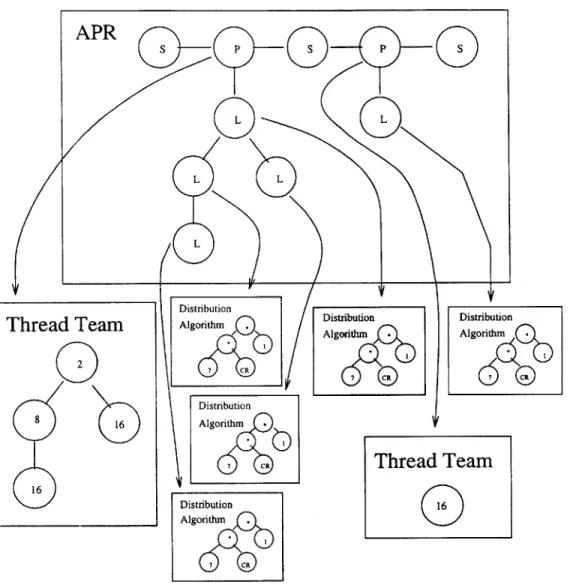
Figure 2-5 shows the relationship between the APR, the thread teams, and the distribution algorithms. Each parallel node in the APR (denoted with a "P") marks a separate loop entity. Each loop entity is associated with a thread team that has the same structure as the loop structure in the initial program. Each loop is associated with a separate distribution algorithm, and each distribution algorithm contains an expression tree.
2.3.6
Implementing Parallelism
The actual implementation of the parallelism is flexible. The GA can utilize mul-tiple parallel protocols simultaneously to maximize performance dependent on the requirements of a specific piece of code and target architecture. The implementation protocols chosen for this system are described in this section.
Two parallel communication protocols are used to implement the parallelism in the generated code: OpenMP [29] and the Message Passing Interface (MPI) [25]. Each has very different performance advantages and restrictions. OpenMP is a directive based technique, much like the directives presented in this research. Parallel regions, critical sections, and loop scheduling techniques are all explicitly implemented by annotations in the code. When the source is compiled, the directives cause extra libraries to be included and add code to distribute the work, protect the variables, and manage the locks. OpenMP assumes that all processors are capable of accessing the same memory, so it only works on shared memory machines, not cluster configurations. MPI is different in that it consists of a library of functions that allow the programmer to directly implement parallelism. It provides an interface for each of the processes to send and receive messages. More complicated communication involving broadcast
and communication groups is also available. MPI programs have separate memory spaces, so they are usually used for network systems, but can also be used on shared memory systems. [26]
Both communication protocols are used. First, in order to support communication on both cluster and shared memory systems, but more importantly because they have different performance characteristics. Communication for OpenMP is a simple variable read from memory, yet in MPI a message must be assembled, sent, received, and unpacked. OpenMP is therefore used for fine-grain parallelism, where low latency communication is appropriate, where MPI is used for more coarse-grain tasks. [15
Often times too much fine-grain parallelism can cause bus saturation and slow the overall execution time. [9] In such cases MPI is appropriate. It is often difficult to determine where these divisions should be drawn, so the type of communication protocol is evolved via the thread teams. For a cluster of shared memory machines, the thread team for a loop entity dictates which processors to distribute the work over, and code is generated for either MPI communication, OpenMP, or both, depending on where the processors are located and what sort of communication is needed.
The initial parallel programs are generic in their implementation, so inserting the appropriate OpenMP and MPI code and ensuring correctness requires careful attention to the memory consistency. Since OpenMP supports a shared memory model, the variables are managed by the OpenMP library as specified in the APR directive variable list. The MPI parallelism does not support a global variable space, so the public variables must be explicitly managed with messages. A master node is designated that accepts all the data, combines it appropriately, and redistributes it to the appropriate nodes. Both the master and the slave nodes contain the work distribution algorithms, so all the nodes can calculate the data that must be sent and received. Dependant on the type of parallelism used to distribute the loop, different memory management schemes are used.
Thread Team
0 (8 16) 16\Distribution
Algorithm 0\Distribution
Agoith Distribution Algorith Distribution Agorith~~Thread Team
Figure 2-5: A Sample APR and the Associated Thread Teams and Distribution Al-gorithms
APR
L
L
L Distribution AlgorithChapter 3
The Evolutionary System
3.1
Introduction to Genetic Programming
Genetic Programming (GP) is an evolutionary system similar to a genetic algorithm
(GA). [22] Essentially, a GA is a search algorithm that is founded on the principles of
natural selection. A search space is represented by a genome, an encoding of informa-tion that supports the biological operainforma-tions of mutainforma-tion and crossover, such as DNA in most living creatures. An individual's genetic material defines that individual's set of traits and hence fitness. More fit individuals correspond to better performance in the original search space. To solve a problem with a genetic algorithm, it is necessary to express the search parameters as a genome and to express the search goals as an objective function used to evaluate an individual's fitness. [11]
The algorithm begins by randomly generating a set of individuals, each having their own genetic material. Each individual's fitness is tested and then ranked by its fitness. The next phase is selection, where individuals are chosen to mate and pass their genetic information to the next generation. The selection is probabilistic, with the more fit individuals having a higher probability of mating. Each offspring inherits some of its traits from each parent, and is subject to possible mutations leading to different traits. After many generations, the population converges toward an optimal position in the search space. [16]
is robustness-- the ability to rapidly find a solution in an arbitrarily complex search space. [11] While other approaches require a well-behaved, well-understood search space, genetic algorithms only require that the search space can be defined by a genome. While genetic algorithms have probabilistic elements, they are more efficient than random searches because of the incorporation of a fitness function. Also, GA's explore the search space from an entire population of individuals, not just one point.
By varying the population size and number of generations, genetic algorithms can
perform well for arbitrarily complex search spaces. [17] As much as evolutionary systems are robust, if fitness evaluation is computationally expensive, they are equally time consuming. Genetic algorithms require p * g fitness evaluations, where p is
the population size and g is the number of generations. A trade-off exists, greater robustness can be achieved at the expense of more computation.
Genetic Programming differs from traditional genetic algorithms in that the genome is the set of valid computer programs. Actual source code is used as the genetic en-coding. GP is a technique for computers to evolve their own programs to solve prob-lems. [22] In the case of this research, the distribution algorithms are sub-programs simultaneously evolved with thread teams in a symbiotic genetic algorithm. The sys-tem employs genetic programming to develop each of the individual populations, and then a genetic algorithm to handle the interaction of all the components.
3.2
System Design: The Symbiotic Genetic
Algo-rithm
The evolutionary system is responsible for evolving a distribution algorithm for each loop and a thread team to define the processor space for each loop entity. These different genomes require different genetic operations of crossover, mutation, and random generation. Each of these techniques are described below, in addition to the symbiotic GA which manages all of the different populations.
3.2.1
Genetic Representation of Distribution Algorithms
A distribution algorithm is a sub-program represented as a parse tree for an expression
that relates loop iterations to a thread assignment. Since every loop in a program has different performance characteristics, the GA maintains separate populations of distribution algorithms for each loop.
The genetic operations of crossover and mutation are sub-tree manipulations de-fined for the tree-structures that represent the distribution algorithm. Crossover is implemented by choosing a node in each parent tree, and then swapping the sub-trees. If one of the nodes chosen is the root node of the parent, then the entire tree will be a subtree in one of the offspring, and the other offspring will be a subtree from the other parent. Any node in the tree can be swapped, but the upper nodes are favored more than the leaf nodes. Since the trees are binary, the leaf nodes consist of ap-proximately half of the total nodes in the tree. If all the nodes are chosen with equal probability, then 75% of the crossovers will involve swapping a leaf node from one of the parents. However, favoring swapping the upper nodes leads to better convergence and efficiency. [22] Swapping the upper nodes encourages the formation of distinct subtrees that handle individual tasks, much like subroutines. Also, swapping the leaf nodes often has little effect on the overall program, while swapping subcomponents more quickly combines the traits of the two parents. The probability of choosing a non-leaf node for crossover is one of the configurable parameters for the GA.
Mutation is supported in two different ways, node alteration and node deletion. Node alteration chooses a node in the tree and replaces it with a randomly chosen node. For example, a leaf node may be replaced with a different constant or vari-able, and a non-leaf node would be replaced with a different operator. Node deletion is intuitive-a node and its subtree are removed from the tree. These two opera-tions help maintain diversity in the genome in order to counterbalance the selective pressure.
A key property of these genetic operations on tree structures is that every possible
perform an undefined operation nor loop indefinitely on any input. This closure property would not be the case on an arbitrary piece of source code represented as text. Converting the source code into a parse tree is imperative. [23]
The random population generator creates the initial populations. The expressions are created by starting with the root operator node and randomly choosing the argu-ments, with each possible entry having a fixed probability. If an operator is chosen for the argument, then a expression is created, and the arguments for that sub-expression are also randomly chosen. If a terminal is chosen, then that part of the tree stops growing. The best set of relative probabilities for the different elements in the expression is not known and is part of this research. As the tree increases in depth, the probability of choosing a terminal increases in order to ensure expressions with finite length. In this manner, a population of random expressions is created for every loop in the program.
3.2.2
Genetic Representation of Thread Teams
A thread team is implemented a tree structure that describes the available processors
for every loop in a loop entity. Each node identifies the number of threads available to that loop. For each loop entity in the program, the GA maintains a separate population of thread teams.
Like the distribution algorithms, the thread teams have a tree structure. Since the structure of the tree is fixed, the thread teams can not support the same type of crossover and mutation operations. Crossover is the same subtree exchange, but the two parents must exchange the same nodes, or the structure of the offspring would not match the structure of the loop entity and the original program. Also, if the crossover results in an invalid thread team, such as a lower node not being able to distribute work to the same number of processors as a higher node, then the team must be checked and fixed. Because of this potential, mutation is not supported. Since the structures are relatively small, mutation is not a useful operation given the high probability of generating invalid thread teams. [24]
but the different parameters at, the nodes are randomly generated. The upper nodes are generated first, and then the lower nodes are defined out of the possible teams that could exist given the upper nodes. The leaf nodes are all set to the maximum number of processors.
3.2.3
The Symbiotic Genetic Algorithm
The symbiotic genetic algorithm is responsible for managing the evolution of the sep-arate thread team and distribution algorithm populations by using shared fitness, multiple testing, and migration. Individuals from each of the disparate populations are assembled together to form a parallel program, and then the code is compiled, executed, and timed, and the fitness values are reported back to each of the pop-ulations. The evaluation stage has some complications owing to the nature of the problem. First, each of the loop entities is separately timed by inserted timing code, but a loop entity consists of several evolved distribution algorithms and a thread team. Each of the distribution algorithms in the run and the thread team receive the same fitness score, though they have very different fitness characteristics. Since the performance of all of the loops in a loop entity are dependent, they receive the same score. It may be the case that assigning all the distribution algorithms in a loop the same score distorts the actual fitness, but it is difficult to know what the fitness is of an inner loop independent of the outer loop. The key goal is to minimize the overall running time of the loop entity, not the individual loops, so whatever assort-ment of distribution algorithms that causes the running time to minimized will be encouraged by the selection pressure. Unlike the distribution algorithms, the thread team should have an independent score and be tested over several different distribu-tion algorithms to determine its fitness score. Since the number of possible thread teams is relatively small, the thread team populations are smaller than the distri-bution algorithm population. Consequently, each thread team individual is tested in several parallel programs. The fitness of a thread team is the average of all the different execution times. In this way the thread teams and the distribution algo-rithms complement each other. The inadequacies in one can be evolved in the other
to still achieve near optimal performance. Finally, individuals from one population can migrate into populations of the same type of individuals. While each loop will require its own specialized distribution algorithm, especially good individuals from one population should be helpful for the evolution of a different population. The symbiotic GA employs shared fitness, multiple testing, and migration to maximize the potential for optimal convergence for parallel programs.
The evolutionary system described here further extends the biological metaphor of genetic algorithms. The symbiotic genetic algorithm is so named because it im-plements the population genetics principles of speciation, inter-population migration, and coevolution. The evolutionary environment contains multiple populations of different types of individuals with different genomes. In this sense, the different pop-ulations are like an ecosystem, with many distribution algorithm poppop-ulations and a few thread team populations. Each separate population evolves differently dependent on the specific performance characteristics of the individual loop. Despite having a common random initialization, the different loop populations quickly develop into different "subspecies." Every generation some individuals migrate into the neighbor-ing population. Migration improves convergence since there are likely to be elements of distribution algorithms that are universally good. [12] Also migration should help maintain genetic diversity and prevent a population from becoming stuck in a sub-optimal niche by providing a constant influx of different genes. [18] In addition to the interactions of separate loop populations, the thread team populations also interact with the loop populations. The performance of the thread teams directly depends on the distribution algorithms in that loop entity. The success of both types of entities depends on mutually beneficial traits. This symbiosis should help improve performance as the separate populations co-evolve to overcome the disabilities of the other. By utilizing principles from biological ecosystems, the symbiotic GA should find efficient solutions.
3.3
The Search Space
The nature of the search space strongly effects the efficiency of the genetic algorithm.
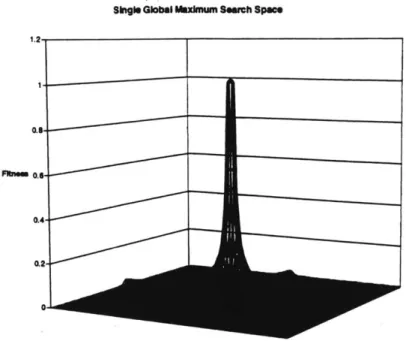
A gradually sloped space with single prominent global maximum is easily scaled and
surmounted by the GA, however a search space with many low local maxima and only a single, obscure global maximum is much more difficult. The local maxima often serve as evolutionary "dead ends" as the algorithm prematurely converges on a sub-optimal result. Any problem would be easily solved with a large population for many generations, but that is rarely computationally feasible. [221 A single, prominent global maximum is best approached with a smaller population for more generations with a low mutation rate. More generations give the algorithm time to find the very top of the maximum. A more hilly search space requires a larger population for a fewer number of generations and a higher mutation rate. [11] This more random search helps the GA locate the highest peak among many. Of course, the search space is n-dimensional, so it is not simply "hilly" or "flat," but this is for the purpose of visualization these terms are used. Figures 3-1 and 3-2 further illustrate the different search spaces. In order to efficiently evolve solutions, the nature of the search space must be considered when choosing parameters for the GA.
The search space for the problem of loop iteration assignment for a thread is immense, yet it is completely covered by the genome representation. Describing the search space as all mappings from loop iterations to thread assignments, there are t' members where t is the number of threads and n is the number of loop iterations to be mapped. Despite this large size, the distribution algorithms cover the set completely. This fact may not appear intuitive, and the proof is strait-forward and illuminative, so it is included below. Consider the function
a1(x/1) + a2(x/2) + a3(x/3) + a4(x/4) + ... + an (x/n) = t.
where again n is the total number of iterations, x is the current iteration number, an is an integer coefficient, and t, is the thread assignment for iteration x. This function can be expressed by a distribution algorithm, since it contains only the simple
Shigle Global WlAdmum Search Space 0.6-FPlnum 0.6- 0.4- 0.2-
0-Figure 3-1: A Single Global Maximum
operations of of multiplication, addition, and integer division. This function can also be expressed as the multiplication of two vectors,
[
(x/1) (x/2) (x/3) ... (x/n)a,
a2
and a3 Now consider a (n x n) matrix, where the ith row is results of evaluating
the x vector with x = i. Multiplying this resulting matrix with the coefficient vector
yields a thread assignments vector, where t2 is the thread assignment when x =
---Muipb Local Maxbna Sech Spac.
F~M
2-
I.-0.5
0
Figure 3-2: A Hilly Search Space
Consider the n = 5 case of Xa = t below.
1 0 0 0 0 a, ti
2 1 0 0 0 a2 2
3 1 1 0 0 * a3 = t
4 2 1 1 0 a4 t4
5 2 1 1 1 as t5
This matrix is X has linearly independent columns, since the only solution to
Xa = 0 is a = 0. The matrix then completely spans the 5-space, so for any vector t
there exists a vector a that satisfies Xa = t. The columns are not just independent in the n = 5 case, but are also independent for all settings of n, because the matrix
is always lower triangular with 1's on the diagonal. This result is not sufficient since it must also be shown that a is only composed of integers, because the evolutionary system is not capable of evolving arbitrary real numbers.
For this result, a simple proof by induction is necessary. First, assume that at the kth position, all a, to ak are integers. This assertion is valid in the base case,
k = 1. The first row has 1 in the first position, and zeros in all the others, so a, = t1.
Therefore, a, must be an integer. In the ak+1 case, positions 1 through k in the
row have integer values (since they are derived from integer division in the original equation), and the k + 1 position is equal to 1. From the assumption, all a, to ak are
integers, so the resulting equation is
a,
a2
Xk+,l Xk+1,2 --- Xk+1,k 1 0 ... 0
*
=k+1ak+1
'SUM = alxk+1,1 + a2Xk+1,2
+
...+
akXk+l,k'sum + ak+1 = tk+1
This reduces to ak+1 = tk+1 - s!m, and since both tk+1 and Isum are integers, ak+1
is an integer. Since both the base case and inductive step are true, there exists for every vector t a set of integer coefficients a that leads to that scheduling allocation. To implement any set of thread assignments, it is only necessary to choose the correct set of coefficients.
This function is one of just many functional forms that covers the entire search space. Certainly many other forms exist. Since the end result of the function is modular divided, many coefficient sets yield the same thread distribution. Also, many different thread distributions yield the same performance results. When all the processors are equivalent in a system, a simple renumbering of the threads will cause the same result. Moreover, the execution time of some iterations is smaller than
the timing granularity, so their assignment does not effect the final result. Although the search space is large, the reduction to the performance space is smaller. Any single optimal result will have many functions that are varied both in form and in constants that yield that same optimal result. The search space therefore has many local maximums, some of which are equivalent global maximums.
Given that there exists a single functional form that covers the space, it is not initially clear why it is appropriate to evolve algorithms instead of coefficient sets or mapping arrays. Such coefficient sets are only valid for a set number of iterations. It is often the case that loops are executed multiple times with a variable number of iterations. Consequently, a function which covers all of those possible maximum iterations is also needed-a static coefficient set is not adequate. In addition, it is hoped that the evolved functions will lend insight into the nature of the distribution. Perhaps a set of consistently effective loop distribution algorithms will be discovered. These effective algorithms could be inserted into similar code, and the evolutionary process will be circumvented.
The search space of thread assignments for given loop iterations is very large, yet it is completely covered by the set of all possible distribution algorithms. There exists for every thread assignment vector a distribution algorithm that maps the set of integers to that vector. The search space when expressed as distribution algorithms has many local maximums and several equivalent global maximum. A principle aspect is to find genetic algorithm parameters that perform well in this search environment.
3.4
Algorithm Tuning and Calibration of
Param-eters
Proper calibration of the evolutionary system is a key part of this research. The evolutionary system has hundreds of different parameters, and finding the proper set of parameters that guarantee a good result is difficult. Every potential program and target architecture have an ideal set of evolutionary parameters that can only
be determined after many trail runs. After some initial tests, a set of evolutionary parameters which work well for many different test cases were found. The most important parameters are described in the following sections.
3.4.1
Standard Crossover Techniques are Used
The two crossover parameters are the crossover rate and the node selection parameter. The crossover rate is the probability that the offspring of two individuals are the result of crossover instead of cloning. These tests use a crossover rate of 1, because the replacement strategy does not remove the parents from the population unless they are less fit than their offspring. The node selection parameter is the probability of selecting a non-leaf node for the crossover point in a tree. A node selection parameter of 0.9 was used, which is widely suggested in the literature. [22] Previous runs with a node selection parameter of 0.5 resulted in slower convergence and lower probability of finding an optimal result.
3.4.2
Mutation is Minimized
The mutation in the system is controlled by three parameters, the mutation rate, the mutation spikes, and the spike period. The mutation rate is the probability that an individual will have a mutation when created. Often times in genetic programming, mutation is not used because lack of diversity in the population is rarely a problem. These tests use a low rate of mutation (0.05). It was rare that the mutation was nec-essary, but sometimes in small populations certain alleles became extinct, so mutation helped restore those lost genes. Mutation spikes are akin to giant radiation storms or comets striking the Earth. They are intended to perturb a converging population in an attempt to reinsert diversity into the population and possibly find a superior result. The mutation spike is implemented by cloning the entire population under a high mutation rate. The spike period is the number of generations that pass be-tween each spike. Experimentation with mutation spikes in this research found them generally ineffective. At times they even served to decrease diversity by crippling
competing individuals and permitting one individual to rise out of the aftermath. The single surviving individual rapidly reproduces itself, and quickly dominates the population-leading to an overall loss of diversity. Mutation rarely added diversity to the population and also slows convergence, so the system uses a low level of mutation.
3.4.3
Replacement Strategy: Direct Removal or Elitism
The two primary replacement parameters are the number of new individuals in each generation and how to replace the old population. Once the new individuals are created, there are two methods for replacement, direct removal and elitism. Direct removal sorts the old population by fitness and then removes the number of individuals equal to the number of new individuals. Then it inserts the new individuals into the population. Elitism only inserts the new individuals if the old individuals have lower fitness than the new individuals. This research uses elitism, which has been shown to cause faster convergence in populations. The disadvantage of this technique is that it may cause an overly rapid loss of diversity and converge too quickly on an non-optimal result. The advantages of faster convergence outweigh any diversity concerns, so elitism is used throughout the tests.3.4.4
Multiple Tests Improve Fitness Calculations
Parallel programs are notoriously non-deterministic in their running time and are often difficult to time accurately. Inaccurate fitness scores undermine the evolution-ary process and make finding an optimal result less likely. A variety of statistical techniques can be used to address this problem, but one of the simpler methods is to test the program multiple times. Multiple execution of the test program is especially useful in networked systems where communication has highly variable latency. In such cases, the program is executed multiple times and the fitness is the average of those running times.