AN APPLICATION OF MULTICRITERIA EVALUATION METHODOLOGIES TO AUTO RESTRICTED ZONE POLICIES
by JAI MU WON
B.E., Han Yang University (1974)
M.C.R.P., Seoul National University (1976)
M.A., University of California, Los Angeles (1979)
Submitted to the Department of Urban Studies and Planning in Partial Fulfillment of the
Requirements for the Degree of
DOCTOR OF PHILOSOPHY at the
Massachsetts Institute of Technology November 1983
Massachusetts Institute of Technology 1983
Signature of Author
Depa3tment of Urban Studies and Planning No mber 9, 1983
Certified by
Accepted by
0alph Gakenheimer, ThesIs Supervisor
a4 rence Sus.Wind, Chairman, Ph.D. Committee
MASSACHUSETTS INSTITUTE OF TU1014OLOY
AUG
10
1984
z/2
dd;il
- - q 45 - - - - - = ...MABSTRACT
AN APPLICATION OF MULTICRITERIA EVALUATION METHODOLOGIES TO AUTO RESTRICTED ZONE POLICIES
by JAI MU WON
Submitted to the Department of Urban Studies and Planning on November 9, 1983 in partial fulfillment of the requirements for the Degree of Doctor of Philosophy
This thesis applies the three multicriteria evlaution methods
- Concordance Analysis, Goal-Achievement-Matrix and Compromise Solution - to auto restricted zone policies. This thesis has two major objectives: (1) to discuss the concept and practice of the auto restricted zone policies in general and the rationale behind restricting auto traffic in central cities both in developed and developing countries; (2) to compare the three multiciteria evaluation methods through the application to auto restricted zone(ARZ) policies in
specified case in order to assess their usefulnesses and limitations.
In the first part of the thesis, the concept and types of ARZ policies are examined, along with the experience with ARZs of the U.S., West Europe and developing countries. The discussion also relates to the objectives and relevant ARZ schemes. Generally, the desirability of closing off streets or areas is determined by the underlying characteristics of a specific urban areas. The objectives and ARZs are distinct for different types of areas. The major reasons of the differences seem to be because each region has different perceptions and attitudes toward the transportation problems themselves. Thus decision making for ARZ selection is different. The key factor is that each of the cities has different goals which greatly affect the ARZ objectives.
In the second part of the thesis, the characteristics of transportation systems in Seoul, Korea are presented. Seven feasible ARZ policies and twelve criteria are selected through interviews and ranking techniques. For selected ARZs and criteria, the implementation of the three methods is performed. The results of the implementation
show that the three methods are very effective in applying to Transporation System Management types of strategies. The area license schemes turn out to be the most preferred ARZ polies by the methods examined.
The third and final part of the thesis assesses the three multicriteria evaluation methods in terms of several criteria. The criteria seen as essential in the assessment of these methods include computational burden, degree of interaction with the decision maker, ease of sensitivity tests,
real-world applicability and applicability to developing countries. The comparison receals that
the results obtained from the three methds are similar but they differ in general in terms of criteria described. The three methods have counterbalancing strengths and weaknesses.
Thesis Supervisor: Ralph Gakenheimer
Professor of Urban Studies and Planning and Civil Engineering
ACKNOWLEDGEMENTS
Throughout the course of this study, I have benefitted from the advice, encouragement and assistantce from my doctoral thesis committee members. The contribtions of Professor Ralph Gakenheimer, my thesis advisor, to the development of this study extend far beyond his valuable suggestions on particular phases of the research. Professor Alan Strout has provided valuable ideas and editorial suggestions that aided in both the implementation of the multicriteria evaluation methods and the writing of the draft. I also wish to express sprecial thanks to Professor Michael Meyer whose earlier comments and suggestions made this thesis possible.
TABLE OF CONTENTS Page TITLE PAGE ...
1
ABSTRACT ... ... . 2 ACKNOWLEDGEMENT ... 4 TABLE OF CONTENTS ... 5 LIST OF TABLES... 9 LIST OF FIGURES... 12 CHAPTER I : INTRODUCTION1. Objectives of the Thesis 13
2. Auto Restricted Zone (ARZ) Schemes 13
3. Multicriteria Evaluation Methods 15
4. Organization of the Research 22
CHAPTER II: AUTO RESTRICTED ZONE (ARZ)
1. Introduction 25
2. The Kinds of ARZ Schemes 27
3. Traffic Restriction Experience 31
a. European Experience 31
b. American Experience 34
c. Experience in Developing Countries 37 4. General Objectives and Related Issues
of ARZ 40
a. Reduction of Congestion 41
b. Improvement of Environment 42
c. Reduction of Conflict between
Pedestrian and Automobile 44
d. Enhancement of Economy and
Activities in the City Center 46 e. Preservation of Cultural Attraction
and City's Unique Character 49
f. Encouragement of Public Transit Use 50 5. The Appropriate ARZ in Developed
and Developing Countries 52
6. Conclusion 56
CHAPTER III: EVALUATION METHODS USED IN ARZ SCHEMES
1. Introduction 58
2. Assessment of ARZ Evaluation
Methods 59
3. Overall Assessment and Methodological
a. Methodological Issues of Cost and
Benefit Analysis 63
b. Methodological Issues of
Impact Analysis 68
c. Methodological Issues of weighting
Technique 70
4. Multicriteria Evaluation Methodologies
in Transportation Field 71
a. Earlier Development of the Field 72 b. Recent Development of the Field 75
5. Conclusion 82
CHAPTER IV DESCRIPTION OF TRAVEL CHARACTERISTICS OF SEOUL
1. Introduction 83
2. Description of Seoul's Central
Business District 83
3. Characteristics of Travel 91
a. Trip Making Shares 91
b. Characteristics of Trip Makers 93
4. Conclusion 99
CHAPTER V: THE DESCRIPTION OF CRITERIA AND ARZ ALTERNATIVES
1. Introduction 100
2. ARZ Alternatives 100
a. Off-Street Parking Fee Increase 104 b. Extensive Parking Meter Intallation 107 c. Public Transit Priority Signals
around Core Ring 107
d. Core Area License Scheme 109
e. Core Area License Scheme
with Transit Improvement 111
f. Toll Increase for Tunnel Gates 112 g. Toll Charge at Bridge Entrance 115 3. Objectives and Criteria Proposed 116 (1) Capital Cost Borne by City 119 a. Off-Street Parking Fee Increase 120
b. Extensive Parking Meters in Core 120
c. Public Transit Priority Signal 120 d. Core Area License Scheme
Bus Improvement 121
f. Toll Increase for Tunnel Gates 122 g. Toll Charge at Bridge Entrances 122 (2) Current Operating Costs Borne by City 123 a. Off-Street Parking Fee Increase 124
b. Parking Meters in Core 124
d. Core ALS 125 e. Core ALS with Bus Impeovement 125 f. Toll Increase for Tunnel Gates 127 g. Toll Charges at Bridge Entrances 127
(3) Revenue to the City 129
b. Parking Meters in the Core 129
d. Core ALS 129
e. Core ALS with Bus Improvement 130 f. Toll Increase for Tunnel Gates 130
g. Toll Charge at Bridges 131
(4) and (5) Travel time Saving for
Auto, Taxi and Bus 132
(6) Reduction in Pollution 140
(7) Institutional Preference 145
(8) Enforceability 147
4. Conclusion 153
CHAPTER VI: EMPIRICAL ANALYSES OF THE THREE MULTICRITERIA EVALAUTION METHOD
1. Introduction 154
2. Concordance Analysis 154
a. Description.of Theory 154
b. Implementation of the Concordance Analysis 165 3. Goal-Achievement Matrix (GAM) 181
a. Description of Theory 181
b. Implementation of the GAM 187
4. Compromise Solution 196
a. Description of Theory 196
b. Implementation of the Compromise Solution 207 CHAPTER VII: EVALAUTION OF THE THREE METHODS
1. Introduction 221
2. Synopsis of the Three Methods 221 3. Evaluation of the GAM, CA and CS 224
a. Computational Burden 227
(1) Information Requirement 227
(2) Possibility of Sensitivity Tests 229 (2) Inclusion of Qualitative
Effects 230
b. Degree of Interaction with the
Decision Maker 232 (1) Understandability of the Methods 232 (2) Encouragement of Public Participation 233 (3) Interaction Requirement 233 c. Real-World Applicability
(2) Applicability to Large-Scale
Projects 238
(3) Incorporation of Uncertainty 240 (4) Linkage to Planning Process 243 (5) Linkage to Decision-Making
Process 243
f. Applicability Transport Environment in Seoul
(1) Adaptabilty to Scarce Information 248 (2) Applicability to to Rapidly
Changing Environment 249
4. Conclusion 250
CHAPTER VIII: SUMMARY AND CONCLUSION
1. Thesis Summary 254
2. Thesis Conclusion 257
a. Conclusion Related to
ARZ Experience 257
b. Conclusion Related to
the Empirical Analysis 258
c. Conclusion Related to
the Three Methods 258
3. Consideration for Further Research 262
4. Extension of the Research 264
REFERENCES 266
APPENDIX II-1 Characteristics of
Widely-Used ARZ Scehemes 271 APPENDIX III-1 Assessment of Evaluation
LIST OF TABLES Page Table Table Table II-1 11-2 11-3 Table 11-4 Table Table Table Table Table Table Table Table 11-5 III-1 IV-1 IV-2 IV-3 V-1 V-2 V-3 Table V-4 Table V-5 Table Table Table Table V-6 V-7 V-8 V-9 ARZ Schemes
American ARZ Schemes and Definitions Objectives and Relevant ARZ and
Techniques
Types of City Center and Relevant ARZ Schemes
Types of City Structure Cases for ARZ Evaluation
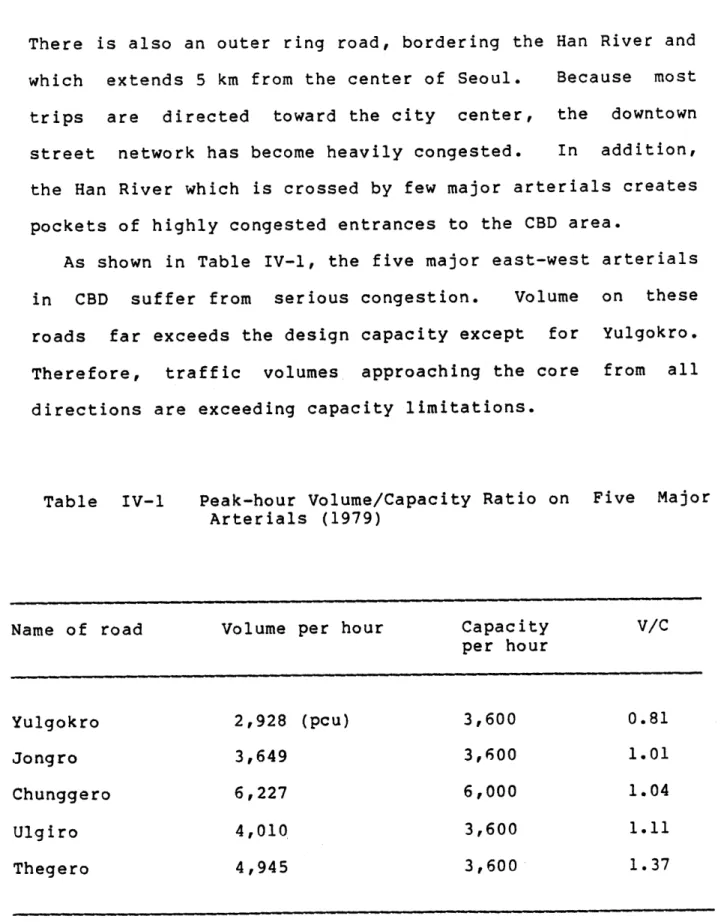
Peak-Hour Volume/Capacity Ratio
on Five Major Arterials (1979) Trip Making Shares in Seoul The Amount of Daily trips Made
by Purpose
Parking Spaces in Seoul Toll Gates and Lanes
Traffic Volumes on Major
Bridges
Summary of City-Born Capital Costs of ARZ Schemes
Summary of City-Born Current Operating and Enforcement Costs
Daily Revenues Collected at Tunnels Revenues Resulting from Five ARZs
Logit Parameters for Jongro Corridor
Simulated Individual Travel Times During Peak Hours After ARZ Schemes Using TTP.2.1 Flow Prediction Models
29 36 41 52 53 62 89 92 98 105 113 115 123 128 130 131 134 138
Table V-10 Simulated Annual Time Savings for Three
Modes Using TTP.2.1 Flow Prediction Models 138 Table V-ll Public Officials' Evaluation on
Pollution Reduction 139
Table V-12 The CAT for the Evaluation of
Pollution Reduction 142
Table V-13 Institutional Preferences 146 Table V-14 Normalize'd Weights for 12 Criteria 152 Table VI-1 Impact Matrix Before Normalization 167 Table VI-2 Normalized Impact Matrix 168 Table VI-3 Concordance Pairs (sets) 169
Table VI-4 Concordance Matrix 170
Table VI-5 Discordance Pairs 172
Table VI-6 Weighted Normalized Matrix 173
Table VI-7 Discordance Matrix 174
Table VI-8 Determination of G, H and T
by .700 and .300 176
Table VI-9 Determination of G, H and T
by .500 and .500 177
Table VI-10 Determination of G, H and T
by .200 and .700 178
Table VI-l Normalized Impact Matrix 190
Table VI-12 Weights for Criteria 191
Table VI-13 Goal-Achievement Scores 191
Table VI-14 Goal-Achievement Matrix 192
Table VI-15 Degree of Closeness with Respect
to i and k 193
Table VI-16 Impact Matrix for ARZ Alternatives
and Criteria 209
Table VI-17 Transformation of Alternatives and
Table VI-18 Table VI-19 Table VI-20 Table VI-21 Table VI-22 Table VII-1 Normalization
Values for g , w and
i i * k Values for (z - z i 2 * g i i k Values for g (z - z ) i i i * k Values for g (z - z ) i i i
Assessment of the Three Methods Against the Criteria 212 213 214 215 217 226 )
LIST OF FIGURES
Figure IV-1 Major Road Network in Seoul 85 Figure IV-2 Seoul's Central Business District 87
Figure V-1 Survey Questionnare 103
Figure V-2 Parking Meters Installed in the CBD
of Seoul 106
Figure V-3 Proposed Locations for 13 Transit
Priority Signals 108
Figure V-4 Area to be Affected by Core Area
License Scheme 110
Figure V-5 Locations of Toll Gates at
Major-Tunnels and Bridges 114
Figure V-6 Procedure Built in T.TP 2.1 136 Figure VII-1 Major Components of the Three Methods 222 Figure VII-2 The Interaction Requirement between
the Analyst and the Decision Maker 235 Figure VII-3 Stages of Planning and Decision
CHAPTER I: INTRODUCTION
1. Objectives of the Thesis
This thesis has two major objectives: (1) to discuss the concept and practice of the auto restricted zone policies in general and the rationale behind restricting automobile
traffic in central cities both in developed and developing countries; (2) to compare the three multicriteria evaluation methods through the application to auto restricted zone policies in specified case in order to assess their
usefulnesses and limitations.
2. Auto Restricted Zone(ARZ) Schemes
The increasing attention being paid to the automobile restriction in central cities is a relatively recent develop-ment in the evolution of conceptual thought in urban transportation planning. The point of departure for this development was characterized by an approach which assumed that automobile restriction would, by itself, eventually
improve the traffic conditions of the urban areas.
restricted zone policies in central cities of developed and developing countries. The increasing interest in restricting auto traffic within the city center is mainly fostered by the deteriorating environmental quality in urban areas. The con-cept has been most significantly advanced in European cities. Over 130 European citeis have implemented a large variety of ARZ policies to reduce congestion and negative effects on the environment. The application of this concept to U.S. cities appears limited in scope. The pedestrian malls which have been built during the last two decades represent a typical ARZ scemes. At present, more than 70 U.S. cities of varying size have instituted some form of auto restriction. Experience in developing countries has been more limited in scope. The Singapore area license scheme is the only well-document case in the context of developing countries. It is, however, fair to say that various types of ARZ schemes may exist in major cities in developing countries.
Despite the growing interest and application, there is still considerable controversy regarding what apporpriate area restricted zone schemes are appropriate in a given urban environment and what they might accomplish. Thus it seems appropriate to address several issues regarding the ARZ schemes. The issues to be addressed in this thesis are as follows:
(1) The first issue to be addressed is with regard to the kinds of ARZ schemes. The schemes available for restricting automobile traffic are numerous and may be applied to whole
ranges of different urban sizes and transportation situations. It seems, therefore, necessary to explore ARZ schemes by classifying them according to the degree of restriction and types of measure exerted by different strategies.
(2) The second issue to be addressed regards the objectives of restricting auto traffic in central cities in both developed and developing countries. The objectives of ARZs vary in intensity from one city to another, depending upon individual circumstances and are tailored to to the specific urban areas. The relationship between the objectives and the ARZ schemes, therefore, deserves an examination.
(3) The third issue to be addressed concerns with the relevant ARZ schemes and their associate techniques by the types of city and region. Question can be raised as to what the relevant ARZ schemes are in central cities of both developed and developed countries and what kinds of supportive techniques are appropriate for these regions.
3.Multicritertia Evaluation Methods
The transportation facilities result in multiplicity and sometimes unidentified arrays of consequences as the transportation facilities cut accross the many parts of the socio-economic and environmental systems. In recognition of
the need to acount for social, economic and environmental factors, transportation planners and analysts have devoted much effort to improving the evaluation methodology. Although some progress has been made in the development and refinement of evaluation methods for dealing with social, economic and environmental factors, a common feature of the transportation analyses is that the evaluation is mostly based on a single criteria - economic efficiency.
Traditionally, most transportation evaluation has centered around criterion such as travel time saving and cost minimization. Criteria other than above-considerations have been largely overlooked as important decision criteria. There seems to be three reasons for this tradition. First, there is a lack of a conceptual or theoretical evaluation framework which is suitable for the transportation systems involving multicriteria. Secondly, criteria other than travel time or investment cost were considered less important. This was true for both transportation analysts and decision makers. Lastly, it was difficult to get the information on various criteria.
The multicriteria evaluation methods are generally designed to accomodate the social, economic and environmental factors. Although some of the criteria are not measurable in an "absolute" sense, the very fact that multidimensional
factors are entering the evaluation process through quantitative and qualitative analysis reflects the attraction of these methods. The insight provided by the multicriteria
evaluation methods can also lead to a better communication between the analyst and the decision maker, thus allowing the decision maker a more active and understanding role in the decision making process.
The emergence of multicriteria concerns in the transporta-tion field has its root in the observation of multiple impacts of transportation systems. The attempt to incorportate multicriteria into an evaluation framework was a response to the widespread use of conventional cost-benefit analysis in transportation project evaluation. There has been a growing recognition of the inadequacies of conventional cost-benefit analysis in capturing the full
range of social values that are relevant in transportation decision making. Academ icians and decision makers alike have pointed to the need to consider intangibles such as social, economic and environmental concerns in choosing from a given set of alternatives.
Despite the relative lack of attention, several writers have advanced and applied multicriteria evaluation methods to transportation situations. There have been several worthwhile contributions to the rationalization of the multicriteria concern in conjuction with evaluaiton and decision making.
An early suggestion regarding the need for a broad framework for evaluation was made by Lang and Wohl (1960). They essentially stressed the need for a more rigorous definition of "impact", suggesting a classification into four
types - economic, social, aesthetic and political.
Faced with the need for incorporating multidimensional concerns, Manheim (1967) has contributed a set of considerations which clearly delineate the task of the transportation systems analyst. The considerations are contained in nine elements called "The Principles of Transportation Sytems Analysis". The major significance of the principles for evaluation is the oderly, explicit presentation of those elements which the analysts must consider in developing the information necessary for the definition and evalaution of alternative systems and their effects.
Manheim (1969) further points out that transportation choices can be described as essentially socio-political choices where differing interests of the various groups are considered and balanced. The inclusion of socio-political choices appears to represent a clear advance over conventional models (or methods) in its abandonment of the search for only single dimensional choice.
In a similar vein, widespread fuzziness about what the goals of transportation systems should be has created controversy, particularly in urban areas where public interests or value systems often conflict. In response to this, Hill (1967) has created a framework in which a great
number of goals for transport systems can be listed and their relationships specified. This work provided a basis for developing the concept of the Goals-Achievements Matrix to be
evaluated latter in this thesis.
The multicriteria evaluation method was developed in explicit form largely through the work of Morris Hill (1973)
and applied to a transportation plan in Cambridge, England. Later, Manheim (1979) made an attemt to apply the multicriteria evalaution method called "impact tableau" to
the effects of alternative alignment for the Los Angeles freeeways. Rietveld (1978) applied interactive programming methods to the rerouting of commuter traffic. Using integer programming, the subjective and provisional nature of the objective function is fully recognized in the method,~ which calls for an interactive exchange in which constraints and preferences are gradually defined. Friezs and others (1980) proposed a constraint method, which is generally attributed to Marglin (1967), and the interactive preference-incorproated method of Zions and Wallenius (1976). They applied these methods to hypothetical rural transportation projects.
The broadened objectives are an attempt not only to assist decision makers in evaluating alternative transportation projects but also to educate the affected public regarding the various effects associated with transportation facilities. Perhaps the most important result of a broader range of considerations is the explicit recognition of the interrelationships between transportation and other facts of life.
considera-tions in the trnasportation field, little attempt has been made either to improve multicriteria evaluation methods
available in the transportation field and other fields or to empirically test these methods in the context of transportation projects.
The three methods chosen for this research include the Concordance Analysis, the Goal-Achievement Matrix and the Compromise Solution. They are generally capable of encompassing multiciteria problems. Strengths of these methods lie in their ability to use many measures of costs and benefits usually excluded from conventional economic analysis. By reflecting social, economic and environmental factors that are not easily quantifiable, the use of the methods can provide adequate justification for transportation projects not defendable previously by economic analysis alone.
With the background of deficiencies in conventional evaluation methods and because of the scant attention being paid to multicriteria evalaution methods in the transportation field, the particular issues to be addressed
in the latter part of the thesis are as follows:
(1) The first issue to be addressed regards the manner in which ARZ schemes are currently evalauted. Such evaluation
It can provide a basis for not only assessing the advantages and limitations of conventional methods but also for examining the extent to which multicriteria (or multiobjective) are taken into account in current assessment
of transportation plans.
(2) The second issue to be addresed regards the way in which qualitative criteria are handled. How are the weights for qualitative criteria obtained?
(3) The third issue to be addressed concerns whether infor-mation on criteria and ARZ alternatives are sufficient and adequate for implementing the three methods - Concordance Analysis, Goal-Achievement-Matrix and Compromise Solution. This issue can be addressed by examining the process and results of an empirical analysis. This serves a basis for whether the three methods are successfully applicable to such transportation systems management strategies as ARZ schemes.
(4) The fourth issue to be addressed is concerned with the best ARZ policies in the context of Seoul. The best policies are to be chosen by each of these methods examined. A related issue concerns with whether the best ARZ policies selected by the three methods turn out to be same or different.
(5) The final issue to be addressed regards the major useful-nesses and limitations inherent in the three methods in terms of several criteria. The criteria seen as essential for assessing these methods include: computational burden, degree of interaction with the decision maker, ease of sensitivity tests, real-world applicability and applicability to developing countries.
4.Organization of the Research
Chapter I introduces the objectives of the thesis and briefly discusses the auto restricted zone policies and multiciteria evaluation methods in the transportation field.
Chapter I also presents the-organization of the thesis.
Chapter II begins with a discussion of auto restricted zone in general: the philosophical rationale behind restricting automobile traffic in central cities, a cursory examination of ARZ application in the U.S., Europe and cities in developing countries, and a taxamony of these and other examples. This discussion continues with a comparison of the objectives and underlying characteristics of ARZ application between developed and developing countries. Relevant ARZ schemes with regard to deveoped and developing countries are explored.
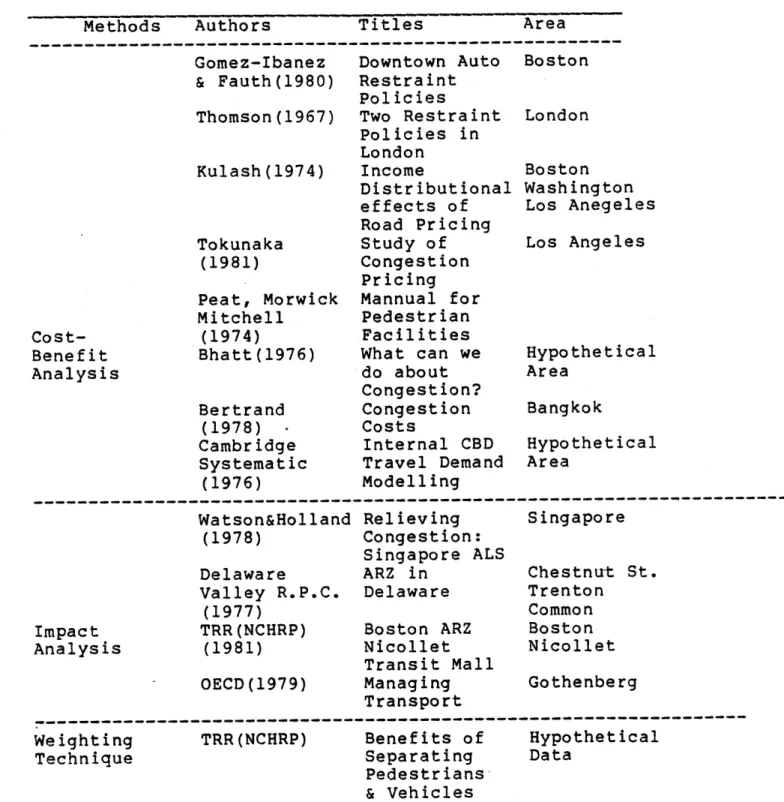
Chapter III examines conventional evaluation methods usually applied to transportation projects. These include: cost-benefit analysis, impact analysis and weighting technique. These evaluation methods are discussed, along with their drawbacks and usefulnesses. Posing the problems associated with these approaches directs attention to alternative methods. This is followed by the review of the multicriteria evaluation methods with reference to
transportation plans or projects. The attempt is made to discuss the multicriteria evaluation methods as well as an
empirical application of these methods to transportation cases.
Chapter IV begins with the description of the central business district in Seoul and describes the characteristics of the transportation systems with an emphasis on mode shares and trip patterns in Seoul.
In Chapter V, feasible auto restricted zone schemes are described. Discussion is also made of twelve criteria
relevant to feasible ARZ schemes. The development of feasible ARZ alternatives and criteria is built upon the Chapter II where relevant ARZ schemes and objectives are described in detail.
Chapter VI begins with a discussion of the underlying theoretical structure of the three methods - Concordance Analysis, Goal-Achiement Matrix and Compromise Solution - and conducts an empirical analysis of the three methods using the information on criteria and alternatives. This chapter also discusses the results of the empirical analysis and its
findings.
Chapter VII assesses the usefulnesses and limitations of the three methods in terms of several criteria. The criteria to be considered include: computational burden, degree of
interaction with the decision maker, ease of sensitivity tests, real-world applicability and applicability to developing countries.
Chapter VIII summarizes the thesis and presents a conclusion. This chapter also suggests directions for
CHAPTER II: AUTO RESTRICTED ZONE (ARZ)
1. Introduction
This chapter presents the concept and types of auto restricted zone (ARZ) schemes. It also examines the experience with ARZs of the U.S., Europe and developing countries. The discussion also relates-the objectives and ARZ schemes in these regions. The appropriate ARZ schemes with respect to each region are presented. This chapter provides a basis for developing the feasible ARZ schemes and criteria for Seoul, Korea, in Chapter V. The feasible ARZs and criteria formulated for Seoul's CBD serve as a vehicle for conducting an empirical analysis in Chapter VI. The Appendix to Chapter II gives a detailed description of the characteristics of widely-used ARZ schemes.
The increasing attention being devoted to the auto restriction is a relatively recent development in the evolution of conceptual thought in urban transportation planning. The point of departure for this development was characterized by an approach which assumed that auto restriction could, by itself, eventually improve the traffic
conditions of the urban areas. Despite the growing interest, there is still considerable controversy regarding what the appropriate area restricted zone schemes are in a given urban areas and what they might accomplish.
A review of the literature and experience with ARZ schemes shows a wide variation of concepts and applications (Herald, ed., 1977; Thomson, 1972; Koffman and Edminster, 1977; Loudon, Pecknold and Kern, 1979; Thomson, 1977; Gomez-Ibanez, 1980; Heaton and Goodman, 1980). The increasing interest in restricting auto traffic within the city center is mainly fostered by the deteriorating environmental quality in urban areas, especially central business distrcits.
In developed countries, it is probably fair to say that the interest in the ARZ schemes which developed in the late 1960's was generated by the recognition that the private automobile is the primary source of traffic congestion in the city center. The interest in this concept was heightened in the mid-1970's by growing concerns regarding energy consumption, air pollution, and mobility needs of persons without access to automobiles.
This concept has been most significantly advanced in European cities. Over 130 European cities have implemented a
large variety of auto restricted zone schemes to reduce congestion and negative effects on environment. Various types of traffic restriction schemes are quite common and
successful throughout the European countries.
In contrast to European cities, the application of this concept to the U.S. downtown zone with element. American and conti Also of transit districts transporta successful countries both in
U.S. cities has been on a limited scale. Most of experience is centered around the closure of the shopping street and its conversion to a pedestrian a high degree of emphasis on the urban design Some of the reasons for the current ARZ interest in cities stem from the energy crisis, air pollution nued deterioration of the economic base of cities. importance has been an interest in giving public an operational advantage in central business and the current Federal policy of encouraging tion system managerment (TSM) actions. In effect, implementation of ARZ schemes in European has awakened widespread interest and acceptance the context of American cities and major cities in developing countries.
2. The Kinds of ARZ Schemes
The schemes available for restricting automobile traffic are numerous and may be applied to whole ranges of different urban sizes and transportation situations. Many such schemes
represent time-worn ideas such as one-way streets or turn prohibitions and assignment of a price for parking. Other methods represent more radical or innovative ideas such as area license schemes, as yet seldom attempted. Because of the great variety of appicability and effect of similar ARZ strategies, it seems appropriate to begin the discussion of such strategies by classifying them according to the degree of restriction and types of measure exerted by different strategies.
ARZ classifications are usually based on the general restriction pattern. The first type of categorization is credited to Thomson(1974) who identifies three sets of automobile restriction methods in central cities:
l.traffic restriction, in which people are pre-vented by physical and/or legal means from
fulfilling certain travel desires;
2.traffic restraint, under which people are dis-couraged, but not prevented from fulfilling such desires;
3.traffic avoidance, in which actions are taken which serves to preclude the development of
travel desires in the first place.
The second type of categorization covers a broad range of measures. This classification of ARZ schemes is based on the
nature of the traffic restriction. Wagner and Gilbert(1979) identify four groups of restriction methods:
l.physical measures, which utilize the design, location and capacity of facilities to control traffic;
2.operational measures, which utilize signs, signals, or mechanical devices to control traffic; 3.regulatory measures, which utilize enforcement
of regulations to control traffic;
4.economic measures, which utilize monetary disin-centives as tools to control traffic.
Table II.1 shows the variety of techniques relevant for each ARZ scheme. Some of the techniques listed in Table II.1 play a supplementary role for ARZ schemes.
Table II-1 ARZ Schemes
Physical Measures Regulatory Measures
Street closing Street barricade
Low design speed Cul-de-sac
Placement of parking lot Number of parking space Ring road/bypass
Area permit
Loading/unloading Parking restriction Vehicular regulation
Staggered work hours Land use regulation Regulation of ownership
Operational Measures Economic Measures
Signalization system Area license
Ramp metering Parking price/tax
Variable route signing Toll
Turn restriction Congestion pricing Special use lane/street Full tax
One-way street Gas rationing
In addition to these categorizations, the characteristics of widely-used ARZ schemes are discussed under the following headings in Appendix to Chapter II:
1. concept 2. mechanism 3. variations
4. possible changes in commuter travel 5. side effects
3. Traffic Restriction Experience
a. European Experience
Generally speaking, the development of ARZs has its roots in the fact that most European cities underwent a similar development pattern and therefore were experiencing similar environmental and traffic problems. Throughout Europe, the transition from the the old to the modern city has been characterized by the built-up areas first reaching and then spilling outside. Cities became organized around a system of radial routes convering on the center.
The growing congestion in the city center caused by rapid urbanization reached the point where remedial action was unquestionably necessary. Controls, such as one-way streets and restricted parking, were introduced. But these strategies proved only partially effective. Thus more comprehensive auto restriction actions emerged along with the above-mentioned strategies. The trend gained momentum, and by
the late 1970's, nearly every major city had banned cars from significant portions of its historic central district and
retail areas.
The ARZ scheme was one of several actions trying to reduce congestion and conserve historic areas. The scheme most
widely-used to date has been that of cell-type restriction measures, generally for reasons which relate to reducing the congestion in the city center. Cell-type restrictin techniques have been employed in the center of Gothenberg, Besancon, Dijon, Bremen, Delft, and Groningen. Gothenberg's CBD was divided into five cells, with boundaries created by surface tramways. Similar-ly, four cells were created in Bremen, Groningen and Besancon. Copenhagen, Dijon, Delft and Upsala adapted essentially single-cell ARZ measures where such techniques as parking restriction, turn prohibition, bus street and pedestrian streets were included. In this way, these cities attempt to control automobile traffic and enhance the quality of the environment.
The experience with traffic cells indicates that they are relatively low cost and very efective in controlling traffic both in the city center and residential areas. In some situations total traffic volume may not be reduced and vehicle miles may be increased. While through traffic was reduced by 50 per cent in Besancon and 40 per cent in Gothenberg in the areas encompassed by the traffic cells, in most cases the total traffic volume for the entire central area has essentially remained constant or slightly increased. But in Besancon, Gothenberg as well as Geneva, the indications are that the redistributed traffic has resulted in both increased efficiency and improved operating
conditions and level of service for other modes (OECD, 1979). The other type of ARZ scheme widely implemented is that of pedestrian streets (or pedestrian areas). More than a hundred city centers have implemented a pedestrian streets. The city centers where the pedestrian streets had been adapted are generally characterized by the congestion during the peak period or most of the day. The reasons advanced by European planners have ranged from strictly functional ones aiming at reducing congestion to humanistic ones aiming at protection of the. environment in historical cores. The broad acceptance of pedestrian streets has been rooted primarily in addressing
these reasons.
A rather unique type of ARZ scheme was developed in Nottingham, England. A system called "zone and collar" was implemented in Nottingham in connection with a new central plan focusing on one-way street networks designed to encourage through traffic. This scheme involved imposing time delays on private automobiles during the morning peak
-essentially metering traffic passage with demand-responsive signals at two locations. Although intrazone circulating traffic was reduced 50 per cent, this scheme was abondoned in
1976 after eleven months because it failed to achieve a substantial modal shift from automobile to public transit.
b. American Experience
Experience in the U.S. appears limited in scope. The pedestrian malls which have been built during the last two decades represent a typical ARZ scheme. Increased concern over traffic congestion and environmental improvement in the 1970s has fueled an explosion in pedestrian mall building. The concept of pedestrian malls was originated from the need to revitalize the downtown area as a commercial and activity center. The urban renewal program provided an impetus for the downtown shopping area to become more competitive with the newer suburban shopping centers by offering much the same convenience and attractiveness: pedestrian access to a variety of business, unobstructed traffic and clean surroundings.
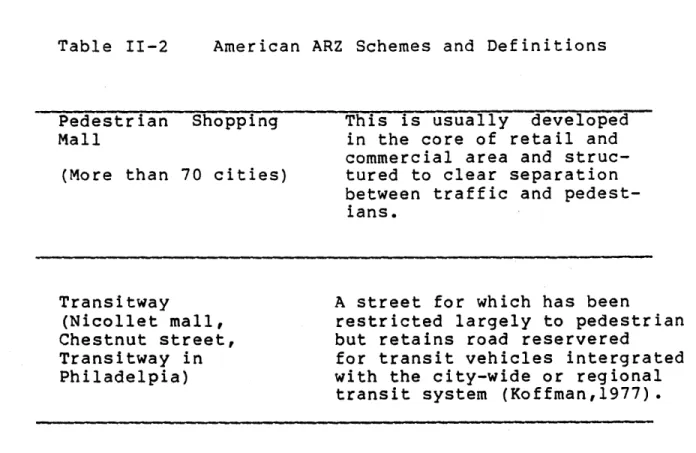
At present, more than 70 U.S. cities of varying sizes have instituted some form of automobile restriction (Loudon,1979). As shown in Table 11-2, the ARZ schemes most frequently
implemented have been the closure of the downtown shopping street and its conversion to either a pedestrian mall or a transit mall. Most of the malls constructed to date have been quite modest in size compared with European examples. The average U.S. mall is about three blocks; almost all are single streets. The effort is generally to improve the
pedestrian movement on major streets with only a minimal effect on automobile traffic.
A different, yet similar, type of mall in America is the so-called "transitway" whose definition is given in Table II-2. Transitway is a compromise between a completly traffic-free zone and the need for shopper's transportation system on the mall. The transitway was generally motivated by the renewed~ interest in public transit in conjuction with the effort to revitalize the city center in the early 1970's. The Nicollect mall, Chestnut street transitway and Portland are typical of the transitway schemes developed in American cities. Transitways in several other cities are in either the planning or construction stage, notably in Madison, Chicago, St. Louis, Cleveland, Denver, and Brooklyn and New York.
American ARZ Schemes and Definitions
Pedestrian Shopping Pedestrian Shopping Mall
(More than 70 cities)
Transitway
(Nicollet mall, Chestnut street, Transitway in Philadelpia)
This is usually developed in the core of retail and commercial area and
struc-tured to clear separation between traffic and
pedest-ians.
A street for which has been
restricted largely to pedestrian use but retains road reservered
for transit vehicles intergrated with the city-wide or regional transit system (Koffman,1977).
The effects of transitways have mostly been favorable. The best evidence of which is both the increasing number of cities instituting such schemes as well as the continuous expansion of ongoing schemes (or plans). In the Nicollet mall case, surveys of merchants reported that the predominant attitude was that the mall had been a good investment. Similar responses were observed at the Chestnut transitway. Accordingly, the transitway is judged to have been successful in accomplishing the goals of improving the commercial vitality and environmental quality of the area.
c. Experience in Developing Countries
Experience in developing countries has been more limited in scope. The Singapore Area License Scheme (ALS) is the only well-documented case in the context of developing countries. The Singapore ALS represents the first ever systematic attempt to use a road pricing policy to control downtown congestion in a major city. Thus it seems appropriate to discuss the experience of the Singapore ALS in terms of its characteristics and effects.
The primary motivation for the Singapore ALS has been to relieve tihe traffic congestion occuring during the peak hours. Under this scheme, which was put into effect in June 1975, vehicle entering the designated restricted zone during certain hours must purchase and display on their windshields a special area license. The boundary of the area is delineated so as to include zones with congestion problems but exclude two circumferential bypass routes for motorists with destinations beyond the zone.
Area license restrictions apply to all automobiles and passenger vehicles (including taxis) with capacities of 12 persons or less. Residents of the central area are exempt from the requirement, as, are police, military and emergency vehicles. To provide an alternative for motorists destined
for the central area, a system of 19 fringe parking lots outside the restricted zone was implemented with shuttle bus service between the lots and the zone. Parking charges were also raised in the central area when the ALS was put into effect to provide added discouragement for automobile users.
The overall effect of the ALS seems to have been favorable. The government of Singapore set a goal of reducing the vehicular traffic entering the restricted area by at least 25 per cent and, at least by this criterion, the ALS has been success. The effect of the ALS on evening outbound traffic was disappointing, however, with little noticeable change in vehicular counts. Also congestion on the inner and outer ring roads also increased substantially because of diverted through-traffic.
While information on traffic restriction schemes in the context of developing countries is either nonexistent or a fairly recent development, it is fair to say that various types of ARZ schemes such as turn restrictions, one-way streets and parking restrcitions may exist in major cities in developing countries. In fact, cities like Lagos, Bogota, Teheran and Singapore, one-way streets are in abundance, with lane markings, parking restrictions and copious use of traffic signals (Thomson,1977).
Most Latin American cities have instituted pedestrian streets in their old city centers. For example, pedestrian
streets (or areas) were implemented in the city centers of Puerto La Cruz, Porlamar and Caracas. About 800 to 1000 meters of streets called Sabana Grande in Caracus and Jiron De La Union were colsed to vehicular traffic. Zones such as Ginza, Shinzuku and Asakusa in Tokyo were designated as an automobile-free zones in the early 1970's. Similar scheme can be found in the Myungdong area in Seoul where vehicular traffic is prohibited during the weekend. These ARZ schemes are aimed at relieving the congestion at the city center
(informal survey conducted by auther in 1983).
The work of Migley and Watson(1981) shows that the city of Curitiba in Brazil regulates street parking in the city center.through no parking areas, loading/unloading areas and restricted waiting areas. Similarly, parking charges were employed that increase with the number of hours parked in Recife in Brazil. The city of Recife has also introduced a number of pedestrian streets in the city center to make the city center less attractive to motorists and more attractive to pedestrians.
Apart from the widely-used ARZ schemes, odd-even plate numbers of automobile are used to relieve congestion in the city center in Lagos, Nigeria. Under this scheme, the automobiles with odd numbers are allowed to drive into the city center on three days per week (Monday, Wednesday and Friday) while the city center is closed for those automobiles
with even numbers on these days and vice versa. The same type of ARZ scheme is currently being implemented in Athens, Greek. In Mexico city, delivery vehicles are prohibited from operating in the city center from 6:00 a.m. to midnight
(informal survey conducted by auther in 1983).
4. General Objectives and Related Issues of ARZ
Having discussed the ARZ experience in developed and developing countries, this section focuses on the definition of a set of generalized objectives and examines the relation of each of these objectives to various ARZ schemes. Clearly, different objectives will vary in intensity from one city to
another, depending on individual circumstances and will be tailored to the specific urban areas.
Six general objective categories have been selected for discussion as a background to the comparison of motives, types and features of ARZ in developed and developing countries. These are:
l.Reduction of congestion.
2.Improvement of noise and visual quality.
3.Reduction of conflict between pedestrian and auto. 4.Enhancement of stability of economy and activity. 5.Preservation of cultural attractiveness.
The objectives, relevant ARZs and techniques are presented in Table 11-3. While a distinction between developed and developing countries is not attempted in the table itself, the classification is designed to focus on the context of both developed and developing countries. One of the difficulties commonly encountered in attempting to classify the ARZ schemes and their associated techniques is that many schemes and techniques are versatile and can be designed to accomplish different objectives. This table provides a basis for discussing the objectives, relevant ARZs and techniques in detail.
a.Reduction of Congestion
This objective generally appears to be a fundamental rationale behind instituting the ARZ schemes in developed and developing countries. The objectives of reducing traffic congestion is constrained by the need to maintain a high level of assessibility to ARZ areas.
The major objective for cell-type traffic restrictions is to reduce the traffic congestion generated by automobiles. For example, The Gothenberg plan was developed to handle the acute traffic congestion that developed in the CBD after completion of two new cross-river links. Similarly, the Nottingham case was based on a strong policy objective of
"balanced transportation" voiced by local political officials.
As discussed previously, most American experience was based on economic revitalization. Auto restriction by itself was not regarded as an objective. The immediate objective of
the Singapore scheme was specified in terms of a reduction in the volume of traffic entering the central area in the morning, with such a reduction expected to achieve the more general objective of changing people's travel habits so as to prevent congestion from becoming a severe problem in the future.
As shown in Table 11-3, the effective ARZs for achieving reduction-of-congestion objective appear to be area licensing, cell-type and street closing. Such techniques as one-way streets, turn restriction and Cul-de-sac are generally supportive means to these ARZ schemes.
b.Improvement of Environment (Air, Noise and Visual Quality)
Untill recently, the environmental objective has received less attention in transportation policy both in the U.S. and in Europe. By the 1970s, with the growth in the number of automobiles, their environmental effects had given rise to
protest everywhere except in developing countries. Air pollution had become the overriding concern for the American public whereas noise become the principal source of
complaints in Europe. Generally speaking, the environmental objective sems to have received more attention in Europe While similar conditions can be observed in developing countries, developing countries generally believe that they cannot afford to pay particular attention to the environmental quality of their cities. This objective appears to be second order of priority.
In American cities, the environmental objective tends to be more directly addressable by the concept of ARZs than was the original objective of revitalization of the CBD as a retail center. In most of the recent ARZ plans in the U.S., the environmental objective is included. The inclusion of the environmental objective reflects the current philosophy of transportaiton policy in the U.S. cities with regard to ARZ schemes.
As to the effectiveness of ARZ schemes toward achieving the environmental objective, the cell-type of measures are likely to have only a limited effect on reducing environmental problems. Many techniques such as turn prohibitions, one-way streets and transitways are so localized in nature that their environmental improvement potential is even more narrowly confined to specific points
or streets.
By contrast, an ARZ scheme such as Singapore's ALS appears to have a great potential for achieving this objective, since it covers a wider area and induces a modal shift from auto to other mode of transportation. It was reported that the Singapore ALS has been successful in improving environmental quality.
c. Reduction of Conflict between Pedestrian and Automobile
Improved pedestrian mobility has been regarded as a separate objective unrelated to traditional transportion policy. The fact that walk trips can be substitutes or complements to vehicular trips has been largely neglected. In American cities, the nature and magnitude of past
transportation investment has forced continued reliance on the automobile, thereby neglecting pedestrian-oriented transportation policy. Pedestrian mobility has received more attention in European countries than in the U.S.
In most cases, the creation of pedestrian and shopping malls in U.S. cities has resulted in increased pedestrian volumes. For example, the volume of pedestrians on streets within the Boston ARZ increased by 5 per cent overall on
weekdays and Saturday: weeknight pedestrian traffic increased by 17 per cent (NCHRP, 1981). Increased pedestrian volume is
commonly associated with exclusive pedestrian areas or streets which enable pedestrians to travel throughout the CBD without the conflict with auto travel. This reduction of conflict between pedestrians and vehicles can result in
improved travel speed for pedestrians since delays due to sidewalk crowding and traffic signals are the primary negative factors on walking speed.
In terms of ARZ scheme effectiveness, cell-type ARZs seem most likely to reduce conflict between pedestrians and vehicular traffic. This is particularly true in Europe where cities were originally designed on a scale to accomodate pedestrians and short vehicular trips, and their central areas still contain high proportion of residential commercial land uses which provide a favorable environment for walking
trips.
In developing countries where the road system is strongly oriented toward the city center and where the road system for absorbing heavy traffic is inadequate, it is not hard to imagine that there shoud be frequent conflicts between pedestrians and vehicular traffic in the city center. Given the high pedestrian traffic in the city centers in these countries, some ARZ schemes which improve the pedestrian mobility are likely to be preferable to other transporation alternatives.
d. Enhancement of Economy and Activities in the City Center
While reducing traffic congestion is a principle objective of the ARZ, another important objective is to enhance the stability'of the economy and activities in the city center. It is, however, naive to assume that the ARZ itself could accomplish this objective. The economic enhancement objective can, of course, be pursued in connection with broad urban development goals. Other contributing factors may include land use policies, public and private investment, metropolitan growth and urban renewal policies.
In terms of the effectiveness of ARZ schemes in achieving the enhanced economy objective, the pedestrian mall and transit mall bear some potential since these schemes were designed to increase retail sales by improving pedestrian mobility and rban design. These types of ARZs have been successful in reversing the decline of economic activity in the city center in American cities. The transit mall may be more effective in fulfilling this objective than pedestrian mall since public transit carries a large number of passengers, thereby increasing the potential patronage of
the downtown retail core. The area must be, above all, the commercial center of particular city in order to sufficiently
achieve the economic enhancement objective.
With regard to European experience, ARZ schemes apear to be less often justified in terms of the economic enhancement objective although this objective is both explicitly and implicitly expressed in their ARZ development. European cities contrast sharply with American cities in terms of economic stability of the city center. While American cities have sufffered from the inevitable decline of their city centers, Europe's inner cities have shown a striking capacity to retain their attractiveness as commercial and cultural centers.
While the characteristics of the city center vary from one developing countries to another, the enhanced economy objective may be readily achievable in developing countries. The reasons seem to be because economic vitality through coexistence of variety of activities has always been maintained, either spontaneously or encouraged by deliberate government planning efforts. Where the city-center space has been in excess demand, with a number of activities competing
for space such as in developing countries, ARZ schemes such as ~pedestrian streets or traffic-free zone may be effective in achieving the economic enhancement objective.
Whether or not paratransit such as jitney or taxi should be allowed in the city centers in developing countries depend greatly on the specific local situations. Paratransit has
augmented the urban development process in the city center in some countries by improving access to local services. Also some economic activities rely heavily on the paratransit system. Thus elimination of this paratransit may undermine the economic activities of the city center.
Accessibility to the city center has been considered an important factor for achieving the economic enhancement objective. The Boston ARZ, for example, shows an increase in sales volume of 27 per cent from 1977 through 1979 (Cambridge Systematics, Inc., 1981). This trend can be attributed to the existence of a transit system which draws both captive riders and shifted-travelers from automo6iles. Thus, with the reduction of automobile accessibility to the area, it seems essential that an alternative transporation system such as public transit be available.
e.Preservation of Cultural Attractiveness and City's Unique Character
This is an objective that is more closely related to urban design and urban form. The achievement of this objective rests directly on the degree of success attained in fulfilling transportation related-objectives such as a reduction in congestion. Traffic congestion along with vehicle pollutants and noise poses a noticeable problem in
European cities. Since town centers frequently contain historical sites, there seems to be a strong desire to
preserve attractiveness and each city's unique character. The cell-type of ARZ appears to be productive in achieving this objective. The traffic cell scheme encompasses the entire city center as well as historical sites and open spaces in some cities. For example, the traffic cells created in Gothenberg, Bremen and Uppsala are far more extensive than those in American cities.
While the preservation objective is explicitly mentioned in several reports which study the ARZ scheme in the U.S. context, this objective received less attention than did the transportation and environmental objectives. Preservation of cultural attractiveness and city's unique character seems to
be an objective that draws virtually no attention in developing countries although some countries have tended to address this issue in recent years.
This objective can best be served by radical measures such as congestion pricing over a larger area. Such techniques as one-way streets and parking restriction are likely to be less
effective in fulfilling this objective.
f.Encougement of Public Transit Use
The encouragement of transit use serves as one of the major objectives addressed in the U.S., Europe and Singapore cases. This objective entails the improvement of public transit accessibility to and within the ARZ area. The public transit mall appears to be the best type of ARZ in accomplishing this objective.
In the U.S., this objective does tend to be more directly addressable by downtown auto restriction than was the original objective of auto restrictionn schemes, namely the revitalization of the CBD as a retail center. This objective can be achieved rather readily in European cities where
transit accessibility to the city center is already high. Besancon experience shows that a 75 percent increase increase in bus ridership was observed within two years (May and Westland, 1979). This increase in transit ridership is
significant when compared to a 34 percent increase in transit ridership in the Boston ARZ during 1978-1980. A similar argument can be made for developing countries where public transit use is generally high. High density cities rely more heavily on public transit than less densely-populated ones.
The existence of more than one public transit or paratransit mode needs to be integrated in order to effectively address the public transit encouragement objective. This is particularly important for an area where various types of paratransit modes compete for a limited space. In some developing countries, there are the motorized and non-motorized paratransit modes such as jitneys, trishaws and minibuses which play relatively important roles in providing trips over short and medium distances. A complete ban of paratransit in some urban areas may be necessary to give preferential access to public transit given the slow paratransit speeds and absence of schedules and fixed stops which impede the general traffic flow in congested areas.
5. The Appropriate ARZ in Developed Develoing Countries
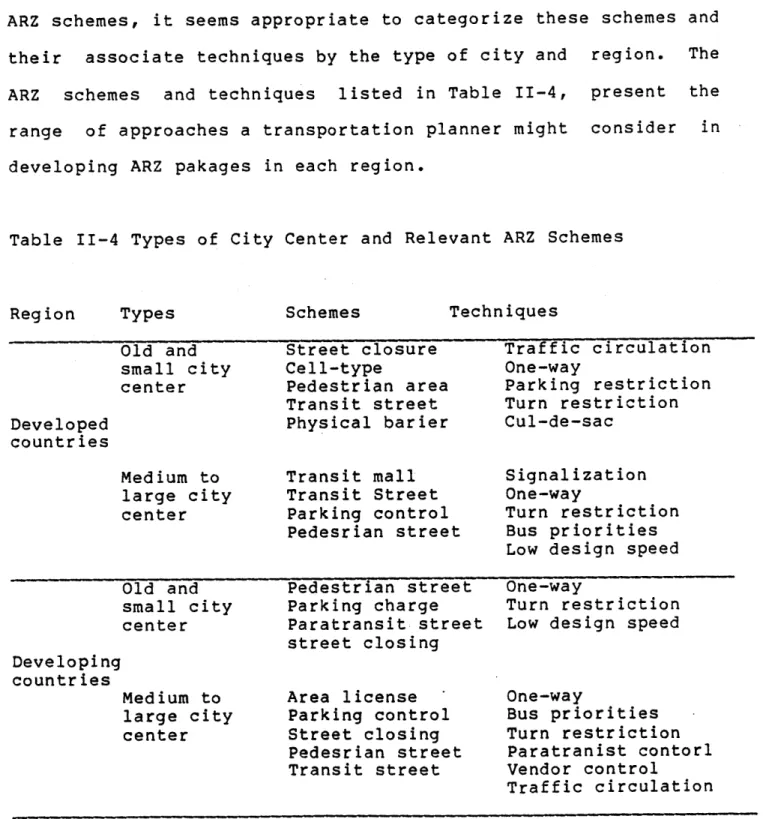
Having established the relationship between objectives and ARZ schemes, it seems appropriate to categorize these schemes and their associate techniques by the type of city and region. The ARZ schemes and techniques listed in Table 11-4, present the range of approaches a transportation planner might consider in developing ARZ pakages in each region.
Table 11-4 Types of City Center and Relevant ARZ Schemes
Region Types Schemes Techniques
Old and small city center Developed countries Medium to large city center Old and small city center Developing countries Medium to large city center Street closure Cell-type Pedestrian area Transit street Physical barier Transit mall Transit Street Parking control Pedesrian street Pedestrian street Parking charge Paratransit street street closing Area license Parking control Street closing Pedesrian street Transit street Traffic circulation One-way Parking restriction Turn restriction Cul-de-sac Signalization One-way Turn restriction Bus priorities
Low design speed
One-way
Turn restriction Low design speed
One-way Bus priorities Turn restriction Paratranist contorl Vendor control Traffic circulation
Most actions listed under techniques should be viewed as supportive or supplemental to the associated ARZ schemes. Since the cities in both developed and developing countries differ considerably from one another, categorization of this sort should be considered suggestive rather than definitive. Likewise implementality depends upon a host of external conditions including the role of the city goverment, prevailing attitudes, and existing modal shares.
The types of cities categorized by Thomson (1977) provides a useful basis for discussing relevant ARZ schemes. As shown in Table 11-5, three types of categorization were made on the basis of centralization versus decentralization.
Table 11-5
City Structure
The Types of City Structure
Cities
Paris, Washington, London, New York, Tokyo, Toronto, Hamburg, Stockholm, Sydney, Athens
Less Centralized
Decentralized
Boston, San Fransisco, Copenhagen, Goteberg, Chicago, Vienna,
Melbourne
Baltimore, Pittsburg, Milwaukee, Buffalo, Salt Lake City, Denver, Detroit, Los Angeles
Source: Thomson(1977) Centralized