
Algorithms and Algorithmic Obstacles for
Probabilistic Combinatorial Structures
by
Quan Li
B.S., Tongji University (2007)
S.M., Tsinghua University (2010)
S.M., Duke University (2012)
M7
hE
NMAR 2Z?018
LIBRARIES
ARCHIVES
Submitted to the Department of Electrical Engineering and Computer
Science
in partial fulfillment of the requirements for the degree of
Doctor of Philosophy
at the
MASSACHUSETTS INSTITUTE OF TECHNOLOGY
February 2018
@
Massachusetts Institute of Technology 2018. All rights reserved.
Author ...
Department of Electrical Engineering aAi
Computer Science
9 October 2, 2017
Certified by...
Professor David Gamarnik
Nanyang Technological University Professor
MIT Sloan School of Management
Thesis Supervisor
Accepted by ...
,II
tUI
I
U
...
Profesbor LWi4JA. Kolodziejski
Chair, Committee on Graduate Students
Department of Electrical Engineering and Computer Science
MITLibraries
77 Massachusetts Avenue
Cambridge, MA 02139 http://Iibraries.mit.edu/ask
DISCLAIMER NOTICE
Due to the condition of the original material, there are unavoidable
flaws in this reproduction. We have made every effort possible to
provide you with the best copy available.
Thank you.
The images contained in this document are of the
best quality available.
Algorithms and Algorithmic Obstacles for Probabilistic
Combinatorial Structures
by
Quan Li
Submitted to the Department of Electrical Engineering and Computer Science on October 2, 2017, in partial fulfillment of the
requirements for the degree of Doctor of Philosophy
Abstract
We study efficient average-case (approximation) algorithms for combinatorial opti-mization problems, as well as explore the algorithmic obstacles for a variety of dis-crete optimization problems arising in the theory of random graphs, statistics and machine learning. In particular, we consider the average-case optimization for three NP-hard combinatorial optimization problems: Large Submatrix Selection, Maximum Cut (Max-Cut) of a graph and Matrix Completion.
The Large Submatrix Selection problem is to find a k x k submatrix of an n x n matrix with i.i.d. standard Gaussian entries, which has the largest average entry. It was shown in [131 using non-constructive methods that the largest average value of
a k x k submatrix is 2(1 + o(1)) Vlog n/k with high probability (w.h.p.) when k =
O(log n/ log log n). We show that a natural greedy algorithm called Largest Average Submatrix LAS produces a submatrix with average value (1+ o(1)) 2 log n/k w.h.p. when k is constant and n grows, namely approximately
V'2
smaller. Then by drawing an analogy with the problem of finding cliques in random graphs, we propose a simple greedy algorithm which produces a k x k matrix with asymptotically the same average value (1+o(1)) 2log n/k w.h.p., for k = o(log n). Since the maximum clique problem is a special case of the largest submatrix problem and the greedy algorithm is the best known algorithm for finding cliques in random graphs, it is tempting to believe that beating the factor v performance gap suffered by both algorithms might be very challenging. Surprisingly, we show the existence of a very simple algorithm which produces a k x k matrix with average value (1 + ok(1) + o(1))(4/3) 2log n/k for k = o((logn)"), that is, with asymptotic factor 4/3 when k grows. To get an insight into the algorithmic hardness of this problem, and motivated by methods originating in the theory of spin glasses, we conduct the so-called expected overlap analysis of matrices with average value asymptotically (1 + o(1))a 2 log n/k for a fixed value a E [1, V"2]. The overlap corresponds to the number of common rows and common columns for pairs of matrices achieving this value. We discover numerically an intriguing phase transition at a* 5v/2/(3v ) ~ 1.3608.. c [4/3, V1d: whena < a* the space of overlaps is a continuous subset of [0, 112, whereas a = a* marks the onset of discontinuity, and as a result the model exhibits the Overlap Gap Property
(OGP) when a > a*, appropriately defined. We conjecture that OGP observed for a > a* also marks the onset of the algorithmic hardness - no polynomial time algorithm exists for finding matrices with average value at least (1+o(1))a 2 log n/k, when a > a* and k is a growing function of n.
Finding a maximum cut of a graph is a well-known canonical NP-hard problem. We consider the problem of estimating the size of a maximum cut in a random Erd6s-R6nyi graph on n nodes and
[cn]
edges. We establish that the size of the maximum cut normalized by the number of nodes belongs to the interval [c/2 + 0.47523v/5, c/2 + 0.55909\/-] w.h.p. as n increases, for all sufficiently large c. We observe that every maximum size cut satisfies a certain local optimality property, and we compute the expected number of cuts with a given value satisfying this local optimality property. Estimating this expectation amounts to solving a rather involved multi-dimensional large deviations problem. We solve this underlying large deviation problem asymptotically as c increases and use it to obtain an improved upper bound on the Max-Cut value. The lower bound is obtained by application of the second moment method, coupled with the same local optimality constraint, and is shown to work up to the stated lower bound value c/2 + 0.47523v/2. We also obtain an improved lower bound of 1.36000n on the Max-Cut for the random cubic graph or any cubic graph with large girth, improving the previous best bound of 1.33773n.Matrix Completion is the problem of reconstructing a rank-k n x n matrix M from a sampling of its entries. We propose a new matrix completion algorithm us-ing a novel samplus-ing scheme based on a union of independent sparse random regu-lar bipartite graphs. We show that under a certain incoherence assumption on M and for the case when both the rank and the condition number of M are bounded, w.h.p. our algorithm recovers an E-approximation of M in terms of the Frobenius norm using O(nlog2(1/f)) samples and in linear time O(nlog2(1/e)). This provides the best known bounds both on the sample complexity and computational cost for reconstructing (approximately) an unknown low-rank matrix. The novelty of our al-gorithm is two new steps of thresholding singular values and rescaling singular vectors in the application of the "vanilla" alternating minimization algorithm. The structure of sparse random regular graphs is used heavily for controlling the impact of these regularization steps.
Thesis Supervisor: Professor David Gamarnik Title: Nanyang Technological University Professor MIT Sloan School of Management
Acknowledgments
First of all, I would like to express my sincere gratitude to my advisor, Professor David Gamarnik, for his support and guidance in the last five years. I was frequently inspired by his earnest attitude towards original research and patience towards high quality work. I learned trememdously from his intellectual curiosity to explore chal-lenging open problems and always look for insightful ways to improve the current state of the art results. I benefited a lot from our discussions in the regular weekly meetings, during which he always encouraged me to think deeply and thoroughly on the intellectually challenging problems, and offered lots of patience to delve into the involved technical details. David is also an extremely supportive mentor, and pro-vided much inspiration and encouragement to navigate me through several struggling stages during my tough journey of exploring open problems.
I feel grateful to thank my committee members Professor Caroline Uhler and Pro-fessor Guy Bresler for serving on my thesis committee. They asked many intriguing questions and provided much constructive feedback, which helped me a lot in improv-ing the quality of this thesis.
My time at MIT would not be so enjoyable without many friends and colleagues at LIDS and EECS. I would like to thank Jianan Zhang for all his kind help, the
discussion with him on the final project for advanced algorithms, and the preparation of coding questions and brain teasers for hedge fund and trading firm interviews. I also would like to thank Hongyu Yang and He Sun for all their help, the enjoyable discussion on trading and investments, and exploration of the delicious food around MIT. Last but not least, I would also like to thank my officemates Hamza Fawzi, Omer Tanovic, Hongyi Zhang, Xia Miao for their enjoyable company and many stimulating white board discussions.
I would like to thank the support from my parents on my life, education and
career. Their unconditional love and encouragement are the precious sources which power me through all the strugging stages in my life and will continue to help me overcome the challenges in the career. Finally, I am extremely grateful to my wife
Yuan Gao for being my comfort and home. Her recent joining me makes my last year at MIT full of joy and love. Her genuine support to the family is a great help to my preparation of this thesis and the following thesis defense, and my forthcoming career. I am truly blessed to have Yuan as my wife, friend and soul mate in my life.
Contents
1 Introduction 13
1.1 Organization of the Thesis and its Contributions . . . . 16
1.1.1 Finding a Large Submatrix of a Gaussian Random Matrix, chapter 2 ... .... ... ... . .. 16
1.1.2 Max-Cut of Sparse Random Graphs, chapter 3 . . . . 20
1.1.3 Matrix Completion from 0(n) Samples in Linear Time, chapter 4 24 2 Finding a Large Submatrix of a Gaussian Random Matrix 27 2.1 M ain Results . . . . 28
2.2 Analysis of the
igP
algorithm . . . . 372.3 The Ovelap Gap Property . . . . 40
2.4 Analysis of the LAS algorithm . . . . 45
2.4.1 Preliminary results . . . . 45
2.4.2 Conditional distribution of the row-dominant and column-dominant subm atrices . . . . 48
2.4.3 Bounding the number of steps of LAS. Proof of Theorem 2.1.1 60 2.5 Open Problem s . . . . 75
3 Max-Cut of Sparse Random Graphs 77 3.1 M ain Results . . . . 77
3.2 Preliminary results. Random multi-graphs, the Balls into Bins model and the Local Large Deviations bounds . . . . 85
3.4 Lower bound. The second moment method . . . .
3.4.1 Bounds on 11 . . . .
3.4.2 Bounds on 12 .. . . . . . . .. . . .
3.4.3 Computing the limit of
limn n
1log(11
2).3.5 Solving the optimization problem (3.112) . . . . . 3.6 Proof of Theorem 3.1.5 . . . . 3.7 Conclusions and further questions . . . .
. . . . 104 . . . . 111 . . . . . . . ...114 . . . . 120 . . . . 127 . . . . 132 . . . . 134
4 Matrix Completion from 0(n) Samples in Linear Time 137 4.1 Problem Formulation and Assumptions ... 140
4.2 Main Results ... ... 142
4.3 Analysis of the TAM algorithm ... 148
4.3.1 Initialization ... ... 148
4.3.2 Convergence of the algorithm TAM. Proof of Theorem 4.2.1 154 4.3.3 Bounding the Frobenius norm |IFt/ot||F. Proof of Theorem 4.3.4162 4.3.4 Bounding the size of Sj(#). Proof of Theorem 4.3.7 . . . . 175
4.4 Conclusions and Open Questions . . . . 193
A Appendix 195 A.1 Proof of Lemma 2.2.1 . . . . 195
A.2 Derivation of two phase transition points a* = v/v and c* = 5 N /(3V ) . . . . 196
A.3 Proof of Proposition 4.3.9 . . . . 198
List of Figures
Step 2r of IgP algorithm . . . . Step 2r + 1 of 1GP algorithm . . . .
R(a) for a
c
(0,
/\)
. . . .
R(a) for a E (V //,5V /(3V3))
. . . .R (5 v /(3v3)) . . . .
R(a) for a
E(5V2/(3v ),2)
. . . .
Step 2r of LAS algorithm . . . .
suPi3E(o,1/2) W(x, /) and 2w(x) for x E [0.44,0.56. . . . .
Illustration of computing E[X2(zn)] where
Yj,k =flZk, 1
j
W(x, /3) for x = 0.47523 . . . . W(x,/3)
for x = 0.5 . . . . . . . . . 33 . . . . . 34 . . . . . 36 . . . . . 36 . . . . . 36 . . . . . 36 . . . . . 61 < k < 4.4-1 Illustration of the event R(/n, ad, 6Odn) where EQ,s = 6/dn repre-sents the number of edges between two vertex sets sitting at the ends of the line corresponding to EQ,S. EQ,sc = 1rytdn - 6/dn, EQc,s =
#dr
- 9/3dn and EQc,sC = (1 -#)dn
- ,rytdn + O/dn are defined ac-cordingly. . . . . 80 107 133 133 185 2-1 2-2 2-3 2-4 2-5 2-6 2-7 3-1 3-2 3-3 3-4List of Tables
4.1 Comparison of various matrix completion methods. k is rank, K is condition number and po is incoherence parameter defined below. The methods with superscript symbols 't' are for exact matrix comple-tion while the remaining methods without 't' are for approximate ma-trix completion. The methods with superscript symbols '*' are under stronger incoherence assumption than the standard incoherence as-sumption (Asas-sumption 1), appropriately defined while others are un-der the standard incoherence assumption. c is the tolerance such that the reconstructed matrix MI satisfies JIM - I|F <_ EIMIIF w.h.p. 0 notation hides factors polynomial in k, K and po. . . . . 138
Chapter 1
Introduction
In this thesis, we study efficient average-case approximation algorithms for combina-torial optimization problems, as well as explore algorithmic obstacles for a variety of discrete optimization problems arising in the theory of random graphs, statistics and machine learning. In particular, we consider the average-case optimization for three NP-hard combinatorial optimization problems: Large Submatrix Selection, Max-Cut and low-rank Matrix Completion. A natural choice for the probability distribution over inputs for these problems is a random matrix with i.i.d. entries or a random graph, more specifically, an Erd6s-R6nyi graph or random regular graph. We also investigate the algorithmic hardness of the problem of Large Submatrix Selection in a Gaussian random matrix. Now we introduce three main problems considered in this thesis.
Problem 1: Large Submatrix Selection. We consider the algorithmic
prob-lem of finding a submatrix of a given random matrix such that the average value of the submatrix is appropriately large. Specifically, consider an n x n matrix C" with i.i.d. standard Gaussian entries. Given k < n, the goal is to find algorithmically a k x k submatrix of C" (not necessarily principal) with average entry as large as possible. The problem has motivations in several areas, including biomedicine, genomics and social networks [651,[56],[351. The search of such matrices is called "bi-clustering" [561.
Problem 2: Max-Cut. The Max-Cut (finding the maximum cut) of a graph
the number of edges between the two parts. In the worst case the problem falls into the Max-SNP-hard complexity class which means that the optimal value cannot be approximated within a certain multiplicative error by a polynomial time algorithm, unless P=NP. Here we consider the problem of estimating the size of a maximum cut in a sparse random Erd6s-R6nyi graph on n nodes and [cnJ edges for a large constant
c > 0.
Problem 3: Low-rank Matrix Completion. We consider the problem of
recovering a rank-k n x n matrix M from a sampling of its entries. Specifically, let M G R" "x be a rank-k matrix. The entries in M associated with the index set
Q
C
[n] x [n] are observed, that is, the entries Mij, V(i,j)
E Q, are known. Definethe sampling operator PQ : R nx" R "n' by
Ph(M) Mij if (i ) O
10 if (,j) Q .
Let VR and VC be the sets of rows and columns of the matrix M, respectively, indexed
by the sets {1, 2,... , n} and {1, 2, ... ,n}. Also, let
g
= (V, S) be the bipartiteundirected graph on the vertex set V = VR U Vc with edge set E -3 (i, J) if and only if (i, j) E Q. Our goal is to design the sampling graph 9 and an efficient (polynomial time) algorithm such that M can be approximately reconstructed from the observed
PQ(M) with the cardinality
IQI
as small as possible. Our work consists of two parts.* Average-case algorithm design and analysis. For Large Submatrix Selection problem, we specifically estimate the performance of the so-called Largest Av-erage Submatrix (LAS) algorithm and further develop an efficient algorithm with improved performance compared with the LAS algorithm. For Matrix Completion problem, we design a novel sampling scheme based on a union of independent random regular bipartite graphs. Under this sampling scheme, we propose a linear algorithm for (approximate) low-rank matrix completion using linear samples in the dimension of the matrix. The novelty of our algorithm
lies in two new regularization steps of thresholding singular values and rescal-ing srescal-ingular vectors in the application of the "vanilla" alternatrescal-ing minimization algorithm [591. In the analysis of this algorithm, the structure of sparse random regular graphs is used heavily for controlling the impact of these regularization steps. This result provides the best known bounds on both the sample complex-ity and the computational cost for (approximately) reconstructing an unknown low-rank matrix under standard incoherence assumptions.
* Theory of random graphs. We establish the Overlap Gap Property (OGP
)
[381 for the Large Submatrix Selection problem which originates in the theory
of spin glasses and is also observed in many sparse random constraint satisfac-tion problems, such as random K-SAT, coloring of sparse Erd6s-R6nyi graph problem and the problem of finding a largest independent set of a sparse Erd6s-R6nyi graph. The OGP is also established in a setting other than constraint satisfaction problems on graphs, specifically in the context of high-dimensional regression [421. Furthermore, we connect OGP with the algorithmic hardness,
and conjecture that OGP in fact marks the onset of the algorithmic hardness. For Max-Cut, we establish improved upper and lower bounds on the size of the maximum cut normalized by the number of nodes in an Erd6s-R6nyi graph, by introducing a novel bounding technique based on local large deviation results for lattice based random variables.
As a whole, the work in this thesis makes contributions to the average-case al-gorithm design and analysis in random graphs, or more general problems involving i.i.d. data. This work also benefits various applications such as "bi-clustering" [561 for data analysis in biomedicine, genomics and social networks [651,[561,[35], and ma-trix completion in collaborative filtering, system identification, global positioning and computer vision [16].
1.1
Organization of the Thesis and its Contributions
In this section, first we give a brief survey of the previous work related to each problem we study. Then, we state our main results and summarize briefly the techniques we use to establish them.
1.1.1
Finding a Large Submatrix of a Gaussian Random
Ma-trix, chapter 2
Analysis of LAS algorithm
The problem of finding asymptotically the largest average entry of k x k submatrices of C7 was recently studied by Bhamidi et.al. [13] (see also [681 for a related study) and questions arising in this paper constitute the motivation for our work. It was shown in [131 using a non-constructive method of moments that the largest achievable average entry of a k x k submatrix of C" is asymptotically with high probability (w.h.p.)
(1 + o(1))2 log n/k when k = O(log n/ log log n) (a more refined distributional result is obtained). Here o(1) denotes a function converging to zero as n -+ oc regardless of k. Furthermore, the authors consider the asymptotic value and the number of so-called locally maximum matrices. A k x k matrix A is locally maximal if every k x k matrix of C" with the same set of rows as A does not have a larger average value than A and every k x k matrix of C" with the same set of columns as A does not have a larger average value than A. Such local maxima are natural objects arising as terminal matrices produced by a simple iterative procedure LAS, designed for finding a matrix with a large average entry. LAS proceeds by starting with an arbitrary k x k submatrix A0 and finding a matrix A1 sharing the same set of rows with A0 which has the largest average value. The procedure is then repeated for A1 by searching through columns of A1 and identifying the best matrix A2. The iterations proceed while possible and at the end some locally maximum matrix ALAS is produced as the output. The authors show that when k is constant, the majority of locally maximum matrices of C" have an asymptotic value (1 +o(1)) /2log n/k w.h.p., thus factor v/2
smaller than the global optimum. Motivated by this finding, the authors conjecture that the outcome of the LAS algorithm should be also factor / smaller than the global optimum, however one cannot deduce this from the result of [13] since it is not ruled out that LAS is clever enough to find a "rare" local maximum with a significantly larger average value than 2 log n/k. Also the authors leave open the question regarding the number of iterations of LAS.
Our work on this problem has confirmed the conjecture on the performance of
LAS algorithm for the case of constant k: the LASalgorithm produces a matrix
with asymptotic average value (1 + o(1))N2 logn/k with high probability (w.h.p.)
[131. We further establish that the number of iterations of the LAS algorithm is
stochastically bounded as n grows. The proof of this result is fairly involved and proceeds by a careful conditioning argument. In particular, we show that for fixed r, conditioned on the event that LAS succeeded in iterating at least r steps, the probability distribution of the "new best matrix" which will be used in constructing the matrix for the next iteration is very close to the largest matrix in the k x n strip
of C", and which is known to have asymptotic average value of 2 logn/k due to result in [131. As a result we show that the matrix produced in step r and the best matrix in the k x n strip among the unseen entries are asymptotically independent. Using this we show that given that LAS proceeded with r steps the likelihood it proceeds with the next r +2k +4 steps is at most some value 0 < 1 which is bounded
away from 1 as n grows. As a result the number of steps of LAS is upper bounded
by a geometrically decaying function and thus is stochastically bounded. We use
this as a key result in computing the average value produced by LAS, again relying on the asymptotic independence and the average value of the k x n strip dominant submatrix.
Connection between Large Submatrix Selection problem and maximum clique problem
As it was observed already in [131, the factor v'2 gap between the global optimum and the performance of LAS is reminiscent of a similar gap arising in the study of a largest
clique of a random graph. Arguably, one of the oldest algorithmic open problems in the field of random graph is the problem of finding a largest clique (a fully connected subgraph) of a random Erd6s-R6nyi graph G(n, p), when p is at least n1 + for some positive constant J. It is known that the value is asymptotically 2 log n/(- log p) and a simple greedy procedure produces a clique with size log n/ (- log p), namely factor 2 smaller than the global optimum. A similar result holds for the bi-partite Erd6s-R6nyi graph: the largest clique is asymptotically 2logn/(-logp) and the greedy algorithm produces a (bi-partite) clique of size asymptotically log n/(- log p). Karp in his 1976 paper [49] challenged to find a better algorithm leading to a clique with size say (1 + c) log2 n and this problem remains open. The factor v appearing in
our context is then arguably an analogue of the factor 2 arising in the context of the clique problem in G(n,p).
In order to further investigate the possible connection between Large Submatrix Selection problem and maximum clique problem in a random graph, we propose the following simple algorithm for finding a submatrix of C" with a large average entry. Fix a threshold 9 and consider the random 0, 1 matrix C' obtained by thresholding each gaussian entry of Cn at 9. Clearly Cn is an adjacency matrix of a bi-partite Erd6s-R6nyi graph G(n, po), where po = IP(Z > 0) and Z is a standard gaussian random variable. Observe that any k x k clique of G(n,p0) corresponds to a k x k submatrix of C" with each entry at least 0. Thus any polynomial time algorithm for finding a clique in G(n, po) which results in a k x k clique immediately gives a matrix with average value at least 9. Consider the greedy algorithm and adjust 9 so that the size of the clique is at least k on each side. Reverse engineering 9 from such k, we find 9 ~ V2log n/k with p ~ exp(-92/2) = n-k. Namely, both LAS and the greedy algorithm have the same asymptotic power! (Note, however, that this analysis extends beyond the k = 0(1) unlike our analysis of the LAS algorithm).
IGP algorithm: go beyound v gap
In light of these connections with studying cliques in random graphs and the apparent failure to bridge the factor 2 gap for cliques, one might suspect that v is equally
challenging to beat for the maximum submatrix problem. Perhaps surprisingly, we establish that this is not the case and construct a very simple algorithm, both in terms of analysis and implementation, which construct a submatrix with average value asymptotically (1 + ok(1)(4/3)/2 logn/k [381. Here ok(1) denotes a function decaying to zero as k increases, for k = o(log1.5 n). The algorithm proceeds by starting with one entry and iteratively building a sequence of r x r and r x (r + 1) matrices for r = 1,... , k - 1 in a simple greedy fashion. We call this procedure, Incremental
Greedy Procedure (19P), referring to the incremental increase of the matrix size. No immediate simple modifications of IG led to the improvement of the 4/3 factor, unfortunately.
Solution space geometry and a hardness conjecture
The link between OGP and algorithmic hardness has been suggested and partially
established in the context of sparse random constraint satisfaction problems, such as random K-SAT problem, coloring of sparse Erd6s-R6nyi problem and the problem of finding a largest independent set of a sparse Erd6s-R6nyi graph problem [1, 2, 22, 40,
61, 411. The OGP is also established in a setting other than constraint satisfaction
problems on graphs, specifically in the context of high-dimensional regression [42]. Many of these problems exhibit an apparent gap between the best existential result and the best result found by algorithmic means, very similar in spirit to the gaps 2, v2 etc. discussed above in our context. For example, the largest independent set of a random d-regular graph normalized by the number of nodes is known to be asymptotically 2 log d/d as d increases, while the best known algorithm can produce sets of size only log d/d again as d increases. As shown in [221,[40] and [611 the threshold log d/d marks the onset of a certain version of OGP .Furthermore, [401 and
[61] show that OGP is the bottleneck for a certain class of algorithms, namely local
algorithms (appropriately defined). A key observation in [61] is that the threshold for multioverlap version of the OGP , namely considering m-tuples of solutions as opposed to pairs of solutions as we do in this proposal, lowers the phase transition point. The multioverlap version of OGP was also a key step in [41] in the context of
random Not-All-Equal-K-SAT (NAE-K-SAT) problem which also exhibits a marked gap between the regime where the existence of a feasible solution is known and the regime where such a solution can be found by known fast algorithms.
The discussion above raises the following question: where is the true algorithmic hardness threshold value for the maximum submatrix problem if such exists? We fix a E (1, v/2) and let C(a) denote the set of matrices with average value asymptotically aV2 logn/k. Thus a conveniently parametrizes the range between the achievable value on the one hand, namely a = 1 for LAS and greedy algorithms, a = 4/3 for the
igP,
and a = v/2 for the global optimum on the other hand. For every pair ofmatrices A1, A2 E (a) with row sets I1, 12 and column sets J1, J2 respectively, let
x(Ai, A
2) = 1I,n
I
21/k, y(A
1,
A2) =IJi
n
J
21/k.Namely x and y are the normalized
counts of the common rows and common columns for the two matrices. For every
(x, y) E [0, 1]2 we consider the expected number of pairs A1,
A
2 such thatx(Ai, A
2) ~x, y(A1, A2) y, in some appropriate sense [38]. We compute this expectation
asymptotically. We define R(x, y) = 0 if such an expectation converges to zero as n -+
oo and = 1 otherwise. Thus the set R(a) {(x, y) : R(x, y) = 1} describes the set of
achievable in expecation overlaps of pairs of matrices with average value a V2 log
rn/k.
At a* 5V/(3f) ~ 1.3608.. we observe an interesting phase transition - the set
R(a) is connected for a < a*, and is disconnected for a > a*. Namely, for a > a*
the model exhibits the OGP : the overlaps of two matrices can only belong to the disconnected region.
Motivated by this observation, we conjecture that the problem of finding a matrix with the corresponding value a > a* is not-polynomially solvable when k grows. In fact, by considering multi-overlaps instead of pairwise overlaps, which is a future work, we conjecture that this conjectured hardness threshold might be even lower than a*.
1.1.2
Max-Cut of Sparse Random Graphs, chapter 3
Last decade we have seen a dramatic progress improving our understanding of var-ious randomly generated constraint satisfaction models such as the random K-SAT
problem, the random XOR-SAT problem, proper coloring of a random graph, inde-pendence ratio of a random graph, and many related problems [32], [231, [241. These problems broadly fall into the class of so-called anti-ferromagnetic spin glass models, borrowing a terminology from statistical physics. At the same time the best known results for the Max-Cut problem (which falls into anti-ferromagnetic category) were obtained in [26] about a decade ago, and have not been improved ever since. In the aforementioned reference, upper and lower bounds are obtained on the Max-Cut value for the sparse random Erd6s-R6nyi graph. Related results concerning the Max-K-SAT problem were considered in [3] and [4].
Recall that an Erd6s-R6nyi graph G(n, m) is a random graph generated by select-ing m edges uniformly at random (without replacement) from all possible edges on n vertices. The Max-Cut problem exhibits a phase transition at 2m/n = 1. Specifically,
Coppersmith et al. [26] showed that the difference of m and the MaxCut size jumps from E(1) to O(n) as 2m/n increases from below to above 1. Furthermore, Daud6, Martinez, et al. [281 established the distributional limit of Max-Cut size in the scaling window 2m - n = o(n).
Let m = [cnJ for some constant c. When c is sufficiently large, which is the setting considered in this thesis, both upper and lower bounds of the Max-Cut size are also obtained in [26]. To describe their result, let MCnc denote the Max-Cut value in the Erd6s-R6nyi graph G(n, [cnJ). Then there exists MC(c) such that
MC~nc A c
'-+ MC(c) (1.1)
n
in probability as n -+ oo. The existence of this limit is by no means obvious and was only recently established in [9]. The fact that the actual value concentrates around MC(c) with high probability follows directly by application of the Azuma's inequality. In terms of MC(c), it was shown in [26] that
MC(c) E [c/2 + 0.37613V/ + oc(V/2), c/2 + 0.58870v/ + oc(v/2)],
we use standard notations o(.),
O(-)
andE(-)
with respect to n -+ o. When theseorder of magnitude notations are with respect to the regime c - oo, we use subscripts
oc, O,
Ec.
The upper bound was obtained by using a standard first moment method.Namely, one computes the expected number of cuts achieving a certain cut size value. It was shown that when the size is at least c/2 + 0.58870V/ + oc(v/2) the expectation converges to zero exponentially fast, and thus the cuts of this size do not exist w.h.p. For the lower bound the authors constructed an algorithm where the nodes were dynamically assigned to different parts of the cut based on the majority of the implied degrees. Since the degree of a node has approximately a Poisson distribution with parameter 2c, which for large c is approximated by a Normal distribution with mean
2c and standard deviation V/2, the absolute value of the difference of two such random
variables is approximately the absolute value of the difference of two i.i.d. normally distributed random variables and has mean of order 9/2. This approach leads to a lower bound c/2 + 0.37613V/ + oc(V/).
We establish that the size of the maximum cut normalized by the number of nodes belongs to the interval [37]
MC(c) E [c/2 + 0.47523/c +
oc(v/2),
c/2 + 0.55909V/] +
oc(V1/).
Our main approach is based on computing the expected number of cuts which satisfy the local optimality constraint and which achieve a certain cut value
LznJ
for a con-stant z in G(n, [cnj). Computing this expectation is an involved task and amounts to solving a certain multi-dimensional large deviations problem. The nature of this problem can be described as follows. Consider the random multi-graph as the config-uration model generalized to Erd6s-R6nyi graph. The joint distribution of degrees of nodes in this random multi-graph can be described by the joint distribution arising from the balls into bins problem. Specifically, for an even n, given a cut V1, V2 of a graph of equal size V1I=
I
V2| = n/2 (later we will establish that this case determines the normalized exponent of the expected number of cuts which satisfy the localremaining parts V and V2 have the number of internal edges equal to zinJ and [z2nJ for two constants zi and z2 respectively, with [znj + [zinJ + [z2nJ = [cnJ, the joint distribution of the number of neighbors of nodes of V in part V2 is described as the joint distribution arising from putting
LznJ
balls into n/2 bins uniformly at random. Similarly, the joint distribution of the number of neighbors of nodes of Vj who also be-long to V is also described as the joint distribution arising from putting [2zjnj balls into n/2 bins uniformly at random, independently from the first process and from the other part. Let the first LznJ balls be colored blue, and the balls corresponding to the [znj edges be colored red forj
= 1, 2. Then the local optimality constraintmeans that in each bin the number of red balls does not exceed the number of blue balls. Achieving a particular cut value [znJ amounts to saying that the total number of blue balls equals LznJ. Both events are of large deviations type and computing the likelihood of this rare event amounts to solving a multi-dimensional large deviations problem. While solving this problem for a fixed c appears to be intractable, it can be solved asymptotically when c is large since in this case the distribution of balls in bins is well approximated by a normal distribution. As a result the large deviations rate function can be solved by integration over Gaussian distribution. This approach leads to an upper bound on the size of maximum cut in G(n, [cn]).
To obtain the lower bound we consider the second moment of the number of cuts achieving value
LznJ
satisfying the local optimality constraint. The idea of the approach is very similar to the case of the upper bound, but details are more involved since we consider now pairs of cuts. We use the second moment method to obtain a lower bound on the probability of existence of a cut with a particular value. This lower bound still is exponentially small. Our last step is to use an exponential concentration of the Max-Cut value around its expectation in order to argue the existence of a cut with a stated value. The last step is similar to the one used in earlier papers, such as1.1.3
Matrix Completion from
0(n)
Samples in Linear Time,
chapter 4
For the convenience of discussing various matrix completion results and comparing them to our work, we will assume below that the rank, condition number and the incoherence parameter of M E R"""n (appropriately defined) are bounded in n. The problem of reconstructing M under uniform sampling received a considerable atten-tion in recent years. One research direcatten-tion of matrix compleatten-tion under this sampling scheme focuses on the exact recovery of M. Recht [621 and Gross [451 showed that M can be constructed exactly from O(n log2 n) samples using trace-norm based optimiza-tion. Keshavan et al. [50] showed that M can be constructed exactly from O(n log n) samples using singular value decomposition (SVD) followed by gradient descent on Grassmanian manifold. Another research direction of matrix completion under uni-form sampling pays more attention to the efficiency of the algorithm. Jain et al. [59] showed that a 1 E multiplicative approximation of M in Frobenius norm can be
con-structed from O(n log n log(1/c)) samples using alternating minimization algorithm in O(n log n log(1/E)) time. For simplicity, we call this just E-approximation. Then Hardt [46] refined the analysis of alternating minimization and improved the sample complexity to O(n log(n/E)). It was shown by Cand6s and Tao [18] that O(n log n) is the information theoretic limit of the number of samples for exact recovery of M. With extensive research on this subject, it is tempting to believe that the sample com-plexity obtained by Jain et al. [591 or Hardt [46] for approximate matrix completion
are optimal (up to a constant factor).
Perhaps surprisingly, we establish that this is not the case and propose a linear time algorithm, which constructs an E-approximation of M in Frobenius norm using O(n log2(1/c)) samples. This algorithm uses a novel sampling scheme based on a union of independent sparse random regular bipartite graphs. More specifically, we show that under a certain incoherence assumption in M and for the case when both the rank and the condition number of M are bounded, this algorithm reconstruct an c-approximation of M using O(n log2(1/E)) samples under standard incoherence
assumption in linear time O(n log2(1/E)) [39]. This algorithm is built upon
appropri-ately thresholded alternating minimization. Specifically, due to the reduced sample complexity by a logarithmic factor, a matrix inverted in each step of the alternating minimization algorithm may become conditioned. Our algorithm avoids this ill-conditioning issue by adding an extra step of singular value thresholding applied to certain matrices before their inversion in the "vanilla" alternating minimization. The idea behind this step is regularization of the least square estimation in the form of the eigenvalue thresholding. We call this algorithm Thresholded Alternating Mini-mization (TAM), referring to the extra singular value thresholding steps added for alternating minimization. A rescaling of the entries of singular vectors is also imple-mented in order to maintain the proximity to incoherence.
Let M = U*E*(V*)T and U be the input to one of the iterations of TAM. The detailed structure of sparse random regular graphs is used heavily for controlling the impact of regularization, i.e. the number of times that the eigenvalue thresholding steps are applied per one iteration of our algorithm. In particular, let y be the
distance between the subspaces spanned by U* and U, appropriately defined in [39]. We establish that the number of times that the singular value thresholding is applied per one iteration of TAM is bounded above by a decreasing function in -Y. We use it as a key result in establishing the geometric convergence of TAM.
As already mentioned, TAM employs a sampling generated from a union of independent random bipartite regular graphs. Although our results of TAM are established for this special sampling, TAM can be generalized to uniform sampling in the obvious manner and similar results of TAM under uniform sampling can be established accordingly. In fact, by considering Poisson cloning model [51] for Erd6s-R6nyi graphs, (which we intend to research in future), we conjecture that the same sample complexity of TAM might hold for constructing an E-approximation of M under uniform sampling.
TAM maintains the computational complexity of alternating minimization, which
is
O(IQI)
for bounded k. TAM only requires O(nlog2(1/c)) samples. Hence, TAM is a linear algorithm of computational complexity O(n log2(1/c)). Like alternatingminimization, TAM has computational efficiency advantage over trace-norm based optimization, which requires time Q(n2 log n/i-) using the singular value thresh-olding algorithm [48] or
O(n
5 log(1/e)) using interior point methods. More specificcomputational complexity comparison between trace-norm based optimization and
Chapter 2
Finding a Large Submatrix of a
Gaussian Random Matrix
This chapter is structured as follows. In the next section we formally state our four main results: the one regarding the performance of LAS, the one regarding the performance of the greedy algorithm by reduction to random bi-partite graphs, the result regarding the performance of igP, and finally the result regarding the OGP. The same section provides a short proof for the result regarding the greedy algorithm. Section 2.2 is devoted to the proof of the result regarding the performance of
igP.
Section 2.3 is devoted to the proof of the result discussing OGP, and Section 2.4 (which is the most technically involved part of this chapter) is devoted to the proof of the result regarding the performance of the LAS algorithm. We conclude in Section 2.5 with some open questions.Now we introduce some notational convention. We use standard notations o(.),
O(-) and 6(.) with respect to n -+ oc. ok(1) denotes a function f(k) satisfying limke, 0 f(k) = 0. Given a positive integer n, [n] stands for the set of integers 1,... , n.
d
Given a matrix A, AT denotes its transpose. -> denotes weak convergence. =
denotes equality in distribution. A complement of event A is denoted by Ac. For two events A and B we write A n B and A U B for the intersection (conjunction) and the union (disjunction) of the two events, respectively. When conditioning on the event
b
1,
b
2,---
, b= such that _b = n, the multinomial coefficient isn n!
(bi, b
2,
...
,
b
1)
bi!b
2!.
..
bl!
Let Ib(u) be the cumulative distribution function of the standard normal random variable. When u is large, the function 1 - <D(u) can be approximated by
1 1
1
exp(-u2/2)(1 - 2U 2) 5 1- <b(u) < 1 exp(-u2/2). (2.1)2.1
Main Results
In this section we formally describe the algorithms we analyze in this chapter and state our main results. Given an n x n matrix A and subsets I C [n], J C [n] we denote by A1,j the submatrix of A indexed by rows I and columns J. When I consist of a single row i, we use Ai,j in place of a more proper A{2},j. Given any mi x m2
matrix B, let Ave(B) -m j Bij denote the average value of the entries of B.
Let C = (Cij, i,
j
> 1) denote an infinite two dimensional array of independentstandard normal random variables. Denote by CnXm the n x m upper left corner of
C. If n = m, we use Cn instead.
The Large Average Submatrix algorithm is defined as follows.
Large Average Submatrix algorithm (LAS)
Input: An n x n matrix A and a fixed integer k > 1. Initialize: Select k rows I and k columns J arbitrarily. Loop: (Iterate until no improvement is achieved)
Find the set j c [n],
IJI
= k such that Ave(A1 1j) > Ave(Ai,j,) for all J' C [n], J'| = k. Break ties arbitrarily.If J = J, STOP. Otherwise, set J = J.
[n], II'| = k. Break ties arbitrarily.
If i =
I,
STOP. Otherwise, Set I =I.
Output: A
1,j.
Since the entries of C" are continuous independent random variables the ties in the
LAS algorithm occur with zero probability. Each step of the LAS algorithm is easy
to perform, since given a fixed set of rows I, finding the corresponding set of columns
i
which leads to the matrix with maximum average entry is easy: simply find k columns corresponding to k largest entry sums. Also the algorithm will stop after finitely many iterations since in each step the matrix sum (and the average) increases and the number of submatrices is finite. In fact a major part of our analysis is to bound the number of steps of LAS. Our convention is that in iteration zero, the LASalgorithm sets Io = I = {1, . ., k} and Jo = J = {1,. . ., k}. We denote by TLAS
the number of iterations of the LAS algorithm applied to the n x n matrix C" with i.i.d. standard normal entries. For concreteness, searching for
I
andJ
are counted as two separate iterations. We denote by C" the matrix produced by LAS in step (iteration) r, assuming TLAS > r. Thus our goal is to obtain asymptotic values ofAve (CTCAs), as well as the number of iterations TLAS.
Our first main result concerns the performance of LAS and stated as follows. Let wo denote any positive function satisfying Wn= o(V/log n) and log log n = O(W,).
Theorem 2.1.1. Suppose a positive integer k is fixed. For every e > 0 there is a
positive integer N which depends on k and e only, such that for all n > N, P(TrAs N) < e. Furthermore,
lim P Ave(CrAS) - log n n = 1. (2.2)
n-+co
(Ik
Theorem 2.1.1 states that the average of the k x k submatrix produced by LAS converges to the value (1
+o(1))
2 log n/k, and furthermore, the number of iterations is stochastically bounded in n. In fact we will show the existence of a constant 0 < V < 1 which depends on k and e only such that P(TLAS > t) < 0', t > 1 forall large enough n. Namely, TLAS is bounded by a geometric random variable for all large enough n.
Next we turn to the performance of the greedy algorithm applied to the random graph produced from C" by first thresholding it at a certain level 6. Given C"
let G(n, n, p(6)) denote the corresponding n x n bi-partite graph where the edge
(i,
j),
1, ' E [n] is present if C > 0 and is absent otherwise. The edge probabilityis then p(O) = P(Z > 6) where Z is a standard normal random variable. A pair of subsets I c [n], J c [n] is a clique in G(n, n, p(6)) if edge (i, j) exists for every
i E I,j E J. In this case we write i j.
Consider the following simple algorithm for generating a clique in G(n, n, p(6)), which we call greedy for simplicity. Pick node i1 = 1 on the left part of the graph and let J =
{j:
1 ~j}.
Pick any nodej,
E J1 and let I1 {i E [n] i ~ i}. Clearly , E I1. Pick any node i2c
I1 different from i1 and let J2 ={j
E 1 i2 -i}-
ClearlyJi E J2. Pick any 32 E J2 different from ji and let 12 ={i E I, : i - j2}, and so on. Repeat this process for as many steps m as possible ending it on the right-hand side of the graph, so that the number of chosen nodes on the left and the right is the same. The end result Im, Jm is clearly a clique. It is also immediate that Iml = IJmI = m. The corresponding submatrix C' , of Cn indexed by rows Im and columns Jm has
every entry at least 6 and therefore Ave(Cy jm) > 6. If we can guarantee that 6 is small enough so that m is at least k, we obtain a simple algorithm for producing a
k x k matrix with average entry at least 6. From the theory of random graph it is
known (and easy to establish) that w.h.p. the greedy algorithm produces a clique of size log n/ log(1/p) provided that p is at least n-+ for some E > 0. Since we need
to produce a k x k clique we obtain a requirement log n/ log(1/p) > k (provided of course the lower bound n-+E holds, which we will verify retroactively), leading to
p = P(Z > 6) > n- ,
suppose k = o(log n) implying n-k = o(1). Solving for O, defined by
P(Z > On) = n-T,
and using the fact
1 lim t-2 log P(Z > t)
t-+oo 2
which is an easy consequence of (2.1), we conclude that
2 log n
On = (I + 1(1)) ,
leading the same average value as the LAS algorithm! The two algorithms have asymptotically the same performance (though the greedy algorithm guarantees a min-imum value of (1 + o(1)) 210n as opposed to just the (same) average value). We summarize our finding as follows.
T heorem 2.1.2. Setting = (1+o(1)) 2n" , the greedy algorithm w.h.p. produces a k x k sub-matrix with minimum value On for k = O(log n).
Next we turn to an improved algorithm for finding a k x k submatrix with large average entry, which we call Incremental Greedy Procedure (19P) and which achieves
(1 + ok (1))(4/3) 2log n/k asymptotics. We first provide a heuristic idea behind the algorithm which ignores certain dependencies, and then provide the appropriate fix for dealing with the dependency issue. The algorithm is described informally as follows. Fix an arbitrary i1 E [n] and in the corresponding row Cn, find the largest element
CK3 1. This term is asymptotically /2log n as the largest of n i.i.d. standard normal random variables (see (2.21) in Section 2.4). Then find the largest element C in the column C[n],J other than Ci,,jl' which asymptotically is also /2 log n. Next in the 2 x n matrix C } find a column J2
$
Ji such that the sum of the two elementsof the column C } is larger than the sum for all other columns Cn for all I =
ji.
Ignoring the dependencies, this sum is asymptotically /2 /2log n, though thedependence is present here since the original row Ci,,[] is a part of this computation. We have created a 2 x 2 matrix
(C,
i = i1,i2; j= j1,j2).
Then we find a row i3 7 i1, i2 such that the sum of the two elements of the row Ci3,{1,s2 is larger than any other such sum of Ci3,{, 2} for i / ii, i2. Again, ignoring the dependencies,this average is asymptotically
V/2/2ogIn.
We continue in this fashion, greedily and incrementally expanding the matrix to a larger sizes, creating in alternation r x r and (r+
1) x r matrices and stop when r = k and we arrive at the k x k matrix. In eachstep, ignoring the dependencies, the sum of the elements of the added row and added column is F/2 log n when the number of elements in the row and in the column is r, again ignoring the dependency. Thus we expect the total asymptotic size of the final matrix to be
2 Vf V20logn+ V 21-g n.
1<r<k-1
Approximating 2 1,<r<k1 F + x7k by 2 fl xftd~ 4k3/2/3 for growing k and then dividing the expression above by k2, we obtain the required asymptotics. The flaw in
the argument above comes from ignoring the dependencies: when r x 1 row is chosen among the best such rows outside of the already created r x r matrix, the distribution of this row is dependent on the distribution of this matrix. A simple fix comes from partitioning the entire n x n matrix into k x k equal size groups, and only searching for the best r x 1 row within the respective group. The sum of the elements of the r-th added row is then V 2 log(n/k) which is asymptotically the same as
fr/27log n,
provided k is small enough. The independence of entries between the groups is then used to estimate rigorously the performance of the algorithm.We now formalize the approach and state our main result. The proof or the performance of the algorithm is in Section 2.2. Given n E Z+ and k E [n], divide the set [n] into k + 1 disjoint subsets, where the first k subsets are
When n is a multiple of k, the last subset is by convention an empty set. A detailed description of 1!9 algorithm is as follows.
igP algorithm.
Input: An n x n matrix A and a fixed integer k > 1.
Initialize: Select i1 E Pf' arbitrarily and set I = {i1}, and let J = 0.
Loop: Proceed until I|I =
IJI
= kFind the column j E P"1 such that Ave(Ai,) > Ave(Aj') for all j' E PnI. Set
J= J U{j}.
Find the i E Pn such that Ave(Ajj) > Ave(Ai,j) for all i' E pny. Set I U {i}.
Output: A1,j.
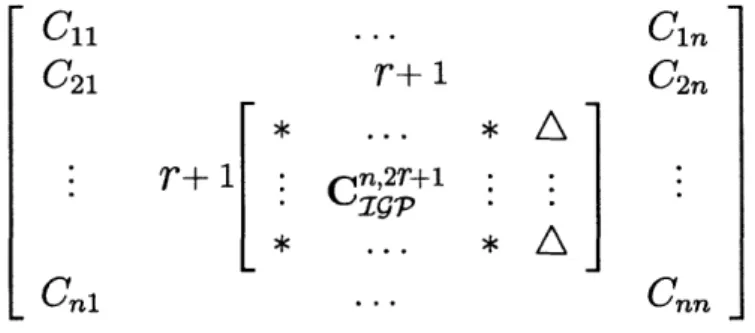
As shown in Figure 2-1, Ig algorithm at step 2r adds a row of r entries (repre-sented by symbol 'A') with largest entry sum to the previous r x r submstrix C~; n-.
Similarly, as shown in Figure 2-2,
igP
algorithm at step 2r +1 adds a column of r +1 entries (represented by symbol 'A') with largest entry sum to the previous (r + 1) x r submstrix Cn,2C11
...
C1
C21
r
C2n* ... *
.
A
:n Cnn
...A
-Figure 2-1: Step 2r of 191' algorithm
Just as for the LAS algorithm, each step of
igP
algorithm is easy to perform: simply find one column (row) corresponding to the largest entry sum. The algorithm011 C1n
C21 r+ 1 C2n
r+1 Cn,2r
I
..
*
A
Cn1 Cnl
Figure 2-2: Step 2r + 1 of IP algorithm
will stop after 2k steps. We denote by Cngp the k x k submatrix produced by IgP applied to C". Our goal is to obtain the asymptotic value of Ave(Cngp).
Our main result regarding the performance of the 19gP algorithm is as follows.
Theorem 2.1.3. Let f(n) be any positive function such that f(n) = o((log n)1 5).
Then
lim min P Ave(Cn P) - - ;
l 3max - logn =og l
n-+oo 1<k f (n) 3 klog k' = lokiog n
(2.3)
The bound on the right hand side is of the order magnitude O(Vlog n) when k is constant and o( log n/k) when k is a growing function of n and k = o((logn)' 5).
T+ ogn corresponds to the latter case.
Next we turn to the discussion of the Overlap Gap Property (OGP ). Fix a E
(1, V'2), real values 0 < Y1, Y2 < 1 and 6 E (0, a). Let Ok(a, yI, y2, 6) denote the
set of pairs of k x k submatrices Cy, CymJ2 with average value in the interval
[(a-6) v2logn/k, (a+6)V2 logn/k] andwhichsatisfy 1I1nI2/ E (yl-6,yl+ 6),
IJi
J21/k E (Y2 - 6, Y2+
J). Namely, Ok(a, y1, Y2, 6) is the set of pairs of k x k matrices with average value approximately a 2 log n/k and which share approximately ylk rows and y2k columns. Let2 2
![Figure 3-1: sup 3 E(0,1/ 2 ) W(x, #) and 2w(x) for x C [0.44, 0.56].](https://thumb-eu.123doks.com/thumbv2/123doknet/13923179.449932/81.918.171.779.366.757/figure-sup-e-w-x-w-x-c.webp)
![Figure 3-2: Illustration of computing E[X 2 (zn)] where Yj,k = nZj,k, 1 j k 4.](https://thumb-eu.123doks.com/thumbv2/123doknet/13923179.449932/108.918.328.513.112.281/figure-illustration-computing-e-x-zn-yj-nzj.webp)

![Caractérisation fonctionnelle de la mutation M201V du récepteur CysLT[indice inférieur 2]](data:image/gif;base64,R0lGODlhAQABAIAAAP///wAAACH5BAEAAAAALAAAAAABAAEAAAICRAEAOw==)