HAL Id: hal-00316562
https://hal.archives-ouvertes.fr/hal-00316562
Submitted on 1 Jan 1999
HAL is a multi-disciplinary open access
archive for the deposit and dissemination of sci-entific research documents, whether they are pub-lished or not. The documents may come from teaching and research institutions in France or abroad, or from public or private research centers.
L’archive ouverte pluridisciplinaire HAL, est destinée au dépôt et à la diffusion de documents scientifiques de niveau recherche, publiés ou non, émanant des établissements d’enseignement et de recherche français ou étrangers, des laboratoires publics ou privés.
Letter to the Editor: Geomagnetic storm effects at low
latitudes
R. G. Rastogi
To cite this version:
R. G. Rastogi. Letter to the Editor: Geomagnetic storm effects at low latitudes. Annales Geophysicae, European Geosciences Union, 1999, 17 (3), pp.438-441. �hal-00316562�
Letter to the Editor
Geomagnetic storm eects at low latitudes
R. G. Rastogi
School of Physics, University of New South Wales, Sydney 2052, Australia and Department of Physics, Gujarat University, Ahmedabad 380 009, India Received: 30 April 1998 / Accepted: 3 September 1998
Abstract. The geomagnetic horizontal (H) ®eld from the chain of nine observatories in India are used to study the storm-time and disturbance daily variations. The peak decrease in storm-time variation in H showed signi®cant enhancements at the equatorial electrojet stations over and above the normally expected decrease due to the ring current eects corrected for geomagnetic latitudes. The disturbance daily variation of H at equatorial stations showed a large decrease around midday hours over and above the usual dawn-maximum and dusk-minimum seen at any mid-latitude stations around the world. These slow and persistent additional decreases of H of disturbance daily variation at equa-torial latitudes could be the eect of a westward electric ®eld due to the Disturbance Ionospheric dynamo coupled with abnormally large electrical conductivities in the E region over the equator.
Key words. Ionosphere (electric ®elds and currents) á Magnetospheric physics (electric ®elds; storms and substorms).
1 Introduction
Moos (1910) from his monumental study of mag-netic data collected at Bombay, India from 1846 to 1905, identi®ed two distinct components of magnetic disturbance in the horizontal component of the geo-magnetic horizontal ®eld (H). After removing the normal daily variation and averaging over a number of events, the magnetic storm was found to start with a sudden increase lasting a couple of hours, followed by a rapid decrease continuing for few hours and later the recovery to normal conditions in a day or two. This feature of the storm occurring at same universal time at dierent observatories round the world is known as
storm-time variation, Dst(H). The second component depending on the local solar time was identi®ed as additional solar daily variation imposed on normal daily variation during disturbed days. Moos had found a maximum around dawn and a minimum around dusk period. This is now known as disturbance daily variation, SD(H), and is computed by subtracting the mean solar daily variation on ®ve international days of the month (SqH) from the corresponding mean vari-ation on ®ve internvari-ational disturbed days of the month (SdH).
Vestine et al. (1947) described the results of a comprehensive study of the solar daily variations of the three components of the geomagnetic ®eld at a large number of observatories on quiet as well as disturbed days. The disturbance daily variation of H, SD(H) was found to be a single sine wave with a dawn-maximum and a dusk-minimum at any of the stations in low and middle latitudes. Chapman (1951) concluded that the magnetic disturbance at equatorial stations does not present any abnormal features characteristic of the equatorial electrojet. Sugiura and Chapman (1960) similarly concluded, after their extensive studies of Dst and SD variations of D, H and Z components at a number of observatories, that the eect of magnetic storms at equatorial stations are similar to those at other low and middle latitude stations. Recently Rastogi (1998a) has shown that disturbance daily variation of equatorial electrojet current has a distinct minimum near noon, the amplitude of which increases near the magnetic equator.
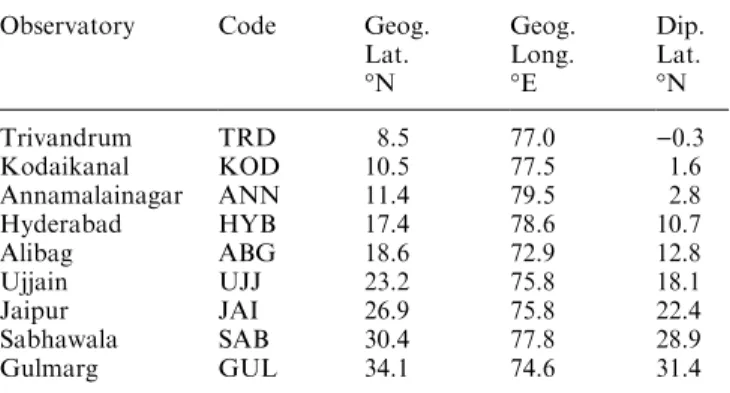
Since 1975, a unique network of geomagnetic obser-vatories is in operation in India con®ned within a narrow longitude zone, but extending in latitude from the centre of the electrojet to the focus of Sq current system. The list of these observatories with their coordinates (for the year 1976) are given in Table 1.
The present paper examines the storm-time and disturbance daily variations of H at the unique set of stations in India to check any possible abnormal eects at equatorial electrojet stations.
2 Disturbance daily variation of the electrojet
In Fig. 1 are shown the disturbance daily variations of H, SD(H) = Sd(H))Sq(H) at all Indian observatories averaged over all months of the year 1980. The diurnal inequalities were properly removed from the Sq and Sd variations. The SD variations at stations outside the electrojet belt show primarily a single sine wave with a dawn-maximum and a dusk-minimum, in conformity with the results of Vestine (1947) and of Yacob and Sastri (1966). At equatorial electrojet stations TRD, KOD and ANN a signi®cant depression of H is observed around midday hours. The magnitude of the midday depression in H is progressively reduced with increasing distance from the equatorial station Trivan-drum.
This suggests that a regular westward electric ®eld is imposed on the equatorial latitudes during the midday hours of the geomagnetically disturbed days. The amplitude of midday decreases of SD(H) showed an enhancement over the magnetic equator in a fashion similar to the daily range of Sq(H) at equatorial latitudes. Rastogi (1998b) has compared SD(H) varia-tions at equatorial electrojet stavaria-tions in Indian and American longitudes. The SD(H) at Kodaikanal showed a prominent midday decrease during the years 1954± 1960 but at Huancayo SD(H) did not show any evidence of midday decrease beyond the dawn-maximum and dusk-minimum.
3 Storm-time variation of the electrojet
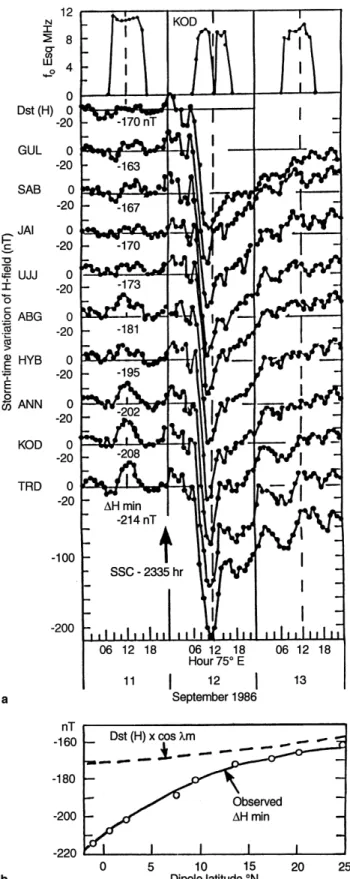
In Fig. 2(a) are shown the storm-time variations of H at all of the nine Indian observatories for the magnetic storm which started at 2335 hours 75°EMT on 11 September 1986. The variations of DST-H index and of the top frequency re¯ected from the equatorial E region instabilities, Es-q, over Kodaikanal are also shown in the diagram. In Fig. 2(b) are shown the latitudinal variations of the observed Dst-H at the peak of the storm compared with the axial symmetric part of the Dst-H corrected for the dipole latitude, km. The Dst-H index shows sudden increase of H at midnight of 11±12 Sept. 1986 associated with SSC. The main phase started at 0630 hours on 12 Sept. 1986 reaching the peak
activity at 1130 hours (Dst-H = )170 nT) followed by a slow recovery on 13 Sept. 1986. The storm changes in H at all of the stations were very similar to the changes of Dst-H index. At Jaipur the maximum decrease of H was )170 nT almost the same as of the Dst index. The magnitude of the maximum of H was )173 nT at UJJ, )181 nT at ABG, )195 nT at HYB, )202 nT at ANN, )202 nT at KOD and )214 nT at TRD. Thus Dst observed at any of the stations was larger than the global average index and specially at the stations within
Table 1 List of geomagnetic observatories in India
Observatory Code Geog. Geog. Dip. Lat. Long. Lat.
°N °E °N Trivandrum TRD 8.5 77.0 )0.3 Kodaikanal KOD 10.5 77.5 1.6 Annamalainagar ANN 11.4 79.5 2.8 Hyderabad HYB 17.4 78.6 10.7 Alibag ABG 18.6 72.9 12.8 Ujjain UJJ 23.2 75.8 18.1 Jaipur JAI 26.9 75.8 22.4 Sabhawala SAB 30.4 77.8 28.9 Gulmarg GUL 34.1 74.6 31.4
Fig. 1. Disturbance daily variations on H ®eld at Indian observato-ries averaged for all months of the year 1980
the electrojet belt. Around noon on 12 Sept. 1986 the value of H(TRD) )H(ABG) was )33 nT suggesting a
counter electrojet event, which is con®rmed by the absence of Es-q re¯ections at the same time. The Eq was absent at Kodaikanal at each of the 15-min observations from 1115 to 1230 hours 75°EMT (K. Karunakaran, private communication). The regular hourly ionograms at Thumba showed Esq at all hours from 0730 hours to 1530 hours 75°E on 11 September 1986; on 12 Septem-ber 1986 Esq was present from 0730 to 1130 hours, was absent at 1230 hours and present again from 1330 hours to 1530 hours 75°E (B. V. Krishna Murthy, personal communication). This shows that a strong westward electric ®eld was imposed over the equatorial ionosphere which overbalanced the normal eastward Sq ®eld during the peak of the storm. Referring to Fig. 2(b), the axially symmetric part of Dst increased from a value of )168 nT at 25° latitude to )170 nT at 0° latitude. The observed Dst-H increased slowly with decreasing lati-tude and later increased very fast at latilati-tudes close to the equator indicating the characteristics of the equatorial electrojet. It is to be noted that no large substorms were indicated during the storm. Similar increases of Dst-H at equatorial latitudes were not seen during the storms with the main phase occurring during the local night time hours.
4 Discussion
Rastogi (1977) has shown the evidence of such a change of large electric ®eld imposed on the dayside of the electrojet during a geomagnetic storm. The present analyses indicate a rather slow and persistent electric ®eld imposed on the equatorial ionosphere during the main phase of the storm. Blanc and Richmond (1980) have suggested, based on their numerical analyses, that the global distribution of ionospheric currents and electric ®elds can be altered by the perturbations in the solar wind magnetosphere dynamo and the ionospheric wind dynamo. These modi®cations in the neutral atmospheric circulation during geomagnetic distur-bances can decrease or even reverse the quiet time electric ®eld pattern in the vicinity of the dip equator. Fejer et al., (1983) showed evidence that the F region vertical drift at Jicamarca are sometimes perturbed 16± 24 h after the onset of geomagnetic storms. Fejer and Scherliess (1955) using the radar measurements of F region vertical plasma drifts at Jicarmarca and AE indices, have shown that the high latitude electric ®eld from the dynamo action of storm time winds produce largest perturbations a few hours after the onset of magnetic activity. Short period ¯uctuations in H at equatorial stations are known to occur during storms (Gonzales et al., 1983; Chandra and Rastogi 1997). These eects are often related to the directional changes in the Bz component of the interplanetary magnetic ®eld (Rastogi and Kroehl 1978). Mazaudier and Venkates-waran (1990) have described variations of the E and F region meridional winds derived from the quadristatic radar at St Santin on 23 March 1979 with a time delay of several hours after the substorm event of 22 March, when the state of magnetosphere was fairly quiet. They
Fig. 2. a Storm time variations of H ®eld at Indian observatories during the storm starting at 2335 hours 75°EMT on 11 Sep. 1986. b Latitudinal variations of the observed minimum of H at dierent stations during the peak disturbance activity compared with the latitudinal variation of Dst(H) index ´ cosine geomagnetic latitude.
explained the eect as due to the thermospheric and ionospheric winds caused by disturbance dynamo elec-tric ®eld.
The additional storm time decrease of H at electrojet stations are in perfect time coincidence with the changes of ring current strength (= Dst H index) and hence cannot be attributed to any neutral wind modi®cations which are associated with a long time lag. Most probably this phenomenon is due to imposition of a westward electric ®eld at the equatorial latitudes simul-taneously with the arrival and trapping of charged particles of solar wind origin.
Unfortunately there is no equatorial chain of mag-netic observatories east or west of India where such phenomenon can be studied for longitudinal inequality if any.
Acknowledgements. The author is thankful to the University of New South Wales for the facilities of the present study and to Prof. R. Stenning and Prof. D. E. Winch for useful discussions. Thanks are due to Indian National Science Academy, Gujarat University and Physical Research Laboratory for supporting the research activities of the author.
Topical Editor D. Alcayde thanks M. A. Abdu for his help in evaluating this paper.
References
Blanc, M., and A. D. Richmond, The ionospheric disturbance dynamo. J. Geophys. Res., 85, 1699±1688, 1980.
Chandra, H., and R. G. Rastogi, Geomagnetic storm eects on zonal and meridional equatorial electrojet currents. J. Geophys. Res., 102, 11611±11617, 1997.
Chapman, S., The normality of geomagnetic disturbance at Huancayo, Geo®sica, Pura e Applicata 14, 151±158, 1951. Fejer, B. G., and L. Scherliess, Time dependent response of
equatorial ionospheric electric ®elds to magnetospheric distur-bances, Geophys. Res. Lett., 22, 851±854, 1995.
Fejer, B. G., M. F. Larsen, and D. T. Farley, Equatorial disturbance dynamo electric ®elds. Geophys. Res. Lett., 10, 5337±5340, 1983. Gonzales, C. A., M. C. Kelley, R. A. Behnke, J. F. Vikrey, R. Ward, and J. Holt, On the latitudinal variations of the ionospheric electric ®eld during magnetic disturbances, J. Geophys. Res., 88, 9135±9144, 1983.
Mazaudier, C., and S. V. Venkateswaran, Delayed ionospheric eects of the geomagnetic storms of March 22, 1979 studied by the sixth co-ordinated data analysis workshop (CDAW-6 Ann. Geophysicae 8, 511±518, 1990.
Moos, N. A. F., Magnetic observations made at the government observatory Bombay for the period 1846±1905 and their discussions, Part II The phenomenon and its discussions, Bombay. 1910.
Rastogi, R. G., Geomagnetic storm and electric ®elds in the equatorial ionosphere, Nature 268, 422±424, 1977.
Rastogi, R. G., Disturbance daily variation of equatorial electrojet current, Current Sci., 74(5), 457±460, 1998a.
Rastogi, R. G., Disturbance diurnal electric ®eld in Indian and American equatorial electrojet regions, J. Atmos. Solar Terr. Phys., 1998b (in press).
Rastogi, R. G., and H. W. Kroehl, Interplanetary magnetic ®eld and equatorial ionosphere, Ind. J. Rad. Space Phys., 7, 84±89, 1978. Sugiura, M., and S. Chapman, The average morphology of geomagnetic storms with sudden commencement, Abb. Akad. Wies. Gottingen. Maths-Phys. K. I. Sonderheft 4, 1960. Vestine, E. M., L. Laporte, I. Lange, and W. E. Scott, The
geomagnetic ®eld and its application and analysis, Carnegie Inst. Washington, Publ. 580, 1947.
Yacob, A, and N. S. Sastri, The morphology of great geomagnetic storms recorded at Alibag for the period 1905±1945: Part II. The disturbance local time inequality, DS and the disturbance daily variation SD, Ind. J. Meteor. Geophys., 17, 187±198, 1966.