INTERNATIONAL TRADE
H
aving drawn up with American counterparts the rules and institutions of post-war international economy European nations, often acting in collabora-tion, remain a dominant force in the multilateral trad-ing system. For sure, European nations have pursued trade policies with foreign policy as well as commercial goals in mind and have signed bilateral trade agree-ments in addition to multilateral accords; yet the fact remains that, acting together, the members of the Eu-ropean Union1 were one of the two poles of the worldtrading system. However, in the last 10 years other na-tions, in particular certain large developing countries, have contested these arrangements and arguably the bipolar world has given way to a multipolar alternative. This short essay examines some of the longer-term implications of a multipolar World Trade Organization (WTO) for European policymakers and explores what role the European Union might play in the multilateral trading system in the years to come. Along the way, I make a number of observations about the decline of the bipolar dominance of the world trading system, the factors likely to infl uence the future commercial poli-cies of the emerging trading powers, and the possi-ble form that future multilateral trade initiatives might take. These observations may be of interest not just to those concerned about Europe’s place in the world but to those interested in the potential future trajectory of the multilateral trading system.
To me there are at least four important challenges to be faced when thinking through the implications of a multipolar world trading system. I will describe these challenges so as to better characterise the various ele-ments of the required analysis. The fi rst challenge is that the contours of this new world have not been
pre-cisely defi ned. Even so, part (and maybe enough) of the landscape is coming into focus. Given their recent economic performance and the positions taken during the Doha Round of multilateral trade negotiations, it seems that the identity of the new poles can be es-tablished with some confi dence. I shall take these new poles, or trading powers, to be China, India, and Bra-zil. In what follows I argue that specifi c aspects of their economic reform programmes, in particular the nature of business-state relations, as well as their very limited experience of liberalising in the context of reciprocal trade agreements, will shape the ends and means that these three nations pursue in the WTO over the me-dium to longer term.
It is often said that the poles of the world trading system are supposed to provide its leadership. The second challenge, then, is that it is not immediately apparent what leadership means in this context.2 Does
it mean the capacity of a WTO member to ensure that its proposals end up on this organisation’s agenda? Does it mean the ability to cajole other members into accepting a nation’s plans for the multilateral trading system, be that with respect to the future market open-ing and liberalisation or the development of new rules for the world economy? Or does leadership include the capacity to successfully broker compromises and agreements among the diverse WTO membership? Does leadership include the capacity to encourage compliance by others with the WTO’s rules and prin-ciples? Arguably, leadership in the WTO consists of all of these things and towards the end of this essay, after discussing the evolving multilateral trade landscape,
Simon J. Evenett*
EU Commercial Policy in a Multipolar
Trading System
In recent years the bipolar multilateral trading system of the post-war years has given
way to a multipolar alternative. Although many specifi cs have yet to be determined, some
contours of this new trade policy landscape are coming into focus. This article examines
their implications for the EU’s external commercial policy. Particular attention is given to
both the state of business-government relations and the propensity to liberalise under
the auspices of reciprocal trade agreements by Brazil, India, and China, the potential new
poles of the world trading system.
* Professor of International Trade and Economic Development, De-partment of Economics, University of St. Gallen, Switzerland. I thank John Curtis and Bob Wolfe for stimulating my thinking on this subject in a recent conversation on the multipolar trading system. I also thank Roderick Abbott, Richard Baldwin, Krishna Gupta, Bernard Hoekman, Patrick Low, and John Whalley for helpful comments on the fi rst draft of this paper. I alone am responsible for the errors contained herein.
1 As it was to become.
2 Wolfe takes a different perspective examining, amongst others, what
subset of the WTO membership effectively constitute “critical mass” in so far as the decision-making of that international organisation is concerned. See Robert W o l f e : Can the trading system be governed? Institutional implications of the WTO’s suspended animation. To be published in Alan A l e x a n d r o f f (ed.): Can the world be governed?, forthcoming 2007. Section 1 of Wolfe’s paper contains a particularly interesting discussion of the notions of power, negotiations, learning, and agency in the context of the WTO.
I will draw out a number of implications for the lead-ership that Europe could offer the multilateral trading system in the years ahead.
A third challenge concerns the question “whose trade policy is the EU’s trade policy?” This question speaks not only to the institutional mechanisms that determine EU commercial policy, but also to the inter-ests of European Union member states, corporations, unions, and other interested parties.3 Although I will
not dwell on these factors as much, I note that the EU’s population and member states have in recent years been sharply divided over the case for further liberal-ising their respective economies, in national, regional, and multilateral initiatives. (In the trade policy arenas this has manifested itself in a divergence of view on the merits of liberalising agriculture in the context of the Doha Round.4 Moreover, clear divisions between the
member states have arisen concerning the use of so-called trade defence instruments, namely, antidump-ing, countervailing duties, and safeguard measures.5)
Finally, EU member states have acted more aggres-sively towards the European Commission, a point that I doubt is lost on the EU’s trading partners. There are certainly connections between these considerations and the rise of a multipolar world, not least because it is the very growth of certain emerging markets that some see as a threat to European living standards and this factor has conditioned trade policy of the EU. These arguments also beg the question as to whether the European Union has the trade policy-making pri-orities and institutions it needs, a matter that is all the more poignant as 2007 marks the 50th anniversary of the signing of the Treaty of Rome.6
The fi nal challenge concerns the WTO itself. At this stage the outcome of the Doha Round is unknown and, whatever the conclusion is, it could have impor-tant implications for the attitudes taken by the current and future poles of the world trading system. Some observers in industrialised countries, for example, see the Doha Round as the last multilateral trade round, arguing that securing agreement takes too long or
doubting that there is a basis for a reciprocal bargain that could form the foundation of a successful future multilateral trade round. Moreover, questions might well be asked of the WTO’s rule-making procedures and associated principles7 (including the consensus
principle, the Single Undertaking, binding dispute set-tlement, the principle of reciprocity, etc.) These institu-tional factors and any changes therein will both be the result of decisions by WTO members and are likely to infl uence the future role of trading powers in the WTO.
Inevitably, in such a short essay some selectivity is required. In what follows I will focus on the fall of the bipolar world trading system; the factors likely to shape the commercial policies of the three emerging trading powers, namely, Brazil, China, and India; and the implications for the commercial policy of the Euro-pean Union and the possible shape of future multilat-eral trade initiatives. Some concluding remarks follow. At most I hope that arguments developed here will en-courage policymakers and analysts to refl ect further on the four challenges described above and on what the shift towards multiple poles implies for the multilat-eral trading system.
The Fall of the Bipolar World Trading System
From at least the negotiation of the General Agree-ment on Tariffs and Trade (GATT) to the establishAgree-ment of the WTO in 1995, the two dominant powers in the world trading system were the European Union (for-mally the European Communities and its Member States) and the United States. When Pascal Lamy was the European Commissioner for Trade he described the situation thus:
“One classical piece of conventional wisdom on the WTO is that nothing happens in the WTO with-out agreement between the US and the EU. Other countries stand aside, not always happily, until the elephants have fought it out and they are ‘invited’ to join the consensus. The other part of the conventional wisdom is that the US tends to lead the way, dragging with it an unwilling EU. This might have been true in earlier days of the GATT, but I do not believe it has been the case over the last few years”.8
The conclusion of the Uruguay Round which, in ad-dition to cutting tariffs on merchandise trade further, brought agriculture, services, and intellectual prop-erty rights into the ambit of international trade rules,
3 An analogous question could be asked of the political economy of
trade reform in each of the existing and emerging trading powers.
4 I documented those intra-EU differences on agricultural trade reform
in Simon J. E v e n e t t : The WTO Ministerial Conference in Hong Kong: What Next?, in: Journal of World Trade, Vol. 40, No. 2, April 2006.
5 Edwin Vermulst and I have documented the differences in view
be-tween member states concerning the effi cacy of antidumping meas-ures, see Simon J. E v e n e t t , Edwin V e r m u l s t : The Politicisation of EC Anti-dumping Policy: Member States, Their Votes, and the Euro-pean Commission, in: The World Economy,Vol. 28, No. 5, 2005.
6 Recently I have evaluated both the near-term trajectory and the
longerterm strategy of EU commercial policy, see Simon J. E v e n -e t t : “Global Europ-e”: An Initial Ass-essm-ent of th-e Europ-ean Commis-sion’s New Trade Policy, in: Aussenwirtschaft, December 2006; Simon J. E v e n e t t : The Trade Strategy of the European Union: Time for a Rethink? Paper prepared for Breugel, April 2007.
7 I admit that much has been written on these matters, too much in
fact to summarise here. One contribution in this respect is the Suth-erland Report. See Peter S u t h e r l a n d , Jagdish B h a g w a t i , Kwesi B o t c h w e y, Niall F i t z g e r a l d , Koichi H a m a d a , John H. J a c k -s o n , Cel-so L a f e r, Thierry d e M o n t b r i a l : The Future Of The WTO. Addressing institutional challenges in the new millennium. Report by the Consultative Board to the Director-General Supachai Panitchpa-kdi, World Trade Organization; Geneva 2004. See also Robert W o l f e , op. cit., for a recent insightful analysis of such matters.
created a binding system of dispute settlement, and established the WTO, represented the high point in the infl uence of the transatlantic powers on the world trading system. During the Uruguay Round, for the large part, the European Community and the United States set the multilateral trading system’s agenda, advanced their own interests, negotiated compromis-es, and eventually secured the agreement of the GATT membership. For sure the Uruguay Round took a long time to negotiate, experienced a few “near death” ex-periences along the way, and certainly involved the as-sent of other nations, but still the broad thrust of this initiative was guided by the two leading powers.
Europe and America’s continued dominance of the world trading system was not to last. In just over 10 years since the conclusion of the Uruguay Round their infl uence has been vigorously contested and the WTO, the product of this transatlantic leadership, has suf-fered a considerable reversal of fortune. With hindsight it is possible to identify a number of factors responsi-ble for this turn of events. First, chronologically speak-ing, were the doubts that many WTO members began to have in the mid-to-late 1990s about the effi cacy of certain Uruguay Round agreements. Developing countries took aim in particular at the Agreement on Trade-Related Aspects of Intellectual Property Rights (TRIPs), arguing that it raised the cost of medicines in their countries without enhancing their availability. As this Agreement was seen by many industrialised coun-tries as an important accomplishment of the Uruguay Round the battle lines were drawn and arguably the guerrilla war against the TRIPs agreement continues to this very day. Developing countries also called at-tention to what they saw as heavy costs of implement-ing the Agreement on Technical Barriers to Trade, the Sanitary and Phytosanitary Measures Agreement, and obligations entered into concerning customs reform. Despite the weak evidence offered in support of these claims, many developing country trade offi cials feared that the balance of costs and benefi ts associated with
the Uruguay Round trade agreements had shifted too far against them. Demands to address these concerns, including the potential renegotiation of certain agree-ments, grew over time. The legacy of bipolar control of the world trading system looked increasingly tar-nished.9
A second development was the determination of the European Commission and the United States to introduce proposals that would further expand the binding rules of the multilateral trading system, in par-ticular as they relate to domestic regulatory policies. Both sought in the mid-to-late 1980s the inclusion of labour and environmental provisions in WTO agree-ments. The European Commission also sought to ne-gotiate multilateral disciplines on investment policy, competition law, transparency in government procure-ment, and trade facilitation (the so-called Singapore Issues). Many developing countries saw potential la-bour and environmental provisions as both directly undermining the cost competitiveness of their exports and providing a pretext for protectionist measures by industrialised countries and consequently vigorously opposed these provisions. One casualty of this op-position was the WTO Ministerial Meeting in Seattle, held in 1999, where the American chair got a taste of more of what was to come: robust opponents willing to block progress in a system based on the consensus principle. European objectives were to fare little better. At the Cancun Ministerial Conference in 2001 repre-sentatives of the African Group of developing coun-tries vetoed the formal launch of negotiations of the four Singapore Issues and the meeting collapsed soon thereafter. Also, a joint US-EU proposal on the modali-ties for the agricultural trade negotiations was rejected as inadequate by a group of 20 or so developing coun-tries led by Brazil and including China and India. The EU-US cartel over agenda setting and compromise brokering was over.
A third development at the Cancun Ministerial Con-ference and afterwards was the formation of different groups of developing countries keen to infl uence delib-erations at the WTO. Care is needed here as develop-ing countries have formed alliances before, includdevelop-ing during the GATT era. Now, however, the scale and robustness of these groupings is of a different order. Some groupings have sought to aggressively cut the agricultural support paid by industrialised countries, others have argued to limit the reforms expected of their own agricultural sectors. Meanwhile other groups are oriented around regional, stage-of-development, and even product-related (e.g. cotton) concerns.
Bro-9 Sylvia O s t r y, op. cit., offered the following colourful evaluation of
what developing countries actually obtained from the Uruguay Round of multilateral trade negotiations “The Grand Bargain turned out to be a Bum Deal” (page 3).
8 Pascal L a m y : Leadership, the EU and the WTO, speech given at
the Evian Group, Montreux, Switzerland, 13 April 2002. Ostry char-acterises the bipolar dominance slightly differently and arguably more completely than Lamy: “The GATT worked very well, effectively man-aged from the 1960s by the European Community (now European Union or EU) and the US with a club of friends. No headlines for the General Agreement to Talk and Talk. The club model was based on a post-war consensus termed ‘embedded liberalism’: rules and other arrangements to buffer or interface between the international objec-tive of sustained liberalisation through the reduction or elimination of border barriers and the objectives of domestic policy, sovereignty and stability. This largely transatlantic consensus was greatly aided by the use of reciprocity in negotiations (denounced as mercantilist by pur-ists) and by the virtual exclusion of agriculture (via an American waiver and the near-sacrosanct European CAP or Common Agricultural Poli-cy). Developing countries were largely ignored, although that began to change in the 1970s as a consequence of the OPEC oil shock”. Sylvia O s t r y : After Doha: Fearful New World?, in: Bridges, Year 10, No 5, August 2006, page 3 (italics in the original).
kering compromises simultaneously among such a large number of groups became impossible and the obvious alternative – taking sequential steps towards compromise – ran into trouble as no individual WTO member or group was prepared to make concessions fi rst, fearing that those concessions would be “pock-eted” and the demands of trading partners ratcheted up higher. This proved to be a recipe for delays, stale-mate, and endless missed deadlines.
Another innovation was that development-related considerations were supposed to be given particu-lar attention during the Doha Round. The Ministerial Declaration launching the Doha Round is replete with development-related statements.10 If the emphasis
on development concerns was the price that had to be paid by the European Commission and the USA to secure the launch of the Round in 2001, then that says something about the collective clout of develop-ing countries and their capacity to infl uence the WTO agenda-setting process. The fact that subsequent discussions, in particular as they relate to Special and Differential Treatment and Aid for Trade, have rarely moved beyond generalities to specifi cs can be inter-preted in a number of ways. It could imply that devel-oping countries’ ability to infl uence the WTO’s agenda does not carry over yet to securing agreement on ma-jor items of interest to them. Alternatively, it could re-fl ect the fact that developing countries are divided on some development-related matters (for example, the effi cacy of measures to address preference ero-sion), or that they do not know what they really want in this respect (or cannot decide what they want until they see the other elements of a potential Doha Round agreement), or that they know what they want but do not want to specify their demands as of yet.11
Moreo-ver, doubts have been expressed about the commit-ment of certain industrialised countries, in particular the United States, to the development dimension of the Round.12 The latter point may be a reminder that
the end of the bipolar world trading system does not mean the end of these two trading powers’ infl uence.
It would be wrong to infer from this discussion that the decline of the bipolar world trading system was responsible for all of the trials and tribulations of the Doha Round. Nor does the foregoing discussion imply that the EU and the USA no longer remain central to
10 The Doha Ministerial Declaration mentions the word “development”
39 times, the phrase “technical assistance” 21 times, the phrase “ca-pacity building” 13 times, and the expression “Special and Differential Treatment” 8 times.
11 It seems to me that many Least Developed Countries’ approach to
the various forms of Special and Differential Treatment could well be examples of these last two possibilities.
12 For example, the Doha Development Agenda is almost always
re-ferred to as the Doha Round in Washington, DC trade circles.
the destiny of the multilateral trading system. The lat-ters’ economic size and extensive international trade and investment interests provide strong incentives to keep them engaged and underlie their still signifi cant bargaining power. Even so, it is worth briefl y noting the other central challenges faced during the Doha Round negotiations to date. These challenges may well be overcome in 2007 and, even if they are, a return to a bipolar world trading system seems highly unlikely.
A major obstacle experienced during the Doha Round negotiations is that, for various domestic po-litical reasons in Europe, the United States, China, and India, to date it has been impossible to identify an overlap in the tolerable level of liberalising ambition. Nowhere is this more apparent than in the agricultural trade negotiations which have received prominent bill-ing in this Round. Domestic considerations have forced the European Union, India, and China to limit conces-sions on market access to their agricultural sectors, which is precisely the opposite of the reforms sought by the United States (and, earlier, by Brazil too.) Appar-ently US trade negotiators feel they need aggressive foreign market opening for their farmers and ranchers if the latter are to be persuaded to accept reductions in domestic support payments (subsidies and associ-ated payments) that America’s trading partners seek. Arguably, similar mismatches in ambition can be found in the current proposals to liberalise goods trade and national service sectors. In each case readily identifi -able, strong domestic constituencies have sought to constrain the freedom to make concessions by nation-al trade negotiators, with some interest groups seeking to cap reforms while others demand minimum levels of liberalisation. In my view these constituencies in Eu-rope and in the United States have effectively and con-sistently outmanoeuvred supporters of trade reform and negotiators since the beginning of the Round. If such constituencies prevail and the Doha Round ir-revocably collapses then there may well be questions about the extent and form of liberalisation that the WTO could possibly deliver in the medium term.
Another feature of the Doha Round has been the re-luctance of trade negotiators to “pay” for other coun-tries’ unilateral reforms. For example, few of the EU’s trading partners appear willing to give their European counterparts “negotiating credit” for implementing the unilateral reforms of the Common Agricultural Policy agreed to by EU Member States at the beginning of this decade. This unwillingness goes against two of the major tenets of WTO negotiations; namely, that it is bindings that matter and that the binding of previously undertaken unilateral reforms is of value. Perhaps cor-porate interests view completed unilateral reforms as “history” and, more importantly, as almost certainly
ir-reversible. In which case, those interests are unlikely to be impressed by commitments to bind unilateral re-forms because it does not create any new commercial opportunities for them. In such circumstances corpo-rate interests may well demand as a condition for their support of the multilateral trade round further actual liberalisation on the part of trading partners. Given the high level of bindings agreed in some sectors and by many developing countries in the Uruguay Round, this demand typically amounts to demanding very signifi -cant cuts in the relevant bindings by trading partners. Moreover, the levels of cuts necessary to create new commercial opportunities for corporate interests may not be consistent with any commitment to ensure comparable levels of cuts within a given class of WTO member, or indeed with a commitment that one group of WTO members (such as developing countries) makes less cuts on average than another group.
There are several related factors at work here: the signifi cant number of unilateral reforms undertaken in some sectors and by many countries that has cre-ated the gap between the bindings and the applied measures in the fi rst place; the fact that it is cuts in applied measures and not bindings which create new commercial opportunities; agreements among WTO members to maintain comparable levels of ambition among countries at similar levels of development and to expect less ambition from the developing and least developed countries; and the apparently low levels of corporate support for completing the Doha Round. In sum, bindings may well be the legal “currency” at the WTO but, after nearly two decades of unilateral re-forms in some WTO members, as currently formulated the proposed cuts in such bindings do not appear to elicit enough corporate support to overcome the op-ponents to multilateral trade reform.13 If this diagnosis
is correct then there may be signifi cant fl aws at the po-litical economy core of the reciprocity-based multilat-eral trading system.
To summarise, above I have marshalled arguments in support of the proposition that the bipolar domina-tion of the world trading system by the European Un-ion and the United States has ended. Moreover, I have argued that other countries have come forward and
13 Another factor limiting corporate support is the lack of transparency
and specifi city concerning the exceptions that each WTO member can take with respect to liberalisation in each major area of trade. Un-less and until these exceptions are specifi ed openly, a major exporter is likely to discount any potential exports gains from completing the Doha Round by the likelihood that the product or products it ships are listed as an exception. Arguably, the diffi culties with bindings described in the main text and the uncertainty generated by lack of specifi city on exceptions combine to limit the willingness of major ex-porters to support the current round of multilateral trade negotiations. In general, more thought needs to be given to the effect of what might appear to be tedious technical negotiating modalities on the incen-tives of major corporate groups to support multilateral trade liberalisa-tion.
joined, rather than displaced, the EU and the United States. Finally, I have tried to put these arguments in perspective by pointing out other factors that have complicated the negotiation of the Doha Round, in-cluding effective domestic interests that have made fi nding a common level of liberalising ambition diffi -cult and the complications that arise when negotiat-ing trade agreements usnegotiat-ing bindnegotiat-ings after an era of extensive unilateral reforms. These latter two factors raise questions about the political economy of the reciprocity-based negotiations at the WTO. Having said that, I return to the focus here on the multipolar trading system. Next I will consider the various fac-tors likely to shape the commercial policy objectives of the potential new poles in the world trading system. That discussion, plus the observations made above, will provide the basis upon which to consider the pos-sible implications for Europe’s longer-term commercial policy and associated strategy.
Factors underlying the Likely Future Commercial Policy Strategies of Brazil, China, and India
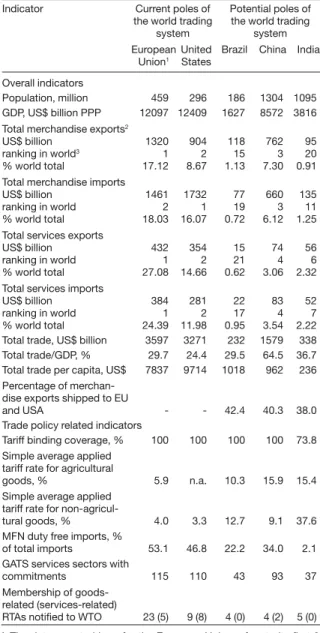
Which nations are likely to join the EU and the USA as leading trade powers? This question is diffi cult to answer with certainty, however, recent economic per-formance and the profi le adopted during the Doha Round of negotiations suggest, initially, three potential candidates namely, Brazil, China, and India. As the da-ta reported in Table 1 indicates, in purchasing power parity terms, after 30 years of fast growth China now has an enormous economy, whose gross domestic product (GDP) is two-thirds that of the size of the US economy.14 Underlying China’s phenomenal economic
growth has been an export boom that has seen it be-come the third largest exporter of merchandise goods in the world (see Table 1). The ratio of total imports plus exports to GDP in China is just under 65 per cent, a level far higher than in the US, EU15, Brazil, and India.
China’s growing clout has been recognised by its trad-ing partners and, indeed, some have contended that fear of competitive Chinese exports has made some WTO members more reluctant to liberalise under the auspices of the Doha Round. Even if China’s growth rate were to halve over the decade to come then it would still be a sizeable economic power. Together, these matters justify further consideration of China as a potential pole of the world trading system.
In contrast the case in favour of Brazil and India’s emergence as poles is less clear cut. Brazil and India
14 Using current exchange rates the relative size of China’s economy
looks slightly less large. China’s economy recently overtook the Unit-ed Kingdom’s in size, the latter being the fourth largest economy in the world. China is expected to overtake Germany, the third largest economy, soon.
15 Please note that the data reported in Table 1 for the European Union
are the 15th and 20th largest exporters of merchandise
goods in the world, respectively (see Table 1). Moreo-ver, neither country’s trade-to-GDP ratio is exception-ally high. Even so, both countries are regional powers and have been keen to raise their profi le globally. Both countries have played a central role in the Doha Round
negotiations and have built worldwide coalitions of WTO members, which is one important characteristic of leading trading powers. Their inclusion as potential poles is more of a refl ection of this fact than because of their prior economic performance. Having said that, both countries (and India in particular) may in the fu-ture become global economic powerhouses.
The requirements of a sizeable economy and over-seas commercial interests and, as far as trade diplo-macy is concerned, global ambition and reach are arguably what disqualifi es many other regional trading powers from being possible poles of the world trading system, at least for the moment. For sure, both Rus-sia and Turkey are important trading partners of the European Union. Yet neither country has a particularly large footprint in the world trading system (and let us not forget that Russia has still to accede to the WTO). South Africa, Nigeria, and Egypt seem, at most, to be regional powers. Korea, despite its relatively large economy, has not asserted itself as much as India and Brazil in multilateral trade circles preferring, it seems, to focus its energies on negotiating free trade agree-ments. Much of the same could be said about Mexico. Other regional powers, such as Saudi Arabia, have a sizeable economic footprint but have not been partic-ularly active in either bilateral or multilateral trade ne-gotiations, at least as of now. For all of these reasons I focus my attention on just three new poles: Brazil, China, and India. In what follows I consider the impli-cations of their current trading performance, develop-ment strategies, and overseas corporate interests for their potential long-term strategies towards the world trading system. In the short space available I can hardly do justice to each of these nations’ rich and illu-minating development experience. Instead I identify a number of common themes which may infl uence their commercial policies in the years to come. Before do-ing that, however, it is appropriate to dwell on the rela-tive importance of the three new potential poles and the two existing poles (the EU and the USA)
In discussions of changing economic leadership, catching-up, and overtaking and the like it is sensi-ble to keep some sense of proportion. Tasensi-bles 1 and 2 provide information that may be useful in this respect. Table 1 implies that, at present, the US and the EU to-gether create (in purchasing power parity equivalent terms) nearly $25 trillion of value-added each year, nearly double the combined national outputs of Brazil, China, and India. Moreover, the EU and the US hold fi rst or second place in the world as traders of both goods and services. The EU, for example, currently exports more in a month than India does in a year. The amount of trade per capita in both the EU and the US is seven times that of Brazil, and the comparable
ra-Table 1
Principal Trade-related Statistics of Current and Potential Poles of the World Trading System
Indicator Current poles of the world trading
system
Potential poles of the world trading
system European
Union1
United States
Brazil China India
Overall indicators
Population, million 459 296 186 1304 1095 GDP, US$ billion PPP 12097 12409 1627 8572 3816 Total merchandise exports2
US$ billion ranking in world3 % world total 1320 1 17.12 904 2 8.67 118 15 1.13 762 3 7.30 95 20 0.91 Total merchandise imports
US$ billion ranking in world % world total 1461 2 18.03 1732 1 16.07 77 19 0.72 660 3 6.12 135 11 1.25 Total services exports
US$ billion ranking in world % world total 432 1 27.08 354 2 14.66 15 21 0.62 74 4 3.06 56 6 2.32 Total services imports
US$ billion ranking in world % world total 384 1 24.39 281 2 11.98 22 17 0.95 83 4 3.54 52 7 2.22 Total trade, US$ billion 3597 3271 232 1579 338 Total trade/GDP, % 29.7 24.4 29.5 64.5 36.7 Total trade per capita, US$ 7837 9714 1018 962 236 Percentage of
merchan-dise exports shipped to EU
and USA - - 42.4 40.3 38.0 Trade policy related indicators
Tariff binding coverage, % 100 100 100 100 73.8 Simple average applied
tariff rate for agricultural
goods, % 5.9 n.a. 10.3 15.9 15.4 Simple average applied
tariff rate for
non-agricul-tural goods, % 4.0 3.3 12.7 9.1 37.6 MFN duty free imports, %
of total imports 53.1 46.8 22.2 34.0 2.1 GATS services sectors with
commitments 115 110 43 93 37 Membership of
goods-related (services-goods-related)
RTAs notifi ed to WTO 23 (5) 9 (8) 4 (0) 4 (2) 5 (0)
1 The data reported here for the European Union refers to its fi rst 25
members. All extra-EU trade data is taken from the DG Trade website and refers to the year 2005.
2 All trade data reported here (exports and imports) excludes intra-EU
trade.
3 All rankings take the EU as a single trading entity.
S o u r c e : WTO Country Profi les, obtained from http://stat.wto.org, unless otherwise specifi ed. Data relates to latest year reported in source.
tios are even higher for China and India. Clearly, the latter three countries still have a long way to go be-fore they match the global economic footprint of the transatlantic trading powers. Some sense of how long is given in Table 2, which reports Goldman Sachs’ now-famous long term economic growth predictions for Brazil, China, and India.16 Without doubt the
pre-cise predictions of such models should not be taken too seriously. Nevertheless they can provide approxi-mate information about the relative economic size of different nations. For instance, these projections suggest that almost 10 years from now Brazil, India, and China’s combined economic clout (as measured by their GDPs) will likely exceed the comparable total for the four largest EU economies (France, Germany, Italy, and the United Kingdom.)17 The current size of
the US economy will prevent it from being overtaken for decades after that. In sum, then, it seems reason-able to expect that Brazil, India, and China will con-tinue to expand their shares of the world economy and will relatively soon have in aggregate roughly the same economic footprint as the European Union. This devel-opment does not imply that the EU and the USA will cease to be signifi cant forces in the world economy. Indeed, both seem certain to retain considerable infl u-ence in the world trading system.
I now turn to the factors likely to shape Brazil, Chi-na, and India’s external commercial policies in the decades ahead. In what is admittedly an ambitious undertaking, I shall emphasise certain economic and political factors which seem to be important in all three of these societies. I do not mean to suggest that these factors are equally important in each country or that other factors are unimportant. Instead, this kind of
16 The original study by Goldman Sachs (Dominic W i l s o n , Roopa
P u r u s h o t h a m a n : Dreaming With BRICs: The Path to 2050, Gold-man Sachs, Global Economics Paper No. 99, 2003) included econo-mic growth predictions for Russia as well and introduced the moniker for these four emerging markets of “BRICs”.
17 This particular Goldman Sachs study does not present growth
pre-dictions for the entire European Union, just these four countries.
forward-looking and inherently speculative exercise is fraught with enough risks that I would prefer to identify a few factors that I am relatively more confi dent about than produce laundry lists of factors and caveats that the reader has a diffi cult time sorting through.
The fi rst factor that is likely to be important is that all three economies have turned to external demand to stimulate economic growth (through exports) and are, therefore, relatively dependent on open markets abroad. Indeed, China has been sensitive in recent years to the amount of restructuring that its exports are causing its trading partners and is seeking to shift demand growth towards more domestic sources (in-cluding consumption growth and growing demand for non-traded services). Table 1 reports that approxi-mately 40 per cent of each of the new trading powers’ exports are shipped to the United States or to Europe; a percentage that, if current trends are to go by, is likely to increase. This fi nding suggests, amongst oth-ers, that the case could be made to Brazil, China, and India that they have a strong interest in ensuring that Western markets stay open and that currently WTO-le-gal loopholes to close markets (namely, antidumping, countervailing duties, and safeguard measures) ought to receive further scrutiny. The preservation of market access, an important function of the WTO, should at a minimum be of interest to these emerging trading powers.
The second factor to take into account is that, de-spite all of the trade reforms undertaken by Brazil, China, and India, to date there is still plenty of room for these countries to liberalise access to their markets further. Data reported in Table 1 indicates that the aver-age applied rate of tariffs on agricultural and non-agri-cultural goods is multiples of the comparable numbers for the US and EU. In addition, comparatively fewer products enter Brazil and especially India duty free. Moreover, with the possible exception of China (which went through the one-sided WTO accession process) there is plenty of room for these countries to expand
Table 2
Projected GDPs of Leading National Economies 2000-2030
(billons of 2003 US dollars) Year Potential poles of the multilateral trading
system
Current poles Total GDP of potential poles as a percentage of
Brazil China India Total (Brazil, China, India)
Total for four largest EU nations (France, Germany, Italy, UK)
Total for four largest EU nations plus the United
States of America
Total for four largest EU nations (France, Germany, Italy, UK)
Total for four largest EU nations plus the United
States of America
2000 762 1078 469 2309 5701 15526 40.5 14.9
2010 668 2998 929 4595 7047 20318 65.2 22.6
2020 1333 7070 2104 10507 8292 24707 126.7 42.5
2030 2789 14312 4935 22036 9284 30117 237.4 73.2
S o u r c e : Dominic W i l s o n , Roopa P u r u s h o t h a m a n : Dreaming With BRICs: The Path to 2050, Goldman Sachs, Global Economics Paper No. 99, 2003.
their commitments to open their service sectors to in-ternational competition. The potential for trade reform, of course, does not imply an appetite for such reform. Indeed, a review of public statements made to na-tional newspapers (and not to internana-tional audiences) by Chinese and Indian government offi cials during the second half of 2006 suggests little desire to liberalise agricultural import regimes or service sectors. India has also expressed concerns about liberalising goods trade further.
Notwithstanding developments in the last year or so, another similarity between Brazil, China, and India is just how relatively few free trade agreements they are members of (see Table 1). Perhaps more impor-tantly, there is little or no evidence that any of these countries have been willing to substantially liberalise their economies within the context of reciprocal free trade agreements. China, for example, has to date signed FTAs that are confi ned principally to freeing merchandise goods trade and these accords do not include many (if any) service sector commitments or provisions on regulatory measures that tend to be of interest to industrialised countries.18 If anything,
In-dia’s track record in FTA negotiations is worse. In ad-dition to limiting the scope principally to goods trade, India has sought exceptions for literally hundreds of tariff lines (so much so that a number of its FTA nego-tiations have stalled19 or been suspended because of
these demands for exemptions.)20 Brazil’s FTA
initia-tives have tended to fall into two groups: those that
18 The China-Chile FTA is a good example. This FTA contains no
pro-visions on service sector liberalisation or on national intellectual prop-erty rights law. In fairness provisions on sanitary and phytosanitary measures are included in this FTA and appear to go beyond existing multilateral disciplines. With respect to the liberalisation of trade in goods in this FTA, China ensured that 211 tariff lines were excluded outright from liberalisation. In addition a total of 1610 product lines were given 10 year phase-in times for tariff elimination.
19 India sought to put 840 items on a sensitive list (down from an initial
demand of 1400 items) in its FTA negotiations with ASEAN, and reject-ed an ASEAN demand that India remove import duties on 90 per cent of its product lines by 2011. The ASEAN-Indian FTA negotiations were suspended soon after on 25 July 2006. Thailand faced similar chal-lenges in its negotiations with India, with the latter seeking to impose very restrictive rules of origin that would have reduced the amount of goods able to enter India on a preferential tariff basis.
20 Defenders of India’s FTA strategy point to its FTA with Singapore,
which includes measures to modestly liberalise India’s service sec-tor. (Even here certain restrictions on the establishment of commercial presence through foreign direct investment have been retained by In-dia.) It should be noted that this agreement also contains numerous exceptions to liberalising goods trade between the parties. A total of 6551 tariff lines were excluded outright from tariff liberalisation. A fur-ther 2407 tariff lines will only see a phased reduction of 50 per cent in the applied tariff rates. Together these exclusions and phased re-ductions account for approximately 76 per cent of India’s tariff line commitments in its FTA with Singapore. In my view the latter indicates a distinct reluctance by India to commit to across-the-board goods trade liberalisation in the context of a reciprocal trade agreement with a nation whose economy is less than fi ve per cent of the size of the Indian economy (when these economies are measured in purchasing power parity terms.)
are concluded with Latin American neighbours where the implementation record has been poor (e.g. Merco-sur) and those with non-Latin American trading part-ners were the negotiations have not been completed (e.g. the EU-Mercosur negotiations.)
The conclusion I draw from this experience is that all three countries have little or no experience of agreeing to and implementing extensive trade reforms within the context of reciprocally-negotiated international trade agreements. In this regard it is worthwhile recalling that before the Uruguay Round of trade negotiations devel-oping country members of the GATT (which included Brazil and India) were not expected to liberalise during multilateral trade rounds. The Uruguay Round did call for reciprocal liberalisation, but as noted earlier, this agreement is not held in high regard by many devel-oping countries, including Brazil and India.21 In short,
Brazil, China, and India have little or no track record of engaging in reciprocal trade liberalisation and, since these three emerging trading powers are taking centre stage in the WTO, the degree of future support for the liberalisation function of the multilateral trading system must be called into question. Worse still, the impres-sive growth of each of the three new trading powers’ exports since 2000 may further convince them that their overseas commercial interests can fl ourish with-out further reciprocal trade liberalisation.22
A fourth similarity concerns the use of industrial pol-icy and the associated implications for business-gov-ernment relations in Brazil, China, and India. As is well known, with the Washington Consensus moving out of favour with developing country policymakers, indus-trial policy’s profi le has risen. For better or for worse, desires not to leave corporate development entirely to the marketplace and to use large domestic markets to nurture national fi rms probably also account for the at-tention to industrial policy given by decision-makers in these three countries (and elsewhere for that matter).23
As I argue below, what is also important is the impli-cations of these policies for how states perceive the performance of “their” fi rms abroad for their offensive commercial policy agendas.
21 Both of these nations have called for certain Uruguay Round trade
agreements to be renegotiated.
22 According to WTO statistics Brazil, India, and China each saw their
combined exports of goods and services grow on average (in nominal terms) by at least 20 per cent per annum since 2000.
23 The reader should not interpret the following emphasis on China
and India’s industrial policies and the extensive nature of their busi-ness-government linkages as suggesting that these countries’ circum-stances are particularly egregious or unique. The resurgence in recent years of policies towards national champions from certain European governments, including for example its manifestation as “economic patriotism” in France, demonstrate that the new trading powers are not alone in their pursuit of industrial policies and the like.
China, for one, adopted a policy in the 1990s of de-veloping a so-called National Team of fi rms capable of competing in world markets.24 According to
Suth-erland25, 113 of China’s 2692 industrial groups were
selected for special treatment and have strong links to China’s State Council, the most senior governmental decision-making body. A Vice-Premier of China, Wu Bangguo, once rationalised this policy in the following terms:
“In reality, international economic confrontations show that if a country has several large companies or groups it will be assured of maintaining a certain mar-ket share and a position in the international economic order. America, for example, relies on General Motors, Boeing, Du Pont, and a batch of other multinational companies. Japan relies on six large enterprise groups and Korea relies on 10 large commercial groupings. In the same way now and in the next century our nation’s position in international economic order will be to a large extent determined by the position of our nation’s large enterprises and groups.”26
“If we use our strong large-scale enterprises and groups and they all fi ght alone, everyone will still fi nd it diffi cult in the ever intensifying domestic and inter-national competition to compete on equal terms with large international companies. We must therefore unite and rise together, develop economies of scale and scope and nurture a ‘national team’ capable of enter-ing the world’s top 500.”27
It is doubtful whether, having nurtured these large fi rms and encouraged them to cultivate links with the highest reaches of central government, that Chinese offi cials will be prepared to let them fail in foreign markets or have their overseas strategies thwarted without some form of intervention on the fi rm’s be-half.28
Matters are slightly different, however, in India. In a pair of penetrating articles published in 2006 Kohli describes how a business, rather than a pro-market, strategy guided both business-government relations in India and the course of economic reforms
24 For details see Peter N o l a n : China and the global business
revolu-tion, Palgrave 2001.
25 Dylan S u t h e r l a n d : China’s Large Enterprises and the Challenge
of Late Industrialisation, Routledge 2003.
26 Peter N o l a n , op. cit., p. 71. 27 Peter N o l a n , op. cit., p. 81.
28 For a recent analysis of the corporate performance of the Chinese
National Team see Paul G u e s t , Dylan S u t h e r l a n d : How Has Chi-na’s ‘National Team’ Of Enterprise Groups Performed? An Evaluation Using Aggregate and Firm Level Data, Centre for Business Research, University of Cambridge, Working Paper, 2006.
in recent years.29 In his concluding observations Kohli
notes:
“The evidence is more consistent with the view that the development model pursued in India since about 1980 is a pro-business model that rests on a fairly narrow ruling alliance of the political and economic elite.”30
Kohli contends that an infl uential group of Indian businesspeople agreed that the state should take measures to facilitate export expansion. Indeed so in-fl uential was this group in the early 1990s, at the time of India’s reforms, that it was referred to as the “junior partner” of government on account of its close ties to the Indian civil service.31 Even so, the elaborate steps
taken by the Chinese government to promote its Na-tional Team (as documented by Nolan) appear to have gone far beyond those taken by Indian counterparts towards their own private sector fi rms (at least as doc-umented by Kohli).
Two developments in the past year suggest a differ-ent form of Indian state intervdiffer-ention on behalf of “its” fi rms, in particular when those fi rms encounter diffi -culties abroad. The fi rst development concerned the hostile takeover by Mittal Steel (a London-based but Indian-run company) of Arcelor, a Continental Euro-pean steel company partly owned by France, Luxem-bourg, and Spain. This takeover met with considerable criticism from politicians in Luxembourg and France, raising the prospect of overt or covert discrimination against the bidder. So concerned was the Government of India about Arcelor’s treatment that its Prime Minis-ter is reported to have raised the matMinis-ter in person with the French President, surely the fi rst time the holders of such offi ces have discussed a corporate takeover.32
During the dispute it is worth noting what Indian Com-merce Minister, Mr. Nath, had to say about this matter, as reported in the Financial Times:
“This is an era of globalisation, cross-border invest-ment and liberalisation, not one in which investors are judged by the colour of their skin in breach of . . . na-tional treatment rules. If the colour of the shareholder, the nationality of the shareholder, or the passport of the shareholder is to be looked at, then we will have to give new defi nitions to national treatment.”
29 Atul K o h l i : Politics of Economic Growth in India, 1980-2005. Part
I: The 1980s, in: Economic and Political Weekly, 1 April 2006; Atul K o h l i : Politics of Economic Growth in India, 1980-2005. Part II: The 1990s and Beyond, in: Economic and Political Weekly, 8 April 2006.
30 Atul K o h l i : Politics of Economic Growth in India, 1980-2005. Part
II: The 1990s and Beyond, op. cit., p. 1368.
31 Ibid., p. 1362.
32 See “India asks Chirac to be fair to Mittal,” in: Financial Times, 21
Advising protectionist EU countries to take account of the rise of India and China as economic powers, Mr. Nath said governments should allow shareholders to determine the bid’s outcome. “Countries must wake up to the new economic architecture,” Mr. Nath said. “The Indian government is very concerned. I raised this with Peter Mandelson (EU trade commissioner) on February 1 and will raise it again.”
“Mr Nath’s intervention refl ects growing concern in India that non-tariff barriers are being erected in Eu-rope and the US that will slow its emergence as a glo-bal economic powerhouse.”33
The second development concerns the reaction in India to Tata’s very recent takeover of Anglo-Dutch steel group, Corus. The jubilation expressed in India at this corporate deal strongly suggests that many iden-tify Indian well-being with the performance of its multi-national fi rms and raises questions as to whether New Delhi could withstand entreaties by Indian multination-als to intervene abroad on their behalf.
Industrial policy in Brazil does not appear to have taken on the same virulent forms as in India and China. Government measures to bolster exports, in particular to diversify exports (away from agriculture and raw ma-terials) have been taken. Arguably, Brazil has defend-ed internationally its industrial policy interests before, as the long-running Bombardier-Embraer dispute with Canada demonstrated.34 Moreover, India and Brazil
have made joint submissions to the WTO membership to relax certain multilateral rules on trade-related in-vestment measures. Yet, these steps appear to be the exception rather than the rule. Overall, then, for two of the new emerging trading powers there appears to be a strong nationalistic link between their multination-als’ performance and perceived state interest which, in turn, may well infl uence their external commercial policies.
What light can the available facts on multinationals’ activity shed on the strength of Brazil, China, and In-dia’s likely interest in the overseas performance of their national fi rms? Table 3, which was compiled from Unit-ed Nations sources, provides some information that may be useful in this regard. The fi rst potentially sig-nifi cant fi nding is that, together, these three countries have over 6,000 multinational corporations operating
33 “Racism alleged over Mittal’s Arcelor bid – New Delhi criticises
European governments opposed to Euros 18.6bn move for Luxem-bourg-based group,” in: Financial Times, 11 February 2006.
34 For an account of this dispute and the associated government
poli-cies see Andrea E. G o l d s t e i n , Steven M. M c G u i r e : The Political Economy of Strategic Trade Policy and the Brazil-Canada Export Sub-sidies Saga, in: The World Economy, Vol. 27, No. 4, April 2004.
overseas already.35 Nearly 5,000 of these corporations
are Chinese and Indian. Moreover, in the latest year for which data was available, China has nearly as many multinational companies operating overseas (3429)36
as the United States (3857). (This is not to say, though, that Chinese multinationals are on average the same size as their American counterparts.)
The second fi nding in Table 3 is that almost all of Brazil, China, and India’s outward foreign direct in-vestment is in the form of cross-border mergers and acquisitions, making the manner in which these fi rms are treated by foreign governments, regulators, and politicians a recurring potential concern for the three governments. Firms from Brazil, China, and India pur-chased or merged with a total of 490 foreign fi rms dur-ing the years 2003-2005. Overall, the total overseas stock of foreign direct investments held by these three countries rose from $82 billion in 2000 to $128 billion in 2005. While this represents a substantial expansion in the overseas footprint of Brazilian, Chinese, and Indian fi rms, the data presented in Table 3 also indicates how small (relatively speaking) these sums are compared to the existing operations of US and EU multinationals. However, for my purposes what matters is not whether parity in multinational activity between the new trading powers and the US and EU has been achieved, but when overseas multinational activity becomes suffi -ciently large so that it begins to markedly infl uence the trade policies of Brazil, India, and China. As the raw nerves sparked in India by the Mittal-Arcelor takeo-ver can attest, that point may well have already been reached. Further expansion of multinational activities by these three nations’ companies is likely to reinforce the priority given to defending the overseas corporate interests of “own” fi rms.
The purpose of the above was, fi rst, to identify three potential new poles in the world trading system and to justify their choice and the exclusion of other candi-date countries. Essentially, the combination of actual economic clout (or the serious likelihood thereof) and the development of a global profi le in the multilateral trade arena (in particular during the Doha Round) were the selection criteria. The discussion then proceeded to identify four shared characteristics of these emerg-ing trademerg-ing powers, namely, a high dependence on Western export markets, overseas investments and
35 This count is likely to be an underestimate as it refers to the number
of parent companies that are based in a given economy and so ex-cludes multinational companies perceived to be “ours” even though they are based abroad. Therefore, India’s count would not include the Mittal Steel Company, whose headquarters is based in Europe.
36 This statistic does not include the 948 multinationals based in Hong
Kong, China. Whether the Chinese government feels the same degree of affi nity for Hong Kong-based multinationals as it probably does for mainland Chinese counterparts is another matter and worth consider-ing further.
corporate activity, industrial policies, and business-government relations that could very well shape their external commercial policies in the years to come, with potential implications for each of these countries’ role in the world trading system. In the next part the impli-cations of the foregoing observations for the European Union’s trade policy and its place in the WTO as well as for the possible form of future multilateral initiatives will be discussed.
The European Union’s Commercial Policy in a Multipolar Trading System
A number of internal and external factors are likely to infl uence the role that the European Union is likely to play in the world trading system over the medium to longer term, and not all of them are related to the rise of a multipolar WTO. Addressing the EU’s likely role is quite a different matter from considering the role it should play and my focus here is on what those exter-nal and interexter-nal factors imply for what the EU is likely to do. I discuss a number of such factors in turn.
In recent years and for a variety of reasons many European voters have tended to side with those in-terest groups opposed to further economic reforms. There is, for sure, variation across Europe in the sup-port for trade and other forms of economic reform.37
This opposition has manifested itself in the paring back of a European Commission initiative to liberalise the service sector (the so-called Bolkestein Directive), in the watering down of an important takeover direc-tive, in the belief that insuffi cient attention was given to “social” provisions in the draft European Constitution (which contributed considerably to the eventual de-feats of referenda to ratify the proposed Constitution in France and in the Netherlands), and in widespread
37 See German Marshall Fund: Perspectives on Trade and Poverty
Reduction. A Survey of Public Opinion, Key Findings Report 2006, Washington, DC 2006, for a recent survey of European and US public opinion on globalisation, economic reform, and related matters.
resistance to liberalising the Common Agricultural Policy. Fears about the effects of import competition from emerging markets, from East Asian nations in particular, have been expressed. All of these consid-erations are likely to raise doubts as to the extent to which the European Union can liberalise substantially further within the context of reciprocal trade agree-ments. The opposition to reform may well change over time, in particular if economic growth in Europe rises and there is a sustained reduction in the numbers of unemployed.
European political pressures to resist, or limit, se-rious liberalisation in the context of reciprocal trade agreements, mirroring similar earlier remarks about India and China, have a number of implications for European Union commercial policy. First, it must call into question what can seriously be accomplished in bilateral FTAs between the European Union and the new poles of the world trading system. The EU’s eco-nomic footprint is still too big to avoid demands from trading partners that it reform, demands that it would be (on the basis of recent debates within Europe) hard pressed to meet in agriculture and in services. Interest-ingly, the European Commission is about to launch FTA negotiations with India. Realistically, the prospects of the latter amounting to much are limited, especially as neither party to the negotiation has prepared their re-spective publics for any of the reforms that might come with this initiative.38 Moreover, if the public statements
of Indian ministers are anything to go by, then the In-dian government has already successfully painted the European Union as the demandeur in this negotiation. Finally, both parties appear to have very different ideas about the desirable timetable for the talks (with the Europeans wanting a shorter timetable for the conclu-sion of the negotiations and the Indians indicating a
38 For example, have EU offi cials made the case for allowing more
temporary workers into Europe, which is almost certain to be a key demand of the Indian government?
Table 3
Various Indicators of the Extent and Nature of Overseas Investments
Country Number of own Multinationals1 FDI outfl ow (total 2003-2005), value2 Cross-border M&A purchases (total 2003-2005), value3 Cross-border M&A purchases (total 2003-2005), number4 Total stock of outward FDI, 20005 Total stock of outward FDI, 20056 Brazil 1225 12.6 16.0 88 52 72 China 3429 13.1 8.0 190 28 46 India 1493 4.9 4.7 212 2 10
Total (potential poles) 6147 30.6 28.7 490 82 128
European Union member states 39018 1176 673 6259 3050 5475
United States 3857 351 340 3776 1316 2051
Total (current poles) 42875 1527 1013 10035 4366 7526
S o u r c e : United Nations Conference on Trade and Development: World Investment Report. FDI from Developing and Transition Economies: Impications for Development, New York and Geneva 2006. 1 Annex table A.I.6., number of parent corporations, latest year available. 2 Annex
table B.1., billions of US dollars. 3 Annex table B.4., billions of US dollars. 4 Annex table B.5., number of deals. 5 Annex table B.2, billions of US
preference for a more relaxed posture). A substantial amount of optimism is needed to overcome the gloom raised by these considerations.
With respect to an FTA with China, the European Commission recently ruled this out, presumably be-cause it would scare too many horses in Europe. China’s economic prowess, especially as it relates to exports, may now make it “too big” for the Europe-an Union to negotiate Europe-an FTA with, unless there is a marked increase in European self-confi dence. Indeed, so long as fears about the rising of emerging mar-kets persist in Europe, India and Brazil may too fi nd that their aspirations for economic growth are a dou-ble-edged sword in their dealings with the European Union. On the one hand, a larger market may make the EU keener to negotiate an FTA with them. On the other hand, if greater economic size has come about through exports then European fears about the impact of import competition may block a negotiation from starting or from being successfully concluded. Plus, EU policymakers will take into account that the larger the trading partner the more likely politically painful demands will be made of the EU during any FTA nego-tiation. If the latter considerations dominate, then the window of opportunity for Brazil and India to sign FTAs with the EU may be short-lived.
The second implication is that, given the limited prospects for successful EU bilateral trade initiatives with Brazil, China, and India, whether the EU likes it or not, all roads lead back to the WTO. However, the very diffi culties that the EU, China, and India, in particular, may have in making substantial reforms in the context of reciprocal trade agreements, suggest that the mar-ket-opening role of the WTO is likely to be demoted in the years to come.39 Instead, the EU may fi nd common
ground with the new trading powers in the develop-ment of certain rules that protect their respective over-seas commercial interests. To see why recall that the new trading powers are heavily dependent on access to the EU and US markets for their exports and could, therefore, be willing to support measures that constrain the use of trade defence instruments.40 Moreover, the
39 Another reason for doubting a market access agenda will gain
broad-based support is that the OECD nations’ merchandise trade is almost open and that the remaining market access interests of the new trading powers (including agriculture and national labour markets, the latter through the movement of national persons) remain politically sensitive matters in the USA and the EU.
40 A contrary argument is that in recent years China and India have
increasingly sought recourse to antidumping investigations to protect their domestic fi rms. During the period 2000-June 2006 China and In-dia initiated 125 and 316 antidumping investigations respectively. The comparable numbers for the EU and the US were 159 and 232 respec-tively. (Some have argued, however, that with all concerned targeting each others’ exports then the case for stronger multilateral disciplines on antidumping measures may become more attractive. There may be something to this argument, however, on the basis of prior experience it seems to me to be yet another triumph of hope over experience.)
concerns of China and India with respect to the over-seas operations of their multinationals may lead them to seek new and stronger rules on non-discrimination (on national treatment in particular) in a number of the regulatory arenas that their fi rms operate in.
Given that Europe has a very large number of mul-tinationals of its own and seeks to secure a greater share of commerce in emerging markets, a rules-based agenda for the WTO may be more appealing than mar-ket access-improving initiatives. No one should be under any doubt, however, about the opposition to such an agenda, which would likely have a number of sources. Nationalistic sentiments may well be aroused by an agenda to reform national regulatory policies. Furthermore, if history is anything to go by, the United States for one is likely to vigorously oppose any tight-ening of rules on trade defence instruments. Moreover, a shift away from the market-opening role of the WTO towards rules development is, at fi rst, unlikely to excite US corporate interests (including its infl uential agricul-tural interests), although presumably the case could be made that US multinational corporations would gain. Brazil too may resent foregoing its ambitions to liberalise agricultural trade. These considerations sug-gest that there is a risk of no coincidence of wants emerging among the fi ve likely future trading powers, with three powers probably disinclined to pursue mar-ket opening and two wanting such liberalisation. At this stage, however, perhaps the main point to stress is that a multilateral negotiation based principally on rules may well deserve a closer look, especially if the Chinese and Indian governments continue to identify closely with the overseas performance of their multi-nationals. On this logic rules strengthening and wid-ening the application of national treatment disciplines could provide one foundation for future multilateral trade accords.41
The third implication concerns the nature of any future EU leadership at the WTO. Perhaps the right place to start is to reiterate that even though Europe’s economy may be slow growing its very size will ensure that it can take a leadership role, should it wish to. For sure, it will be shared leadership. What the EU will have to get used to, however, is a diminution of its power as an agenda setter and as a compromise broker, and its ability to single-handedly advance its interests. The EU will likely retain an effective veto on measures that it does not like and can play a strong role in ensuring that WTO rules are adhered to by others and, perhaps
41 Bernard Hoekman reminded me that international cooperation on
such matters need not take place within the confi nes of binding mul-tilateral agreements and that alternatives, including soft-law alterna-tives, could be considered. Pointing to the latter logical possibility is perfectly proper and, in turn, raises the question of the relative effec-tiveness of potential future binding and non-binding initiatives.