Decisionmetrics: Dynamic Structural
Estimation of Shipping Investment Decisions
by
George N. Dikos
Diploma, Naval Architecture and Marine Engineering, National Technical University of Athens, Greece, 1999
M.S. Shipping, Trade and Finance, City University Business School, London, U.K., 2001
M.S. Ocean Systems Management, MIT, 2003
SUBMITTED TO THE DEPARTMENT OF OCEAN ENGINEERING IN PARTIAL FULFILLMENT OF THE REQUIREMENTS FOR THE
DEGREE OF
DOCTOR OF PHILOSOPHY IN OCEAN SYSTEMS MANAGEMENT AT THE
MASSACHUSETTS INSTITUTE OF TECHNOLOGY JUNE 2004
@ 2004 George N. Dikos. All rights reserved.
The author hereby grants to MIT permission to reproduce and to distribute publicly paper and electronic copies of this thesis document in whole or in
Dart.
Signature of A uthor: . ... Department of Ocean Engineering
March 29, 2004
Certified by:... ...
Henry S. Marcus Professor of Marine Systems Thesis Supervisor
Accepted by: ...
Michael S. Triantafyllou Professor of Ocean Engineering Chairman, Committee for Graduate Students
1MASSACHUSETTS
INS7 EOF TECHNOLOGY
MITLibraries
Document Services
Room 14-0551 77 Massachusetts Avenue Cambridge, MA 02139 Ph: 617.253.2800 Email: [email protected] http://libraries.mit.eduldocsDISCLAIMER OF QUALITY
Due to the condition of the original material, there are unavoidable
flaws in this reproduction. We have made every effort possible to
provide you with the best copy available. If you are dissatisfied with
this product and find it unusable, please contact Document Services as
soon as possible.
Thank you.
The images contained in this document are of
the best quality available.
Decisionmetrics: Dynamic Structural
Estimation of Shipping Investment Decisions
by George N. Dikos
Submitted to the department of Ocean Engineering on March 29, 2004, in
partial fulfilment of the requirements for the degree of Doctor of Philosophy
in Ocean Systems Management at the Massachusetts Institute of
Technology.
Abstract
This dissertation develops structural models for analyzing shipping
invest-ment decisions, namely ordering, scrapping and lay-up decisions in the tanker
industry. We develop models, based on a microeconomic specification, that
allow us to understand the dynamics of shipping investment decisions under
uncertainty and test interrelated economic assertions with aggregate data.
The main framework is a three-party model with a structural specification
of the time charter rate process, based on market clearing conditions.
Struc-tural estimation of shipping investment decisions is performed by using
ad-vanced econometric methods consistent with the Real Options and Market
Microstructure literature. Several statistical tests are employed, in order
to evaluate alternative specifications. Once the aggregate models have been
identified and estimated, some of the early hypotheses in maritime economics
are addressed and re-evaluated.
Finally we integrate the three different investment modules and reconstruct
the structural transportation supply function that deternines the equilibrium
time charter rate. System identification techniques and advanced
economet-ric methods are employed separately and then combined, resulting in an
exceptional "within-sample", as well as "out-of-sample" performance of the
integrated model.
Supervisor: Henry S. Marcus, D.B.A.
Title: Professor of Marine Systems
Department of Ocean Engineering
Biography
George Dikos attended the National Technical University of Athens, Greece,
from 1995 to 1999, where he received his Diploma in Naval Architecture and
Marine Engineering. From 2000-2001 he attlended the City University
Busi-ness School, London, where he received an M.S. in Shipping, Trade and
Finance with distinction. In August 2001, Dikos was accepted as a graduate
student in the Ocean Systems Management Program in the Department of
Ocean Engineering at MIT. le graduated with an M.S. in February
2003
Acknowledgements
Throughout the time I have spent researching, writing and structuring this thesis, I have been offered support from people who have taken interest in my work. I would like to take this opportunity to acknowledge the assistance of these people.
First of all I would like to thank the Eugenides Public Benefit Foundation, the Alexander Onassis Public Benefit Foundation and the Fullbright Foundation for their generous financial support.
Special thanks to the President of the Eugenides Foundation Mr. Leonidas Demetriades-Eugenides and Mr. Nick Teleionis for their support and belief in my work, as well as their warm
#tAoevtca,
while I was conducting a significant part of this research at the Eugenides Foundation.All the staff in the department of Ocean Engineering; for their academic and personal support throughout the thirty months of my postgraduate degree. My co-authors and good friends Martin Papadatos and Vassilis Papakon-stantinou.
My thesis committee, consisting of Professor Henry Marcus, Professor Nicholas Patrikalakis and Professor Victor Chernozhukov, whose breadth of knowledge and experience was of great help during the writing of this thesis.
My supervisor Professor Marcus was always willing to give me direction as advice, which proved to be substantial. I have been able to make use of his knowledge and ideas in Management Science.
Professor Nicholas Patrikalakis is greatly acknowledged for his constant be-lief, encouragement and valuable discussions, which I will wholeheartedly miss.
Professor Victor Chernozhukov at the Department of Economics for teaching me Asymptotic Econometrics, as well as how to think "econometrically", beyond the limits of Ordinary Least Squares.
Folk Symphonies Pw1ptooiVvr and 'A~tov EUT[ have been an inspiration during the writing of my thesis, making me understand that Greece extends beyond its borders to a timeless tRodZ.
Finally, I would like to thank Atovvoo-a who has a special place in my heart and my small black and white dog AvTt-yuVr, who has been waiting faith-fully, while away from my 10ar.
With all my heart, I dedicate this thesis to my mother.
Contents
1 Project Statement 9
1.1 Aggregate Shipping Investment Decisions . . . . 9
1.2 Endogenous Time Charter Models . . . . 12
1.3 Structural Estimation . . . . 15
1.4 Existing Research and Methodologies . . . . 17
1.5 Critique of the Basic Assumptions . . . . 18
2 Road Map 21 2.1 Investment Models in Complete Markets . . . . 21
2.2 Incomplete Markets . . . . 23
2.3 Rational Expectations Time Charter Rates . . . . 24
2.4 Sections . . . . 25
2.5 Specification and Estimation: Empirical Limitations and the Decisionmetric Concept . . . . 28
2.5.1 Comments on the Empirical Data . . . . 28
2.5.2 Decisionmetrics: Model Selection and Specification 31 3 Introduction 34 3.1 Model Specification: Semi-Structural Estimation . . . . 36
3.2 The Efficient Operator Specification . . . . 37
3.3 A Perfect Competition Model . . . . 40
3.4 A Simple Auction Equilibrium and the Supply Side . . . . 41
3.5 D ata . . . . 42
3.6 M odel I . . . . 44
3.7 M odel II . . . . 48
3.8 Explaining Capacity Orders . . . . 58
3.9 Conclusions . . . . 60
3.10 An Evolutionary Approach to Entry Decisions . . . . 63
4 Module 2 68 4.1 Introduction and Data Analysis . . . . 68
4.2 Model IV: A Model of Heterogenous Agents . . . . 71
4.3 Model V: Equilibrium Models of Exit . . . . 79
5 Module 3: Structural Time Charter Rates
5.1 Lay - Up: A Feedback Mechanism . . . . 5.2 Rational Expectations Equilibrium: A Structural Framework
for Time Charter Dynamics . . . . 5.3 GARCH Models for Time Charter Rates Revisited . . . . 5.4 Busdyn@: The System Dynamics Approach and Implications 5.5
5.6 5.7 5.8 5.9
for Structural Processes . . . . System Identification . . . . Performance Evaluation across Categories . . . . A mixed Busdyn@-GARCH Model . . . . "Out-of-Sample" Performance Evaluation . . . . . A Model for Prices of New Vessels . . . .
86 89 91 97 . . . 104 . . . 112 . . . 115 . . . 123 . . . 131 . . . 134
6 A Partial Equilibrium Model for the Valuation of Second-Hand Vessels 140 6.1 Introduction . . . 140
6.2 The Contingent Claim Valuation Approach . . . 143
6.3 A Two Factor Valuation Model . . . 145
6.4 Em pirical Results . . . 148
6.5 Conclusions: The Market Price of Shipping Investment Risk and Future Research Directions . . . 150
7 Conclusions 7.1 Empirical Limitations. . . . . 7.2 Summary of Results . . . . 7.3 Applications of the Model in Policy and Business 7.4 Topics for Further Research . . . . 155 . . . 155 . . . 156 . . . 156 . . . 158 161 165 167 168 A Glossary B Appendix B C Appendix C D Appendix D 7
List of Figures
Tonnage Ordered across Categories 1980-2002(q) . . Tonnage Scrapped 1980-2002(q) . . . . System Dynamics Modelling of Freight Rates . . . . System Dynamics Output: Aggregate Productivity System Dynamics Output: Final Results . . . . Equilibrium Implied Average Fleet Productivity . . Cause and Effect Diagram . . . . Hybrid GARCH-System Dynamics Output . . . . . Out of Sample Forecast . . . . Depreciation Curves: Bulk 70000 . . . . Depreciation Curves: VLCC . . . . Depreciation Curves: Suezmax . . . .
. . . . 45 . . . . 70 . . . 111 . . . 120 . . . 124 . . . 125 . . . 126 .. ...130 . . . 133 . . . 149 . . . 151 . . . 152 1 2 3 4 5 6 7 8 9 10 11 12
1
Objective and Project Statement
In this Chapter the basic problem and motivation for this research are dis-cussed. Before describing the problem, existing research and methodology is reviewed and potential extensions are considered. This section is a broad description of the problem and the complications that arise when using aggre-gate data to infer individual actions, as well as the implications of heterogene-ity of agents and some convenient shortcuts, that yield tractable solutions. Finally, it is a general introduction for the non-specialized reader.
1.1
Aggregate Shipping Investment Decisions
There are two main goals when evaluating investment decisions. On the one hand, a good understanding of the mechanics of the formation of decisions may provide a more efficient decision support system for managers and in-vestors. On the other hand, it is crucial for policy makers and legislators to have a clear-cut understanding of the dynamics of the investment process. Furthermore, due to its competitive nature and fairly simple payoff structure, the shipping industry provides a very interesting framework for testing some of the main assumptions of Economic Theory.
In this thesis we shall consider three basic investment decisions, which are clearly interrelated. The first one is the investment in new vessels, or newbuildings. The second is the decision whether to charter or lay-up a vessel for a given time charter rate and the third one is the decision whether to scrap an existing vessel or not. The main difficulty with analyzing these decisions and the impact of different policies on the dynamics of the industry is that the researcher cannot match specific actions to specific persons and all the analysis has to be carried out on aggregate data. There is also a fourth decision that exists due to the dual nature of vessels as both consumption and capital assets: this is the decision to sell a second hand vessel in the second hand market, which is clearly an asset play decision that does not affect the other three decisions and markets. In her recent paper, Strandenes [57] makes a very interesting characterization of the first three markets and the market for second hand vessels. She considers the first three as real markets, that determine the transportation capacity supply through their structure, whereas the market for second hand vessels is considered as an auxiliary or secondary market with no profound impact on the transportation supply and the formation of the time charter rate. Although the transactions in
the second hand market do not affect the transportation capacity supply or demand, there could be some indirect effects on the prices of vessels and the time charter rate. To the knowledge of the author no research has been done on the effects of trading volumes in the second hand market on the dynamics of prices in the real markets.
In his pioneering work, Devanney [20] used Dynamic Programming to characterize optimal marine decisions under uncertainty and irreversibility and offered a complete specification for optimal individual actions. The de-rived policies depend on personal attributes towards risk and assessment of future uncertainty. The main drawback of this methodology is that it cannot be applied to aggregate data and only to individual specific data. Since data are available in aggregate form and individual actions are usually undisclosed, it is impossible to construct a model based on micro-foundations.
Adland [3] sets the Dynamic Programming problem in continuous time and considers the scrapping and lay-up or charter decisions simultaneously. He implicitly adopts the assumption that the value of these payoffs are spanned in financial markets and are tradable. However, he does not solve the full optimization problem. As stated "given the complexity and scope of the problem, only a special case is considered below and the solution to the general optimization problem is left for future research." Adland [3] also adopts the assumption of rational expectations and separates the charter or lay-up decision from the scrapping decision. This will be the core of this model, but instead of using non-parametric methods to specify the dynamics of the time charter process, economic structure will indicate the specification of the functional form of the transportation supply function. This approach might shed some light on the empirical findings of Adland [3], namely that the time charter rate displays some non-Markovian dynamics.
Another implicit assumption introduced by Adland [3] is the assump-tion of independence of acassump-tions. Theoretically, every shipowner solves a complicated Dynamic Programming Problem that pins down his optimal investment, scrapping and charter versus lay-up policy. Following Adland [3] we shall consider these three actions independently. In this setting, the mar-ket for new vessels (newbuilding marmar-ket hereafter) will be determined by the demand for new vessels, the scrapping of old vessels will be determined by the decision to exit and finally, the time charter rates will be determined by the decision to charter or lay-up a vessel. These three actions will comprise the core of the three modules of the model presented in this thesis.
(dwt hereafter) ordered for a prevailing time charter rate, or the price of a new vessel, are similar to supply and demand functions for consumer goods. Considering investment decisions in assets, as supply and demand functions is a major step towards the understanding of investment in a market mi-crostructure framework. Despite the significant similarities with consumer-production theory that arise in this setting, there is one main difference: In consumer theory, the main determinant of individual choice is consumer's positive definite utility, whereas in our case the sufficient statistic will be the value function. Whether this arises from each agent's Dynamic Program-ming problem or is uniquely determined in financial markets, depends on the level of market completeness. Aggregating all these different actions of het-erogenous individuals, forms the "demand" function for new vessels by the potential investors, the "supply" of transportation from existing owners and the "supply" of new vessels by the shipyards. Even when using the aggregate data specification, which mainly consists of specifying the appropriate func-tional form between the demand and supply functions and their explanatory variables, finding the correct specification is not an easy task. If we assume that markets are in equilibrium and supply equals demand, we only observe the equilibrium prices and we can only separate supply from demand func-tions (since we only observe their intersection) by using appropriate cost shifters. For an excellent discussion of identification and estimation of simul-taneous equations see Hausman [37]. One of the main contributions of this thesis is be the treatment of investment decisions in a market clearing supply and demand framework. Using the advances in modern financial economics and economic intuition we try to identify the correct form of the aggregate demand function for new vessels, transportation supply function by existing carriers, supply function of new vessels by the yards and finally scrapping supply of old and obsolete carriers.
After the preliminary analysis of the performance of this three-party equilibrium (new investors, existing owners and yards) with an exogenously driven demand for transportation capacity, the main focus will be on the construction of a model that will be consistent with optimal individual ac-tions. The methods employed to aggregate these actions will be the main topic of the next two sections.
1.2
Endogenous Time Charter Models
In the classical Devanney model [20] for optimal marine decisions under un-certainty, it is assumed that each agent has different preferences towards risk and the future state of demand. This implies that each agent has a different value function (the value of the Bellman equation [9]) and therefore different responses. However, if a set of risks is spanned in financial markets, then the value of each action spanned in these markets is a sufficient statistic for the characterization of optimal actions and exists in a closed form. If a subset of risks is spanned in financial markets and we can replicate the project by existing trading strategies, then we do not need to solve the dynamic pro-gramming policies or specify payoff functions in the micro levels. We can use directly the results of the Real Option literature as in Goncalves [30] and in the pioneering book of Dixit and Pindyck [28].
Given an exogenously specified process, we can calculate the value of each action explicitly. Investment dynamics may then be attributed to op-erating cost differences among operators and variations in the number of agents present in the industry, which depend on finance availability and par-ticipation fees. The assumption of complete markets, where namely all risks can be priced by combination of traded assets like futures, shares or bonds, allows us on the one hand to have a closed form for the value of each action, which is common for all agents and on the other hand it allows the usage of this unique value as an explanatory variable for the investment supply and demand functions. This assumption was first introduced in Maritime Economics by Goncalves [30].
If we assume that not all risks are spanned in financial markets, but all agents agree on the dynamics of the underlying process, the value function will only differ due to preferences towards risk. Using the existing literature on simulation methods [48], we may aggregate the different value functions into the aggregate investment supply and demand functions. Using economic theory and intuition allows us to gain some knowledge on the appropriate specification of the functional form and not assume an ad hoc specification of the functional form.
All the analysis of optimal marine decisions under uncertainty and the derivation of the associated value function is based on the prevailing spot rate. As noted already in 1971 in Devaney's pioneering work [20] "the charter rates are not the driving forces in this market. Rather they are determined by the underlying demand and supply of the type of shipping services." Agents
perceive the underlying process, form their optimal actions, they act and service the existing demand for transportation. The underlying process is determined in equilibrium when demand equals supply. This is due to the dual nature of the ship as capital and physical good. Assumptions on the existence of financial markets allow us to derive closed form optimal decision rules; however these actions affect the underlying process. As noted in Dixit and Pindyck [28] "each firm takes as exogenous the whole stochastic process of the price. So we start with a price process, let all agents respond to it, and then find the process that clears the market at each instant." This is a function or a mapping that takes us from one stochastic process to another. We have an equilibrium if we get the same price process that we started with or a fixed point. It is very difficult to construct fixed point theorems or laws of large numbers for entire processes. The derivation of optimal actions, with an endogenously specified process, under uncertainty and irreversibility is one of the main contributions of this thesis, from a theoretical point of view. Specifying the rates endogenously will also lead to the correct specification of the transportation supply function.
In the basic three-party model, discussed in the previous section, the time charter process may be perceived as exogenous for the characteriza-tion of investment decisions in new vessels. This is due to two main
reasons:
1) There is a construction lag between the investment order and the time when the ship is delivered and affects the investment process.
2) The amount of new tonnage is very small compared to the existing tonnage and therefore the time charter rate is determined exogenously for the investors.
This second assumption of no feedback, coupled with the indepen-dence of actions assumption allows us to study the entry, exit and waiting decisions in an independent framework, without considering any feedback ef-fects.
Even though the above reasons allow us to forego endogeneity issues re-garding the time charter rate (tcrate) for the investment demand function, the time charter rate has to be determined by market clearing conditions in the second hand chartering market, in a rational expectations general equilib-rium framework. This framework, combined with the interaction of financial markets will provide the required structure for determining the transporta-tion supply functransporta-tion of second hand vessels (already existing vessels). Having specified the functional form of the transportation supply function allows the
derivation of the general equilibrium time charter rate. Finally, uncertainty and irreversibility will clearly affect the functional form of the supply side and generate a different specification than the classical "step function" intro-duced by Devanney [20]. This observation has been made also by Adland
[3],
who demonstrated with Monte Carlo simulations that the short-term supply function in bulk shipping is determined not only by the lay-up option, but also by other unemployment risk factors.
If the time charter rate is specified by the dynamics in the second hand market, then potential investors will invest in new vessels only if technological progress provides a significant technical advantage that justifies investment in new vessels, given the discounted expected profit flow from the structural time charter rate process.
However, there is a third party that interferes with the dynamics of in-vesting in new ships and this is the party of the shippers. The role of this party has not been taken into consideration in the existing literature, but has a significant impact on the demand for new vessels. In a frictionless market, shippers with a vertical demand function would operate the vessels themselves and would not purchase transportation services. Due to reasons of risk sharing, shippers are willing to offer a premium (rpr hereafter) for purchasing a long term contract for the services of a new vessel. Contingent on this contract, the shipowner will acquire finance for the new deal and go to the shipyards to launch the construction of a new vessel. At this point we can assume the rpr is an unobservable and we can either assume a stochastic process for rpr, which then will lead to an incomplete market specification for the objective value function and account for investor heterogeneity, or we can consider rpr as endogenous unobserved heterogeneity. This last observa-tion provides the motivaobserva-tion for adding a stochastic term to each investor's policy rule that makes econometric estimation non-degenerate. Finally, we can do semi-structural estimation by modelling rpr as the outcome of an auction between shipper and investor.
The above discussion allows us to separate the investment process in new vessels from the endogenous formation of the time charter rate and consider the time charter rate as exogenous, for both the "demand" function for new vessels, as well as the "supply" function of shipyards. This assumption will be crucial, since it simplifies the specification of a model with dynamic feedback from the new vessels to the existing ones.
From the above discussion and without using our economic reasoning to impose more structure on the functional forms of the investment demand for
new vessels, the supply and demand equations for the above model, are as follows, with new being the price of new vessels and dwt the tonnage ordered:
dwt = f1(tcrate, rpr, new, other f actors) (1)
new = f2(tcrate, dwt, productioncosts) (2)
rpr = f3(tcrate, dwt, f inanceavailability) (3)
Finally, the demand for transportation and services of new vessels is ex-ogenous, as well as the total demand for transportation that determines the time charter rate in the second hand market:
tcrate = g1 (demand) (4)
This is a full structure model that specifies the time charter rate endoge-nously, with the supply function determined as a fixed point mapping. Once the process or the level of the time charter is specified, the prices of new vessels, the ordered deadweight and the paid premia to new investors are fully determined.
1.3
Modelling Investment in Incomplete Markets:
Structural Estimation
Shipping markets are incomplete markets. This implies that it is not clear if all risks can be taken away by appropriate portfolios (e.g. a combination of second hand vessels, shipping shares, junk bonds). This question is a very interesting topic for further research and may have important implications for risk management in this industry. Furthermore, trading continuously is not straightforward in these markets, on the one hand due to transaction costs and on the other due to absence of liquidity. Finally, the objective value that determines optimal actions is not a positive definite utility that results in always positive values, but a value maximizing function that takes negative values for some sub-optimal actions. This is consistent with the observation that the aggregate "demand" investment function in new vessels is censored, with many periods where zero investment is observed and then large investment orders. The same crucial observation applies to scrapping decisions.
In an environment with heterogenous agents and shippers, each agent solves for his optimal investment rule. Instead of solving the full problem
we specify a reduced form for the policy rule. Using simulation estimators we may then aggregate all these different preferences and actions, in order to fit the actual data. In order to perform structural estimation we assume that the system is in equilibrium and that the observed tcrate, new and
dwt are formed in a general competitive equilibrium. In this context, we do
not need to care about the mechanics of the formation of the time charter rate. We perceive it as endogenous and use it as a variable in our estima-tion. The rpr is then the unobservable correlated effect that determines the probability of investment for each agent. We shall go one step further and address some other methods that will allow us to forego the rational expecta-tions approach and the interrelated endogenous formation of the mechanics of the time charter rates. Using Laws of Large Numbers for discrete events (entry, exit) performed by agents with heterogenous value functions and a competitive model from evolutionary biology, we may avoid the complicated derivation of rational equilibria. These alternative approaches will allow us to employ the estimated models for the exante estimation of the equilibrium time charter rate, which will be assumed exogenous (or an input) for the estimation of entry and exit decisions.
The simulation method was introduced by Berry, Levinsohn and Pakes [7] for analyzing discrete choice models of differentiated products demand. In their analysis, the objective function is consumer's utility, whereas in this analysis the objective function is the outcome of each agent's Dynamic Programming problem. Specifying a generalized form for the value function of each agent and accounting for individual heterogeneity, allows the usage of structural estimation, for the first time in investment theory. Simulation estimators allow the estimation of investment (entry - exit) decisions without any binding assumptions on market structure and the process of the time charter rate; however, they will not yield closed form solutions. Introducing market completeness is a binding assumption; however it reduces the complexity and dimensionality of estimation, since it yields a unique reduced form for all agents. The price we pay for the reduction of dimensionality is that we have to specify the mechanics of the underlying process, which either limits our analysis to partial equilibria, or makes the computation of a full equilibrium model very difficult. Finally, the econometric error appears only as a form of risk premium offered by the shipper and is necessary in order to make statistical estimation non-degenerate.
Furthermore, assuming complete markets reduces the dimensionality of complexity by implying a unique reduced form for the value function that
determines the actions of agents. In a setting with heterogenous agents any attempt to identify the structural function has to rely on Laws of Large Numbers or a strong restriction on the form of heterogeneity.
1.4
Existing Research and Methodologies
There has been a lot of theoretical and empirical research for optimal ship-ping investment decisions. In discrete time, Devanney [20] is the first to characterize optimal marine investment decisions on a "Bottom - Up" indi-vidual specification. In continuous time and in a complete market framework, several theoretical models for the valuation of ships, like any other real as-set, have been developed over the years. Beenstock and Vergottis [6] take the approach that ships are demanded by investors who seek to earn a re-turn on their wealth. Because the rere-turns are risky, theory suggests that the proportion of wealth that investors wish to hold in tankers depends on the difference between the expected returns and the returns on competing invest-ments. The return on tankers consists of profit from operation and capital gains. Capital theory then leads to a suggested equilibrium price. Tvedt [61], Martinussen [45] and Goncalves [30], regard the ship as a risky security that is a claim to the earnings process from ship operation. These authors use variations of parametric stochastic models to model the underlying freight rate. Furthermore, the value is calculated based on rational exercise of the option to scrap the vessel prior to expiration at a maximum age. Finally Dikos and Marcus [22] consider ship valuation in a two-risk factor frame-work, extending the seminal "Buy Low - Sell High" [44] in continuous time and in a stochastic environment.
Several weaknesses are inherent in the existing research: All the above are partial equilibrium models with an exogenously specified time charter process. To our knowledge, this is the first attempt to endogenize the time charter process as a fixed point of the system.
The pioneering "Top-Down" approach based on aggregate data is the classic work by Zannetos.[64], who not only specified the form of aggregate supply and demand functions, but also identified the role of expectations in the formation of investment decisions.
In this thesis we will use the advances of "Bottom - Up" individual type models to form the aggregate functions that we will bring to the data in a general equilibrium framework. Economic theory, intuition and advanced econometric methods will be the main artillery, to perform this full
rium exercise.
1.5
Review, Critique and Discussion of the Basic
Un-derlying Assumptions
Before proceeding with a more detailed analysis of the assumptions and the methodology to be used we review some of the basic facts, that are industry specific and make the estimation of investment decisions very challenging.
It is clear that our main model consists of three equations, which are interrelated to each other. Beyond the issues of determining the functional form of the aggregate equations, important issues of endogeneity might arise in such systems, that may complicate estimation significantly. It is therefore important to discuss the assumptions made on the potential endogeneity of some variables, before proceeding with a more detailed description of our estimation techniques.
As discussed in the previous section, we assume independence of the reduced form of the optimal rule of each action as well as exogeneity of the time charter process for the determination of investment and (disinvestment) scrapping decisions. The main intuition for this assumption is the following: 1) There is a construction lag between the investment order and the time when the ship is delivered and enters active supply.
2) The amount of new tonnage is very small compared to the existing tonnage and therefore the time charter rate is determined exogenously for the investors.
3) The amount of vessels scrapped is very small compared to the existing tonnage.
The assumption of market completeness will determine the "tools" we will employ in order to "aggregate" individual decisions and determine the structural functional form of the equations of our system. Under complete markets and having specified a process for the time charter rate, the opti-mal action - inaction thresholds are sufficient to characterize the investing -scrapping decisions. Under this specification the functional forms of the three party model exist in closed form. However, some statistics of the time charter process have to be specified and this complicates estimation significantly. If one wants to avoid the above assumptions, the time charter is taken as exoge-nously specified in a rational expectations framework, with the risk premia
having discussed the key underlying assumptions, a more detailed road-map will follow, where the methodology employed will be presented in details, contingent on the prevailing assumptions.
Another crucial observation for our model and equations, is that the num-ber of investment decisions does not affect the action - inaction rule. There-fore, the number of firms entering or exiting this market does not affect the entry - exit thresholds. The bulk shipping industry is perfectly competitive, which implies that agents cannot affect the underlying process and that the number of entering or exiting firms does not affect potential profitability as in the airline industry [8]. The underlying economic structure of this market, simplifies our analysis a lot since it does not require any assumptions on Nash equilibria. A similar analysis in the container industry would be totally dif-ferent and would require the characterization of an oligopolistic equilibrium, in order to carry out this analysis (see Berry [8]).
Another potential source of endogeneity is the presence of the price of new vessels in both the "demand" function for new vessels, as well the supply function by shipyards. Since the price of new vessels appears as a dependent variable in the yards' supply function and as an explanatory variable in the demand function, there is an issue of endogeneity, which has to be restored. This requires the selection of valid instruments whose validity shall be tested by employing the Hausman test.
Finally, the last potential source of endogeneity is the associated risk pre-mium rpr that appears in both the demand for new vessels equation, as well as the shippers demand. Either a full functional form has to be specified, by assuming it is determined in a two party auction between shippers and investors, or it may be considered as a random error that will introduce indi-vidual heterogeneity and make the econometric estimation non-degenerate.
Having discussed the basic underlying assumptions we proceed with the following question: Even if the time charter rate is exogenous to the invest-ment and scrapping process, how can we effectively determine the appropriate form of the time charter dynamics?
A structural process that is a result of all aggregate "lay-up or employ" decisions and simultaneously clears the market, can be determined in a Ra-tional Expectations framework. In market equilibrium, supply of transporta-tion is equal to demand. This equality provides a functransporta-tional relatransporta-tion between freight rates and ship prices, and once correctly estimated it may be used to predict the impacts of policy, accidents and demand shocks on shipping cycles. The above observations are in line with the critique by Dixit and
Pindyck [28]. The sum of individual's agent responses to the time charter rate constitutes the industry's transport supply function. The equilibrium price is then determined by market clearing conditions that equate demand and supply. Following Lucas' critique, under uncertainty and irreversibility the transportation supply function depends on the underlying process and changes dynamically. A significant simplification arises from the perfectly competitive nature of the shipping industry: on the one hand the number of firms does not affect the transportation supply function and on the other hand demand for transportation services may be taken as vertical. The last observation takes away the implications of simultaneity, since the demand for transportation capacity does not depend on the prevailing freight rate, for the short term at least.
Specifying a structural time charter rate can result in highly non-linear processes with stochastic volatility, that make the associated Dynamic Pro-gramming Problem i ntractable in closed form. This implication, as well as the assumption of complete markets are foregone, once we adopt a Berry, Levinsohn and Pakes [7] full structural estimation approach for entry-exit decisions, which does not require a closed form derivation of the optimal action thresholds, by simply assuming an ad hoc specification of the individ-ual value function. To avoid the burden of increased computation we shall introduce threshold and factor models in a semi-structural framework.
Having discussed the basic assumptions underlying this structural three-party model we now provide a road map to the different techniques to be used and the contributions on the modelling of investment decisions, generally.
2
Road Map
In this section we revisit the assumptions that appear essential for estimating the proposed three party model. The discussion in this section is for the spe-cialized reader who wants to understand the economic intuition that allow us to adopt each assumption. The economic terms used are tied to the specifics of the tanker industry and a preliminary road map of model estimation is proposed.
2.1
Investment Models in Complete Markets
Under the assumption of complete markets the Real Option value [28] is a sufficient statistic for characterizing investment decisions under irreversibil-ity. However, since data for the number of tanker ships ordered in each period are available in aggregate form, a model that will make the parameters es-timable, needs to be specified. Even in the 'Bottom - Up' approach, where estimation is based on the actions of a particular agent or a set of agents, the estimation of the objective function or the sufficient statistic that character-izes the behavior of the agent, is part of the problem. If we take the approach that part of the underlying project and the associated risks are traded in the financial markets, then the objective value function is uniquely determined, up to the market price of risk, which is determined in equilibrium by the market.
Structural Estimation with complete markets allows the usage of the value function determined by "arbitrage" arguments, which simplifies the analysis a lot, and does not require the solution to each agent's Dynamic Programming problem. However, the problems of aggregation are still open. In the first part we shall consider three different models, which will allow us to work with aggregate data. Our approach is similar to the pioneer-ing work of Berry [8]. Berry, considers profits as a sufficient statistic for the characterization of entry and exit in airport hubs. He accounts for unobserv-ables both in the profit function as well as in the error term, which represents characteristics of the market that are observed by the firms, but not by the econometrician. The basic motivation for including an error term in decision variables is to obtain statistically non-degenerate econometric models. Fur-thermore, if this error term was not present, direct investment could not be observed, since agents could replicate the payoff of the projects by existing traded securities. Structural Estimation with complete markets does not
quire the modelling of equilibrium choices over entire networks. Especially in the shipping industry, that is considered as a paradigm for a perfectly competitive market, the interactions of firm decisions may be disregarded. It requires however a market imperfection that will make the value function in a complete setting higher than the cost of the investment; under no arbitrage any value function should be always equal to the cost of the project since prices would adjust dynamically, in order to eliminate any arbitrage oppor-tunities. To make the above argument more concrete, in a complete market setting, the value of the project spanned in financial markets (the value of the new vessel) should always equal the cost of the project (the price of a new vessel). The price quoted by the yards should reflect the discounted ex-pected payoffs the owner will receive by operating this vessel. In order to use the "excess" or "arbitrage profits" as a sufficient statistic for characterizing investment decisions we need to introduce market imperfections or an econo-metric error for unobservables (the premia offered by the shippers in our case) that will make the estimation feasible. As noted in Strandenes
[57]
the market imperfection in this industry, is due to the overcapacity of production by the shipyards, that does not allow the adjustment of newbuilding prices to satisfy the "no arbitrage" condition, whereas the error term premium is either due to the term structure of time charter rates, or due to the premia offered by shippers. As Strandenes [57] notes "labor unions have been strong in shipbuilding, which traditionally has led to lower flexibility in the labor market." This has led to systematic governmental intervention that has had significant effects on ship values and the functioning of the newbuilding mar-ket. Subsidization implies that new vessels are sold at lower than the market clearing or "no arbitrage" price that corresponds to a zero Real Option value. This imperfection, coupled with the presence of shippers, makes the usage of the Real Option value statistically non-degenerate.In the first model we shall consider firm heterogeneity in the operating costs and an identification condition on the "most efficient operator" will be imposed. In the second model we shall consider equally efficient operators, as a result of the perfect competition in the industry and in our third model we shall consider the interaction and correction terms imposed by the supply side of shipyards. In ModelIV we shall consider the exit decision for equally efficient operators, whereas ModelV will be a description of aggregate exit decisions of heterogenous agents and finally ModelVI will be a search model of exit. We shall then proceed with the derivation of a structural time charter process. The term Semi Structural Estimation is used, because on the one
hand there are no requirements on Game Theoretical Equilibria and on the other hand, the objective value function is determined by the Real Option Theory. There is still space for unobservables in the above specifications that appear in the "risk premia" or the real option markup. If the econometrician gets the aggregate model right, then the "unobservables", the "risk premia" or the option markup, are parameters of the estimation and the proposed models consist a new framework for identifying the effects of time varying unobservables in direct investment decisions and what Spyro Skouras [56] named "Decisionmetrics".
Before proceeding with testing simultaneously both the significance of the Real Option value rule as well as the aggregation specification there are two final observations. First, the different assumptions imply that identification is not only a matter of functional form and second, we cannot develop a theory of investment independently of the market structure in which the firm operates, as well as the ability to span the under maximization value in financial markets.
2.2
Incomplete Markets
There has been one main assumption underlying the previous analysis: Mar-kets were assumed complete and the potential investors could span the value of the project in financial markets. The presence of the econometric error was due to unobservables (and made the specification non-degenerate). However, the assumption of complete markets does not hold and in general, real assets are illiquid, and this makes it difficult to find replicating portfolios and there are huge transaction costs in this market.
Under the assumption that all agents have the same expectations regard-ing the underlyregard-ing time charter process, heterogeneity arises due to differ-ences in operating costs, as well as the market price of risk of each individual. Individual heterogeneity cannot be easily aggregated to elegant closed form solutions and estimation has to be conducted by using simulation techniques, unless we impose some restrictions on the heterogeneity. A prominent ex-ample is the one considered by Berry [8]; in our case however it has to be a dynamic analysis, rather than Berry's static approach.
To give an example let us assume that the value of investing in a new vessel for agent
j
at time t is given by:V
- tcrate - opex _ mup(Aj)I
(5)op-t
- - -r
Then the number of observed investments in each period is:
Shipsordered,t = (nt : V]jp
> 0, nt
<;
N)
(6)
Nt= p o Nti1 + et (7)
with et ~ P(At) and p the thinning operator as defined in Cameron and Trivedi [17].
Although the problem is solved in "static cases" (for N constant, [8]), it is a promising candidate for explaining dynamic investment decisions and a very interesting topic for further research.
2.3
Rational Equilibrium Time Charter Rates
Given the exogenously specified demand our three party model fully de-termines the equilibrium rpr, tcrate, dwt. For our analysis of investment decisions the time charter rate process is considered exogenous. In order to close our model we want to specify the dynamics of the charter rate from market clearing conditions. Furthermore, economic analysis will allow us to gain efficiency by improving the functional form specification of the estimated relations. Thus we are faced with a philosophical inconsistency: on the one hand the time charter process is used as exogenous for the estimation of in-vestment decisions and on the other hand we aim to employ these models, in order to determine the time charter rate. We have achieved a rational expectations equilibrium, once the assumed and the actual process turn out to be equal.
In classical economics a Rational Expectations equilibrium is a convenient framework for estimating a structural time charter rate. Existing owners decide whether to charter their ship or lay it up and wait. If there was neither uncertainty nor irreversibility, then the operator would charter the vessel as long as the net operating profits would exceed fixed costs. Under uncertainty and irreversibility this rule has to be modified in order to account for the implicit option value of waiting. Once the value of each action has been calculated the aggregate supply of transportation for each prevailing rate may be derived.
It turns out the solving for a rational equilibrium with entry, exit and lay-up decisions simultaneously is almost impossible. We therefore consider each action independently (independence of actions assumption) and derive aggregate entry and exit models in a partial equilibrium framework. As-suming that the demand is exogenous we may then derive a structural time charter process in this Rational Expectations framework.
s(tcratet) = demandt (8)
tcratet = s-1 (demandt) (9)
Following Dixit and Pindyck [28] we shall consider competitive market equilibria under market uncertainty and firm specific uncertainty. Market uncertainty implies that the structural process has an upper reflecting barrier, whereas firm specific uncertainty has strong implications for the tonnage in Lay-Up and the dynamics of transportation capacity.
2.4
Sections and Model Estimation Review
Before proceeding with model estimation let us restate the basic assumptions and shortcuts as well as the plans for model estimation:
" Agent Heterogeneity and Dynamic Programming for Entry, Exit, Lay Up and Chartering actions.
" Assumption 1: Each action is separated from the other ones. (Separability of actions).
" Assumption 2: Entry and Exit actions perceive the time charter as exogenous. (No feedback effects).
" Assumption 3: The market is perfectly competitive: the number of entering and exiting firms does not affect profitability.
* Assumption 4: Agent heterogeneity arise from cost heterogeneity and shipper premia.
* Model 1: Rational Expectations and Complete Markets yield a unique entry-exit statistic.
* Model 2: Rational Expectations and Incompleteness yield heterogene-ity in the discount factor. Each agent solves his own dynamic program-ming problem.
" Model 3: Heterogeneity in Expectations and Incompleteness yield a Market Microstructure Equilibrium with "wait and see" or "search" op-tions.
The remainder of this thesis is organized as following:
In Chapter 3 we proceed with the analysis of the first module, namely the investment decisions in new vessels. We assume complete markets with rational investors. The time charter rate will be exogenous and the market for new vessels will be considered perfectly competitive. In the proposed models, the Real Option Value will be the unique sufficient statistic for characterizing investment decisions.
In Chapter 4 we analyze the scrapping data (exit decisions), which con-sists of the second module. We employ the same techniques and assumptions as in the first module; however due to the low quality of the data available in this market, we can only make qualitative observations on the scrapping dynamics. We finally include two more models: a model of heterogenous agents and a search model.
In Chapter 5 we consider structural time charter rates. As noted already in 1971 in Devaney's [20] pioneering work "the charter rates are not the driv-ing forces in this markets. Rather they are determined by the underlydriv-ing demand and supply of the type of shipping services." We start with market uncertainty and firm specific uncertainty and derive competitive equilibria in line with the models derived in Dixit and Pindyck [28]. We then pro-ceed with a model of transportation capacity with switching costs, as in the classical 1983 Townsend model [60], in order to take the effects of speed adjustment on the formation of rates. This model has strong implications on the time charter rate dynamics; however it does not require the Lay-Up data. Furthermore, it provides an elegant structural framework for the Generalized Autoregressive Heteroscedastic (GARCH) [29] type models, as well as a structural interpretation for the coefficients of the GARCH spec-ification, that have prevailed the last decade in the time charter literature by the pioneering work of Kavussanos [42]. Using robust control equilibria the Townsend [60] model may generate even more interesting dynamics. We
then relax the derivation of rational expectation price process and adopt the System Dynamics approach to price modelling. Finally, we work towards a synthesis of the mechanism that determines price formation in this market. By assuming myopic actions in the competitive equilibrium [28] we employ the estimated equations simultaneously, in order to determine the time char-ter process. We discuss several stabilizing mechanisms that are inconsistent to the market clearing approach, but sympathetic to the real data.
In Chapter 6 we derive a model for the valuation of second hand vessels in a partial equilibrium framework by employing the Real Options literature. Finally in Chapter 7 we derive our conclusions and address topics for further research in this area.
2.5
Specification and Estimation: Empirical
Limita-tions and the Decisionmetric Concept
Before starting with the specification and estimation of our model we discuss the empirical limitations imposed by the data, as well as the choice of inputs. Finally we define the Decisionmetric Concept and discuss issues of model selection and order.
2.5.1 Comments on the Empirical Data
Throughout this thesis, several different sets of data will be employed for the estimation of the different modules which constitute the transportation supply function. The economic reasoning for choosing a particular set of data in the model specification and estimation process is discussed explicitly for each module and differs significantly. However, even after economic reasoning and intuition have determined the required data, empirical limitations can impose significant restrictions on the magnitude of our results. In this section we address such issues.
All sets of data employed in our analysis are explicitly analyzed during the presentation of the models and consistently defined in the Glossary. In this section we will discuss a priori the limitations of our data, as well as some necessary transformations we had to apply, in order to carry out the pro-gram. Finally, we discuss the selection of categories for different tanker sizes. The main source of the data on maritime investment (orders for new vessels, scrapped tonnage, existing fleet and aggregate demand) has been Marsoft,
(Boston) Inc., who has been very supportive and encouraging throughout this project. However, since data in Maritime Economics differ across dif-ferent consulting firms, we have used various sources, in order to check the consistency and accuracy of our data, which in general has been of high quality.
Three key data series constitute the transportation supply function: The number of the vessels ordered in each period (ship), which determines the new entrants in each period, the tonnage scrapped (scr), which determines exit and finally the prevailing time charter rate (tcrate) that is determined in the market by the interactions between supply and demand (dmd). For the number of vessels ordered in each period we are in possession of quarterly data for five different categories, as defined by Marsoft, (Boston) Inc. in their data set. The five categories introduced in our analysis of orders for new
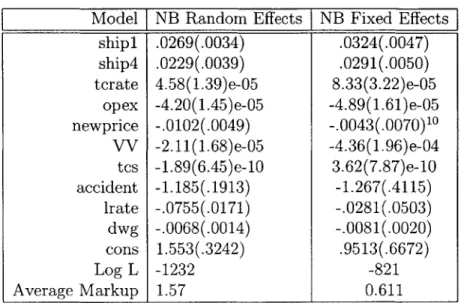
vessels in tonnes of deadweight (10000-60000, average 30000; 60000-80000; average 70000, 80000-120000; average 90000, 120000-200000; average 140000, and 200000+) have been directed by Marsoft and the particular nature of the data. In the relevant chapter (Chapter 3) we account for the individual effects of each category by estimating the model with Fixed Effects (FE) and Random Effects (RE), which correspond to fixed or random dummy variables across categories. In Chapter 5 we go one step further and estimate the time charter rate models separately for each category, as well as the Full Model. Performing this task we fully exploit throughout our analysis, the impact of size on decisions of entry and exit, as well as on the dynamics of the price process.
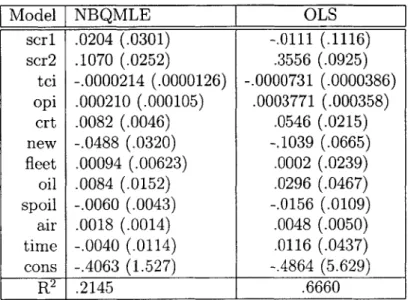
Our ability to account for size heterogeneity is limited, when perform-ing the analysis of exit decisions (Chapter 4), since scrappperform-ing data are not available for each category. Although it turns out that the tonnage scrapped each period does not have a first order effect on time charter rates, the lack of scrapping data for each category, limits significantly our ability to address questions of Economic Theory related to exit decisions. We are therefore forced to forego size heterogeneity effects and estimate our scrapping models with aggregate data. In order to account for some source of heterogeneity without overparametrizing the model, we construct tonnage weighted indices of the time charter prices and operating expenses, denoted (tci) and (opi), respectively. Another significant complication is that data on scrap prices are not available in a consistent way for the entire period 1980-2002. As we will discuss in the relevant Chapter, the lack of scrap price data forces us to use instruments, whose validity we are not able to check.
Fortunately enough, price data for new vessels and for the key input (which is our ultimate target, too), namely the time charter rate process, are available for the entire 1980-2002 period and on a monthly basis. Therefore, for the price for new vessels (newprice), which is a key input for the demand for new vessels and the time charter process (tcrate) we have aggregated monthly data to quarterly data. In some sense we have not fully employed all available information and one could argue that we could try to use monthly data. One more crucial empirical limitation, which hinders any such attempt is the fact that the demand data (dmd) are only available quarterly.
Interrelated to the time charter (price) process are operating expenses. Operating expenses (opex) vary significantly across vessels, operators and age. However, since they are a crucial factor, especially for decisions of en-try, we may focus on the operating expenses of new vessels, which anyhow
are a valid instrument for the operating expenses of any vessel. Our series on operating expenses have been constructed from different sources and this spe-cific data set is complicated and is the outcome of averaging several different estimates.
All other variables that appear in the analysis are consistently defined in the Glossary and have been fully available from independent sources. Most of them are publicly quoted indexes (air is the Standard and Poor's trans-portation index, oil is the price of crude oil quoted by the Chicago Board of Trade, irate the FED lending rate, etc.) and there is no ambiguity on their definition and quality.
Before concluding with this section there are some significant issues, which may account for the poor performance of different specifications and are therefore worth mentioning. Most of them are related to the limitations of our data that stem from the particular illiquid nature of shipping markets. Throughout this thesis, the time charter freight rate refers to an arithmetic average of time charter rates on the major routes for a particular vessel. In order to get consistent series the time charter rates are usually published for a representative vessel and since it is published in United States Dollars, the estimates quoted by different sources as the time charter rate include the effects of inflation and technological innovation. Furthermore, as the time series will represent averages (given the process has finite moments) the data will possess less volatility than the actual market price process. Finally, the market for long term contracts virtually disappears during poor freight markets [3]. The low number of fixtures makes it particularly difficult to de-termine accurate empirical measures of the time charter price in a depressed market. In our analysis we specifically choose the one year time charter rate, since it is the median of charter durations in this market ([3], p.28).

![Table XI Model II NB FE-RE [36] Real Option Model Eq.(19)](https://thumb-eu.123doks.com/thumbv2/123doknet/14670412.556679/58.918.155.592.237.476/table-xi-model-ii-nb-real-option-model.webp)