HAL Id: tel-02524157
https://tel.archives-ouvertes.fr/tel-02524157
Submitted on 30 Mar 2020
HAL is a multi-disciplinary open access archive for the deposit and dissemination of sci-entific research documents, whether they are pub-lished or not. The documents may come from teaching and research institutions in France or abroad, or from public or private research centers.
L’archive ouverte pluridisciplinaire HAL, est destinée au dépôt et à la diffusion de documents scientifiques de niveau recherche, publiés ou non, émanant des établissements d’enseignement et de recherche français ou étrangers, des laboratoires publics ou privés.
diversification
Oussama M’Saddek
To cite this version:
Oussama M’Saddek. Essays in international finance : risk, jumps and diversification. Economics and Finance. Université Clermont Auvergne, 2018. English. �NNT : 2018CLFAD009�. �tel-02524157�
´
Ecole Universitaire de Management ´
Ecole Doctorale des Sciences ´Economiques, Juridiques, Politiques et de Gestion Centre de Recherche Clermontois en Gestion et Management
Pr´esent´ee par
Oussama M’SADDEK
Pour obtenir le titre de
DOCTEUR EN SCIENCES DE GESTION Sujet de la th`ese :
Essays in International Finance: Risk, Jumps and
Diversification
Soutenue le 28 septembre 2018 Composition du jury :
Directeur de th`ese Mohamed AROURI
Professeur, Universit´e Cˆote d’Azur Rapporteur Julien FOUQUAU
Professeur, ESCP Europe Rapporteur Michael ROCKINGER
Professeur, HEC, Universit´e de Lausanne Suffragant Fabrice HERV´E
Professeur, Universit´e de Bourgogne Suffragant J´erˆome LAHAYE
Professeur, Universit´e Fordham Suffragant Benjamin WILLIAMS
Professeur, Universit´e Clermont Auvergne Membre invit´e S´ebastien LAURENT
Je tiens ici `a exprimer ma profonde gratitude `a toutes les personnes qui ont rendu possible la r´ealisation de cette th`ese. Je tiens tout d’abord `a remercier mon directeur de th`ese, Mon-sieur Mohamed Arouri, pour son int´erˆet, son soutien, sa disponibilit´e et ses pr´ecieux conseils durant la r´edaction de la th`ese.
Je remercie ´egalement les membres du jury, Monsieur Julien Fouquau et Monsieur Michael Rockinger pour avoir accept´e de rapporter ma th`ese, Monsieur Fabrice Herv´e, Monsieur J´erˆome Lahaye et Monsieur Benjamin Williams d’en ˆetre les suffragants. Je remercie ´egalement Monsieur S´ebastien Laurent pour avoir accept´e de participer `a l’´evaluation de ce travail de recherche.
Mes remerciements vont ´egalement `a tous les membres de CRCGM, et en particulier les chercheurs de la th´ematique ”Gouvernance et Valeur” pour leurs remarques et suggestions au cours des s´eminaires mensuels du CRCGM.
Enfin, je ne pourrais finir ces remerciements sans penser `a ma famille dont l’affection, l’amour, le soutien et l’encouragement constants m’ont ´et´e d’un grand r´econfort et ont con-tribu´e `a l’aboutissement de ce travail.
This thesis consists of an introductory chapter and three empirical studies that contribute to the international finance literature by investigating the dynamics of cojumps between major equity markets and assessing their impact on international portfolio allocation and asset pricing.
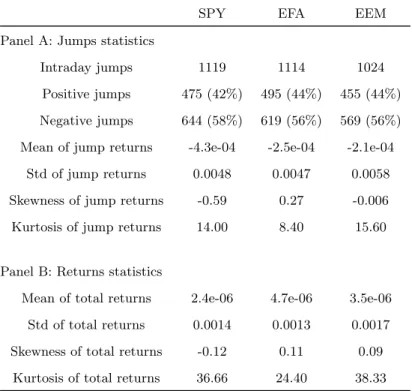
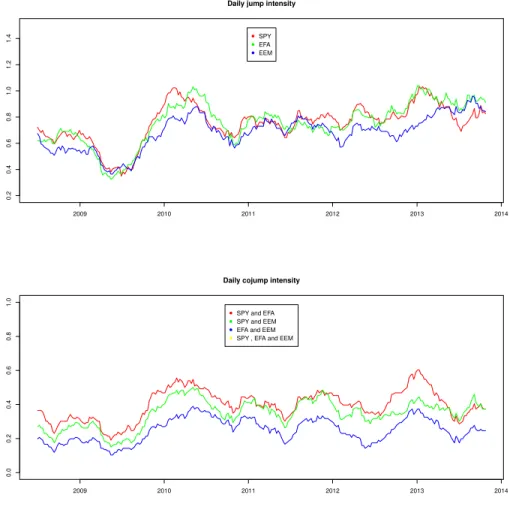
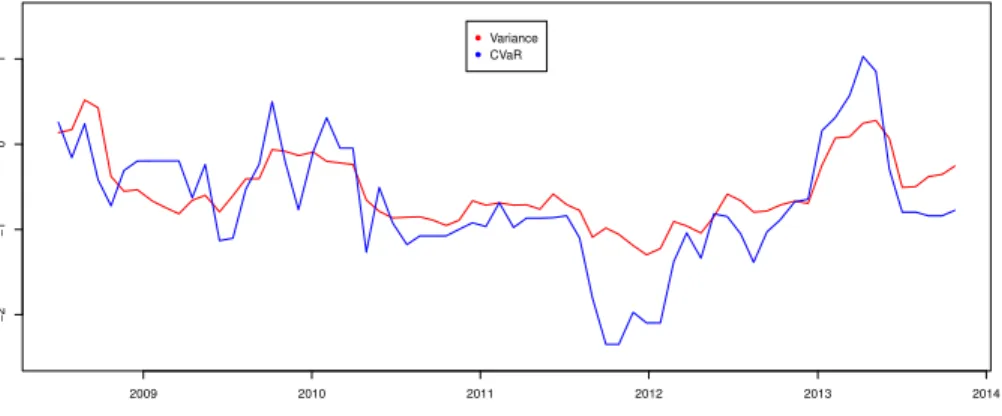
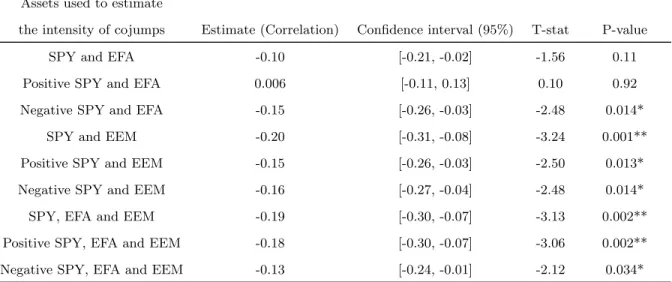
The first study (chapter 2) examines the impact of cojumps between international stock markets on asset holdings and portfolio diversification benefits. Using intraday index-based data for exchange-traded funds (SPY, EFA and EEM) as proxies for international equity markets, we document evidence of significant intraday cojumps, with the intensity increasing during the global financial crisis of 2008-2009. The application of the Hawkes process also shows that jumps propagate from the US and other developed markets to emerging markets. However, the evidence of jump spillover from emerging markets to developed markets is weak. To assess the impact of cojumps on international asset holdings, we consider a representative American investor who allocates his wealth among one domestic risky asset, the SPY fund, and two foreign risky assets, the EFA and EEM funds and compute the optimal portfolio com-position from the US investor perspective by minimizing the portfolio’s risk. We find that the demand of foreign assets is negatively correlated to jump correlation, implying that a domestic investor will invest less in foreign markets when the frequency of cojumps between domestic and foreign assets increases. In contrast, idiosyncratic jumps are found to increase the di-versification benefits and foreign asset holdings in international equity portfolios. Finally, we examine the impact of higher-order moments induced by idiosyncratic and systematic jumps on the optimal portfolio composition by considering an investor who recognizes jump risks as well as another investor who ignores them. Our results show that both investors have almost the same portfolio composition, which indicates that the impact of jump higher-order moments on optimal portfolio composition is not significant.
The second study (chapter 3) tackles the issue of pricing of both continuous and jump risks in the cross-section of international stock returns. We contribute to the literature on
components. The intraday market risk includes both continuous and jump parts. We then consider the asymmetry and size effects of market jumps by separating the systematic jump risk into positive vs. negative and small vs. large components. Using the intraday data of a set of country exchange traded funds covering developed, emerging and frontier markets, we show that continuous and downside discontinuous risks are positively rewarded in the cross-section of expected stock returns during the pre-financial crisis period whereas the upside and large jump risks are negatively priced during the crisis and post-crisis periods. We also provide evidence on the strong negative relationship between market price movements and market volatility changes, suggesting that both price and volatility risks share compensations for common underlying risk factors.
The third study (chapter 4) examines how international equity markets respond to ag-gregate market jumps at price and volatility levels. Using intraday data of ten exchange-traded funds covering major developed and emerging markets and two international market volatility indices (VIX and VXEEM), we show that both price and volatility jump betas are time-varying and exhibit asymmetric effects across upside and downside market movements. Looking at the relation between future stock market returns and aggregate market price and volatility jumps, we measure the proportion of future excess returns explained by market price and volatility jumps and provide evidence of a significant predictive power that market price and volatility jumps have on future stock returns.
Overall, our results suggest that the jump risks play an important role in determining the market risk premium and portfolio allocation decisions in an international setting.
Keywords: cojumps, international diversification, home bias, risk premium, leverage effect, high frequency data.
1 General Introduction 2
1.1 Background . . . 2
1.2 Diversification, jump and cojump risks in international stock markets . . . 3
1.2.1 Jump identification techniques . . . 4
1.2.2 Cojump identification techniques . . . 6
1.2.3 Jumps and cojumps in equity markets . . . 6
1.2.4 International diversification in presence of correlated jumps . . . 7
1.2.5 The pricing of jump risks in the cross-section of returns . . . 10
1.3 Essays . . . 12
1.3.1 First essay . . . 12
1.3.2 Second essay . . . 13
1.3.3 Third essay . . . 14
2 Cojumps and Asset Allocation in International Equity Markets 22 2.1 Introduction . . . 23
2.2 Jump and cojump identification . . . 26
2.3 Portfolio allocation problem . . . 29
2.3.1 Optimal portfolio composition and jump correlation . . . 30
2.3.2 Optimal portfolio composition and jump higher-order moments . . . 36
2.4 Data . . . 41
2.5 Empirical findings . . . 42
2.5.1 Intraday jump identification . . . 42
2.5.2 Time and space clustering of intraday jumps . . . 48
2.5.3 Cojumps and optimal portfolio composition . . . 52
2.5.4 Cojumps and the benefits of international portfolio diversification . . . 61
2.6 Conclusion . . . 64
Appendix 2.A Intraday volatility pattern . . . 71
Appendix 2.B Mean-CVaR optimization problem . . . 72
Appendix 2.C Expected power utility maximization . . . 74
3 Jump Risk Premia Across Major International Equity Markets 78 3.1 Introduction . . . 79
3.2 Betas estimation framework . . . 83
3.3 Data description . . . 86
3.4 Empirical Findings . . . 89
3.4.1 Systematic cojumps . . . 89
3.4.2 Diffusive and jump betas . . . 96
3.4.3 Risk factors and portfolio sorts . . . 98
3.4.4 Fama-MacBeth regressions . . . 107
3.4.5 Currency jump risk premium . . . 111
3.4.6 Equity risk premia and the leverage effect . . . 115
4 Price and Volatility Jump Risks in International Equity Markets 130
4.1 Introduction . . . 131
4.2 Betas estimation framework . . . 134
4.2.1 Price jump regressions . . . 134
4.2.2 Volatility jump regressions . . . 137
4.3 Data description . . . 139
4.4 Empirical Findings . . . 141
4.4.1 Price and volatility cojumps . . . 141
4.4.2 Price jump betas . . . 145
4.4.3 Volatility jump betas . . . 150
4.4.4 Upside and downside jump betas . . . 155
4.4.5 Predictive jump regressions . . . 159
4.5 Conclusion . . . 167
Appendix 4.A Jump and cojump identification methodology . . . 171
5 General Conclusion 176
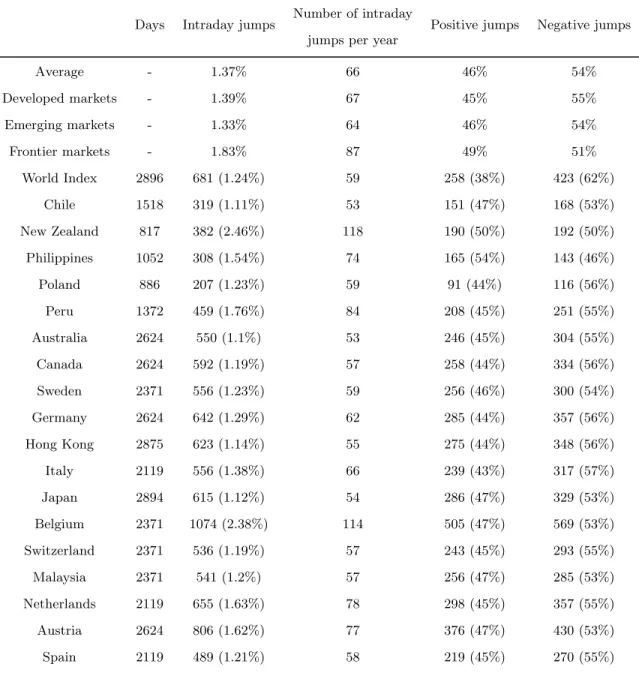
2.1 Summary statistics of jump occurrences, jump sizes and intraday returns. . . . 43
2.2 Summary statistics of jump occurrences at day level. . . 44
2.3 Summary statistics of cojump occurrences. . . 45
2.4 Summary statistics of cojump occurrences at day level. . . 45
2.5 Summary statistics of cojumps between EUR/USD exchange rate and interna-tional equity funds. . . 46
2.6 Maximum likelihood estimation of the bivariate Hawkes model. . . 51
2.7 Correlation between the daily intensity of cojumps and the optimal proportion of the foreign assets. . . 58
2.8 Correlation between the daily intensity of idiosyncratic jumps and the demand of foreign assets. . . 59
2.9 Multivariate jump-diffusion model estimation. . . 60
2.10 Optimal portfolio weights using power utility maximization approach. . . 61
2.11 The impact of simultaneous and idiosyncratic jumps on the optimal level of the diversification benefit. . . 63
3.1 Country exchange-traded funds. . . 87
3.2 Summary statistics of jump occurrences. . . 90
3.3 Summary statistics of systematic cojumps. . . 93
3.4 Summary statistics of different betas. . . 97
3.5 Contemporaneous and future returns of portfolios sorted by different betas for the period from July 2003 to December 2014. . . 100
3.7 Contemporaneous and future returns of portfolios sorted by different betas
during the crisis and post-crisis period (July 2008-December 2014). . . 105
3.8 Fama-MacBeth regressions. . . 110
3.9 Cojumps between stock markets and EUR/USD exchange rate. . . 112
3.10 Equity and currency jump risk premia. . . 114
3.11 Continuous and discontinuous leverage effects. . . 119
4.1 Country exchange-traded funds and volatility indices. . . 140
4.2 Summary statistics of jump occurrences. . . 143
4.3 Summary statistics of cojump occurrences. . . 144
4.4 Price jump beta estimation and tests for constancy over the full sample. . . 147
4.5 Price jump beta estimation over years. . . 148
4.6 Tests of a constant price jump beta over years. . . 150
4.7 Volatility jump beta estimation and tests for constancy over the full sample. . . 151
4.8 Volatility jump beta estimation over years. . . 153
4.9 Tests of a constant volatility jump beta over years. . . 154
4.10 Positive and negative price jump betas estimation and tests for constancy over the full sample. . . 156
4.11 Positive and negative volatility jump beta estimation and tests for constancy over the full sample. . . 158
2.1 Jump and cojump occurrences. . . 47
2.2 Time and space clustering of intraday jumps. . . 49
2.3 The variation of the optimal proportion of foreign assets. . . 53
2.4 Standard deviation, CVaR and correlations of domestic and foreign assets. . . . 55
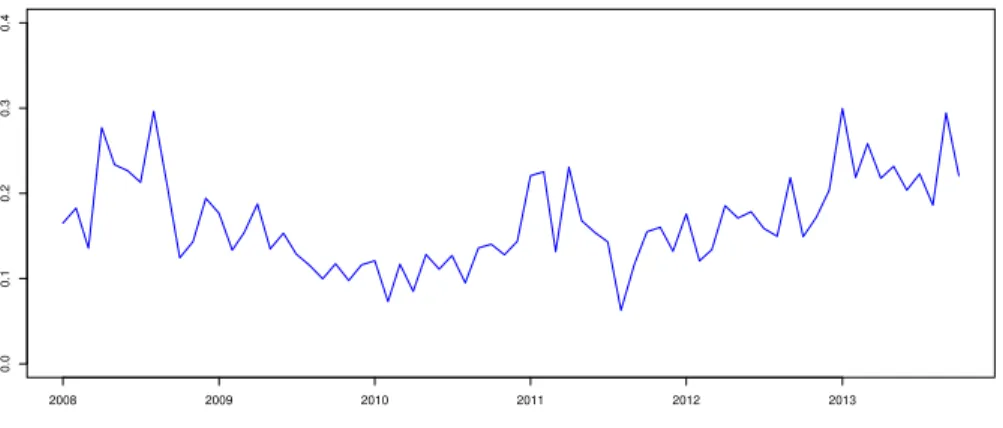
2.5 The conditional diversification benefit (CDB). . . 62
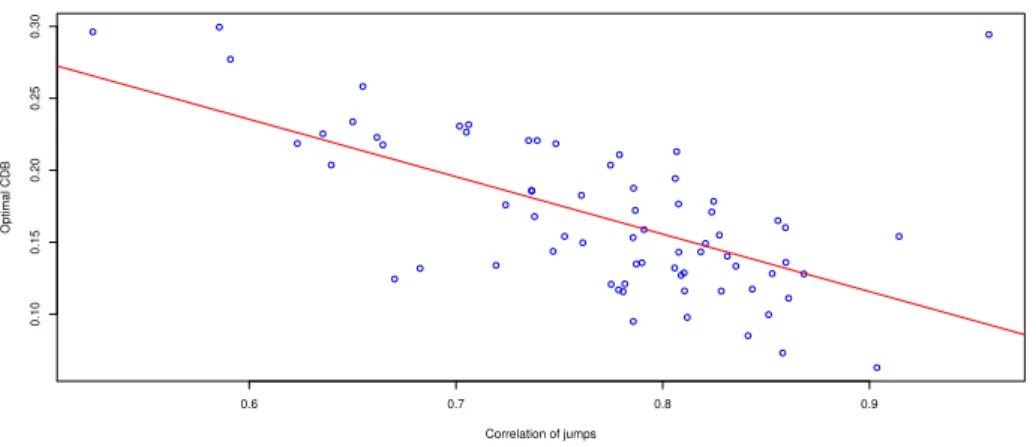
2.6 Linear regression between the conditional diversification benefit (CDB) and the correlation of jumps. . . 64
3.1 Beta distributions. . . 98
4.1 Positive and negative SPY price jumps and SPY future excess returns. . . 161
4.2 Positive and negative SPY price jumps and future individual country fund excess returns. . . 162
4.3 Positive and negative SPY volatility jumps and SPY future excess returns. . . 164
4.4 Positive and negative SPY volatility jumps and future individual country fund excess returns. . . 165
General Introduction
1.1
Background
This dissertation consists of an introductory chapter and three research essays that con-tribute to the existing literature on international finance by focusing especially on the effects of jump and cojump risks on international portfolio allocation and asset pricing. The nature of international stock market comovements is an important issue that has been extensively studied in the international finance literature (see, among others, Karolyi and Stulz (1996), De Santis and Gerard (1997), Ang and Bekaert (2002)). The topic of international stock market interdependencies has gained an increased interest among researchers for at least two main reasons. First, the nature and degree of cross-market linkages have a direct effect on international diversification. The modern portfolio theory suggests that diversification is an efficient tool to minimize the portfolio’s risk. Investors, either individual or institutional, can reduce the risk of their portfolios by holding assets that are not perfectly correlated. On the contrary, in the context of an increased cross-market correlation, the benefit of portfolio di-versification will be reduced. Motivated by the increased capital market integration covering both developed and emerging markets during the last decades, many researchers questioned if cross-country correlations would increase and thus the international diversification benefits would decrease.
Second, the study of correlations has been also boosted by the recurrence of financial crises that occurred in both developed and emerging countries during the last three decades. Understanding the nature of interdependencies between international stock markets in period of crisis is of great interest for both investors and policy makers who want to guard against an excessive correlation between international markets, known also as contagion risk. Several studies (Ang et al., 2006 and Lettau et al., 2014) provide evidence of a significant downside
risk in equity markets and have documented the high correlation of large down moves in international markets (see, among others, Longin and Solnik (2001), Ang and Bekaert (2002), Ang and Chen (2002) and Hartmann et al. (2004)).
More recently, researchers have especially focused on studying the comovement of stock returns in the tail of the distribution, also called tail dependence or tail risk. It is well documented in the finance literature that financial asset prices often violate the log-normality assumptions and exhibit large discontinuities or jumps in their trajectories. Thanks to the availability of high frequency data, the recent development of nonparametric jump detection techniques (see, among others, Barndorff-Nielsen and Shephard (2004, 2006), Andersen et al. (2007), Lee and Mykland (2008) and Ait-Sahalia and Jacod (2009)) provides strong evidence in favor of the presence of jumps in asset prices. The main objective of this dissertation is to contribute to the existing literature on international stock market correlations by empirically investigating the dynamics of cojumps in international equity markets and assessing their impact on portfolio allocation decisions and asset pricing.
The remainder of this introductory chapter is organized as follows. Section 1.2 goes through the existing literature on international diversification, jump and cojump risks in international stock markets. Section 1.3 summarizes the three essays and highlights their main contributions.
1.2
Diversification, jump and cojump risks in international
stock markets
This section goes through the main works in the literature that motivated our study. The objective is not to provide an exhaustive list of all studies on jump and cojump risks in international stock markets, but to shed light on the main strands of the literature that are directly linked to the topics addressed in this thesis.
strands. The first one focused on the issue of jump identification. The works in this era have been motivated by the availability of high frequency data and the development of new jump identification techniques. Others studies were interested in studying simultaneous jumps or cojumps and developed new statistical techniques to detect the occurrence of cojumps across assets. The tools proposed in these studies are very useful for detecting both individual and common arrivals of jumps which is a key building block in studying jump dependencies.
The second branch of the literature examines the question of international diversification in presence of jumps and cojumps between assets. As mentioned earlier, the main question here is to analyze how asset allocation decisions of investors will move when considering asset jumps’ dependencies.
The third branch of the literature explores the relationship between jumps in asset prices with those of aggregate risk factors and develops new econometrical tools for measuring the sensitivity of individual assets to market jumps, known also as the jump beta. These tools are very useful in practice especially for researchers who are interested in the pricing of individual assets and the understanding of the cross-section of asset returns.
1.2.1 Jump identification techniques
Numerous detection techniques have been proposed in the literature to resolve price jump identification issues. These techniques are often derived from the statistical test theory. They aim to study the dynamics of jumps’ arrivals using high frequency data. The seminal work in this area was Barndorff-Nielsen and Shephard (2004, 2006) who distinguish between two measures of integrated variance. The first one takes into account the jump component of the price process when measuring the integrated variance while the second one is a jump robust measure. Authors develop a nonparametric test which indicates if a sample contains jumps using the reported measures.
Lee and Mykland (2008) notice the impact of the sensitivity of intraday volatility patterns on Barndorff-Nielsen and Shephard nonparametric test, that leads to spurious detection of
jumps. The basic idea behind their statistical test is to distinguish movements of the realized return that are caused by jumps from those that are induced by a high level of volatility. Thus, they develop a new statistical test by scaling returns by a local volatility measure. Bajgrowicz et al. (2015) also propose a technique to eliminate spurious detection of jumps on available test statistics using specific thresholds. Mancini (2001, 2009) has also developed a nonpara-metric test for measuring jump arrival times from high-frequency data using threshold-based methods.
A different approach (known as the ”swap variance” approach) was proposed by Jiang and Oomen (2008) who consider the third and higher-order return moments to identify jumps at day level. They were inspired from the ”swap variance” replication strategy to construct their statistical test. Ait-Sahalia and Jacod (2009) also examine the difference between high order moments of returns at two different sampling frequencies to detect jumps in a daily basis.
Although these statistical tests are designed to detect the same jumps, studies show that their results are often incoherent. Schwert (2008) finds, for example, that the amount and the timing of jumps depend on the choice of the sampling frequency. In an attempt to find the optimal level of sampling frequency, he mentions that the microstructure noise has a significant impact on different test statistics.1 He proposes to sample market data at intervals of five to eleven minutes to reduce the effects of microstructure noise. Dumitru and Urga (2012) provide a comparison study between various univariate tests through Monte Carlo procedures and find that the intraday jump test of Lee and Mykland outperforms other jump identification procedures especially when the volatility is not high. The test of Lee and Mykland has also the advantage to identify jumps intradaily compared to others jump tests that have been designed to determine if a day (or a given time window) contains price jumps.
1
The microstructure noise is the deviation of the asset price from its fundamental value due to market frictions such as bid-ask bounce, latency, and asymmetric information.
1.2.2 Cojump identification techniques
In addition to univariate jump identification techniques, econometric tools have been devel-oped to detect common arrivals of asset jumps, also called multivariate jump tests. However, the literature on cojump identification is relatively recent and scarcer compared to univariate jump tests. The most intuitive way to detect cojumps is to identify jump occurrences for each individual asset using an univariate jump test and then apply the co-exceedance rule proposed by Bae et al. (2003). A cojump is identified if two or more assets jump within the same intraday time interval. Bollerslev et al. (2008) use the mean of cross products of returns of a large number of stocks as a test statistic to detect common arrival of jumps at portfolio level. Their test statistic is sensitive to the number of stocks considered in the portfolio. Indeed, a large number of stocks is required to diversify away asset idiosyncratic jumps.
Jacod and Todorov (2009) develop a bivariate jump indentification test using the ratio of power variation estimators. However, their approach can only be applied to detect if a particular day contains cojumps. Gobbi and Mancini (2012) propose a daily cojump test by applying thresholding techniques. Gnabo et al. (2014) use the product of assets’ intraday re-turns and parametric bootstrapping techniques to identify intraday cojumps. Their approach complements the univariate jump detection tests in the sense that it aims to identify poten-tial cojumps, which are not, detected through univariate jump tests. However, Gnabo et al. (2014) show that univariate tests remain satisfactory and best-suited for detecting jumps and cojumps as long as the jumps sizes are sufficiently large and have the same sign as the assets’ correlation.
1.2.3 Jumps and cojumps in equity markets
Motivated by the development of nonparametric jump detection tests, researchers exam-ine the dynamics of jumps in different stock markets. Gilder et al. (2012) use univariate jump detection techniques to identify intraday jumps in the US stock market and examine the frequency of cojumps between individual stocks and the market portfolio. They find a
tendency for a relatively large number of stocks to be involved in systematic cojumps, which are defined as cojumps between a stock and market portfolio. Lahaye et al. (2010) and Evans (2011) examine the link between asset cojumps and new macro announcements and find that cojumps are partially associated with macroeconomic news. Bormetti et al. (2015) study the dynamics of intraday jumps in the Italian stock market and show that Hawkes one-factor model is more suitable to capture the high synchronization of jumps across assets than the multivariate Hawkes model (1971). Using daily data, Ait-Sahalia et al. (2015) develop a multivariate Hawkes jump-diffusion model to capture the propagation of jumps over time and across markets. They provide strong evidence for jumps to arrive in clusters within the same market and to propagate to other international stock markets. Pukthuanthong and Roll (2015) also use daily data to examine jump correlation across international stock markets. In the first essay, we extend the existing literature by studying the dynamics of jumps in an international setting. Our approach is based on the use of high frequency data and the application of nonparametric jump identification tests. We also examine the time (within same market) and space (across markets) clustering properties of intraday jumps using the multivariate Hawkes model.
1.2.4 International diversification in presence of correlated jumps
International stock markets are characterized by jumps that have tendency to occur at the same time across markets especially in bearish market conditions marked by large downturns and high volatility. This excessive correlation between jumps leads researchers to question whether the jump risk reduces the gains from the international diversification. Das and Uppal (2004) examine this question by considering a multivariate system of jump-diffusion processes where jumps are infrequent and occur simultaneously across assets. They find that systemic jump risk reduces the gains of portfolio diversification especially if the considered portfolio includes a risk free asset. Cvitani et al. (2004) consider the optimal portfolio strategy of a representative investor with CRRA utility where the risky asset is modeled as a pure jump process with non-trivial higher moments. They find that ignoring higher moments in the
portfolio optimization problem leads to an over-investment in risky assets and results in a substantial wealth loss. Ait Sahalia et al. (2009) examine the problem of portfolio allocation in presence of jumps and propose a closed-form solution for it.
The benefits from international portfolio diversification have been widely documented in the finance literature (see, among others, Grubel (1968), Levy and Sarnat (1970), Lessard (1973), and Solnik (1974)). However, studies show that in practice investors have tendency to overweight their portfolios with assets from their home country market, meaning that those portfolios tend to be less diversified internationally than would be optimal according to modern portfolio theory (Markowitz, 1952). In the finance literature, this lack of international portfolio diversification is called the home bias puzzle.
The equity home bias was first documented by French and Poterba (1991). They studied the home bias phenomenon in five major countries and they found that at the end of 1989, US investors hold more than 92% of their equity in domestic stock (Japan, 95%; United Kingdom, 92%; Germany, 79% and France, 89%). Tesar and Werner (1998) show the same figures. These empirical data are largely different from those predicted by theoretical studies that demonstrate that the share of domestic assets in optimal portfolio composition should be in line with the share of the domestic equity market compared to the total world equity market. More recently, many researchers studied the evolution of the phenomenon over the past three decades. Karolyi and Stulz (2003) found that international diversification has increased slightly for US investors from 1973 through 2001. This decrease in home bias could be explained by changes that experienced equities market in the nineties including the advent of internet, the development of emerging markets, deregulation and markets liberalization. In spite of this decrease in home bias, several studies report that investors are still far from taking all the gains from international diversification and differences between the theoretical share of foreign assets that should be held by investors and the real share effectively held are largely disproportionate.
been various theoretical explanations that were given to rationalize investors’ behaviour and thus the lack of international diversification observed in financial markets.2 A first potential explanation for equity home bias is that domestic equities provide a better hedge for risks that are home-country specific such as domestic inflation risk, exchange rate risk and hedges against wealth that is not traded in capital markets. Empirical studies show that there is a weak correlation between domestic stock returns and domestic inflation rate (exchange rate, non-tradable income) indicating that hedging domestic risks fails to explain the observed home bias.
An alternative explanation for international under-diversification is the existence of various barriers and relatively important transaction costs for foreign investments. However, none of the studies that consider barriers and transaction costs as an explanation to home bias succeeds to provide plausible empirical proofs. Moreover, recent studies show that costs and barriers to foreign investments have decreased considerably due to market liberalization in the early nineties. Thus, the home bias in equities cannot be explained by international capital controls or transaction costs.
A different explanation is suggested by recent empirical studies (Chan et al., 2005) that consider information asymmetries between domestic and foreign investors as the main cause of home bias. In order to examine the link between information asymmetries and international portfolio choice, researchers mainly use econometric regression models to measure the impact of each explanatory variable. The physical distance between two countries or the fact to share a common language or culture is often used as a proxy for information asymmetries in those models. Contrary to the information-based explanation of home bias, others researchers criticize the fact that this theory implicitly assumes that domestic investors have superior access to the domestic market in an environment of global information access. It seems that there is no consensus between researchers on the role of information asymmetries as a cause to the observed home bias. This is also related to difficulties to provide a convincing empirical study about the effect of information asymmetries on the portfolio choice due to the lack in
practice of data necessary to measure these asymmetries.
The explanations reported below are based on the assumption of perfectly rational be-haviour of individuals. As it seems that the home bias cannot only be explained by rational behaviour of investors, recent studies rely on recent findings of behavioral finance in order to explain international under-diversification. Researchers examined if the irrational behaviour of investors could be explained by behavioural biases such as overconfidence, familiarity with domestic stocks, patriotism and specific investor characteristics (sophisticated investor or not, age, gender, income).
The puzzle has led to an extensive research effort in both traditional and behavioral fi-nance. So far, several explanations have been presented, but a solution generally accepted by the researchers remains elusive. In the first essay, we contribute to the existing literature on the lack of international diversification by investigating how the cojumps between interna-tional stock markets will affect the demand of foreign assets and the gains from internainterna-tional diversification. To the best of our knowledge, we are the first study that examines the impact of intraday cojumps on portfolio allocation decisions in an international setting. Our approach is based on the identification of cojumps using high frequency data. We use mean-variance and mean-CVaR approaches to determine the optimal portfolio composition and examine how the demand of foreign assets varies with jumps’ correlation. The impact of higher-order moments induced by jumps on the optimal portfolio composition is also examined.
1.2.5 The pricing of jump risks in the cross-section of returns
The finance theory establishes that investors should be compensated for bearing non-diversifiable risks. Aggregate market jumps are a potential source of systematic risk. There-fore, understanding how individual assets are linked to aggregate market jumps plays a key role in measuring, managing and pricing jump risks. In this field, Bollerslev et al. (2016) and Li et al. (2017) develop new econometrical tools for estimating the sensitivity of indi-vidual assets to market jumps. Using these new tools, Bollerslev et al. (2016) and Alexeev
et al. (2017) document that the jump risk carries a significant positive premium. However, the scope of their empirical works is restricted to the US market. Using option data and by constructing suitable option trading strategies, Cremers et al. (2015) provide evidence that both aggregate jump and volatility are priced risk factors, but both of them carry negative market risk prices.
More recently, studies (Bandi and Reno (2016), Jacod and Todorov (2010), Todorov and Tauchen (2011)), show that jumps in prices are often associated with strongly anti-correlated, contemporaneous, discontinuous changes in volatility, suggesting that both the price and volatility jump risks are derived by common underlying risk factors and thus should be handled jointly by investors. Other studies (Bandi and Reno (2016), Davies (2016)) suggest that market volatility jumps are also a source of systematic risk and they should be priced in the cross-section of stock returns.
The asset pricing literature that investigates the role of tail risks on explaining the cross-section of stock returns worldwide also includes Weigert (2016) who provides evidence of a significant positive premium for holding stocks with a strong sensitivity to extreme market downturns, with a risk premium particularly high in countries with higher income per capita and negative market skewness. In contrast, Oordt and Zhou (2016) find the reward for holding stocks that strongly comove with the market during extreme market crashes is not significant. Their study is, however, limited to the US stock market.
In the second essay, we contribute to the existing literature by decomposing the non-diversifiable market risk into continuous and discontinuous components and systematic jump risks into positive vs. negative and small vs. large components. We examine their associ-ation with equity risk premia across major equity markets. To the best of our knowledge, we are the first study that examines the market risk across major developed, emerging and frontier markets using a general pricing framework involving six separate market betas measur-ing the sensitivity of individual country stock markets to respectively continuous, overnight, discontinuous up, discontinuous down, discontinuous small and discontinuous large intraday
movements of the market. As jumps in prices are closely linked to jumps in the volatility, we study, in the third essay, how developed and emerging markets react to jumps of an aggregate market index both at price and volatility levels and examine the role of market price and volatility jumps in forecasting international stock market returns.
1.3
Essays
1.3.1 First essay
The first essay aims to examine the impact of cojumps between international stock markets on asset holdings and portfolio diversification benefits. The paper extends previous studies that investigate how international diversification varies with the correlation between stock markets by focusing specifically on the role of cojumps. It also contributes to the existing literature by studying the dynamics of intraday jumps in an international setting.
Our empirical investigation is based on the use of intraday returns for three interna-tional exchange-traded funds, SPY, EFA, and EEM, which respectively aim to replicate the performance of three international equity market indices: S&P 500, MSCI EAFE (Europe, Australasia and Far East), and MSCI Emerging Markets. The data covers the period going from January 2008 to October 2013. We apply the univariate jump identification test of Lee and Mykland (2008) to identify the intraday jumps of the three funds. In order to cap-ture the dependency between the occurrences of the detected jumps, we employ the bivariate Hawkes process (1971) which is appropriate to model the time and space clustering features of jumps. Under this analysis, we find jumps from the US propagate to other developed markets and emerging markets. However, the evidence of jump spillover from emerging markets to developed markets is weak.
To assess the impact of cojumps on international asset holding, we consider a represen-tative American investor who allocates his wealth among one domestic risky asset, the SPY fund, and two foreign risky assets, the EFA and EEM funds. We then compute the optimal portfolio composition from the US investor perspective by minimizing the portfolio’s risk.
Once the optimal composition is determined, we examine how the demand of foreign assets varies with the jump correlation or cojumps. We find that the demand of foreign assets is negatively correlated to jump correlation, implying that a domestic investor will invest less in foreign markets when the frequency of cojumps between domestic and foreign assets increases. We also uncover the negative link between the intensity of cojumps and the conditional di-versification benefit measure suggested by Christoffersen et al. (2012). Putting differently, the excessive jump correlation increases the cross-market comovements, and therefore reduces the international diversification benefit and leads investors to prefer home assets. In contrast, we find that idiosyncratic jumps have a positive effect on foreign asset holding and diver-sification benefits, implying that country-specific jumps are a potential source of portfolio diversification for investors. Finally, we examine the impact of higher-order moments (skew-ness, co-skew(skew-ness, kurtosis, and co-kurtosis) induced by idiosyncratic and systematic jumps on the optimal portfolio composition by considering an investor who recognizes idiosyncratic and systematic jump risks and assumes that asset returns are given by a multivariate jump-diffusion process as well as another investor who ignores jumps and assumes a pure-jump-diffusion process for asset returns. Our results show that both investors have almost the same portfo-lio composition, which indicates that the impact of jump higher-order moments on optimal portfolio composition is not significant.
1.3.2 Second essay
The second research paper tackles the issue of pricing of both continuous and jump risks in the cross-section of international stock returns. We contribute to the literature on interna-tional asset pricing by considering a general pricing framework involving six separate market risk factors. We first decompose the systematic market risk into intraday and overnight components. The intraday market risk includes both continuous and jump parts. We then consider the asymmetry and size effects of market jumps by separating the systematic jump risk into positive vs. negative and small vs. large components.
exchange-traded funds covering developed, emerging and frontier markets from July 2003 to December 2014. We follow Todorov and Bollerslev (2010)’s methodology to estimate the exposure of each country fund returns towards the systematic market diffusive and jump risks. We examine the cross-sectional relation between estimated betas and return by forming portfolios ranked on the basis of market betas. We find that there is a positive link between the returns of the sorted portfolios and different factors of risk (except the overnight beta) during the pre-crisis period going from July 2003 to June 2008. During the crisis and pre-crisis period (July 2008 to December 2014), we observe an inversion of the patterns of realized returns for portfolios sorted on jump betas (expect for discontinuous downside beta), with a negative relation being more pronounced for discontinuous positive and large betas. This result is consistent with an increasing investor appetite for equities that positively comove with large and positive market jumps during periods of market turmoil. These equities will help investors to better hedge against large movements of market and thus would require lower expected returns.
In order to assess the price of bearing continuous and jump market risks, we follow Fama and MacBeth (1973)’s approach by running a set of cross-sectional regressions in a monthly basis. The results of the cross-sectional Fama and MacBeth (1973) regressions are in line with the portfolio sorting findings. We mainly find that continuous and downside discontinuous risks are positively rewarded in the cross-section of expected stock returns during the pre-crisis period whereas the upside and large jump risks are negatively priced during the pre-crisis and post-crisis periods. By studying the return-volatility relationship over the sample period, we provide evidence on the strong negative covariation between market price movements (both continuous and downside discontinuous) and market volatility changes during the pre-crisis period, suggesting that both price and volatility risks share compensations for common underlying risk factors during the pre-crisis period.
1.3.3 Third essay
The third research article complements the first two essays by examining how interna-tional equity markets respond to aggregate market jumps at both price and volatility levels.
Motivated by the recent development of jump regression techniques (Li et al. (2017) and Davies (2016)), we examine the linear relationship between individual stock markets and an aggregate market proxy at jump times at both price and volatility levels.
The empirical work is based on two sets of high frequency data. The first set is composed of ten exchange-traded funds covering major developed and emerging markets. The second set is composed of two volatility indices: the Chicago Board of Options Exchange’s (CBOE) Volatility Index (VIX) and CBOE Emerging Markets ETF Volatility Index (VXEEM) serving as proxies for respectively the developed and emerging market volatilities. The sample covers the period going from January 2008 to May 2015. By applying the techniques proposed by Andersen et al. (2007) and Lee and Mykland (2008), we identify intraday jumps and cojumps of all funds and volatility indices in the sample and find that simultaneous jumps between individual country funds and two volatility indices have opposite signs, with a higher propor-tion of positive volatility and negative return cojumps, suggesting a strong anti-correlapropor-tion between market volatility jumps and the asset returns when the market is downward and its volatility is high.
By considering jump regression techniques proposed by Li et al. (2017) and Davies (2016), we estimate the sensitivity of individual country markets to respectively market price and volatility jumps and show that both price and volatility jump betas are time-varying over the period of study. We also document asymmetric effects across upside and downside market movements for the price jump betas. The results found for the upside and downside volatility jump betas, are, however, inconclusive.
Looking at the relation between future stock market returns and aggregate market price and volatility jumps, we measure the proportion of future excess returns explained by market price and volatility jumps and provide evidence of a significant predictive power that market price and volatility jumps have on future stock returns, with a stronger degree of predictability obtained with market price jumps.
Ait-Sahalia, Y., Cacho-Diaz, J., and Laeven, R., 2015. Modeling financial contagion using mutually exciting jump processes. Journal of Financial Economics 117, 585-606.
Ait-Sahalia, Y., Cacho-Diaz, J., and Hurd, T. R., 2009. Portfolio Choice with Jumps: A Closed-Form Solution. The Annals of Applied Probability 19, 556-584.
Ait-Sahalia, Y. and Jacod, J., 2009. Testing for jumps in a discretely observed process. The Annals of Statistics 37, 184-222.
Alexeev,V., Dungey, M. and Yao, W., 2017. Time-varying continuous and jump betas: The role of firm characteristics and periods of stress. Journal of Empirical Finance 20, 1-20.
Andersen, T.G, Bollerslev, T., and Dobrev, D., 2007. No-arbitrage semi-martingale restric-tions for continuous-time volatility models subject to leverage effects, jumps and i.i.d. noise: Theory and testable distributional implications. Journal of Econometrics 138 (1), 125-180.
Ang, A., and Bekaert, G., 2002. International Asset Allocation with Regime Shifts. Review of Financial Studies 15, 1137-1187.
Ang, A. and Chen, J., 2002. Asymmetric correlations of equity portfolios. Journal of Financial Economics 63, 443-494.
Ang, A., Chen, J., and Xing, Y., 2006. Downside Risk. Review of Financial Studies 19 (4), 1191-1239.
Bae, K.-H., Karolyi, G. A. and Stulz, R. M., 2003. A new approach to measuring financial contagion. Review of Financial Studies 16, 717-763.
Bajgrowicz, P., Scaillet, O., and Treccani, A., 2015. Jumps in High-Frequency Data: Spurious Detections, Dynamics, and News. Management Science, 2198-2217.
Bandi, F.M., and Reno, R. 2016. Price and volatility co-jumps. Journal of Financial Economics 119, 107-146.
Barndorff-Nielsen O. E. and Shephard, N., 2004. Power and bipower variation with stochastic volatility and jumps. Journal of Financial Econometrics 2, 1-37.
Barndorff-Nielsen, O. E. and Shephard, N., 2006. Econometrics of testing for jumps in financial economics using bipower variation. Journal of Financial Econometrics 4, 1-30.
Bollerslev, T., Law, T. H., Tauchen, G., 2008. Risk, jumps, and diversification. Journal of Econometrics 144(1), 234-256.
Bollerslev T., Todorov V., and Li S. Z., 2016, Roughing up Beta: continuous vs. discontinuous betas, and the cross-section of expected stock returns. Journal of Financial Economics 120 (3), 464-490.
Bormetti, G., Calcagnile, L.M., Treccani, M., Corsi, F., Marmi, S., Lillo, F., 2015. Modelling systemic price cojumps with hawkes factor models. Quantitative Finance 15, 1137-1156.
Chan, K. , Covrig, V., and Ng, L., 2005. What Determines the Domestic Bias and Foreign Bias? Evidence from Mutual Fund Equity Allocations Worldwide. Journal of Finance 60, 1495-1534.
Christoffersen, P., Errunza, V., Langlois, H., and Jacobs, K., 2012. Is the Potential for Inter-national Diversification Disappearing? Review of Financial Studies 25, 3711-3751.
Cremers, M., Halling, M. and Weinbaum, D., 2015. Aggregate Jump and Volatility Risk in the Cross-Section of Stock Returns. The Journal of Finance 70 (2), 577-614.
Cvitanic, J., Polimenis, V. and Zapatero, F., 2008. Optimal portfolio allocation with higher moments. Annals of Finance 4, 1-28.
Das, S., Uppal, R., 2004. Systemic Risk and International portfolio choice. Journal of Finance 59, 2809-2834.
Davies, R., 2016. Volatility Jump Regressions. Working paper, Duke university.
De Santis, G. and Gerard, B., 1997. International asset pricing and portfolio diversification with time-varying risk, Journal of Finance 52 (5), 1881-1912.
Dumitru, A.M. and Urga, G., 2012. Identifying jumps in financial assets: A comparison between nonparametric jump tests. Journal of Business and Economic Statistics 30 (2), 242-255.
Evans, K.P. , 2011. Intraday jumps and US macroeconomic news announcements. Journal of Banking and Finance 35 (10).
Fama, E. F. and MacBeth, J. D, 1973. Risk, Return, and Equilibrium: Empirical Tests. Journal of Political Economy 81 (3), 607-636.
French, K., and Poterba, J., 1991. Investor Diversification and International Equity Markets. American Economic Review 8, 222-226.
Gilder, D., Shackleton, M., and Taylor, S., 2012. Cojumps in Stock Prices: Empirical Evi-dence. Journal of Banking and Finance 40, 443-459.
Gnabo, J., Hvozdyk, L., and Lahaye, J., 2014. System-wide tail comovements: A bootstrap test for cojump identification on the S&P500, US bonds and currencies. Journal of Inter-national Money and Finance 48, 147-174.
Gobbi, F., and Mancini, C., 2012. Identifying the Brownian Covariation From the Co-jumps given discrete observations. Econometric theory, 28, 249273.
Grubel, H., 1968. Internationally diversified portfolios: Welfare gains and capital flows. Amer-ican Economic Review 58, 1299-1314.
Hartmann, P., Straetmans, S. and de Vries, C., 2004. Asset market linkages in crisis periods. Review of Economics and Statistics 86, 313-326.
Hawkes, A.G., 1971. Spectra of some self-Exciting and mutually exciting point Processes. Biometrika 58, 83-90.
Jacod, J., Todorov, V., 2010. Do price and volatility jump together? The Annals of Applied Probability 20, 1425-69.
Jacod, J., and Todorov, V., 2009. Testing for Common Arrivals of Jumps for Discretely Observed Multidimensional Processes. The Annals of Statistics 37, 1792-1838.
Jiang G. J. and Oomen, R. C. A., 2008. Testing for jumps when asset prices are observed with noise - A swap variance approach. Journal of Econometrics 144, 352-370.
Karolyi, A., and Stulz, R., 1996. Why do markets move together? An investigation of U.S.-Japan stock return comovements, Journal of Finance 51 (3), 951-986.
Karolyi, A. and Stulz, R., 2003. Are Financial Assets Priced Locally or Globally? Handbook of the Economics of Finance 1, 975-1020.
Lahaye J., Laurent, S., and Neely, C.J., 2010. Jumps, cojumps and macro announcements. Journal of Applied Econometrics 26, 893-921.
Lee S. S. and Mykland, P.A., 2008. Jumps in financial markets: A new nonparametric test and jump dynamics. Review of Financial Studies 21, 2535-2563.
Lessard, D., 1973. World, national and industry factors in equity returns. Journal of Finance 29, 379-391.
Lettau, M., Maggiori, M. and Weber, M., 2014: Conditional Risk Premia in Currency Markets and Other Asset Classes. Journal of Financial Economics 114 (2), 197-225.
Levy, H. and Sarnat, M., 1970. International diversification of investment portfolios. American Economic Review 60, 668-675.
Lewis, Karen K., 1999, Trying to Explain Home Bias in Equities and Consumption, Journal of Economic Literature 37, 571-608.
Li, J., Todorov, V., Tauchen, G., 2017. Jump Regressions. Econometrica 85, 173-195.
Longin, F., and Solnik B., 2001, Extreme Correlation of International Equity Markets, Journal Finance 56, 649-676.
Mancini, C., 2001. Disentangling the Jumps of the Diffusion in a Geometric Jumping Brownian Motion. Giornale dell’Istituto Italiano degli Attuari, LXIV, 19-47.
Mancini, C., 2009. Non-Parametric Threshold Estimation for Models With Stochastic Diffu-sion Coefficient and Jumps, Scandinavian Journal of Statistics 36, 270-296.
Markowitz, H., 1952. Portfolio selection. The journal of finance 7, 77-91.
Oordt, M and Zhou, C., 2016. Systematic tail risk. Journal of Financial and Quantitative Analysis 51, 685-705.
Pukthuanthong, K., and Roll, R., 2015. Internationally correlated jumps. Review of Asset Pricing Studies 5, 92-111.
Schwert, M., 2008. Problems in the Application of Jump Detection Tests to Stock Price Data. Duke University Senior Honors Thesis.
Solnik, B., 1974. Why not diversify internationally rather than domestically. Financial Ana-lysts Journal, 48-53.
Tesar, L.L., and Werner, I.M., 1998. The Internationalization of Securities Markets Since the 1987 Crash. Brookings-Wharton Papers in Financial Services, 283-349.
Todorov, V. and Bollerslev, T., 2010. Jumps and Betas: A New Framework for Disentangling and Estimating Systematic Risks. Journal of Econometrics 157, 220-235.
Todorov, V., Tauchen, G., 2011. Volatility jumps. Journal of Business and Economic Statistics 29, 356-371.
Weigert, F., 2016. Crash Aversion and the Cross-Section of Expected Stock Returns World-wide. The Review of Asset Pricing Studies 6, 135-178.
Cojumps and Asset Allocation in International
Eq-uity Markets
1Abstract
This paper examines the patterns of intraday cojumps between international equity markets as well as their impact on international asset holdings and portfolio diversification benefits. Using intraday index-based data for exchange-traded funds as proxies for international equity markets, we document evidence of significant cojumps, with the intensity increasing during the global financial crisis of 2008-2009. The application of the Hawkes process also shows that jumps propagate from the US and other developed markets to emerging markets. Correlated jumps are found to reduce diversification benefits and foreign asset holdings in minimum risk portfolios, whereas idiosyncratic jumps increase the diversification benefits of international equity portfolios. In contrast, the impact of higher-order moments induced by idiosyncratic and systematic jumps on the optimal composition of international portfolios is not significant. Keywords: Cojumps; Foreign asset holdings; International diversification.
1
A paper based on this chapter has been accepted for publication in Journal of Economic Dynamics and Control.
2.1
Introduction
It is now well established in the finance literature that price discontinuities or jumps should be taken into account when studying asset price dynamics and allocating funds across assets (Bekaert et al., 1998; Das and Uppal, 2004; Guidolin and Ossola, 2009; Branger et al., 2017). In this regard, the recent development of non-parametric jump identification tests has enabled jump detection in financial asset prices. The seminal works in this area include Barndorff-Nielsen and Shephard (2004; 2006a) who test for the presence of jumps at the daily level using measures of bipower variation. The same family of intraday jump identification procedures includes the tests developed by, among others, Jiang and Oomen (2008), Andersen et al. (2012), Corsi et al. (2010), Podolskij and Ziggel (2010), and Christensen et al. (2014). Andersen et al. (2007) and Lee and Mykland (2008) have developed techniques to identify intraday jumps using high frequency data. All of these jump detection techniques provide empirical evidence in favor of the presence of asset price discontinuities or jumps.
More recently, researchers have been interested in studying cojumps between assets (Dungey et al., 2009; Lahaye et al., 2010; Dungey and Hvozdyk, 2012; Pukthuanthong and Roll, 2015; Ait-Sahalia and Xiu, 2016). For instance, Gilder et al. (2012) examine the frequency of cojumps between individual stocks and the market portfolio. They find a tendency for a relatively large number of stocks to be involved in systematic cojumps, which are defined as cojumps between a stock and market portfolio. Lahaye et al. (2010) show that asset cojumps are partially associated with macroeconomic news announcements. Ait-Sahalia et al. (2015) develop a multivariate Hawkes jump-diffusion model to capture jumps propagation over time and across markets. They provide strong evidence for jumps to arrive in clusters within the same market and to propagate to other international markets. Bormetti et al. (2015) find that Hawkes one-factor model is more suitable to capture the high synchronization of jumps across assets than the multivariate Hawkes model.
Our study furthers the above-mentioned literature in two ways. First, we empirically investigate intraday cojumps between international equity markets. Second, we show their
impact on international asset allocation and portfolio diversification benefits. To the best of our knowledge, we are the first study that examines the impact of intraday cojumps on portfolio allocation decisions in an international setting. Past studies focus more on the im-pact of return correlation without separating between continuous and jump parts. Modern portfolio theory suggests that international diversification is an effective way to minimize portfolio risks given that international assets are often less correlated and driven by different economic factors. However, one might expect that cojumps can lead to an increase in the correlation between these international assets and thus reduce the benefit from international diversification. Inversely, if price jumps of different assets do not occur simultaneously, they are categorized as idiosyncratic jumps and will not affect portfolio allocation decisions in an international setting. Choi et al (2017) show, in contrast to traditional asset pricing theory and in support of information advantage theory, concentrated investment strategies in inter-national markets are associated with higher risk-adjusted returns. Our study complements their study by showing investors prefer concentrated portfolios tilted toward home market because cojumps between home and foreign stock markets significantly reduce diversification benefits.
Accordingly, a risk-averse investor who holds an international portfolio is exposed to two types of jump risks: cojump or systematic jump risk (jumps common to all markets) and idiosyncratic jump risk (jumps specific to one market). If an investor’s portfolio is well diversified, the idiosyncratic jump risk will be reduced or even eliminated. On the other hand, the cojump risk cannot be eliminated through diversification, thus making its identification central to asset pricing, asset allocation and portfolio risk hedging. Identifying cojumps is also important to policy makers attempting to propose the policies to stabilize financial markets.
Our empirical tests rely on the use of intraday returns for three dedicated international exchange-traded funds (ETFs) – SPY, EFA, and EEM – which respectively aim to replicate the performance of three international equity market indices: S&P 500, MSCI EAFE (Europe,
Australasia and Far East), and MSCI Emerging Markets.2 We use the technique proposed by Andersen et al. (2007) and Lee and Mykland (2008) to empirically identify all intraday jumps and cojumps of the three funds from January 2008 to October 2013. Lee and Mykland (2008) show that the power of their non-parametric jump identification test increases with the sampling frequency and that spurious detection of jumps is negligible when high frequency data are used. Unlike Ait-Sahalia et al. (2015) who use low frequency data to study the dynamics of jumps, we employ a bivariate Hawkes model to reproduce the time clustering features of intraday jumps and the dynamics of their propagation across markets. The appli-cation of the Hawkes process allows us to capture the dependence between the occurrences of jumps which cannot be reproduced by, for example, the standard Poisson process, owing to the hypothesis of independence of the increments (i.e., the numbers of jumps on disjoint time intervals should be independent). Under this analysis, we find jumps from the US propagate to other developed markets and emerging markets. However, the evidence of jump spillover from emerging markets to developed markets is weak.
Finally, we assess the impact of cojumps on international portfolio allocation by con-sidering a domestic risk-averse investor who selects the portfolio composition based on one domestic asset and two foreign assets in a way to maximize his expected utility.3As investors are concerned about negative movements of asset returns, we take the risk of extreme events into account using the Conditional Value-at-Risk or CVaR (Rockafellar and Uryasev, 2000) as a risk measure in our portfolio allocation problem. Unlike the standard mean-variance approach, which typically underestimates the risk of large movements of asset returns, the mean-CVaR approach allows us to provide a fairly accurate estimate of the downside risk induced by negative cojumps of asset returns. As to cojumps, we apply two approaches to assess how assets jumps are linked to each other. The first one is cojump intensity measure obtained from the co-exceedance rule (Bae et al., 2003) and univariate jump identification tests proposed by Andersen et al. (2007) and Lee and Mykland (2008). The second one
2
S&P 500 index is used as a proxy for the US market. MSCI EAFE index is the benchmark for developed markets excluding the US and Canada, whereas the MSCI Emerging Markets is used to capture the performance of emerging equity markets.
is based on the realized jump correlation measure proposed by Jacod and Todorov (2009). Contrary to the first approach, that only measures the frequency of simultaneous jumps, the correlated jump approach captures both the intensity and size effects of cojumps. It has also the advantage to be robust to jump identification tests.
Once the optimal portfolio composition is determined, we analyze how jumps and cojumps affect investor demand for domestic and foreign assets. Our results show evidence of a negative and significant link between the demand for foreign assets and the jump correlation between the domestic and foreign markets. We also find a negative effect of cross-market cojumps on diversification benefits. In contrast, we find that idiosyncratic jumps have a positive effect on foreign asset holding and diversification benefits.
We also examine how higher-order moments (skewness, skewness, kurtosis, and co-kurtosis) induced by idiosyncratic and systematic jumps affect the optimal portfolio compo-sition. For this purpose, we consider an investor who recognizes idiosyncratic and systematic jump risks and assumes that asset returns are given by a multivariate jump-diffusion process as well as another investor who ignores jumps and assumes a pure-diffusion process for asset returns. Both investors have a power utility function and select their respective portfolios composition in a way to maximize their respective expected utilities. Our results show that both investors have almost the same portfolio composition, which typically indicates that the impact of jump higher-order moments on optimal portfolio composition is not significant.
The remainder of the paper is organized as follows. Section 2.2 introduces the jump and cojump identification techniques used in our study. Section 2.3 presents the portfolio allocation problem. Section 2.4 describes the data. Section 2.5 discusses our main empirical findings. Section 2.6 concludes the paper.
2.2
Jump and cojump identification
This section briefly introduces the methodology that we follow to detect intraday jumps and cojumps. We first begin with the univariate jump identification tests proposed by
An-dersen et al. (2007, henceforth ABD) and Lee and Mykland (2008, henceforth LM).4The LM and ABD procedures use the same test statistic, but differ on the choice of the critical value. ABD assumes that the test statistic is asymptotically normal, whereas LM provides critical value from the limit distribution of the maximum of the test statistic.
The LM test statistic compares the current asset return with the bipower variation calcu-lated over a moving window with a given number of preceding observations. It tests on day t at time k whether there was a jump from k − 1 to k and is defined as:
Lt,k= |rt,k| ˆ σt,k (2.1) where (ˆσt,k)2= 1 K − 2 k−1 X j=k−K+2 |rt,j−1| |rt,j| (2.2)
rt,k is the kth intraday return. ˆσt,k refers to the realized bipower variation calculated
for a window of K observations and provides a jump robust estimator of the instantaneous volatility. A jump is detected with LM test on day t in intraday interval k if the following condition is satisfied:
|Lt,k|> − log(− log(1 − α)) × SM + CM (2.3)
where α is the test significance level. SM and CM are function of the number of
observa-tions in a day M , introduced in Lee and Mykland (2008).
On the other hand, the ABD test statistic is assumed to be normally distributed in the absence of jumps. A jump is detected with the ABD test on day t in intraday interval k if the following condition is satisfied:
|rt,k| q 1 MBVt > Φ−1 1−β2 (2.4) 4
Dumitru and Urga (2012) show that intraday jump tests of LM and ABD outperform other test procedures especially when price volatility is not high.
where BVtis the bipower variation (Barndorff-Nielsen and Shephard 2004) defined as follows: BVt= π 2 M M − 1 M X k=2 |rt,k−1| |rt,k−1| (2.5) Φ−1
1−β2 represents the inverse of the standard normal cumulative distribution function
eval-uated at a cumulative probability of 1 −β2 and (1 − β)M = 1 − α, where α represents the daily significance level of the test.
In our study, we identify intraday jumps by relying on the intraday procedure of LM-ABD. A jump is detected with the LM-ABD test on day t in intraday interval k when:
|rt,k| ˆ σt,k
> θ (2.6)
The threshold value θ is calculated for different significance levels. For a daily significance level of 5% and a sampling frequency of 5 minutes (which corresponds to 77 intraday returns per day in our study), we obtain a threshold value of 3.40 and 4.40 using ABD and LM methods, respectively. In our study, we combine both procedures by taking an intermediate threshold value equal to 4.5
Once all intraday jumps are identified using the univariate jump detection test of LM-ABD, we apply the following co-exceedance rule to verify if a cojump occurs between assets i and j at intraday time k on day t (Bae et al., 2003):6
1( |ri,t,k| ˆ σi,t,k >θ )× 1( |rj,t,k| ˆ σj,t,k >θ ) =
1 : a cojump between assets i and j
0 : no cojump
(2.7)
Thus, a cojump exists when asset returns jump simultaneously. We distinguish between an idiosyncratic jump defined as jump of a single asset or jump that occurs independently
5This threshold value is also employed by Bormetti and al. (2015). We also consider different threshold
values (3 and 5). However, the results remain intact.
of the market movement and cojump defined as jumps of two or more assets that occur simultaneously.
Other techniques have recently been proposed to identify cojumps in the multivariate context using a single cojump test statistic such as those proposed by Barndorff-Nielsen and Shephard (2006b), Bollerslev et al. (2008) and Jacod and Todorov (2009). For instance, Bollerslev et al. (2008) uses the mean of cross products of returns of a large number of stocks as a test statistic to detect common arrival of jumps at portfolio level. Their test statistic is sensitive to the number of the stocks considered in the portfolio. Indeed, a large number of stocks is required to diversify away asset idiosyncratic jumps. Jacod and Todorov (2009) develop a bivariate jump indentification test using the ratio of power variation estimators. However, their approach can only be applied to detect if a particular day contains cojumps. Gobbi and Mancini (2012) also propose a daily cojump test by applying thresholding tech-niques.
The cojump test based on co-exceedance rule is appropriate for our context because it presents simple estimates of precisely timed cojumps with a relatively narrow range of intraday data. Moreover, Gnabo et al. (2014) show that univariate tests we use are satisfactory and best-suited for detecting jumps and cojumps as long as the jumps sizes are sufficiently large and have the same sign as the assets’ correlation. This is effective in our case where the intraday jump return is greater than four times the estimate of the local volatility and assets are jumping in the same direction of the correlation.
2.3
Portfolio allocation problem
In this section, we present two different approaches for addressing the portfolio allocation problem and derive the optimal portfolio composition when there are domestic and foreign assets. First, we consider a representative domestic investor with a quadratic utility and show that the optimal weight of foreign asset holdings is a decreasing function of the correlation between assets, provided that the variability of the domestic asset is lower than the foreign
asset. Second, we consider the standard power utility approach and examine how higher-order moments induced by systematic and idiosyncratic jumps affect the optimal portfolio composition.
2.3.1 Optimal portfolio composition and jump correlation
Two-fund case
We consider a risk-averse investor who selects his portfolio composition based on two assets: a domestic risky asset and a foreign risky asset. Both asset returns are expressed in the investor’s domestic currency. We consider the standard mean-variance approach initially formulated by Markowitz (1952). The approach defines the risk as the variance of the portfolio return. The domestic investor chooses the proportion of his wealth portfolio to invest in foreign asset (wf) and domestic asset (1 − wf) to maximize his objective utility function given by:
U (wf) = µP(wf) −
γ
2vP(wf) (2.8)
where µP, vP are respectively the portfolio’s mean return and variance. γ is the investor’s
risk aversion coefficient. The investor’s objective function increases with the portfolio mean return and decreases with its variability. µd(σd) and µf(σf) denote as the expected returns
(volatilities) of the domestic and foreign assets, respectively. The proportion of the foreign asset that maximizes the investor’s objective function is given by:
wf∗ = 1 γ (µf − µd) σ2f− 2ρσfσd+ σ2d + σd(σd− ρσf) σf2− 2ρσfσd+ σ2d (2.9)
where ρ is the correlation coefficient between domestic and foreign assets.
The optimal proportion of foreign asset is composed of two terms. The first one represents the demand stemming from a higher potential return of the foreign asset. This term decreases with the investor’s risk aversion. The second term represents the demand of foreign asset that minimizes the portfolio variance. The first order derivative of the optimal proportion of the
foreign asset per correlation is: dw∗f dρ = 1 γ 2σfσd(µf − µd) (σf2− 2ρσfσd+ σd2)2 + σfσd(σ 2 d− σf2) (σ2f − 2ρσfσd+ σd2)2 (2.10)
The optimal proportion of the foreign asset in Eq. 2.9 is thus a decreasing function of the correlation if :
σ2d+ 2
γ(µf− µd) < σ
2
f (2.11)
This condition is verified if the domestic asset has a higher expected return and a lower variability than the foreign asset.
The optimal weight of the foreign asset can be approximated by the second term in Eq. 2.9 (minimum variance portfolio) for conservative investors with high risk aversion levels.7 In that case, an increase in the correlation between assets will lead to a decrease on the demand of foreign asset provided that the volatility of the foreign asset is greater than the domestic one . In practice, it is likely that the foreign asset’s volatility is higher than the domestic asset one, given that the variability of the domestic asset only depends on the stock market whereas the variability of foreign asset depends on the foreign market and the variability of the domestic investor’s exchange rate against foreign currency.
The correlation of two assets can be seen as the sum of two components. The first one represents the correlation arising from comovement of smooth returns of two assets whereas the second one represents the correlation stemming from simultaneous jumps. Indeed, the expression of the realized correlation (RC) of assets i and j over a time period [0, T] is given
7
The demand of the foreign asset is also given by the minimum variance portfolio if the difference between domestic and foreign expected returns is not significantly different from zero.