Parasites dominate hyperdiverse soil protist
communities in Neotropical rainforests
Frédéric Mahé
1, Colomban de Vargas
2,3, David Bass
4,5, Lucas Czech
6, Alexandros Stamatakis
6,7,
Enrique Lara
8, David Singer
8, Jordan Mayor
9, John Bunge
10, Sarah Sernaker
11, Tobias Siemensmeyer
1,
Isabelle Trautmann
1, Sarah Romac
2,3, Cédric Berney
2,3, Alexey Kozlov
6, Edward A. D. Mitchell
8,12,
Christophe V. W. Seppey
8, Elianne Egge
13, Guillaume Lentendu
1, Rainer Wirth
14, Gabriel Trueba
15and Micah Dunthorn
1*
High animal and plant richness in tropical rainforest communities has long intrigued naturalists. It is unknown if similar
hyper-diversity patterns are reflected at the microbial scale with unicellular eukaryotes (protists). Here we show, using environmental
metabarcoding of soil samples and a phylogeny-aware cleaning step, that protist communities in Neotropical rainforests are
hyperdiverse and dominated by the parasitic Apicomplexa, which infect arthropods and other animals. These host-specific
parasites potentially contribute to the high animal diversity in the forests by reducing population growth in a
density-depen-dent manner. By contrast, too few operational taxonomic units (OTUs) of Oomycota were found to broadly drive high tropical
tree diversity in a host-specific manner under the Janzen-Connell model. Extremely high OTU diversity and high heterogeneity
between samples within the same forests suggest that protists, not arthropods, are the most diverse eukaryotes in tropical
rainforests. Our data show that protists play a large role in tropical terrestrial ecosystems long viewed as being dominated
by macroorganisms.
S
ince the works of early naturalists such as von Humboldt
and Bonpland
1, we have known that animal and plant
commu-nities in tropical rainforests are exceedingly species rich. For
example, one hectare can contain more than 400 tree species
2and
one tree can harbour more than 40 ant species
3. This hyperdiversity
of trees has been partially explained by the Janzen-Connell model
4,5,
which hypothesizes that host-specific predators and parasites
reduce plant population growth in a density-dependent manner
6,7.
Sampling up in the tree canopies and below on the ground has
fur-ther led to the view that arthropods are the most diverse eukaryotes
in tropical rainforests
8,9.
The focus on eukaryotic macroorganisms in these studies is
primarily because they are familiar and readily observable to us.
We do not know whether the less familiar and less readily
observ-able protists—microbial eukaryotes that are not animals, plants or
fungi
10—inhabiting these same ecosystems exhibit similar
diver-sity patterns. To evaluate if macroorganismic diverdiver-sity patterns
are reflected at the microbial scale with protists, we conducted
an environmental DNA metabarcoding study by sampling soils
in 279 locations in a variety of lowland Neotropical forest types
in La Selva Biological Station, Costa Rica, Barro Colorado Island,
Panama and Tiputini Biodiversity Station, Ecuador. This
meta-barcoding approach has the power to uncover known and new taxa
on a massive scale
11. By amplifying DNA extracted from the soils
with broadly targeted primers for the V4 region of 18S rRNA and
sequencing it using the Illumina MiSeq platform, we were able to
detect most eukaryotic lineages, and assess the diversity and relative
dominance of free-living and parasitic lineages.
Results
Sequencing of the Neotropical rainforest soil samples resulted in
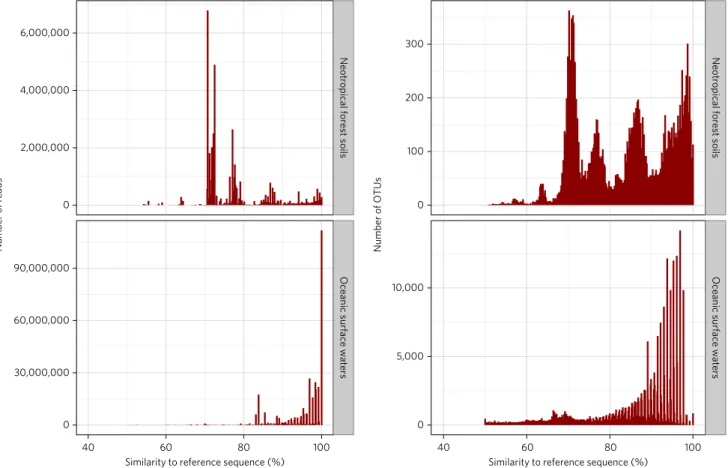
132.3 million cleaned V4 reads (Supplementary Table 1). Of the
50.1 million reads assigned to the protists, 75.3% had a maximum
similarity of < 80% to references in the Protist Ribosomal Reference
database (PR
2)
12(Fig. 1 and Supplementary Fig. 1). By contrast, our
re-analysis of 367.8 million reads from the hypervariable V9 region
of the 18S rRNA from the open oceans
11produced only 3.1% reads
< 80% similar to the PR
2database, and most of our new V4 and V9
reads from European near-shore marine environments were likewise
highly similar to the PR
2database (Fig. 1 and Supplementary Fig. 1).
1Department of Ecology, University of Kaiserslautern, Erwin-Schrödinger-Straße, 67663 Kaiserslautern, Germany. 2CNRS, UMR 7144, Station Biologiquede Roscoff, Place Georges Teissier, 29680 Roscoff Cedex, France. 3Sorbonne Universités, UPMC Université de Paris 06, UMR 7144, Station Biologique de
Roscoff, Place Georges Teissier, 29680 Roscoff Cedex, France. 4Department of Life Sciences, The Natural History Museum London, Cromwell Road,
London SW7 5BD, UK. 5Centre for Environment, Fisheries and Aquaculture Science, Barrack Road, The Nothe, Weymouth, Dorset DT4 8UB, UK. 6Heidelberg Institute for Theoretical Studies, Schloß-Wolfsbrunnenweg, 69118 Heidelberg, Germany. 7Institute for Theoretical Informatics, Karlsruhe
Institute of Technology, Am Fasanengarten, 76128 Karlsruhe, Germany. 8Laboratory of Soil Biodiversity, Université de Neuchâtel, Rue Emile-Argand,
2000 Neuchâtel, Switzerland. 9Department of Forest Ecology and Management, Swedish University of Agricultural Sciences, Skogsmarksgränd, 90183
Umeå, Sweden. 10Department of Computer Science, Cornell University, Gates Hall, Ithaca, New York 14853, USA. 11Department of Statistical Science,
Cornell University, Malott Hall, Ithaca, New York 14853, USA. 12Jardin Botanique de Neuchâtel, Pertuis-du-Sault, 2000 Neuchâtel, Switzerland. 13Department of Biosciences, University of Oslo, Blindernveien, 0316 Oslo, Norway. 14Department of Plant Ecology and Systematics, University
of Kaiserslautern, Erwin-Schrödinger-Straße, 67663 Kaiserslautern, Germany. 15Instituto de Microbiología, Universidad San Francisco de Quito,
Reads < 80% similar to known references are often considered
spu-rious and removed in environmental protist sequencing studies
13.
Three-quarters of our rainforest soil protist data would be discarded
if we applied this conservative cleaning step. Furthermore, PR
2and
similar databases are biased towards marine and temperate references.
To solve these problems, reads were dereplicated into 10.6 million
amplicons (strictly identical reads to which an abundance value
can be attached), and subsequently placed using the Evolutionary
Placement Algorithm (EPA)
14, as implemented in RAxML
15, onto
a phylogenetic tree inferred from 512 full-length references from
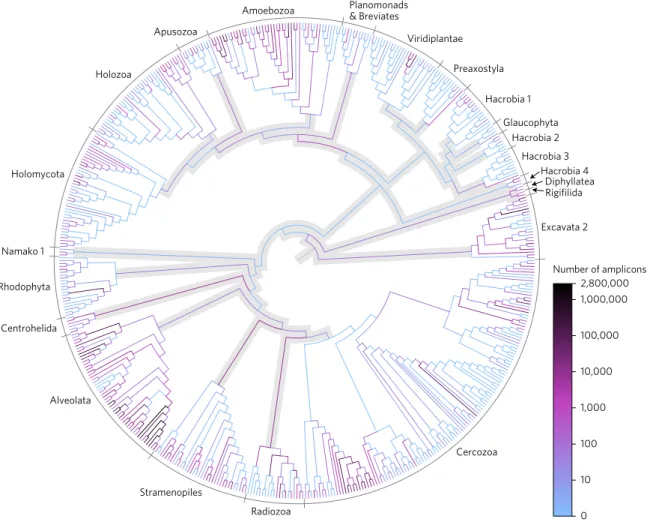
all major eukaryotic clades (Fig. 2 and Supplementary Fig. 2). We
conservatively retained operational taxonomic units (OTUs)
con-structed with Swarm
16(Supplementary Fig. 3) whose most abundant
amplicon fell only within known clades with a high
likelihood-weight score. This novel phylogeny-aware cleaning step effectively
discarded highly divergent amplicons
17, resulting in the removal of
only 6.8% of the cleaned reads and 7.7% of the OTUs.
The retained protist reads from the Neotropical rainforest soils
clustered into 26,860 OTUs. As in a recent sampling of the
sun-lit surface layer of the world’s open oceans
11, more protist OTUs
were detected than animals (4,374, of which 39% were assigned
to the Arthropoda), plants (3,089) and fungi (17,849) combined
(Supplementary Table 1). The OTUs found in the samples may
not all correspond to soil-dwelling species: some of these
hyper-diverse protists and other eukaryotes could be a shadow of the
tree-canopy communities from cells that have rained down from
above. Taxonomic assignment of the protists showed that 84.4% of
the reads and 50.6% of the OTUs were affiliated to the Apicomplexa
(Fig. 3 and Supplementary Fig. 4). Apicomplexa are widespread
parasites of animals
18,19. As an independent line of evidence for their
dominance in the Neotropical rainforest soils, ten samples from both
Costa Rica and Panama were amplified with primers designed to
specifically target the closely related Ciliophora (both the Ciliophora
and the Apicomplexa are in the Alveolata
20) and sequenced using
a Roche/454 pyrosequencer. From these ciliate-specific
amplifica-tions, 47.8% of the 297,892 reads and 28.1% of the 1,082 OTUs were
assigned to the Apicomplexa (Supplementary Fig. 5). In contrast
to the results presented here, read- and OTU-abundances of the
Apicomplexa were observed to be substantially lower in marine and
other terrestrial environments (Supplementary Fig. 4).
Using EPA we placed the Apicomplexa OTUs into a more focused
phylogeny inferred from 190 full-length references from all major
Alveolata clades. While the OTUs were generally distributed across
the whole tree (Supplementary Fig. 6), 80.2% of them were grouped
with the gregarines. Gregarines predominantly infect arthropods
and other invertebrates
18. About 23.8% of these gregarine OTUs
were placed within the lineage formed by the millipede parasite
Stenophora, and the insect parasites Amoebogregarina, Gregarina,
Leidyana and Protomagalhaensia. An additional 13.5% of the OTUs
were placed with two environmental gregarine sequences collected
from brackish sediment
21. Many other OTUs were grouped within
gregarine lineages thought to be primarily parasites of marine
annelids and polychaetes. Non-gregarine Apicomplexa OTUs were
largely grouped with the blood parasites Plasmodium (some of
which cause malaria) and close relatives, including those that can
cycle through arthropods and vertebrates such as birds.
The second to fifth most diverse protist taxa were the
predomi-nantly predatory Cercozoa, Ciliophora, Conosa and Lobosa (Fig. 3),
accounting for a combined total of 5,572,490 reads and 10,338
OTUs. Fewer photo- or mixo-trophic Chlorophyta, Dinophyta,
Haptophyta, and Rhodophyta were also found, accounting for a
combined total of 699,187 reads and 1,096 OTUs. Haptophyta, for
0 2,000,000 4,000,000 6,000,000 0 30,000,000 60,000,000 90,000,000
Neotropical forest soils
Oceanic surface waters
40 60 80 100
Similarity to reference sequence (%)
Number of reads 0 100 200 300 0 5,000 10,000
Neotropical forest soils
Oceanic surface waters
40 60 80 100
Similarity to reference sequence (%)
Number of OTUs
Figure 1 | Similarity of protists to the taxonomic reference database. In contrast to marine data, most of the reads and OTUs from the Neotropical rainforest soils were < 80% similar to references in the PR2 database. Only 8.1% of soil reads had a similarity ≥ 95%, whereas 68.1% of the marine reads from the Tara Oceans study of the world’s open oceans had a similarity ≥ 95%.
example, are mostly marine
22but a phylogenetic inference of these
OTUs showed that most of them had close relationships with
fresh-water species (Supplementary Fig. 7). Although algae are thought
to affect the net uptake of carbon in some terrestrial ecosystems
23,
the contribution of these soil-inhabiting algae to the carbon cycle in
Neotropical rainforests is unknown. Only 131 OTUs were assigned
to the Oomycota. Oomycota are efficient parasites with flagellated
stages that disperse through soils. Using the best BLAST hits to
GenBank references, we inferred close relationships between many
of these Oomycota OTUs and taxa that infect either animals or
plants (Supplementary Fig. 8).
Non-metric multidimensional scaling (Supplementary Fig. 9)
and Bray-Curtis dendrograms (Supplementary Fig. 10) showed
that the protist community composition was slightly more similar
among the samples from Costa Rica and Panama than those from
Ecuador, reflecting similar diversity patterns seen in animals and
plants in Central and South American forests
24. Within each
for-est, we estimated fewer than 1,732 unobserved OTUs exclusively
from the samples taken (Supplementary Table 2), suggesting that
our sequencing depth detected a high fraction of the total diversity
within each of the samples. However, within-forest OTU rarefaction
curves, based on the sample accumulation, estimated logarithmic
increases without plateaus (Supplementary Fig. 11), and the Jaccard
similarity index estimated high OTU heterogeneity between
sam-ples even within the same forest (Supplementary Fig. 12). This high
heterogeneity between samples indicates that our sampling effort
unveiled only a fraction of the protist hyperdiversity in the three
Neotropical rainforests.
Discussion
The broad sampling and deep sequencing of soils from three
Neotropical rainforests revealed numerous protist taxa. Much of this
unravelled diversity was detected by our phylogeny-aware cleaning
step that retained OTUs with low similarity to existing 18S rRNA
references (Figs 1 and 2). Using EPA phylogenetic placements, rather
than relying solely on pairwise sequence similarities, is a powerful
approach to metabarcoding studies aimed at discovering novel taxa
in environments where little is known and few references are
avail-able—such as tropical soils. Even if almost all the tips are missing in
the tree—that is, there are no references closely related to the
envi-ronmental data— a tree that comprises at least the major eukaryotic
lineages allows phylogenetic placements to retain most of the novel
diversity that would have otherwise been discarded. While the
place-ments can be evaluated at the amplicon or OTU levels, placing only
the OTU representatives produced by Swarm drastically reduces
computation time without significant information loss.
Even with the phylogeny-aware cleaning step, our molecular
approach probably underestimated diversity across all
micro-bial eukaryotic and macroorganismic taxa. For example, while
the broadly targeted V4 primers used here amplify a wide variety
of eukaryotic lineages
13,25–29, other primers could have amplified
additional taxa
30–32(Supplementary Table 1). The resolution power
2,800,000 1,000 100 10 0 Number of amplicons 10,000 100,000 1,000,000 Cercozoa Excavata 2 Rigifilida Diphyllatea Hacrobia 4 & Breviates Amoebozoa Apusozoa Holozoa Holomycota Viridiplantae Hacrobia 2 Centrohelida Glaucophyta Hacrobia 1 Hacrobia 3 Namako 1 Preaxostyla Rhodophyta Alveolata Stramenopiles RadiozoaFigure 2 | Phylogenetic placement of Neotropical soil protist reads on a taxonomically unconstrained global eukaryotic tree. Reads were dereplicated into strictly identical amplicons. Inferred relationships between these major taxa may differ from those obtained with phylogenomic data. Alveolata includes Apicomplexa and Ciliophora; Holozoa includes animals; Holomycota includes fungi. Branches and nodes outside of known clades are shaded grey. In our conservative approach only OTUs that placed within known clades with high likelihood-weight scores were retained.
of metabarcoding also has its limits. The Swarm clustering method,
which relies on iterative local clustering thresholds, often results in
fine-grained OTUs that can reveal additional diversity compared
with traditional clustering methods that rely on global clustering
thresholds
16,33(Supplementary Fig. 3). Species with identical
bar-code sequences (that is, no variation between taxa) can
neverthe-less be indistinguishable by any clustering method, which may mask
potentially different ecological roles and functions.
The parasitic Apicomplexa dominated the Neotropical soil
pro-tist communities by accounting for the majority of both reads and
OTUs (Fig. 3). This pattern of dominating parasites contrasts with
the prevailing view that soil protist communities are dominated by
predators of bacteria
34, although a considerable presence of
pro-tist predators of fungi and animals, as well as propro-tist parasites, has
been observed elsewhere
35–41. These dominating protist parasites
also potentially contribute to the high animal diversity in the
rain-forests by the same mechanisms that other parasites contribute to
high tree diversity as hypothesized in the Janzen-Connell model
4,5.
Apicomplexa infect animals (for example, refs
42,43) and are usually
host-specific, although host switching is known
18,19,42,43. They
there-fore potentially limit population growth of species that become
locally abundant. In this tentative model we expect Apicomplexa to
dominate both the below- and aboveground protist communities in
tropical forests worldwide, most animal populations in these forests
will have apicomplexan parasites, and animals that become locally
dominant will have escaped from their apicomplexan enemies or
at least evolved to be able to cope with this burden. This
relation-ship between animals and the Apicomplexa could also be reciprocal,
with each group contributing to the diversity of the other. This
top-down force by parasitic protists on tropical animal diversity may
complement the bottom-up response that was proposed for plants
on herbivorous insects
8.
In contrast to the Apicomplexa parasites, few parasitic Oomycota
were detected in the Neotropical soil protist communities
Costa Rica (La Selva) Panama (Barro Colorado) Ecuador (Tiputini) 0 25 50 75 100 Observed reads (%) Forests Clade Apicomplexa Cercozoa Ciliophora Conosa Lobosa Chlorophyta Ochrophyta Non–Ochrophyta Stramenopiles Dinophyta
Amoebozoa incertae sedis Haptophyta Hilomonadea Discoba Unknown Costa Rica (La Selva) Panama (Barro Colorado) Ecuador (Tiputini) 0 25 50 75 100 Observed OTUs (%) Forests Clade Apicomplexa Cercozoa Ciliophora Conosa Lobosa Chlorophyta Non–Ochrophyta Stramenopiles Ochrophyta Dinophyta
Amoebozoa incertae sedis Choanoflagellida Mesomycetozoa Discoba Unknown Centroheliozoa Perkinsea Hilomonadea Apusomonadidae
Figure 3 | Taxonomic identity and relative abundances of soil protist reads and OTUs in three Neotropical rainforests. Each taxon shown represents at least 0.1% of the total data. Across the three forests, 76.6–93.0% of the reads and 43.1–61.5% of the OTUs were assigned to the Apicomplexa.
(Supplementary Fig. 8). Along with fungi and insects, the Oomycota
have long been thought to be one of the drivers of the
Janzen-Connell model. However, the degree of host-specificity is unknown
for most Oomycota species
46, and a fungicide study in Belize
docu-mented a non-significant effect by these protists
6. If the Oomycota
broadly drive the Janzen-Connell model, then we can expect their
diversity to be very high, mirroring tree diversity. However, we did
not find enough Oomycota OTUs for them to be host-specific plant
parasites under this model; although, as mentioned above, OTUs
can mask functional diversity.
Just as there is high species richness in Neotropical rainforests
at the macroorganismic scale, the high OTU numbers of both
free-living and parasitic protists (Supplementary Table 1) and the high
heterogeneity between samples (Supplementary Fig. 12) show that
such hyperdiversity also exists at the microbial eukaryotic scale,
where its degree is even greater. Given the low similarity of protist
compositions between samples, and the six-to-one ratio for protist
to animal OTUs, a concerted and comparable count will probably
show that protists are more diverse than arthropods in tropical
rainforests. This would certainly be the case if, as we suggest, every
arthropod species has at least one apicomplexan parasite, and the
Apicomplexa are only one component of the total protist
hyper-diversity (with fungi being the second most diverse group). If protists
are the most diverse eukaryotes in tropical rainforests, it would not
be due to inordinate speciation in just a few clades since the
mid-Phanerozoic (for example, the beetles
47), it would be because of the
diversification of rich and functionally complex protist lineages,
beginning in the early Proterozoic
48, that built up the multifaceted
and interactive unseen foundation of these now familiar
macro-scopic terrestrial ecosystems.
Methods
Neotropical soil samples. A total of 279 soil samples were taken from the
following locations: La Selva Biological Station, Costa Rica in October 2012 and June 2013; Barro Colorado Island, Panama in October 2012 and June 2013; and Tiputini Biodiversity Station, Ecuador in October 2013 (see Supplementary Code 1 for sample coordinates). The aim was to collect soils from around each field station (excluding areas where humans were not permitted and areas of secondary growth) without targeting any specific sub-environments (samples were collected from a variety of soil types, including swamp mud, sandy soils and hill-top dry soils). Fieldwork and government-issued sampling permits were made possible by the Organization for Tropical Studies and the Ministerio del Ambiente y Energía and Sistema Nacional de Areas de Conservación in Costa Rica, the Smithsonian Tropical Research Institute in Panama, and David Romo Vallejo at the Universidad San Francisco de Quito in Ecuador.
At the site of collection, the loose-leaf layer and stones were removed. A 5 ml sample of the top-most layer of surface soil (with visible plant roots and visible animals removed) was immediately placed into 8 ml of LifeGuard Soil Preservation Solution (Mo Bio). DNA was isolated using the PowerSoil DNA
Elution Accessory Kit (Mo Bio). Like other large-scale sequencing studies11,49,
only DNA was used in this study, not RNA, which can also be retained in
sediments, even ancient ones50,51. See Supplementary Fig. 13 to see that RNA
can be found in cysts, and for a comparison of DNA and RNA abundances; in addition, the low similarity of OTUs among samples within each forest, even those that were collected near each other (Supplementary Fig. 12), point to the soils not having the taxa, that would be expected if most of the DNA was from a large seed bank of dead or inactive species that collected overtime. The samples were mostly taken at least 100 m apart. DNA from every two consecutive samples was combined in equal concentration to reduce costs; many of these samples failed to amplify and only those that worked are shown here. The combined samples were amplified with a high fidelity polymerase for the V4 region of 18S rRNA
following ref. 52 with universal eukaryotic V4 primers (TAReuk454FWD1 and
TAReukREV3)13. This primer pair has not shown a preference for amplifying
Apicomplexa, and the V4 primers were able to amplify all Oomycota in GenBank in an in silico analysis.
After PCR cleanup, a second PCR with primers containing sample-specific tags and the Illumina MiSeq sequencing adapters was performed following the manufacturer’s instructions. Amplicons were gel size-selected for appropriate length, and library quality was assessed using a Bioanalyzer 2100 (Agilent) and Qubit 2.0 (Life Technologies). Illumina MiSeq sequencing was performed at GATC Biotech AG (Konstanz, Germany), using v3 chemistry and the software MCS v2.3.0.3 and RTA v1.18.42 (Illumina). PhiX DNA (20%) was spiked into the
MiSeq flowcell to increase base diversity. Twenty amplified products (each from a combined two samples) were loaded onto one MiSeq flowcell.
Ten samples from La Selva, Costa Rica, and ten samples from Barro Colorado Island, Panama, were also amplified with primers designed to specifically
target the closely related Ciliophora53. After PCR cleanup, a second, nested
PCR was performed with the above V4 primers, and then sequenced using a Roche/454 GS FLX+ Titanium system and v2.6 of the associated software. The 20 amplified products were loaded onto one-quarter of a plate.
Marine samples. Reads from the open oceans came from the Tara Oceans
consortium11. Starting with the Tara Oceans raw reads (Sequence Read Archive
accession numbers: PRJEB6610 and PRJEB7315) allowed us to treat the sequencing data with the same bioinformatic pipeline. Our pipeline’s goal was to improve the sensitivity of OTU detection by applying most quality- and frequency-based filtering steps after clustering instead of applying them before. Removal of low-abundance OTUs was performed on the combined data and not at the sample level. We also replaced the paired-read merger FLASH (Fast Length Adjustment
of SHort reads)54 with the newer tool PEAR (Paired-End reAd merger)55, which is
advertised as yielding higher-quality results. After a careful investigation, it turned out that the large increase in OTU number we observed compared with
de Vargas et al.11 was mainly due to our use of PEAR rather than FLASH.
Samples from European near-shore marine sites (see Supplementary Code 1
for coordinates of each sample) came from the BioMarKs consortium28,56.
We re-sequenced the samples here to obtain deeper sequencing. Total nucleic acids from sediment samples were extracted using a RNA Power Soil Total Isolation Kit combined with a DNA Elution Accessory Kit (Mo Bio) according to the manufacturer’s instructions. To remove contaminating DNA in the RNA extracts, the samples were treated twice with DNase for 25 min at 37 °C with 2 U of Turbo DNA-free Kit (Ambion) following the manufacturer’s instructions. RNA was reverse-transcribed into first-strand cDNA using Invitrogen’s Superscript III (Thermo Fisher Scientific) following the manufacturer’s instructions. The V4 region was amplified with the above primers, and the
V9 region was amplified with general eukaryotic primers (1389F and 1510R)57.
Amplified products were sequenced on an Illumina Genome Analyser IIx sequencer at CEA Genoscope (Évry, France).
Read cleaning and clustering. Fastq files were assembled via PEAR v0.9.8 using
default parameters and converted to fasta format. Following ref. 52, assembled
paired-end reads were filtered using Cutadapt58 v1.9 and retained if they had both
primers and no ambiguously named nucleotides (Ns). Reads were dereplicated into
strictly identical amplicons with VSEARCH59 v1.6.0, then clustered using Swarm16
v2.1.5, with the parameter d = 1 and the fastidious option on. The most abundant amplicon in each OTU was searched for chimeric sequences with VSEARCH, and their OTUs were removed even if they occurred in multiple samples.
Taxonomic assignment. Taxonomic assignment used VSEARCH’s global pairwise
alignments with the PR2 database12 v203 (based on GenBank release v203).
Using Cutadapt, the PR2 database was extracted for just the specific regions that
were amplified and sequenced to allow for comparisons using a global pairwise alignment. Amplicons were assigned to their best hit, or co-best hits, in the reference database as reported by VSEARCH. The different steps of that taxonomic
assignment strategy are grouped in a pipeline called Stampa60. Low-abundance
OTUs were removed from the combined dataset only if they included ≤ 2 reads, were found in only one sample and were < 99% similar to an
accession in PR2.
Stampa plots. To globally assess the results of Stampa, our taxonomic assignment
pipeline, we produced ‘Stampa plots’60. Stampa plots are simple distribution plots
showing the number of reads per similarity value, where the similarity value is the best match between environmental and reference sequences. Stampa plots are a visual assessment of the taxonomic coverage of our reference database sequences: if most environmental reads or OTUs have high similarity values with references, then the coverage is good. Low similarity values indicate a lack of coverage, which can be a sign of amplification-sequencing artefacts (chimeras for instance), the presence of known taxa without reference sequences, the presence of new taxa, or if the coverage deficit is very large, a previously unexplored environment (such as Neotropical rainforest soils).
Phylogenetic placement pipeline. To put the 50,118,536 soil protist reads
into a phylogenetic context, they were dereplicated into 10,567,804 strictly identical amplicons and placed onto a comprehensive eukaryotic reference tree. The corresponding multiple sequence alignment used to build this tree contained 512 full-length sequences from all major eukaryotic clades (see Supplementary Data 1 and 2 for GenBank accession numbers, sequences and clade assignments), based on the taxon sampling as summarized in a range of pan-eukaryotic
phylogenomic studies reviewed in refs 61,62, with a bias towards lineages
known to occur in soils from environmental sequencing studies; for example,
refs 35,37,38. To reduce phylogenetic artefacts, only high quality, full- or
been observed to form long branches were omitted. It is acknowledged that single gene trees are unable to resolve the backbone of the eukaryote phylogeny; however, this was not the intended purpose of this taxon selection or the phylogenetic analyses. The intent was to produce a comprehensive eukaryote sample tree on which to place the V4 reads generated by this study. Phylogenetic placements of query OTU representatives that were taxonomically assigned to the Apicomplexa were conducted using a full-length reference multiple sequence alignment and corresponding phylogeny comprising 190 taxa from all major Alveolate clades (see Supplementary Data 3 and 4 for GenBank accession numbers, sequences and clade assignments). The taxon sampling was collated from a range of publications relating to eukaryotic diversity in general and
Alveolata diversity and phylogeny in particular; for example, refs 20,63–69.
It is also acknowledged that single gene trees are unable to resolve the backbone of the Alveolate phylogeny.
For a full explanation of the phylogenetic placement, see Supplementary
Methods. In brief, we used RAxML15 v8.1.15 to infer reference trees from the
reference alignments, then used PaPaRa70 v2.4 to align the query sequences
to those reference alignments, and finally used the EPA14 as implemented in
RAxML to place the queries onto the trees. Placement results were visualized
as ‘heat trees’ using Genesis71 v0.2.0. The trees were inferred with and without
taxonomic constraints, although the results were similar. We also assessed the quality of the phylogenetic placement positions to determine how confident the algorithm is when placing a query sequence on the branches of the reference tree by analysing the distribution of the likelihood weights for the placements, and by analysing the locality of placement distributions for each amplicon over the tree (Supplementary Fig. 14).
Phylogenetic placement of Haptophyta. For the 28 Haptophyta OTUs,
we first downloaded 106 GenBank accessions following a previously described
taxon-sampling method22,72,73, and aligned them in MAFFT74 v7. OTU
representatives were then added to this alignment using the MAFFT ‘add-in’ function, and the tree was inferred with RAxML, using the substitution model GTR-G-I, the new rapid hill-climbing algorithm and 100 bootstrap runs.
Oomycete analyses. To tentatively assign functional roles of the Oomycota
OTUs, we first compared each individual OTU with related sequences in
GenBank using BLAST75 for a taxonomic affiliation. In cases of identical
BLAST hits, we proceeded to a quick phylogenetic neighbour joining analysis to determine as closely as possible its affiliation. Functional affiliation of the
OTUs was then determined mostly based on Lara et al.76.
Statistical analyses. We analysed frequency count data derived from OTU
clustering to estimate the total (observed + unobserved) OTU richness in the population from which the observed samples were drawn. These data consisted of the number of OTUs with one representative in the sample (the ‘singletons’), and then the number with two representatives, the number with three, and so on. We used two sets of statistical procedures. The first was implemented in the
software package, Breakaway77 v2.0. This method estimates a family of statistical
models, known as Kemp-type distributions, from the frequency count data, by fitting ratios of successive frequency counts via nonlinear regression; an optimal selected model is returned, along with error and goodness-of-fit assessments. In the case of the combined (global) OTU data the lowest-order model was selected, which is equivalent to fitting a weighted linear regression to the ratios of successive frequency counts. The second was implemented in the software
package CatchAll78. This method fits a family of mixed-Poisson models to the
frequency data, as well as calculating a suite of nonparametric procedures. It returns an optimal selected model with errors and goodness-of-fit assessments, and comparisons of parametric and nonparametric analyses. CatchAll selected a mixture of three exponential-mixed Poisson models. In all cases, the results were virtually identical, showing almost no diversity extant in the population beyond
that observed in the sample. The R package vegan79, was used to analyse frequency
count data derived from OTU clustering. Different functions of Vegan were called to randomly subsample our samples (rrarefy function) and to estimate and compare species compositions, using Bray-Curtis distance and NMDS ordination
(monoMDS function). Figures were made with R80 and ggplot281.
Detecting RNA in cysts. To assess if viable and sequenceable RNA can be detected
in protist cysts, we designed fluorescent in situ hybridization (FISH) probes specific to the kinetoplastids with 18S rRNA probes coupled to the Cy3 fluorochrome and designed to hybridize to ribosomes: KIN516, a wide-spectrum kinetoplastid probe (ACCAGACTTGTCCTCC); and Bodo1757, a probe designed on the V8 region and specific to the clade Bodo (CGAGCAAGTGAAACACTCGCC). Probes were checked for specificity using pure cultures of the Neobodo designis strain AND31 (AY965872) and the Bodo saltans strain SCCAP BS364. Cultures were fixed with three volumes of 4% paraformaldehyde for 2 h. Fixed cell suspensions were collected on a 0.2 μ m nitrocellulose ISOPORE filter (Millipore) and rinsed with demineralized water. Hybridizations were performed at 45 °C for 90 min in a buffer containing 0.9 M NaCl, 20 mM Tris HCl, and 0.01% SDS, pH 7.2.
Probes were used at a concentration of 50 ng μ l−1. The optimal amount of
formamide in the hybridization buffer to reduce non-specific binding of the probe was set by performing hybridizations with increasing formamide concentrations for the different strains investigated. In general, hybridization with 35% formamide did not result in any unspecific binding of the probes to non-target organisms. For non-specific staining of all cells, DAPI (4′ ,6-diamidino-2-phenylindole)
was added at a concentration of 1 μ g ml−1 to the hybridization buffer. After
hybridization, filters were washed for 15 min at 48 °C in a buffer containing 20 mM Tris-HCl (pH 7.2), 10 mM EDTA, 0.01% SDS and 80 mM NaCl, subsequently rinsed with distilled water and air dried. Prior to microscopic observation, filters were mounted with Citifluor solution. Probes were applied to soil taken from a garden compost in a garden in Switzerland. Soil was mixed and sieved through a 2 mm grid to remove large debris. The soil was then spread as a 1 cm layer on a 16 cm × 23 cm plastic tray, and wetted with autoclaved demineralized water (without flooding). Two layers of lens-cleaning tissues were spread on the surface, and four microscope cover slips measuring 24 mm × 50 mm each (Menzel Gläser) were laid on the wet tissues. The tray was left in the dark at 18 °C for one week. Protists attached to the coverslips were removed by rinsing with Neff’s Amoeba Saline buffer and collected in a 10 ml tube. The cells were directly fixed with paraformaldehyde on a nitrocellulose filter (0.2 μ m) and hybridized using the specifically designed probes along with DAPI as described above.
Measuring DNA and RNA. The DNA and RNA abundances of the 18S rRNA
locus were measured in the following ciliates: Colpoda magna, from the American Type Culture Collection number 50128; Dileptus sp., from Carolina Biological Supply Company; Halteria grandinella, collected on October 2013 at a pond at the University of Kaiserslautern; Paramecium tetraurelia strain D4-2, provided by Martin Simon, Saarland University; and Tetrahymena thermophila wildtype B, provided by Josef Loidl, University of Vienna. Clonal populations were cultured with wheat grass powder medium inoculated with the bacterium Klebsiella minuta. Standard curves were made with cells from each species and were amplified for the
3′ end of 18S rRNA with the primers 1391-F (ref. 82) and Euk-B (ref. 83). PCR
products were cleaned via a MinElute PCR Purification Kit from Qiagen and ligated to a pGEM®-T vector (Promega) and cloned. Plasmids were isolated with the FastPlasmid Mini Kit (5 Prime), and checked with an amplification using vector primers and Sanger sequencing. Plasmids underwent six tenfold dilutions
(in series) to provide quantitative PCR (qPCR) standards ranging from 10−1 to
10−6 ng μ l−1. For qPCR of RNA, total RNA was extracted 12 separate times from
single cells, first washed three times in Volvic water, then lysed using the Ambion Single Cell Lysis Kit (Thermo Fisher Scientific) with an integrated DNase step. cDNA was generated using the QuantiTect Reverse Transcription Kit (Qiagen) with another integrated DNase step. For qPCR of DNA, measurements were taken directly from 12 separate single cells. Amplifications were performed in a final volume of 20 μ l, containing 10 μ l of iQ SYBR Green Supermix (Bio-Rad), 1 μ l of template DNA (cDNA or a single cell), 10 pg of each primer and 7 μ l of RNase-free water. Cycling conditions were: 95 °C for 2 min; and 40 cycles of 95 °C for 15 s, 57 °C for 25 s, and 72 °C for 40 s. Melt curve data were collected after cycle 2 between 57 and 95 °C with the temperature increasing at a rate of 0.5 °C per 10 s. qPCR reactions were performed using an iQ Single Color Real-Time PCR Detection System (Bio-Rad), with a negative control and six tenfold serial dilutions in triplicates. The amplification efficiency E was
estimated using the equation E = (10−1/slope) − 1 with the calculated slope of
the standard curves. We obtained efficiencies of between 90.1 and 105.5%
and a coefficient of determination R2 of between 0.987 and 1.000. Copy
numbers were calculated as follows: number of copies = (amount × 6.022 ×
1023) / (length × 109 × 660), where amount is the mass of DNA or cDNA (in ng),
length is the length of the linear fragment plus the plasmid, 660 is the average molecular weight (in daltons) of one base pair for double stranded DNA and
6.022 × 10²³ is Avogadro’s constant84.
Code availability. All codes used in this study can be found in Supplementary
Code 1 and 2 (HTML format).
Data availability. The data analysed in this study are available at GenBank’s
Sequence Read Archive under BioProject number PRJNA317860.
References
1. von Humboldt, A. & Bonpland, A. Personal Narrative of Travels to the
Equinoctial Regions of the New Continent, During the Years 1799–1804
(Longman, Hurst, Rees, Orme & Brown, 1814–1829).
2. Valencia, R., Balslev, H. & Paz Y Miño, G. High tree alpha-diversity in Amazonian Ecuador. Biodivers. Conserv. 3, 21–28 (1994).
3. Wilson, E. O. The arboreal ant fauna of Peruvian Amazon forests: a first assessment. Biotropica 19, 245–251 (1987).
4. Janzen, D. H. Herbivores and the number of tree species in tropical forests.
5. Connell, J. H. in Dynamics of Population (eds Den Boer, P. J. & Gradwell, G. R.) 298–392 (Wageningen, 1971).
6. Bagchi, R. et al. Pathogens and insect herbivores drive rainforest plant diversity and composition. Nature 506, 85–88 (2014).
7. Terborgh, J. Enemies maintain hyperdiverse tropical forests. Am. Nat. 107, 481–501 (2012).
8. Basset, Y. et al. Arthropod diversity in a tropical forest. Science 338, 1481–1484 (2012).
9. Erwin, T. L. Tropical forests, their richness in Coleoptera and other arthropod species. Coleopts. Bull. 36, 74–75 (1982).
10. Pawlowski, J. et al. CBOL Protist Working Group: barcoding eukaryotic richness beyond the animal, plant, and fungal kingdoms. PLoS Biol. 10, e1001419 (2012).
11. de Vargas, C. et al. Eukaryotic plankton diversity in the sunlit ocean.
Science 348, 1261605 (2015).
12. Guillou, L. et al. The Protist Ribosomal Reference database (PR2): a catalog
of unicellular eukaryote small sub-unit rRNA sequences with curated taxonomy. Nucleic Acids Res. 41, D597–D604 (2013).
13. Stoeck, T. et al. Multiple marker parallel tag environmental DNA sequencing reveals a highly complex eukaryotic community in marine anoxic water.
Mol. Ecol. 19, 21–31 (2010).
14. Berger, S. A., Krompass, D. & Stamatakis, A. Performance, accuracy, and web server for evolutionary placement of short sequence reads under maximum likelihood. Syst. Biol. 60, 291–302 (2011).
15. Stamatakis, A. RAxML version 8: a tool for phylogenetic analysis and post-analysis of large phylogenies. Bioinformatics 30, 1312–1313 (2014).
16. Mahé, F., Rognes, T., Quince, C., de Vargas, C. & Dunthorn, M. Swarm v2: highly-scalable and high-resolution amplicon clustering.
PeerJ 3, e1761 (2015).
17. Dunthorn, M. et al. Placing environmental next-generation sequencing amplicons from microbial eukaryotes into a phylogenetic context.
Mol. Biol. Evol. 31, 993–1009 (2014).
18. Desportes, I. & Schrével, J. Treatise on Zoology—Anatomy, Taxonomy,
Biology: The Gregarines Vols 1 & 2 (Brill, 2013).
19. Perkins, F. O., Barta, J. R., Clopton, R. E., Peirce, M. A. & Upton, S. J. in
An Illustrated Giude to the Protozoa 2nd edn (eds Lee, J. J., Leedale, G. F. &
Bradbury, P.) 190–369 (Society of Protozoologists, 2002). 20. Adl, S. M. et al. The revised classification of eukaryotes. J. Eukaryot.
Microbiol. 59, 429–493 (2012).
21. Dawson, S. C. & Pace, N. R. Novel kingdom-level eukaryotic diversity in anoxic environments. Proc. Natl Acad. Sci. USA 99, 8324–8329 (2002).
22. Edvardsen, B., Egge, E. & Vaulot, D. Diversity and distribution of haptophytes revealed by environmental sequencing and metabarcoding — a review.
Perspec. Phycol. 3, 77–91 (2016).
23. Elbert, W. et al. Contribution of cryptogamic covers to the global cycles of carbon and nitrogen. Nat. Geosci. 5, 459–462 (2012).
24. Gentry, A. H. Four Neotropical Rainforests (Yale Univ. Press, 1991). 25. Hu, S. K. et al. Protistan diversity and activity inferred from RNA and
DNA at a coastal ocean site in the eastern North Pacific. FEMS Microbiol.
Ecol. 92, fiw050 (2016).
26. Filker, S., Gimmler, A., Dunthorn, M., Mahé, F. & Stoeck, T. Deep sequencing uncovers high and substantial novel diversity in protistan plankton of solar saltern ponds. Extremophiles 19, 283–295 (2015).
27. Forster, D. et al. Benthic protists: the under-charted majority. FEMS
Microbiol. Ecol. 92, fiw120 (2016).
28. Logares, R. et al. Patterns of rare and abundant marine microbial eukaryotes.
Curr. Biol. 24, 813–821 (2014).
29. Richards, T. A. et al. Molecular diversity and distribution of marine fungi across 130 European environmental samples. Proc. R. Soc. B 282, 20152243 (2015).
30. Adl, S. M., Habura, A. & Eglit, Y. Amplification primers of SSU rDNA for soil protists. Soil Biol. Biochem. 69, 328–342 (2014).
31. Hu, S. K. et al. Estimating protistan diversity using high-throughput sequencing. J. Eukaryot. Microbiol. 62, 688–693 (2015).
32. Lentendu, G. et al. Effects of long-term differential fertilization on eukaryotic microbial communities in an arable soil: a multiple barcoding approach.
Mol. Ecol. 23, 3341–3355 (2014).
33. Forster, D., Dunthorn, M., Stoeck, T. & Mahé, F. Comparison of three clustering approaches for detecting novel environmental microbial diversity.
PeerJ 4, e1692 (2016).
34. Adl, S. & Gupta, V. V. S. R. Protists in soil ecology and forest nutrient cycling.
Can. J. For. Res. 36, 1805–1817 (2006).
35. Bates, S. T. et al. Global biogeography of highly diverse protistan communities in soil. ISME J. 7, 652–659 (2013).
36. Dumack, K., Müller, M. E. H. & Bonkowski, M. Description of Lecythium
terrestris sp. nov. (Chlamydophryidae, Cercozoa), a soil dwelling protist
feeding on fungi and algae. Protist 167, 93–105 (2016).
37. Dupont, A., Griffiths, R. I., Bell, T. & Bass, D. Differences in soil micro-eukaryotic communities over soil pH gradients are strongly driven by parasites and saprotrophs. Environ. Microbiol. 18, 2010–2024 (2016).
38. Geisen, S. et al. Metatranscriptomic census of active protists in soils.
ISME J. 9, 2178–2190 (2015).
39. Grossmann, L. et al. Protistan community analysis: key findings of a large-scale molecular sampling. ISME J. 10, 2269–2279 (2016). 40. Foissner, W. Colpodea (Cillophora) (Protozoenfauna Vol. 4/1,
Gustav Fischer Verlag, 1993).
41. Mitchell, E. A. D. Pack hunting by minute soil testate amoebae: nematode hell is a naturalist’s paradise. Environ. Microbiol. 17, 4145–4147 (2015). 42. Ellis, V. A. et al. Local host specialization, host-switching, and dispersal
shape the regional distributions of avian haemosporidian parasites.
Proc. Natl Acad. Sci. USA 112, 11294–11299 (2015).
43. Rueckert, S., Villette, P. M. & Leander, B. S. Species boundaries in gregarine apicomplexan parasites: a case study-comparison of morphometric and molecular variability in Lecudina cf. tuzetae (Eugregarinorida, Lecudinidae).
J. Eukaryot. Microbiol. 58, 275–283 (2011).
44. Asghar, M. et al. Hidden costs of infection: chronic malaria accelerates telomere degradation and senescence in wild birds. Science 347, 436–438 (2015).
45. Bouwma, A. M., Howard, K. J. & Jeanne, R. L. Parasitism in a social wasp: effect of gregarines on foraging behavior, colony productivity, and adult mortality. Behav. Ecol. Sociobiol. 59, 222–233 (2005). 46. Freckleton, R. P. & Lewis, O. T. Pathogens, density dependence and the
coexistence of tropical trees. Proc. R. Soc. B 273, 2909–2916 (2006). 47. Farrell, B. D. “Inordinate fondness” explained: Why are there so many
beetles? Science 281, 555–559 (1998).
48. Knoll, A. H. Paleobiological perspectives on early eukaryotic evolution.
Cold Spring Harb. Perspect. Biol. 6, a016121 (2014).
49. Tedersoo, L. et al. Global diversity and geography of soil fungi. Science 346, 1256688 (2014).
50. Orsi, W., Biddle, J. F. & Edgcomb, V. Deep sequencing of subseafloor eukaryotic rRNA reveals active fungi across marine subsurface provinces.
PLoS ONE 8, e56335 (2013).
51. Pawlowski, J., Esling, P., Lejzerowicz, F., Cedhagen, T. & Wilding, T. Environmental monitoring through protist next-generation sequencing metabarcoding: assessing the impact of fish farming on benthic foraminifera communities. Mol. Ecol. Res. 14, 1129–1140 (2014).
52. Mahé, F. et al. Comparing high-throughput platforms for sequencing the hyper-variable V4 region in environmental eukaryotic diversity surveys.
J. Eukaryot. Microbiol. 62, 338–345 (2015).
53. Lara, E., Berney, C., Harms, H. & Chatzinotas, A. Cultivation-independent analysis reveals a shift in ciliate 18S rRNA gene diversity in a polycyclic aromatic hydrocarbon-polluted soil. FEMS Microbiol. Ecol. 62, 365–373 (2007).
54. Magoč, T. & Salzberg, S. L. FLASH: fast length adjustment of short reads to improve genome assemblies. Bioinformatics 27, 2957–2963 (2011). 55. Zhang, J., Kobert, K., Flouri, T. & Stamatakis, A. PEAR: a fast and accurate
Illumina Paired-End reAd mergeR. Bioinformatics 30, 614–620 (2014). 56. Massana, R. et al. Marine protist diversity in European coastal waters and
sediments as revealed by high-throughput sequencing. Environ. Microbiol. 17, 4035–4049 (2015).
57. Amaral-Zettler, L. A., McCliment, E. A., Ducklow, H. W. & Huse, S. M. A method for studying protistian diversity using massively parallel sequencing of V9 hypervariable region of small-subunit ribosomal RNA genes. PLoS ONE 4, 7 (2009).
58. Martin, M. Cutadapt removes adapter sequences from high-throughput sequencing reads. EMBnet.journal 17, 10–12 (2011).
59. Rognes, T., Flouri, T., Nichols, B., Quince, C. & Mahé, F. VSEARCH: a versatile open source tool for metagenomics. PeerJ 4, e2584 (2016). 60.Mahé, F. Stampa: sequence taxonomic assignment by massive pairwise
alignments. GitHub https://github.com/frederic-mahe/stampa (2016). 61. Burki, F. The eukaryotic tree of life from a global phylogenomic perspective.
Cold Spring Harb. Perspect Biol. 6, a016147 (2014).
62. del Campo, J. et al. The others: our biased perspective of eukaryotic genomes.
Trends Ecol. Evol. 29, 252–259 (2014).
63. Barta, J. R., Ogedengbe, J. D., Martin, D. S. & Smith, T. G. Phylogenetic position of the adeleorinid coccidia (Myzozoa, Apicomplexa, Coccidia, Eucoccidiorida, Adeleorina) inferred using 18S rDNA sequences.
J. Eukaryot. Microbiol. 59, 171–180 (2012).
64. Bass, D. & Cavalier-Smith, T. Phylum-specific environmental DNA analysis reveals remarkably high global biodiversity of Cercozoa (Protozoa).
Int. J. Syst. Evol. Microbiol. 54, 2393–2404 (2004).
65. Gomez, F., López-Garcia, P., Nowaczyk, A. & Moreira, D. The crustacean parasites Ellobiopsis Caullery, 1910 and Thalassomyces Niezabitowski, 1913 form a monophyletic divergent clade within the Alveolata.
66. Rueckert, S. & Leander, B. S. Molecular phylogeny and surface morphology of marine archigregarines (Apicomplexa), Selenidium spp., Filipodium
phascolosomae n. sp., and Platyproteum n. g. and comb. from North-Eastern
Pacific peanut worms (Sipuncula). J. Eukaryot. Microbiol. 56, 428–439 (2009). 67. Rueckert, S., Chantangsi, C. & Leander, B. S. Molecular systematics of marine
gregarines (Apicomplexa) from North-eastern Pacific polychaetes and nemerteans, with descriptions of three novel species: Lecudina
phyllochaetopteri sp. nov., Difficilina tubulani sp. nov. and Difficilina paranemertis sp. nov. Int. J. Syst. Evol. Microbiol. 60, 2681–2690 (2010).
68. Slapeta, J. & Linares, M. C. Combined amplicon pyrosequencing assays reveal presence of the apicomplexan “type-N” (cf. Gemmocystis cylindrus) and Chromera velia on the Great Barrier Reef, Australia. PLoS ONE 8, e76095 (2013).
69. Wakeman, K. C. & Leander, B. S. Molecular phylogeny of Pacific Archigregarines (Apicomplexa), including descriptions of Veloxidium
leptosynaptae n. gen., n. sp., from the sea cucumber Leptosynapta clarki
(Echinodermata), and two new species of Selenidium. J. Eukaryot. Microbiol.
59, 232–245 (2012).
70. Berger, S. A. & Stamatakis, A. Aligning short reads to reference alignments and trees. Bioinformatics 27, 2068–2075 (2011).
71. Czech, L. & Stamatakis, A. Genesis. A toolkit for working with phylogenetic data. GitHub https://github.com/lczech/genesis (2016).
72. Egge, E., Eikrem, W. & Edvardsen, B. Deep-branching novel lineages and high diversity of haptophytes in the Skagerrak (Norway) uncovered by 454 pyrosequencing. J. Eukaryot. Microbiol. 62, 121–140 (2015).
73. Shalchian-Tabrizi, K., Reier-Røberg, K., Ree, D. K., Klaveness, D. & Bråte, J. Marine-freshwater colonizations of haptophytes inferred from phylogeny of environmental 18S rDNA sequences. J. Eukaryot. Microbiol. 58, 315–318 (2011).
74. Katoh, K., Misawa, K., Kuma, K. & Miyata, T. MAFFT: a novel method for rapid multiple sequence alignment based on fast Fourier transform.
Nucleic Acids Res. 30, 3059–3066 (2002).
75. Altschul, S. F. et al. Gapped BLAST and PSI-BLAST: a new generation of protein database search programs. Nucleic Acids Res. 25, 3389–3402 (1997). 76. Lara, E. & Belbahri, L. SSU rRNA reveals major trends in oomycete
evolution. Fungal Divers. 49, 93–100 (2011).
77. Willis, A. & Bunge, J. Estimating diversity via frequency ratios. Biometrics 71, 1042–1049 (2015).
78. Bunge, J. et al. Estimating population diversity with CatchAll. Bioinformatics
28, 1045–1047 (2012).
79. Oksanen, J. et al. vegan: Community Ecology Package. R package version 2.0-7 (2013).
80. R Core Team R: A Language and Environment for Statistical Computing (R Foundation for Statistical Computing, 2014).
81. Wickham, H. gplot2: Elegant Graphics for Data Analysis (Springer, 2009). 82. Lane, D. J. in Nucleic Acids Techniques in Bacterial Systematics
(eds Stackebrandt, E. & Goodfellow, M.) 115–147 (John Wiley & Sons, 1991). 83. Medlin, L., Elwood, H. J., Stickel, S. & Sogin, M. L. The characterization of
enzymatically amplified eukaryotes 16S-like ribosomal RNA coding regions.
Gene 71, 491–500 (1988).
84. Zhu, F., Massana, R., Not, F., Marie, D. & Vaulot, D. Mapping of
picoeucaryotes in marine ecosystems with quantitative PCR of the 18S rRNA gene. FEMS Microbiol. Ecol. 52, 79–92 (2005).
Acknowledgements
We thank T. Stoeck, L. Katz, H. Kauserud, O. T. Lewis and D. Montagnes for helpful comments. Funding primarily came from: a Deutsche Forschungsgemeinschaft grant DU1319/1-1 to M.D.; the Klaus Tschira Foundation to L.C., A.S and A.K; and the French Government’s ‘Investissements d’Avenir’ program OCEANOMICS (ANR-11-BTBR-0008) to C.d.V., C.B. and S.R. Funding also came from: the Natural Environment Research Council grants NE/H000887/1 and NE/H009426/1 to D.B.; the National Science Foundation’s International Research Fellowship Program (OISE-1012703) and the Smithsonian Tropical Research Institute’s Fellowship program to J.M.; the Swiss National Science Foundation (310003A 143960); and the Swiss Federal Office for the Environment and Swiss National Science Foundation to E.L. and E.A.D.M. The authors gratefully acknowledge the Gauss Centre for Supercomputing e.V. (www.gauss-centre.eu) for funding this project by providing computing time on the GCS Supercomputer SuperMUC at the Leibniz Supercomputing Centre (www.lrz.de).
Author contributions
F.M. and M.D. conceived the project. F.M., C.d.V., J.M., T.S., S.R. and M.D. collected the samples. Sequencing was carried out by F.M., T.S., I.T., S.R and M.D. Data analysis was done by F.M., D.B., L.C., A.S., E.L., D.S., J.B., S.S., I.T., C.B., A.K., E.E. and M.D. The first draft of the manuscript was written by F.M., C.d.V., D.B., L.C., A.S. and M.D., and all authors contributed to discussing the results and editing the manuscript.
Additional information
Supplementary information is available for this paper.
Reprints and permissions information is available at www.nature.com/reprints. Correspondence and requests for materials should be addressed to M.D. How to cite this article: Mahé, F. et al. Parasites dominate hyperdiverse soil protist communities in Neotropical rainforests. Nat. Ecol. Evol. 1, 0091 (2017).