Larval Performance in Relation to Labile Oviposition Preference
of Crocidolomia pavonana [F.] (Lepidoptera: Pyralidae) Among
Phenological Stages of Cabbage
REBECCA R. SMYTH,1MICHAEL P. HOFFMANN,ANDANTHONY M. SHELTON2
Department of Entomology, Cornell University, Ithaca, NY 14853
Environ. Entomol. 32(4): 765Ð770 (2003)
ABSTRACT Crocidolomia pavonana (⫽binotalis) [F.] demonstrates oviposition peaks in the Þeld
that we believe to be correlated with host plant phenology. In previous two-choice laboratory experiments, we found the highest relative proportion of oviposition on cabbage to correspond either to plant growth stages ⬇7Ð8 wk or ⬇9Ð11 wk old, depending on the alternate host plant with which it was presented. In cabbage-only trials, leaves from 7- to 8-wk-old plants were preferred. Inconsis-tency in preference led to the question of whether oviposition on either cabbage growth stage would confer adaptive advantages in offspring performance. We simulated oviposition on four phenological stages of cabbage in two ways. In a study of complete immature development, growth rate, pupal weight, and survivorship were measured. We also compared food utilization efÞciency during the fourth larval instar by analyzing growth rate, efÞciency of biomass accumulation, and frass production by analysis of covariance (ANCOVA). For both experiments, cabbage plants of deÞned phenological stages were designated at the time of oviposition, and larvae were fed from these as plants continued to grow throughout larval development. Our data indicate adaptive advantages in larval growth rate and food conversion efÞciency to oviposition on cabbage at ⬇7Ð8 wk from planting. Oviposition on later cabbage growth stages resulted in comparatively poor larval performance. Possible explanations for C. pavonana oviposition behavior in light of these results are discussed.
KEY WORDS food utilization, plant-herbivore interactions, plant phenology, larval development
Crocidolomia pavonana(⫽binotalis) [F.]IS ONE OFthe most destructive pests of crucifer crops in the Old World tropics. This moth is common in southern Af-rica, Madagascar, and India, through Southeast Asia, the southwest PaciÞc, Guam, and Queensland, Aus-tralia (USDA 1968, CAB 1979). Eggs are laid in par-tially overlapping, shingled masses on the undersides of leaves. Three to four days after the eggs hatch, larvae migrate toward the growing center of the cab-bage, where they conceal themselves in webbing. Then, they can destroy the plantÕs apical meristem and ruin the entire cabbage head.
When the fate of offspring is tightly linked to the site of oviposition, as with C. pavonana, optimality models in evolutionary ecology predict a close correlation between offspring performance and oviposition pref-erence on the part of the mother (Jaenike 1978). A majority of tests support this (Mayhew 1997), but numerous exceptions also exist (reviewed in Thomp-son 1988 and ThompThomp-son and Pellmyr 1991). Many of these may involve ecological factors not measured in
the laboratory that can affect larval performance in the Þeld.
Correlations have been found between larval per-formance and oviposition on host plants of different taxa, different plant genotypes of the same species, and different tissue types within plants (Valladares and Lawton 1991). We examined the effect of C.
pavonanaoviposition at differing, phenologically de-Þned, growth stages of cabbage on larval performance. In the Old World highland tropics, cabbage is planted continuously. For this reason, C. pavonana females may have an opportunity to select among plants from 1mo (at time of transplant) to 4 mo (harvest) of age. In a previous study (Smyth et al. 2003), we found that C. pavonana females could dis-criminate between phenological stages of cabbage (as described by Andaloro et al. 1983), and the pattern of oviposition preference strongly suggested that C.
pavonanaÞeld oviposition peaks are related to cab-bage plant phenology. When only cabcab-bage stages were compared, stage 4 cabbage (7Ð8 wk old) was signiÞ-cantly preferred over stage 5 cabbage (9Ð11 wk old) (Smyth et al. 2003). When these, as well as stage 6 cabbage (⬇12 wk old), were presented simulta-neously in two-choice tests with alternate host plants, however, in several cases, stage 5 cabbage was con-1E-mail: [email protected].
2Department of Entomology, Cornell University, NYSAES, Ge-neva, NY 14456.
sistently more preferred than stage 4 cabbage, relative to the alternate host (Smyth et al. 2003). This lack of hierarchical simplicity stimulated the question of whether there is an effect of cabbage plant phenology on offspring performance and whether differential oviposition in C. pavonana can be interpreted as adap-tive.
Two experiments were conducted to compare larval performance consequent to simulated oviposition on four sequential phenological stages of cabbage. One followed mean growth rates, pupal weights, and per-cent survivorship for the four diet groups. The second analyzed food use during a 24-h period on initiation of the fourth larval instar for individuals from the four diet groups.
Materials and Methods
Plant Culture. Brassica oleracea L., variety capitata,
cultivar Gloria (Kays and Dias 1996), a commercial head cabbage commonly grown in Southeast Asia, was grown in a glasshouse under natural light in the sum-mer months or under Lumalux high pressure sodium lamps with a 12:12 (L:D)-h photoperiod schedule. “Gloria,” known in North America as “Greenboy,” seed was obtained from ReedÕs Seeds, Cortland, NY. Plants were grown in 25-cm diameter pots in Premier Pro Mix BX (Premier Horticulture, Que´bec, Canada) potting soil. PeteÕs (Grace-Sierra Horticultural Products, Mil-pitas, CA) water soluble fertilizer (20N:10P2O5: 20K2O) was administered to the soil in the plant pots at a 1:15 concentration once each week.
Cabbages were categorized according to phenolog-ical stages as described by Andaloro et al. (1983). Within the length of time in which cabbages retained phenological characteristics, plants used in these ex-periments were as close in age as possible. The plants reached stage 4 from 43 to 51d after planting, had 11 or 12 true leaves, and the base of the stem and bases of all leaves were still visible when viewed from above. Stage 5 cabbages were 56Ð66 d old, had 13 true leaves, and the base of the stem and bases of all leaves were no longer visible from above. The innermost heart leaves were growing upright, were concealed by outer leaves, and were not yet forming a Þrm center. Stage 6 cabbages were 86Ð91d old, had ⬎13 true leaves, and the inner heart leaves were as in stage 5 but forming a Þrm center. Stage 7 cabbages were 120Ð122 d old, and the inner heart leaves were forming a Þrm ball ⱕ10 cm in diameter.
Colony Rearing. Larvae were obtained from a
col-ony that had been established at the USDA-approved ARS quarantine facility at Cornell University for ⬇15 mo and had originated from 150 C. pavonana pupae collected in the Puncak region of West Java ⬍3 mo earlier. A minimum population size of ⬇300 adults was maintained at all times. Eggs used for continuation of the colony were taken from cages in which moths had access to host plant leaves. Larvae were fed a mixture (each day ⱖ2 types) of fresh crucifer leaves: cabbage, Indian mustard (Brassica juncea [L.] Czernj. and Coss variety rugosa Bailey), Chinese cabbage (B. rapa L.
variety pekinensis [Lour.] Olsson), rapeseed (B. napus L. variety napus), and sawi manis or sayur pahit (both
B. rapavariety parachinensis [Bailey] Tsen and Lee). See Smyth (1999) for rearing details.
Larval Experiments. Experiments were conducted
in a 2.36 by 1.75 m walk-in chamber maintained at 27.8 ⫾ 1.4⬚C, 54.6 ⫾ 5.7% RH, and a photoperiod of 14:10 (L:D) h. The chamber was equipped with full spectrum lighting. We evaluated larval development after simulated oviposition on cabbage stage 4, 5, 6, or 7 in two ways. In neither case did larvae develop on leaves of a static age. Rather, plants of the four phe-nological stages were designated at the time of ovi-position, and larvae were fed from them as the plants continued to grow throughout the course of larval development.
Larval Development and Survival. Egg masses for
this experiment had been laid on waxed paper and were selected from two or three nonsibling females. Larvae remained close to the location of the egg mass on the waxed paper for a short period after hatching and were counted and transferred on the pieces of waxed paper to bins at this time. Neonates were not directly handled. This experiment was of a completely randomized design with subsamples. Three groups of ⬇50 larvae were reared on each of the four pheno-logical stages of cabbage. Groups were contained in circular 1.82-liter Rubbermaid bins (Rubbermaid Commercial Products, Winchester, VA) that mea-sured 18.5 cm diameter at the rim.
Larvae were provided with the open leaves growing near the center of each plant ad libitum. In the Þeld, 4-d-old larvae migrate to the center of the growing head of cabbage; therefore, larvae in this experiment also received plant centers at the appropriate time. Two plants were needed to supply each bin of larvae reared on designated stages 4, 5, and 6 cabbage throughout the course of larval development. One plant was adequate to supply each bin of larvae reared on stage 7 cabbage.
To assess rates of weight gain, 10 larvae from each bin were randomly selected and weighed (Mettler AT460 Delta Range) on days 4, 6, and 8 after hatching. Larvae were returned to bins after weighing. All pupae were collected and weighed, and the percent of larvae surviving to pupation in each bin was recorded. De-velopment rates were compared by mixed effect anal-ysis of variance (ANOVA) with a repeated measure design modeled through the origin (SAS; SAS Institute 1999). Larval weights were log-transformed. Percent survivorship per bin and pupal weights (with a bin within treatment covariate) were compared by ANOVA. Tukey or Tukey-Kramer multiple compari-sons were conducted to detect differences in each dayÕs larval weights and between treatment means for survivorship and pupal weight (SAS; SAS Institute 1999). An additional ANOVA analysis of pupal weight that controlled for the number of larvae surviving in each bin was performed to test for a differing effect of competition for nutritional resources between treat-ments.
Food Assimilation. Groups of ⬇65 larvae were
reared in circular 1.82-liter bins on leaves from cab-bage plants that initiated the experiment at pheno-logical stages 4, 5, 6, and 7. As fourth instars, usually 7Ð12 d from egg hatching, C. pavonana larvae feed and grow most rapidly. Within 8 h of molting to the fourth instar, ⱖ20 randomly selected individuals from each diet treatment were transferred to 14-cm diameter petri dishes lined with Þlter paper moistened with 2 ml deionized water. Each larva was given one-half of a leaf from a plant of the same phenological category as that on which it had been fed previously. Individual petri dishes were not sealed but assembled and placed in large, closed plastic bags to minimize leaf drying and larval movement in the growth chamber.
Twenty-four hours later, larvae, frass, and leaves were weighed, placed in ⫺80⬚C storage, and freeze dried. Fresh weights of leaves and larvae were used for preliminary analyses only. ANOVAs preparatory to analyses of covariance (ANCOVA) (Fisher 1932, Neter et al. 1990) and ANCOVAs were calculated on a dry weight basis.
For dry weight calculations, a “before treatment” dry weight of larvae and leaves was estimated from percent dry matter of similar aliquots. Leaves from the four plant growth stage categories were cut in half, with midrib sections excluded. One-half of each leaf was used to determine percent dry weight of the leaf, and the other half was fed to a larva. “Before treat-ment” larval dry weight estimates were obtained from a regression of percent dry weight to fresh weight of aliquot larvae reared simultaneously and from the same pretreatment diets as experimental larvae. These were weighed and frozen at the start of the experiment and later freeze dried. Larval consumption and gain in biomass were derived from Þnal dry weights ⫺ initial dry weights of leaf halves and larvae, respectively.
Data were analyzed by ANCOVA, a statistically more detailed and accurate approach for food utili-zation studies than ratio-based indices (Raubenhei-mer and Simpson 1992, Horton and Redak 1993). Tukey-Kramer simultaneous tests were conducted to detect differences between treatment means (SAS; SAS Institute 1999). Reported least square means have been adjusted for the covariates.
Food Utilization Estimates. Because larvae were
selected from cabbage stage pretreatment diets and thus not assigned randomly to treatments, this exper-iment differs from most insect dietary studies. The objective here was to compare aspects of food utili-zation for fourth instar larvae in the course of devel-opment that initiated on hosts of different ages. This design also avoided possible effects of diet switching. In such observational studies, ANCOVA covariates may serve purposes not usually considered in random-ized experiments. For example, variables that differ among the groups, e.g., initial biomass of larvae, may be deliberately chosen as covariates to remove bias (Cochran 1957). One can also distinguish between multiple treatment effects (Cochran 1957), for exam-ple, by removing the effect of diet on consumption from larval gain in biomass or frass production.
Al-though the use of covariates that may be affected by treatment is normally cautioned against (Cochran 1957, Smith 1957, Raubenheimer and Simpson 1992) for removing variation caused by the treatments them-selves, the usefulness of the consumption covariate in insect diet studies is supported by Horton and Redak (1993), with examples from Cochran and Cox (1957), Cox (1958), Steel and Torrie (1980), and Packard and Boardman (1988). We considered it essential to dis-tinguish between biomass increase caused by in-creased consumption from biomass increase caused by differences in assimilation of treatment cabbage leaves.
To estimate the effect of diet on weight gain during the 24-h experimental period, Þnal dry mass was an-alyzed using initial larval dry mass as a covariate (Raubenheimer and Simpson 1992). Results from this analysis and that of larval gain in biomass with initial dry mass as a covariate, suggested as an alternative by Horton and Redak (1993), were statistically the same. Only the former is reported. The efÞciency of con-version of ingested food to biomass was estimated by measuring the biomass gain of larvae using consump-tion as a covariate. The effect of diet on frass produc-tion was estimated using consumpproduc-tion as a covariate.
Results
Larval Development and Survival. SigniÞcant
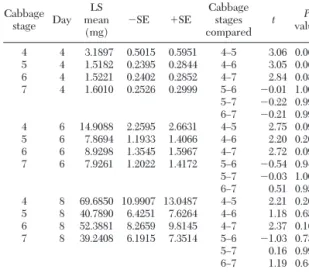
dif-ferences were detected in larval weight increase through the eighth day caused by cabbage stage treat-ment (F ⫽ 1886.99; df ⫽ 4, 8; P ⬍ 0.0001), larval age (F ⫽ 4479.81; df ⫽ 1, 348; P ⬍ 0.0001), and the inter-action of treatment and age (F ⫽ 3.88; df ⫽ 3, 348; P ⫽ 0.009) in the full model ANOVA. Tukey-Kramer si-multaneous tests, however, resulted in marginally nonsigniÞcant differences between only some
treat-Table 1. Least squared mean adjusted weights of C. pavonana larvae by diet treatment (stage of cabbage at initiation of experi-ment) and results of Tukey-Kramer simultaneous tests of differ-ences between treatments for each day larvae were weighed during larval development Cabbage stage Day LS mean (mg) ⫺SE ⫹SE Cabbage stages compared t P value 4 4 3.1897 0.5015 0.5951 4Ð5 3.06 0.061 5 4 1.5182 0.2395 0.2844 4Ð6 3.05 0.062 6 4 1.5221 0.2402 0.2852 4Ð7 2.84 0.083 7 4 1.6010 0.2526 0.2999 5Ð6 ⫺0.011.000 5Ð7 ⫺0.22 0.996 6Ð7 ⫺0.210.997 4 6 14.9088 2.2595 2.6631 4Ð5 2.75 0.095 5 6 7.8694 1.1933 1.4066 4Ð6 2.20 0.202 6 6 8.9298 1.3545 1.5967 4Ð7 2.72 0.099 7 6 7.9261 1.2022 1.4172 5Ð6 ⫺0.54 0.946 5Ð7 ⫺0.03 1.000 6Ð7 0.510.954 4 8 69.6850 10.9907 13.0487 4Ð5 2.21 0.201 5 8 40.7890 6.4251 7.6264 4Ð6 1.18 0.658 6 8 52.3881 8.2659 9.8145 4Ð7 2.37 0.162 7 8 39.2408 6.1915 7.3514 5Ð6 ⫺1.03 0.737 5Ð7 0.16 0.998 6Ð7 1.19 0.649
ment means (Table 1). All of these were between stage 4 and a later cabbage stage on day 4 or 6. All other tests were not signiÞcant.
Neither differences among treatments in pupal weights (F ⫽ 0.72; df ⫽ 3, 8; P ⫽ 0.568) nor survivorship (F ⫽ 3.60; df ⫽ 3, 8; P ⫽ 0.065) were signiÞcant. We note, however, that for survivorship, this may be an artifact of our experimental design, which resulted in an analysis of means among only three bins per treat-ment. Statistical results were not signiÞcant, although survivorship on cabbage stage 4 was nearly twice as high as on stage 7 (Fig. 1). Analysis of diet treatment effects on pupal weight, controlling for per bin sur-vivorship, showed a signiÞcant treatment ⫻ survivor-ship interaction (F ⫽ 2.84; df ⫽ 3, 377; P ⫽ 0.038), indicating that treatment effects varied depending on the number of larvae surviving in each bin. Only the cabbage stage 5 treatment, however, showed the neg-ative correlation between survivorship and pupal weight that could be anticipated from larval compe-tition for nutritional resources.
Food Assimilation. Final larval dry weights,
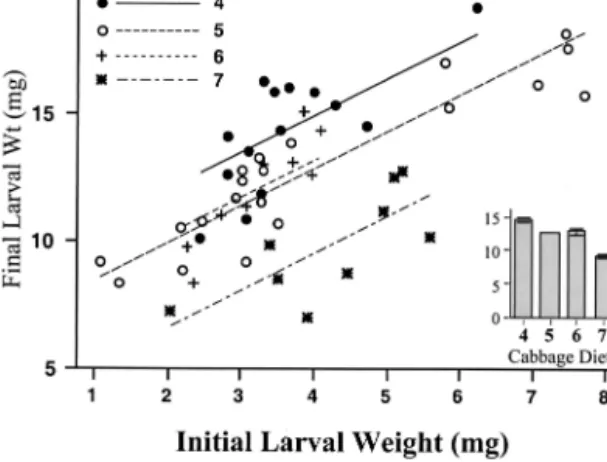
ad-justed by the initial larval dry weight covariate, varied signiÞcantly among treatment groups (F ⫽ 26.71; df ⫽ 3, 47; P ⬍ 0.0001). Interaction terms were not signif-icant, indicating that slopes among diet treatment re-gression lines did not differ. Figure 2 shows raw data and ANCOVA-Þtted data for the relationship between Þnal dry weights and initial dry weights among diet treatments. Larvae continuing on a diet of plants ini-tially designated as stage 4 increased signiÞcantly more in weight during the 24-h period than larvae on any other cabbage stage (stage 5, P ⫽ 0.0008; stage 6,
P ⫽ 0.0322; stage 7, P ⬍ 0.0001). Larvae continuing on
diets of plants designated as cabbage stages 5 and 6 at the start of the experiment were not signiÞcantly dif-ferent from each other, but grew signiÞcantly faster than those on cabbage stage 7 (both P ⬍ 0.0001).
Similarly, weight gain for quantity consumed (con-version efÞciency) differed signiÞcantly among diet treatments (F ⫽ 16.91; df ⫽ 3, 46; P ⬍ 0.0001). Figure 3 shows raw data and ANCOVA-Þtted data for the relationship between weight gain and consumption among diet treatments. Larvae developing on a diet of
plants designated as stage 4 gained signiÞcantly more weight for leaf biomass consumed during the 24-h period than larvae on cabbage stage 5 (P ⫽ 0.006) or 7 (P ⬎ 0.0001), and marginally more than those on cabbage stage 6 (P ⫽ 0.0724). Larvae developing on cabbage stage 7 also gained signiÞcantly less weight for leaf biomass consumed than larvae fed cabbage stage 5 (P ⫽ 0.0002) or 6 (P ⫽ 0.0003).
Frass (egesta) biomass for quantity consumed also differed signiÞcantly among some treatments (F ⫽ 9.36; df ⫽ 3, 46; P ⬍ 0.0001). Figure 4 shows raw data and ANCOVA-Þtted data for the relationship between egesta and consumption among diet treatments. Lar-vae developing on plants that had been designated as stage 4 excreted the highest dry weight of frass for leaf
Fig. 1. Least squared mean (⫾SE) percent survivorship
of C. pavonana larvae reared from egg hatch on four diet treatments, indicated by cabbage stage at the time of ovipo-sition.
Fig. 2. Raw and ANCOVA-Þtted data showing the
rela-tionship between initial (dry) weights and Þnal (dry) weights, after 24 h, of C. pavonana fed four diet treatments, indicated by cabbage stage at the time of oviposition. Com-mon slope ⫽ 1.44. Inset shows Þnal weight ANCOVA means (⫾SE).
Fig. 3. Raw and ANCOVA-Þtted data showing the
rela-tionship between consumption (dry) and weight gained (dry), after 24 h, of C. pavonana larvae fed four diet treat-ments, indicated by cabbage stage at the time of oviposition. Common slope ⫽ 0.0079. Inset shows ANCOVA means (⫾SE) for weight gained.
mass consumed. Differences in quantities of frass were statistically signiÞcant between cabbage stage 4 and stages 6 (P ⫽ 0.027) and 7 (P ⬍ 0.0001) but not signiÞcantly different from that excreted by larvae developing on stage 5 cabbage. Dry weight of frass for stage 7 cabbage was also signiÞcantly lower than for stage 5 (P ⫽ 0.0009). Percent dry biomass in the four leaf types was also progressively lower for each later cabbage stage (F ⫽ 66.52; df ⫽ 3, 47; P ⬍ 0.0001; Fig. 5). Consumption was signiÞcantly different between groups (F ⫽ 3.18; df ⫽ 3, 47; P ⫽ 0.033; Fig. 6).
Discussion
Patterns of larval performance in relation to simu-lated oviposition on the four consecutive phenological cabbage stages were consistent in the two experi-ments. Although results of simultaneous comparisons between diet treatments in the experiment on com-plete immature development were not statistically sig-niÞcant, we believe this to be a consequence of the
experimental design rather than of a discrepancy be-tween treatment effects during the entire larval de-velopment versus during only one larval instar. Larvae developing from eggs beginning on stage 4 cabbage had the most rapid development rates and highest mean survivorship in this experiment. In the 24-h test, larvae on stage 4 cabbage gained weight faster, showed higher efÞciency of food conversion, and produced more frass than larvae from later cabbage stages. The accelerated response to this phenological stage of cab-bage seems to be both behavioral and nutritional.
Larvae that hatched from eggs that would have been laid on cabbage stage 5 survived as well as those on stage 4. During the 24-h test at the start of the fourth instar, however, these larvae gained less weight and showed lower food conversion efÞciency than stage 4 larvae. That stage 5 larvae showed similar consump-tion rates and produced similar amounts of frass while growing less than those on stage 4 indicates that the diet consequent to oviposition on stage 5 cabbage is nutritionally inferior to that beginning with the pre-vious plant stage.
Similar to stage 5 larvae, those that hatched from eggs that would have been laid on stage 6 cabbage showed lower growth rates than stage 4 larvae but higher growth rates and food conversion efÞciency than stage 7 larvae. They also produced less frass than larvae from stage 4 cabbage.
Larvae that hatched from eggs that would have been laid on stage 7 cabbage performed poorly in compar-ison with all others. One-half of the larvae from this category also died during the 24-h food utilization experiment. Those that survived consumed less leaf biomass, grew less, converted food to biomass less efÞciently, and produced less frass. Less frass, given similar consumption, is normally thought to indicate higher food digestibility (Wheeler and Halpern 1999). The lower frass production for leaf biomass consumed may, alternatively, be the result of lower percent dry weight of leaves from this phenological category. There would have been a considerably higher volume of water to be processed by the larvae eating them.
These data indicate that preference of female C.
pavonanato oviposit on stage 4 cabbage over other
Fig. 4. Raw and ANCOVA-Þtted data showing the
rela-tionship between consumption (dry) and egesta (dry), after 24 h, of C. pavonana larvae fed four diet treatments, indicated by cabbage stage at the time of oviposition. Common slope ⫽ 0.0272. Inset shows ANCOVA means (⫾SE) for egesta.
Fig. 5. Mean (⫾SE) percent dry mass of leaves used in
experiments lasting 24 h in which C. pavonana larvae were fed four cabbage diet treatments, indicated by growth stage at the time of oviposition.
Fig. 6. Mean (⫾SE) consumption of C. pavonana larvae
during 24 h on four diet treatments, indicated by cabbage stage at the time of oviposition.
phenological stages of cabbage (Smyth et al. 2003) is correlated with stage 4 being a nutritionally superior host for their offspring, resulting in more rapid and efÞcient development. These results were obtained despite stage 4 lasting only 6 d of a total 4-mo growing period, while later cabbage stages lasted 2 wk or more. Previous work (Smyth et al. 2003), however, showed that C. pavonana oviposition preference shifted to the next cabbage stage in the context of certain alternate hosts. Offspring development consequent to oviposi-tion at the later stage was slower, although survivor-ship of larvae on the two diets was similar.
Several explanations have been offered for a lack of correlation between oviposition preference and off-spring performance, such as factors that inßuence escape from natural enemies, variation in plant abun-dance (Thompson 1988 and references therein), in-ter- or intra-speciÞc competition, and physiological, behavioral, or phylogenetic constraints (Mayhew 1997). Our study Þts in the context of the potential adaptive importance of intraspeciÞc host selection (Ng 1988, Jaenike 1990). The brevity of stage 4 may mean that C. pavonana often do not have access to this resource. Oviposition preference for stage 5 over stage 4 cabbage, which we observed when mediated by the presence of certain taxonomically differing hosts, may reßect plasticity that would be adaptive in conditions of limited resource options or interactions with at-tributes of the alternate host plants. Studies of larval development on hosts other than cabbage and the plant characteristics that explain differences in larval performance could contribute much to the under-standing of C. pavonana oviposition behavior.
Acknowledgments
We are grateful to J. Vandenberg and J. McManus for welcoming this project in the USDAÐARS quarantine facility at Cornell University; to D. Reed of ReedÕs Seeds in Cortland, NY, for donating cabbage seeds cultivar Gloria; and to C. A. Heinz, F. Vermeylen, and K. Grace-Martin for essential ad-vice concerning statistical analyses of these data. Two anon-ymous reviewers made thoughtful criticisms of an earlier draft of this manuscript. This research was supported by Cornell International Institute for Food and Agricultural Development (CIIFAD).
References Cited
Andaloro, J. T., K. B. Rose, A. M. Shelton, C. W. Hoy, and R. F. Becker. 1983. Cabbage growth stages. New YorkÕs Food
and Life Sciences Bulletin Number 101, New York State Agricultural Experiment Station, Geneva, NY.
[CAB] Commonwealth Agricultural Bureaux. 1979.
Distri-bution maps of pests, series A, Map No. 236 (revised). CAB International, Oxon, United Kingdom.
Cochran, W. G. 1957. Analysis of covariance: its nature and
uses. Biometrics. 13: 261Ð181.
Cochran, W. G., and G. M. Cox. 1957. Experimental designs,
2nd ed. Wiley, New York.
Cox, D. R. 1958. Planning of experiments. Wiley, New York. Fisher, R. A. 1932. Statistical methods for research workers.
Oliver and Boyd Ltd., Edinburgh, Scotland.
Horton, D. R., and R. A. Redak. 1993. Further comments on
analysis of covariance in insect dietary studies. Entomol. Exp. Appl. 69: 263Ð275.
Jaenike, J. 1978. On oviposition behavior in phytophagous
insects. Theoret. Populat. Biol. 14: 350Ð356.
Jaenike, J. 1990. Host specialization in phytophagous
in-sects. Annu. Rev. Ecol. Systematics. 21: 243Ð273.
Kays, S. J. and J.C.S. Dias. 1996. Cultivated vegetables of the
world. Exon Press, Athens, GA.
Mayhew, P. J. 1997. Adaptive patterns of host-plant
selec-tion by phytophagous insects. Oikos 79: 417Ð428.
Neter, J., W. Wasserman, and M. H. Kutner. 1990. Applied
linear statistical models: regression, analysis of variance, and experimental designs, 3rd ed. Irwin Press, Home-wood, IL.
Ng, D. 1988. A novel level of interactions in plant-insect
systems. Nature (Lond.) 334: 611Ð613.
Packard, G. C., and T. J. Boardman. 1988. The misuse of
ratios, indices, and percentages in ecophysiological re-search. Physiol. Zool. 61: 1000Ð1003.
Raubenheimer, D., and S. J. Simpson. 1992. Analysis of
co-variance: an alternative to nutritional indices. Entomol. Exp. Appl. 62: 221Ð231.
SAS Institute. 1999. SAS/STAT userÕs guide, version 8. SAS
Institute, Cary, NC.
Smith, H. F. 1957. Interpretation of adjusted treatment
means and regressions in analysis of covariance. Biomet-rics. 13: 282Ð308.
Smyth, R. R. 1999. Effects of host plant phenology on
ovi-position preference for Crocidolomia pavonana [Fabri-cius] (Lepidoptera: Pyra´lidae): implications for trap cropping in cabbage. M. S. thesis, Cornell University, Ithaca, NY.
Smyth, R. R., M. P. Hoffmann, and A. M. Shelton. 2003.
Effects of host plant phenology on oviposition preference of Crocidolomia pavonana (Leptidoptera: Pyralidae). En-viron. Entomol. 32: 756Ð764.
Steel, R.G.D., and J. H. Torrie. 1980. Principles and
proce-dures of statistics: a biometrical approach, 2nd ed. McGraw-Hill, New York.
Thompson, J. N. 1988. Evolutionary ecology of the
relation-ship between oviposition preference and performance of offspring in phytophagous insects. Entomol. Exp. Appl. 47: 3Ð14.
Thompson, J. N., and O. Pellmyr. 1991. Evolution of
ovipo-sition behavior and host preference in lepidoptera. Annu. Rev. Entomol. 36: 65Ð89.
[USDA] U.S. Department of Agriculture. 1968. Insects not
known to occur in the United States. Coop. Econ. Insect Rpt. 18: 1153Ð1154.
Valladares, G., and J. H. Lawton. 1991. Host-plant selection
in the holly leafminer: does mother know best? J. Anim. Ecol. 60: 227Ð240.
Wheeler, G. S., and M. D. Halpern. 1999. Compensatory
responses of Samea multiplicalis larvae when fed leaves of different fertilization levels of the aquatic weed Pistia stratiotes.Entomol. Exp. Appl. 92: 205Ð216.
Received for publication 25 February 2002; accepted 11 March 2003.