DESIGN, CONSTRUCTION,
A RAM EXTRUDER FOR HIGH
AND TESTING OF
VISCOSITY POLYMERS
BY
JOSEPH S.
LUBISCHER
SUBMITTED IN PARTIAL FULLFILLMENT OF
THE REQUIREMENTS
FOR THEDEGREE OF BACHELOR OF SCIENCE
MECHANICAL ENGINEERING
AND THE DEGREE OF
MASTER OF SCIENCE
IN MECHANICAL ENGINEERING
AT THE
MASSACHUSETTS
INSTITUTE OF TECHNOLOGYJANUARY, 1973
f
SIGNATURE OF AUTHOR ,,,
CERTIFIED BY
ACCEPTED BY
./PARTMENT OF MECHANICAL ENGINEERING
OCTOBER 6, 1972
II I I I I I I t 1 l I r l I I I r II I I I I I I I I I I I I I I I I I I I I I
.HSIS SUPERVISOR
I I I I I I I I I I I I I I I I I I I I I I I I I I I I I I I I I I I I II I II I I
CHAIRMAN, DEPARTMENTAL COMMITTEE
ON GRADUATE STUDENTS
Archives
FEB 141973
-2-TABLE OF CONTENTS
CHAPTER
Title Page ...Table of Contents ..
List of Figures ....Abstract ...
Acknowledgements ... I Introduction ...II
Literature Review ..
II.1 Compression anII.2 Polymer Proper
II.3 Flow BehaviorII
Experimental Work ..
III.1 Basic Concept
III.2 Design ...III.3 Instrumentati
III.4 Tests and ResIII.5 Limitations .
IV Analysis. d Flo ties of Po of t on .. ults Id Flo ties· IV.1 Inapplicability of IV.2 The High Elastic StFlow...
IV,3 The Theory of the HApplied to the Ram
....
...
w of Granu lymers ... he Ram Ext. .... ....
Viscous Fl ate and St igh ElastiExtruder .
PAGE · · · ·... 4 · · · ·... ·· 5 ... ... 7...
10
lar Media . 10 ... 12...
19
... 22 ruder ... 22 ... 22 ... 28 ... 30 ... 32 ... 36 ow Analysis 36ick-Slip
... 38 c State ... 42IV.4 Heating Time
...
45
IV.5 Powder Compression and Air Expulsion ...IV.6 Maximum Output Conditions ...
I
48 48
-3-CHAPTER
V Conclusions Appendix A: Appendix B: Appendix C: Appendix D:References
P...
Detail Drawings
...
Equipment List ...
Test Conditions, Results, and
Calculations
...
Density Measurements
...
...
AGE51
52
62
6468
71
-4-LIST OF FIGURES
Schematic of Screwless Injection Machine
2. Viscosity Data3. Schematic Conce 4. Basic Design of 5. Top View of App 6. Bottom View of 7. Transducer Layo
8.
Velocity Traces
9.
Velocity Traces
10.
Velocity Traces
11. Flow Rate vs. PPolybutadiene
12. Calculation of for UHMWPE AC ption o the Ex aratusApparat
ut ....ress
ure
.
.
ressure f thetrude
us . . US ..rop Drop260-100
Ramr
..
forExtr
. . *o o om eeeoe eoooe moeoo mooeo me·m· · ·· co.l·.e...
14
uder * . * . ·.. mo· oemm mo· mo· moom mo·....
23
...
24
...
25
...
25
...
29
... 33...
34
...
35
41 45Tube Entrance
Gradients ...
FIGURE 1. PAGE...
.. 9
Temperature
ABSTRACT
DESIGN, CONSTRUCTION, AND TESTING OF
A RAM EXTRUDER FOR HIGH VISCOSITY POLYMERS
by
Joseph S. Lubischer
Submitted to the Department of Mechanical Engineering on October 6, 1972 in partial fullfillment for the requirements for the
Degree of Bachelor of Science in Mechanical
Engineering and the Degree of Master ofScience in Mechanical Engineering.
A ram extruder for the direct extrusion of high viscosity
polymers from powder has been successfully designed and tested.
The extrusions, in terms of density, surface finish, anddimensional accuracy, were of very high quality. The flow,
heated by radial heat conduction, was found to exhibit astick-slip phenomena. This has been satisfactorily explained
by theoretical considerations of the high elastic state ofpolymers. The mathematical technique and experimental data
needed for determining the maximum output of the extruder
while retaining a high quality extrudate is explained.
Thesis Supervisor: Nam P. Suh
-6-ACKNOWLEDGEMENTS
Any thesis is first and foremost an educational
experience. As such, suggestion and insights cone to the
writer from many different sources. It is impossible to
acknowledge all, but I would like to thank a few. First, to Nam Suh, my thesis supervisor, for his help, criticisms, and encouragements. To Jack Leach, Fred Anderson, Ralph Whitemore, and Ralph Bowley, I express my thanks for theirassistance and advice in constructing the experimental
apparatus. To my fellow students, I thank you for many
thought provoking discussions. Thanks must also go to
the Shell Companies Foundation and the Department ofMechanical Engineering for financial support and to
Mr. Allan Margolies, Allied Chemical Co., for providing
the polyethylene used.I,
INTRODUCTION
Among the many new polymers introduced in
recent years
are polyethylenes withinteresting are those
in excess of 1,750,000polyethylene (UHMWPE)
ing usage because of t particular, UHMWPE wit like other polyethyler has a coeffieient of fflouroethylene (teflor
However, these
c
cessable [2]. Becausemelts, they
In practicecessing mod
high molecular weights.
with weight average
[ :h :h le Fr l) )n Termed u 1], these eir unique a molecul s, is very iction corn and a ver g chained of the ver cannot be extruded in
, they simply "jam up"
es known to be in use
Especially
molecular weights
ltra-high molecular weight
polymers are seeing
increas-physical properties. In
ar weight of 8 million, whichtough and chemically inert,
parable to that
of
polytetra-y high abrasion resistance.*polymers are not easily pro-y high viscositpro-y of UHMWPE
conventional screw extruders.
in the extruder. Thepro-are counter-rotating twin-screw
extruders, compression molding, and a "screwless injection
machine". Twin screw extruders are undesirable because the
large shearing forces created break up the molecular chains to the point where molecular weight, and thus physicalproper-ties, are significantly altered. Compression molding has the
traditional drawbacks of low production rates and of limitation* This
is sold
UHMWPE has been kindly provided by Allied Chemical and
under the designation AC 260-100.
-8-to single parts. A "screwless injection machine" has been
introduced by Borg-Warner Machines which utilizes mating conical
shear surfaces to heat the plastic, a powder metering screw,
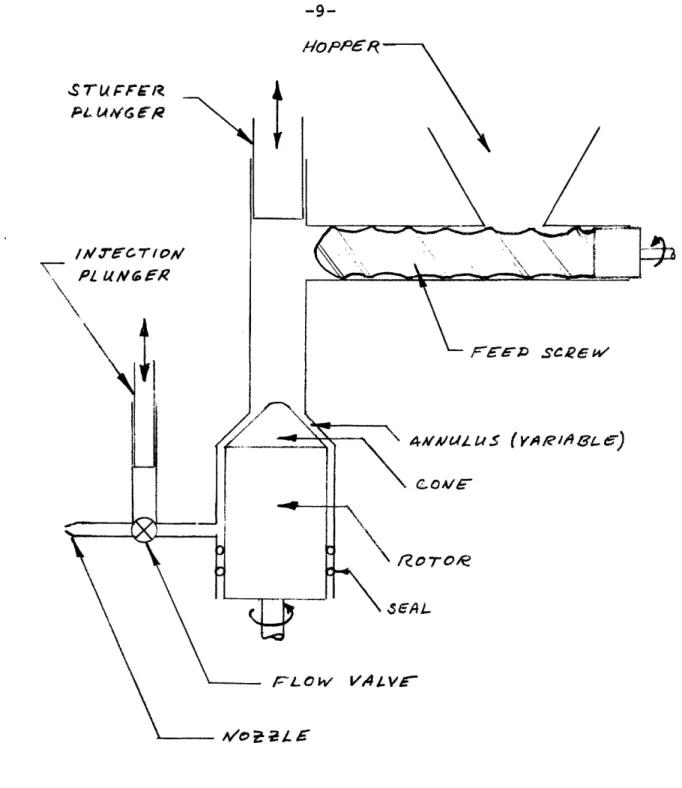
and two stuffer plungers for transporting the powder and melt, respectively (Figure 1). This machine is a significant improve-ment in processing high viscosity polymers. However, it isstill complicated, expensive and, more importantly, utilizes
shear work to melt the polymer.The aim of this research work has been the design, con-struction, and testing of a ram extruder for high viscosity polymers. In contrast to all of the above processing methods, it is simple, inexpensive, and introduces an absolutely
minimal amount of shear work, thereby minimizing physical
deterioration of the polymer.'-
FE
S
Uw
\
4AUzLUS
(YARMerSC-)
\
OA/C
\
RTOTOR
SSAL
FIGURE 1.
Schematic of Screwless Injection Machine
made by Borg-Warner Machines.
rmL
OW
v,4 tvr
7-
-10-II, LITERATURE REVIEW
This chapter reviews previous work which has been relevant to the design and analysis of the ram extruder. Not surprising-ly, no work has been found dealing with the principles of ram
extruder operation. The areas searched were powder flow, powder
compression, polymer properties, and polymer flow.
II,1
COMPRESSION AND FLOW OF GRANULAR MEDIA
The only work found in the area of powder flow dealt with the free flow of powdered and granular materials through hoppers and flow along moving surfaces (such as blades). Adler [3] re-views and analyzes the factors which affect the gravity flow
of powders. Little work has been done concerning pressure
flow of powders. Platonov and Poltorak [4] investigated the shear of granular media along a surface at low normal stresses. They found that the resistance to shear (coefficient of external friction) depended considerably on the normal pressure andalso the rate of increase of the shear stress. They also dis-covered a two-phase process of flow. The first phase was a stick-slip flow accompanied by an increase in the shearing force. The second phase was uniform movement under a constant shearing force. One of the materials used was granular
poly-styrene.
signifi-cant attention. Schwartz and Holland [5], working with iron powders, show that the stress state for initial yielding is
given by the Mohr-Coulomb yield criterion
y
=
C
+
tan~
(1)
where y is shear stress, a is normal stress, C is the cohesion at zero normal stress, and is the angle of internal friction.
However, C increases and
decreases as densification proceeds.
As a result, the failure envelope curves down, but can stillbe reasonably represented by the classical Mohr-Coulomb yield
criterion. Lee and Schwartz [6] applied the modified
Mohr-Coulomb criteria in an analysis of powder rolling. Several
papers [7,8, and 9] have studied the failure of solid polymers under hydrostatic pressure. The data taken shows reasonableagreement with the Mohr-Coulomb yield criterion.
Kawakita and Ludde [10] approach the problem of powder
compression via pressure-volume considerations. They give
pressure-volume equations for piston, tapping, and vibrating
compaction. For piston compression, the following expression
is given.
_ Uo - V abP
C o - V ab (2)
-12-where C is the degree of volume reduction, Vo
apparent volume, V is the volume under pressu
are empirical constants. However, this equat
empirical, has not been related to the statethe constants have not been related to any ph of the material. Thus the usefulness of this
extremely limited
In summary, previous work indicates that
of powder compaction can be idealized through
Mohr-Coulomb yield criterion.
is the initial re P,and a and b ion is entirely
of stress, and
ysical properties expression isthe deformation
the use of the11
,2
POLYMER PROPERTIES
Knowledge of the physical properties of polymers leaves a great deal to be desired. Because of the wide number of
polymers, co-polymers, and polymer mixes, data must be
collect-ed from individual manufacturers. In addition, variations of
many properties with temperature, state of stress, and stress
rate are not well understood, let alone readily available.
Also the inherent non-linearity of such properties as viscosity
has made the synthesis of useful constituitive relations verydifficult. As a result, almost all design and analysis related
to polymers and polymer flows begins with very limitingassumptions regarding the nature of the properties.
VISCOSITY
In general, the temperature-shear-shear rate variation of the viscosity of a polymer melt has been very difficult to
characterize, even though a great deal of work has been done. Recently, a computer simulation of flow in extruders [11, 12, and 13] has utilized several power law models to give a single
viscosity curve. Viscosity relations which have been proposed
for non-Newtonian fluids are given in Table 2-4, reference [14]. The most common, primarily because of its "usability", is the power law model given below:n:
fl
nl
1l
n = no I
(2-3)
A common modificati
based on the Arrenhon is to i
ius equati
nclude temperature dependance
on:
n = Aexp(-AE/RT)II n - 1
The major problem w
empirically determi
rates. The actualis shown in Figure
also plotted. This
ith this model ned Newtonian viscosity data 2. For compar model, using is beha for ison equa that it does vior at high the UHMWPE,
, the power
tion (2-4), yield the and low shearAC 260-100,
law model isis
(2-5)
The value of AE was taken from McKelvey [14].
(2-4)
AC Za-I DO UHMWPF
CI.
viL.co -eR
r t
3o
0°C.
#PWov!ID)D BV
ALLIED CHMetICA1tL C.,
FIGURE 2. Viscosity
Data and Power Law Modelfor UHMWPE AC
260-100,
* '/%
/0' Q /O 1-V7 ri %J WER ,LQ r - ,01T
rces
2
s
. fSU4qr
ICr6' -14-Inq , _VIZCOSITYDA T AR
To(se )
-15-SPECIFIC HEAT
A common value of specific heat for polyethylene given in
the literature [15 and 16] is
CPE = 0.55 Btu/lbm °F
(T=250C)
(2-6)The data in reference [16] shows cp for polyethylene up to 320°K.
temperature effect as
the temperature dependance of Forsythe [17] gives the
Cp = cpo(l + bT) (2-7)
However, no data has temperature range of done to the author's
molecular weight and
manufacturer for thebeen found to support this equation in the the polymer melt. Also, no work has been
knowledge on the relationship between
specific heat. No data is given by the specific heat of AC 260-100.DENS ITY
The specific gravity of AC260-100 is gi
obtained by A.S.T.M. D792-62T. The density
ven as .930,
is thus
PE .g. PEPH2 = 93
.9975
= .928 gr/ccNaturally, due to
strong temperature
has been studied ,compressibility effects, the density has a
and pressure dependance. Though this phenomena
data is not generally generated by the
-16-manufacturers. Forsythe [17] expressed the density change as a
function of pressure and temperature:
p
[=
aTPdT
+pTdP
(2-9)Substituting the definitions of thermal expansion and volume
compressibility he obtained
dp = -pc*sdT + pdP
(2-10)
Values of the constants and , not being generally available, were obtained from manipulation of the Spencer-Gilmore
equation of state as will be noted below.
THERMAL CONDUCTIVITY
The thermal conductivity data, and its variation with temperature, has not been well established. Nor has the mode of heat transfer in polymers been well explained. Values for the thermal conductivity of high molecular weight polymers are not available except within an order of magnitude. The
temperature dependances found [18] are in such disagreement as
to be meaningless.
Data for thermal conductivity of polyethylene in reference [16] show a decrease in k with increasing temperature in the range -100°C to 500C. However, work by Fuller and Fricke [18], Lohe [19], and Hennig [20] in the temperature range 100°C to 300°C is in serious disagreement. As a result, no conclusions
-17-can be made concerning the temperature dependance of the thermal
conductivity of polymer melts.
Fuller and Fricke also noted that thermal conductivity
decreased with increasing complexity of the molecular chain.
Hanson and Ho [21] propose a theory, and present limited data, to show that thermal conductivity increases with molecular weight. They also give data that shows thermal conductivity decreasing with temperature until the melt temperature is reached, at which point the thermal conductivity startsincreasing very slowly. In general, however, data is insufficient
for drawing any hard conclusions.CONSTITUITIVE RELATIONS
The author has found only one attempt to develop a basic constituitive relation. In 1949, Spencer and Gilmore [22 and
23] propsed equation (2-11), the Spencer-Gilmore equation of
(P +
r)
(V - b) = RgT/Mw
(2-11)
state, where P is the external pressure, V is volume, Rg is the gas constant, T is absolute temperature, Mw is the molecular
mer weight,
is internal pressure or cohesive energy density,
and b is volume at absolute zero. Equation (2-11) appears to have been arrived at from considerations of the ideal gas law
-18-and Van der Waale's equation of state,
(P + a/v2 )(v - b) = BT a modifi Though 1 for the
ibility
is straidefiniti
cation of eq imited, thiscoefficients
and the densghtforward,
ons
, giving
uation ofequation
of therm ity. Theinvolving
(2-12) for higher pressures.
can be used to derive expressions
al expansion and volume
compress-derivation of the two coefficientsonly substitutions of their
1 (P
+
)
1 + Rwb ( P + )4=
+R
g
(2-14)
(2-15)
An expression for density can also be found ( by combining equation (10), (14), and (15) and integrating). However, the resulting expression is much too complicated to be of any use. It should furthermore be noted that the Spencer-Gilmore equation of state has never been tested for polymers with
ultra-high molecular weights.
(2-13)
II,3
FLOW BEHAVIOR OF POLYMERS
At the beginning of this work, the author reviewed many papers on the flow characteristics of polymer melts. However, later experimental work showed that the flow in the ram extruder
exhibited a stick-slip phenomena. Since the work on viscous
flow is not applicable, only a brief review of major work will be given.In 1951, Brinkman [24] solved the steady state flow problem for a Newtonian fluid with viscous heat generation.
The governing equation
=k
MrDTJ
r2(aPJ2
_
.
arar
4+ [z
(2-16)
was solved by evaluating an eigenvalue series for boundary
conditions (1) where the tube walls are at To and the entering fluid is at To and (2) where the walls are insulated. The results showed very significant temperature rises due to theviscous heat generation. Bird [25] extended Brinkman's work
to the case of non-Newtonian flow characterized by a power lawviscosity.
Toor [26] investigated the effects of compressibility on
the temperature profiles of power law fluids. The governing
energy equation used was=
=k
rT
+
n+2
2Te + n
rn
T
(2-17)
r r r
n
2
-20-expansion, and W is the average volume rate of energy dissipation across the tube. Toor [33] continues this work by examining the inlet region in order to determine the distance necessary to reach steady state flow. He solves equation (2-17), amended
by the addition of the enthalpy transport term, for a fluid entering a tube with constant wall temperature equal to that of
the entering flow. He shows that that the center temperature
initially decreases due to expansion, but then increases with
axial distance due to viscous heat generation. The Reynolds number is a measure of distance required to reach a steadyvelocity profile and the Peclet number is a similar measure
the development of the temperature profile. Toor develops an
equation for the distance required to reach steady state pro-files and notes basic theoretical agreement with the dimension-less group analysis. For high viscosity fluids, the velocity profile develops much more rapidly than the temperatureprofile. The Prandtl number is pointed out as a measure of the relative rates of development.
Lyche and Bird [27] obtained a semi-analytical solution
for the Graetz-Nusselt problem extended to non-Newtonian flow.
Reduced temperature profiles for heating and cooling for
different power law indexes are given. A final comment pointed out the "urgent need for experimental data on thermal conduct-tivities and heat capacities of non-Newtonian fluids." Fifteen years later this comment is still very applicable. In 1958,
Toor [28] presented a heat transfer analysis of power law non-Newtonian fluids with viscous heat generation in a pipe. Gee
and Lyon [29] derive the under discussion here and
basic equations
give a computergoverning the flow
solution thereof for
a particular material.
Christiansen et.al. [30,31, and 32] have worked on non-Newtonian flow problems but neglected the effects due to viscous heat generation and compressibility which have been shown to be important [24,25,26, and 33]. Gruntfest et.al. [34] present a transient analysis of a power law fluid with viscous heat
generation. The work was based partly on that of Kearsley [35]. Forsythe [17 and 36] developed a numerical solution for steady, state flow of a temperature dependent power law fluid with
viscous heat generation and compressibility effects. The results
showed improvement over the methods of Bird [25] and Toor [26] for the cooling of polymerswell with experiments, are
solution--application to a
These results, though
limited by the nature ofparticular material.
agreeing
-22-III, EXPERIMENTAL WORK
III.1
BASIC CONCEPT
OF
THE
RAM
EXTRUDER
The ram extruder was designed for continuous processing of high viscosity polymers. The usefulness of such a machine was noted in the introduction. The basic concept may be
illustrated through the use of Figure 3. A reciprocating ram (1), on every return stroke, uncovers a port (3) in the feed block (5) through which powder in the hopper (2) falls into that section of the chamber denoted as A. On the forward
stroke, the ram pushes the powder forward. After a few strokes, the wall friction of the powder is sufficient to cause a
pressure build-up in section B every time the ram pushes
forward, thereby compacting the powder. This continuous slug
of compacted powder is then forced through a heated tube (4) where the polymer is melted.III,2
DESIGN
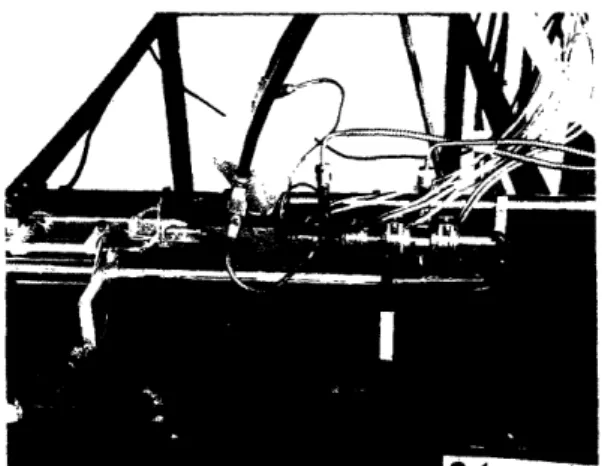
Figure 4 shows the basic extruder design. Appendix A contains detail drawings of the parts and Appendix B is a list of standard equipment used. Figures 5 and 6 are photographs
of the experimental apparatus, including instrumentation.
The extrusion tube was 6 inches long with a 1 inch OD and a inch ID. Four 125 watt band heaters were used. Two
-23-C;
LU K~-uL 3a
P- 5.-w-0
S-x
w E co -1 C) 0c
0 c-, 4-)E C, Cua c0
U-E 0) Cr4 c-l V) 'I, to
a
C) C.) -_ c 4--H CC ~. = 9; t %r-J
.J 1 x CS t , L cv k Lz-24-7YM'~--II
FIGURE 5. Top View of Apparatus
-26-the barrel temperature. Thermocouples A and B were mounted 11 inches from the exit and entrance ends of the tube, respec-tively. The tip of the thermocouple probe was 3 inch from
the inside wall.
The thermal insulator between the feed block and the
extrusion tube was included for two reasons. First, it wasdesired to maintain as sharp a temperature gradient as
possible for later theoretical considerations. Second,
melted polymer near the piston causes the piston to jam in the cylinder. The feed block was water cooled to prevent any
temperature rise in this part. (During start up it was always necessary to turn on the water before powering up the heaters.) Several designs and materials for the thermal insulator were
tested. These included teflon, steel, machinable glass,
water cooled epoxy, and water cooled steel sleeve with a teflon
insert. Ceramic materials were judged to be unsuitable. Most
of the materials were not acceptable because of low mechanicalstrength, high thermal conductivity, surface roughness, or
brittleness. The only successful design was the water cooled
steel-teflon composite. (See Appendix A.) However, the low strength teflon tended to flow out between the steel sleeve andthe heated extrusion tube. Fortunately, the polyethylene
filled this space without apparent effect on the flow. The
design was thus suitable for testing purposes though in practice
a more durable design would be necessary.
Some problems were encountered in the free flow of powder through the port in the feed block, particularly after the
powder had absorbed humidity. All dificulties were eliminated
by simply enlargening the port.Significant problems resulted from the dry sliding friction
between piston and cylinder. Initially, both parts were made of
mild steel. However, after a break-in period piston seizures
were repeated and rapid. Replacement with a brass piston andadditional securement of the bushing prevented further problems.
Periodic inspection of this arrangement showed signs of wear
on the piston which indicated that the design was defficient. The problem is not overwhelming. Use of dual bushings to eliminate non-axial forces and use of hardened steel or lowfriction materials (such as teflon impregnated aluminum) should
eliminate difficulties in the future.
The air motor was run off an 80 psig line through a regu-lator. Valving on the air motor is controlled by two
micro-switches accuated by the lever arm. By adjusting the switch
positions, the stroke distance can be controlled. Shaft speed
is influenced by supply pressure, adjusting screws which restrict
the flow passages, and load. As a result, fine adjustment of thepiston speed was quite difficult. Future apparatus should employ
a much less sensitive speed control.The lever arm was designed to give a force magnification and
stroke reduction factor of 3.
-28-111,3
INSTRUMENTATION
Among the variables to be recorded were piston velocity,
extrudate velocity, piston displacement, and piston force.
The velocities were measured with a self-generating,
magnetic core type transducers (ISA#1-313 [37]). This type
of transducer is suitable for uses where essentially no loading of the measured parameter can be tolerated. The instrument specifics are given in Appendix B. Due to the set-up of the apparatus, it was necessary to mount the transducers in parallel with the moving piston and extrudate. A bent arm, rather than straight shaft, coupling was thus employed. (Figures 5 and 7.) Initial problems were encountered due to the spring effect of these arms. The arms were strengthened at the bend and a teflon guide was inserted in the transducer to prevent lateral motion. Thiseliminated all problems except that of piston velocity
over-shoot at the beginning of the return stroke. Since the unloaded
piston velocity is a constant, this overshoot was obvious andcould simply be ignored. The transducer outputs were fed into
an oscilloscope with camera attachment. 60 cycle pickup was
12 mp
for piston velocity and 4 mp
for extrusion velocity.
An LVDT (ISA#1-034) was used to measure piston displace-ment. Output was fed into a Sanborn recorder and calibrated with
depth micrometer measurements of piston position.
Piston force was to be calculated from measurements of the
differential pressure across the air motor piston. Pressure
taps were located in the cylinder walls at each end of thex
.I--n
ik,
%I LLr! VIl WC It, c) iS ,v i~ t7 A cr Q i4 4. It" -4j 1U V0
Co-J
5--0 F-Li CD-30-motor and connected via
"Poly-Flo" tubing to a differential
pressure transducer. (See Figure 6.) Output was fed to theSanborn recorder and calibrated by comparison to a calibrated
Bourdon tube gage at 20 psid. The transducer was mountedseparately from all other apparatus to prevent vibration
pick-up.
111,4
TESTS
ANDRESULTS
A series of test were run to determine the operating
characteristics of the ram extruder. The factors varied were
the stroke length, the barrel temperature, and the speed orcycling rate. Stroke length was adjusted with the extruder
operating by moving the valve controlling micro-switches.
The travel was read directly from the LVDT output. The extruder
tube temperature was controlled by setting the temperature
controllers. The speed of operation, as noted above, was difficult
to adjust, This was accentuated by the fact that if the machinebegan produced a partially melted extrudate, the process usually,
even when slowed down, went to a new steady state situation where only a thin outer layer of the extrusion was melted. Theauthor attempted to set the air motor speed adjusting screws and
the regulator pressure to yield a maximum output condition for
a given stroke and temperature. Measurement of the success in doing so is discussed below.Variation of differential pressure and piston position
were continuously recorded versus time. Pictures of piston
and extrudate velocities were
-31-taken during the test period of
each specimen. The specimens were marked, during the piston
return stroke, with a knife. A notation was made on the pressure trace to indicate at which cycle the specimen wasmarked. Appendix C contains the specimen notation,
tempera-ture conditions, and readings taken directly from the outputrecordings and the specimens. These later include time,
cycles, stroke, pressure, and specimen length, diameter, and
weight. Calculations included are frequency, mass flow,
average extrusion velocity, and residence time.
Typical velocity traces under different conditions are
shown in Figures 8,9, and 10. The upper trace is pistonvelocity, the lower is extrudate velocity.
Measurements of the density of samples from each specimen were made. The method and results are included in Appendix D.
Also, at the end of tests for a given stroke the partially melted polymer was pulled out of the tube. Only about inch of the specimen, at the tube entrance, did not pull out. By slicing the extrudate axially, the axial point at which the
polymer first becomes completely melted was found. Presumably,
in the ideal situation the polymer would first become completely
melted at the tube exit. On this basis, the speed of operation was judged to be about 30-40% below the maximum speed.The specimens themselves were of very high quality.
Dimensional tolerance was within .001 inch. Surface quality
was excellent. A few small bubbles were noticed in the hot-32-no bubbles were -32-noticed at all. Density measurements, however,
showed no dependance on stroke. A large amount of iron oxide did appear on the inside wall of the steel extrusion tube. However, none of the specimens were contaminated in any way.III,5 LIMITATIONS
There are two primary limitations in this experimental
work. First, difficulty in controlling the speed of operation,
and therefore the residence time of the polymer in the heatedsection, prevented the extruder from attaining the maximum
output steaty state condition. Second, the four 125 watt
heaters were insufficient to keep the barrel temperature much above 450°F. As a result, higher temperature ranges (at which,for short times, the polyethylene will not decompose) were not studied.
Test No. 203
Vertical Scale: .667 in/sec/cm Sweep Speed: .5 sec/cm
Temoerature-Thermocouple A: 400F Thermocouple B: 400°F Stroke: .311 in FIGURE 8b. Test No. 221
Vertical Scale: .667 in/sec/cm
Sweep Seed: .5 sec/cm
Temperature-Thermocouple A: 450F Thermocouple B: 50°F Stroke: .315 in FIGURE Sc. Test No. 242
Vertical Scale: 1.33 in/sec/cm SweeD Speed: .2 sec/cm
Temperature-Thermocouple A: 475°F
Thermocouple B: 460°F
FIGURE ?a.
Test No. 303
Vertical Scale: .667 in/sec/cm
Swee Speed: .5 sec/cm
Te m oerature e-Thermocouple A: 400' Thermocourle : 400 F Stroke: .488 in FIGURE 9b. Test No. 321
Vertical Scale: .667 in/sec/cm
Sweep Seed: .5 sec/cm
Temperature-ThermocouDle A: 450'F Thermocouple B: 450°F Stroke: .438 in FIGURE 9c. Test No. 343
Vertical Scale: .667 in/sec/cm Sweep Speed: .2 sec/cm
Temperature-Thermocouple A: 475°F
Thermocouole B: 460'F
Test No. 402
Vertical Scale: .667 in/sec/cm Sweep Speed: .5 sec/cm
Temperature-Thermocouple A: 400°F Thermocouple B: 400°F Stroke: .582 in FIGURE lOb. Test No. 422
Vertical Scale: .667 in/sec/cm Sweep Speed: .5 sec/cm
Temperature-Thermocouple A: 450°F Thermocouple B: 450°F Stroke: .582 in FIGURE 10c. Test No. 443
Vertical Scale: .667 in/sec/cm Sweep Speed: .5 sec/cm
Temperature-Thermocouple A: 475°F
Thermocouple B: 460°F
-36-IV,
ANALYSIS
IV,1 INAPPLICABILITY OF VISCOUS FLOW ANALYSIS
It was initially supposed that the flow of polymer out the
tube would behave as standard non-Newtonian fluid flow.
There-fore, the governing equations were developed [38] assuming
axi-symmetrical conditions , negligible axial heat conduction,
negligible radial velocity and steady state. Expressions for
the effects of compressibility and thermal expansion weredeveloped following Toor [26]. The equations of continuity,
momentum, and energy then reduced to,az{pz
=
0
Davz 1 a aPz az
r
r
rz
az
WpcvT=
r rT
T.S .
7
+
(4-1) (4-2) (4-3)avZ
rz ar
respectively, where Trz = n v ncoefficient of thermal expansion,
An order of magnitude analysis was under the approximate test conditi was rewritten asis the viscosity, e is the and is the compressibility.
then performed for UHMWPE ons. The continuity equation
-37-3az V z a Z (4-4)
following Forsythe [17]. The analysis showed that v7- was negligible in both the energy and momentum equations and hence that the temperature changes due to compression and expansion
were negligible. The resulting momentum and energy equations
reduced to:
ap a 1 a r
1
r rz z(4-5)
PCVVZH = i kr. +
Trz
a
r3v~z'z r r
However, over the temperature range (300-450°F) for which
the extruder was tested, the flow conditions were not describable
by equations (4-5) and (4-6). At test temperatures of 400°and above the flow exhibited a definite stidk-slip phenomena. This can be seen by comparing the piston and extrusion velocities
(upper and lower traces, respectively) in Figures 8, 9, and 10. In the range of 300-3250F the flow appeared to be viscous flow. But inspection of the extrusion tube showed a heavy iron oxide coating on the interior wall. Since the extruded polyethylene rod was clean and showed no signs of contamination, it must be assumed that the UHMWPE was not adhereing to the tube walls. The flow was thus not sticking to the wall and application of a viscous flow analysis to this problem is impossible.
-38-IV.2 THE HIGH ELASTIC STATE AND STICK-SLIP FLOW
The purpose of this section is to explain the nature of and reasons for the stick-slip flow observed in the experiments.
The phenomena of stick-slip flow has received almost no
attention in the literature. However, a very recent paper by
Vinogradov, et. al. [39] sheds a great deal of light on thesubject. In particular, it is shown that under certain
conditions a polymer in the high elastic state can exhibitstick-slip flow.
Linear uncured polymers, with molecular weight above a
critical value and at temperatures above the glass transition temperature, can exist in the fluid and high elastic states. The high elastic state is characterized by the rubbery nature of the polymer and by the reversible nature of deformations. In the fluid state, deformations are of course irreversible.The critical molecular weight for transition to the high elastic state is given as
M 2M > 10 (4-7)
Mc - 2Me
where M is the molecular weight, Mc is the critical molecular weight corresponding to the change in the nature of the
viscosity power dependance on molecular weight, and Me is the
molecular weight of a chain section between nodes (entanglements).
The values of Mc and Me for polyethylene are extremely low,-39-has been widely noted for polyethylene. For AC260-100, we find that since
=c
4,000 >>
10
(4-8)
this UHMWPE easily meets the necessary
transition
Transi high elasti shear straitransition
co-workers
increase wi the moleculrelatively
rate, c, iexpression
criterion
to the high elastic state.tion of a polymer system from the flui c state is dependent on the shear stre n rate. The critical values of these to occur are denoted Tc and Ic. Vinogr
state that the critical shear stress, th molecular weight and is, in fact, i ar weight. It is also suggested that
insensitive to temperature. The criti s however dependent on
molecular weigh
ic=
Ma for possible d state to the ss and the parameters for adov and Tc, does not ndependent of Tcshould be
cal shear strain
t. The
(4-9)
is given.molecular
the fluidviscosity
An effect of this relationship is that a narrow
weight distribution (MWD) implies a sharp change from state to the high elastic state. Since the initial
dependance on molecular weight is
(4-10)
=o M(
-40-(where a is the power dependance of initial viscosity on the
molecular weight), it is also found that the critical shear
strain rate is inversely proportional to viscosity and is
therefore proportional to temperature, equation (4-11).
-1
Yc
=
no
T
(4-11)
Transition to the high elastic state also causes a change in the nature of deformation. The primary changes are
non-adhesion to solid surfaces and extrudate distortion. The latter
has been referred to in [39] as elastic turbulence. In theliterature, extrudate distortion has been generally referred
to as flow instability (such as the so-called melt-fracture).The experimental work by [39] utilized a constant pressure
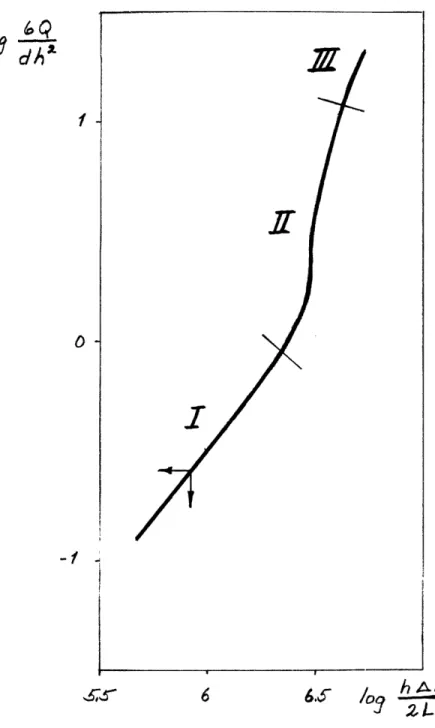
drop apparatus to push a narrow MWD polybutadiene through a rectangular duct. The flow rate was measured and the nature of the flow and extrudate distortion was observed. From the data, a flow rate--pressure drop curve was obtained and is reproduced here as Figure 11. The branch of that curve denoted I is the region of viscous flow. Branch II is the spurt region, with stick-slip flow progressing to continuous slippage as the pressure drop increases. Branch III is characterized by verystrong extrudate distortions. The orthogonal arrows on the
curve indicate the beginning of small scale distortions in theextrudate during viscous flow. Deformation in branch II,
however, is confined to the rounding off of the corners of the6.'
/o
h, L
,
hA_
FIGURE 11. Flow rate dependance on pressure drop for polybutadiene [391.
9
dA"
1-0o
-f
IT
I
6 | ---
-42-rectangular extrusion. Due to the major change in the nature of deformation going from branch II to branch III, it is convient to define a second set of critical parameters,
T6 and l6, for transition between the two regions.
IV,3 THE THEORY OF THE HIGH ELASTIC STATE APPLIED
TO THE RAM EXTRUDER
In this section, the nature of the high elastic state as explained by [39] will be compared to the results from this
experimental work. Similar to the experimental work of [39],
this work uses a device which applies a relatively constant
force to the polymer throughout the extrusion stroke. Also
in this section, the possible effects of the wall-polymer friction factor on the pressure gradient and the iron oxide coating on slippage at the wall will be considered.
Two situations from this experimental work are noted.
First, at temperatures of 4000F and up, the flow wasstick-slip. Second,at temperatures of 300-325
0F both continuous
slippage at the exit and some surface ruptures were observed.There are two possible explanations which account for these
observations. The first explanation takes into account onlythe nature of the high elastic state, while the second includes
considerations of the polymer-metal coefficient of friction andthe pressure gradient.
-43-EXPLANATION ONE
In both cases (high and low temperature), the first set of critical parameters for transition to the high elastic state
are obviously passed. At the higher temperature, stick-slip
flow is observed and the polymer is therefore in region II of Figure 11. At the lower temperature, continuous slippage and surface distortion are noted. This suggests that the polymer is in the area where regions II and III meet.These observations may be explained as follows. Since
Tc
is not temperature dependent, we might well assume that
Tc(the critical shear stress for ruptured extrudate) is also
independent of temperature. And since pressures for both cases are roughly equal, we can assume that the shear stresses are not very different. Thus the important parameter is '
(the critical shear strain rate for a ruptured extrudate). From section IV.2, equation (4-ll),we note that the critical
shear strain rate,
c,
is temperature dependent. Let us assume
this is also true for f'. Then since piston velocities wereroughly the same, the shear strain rates induced would not be
very different. Therefore, raising the barrel temperature
could have raised the second critical shear strain rate, ¢{c, such that the polymer was in region II--spurts without
-44-EXPLANATION Two
In this explanation, the reasoning above is accepted with the exception that the strong temperature dependance of c assumed above is taken to be insufficient in explaning the
observed phenomena. Now the coefficient of friction between
metals and polymers decreases with temperature after the
polymer melting temperature is exceeded. Then for a given
apllied pressure, the pressure gradient will become steeper
as the temperature decreases. For low temperature, therefore,
the state of stress would be very high near the tube entrance
and low elsewhere.
As the temperature is increased, the
pressure gradient and the maximum stress decrease and a larger
portion of the polymer is subjected to higher stresses.
Observations indicate that for temperatures around 400
0F,
the state of stress is sufficient to put a large part ofthe polymer in region II. For temperatures around 300°F, a smaller portion of the polymer would be in a much higher stress state which could account for the distortions observed. The
continuous slippage noted at this temperature can be simply
attributed to a combination of the non-adhesiveness of the polyethylene and the iron oxide acting as a dry lubricant. It should be pointed out that the non-adhesiveness of the polymer may become pronounced well below Tc and c due to the MWD.The author feels that the second explanation is more reasonable. However, the data is really insufficient for
drawing a conclusion.
-45-IV,4 HEATING TIME
Of utmost importance in the design the time necessary to melt the polymer. as the residence time (of an infinitely tube).
of this extruder is This is referred to thin disk in the heated
Comments regarding the nature of gradients in the extruder
tube are in order here [40]. First, using a maximum heat flux into the polymer (1.6 Btu/hr) the radial temperature gradient was found to be completely negligible. Second, the gradient at the tube entrance was found to be significant, as follows.Temperature conditions and physical dimensions are shown in
Figure 12. If the radial gradients at the thermal insulator--extruder tube interface are small, 98% of the heat flux in region A will go through the steel sleeve. We can now equate( j
7
. /7 . I I I I 170
°7
FIGURE 12. Calculation of Tube Entrance
Temperature Gradients
-46-expressions for heat flux in the two regions provided we select an equivalent area for region B. Averaging the interface area with the area of the extruder tube, we obtain AB = .56 sq. in.
T is then given by
T (4-12)
which yields T = 2150F. Taking into account the fact that the sleeve is cooled by assuming Ax = 2- AxA, we find T = 1600F. Thus it seems that "shortening" of the heated section by about 10% would be reasonable.
As noted in Chapter III, the specimens were run 30-40% too slow. Thus another correction factor, of about 35%, is
necessary to obtain the effective residence time:
tcorrected
tmeasured
(.9)(.65)
We can now treat the problem as a cylinder at constant temperature subjected to a sudden increase in the wall temper-ature. Carslaw and Jaeger [41] have solved this problem. The
solution for average and center temperature is plotted with
V versus S as the coordinate axes where
r2
(4-14)
(4-15)T is taken to be either Ttr or Tave a is the thermal
diffusivity, t is the corrected residence time, and r is the
cylinder radius.
Residence times for the tests at 4000 F and 450°F were averaged. At 4000 F the average residence time was 82.0 sec and at 4500F it was 63.8 sec. Applying equation (4-13), the effective residence times are found to be 48.0 sec and
37.3 sec. The thermal diffusivity of polyethylene is
appr
is 1 that oxima.23)
a flt
a al
, Ind
t A in several wdependent.
time could b value of Tm, 300°F and benon-adhesion
layer indica
· (S tem fla ays Thu e v at 1 ow of te 01 ft2/hr. Calculating S, we find (S at 400° at 450° is .96). These values of S indicate perature distribution exists in the polymer [41].t temperature distribution could be explained
First, the melting temperature, Tm, is time s the melting temperature for a given residence ery close to the wall temperature. The actual
this time, can only be stated as being above the wall temperature (4000 or450°). Second, the the polyethylene and the presence of the oxide
the possible existence of a significant contact
resistance. Third, the thermal conductivity, and
thermal diffusivity, could be in error by as much
of 2. In all probability, all three explanations
thus the
as a factor
-48-contribute to obtaining the calculated results. Modification
of the experimental apparatus and further testing is definitely
necessary. However, it is still believed that the polymertemperature increase is caused soley by radial heat conduction and therefore the idealization of the problem made above is
valid.
IV.5 POWDER COMPRESSION AND AIR EXPULSION
During all the tests, no problem was ever encountered due
to inadequate powder compression or entrapped air. As
mentioned in the literature review, the powder compression can
be analized by use of the Mohr-Coulomb yield criterion. Appli-cation of this criterion to powder compaction in a cylinder shows that the pressure drop is exponential.The expulsion of air from the powder is explained as
follows. Initially the powder is compressed to near its
theoretical density. (Preliminary data indicate that the
com-paction results in an initial density of 90-95% of the theoretical density.) As the temperature increase in the powder, the air diffuses back through the powder to the tube entrance andescapes past the piston. This temperature activated diffusion
process completely degases the polymer.
IV,6
MAXIMUM OUTPUT CONDITIONS
The residence time necessary for melting of the powder is proportional to the radius squared and is also related to the
-49-values of the melting temperature and the wall temperature via the solution to the heating problem of an infinite cylinder.
If the melting time and degradation
temperature--time relationships are found, then an iterative graphicalsolution technique may be used to find the minimum residence time. The only other necessary consideration is to make sure that the shear stress and shear strain rate do not move the polymer into range of extrudate distortion--branch III in Figure 1l. The theoretical background for this is simply
tm = f(Tm ,Tda)
=-
(4-16)where tm is the minimum residence time, v is the average
extrusion velocity, L is the barrel length, Tm is the melting temperature, Td is the degradation temperature, and a is the thermal diffusivity. Now, since rY is inversely proportional
c
to viscosity, even a low extrusion velocity will cause of shear strain rate exceeding Y' for the case of high viscosity
c
polymers. Therefore the shear stress will be the primary factor
controlling whether the polymer is in the region of stick-slip flow or in the region of extrudate distortion. The shear stress is primarily affected by the pressure drop which depends on the barrel length. Increasing the length of the extrusion tube would raise the pressure drop and therefore the shear stress would increase. For a given barrel temperature, the output mass flow is limited by that length of the extrusion tube-50-which causes a pressure drop corresponding to the critical
shear stress. Much more experimental work will be necessary to
establish all of the functions needed to determine the-51-V. CONCLUSIONS
The ram extruder has been shown to be feasible for the extrusion of high viscosity UHMWPE in cylindrical form. It is expected that other high viscosity polymers can also be extruded. The nature of the flow has been found to be stick-slip due to the fact that the polyethylene is in the high
elastic state.
Heating of the polymer is by means of radial heat conduc-tion. Thus the time required to heat the polymer is propor-tional to the square of the radius. As a result, the extruder mass flow is greatest for thin extrusions.
The piston driving source should have separate velocity
controls for extrusion and return strokes and a constant force
should be applied by the piston for maximum output. The return
stroke speed is limited by the time required for the powder to fall through the port.Maximum output may be calculated, if the melting
tempera-ture--time and degradation temperatempera-ture--time relations are
known, through use of the solution to heating of an infinite circular cylinder. Extrudate quality can be kept high (i.e. the polymer stays in the region of stick-slip flow) by
-52-APPENDIX A
DETAIL DRAWINGS
COMPONENT
PAGE
Extrusion Tube ... 53
Piston ... 54Air Motor Adaptor ... 54
Lever ... 55
Connecting Rod ... 56Spacer ... 56
Bushing ... 56
Lever Mount ... 57
Extruder Tube Mount ... 57
Pins ... 58 Feed Block ... 59Thermal Insulator ... 60
Velocity Transducer Mount ... 61
Displacement Transducer Mount ...
61-53-I
I-.
.o
1
-(
N QcIIt.
t
o-1wo '.
I~~~-
I
U
Ii
I
II
1 !Ii
-- i. k - ~ _ _ ... ©_[_T -e-I I i ! I i RaI
7i a -? 4i At l~~~~~~al W
k
41
LI)~~~
k~~*z
K
-TC t 41i;
z - 'o
3.\-'V I T.
C XN0
(1 Nt 4c1 __ _II
j
-54-_.,
24
ky- -
--I
-.
6215
"1.--iU-,
) /-/ 7rIT
,.- 1 . I-.... -.---
v
-
,,
,
V
-o
u
r...
Cs
,l-
I( / IvC
V/
1P9pp leaAyRC4rR TrH? 4VPIs T/
CAC
1A4
T;
RA=5
rTOZ-c
RACs ;
Ft
,q
T
/
A/S
-: 6
Z)c c t A L . ol I i -I-.
II;
.
I i '.--l s/ ~~~~~~~~~~~~i , l ,~I!:
I i JL ,
_---1 -- _ -- - -/ ! - -. --- _ -, 1//MorR
AlreR
MN4 (f)
rTOt
RAA6/ce;:
RE'ACYOMS2±
k.,L
iGFCIIS L. oo0 1 __
:
i
._ 1 9/3 D,,.
0, %,. .I..
, W- f -1~~~II
--.of ---II It ..I /---i A)P P-11- --. . . . .. !s ---I Il -i-55-_... .
007
--F o,-II i
II
1
I -- dI;
I I----
2DR4L,
e
4
2/ cekc
"
I,---X Z)RLL,
/-)
e
.__ l- -_. .2.O 1.ooZ
/
e-k
. FvL#7-rC
I f <(X)
T
L&rAAE
C
S :
F R4 C
T/ (AS
IAIt
cE.
A
-
P
to
I i:
00
i l i I L_ I-f
Ce ,C} ,'y MxiAttM V, RADA4S I i - r--' i ,-56-_
z -X s _A t
-' 'I _ . ic:11 -j -N r, 4 I 0~~~~~~~~~~~~~~I*-
,~~~~~~4
k
Q$
I T9 , _ 1. i 6 , Li ,- . t 0 td A t ~ _y
IZ
'$- '' Xr X
-
-4
2SZ'
0
o
0~~_~~~~~~~~~V Pi,_
_
'W s<
tY
I I | R " W k 4 34T.
d , -s t e 4 b~~~~~R~
C
1, G, 4*~~
) s
~~~~~~~~~~
V, VI~
~
u
I
-IIt~~3
·CIq1L
*
14j
t. , - . 4i . 1 ) c7 , J; j 1;
-- % %A Q-\I
~
b,-Z;
-57-_.-. --- -- -...it
---
IF
A
1 V-I II
.--Cn*
0
i Ii~
_li--z~
-"·n -·-rr IU r.rr·--·l I-i 1\1 z!
-58-m __ I IV Na
mo
t
t
]t
IU
00 xrTQ
kv
a
LI~~
i!
1 4J to :I 1 -.. Q.<..
.
.X
el~~~~ei,/
,0. Z '
..-... o0'-rr -c c'r $ vi k 'k1 ,goal- 0-f-Os'-e ' 4 C0
o. r3 l$ , .I
_qoo-90 1'
o · q~e
Ira --.- 0 3t - 0SwP Z'
1. ., L '' z
c' cI + N - - 00'/
..
-/ / ;' _ _ I_ _ __' _ _ __-
-_
- -.--r - -_ _ . . ____ __ I I-,
,--
I I i, - - - -I I I ILI~
I I-
-- -T- -- 4- -. ,L i __ / CO I,, 0-I1i. W-
;!r
----. I /0
..
0
-" -S'Zff I I F" .. Ll I I I t 1 I-#
527/ - v -59--\ 4i LI ;Sl \ 1-. -R - t C4 - 1 I _ II
-G, :t a Cl k .I -:t I 2 L.L 'N V I f~ 1, k-it
4 11 -. -Z til1 -J
t
h'
:?u
., -4 t' I -\6 c k- ticq i--k ,: %.7,; -'1t
-1 L) .. 0 l'a]
ti k Q : '4 I1- r. 4i i i: j. 'z I.J.
Q *-k11 A V ?P0
I) NZ, tW
I --- C-J I---I A . I 11 I,-U) (i3 J 14. -t I' 19 v
t-% < >
t£~~
%
6
Q~z
Lk-60--f.w
h B
"Aa i, i 1 i - Z ,it,\ p
j
Iz10 Zli .42'It
Ni X4 < -d-/ 711
- 11 .- s I 77 ,- ,- u I '.7 7- - ·-61-I
Va
A'C
T RA /P DL1C RJ/
8Rh. P
r7r
l.E<- ()
Fk/,eqC-r
I's
5 Y*JZP,6 C.
IM4 L. i , /
F 1 , W I .1 , \ . , \ - --0 Q Q O O 1#4 ---/vz-/o -32£
A/. ()
(
3/e J'-Pr#)
Dis
PlAeemEcA) rTZAD
VLC-C-7R
/
tOUA~r
MA r:
.
tA1AKt.
/114 x rlf)
()JO0L
C-Rq i C CS'.
FRALTb~lt Y* FSCJA4,1S .SY,
D6~'Cr#t4v.S
±
o
I
1
Y
-
Z
o
urV
(
)
f
A
1T:
No10v-vr j--
-,
A6
r--
... -
IL.
_}-I _}-I L_.L-1=1-.- I,
L j .1 --T 4 I;Z ...
-Lt-L-L 1=D--
,
- - 1t
L -I
O
I-. '"Nt9 ii0
O0
©)
0't
I
3
I_____ __ ____··___·_ · IWL ___P __ _ · \ iV B 1 i - .. i I ... -__-©
. i I ,?.7 UWA - .V's b-pro le/1. ~....,.~.,...~f
n1lll I .z-62-APPENDIX B
EQUIPMENT LIST
AC 260-100, Allied Chemical Co.
Weight Average Molecular Weight
of 8,000,000
Piston type, Bellows-V
Bore: 3- in.Stroke: 2 in.
Force: up to 1500 lbs
Valving: electrically
Speed: wide, variable
alvair
Inc.at 150 psig.
initiated.
range.
Band type, Watlow Inc. Model: 11344G
Rating: 125 watts at 120 volts.
Dimensions: 1 in. ID, 1 in. width.
Thermocouples
Temperature Controllers
Iron-constantan.
Off-on control type. West Model JP and
Barber-Colman Model 297C.
Pressure Transducer
Differential
Model: PSB Range: 0-160
type, Fredric Flader Inc. psi .
UHMWPE
Air Motor
Displacement Transducer
LVDT, Hewlett-Packard Inc.Model: LinearSYN 585DT-1000.
Stroke: 1 in.
Non-linearity: less than 1%.
Velocity Transducers
Magnetic core,
Model: LVSYN Stroke: 6 in.
Non-linearity:
Sensitivity:
5% over full Hewlett-Packard Inc.7LV6-NB6.
less than 150 mv/in/sestroke.
1%. c withinRecorder
Sanborn 321 Dual ChannelAmpl i fi er-Recorder.
Oscilloscope
Carrier
Tektronix Type 564 Storage Scope
with Camera C-27.-64-APPENDIX C
TEST CONDITIONS, RESULTS, AND CALCULATIONS
Specimen Nomenclature:
Test specimens were labeled with three digit numbers. The first digit (2,3, or 4) indicates the nominal stroke and the second digit (0,2, or 4) indicates temperature. The
last number specifies a particular specimen in a test set. Test conditions, results and measurements are on pages C-2 through C-4. Specimens 202, 342, and 402 were incompletely