HAL Id: hal-01168275
https://hal.archives-ouvertes.fr/hal-01168275
Submitted on 18 May 2020
HAL is a multi-disciplinary open access
archive for the deposit and dissemination of
sci-entific research documents, whether they are
pub-lished or not. The documents may come from
teaching and research institutions in France or
abroad, or from public or private research centers.
L’archive ouverte pluridisciplinaire HAL, est
destinée au dépôt et à la diffusion de documents
scientifiques de niveau recherche, publiés ou non,
émanant des établissements d’enseignement et de
recherche français ou étrangers, des laboratoires
publics ou privés.
Red coralline algae assessed as marine pH proxies using
11B MAS NMR
M. Cusack, N.A. Kamenos, C. Rollion-Bard, G. Tricot
To cite this version:
M. Cusack, N.A. Kamenos, C. Rollion-Bard, G. Tricot. Red coralline algae assessed as marine pH
proxies using 11B MAS NMR. Scientific Reports, Nature Publishing Group, 2015, 5, pp.81751
-8175-3. �10.1038/srep08175�. �hal-01168275�
Red coralline algae assessed as marine
pH proxies using
11
B MAS NMR
M. Cusack
1, N. A. Kamenos
1, C. Rollion-Bard
2& G. Tricot
31School of Geographical and Earth Sciences, University of Glasgow, Glasgow, G12 8QQ, UK,2Institut de Physique du Globe,
Paris, France,3LASIR University of Lille 1, Villeneuve d’Ascq, France.
Reconstructing pH from biogenic carbonates using boron isotopic compositions relies on the assumption
that only borate, and no boric acid, is present. Red coralline algae are frequently used in
palaeoenvironmental reconstruction due to their widespread distribution and regular banding frequency.
Prior to undertaking pH reconstructions using red coralline algae we tested the boron composition of the
red coralline alga
Lithothamnion glaciale using high field NMR. In bulk analysed samples, thirty percent of
boron was present as boric acid. We suggest that prior to reconstructing pH using coralline algae
1) species-specific boron compositions and 2) within-skeleton special distributions of boron are determined
for multiple species. This will enable site selective boron analyses to be conducted validating coralline algae
as palaeo-pH proxies based on boron isotopic compositions.
C
oncerns about current and projected ocean acidification as a consequence of oceanic uptake of
anthro-pogenic atmospheric CO
21, heighten our need to understand past oceanic pH. Boron isotopic composition
(d
11B) of marine biogenic carbonates has been considered an attractive pH proxy for several decades since
the early assessments using foraminifera
2–3. As a marine pH proxy, d
11B has already provided insight using several
marine biomineralisers including much further work on foraminifera
4–9, corals
10–14and brachiopods
15–17.
Free-living (maerl / rhodoliths) and encrusting (crustose coralline algae) red coralline algae are attractive marine pH
proxy organisms since they have a global pole to pole distribution providing an outstanding spatial data source that
spans a range of water temperatures and salinities. In addition, the growth mechanism of coralline algae whereby new
growth occurs on top of old provides a rich temporal record
18–19. The high Mg-calcite of coralline algae records
ambient seawater temperature
18,20with the seasonal growth bands (Figure 1) providing the potential for a pH calendar.
In the ocean, boron exists in two molecular species: trigonal boric acid (B(OH)
3) and tetrahedral borate
(B(OH)
-4
). From here on in, boric acid and borate are referred to as B3 and B4 respectively. The ratio of B3 to
B4 is sensitive to pH with B3 being more abundant at low pH
2,6,8,21. There are two isotopes of B:
11B and
10B with
11B
being four times as abundant as
10B. The isotopic fractionation between
11B and
10B in the dissolved species can be
represented by the following mass balance:
10
B(OH)
3
1
11B(OH)
4-<
11B(OH)
31
10B(OH)
4-Boric acid is enriched in
11B relative to borate ion by 27.2%
22. As proportions of B(OH)
3
and B(OH)
-4vary, so will
the isotopic composition such that d
11B in marine carbonates is a function of pH, assuming that only B(OH)
-4
is
incorporated into marine carbonates
2. For any biomineral proxy organism, this sole incorporation of B4 is the key
assumption to be verified
23–24. In the case of coralline algae the combination of high resolution spatial and temporal
data cannot be exploited until this assumption is checked. If it is the case that only B4 is incorporated into the coralline
algal skeleton then the B/Ca ratio and d
11B may be used to determine past ocean pH in coralline algae as in some
species of planktonic foraminifera
4or in coral skeleton
25–26.
11B magnetic angle spinning nuclear magnetic resonance
(MAS NMR) has proved to be a powerful probe of boron speciation in biogenic carbonates
10,27. Compared to previous
studies, the experiments reported here have been performed at very high magnetic field (18.8 T), leading to highly
resolved spectra with well-separated B3 and B4 regions. Moreover, the experiments have been conducted on a
prototype measurement probehead equipped with a B-free stator, leading to
11B background free spectra. For the
first time, the combination of high field and
11B background free spectra allows the investigation of the
11B speciation in
biogenic carbonate with efficient and standard single pulse acquisitions. The B3/B4 quantification was then derived
from standard signal integration whereas previous studies required
11B background signal subtraction
10or complex
signal simulation
27that introduced error in the B3/B4 ratio determination. Thus, high field MAS NMR is applied here
OPEN
SUBJECT AREAS:
BIOGEOCHEMISTRY CLIMATE SCIENCESReceived
7 July 2014
Accepted
12 January 2015
Published
2 February 2015
Correspondence and requests for materials should be addressed to M.C. (maggie. [email protected]. uk)to red coralline algae as a primary assessment of the suitability of this
globally distributed biogenic carbonate as a marine pH recorder.
Results
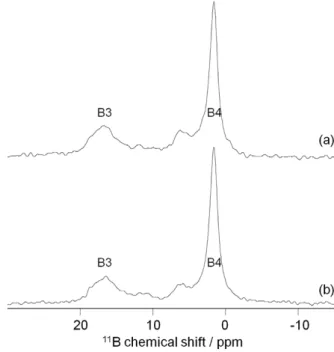
MAS NMR performed at high field (18.8 T) readily resolves the B3
and B4 signals in L. glaciale (Figure 2). In addition to the main B3
(18 ppm) and B4 (2 ppm) signals, a third resonance at 6 ppm can be
observed, indicating that a second B4 species is present at low
amount inside the samples. In L. glaciale with and without
epithe-lium present, boron in the trigonal form (B3) accounts for around
30% of the boron present and B3 is thus present in the calcified high
Mg skeleton (Table 1). Boron in the tetragonal forms (B4) account
for around 70% with 64% originate from the major B4 unit at 2 ppm
and 6% from the minor B4 unit at 6 ppm. This finding indicates that
the assumption of only tetrahedral boron (B4) being incorporated
into biogenic carbonates required for pH reconstruction is not met
on a whole-branch scale in coralline algae, since it is clear that a
significant amount of trigonal boron (B3) is present. This
incorpora-tion of a significant proporincorpora-tion of B3 has occurred in L. glaciale from
Loch Sween where the mean annual pH is 8.10. In these conditions,
the proportion of B3 to B4 in seawater is around 4:1
6,817. Thus, the
proportion of B3 in L. glaciale does not reflect the direct proportion
of B3 relative to B4 in seawater, B4 being majority incorporated into
the skeleton. Importantly, lower pH in ocean acidification conditions
would increase the proportion of B3 to B4 in seawater.
Discussion
A primary assessment of the pH-reconstruction assumption that
boron is incorporated into coralline algae solely in the tetrahedral
(B4) form was made using powdered whole branches. Both trigonal
and tetrahedral boron were present; had high-field NMR indicated
that all boron was in the tetrahedral form, then L. glaciale could then
be used in bulk powdered form to determine past oceanic pH. Boric
acid is not localised just in the epithelium, but is present in the high
Mg skeleton as well. The presence of B3 was already observed in
corals and in foraminifera
9,19. This presence could account for some
of the vital effects in the boron isotopic compositions of
biocarbo-nates, together with an elevation of pH at the sites of calcification
28.
Indeed, some species of coralline algae can increase their internal pH
up to 0.5 pH units in light conditions
29It is clear that a bulk approach
cannot be pursued for pH reconstruction and likely indicates that
spatially non-selective analysis of within growth band CaCO
3may
also be sampling both B3 and B4. To account for the presence of B3, it
is possible to adjust calculations allowing for a 30% B3 presence.
However, prior to this, four further checks should be conducted:
1.
Test boron composition in other coralline algal species to
deter-mine whether L. glaciale portrays the exception or the rule.
2.
Skeletal spatially-specific testing of L. glaciale and other
cor-alline algal species investigating winter and summer growth
bands separately since the faster growth rate of summer growth
and slower winter growth may result in different rates of B3
incorporation. Faster growth rates in summer occur in tandem
with more Mg incorporation
18and this could be associated with
more or less B3 incorporation. Slow winter growth may exclude
B3 and thus the calcite deposited during winter may provide a
more ideal pH proxy. Understanding this is critical in the light
of observations in other organisms where B3 incorporation is
not uniform throughout biomineral structures e.g. as in corals
10.
3.
Quantification of B3 incorporation in L. glaciale grown in
dif-ferent pH environments to determine any pH-depended
vari-ation in B3 incorporvari-ation to determine whether B3 is
incorporated directly into the skeleton or if B4 is modified to
B3 after boron incorporation as suggested by
27.
4.
Measurement of d
11B to test if B3 is incorporated from seawater
or is due to a change of B4 after the carbonate precipitation as
proposed by
27.
Species-specific boron compositions and within-skeleton special
distributions of boron are determined for multiple species of
Figure 1
|
Thallus and branch of maerl,Lithothamnion glaciale.(a) Thallus of Lithothamnion glaciale (scale bar 51 cm), (b) transverse section through a L. glaciale branch tip indicating regular banding (scale bar 51.5 mm).
Figure 2
|
Magnetic angle spinning nuclear magnetic resonance spectraofLithothamnion glaciale. High field (18.8 T)11B MAS-NMR analyses of
two samples of powdered L. glaciale (a) with and (b) without epithelium, indicating trigonal (B3) and tetrahedral (B4) boron.
www.nature.com/scientificreports
coralline algae. This will enable site selective boron analyses to be
conducted validating coralline algae as palaeo-pH proxies based on
boron isotopic compositions.
Methods
Duplicate specimens of a single species of free-living red coralline algae, Lithothamnion glaciale were collected from Loch Sween, Scotland 56u01.99’N, 05u36.13’W from 5 m depth using SCUBA. Annual temperature range at the col-lection site is 6–17uC and average pH is 8.10 (measured in situ with YSI EXO2 Sonde equipped with pH probe which was calibrated monthly and drift adjusted).
Branches of two air-dried specimens were brushed to remove any ground in material and powdered using a Retsh MM400 ball mill. One thallus was crushed with the outer epithelium in place while the second thallus had the epthelium removed using a sanding drill (Dremmel Tool) prior to crushing.
11B magic angle spinning nuclear magnetic resonance (MAS-NMR) experiments were
carried out at 256.71 MHz on a Bruker Avance III spectrometer. A 3.2 mm probehead, operating at a spinning frequency of 20 kHz and equipped with a VespelH stator (avoiding the presence of probe background signal in the11B NMR experiments) has been used. The
spectra were acquired with 0.5 ms pulse length (10u pulse angle) and 700 k transients separated by a 0.2 s recycle delay, leading to a complete measuring time of 40 hours. The trigonal (B3) to tetrahedral (B4) ratios were directly extracted from the spectra by standard signal integration and errors were determined from noise signal integration.
1. Orr, J. C. et al. Anthropogenic ocean acidification over the twenty-first century and its impact on calcifying organisms. Nature 437, 681–686, doi:10.1038/ nature04095 (2005).
2. Hemming, N. G. & Hanson, G. N. Boron isotopic composition and concentration in modern marine carbonates. Geochim Cosmochim Acta 56, 537–543, doi:10.1016/0016-7037(92)90151-8 (1992).
3. Spivack, A. J., You, C. F. & Smith, H. J. Foraminiferal boron isotope ratios as a proxy for surface ocean pH over the past 21 Myr. Nature 363, 149–151, doi:10.1038/363149a0 (1993).
4. Yu, J., Elderfield, H. & Hoenisch, B. B/Ca in planktonic foraminifera as a proxy for surface seawater pH. Paleoceanography 22 doi:Pa220210.1029/2006pa001347 (2007). 5. Kasemann, S. A., Schmidt, D. N., Bijma, J. & Foster, G. L. In situ boron isotope
analysis in marine carbonates and its application for foraminifera and palaeo-pH. Chem Geol 260, 138–147, doi:10.1016/j.chemgeo.2008.12.015 (2009). 6. Yu, J., Foster, G. L., Elderfield, H., Broecker, W. S. & Clark, E. An evaluation of
benthic foraminiferal B/Ca and delta B-11 for deep ocean carbonate ion and pH reconstructions. Earth Planet Sci Lett 293, 114–120, doi:10.1016/
j.epsl.2010.02.029 (2010).
7. Rollion-Bard, C. & Erez, J. In situ boron isotopic measurements in cultured foraminifera: Implications for delta B-11 vital effects. Geochim Cosmochim Acta 74, A879–A879 (2010).
8. Rae, J. W. B., Foster, G. L., Schmidt, D. N. & Elliott, T. Boron isotopes and B/Ca in benthic foraminifera: Proxies for the deep ocean carbonate system. Earth Planet Sci Lett 302, 403–413, doi:10.1016/j.epsl.2010.12.034 (2011).
9. Henehan, M. J. et al. Calibration of the boron isotope proxy in the planktonic foraminifera Globigerinoides ruber for use in palaeo-CO2reconstruction. Earth
Planet Sci Lett 364, 111–122, doi:10.1016/j.epsl.2012.12.029 (2013).
10. Rollion-Bard, C. et al. Boron isotopes as pH proxy: A new look at boron speciation in deep-sea corals using11B MAS NMR and EELS. Geochim Cosmochim Acta 75,
1003–1012, doi:10.1016/j.gca.2010.11.023 (2011).
11. Dissard, D. et al. Light and temperature effects on d11B and B/Ca ratios of the
zooxanthellate coral Acropora sp.: results from culturing experiments. Biogeosciences 9, 4589–4605, doi:10.5194/bg-9-4589-2012 (2012).
12. Anagnostou, E., Huang, K. F., You, C. F., Sikes, E. L. & Sherrell, R. M. Evaluation of boron isotope ratio as a pH proxy in the deep sea coral Desmophyllum dianthus: Evidence of physiological pH adjustment. Earth Planet Sci Lett 349, 251–260, doi:10.1016/j.epsl.2012.07.006 (2012).
13. Reynaud, S., Hemming, N. G., Juillet-Leclerc, A. & Gattuso, J. P. Effect Of pCO(2) and temperature on the boron isotopic composition of the zooxanthellate coral Acropora sp. Coral Reefs 23, 539–546, doi:10.1007/s00338-004-0399-5 (2004). 14. Honisch, B. et al. Assessing scleractinian corals as recorders for paleo-pH:
Empirical calibration and vital effects. Geochim Cosmochim Acta 68, 3675–3685, doi:10.1016/j.gca.2004.03.0026 (2004).
15. Joachimski, M. M., Simon, L., van Geldern, R. & Lecuyer, C. Boron isotope geochemistry of Paleozoic brachiopod calcite: Implications for a secular change in the boron isotope geochemistry of seawater over the Phanerozoic. Geochim Cosmochim Acta 69, 4035–4044, doi:10.1016/j.gca.2004.11.017 (2005).
16. Penman, D. E., Hoenisch, B., Rasbury, E. T., Hemming, N. G. & Spero, H. J. Boron, carbon, and oxygen isotopic composition of brachiopod shells: Intra-shell variability, controls, and potential as a paleo-pH recorder. Chem Geol 340, 32–39, doi:10.1016/j.chemgeo.2012.11.016 (2013).
17. Lecuyer, C., Grandjean, P., Reynard, B., Albarede, F. & Telouk, P. B-11/B-10 analysis of geological materials by ICP-MS Plasma 54: Application to the boron fractionation between brachiopod calcite and seawater. Chem Geol 186, 45–55, doi:Pii s0009-2541(01)00425-910.1016/s0009-2541(01)00425-9 (2002). 18. Kamenos, N. A., Cusack, M. & Moore, P. G. Coralline algae are global
palaeothermometers with bi-weekly resolution. Geochimica et Cosmochimica Acta. 72, 771–779 (2008).
19. Kamenos, N. A. North Atlantic summers have warmed more than winters since 1353, and the response of marine zooplankton. Proceedings of the National Academy of Sciences 107, 22442–22447, doi:10.1073/pnas.1006141107 (2010). 20. Darrenougue, N., De Deckker, P., Payri, C., Eggins, S. & Fallon, S. Growth and
chronology of the rhodolith-forming, coralline red alga Sporolithon durum. Mar Ecol Prog Ser 474, 105-119, doi:10.3354/meps10085 (2013).
21. Hershey, J. P., Fernandez, M., Milne, P. J. & Millero, F. J. The Ionization of Boric Acid in NaCl, Na-Ca-Cl AND Na-Mg-Cl Solutions at 25 Degrees C. Geochim Cosmochim Acta 50, 143-148, doi:10.1016/0016-7037(86)90059-1 (1986). 22. Klochko, K., Kaufman, A. J., Yao, W., Byrne, R. H. & Tossell, J. A. Experimental
measurement of boron isotope fractionation in seawater. Earth Planet Sci Lett 248, 276–285, doi:10.1016/j.epsl.2006.05.034 (2006).
23. Xiao, J., Jin, Z. D., Xiao, Y. K. & He, M. Y. Controlling factors of the delta B-11-pH proxy and its research direction. Environmental Earth Sciences 71, 1641–1650, doi:10.1007/s12665-013-2568-8 (2014).
24. Pagani, M., Lemarchand, D., Spivack, A. & Gaillardet, J. A critical evaluation of the boron isotope-pH proxy: The accuracy of ancient ocean pH estimates. Geochim Cosmochim Acta 69, 953–961, doi:10.1016/j.gca.2004.07.029 (2005).
25. Liu, Y. et al. Instability of seawater pH in the South China Sea during the mid-late Holocene: Evidence from boron isotopic composition of corals. Geochim Cosmochim Acta 73, 1264–1272, doi:10.1016/j.gca.2008.11.034 (2009). 26. Douville, E. et al. Abrupt sea surface pH change at the end of the Younger Dryas in
the central sub-equatorial Pacific inferred from boron isotope abundance in corals (Porites). Biogeosciences 7, 2445–2459, doi:10.5194/bg-7-2445-2010 (2010). 27. Klochko, K., Cody, G. D., Tossell, J. A., Dera, P. & Kaufman, A. J. Re-evaluating
boron speciation in biogenic calcite and aragonite using B-11 MAS NMR. Geochim Cosmochim Acta 73, 1890–1900, doi:10.1016/j.gca.2009.01.002 (2009). 28. Rollion-Bard, C., Chaussidon, M. & France-Lanord, C. Biological control of
internal pH in scleractinian corals: Implications on pH and paleo-temperature reconstructions. Comptes Rendus Geoscience 343, 387–396 (2011). 29. Hurd, C. L. et al. Metabolically induced pH fluctuations by some coastal calcifiers
exceed projected 22nd century ocean acidification: a mechanism for differential susceptibility? Global Change Biology 17, 3254–3262, doi:10.1111/j.1365-2486.2011.02473.x (2011).
Acknowledgments
We thank Stephen Wimperis and Smita Odedra of the School of Chemistry, University of Glasgow for carrying out preliminary NMR analyses. GT acknowledges the financial support of TGIR-RMN-THC Fr3050 CNRS.
Author contributions
M.C. and N.A.K. conceived the project, N.K. prepared the samples, C.R.-B. And G.T. conducted the NMR analyses, N.K. prepared Figure 1 and G.T. prepared Figure 2, M.C. wrote the main manuscript and all authors contributed to the final manuscript.
Additional information
Competing financial interests:The authors declare no competing financial interests. How to cite this article:Cusack, M., Kamenos, N.A., Rollion-Bard, C. & Tricot, G. Red coralline algae assessed as marine pH proxies using11B MAS NMR. Sci. Rep. 5, 8175;
DOI:10.1038/srep08175 (2015).
This work is licensed under a Creative Commons Attribution-NonCommercial-ShareAlike 4.0 International License. The images or other third party material in this article are included in the article’s Creative Commons license, unless indicated otherwise in the credit line; if the material is not included under the Creative Commons license, users will need to obtain permission from the license holder in order to reproduce the material. To view a copy of this license, visit http:// creativecommons.org/licenses/by-nc-sa/4.0/
Table 1 | Proportion of trigonal (B3) and tetrahedral (B4) boron in Lithothamnion glaciale with (1) and without (-) epithelium
L. glaciale B3 (%) B4 (%)
(a) 1 epithelium 30.3 6 4.3 (62.7 1 7.0) 6 4.3
(b) - epithelium 27.7 6 4.6 (66.5 1 5.8) 6 4.6