Publisher’s version / Version de l'éditeur:
Vous avez des questions? Nous pouvons vous aider. Pour communiquer directement avec un auteur, consultez la
première page de la revue dans laquelle son article a été publié afin de trouver ses coordonnées. Si vous n’arrivez pas à les repérer, communiquez avec nous à [email protected].
Questions? Contact the NRC Publications Archive team at
[email protected]. If you wish to email the authors directly, please see the first page of the publication for their contact information.
https://publications-cnrc.canada.ca/fra/droits
L’accès à ce site Web et l’utilisation de son contenu sont assujettis aux conditions présentées dans le site LISEZ CES CONDITIONS ATTENTIVEMENT AVANT D’UTILISER CE SITE WEB.
Housing Note (National Research Council of Canada. Division of Building
Research); no. HN-31, 1969-10-01
READ THESE TERMS AND CONDITIONS CAREFULLY BEFORE USING THIS WEBSITE. https://nrc-publications.canada.ca/eng/copyright
NRC Publications Archive Record / Notice des Archives des publications du CNRC :
https://nrc-publications.canada.ca/eng/view/object/?id=e4963007-af9c-444d-9754-cc08c456bddc
https://publications-cnrc.canada.ca/fra/voir/objet/?id=e4963007-af9c-444d-9754-cc08c456bddc
NRC Publications Archive
Archives des publications du CNRC
This publication could be one of several versions: author’s original, accepted manuscript or the publisher’s version. / La version de cette publication peut être l’une des suivantes : la version prépublication de l’auteur, la version acceptée du manuscrit ou la version de l’éditeur.
Access and use of this website and the material on it are subject to the Terms and Conditions set forth at
Heat Losses from House Basements
Latta, J. K.; Boileau, G. G.
Ser
NA7110
~ 2 1 h 8
no.
31
c.2
BLDG
NATIONAL R E S E A R C H COUNCIL O F CANADA
DIVISION O F BUILDING R E S E A R C H
HOUSING N O T E NO.
31HEAT LOSSES FROM
HOUSE BASEMENTS
b y J . K L a t h and G.G. B o i l e a u
Reprinted from C a n a d i a n B u i l d i n g
Vol. XIX, No.
10,October 1 9 6 9
p.
3 9
-
42.O t t a w a , O c t o b e r 1 9 6 9
This Note may be reprinted without amendment provided acknowledgment is given to Canadian Building
Heat losses from house basements
where necessary.
Heat losses through the portion of the basement wall above grade can be calculated in the same ,manner as those f o r any other above-grade wall, taking into a,ccount both ,conduction and air leakage; although special note should be taken of the air leakage be- tween the basement wall and the sill plate. Below grade it is normal t o adopt a uniform heat loss per square foot of wall o r floor, based o n empiri- cal values. Such values give n o indica- tion of the greater heat loss through the wall near the ground surface rela- tive to that through the lower parts. Thus they cannot be used t o estimate the depth below grade to which it is
economical t o carry insulation. It has been shown (1) that heat loss through the soil surrounding a house basement can be calculated o n the ba- sis of steady-state heat flow round concentric circular paths centred o n the intersection of the ground s,urface and the basement wall. F o r the floor these paths are continued around cir- cular arcs centred o n the intersection of the basement floor and wall (Fig- ure 1).
Walls Below Grade
T h e heat loss per square foot for a 1 F degree temperature difference be- tween the basement temperature and the external temperature is given in Table I f o r uninsulated concrete walls and for those t o which 1, 2 o r 3 in. of insulation have 'been added. A n aver- age value of 0.8 Btu/(hr) (ft) (OF) has been assumed for the conductivity of soil, and insulation is assumed t o have a coefficient of conductivity of 0.24 Btu/(hr)(ft2 )(OF/in). I t should be noted in passing that it is the conven- tion to quote the conductivity of soils for 1-ft thickness and not for 1-in. thickness as for other building materi- als.
Basement Floors
I t is possible t o calculate the heat loss through the 'basement floor for each square foot in the same way as the heat loss for the wall, using longer heat flow paths around the arcs of two circles (see Figure 1). It may be seen from Table I, however, that the heat loss from the 7th foot of the un- insulated basement wall is only a
small fraction of the total loss through the wall; thus it can readily be appreciated that (with the much longer heat flow path) the loss through each square foot of basement floor rapidly becomes a negligible part of the total basement heat loss. I t is reasonable, therefore, to take an av- erage value f o r the loss through the basement floor. This value can be multiplied by the floor area to give the total floor heat loss.
T h e average rate of heat loss through the floor may ,be taken as equal to that from a point located one quarter of the basement width from the side wall. T h e path length from this point varies with both depth of basement below grade and width of basement. Shallow narrow basements will have higher heat loss per square foot than will deep wide basements. Typical values are given in Table 11.
T h e heat loss from the below-grade portion of the ,basement per F degree temperature difference can be esti- mated using the figures given in Ta- bles I and 11. For the wall. the values for heat loss through each square foot
are selected from Table I, added to- gether, and the total multiplied by the perimeter of the house. For the floor, the average heat loss per square foot is estimated from Table I1 and multiplied by the floor area. The re- sulting two values may then be added together and multiplied by the appro- priate design temperature difference to give the maximum rate of heat loss from that portion of the basement be- low grade.
Design Temperatures
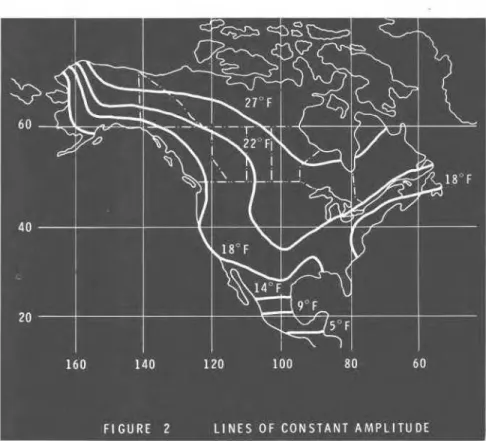
Selecting the appropriate design temperature difference poses some- thing of a problem. Although the in- ternal design temperature is given by the air temperature in the basement, none of the usual external design air temperatures are applicable because of the heat capacity of the soil mass. On the other hand, it can be shown that the ground surface temperature will fluctuate about a mean value (T,,,) by an amplitude A, which will vary with geographic location and surface cover. Thus suitzible external design temperature will be given by subtracting A for the location *from the mean annual air temperature T, which is usually 4 to 6 F deg colder than T,,,. Table 111 gives values of T,, T, and A and of the external design temperature (T, -A) for var- ious locations in Canada under natu- ral snow conditions.
Values for T, can be obtained from the meteorological records, and for A can be estimated from Table 111 and the map given in Figure 2. This map is part of one prepared ,by Jen- H u Chang (2) giving annual ranges in ground temperature at a depth of 10 cm (4 in.).
Below-grade Heat Loss in Relation to Total House Loss
The ,fraction of total heat loss rep- resented by heat loss below grade will vary with the design of the house. As an indication of what it might be, heat losses both above and below grade are given in Table IV for a typ- ical bungalow of about 1050 sq ft in plan area.
The walls are stud frame with brick veneer and have 3 in. of mineral wool batt insulation, as does the ceiling; ap- proximately 2 ft-3 in. of basement wall is exposed above grade. For pur- poses of comparison with an uninsu- lated basement, the effect of eliminat- ing air leakage between the concrete
TABLE I
Depth (ft)
HEAT LOSS BELOW GRADE: Btu/ (hr) (OF) (ft2) Insulation with k = 0.24 Btu/ (hr) (ftP) ('F/in)
= 0.02 Btu/ (hr) (ft) (OF) Soil k = 0.8 Btu/ (hr) (ft) (OF) Path Length Heat Loss through Soil 1-in. 2-in.
l f t ) Uninsulated Insulation Insulation
3-in. Insulation
TABLE I I
MEAN BASEMENT FLOOR HEAT LOSS: Btu/ (hr) (OF) (ft2)
-
Depth of Foundation Width of HouseWall below Gmde 2 0 24 2 8 3 2 (ft) I f t ) l f t ) ( f t l (ft)
TABLE I l l
EXTERNAL DESIGN TEMPERATURES
Place T. (OF) T, (OF1
Swift Current, Sask. . . . 38.5 Guelph, Ont. . . . 44.6 Ottaka, Ont. . . . 42.0 Toronto, Ont. . . . 47.7 Ste. Anne de la Pocatiere, Que. . . . 39.5 Fredericton, N.B. . . . 4 1.6 Charlottetown, P.E.I. . . . 43.1 St. John's, Nfld. . . . 40.5 Saskatoon, Sask. . . . 35.7
HEAT LOSS CALCULATION (for portion of basement below grade)
C ~ n s i d e r a basement 28 ft wide by 30 ft long, sunk 6 ft below grade, with 2-in. insulation applied t o the top 2 ft of wall below grade. Assume an internal air temperature of 7 0 ° F and an external design temperature
(T, -A) of 20°F.
Wall (Using Table I):
1st ft below grade
. . .
0.093 2nd ft below grade. . .
0.079 3rd ft below grade. . .
0.155 4th ft below grade. . .
0.119 5th ft below grade. . .
0.096. . .
6th ft below grade 0.079-
. . .
Total per ft length of wall 0.621 Btu/(hr) (OF) Basement perimeter
. . .
= 2(28+
30) = 11 6 ft. . .
Total wall heat loss = 0.62 x 116 = 71.92 Btu/(hr) (OF) say 72 Btu/(hr) (OF)
Floor (Using Table 11):
Average heat loss per sq ft
. . .
= 0.025 Btu/(hr) (OF) Floor area 28 x 30. . .
= 840 sq ft Total floor heat loss. . .
= 0.025 x 840 = 21 Btu/(hr) (OF) Total basement heat loss below grade = 72+
21 = 93 Btu/(hr) ( O F )Design temperature difference
. . .
= 70-
20 = 5 0 ° FHence, the maximum rate of heat loss from the below-grade basement
heat flow path shown in Figure I. This path is, however, already a long one, and adding insulation (which may be considered the equivalent of lengthening it) will not have any marked effect. Furthermore, the use of insulation ,under the floor is ren- dered ineffective by two other factors. One, the high heat capacity of a floor will produce a sensation of cold until the body has remained stationary on that part of the floor long enough to warm it; and second. once the heat reaches a layer of high conductivity it
can flow laterally, increasing the amount of material to be warmed.
It is clear that in order to prevent a basement floor from feeling cold it is necessary to restrict the flow of heat from the body into the floor. This re- quires that an insulating material be placed between the body and the first layer of material that is of high con- ductivity. The most economical way for an adult to provide the necessary insulation is to wear thicker soled footwear. For children who may play
TABLE IV
HEAT LOSSES FROM A TYPICAL BUNGALOW
on the floor this is not a practical so- lution and some form of carpeting should 'be provided. If there should be a problem of moisture rising through the floor. then the type of carpeting must be chosen with care.
Position of Insulation
In calculating heat loss the effect of insulation is allowed for by convert- ing it to an equivalent thickness of soil. As far as total heat loss is con- cerned it makes no difference where
Totally Uninsulated House Above Above Below
First Floor Grade Grade Tronsmission . . . 21330 Infillrotion . . . 71 70 Infiltration at s i l l . . . . 5600 Transmission ( a ) header . . . 2020 ( b ) concrete wall . . 990 6470 ( c ) floor . . . 1500 Basement windows ( a ) transmission .
.
1440 ( b ) infiltration . . . . 31 80 A Bc
Sub-totols . . . 28500 22140 7970 Total heat loss. . .
Basement uninsulated (A+B+C)
Sill caulked and insulation to grade (A+Do+Eo) . . . . . . Sill caulked and insulation to 1 ft below grade (A+DI+EI)
. . . Sill caulked ond insulation to 2 f t below grade (A+Dz+Ez) Soving
Basement
Insul. to Grade Insul. to 1 ft below and S i l l Caulked Grade and S i l l Caulked Above Below Above Below Grade Grade Grade Grade
. . . 12500 Btu/hr 14030 Btu/hr (21.2 per cent) (23.9 per cent)
Insul. to 2 ft below Grade and Sill Caulked
Above Below Grade Grade
1 5050 Btu / hr (25.6 per cent)
along the heat flow path this added length is inserted, and insulation laid on the surface of the ground is just as effective as the same amount placed on the inside surface of the wall. The temperature conditions in the wall and the soil will, however, be affected because everything outside the insula- tion will 'become colder.
Applying insulation to the inside face of the wall makes both the wall and the soil colder. The cold wall makes an air barrier in the room fin- ish highly desirable to prevent any possibility of condensation on the wall behind the finish from convective air movement from the room into any cold spaces. The lower temperatures in the soil may also pose problems of frost heave, if the soil is ,frost suscep- tib!e, and of plant growth with some types of plants. Moving the insulation to the outside of the ,basement wall solves the problem of condensation in the room by keeping the wall warm, but it makes no difference to the soil
temperature. The insulation, if of foamed plastic, needs no protection below grade, but near and above the surface it must be covered to protect it from damage and for aesthetic rea- sons. Should there be any frost heave this ,covering may be damaged. Lay- ing the insulation horizontally just be- low the ground surface keeps the soil warm and thus solves the frost heave problem, but it requires that only shallow rooted plants 'be planted in the thin layer of soil above it.
Conclusion
Heat losses from a house ,basement above grade can be calculated by the normal methods for walls and below grade by similar steady-state methods assuming circular heat flow paths through the soil. Insulation o n the basement wall above grade is just as important as ,for any other wall above grade and care should be taken to prevent air leakage through the crack between the top of the concrete wall
and the sill plate. The insulation should be carried down at least 1 to 2
f t below the grade line, but thereafter it (becomes af progressively less val,ue and may be difificult to justify eco- nomically. Insulation below the floor has no value and carpeting or other low cond,uctivity floor finish should be used to counteract the sensation of a cold floor.
References
1. Boileau, G. G. and Latta, J. K. Calculation of Basement Heat Losses. National Research Council of Canada, Division of Building Research, NRC 10477, Dec. 1968. 2. Chang, Jen-Hu. Ground Tempera- ture. Vol. I and 11. Bluehill Mete- orological Observatory, Harvard University, 1958.
This paper is a contribution 'from the Division of Building Research, Na- tional Research Council of Canada, and is published with the approval of the Director of the Division.