Edited by:
Olivier Garraud, Institut National de la Transfusion Sanguine, France
Reviewed by:
Markus Bosmann, Gutenberg University Mainz, Germany Ganesan Ramesh, Georgia Regents University, USA Krishna Rajarathnam, University of Texas Medical Branch, USA
*Correspondence:
Mariagrazia Uguccioni [email protected]
Specialty section:
This article was submitted to Inflammation, a section of the journal Frontiers in Immunology
Received: 25 February 2016 Accepted: 29 April 2016 Published: 19 May 2016 Citation:
Proudfoot AEI and Uguccioni M (2016) Modulation of Chemokine Responses: Synergy and Cooperativity. Front. Immunol. 7:183. doi: 10.3389/fimmu.2016.00183
Modulation of Chemokine
Responses: Synergy and
Cooperativity
Amanda E. I. Proudfoot
1and Mariagrazia Uguccioni
2*
1 Novimmune S.A., Geneva, Switzerland, 2 Laboratory of Chemokines in Immunity, Institute for Research in Biomedicine, Università della Svizzera italiana, Bellinzona, Switzerland
Chemokine biology is mediated by more complex interactions than simple
monomolecular ligand–receptor interactions, as chemokines can form higher order
quaternary structures, which can also be formed after binding to glycosaminoglycans
(GAGs) on endothelial cells, and their receptors are found as dimers and/or oligomers at
the cell surface. Due to the complexity of the chemokine binding and signaling system,
several mechanisms have been proposed to provide an explanation for the synergy
observed between chemokines in leukocyte migration. Pioneering studies on
interac-tions between different chemokines have revealed that they can act as antagonists, or
synergize with other chemokines. The synergism can occur at different levels, involving
either two chemokine receptors triggered simultaneously or sequentially exposed to their
agonists, or the activation of one type of chemokine receptor triggered by chemokine
heterocomplexes. In addition to the several chemokines that, by forming a
heterocom-plex with chemokine receptor agonists, act as enhancers of molecules of the same
fam-ily, we have recently identified HMGB1, an endogenous damage-associated molecular
patterns (DAMPs) molecule, as an enhancer of the activity of CXCL12. It is now evident
that synergism between chemokines is crucial at the very early stage of inflammation.
In addition, the low-affinity interaction with GAGs has recently been shown to induce
cooperativity allowing synergy or inhibition of activity by displacement of other ligands.
Keywords: chemokines, cell migration, synergy, oligomerization, glycosaminoglycan
CHeMOKineS AnD THeiR ReCePTORS
Chemokines are key regulators of leukocyte migration and function, playing fundamental roles
both in physiological and pathological immune responses, such as inflammatory diseases (
1
). The
chemokine system includes ~50 ligands, which engage a panel of over 20 chemokine receptors
in a promiscuous fashion, which are differentially expressed by all leukocytes and many
non-hematopoietic cells (
2
). Proper tissue distribution of distinct leukocyte subsets, under normal and
pathological conditions, is guaranteed by the resulting combinatorial diversity in cell responsiveness
to chemokines.
To mediate their activity chemokines bind to cell surface receptors which belong to the largest
branch of the γ subfamily of rhodopsin-like G protein-coupled receptors (GPCRs) (
3
), a receptor
superfamily which represents the most successful target of small molecule inhibitors for treating
diseases affecting different systems in modern pharmacology. All chemokine receptors couple to
heterotrimeric Gα
i-proteins and accordingly most responses can
be fully inhibited by treatment of cells with Bordetella pertussis
toxin. Today, a total of 19 signaling receptors have been identified:
7 CXCRs (CXCR1–6 and CXCR8), 10 CCRs (CCR1–10), CX3R3,
and CKR1. In addition, there are four “atypical” receptors that use
alternative signaling pathways, and act mainly by sequestering
and degrading the chemokines present in the
microenviron-ment (
4
). Thus, the ~50 chemokines outnumber their receptors
indicating that a receptor can bind more than one chemokine. In
addition, several chemokines can also bind to multiple receptors
(
2
,
5
). Novel findings indicate that polysialylation of CCR7, the
central chemokine receptor controlling immune cell trafficking
to secondary lymphatic organs, is essential for the recognition of
the CCR7 ligand CCL21 (
6
), and that the glycosylation pattern
of this receptor shapes receptor signaling (
7
), suggesting that this
further level of control might be shared with other chemokine
receptors.
CHeMOKine SYneRGY AnD
COOPeRATiOn
A vast range of in situ experiments, aimed at understanding
which chemokines are produced under specific circumstances,
has revealed that a variety of chemokines can be concomitantly
produced at the target sites of leukocyte trafficking and homing
(
8
–
12
). This renders the chemokine system a good target for
therapy and has promoted the search by pharmaceutical
compa-nies for small molecule chemokine antagonists (
13
–
16
). While we
understand the effects of different chemokines singly, much less
is known about the potential consequences of the concomitant
expression of multiple chemokines and their interaction with
other inflammatory molecules (
17
,
18
).
The suggestion that chemokines might have additional
regulatory mechanisms started with the identification of natural
chemokine antagonists. Many reports have demonstrated that
certain chemokines can also antagonize non-cognate chemokine
receptors, by altering agonist-induced signaling and abrogating
cellular responses via several mechanisms, including occupancy
of the chemokine receptor-binding pocket or signaling through
Rac-2 (
19
–
24
).
The studies on possible regulatory mechanisms continued when
three reports showed that chemokines can synergize to enhance
leukocyte functions in response to chemoattractants. The first
described a bovine chemokine, regakine 1 that induces enhanced
neutrophil migration when combined with CXCL7, CXCL8,
and C5a. The receptor or the mechanism of regakine-1-induced
synergism is not known. Competition with labeled C5a for
bind-ing to neutrophils or receptor-transfected cell lines demonstrated
that regakine 1 does not alter receptor recognition. The protein
kinase inhibitors 2′ amino 3′ methoxyflavone (PD98059),
wort-mannin, and staurosporine had no effect on the synergy between
C5a and regakine 1 (
25
). The second study showed that migration
of natural IFN-producing cells, a subpopulation of murine and
human lymphocytes, to the CXCR3 agonists requires
stimula-tion of CXCR4 by CXCL12. The mechanism by which CXCL12
induces enhanced migration in response to CXCR3 agonists is yet
unknown. CXCL12 does not upregulate the expression of CXCR3
and does not increase the affinity of CXCR3 for its agonists (
26
).
The third report (
27
) showed the same enhanced migration, on
human plasmacytoid dendritic cells, in response to CXCR3
ago-nists induced by stimulation with CXCL12 as observed by Krug
et al. (
26
). These reports undoubtedly indicate, as for the natural
antagonist chemokines, that it is necessary to carefully analyze
the effects that the concomitant expression of chemokines can
have on cell functions and to elucidate the molecular mechanisms
governing cell activities at sites of inflammation. Synergism can
thus occur at different levels, involving either two chemokine
receptors triggered simultaneously or sequentially exposed to
their agonists (
26
–
30
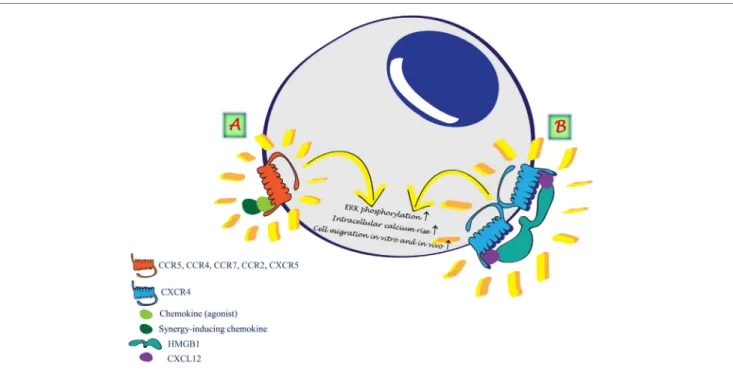
). We have identified a further mechanism by
which chemokines, forming chemokine heteromeric complexes,
can activate one type of chemokine receptor (Figure 1A) (
31
):
(i) CXCL13 enhances CCL19 and CCL21 triggering of CCR7
(
32
); (ii) CXCL10 enhances CCL22 triggering of CCR4 (
33
); (iii)
CCL19 and CCL21 enhance the activity of CCR2 ligands and
protect them from degradation (
34
); and (iv) CXCL9 enhances
migration induced by CXCL12 on CXCR4
+/CXCR3
−malignant
B cells (
35
). Other groups have also shown that the synergism
between a chemokine agonist and a non-ligand chemokine can
enhance the activity of selective chemokine receptors (
36
–
40
).
Chemokines have a second important interaction with cell
surface expressed glycosaminoglycans (GAGs), which mediates
their immobilization on the endothelial surface in order to
pro-vide their directional signal (
41
–
43
). This interaction was shown
to be essential for their ability to recruit cells in vivo by the loss
of activity of chemokine variants, which had abrogated
GAG-binding capacity (
44
). Without the interaction with endothelial
GAGs, most chemokines would be washed away from the local
production site, especially under flow conditions, diluted to
a concentration below the threshold required for binding, and
distributed uniformly throughout the vasculature such that no
localized chemotactic signal is generated for leukocytes to allow
directional mobilization. Furthermore, differential binding to
GAGs plays an important role in localization. Neutrophil
recruit-ment to the lung is greater in response to chemokines that bind
GAGs less strongly. This was demonstrated both by mutants of
CXCL8 with abrogated GAG binding as well as comparison of
another neutrophil chemoattractant, CXCL1. Although increased
recruitment was postulated to be mediated by the stronger GAG
binder, lower binding capacity resulted in enhanced recruitment,
demonstrating that the tissue microenvironment plays a pivotal
role in the spatial formation of chemokine gradients and defining
GAGs functions (
45
,
46
).
Recently, binding to cell surface GAGs has identified more
subtle roles in chemokine biology, where competitive binding of
chemokines to GAGs can either induce cooperative enhancement
of activity or inhibition of activity by displacement of certain
chemokines. Cooperative enhancement has been demonstrated
for both classical receptors as well as atypical or non-signaling
receptors such as CCX-CKR/ACKR4 (
47
). In both cases,
com-petitive displacement of the chemokines from GAGs was shown
to be responsible for the effects, using modified chemokines
lack-ing the GAG-bindlack-ing sequence. The competitive displacement is
limited to chemokines which bind GAGs strongly such as CCL11,
FiGURe 1 | Synergism induced by the formation of heterocomplexes. (A) Heterocomplex formed between two chemokines renders the agonist more potent on the selective receptor. (B) HMGB1 forms a heterocomplex with CXCL12 enhancing CXCL12 potency on CXCR4.
CXCL12, and CXCL13, compared with low-affinity binders, such
as CCL3 and CCL4, being unable to induce this synergy.
A similar phenomenon was observed for CCL18, an
interest-ing chemokine in that is has been shown to be unregulated in
many pathological conditions, yet its receptor remained elusive
until it was shown recently to activate CCR8 (
48
). Moreover,
CCL18 is always present at considerably higher concentrations
in the circulation than most chemokines, and it was shown to
displace certain chemokines bound to heparin (
49
). This
prop-erty led to the hypothesis that it could prevent the recruitment
of leukocytes by these chemokines by removing them from the
endothelial surface.
Since chemokine cooperativity via GAG binding would
allow chemokines to activate their cognate receptors at lower
chemokine concentrations, it is likely that in vivo, this
phenom-enon would extend the range from which chemokines can induce
recruitment of leukocytes (
50
). GAG binding and/or formation
of heterocomplexes can definitively contribute to the fine-tuning
modulation of chemokine activities occurring in vivo.
It is well established that many chemokines exist in equilibrium
between the monomeric and dimeric state, and even as higher
order oligomers (
51
–
53
). It is therefore clear that chemokine
biol-ogy is more complex than simple monomolecular ligand–receptor
interactions. It has been shown in vitro that the quaternary
struc-ture of chemokines influences the affinity of binding to GAGs (
54
,
55
). Moreover, in vitro studies have suggested that dimerization
may also occur after binding to GAGs on endothelial cells (
56
). In
fact, this phenomenon is essential for certain chemokines in vivo
since obligate monomers of the proinflammatory chemokines,
CCL2, CCL4, and CCL5, are unable to recruit cells when injected
into the peritoneal cavity (
44
).
It is however important to note that alterations in GAG
com-position can occur in several pathological conditions (
57
–
59
).
In addition, chemokine receptors can be found as dimers and/
or oligomers at the cell surface (
60
–
62
). Due to the complexity of
chemokine binding and signaling (
63
), several mechanisms have
been proposed to provide an explanation for synergy between
chemokines in leukocyte migration. It is now evident that the
synergism between chemokines is crucial at the very early stage
of inflammation, as in vivo disruption of pro-atherogenic
heter-omers of CCL5 and CXCL4 resulted in a significant decrease in
atherosclerotic lesion formation (
38
,
64
). Moreover, disruption
of the heteromers, formed between CCL5 and the α-defensin
HNP1, attenuated monocyte and macrophage recruitment in
a mouse model of myocardial infarction (
65
). On the contrary,
the study of the role of synergy-inducing chemokines in the
tumor microenvironment is at its infancy, as it has been shown
in vitro that the distinct co-expression of B and T cell attractant
chemokines, present in the tumor microenvironment, control cell
trafficking of both tumor-infiltrating lymphocytes and malignant
B cells (
35
).
CHeMOKineS AnD DAMPs
Under inflammatory conditions, the cross talk between different
molecules plays a crucial role in reaching the balance in tissue
regeneration. A complete system for the detection, containment,
and repair of damage caused to cells in the organism requires
warning signals for the cells to respond. These warning signals
are called endogenous damage-associated molecular patterns
(DAMPs) or alarmins. In addition to the several chemokines that
act as enhancers of molecules of the same family, by forming a
heterocomplex with chemokine receptor agonists, we have recently
identified HMGB1, an alarmin, as an enhancer of the activity
of CXCL12 (Figure 1B) (
66
–
68
). The heterocomplex HMGB1/
CXCL12 can be disrupted with a specific molecule, glycyrrhizin,
which inhibits cell influx into the injured tissue. This indicates that
a number of components, in addition to the direct activation of the
receptor via a selective agonist, can regulate chemokine functions
via a direct interaction with chemokines or chemokine receptors.
Multiple chemokines within inflamed tissues selectively enhance
each other’s migratory functions, depending on their
concentra-tions, proximity, and simultaneous exposure to leukocytes. The
mechanisms underlying the involvement of endogenous DAMPs
in chronic diseases are still largely unexplored, and the interaction
with other molecules might be a possible approach to understand
their targets and functions. The interaction between chemokines
and inflammatory molecules needs to be taken into account when
chemokine cleavage by proteolysis, or chemokine degradation by
atypical chemokine receptors, would be beneficial to achieve a
resolving microenvironment favorable for resolution of
inflam-mation by abrogating chemokine signals and the recruitment of
inflammatory cells (
69
). The heterocomplex HMGB1/CXCL12
was demonstrated to prevent CXCL12 degradation (
70
), similarly
to the observation that the complex CCL19/CCL7 prevents CCL7
degradation by the atypical receptor ACKR2 (
34
).
FUTURe PeRSPeCTiveS
The chemokine system remains a promising biological target
for the development of new therapeutic tools for the treatment
of immunological disorders. Nevertheless, drug discovery
programs have not yet produced successful drugs targeting the
chemokine system for the treatment of inflammatory diseases.
Most of the competitive chemokine receptor antagonists
devel-oped by all major pharma companies have been disappointingly
unsuccessful when tested in clinical trials (
71
), and as a matter of
fact, the only two small molecule inhibitors approved by the FDA
do not target inflammation. Taking into account GAGs-binding
properties, synergy induced by heterocomplexes formed with
non-ligand chemokines or inflammatory molecules, and the
possibility that the heterocomplexes might induce differential
signaling pathways, will certainly help in elaborating the
biol-ogy involved in this family and will surely contribute to the
successful development of inhibitors of the chemokine system
as therapeutics.
AUTHOR COnTRiBUTiOnS
All authors listed have made substantial, direct, and intellectual
contribution to the work and approved it for publication.
ACKnOwLeDGMenTS
Special thanks to Dr. Giorgia Brambilla Pisoni for her work in
transforming our data on the synergism into a visual figure.
FUnDinG
The authors would like to thank, for the support received for
the studies on the modulation of chemokines activities, the
Swiss National Science Foundation (3100A0-143718/1 and
141773-RM3 to MU); European Union’s Programs for research,
technological development and demonstration under grant
agreements INNOCHEM – LSHB-CT-2005-518167 (FP6),
DEC-VAC – LSHP-CT-2005-018685 (FP6), ADITEC – 280873 (FP7),
and TIMER – 281608 (FP7). Further support was obtained by the
San Salvatore Foundation, the Novartis Foundation (to MU), the
Helmut Horten Foundation, the Institute for Arthritis Research,
and the Gottfried and Julia Bangerter-Rhyner-Foundation.
ReFeRenCeS
1. Charo IF, Ransohoff RM. The many roles of chemokines and chemokine receptors in inflammation. N Engl J Med (2006) 354(6):610–21. doi:10.1056/ NEJMra052723
2. Bachelerie F, Ben-Baruch A, Burkhardt AM, Combadiere C, Farber JM, Graham GJ, et al. International Union of Pharmacology. LXXXIX. Update on the extended family of chemokine receptors and introducing a new nomen-clature for atypical chemokine receptors. Pharmacol Rev (2014) 66(1):1–79. doi:10.1124/pr.113.007724
3. Griffith JW, Sokol CL, Luster AD. Chemokines and chemokine receptors: positioning cells for host defense and immunity. Annu Rev Immunol (2014)
32:659–702. doi:10.1146/annurev-immunol-032713-120145
4. Vacchini A, Locati M, Borroni EM. Overview and potential unifying themes of the atypical chemokine receptor family. J Leukoc Biol (2016). doi:10.1189/ jlb.2MR1015-477R
5. Zlotnik A. Chemokines and cancer. Int J Cancer (2006) 119(9):2026–9. doi:10.1002/ijc.22024
6. Kiermaier E, Moussion C, Veldkamp CT, Gerardy-Schahn R, de Vries I, Williams LG, et al. Polysialylation controls dendritic cell trafficking by regu-lating chemokine recognition. Science (2016) 351(6269):186–90. doi:10.1126/ science.aad0512
7. Hauser MA, Kindinger I, Laufer JM, Spate AK, Bucher D, Vanes SL, et al. Distinct CCR7 glycosylation pattern shapes receptor signaling and endocy-tosis to modulate chemotactic responses. J Leukoc Biol (2016). doi:10.1189/ jlb.2VMA0915-432RR
8. Agace WW, Amara A, Roberts AI, Pablos JL, Thelen S, Uguccioni M, et al. Constitutive expression of stromal derived factor-1 by mucosal epithelia and its role in HIV transmission and propagation. Curr Biol (2000) 10(6):325–8. doi:10.1016/S0960-9822(00)00380-8
9. Manzo A, Paoletti S, Carulli M, Blades MC, Barone F, Yanni G, et al. Systematic microanatomical analysis of CXCL13 and CCL21 in situ production and progressive lymphoid organization in rheumatoid synovitis. Eur J Immunol (2005) 35(5):1347–59. doi:10.1002/eji.200425830
10. Mazzucchelli L, Blaser A, Kappeler A, Scharli P, Laissue JA, Baggiolini M, et al. BCA-1 is highly expressed in Helicobacter pylori-induced mucosa-associated lymphoid tissue and gastric lymphoma. J Clin Invest (1999) 104(10):R49–54. doi:10.1172/JCI7830
11. Smith JR, Braziel RM, Paoletti S, Lipp M, Uguccioni M, Rosenbaum JT. Expression of B-cell-attracting chemokine 1 (CXCL13) by malignant lymphocytes and vascular endothelium in primary central nervous system lymphoma. Blood (2003) 101(3):815–21. doi:10.1182/blood-2002-05-1576 12. Uguccioni M, Gionchetti P, Robbiani DF, Rizzello F, Peruzzo S, Campieri M,
et al. Increased expression of IP-10, IL-8, MCP-1, and MCP-3 in ulcerative colitis. Am J Pathol (1999) 155(2):331–6. doi:10.1016/S0002-9440(10)65128-0 13. de Zeeuw D, Bekker P, Henkel E, Hasslacher C, Gouni-Berthold I, Mehling H, et al. The effect of CCR2 inhibitor CCX140-B on residual albuminuria in patients with type 2 diabetes and nephropathy: a randomised trial. Lancet Diabetes Endocrinol (2015) 3(9):687–96. doi:10.1016/S2213-8587(15)00261-2 14. Proudfoot AE, Power CA, Rommel C, Wells TN. Strategies for chemokine antagonists as therapeutics. Semin Immunol (2003) 15(1):57–65. doi:10.1016/ S1044-5323(02)00128-8
15. Wells TN, Power CA, Shaw JP, Proudfoot AE. Chemokine blockers – thera-peutics in the making? Trends Pharmacol Sci (2006) 27(1):41–7. doi:10.1016/j. tips.2005.11.001
16. Yokoyama W, Kohsaka H, Kaneko K, Walters M, Takayasu A, Fukuda S, et al. Abrogation of CC chemokine receptor 9 ameliorates collagen-induced arthritis of mice. Arthritis Res Ther (2014) 16(5):445. doi:10.1186/s13075-014-0445-9 17. Loos T, Dekeyzer L, Struyf S, Schutyser E, Gijsbers K, Gouwy M, et al. TLR
ligands and cytokines induce CXCR3 ligands in endothelial cells: enhanced CXCL9 in autoimmune arthritis. Lab Invest (2006) 86(9):902–16. doi:10.1038/ labinvest.3700453
18. Panzer U, Uguccioni M. Prostaglandin E2 modulates the functional responsiveness of human monocytes to chemokines. Eur J Immunol (2004)
34(12):3682–9. doi:10.1002/eji.200425226
19. Fulkerson PC, Zhu H, Williams DA, Zimmermann N, Rothenberg ME. CXCL9 inhibits eosinophil responses by a CCR3- and Rac2-dependent mechanism. Blood (2005) 106(2):436–43. doi:10.1182/blood-2005-02-0489
20. Fulkerson PC, Zimmermann N, Brandt EB, Muntel EE, Doepker MP, Kavanaugh JL, et al. Negative regulation of eosinophil recruitment to the lung by the chemokine monokine induced by IFN-gamma (Mig, CXCL9). Proc Natl Acad Sci U S A (2004) 101(7):1987–92. doi:10.1073/pnas.0308544100 21. Ogilvie P, Bardi G, Clark-Lewis I, Baggiolini M, Uguccioni M. Eotaxin
is a natural antagonist for CCR2 and an agonist for CCR5. Blood (2001)
97(7):1920–4. doi:10.1182/blood.V97.7.1920
22. Ogilvie P, Paoletti S, Clark-Lewis I, Uguccioni M. Eotaxin-3 is a natural antagonist for CCR2 and exerts a repulsive effect on human monocytes. Blood (2003) 102(3):789–94. doi:10.1182/blood-2002-09-2773
23. Petkovic V, Moghini C, Paoletti S, Uguccioni M, Gerber B. Eotaxin-3/CCL26 is a natural antagonist for CC chemokine receptors 1 and 5. A human chemok-ine with a regulatory role. J Biol Chem (2004) 279(22):23357–63. doi:10.1074/ jbc.M309283200
24. Petkovic V, Moghini C, Paoletti S, Uguccioni M, Gerber B. I-TAC/CXCL11 is a natural antagonist for CCR5. J Leukoc Biol (2004) 76(3):701–8. doi:10.1189/ jlb.1103570
25. Gouwy M, Struyf S, Mahieu F, Put W, Proost P, Van Damme J. The unique property of the CC chemokine regakine-1 to synergize with other plasma- derived inflammatory mediators in neutrophil chemotaxis does not reside in its NH2-terminal structure. Mol Pharmacol (2002) 62(1):173–80. doi:10.1124/ mol.62.1.173
26. Krug A, Uppaluri R, Facchetti F, Dorner BG, Sheehan KC, Schreiber RD, et al. IFN-producing cells respond to CXCR3 ligands in the presence of CXCL12 and secrete inflammatory chemokines upon activation. J Immunol (2002)
169(11):6079–83. doi:10.4049/jimmunol.169.11.6079
27. Vanbervliet B, Bendriss-Vermare N, Massacrier C, Homey B, de Bouteiller O, Briere F, et al. The inducible CXCR3 ligands control plasmacytoid den-dritic cell responsiveness to the constitutive chemokine stromal cell-derived factor 1 (SDF-1)/CXCL12. J Exp Med (2003) 198(5):823–30. doi:10.1084/ jem.20020437
28. Gouwy M, Struyf S, Berghmans N, Vanormelingen C, Schols D, Van Damme J. CXCR4 and CCR5 ligands cooperate in monocyte and lymphocyte migra-tion and in inhibimigra-tion of dual-tropic (R5/X4) HIV-1 infecmigra-tion. Eur J Immunol (2011) 41(4):963–73. doi:10.1002/eji.201041178
29. Gouwy M, Struyf S, Noppen S, Schutyser E, Springael JY, Parmentier M, et al. Synergy between coproduced CC and CXC chemokines in monocyte chemo-taxis through receptor-mediated events. Mol Pharmacol (2008) 74(2):485–95. doi:10.1124/mol.108.045146
30. Mellado M, Rodriguez-Frade JM, Vila-Coro AJ, Fernandez S, Martin de AA, Jones DR, et al. Chemokine receptor homo- or heterodimerization activates distinct signaling pathways. EMBO J (2001) 20(10):2497–507. doi:10.1093/ emboj/20.10.2497
31. Cecchinato V, D’Agostino G, Raeli L, Uguccioni M. Chemokine interaction with synergy-inducing molecules: fine tuning modulation of cell trafficking. J Leukoc Biol (2015). doi:10.1189/jlb.1MR1015-457R
32. Paoletti S, Petkovic V, Sebastiani S, Danelon MG, Uguccioni M, Gerber BO. A rich chemokine environment strongly enhances leukocyte migration and activities. Blood (2005) 105(9):3405–12. doi:10.1182/blood-2004-04-1648 33. Sebastiani S, Danelon G, Gerber B, Uguccioni M. CCL22-induced responses
are powerfully enhanced by synergy inducing chemokines via CCR4: evidence for the involvement of first beta-strand of chemokine. Eur J Immunol (2005)
35(3):746–56. doi:10.1002/eji.200525800
34. Kuscher K, Danelon G, Paoletti S, Stefano L, Schiraldi M, Petkovic V, et al. Synergy-inducing chemokines enhance CCR2 ligand activities on monocytes. Eur J Immunol (2009) 39(4):1118–28. doi:10.1002/eji.200838906
35. Venetz D, Ponzoni M, Schiraldi M, Ferreri AJ, Bertoni F, Doglioni C, et al. Perivascular expression of CXCL9 and CXCL12 in primary central nervous system lymphoma: T-cell infiltration and positioning of malignant B cells. Int J Cancer (2010) 127(10):2300–12. doi:10.1002/ijc.25236
36. Gijsbers K, Gouwy M, Struyf S, Wuyts A, Proost P, Opdenakker G, et al. GCP-2/CXCL6 synergizes with other endothelial cell-derived chemok-ines in neutrophil mobilization and is associated with angiogenesis in gastrointestinal tumors. Exp Cell Res (2005) 303(2):331–42. doi:10.1016/j. yexcr.2004.09.027
37. Gouwy M, Schiraldi M, Struyf S, Van Damme J, Uguccioni M. Possible mech-anisms involved in chemokine synergy fine tuning the inflammatory response. Immunol Lett (2012) 145(1–2):10–4. doi:10.1016/j.imlet.2012.04.005 38. Koenen RR, von Hundelshausen P, Nesmelova IV, Zernecke A, Liehn EA,
Sarabi A, et al. Disrupting functional interactions between platelet chemokines inhibits atherosclerosis in hyperlipidemic mice. Nat Med (2009) 15(1):97–103. doi:10.1038/nm.1898
39. von Hundelshausen P, Koenen RR, Sack M, Mause SF, Adriaens W, Proudfoot AE, et al. Heterophilic interactions of platelet factor 4 and RANTES promote monocyte arrest on endothelium. Blood (2005) 105(3):924–30. doi:10.1182/ blood-2004-06-2475
40. Weber C, Koenen RR. Fine-tuning leukocyte responses: towards a chemo-kine ‘interactome’. Trends Immunol (2006) 27(6):268–73. doi:10.1016/j. it.2006.04.002
41. Hamel DJ, Sielaff I, Proudfoot AE, Handel TM. Chapter 4. Interactions of chemokines with glycosaminoglycans. Methods Enzymol (2009) 461:71–102. doi:10.1016/S0076-6879(09)05404-4
42. Kuschert GSV, Coulin F, Power CA, Proudfoot AEI, Hubbard RE, Hoogewerf AJ, et al. Glycosaminoglycans interact selectively with chemokines and modulate receptor binding and cellular responses. Biochemistry (1999)
38(39):12959–68. doi:10.1021/bi990711d
43. Rot A. Neutrophil attractant/activation protein-1 (interleukin-8) induces in vitro neutrophil migration by haptotactic mechanism. Eur J Immunol (1993) 23:303–6. doi:10.1002/eji.1830230150
44. Proudfoot AE, Handel TM, Johnson Z, Lau EK, LiWang P, Clark-Lewis I, et al. Glycosaminoglycan binding and oligomerization are essential for the in vivo activity of certain chemokines. Proc Natl Acad Sci U S A (2003)
100(4):1885–90. doi:10.1073/pnas.0334864100
45. Gangavarapu P, Rajagopalan L, Kolli D, Guerrero-Plata A, Garofalo RP, Rajarathnam K. The monomer-dimer equilibrium and glycosaminoglycan interactions of chemokine CXCL8 regulate tissue-specific neutrophil recruit-ment. J Leukoc Biol (2012) 91(2):259–65. doi:10.1189/jlb.0511239
46. Tanino Y, Coombe DR, Gill SE, Kett WC, Kajikawa O, Proudfoot AE, et al. Kinetics of chemokine-glycosaminoglycan interactions control neutrophil migration into the airspaces of the lungs. J Immunol (2010) 184(5):2677–85. doi:10.4049/jimmunol.0903274
47. Verkaar F, van OJ, van der Lee MM, van Lith LH, Watts AO, Rops AL, et al. Chemokine cooperativity is caused by competitive glycosaminoglycan bind-ing. J Immunol (2014) 192(8):3908–14. doi:10.4049/jimmunol.1302159 48. Islam SA, Ling MF, Leung J, Shreffler WG, Luster AD. Identification of human
CCR8 as a CCL18 receptor. J Exp Med (2013) 210(10):1889–98. doi:10.1084/ jem.20130240
49. Krohn SC, Bonvin P, Proudfoot AE. CCL18 exhibits a regulatory role through inhibition of receptor and glycosaminoglycan binding. PLoS One (2013)
8(8):e72321. doi:10.1371/journal.pone.0072321
50. Adage T, Konya V, Weber C, Strutzmann E, Fuchs T, Zankl C, et al. Targeting glycosaminoglycans in the lung by an engineered CXCL8 as a novel thera-peutic approach to lung inflammation. Eur J Pharmacol (2015) 748:83–92. doi:10.1016/j.ejphar.2014.12.019
51. Campanella GS, Grimm J, Manice LA, Colvin RA, Medoff BD, Wojtkiewicz GR, et al. Oligomerization of CXCL10 is necessary for endothelial cell pre-sentation and in vivo activity. J Immunol (2006) 177(10):6991–8. doi:10.4049/ jimmunol.177.10.6991
52. Das ST, Rajagopalan L, Guerrero-Plata A, Sai J, Richmond A, Garofalo RP, et al. Monomeric and dimeric CXCL8 are both essential for in vivo neutrophil recruitment. PLoS One (2010) 5(7):e11754. doi:10.1371/journal. pone.0011754
53. Rajarathnam K, Sykes BD, Kay CM, Dewald B, Geiser T, Baggiolini M, et al. Neutrophil activation by monomeric interleukin-8. Science (1994)
264(5155):90–2. doi:10.1126/science.8140420
54. Dyer DP, Salanga CL, Volkman BF, Kawamura T, Handel TM. The dependence of chemokine-glycosaminoglycan interactions on chemokine oligomerization. Glycobiology (2016) 26(3):312–26. doi:10.1093/glycob/ cwv100
55. Joseph PR, Mosier PD, Desai UR, Rajarathnam K. Solution NMR character-ization of chemokine CXCL8/IL-8 monomer and dimer binding to glycos-aminoglycans: structural plasticity mediates differential binding interactions. Biochem J (2015) 472(1):121–33. doi:10.1042/BJ20150059
56. Hoogewerf AJ, Kuschert GSV, Proudfoot AEI, Borlat F, Clark-Lewis I, Power CA, et al. Glycosaminoglycans mediate cell surface oligomerization of chemo-kines. Biochemistry (1997) 36:13570–8. doi:10.1021/bi971125s
57. Monneau Y, Arenzana-Seisdedos F, Lortat-Jacob H. The sweet spot: how GAGs help chemokines guide migrating cells. J Leukoc Biol (2015). doi:10.1189/ jlb.3MR0915-440R
58. Tarbell JM, Cancel LM. The glycocalyx and its significance in human medi-cine. J Intern Med (2016). doi:10.1111/joim.12465
59. Taylor KR, Gallo RL. Glycosaminoglycans and their proteoglycans: host- associated molecular patterns for initiation and modulation of inflammation. FASEB J (2006) 20(1):9–22. doi:10.1096/fj.05-4682rev
60. Johnson Z, Schwarz M, Power CA, Wells TN, Proudfoot AE. Multi-faceted strategies to combat disease by interference with the chemokine system. Trends Immunol (2005) 26(5):268–74. doi:10.1016/j.it.2005.03.001
61. Springael JY, Urizar E, Parmentier M. Dimerization of chemokine recep-tors and its functional consequences. Cytokine Growth Factor Rev (2005)
16(6):611–23. doi:10.1016/j.cytogfr.2005.05.005
62. Thelen M, Munoz LM, Rodriguez-Frade JM, Mellado M. Chemokine receptor oligomerization: functional considerations. Curr Opin Pharmacol (2010)
10(1):38–43. doi:10.1016/j.coph.2009.09.004
63. Corbisier J, Gales C, Huszagh A, Parmentier M, Springael JY. Biased signaling at chemokine receptors. J Biol Chem (2015) 290(15):9542–54. doi:10.1074/jbc. M114.596098
64. Back M, Weber C, Lutgens E. Regulation of atherosclerotic plaque inflamma-tion. J Intern Med (2015) 278(5):462–82. doi:10.1111/joim.12367
65. Alard JE, Ortega-Gomez A, Wichapong K, Bongiovanni D, Horckmans M, Megens RT, et al. Recruitment of classical monocytes can be inhibited by disturbing heteromers of neutrophil HNP1 and platelet CCL5. Sci Transl Med (2015) 7(317):317ra196. doi:10.1126/scitranslmed.aad5330
66. Schiraldi M, Raucci A, Munoz LM, Livoti E, Celona B, Venereau E, et al. HMGB1 promotes recruitment of inflammatory cells to damaged tissues by forming a complex with CXCL12 and signaling via CXCR4. J Exp Med (2012)
209(3):551–63. doi:10.1084/jem.20111739
67. Venereau E, Casalgrandi M, Schiraldi M, Antoine DJ, Cattaneo A, De Marchis F, et al. Mutually exclusive redox forms of HMGB1 promote cell recruitment or proinflammatory cytokine release. J Exp Med (2012) 209(9):1519–28. doi:10.1084/jem.20120189
68. Venereau E, Schiraldi M, Uguccioni M, Bianchi ME. HMGB1 and leukocyte migration during trauma and sterile inflammation. Mol Immunol (2013)
55(1):76–82. doi:10.1016/j.molimm.2012.10.037
69. Ortega-Gomez A, Perretti M, Soehnlein O. Resolution of inflammation: an integrated view. EMBO Mol Med (2013) 5(5):661–74. doi:10.1002/ emmm.201202382
70. Campana L, Bosurgi L, Bianchi ME, Manfredi AA, Rovere-Querini P. Requirement of HMGB1 for stromal cell-derived factor-1/CXCL12-dependent migration of macrophages and dendritic cells. J Leukoc Biol (2009)
86(3):609–15. doi:10.1189/jlb.0908576
71. Solari R, Pease JE, Begg M. Chemokine receptors as therapeutic targets: why aren’t there more drugs? Eur J Pharmacol (2015) 746:363–7. doi:10.1016/j. ejphar.2014.06.060
Conflict of Interest Statement: The authors declare that the research was
con-ducted in the absence of any commercial or financial relationships that could be construed as a potential conflict of interest.
Copyright © 2016 Proudfoot and Uguccioni. This is an open-access article distributed under the terms of the Creative Commons Attribution License (CC BY). The use, distribution or reproduction in other forums is permitted, provided the original author(s) or licensor are credited and that the original publication in this journal is cited, in accordance with accepted academic practice. No use, distribution or reproduction is permitted which does not comply with these terms.