INTRODUCING A MARKET ELEMENT INTO THE
FUNDING MECHANISM OF PUBLIC EDUCATION IN
BRITISH COLUMBIA: A CRITICAL POLICY ANALYSIS
OF THE SCHOOL AMENDMENT ACT, 2002
GERALD FALLON University of Saskatchewan JERALD PAqUETTE University of Western Ontario
ABSTRACT. This policy study explores origins of part 6.1 of Bill 34 (School
Amend-ment Act, 2002) and its impacts on the institutional behaviour of two public
school districts in British Columbia. Part 6.1 permits school districts to raise funds through for-profit school district business companies (SDBC). The analy-sis found several consequences of the policy: lack of accountability of SDBCs, increased fiscal inequity among school districts, and greater responsiveness of school districts to the needs of a globally rather than locally situated community of students.
INTRODUIRE UN ÉLÉMENT DE MARCHÉ AU SEIN DES MÉCANISMES DE FINANCEMENT DE L’ÉDUCATION PUBLIqUE EN COLOMBIE-BRITANNIqUE: UNE ANALYSE CRITIqUE DES POLITIqUES AU SEIN DU SCHOOL AMENDMENT ACT DE 2002
RÉSUMÉ. Cette étude est une analyse critique qui examine l’origine de la section 6.1 des modifications apportées à la loi scolaire en 2002 (School Amendment
Act, 2002) et ses répercussions sur la culture organisationnelle de deux conseils
scolaires en Colombie Britannique. La section 6.1 permet aux conseils scolai-res de créer des organismes à but lucratif dans le but de générer une partie du financement de leurs opérations. L’analyse démontre plusieurs conséquences de cette politique : la faiblesse de l’imputabilité de ces organismes à but lucratif; la diminution de l’équité entre les conseils scolaires en matière de financement; et la propension des conseils scolaires à s’intéresser davantage aux besoins de diverses clientèles internationales au détriment des clientèles locales.
INTRODUCTION
T
his article presents a qualitative, multiple case policy study seeking to expli-cate and understand in context the emergence and perceived impacts of part 6.1 of Bill 34 (School Amendment Act, 2002) on the institutional behaviour of two public school districts in British Columbia (BC) since 2002. Part 6.1 ofBill 34 is the central plank of the BC Government’s efforts to bring market
relations to the heart of public education as it attempts to link part of the funding mechanism and “financial flexibility” with school districts’ capac-ity to pursue for-profit entrepreneurial activities. This part of Bill 34 allows school districts to fund part of their operation by engaging in entrepreneurial activities through the creation of for-profit school-board business companies
(SDBCs). Through part 6.1 of Bill 34, the government seemed to have reframed part of its responsibility regarding the resourcing of public education as an obligation to provide suitable opportunities to school districts to generate their own
non-tax revenues.
This article consists of four major sections followed by a conclusion and discus-sion of future research implications. The first section describes the context and purpose of this policy study by examining the key policy features of Bill 34, particularly in regard to part 6.1. The second section presents the features of the multi-staged, developmental, and iterative conceptual framework for policy analysis selected for this policy study. This is followed by an explanation of why and how this policy analysis model was applied to the specific policy setting we were studying. Based on a case study model, the third section describes the methodology used for analysis of policy processes that framed the emergence and implementation of part 6.1 of Bill 34. The fourth section provides an ac-count of the manner in which policy problems were posed and of the policy issues to which policy makers ultimately paid attention. This account is followed by a discussion of findings related to the implementation and perceived policy impacts of part 6.1 of Bill 34 in two different school districts.
CONTExT AND PURPOSE OF THE STUDY
In 2001 the need for policy changes to the public education system was outlined by the BC Liberals in their election platform “A New Era for British Columbia: A Vision for Hope & Prosperity for the Decade and Beyond” (BC Liberals, 2001). The document was critical of what it called the inefficiency of public education and its failure to cater to the current needs of the British Columbia economy. Central to this policy agenda for public education was the overriding objective of opening public education to market forces. The authors assumed that the establishment of a quasi-market in education would enhance learning possibilities and opportunities (for examples of such a rationale for an educational market-place, see Lubienski, 2001a; Lubiensky, 2001b; Whitty, Power, & Halpin, 1998). After their election in 2001, the new Liberal Government set up a task force, The Select Standing Committee on Education (SSCE), with the mandate to come up with recommendations pertaining to policy changes needed to improve the system in terms of operational principles, goals, and objectives. Their report, A
Future for Learners: A Vision for Renewal of Education in British Columbia (British
Columbia Ministry of Education, 2002), criticized the education system for being unresponsive to learners’ needs and to parents, for being over-centralized, and for lacking accurate measurement of its quality. The centerpiece of the report was the promotion of a market- and consumer-driven, decentralized education system of high accountability. The School Amendment Act of May 30th, 2002 (Bill 34)1
was the government’s response to the Select Standing Committee on Education report and it supported nearly all of its recommendations. Bill 34 provided for and encouraged development of a quasi-market in the field of public education by introducing (a) entrepreneurial powers for school districts through an explicit statutory framework for creation of for-profit school-board business companies, (b) parental choice and school autonomy (through the creation of school-planning
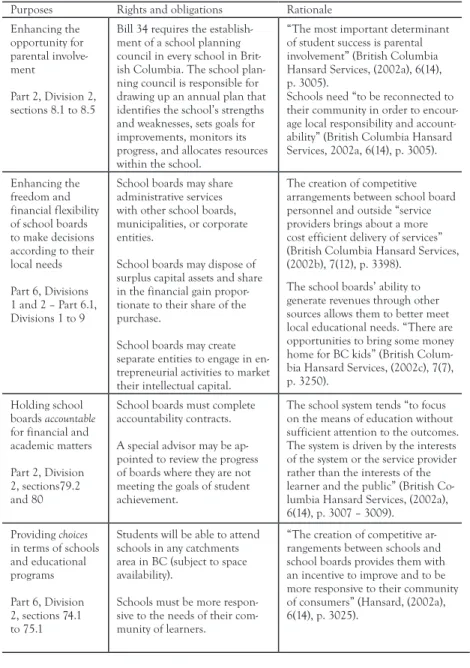
councils), and (c) a considerable degree of apparent public accountability (through school-board accountability contracts). Table 1 provides an overview of the key policy features of Bill 34, and the rationale underpinning each feature, as they were debated during legislative process leading to proclamation.
TABLE 1. Overview of Bill 34, School Amendment Act, 2002 Purposes Rights and obligations Rationale Enhancing the opportunity for parental involve-ment Part 2, Division 2, sections 8.1 to 8.5
Bill 34 requires the establish-ment of a school planning council in every school in Brit-ish Columbia. The school plan-ning council is responsible for drawing up an annual plan that identifies the school’s strengths and weaknesses, sets goals for improvements, monitors its progress, and allocates resources within the school.
“The most important determinant of student success is parental involvement” (British Columbia Hansard Services, (2002a), 6(14), p. 3005).
Schools need “to be reconnected to their community in order to encour-age local responsibility and account-ability” (British Columbia Hansard Services, 2002a, 6(14), p. 3005). Enhancing the freedom and financial flexibility of school boards to make decisions according to their local needs Part 6, Divisions 1 and 2 – Part 6.1, Divisions 1 to 9
School boards may share administrative services with other school boards, municipalities, or corporate entities.
School boards may dispose of surplus capital assets and share in the financial gain propor-tionate to their share of the purchase.
School boards may create separate entities to engage in en-trepreneurial activities to market their intellectual capital.
The creation of competitive arrangements between school board personnel and outside “service providers brings about a more cost efficient delivery of services” (British Columbia Hansard Services, (2002b), 7(12), p. 3398).
The school boards’ ability to generate revenues through other sources allows them to better meet local educational needs. “There are opportunities to bring some money home for BC kids” (British Colum-bia Hansard Services, (2002c), 7(7), p. 3250).
Holding school boards accountable for financial and academic matters Part 2, Division 2, sections79.2 and 80
School boards must complete accountability contracts. A special advisor may be ap-pointed to review the progress of boards where they are not meeting the goals of student achievement.
The school system tends “to focus on the means of education without sufficient attention to the outcomes. The system is driven by the interests of the system or the service provider rather than the interests of the learner and the public” (British Co-lumbia Hansard Services, (2002a), 6(14), p. 3007 – 3009). Providing choices in terms of schools and educational programs Part 6, Division 2, sections 74.1 to 75.1
Students will be able to attend schools in any catchments area in BC (subject to space availability).
Schools must be more respon-sive to the needs of their com-munity of learners.
“The creation of competitive ar-rangements between schools and school boards provides them with an incentive to improve and to be more responsive to their community of consumers” (Hansard, (2002a), 6(14), p. 3025).
The uniqueness of Bill 34 resides in its intent to stimulate – and protect – market-sensitive behaviours among school districts – locally and internation-ally – in order to support and finance part of their current operations and growth. Bill 34 brought a new institution to the public schools in BC: the School District Business Company. Each school board now has the right to create a company to carry out business activities that would not otherwise be possible for it as a public body. Part 6.1 of Bill 34 encourages school districts to calculate and accept business risk, to make risk-based decisions, and to as-sume full management of, but paradoxically not legal liability for, risks related to their commercial activities on- and offshore. Within this policy direction, the government acts as an enabler by providing school districts with opportunities to enhance their financial flexibility, but it is up to districts to take advantage of these opportunities. With the enactment of part 6.1 of Bill 34, the BC public-education sector has taken a step away from full public financing and towards greater market responsiveness, and thus toward openness to alternative financing mechanisms (Kuehn, 2002). Public school districts in BC are now not only required by the government to be more efficient and effective in their use of government resources, they are also encouraged to compensate for reduced government funding by attracting funds from private sources, primarily through marketing their knowledge products within established and emerging national and international markets. This policy direction stimulates competition among school districts as they attempt to access resources in the form of financial assets and students (particularly those, such as “offshore” students, who have the greatest potential to contribute to a school district’s revenues).
Very little research is available on the phenomenon of a public school district geared towards marketing its services and programs as part of its funding mecha-nism. Therefore, the purpose of this study was to develop an understanding of how and why such a policy direction emerged in British Columbia, how it was implemented, and what impact it had on the institutional dynamics of two school districts.
CONCEPTUAL FRAMEwORK AND RESEARCH qUESTIONS
In selecting a policy-analysis model, special attention was given to developing a framework that reflected a balance between the linearity of rational models (Bridgeman & Davis, 1998; Grindle & Thomas, 1991; McCool, 1995) and the multi-staged, developmental, and iterative nature of critical models (Ball, 1998; Blaikie & Soussan, 2000; Dye, 2002; Levin, 2001).
We used Levin’s (2001) and Blaikie and Soussan’s (2000) four-stages concep-tion of the policy cycle as the foundaconcep-tional framework for this policy study (see Table 2) because these scholars advocate the policy-stages approach as a valuable analytical tool while recognizing that policy processes are often discontinuous, overlapping, and interactive. Their analytic model allowed us
to bring to the surface different interests, perspectives, and actors integrated into the policy processes while capturing the incremental and complex nature of policy development. It takes account of diverse roles that the full range of policy actors played in the policy process. It also reflects the multi-staged, developmental, and iterative nature of policy making and analysis.
TABLE 2. Levin’s (2001) and Blaikie & Soussan’s (2000) four-stages conception of the policy cycle
Stages of Policy Cycle Elements of Analysis
Policy origins
Key policy milestones: the focus is on the what and the why from the past; the policy history, legislation, specific events and so on; the source of the policy.
Social and political context: the focus is on the social and political framework, change trends, policy drivers, and key political actors at play as well as on the situational pragmatics and the intricacies of politics in action.
Interests and ideas: the focus is on the core beliefs that shape the policy; the framework used to think about the key policy issues.
Policy adoption
Policy development process: the focus is on the interactions and responses of actors around policy formulation; the roles and power of the main actors in the policy process; their strategies to represent their position in the policy process; the main actors’ impacts on the policy processes.
Policy implementation
Communication and dissemination: the focus is on the conceptual underpinnings and logic used by government agencies and interest groups to raise the level of awareness regarding the new policy. Implementation process: the focus is on developing an understanding of how the policy is interpreted and experienced by implementing agencies (such as school district personnel) as well as of each agency’s implementation capabilities for the policy being introduced.
Policy impacts
Impacts of policy: the focus is on developing an understanding of the extent to which school district services and programs are used as generators of extra local revenue; related organizational changes with respect to school districts’ missions, purposes, and functioning processes; on the ways the policy is experienced by teachers and ad-ministrators; and on perceived impacts of the policy on the working environment of those directly involved in the implementation of the policy.
Levin’s (2001) and Blaikie and Soussan’s (2000) conceptualization of policy analysis was used to develop four main research questions. The first question addressed how the marketing of educational services and programs for profit
by public school districts came to be a policy direction in British Columbia. The second question addressed the adoption of the policy direction. The third question was concerned with the process and the extent to which the policy direction under study was translated into policy actions at the district level. The final question dealt with changes in the market behaviour of two school districts and of individuals directly in charge of translating the policy direction into actions in those districts.
METHODOLOGY AND RESEARCH DESIGN
There are several broad purposes for conducting an analysis of policy processes. One is to determine how a public policy has fared “in action” in terms of its perceived intention and results. This form of policy analysis is referred to as policy evaluation or knowledge in the policy process (Pal, 1997). The other purpose is more exploratory, explanatory, and descriptive: “analyzing policy is akin to trying to figure out which maps people used by studying the paths they took on their journey” (Pal, 1997, p. 13). Pal (1997) refers to the scope of this form of policy analysis as knowledge of the policy process. The latter, policy analysis that is, was the central focus of inquiry in this study.
Given the focus of this study, an exploratory, explanatory, and descriptive multi-case study method was used for the purpose of cross-unit comparison (Jensen & Rodgers, 2001; Robson, 1993; Yin, 1993). This multi-case study research method was integrated into a multi-method approach (triangulation) in which the same phenomenon was investigated using several procedures and data sources: content analysis, archival data, policy documents, and semi-structured interviews. Face-to-face semi-semi-structured interviews were conducted in 2006 with government officials and other stakeholders involved in the formulation and adoption stages of the studied policy direction (7 interviews), school district officials directly in charge of the implementation of the policy (6 interviews), and staff involved in running the services and programs used as revenue generators (5 interviews).
This multi-case study was conducted in policy environments consisting of the British Columbia provincial government and two public school districts selected from sixty school districts that raised “supplementary” (beyond grants and property taxation) local revenue by marketing services and programs for profit. The selection of the two sites was based on substantial differences be-tween the two sites in per-pupil income generated from marketing educational programs and services. Based on a table reporting the per-student revenue by district in 2002-03 (Lowry, 2004), these school districts were listed from top to bottom in terms of the revenues they generated from entrepreneurial activ-ity in 2002-03. This list was then divided in half and one board was selected randomly from the upper half and one randomly from the lower half (in effect, random selection of one above-median entrepreneurial-revenue board and one below-median entrepreneurial-revenue board).
The first selected school district (School District A) has a student population of approximately 3,500 and employs about three hundred school administra-tors, teachers, and support staff. It has unique geographical characteristics and its schools are small and distributed over several small islands, which make the district expensive to operate compared to a larger urban school district. In the mid-1990s this school district experienced serious financial difficulties as it struggled with declining enrolment in addition to high operational cost due to its geographical location. Notwithstanding subsequent changes to the funding formula, the school district continued to face financial challenges that jeopardized its survival. As a result, it developed a strategy to diversify its sources of funding (Hawkins, 1999; 2000; 2001). Today, School District A generates around seven percent of its operating funds through various entrepreneurial activities, including the sale of online courses, software, educational services, and international programs for foreign students.
The second school district (School District B) has approximately 15,000 students in approximately 35 elementary schools and 10 secondary schools. The district employs 1500 teachers, school administrators, and support staff. Like other school districts in the province, School District B has experienced service and program cuts as the result of declining enrolment and changes to the funding formula. However, it has never experienced financial difficulties that threatened its financial sustainability. In 2003, however, the district was facing significant financial challenges as a substantial gap occurred between anticipated revenues and the levels of expenditure required to maintain services. This shortfall – estimated at 2.9 million in February of 2003 (Malcolmson, 2004b) – led the district to implement a series of budget cuts. One of the key elements of the strategy to minimize the impact of the budget cuts was to raise additional funds through various SDBC-based business-oriented initia-tives. The district became increasingly interested in the possibility of attracting full-fee-paying international students and in running distance and continuing education programs. Today, School District B generates 1.5 percent of its operating budget from international students’ fees.
Data analysis for this policy study was ongoing and iterative. Two basic models of data analysis were employed: pattern matching and explanatory building (Tellis, 1997; Yin, 1994). Data collection and analysis were concur-rent in this study. Data were analyzed as they became available, and the emerging results were used to shape each successive phase of data collection and analysis (Tellis, 1997).
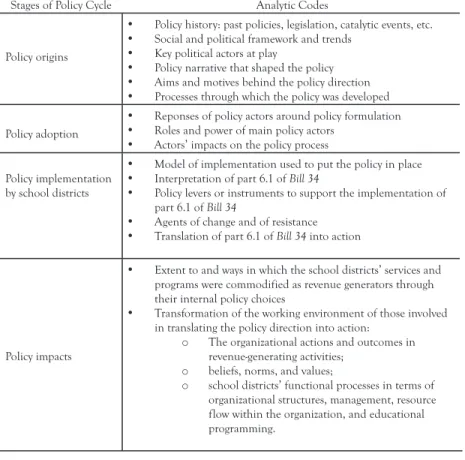
Analytic case summaries were developed for each of the policy-analysis phases. Using the analytic coding system developed to organize the findings (see Table 3) descriptive case accounts were developed for both school districts. The data were analyzed across the policy phases and the two school district case accounts, and within each major analytic code or category, to interpret and explain the process through which the policy direction embedded in part 6.1 of Bill 34
was developed, the way in which school districts responded, and finally the ways that the policy direction impacted each school district.
TABLE 3. Analytic codes adapted from Brandon (2001) and Levin (2001)
Stages of Policy Cycle Analytic Codes
Policy origins
Policy history: past policies, legislation, catalytic events, etc. •
Social and political framework and trends •
Key political actors at play •
Policy narrative that shaped the policy •
Aims and motives behind the policy direction •
Processes through which the policy was developed •
Policy adoption
Reponses of policy actors around policy formulation •
Roles and power of main policy actors •
Actors’ impacts on the policy process •
Policy implementation by school districts
Model of implementation used to put the policy in place •
Interpretation of part 6.1 of
• Bill 34
Policy levers or instruments to support the implementation of •
part 6.1 of Bill 34
Agents of change and of resistance •
Translation of part 6.1 of
• Bill 34 into action
Policy impacts
Extent to and ways in which the school districts’ services and •
programs were commodified as revenue generators through their internal policy choices
Transformation of the working environment of those involved •
in translating the policy direction into action: The organizational actions and outcomes in o
revenue-generating activities; beliefs, norms, and values; o
school districts’ functional processes in terms of o
organizational structures, management, resource flow within the organization, and educational programming.
FINDINGS AND DISCUSSION Policy origin of Part 6.1 of Bill 34
Entrepreneuralism emerged in the policy narratives of several stakeholders involved in the 2003 Select Standing Committee on Education (SSCE) pub-lic hearings who viewed it as a vital asset for the organizational survival and growth of school districts and individuals schools.
Representatives of post-secondary institutions made a strong case that all public educational institutions should act in a more entrepreneurial fashion. They argued for an enabling policy framework that would allow them to do so by growing their own financial resources and having the flexibility to offer services and programs in response to revenue opportunities.
One is to consider enabling legislation for the university colleges that will allow us to do selected graduate programs in response to demand within our regions and, frankly, also in response to revenue opportunities (Skip Triplett, Kwantlen University College). (The Legislative Assembly of British Columbia, October 25, 2001, p. 184)
A similar discourse was found in the narratives of some of the representatives from the K-12 public system who also advocated an enabling policy framework for entrepreneurial activities.
We believe the BC curriculum is world-class. Let it become one of BC’s chief exports. We can make friends and contacts throughout the world if we are willing to share what has been developed right in our own backyard. If you let us, we can deliver choice in education, quality standards, access and flexibility, leadership and economies of scale to the rest of the province and the world. The bus has been travelling throughout BC, leaving the Ministry of Education and hundreds of students waiting. The bus wants to travel, so don’t miss the bus (Brian Malchow, Nechako School district). (The Legislative Assembly of British Columbia, November 23, 2001, p. 665)
Under discussion here was a policy change encouraging school districts to engage actively in entrepreneurial activities, to market their intellectual capital as a commodity, both provincially and internationally. This policy narrative attempted to reconceptualize school districts as a new breed of public institu-tions acting like private enterprise in an open market for consumers. Within this context, students became objects of marketing as school districts compete with each other for domestic and international enrolment share and the fund-ing associated with each.
However, in the SSCE Report (British Columbia Ministry of Education, 2002), there was no mention of entrepreneurial activities as means of enhanc-ing financial flexibility of school districts and their capacity to increase the diversity of programs and services to their community and parents. Although some participants in the public hearings (mainly post-secondary public in-stitutions) focused the attention of the SSCE on constituting an education industry through provisions for producing and regulating quality, sales, and marketing practices, no language about K-12 public education as an industry was employed in the Report. Given subsequent legislation (Bill 34), one might have expected some policy language in the Report designed explicitly to pro-mote transforming education into an international competitive industry, but such was not the case.
However, entrepreneurialism became a policy direction embedded in part 6.1 of Bill 34, whose goals were to limit the liability of school districts engaged in entrepreneurial activities while enabling them to supplement their revenues from entrepreneurial activity protected from exposure to institutional risk by “fronting” such activities through a School District Business Corpora-tion (SDBC). Through this policy initiative, the government signalled that
it would no longer remain the sole significant funder of public education. Rather, it would become an enabler, generating opportunities for financial self-improvement.
Except for some presentations made during the public hearings conducted by the SSCE, nowhere in previous policy documents of any sort were the provisions of this amendment to the School Act publicly discussed. As research participants representing provincial organizations have stated,
There was in general a direction of that sort, the whole choice thing. [It was] encouragement of entrepreneurialism in the schools as ways of overcoming the restriction on funding. So there were sort of two sides of the same thing that, at the very least, the restricted funding led to circumstances where districts were looking for what else they could do, you know. Whether that was intentional, whether there was intent to push the entrepreneurialism beyond that, I don’t quite know. But there wasn’t really any precursor to this. [There wasn’t any] indication [about that] particular aspect of Bill 34 [setting up school district business companies]. (Interview with an official of the BCTF – British Columbia Teacher Federation)
That’s an issue that is hard to comment on because I made some notes prior to you coming, and one of the concerns was that these proposals that produced section 6.1 were never canvassed with this association [BCPVPA] nor do I know whether or not they were canvassed with other associations. They may have been canvassed with the Trustees Association [BCSTA] but again, I am not sure. So, the whole 6.1 entrepreneurial policy came right out of left field for most of us. (Interview with an official of the BCVPPA – British Columbia Vice-Principals and Principals Association)
So, why did the BC Ministry of Education want school districts to fund programs by engaging in entrepreneurial activities through incorporated companies? The main argument supporting this policy direction is highlighted in this statement from an official of the Ministry of Education who was closely involved in the policy making process leading to part 6.1 of Bill 34:
So … when you start taking away a number of the rules which is going to give the autonomy back to the school districts to make some decisions, and to encourage them to be more entrepreneurial in their actions and also to look at ways in which they can solve their problems rather than always relying on mother Ministry if you will or always relying back to a central authority whenever there is a problem. We said make sure when you go out and you start doing things, we want you to take risk but also look after your risk. The way you look after your risk is that you establish a separate company. You establish a company that is separate from the Board. Legally, we looked at it and we said that a number of our districts, a number of schools are very much involved in terms of offshore kids and it is approximately a thirty-two to thirty-three million dollars industry in our province with kids coming in. And as such, if something happens with one of those kids, there is a suit from China or there is a suit from Malaysia or something against one of our school districts. At that point in time, all of the assets and liability within that district are subject to that suit. If there is no protection then all of this
comes back to not only that district but also back to the province. So, we’re asking them to limit their liability by setting up separate companies. (Interview with an official of the Ministry of Education)
This policy direction has reconfigured and attempted to legitimize the role of school districts as competitive units engaged in for-profit entrepreneurial activities as ways to subsidize certain segments of the domestic provision of educational programs and services. In employing the language of the market, part 6.1 of Bill 34 raises issues regarding the promotion of the BC public education as a “brand” in international markets, and the partial privatization of the funding mechanism of public education in British Columbia.
IMpLEMENTATION AND pERCEIVED IMpACTS OF pART 6.1 OF BILL 34: THE TALES OF TwO SCHOOL DISTRICTS
Implementation characteristics and movement
The intention of policy-makers was to use part 6.1 of Bill 34 to transfer part of the school district resource burden into school district entrepreneurialism; however, the consequences of the policy’s “implementation” were markedly different in each of the two school districts studied (School District A & B). The evidence suggested that this policy initiative had the potential to influ-ence the behaviours and policy environments of the two school districts, but insufficient persuasive force to assure the desired end of using an SDBC as the sole vehicle for carrying on entrepreneurial activities. The SDBC model was directly adopted in one case, but its implementation was problematic in the other. In School District A, success was attributed to a dramatic fiscal-crisis history, a conciliatory leadership, and a process of deliberative democracy (Mintrom, 2003). The serious financial difficulties that threatened School District A’s financial sustainability provided a justification for engaging in a strategy of diversifying its sources of income through the establishment of a task force to deal with the issue of inadequate funding.
What happened, I mean this district had been in crisis since the early 90s, when they changed, they eliminated local taxation for funding. So in the 89–90 period they lost the ability to assess taxes for the school district and then they also lost 10-15 percent of the funding. So this district starting in, I think ’92, ran deficit budgets. I think they ran at deficit budgets for over 7 years in a row. It was a district in crisis. Basically what happened is [that] by 97–98, we were in a position where our deficit was really increasing and 1998 was the year that the board basically challenged the provincial govern-ment about the funding. It was an extremely tense time and they basically said we were running deficit budgets and it came down to actually meeting with the Minister of Education at the time. It was a really difficult time, it was a very upfront confrontation and I think the district was really close to being in a position where the Ministry was going to take it over.
In our district we had established in 1999 a revenue generation task force, which was operating, and we’d operated within the School district. (Interview with the Secretary Treasurer of School District A)
Even prior to the enactment of part 6.1 of Bill 34, District A was solidly on its way to pursuing a strategy of “ratcheting up the marketness factor” in school district work (for examples of such strategy of “ratcheting up the marketness” factor, see Robertson, 2000). School District A moved quickly into incorporat-ing its school district business company (SDBC) under the terms of part 6.1 of Bill 34 and used its business company as part of its entrepreneurial strategy to enhance financial flexibility by generating more funds to pay for parts of its educational program development and delivery.
In District B, a top-down approach to implementation and opposition from local stakeholders, particularly union and community-based groups, shaped the outcome. The idea of creating a SDBC in District B came mainly from senior staff in response to funding level decreases in the year 2001–2002 due mainly to enrolment decreases which exceeded the provincial average at the time (Malcolmson, 2004a). It became apparent that School District B needed to act more entrepreneurially in meeting financial challenges, finding oppor-tunities, and succeeding with less.
Well, at that time, the district had gone through a number of years of budget reductions. You know, they had to make budget reductions to balance their budget and there was talk at the time of starting a foundation to raise extra money. There was some other talk about combining the Scholarship Society that we had with the foundation. But I think, primarily, I saw the change in the legislation as an opportunity for the school district to generate additional funding. At the time, the new funding formula had just come into effect. There was a change from funding on a space basis to a pupil basis. And I think that people didn’t quite understand or didn’t see how that funding formula would play out over the next number of years, especially when you are looking at things like declining enrolment and that sort of thing. So, there was a fear, I think, of the fact that the funding wouldn’t be there. So, there was some interest in trying to find other sources of funding. (Interview with the Secretary Treasurer of School District B)
District senior staff and trustees decided to create a company under section 6.1 that would carry out for-profit educational programs and services. At that time, the Board of Trustees directed senior staff to prepare business plans for offering carpentry products, information-systems services, vehicle maintenance, print-shop services, and bus rentals to the community (Kuehn, 2002). Crudely put, the philosophy was “if it moves, sell it.”
We started thinking about a school district corporation in late 2002. And we had some ideas of what we would like to do with it at that time. At the time that we actually got it enacted, or got the corporation formed, it was late 2003, and at the time when we did it, we basically tried to say that we would be doing this like, you know, day-care operations, and supplementing work that the school district employees were presently doing, like vehicle repairs
perhaps, furniture manufacturing and those sort of things. But, there are also other thoughts in my mind, bigger, more potential …. (Interview with the Secretary Treasurer of School District B)
However, the local chapter of CUPE opposed the SDBC because they saw the legislation as a tool designed specifically for privatization of services currently being performed by CUPE members and teachers in the district.
On behalf of the Local, I met with senior management to express the Local’s concerns and made presentations to the Board of Trustees. Prior to doing this I attended legal seminars on the legislation, [did] a great deal of research on this topic; accessing BCTF as well as CUPE BC information and of course the Internet. The Local has discovered the most effective method at [by] which one confronts controversial issues is with sound information and rational. As President of the Local, I broadened the dialogue by approaching the media and the Chamber of Commerce as this is not just a public school issue, it is a community issue with a potential of having outreaching effects. (Interview with a local CUPE official)
The broadening of the debate to non-education partners like the local Cham-ber of Commerce had an impact on the extent to which part 6.1 of Bill 34 was put into action. This array of political influences exercised by strategically placed groups who resisted the proposed SDBC activities in most cases was instrumental in determining whether the momentum for the creation of an entrepreneurial environment through the operation of the SDBC would grow or be halted. CUPE strategy was pivotal in ensuring that the SDBC would never be operational as planned by the district. Issues related to the internal culture of the district as a public institution, the level of resistance to the policy, the ways in which the policy was reinterpreted by local stakeholders, potential changes to internal procedures in offering services and programs, potential privatization of parts of the district’s operations, and the issues of accountability and transparency were used effectively in shaping the policy outcomes in the case of part 6.1 of Bill 34.
The Company is not doing anything right now. It’s pretty inactive. We did put forward some proposals to the Board. We did talk to the unions and there is a tremendous resistance on [the] part of both the teachers’ union and the support staff’s union in this district to not have a corporation. They see it as: their philosophy is that public education should be funded publicly. They just see a corporation as being a threat of some sort. They also believe that …: districts that have corporations and have income that is not public, basically, they can become “have” districts versus “have-not” districts—the same way that within a district, you can have “have” schools and “have-not” schools depending of the level of funding going into each school.
• • • • •
I think they should be aware of the impact because we have presented it to our business committee, which those unions are part of, are one of the partner groups related to that. I think the problem is that they really don’t want to accept what you say about something like that. They really have their own way of thinking about …public operation versus private operation and,
I guess, it has just been ingrained in them over the years, they are not open to change. (Interview with the Secretary Treasurer of School District B)
In contrast to the way implementation occurred in School District A, the dynamics of implementation in School District B can be explained best by an advocacy-coalition model (Sabatier, 1999). This approach focuses on advocacy coalitions who share common beliefs and undertake some level of coordi-nated activity. The coalition led by the CUPE local used this opportunity for continuing local struggles the union movement had lost provincially at an earlier stage of the policy process leading to part 6.1 of Bill 34. In the case of District B, the SDBC was incorporated but never got to the consolidation and operational phases. The findings in the case of District B illustrated that effective policy implementation and change can take place only where there is a supportive coalition of key actors and interests at the political level, the level of the educational bureaucracy (where tensions between entrepreneurs and individuals who believe in full government funding), and at the wider community level (for more on the concept of coalition of key actors in the implementation process, see Howlett & Ramesh, 2003).
The evidence gathered regarding the implementation of part 6.1 of Bill 34 in these two school districts suggested that the control of policy-makers might be considerably reduced by local contextual complexities and interactions among local stakeholders once implementation was initiated. In both cases, however, the implementation of part 6.1 of Bill 34 involved, at the local level, a non-linear process of rethinking what should happen, when it should hap-pen, where and how things should change, and what should count for success (Geller & Johnston, 1990).
Perceived impacts
The introduction of market logic into the funding mechanism of public-school districts moved some research participants to address the potential impacts of such a policy direction in terms of fiscal equity at the provincial level. In both school districts, some interviewees clearly indicated that greater inequity in course quality and diversity of services and programs, as a result of unequal funding, could very well be the long-term policy outcomes of part 6.1.
Well, I think, if this kind of thing continues without any kind of checks and balances, then I think that definitely there is a potential for that [inequities among districts]. I think that would be a real concern for lots of districts. Some of the outlying districts, for example, don’t have the amenities to at-tract some of these kinds of programs, it could represent real hardship. So, I think the potential is there. (Interview with the Superintendent of School District A)
Like I said before, … it could lead to a situation where you have rich dis-tricts and not-so-rich disdis-tricts that can generate money. The other inequity I think is that, because of the size of the province and the physical location
of some of the school districts, they don’t just have the same opportunity that other districts would have in the Lower Mainland and on Vancouver Island, you know, in generating the extra money in attracting international students and whatever. It could be that the negative thing I would see would be that districts that are able to offer better programs would ultimately, over time, perhaps attract teachers and administrators from other districts who, you know, are good people but aren’t supported in their districts by the right kind of programs. So, I think that could ultimately have an impact on education, and more, I say, on the rural areas. (Interview with the Secretary Treasurer of School District B)
These research participants argued that the policy direction of part 6.1 might lead toward a kind of “winner-take-all” public system, in which “the prizes” will most likely accrue more than ever to socially, economically, and cultur-ally favoured school districts. As a result, some school districts would be able to offer more to their communities than others. Some research participants argued plausibly that part 6.1 would serve the interests of those school dis-tricts already advantaged by their geographical locations, cultural capital, and marketing savvy.
There is definitely a brand building. Our brand building is around perform-ing arts in particular, and around very high academic results for our kids when they graduate from grade twelve; those two in particular are strong. The other aspect, which has nothing to do with curriculum and everything to do with the culture of the schools and the community, is the safety aspect of our islands. Parents who are considering sending their kids from offshore are very interested in their children being safe. (Interview with the Superintendent of School District A)
Consensus existed among interviewees in both school districts that increased uncertainties in the level of public funding, competitiveness among districts, and scarcity of financial resources have made entrepreneurial activities a vital endeavour for organizational sustainability and growth.
In our district, International Education brings in a couple of million dollars a year. Obviously, of that, we employ teachers and provide services and such to provide to those international students. So, by no means it is all profit. For certain, … several hundred thousand dollars that one might view as profit coming out of International Education. That’s equivalent to perhaps ten support staff positions, maybe equivalent to five or six teaching positions. So, you can look at any area of the district and say well: “We would have fewer librarians, or we might have fewer learning assistance teachers; you might have larger class sizes.” We haven’t, in this district, tagged or labeled or targeted any particular program by saying: “You know, that is the program that is funded or supported by the International Education program.” We have thought about it and we may in fact do that so that there is a greater appreciation for what is being provided as the direct result of International Ed in this district. We talked about that a number of times and I personally think that we should do that so it would be clear to the community that includes parents and staff, as to what service level or to what specific areas
we are able to sustain or enhance because of programs like International Education. (Interview with the Superintendent of School District B)
There is also some evidence that marketing educational programs to interna-tional students for profit might entail program packaging and delivery modes different from those used for the local student population.
Well, what’s always happened is when you have international students they require additional ESL or tutoring in certain subjects and they pay for that; that’s what they are paying, when they come here, they pay their tuition that’s part of the practice. So when we had a 5-day week, they were picking that up during the week, what’s happened as we have gone to a 4-day week is some of those evening activities that were initially happening say in the late afternoon or evening, they have moved them to Friday. So they are not getting any more, but there are things that are being put in on Friday. (Interview with the Secretary Treasurer of School District A)
This differentiation in marketing and in program substance means that school districts might become more responsive to the needs of a globally rather than locally situated community of students and parents.
As they search for a competitive edge in the international schooling marketplace, there is evidence that school districts might try to maximize profit margins by changing their market response to attract certain types of students deemed cheaper to serve than other groups.
If you get somebody who has a high ESL requirement, they are going to really struggle in their social studies, they are going to require a lot more tutoring and areas like that. It’s not that we’re saying that they have to speak English, but it’s just, especially going for the European students, it’s profitable, yes, it is more profitable. But you have a better mix and a better integration with all the other students; it’s a much better situation. (Interview with the Secretary Treasurer of School District A)
Given the stakes, the evidence is perhaps not surprising that entrepreneurial-ism is increasingly valued as a basis for determining teacher and administrator competency. “Successful” educators, leaders, and schools, within an entrepre-neurial perspective, are those who respond creatively to market preferences so they can maintain or enhance their district’s market share and status.
I think that it becomes a combination of … a superintendent for example needs to be not only but primarily the educational leader in the district. There is also a need to think, I hate to use the term, but outside of the box, because before we relied upon the Ministry to give us the dollars. We had no other way to gain money because the legislation restricted us. We now have an opportunity to do things differently. So, my role as superin-tendent becomes one of supporting the Board in its interest in other ways of generating dollars and helping others in our public, not only within our district but within the province, understand why it is necessary and why it actually works. It isn’t something that is going to devalue education in our district. It actually sustains our growth. (Interview with the Superintendent of School District A)
Policy impacts were thus perceived by research participants as qualitatively different in the two districts. Given District A’s particular vulnerability to external market pressures, its entrepreneurial activities resulted in a mode of program delivery to its international students different from that offered to its domestic students, or at least, that is what appeared to be the case to many observers. This trend confirmed previous research findings that school districts engaged in selling programs and services to overseas students tend to tailor their policies and programs to enhance the districts’ attractiveness as educational destinations, while treating their local populations differently. In District B, the perceived impact of running a successful international program translated into perceptions of increasing funding inequity among districts in the province. Inequity in the capacity of school districts to market themselves as attractive educational destinations was clearly outlined by research partici-pants in both school districts. Running part of their operations as for-profit schooling brought into focus the uneven capacity of school districts to position themselves in the educational marketplace given, in particular, inequalities in the entry point of a school district into the market and in the level of resources and change strategies that underpinned it.
CONCLUSION AND RESEARCH IMPLICATIONS
Several aspects of the policy direction embedded in part 6.1 of Bill 34 in Brit-ish Columbia merit attention in future research. First, this policy direction has been in effect for only seven years and its impact needs to be studied over a longer timeframe. For instance, future funding-pattern trends in public education in British Columbia merit longer-term study, especially in regard to potential impacts on real education spending per capita and as a percentage of the overall budget of the BC government. In short, the question of the “narcotic effect” of such policy on government’s sense of responsibility to fund public education from own-source revenues remains an open and important question inviting future study.
Much work remains to be done on the impact of part 6.1 of Bill 34 on the funding levels of individual school districts in relation to their capacity to ad-dress the needs of all students through more diversified education programs. Will this policy direction create “have” and “have-not” school districts, and, if so, to what extent? How sustainable is such a financing strategy in the long term? Will such a funding strategy enable school districts to maintain an appropriate degree of local independence and autonomy from overseas con-sumer influences and educational preferences? Such study would further the understanding of the relationship between entrepreneurial success, levels and sources of funding, and equity within the public school system. In addition, this research would help to show whether school district entrepreneurship holds the promise of better schooling for all or for just a few.
Given the possibility that fiscal inequity will continue to grow in importance as a school-finance issue, one wonders whether any legal remedies exist for parents and students to redress financial inequities and to ensure that all stu-dents and communities in BC have access to adequate educational programs, regardless of where they live or the circumstances under which they live. Al-though such legal issues are not part of this policy study, they deserve future investigation. A very superficial consideration of the matter suggests that an equality rights argument based on section 15 of the Canadian Charter of Rights
and Freedoms may be unavailable because any disparate treatment would be
based on territoriality rather than a listed or analogous ground of discrimina-tion under secdiscrimina-tion 15. That is, whereas age, sex, or disability, for example, provides actionable grounds of discrimination, geographic residence would seem unlikely to do so. Assuming one could demonstrate that inadequacy of funding resulted in inadequate education for some students – and this is a precarious assumption based on the definitional problems associated with educational adequacy and the complex, contested, and uncertain cause and effect relationship between funding and educational achievement – actions in tort or for violation of the liberty and fundamental justice provisions of section 7 of the Charter are at least within the theoretical pale of the possible. The track record of such “failure to educate” lawsuits, of course, is extremely poor (MacKay & Dickinson, 1998). Nevertheless, the prospect of legal recourse relating to the fiscal equity fallout of Bill 34 is a legitimate area of concern and, hence, of future research. In the absence of such legal remedies, the equity and adequacy outcomes of a public-school financial system partly dependent on school district entrepreneurial activities escape judicial scrutiny entirely and rest solely in the political arena.
Everything considered – including the limitations of this policy study with its specific foci – the story of part 6.1 of Bill 34 is unique in the Canadian context of neo-liberalism and education policy. It has been the aim of this policy study to scrutinize the particularities of Bill 34, especially of part 6.1, through the lenses of a critical policy analysis model, to explain how the introduction of school district entrepreneurialism as a policy direction was placed on the policy agenda, then understood, interpreted, and put into action in very different ways within two local school districts. A policy that promotes less institutional dependence upon government for fiscal resources deserves ongoing scrutiny. It is our hope that, in some small measure, this policy study has contributed to an understanding of how neo-liberal ideologies can be translated into policies that redefine what it means to educate and to be educated in a public-school system. Underlying these policies is an altered view of the nature of school-based knowledge, namely, that such knowledge is a commodity to be sold on the market for maximal return, that the market value of such knowledge trumps its intrinsic value, and that its main purpose is to generate greater capacity to consume and compete.
NOTE
1. Bill 34, School Amendment Act, 3rd Session, 37th, Parl., British Columbia, 2002 REFERENCES
BC Liberals. (2001). A new era for British Columbia: A vision for hope and prosperity or the next decade and beyond. Retrieved January 7th, 2003, from http://www.bcliberals.com
Blaikie, P. M., & Soussan, J. G. (2000). Understanding policy processes. Leeds, UK: University of Leeds. Boxley, S. (2003). Performativity and capitals in schools. Journal of Critical Education Policy Studies, 1, 1-17. Brandon, J. (2001). A standards-based assessment of Alberta’s teacher growth, supervision and evaluation policy: Preliminary findings. Unpublished manuscript, Calgary, ALTA.
Bridgeman, M., & Davis, H. (1998). Australian policy handbook. Sydney, AUS: Allen and Unwin. British Columbia Hansard Services. (2002a). Official report of debates of the Legislative Assembly, 3rd session, 37th Parliament. Hansard, 6(14), 2997-3089.
British Columbia Hansard Services. (2002b). Official report of debates of the Legislative Assembly, 3rd session, 37th Parliament. Hansard, 7(12), 3377-3424.
British Columbia Hansard Services. (2002c). Official report of debates of the Legislative Assembly, 3rd session, 37th Parliament. Hansard, 7(7), 3099-3121.
British Columbia Ministry of Education. (2002). The Select Standing Committee on Education Report. A future for learners: A vision for renewal of education in British Columbia. Victoria, BC.
Dye, T. R. (2002). Understanding public policy. New York: NY: Prentice Hall.
Geller, H. A., & Johnston, A. P. (1990). Policy as linear and nonlinear science. Journal of Education Policy, 5(1), 49-65.
Grindle, M., & Thomas, W. (1991). Public choices and policy change: The political economy of reform in developing countries. London, UK: The John Hopkins University Press.
Hawkins, K. (1999). Starting anew: Priority setting and planning session. School District A, British Columbia.
Hawkins, K. (2000). Moving forward: Review of progress on “Starting Anew 1999-2000” and priority setting for 2000-2001. School District A, British Columbia.
Hawkins, K. (2001). Moving ahead: Review of progress on “Moving Forward 2000-2001” and priority setting for 2001-2002. School District A, British Columbia.
Howlett, M., & Ramesh, M. (2003). Studying public policy: Policy cycles and policy subsystems (second ed.). Don Mills, ON: Oxford University Press.
Jensen, J. L., & Rodgers, R. (2001). Cumulating the intellectual gold of case study research. Public Administration Review, 61(2), 236-246.
Kuehn, L. (2002). B.C. Liberal push boards to market education. Teacher: News Magazine of the BC Teachers’ Federation, 15(2), 1-3.
Levin, B. (2001). Conceptualizing the process of educational reform from an international perspective. Retrieved February 2, 2004, from http://epaa.asu.edu//epaa/v9n14.html
Lowry, M. (2004). Fee-generation as an indicator of developing funding inequities in the B.C. school system. Re-trieved November 3rd, 2004, from http://www.bctf.bc.ca/ResearchReports/2004ef01/report.html
Lubienski, C. (2001a). Redefining public education Charter schools, common schools, and the rhetoric of reform. Teachers College Record, 103(4), 634-666.
Lubienski, C. (2001b, April 10-14). School choice and privatization: Towards an alternative analytical framework. Paper presented at the Annual Meeting of the American Educational Research Associa-tion, Seattle WA.
Malcolmson, J. D. (2004a). School District B budget and staffing report: 2002/03 to 2004/05 (Budget Analysis). Burnaby: CUPE BC.
Malcolmson, J. D. (2004b). School District B budget proposal for 2004/05: A comment (Budget Analysis). Burnaby: CUPE BC.
MacKay, A. W., & Dickinson, G. M. (1998). Beyond the “careful parent”: Tort liability in education. Toronto, ON: Emond Montgomery Publications.
McCool, D. (1995). Public policy theories, models, and concepts. Englewood Cliffs, NJ: Prentice Hall. Mintrom, M. (2003). Market organizations and deliberative democracy: Choice and voice in public service delivery. Administration and Society, 35(1), 52-81.
Pal, L. (1997). Beyond policy analysis: Public issues in turbulent times. Scarborough, ON: International Thompson Publishing.
Robertson, S. L. (2000). A class act: Changing teachers’ work, globalization and the state. New York, NY: Falmer Press.
Robson, C. R. (1993). Real world research: A resource for social scientists and practitioner-researchers. Oxford, UK: Blackwell.
Sabatier, P. A. (Ed.). (1999). Theories of policy process. Boulder CO: Westview.
Tellis, W. (1997). Application of a case study methodology. Retrieved November 15, 2004, from www. nova.edu/ssss/QR/QR3-3/tellis2.html
The Legislative Assembly of British Columbia. (October 25, 2001). Legislative Session: 2nd Session, 37th Parliament, Select Standing Committee on Education Minutes. Retrieved September 5, 2005, from
http://www.leg.bc.ca/cmt/37parl/session-2/edu/hansard/e11025a.htm
The Legislative Assembly of British Columbia. (November 23, 2001). Legislative Session: 2nd Session, 37th Parliament, Select Standing Committee on Education, Minutes and Hansard. Retrieved April 5, 2005, from http://www.leg.bc.ca/cmt/37parl/session-2/edu/hansard/e11123a.htm
Whitty, G., Power, S., & Halpin, D. (1998). Devolution and choice in education: the school, the state, and the market. Birmingham, UK: Open University Press.
Yin, R. K. (1993). Applications of case study research. Newbury Park, CA: Sage Publishing. Yin, R. K. (1994). Case study research design and methods. (Vol. 5). Thousand Oaks, CA: Sage Publications. GERALD FALLON is an Assistant Professor in the Department of Educational Adminis-tration at the College of Education, University of Saskatchewan. His research interests are in educational leadership and policy; legal studies; governance of First-Nations education; and marketization of public education.
JERALD PAqUETTE is a Professor at the Faculty of Education at the University of west-ern Ontario. His main research interests are in education finance; minority education policy; First-Nations education; research theory and methods; educational policy and related issues of social purpose; equity and public funding of private education in the Canadian context.
GERALD FALLON est professeur adjoint dans le Département d’administration scolaire à la Faculté d’éducation de l’Université de la Saskatchewan. Ses intérêts de recherche concernent la notion de leadership en éducation; l’analyse critique de la formation, de la mise en œuvre et des impacts des politiques en matière d’éducation; le droit scolaire; les questions relatives à la gestion autochtone en éducation et l’impact du mercantilisme sur la nature et le fonctionnement des systèmes d’éducation publique ici et ailleurs dans le monde.
JERALD PAqUETTE est professeur titulaire à la Faculté de l’éducation de l’Université Western Ontario. Ses intérêts de recherche concernent les modes de financement de l’éducation publique, les politiques touchant l’éducation en milieu minoritaire; l’éduca-tion autochtone; les théories et méthodes de recherche; les quesl’éduca-tions sociales et les politiques en matière d’éducation; la notion d’équité et le financement des institutions privées d’éducation au Canada.