AN EMPIRICAL STUDY OF THE CAREER PATHS
OF SENIOR EDUCATIONAL ADMINISTRATORS IN
MANITOBA, CANADA: IMPLICATIONS FOR CAREER
DEVELOPMENT
DAWN C. WALLINUniversity of Manitoba
ABSTRACT. This paper conceptualizes queue theory (Tallerico & Blount, 2004) to discuss a mixed-methods study that determined the career patterns of senior educational administrators in public school divisions in Manitoba, Canada, compared by position, context and sex. Findings indicate that queue theory has merit for describing the career paths of senior administrators in Manitoba, but it must be qualified. Context creates labour queue stratifications based on educational level (access), the extent to which senior administrators are channeled into traditional career paths, and number of positions served overall. Context, sex and position interact to form queues based on leaves from service, and create discrepancies on the experiences of career supports and work challenges. ÉTUDE EMPIRIQUE DU PARCOURS PROFESSIONNEL DES CADRES SUPÉRIEURS AU MANITOBA, CANADA: IMPLICATIONS POUR LE DÉVELOPPEMENT PROFESSIONNEL RÉSUMÉ. This paper conceptualizes queue theory (Tallerico & Blount, 2004) to discuss a mixed-methods study that determined the career patterns of senior educational administrators in public school divisions in Manitoba, Canada, compared by position, context and sex. Findings indicate that queue theory has merit for describing the career paths of senior administrators in Manitoba, but it must be qualified. Context creates labour queue stratifications based on educational level (access), the extent to which senior administrators are channeled into traditional career paths, and number of positions served overall. Context, sex and position interact to form queues based on leaves from service, and create discrepancies on the experiences of career supports and work challenges.
D
iscussions regarding sex/gender and the superintendency recognize the persistence of the disproportionately low representation of women in the superintendency (Brunner, 2004; Glass, Bjork & Brunner, 2000; Grogan, 2000; Kachur-Reico, 2010; Reynolds, 2002; Skrla, 2003; Wallin, 2005a;2005b; Wallin & Sackney, 2003). This finding is noticeable in Manitoba, where only 6 of the 37 public school division chief superintendents in the 2006-2007 school year were women. The sex proportions of the assistant su-perintendency were more equitable; women represented half (26 out of 52) of the assistant superintendents in the province. Even though intuitively one would think that those who hire superintendents draw primarily from the pool of assistant superintendents, the major drop in representation from the assistant superintendency to the superintendency illustrates that sex/gender plays a role in senior-level career advancement, either systemically or individu-ally. Coralie Bryant (2004), executive director of the Manitoba Association of School Superintendents, made three points that demonstrate the depth of the discrepancy: (a) since 2001, at the University of Manitoba alone, 66% of the graduates with a Masters in Educational Administration were women; (b) 65% of the teaching staff in Manitoba are women; and (c) 45% of inschool administrators are women. There is no lack of qualified females to warrant such a difference in representation in senior administrative appointments. Context plays no less of a role in the career patterns of senior educational administrators in Manitoba. For example, if “urban” is defined to include the one census metropolitan area (Winnipeg) and the three census agglomera-tions (Brandon, Portage la Prairie and Thompson), in 2006-2007 there were only 9 urban superintendents in the province, and 28 rural superintendents. However, exactly half of the 54 assistant superintendent positions existed in urban areas. Economies of population notwithstanding, this means that there are a number of rural school divisions without an assistant superintendent’s position, which nullifies the opportunity of using the position as a succession management “training ground” for career development purposes. Some sig-nificant trends also develop when sex and context are cross-tabulated. Women constituted 14% of the population of rural superintendents (4 out of 28), and 22% of the population of urban superintendents (2 out of 9). Paradoxically, however, males constituted almost 65% of the rural assistant superintendent population (17 out of 27), but females constituted 65% of the urban assistant superintendent population (17 out of 27), an exact opposite proportion. Data suggest that females are advancing into the assistant superintendency, and in particular in urban assistant superintendencies. Males on the other hand, appear to have an advantage in gaining the superintendency and the rural as-sistant superintendency, but they are underrepresented in the urban asas-sistant superintendency. None of this data is collected or distributed by the provincial ministry (Manitoba Education), which emphasizes the “conspiracy of silence” of the failure to report explicit data by position and district (Shakeshaft, 1999; Tyack & Hansot, 1982).
It is because of the curious contextual and sexed representative statistics of the senior administrative cadre in Manitoba that a study that examined the career paths of senior educational administrators was undertaken during the
2007-2008 school year. Its purposes were fourfold: (a) to determine the career patterns of senior educational administrators in public school divisions; (b) to compare and contrast their career patterns on position (assistant super-intendent versus supersuper-intendent), context (rural versus urban); and sex (male versus female); (c) to determine the level of career development supports and work challenges for senior educational administrators; and, (d) to develop implications for career development programs targeted for senior educational administrators. This paper offers the findings related to two of these purposes: the career patterns of senior educational administrators, and their implications for career development programs.
CONCEPTUAL FRAMEWORK
This section will outline the literature that speaks to the career paths of educational administrators as it exists for different positions within the education system, and career supports and work challenges based upon sex and/or context. Though there is a conflation in the literature between sex (biology) and gender (the social construction of normative behavior), studies of female superintendents suggest that females do not enjoy the same level of encouragement, mentorship, or sponsorship as do males, and that they continue to face gender bias and gender discrimination (Bell, 1995; Blount, 1998; Brunner, 2000b, 2003; Grogan, 1996; Kachur-Reico, 2010; Kamler & Shakeshaft, 1999; Ortiz & Marshall, 1988; Shakeshaft, 1989, 1999; Skrla, Reyes & Scheurich, 2000; Tallerico, 2000). Others contend that context plays an important role in who is hired in administrative positions, as women have been documented to have gained strides in obtaining administrative positions in very small school divisions (Gupton & Slick, 1996; Wallin, 2005a; 2005b), remote school divisions (Kachur-Reico, 2010), and inner-city urban divisions (Mertz, 2003; Murtadha-Watts, 2000). As well, while some researchers argue that there are significant differences in the ways in which men and women lead that may impact on the perceptions of their effectiveness (Bjork, 2000; Brunner, 2000a; Chase, 1995; Gilligan, 1982; Marshall, Patterson, Rogers & Steele, 1996; Pounder, 1990, Shakeshaft, 1989, 1999), others have argued that leadership style has little to do with gender and/or more to do with accom-modations to socially constructed leadership norms (Astin & Leland, 1991; Eagly & Johnson, 1990; Eagly & Johannesen-Schmidt, 2001, Eagly, Karau & Johnston, 1992).
Added to this is the common understanding that the nature of the position of superintendent has changed dramatically in the past decade (Grogan, 2000), which has implications for both men and women in the position. Unfortunately, there are few Canadian studies that examine the roles of senior administrators (Wallin & Crippen, 2009; Kachur-Reico, 2010), and even fewer comparative studies to help determine whether findings are shaped by sex, context, or role requirements.
Tallerico and Blount (2004) used occupational sex segregation theory and feminist scholarship to discuss the career patterns and work challenges of females in the superintendency over time in the United States. According to queue theory (Reskin & Roos, 1990), prospective incumbents rate potential work positions in terms of a hierarchy of desirability, which is known as job queuing. Similarly, prospective employers rate the incumbents, creating labour queues. Tallerico and Blount (2004) suggested that there is merit in queue theory because it “illustrates how personal agency…is mediated by sociocultural norms and values” (p. 635). However, they also contend that “labour queues operate fundamentally as gender queues, with males at the highest end of the hierarchical ordering and women at the lowest” (p. 635). By applying queue theory to the education profession, Tallerico and Blount (2004) proposed three possible culminations: (a) re-segregation, whereby the profession will become dominated by women as males exit, thereby re-segregating the profession by gender (but also potentially contributing to a devaluing of the profession overall); (b) ghettoization, whereby one sex is relegated to the less valued and less desirable contexts or positions within the profession; and, (c) integration, whereby there exists an enduring gender balance among employees in the same gender work role over time.
However, Tallerico’s and Blount’s (2004) work is limited in that it conceptualizes queue theory in relation to the superintendency only. In fact, the Manitoba statistics suggest that Tallerico’s and Blount’s (2004) analysis falls short when the assistant superintendency is in question, as in 2006-2007 females were the majority within the urban context (potential re-segregation?), the minority in the rural context (potential ghettoization?) but were equal in number overall (integration?). Their work is also limited in that it does not incorporate pro-feminist as well as pro-feminist principles in its understandings, to include the idea that, just as females face gendered normative expectations as they move along in their careers, so too might males. Queue theory, informed by feminist and profeminist principles, is of value to the purposes of this study because it offers a way to broaden the awareness of the dynamic relationship between personal agency and societal norms in the career development process; it illustrates how stratification by sex, context, and position may occur within education; it offers possibilities for how queues may impact the future of educational administra-tion in terms of re-segregaadministra-tion, ghettoizaadministra-tion, and integraadministra-tion; and, therefore it helps researchers and educators proactively work towards integration as they design career development opportunities sensitive to the needs of women and men working within various contexts and positions.
METHODOLOGY
This study utilized a mixed methods design of surveys and interviews. This paper speaks to only a part of the larger study, delineating the career paths and implications for career development. To capture data for the entire study, a
survey was sent to all superintendents and assistant superintendents in public school divisions in Manitoba, and was returned at a rate of 54% (49 of 91 surveys). The purpose of the survey was to acquire the career progressions of practicing assistant superintendents and superintendents in the province, and to have them indicate the nature of career supports and work challenges they faced in their roles. The software program SPSS was used to conduct chi-square tests of the nominal demographic data, and independent t-tests and analysis of variance of the career support and work challenge items of the survey using the demographic variables of position, context and sex, to determine where signifi-cant differences and/or possible interaction effects occurred. A p-level of .05 was utilized for all tests of significance. Visual models of the average positional placements (teachers, in-school administrators, senior administrators and “other”) and career interruptions were created based on sex (male or female), position (assistant superintendent or superintendent), and context (rural or urban) in order to create career profiles.
Interview questions were developed to extend and enrich the survey find-ings related to career progression, career supports, and work challenges. Five superintendents and five assistant superintendents (representing an even proportion of male/female and six rural/four urban school divisions) were interviewed once each to determine career development progression, career development supports, and work challenges. The qualitative data related to the career patterns of respondents were input into Atlas-ti, and were analyzed using a constant comparative method (Glaser & Strauss, 2009).
Table 1 provides the representative proportions of individuals from the popu-lation, the survey sample, and the interview sample frequency for the key variables under study (position, context and sex). The proportions suggest that the survey sample very closely represents the population from which it was drawn. In fact, most categories differ by at most 2%. Though the differ-ence is small (5% for each case), the sample is somewhat over-represented by assistant superintendents.
DEMOGRAPHIC BACKGROUND
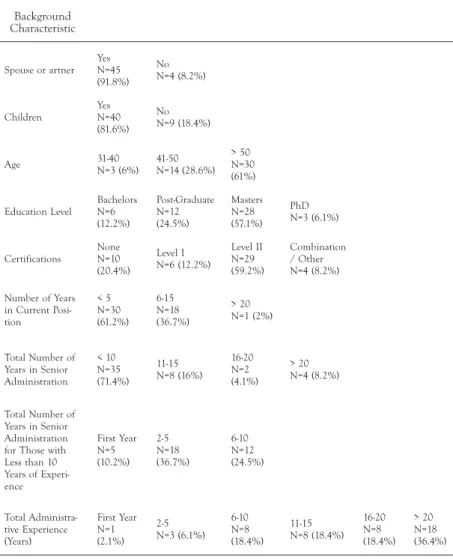
Table 3 (see Appendix A) provides the background demographic and career information found in this section in tabular format. The majority of Manitoba senior administrators have a spouse or partner (91.8%; N=45), and have children (81.6%; N=40). Sixty-one percent of the senior administrators (N=30) were over the age of 50, followed by 28.6% (N=14) between the ages of 41-50, while only three (6%) of the senior administrators were between the ages of 31-40. The majority of senior administrators have master’s degrees (57.1%; N=28) or post-graduate degrees (24.5%; N=12), with a much smaller proportion having a bachelor’s (12.2%; N=6) or a doctoral degree (6.1%; N=3). Most senior ad-ministrators have the non-mandatory Manitoba Level II Principals’ certificates
(59.2%; N=29), though a large proportion have no certification at all (20.4%; N=10). A smaller proportion have their Level I Administrator’s certificate (12.2%; N=6) or some combination of certificates (8.2%; N=4) that included Level I, Level II, Special Educators’ or Coordinators’ certificates.
TABLE 1.Proportions of study sample that reflect study variables
Variable Category Population SampleSurvey Participants by Interview Category Position Superintendent 39.6% 34.7% 5 Assistant Superintendent 60.4% 65.3% 5 Context Rural 40% 38.8% 6 Urban 60% 61.2% 4 Sex Male 62.6% 60.4% 5 Female 37.4% 39.6% 5
DEMOGRAPHIC CHARACTERISTICS AND RELATIONSHIP TO CAREER PROGRESSION
A Chi-Square analysis on the demographic variables found no significant differ- no significant differ-ences by sex on any of the demographic variables. However, because assistant superintendents were significantly younger than superintendents (p=.047), it is not surprising to find that superintendents were likely to have significantly more senior administrative experience (p=.020) and total administrative experi-ence (p=.018). Context was significantly related to educational background (p=.020), administrative experience in the current position (p=.009) and total senior administrative experience (p=.042). A closer examination of the data revealed that although rural senior administrators’ education levels represented all four categories (bachelor, post-graduate, master, and doctorate), they were more apt than urban senior administrators to have obtained their position with a bachelor’s degree as their highest level of education. All of the urban senior administrators had between 2-10 years of experience in their current senior administrative position, but the pattern for rural senior administrators was very different. Although the majority of these administrators had between 1-5 years of experience, there are some administrators who represented all other experiential level categories, from 6-20+ years of experience. In terms of total senior administrative experience, the largest category of urban administrators (42.1%) had between 6-10 years of senior administrative experience, followed by those who had 2-5 years of experience (26.3%). Senior administrators in
rural areas were most likely to have between 2-5 years of experience (43.3%), but were represented more evenly across experiential categories.
The interviewee career progression experiences suggest that they are a rep-resentative sample of the cadre of Manitoba senior administrators, as their careers tended to develop in a similar pattern to that listed above and include a diversity of experiences. All participants had begun their careers as teachers (though one in fact began as a substitute teacher for a year, after which she completed her Bachelor of Education degree to become a certified teacher). The second position for this group generally entailed another teaching posi-tion (four respondents), a specialized in-school role (two resource teachers and one counselor), or in-school administration (two vice principalships and one principalship). Overall, this group had served in three to seven positions before entering their first senior administrative appointment, with time served overall in these positions before the senior appointment between 10-28 years. Interestingly, all but one of the males in the group had spent more time in non-senior administrative appointments than the females in the group, with or without leaves. In addition, of the 10 respondents, one of the males had background as a Student Services administrator, another as a Director of Cur-riculum, and a third as a counselor / special educator. A fourth indicated that he had turned down the assistant superintendency twice because of family commitments. Of the females in the sample, two had backgrounds as resource teachers and one as a consultant. All interviewees had some in-school admin-istrative experience, though two females had not taken on a principalship, and one male’s experience of the principalship consisted of a year-long position in an alternative high school. Two of the respondents, one male and one female, had taken positions outside of education for a time, before returning to the education system as senior administrators. All but two participants, one rural male assistant superintendent and one rural male superintendent, had moved across divisions to obtain positions. Two others who now worked in urban superintendencies had moved across provinces to obtain positions.
CAREER PATHS
This section discusses survey and interview data related to the career paths of senior administrators, including various issues, such as positions held, leaves taken during their career progression, and reasons for accepting a senior admin-istrative position. Respondents were asked to include all formal employment positions held within education in chronological order, as well as the length of time they served within the position. All interruptions of service were to be included (i.e., parental leaves, study leaves, sick leaves, etc.), as well as the length of service interruption. Each position described by respondents was organized into the following categories: (a) teacher; (b) school-based profes-sional; (c) school-based administrator; (d) division-based profesprofes-sional; (e) senior administrator; (f) leave; or, (g) other.
Leaves
In the survey data, there were 22 leaves taken by 14 respondents. Women were most apt to take multiple leaves due to maternity, or to a combination of maternity and educational leave. The highest number of leaves taken by any individual was three (three individuals). The majority of leaves were taken by rural female assistant superintendents, and these leaves were almost all for maternity reasons. No men indicated they had taken a parenting leave. No urban superintendents, male or female, indicated that they had ever taken a leave of any sort.
Career path
The career path of current senior administrators was traced back to the point in time when they had received their first senior administrative appointments. Almost three-quarters of the survey respondents (73%) began their senior ad-ministrative appointments as assistant superintendents. The first position held for all participants was that of teacher. By the time people moved into the second position, all categories were represented except for senior administra-tion and other. By the third posiadministra-tion, all categories were represented. When leaves were taken into consideration, respondents had served an average of 21.76 years before entering their first senior administrative appointment, after serving in an average of 5.41 positions. When leaves were taken out of the analysis, the findings indicated that respondents had served an average of 20.69 years before receiving their first senior administrative position, after serving in an average of 5 positions. At the time of the study, senior administrators had served in as little as four positions throughout their careers, and up to 13 positions (including the one in which they currently served), when leaves were included in the analysis as a “position.” When leaves were taken out of the calculation, senior administrators had served in as many as 3 to 12 positions. The average number of positions in which senior administrators served in Manitoba was found to be 7.24 when leaves were considered to be a position, and 6.78 when leaves were stripped from the analysis.
Chi-Square tests were conducted to determine whether position, context, or sex were related to the first in-school administrative position acquired. T-tests for each variable and univariate analysis of variance (UNIANOVA) were conducted to search for significant differences between the three variables under study, the mean time served before receiving the first administrative appointment, as well as the total number of positions held before receiving the appointment when leave was included in the analysis and when it was stripped from the analysis. The chi-square tests revealed that current position was moderately related to first position served (p=.001). In this case, the majority of those individuals who are current assistant superintendents began their senior administrative careers as assistant superintendents (87.5%). Similarly, the majority of current superintendents began their careers as superintendents (58.8%). Only 41.2%
of the current superintendents began their senior administrative careers as assistant superintendents. The remaining two variables showed no significant difference for positions held.
Factors for deciciding to accept senior administrative position
All of the interviewees were asked what factors lead to their decision to accept a senior administrative position. Table 2 provides the list of factors listed in order of frequency from most often cited to least by category of analysis. TABLE 2. Factors leading to decision to apply for a senior administrative position
Factor Total (/10) Rural (/ 6) Urban (/ 4) Male (/ 5) Female (/ 5) Supt. Asst. (/ 6) Supt. (/ 4) Encouraged by Others 9 5 4 5 4 6 3 Need for Change or Transition 4 3 1 2 2 2 2 Blend of Timing and Opportunity 3 3 -- 2 1 3 --Opportunity to Influence or Contrib-ute 3 3 -- 2 1 2 1 Initial Career Goal 1 -- 1 -- 1 1 --Critical of Past Incum-bent 1 1 -- -- 1 1
--All but one interviewee suggested that the encouragement of others had influenced their decision to move into a senior administrative position. Four respondents indicated that they had been ready for more professional challenges or needed to transition into a different role based on the time in their career or positions / divisions around which they needed to make some decisions. For example, one senior administrator decided to apply for a se-nior administrative position “on a whim” to avoid feeling entrenched in the same role until retirement; another needed to decide whether to remain in a position in a division where an administrative appointment seemed unlikely, or to resign and apply for new positions. Three of the administrators spoke of the melding of both timing and professional opportunity, even if they were unsure at the time of their personal readiness. Two administrators had just finished or had almost finished gaining credentials when the positions
came up, after which they were encouraged to apply for the position because of the melding of credentials with the timing of the position. A third indi-cated that he had turned down the assistant superintendency twice due to family responsibilities before finally accepting the position. The possibilities for influencing or contributing to the education system were mentioned by three respondents. One of the respondents suggested, “the position could help me influence programming and students for inclusive special education that at the time was being resisted by in-school administration and teachers.” Another respondent suggested that she wanted to contribute to the system in a different way, and the third suggested that the opportunity to influence a system in innovative and creative ways had been an impetus for her decision. One senior administrator indicated that she had her sites set on a senior administrative position as a career goal, so she “signaled to the board that one day I would be interested in doing that, and sometimes you have to be careful what you wish for because you get it straight away.” The remaining factor was communicated by a senior administrator who decided to apply for the position because she believed that she could be as effective or better than the previous incumbent in the role.
Interviewees were asked about the factors that encouraged them to move on from their first senior administrative position, and/or the factors that held them to their positions. Five of the respondents spoke of reasons for staying in their position. Three of the respondents (all women) were in their first three years of the position, and were content to remain in their assistant su-perintendencies to gain more experience in their areas of responsibility. The remaining two respondents (both males) were content both in their career responsibilities and in the communities in which they worked. In fact, these two males and one of the females indicated that their connection to their local communities were decisive factors in their decision to remain in their current positions. The decision to remain in the local community was also impacted by the considerations of retirement for one of these men, who suggested, “the only reason I would leave is to be closer to my kids.” Other factors that were mentioned included the ability to work with “fabulous people,” to participate in innovative leadership opportunities, and to maintain the supportive connec-tions to the Manitoba Association of School Superintendents (MASS). When asked what factors led them to leave their first senior administrative appointment, two of the respondents indicated that amalgamation of divisions had been of primary importance because of the uncertainties around position maintenance. A senior administrator who had been a division-based Director of Curriculum mentioned that he moved because, for these positions, “the formal support is not there; they are not accepted positions in the same was as the assistant superintendent or the superintendent” and there was no formal support for these roles in organizations such as MASS. Two of the senior administrators moved on from their first appointments because they had the
opportunity to move into positions for which the responsibilities aligned with their personal interests. One of the superintendents suggested that she had moved on because of her high need for change. In her estimation, senior administrators need to establish a vision for the division and then ensure that the structures and processes are in place for the vision of the division to move forward with or without the current incumbent.
DIFFERENCES IN CAREER DEVELOPMENT
Chi-Square Tests were conducted to determine if there was a relationship be-tween the three variables of analysis to each of the career positions with and without leave. In addition to the Chi-Square tests used for the nominal data, T-tests and a univariate analysis of variance (UNIANOVA) were conducted to determine whether significant differences in the mean scores of length of time served in each position and in time overall with or without leaves occurred for each of the variables under study. Significant main effects up to and including the sixth position are included in this analysis, which is the average number of positions served by senior administrators. Although there did exist significant main and interaction effects for positions after the sixth position, sample sizes were too small to warrant inclusion in the results.
Position
In the survey data, a significant difference between chief superintendents and assistant superintendents occurred for the sixth position when leaves were included. In this case, superintendents (mean=4.93 years) had spent a significantly longer time (p=.044) in their sixth position than did assistant superintendents (mean=2.72 years). However, in the time served overall, superintendents had significantly higher service lengths than assistant su-perintendents with (p=.003) or without (p=.003) leaves. When leaves were included, superintendents spent on average a total of 33.48 years as compared to 27.51 years for assistant superintendents. When leaves were taken out of the calculation, superintendents had served an average of 32.99 years of service as compared to 26.89 years for assistant superintendents.
In terms of interaction effects, there were no differences in the mean scores by virtue of position in service time between rural and urban senior administrators. However, when leaves were taken out of the data, rural senior administrators tended to serve in significantly fewer (p=.045) positions overall (mean=6.33) than their urban counterparts (mean=7.47).
Context
In the survey data, context was significantly related to the fourth career position (p=.041). By the time urban administrators moved into their fourth position, the majority had converged into school-based administration. In rural areas,
the career position categories were much more evenly represented, and there were higher proportions of individuals who had moved into division-based positions as their fourth position.
In the interviews, both urban and rural administrators suggested that there were differences in career development. Six of the 10 respondents spoke of the difference that the economies of scale make on the roles of senior ad-ministrators. Essentially, since rural jurisdictions tend to be smaller in scale, senior administrative positions in rural areas tend to be fewer in number, and therefore the responsibilities for overseeing a variety of portfolios are greater. In urban areas the administrative responsibilities tend to be directed by a chief superintendent and divided up amongst a group of assistant superintendents who often further delegate them to consultants and directors. In rural areas, the superintendent and assistant superintendent (if there is an assistant super-intendent), carry the responsibility for all administrative and student service areas. One senior administrator suggested that rural senior administrative posi-tions are great “training grounds” for urban environments, since incumbents learn a variety of skills across general areas of focus. However, one senior administrator suggested that the specialization in urban environments led to more distance between the chief superintendent and assistant superintendents, which could create a bureaucratic separation in urban senior administration that was less apparent in rural areas.
Urban environments provided more opportunity overall in terms of number of positions, professional development opportunities, committee work, and working with larger school boards. However, three of the interviewees indicated that due to this economy of scale, urban areas tend to have a much more “lock-step” process for access to senior administrative positions. Two administrators suggested that urban senior administrators have generally served longer in the education system because of this hierarchical approach that ensures aspirants advance through a traditional career path of teaching and administrative ex-periences. One superintendent suggested that this focus was facilitated by the fact that urban divisions are able to transfer employees with greater ease than rural divisions; another suggested that rural divisions have had to become more creative in their succession planning strategies because of this. In fact, a rural senior administrator suggested that those who live in rural environments have to be willing to move to other divisions in order to access positions, which may not be necessary, or less difficult to do, in urban areas.
Related to the lock-step approach of urban areas, three senior administrators spoke of the greater focus on credentialing that occurs in urban environments. In the estimation of two superintendents, rural divisions are more likely than urban divisions to focus on the match between an individual’s skills/experi-ences and the positional requirements and be more flexible regarding candidate credentials, though credentials are increasingly important in rural areas as
well. A rural senior administrator stated that urban divisions are more apt to have a systems focus, whereas rural divisions maintain a community focus. Although the lack of anonymity in rural communities could be a “blessing or a curse,” along with professional isolation, these administrators enjoyed the opportunity to serve their communities and make career decisions based on the quality of life they wanted to lead.
Sex
In the survey data, sex was significantly related to the second career position (p=.010).The majority of men and women remained in school-based posi-tions in their second position, including either school-based professional or school-based administration. However, while the majority of men moved into a second teaching position, over one-third of the women used their second “position” as a maternity leave.
When leaves were included in the analysis, women (mean=2.44 years) spent a significantly shorter time (p=.017) in their sixth position than men (mean=4.36 years). However, there was found to be no significant difference in the number of positions held by men and women either when leaves were included in the analysis, or when they were not.
In terms of career development based on sex, the most-often cited difference perceived by six respondents (five males and one female) who were interviewed included the sense that women still maintained a larger share of home duties, that the balance between professional and private lives may be more difficult for women, and that males tended to have greater spousal support for managing home responsibilities. An urban female assistant superintendent maintained that administrative positions remain more challenging for women with children and suggested that “if you’re going to be successful, don’t plan on having balance…. There are very few moments that are my own.” Two of the males spoke of their assumptions that women still maintained the larger portion of home responsibili-ties, and three others credited their spouses’ support at home for contributing significantly to their own career development. On the other hand, two of these men openly regretted the time they had lost with their families. One superintendent talked of his decision to obtain his master’s degree, and “I was able to do it, and I managed to do it while I was working and with small kids. But time with my wife and family was compromised.” Another male superintendent suggested, “I didn’t spend the time with my family that I would have liked…when they were young my wife spent the time with the boys.” This man spoke hopefully of the discussions he has been privy to with his own children who, now as husbands, talk more openly about family issues and role differences, and discuss how to compromise and balance the priorities of work and home.
Five senior administrators (two males and three females) commented upon what they perceived to be a difference in the experiential background between
males and females. They perceived that females tended to gain positions in senior administration through previous backgrounds in the areas of curriculum, special education, or student services, and men tended to have backgrounds in high school education, physical education, educational administration, and finance. Curiously, the actual backgrounds of these respondents did not cor-roborate this generality, as at least three of the five males in the sample had backgrounds in special education or curriculum, and three of the five women came from more traditional administrative backgrounds. In addition, these same individuals suggested that in rural areas, women were more apt to gain senior administrative positions that also included student service roles. In urban areas, they perceived that males gained positions in facilities, finance, and human resource management, and females accessed positions related to curriculum, programming, student services, and special education.
Two urban female senior administrators indicated that women are more apt to receive supportive or task-oriented roles rather than lead or decision-making roles, and they are not encouraged to voice disagreement. As one of them suggested:
Where there are men superintendents, and they are mostly men, if they are chief executive officers, they have women associate superintendents or assistant superintendents. The women are different from the men, are different from the women that I have met who have been, or are, superin-tendents. They have task-oriented jobs. “OK, Susan, you are in charge of curriculum.” And so all Susan gets to do is curriculum. She doesn’t get much influence in the decision making; she doesn’t get much influence with the board; she is like a help-mate. And it’s interesting watching the women in the superintendents’ association, because very, very few of them will ever challenge a male idea. I haven’t seen it yet. I remember going to a meeting in the second year I was here, and I forget what it was about, funding or something. I remember disagreeing at a table and all the men looked at me as if so say, “Don’t you know your place?” And you know that told me right away what was going on. But the women here do not appear to be as assertive and aggressive in their senior admin career development or paths as [other] women I have met.
Two female senior administrators suggested that males tended to be more focused on status, prestigious portfolios such as particular committee work or work background, and public accolades than women over the course of their careers. In their estimation, women did not need the “pomp and pomposity” that sometimes occurs in the networking opportunities found in their profes-sional associations. Interestingly, however, one male senior administrator sug-gested that urban senior administrators tended to be more focused on power, image, and politics, and that “rural people have a little different focus.” Four respondents (three females and one male) suggested that males tend to be granted credibility and or legitimacy in leadership sooner than females. Interestingly, three of these comments were made by rural senior
administra-tors and only one from an urban administrator, which speaks to a comment made by a senior administrator that rural areas may still foster more conserva-tive gender stereotypes. When speaking of her experience as a new assistant superintendent, one woman felt:
It was easier for males…the people that I end up networking with are people who know me and have worked with me before, and have a certain level of respect for me already…. Whereas males I think will come into it, and they already have got a little bit of respect. They don’t have to have that knowledge, that this is somebody that you can trust, or this is someone who works hard. They are welcomed into it differently…. They are already granted credibility.
One male superintendent suggested that the credibility for males as senior administrators is granted because:
males, for years, it was much more acceptable for them in senior administra-tive positions…. Our admin team now, school-based, is half and half, but I think there is still a discrepancy at the senior level. There are not very many female superintendents. I would say they’ve had a harder time being accepted by [school] boards.
A third female assistant superintendent also spoke to board acceptance when she suggested that “I suspect that boards still want to be, have their CEO’s be a man. That they may not know that consciously, though they probably would never say that out loud, I think there is evidence to show that, really.” All five women indicated that female senior administrators had to work harder, longer hours, and multi-task in order to be granted the same credibility as their male colleagues. One assistant superintendent suggested that by hiring a female, school divisions got a “two for one” deal. In her estimation, “male colleagues are much better at closing the door and leaving…women are much more prepared to finish something.” None of the men mentioned this factor in their conversations. One rural female mentioned that women were often more highly credentialed, though another urban male administrator suggested that credentials no longer were much of an issue in urban environments be-cause they were required for positional placement.
Two urban senior administrators, one male and one female, alluded to the fact that gender equity is still not built in to senior administrative contracts, using the example of maternity benefits. For example, the male superinten-dent suggested:
It’s not that the will isn’t there; it’s just never been dealt with…. Some people look at that and say, “that organization obviously doesn’t value that or they would have put that in place…. It’s like when I was negotiating my contract. I said, “So what about technology? Do you provide that? Do you provide a cell phone? Do you provide a laptop? Do you provide a Blackberry?” because those were things that I had in my previous position…. And they said, “well we will, we can consider it.” And they included it. But I don’t think that
basic things like maternity benefits should fall into that category where you have to ask for it. Those things in this day and age should already be in place. It isn’t like a Blackberry.
A female senior administrator concurred by stating that senior administrative contracts are “not built for women who want families.”
The remaining factors mentioned by respondents around sex differences in career development had some differences in opinion. Although four senior administrators (two male and two female) overtly mentioned the “boys’ club” in senior administration, the general perception of all but one female was that “the club” was either “dead or dying.” One of the females mentioned that “the old boys’ club is kind of dying off” as new younger males entering the profession have a different outlook that is more equitable. Yet this same woman contradicted herself later when she suggested that males still are more apt to be hired in positions as “poster boys” who “can talk the current educational rhetoric but don’t necessarily practice it.” One of the males suggested that “the days when they boys got together and smoked cigars are over,” particularly in response to the growing number of women who comprise MASS. A second male suggested that “I think that males have an easier time partially because of the old boys’ club, though I think it’s disappearing. I hope it’s disappearing.” He also indicated, however, that he was aware that he had likely benefited from its presence when he stated, “I guess I was lucky. And that’s maybe why I was saying there’s an old boys’ club. It might have been easier for me because I felt accepted fairly quickly, and enough people knew about this town, but it was enough connection that I quickly got in.” The second woman, however, was adamant that “the club” was alive and well:
It is easier for men to move from a position of maybe school-based administra-tion into a superintendency or assistant superintendency with little classroom experience if they are part of the old boys’ network. And it’s alive and well everywhere. I’ve seen people go into superintendencies who are not prepared, and they suffer and everyone else around them suffers.
And yet, two women offered that females are not always excluded from “the club;” in fact, some are contributing members of it. As one woman suggested, “the fact that they happen to be male or female by sex doesn’t necessarily mean that they will practice what I think are more gender neutral practices, or more inclusive practices.” In her view, the role of senior administration is masculinized, so women have felt pressure to be “male oriented, male dominated.” This was echoed by another female who suggested, “The school system, the division office rural, is totally androcentric. The elementary is more androgynous. And senior high schools are kind of schizophrenic. So the systems of school systems, within school systems, have been developed by men.” Given the view of many senior administrators that the context of leadership is changing, they suggest that neither males nor females exclusively align with traditional sex roles in their leadership styles.
Two men suggested that there were no longer any differences in the career development between men and women, but later qualified this by suggesting that there still is a greater expectation for women to maintain the primary role in the home even if she has a full time position in senior administration. One of these men also later qualified his comment by stating that there were fewer women who came into senior administration with high school principalship experience, and that the majority of elementary principals were female. A third male and one female spoke of the changing context whereby more females were accessing senior administrative positions, and that the males who were in positions tended to have a more equitable outlook on inclusive leadership practices as well as more equitable private roles in the home.
IMPLICATIONS FOR CAREER DEVELOPMENT
Many senior administrators are close to retirement, and there is some indi-cation that administrative turnover has begun. This is exemplified by the fact that current assistant superintendents are significantly younger than superintendents. It is also evidenced in the fact that the majority of senior administrators (71%), and in particular rural senior administrators, had less than 10 years of experience in senior administrative positions, and 61% had worked in their current position for less than 5 years. This finding suggests that there is a need for two areas of career support: retirement planning and induction efforts. To that end, MASS has initiated a mentoring program for new members, and the feedback to date has been positive.
The sample also describes a well-educated and highly credentialed cadre of professionals, although rural senior administrators were less likely to be as highly educated as urban administrators. Some of this no doubt stems from access issues to centers of higher learning which are centered in Winnipeg and Brandon. It may also be due to the fact that collective bargaining for teachers and school-based administrators is done at the local divisional level in Manitoba. Collective agreements in urban areas tend to be more lucrative because of their economies of scale, and are more apt to encourage and provide some resource support (time, sabbaticals, and reimbursement) for professional development activities, including education. There was no difference in the educational and certification levels between assistant superintendents and superintendents (and in fact, the proportions of assistant superintendents with master’s degrees and “Level II Principal’s Certificates” were higher than superintendents). Given this, and that assistant superintendents were significantly younger than superintendents, it may be argued that the “new” pool for the superintendency tends to be a younger and more highly qualified group than in the past.
Even though neither education beyond a bachelor’s degree nor certification is “required” by law in Manitoba, local school divisions are prioritizing them
in hiring procedures, and it appears that assistant superintendents are taking the initiative to increase their educational credentials. The implications for career development therefore stem from designing programs that “level the playing field” of access and opportunity for rural administrators. A program that was designed to minimize time, resource, and distance issues would help to increase the educational credentials available to rural administrators and would heighten the quality standards of hiring practices in rural areas. Such a program may include senior administrators, but it could also target those aspiring to administration, so that rural areas could build capacity in succes-sion planning for the future. This may include the design of programs with some combination of online work, cohort programs offered onsite in rural communities, and summer/weekend initiatives. In addition, some discussion on collective bargaining and negotiating individual contracts that include op-portunities for learning might be beneficial.
Career patterns
This cadre of professionals “arrived” in age and service in senior administration at a time that pre-exists many of the current collective bargaining agreements that now include opportunities for parental leave for males, as well as the cur-rent federal legislation that in effect grants up to a year’s leave for maternity. The women in this study, at the time they had children, often took less than a year maternity leave before going back to work, which has implications for their average service length, and career path analysis overall. In fact, there was found to be no significant difference in the number of positions held by men and women either when leaves were included in the analysis, or when they were not. The fact that men are now able to take parenting leaves may have implications for their career paths into senior administration, and may challenge some of the gendered norms regarding parenting for both men and women. Since assistant superintendents are significantly younger than superintendents, there may need to be more emphasis on providing paternity / maternity leaves in senior administrative contracts, which was almost un-heard of in the past, but has occurred in the recent past in Manitoba. The fact that no urban superintendents had taken a leave of any sort opens up questions regarding why this may be so. Are the incumbents more apt to be “career bound” individuals, whether male or female, and even if they have family responsibilities, have supports in place to minimize potential disruptions to service? Are they more able to access educational qualifications because they are urban without having to take educational leaves? Or have they ac-commodated the highly political, often hyper-masculinized role norms of the urban superintendency by ensuring their visibility and by not taking leaves, possibly at the expense of their own desires? Since both male and female urban assistant superintendents have taken maternal and / or educational leaves, will the past pattern of urban superintendents no longer apply in the future? All of these concerns behoove the need to watch the patterns of leaves
taken in the future as they impact on lengths of service, time it takes to enter administration, and have implications for gender, context and the nature of the position. In terms of career development, some discussion over how leaves are negotiated and patterned over time, along with building in maternity and paternity leaves into individual contracts seems to be prudent. Such practices serve current incumbents and may attract potential aspirants as they become aware of the potential to balance familial and career ambitions. In addition, some consideration of how changing leave legislation / processes may affect senior administrative appointments over time by context and / or sex might help to build in structures that could ameliorate disadvantages that might accrue over time.
The pool of senior administrators is primarily drawn from those who have been in-school administrators. However, the chi-square analysis suggested that there are differences by sex for the second position and by context for the fourth position. While the majority of men move into a second teaching position (almost 60%), over one-third of the women use their second “position” as a maternity leave. This is likely due to the fact that younger teachers entering the profession, particularly females, are likely to secure a teaching position, work for awhile, and then begin a family, as evidenced by the fact that the vast majority of study participants were married with families. Until recently, male teachers did not have access to parenting leaves, whereas females could access the opportunity. Since no males in the study had ever taken a parent-ing leave, and only three had taken any kind of leave at all, they were less apt to move into a leave as their second position.
In terms of context, when urban administrators moved into their fourth posi-tion, the majority converged into school-based administration. In rural areas, the career position categories were much more evenly represented, and there were higher proportions of individuals who had already moved into division-based positions. It may be that rural professionals can demonstrate visibility and capacity for leadership more easily in a smaller division, and therefore the opportunities for securing leadership positions occur sooner. It may also be that administrative positions in rural areas are less competitive, and fewer people apply, thereby granting access into those positions by those who want them. It may also be that urban areas tend to have an entrenched succession management system with leadership candidates in larger supply. Therefore “earning one’s stripes” may come only through gaining experience in a larger number of positions. Some support for this comes from the finding that rural senior administrators served in significantly fewer positions overall and in less rigid convergence into administration as the “typical,” “traditional” or only pathway into senior administration. Interestingly, this finding contrasts to the intuitive understanding that since urban areas have a greater diversity of positions, there is greater opportunity to move into senior positions. Though the hierarchical bureaucratization of movement into administration that
channels people first into school based administration and then into senior administration occurs in both urban and rural divisions, it may be that greater visibility in rural areas allows for more flexibility in the hiring process and less whole-scale reliance on an in-school administrative background as the primary indicator of effectiveness for senior administration.
Given these differences, it may be wise for groups that have an interest in senior administration to reconsider the necessary knowledge, skills and abili-ties necessary for effective leadership in senior administration, and to design career development programs targeted to developing those skills. Although the role requirements and skill sets of senior administration are not likely to be radically different from those developed over time in in-school administra-tion, it may unearth issues and skill sets for consideration that are outside of this experience, and underscore the value of considering aspirants who have alternate professional experiences or less traditional career paths. Such a consideration will also shed light on potential improvements that could be made to university programs and / or coursework, and professional develop-ment opportunities that would more relevantly serve the needs of senior administrators in Manitoba.
CONCLUSION
The data suggest that queue theory as operationalized by Tallerico and Blount (2004) exists in Manitoba, but it must be qualified on a number of fronts. For the most part, gender may not by itself operate as a labour queue, though its impact is felt by both men and women. In fact, gender norms are most often evidenced in interaction with context and position. Context creates labour queue stratifications based on educational level (access), the extent to which senior administrators are channeled into traditional career paths, and number of positions served overall. Context, gender, and position interact to form queues based on leaves from service, and create discrepancies on the experiences of career supports and work challenges (though the findings on career supports and work challenges were beyond the scope of this paper). For example, women remain more apt to utilize maternity leave clauses and/or to follow their husband’s careers and that men have avoided taking parenting leaves and are more likely to have their spouses follow their careers, even though male interviewees nearer retirement lament the loss of their family time. These gendered norms are reiterated in the comments made about achieving personal balance. Overall, women speak to various strategies they have implemented to help offset demands, such as delegation or sharing of work at school and at home, hiring help at home, balancing the responsibilities for childcare or elder care, and ensuring they are taking time to maintain their personal well-ness and relationships. Women struggle with this aspect of their lives moreso than men, whereas men are more apt to commend their partners for the roles their partners played in managing their home lives while they succeeded in
their careers (Wallin, 2010). These findings may be suggestive of pressure to conform to hypermasculinzed career norms in high status positions for males while also reaffirming women’s roles as caregivers and/or mothers. Lugg’s (2003) work may also support these findings, as she suggests that men have had to live up to hypermasculinized understandings in order to be hired as leaders, and women who adopt a more masculinized approach may be barred from positions because they are suspected of being queer.
Though women are demonstrating their personal agency by applying for and accessing assistant superintendencies in Manitoba, they remain less likely to obtain senior positions in rural contexts (unless they are hired in “director” positions rather than superintendent administrators), especially in areas where the position of assistant superintendent does not exist and there exists only one senior administrative position for which men are favoured for leadership. Women are less likely to obtain chief superintendencies in urban contexts, though they may be hired into the “supportive” role of the assistant superin-tendency. This serves as a form of gheottoization, often as a consequence of their former backgrounds in Curriculum or Student Services. Overall, however, there is a “new generation” of assistant superintendents, both male and female, who are younger, more attuned to personal balance, and are likely to demand family-friendly policies that were not in existence in previous generations of senior administrators, which may be suggestive of a move towards integration even if the gendered norms remain oriented strongly towards heterosexism. Also of note here, however, are growing concerns around the “feminisation of teaching” which creates its own complex assumptions about gender scripts, professionalism and schooling (Drudy, Martin, Woods, & O’Flynn, 2005). This may be evidenced by the growing negative public opinion of public education being spun in the media and research that demonstrates that men are less often choosing education as a career. Drudy (2008) wrote:
in Western societies, the earliest stages of the formation of masculine identity involve processes which result in the association of a masculine identity with patterns of behaviour that are “not feminine.” For some men, such processes may also involve the denigration of the “feminine”…. It is also suggested that, in rapidly changing post-modern societies, schools and educational institu-tions are places where gender identities, but especially masculine identities, are constantly being negotiated, tested and constructed. It is in this situa-tion, and within the context of a highly feminised teaching profession, that male and female educational and occupational choices are being made. It would appear that, in patriarchal societies, as the proportion of women in an occupation increases, entry to occupations which are highly feminised, or which are in the process of becoming so, is an increasingly difficult choice for men….If as the OECD (2005, 59) point out, many countries are concerned at the increasing feminisation of teaching and perceive that a decline in male teacher numbers signals teaching’s more general loss of appeal as a career, then it clearly indicates that women themselves still have significantly lower levels of status in those societies. (p. 319)
As mentioned above, when men leave professions or opt out of choosing them as a career choice, the entire status of the profession may be minimized, which in fact does not bode well for the women and men who may be lead-ing within it.
Others, however, contend this notion and suggest that patterns of representation are more complex. Though there is a certain level of agreement in the career experiences of women across time, there is no one pattern or experience that represents the experiences of all women, as there is no one pattern for all men. The dynamism of careers in educational administration play out differently for different people in different contexts. In her discussion of the change in career patterns over time, Reynolds (2002) suggested the following:
We can see that individual men and women, while aware of the dominant [gender] scripts, took up or read from a range of scripts, or what Davies (1993) calls subject positions, in creative ways. Like actors in a play, or dancers (Hall, 1997), they pulled from a repertoire of skills and personal attributes to interpret the scripts. Their audiences, by their accounts, how-ever, frequently saw their portrayal, or dance, only in relation to what was deemed acceptable for men and women in that time period. Organizational structures and available discourses were important in terms of how men and women viewed school leadership and structures and how discourses affected the ways in which they decided to pick up, alter or discard available leader-ship scripts. (p. 46)
By extension then, we are all part of the social constructions of our world, but we are also individual actors with agency within those social worlds. To think otherwise nullifies the complexity of the dynamics at play in the world of educational administration, and sets up dichotomous and faulty understand-ings of individualistic meritocracy or social fatalism.
The key to integration is to work towards a reconceptualization, as advocated by Grogan (2000) of the knowledge, skills and role requirements of senior administrators in Manitoba, lead by MASS, with input from those groups that have an interest in ensuring that the senior administrative cadre in Manitoba is highly qualified and supported. Such groups may include Manitoba Educa-tion, Citizenship and Youth, the four preparatory universities in the province, the Manitoba Association of School Trustees, the Council of School Leaders, and the Manitoba Teachers Society.
In order to become more transformative, Blackmore (2006) suggested that conceptualizations of educational leadership must pay attention to principles of recognition, redistribution, participation, and agency, all of which have implica-tions for the findings of this study and career development programming. She offers practical examples of how each of these principles could be actualized in practice and theory. The first principle of redistribution necessitates that equity issues become prioritized in policy and resource agendas, with questions asked around who is privileged in the distribution of these and by extension,
who is not. The principle of exclusion asks educators to consider how policies and practices exclude or include different groups within the system. Both of these principles necessitate that career development programs include research and discussions on how positions are distributed, to whom, and under what conditions in rural and urban contexts, by both position by sex. The principle of agency asks educators to consider questions related to how decisions are made, who is involved in making those decisions, how communication occurs, and the extent to which multiple perspectives and ways of understanding the world are acknowledged and affirmed. This principle necessitates that research focus, not only on the decisions of hiring committees and their views around leadership that may differentially affect women and men, but also those of the aspirants themselves, as these individuals may have very different reasons for aspiring to the positions they wish to hold in different contexts. Finally, working towards recognition and representation means that educational leaders must consider the networks that exist, the extent to which they represent the educational community, how it is that misunderstandings or conflict develops, how more inclusive ways of networking could occur, and how rewards are dis-tributed, and to whom. Wallace (2007) adds to this the idea that these issues are “worked out at both the level of individual consciousness and systemic reform” but that “the growing discussion among academics and practitioners about the need to do both in theory and practice in educational administra-tion and policy are encouraging” (p. 164). Though Manitoba is geographically large, the fact that there are only 38 public school divisions in the province means that public education maintains a loosely connected but powerful network of people representing leadership groups. Such networks of power need to be examined for how they may perpetuate normative understandings of leadership that influence access to positions for men and women in urban and rural contexts. Based on this reconceptualization of leadership, a career development program that targets both aspiring and current incumbents within senior administrative positions should be designed that reflects the complex and interconnected relationships between position, context, and sex. This development program must consider design and delivery elements and topics that reflect the needs of senior administrators, is accessible to all, and openly considers how equity and power are distributed across the Manitoba public school system.
REFERENCES
Astin, H. S., & Leland, C. (1991). Women of influence, women of vision: A cross- generational study of leaders and social change. San Francisco, CA: Jossey-Bass.
Blackmore, J. (2006). Deconstructing diversity discourses in the field of educational management and leadership. Educational Management Administration and Leadership, 34(2), 181-199.
Blount, J. M. (1998). Destined to rule the schools. Women and the superintendency. 1972-1995. Albany, NY: SUNY Press.
Brunner, C. C. (2000a). Principles of power. Women superintendents and the riddle of the heart. Albany, NY: SUNY Press.
Brunner, C. C. (2000b). Unsettled moments in settled discourse: Women superintendents’ experi-ences of inequality. Educational Administration Quarterly, 36(1), 76-111.
Brunner, C.C. (2003). Invisible, limited, and emerging discourse: Research practices that restrict and/or increase access for women and persons of color in the superintendency. Journal of School Leadership, 13(4), 428-50.
Brunner, C. (2004). Women performing the superintendency: Problematizing the normative alignment of conceptions of power and constructions of gender. In J. Collard, & C. Reynolds (Eds.), Leadership, gender and culture in education: Male and female perspectives (pp. 121-135). Cornwall, UK: MPG Books Ltd.
Bryant, C. (2004). Women in the superintendency in Manitoba. MASS Journal, 4(1), 32-33. Drudy, S. (2008). Gender balance / gender bias: The teaching profession and the impact of femi-nization. Gender and Education, 20(4), 309-323.
Drudy, S., Martin, M., Woods, M., & J. O’Flynn, J. (2005). Men and the classroom: Gender imbalances in teaching. London UK: Routledge.
Eagly, A. H., & Johannesen-Schmidt, M. C. (2001). The leadership styles of women and men. Journal of Social Issues, 57(4), 781-797.
Eagly, A.H., & Johnson, B.T. (1990). Gender and leadership style: A meta-analysis . Psychological Bulletin, 108, 233-256.
Eagly, A.H, Karau, S.J., & Johnson, B.T. (1992). Gender and Leadership style among school prin-cipals: A meta-analysis. Educational Administration Quarterly, 28(1), 76-102.
Gilligan, C. (1982). In a different voice: Psychological theory and women’s development. Cambridge, MA: Harvard University Press.
Glaser, B.G., & Strauss, A.A. (2009). The discovery of grounded theory: Strategies for qualitative research. Piscataway, NJ: Transaction Publishers, Rutgers.
Glass T. E., Bjork, L.G., & Brunner, C.C. (2000). The study of the American superintendency: 2000. Arlington, VA: American Association of School Administrators.
Grogan, M. (1996). Voices of women aspiring to the superintendency. Albany, NY: SUNY Press. Grogan, M. (2000). Laying the groundwork for a reconception of the superintendency from feminist postmodern perspectives. Educational Administration Quarterly, 36(1), 117-42.
Gupton, S.L., & Slick, G.A. (1996). Highly successful women administrators: The inside stories of how they got there. Retreived from ERIC database. (ED399674)
Kachur-Reico, C. (2010). Tracing the career paths of female superintendents in Canada. (Unpublished master’s thesis), University of Manitoba, Winnipeg, Manitoba.
Lugg, C. (2003). Sissies, faggots, lezzies and dykes: Gender, sexual orientation and a new politics of education? Educational Administration Quarterly, 39(1), 95-134.
Marshall, C., Patterson, J.A., Rogers, D.L., & Steele, J.R. (1996). Caring as career: An alternative perspective for educational administration. Educational Administration Quarterly, 32(2), 271-94.
Mertz, N. T. (2003). Women in line administration: A longitudinal study in one state. 1972-2002. Journal of Women in Educational Leadership, 1(4), 303-322.
Murtadha-Watts, K. (2000). Cleaning up and maintenance in the wake of an urban school admin-istration tempest. Urban Education, 35(5), 603-15.
Ortiz, F. I., & Marshall, C. (1988). Women in educational administration. In N.Boyan (Ed.) Handbook of research on educational administration (pp. 123-144) Albany, NY: Longman.
Pounder, D. G. (1990, October). National megatrends and increased leadership in schools. Paper presented at the Annual Meeting of the American Educational Research Association Meeting, Pittsburgh, PA.Reskin, B., & Roos, P. (1990). Job queues, gender queues: Explaining women’s inroads into male oc-cupations. Philadelphia, PA: Temple University Press.