Distributed Control of Coded Networks
by
Fang Zhao
B.Eng., National University of Singapore (2000)
M.Eng., l\ational University of Singapore (2001)
ARCHIVES
MASSACHUSETS INSTMUTE OF TECHNOLOGY
FEB 2
3
2010
LIBRARIES
Submitted to the Department of Electrical Engineering and Computer
Science
in partial fulfillment of the requirements for the degree of
Doctor of Philosophy in Electrical Engineering and Computer Science
at the
MASSACHUSETTS INSTITUTE OF TECHNOLOGY
February 2010
©
Massachusetts Institute of Technology 2010. All rights reserved.
Author..
.
T..
...
Department of Electrical Engineering and Computer Science
November 12, 2009
-
z
C ertified by ... ... ,-. . . .. ... ...
Muriel Medard
Professor, Department of Electrical Engineering and Computer
Science
Thesis Supervisor
A ccepted by ... ...
...
Terry P. Orlando
Chairman, Department Committee on Graduate Theses
Distributed Control of Coded Networks
by
Fang Zhao
Submitted to the Department of Electrical Engineering and Computer Science on November 12, 2009, in partial fulfillment of the
requirements for the degree of
Doctor of Philosophy in Electrical Engineering and Computer Science
Abstract
The introduction of network coding has the potential to revolutionize the way people operate networks. For the benefits of network coding to be realized, distributed solutions are needed for various network problems. In this work, we look at three aspects of distributed control of coded networks.
The first one is distributed algorithms for establishing minimum-cost multicast connections in coded networks. The subgraph optimization problem can be viewed as an linear optimization problem, and we look at algorithms that solve this problem for both static and dynamic multicasts. For static multicast, we present decentral-ized dual subgradient algorithms to find the min-cost subgraph. Due to the special structure of the network coding problem, we can recover a feasible primal solution after each iteration, and also derive theoretical bounds on the convergence rate in both the dual and the primal spaces. In addition, we propose heuristics to further improve our algorithm, and demonstrate through simulations that the distributed algorithm converges to the optimal subgraph quickly and is robust against network topology changes. For dynamic multicast, we introduce two types of rearrangements, link rearrangement and code rearrangement, to characterize disturbances to users. We present algorithms to solve the online network coding problem, and demonstrate through simulations that the algorithms can adapt to changing demands of the mul-ticast group while minimizing disturbances to existing users.
The second part of our work focuses on analysis of COPE, a distributed oppor-tunistic network coding system for wireless mesh networks. Experiments have shown that COPE can improve network throughput significantly, but current theoretical analysis fails to fully explain this performance. We argue that the key factor that shapes COPE's performance curve is the interaction between COPE and the MAC protocol. We also propose a simple modification to COPE that can further increase the network throughput.
Finally, we study network coding for content distribution in peer-to-peer networks. Such systems can improve the speed of downloads and the robustness of the systems. However, they are very vulnerable to Byzantine attacks, and we need to have a signature scheme that allows nodes to check the validity of a packet without decoding.
In this work, we propose such a signature scheme for network coding. Our scheme makes use of the linearity property of the packets in a coded system, and allows nodes to check the integrity of the packets received easily. We show that the proposed scheme is secure, and its overhead is negligible for large files.
Thesis Supervisor: Muriel Medard
Acknowledgments
I am heartily thankful to my advisor, Professor Muriel M6dard, for her invaluable
guidance, support, encouragement, and care through the years. Besides teaching me how to be a researcher, she has been a constant source of inspiration. I cannot imagine having a better or friendlier advisor for my Ph.D study.
I thank my thesis committee members/collaborators, Professors Asuman Ozdaglar and Desmond Lun, for their guidance and insightful comments. It was a great pleasure working with them.
Many thanks also go to my friends for their friendship and help.
Last but not least, I owe my deepest gratitude to my family, for their unwavering love and support.
Fang Zhao Cambridge, MA November 2009
This thesis is based upon work supported by:
" BAE Systems National Security Solutions Inc., Defense Advanced Research
Projects Agency (DARPA), and the Space and Naval Warfare System Center
(SPAWARSYSCEN), San Diego, under subcontracts 6899963, 6917551, 060786,
and 069145;
" National Science Foundation (NSF) under grants CCR-0325496, CNS-0627021, CNS-0627021;
* The Air Force Office of Scientific Research (AFOSR) under grant
Contents
1 Introduction 13
1.1 Distributed control of coded networks . . . . 14
1.2 M ain contributions . . . . 16
1.3 Thesis outline . . . . 17
2 Minimum-cost Subgraph Algorithms for Static and Dynamic Multi-casts with Network Coding 19 2.1 Background . . . . 19
2.1.1 Min-cost subgraph for static multicasts . . . ... . 20
2.1.2 Min-cost subgraph for dynamic multicasts . . . . 21
2.2 Problem formulation . . . . 23
2.2.1 W ireline network . . . . 23
2.2.2 W ireless network . . . . 25
2.3 Decentralized min-cost subgraph algorithm for static multicast . . . . 28
2.3.1 Subgradient method for decentralized subgraph optimization . 29 2.3.2 Convergence rate analysis.. . . . . . . . 33
2.3.3 Initialization and primal solution recovery . . . . 40
2.3.4 Simulation results . . . . 43
2.4 Min-cost subgraph algorithms for dynamic multicasts . . . . 48
2.4.1 Nonrearrangeable Algorithm . . . . 48
2.4.2 Rearrangeable algorithms . . . . 52
3 Analysis and Improvement to COPE 63
3.1 Background ... ... ... 63
3.1.1 The COPE system ... 63
3.1.2 Existing analysis on COPE.... . . . . . . . 67
3.2 COPE performance analysis.. . . . . . . . 68
3.3 Improvements on COPE... . . . . . . . . 75
4 Signatures for Content Distribution with Network Coding 79 4.1 Background... . . . . . . . . 79
4.1.1 Network coding in P2P networks . . . . 79
4.1.2 Byzantine detection scheme for network coded systems . . . . 82
4.2 Problem Setup . . . . 84
4.3 Signature scheme for network coding . . . . 85
4.4 Discussion.. . . . . . . . 88
5 Conclusion and Future Work 93 5.1 Future work . . . . 95
List of Figures
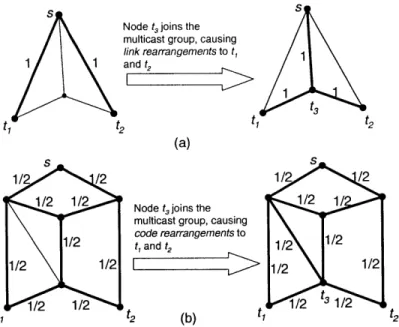
2-1 (a) Example of an online step that causes link rearrangements to ex-isting users; (b) Example of an online step that causes code rearrange-ments to existing users. The multicast rate from source node s to terminal nodes {ti, t2, t3} is 1. The thick lines indicate links used in
the multicast, and the numbers against them indicate the rate of flow
on them . . . . . . . . 22
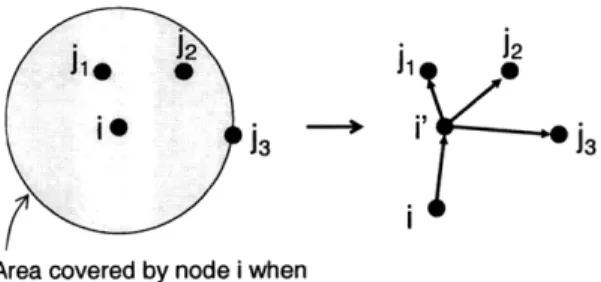
2-2 The "wireless multicast advantage" associated with omnidirectional antennas. The three destinations ji, J2, and
j
3 can all be reached atthe same time with cost aj, and this is equivalent to having three unit capacity links from i to ji, j2, and
ja.
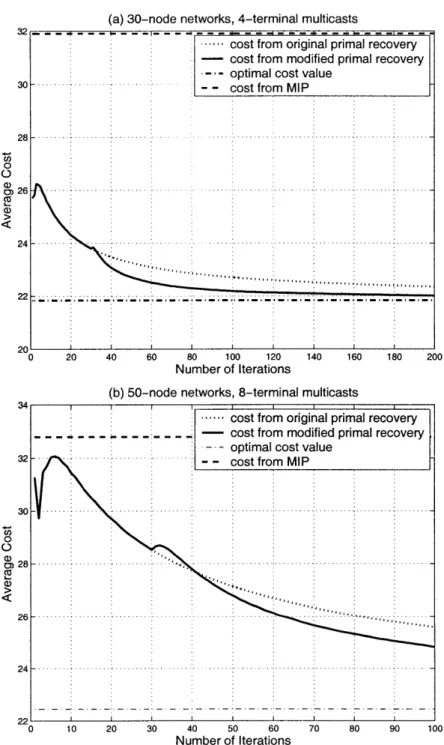
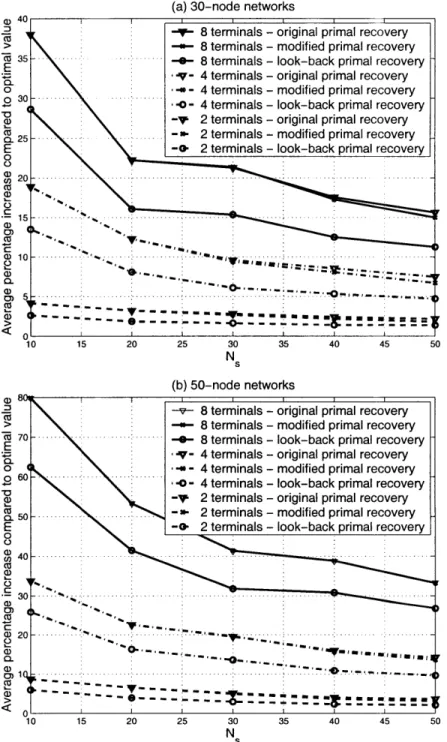
Here, we also included avir-tual unit-capacity link (i, i') to impose the constraint that information transmitted on the three links must be the same. . . . . 26 2-3 Average cost of random 4/8-terminal multicasts in 30/50-node wireless
networks, using the decentralized subgraph optimization algorithms and centralized MIP algorithm. For modified primal recovery method,
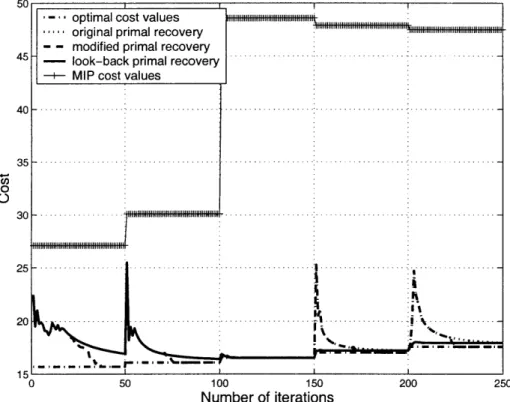
N a = 30 . . . . 45 2-4 Cost of a random 4-terminal multicast in a 30-node mobile wireless
network, with N, = 50, under various algorithms. For the modified
primal recovery method, we used Na = 20 and, for the look-back primal
recovery method, we used Na = 50. . . . . 47
2-5 Extra energy required for multicasts in mobile wireless networks using
decentralized subgraph optimization scheme in terms of percentage of the optim al value. . . . . 49
2-6 Nonrearrangeable algorithm.. . . . . . . . . 51
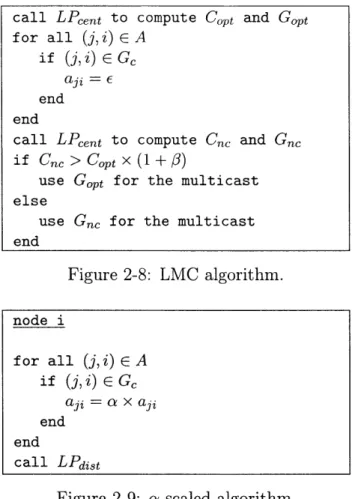
2-7 MLR algorithm... . . . . . . . . . . . . . 52
2-8 LMC algorithm... . . . . . . . . . . . 54
2-9 a-scaled algorithm.. . . . ..54
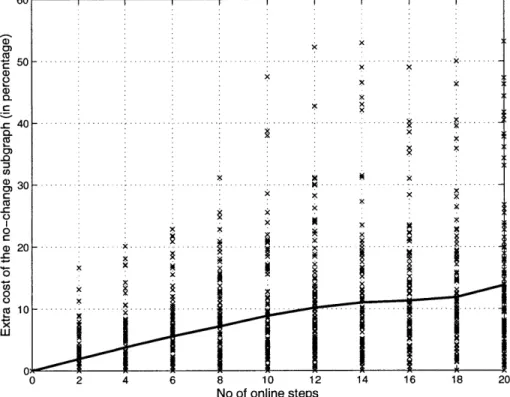
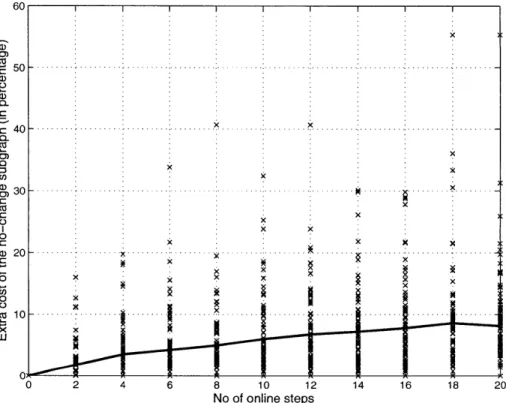
2-10 Extra cost of the multicast subgraph generated by the MLR algorithm in terms of percentage of Copt for the Exodus network. We are showing both the individual data points for each trial and the average curve. . 57 2-11 Extra cost of the multicast subgraph generated by the MLR algorithm for the EBONE network in terms of percentage of Cpt. . . . . 58
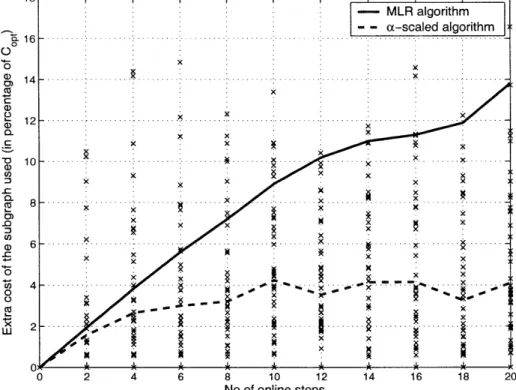
2-12 Extra cost of the multicast subgraph generated by the a-scaled algo-rithm with a = 0.75 and the MLR algorithm in terms of percentage of Copt, on the Exodus network. We are also showing the individual data points for each trial for the a-scaled algorithm . . . . 60
2-13 Extra cost of the multicast subgraph generated by the a-scaled algo-rithm with various a values, on the Exodus network. . . . . 61
3-1 Example of how COPE increases the throughput in the Alice-and-Bob wireless network.. . . . . . . . 64
3-2 Cross network. . . . . 65
3-3 COPE can provide a several-fold (3-4x) increase in the throughput of wireless ad hoc networks with UDP flows. This figure is taken from [29]. 66 3-4 Throughput for COPE and non-COPE systems in an Alice-and-Bob network with cross traffic only. . . . . 71
3-5 Throughput for COPE and non-COPE systems in a cross network with cross traffic only. . . . . 73
3-6 Throughput for COPE and non-COPE systems in a cross network with cross traffic and traffic generated at the center node. . . . . 74
3-7 An example of queue status and packets sent in a cross network with COPE... ... ... ... 75
3-8 An example of queue status and packets sent in a cross network with
m odified COPE . . . . 76 3-9 Throughput for COPE, modified COPE, and non-COPE systems in a
cross network with cross traffic and traffic generated at the center node. 77 4-1 Content distribution with network coding. Assume the file being
dis-tributed is broken into three blocks, P1, P2, and P3. Any packet being transmitted is a random linear combination of all the blocks the sender has. For example, the packet sent from the source to peer A is a combination of P1, P2, and P3, whereas the packet sent from peer
A to D is a combination of blocks Al and A2. A peer is able to decode
Chapter 1
Introduction
The concept of network coding, introduced by Ahlswede et al. in their pioneering work [4], is to allow and encourage mixing of data at intermediate network nodes. This is in contrast to conventional routing networks, where intermediate nodes only store and forward packets. A receiver in a coded network sees these mixed data packets and deduces from them the messages that were originally intended for the data sink. This shift in paradigm has a deep impact on a wide range of areas such as reliable delivery, resource sharing, efficient flow control, and security [16]. Due to this deep impact, network coding has generated a lot of research interest in recent years, and numerous subsequent papers, e.g., [38, 33, 27, 19, 44], have built upon this concept.
Much work in network coding has concentrated on a particular form of coding,
random linear network coding (RLNC). RLNC was first introduced by Ho et al. in
[19]. It is a coding method that lets nodes randomly pick their own coding coefficients
from a given field without centralized coordination. It has been shown that as long as the field size is large enough, the probability that the receiver nodes can decode successfully is close to 1. This coding method is particularly attractive because it is completely distributed, and is robust to changes.
Network coding provides benefits along many diverse dimensions of communi-cation networks, such as throughput, robustness, security, complexity, and wireless resources [16, 22]:
* Throughput - Ahlswede et al. showed in
[4]
that network coding can achieve the maximum multicast rate, which is not achievable by routing alone. In ad-dition, Li et al. [38] and Koetter and Medard [33] showed that linear network codes suffice to achieve the capacity of a multicast connection in an error-free network. Beside increasing throughput for a multicast in a wireline network, network coding has also been shown to improve throughput in unicast connec-tions [39] and in wireless networks [28].* Robustness - Network coding provides robustness to both packet losses and link failures. In a lossy network, we can code packets across time, i.e., mix packets from the same flow together, to combat packet losses. This method can achieve the same sending rate as that when using link-by-link erasure codes. However, unlike the link-by-link erasure codes, the network coding approach does not require decoding at the intermediate nodes, thus avoid the delay prob-lem. As for link failures, since network coding allows sharing of network sources among different flows, it can provide path protection and improve re-source usage.
" Security - From a security point of view, network coding provides both benefits and drawbacks. Sending linear combinations of packets instead of the uncoded packets is a natural way to take advantage of multipath diversity for security against wiretapping attacks. However, network coding also introduces new se-curity problems as it is particularly susceptible to Byzantine attacks. We will discuss this in more detail in Chapter 4.
1.1
Distributed control of coded networks
Distributed solutions are desirable for many network problems, as they are scalable, robust to network changes, and can take advantage of the distributed resources in the network, such as CPU, storage, etc.. For example, in conventional networks, routing is done in a distributed manner using algorithms such as the distributed
Bellman-Ford algorithm and the Dijkstra's shortest path algorithm [5]. Distributed flow management is available for congestion control. Distributed storage and peer-to-peer file sharing are also examples of distributed network solutions. When network coding is introduced, we need to develop new distributed methods or modify existing ones to adapt to the new paradigm.
In fact, distributed methods appear to have a natural place in network coding. The generation of network codes can be done in a distributed manner through the use of RLNC as mentioned previously. Another example is the problem of subgraph selection for multicasts. In routing networks, the subgraph selection problem is the Steiner tree problem, which is NP-complete, and hard to solve even in a centralized manner. However, with network coding, we can formulate the subgraph selection problem into a linear programming problem, and distributed methods are available to find the optimal subgraph [44].
To transfer the theoretical benefits of network coding into practical systems, we still need to develop distributed solutions to a variety of problems in coded networks. In this work, we focus on three aspects of distributed control of coded networks.
The first one is the minimum-cost subgraph selection for multicasts in coded networks. Similar to routing for unicast connections, when we need to establish a multicast connection, we have to first find the subgraph on which the multicast can be performed. As mentioned previously, this problem is NP-complete in a conventional routing network. However, in a coded network, distributed algorithms are available to find the minimum-cost subgraph. We study the algorithm proposed in [44], derive bounds on its convergence rates, and introduce methods to improve its convergence performance. In addition, we also study the dynamic multicast problem, where the members in the multicast group is not constant. We propose distributed algorithms to cater for the dynamic needs of the users, and at the same time, strive to keep the cost of the multicast low.
The second aspect we look at is distributed network coding for unicasts in wireless networks. Specifically, we study the COPE system proposed in [28, 29]. COPE is a packet-level network coding technique that exploits wireless broadcast to improve
throughput in congested networks. The nodes in COPE performs opportunistic cod-ing, and decoding is done at the next hop. The coding and decoding are performed locally, and does not require any centralized control. Experiments demonstrate that
COPE can significantly improve the network throughput with UDP traffic. We
an-alyze the coding structures in COPE to understand the reasons behind these gains, and also, propose modifications to COPE that can further improve its throughput.
Finally, we study the usage of network coding in content distribution in peer-to-peer (P2P) networks. Network coding has been shown to improve the speed of content distribution, however, this system is very susceptible to Byzantine attacks. This is a major obstacle against practical implementation of network coded content distribution. We propose a distributed signature system that can efficiently detect the presence of corrupted data in received packets.
1.2
Main contributions
The main contributions of this work are summarized below:
e For static multicast, we present distributed subgradient algorithms to find the
min-cost subgraph, and derive their convergence rate in both the primal and the dual domains. We also propose various heuristics for dual variable initialization and primal solution recovery to further improve the convergence rate, and use simulations to verify their performance. We also show through simulations that the algorithm is robust to changes in the network and can converge to new optimal solutions quickly as long as the rate of change in the network is slow as compared to the speed of computation and transmission.
* For dynamic multicasts, we propose both nonrearrangeable and rearrangeable algorithms for the subgraph selection problem, and use simulation results to show that one of our proposed algorithms, the a-scaled algorithm, can effectively bound the growth of the multicast cost without causing too many disturbances to existing users.
* We analyze the performance of COPE and argue that the main reason that shapes COPE's performance curve is the interaction between COPE and the
MAC protocol used in the wireless network. The local fairness imposed by
the MAC protocol among competing nodes plays an important role here. In addition, we propose a simple modification to the COPE system that can further improve the network throughput.
" For network coded content distribution in P2P networks, we propose a new
ef-ficient, packet-based signature scheme, designed specifically for RLNC systems, to detect Byzantine attacks by checking the membership of a received packet in the valid vector space. This scheme allows an one-hop containment of the contamination, and its overhead is very small.
Various parts of the work in this thesis appear in various published and as yet unpublished papers [58, 59, 30, 60, 57, 61].
1.3
Thesis outline
In Chapter 2, we first introduce the background to the minimum-cost sugbraph prob-lem in Section 2.1. This probprob-lem is then formulated in Section 2.2. In Section 2.3, we present the decentralized algorithm for subgraph optimization, analyze its conver-gence rate, propose heuristics to improve the algorithm, and simulate its converconver-gence performance. In Section 2.4, we propose algorithms to cater for the changing need of a dynamic multicast group, and demonstrate the effectiveness of our algorithms through simulations.
In Chapter 3, Section 3.1 provides the background on the COPE system and ex-isting work on its analysis. We present our new analysis of the COPE performance in Section 3.2, and propose a modification to COPE to improve its throughput per-formance in Section 3.3.
In Chapter 4, we give the background on network coding in P2P networks and its security problems in Section 4.1. We present the network model used in Section 4.2,
and the proposed digital signature scheme in Section 4.3. Section 4.4 discusses the overhead of the signature scheme.
Chapter 2
Minimum-cost Subgraph
Algorithms for Static and Dynamic
Multicasts with Network Coding
In this chapter, we study the subgraph optimization problem for both static and dynamic multicasts in coded networks.
2.1
Background
One of the main advantages of network coding over traditional routed networks is in the area of multicast, where common information is transmitted from a source node to a set of terminal nodes. When coding is used to perform multicast, the problem of establishing a minimum-cost multicast connection is equivalent to two effectively decoupled problems: one of determining the subgraph to code over, and the other of determining the code to use over that subgraph. The latter problem has been studied extensively in [19, 23, 20, 13], and a variety of methods have been proposed, which include employing simple random linear coding at every node. As mentioned in Chapter 1, such random linear coding schemes are completely decentralized, requiring no coordination between nodes, and can operate under dynamic conditions [21]. These papers, however, all assume the availability of dedicated network resources.
In this chapter, we focus on the former problem, which is to find the min-cost sub-graph that allows the given multicast connection to be established (with appropriate coding) over coded packet networks. This problem has been studied in [54], [43]. The analogous problem for routed network is the Steiner tree problem, which is known to be NP-complete [7, 52]. When coding is allowed, the min-cost subgraph problem
can be formulated as a linear programming (LP) problem, and in this chapter, we examine algorithms to solve it for both static and dynamic multicasts.
2.1.1
Min-cost subgraph for static multicasts
By static multicast, we refer to the case where a connection is setup for the user
of a multicast group whose membership stays constant throughout the connection duration. The network topology, on the other hand, is not necessarily static. Lun
et al. showed in [43] that the min-cost subgraph problem can be solved in a
decen-tralized manner by using the dual subgradient method. In Section 2.3, we give an overview of this method, and study its convergence performance both theoretically and numerically.
There has been much work on using subgradient method to solve the Lagrangian dual of a convex constraint optimization problem. The convergence behavior of the subgradient method used on the dual problem is well understood under various step size rules. However, in practice, the main interest is in solving the primal problem, and recovering, from the dual iterations, feasible or near-feasible primal solutions that converge to the optimal solution. There are special cases where the primal solutions computed as a by-product of the dual iterations are feasible, such as in [41], but this is not the case in general. There are only a few papers studying the recovery of primal solutions from the dual iterations, for example [50], [36], and [31]. Recently, Nedi6 and Ozdaglar also looked at the convergence rate of the primal solutions in [46].
In Section 2.3, we present two slightly different formulations of the min-cost sub-graph problem, both of which have the same optimal solutions. These two formu-lations give rise to two different distributed algorithms. One of them gives us a theoretical bound on the convergence rate of the primal solution, however, its
in-termediate primal solutions are not always feasible. The second one, on the other hand, produces a feasible subgraph after each iteration, which allows us to start the multicast with minimum delay. We would like to point out that this is possible due to the special structure of the network coding problem, and it is not true in general for the dual subgradient method. More details on this are presented in Section 2.3.1.
We also introduce heuristics to improve the convergence performance of our al-gorithm, and through simulations, we show that the algorithm produces significant reduction in multicast energy as compared to the centralized routing algorithm just after a few iterations, and it converges to the optimal solution quickly.
One of the challenges of wireless networks, such as ad hoc networks and sensor networks, is variability of the network topology. Topology changes can be caused
by mobility of users, sleeping or waking up of nodes, or the shadowing effect due to
moving obstacles. Our algorithm is also put to test in a dynamic wireless network model, and we show that the subgradient method is robust to topology changes, and nodes are able to adjust their transmission power levels to move smoothly and quickly to a new optimal subgraph in a distributed manner.
2.1.2
Min-cost subgraph for dynamic multicasts
In applications such as real-time video distribution and teleconferencing, users can join or leave the multicast group at any time during the session. In such cases, we need to adjust the multicast subgraph to cater for the needs of this dynamic group. Lun
et. al. gave a dynamic programming formulation of this problem in [42], which aims
to deliver continuous service to the users. However, link and code rearrangement, which are defined later, can still occur under their formulation.
In the context of traditional routing networks, this problem corresponds to the the dynamic Steiner tree (DST) problem [25]. In DST, it is important to limit the number of rearrangements as a connection evolves, because rearranging a large multi-point connection may be time consuming and may require significant use of network resources in the form of CPU time. In addition, rearrangement of a connection may result in the blocking of some parts of the connection as rearrangement proceeds.
Node t, joins the multicast group, causing link rearrangements to t, 1 1 and t, 1 t3 t, t2 ti t2 (a) S S 1/2 /2 1/2 /2
1/2 1/2 Node t, joins the multicast group, causing code rearrangements to
1/2 t, and t 1/2 1/2
1/2 1/2 | 1/2 1/2
tF 1/2-1/2 t (b)
t
1/2 t3 1/2 tsFigure 2-1:
(a)
Example of an online step that causes link rearrangements to existing users;(b)
Example of an online step that causes code rearrangements to existing users. The multicast rate from source node s to terminal nodes{t1
, t2, t3}
is 1. The thick lines indicate links used in the multicast, and the numbers against them indicate the rate of flow on them.Therefore, the DST problem comes in two flavors [25, 48]. One is the nonrearrange-able version, in which rearrangement of existing routes is not allowed. In the other version, rearrangement is allowed, but the cost of rearrangements is taken into con-sideration.
The situation is similar in networks with coding. When the membership of the multicast group changes, we want to minimize the disturbance to existing users in the group by limiting both link rearrangements and code rearrangements. A link
re-arrangement occurs when some links in the current multicast subgraph is removed
causing alternate paths to be used to serve existing users (see Fig. 2-1(a) for an example). Like in the routing networks, owing to the change in the physical con-nection, this kind of rearrangement causes disruptions to the continuous service to the multicast group. The second kind of rearrangement, which we call code
rear-rangement, is more subtle. Code rearrangement occurs when new incoming links are
for code rearrangements. Since random coding is used by the intermediate nodes in the subgraph to perform network coding, when a node has an additional incoming link, it will have to generate a new set of random parameters to mix the incoming streams. All receivers downstream, therefore, have to use these new parameters and recompute the inversion matrix to decode the data streams. This scenario does not involve any physical switching of paths for the existing terminals, but it still causes a minor disruption to the continuous service due to this reprocessing of network coding parameters. Note that the disruptions caused by code rearrangements are generally smaller than that caused by link rearrangements.
In Section 2.4 we present algorithms that adapt to the changing demand of the multicast group, and at the same time, minimize disturbances to existing users. We also compare their performances through simulation.
2.2
Problem formulation
In this section, we present the LP formulation of the min-cost subgraph problem in both wireline and wireless networks. We also derive the Lagrangian dual of these LP problems, which will be used in the distributed algorithms presented in Section 2.3.
2.2.1
Wireline network
We look at the problem of single multicast in wireline networks, and model the net-work with a directed graph G = (N, A), where N is the set of nodes and A is the set
of links in the network. Each link (i,
j)
E A is associated with a non-negative numberaij, which is the cost per unit flow on this link. We assume that the total cost of using a link is proportional to the flow, zij, on it. For the multicast, suppose we have a source node s
C
N producing data at a positive rate R that it wishes to transmitto a non-empty set of terminal nodes T in N.
It is shown in [4] that a subgraph z is capable of supporting a multicast connection of rate R from source s to T if and only if the min-cut from s to any t E T is greater than or equal to R. Hence, the problem of finding the min-cost subgraph can be
formulated into the following LP problem [44]: minimize
f
(z) =(
aijzij (ij)EA subject to z y;> x(, x|Z
xj. =61(,)
{jI(i,j)EA} {jl(j,i)EA} _ > 0where x fi corresponds to the virtual flow on link (i,
j)
flow on link (i*, j) in the multicast subgraph, and6(t
={
R, -R, 0 (2.1) Vi e Nt E T, V(i, j) E A, t E T,for terminal t, zij is the actual
if i= s,
if i=t, otherwise.
Although the decision variables, zij, are unbounded in the above formulation, it is easy to see that any optimal solution of (2.1), z*, is bounded, i.e.,
0 <3z". bij, V(i, j) E A,
for any bij > R. Thus, including the additional constraint (2.2) in (2.1) would not change the optimal solution set. However, it will affect its Lagrangian dual, and consequently, the algorithm for solving this problem. We will see later in Section
2.3.2 that this additional constraint can help us derive a theoretical bound on the
convergence rate of our distributed algorithm.
The Lagrangian dual problem for (2.1) is given by:
maximize q(p) =
S
q(t) (p(t)) tET subject to = ag, tET p > 0 (2.3) V(i, j) E A, V(i, j) E A, t E T, (2.2) V(i, j) E A, t E T,q()(p () = min pi , X(-x' (ij)CA
Vt E T, (2.4)
and F,,) is the bounded polyhedron of points x() satisfying the conservation of flow constraints
X (t)
5
{jl(j,i)EA}
x > 0, V(i, j) E A.
Note that subproblem (2.4) is a standard shortest path problem with link costs
p , which can be solved using a multitude of distributed algorithms (e.g., distributed
Bellman-Ford).
When constraint (2.2) is included in the primal problem, the dual problem becomes
maximize subject to q(p)= E q(t)(p(t)) + I rij(pij) tET (ij)EA p > 0, V(i, j) A, t E T, (2.5) where
rij(pij) = min(aij - p: )zi
tET
and Fz is the bounded region of z given by
V(i, j) E A,
V(i, j) C A.
2.2.2
Wireless network
Under this model, we consider wireless networks where nodes are placed randomly within a 10 x 10 square with a radius of connectivity r. The energy required to transmit at unit rate to a distance d is taken to be d2. Let fig be the cost function
of link (i,
j),
and in our model, fij(ziy) = asyzij where aij = d is the energy requiredto send at unit rate over this link and zij is the rate of flow on this link. We justify this assumption on the basis that we take energy as the most significant constraint, so there are, for example, sufficient time or frequency slots to guarantee that no two where
{jl(i,)eA}
r(t) 6(t) Vi (E N
J2 j2
J3 j3
Area covered by node i when transmitting at power level a3
Figure 2-2: The "wireless multicast advantage" associated with omnidirectional an-tennas. The three destinations ji, j2, and
ja
can all be reached at the same time withcost ai,, and this is equivalent to having three unit capacity links from i to
ji,
j2, andja.
Here, we also included a virtual unit-capacity link (i, i') to impose the constraint that information transmitted on the three links must be the same.transmissions ever interfere. This model is discussed in more depth in [44].
We consider wireless networks in which antennas are omnidirectional. When we transmit from node i to node
j,
we get transmission to all nodes whose distance from i is less than that from i toj
"for free" - a phenomenon referred to as the"wireless multicast advantage" in [53]. If we impose an ordering - on the set of
outgoing links from i, such that (i, k) (i,
j)
if and only if ak :k a , we can thenassume that we obtain a lossless broadcast link of unit rate from node i to all nodes
k such that (i, k) -< (i,
j)
for cost as,. Consider the example shown in Fig. 2-2, wherethere are three nodes within distance r from node i. If node i transmits with power a ih to node
j
3, the two nearer nodes, ji and j2 also receive this information withoutadditional cost. Thus, the situation here is quite different from the wireline case. Instead of picking links to transmit on in the wireline networks, the nodes in wireless networks pick power levels to transmit with, and this in turn determines their radius of coverage.
Similar to the wireline case, in a wireless network, the min-cost subgraph that can be used to perform multicast with network coding is given by the following linear
optimization problem: minimize f (z) = aijzij (i,j)EA subject to
E
z -M {jI(i,j)EA} > 0 (zik - x(0) > 0, z =t) (t) X* M M 32 2 i (2.6) Vic
Nt c T, {jil(j,i)EA} V(ij) E A, t E T,Here, A' is a subset of A with the property that the constraint
{kI (i,k)EA,(i,k)>-(i,j)}
is unique for all (i, j) E A'.
The subgraph optimization scheme also uses the Lagrangian dual of (2.6) given below. maximize q(p) = q(t) (p(t)) tET subject to
E
k (i,k)EA',(i,k)-(ij) pT > 0, (2.7) Pi aij, tET V (i, j)c
A, V (i, j) E A', t E T, where q(t) (p(t)) =min
X ME Fx (i~j)EA {k(i, k)EA',(i,k)-<(ij)}
(2.8)
and FM is the bounded polyhedron of points z) satisfying the conservation of flow constraints.
To simplify the constraints in the dual problem (2.7), we can sort the outgoing links from node i in A' according to their costs. Note that in A', no two outgoing links from a node i are of the same cost. Consider the example in Fig. 2-2 where there are three outgoing links from i with (i, ji) -' (i, j2) -N (i,
ja),
the equality constraintsV(i-, j) E A', it E T,
in (2.7) with respect to these links become
Z()
=ij, tET Zd M) +Z.. EPM -a ij p+ p aij2,ii tET tETP
p
+E(
+
Z
p =a
tET tET tET
These are equivalent to
Z
p
=i tET 1p2 = ij2 tETZ
pg
=ar tET Therefore, if we define si = aj - max aik, {kl (i,k)EA',(i,k)-<(i,j)}the dual problem (2.7) can be simplified to
maximize subject to E qM (p) W tET
XI
=sg, tET pt) > 0, V(ij) C A, V(ij) E A', t E T.2.3
Decentralized min-cost subgraph algorithm for
static multicast
We focus on static multicasts in this section. Section 3.1 gives an overview of the dual subgradient method for decentralized subgraph optimization. The convergence rate of this method is analyzed in Section 2.3.2. Various heuristics to improve the convergence performance of the canonical algorithm in both static and dynamic wire-less networks are presented in Section 2.3.3, and Section 2.3.4 gives some numerical
(2.9)
(2.10)
- aiji,
aij2-results.
2.3.1
Subgradient method for decentralized subgraph
opti-mization
The subgraph optimization scheme in [44] tries to converge to the optimal primal solution by using subgradient method on the dual problem. This algorithm is com-pletely decentralized and each node only has to know the cost of its incoming and outgoing links, and exchange information with neighboring nodes. We first give an overview of the algorithm under the wireline network model in Section 2.3.1. Section
2.3.1 describes the extension of this algorithm to the wireless case. Subgradient method in wireline networks
In the following, we describe the distributed algorithms for solving (2.1) with and
without constraint (2.2). We refer to the algorithm that solves problem (2.1) and its dual (2.3) as Algorithm A, and the algorithm for solving the primal with constraint (2.2) and dual (2.5) as Algorithm B. Most of the discussions and simulations in Section
2.3 are based on Algorithm A, since it has better convergence performance in practical
settings. However, in Section 2.3.2, we use Algorithm B to derive a theoretical bound on the convergence rate of the primal solutions, which is not available for Algorithm
A.
Algorithm A
1. Initialize p[O] - Before the first iteration, each node initializes p[O].
2. Compute x[n] - In the nth iteration, use p[n] as link costs, and run a
dis-tributed shortest path algorithm to determine x[n].
3. Update p[n
+
1] - Update p[n+
1] using subgradient obtained through x[n]values.
where g[n] is the subgradient for p[n], O[n] is the step size for the nth iteration, and
[.]
denotes the projection onto the constraint set P in (2.3). This projec-tion can be done in a distributed manner, and specifically, p [n+
1] is givenby
p [n + 1] = max (0, p [n] +[n]z)[n] + dig[n] , (2.11)
where dij[n] < 0 is a number computed based on the p[n], x[n], and O[n] values [44].
4. Recover
zi[n]
- At the end of each iteration, nodes recover a primal solution,z[n],
based on the dual computations. Let{p
1[n]}
1_1,...,n be a sequence of convex combination weights for each non-negative integer n, i.e.,E1"
1 11[n] = 1 andpu[n] > 0 for all 1 = 1, ..., n. Further, let us define
'Yin = l ,n 7 1, ... n, n = 0, 1, ...,I and
2
= max {OYn - 'Y(-1)n}.
According to [50], if the step sizes {6[n]
}
and the convex combination weights{i
[n]}
are chosen such that(a) 71n > 7(1-1)n for all l = 2, ...n, and n = 0, 1, ...,
(b) A-yn" -+ 0 as n -+ oc, and
(c) 1n -+ 0 as n - o and ynn for all n = 0, 1,...,for some 6
>
0,then we obtain an optimal solution to the primal problem (2.1) from any accu-mulation point of the sequence of primal iterates {z[n]} given by
]= pZ-ti[n] )[l], n = 0, 1, ...
1=1
An example of a set of parameters that satisfy the above conditions are O[n] =
5. Determine '[n] - Each node computes the
z[i[n]
values from thez)[n]
values. In order to minimize the cost,zij[n]
= maxteTz
[n).
6. Repeat - Steps 2 to 5 are repeated until the primal solution has converged. For details of this algorithm and related proofs, please refer to [44].
Since the intermediate
{z[n],
z[n]}
values after each iteration are always feasible solutions to the primal problem, we do not have to wait till the primal solution converges to start the multicast. Instead, the multicast can be started after the first iteration, and we can shift the flows gradually through the iterations to operate on a more cost effective subgraph. Note that in general, this is not true for dual subgradient methods, and it works out here due to the unique structure of the network coding problem. Specifically, the flow variables, zij, are not involved in the flow conservation constraints, and they do not appear in the dual iterations. This allows us to pick feasible z values after each dual iteration based on a set of feasible virtual flows x.If the boundedness constraint (2.2) is included in the primal problem, we have Algorithm B for solving this new problem and its dual (2.5).
Algorithm B
1. Initialize p[O].
2. Compute x[n] and z[n] - Computation of x[n] is the same as that in Algo-rithm A. For z[n], we have
0, if p ;aij,
= tET
Zij[ n]b ij , if pE ;t) > a i.
tET
3. Update p[n + 1] - Update p[n + 1] using subgradient obtained through x[n]
and z[n] values.
p([n + 1] = max (0, p[n] + O[n]g)[n]).
4. Recover z[n] - Recovery of the primal solution
z[n]
is done by taking a convex combination of all past z[n] values, similar to the recovery ofz[n]
in AlgorithmA.
n
[]=
Z]pi[n]z,
[1], n = 0, 1,.../=1
5. Repeat - Steps 2 to 4 are repeated until the primal solution has converged. As we will see in Section 2.3.2, Algorithm B gives us a nice theoretical bound on the primal convergence rate of the min-cost subgraph problem, which is not available for Algorithm A. However, a major drawback of Algorithm B as compared to Algorithm A is that the
z[n]
values are not always feasible, therefore, we cannot start the multicast right away as in the case of Algorithm A. This is very undesirable in practice, and is one of the main reasons why we only focus on Algorithm A in our simulations.Subgradient method in wireless networks
The main steps in the distributed min-cost subgraph algorithm for wireless networks are the same as that in Algorithm A of the wireline case, except for steps 3 and 5, in which some modifications are required. The details of the changes are highlighted below.
In step 3, when updating p[n + 1], the subgradient for pij
[n]
in the wireless case is given by{k I(i,k) EA, (i,k) :(ij)}I
and again, pij[n + 1] is the Euclidean projection of pij[n] + 6[n]gij[n] onto the feasible set Pi.
In step 5, we compute
z[n]
based on the recovered primal solutionz[n].
Recall that in the primal problem (2.6) we have the constraints(ik
-x()
;>
0,V (i, j)
c
A', t
E
T.
(2.12)
Assume that the sorted list of outgoing links from node i in A' based on their costs is
{(i, j),
..., (i, jk)}, and start from the most expensive links (i, ik), the above constraintbecomes
it) >i V t ET.
To minimize total cost, the optimal
ziJk
value should be maxteTz'.
In cases where more than one outgoing links are of the same cost, we just need to make sure that the sum of the flows on these links satisfy constraint (2.12). The distribution of the total flow among these links can be done randomly without affecting the total cost. OnceZijk value is determined, we can move on to the second most expensive link (i, jA-1),
whose constraint now becomes
(iijkl Ilk- 1 )± (niik it))
>
0, V t E T,and we have Zij_ = maxtErx_ +
zt.
) - zijk. By repeating the above process, wecan obtain the optimal primal solution
z
fromz.
2.3.2
Convergence rate analysis
In this section, we study the convergence rates of our dual subgradient method pre-sented in Section 2.3.1 in both the primal and the dual spaces. For clarity of presen-tation, we use the wireline model in this section, as its notations are much simpler than the wireline one. All results here can be easily extended to the wireless case.
Convergence rate for the dual problem
The analysis and results in this subsection apply to both Algorithm A and Algo-rithm B. Here, we will just present the analysis for AlgoAlgo-rithm A, as the extension to Algorithm B is fairly straight-forward.
With properly chosen stepsizes, the standard subgradient method proposed in the Section 2.3.1 converges to dual optimal solutions eventually [6], but it is hard to analyze the convergence rate of the standard method. To this end, we consider
the incremental subgradient method studied in [45]. The incremental subgradient method can be used here because the objective function in (2.3) is the sum of
|TI
convex component functions, and the constraint set is non-empty, closed and convex(see Chapter 2 of [45]). At each iteration, p is changed incrementally through a sequence of
|T|
steps. Each step is a subgradient iteration for a single component function q(t). Thus, an iteration can be viewed as a cycle of|T|
subiterations. Denote the terminal nodes by{1,
2,.. ., NT}, where NT=|T|.
The vector p[n+ 1] is obtainedfrom p[n] as follows.
Oo[n] P~n],
'#i[n] [4i_1[n] + 9[n]g(i)[n]]+,
p[n + 1] := NT n
-We first prove two propositions that are useful for the convergence rate analysis.
Proposition 1. Problem (2.3) satisfies the subgradient boundedness property, which
means there exists a positive scalar C such that
||g| ; C, Vg E aq(t)(p[n])
Uaq(
t)(p _,),
Vi = 1, ..., N, Vn.
Proof. This is true because q(t) is the pointwise minimum of a finite number of affine
functions, and in this case, for every p, the set of subgradients 9q(t)(p) is the convex
hull of a finite number of vectors. Thus, the subgradients are bounded. E
Proposition 2. Let the optimal solution set be P*, there exists a positive scalar y
such that
q* - q(p) > p(dist(p, P*))2, Vp E P.
fol-lows.
maximize q'(v6)
Z
((r
t) R R (<) - r ) (2.13)tET ieN tET
subject to r( - r)< P p V (i,j) E A, t E T, p( aj, V (i,j) E A,
tET
p ) 0, V (j)E A, t E T.
The decision vector, v, is a concatenation of vectors p and r, and we denote the feasible set by V. For any feasible p C P from (2.3), there is a corresponding v in
(2.13) with the same p-component and q'(v) = q(p). Furthermore, for any feasible
V C V, we can extract a p vector from it that gives the same total cost in (2.3).
Therefore, the two formulations (2.3) and (2.13) have the same optimal values, i.e.,
q* = q*
Since the set of solutions for a linear programming problem is a set of weak sharp minima [9], there exists a positive a such that
q'* - q'(v) > a(dist(v, V*)), Vv E V.
So for any p E P in (2.3), we have
q* - q(p) = q'* - q'(v) > a(dist(v, V*)) > a(dist(p, P*)).
The last inequality comes from the fact that p/P* is the projection of v/V* on P, and the projection operation is non-expansive. Since P is a bounded polyhedron, the distance between any two points in P is bounded, i.e., dist(p, p') < B for all p, p' C P
for some positive B. Therefore,
q* - q(p) > -(dist(p, p*)) 2
-B
Let y = a/B, and the proposition is proved. l
Proposition 3. For the sequence
{p[n]}
generated by the incremental subgradient method with the step size O[n] fixed to some positive constant 0, where 0 < , wehave
p)±0|T|2 2
C
2(dist(p[n + 1], p*))2 < (1 - 20p)n+1(dist (p[0], P*))2 +
J
2p Vn. (2.14)
Proof. The proof for this proposition follows from Proposition 1.2 and the proof of
Proposition 2.3 in [45]. Since the dual problem satisfies Proposition 1 (bounded subgradient), from Lemma 2.1 in
[45],
we have||p[n + 1] - r||2
< ||p[n] - r112 - 20(q(r) - q(p[n])) + 021T12
C
2,
Using this relation with r = p* for any optimal p* E P*, we see that
||p[n + 1] - p*|| 2 <2 - 20(q* - q(p[n] )) +02|T|2C2,
and by taking the minimum over all p* E P*, we have
(dist(p[n + 1], p*)) 2 K (1 - 20p)(dist(p[n, p*))2+ 02|T12C2 , Vr E PVn. Vr E P,Vn, (2.15) (2.16) Vn,
where the last inequality comes from Proposition 2. From this relation, by induction, we can see that
(dist(p[n + 1], p*))2 < (1 - 20p)(n+l (dist(p[O], p*))2 + 02|T12C 2 Z(1 - 20p)i, Vn,
which combined with
(1 - 20pu)i < o20pt
yields the desired relation (2.14).
In summary, we have shown that the convergence rate for the incremental sub-gradient method on (2.3) is linear for a sufficiently small stepsize. However, only
convergence to a neighborhood of the optimal solution set can be guaranteed, which is typical for constant step size rules. Moreover, our result also highlights the trade-off between the error and the convergence rate constant. The smaller the 0 value, the smaller the size of the neighborhood, but on the other hand, we get slower conver-gence.
Convergence analysis for the primal problem
As mentioned in Section 2.3.1, it is advantageous to use Algorithm A in practice, as its primal solution is always feasible through the iterations. Unfortunately, due to the unboundedness of zij in formulation (2.1), it is very hard to derive its primal convergence rate. Therefore, in this section, we turn our focus to Algorithm B, for which we derive a bound on its convergence rate.
We first prove that our primal problem (2.1) with constraint (2.2) satisfies the Slater condition in Proposition 4, then present the main convergence rate result in Proposition 5.
Proposition 4. The Slater condition There exists a vector
{2,
z}
E F such thatij> 2 V(i, j) E A, t E T., (2.17)
where F = {F., F,} is the feasible set for the boundedness constraints for z and the
conservation of flow constraints for x.
Proof. For the virtual flows, P , based on the conservation of flow constrains, there
exists feasible solutions where z < R for all (i,
j)
E A and t E T. Since the upperbound on zij is bij > R, we can always find a set of z that is strictly greater than the corresponding x. Therefore, our primal problem satisfies the Slater condition. L
Proposition 5. Let
{,
zt}
be a Slater vector satisfying (2.17), and C be the subgra-dient norm bound in Proposition 1, define* 2 1 C2
where -y = m 2 - 24). If constant stepsize 0 is used in the dual iterations,
{ijjEA,tET i
and simple averaging is used in the primal recovery, i.e., 1i [n] = 1/n for I = 1, 2, ..., n,
then the primal cost after the nth iteration is bounded by
1 (B* |p[O]||2 0C2
f* [ n- 2n0 2
Proof. We first derive the lower bound on f(z[n]) (the left side of (2.18)). Recall that
in Algorithm B, gg [n] = g(zij [n],
4)
[n]) = x [n] - zij [n], and p[n + 1] = max(0, p[n] + Og[n]) > p [n] + Og [n],we have
Og(z[n], x[n]) < p[n + 1] - p[n] Vn > 0.
(2.18)
n-I
Therefore,
>3
Og(z[n], x[n]) < p[n] - p[O] < p[n], where the last inequality followsimO0
from
p[0]
> 0. By the convexity of the functiong,
it follows thatg([n], z[n]) < E g (z[n], x[n]) = Og(z[n], x[n])
i=0
Sp[n]
-nO
Because p[n] > 0, the positive elements in g(z[n],
z[n])
satisfy g(i[n],z[n])+
< p[n]/nOfor all n > 0. Let the amount of constraint violation of (i[n],
z[n])
be ||g(z[n],z[n])+1,
we haveg([n],z[n])+< p[n]
no Vn > 1. (2.19)
Given a dual optimal solution p*, we have
q(p*) = q* < f (z) + (p*)'g(z, x)
for any x E F2 and z C Fz. Thus,
= f (%[n]) + (p*)'g(z[n], z[n]) - (p*)'g(z[n], z[n]) > q* - (p*) 'g ([n, J[n]).
f
(z[n)) (2.20) n-1 n-1 i=0Because p* > 0 and g(zfn],
z[n])+
> g (z n],z6[n]),
we further have-(p*)'9(2[n],a[n]) 2 t llows ,t[h])+tn)
From (2.19)(2.20) and (2.21), it follows that
f (z[n]) q
-(2.21)
(2.22)
||p[n]||
||p*|
.
Since our primal problem satisfies the Slater condition and the dual iterates have bounded subgradients, from Lemma 1 and 3 in [46], we have
|1p*|| 1 -(fQz) - q*)
and
||p[n]I|
B*
where -y and B* are defined in the above proposition. Substitute these bounds into (2.22), and we have the lower bound on f ([n])
f(z[n]) > q*
- -[f(f) - q*] B*
Next, we derive the upper bound on f (z[n]) (right side of (2.18)). By the convexity
of f(z) and the definition of (z[n], x[n]) as a minimizer of the Lagrangian function
f(z)
+
p'g(z, x) over x E Fx and z E Fz, we have n-if (zn]) 1f (z n])
i=0
n-1 n-1
(f (z[i]) + p[i]'g(z[i], x[i])) p[i]'g(z[i], x[i])
0 ii=O n-1n-- 1 q (p[in]) - p[i]'g(z[], x i=O i=O 1n-1 i=O (2.23)
Since p[n + 1] = [p[n] + Og[n]]+, by using the non-expansive property of projection
and the fact that 0 is in the feasible region of the dual problem (2.5), we have
||p[i + 1]|
2<
lp[i]1' 2+ 20p[i]'g[i]
+ 212g[Z]1 2_
Since g[i] = g(z[i], x[i]), we further obtain
-p[i]||2 _ ||p[i + 1]1| 2 + 2O||g(z[i],
x[i])|
2-p[i) g(z[i], z[i]) <_ 20 , 0 < Z < n - 1.
By summing over i = 0,1,..., n - 1, and combining with (2.23), we have
||p[]||22 g n-1
f(i[n])
< q* ++
(
|g(z[i],z[i])||
22n0 2n (2.24)
<
q*
+1p[01
2+
2Vn >
YC 1.By combining (2.22) and (2.24), we have the desired relation.
This proposition shows that when using constant stepsize, the primal solutions converge to a neighborhood of the optimal solution with rate 0(1/n). We are inter-ested in the constant stepsize rule for dual subgradient algorithms, mainly because of its practical importance and simplicity for implementations. Note that there is a trade-off between the size of the neighborhood and the convergence rate. If we want the primal solution to be close to the optimal one, we need to choose a small stepsize, but this would make the convergence rate very slow. This is a typical problem with using constant stepsize, and one way to avoid this situation is to use diminishing stepsize.
2.3.3
Initialization and primal solution recovery
In order to improve the convergence performance of the subgradient algorithms, we introduce some heuristics for steps 1 and 4 in the algorithm presented in Section 2.3.1. Specifically, we propose several methods for initializing the dual vector p[O], and for recovering primal solutions