
Documentation in Progress: Challenges
With Representing Design Process Online
The MIT Faculty has made this article openly available.
Please share
how this access benefits you. Your story matters.
Citation
Tseng, Tiffany, Maria Yang, and Stephen Ruthmann. “Documentation
in Progress: Challenges With Representing Design Process Online.”
Volume 3: 16th International Conference on Advanced Vehicle
Technologies; 11th International Conference on Design Education;
7th Frontiers in Biomedical Devices (August 17, 2014). © 2014 ASME
International
As Published
http://dx.doi.org/10.1115/DETC2014-34686
Version
Final published version
Citable link
http://hdl.handle.net/1721.1/109216
Terms of Use
Article is made available in accordance with the publisher's
policy and may be subject to US copyright law. Please refer to the
publisher's site for terms of use.
DOCUMENTATION IN PROGRESS: CHALLENGES WITH REPRESENTING DESIGN
PROCESS ONLINE
Tiffany Tseng
Department of Media Arts and Sciences
Massachusetts Institute of Technology Cambridge, Massachusetts 02139
Email: [email protected]
Maria Yang
Department of Mechanical Engineering and Engineering Systems Division Massachusetts Institute of Technology
Cambridge, Massachusetts 02139 Email: [email protected]
Stephen Ruthmann
Department of Music Education and Music Technology New York University
New York, New York 10003 Email: [email protected]
ABSTRACT
Web-based documentation platforms afford lightweight and visually rich mechanisms for designers to share documentation online, yet present challenges regarding representation, partic-ularly for collaborative teams. This paper highlights some of these issues through a descriptive case study based on the use of a new web-based social media tool for documenting the develop-ment of design projects called Build in Progress. Undergraduate students worked in teams to design musical construction kits and documented their process using Build in Progress over the course of three weeks. We examined students’ project pages to determine trends with how students visually represented their design pro-cess, and we gathered students’ experiences using the platform through surveys and interviews with select project teams. We found that groups developed their own representations of their design process via tree structures afforded by Build in Progress that present the simultaneous development of distinct elements of their projects and highlight the contributions of each student on the team. The interviews revealed differences between how inter-nal and exterinter-nal documentation are presented and contrasting approaches to creating narrative and instructional documenta-tion based on the intended audience. In particular, we found that students interpreted the tool as one used to help others recreate their design, which led to the omission of several parts of their design process, including experimentation and mistakes. These results suggest the need to further develop tools to support re-flection on process rather than product.
INTRODUCTION
For novice designers, learning a design process involves a challenging balance of responding to ambiguity and uncertainty, gaining domain expertise, and learning to collaborate with oth-ers. Reflecting on the design process is commonly seen as criti-cal for design students to gain design-thinking skills [1–3] and is often encouraged through documentation. With documentation, designers can capture not only what they create but also their rationale behind design decisions that ultimately impact their fi-nal product. As a tool for self-reflection, documentation enables students to reassess their individual capabilities and growth as designers. When design documentation is shared publicly, it has the additional benefits of helping students exhibit their under-standing of the design process and share their experiences and knowledge with an audience beyond their immediate peers.
Prior research on documenting design processes range from understanding how experts visually depict steps of a design pro-cess [4] to how students represent design and engineering propro-cess over time [5] to how freshmen undergraduate students order steps of the design process [6]. As designers gain expertise, they may extend traditional, linear-based design processes to represent a more cyclical, iterative design process [4, 5]. Additionally, ex-pert designers emphasize the importance of communication and teamwork, which may not necessarily be embodied in linear rep-resentations of design processes [4]. Thus, the creation of tools that help students develop and refine their own design practices may help them gain expertise as designers.
Proceedings of the ASME 2014 International Design Engineering Technical Conferences & Computers and Information in Engineering Conference IDETC/CIE 2014 August 17-20, 2014, Buffalo, New York, USA
While existing research has analyzed the role of personal design journals in facilitating student reflection [7], web-based tools have introduced powerful features for collaboration and have become increasingly important for project teams to com-municate their work both internally and externally [8–11]. The uptake of documentation platforms such as wikis is aligned with the emergence and popularity of social media that create oppor-tunities for people to share user-generated content [12]. How-ever, the sharing of content online carries several unique obsta-cles. Self-presentation and self-disclosures are issues faced by users sharing their experiences publicly through the web [12]; as users see the work they share online as an extension of their persona, they curate the content they share such that it aligns with how they wish to be perceived [13]. Thus, we can imagine that the sharing of iterative design processes that may involve re-finement in response to mistakes or setbacks can be particularly challenging for users to share publicly online.
Another issue with documenting design process online is the organization and presentation of information. Creating de-sign documentation involves the representation of dede-sign pro-cess, which have been visually represented in many forms, in-cluding vertical or horizontal block-flow diagrams (indicating a sequential design process), horizontal divergence and conver-gence diagrams (which show narrowing and expanding due to exploration or re-focusing) and cyclical diagrams (emphasizing iteration and concurrency) [4, 14]. While popular existing plat-forms such as blogs and wikis often organize entries linearly and chronologically [15–17], this perspective may make it difficult for readers to gain a sense of the overall scope of the work and may not best represent the iterative and collaborative nature of many design processes [18, 19]. Web-based documentation plat-forms have the capability of combining rich media and visualiza-tion to represent design processes in new ways. In particular, the integration of multiple media formats can enable collaborative design teams to represent both technical aspects of their design process (sketches, prototypes, and technical drawings) as well as human aspects(group discussions, decisions, and rationales be-hind these decisions) [20]. As the integration of these two factors are an indication of more successful design teams [21], enabling lightweight methods for collaborative design teams to organize this information can improve performance.
To examine the potential of web-based tools for collabora-tive teams to document and share their design process, we stud-ied how novice designers documented design projects utilizing a new, publicly-accessible, web-based platform called Build in Progress [22]. Build in Progress (BiP), developed by one of the authors, is a lightweight tool specifically designed to help users share design projects as they develop rather than after the project is complete. The steps taken within a project are visually repre-sented using a tree structure that shows pathways and decision-making in the design process. In this case study, undergradu-ate students worked collaboratively in groups to develop musical
construction kits over the course of three weeks and documented the development of their project using BiP. Through the students’ use of the platform, we explore the following research questions: 1. How do designers visually represent the pathways in their
design process using Build in Progress?
2. How accurately do design projects shared online represent the actual process designers experience in creating their project?
In essence, we are concerned not only with how designers represent their process online but also what they communicate as steps in their process. Through analyzing novice designers’ doc-umentation on BiP and surveying and interviewing select project teams, we uncover opportunities and challenges resulting from sharing design documentation on the web. The results of this paper can be used to refine the design of web-based tools for col-laborative design teams and, more broadly, to improve the fram-ing of documentation activities to encourage particular types of reflection practices.
BUILD IN PROGRESS
In this study, students used a new web-based social media tool called Build in Progress (BiP), a platform being developed by one of the authors to support designers publicly documenting the development of their design projects [22]. The goals of BiP are to enable users to share the story of and rationale for creat-ing a design and shed light on the design process by emphasizcreat-ing process over a final product. We chose to use BiP because of its affordances for supporting documentation during the design pro-cess rather than after a project is complete and because it affords nuanced ways of visually representing a design process.
Using BiP, designers are encouraged to represent the entirety of their design process, including design iterations, setbacks, and reflections, through text descriptions and media, such as images, videos, and sound clips. On a BiP project page, process is rep-resented in two forms: a process map (on the left in Figure 1), which visually represents various pathways and design decisions in a project’s development, and a process blog (on the right in Figure 1), a list of entries (organized chronologically) that pro-vide further detail into each step carried out through the design process. Users can navigate through project pages by scrolling vertically through the process blog or clicking on individual steps in the process map to automatically scroll to the corresponding step in the process blog.
The process blog enables users to describe procedures and rationale for each step in their design process via a blog entry. With each blog entry, user provide a name and description of the step and can upload supplementary media such as images and video. Furthermore, users can leave feedback and suggestions on project pages by way of comments in the process blog.
FIGURE 1: A SAMPLE BUILD IN PROGRESS PROJECT PAGE
The process map provides a more holistic view of the design process through a node-link structure connecting individual steps via horizontal and vertical branches (Figure 2). The content of the process map (the names of individual steps and images as-sociated with the step) are automatically generated when a user creates a new blog entry for a step in the process blog. However, the user manually organizes the structure, or branching, of the process map by clicking and dragging steps to rearrange them. When a blog entry for a new step is created, the step is automat-ically appended to the last step in the process map. This means that for new projects, all steps are connected in a vertical, linear structure in the process map until a user decides to rearrange the structure otherwise.
It should be noted that BiP does not impose a process struc-ture, but instead allows the user to define their own structure as their process emerges. This provides opportunities for users to not only reflect on what they create but reflect on the process by which they created it.
METHODOLOGY
To investigate how novice designers represent collaborative design processes online, students in an undergraduate music ed-ucation course at a mid-Atlantic university were tasked with de-veloping a design project and documenting their process using BiP. This unique population of music education students pro-vided a means to understand how novice designers represent a collaborative design project. Students in the course were
pre-FIGURE 2: A SAMPLE PROCESS MAP TREE STRUCTURE
dominantly second year students studying to become K12 music teachers. Working in groups of three or four over the course of three weeks, 6 teams consisting of a total of 22 students de-signed musical construction kits for learning and making music as well as complementary experience designs, or activities that could be carried out using their designed kits. Each musical con-struction kit contained a set of materials a user could assemble to create various musical instruments and also included paper-based assembly and activity instructions. The kit was to contain no more than $20 dollars worth of material in order to ensure that it was easily accessible to a wide audience; many students repurposed recycled materials and common household items in their kits. After developing the kit and activities, students tested their prototypes with users outside of their group in order to so-licit feedback and consider possibilities for improving their kits in future iterations.
Students were asked to document their individual and group process using BiP, which was introduced as a tool for docu-menting both the steps taken by the group to create the project and their thought process behind each step. Each group cre-ated a project page for their team and crecre-ated a single username to be used by all members of the team for editing the project page. Groups developed the visual representation of their pro-cess through the propro-cess map on their project page; importantly, students were not given direct instruction on how to structure their projects, so the structures they developed were self-defined. All of the teams’ project pages on BiP were publicly viewable throughout the course of the class.
struc-ture of all project pages to determine trends in how students rep-resented their design process. We then individually surveyed and interviewed two project groups to learn more about their expe-riences documenting their projects online. These project teams were selected based on their documentation on BiP, which con-tained a combination of personal reflections and insights as well as more instructional documentation intended for the end user to recreate their project. The survey was administered online and contained a combination of multiple-choice and open-ended questions pertaining to the students’ design experience prior to the course and rationale for structuring their project on BiP. The survey was designed to take no more than ten minutes to com-plete. A one-hour, in-person interview was conducted with each of the two design teams. During the interviews, members of the teams participated in an activity in which each member outlined both their individual process and their team process using hand-drawn sketches. These sketches were then compared to the rep-resentations shown on the BiP website to determine how accu-rately BiP visually represented their actual process. As a token of compensation for their participation in the interviews, each interviewee received a $20 Amazon gift card.
RESULTS
We present the results of this case study in three sections. The first section describes characteristics of the six project pages developed by the students on BiP, and the second and third sec-tions describe results from the surveys and interviews respec-tively from the two interviewed groups.
Project Documentation on Build in Progress
The six project teams successfully created documentation using BiP, with projects averaging a total of 21 steps, or individ-ual entries in the process blog (SD=3.7).
Visual Representations of Process All teams chose to present their process using multiple branches depicting the si-multaneous development of multiple parts of their project (Fig-ure 3). Branches signified several interrelated ideas including 1) different subproducts (in this case, instruments that could be cre-ated using the kits), 2) different experiences, or activities, that could be carried out using the assembled kit, and 3) different team membersand their respective contributions to the project.
For one of the six projects, branching was used to represent potential design alternatives (Figure 3b). The students in this group described three different versions of Component C, with C1 being the most desired solution, C2 being the backup for C1, and C3 being the last resort. As can be seen in Figure 3b, the students ultimately chose C2, although they did not indicate in their documentation why they made this decision.
(a) Sample team project page (b) Iteration in Process Map
FIGURE 3: PROCESS MAP REPRESENTATIONS ON TEAM PROJECT PAGES
Using the process map, readers can see which projects had a cohesive, unifying theme and which projects consisted of a combination of otherwise distinct ideas. For half of the projects, branching occurred from a step in which students described the theme of their project, such as building percussion instruments or using a consistent set of materials across all elements of the project (such as empty cans or water-filled bottles). For the remaining projects, branching occurred without developing an overarching theme, suggesting that students worked more inde-pendently in these groups and combined individual projects into a final kit.
Finally, several users reported confusion over the ordering of steps in the process blog of their project pages. In the pro-cess map, steps are organized chronologically, but because sev-eral parts of the project were being developed simultaneously, some users preferred to navigate project pages directly from their self-organized process process map rather than scrolling through the process blog.
Narrative and Instructional Documentation Stu-dents described their process using a combination of narrative and instructional language. Four out of the six projects included narrative documentation consisting of descriptions of their inten-tions (“I was thinking of originally thinking of including a few rhythm exercises, but I think I may actually include a few simple percussions rudiments”), reflections (“A lot of the instructions aren’t as clear as I thought they were.”), and rationales (“Our in-strument kit is aimed at elementary grade students”). Narrative documentation was written in the first person. This is in contrast to more instructional documentation in which students explained how a user would assemble and use their kit (“Tap the container a few times to get an idea of what your drum will sound like”). All six projects on Build in Progress contained instructional doc-umentation written in the second person.
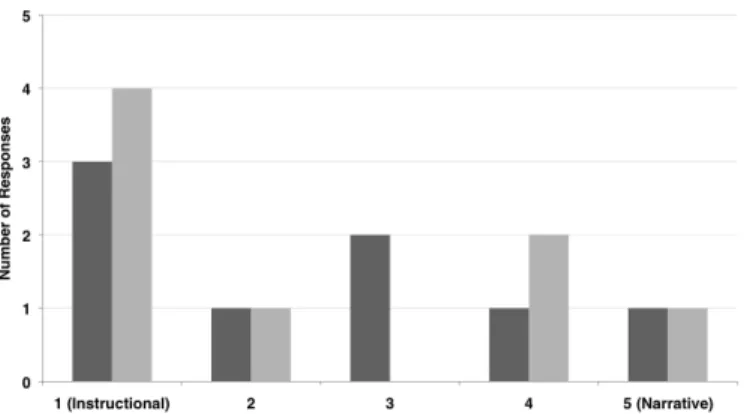
FIGURE 4: STUDENTS’ PERCEPTION OF THE PURPOSE OF BUILD IN PROGRESS AND THEIR TEAM’S PROJECT DOCUMENTATION
steps at the start of the project and at the end of the project. For projects that contained narrative documentation, steps at the be-ginning of the project contained intention and rationale for why students chose particular materials and what they hoped the user would gain from using their musical construction kit. Steps to-wards the end contained reflections, particularly regarding the results of user testing with their kits.
Survey Results
In this section, we describe the survey results of eight stu-dents from two project teams. Prior to the course, six out of the eight students (75%) had no experience design a physical object, further highlighting that many students in this course were en-gaging in a design project for the first time.
Narrative and Instructional Documentation One open-ended question on the survey asked students to “Please de-scribe, in your own words, what the main purpose of Build in Progress is.” Responses to this question ranged from emphasiz-ing the instructional quality of the documentation to developemphasiz-ing a more narrative approach to sharing the design process. For ex-ample, three students used the phrase ‘thought’ to describe the purpose of BiP: “[The main purpose of BiP is] to show the dif-ferent steps in your thought process as you create your projects.” One of the eight students saw BiP as a site for instructions: “To make available to others the instructions to construct a variety of different objects and projects.” The remaining four students saw BiP as a combination of instructional and narrative documenta-tion: “[To] create an instruction guide and document the progress of a project.”
Students were asked to rate on a scale from instructional (1)
to narrative (5) what type of project documentation BiP was de-signed for sharing. Additionally, students were asked where they felt their teams’ BiP project fell on the same spectrum. Figure 4 presents the students’ responses to these two questions. On average, the students felt that the purpose of the tool was more instructional than narrative (µ=2.5). Students’ responses to the question “Our team’s project on Build in Progress was designed to be . . . ” indicated that they felt that their projects were slightly more instructional than their perceptions of the purpose of Build in Progress as a whole (µ=2.34).
Finally, students were asked to select, from a list of options, who they thought the audience was for their Build in Progress project page (students could select multiple options). Most stu-dents expressed that the audience for their project was their class-mates (75%) and their professor (25%), while two students listed K12 teachers and one student listed children. Interestingly, no student selected the options “General Public” or ”Your Team-mates.” This result suggests that students felt that their main audi-ence was their immediate peers outside of their own teammates.
Interview Results
Interviews enabled the researchers to analyze how closely the projects shared on BiP mirrored the students’ actual experi-ence developing their projects. In the interviews, students cre-ated hand-drawn sketches of their individual and team process and compared these sketches with the process map they devel-oped on their BiP project page. The sketches and the dialogue that pursued from this activity elicited differences between inter-nal and exterinter-nal representation of design process.
Discussions with the two groups revealed two different ap-proaches to the collaborative project. When asked to sketch their group’s collaboration process, the first team (Team 1) drew sketches focused on the technological tools they used to com-municate with one another, namely Facebook and BiP (Figure 5). The students on Team 1 individually determined the type of instrument they wanted to create, and each worked relatively in-dependently on developing their instructions and corresponding activity. They then combined each of their final designs into one kit of materials.
In contrast, the second team’s (Team 2) collaborative pro-cess revolved around the roles and responsibilities of the individ-ual group members as indicated by their sketches (Figure 6), and they worked together to develop a kit of shared components that would be used across the activities developed by each student.
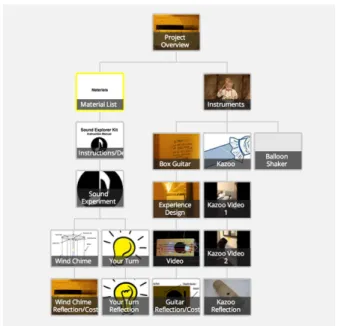
The distinction in how integrated the final projects were for these two teams can also been seen on BiP, where Team 1’s pro-cess map indicates four independent branches representing each student’s distinct ideas (Figure 7), while Team 2’s process map shows that the team came together in the design of their kit (‘Fi-nal Product’) before creating branches for each student to de-scribe an activity they developed using the same fundamental set
FIGURE 5: SKETCH OF TEAM PROCESS FROM STUDENT IN TEAM 1
FIGURE 6: SKETCH OF TEAM PROCESS FROM STUDENT IN TEAM 2
of materials (Figure 8). Both teams expressed that all members of the team contributed to updating their BiP page. On these teams, each student was responsible for maintaining their own branch within the project.
For both teams, students omitted parts of their process on BiP that they shared through their sketches. We classify these omissions into three categories: external actions, experimenta-tion, and mistakes. External actions included processes outside of the immediate use of the kit. For example, neither team docu-mented the process of finding the materials that were included in their kits, which were purchased or obtained outside of the class.
FIGURE 7: PARTIAL TREE STRUCTURE FROM TEAM 1’S PROJECT PAGE [23]
FIGURE 8: PARTIAL TREE STRUCTURE FROM TEAM 2’S PROJECT PAGE [24]
One student described this distinction as follows: “I mostly had the ideas on there [BiP]. Like this (pointing to sketch), I wrote the physical things I did whereas on there [pointing to BiP], it was more like here’s my idea stream.” Team 2, which met in per-son more frequently, did not share when their team met to dis-cuss and build their project. Although they shared their ideation process and the results of their user testing, both teams created documentation on Build in Progress that focused predominantly on the description of the final product and how it was used rather
than the development of their kits.
The exclusion of experimentation was another indication of an overall emphasis on the final product. Through the sketches, several examples of experimentation and refinement were re-vealed that were not represented on BiP. For example, one team had intended to use sand in their final kit, but upon finding that sand exceeded the budget for materials, they decided to use wa-ter, which they found worked just as well. Similarly, a student on the same team tested several different implements for tapping bottles to produce noise before picking the best one. When asked about why they did not share these iterations on BiP, one student made the distinction that the sketches they created of their team process was “how we made the project,” and their project page on BiP was “how you can make the project.” The teams emphasized that they designed their documentation such that a user viewing their BiP project page could easily follow their instructions to recreate their project.
Finally, there was one example of a student who left out a mistakein his process. A student from Team 1 described testing his design with a user who incorrectly followed the instructions and therefore carried out the activity differently than the designer had intended. The student did not share this experience on the site, stating that he “didnt feel the need to take up space with something that was incorrect.” In contrast, another student on the same team shared unexpected results from her user testing in her reflection on the BiP project page. Students’ reflections were generally focused on the final product and how it was used rather than their process of developing the final product. These results suggest that the students’ overall understanding of the purpose of BiP was to share instructions for recreating a final design rather than convey their personal process of creating it, and they repre-sented their process under this assumption.
DISCUSSION
How do designers visually represent the pathways in their design process using Build in Progress?
In this case study, we found that all teams visually repre-sented their projects on BiP using branching structures indicat-ing the subcomponents, activities, and people developindicat-ing various parts of their project. For one project team, the students used the branching structures to exhibit alternative designs, or backup so-lutions for a design. The development of these branching struc-tures occurred organically, as students were not instructed to or-ganize their projects in any particular way. The tree structures were useful to the students in that it gave them an opportunity to show the simultaneous development of different aspects of their projects in an organized way. Additionally, it visually indicated the roles of the different students on the team, helping students showcase their own contributions. As one student stated, “The site was really helpful to help organize it [the project]. Visually, it’s really effective for people who want to learn to do things like
this or create things like this because they can just click on the step if it’s [the project page] is formatted right.”
Several students expressed that they expected the process blog to follow the tree structure from left to right and top to bot-tom. Similar to existing blog structures, the process blog shows steps chronologically, which can be difficult to navigate when multiple parts of the project are being developed at once. As a result, some teams navigated their project pages through the process map rather than scrolling vertically through the process blog. The addition of the process map already appears to be an improvement over linear structures on more traditional systems (such as wikis), and the students’ suggestion indicates opportu-nities to rethink the organization of information in the process blog. For example, one possible solution would be for students to manually indicate in what order they want the steps to appear, which may provide an additional opportunity for reflection.
How accurately do design projects shared online rep-resent the actual process designers experience in cre-ating their project?
Overall, the BiP projects created by the students leaned more towards documenting the final design than the process of devel-oping it. However, four out of the six teams represented inten-tion, reflections, and rationale within their projects, often at the beginning of their projects to describe the goal of their project and at the end in response to user testing. This result suggests opportunities to further encourage reflecting on process, particu-larly as students are developing their prototypes.
Processes that were omitted from BiP include external ac-tions, experimentation, and mistakes. The interviewed students did not feel that these processes would be necessary for a person wishing to recreate their project. It is possible that these chal-lenges may have resulted from limitations of the environment of the case study; the participating students are in a music educa-tion program where they are learning to become teachers, and their assignment also required the development of instructions for how a user would put together and use their construction kit. As a result, the students in this study may have been more likely to consider BiP as an instructional tool rather than one for shar-ing design process. Interestshar-ingly, although students appeared to write their documentation in a format that would appeal to some-one recreating their kit, students felt that the primary audience for their project documentation was their classmates and profes-sor as indicated through the survey. Overall, further refinement is needed to encourage reflection on process, potentially through more explicit encouragement in the user interface and providing richer model examples of sharing process online.
CONCLUSION
By examining how novice designers represent their de-sign process online, this study reveals opportunities for improv-ing visual representations of process and encouragimprov-ing reflection on process. Students documenting their projects on Build in Progress were able to visually represent the simultaneous devel-opment of distinct aspects of their projects through branching structures. The flexibility of the branching structures enabled students to provide their own meaning to the branches, which ranged from representing subcomponents to the design, activities that could be carried out with the subcomponents, and individual team members’ roles and responsibilities. This insight suggests that the combination of tree and blog structures can provide an organized way for viewers to both get an overview of the project and dive deeper into specific elements of the project.
As expected, students did not reveal all aspects of their project in their online documentation, which they felt had the primary purpose of conveying instructions for users to imple-ment their designs. Although the students interviewed did go through an iterative design process, they chose not to share this part of their process online. It appears that the reasoning for dis-crepancies between the students actual design process and what was shared online is the perception that the tool is meant for in-struction rather than narration. This perception may have been a particular limitation of the exact assignment that BiP was used for in this case study, which was to develop a kit with instruc-tional material. The results suggest that students may require more explicit encouragement to reflect on their process and that future work is needed to determine interface changes, assignment framing, and instructional guidance that can help foster a more open community for sharing process over product.
REFERENCES
[1] Adams, R., Daly, S., Mann, L., and Dall’Alba, G., 2011. “Being a professional: Three lenses into design thinking, acting, and being”. Design Studies, 32(6), pp. 588–607. [2] Agouridas, V., and Race, P., 2007. “Enhancing knowledge
management in design education through systematic reflec-tion practice”. Concurrent Engineering-Research and Ap-plications, 15(1), pp. 63–76.
[3] Amon, C., Finger, S., Siewiorek, D., and Smallagic, A., 1996. “Integrating design education, research, and practice at carnegie mellon: A multi-disciplinary course in wear-able computers”. Journal of Engineering Education, 85(4), pp. 279–285.
[4] Mosborg, S., Adams, R. a nd Kim, R., Atman, C., Turns, J., and Cardella, M., 2005. “Conceptions of the engineering design process: an expert study of advanced practicing pro-fessionals”. In Proceedings of the 2005 American Society for Engineering Education Annual Conference and Exposi-tion.
[5] Lande, M., and Leifer, L., 2009. “Work in progress: Stu-dent representations and conceptions of design and engi-neering”. In Frontiers in Education Conference, IEEE. [6] Schubert Jr, T.F. a nd Jacobitz, F., and Kim, E., 2012.
“Stu-dent perceptions and learning of the engineering design process: an assessment at the freshmen level”. Research in Engineering Design, 23(3), pp. 117–190.
[7] Oehlberg, L., Lau, K., and Agogino, A., 2009. “Tangi-ble interactions in a digital age: Medium and graphic vi-sualization in design journals”. Artificial intelligence for Engineering, Design, Analysis, and Manufacturing, 23(3), pp. 237–249.
[8] Walthall, C., Devanathan, S., Kisselburg, L., Ramani, K., hirleman, E., and Yang, M., 2011. “Evaluating wikis as a communicative medium for collaboration within colocated and distributed engineering design teams”. Journal of Me-chanical Design, 133.
[9] Hong, J., Toye, G., and Leifer, J., 1995. “Personal elec-tronic notebook with sharing.”. In 4th Workshop on abling Technologies: Infrastructure for Collaborative En-terprises.
[10] McAlpine, H., Hicks, I., and Culley, S., 2009. “Improv-ing re-use of informal information through the creation of an engineering electronic logbook (eel) - a demonstrator”. In International Design Engineering Technical Conference, ASME.
[11] Yang, M., Wood, W., and Cutkosky, M., 2005. “Design in-formation retrieval: A thesauri-based approach for reuse of informal design information”. Engineering with Comput-ers, 21(2), pp. 177–192.
[12] Kaplan, A., and Haenlein, M., 2010. “Users of the world, unite! the challenges and opportunities of social media”. Business Horizons, 53(1), pp. 59–68.
[13] Turkle, S., 1999. “Cyberspace and identity”. Contemporary Sociology, 28(6), pp. 643–648.
[14] Eide, A., Jenison, R., Mashaw, L., and Northrup, L., 2002. Engineering fundamentals and problem solving. McGraw-Hill, New York.
[15] PBworks. http://www.pbworks.com/. [16] Instructables. http://www.instructables.com. [17] WordPress. http://wordpress.com/.
[18] Adams, R., and Atman, J., 2000. “Characterizing engineer-ing student design processes: An illustration of iteration”. In American Society of Engineering Education Conference. [19] Jin, Y., and Chusilp, P., 2006. “Study of mental iteration in different design situations”. Design Studies, 27(1), pp. 25– 55.
[20] Maier, A., Claudia, M., and Clarkson, J., 2005. “A meta-model for communication in engineering design”. CoDe-sign, 1(4), pp. 243–254.
[21] Badke-Schaub, P., Neumann, A., Lauche, K., and Mo-hammed, S., 2007. “Mental models in design teams: a
valid approach to performance in design collaboration?”. CoDesign, 3(1), pp. 5–20.
[22] Build in Progress. http://buildinprogress.herokuapp.com. [23] Team 1’s Build in Progress project page.
http://buildinprogress.herokuapp.com/projects/185/steps. [24] Team 2’s Build in Progress project page.
![FIGURE 8 : PARTIAL TREE STRUCTURE FROM TEAM 2’S PROJECT PAGE [24]](https://thumb-eu.123doks.com/thumbv2/123doknet/14752503.580898/7.918.53.443.420.749/figure-partial-tree-structure-team-s-project-page.webp)