W&SWiiJ
HD28 .MA 14
WORKING
PAPER
ALFRED
P.SLOAN
SCHOOL
OF
MANAGEMENT
DIFFUSION
OF
INFORMATION
TECHNOLOGY
OUTSOURCING: INFLUENCE
SOURCES
AND
THE
KODAK
EFFECT
LawrenceLoh
and
N. Venkatraman
WorkingPaper No. 3476-92BPS c 'King
345
October1992MASSACHUSETTS
INSTITUTE
OF
TECHNOLOGY
50MEMORIAL
DRIVE
CAMBRIDGE,
MASSACHUSETTS
02139
DIFFUSION
OF INFORMATION
TECHNOLOGY
OUTSOURCING: INFLUENCE
SOURCES
AND
THE
KODAK
EFFECT
LawrenceLoh
and
N. Venkatraman
Diffvsion of
Information
Technology
Outsourcing:
Influence
Sources
and
theKodak
EffectLawrence Loh
Sloan School of
Management
Massachusetts Institute ofTechnology
50
Memorial
Drive E52-509Cambridge
MA
02139 (617) 253-3857N.
Venkatraman
Sloan School of
Management
Massachusetts Institute of
Technology
50Memorial
Drive E52-537Cambridge
MA
02139 (617) 253-5044Version:
September
15, 1992Forthcoming
in InformationSystems Research
Submitted: January 9, 1991; Accepted: October 3, 1992Acknowledgements.This research wassupported by theconsortium on Managing
Information Technology in the Next Era (MITNE) of the Center for Information Systems Research at
the Massachusetts Institute of Technology and IBM's Advanced Business Institute.
We
thank twoDiffusion ofInformation Technology Outsourcing
Diffusion of
Information
Technology
Outsourcing:
Influence
Sources
and
theKodak
EffectAbstract
The
governance
of an organizational information technology (IT) infrastructure is steadily shiftingaway
from
pure hierarchicaland market
mechanisms
toward
hybridand
partnershipmodes
that involve external vendors. In particular, IT outsourcing has recentlyemerged
as a significant administrativeinnovation in an organization's IT strategy. This paper seeks to explore the sources
of influence in the adoption of this innovation. For this purpose,
we
generated acomprehensive
sample
of outsourcing contracts in the U.S. usingan
electronicbibliometric search process.
Using
diffusion modeling, our empirical analysisshows
that the adoption of IT outsourcing is motivated
more
by
internal influence (orimitative behavior) than
by
external influenceamongst
the user organizations.Subsequently,
we
considered the widely-publicized Eastman Kodak's outsourcingdecision as a critical event to assess
whether
this internal influence ismore
pronounced
in the post-Koda^ rgime
than in the pre-Kodak regime.Our
resultsshow
that internal influence isdominant
in the post-Kodakregime
but not in the pre-Kodak regime. Implicationsand
directions for future research are discussed.Keywords:
Diffusion models; information technology governance; information technologyIntroduction
In recent years, the
governance
of information technology (IT) infrastructurehas shifted
beyond
its traditional hierarchical locustowards
a hybridmode
involving external organizations.
The newer
approaches
include jointownership
ofIT
networks
(e.g., in an industry-wide electronic data interchange),co-development
of applications software (e.g., in a
multi-company
consortium) as well as severalother types of partnerships
between
usersand
vendors.Within
such a spectrum,we
focus
on
one governance
mode
that hasbecome
prominent
in recent years:outsourcing of all or significant
components
of the user's IT infrastructure. In simpleterms, this involves the transfer of property or decision rights in varying degrees
over the IT infrastructure
by
a user organization to an external organization such asa technology
vendor
or a systems integrator.The
trendtoward
IT outsourcing is proffered in a prognosticcommentary
by
Dearden
(1987),who
argued
that the IT organization is "witheringaway"
asend-users gain greater control of their
computing environments and
more
importantly,as external software specialists increasingly take charge of corporate systems
development. Indeed, this shift in IT
governance
is currently characterizedby
a multi-billion dollar outsourcing market.A
leading IT consulting firm, The YankeeGroup
estimated that outsourcing revenues for all types of outsourcing totaled $33billion,
and
are expected to reach $49 billion in 1994.! In a similar vein,two
otherconsulting organizations:
G2
Researchand
Input, Inc. separately forecasted that theannual
growth
rate in IT outsourcingwould
be about17%
for 5 years after 1990.2The
IT outsourcing business is rapidly evolving.On
thedemand
(i.e., user) side, themarket encompasses
organizations in the for-profitand
not-for-profit sectors.Many
users in these different sectors are simultaneously servedby
thesame
vendor.3
On
thesupply
(i.e., vendor) side, the industry is
dominated
by
the top fivevendors: Anderson Consulting, Computer Sciences Corp. (CSC), Digital Equipment Corp. (DEC), Electronic Data Systems Corp. (EDS), and International Business Machine Corp.
Diffusion ofInformation Technology Outsourcing
(IBM). All these IT suppliers provide a full range of outsourcing services across
multiple industries
and
sectors.4'5With
the increasing significance of IT outsourcing as a viable strategic option,this innovative administrative practice is being
viewed
with considerable attention within the professionalcommunity.
Against thisbackdrop
and
the high potential profits in the marketplace,6 there has been an aggressivepush by
thevendors
tomanage
the IT infrastructure of the users. For instance, Martin Marietta InformationSystems
Group
ran an advertisement with the caption:"You
don'town
apower
plant for
your
electricity ...Why
own
a data center foryour
information systems?"7Further, Computerworld
and
InformationWeek
—
two
leading industry publicationshave devoted
extensive coverage of the outsourcingphenomenon.
As
a Merrill Lynch outsourcing analyst put it, this industry is "a huge,burgeoning
snowballrolling downhill. This is not a
market
that's burning out -- it's exploding... thecurrent year
among
the leading outsourcers will bemarked
by
fierce competition, anintensified scramble for differentiation, jockeying in ..hr ranks
and
staggering dealvalues."8 In this light, it has
been contended
that "outsourcingsuddenly
went
from
a curious
anomaly
to a veritable craze."9The
interest in IT outsourcing escalatedwhen
IBM
announced
"anunusual
agreement under
which
it will buildand
operate a data center for Eastman Kodak."10According
to this agreement,IBM
"will take over thework done
by
fourKodak
centers,
and
300Kodak
workers
willbecome
IBM
employees." In addition,"Kodak
...hopes
to cut costs asmuch
as50%
by
turning the operation over to IBM."The
impact of this large contract involving
two
prominent
companies
had
been
profound: IT outsourcing
suddenly
became
a serious strategic choice for firms,and
the "consideration of outsourcing"emerged
asone
of the top ten issues for success(or survival) in the 1990s.11
Within
the researchcommunity,
ITgovernance
is beginning to be recognized as an importantcomponent
of IT strategy in conceptualframeworks (Henderson
and Venkatraman,
1992)and
analyticalmodels (Richmond,
Seidmann
and
Whinston,
1992;Whang,
1992). Empirical studieson
ITgovernance
adopting a cross-sectionalapproach
are beginning toappear
recently (Lohand Venkatraman,
1992a,b). This paper
adds
to the empirical streamby
adopting a longitudinalapproach
to explore the sources of influence underlying the diffusion process of IT outsourcingas an administrative innovation.
We
apply the analyticalmodels
of diffusion asused by Mahajan, Sharma, and
Bettis (1988) in the case ofM-form
(multidivisional)organizational structure but with a significant methodological
improvement
through our
more
powerful
nonlinear estimationand
specification tests.Specifically, we: (a) identify a
sample
of 60 outsourcing decisions in the U.S.from
April 1988 to
August
1990 using an electronic bibliometric search; (b)adopt
nonlinear estimation
methods
and
specification tests toexamine
the sources ofinfluence
—
internal, external,and
mixed
—
that could explain the diffusion patternof outsourcing;
and
(c) treat theprominent
Kodak outsourcing decision as a'critical-event' in delineating
two
regimes—
"pre-Kodak"and
"post-Kodak' to assess thedifferential impacts of the influence sources within each of the regimes.
TJieoretical
Perspectives
IT
Outsourcing
asan
AdministrativeInnovation
In general terms, outsourcing falls within a class of
"make-versus-buy"
decisions in
an
organization. It hasbeen
studied in several settings such as: themanufacturing
of parts in the automobile industry (e.g.,Walker and Weber,
1984);the sales function in the electronic industry (Anderson, 1985);
and
the distributionof
equipment, components, and
supplies across abroad
set of industrial firms (Johnand
Weitz, 1988).We
define IT outsourcing as the significant contributionby
externalvendors
ofthe physical
and/or
human
resources associated with the entire or specificcomponents
of the IT infrastructure in the user organization.12 This definition isDiffusion of Information Technology Outsourcing
For instance,
Elam
(1988) suggested the possible use of three forms of cooperativearrangement
(i.e., full-equity ownership, partial ownership,and no
ownership)involving external
vendors
that can be used for the jointdevelopment
of corporateinformation systems. Further, a leading FT periodical described outsourcing as the
"turning over, or sharing, responsibility for all or part of
an
organization'sinformation technology function with a third party."13
We
argue that FT outsourcing represents afundamental
point of departure inhow
firmsgovern
ormanage
their FT infrastructure,and
hence could beviewed
asan administrative innovation (Teece, 1980;
Mahajan
et. al., 1988).Venkatraman,
Loh,and
Koh
(1992) defined an administrative innovation as "involving significantchanges in the routines (or behavioral repertoires)
used by
the organization to dealwith its tasks ofinternal arrangements
and
external alignments." This definition reflects(a) the critical notion of first-time adoption
by
an organization (Rogers, 1983;Zaltman,
Duncan, and
Holbeck, 1984); (b) the changes in the routinesand
procedures of organization
and
management
involving substantial set-up costsand
organizational disruptions (Nelson
and
Winter, 1982);and
(c) acomprehensive
view
of administrative tasks as organization-environmentcoalignment
(Thompson,
1967;Snow
and
Miles, 1983).Table 1
summarizes
ourarguments
supporting the treatment of FToutsourcing as
an
administrative innovation. First, it represents a significant shift inthe
mode
ofgovernance --from
the traditional locus of controland
coordinationwithin the hierarchy
(combined
with relatively standardizedmarket
transactionswith vendors)
towards
newer
modes
that could be characterized as hybrids(Williamson, 1991) or partnerships (Kanter, 1989; Powell, 1990).
As
Markus
(1984: pp.125-127) articulated: 'In the early days of computing, in-house
development
was
theonly alternative available to those organizations that
wished
to explore thecommercial
potential of computers....most companies
with sizeable internalTable
1IT Outsourcing
as
an
Administrative
Innovation
Key Component
of the Definition ofAdministrative
Innovation
Diffusion of Information Technology Outsourcing
operated computers."
A
good
example
of a recent outsourcing contract involving afundamental
reorganization of the IT function is GeneralDynamics
Corp. that has outsourced a major part of its IT infrastructure (with 2600employees and
a datacenter of over 1000
MIPS)
to the Computer Sciences Corp.-14 In fact, such a shift inmode
ofgovernance
is associated withprofound
transformations in the strategicand
operationalmechanisms
that are necessary foran
organization to position itselfwithin its current mission or scope. It is consistent with Evan's (1966: p. 51)
view
ofadministrative innovation as "the implementation of an idea for a
new
policypertaining to .... the allocation of resources, structuring of tasks, authority, of
rewards."
Second, IT outsourcing represents significant changes in the internal processes of
the user organizations. Kanter (1989: p. 141)
argued
that multi-organizationalpartnerships alter "internal roles, relationships,
and
power
dynamics
for theorganizations entering into them." This perspective applies well to IT outsourcing
in
many
cases.As
a leading IT periodical observed, "Information systems executivesleft
behind
tomind
theshop
after parts of their operationshave been
outsourcedmay
suddenly
feel like fish out of water: They're forced to learn almost an entirelydifferent set of job skills....
A
large bulk of the responsibility ISmanagers
takeon
in overseeing outsourcing contracts is monitoring the outsourcing vendor's work."15This clearly calls for a principal adjustment in the nature
and
degree of internal routines. For example, a large oiland mining
company
that has outsourcedwas
leftwith just five
managers
within its IT organization.16These managers, however,
have
the responsibility for ensuring that theirdepartment
develops an internal ITrole that supports the firm's business strategy.
Beyond
this specific case,we
argue that IT outsourcing --by
virtue of its radical shift in the locus ofgovernance
-- callsfor
changes
in internal processes involving redefinitions of liaison roles,new
mechanisms
for joint decision-making in areas such asdevelopment,
maintenance
divergence in goals,
and
redistribution of authority as well as criteria forperformance
appraisal.Third, IT outsourcing constitutes a significant change in the organizational
routines used todeal with the external environment. Specifically, a shift
away
from
an arms-lengthapproach
for dealing with the IT marketplace (with multiplecompeting
bidsand
price-dominated short-term contracts)towards
a "quasi-firm"mode
(withlonger-term alliances involving a
few
selected partners) requires increasedmutual
understanding,
enhanced
goal compatibilityand
recognition ofcomplementary
skills
and
requirements. For instance, National Car Rental System, Inc. has outsourcedthe operational
management
its IT infrastructure toEDS.
17As
part of this alliance,National
and
EDS
planned
to jointly develop applicationsand
systems thatwould
beinitially installed at National but could subsequently be
marketed
to other car rental companies. This implies that the routines for dealing with the external partner aredifferent
from
the traditional user-vendor relationship as it involvesjoint-development and
changes in the business scope of National Car Rental System(beyond
merely
renting cars).As
Kirkpatrick (1991: p. 112) noted, "Ultimately,outsourcing
may
pointtoward
anew
form
of corporate interdependence withimplications that extend
beyond
thecomputer
room."A
Diffusion-of-Innovation PerspectiveThe
diffusion of an innovation is the processby which
the innovation "iscommunicated
through
certain channels over timeamong
themembers
of a social system" (Rogers, 1983: p. 5). Extant research in this area (see for instance,Mahajan
and
Peterson, 1985) describes this process using four critical elements: the innovation(any idea, object, or practice that is perceived to be new); the social system (the
community
of individualsand/or
organizations that are potential adopters of theinnovation), the channels of communication (the
means
by
which
information istransmitted to or within the social system);
and
time (the rate or speedby which
Diffusion ofInformation Technology Outsourcing 10
adopted
to understand the pattern of diffusion of awide
range of innovationstechnological
and
administrative innovations (seeMahajan,
Muller,and
Bass, 1990for a recent review pertaining to the case of marketing). In the context of IT
innovations, the diffusion
approach
hasbeen
used in studies such as:Zmud
(1983)for
modern
software practices,Brancheau and Wetherbe
(1990) for spreadsheetsoftware,
Gurbaxani
(1990) forBITNET,
and
Nilakantaand
Scamell (1990) fordatabase design tools
and
techniquesThis
paper
is concerned with IT outsourcing as an administrative innovationwhere
the relevant social system is the set of organizations leveraging ITinfrastructures to achieve their mission. Specifically, our referent
community
encompasses
thecomputer-using
organizations thatmight
consider the adoption ofIT outsourcing. Channels of communication in IT outsourcing take
two
forms:horizontal channel (namely:
how
themembers
of a socialsystem
interact withone
another -- for example, through direct interpersonal contacts or indirect
observations within the IT user
community) and
vertical channel (namely:how
themembers
of a social system interact with the outside agents -- for example,through
promotional efforts
by
the IT vendors, results of research studies orsummaries
of state-of-the-art practicesfrom
other countries).Rogers
and Agarwala-Rogers
(1976: p. 7) relatedcommunication
toorganizational decision making: "an organization is an elaborate set of
interconnected
communication
channels designed to import, sort,and
analyzeinformation
from
theenvironment
and
export processedmessages back
to theenvironment.
Communication
provides ameans
formaking and
executing decisions, obtaining feedback,and
correcting organizational objectivesand
procedures as the situation
demands" Communication
can also be facilitated withinthe context of a professional
network
comprising corporate executives acrossdifferent organizations (Blair, Roberts,
and McKechnie,
1985; Mueller, 1986).Thus
communication
is an integral aspect of the diffusion model.The
inter-temporalpattern of outsourcing contract
announcements
represents the time element of thediffusion of IT outsourcing.
Influence Sources in the Diffusion of IT
Outsourcing
In diffusion models, there are
two
basic types of influence—
internaland
external
—
that drive the adoption of an innovationby
members
of a social system.In addition, these
two
can be aggregated to constitutewhat
istermed
asmixed
influence.
Internal influence. This perspective purports that diffusion takes place solely
through
channels ofcommunication
within a specificcommunity
or social system.The
diffusion rate can be represented as:^^-
=qN(t)[m-N(t)]dt (1)
where
N(t) is the cumulativenumber
of adoptions at time period t, q is thecoefficient of internal influence (q>0),
and
m
is the potentialnumber
of adopters in the social system.A
plot of N(t) with t results in a standard S-shaped curve.The
internal-influencemodel
is structurally equivalent to the imitationmodel
(Mahajan
and
Peterson, 1985: p. 17).As
evident in the equation, the rate ofincrease in the
number
of adoptiondepends
on
the extent inwhich
themembers
ofthe
community
have
alreadyadopted
the innovation. In otherwords,
theimpetus
for diffusion is an emulation of prior adopters
by
potential adopters. Inour
study,imitation in the adoption of IT outsourcing
may
take placewhen
organizations, thathave
hithertomaintained
their IT function inhouse,make
their sourcing choicebased
on
other organizations thathave
already outsourced.The
internal-influencemodel
has received empirical supportfrom
well-citedstudies such as Griliches (1957)
and
Mansfield (1961). In the former study, Grilichesanalyzed the diffusion of hybrid seed corn
amongst
farmers in crop-reporting areaswithin the U.S. In the latter study, Mansfield
examined
the diffusion of severalDiffusion ofInformation Technology Outsourcing 12
mining machines
among
firms. In amore
recent work,Venkatraman
et al. (1992)investigated the comparative diffusion pattern of
two
corporategovernance
mechanisms
(specifically, joint venturesand
M-form
structures) -- itwas
verifiedthat the internal-influence
model
ismore
appropriate in the case of joint ventures.The
authorsargued
that this is conceptuallydue
to the relative ease of imitability of the innovationwhich
isbrought
aboutby
the absence of three factors:unique
historical conditions, causal ambiguity,
and
social complexity.Within
IS research,Brancheau
and
Wetherbe
(1990)proposed
that internal (i.e., interpersonal) channelsof
communication
are instrumental in the diffusion of spreadsheet softwareamongst
later adopters.External influence. This perspective specifies that diffusion is driven only
by
information
from
acommunication
source external to the social system. Thus, therate of diffusion at time t is
dependent
onlyon
the potentialnumber
of adopterspresent in the social system at time t without attributing
any
diffusion to interactionbetween
^rior adoptersand
potential adopters. Formally, thismodel
can be writtenas:
dN(t)
r m/*m
_=
p[m-N(t)](2)
where
p
is the coefficient of external influence (p>0). Plotting N(t) with t results in acurve that increases at a decreasing rate. In the specific context of our study, external
influence
on
the potential adopters of IT outsourcing canemanate from
effortsby
vendors (e.g.,
EDS
and
IBM), consulting firms (e.g., The YankeeGroup
and
Input, Inc.)or trade periodicals (e.g., Computerworld
and
Information Week).The
external-influencemodel
hasbeen
empiricallysupported by Coleman,
Katz,
and Menzel
(1966)where
the diffusion of anew
drug
amongst
physicians isbeing studied in four
midwestern
communities.The model
is especially appropriatewhen members
of a social system are isolated orwhen
informationon
theinnovation is not obtained through interpersonal (or interorganizational)
1985).
Venkatraman
et al. (1992) established that external-influencemodel
isinherent in the diffus;
on
ofM-form
structures, arguablydue
to the imperfectimitability of the innovation.
Within
the IS literature,Zmud
(1983) verified thatexternal information channels can facilitate the diffusion of
modern
softwarepractices (or
new
system
development
methodologies)and
this is contingenton
organizational factors such as size, professionalism, task complexity,
and
context.Brancheau
and Wetherbe
(1990)argued
that early adopters aremore
likely to relyon
external channels of
communication
(i.e.,mass
media)
in the adoption ofspreadsheet software. Nilakanta
and
Scamell (1990)found
limited support for theinfluence of external information sources
and
communication
channels in thediffusion of database design tools
and
techniques (see alsoSwanson,
Fuller,Nidumolu,
Ramiller,and
Ward,
1991). In a recent review, Gurbaxani, King,Kraemer,
McFarlan,Raman,
and
Yap
(1990) highlighted that several externalinstitutions (e.g.,
governments,
international agencies,and
educational institutions)are critical in
shaping
the international diffusion of IT.Mixed
influence. This perspectivesubsumes
both the internal-and
external-influence
models
and
can be representedby
the following equation:^p
=[p+qN(t)][m-N(t)]The
cumulative distribution of the mixed-influencemodel
gives rise to ageneralized logistic curve
whose
S-shapedepends
on
the coefficientsp and
q. It isthe
most
generalform
and
widelyused
because theassumptions
of either theexternal- or the internal-influence
models
areseldom
met
unequivocally.The
mixed-influence
model
hasbeen
successfully applied in thework
of Bass (1969)where
the sales of several electric appliances are being forecasted. In the IT arena,Gurbaxani
(1990) discovered that the diffusion ofBITNET
followed a S-curve, ormore
specifically, a logistic curve.The
impetus
for its diffusionwas
a combinationof coverage
by
themedia
and
the early adoptionby
highly visible researchDiffusion of Information Technology Outsourcing 14
Based
on
theabove
discussion,we
seek to assess the influence type thatcaptures the pattern of diffusion of IT outsourcing.
Our
first research question is:Research Question 1: Wliat sourceof influence best characterizes the diffusion ofIT outsourcing?
Kodak's Outsourcing
as a CriticalEvent
In July 1989, Kodak
announced
aunique
contractunder
which
it outsourcedits data center operations to
IBM.™
This involved a transfer of four data centersand
three
hundred
IT personnel within the IT function ofKodak
toIBM.
19We
will arguethat this specific case constitutes a critical event in the overall pattern of diffusion of
outsourcing. In particular,
we
seek to testwhether
the types of underlying influencediffer before
and
after this critical event.The
possibility thatone
single adoption can drive the diffusion of innovations hasbeen
documented
in themanagement
literature. Rogersand
Kincaid (1981)
argued
cogently that adoptionby
an opinion leader canhave
aprofound
effecton
subsequent adoptions. This is because opinion leadershave
connections to multiple
and
diverse sources of relevant information; in addition,they usually
occupy boundary-spanning and
central positions within thenetwork
ofpotential adopters. In general, such personnel serves to reduce the incidence of
uncertainty inherent in the process of adoption
by
providing information access,sources of reliability,
and symbols
of legitimacy to potential adopters. In the ITcontext,
MIS
opinion leaders can facilitate thepromotion
ofnew
applicationsand
training of users(McLeod
and
Fuerst, 1982) as well as fosterMIS
infusion(Kwon,
1990).The
most
appropriateexample
of a critical adoption driving diffusion is the case ofBITNET
(Gurbaxani, 1990).BITNET
was
established through a linkbetween
the City University ofNew
Yorkand
Yale University. Subscription to thenetwork
was
based
on
the operating philosophy that anew
adopter has to provide a line to thein the U.S. east coast.
As
Gurbaxani
(1990: p. 74) noted,"A
significant event in theevolution of
BITXET
was
the adoptionby
the University of California at Berkeley.This greatly
lowered
the access costs to other western universitieswho
subsequentlyjoined the network."
We
buildon Gurbaxani
(1990)by
considering a critical eventand
developtwo
regimes to see the differential types of influence
on
the diffusion pattern. Specifically,we
consider Kodak's decision as a critical event for the followingreasons:
One,
this represented a higher level of visibility for the administrativepractice than prior user-vendor relationships
due
to theprominence
of thetwo
companies
and
themagnitude
of the contract ($500 million).Two,
thisseems
tohave provided
amajor impetus
formanagers
in other organizations to seriouslyevaluate outsourcing as a
governance
option.As
Kirkpatrick (1991: p. 103) noted,'The
move
startledcomputer managers
across corporate America.No
company
ofKodak's
sizeand
prominence
had
ever turned over itscomputers
to an outsider..."Indeed, this decision sparked a greater level .>f interest in this
mode
of ITgovernance: "For the majority of organizations,
however,
the ideabecame
thinkableonly
when
largeand
visible corporations such asEastman
Kodak
Co....began
topublicize their plans to divest
and
openly discuss the cost benefits of outsourcing."20A
leading outsourcing consultant attributed the current interest in outsourcing to the Kodak decision:"The
Kodak
contractwas
really thewatershed
event.The
fact thatKodak
isdoing
this sends amessage
that it isOK
togo
to outsourcing."21No
other single decision
seems
tohave
asmuch
impact during the time period thatwe
considered in this paper.
We
use the terms"Kodak
effect" to signify the importance of theKodak
critical event in driving the diffusion pattern of IT outsourcing. Specifically,
we
examine whether
the post-Kodakregime
exhibits a different pattern of influence than the pre-Kodak regime. For this purpose,we
consider the time period -- April 1988 to July 1989-- as the first diffusion regime,and
the time period --August
1989 toDiffusion of Information Technology Outsourcing 16
August 1990—
as the second diffusion regime.Our
second research question is:Research Question 2:
What
sourceof influence best characterizes the diffusion ofIToutsourcing before and after the
Kodak-IBM
contract?Methods
Sample
We
generated asample
of outsourcing contractsby
an electronic search oftwo
CD-ROM
databases-
NewspaperAbstracts Ondiscand
Business Dateline Ondisc--produced by
University Microfilms International (UMI).The
first contains indexes of seven major daily newspapers, while the second provides the full text of articles ofnearly 180 regional magazines, daily newspapers,
and
wire services.We
performed
acomprehensive
search of these information sources startingfrom
January 1985 (asconstrained
by
the databases)and
identified a total of 60 outsourcing contractsspanning
the time period April 1988 toAugust
1990.22We
included both facilitiesmanagement
outsourcingand
systems integration outsourcing,which
aretwo
major
modes
of IT outsourcing practiced currentlyand
are consistent with our earlier definition.Appendix
A
provides a detailedbreakdown
of the contracts.The
average size of the contracts is $191.1 million (with a standard deviation of $589.9
million), while the average duration of the contracts is 5.6 years (with a standard
deviation of 5.0 years). Figure 1
shows
a time-plot of 'ihe outsourcing adoption.Analytical
Framework
Mahajan
et al. (1988)developed
and
used a linear analogueapproach
to testthe imitation hypothesis in the case of
M-form
structure. Thisapproach
is,however,
subject to econometric limitations such as multicollinearity
and
non-availability of standard errors for the crucial parameters (p, q,and
m)
of equations (1) to (3). Hence,we
adopt
nonlinear least squares (NLS) estimation of the three models.The
inferential procedures are based
on
a special class ofmodel
specification testsdeveloped by Davidson and
MacKinnon
(1981) for the case of a non-nestedFigure 1
Diffusion Pattern of
IT Outsourcing
A
d o P t i o n 60 t 50 -40 •-30 -20 -10 -i>—
r;~I^T->
-^
<*":-N
--Number < 1—
1 1—
I1—
I—
I—
1988Apr
1988 Jul 1988 Oct 1989 1989 JanApr
1989 Jul 1989 Oct 1990 Jan 1990Apr
1990 JulDiffusion of Information Technology Outsourcing 18
nonlinear alternative hypothesis. For testing the linear null hypothesis
and
a nonlinear alternative hypothesis,we
apply the J-test;and
for testing nonlinear nulland
alternative hypotheses,we
apply the P-test.These
specialized tests are necessaryas the conventional F-test is inappropriate
when
the alternative hypothesis is non-nested with respect to the null hypothesis.Under
such circumstances,we
cannot simply constrain a portion of the hypothetical functionalform
to be zero. Figure 2 isa schematic representation of the analytical
framework.
The null hypothesis.
A
stringent null hypothesis is that the diffusion patternfollows a white-noise or
random
walk
process(Mahajan
et al, 1988). This specifiesthat the difference
between
thenumbers
of adopters at tand
(t-1) israndom,
implying that the rate of diffusion will be driven
by
the errorterm
only.The
mathematical
form
of the null hypothesis posits that the first differences in thenoncumulative
adoption time-series arerandom:
x(t) =x(t-l)
+
e(t)(4)
where
x(t) is thenumber
of adopters at time t,and
the residuals e(t)have
a zercmean
(e(t) isuncorrected
with e(t-k) for allnonzero
k). Equation (4) specifies thatthe adoption time-series will proceed
by
a sequence ofunconnected
steps, starting each timefrom
the value in the previous period.The internal-influence model. Solving equation (1) to obtain the functional
form
for estimation,
we
have:N(t) =
^
1+
-m^
exP
(^
mt)(5)
where
mo
represents thenumber
of adopters in the initial period.Using
a discreteformulation,
we
obtain the following functional form:x(t)
=m
1 1(m-mo)
, . ,(m-m
) . . 1V.1+
mQ
exp
(-qmt) 1+mQ
exp
(-qm(t-l)) (6)The external-influence model.
From
equation (2) earlier,we
get:c
Start Figure 2 AnalyticalFramework
Specification of White-NoiseModel
as NullHypothesisI
Specification ofIndividual Influence
Models
as Alternative
Hypotheses
i
Nonlinear Estimation of
Individual Influence
Models
i
TestingofInfluence
Models
against White-Noise
Model
uisng J-Test
I
Are
Two
orMore
Influence
Models
Significant?i
YesFiner Specification of
Influence
Models
asNull
and
AlternativeHypotheses
I
Comparison
of InfluenceModels
using P-TestNo
Stop"^
Diffusion of Information Technology Outsourcing 20
This results in the following functional
form
for estimation:x(t) =
m
[exp(-p(t-D) -exp(-pt)] (8)The mixed-influence model.
An
NLS
estimationmethod
for themixed-influence
model
hasbeen used
by
Srinivasanand
Mason
(1986)who
showed
thatthis nonlinear estimation procedure
performed
better than its ordinary least squares(OLS)
and
maximum
likelihood estimation(MLE)
counterparts. Accordingly,we
use the following functional form:l-exp(-(p+q)t) l-exp(-(p+q) (t-1))
x(t) =
m
1
+^
exp
(-(p+q)t) 1-3
exp (-(p+q)(t-l))(9)
Test of alternative models against the null white-noise model. In the null
hypothesis,
we
have
specified a white-noisemodel
for the diffusion of IToutsourcing.
As
reasoned earlier, the usual F-test is inapplicable. Since our nullmodel
is linear,we
employ
the J-test as derivedby Davidson and
MacKinnon
(1981). Accordingly,we
estimate the regression:x(t) = (1-a) f(t) +
a
g<t)+ u(t)(10)
where
f(t)=x(t-l)+e(t) is the null white-noise model, g(t) is the predicted valueunder
an appropriate alternative
model
basedon
amaximum
likelihood estimation,a
issome
constant,and
u(t) is arandom
errorwhich
is normallyand
independentlydistributed with zero
mean
and
constant variance.The
econometric properties ofthe estimation
and
inference using equation (10) enable us to test the alternativeinfluence
model
by
applying the conventional asymptotic one-tailed t-test for thenull hypothesis that a=0.
Testing the influence models against one another. Here, both the null
and
thealternative hypotheses nonlinear.
The
P-test is thusused (Davidson
and
MacKinnon,
1981). This is similar to the J-test, except thatwe
now
estimate thefollowing function:
where
f(t)and
g(t) are the appropriate nulland
alternativemodels
respectivelyand
F is a
row
vector containing the derivatives of f with respect to B (the parameters of0, evaluated at B.
Evaluating the two research questions.
The
first research question is directly testedusing the analytical
framework
(Figure 2) for the entire diffusion regime. Nonlinearestimation of the three influence
models
is performed,and
the J-test isused
toassess the relative
adequacy
of an influencemodel
vis-a-vis the white-noise model.If
two
ormore
influencemodels
turn out significant,we
perform
the P-test thatallow us to directly
compare
the individual models.The
second
research question isappraised using the analytical
framework
in thetwo
regimes (pre-Kodakand
post-Kodak).
The
specification testsdo
not permit a direct verification of themodels
spanning
acrosstwo
different regimes.Our
approach
isbased on
the standard econometric technique of testing structuralchange by
breakingup
a full time seriesinto separate regimes using
some
conceptually conceived cutoff points (Johnston,1984).
The
research question is then evaluatedby comparing
the separate J-testand/or
P-test results within each of the regimesand
interpreting the results in termsof the
dominant
type of influence in thetwo
regimes.Results
Research
Question
1: Influence Sources in the Diffusion ofIT Outsourcing
Table 2 (a)
summarizes
theparameter
estimatesand
themodel
fit for thethree models.
The
estimated values form
rangefrom
149 to 206,which
are in linewith predicted
numbers
of outsourcing adoptionby
a leading consulting firm.23We
note that
amongst
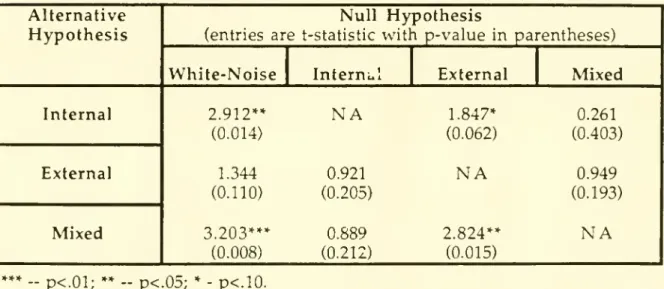
the three influence models, the internal-influencemodel
has thebest absolute fit. Table 2 (b) presents the results of
comparisons
of the alternativespecifications with the white-noise
model
using the J-test, while Table 2 (c)shows
the results
comparing
different alternative specifications using the P-tests.Based on
the J-test, all three specifications are significantly superior to the white-noise
model
Diffusion ofInformation Technology Outsourcing 22
providing the better fit to the data
when
tested against the external-influencemodel
(p <.01). It is interesting to note that the internal-influence
model
is able to reject theexternal-influence
model
but not the mixed-influence model. Further, themixed-influence
model
is not able to reject either the internal- or the external-influencemodels.
We
believe this isdue
to theparsimony
of internal-influencemodel
specification that gives it the
power
to reject the external-influence model;on
theother hand, being
more
fully specified, the mixed-influencemodel
is difficult to berejected.
To
ensure robustness of the results,we
carried out thesame
analyses withdata aggregated at a quarterly level. These findings are
summarized
inAppendix
Bwhere
we
can observe generally consistent results as those obtained usingmonthly
data.Most
interestingly,we
see that the external-influencemodel
cannoteven
reject the null white-noisemodel
under
the J-test, but cannow
be rejectedby
themixed-influence
model
under
the P-test.The
mixed-influencemodel
is an additive combination of thetwo
basicmodels
of influence: internaland
external.While
this is included for completeness, ourprimary
concern is with the distinctionbetween
thetwo
basicmodels
ofinfluences.
Given
that the mixed-influencemodel
ismore
fully specified, it is notsurprising that the internal-influence
model
per se is unable to reject themixed-influence
model
outright in our results. Nevertheless,between
internaland
external influences, our results strongly support the
dominance
of internalinfluence in the diffusion of IT outsourcing.
Research
Question
2:Kodak's Outsourcing
as a CriticalEvent
Tables 3
and
4summarize
the results for the pre-and
post-Kodak regimesrespectively.
The
patterns in the parameter estimationand
model
fit correspondwith those obtained earlier
under
the full regime. In the pre-Kodak regime, all threeTable2
Diffusion Results for IT
Outsourcing
in the FullRegime
Diffusion of Information Technology Outsourcing 24
the J-test (p <.05).
However,
using the P-test,no one
model
emerges
as beingstatistically superior to another. In the post-Kodak regime, all three
models
are statistically significantunder
the J-test (p <.05).However,
using the P-test, theinternal-influence
model
rejects the external-influencemodel
(p <.05).The
resultspertaining to the mixed-influence
model
are similar to those discussed earlierunder
the full regime.
Our
critical event is a facilitiesmanagement
outsourcing contractbetween
Kodak
and
IBM.
Thus, to ensure robustness of the results,we
evaluate this researchquestion using only the
subsample
composed
of facilitiesmanagement
agreements
for the pre-
and
post-Kodak regimes.The
results aresummarized
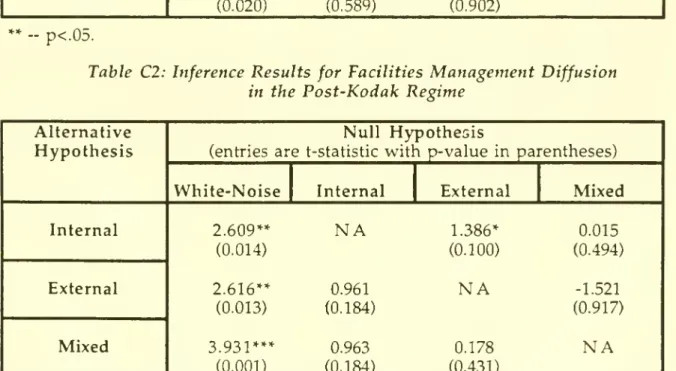
inAppendix
C.We
can see that the patterns of statistical inference
under
the J-and
P-tests are consistentwith those based
on
the full dataset.Our
overall conclusion is that while all themodels
provideadequate
fit to the data in the pre-Kodak regime, the external-influencemodel
is clearly an inferiormodel
wlwm
compared
to the internal-influencemodel
in the post-Kodak regime.The
implication is that the Kodak eventseems
to distinguishbetween
an antecedentregime
that is notdominated by any
single influenceand
a consequentregime
thatis characterized
by
internal influence (vis-a-vis external influence). Thus,we
contend that there is a Kodak effect underlying this
unique
observed pattern of IToutsourcing diffusion.
Discussion
Diffusion of
IT
Outsourcing: Imitation as an ExplanationOur
analysesand
results of this study suggest that the internal-influencemodel
is a better explanatorymechanism
of the diffusion pattern of IT outsourcingthan the external-influence model. Further
decomposition
of the time period intopre-
and
post-Kodak regimes indicates that the critical Kodak event significantly differentiates the pattern of influences in the diffusion of IT outsourcing-
internalTable 3
Diffusion Results for
IT Outsourcing
in thePre-Kodak Regime
Diffusion ofInformation Technology Outsourcing 26
Table 4
Diffusion Results for
IT
Outsourcing inPost-Kodak Regime
Mahajan
and
Peterson (1985: p.18) noted that the internal-influenceperspective is
"most
appropriatewhen
an innovation is .... socially visible,and
notadopting it places social system
members
at a 'disadvantage' (e.g., a competitive disadvantage in business)" .... (emphasis added).Mahajan
et al. (1988) tested theimitative behavior in the adoption of
M-form
structure within thediffusion-of-innovation perspective.
Our
analyses are consistent with those ofMahajan
et al.(1988) but with significant methodological
enhancements.
Our
results stronglysupport
Mahajan
and
Peterson's discussion of the role of social visibility since theimitative behavior explanation is
more
pronounced
in the post-Kodakregime
thanin the pre-Kodak regime.
From
the theory of imitative behavior, our results are in line with the notionof institutional
isomorphism
presentedby
DiMaggio
and
Powell (1983). Essentially, thisisomorphic
phenomenon
arisesfrom
a basic organization-theoreticargument:
"the
major
factors that organizationsmust
take into account are otherorganizations" (Aldrich, 1979: p. 265).
The
tendency for organizations tomodel
others is often a response to uncertainty.
Such
organizationalmodels
can diffusedirectly
through
explicit interaction or an externalchange
agent.The
compelling logic of imitative behavior is bestexamined
in the context of organizationallegitimization.
As DiMaggio
and
Powell '1983: pp. 151-152) articulated:"When
organizational technologies are poorly understood, [and]
when
goals areambiguous,
or
when
theenvironment
creates symbolic uncertainty, ... organizations tend tomodel
themselves after similar organizations in their field that they perceive to bemore
legitimate or successful."Nelson
and
Winter
(1982: p. 123) discussed imitation asan
organizationalroutine
and
noted: "envious firms, then attempt to duplicate [the] imperfectlyobserved
success." It is important to recognize that although theperformance
effects of specific administrative innovations are never perfectlyknown,
imitationDiffusion ofInformation Technology Outsourcing 28
argument), possibly as an insurance against being locked-out of access to
new
resources or
new
sources of competitiveadvantage
in the marketplace.In
summary,
theabove
set ofarguments
contends that organizationsmimic
others
when
the underlying administrative processes are complex, especiallyunder
conditions of environmental uncertainty.
The
management
of IT infrastructure hasbeen
made
particularlycomplex
given the uncertainties associated with theproliferation of
competing
standards, fluctuations in cost-performance trends,introduction of
new
systemic functionalities as well as risk of technologicalobsolescence (e.g., Keen, 1988, 1990; Strassmann, 1991).
Beyond
uncertainties withinthe technological environment, the role of IT in the business operations has
changed from
an administrative support roletowards
providingnew
sources of strategicadvantage
in the marketplace (e.g., McFarlan, 1984; Scott Morton, 1991).Such
a shift couldcompel
organizations tomimic
seemingly successfuladministrative practices
adopted by
others within the social system.While
imitative behavior as an underlying determinant for innovation adoptionmay
appear to be non-rational, our position is that itneed
not be so. In abroad
sense, isomorphic behavior is linked towhat
DiMaggio
and
Powell (1983)termed
as "collective rationality." Further, Fulk, Schmitz,and
Steinfield (1990)developed
the concept of rationality in the context of ^. social influence model.Accordingly, rationality is subjective, retrospective,
and
attributable to influencethrough information
provided by
others.However,
the rationalargument
is bestadvanced
in theeconomics
literatureon
the adoption of standards (see for instance,Farrell
and
Saloner, 1985).It is then possible that a firm adopts FT outsourcing as a deliberate strategic
choice that is
based
on
asound and
rationally-conceivedeconomic
analysis.A
recentevent study of stock
market
reactions to IT outsourcing established a positive impacton
themarket
value of the user firms adopting thisgovernance
mechanism
(Lohenhanced through
such efficient choice of ITgovernance
mechanisms which
isconsistent with organizational
economics
(Williamson, 1991).Our
paper hasadded
to thegrowing
literatureon
the diffusion ofadministrative innovation (such as:
M-form
structureand
joint venture)by
proposing a set of
arguments
for the consideration of IT outsourcing asan
administrative innovation. Further,
from
a methodological point of view,we
have
contributed
by
developingand
usingmore
powerful
analytical estimationtechniques than those traditionally used. In terms of IT research, this
paper
constitutes an attempt to empirically assess the diffusion pattern of a significant
and
current administrative innovation within the IT
domain and complements
thestudy
conducted
by Gurbaxani
(1990) in the area of diffusion of an importanttechnical innovation.
Limitations
and
ExtensionsContract size.
Our
results arebasedon
outsourcing contracts that aresufficiently large to merit reporting in professional trade periodicals
and
may
bebiased to the extent that smaller outsourcing decisions
might
bemade
known
to theprofessional
community
of ISmanagers
through
information sources not coveredin our bibliometric search.
However,
we
believe thatdue
to their lower visibility,smaller contracts are not critical catalysts underlying imitative behavior in the
diffusion of IT outsourcing. Thus,
we
do
not think that the exclusion of the smallercontracts
may
have
adversely affected our resultsand
interpretations.Time-period.
Our
bibliometric searchwas
performed
from
January 1985 (whichis the starting date of the databases)
and
no
coverage of IT outsourcing thatmet
our definitionwas
located before April 1988.Our
results are limited to the extent thatthe trade periodicals
may
have
changed
their criteriaand emphasis
in the reportingof IT outsourcing contracts. Further, it has
been
known
that several organizationshad
outsourced their IT operations historicallyfrom
the 1960s.As Markus
(1984) uncovered, such usage of externalvendors
was
confined to time-sharing orDiffusion ofInformation Technology Outsourcing 30
processing services involving service bureaus, limited use of integrated
computer
systems
and
application software involving systems houses,and
some
facilitiesmanagement
involving professional services firms (see also Phister, 1979 foradditional perspectives
on
the history ofcomputing
and
information systems).These forms
ofvendor
participation are,however
notwidespread
-- for instance,facilities
management
had been
largely confined within hospitalsand
educationalinstitutions. Further, these contracts
were
not usually reported in themedia
as they are normally operational agreements related to the routinal conduct of the business(e.g.,
custom
programming
and
item processing).The
contemporary
form
of outsourcing, as evidentfrom
the extantmedia
coverage, constitutes a
more
fundamental
reconstitution of the overall ITinfrastructure strategy in the organization.
To some
extent,we
believe this currentuse of outsourcing is in line with the evolutionary importance attached to the
organizational information infrastructure. Thus,
we
are comfortable in the timeframe
selected for our analysis.More
importantly,even
ifwe
include thefew
organizations that
have
outsourced before our starting point, the actual diffusioncurve
would
bemore
S-shaped; in other words, the direction of the biaswould
make
the internal-influencemodel
more
pronounced
thanwe
may
have
found.Had
we
uncovered
thedominance
of an external-influencemodel
in the diffusionpattern ex post, a
more
rigorous examination of this biaswould
be an importantextension of this paper.
Specification and estimation ofmodels.
We
specifiedand
estimated a class ofdiffusion
models
that is consistent with our conceptual level of analysis pertainingto the
phenomenon
as well as the current state-of-the-art in estimation procedures.Within
the substantivedomain
of information technology,our
model
specificationrepresents an
improvement
over priorwork
(e.g., Gurbaxani, 1990).As
theanalytical progress using the diffusion perspective gains
momentum
within ITframed
within other forms of diffusionmodels
such asdynamic
diffusionmodels
(e.g.,
Chow,
1967;Dodson
and
Muller, 1978)where
we
can relax theassumption
of aconstant adoption population.
Expanding the scope of the model.
A
useful direction for future researchwould
be toexpand
the scope of the constructs considered. For instance, ourmodels
assumed
a population withhomogeneous
mixing,where
the likelihood ofcommunication between any
pair of priorand
potential adopters is equal.From
an analytical point of view, it is possible to relax thisassumption
and
incorporate the effects of social structure into the diffusionmodeling
using an event-historymethod
(Strang, 1991).However,
this should be basedon
corresponding theoreticalsupport. For instance, it
may
be possible to developarguments
that the diffusion ofIT outsourcing within the
US
economy
is channeledby
structural characteristics ofthe social relations that link the adopters. Then, it
may
be appropriate to use thedegree of interlocking directorates
between
the user organizationsand
thetechnology
vendors
/systems integrators as well asmembership
incommon
professional bodies
and
associations.Such
anapproach
could buildfrom
thework
ofBurt (1987)
who
considered the effects of cohesionand
structural equivalence in the well-cited diffusion of medical innovation discussed inColeman
et al. (1966).Complementing a cross-sectional model ofIT outsourcing.
Our
study constitutes alongitudinal
approach
in explaining the incidence of IT outsourcing. Thiscomplements
a cross-sectionalapproach
usedby
Loh
and
Venkatraman
(1992a)where
the authors empiricallyexamined
the level of IT outsourcing usingfirm-level determinants derived
from
two
contexts: business cost structure, business performance, financial leverage, IT cost structure,and
FT performance.Our
studysuggests that the institutional context at the social
system
levelmay
add
value inDiffusion of Information Technology Outsourcing 32
Conclusion
It is clear that IT outsourcing is an innovative
governance
mechanism
withinthe
US
economy
today.Our
paper sought to understand the sources of influence inthe pattern of diffusion of this
governance
mode.
We
provide strong empiricalsupport for the internal-influence model; this
model
was
more pronounced
afterthe
much-publicized
Kodak-IBM
outsourcing contract than before.We
conclude with an enthusiastic call for furtherwork on
IT outsourcing—
both along cross-sectionaland
longitudinal perspectives.References
Aldrich, H., Organizations and Environments, Prentice-Hall,
Englewood
Cliffs, NJ, 1979.Anderson, E., "The Salesperson as Outside Agent or Employee:
A
Transaction CostAnalysis," Marketing Science, 4 (1985),234-253.
Bass, F.M,
"A
New
ProductGrowth Model
forConsumer
Durables.," Management Science, 15(1969),215-227.
Blair, R., K.H. Roberts, and P. McKechnie, "Vertical and
Network Communication
inOrganizations:
The
Present and the Future," in R.D.McPhee
and P.K.Tompkins
(Eds.),Organizational Communication: Traditional Themes and
New
Directions, Sage Publications, Beverly Hills, 1985.Brancheau, J.C. and J.C. Wetherbe, 'The Adoption ofSpreadsheet Software: Testing
Innovation Diffusion Theory in the Context of End-User Computing," Information
Systems Research,1 (1990), 115-143.
Burt, R.S., "Social Contagion and Innovation: Cohesion versus Structural Equivalence,"
American Journal of Sociology, 92 (1987), 1287-1334.
Chow,
G.C., "TechnologicalChange
and theDemand
for Computers," American EconomicReview, 57(1967), 1117-1130.
Coleman, J.S, E. Katz, and H. Menzel, Medical Innovation:
A
Diffusion Study, Bobbs-Merrill, Indianapolis, 1966.Davidson, R. and J.G. MacKinnon, "Several Tests for
Model
Specification in the Presence of Alternative Hypothesis," Econometrica,49 (1981), 781-793.Dearden, J., "The Withering
Awav
of the IS Organization," Sloan Management Review, (1987),87-91.
DiMaggio, P. and
W.
Powell, 'The IronCage
Revisited: Institutional Isomorphism and Collective Rationality in Organizational Fields," American Sociological Review, 48 (1983),147-160.
Dodson, J.A. and E. Muller, "Models of
New
Product DiffusionThrough
Advertising andWord-of-Mouth," Management Science, 24(1978), 1568-1578.
Elam, J. J., "Establishing Cooperative External Relationships," in J.J. Elam, M.J. Ginzberg,
P.G.W. Keen, and R.W.
Zmud
(Eds.), Transforming the IS Organization, ICFTPress,Washington, DC, 1988.
Evan, W.M., "Organizational Lag,"
Human
Organizations,25 (1966),51-53.Farrell, J. and G. Saloner, "Standardization, Compatibility, and Innovation," Rand Journal of
Economics,16 (1985), 70-83.
Fulk, }., J. Schmitz, and C.W. Steinfield,
"A
Social InfluenceModel
of Technology Use," in J. Fulk andC
Steinfield (Eds.), Organizations and Communication Technology, Sage Publications,Newbury
Park, 1990.Griliches, Z., "Hybrid Corn: