HAL Id: hal-03201087
https://hal.archives-ouvertes.fr/hal-03201087
Submitted on 17 Apr 2021
HAL is a multi-disciplinary open access archive for the deposit and dissemination of sci-entific research documents, whether they are pub-lished or not. The documents may come from teaching and research institutions in France or abroad, or from public or private research centers.
L’archive ouverte pluridisciplinaire HAL, est destinée au dépôt et à la diffusion de documents scientifiques de niveau recherche, publiés ou non, émanant des établissements d’enseignement et de recherche français ou étrangers, des laboratoires publics ou privés.
Greenhouse Salinity as Soil Fertility Criterion
Nicolas Chouliaras
To cite this version:
Nicolas Chouliaras. Greenhouse Salinity as Soil Fertility Criterion. GEOTECHNIC: Scientific Issue, Geotechnical Chamber of Greece, 1991. �hal-03201087�
1/ GEOTECHNIC: Scientific Issue- Scientific Edition of Geotechnical Chamber of Greece, 04/1991, 23-27 p
Greenhouse Salinity as Soil Fertility Criterion
Nikolaos Chouliaras
Technological Education Institution (TEI) of Larissa Department of Crop Production, 41110 Larissa, Greece
ABSTRACT
The elemental composition of the soil extract (soil:water/1:5) enables us to compare the levels of soil water-soluble N, P, K with the corresponding conductivity of the extract 1:5, and to explore more detailed the issue of salinity in greenhouses. During greenhouse crop development, when the measurement of the specific conductivity of 1soil:5H2O, soil extract, shows
values at levels like as the value measured before the top dressing, then it is probable the discovery of low soil contents in N and K. Based on estimated covariance relations, when the value of the specific conductivity of the extract 1:5 becomes >0,4 mS/cm, then the soil content at least of water-soluble element N is proved greater than 120 ppm, value recommended as stopping criterion for Nitrogen fertilizers application. This study, concerns soils of greenhouses in Thessalia area (Greece).
Introduction
The phenomenon known as ion accumulation in greenhouse soils, is resulted from strong fertilization and from salts of irrigation waters. Thus the size of soil salinity, is closely related to its content of nutrients (Chouliaras and Mavromatis, 1987), and deserves to be investigated, under which conditions, the evaluation of salinity could provide information about the content of soil (Chouliaras and Mavromatis, 1989). Besides, when soil salinity exceeds certain thresholds, adverse effects on crops are observed (Simonis and Grafiadellis, 1985). Usual method for assessing salinity is by ensuring the value of the specific conductivity of aqueous extract of the soil; it is a determination easily performed, but the value of electrical conductivity is not sufficient by itself to describe the qualitative and quantitative composition of salts. Given this problem, some possible scenarios could be based on prevailing conditions and ionic overages in the soils of greenhouses. These conditions are described by the quality of irrigation water, the soil properties, the fertilization treatments, and other cultivation interventions.
In current practices, soilless cultivations are based on the values of electrical conductivity of the nutritive solution, in order to estimate the chemical composition of the solution. A good approximation by the need to increase or reduce the concentration of the solution used in fertigation, can be achieved by evaluating the electrical conductivity of water drainage of soils. In fact, very small percentage of greenhouses dispose network of drainage in Greece. That's why it is chosen to study the issue, by analyzing the specific
2/ GEOTECHNIC: Scientific Issue- Scientific Edition of Geotechnical Chamber of Greece, 04/1991, 23-27 p
conductivity of the extract (1soil: 5H20), correlating the values of electrical
conductivity data, with the constitution of salinity; furthermore, in the case of greenhouses, the aqueous extraction of soils, is indicated as an adequate method of evaluating soil on its content of available macronutrients (Ende, 1968).
Materials – Methods
Seventy eight (78) soil samples, from 55 greenhouses of Thessaly in Volos, Larissa and Trikala have been studied. The samples were collected at three sampling phases, in connection with the development of the culture as follows:
Phase Do: Starting phase, prior to installation of plants and the
application of top dressing.
Phase Da: First period of plant growth, 6-8 weeks after planting.
Phase Db: Second period of plant growth, from 12 to 16 weeks after
planting.
The work is based on data from a research project conducted at the TEI Larissa (Greece), in the years 1987-88-89 and 90. In all soil samples, (sampling depth 25 cm) were realized the following determinations in soil extract (soil: water, 1:5): Electrical Conductivity, 25 oC. Nitrogen. Phosphorus. Potassium, Na+, HCO
3-, Cl-, Ca + +, Mg + + .
In 17 of these samples were determined in addition: S04 --, NH
4 +, NO
3
-Finally, 55 of the above samples were measured concerning their electrical resistance of the soil saturation paste (16 oC). The general properties of soils are described in a previous work made by Chouliaras and Mavromatis, (1987).
Results
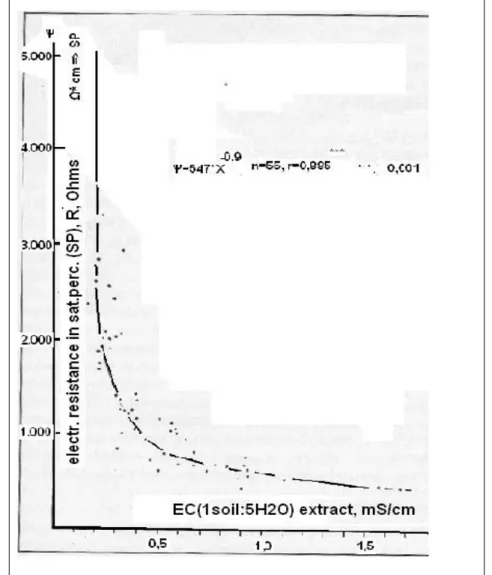
The measurements of electrical resistance to saturation paste, and the specific conductivity of the extract to 1:5, gave the diagram of Figure 1.
The equation (a),
[Y = 547* X-0,9, (a) , where: Y= specific resistance of paste saturation, Ω* cm, 16°C,
X = specific conductivity of extract 1:5, mS/cm, 25 °C] ,
connecting the respective X and Y values, is evaluated statistically significant.
Table I: Average composition of Soil Water extract (1soil:5H2O)
ppm ( in soil) K+ Ca++ Mg++ Na+ NH4++ NO3- PO43- HCO3- SO4- Cl -S mS/cm EC n 255,5 386,2 249, 8 236,9 67,8 1125 78,9 276,5 1056 468,8 4188 1,009 17
3/ GEOTECHNIC: Scientific Issue- Scientific Edition of Geotechnical Chamber of Greece, 04/1991, 23-27 p
Fig:1. Correlation between soil electrical conductivity of water extract and soil electrical resistance in saturation percentage soil paste
Table II - Content of water-soluble elements N+P+K and electrical conductivity of the extract (1soil: 5H2O)
4/ GEOTECHNIC: Scientific Issue- Scientific Edition of Geotechnical Chamber of Greece, 04/1991, 23-27 p
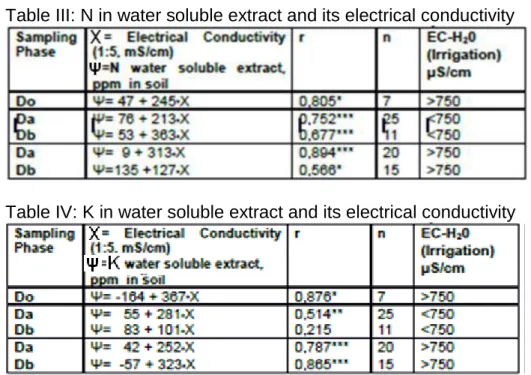
Table III: N in water soluble extract and its electrical conductivity
Table IV: K in water soluble extract and its electrical conductivity
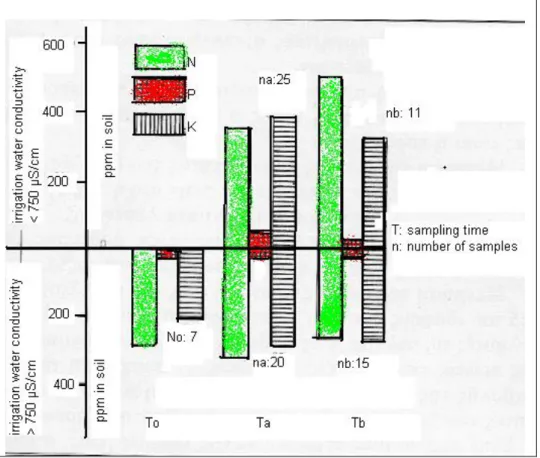
Figure 2 shows roughly the average constitution of soil salinity unit (1mS/cm) of soil extract 1:5, in relation to the elemental content of the soil with water soluble forms in N, P, K, and the corresponding quality of irrigation water used, for all sampling phases.
Among the total content of soil in salts, and the specific conductivity of the extract (1soil:5H2O), the following linear regression (b), was evaluated
statistically:
Y = 0.06 + 356 * X (b) , n = 17, r = 0,967 ***, ***: 0.001, X = specific conductivity in Siemens/cm, Y =% soil salts.
Similar conclusions in soils, are reached by other studies (Hess, 1971). The elemental composition of the extract 1:5 in N, P K enables us to compare the levels of soil water-soluble N, P, K with the corresponding conductivity of the extract 1:5, and to explore more detailed the issue of salinity. According to Table II, the positive correlations between the total content of soil soluble N+P+K in ppm, and the conductivity values to extract 1:5, they are statistically significant. With the help of these equations a sum of soluble N+P+K is estimated statistically in levels of 972 and 831 ppm in Da and Db sampling phases respectively, when the used irrigation water is of low salinity, for a specific conductivity value of the extract 1:5 at 1mS/cm. When the quality of irrigation water deteriorates, then the corresponding values of the sum of N+P+K, are 532, 633 and 550 ppm in phases sampling, Do, Da and Db.
5/ GEOTECHNIC: Scientific Issue- Scientific Edition of Geotechnical Chamber of Greece, 04/1991, 23-27 p
Fig:2. Means composition of water extract (1soil:5H2O), with 1 mS/cm
electrical conductivity
Based on these covariance relations of Table III, when the value of the specific conductivity of the extract 1:5 becomes 0,4 mS/cm, then the soil content of water-soluble element N is greater than 120 ppm, values recommended as stopping criterion for Nitrogen fertilizers application (Zuang, 1982). The study of particular values of this investigation, indicated a deviation from the above statistical (stochastic) estimation, only for three samples, but the lower-soluble N content measured, was always above the level of 77 ppm; in all these three cases, the used irrigation water salinity, was always greater than 750 μS/cm.
Table IV also shows that among the values of K-soluble and the value of specific electrical conductivity of the same extract 1:5, there is a positive linear correlation in the various phases of sampling. According to these relations, K values of soil-water soluble of 100 ppm correspond to a conductivity range of 1:5 extract, from 0,16 to 0,72 mS/cm, at the different sampling phases; then, N content prognosis based on soil salinity, is more efficient compared to K.
The amounts of water soluble ions PO4 - - -are lower compared with the
sum of other water soluble ions (Table I). It should be noted that the pH of the soils are always less than 8.20, but the average value has been found at 7,63. Indeed soils of our research are characterized by dominant presence of ions Ca++and Mg++ in the adsorption complex, (Chouliaras al. 1990a)
6/ GEOTECHNIC: Scientific Issue- Scientific Edition of Geotechnical Chamber of Greece, 04/1991, 23-27 p
Comments
Figure:1 shows graphically, that measurement of the electrical resistance in the saturation paste, is indicated for samples with small salinity; conductivity measurement of the extract soil:water (1:5) is better for samples with elevated salinity. These findings are indicated in practice, by choosing the method of specific conductivity for soils of greenhouses, already received high rates of fertilizers and irrigation waters.
In Table 1, it appears that both salinity produced by the ions originating from the irrigation water (Na+, Cl-
)
and from the fertilizers, accumulates addingsalinity (NH4 +, NO3 -, K +
,
P04- - -). Of course, more other ions accumulate duringthe event as the B03 ---in lower presence, compared with the general balance
of ions (Chouliaras al. 1990v). Also, is noteworthy the role of organic matter biodegradation, producing inorganic forms of ions, contributing to increased salinity (Chouliaras, 1990).
The conclusions based on the evaluation of data of Table II, shows that when the irrigation water, characterized by a specific conductivity of less than 750 μS/cm, soil salinity can be attributed by priority to the presence of water soluble forms of N+P+K. The approaches based on the values of the N+P+K or on N either on Κ, all water-soluble estimated separately by the corresponding equations, on the basis of values of specific conductivities of the extract 1:5, can not be generalized. The subject of the values of the electrical conductivity of solutions is relative to the concentration of ions in soil water solution, but it is complicated as result, because much effects involve interactions between ions (Levine, 1988).
The commonly used today in greenhouses nitrogen fertilizers, strongly contribute to increasing salinity; the partial salt index of the most widely used nitrogen fertilizer in greenhouses, are more powerful compared to the corresponding index for the K20 (Zuang, 82). This means that by adding equal
units N and K20 to soil, nitrogen addition will contribute to a stronger degree of
salinity. We should also emphasize the role of soil type; the value of cation exchange capacity (CEC), sets the rate of K that will remain adsorbed on the colloids, reducing the amounts of potassium water-soluble content.
For phosphorus, a very small percentage of compounds that accumulate in soils of greenhouses enter in a water-soluble form, contributing much less to soil salinity (Figure 2). In a previous work (Chouliaras and Mavromatis 1987), no correlation was found statistically significant between the specific conductivity of the extract 1:5 and in soil P-soluble.
Conclusions
The research findings, show that during the evolution of a greenhouse crop, the measurements of the specific conductivity of aqueous extract 1:5 (soil:water), give a very useful fact. The simplest practical process which could achieve this objective, is the following:
7/ GEOTECHNIC: Scientific Issue- Scientific Edition of Geotechnical Chamber of Greece, 04/1991, 23-27 p
Measurement of conductivity in 1:5 soil extract of the greenhouses at the beginning of the installation and prior to applying basic dressing.
Evaluation of irrigation water quality and, in particular measurement of the specific conductivity.
Measurement of specific conductivity of the extract 1:5 (soil: water) after the top dressing. The correlation between the increased values of the specific conductivity, and the rates of fertilizers applied, gives a very useful information.
During greenhouse crop development, when the measurement of the specific conductivity of 1soil:5H2O, soil extract, shows values at levels like
as the value measured before the basic dressing, then it is probable the discovery of low soil contents in N and K. When the values of these same extracts are significantly large, then the condition is due either to the great presence of NO3-- and K+
, either to the accumulation of salts that carries
irrigation water, or both possibilities exist; depending on the selected conclusions, stopping fertilization and leaching of salts could be decided.
REFERENCES
Chouliaras, N., and Mavromatis, E., 1989. Nutritional conditions of cultures in Greenhouses in Thessaly. 2nd Intern. Symp. ISHS, Acta Hort., 287, pp: 219-227.
Ende, J., 1968. Analysis of greenhouse soils by means of aqueous extracts in "La fertilization des cultures protégées". CR du 6e Coll. De 1 'Ind. Intern. De 1 a Potasse. Florence, 1968,246 - 255, Ed. Inst. Intern. de la Potasse.
Hess, PR, 1971. A textbook of soil Chemical analysis. Ed: Murray.
Levine, I., 1988. Physical Chemistry, Mc Graw, Hill Book comp. 3rd ed., Pp, 493. Simonis, A. and Grafiadellis, M., 1985. Effect of degree of soil salinity on crop yields in greenhouses. Home wares. Press K.G.E.V.E., No. 1, 69-77.
Chouliaras , N. and E. Mavromatis, 1987. Fertility greenhouses. Residual effect of fertilization, 2nd Pan-Hellenic Conf. of Soil Sc. Soc., Larisa 221-235.
Chouliaras, N., Mavromatis, E. Sidiras N., 1990. Phosphorus in soils of greenhouses. 3rd Panellenic Conf. of Soil Sc. Soc., Athens, 291-297.
Chouliaras N., Tsantilas, Ch., E. Mavrommatis, 1990v. Accumulation of boron in Greenhouses. 3rd Panhellenic Society of Soil Science, Athens, 369-374.
Chouliaras N., 1990. Organic matter and organic nitrogen in soils of greenhouses. Bull. Hellen. Soils. Soc., Issue 10-11, 18-20.
Zuang, The., 1982. La fertilisation des cultures legumieres. Centre Techn. Interprofessionnel des Fruits et Légumes, Paris, pp. 51-55, 113-114.