HAL Id: hal-01755733
https://hal.parisnanterre.fr//hal-01755733
Submitted on 14 Jan 2021
HAL is a multi-disciplinary open access
archive for the deposit and dissemination of
sci-entific research documents, whether they are
pub-lished or not. The documents may come from
teaching and research institutions in France or
abroad, or from public or private research centers.
L’archive ouverte pluridisciplinaire HAL, est
destinée au dépôt et à la diffusion de documents
scientifiques de niveau recherche, publiés ou non,
émanant des établissements d’enseignement et de
recherche français ou étrangers, des laboratoires
publics ou privés.
Virtual Social Network Characterization: Reference
Framework for a Comparative Analysis
Bernard Quinio, Rolande Marciniak
To cite this version:
Bernard Quinio, Rolande Marciniak. Virtual Social Network Characterization: Reference Framework
for a Comparative Analysis. Reshaping Society Through Information Systems Design, Dec 2013,
Milan, Italy. �hal-01755733�
V
IRTUAL
S
OCIAL
N
ETWORK CHARACTERIZATION
:
A
REFERENCE FRAMEWORK FOR A COMPARATIVE
ANALYSIS
Completed Research Paper
Bernard Quinio
Université Paris Ouest Nanterre La
Defense
200 avenue de la République
92001 Nanterre cedex
[email protected]
Rolande Marciniak
Université Paris Ouest Nanterre La
Defense
200 avenue de la République
92001 Nanterre cedex
[email protected]
Abstract
Although social network, social media, social networking site, online game and online community are all terms found in the literature, do they actually refer to radically different environments? The paper proposes a generic definition for Virtual Social Networks (VSNs) and it identifies the environments' five essential dimensions. Thanks to a simple reference framework it becomes possible to compare the research work on the different environments and their varied theoretical approaches. The paper is based on both the literature and original research.
Keywords: Social media, Social networks, Social Network Analysis, Virtual World, TAM,
Introduction
At the turn of the 21st century online social networks witnessed high growth. In late 2012, Facebook, established in 2004, boasted over two billion users. It also provided the first gateway to other websites or networks. LinkedIn, an online professional social network, established in 2003, claims over 200 million members in 170 activity sectors over more than 200 countries and territories. Twitter, established in 2006, advertizes over 500 million users.
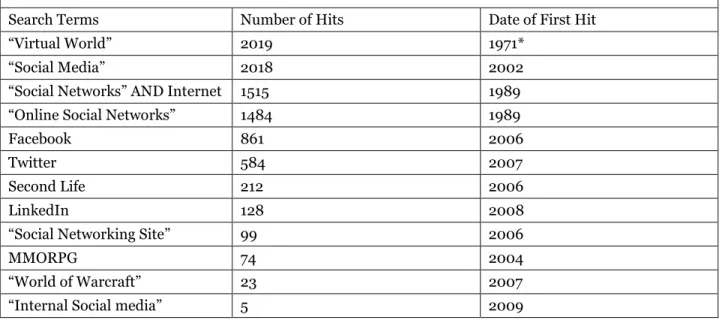
Researchers have rushed to study this new field to which they give various names, so it is difficult to compare the different studies and fully understand what they really focus on (O’Riordan et al. 2009). The different search terms we entered to gather our material on EBSCO produced a large number of papers — see Number of Hits in Table 1 where the same paper can be be listed in one single or in several different categories. Besides, the large majority of the papers offers merely a description or an explanation for these technical environments while only 10% actually resort to a theoretical approach (Richter et al. 2011). The interest for these environments is only fairly recent, as shown by Date of First Hit in Table 1, and it requires structuring as it is undergoing rapid development.
Table 1. Number of papers tracked in academic reviews with reading committees (looked up in EBSCO Complete, April 3rd, 2013).* The first papers on Virtual Worlds come from the IT field
Search Terms Number of Hits Date of First Hit
“Virtual World” 2019 1971*
“Social Media” 2018 2002
“Social Networks” AND Internet 1515 1989
“Online Social Networks” 1484 1989
Facebook 861 2006
Twitter 584 2007
Second Life 212 2006
LinkedIn 128 2008
“Social Networking Site” 99 2006
MMORPG 74 2004
“World of Warcraft” 23 2007
“Internal Social media” 5 2009
This type of environment has indeed a significant economic impact (Clemons 2009; Guo and Barnes 2012) as it may lead to the co-creation of products and services (Xiaoquang and Chong 2012) and to new socializing ways (Cheung and Lee 2010). However since Web2.0’s advent a large variety of online social sites (networks, social media, on line communities, virtual worlds, Massive Multiplayer Online Role Playing Games) have appeared and this brought along the difficulty of how to name and define them all (Agarwal et al. 2008). Because it comes from various academic fields, research on these environments has mobilized different theoretical approaches and it is therefore difficult to compare them and build up significant knowledge in that field. And finally, obsolescence renders useless the research that is rooted too deeply into the products’ technical features. Studying these environments meets with difficulty, e.g., (1) how to define this research topic and (2) how to tackle the variety of theoretical approaches to acquire better knowledge of this phenomenon.
We aggregated the definitions present in the literature on the social environments that use the Internet and then proposed a precise and simple definition of our own.
(Wasserman and Faust 1994). The social links among the actors may be of a very different nature, i.e. communication, collaboration, consultancy, supervision etc. Yet in all of these instances, the research topic is the interaction between actors through these links. The actions of individuals are embedded in social relations networks (Granovetter 1985). The analysis of interpersonal relations via networks makes way for the switch from the individual to the social levels (group, collective). Richter et al. (2011) make the distinction between Internet Social Networks (ISNs) which include all the social networks set up or maintained through the Internet and Social Network Sites (SNSs) which are those dedicated to social relationships. For these authors, Youtube for instance is not an SNS.
Boyd and Ellison (2007, p. 221) characterize digital social networks as services which allow individuals to create profiles, lists of contact management with which it is possible to exchange all sorts of information, navigate through one's own list of contacts and that of other users. These authors make the distinction between professional networks like LinkedIn and personal networks like Facebook. The firms’ social networks, the intranet and extranet’s evolution, also offer the opportunity to create a profile, to search for skills, to exchange information and to work collaboratively (Garnier and Hervier 2011). The description is very similar to that of digital social networks. As it is specifically attached to one organization, contextual use marks the difference with the other digital social networks. It must be noted that the same application packages are used equally for the digital social networks designed for the general public or firms and for professional use. The trend is to consider a digital social network’s functionality as a module that can be integrated in an Enterprise Resources Planning (ERP), a knowledge management system (KMS), a Customer Relationship Management software (CRM) or a commercial website.
Since the virtual worlds' appearance in 2003, interaction and social contacts have taken place through avatars (Wasko et al. 2011). Virtual worlds present no major differences with digital social networks as “a virtual word is defined as an electronic environment that visually mimics complex physical spaces, where people can interact with each other and with virtual objects, and where people are represented by animated characters” (Bainbridge 2007 p. 472). Another definition proposed by O’Riordan et al. (2009) is that of a shared, interactive, immersive environment where participants can communicate, collaborate, innovate and trade with each other. Users create their profile in avatar form then they interact with other avatars or with the contents available in the virtual world. The main difference with digital social networks regards 3D use and the user’s representation in the form of an avatar, which can also influence the sense of immersion (Guadagno et al. 2007).
A MMORPG (Massive Multiplayer Online Role Playing Game) is an online environment in which the user becomes a character pursuing a quest, generally in cooperation with other players (Nelson et al. 2011). Each character is an avatar (Orr et al. 2012) and MMORPG players start creating their profile (avatar) according to certain features then they interact with other players and the game’s environment (scenery, weapons or non-player character piloted by the game’s engine). Available to players are some equipments, weapons or garments they can buy, exchange or steal.
Online communities gather actors who share common objectives and are put in relation in a digital space (Rosenbaum and Shachaf 2010). A virtual community is a group of people interacting predominantly in cyberspace for their own common interests (Koh et al. 2007). The communities expand into various fields like education or leisure time activities. Questions and answers communities like “Yahoo answers” in the US or “Commencamarche” in France make up specific online communities which are enjoying remarkable success.
The Virtual Social Network (VSN) concept is used by computer science and the professional literature (Xia and Bu 2012) yet with no formal definition. In academic reviews, a VSN is defined as a social structure made of nodes (individuals) linked by interdependencies like values, friendship, financial exchange etc. (Pagani and Hofacker 2010). VSNs are used in two ways, they can be passive (like viewing) or active (like posting). Another definition describes the VSN as a virtual multi-users community for social networking (Sangwan et al. 2009). The VSN concept is also used in strategic management (Bretones et al. 2009).
We propose an integrative definition of these environments that goes beyond specific objectives like socialization, game playing, common interest etc. and yet includes common functionalities regardless of the technology used. This operational definition is large enough to remain pertinent in spite of the quick evolution in that field. We decided on “Virtual Social Network” because it is the term with the widest
scope.
We propose to call Virtual Social Networks (VSNs) the online environments which offer their users three large categories of functionality:
(1) creation, modification and sharing of a (text or graphic) self representation, (2) creation, modification and sharing of digital contents,
(3) user interaction via profiles or contents created by users or VSN designers.
To overcome the first difficulty with the research topic, our definition comprises digital social networks, public, professional, corporate, virtual worlds, online games and online communities.
To face the second difficulty i.e., the variety in the theoretical approaches used, we identify the VSNs’ essential features, we examine how the main theoretical approaches take these dimensions into account and to finish with, we suggest a general framework for presenting the results.
The paper’s continuation unfolds the following parts. First of all, we present the VSNs’ five essential theoretical dimensions and we propose a methodological framework for presenting research results on VSNs illustrated by one of our research piece in that field. In the following section we examine how the three main theoretical approaches mobilized in VSN research take the VSNs’ essential dimensions into account, namely Social Network Activity, the TAM model and its variant forms and finally, the structurationist approach.
Theoretical and methodological foundations for the study of VSNs
From a review of the literature we identify the VSNs' five essential dimensions. Then we propose a methodological framework for the presentation of the results on VSN research that take these dimensions into account.
The VSNs’ five dimensions
The five essential dimensions of VSNs are deduced from the features and taxonomies proposed in the literature relating to digital social networks, online communities, virtual worlds and online games.
This is how we proceeded to identify the dimensions of VSNs through the analysis of the literature. We first checked the taxonomies and the typologies proposed in the VSN literature. We then extracted from these taxonomies and typologies the five dimensions that appeared essential to us. Finally, we checked that the five dimensions fully covered all the taxonomies and typologies we started from (see Appendix 1). A well known taxonomy distinguishes five attributes for virtual communities (Porter 2004): (1) the purpose, i.e., the subject’s objective that forms the interaction basis (2) the place, i.e., the extent of the technology's interaction mediation, (3) the platform, i.e., the interaction design, (4) the population's interaction structure and (5) the profit model, i.e., return on interaction. For his part, Ito (2008) distinguishes two main uses: (1) sociability and (2) finalized use. Agarwal et al. (2008) identify three dimensions for social digital networks: (1) their scale, i.e., size or number of actors, (2) the new interaction dynamics, and (2) the explosion of User Generated-Content (UGC). Besides, Kaplan and Haenlein (2010) propose to rank digital social networks according to the intensity of social presence and to the individual’s representation and revelation levels. Finally, four other features are put forward: (1) the persistence of contents, (2) replicability, i.e., contents easily copiable (3) scalability i.e., contents have the potential to be viewed by very large audiences and (4) searchability, i.e., contents can easily be found (Boyd 2010; Marwick and Ellison 2012).
Six features were identified in the field of virtual worlds: (1) achievement, i.e., the structure of the goals that can be pursued by users, (2) control of user behaviour, (3) creativity, i.e., the availability of tools that allow users to develop content, (4) sociability, i.e., the availability of tools through which social relationships are established, (5) realism, i.e., the characteristics implemented in the platform promoting user experience and (6) membership, i.e., the sense of being a part of a community (Cagnina & Poian 2009).
Five online games features were identified: (1) creativity, i.e. the interaction between the different specialists working in a games company and the users, (2) the community, i.e., the group of users (3) the codes, i.e., writing into the program the laws defining what is permitted and what is not, (4) the copyright applied to text, digital images etc. and (5) the contract between the user and the creator (Roquilly 2011). Online communities are endowed with five attributes (1) the community, i.e. the people & individuals, (2) the purposes, i.e. the goals & aspirations, (3) the tools implemented in the software platform, (4) the policies, i.e., the norms & rules and (5) actions by individuals, i.e., operations & communications (de Souza & Preece 2004).
VSNs are also characterized by membership, fulfillment of needs, integration, shared emotional connection and influence (Sangwan et al. 2009).
Finally, many VSN cartographies are found in the field of the professional literature which prompt three criteria to intersect: (1) the use objective, i.e, sociability, networking or entertainment, (2) the categories of users, i.e. children, teenagers, grown ups and (3) the types of technical support.
Crosschecking these different characterizations leads to identifying the VSNs' five essential dimensions, namely the actor, objective, artifact, action and evolution.
The actor and types of actors
The first dimension lies in the characterization of the actors present in VSNs, which naturally comprises the users, yet also the VSNs'designers, owners or partners. The role differentiation exerted by actors in the VSN implies the regrouping of actors in types of actors. The actor dimension can be found in several of the characterizations or taxonomies we have just presented. For example, Ito’s study (2008) focuses on young users and Witzig et al (2012) on the types of firms which use LinkedIn. Depending on which research we select VSN analysis may either consider the individual level (Lorenzo et al. 2012) or take account of the types of actors supposed to adopt a similar behavior (Mercanti-Guerin 2010). Few studies exhaustively take all types of actors into account.
The objective
The second dimension concerns the objective which justifies why Internet users join VSNs (Ito 2008; Porter 2004; Cagnina and Piano 2009). This objective may very much vary depending on the actor or the categories they belong to. It may be finalized and precise like play or sell. It may also be more oriented towards putting people into contact, namely sociability. The objective is always linked to the actor or to the type of actor concerned. For the same VSN, the designers’ objectives will thus certainly differ from the users’. The objective of the VSN’s owner may boost his/ her revenue, while the designer is after increasing his/her notoriety. Research on VSN Business Models is bound to take into account the objectives of the VSN’s actor owners.
The artifact
The third dimension deals with the technologies used and the possibilities they offer. This is found in Porter’s taxonomy (2004), Cagnina and Poian’s (2009) or in Roquilly’s codes (2011). The VSN’s artifact dimension is also linked to 3D use and to the realism of virtual representation. The characteristics identified by Boyd (2010) are essentially linked to proper technology use (persistence, duplication, increasing workloads and the possibility of finding the contents). For online communities the technical dimension is taken into account through the notion of software platforms (de Souza and Preece 2004). This technical dimension stems from the technological artifact (Benbasat and Zmud 2003 p. 86): “the hardware/ software design of the IT artifact encapsulates the structures, routines, norms and values implicit in the rich contexts within which the artifact is embedded”. A VSN is an artifact which holds a material component [some network connexion capacities, contents (a picture, a 3D object, some text and sound), equipments (keyboard, screen etc.)] and rules of use. VSN rules can be encoded, inserted in the artifact by the designers, or uncoded as they surge from use. In an online game the power of a weapon is thus a coded rule in the game whereas the style of exchanges (language levels and aggressiveness) among
players is a rule of use. The software part is made up of IT programs (processors) and data (contents). The structures, the routines and the norms can be encapsulated in the artifact’s programs. The description of the artifact, functionalities and rules is essential for the understanding of VSNs and thus moves away from the commercial product involved.
The action
The fourth dimension is the action by individuals, i.e., what they actually do in these environments. A VSN is a meeting space in which actors act and interact. This dimension corresponds to Boyd and Ellison’s (2007) functionalities, namely creating a profile, navigating or managing a contact list. It is also present in the interaction’s control level (Cagnina and Poian 2009). Social interactions and User generated Content (UGC) are analyzed through the study of actions (Agarwal et al. 2008). Actions and interactions can explain the influence between actors (Sangwan et al. 2009). The actions will vary depending on the actors. The designer will modify the digital environment (e.g., add on a new functionality), the owner will be able to moderate remarks or actions, a banking partner will enable transactions payments and the user can add contents or exchange views with other actors.
In a VSN, the individual takes action (gets represented or creates contents) by interacting with a technical environment and actors (community, population, contact list or group of friends). It would be illusory to try to isolate an individual without taking account of his/ her actions with the artifact and the other actors and the groups to which it is linked. An VSN is a system where different actors cooperate to use, modify and even define products and services. Action in a VSN is therefore both individual and collective. Whether prescribed or not in the artifact, the meaning given to it by the actor depends on the collective. Two types of action must be distinguished, i.e., common and joint actions. The possibility of interacting on one’s own with the artifact, like e.g., defining one’s profile, is an action common to all individuals. When interactions in the VSN are complementary, e.g., when commenting on some content supplied by someone else, actions are joint (Lorino 2009). For VSNs a common action concerns the interaction between the artifact and the actor. It is what the latter uses, creates or modifies, i.e. function, digital content or rule of use. With this action, the actor will get pleasure in return as well as money or new skills. A joint action takes the shape of actions/ reactions among individuals who jointly exchange, comment, complete or modify contents. Yet a joint action can also consist in some interaction between an actor and a group which can take the shape of an opinion poll the site’s owner carries out for the group of users. A VSN functions in a real environment. The frontier between the real world and the VSN cannot be entirely watertight. Consequently, according to which VSN is studied, it will be appropriate to distinguish actions taken by the actors “within” and “outside” the VSN. For example, Hotel clients’ opinions left within the VSN are used to run a management meeting “outside” the VSN (Scott and Orlikowski 2012). Action, either common or joint, can make the actor’s objectives and/ or the VSN’s artifact content evolve.
The Evolution
Evolution makes up the fifth dimension, i.e., the possibility given by the VSN to greet very many users (increasing workloads) and to add new functionalities or content which can be created either by the designers or the users. Some VSNs, like online games, do not evolve much outside the possibilities of increasing workloads while conversely others, like Facebook evolve a lot. Evolution is linked to the possibilities of creating content as highlighted in the literature (Kaplan and Haenlein 2010). Evolution may concern actors, objectives and artifact. Implicit for taxonomies, this dimension is tackled through features such as user action or artifact. The analysis requires a chronological or longitudinal approach as mentioned by Marwick and Ellison (2012).
To test the relevance of our approach we confronted the VSN literature’s characterizations and taxonomies to the five dimensions just presented. It was possible to link each element from the literature to one or two dimensions (see Appendix 1). VSNs can therefore be characterized through the five dimensions.
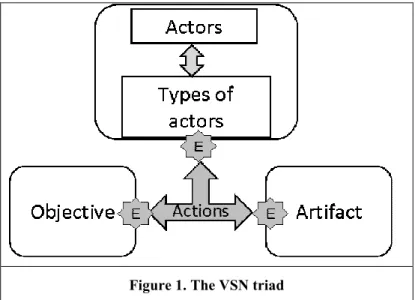
We can represent a VSN in the form of a triad including actors, artifact and objective whose three elements are linked and inseparable (see figure 1). The IT artifact designer, for example, uses it differently and with an objective different from the end user. Similarly, an actor may be influenced by how another
actor uses the VSN. Actions and interactions in VSNs are symbolized by arrows in the middle of the figure. Each action produces an effect or result. That result can in turn modify each element of the triad (actor, objective and artifact). The arrows in the figure’s middle indicate that, potentially, each element may be modified by actions and this is how a VSN evolves. The evolution of the VSN is the effect of actions and interactions and the evolutions concern actors and types of actors, objective and artifact.
Figure 1. The VSN triad
A VSN triad must rest on one specification for each of the dimensions which have just been presented. In order to compare the contributions of the various VSN studies we now propose a presentation framework for the results.
A presentation framework for the VSNs’ results analysis
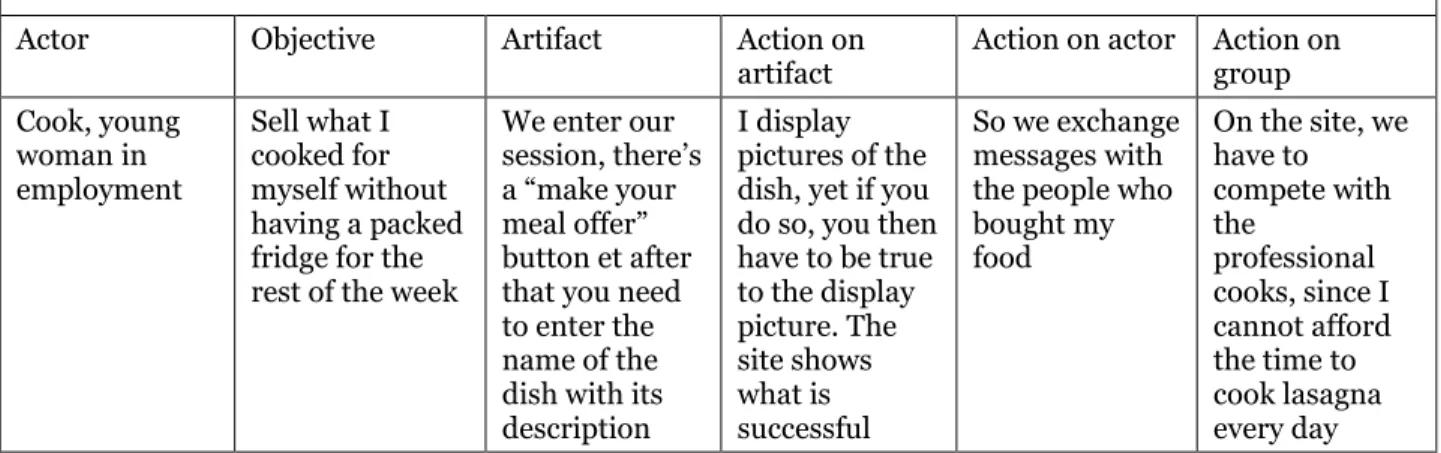
Our results presentation model is illustrated by some research conducted in 2011-2012 on several VSNs (Quinio et al. 2012) by a team of four researchers. Our illustration concerns a geolocalized social network allowing the registered users to offer ready cooked meals’ portion sizes priced at a couple of euros and these users are the “cooks”. The “gourmets”, the registered users attracted to a dish, contact the cook of their choice and agree with him on a meeting place where to get the dish delivered. The size portion is paid in hard cash when the exchange takes place. We interviewed users (both cooks and gourmets) as well as the designers and the site’s owner. All the interviews were recorded and full Nvivo treatment was applied. Table 2 presents an extract from the results for one actor. The actions taking place outside the VSN such as shopping, preparation or sale are not represented here, even though our research took it into consideration.
In our research, we illustrated how the artifact’s different components evolve depending on how they are being used. The actor makes the tool richer in content and rules and in return, the actor becomes richer through the effects from the tool like training or behavior change. The effects of tool use are observable and can be interpreted. The VSN is in constant evolution and the rules, the technical artifact, the objectives change over time depending on the interactions while the evolutions are not altogether decided upon by the VSN’s owner.
Table 2. Results’ presentation framework for a given actor
Actor Objective Artifact Action on artifact
Action on actor Action on group Cook, young woman in employment Sell what I cooked for myself without having a packed fridge for the rest of the week
We enter our session, there’s a “make your meal offer” button et after that you need to enter the name of the dish with its description
I display pictures of the dish, yet if you do so, you then have to be true to the display picture. The site shows what is successful So we exchange messages with the people who bought my food On the site, we have to compete with the professional cooks, since I cannot afford the time to cook lasagna every day Observed Evolution : I don’t cook on specific days yet if I’m given, let’s say, a twelve hour advance warning; I can get myself organized
From our framework we shall now examine how the theoretical approaches used in VSN research take the five dimensions into account.
Three theoretical approaches for VSN specification
A VSN research reveals many different subjects: sociology, psychology, communication, management, IS or IT (Argawal et al. 2008). The theoretical approaches selected logically reflect the diversity of the various disciplines involved.
In their review of the SNS literature between 2003 and 2009, Richter et al (2011) observed that only 10% of the papers had adopted a theoretical approach, most often that of Social Capital theory or Social Network Analysis (SNA). Since both analyses are closely connected (O’Riordan et al. 2009), we decided to study the SNA. Several studies used the TAM model and its variant forms, which are most famous in IS (Pagani and Hofacker 2010). Finally, the structurationist approach seemed to be a relevant choice as in essence it links up the actor, the tool and the structure.
Other theories like the Transaction Cost Theory, Innovation Theory, Knowledge Management, Resource Based View etc. have also been used to study VSNs however much less frequently than the three approaches we have selected at this stage of our research (SNA, TAM and Structurationist).
After deciding on the three theoretical approaches, we selected from “EBSCO Complete” the papers offering an empirical study actually resting on the theoretical approach cited. This was not easy because even though many studies claim to use a theoretical approach, in actual fact they do not and prove purely descriptivist.
We shall therefore focus on these three approaches to analyze how they allow for taking account and specifying the VSNs five dimensions. We will first present the theoretical approach then analyze several VSN research studies which adopted this theoretical perspective.
Social Network Analysis (SNA
Presentation of SNA
The analysis of the social networks supplies a set of tools to visualize and modelize social relations. It allows for the representation of the interdependencies among actors, albeit in a somewhat simplified manner. It is an exploration and representation technique (Lazega 1998). The analysis strives to describe the social network’s structure (strong and weak links, holes, centrality and dependence etc.) and the impact of the network members’ activities on its evolution. The SNA can be seen as a “toolbox” so it is often completed by another theoretical approach (Gray et al. 2011).
The actors or groups of actors make up the network knots. They are hardly characterized since the interactions among the knots are placed at the study’s heart. The objective of participating to the VSN is not tackled by SNA which concerns the structure of an existing network and not the reasons why the actors take part in this network.
The artifact is not really taken into account and the technology in SNA is indeed only a physical support. In the same way the rules of use are not or not much taken into account. In SNA, only the flux and the exchanges among the subjects or the groups of subjects are of interest and not the practice, i.e., what the actors do. The only actions taken into account are the exchange actions which are represented by links. In SNA, the focus is either on the exchanges among individuals which then become the network knots or on the exchanges among groups. It is therefore impossible in the same study to switch from individuals to groups to apprehend all of the interactions among actors and groups. There exist two SNA approaches, the first is static while the second is dynamic (Hu et al. 2009). The first is more frequent and consists in studying the network’s topology and structure. The second, Dynamic Social Network Analysis (DSNA), studies the changes in the network’s topology or structure. It associates evolved mathematical or statistical tools to the traditional tools of social network analysis. With DSNA, it is therefore possible to take a VSN’s evolution into account.
Research with an SNA perspective
Lorenzo et al. (2012)
This study analyses a virtual learning device’s efficiency by comparing it with the traditional online course device. It is an experimental study of about 21 students. SNA use shows that participation is stronger with virtual learning and that network density is higher than with the traditional device. The actors are characterized by simple variables. The tutor role is distinguished from that of the traditional student. The notion of group of actors does not exist. The actions taken by individuals through the artifact are summarily described but they do not play a part in the analysis. Only the exchanges among actors are taken into account. Actor’s objectives are not analyzed, they are students supposed to be keen learners. The artifact is adequately described (3D platform developed with Opensim) and the software functionality is explained too. In contrast, there is no specification regarding the rules of use.
The artifact’s precise description lies beyond SNA potentialities and it makes it possible to replicate the study on this point for another environment of a similar type. By contrast, because actors, actions and evolutions are taken into account only to a lesser extent, it is not possible to understand how the VSN is run or what its real effects are.
Mercanti-Guerin (2010)
This research analyses Facebook groups during the political campaign for France’s socialist party’s primary elections. The analysis focuses mainly on the groups with an interest for a politician. The study shows the influence of hostile groups on the functioning of the network as well as the efficiency in terms of communication of large yet low-density networks.
Only the groups of actors are taken into accounts, not the individuals. These groups are rapidly characterized with regards to size and positive or hostile positioning. There are three types of groups: the applicant’s supporters, the opponents and the targeted groups which play a part only on specific issues like the defence of town-planning or industrial projects.
Exchanges are the only actions taken into account. The objectives are defined and explained group of actors by group of actors. Understanding of the network can be achieved through these objectives. The artifact is described and the used functionalities are presented. In contrast, there is no specification regarding the rules of use. Although evolution possibilities are mentioned in the article, they are neither observed nor described. The interactions among groups of actors are taken into account as well as those amounting to leaving content in the artifact.
Actor behavior cannot be apprehended because of the group for level approach. The artifact’s description, taking account of the objectives and the groups of actors allow the study’s replication in a different context and a fair understanding of the way the VSN is run. By contrast, because actions are not taken into account, the levers most pertinent in improving the political communication’s efficiency cannot be
identified.
The actors’ objectives and the artifact’s description make it possible to go beyond SNA potentialities. Actions are described at group level and not at actor level.
Hsu and Park (2012)
The study analyses the use of Twitter and blogs by Korean parliamentarians. We shall here only consider the analysis of Twitter. The links among parliamentarians are analyzed from the data collected in the VSN. A first study is based on 285 parliamentarians and another study on political parties (groups of actors). The parliamentarians and the groups of actors are characterized as political parties and by economic positioning. The study points out significant behavior differences among conservative party members and the other members of parliament and some oddities for a few of them (more especially women). The less linked to a party the members of parliament, the more they exchange on the work. A comparison is drawn between the 2009 and the 2010 networks.
Both actors and groups are considered. Actions are partly specified as with e.g., Tweet, R-tweet. The objectives are defined and explained by group of actors and individually for those who behave in an uncommon fashion. The artifact is quickly described and the functionalities used are specified. The rules are not considered. The network evolution between 2009 and 2010 is analyzed. Interactions among groups and individuals are taken into account.
The study satisfactorily covers the five dimensions and goes beyond the potentialities of the SNA approach. The three VSN-based studies show that to achieve an adequate coverage of the VSN triad, the SNA must be complete, e.g., with the functionalities of the artifact and its evolution's description.
The TAM model and its variant forms
Presentation of the TAM-TAM2-UTAUT approaches
The TAM model (Davis, 1989) suggests that the acceptation of a technology is determined by two types of perceptions, namely the perceived utility (PU) and its system’s perceived ease of use (PEU). PU and PEU have a significant impact on behavioral intention which is itself considered a determinant of effective use. In a more recent version, TAM2 (Venkatesh & Davies, 2000), both social influence processes (subjective norm, voluntariness and image) and cognitive instrumental processes (job relevance, output quality, result demonstrability) were added to the initial model. Then the unified UTAUT model (Unified Theory of Acceptance and Use of Technology) was put forward on the basis of longitudinal empirical tests among others (Venkatesh et al. 2003). The model highlights three direct determinants of use intentions (expectations in terms of performances and effort and social influence), two direct determinants of real use (the intention of use and the facilitating conditions) and the influence of moderating variables (previous experience with the system, the willingness and unwillingness of use aspect, sex and age).
The model is placed at actor level where the actor is characterized by sex and age. The objectives may be taken into account by expectations in terms of performance and perceived utility. The artifact is taken into account only through its ease of use in TAM and its variant forms, even though some studies describe it as a preamble. The actions performed by actors through technology are not taken into account in this analysis. In the initial model, social interactions were not taken into account while they are covered in TAM2 and UTAUT. The adoption system’s analysis takes place at a given instant. TAM, TAM2 and UTAUT do no take evolution into account. When longitudinal studies are carried out it becomes possible to take part of the evolution into account.
TAM-Based Research
Schen and Eder (2009)
The research studies the intention of using Second Life (SL) for training 77 students. They attended a short SL training course and were then requested to carry out two tasks as a group, namely to retrieve some information and configure a computer in SL’s 3D environment. The TAM model was enriched with
3 variables, i.e., Playfulness, Self-Efficacity and Anxiety.
Only individual actors are taken into account with some characteristics (age, sex) which remain unused later on. Actions are not described in detail, SL functionalities are unknown. Apart from the intention of use, objectives are not taken into account. The artifact is not described, the rules are not mentioned and the evolutions are not dealt with.
The results show that perceived facility impacts intention of use and the Playfulness and Self-effacing variables also have a positive impact. As what the subjects’ objectives are, what the subjects do or have done for real in the environment remain unknown, it becomes difficult to draw from this any lessons that can be extended to other sectors. Besides, as the artifact is not described, there is no way one can ascertain that similar results may be reached in another VSN.
Fetscherin and Latteman’s study (2008) is very similar in terms of processes and results. Instant cut TAM provides incomplete results and is hardly extendable to other sectors.
Cheung and Lee (2010)
In this study, the Tam model was enriched by taking some norms (Subjective Norm, Group Norm) and social interactions (social identity). The poll was carried out with 389 Facebook users who were given a fictitious framework of collective actions to do. Several questions were about how they really used Facebook.
The results show the importance of social interactions and how subjective norms influence VSN use. Yet, as respondents were not placed in a real collective situation, it is difficult to understand how and on what these groups and social interaction effects really act.
The study’s results are close to those of TAM-TAM2-UTAUT potentialities, even though the evolutions and objectives are not taken into account.
From these Tam-based studies, we can see that the introduction of Tam evolutions (TAM2, UTAUT) may have led to more thorough results.
The structurationist approach
Presentation of the structurationist approach
The structurationist theory (Giddens, 1987) is a macro theory whose three fundamental principles are the following (Husser 2010). Reflexive control, the first principle, implies an inseparable relation between actor and action. On the one hand, the actor controls his/ her action and on the other, the oriented action supplies the actor with new information and action sources. Structural duality, the second principle, considers that actions produce and reproduce structural properties which make up both constraints and resources for these actions. And finally, the third principle points out that the structural properties are to become changed over time and space into a genuine social system where relationships are seen as reproduced practices” (Giddens, 1987, p. 444). It is through actions that can be either individual and collective, deliberate or not and results associated with technological change that a vision arises.
The actor is both active and constrained. Social structures constrain individual action but the actor is also competent in his/ her actions and can thus act on the social structure. The objective made implicit through the actor’s description by Giddens is however present in the research inspired by the structurationist approach. The performative perspective indeed places users and developers’ intentions at the heart of this research. The artifact keeps traces of the restructuring and interactions (Husser 2010). The artifact is therefore described and the different traces studied.
Common encounters and actions among actors make it possible for structures to evolve (Husser 2010). Action lies at the heart of the structurationist analysis and in the performative perspective, reality is viewed as enacted in ongoing practice (Schultze and Orlikowski, 2010). Evolution either technical or social is taken into account.
VSN research based on the structurationist perspective
Scott and Orlikowski (2012)
The VSN studied here is Tripadvisor which is one of the world’s major Hotel and restaurant recommendation sites. Collecting data took three years and this paper presents the results for one distinct hotel in a UK specific region.
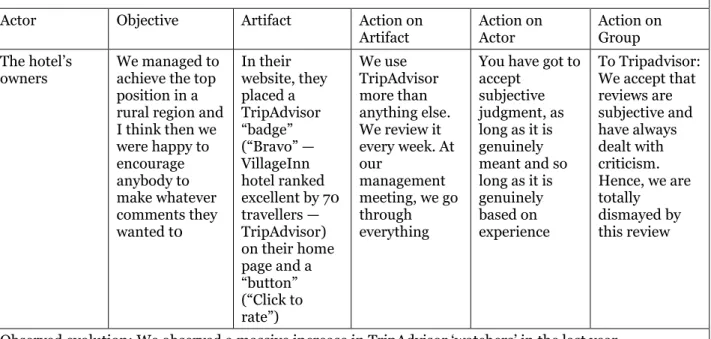
The couple owning the hotel makes up the main actor studied and they are presented with their own history and desires. An unknown hotel client constitutes another identified type of actor through his/her comments on the hotel. Other actors also take part in the VSN, albeit indirectly like the tourist office, the Chamber of commerce and Tripadvisor’s managers. Each actor’s objective is clearly justified. The actions taken by actors or groups of actors are detailed inclusive of their three components, i.e., among actors and tools, actors and actors and groups. Some actions lie outside the VSN’s scope and are linked to actions within the VSN. The artifact is described through these rules and its technical component. Evolution is taken into account in terms of objectives, consequences, use and interactions. The study’s results are in keeping with the potentialities of the structurationist approach and adequately deal with the VSN’s five dimensions. Verbatim excerpts clearly how it is taken into account (see Table 3).
Tableau 3. Results presentation framework for a given actor in Scott and Orlikowski (2012)
Actor Objective Artifact Action on Artifact Action on Actor Action on Group The hotel’s owners We managed to achieve the top position in a rural region and I think then we were happy to encourage anybody to make whatever comments they wanted t0 In their website, they placed a TripAdvisor “badge” (“Bravo” — VillageInn hotel ranked excellent by 70 travellers — TripAdvisor) on their home page and a “button” (“Click to rate”) We use TripAdvisor more than anything else. We review it every week. At our management meeting, we go through everything
You have got to accept subjective judgment, as long as it is genuinely meant and so long as it is genuinely based on experience To Tripadvisor: We accept that reviews are subjective and have always dealt with criticism. Hence, we are totally dismayed by this review
Observed evolution: We observed a massive increase in TripAdvisor ‘watchers’ in the last year
We have presented and analyzed the three theoretical approaches selected as well as the associated empirical studies associated with them. We shall now discuss what this analysis implies.
Discussion
Our presentation framework can be used to compare the theories and empirical studies on VSNs. Discussing the comparisons will follow three stages. We first compare the three theories, then the discrepancies between the potential of a given theory and the actual results given by the empirical studies using the theory. Finally, we question the pertinence of the studies that do not rest on any theory. All the results obtained and discussed are shown in Table 4.
Table 4. Matching correspondence between theories and the VSN five dimensions
For each dimension, the answer is: “Yes” if it is taken into account, “Weak” if only part of the dimension is studied, “No” if the dimension is not mentioned
Actor Objective Artifact Evolution Action on artifact Action on actor Actions on group
SNA & DSNA Weak No No Yes No Yes No
TAM-TAM2-UTAUT Weak Weak No Weak No Yes Yes Structurationism Yes Yes Yes Yes Yes Yes Yes
Empirical studies
YES is printed in uppercase when the dimension is more widely studied in the empirical study than when supported by theory. NO or WEAK is printed in uppercase when one dimension is less widely studied by empirical studies than when supported by theory
SNA & DSNA Empirical studies
Lorenzo et al. (2012) Weak No YES NO No Yes No Mercanti-Guerin (2010) Weak WEAK YES NO YES NO YES Hsu and Park (2012) YES YES YES Yes No Yes YES TAM-TAM2-UTAUT Empirical studies
Schen and Eder (2009) Weak Weak No NO No NO NO Cheung and Lee (2010) Weak NO No NO No Yes Yes Structurationism Empirical studies
Scott and Orlikowski (2012)
WEAK Yes Yes Yes Yes Yes Yes Without theory Empirical studies
vom Brocke et al., (2009) Weak Yes Yes No Yes Yes No Several of the VSN dimensions can be potentially covered with the SNA-DSNA theoretical approach. The basic TAM approach provides unsatisfactory cover of the five dimensions, and more especially, the actors' characteristics and their objectives are hardly taken into account and the technical artifact is not integrated. The evolutions of the TAM2-UTAUT approach appear to provide a more thorough cover and they take better account of social effects. The five dimensions are potentially best covered with the structurationist approach.
This does not imply that we mean to conclude that the structurationist theory is the only suitable approach, yet some studies based on SNA-DSNA or TAM in their variant forms can exceed these theories' potentialities. This better result can be reached through enriching, specifying or contextualizing. Adding constructs will enrich the study model and can take the form of additional usage description in a study based on TAM and its variant forms. Specifying consists in modifying a construct as achieved by Pagani and Hofacker (2010) with the usefulness notion. The description of the artifact which is not integrated in the selected theoretical approach (Hsu and Park 2012) is an example of contextualization.
Conversely, some empirical studies do not develop all the potentialities the theory offers. For example, although VSN evolution can be described by DSNA or by simple comparison over time in the network structure, some SNA-based empirical studies do not deal with this essential VSN dimension.
Finally, some empirical studies go beyond a mere VSN description, although they do not rest on any theory. For instance, vom Brocke et al. (2009) analyzed VSN use by students. This study yields interesting results regarding the use objectives, the national differences in VSN use and the artifact's functionalities used according to which actor is concerned. Although not all the dimensions are covered, those which are indeed covered are then finely dealt with.
Conclusion
Like any IS, a VSN is a socio-technical system. However the different actions and interactions play an essential part in the VSN by making the VSN and the actors evolve. We defined the VSNs and identified their five essential dimensions so they can be identified as actor-actor type, objective, artifact, action-interaction and evolution. A presentation framework of the research results was then proposed to describe the triad including the actors concerned, their objectives, the artifact used and the interactions depending on an (evolutionary) dynamic perspective. Since it facilitates the comparative analysis of VSNs, the framework contributes to fertilizing research in this fairly recent study field.
We applied our method to three theoretical approaches often mobilized in VSN research. The structurationist perspective adequately deals with the VSNs’ five dimensions. VSN-DSNA and TAM-UTAUT, the other two perspectives, do not tackle the artifact dimension and prove weaker on objectives and actions. After adopting the last two approaches, some researchers completed their analysis by enriching, specifying or contextualizing the theory so the VSNs’ essential dimensions could be better addressed. We believe that this research development highlights the methodological framework’s pertinence and helps further with the analysis of VSNs.
Our contribution will assist researchers in comparing different studies and capitalize on the knowledge gained. Thanks to our general presentation framework it becomes possible to move away from a given technical product that is likely to disappear rapidly without disregarding the technology involved. It is evident that no theoretical approach can claim to be the best or intend to cover VSN complexity on its own. However, researchers may produce interesting results that can be reproduced if the traditional tools are completed with the adequate methodological approaches and if the study's focus is clearly defined. It must also be noted that descriptive research can prove most pertinent and helpful for the community even though the work may not be based on any specific theory.
The limits of our research are clear-cut. We need to enrich the number of studied theories and put them to the test of the five dimensions for all types of VSNs. Besides, the work’s ongoing continuation bears on the detailed development of our reference framework for several types of VSNs and the analysis of the links among the five dimensions.
References
Agarwal, R., Gupta, A., and Kraut R. 2008. “Editorial Overview: The Interplay Between Digital and Social Networks,” Information Systems Research (19:3), pp. 243–252.
Bagozzi, R.P. 2007. “The legacy of the technology acceptance model and a proposal for a paradigm shift,” Journal of the Association of Information Systems (8:4), pp. 244-254
Bainbridge, W.S. 2007. “The scientific research potential of virtual worlds,” Science (317), pp. 472– 476. Benbasat, I., and Zmud, R. 2003. “The Identity Crisis within the IS Discipline: Defining and
Communicating the Discipline’s Core Properties,” MIS Quarterly, (27:2), pp. 183-194.
Boyd, D., and Ellison, N. 2007, “Social Network Sites: Definition, History, and Scholarship,” Journal of Computer-Mediated Communication, (13:1), on ligne on <http://jcmc.indiana.edu/ vol13/issue1/boyd.ellison.html>, access on 07/10/2009.
Boyd, D. 2010. “Social network sites as networked publics: Affordances, dynamics, and implications,” in A networked self: Identity, community, and culture on social network sites, Z. Papacharissi (ed.), New York: Routledge, pp. 39–58.
Bretones, D., Quinio, B. and Reveillon, G. 2011 “Bridging virtual and real worlds: enhancing outlying clustered value creations,” Journal of Strategic Marketing (18:7), pp. 613-625.
(vom) Brocke, J., Richter, D., and Riemer, K., 2009 "Motives for Using Social Network Sites (SNSs) – An Analysis of SNS Adoption Among Students," BLED 2009 Proceedings, Paper 40.
Cagnina, M., and Poian, M. 2009, “Beyond e-business models: the road to virtual worlds,”, Electronic Commerce Research (9), pp. 49–75.
Cheung, C., and Lee, M. 2010. “A theorical model of intentional social action in online social networks”; Decision Support Systems (49), pp24-30.
Clemons, E. 2009. “The complex problem of monetizing virtual electronic social networks,” Decision Support Systems (48), pp. 46–56.
Davis, R. 1989.“Perceived usefulness, perceived ease of use and user acceptance of information technology,” MIS Quarterly (13:3), pp. 319–339.
Fetscherin, M., and Lattemann, C. 2008. “User Acceptance Of Virtual Worlds,” Journal of Electronic Commerce Research (9:3), pp 231-242.
Garnier, A., and Hervier, G. 2011. Le réseau social d’entreprise, Hermes Paris.
Giddens, A. 1987. La constitution de la société : Eléments de la théorie de la structuration, PUF, Collection Sociologies, Paris.
Granovetter, M. 1985. “Economic Action and Social Structure: The Problem of Embeddedness,” The American Journal of Sociology (91:3), pp. 481-510.
Gray, P., Parise, S., and Iyer, B. 2011. “Innovation Impacts Of using Social Bookmarks Systems,” MIS Quarterly (35:3), pp. 629-643.
Guadagno, R. E., Blascovich, J., Bailenson, J. N., and McCall, C. 2007. ”Virtual humans and persuasion: The effects of agency and behavioral realism,” Media Psychology (10:1), pp. 1-22.
Guo, Y., and Barnes, S. 2012. “Explaining Purchaising Behavior Within World of Warcraft,” Journal of Computer Information Systems (Spring 2012), pp. 18-30.
Hsu, C. L., and Park, H. 2012. “Mapping online social networks of Korean politicians,” Government Information Quaterly (29), pp. 168-181.
Hu, D., Kaza, S., and Chen, H. 2009. “Identifying Significant Facilitators of Dark Network Evolution,” Journal of The American Society For Information Science and technology (60:4), pp. 655-665.
Husser, J. 2010. “La théorie de la structuration : Quel éclairage pour le contrôle des organisations?,” Vie & sciences de l'entreprise, (183-184), pp. 33-55.
Ito, M., 2008. “Living and learning with new media: summary of findings from the digital youth project,”, Berkeley, http://digitalyouth.ischool.berkeley.edu/files/report/digitalyouth-WhitePaper.pdf, access on 10/08/10.
Kaplan, A. M., and Haenlein, M. 2010. “Users of the world, unite! The challenges and opportunities of Social Media,” Business Horizons (53: 1), pp. 59-68.
Koh, J., Kim, Y. G., Butler, B., Bock, G. W. 2007 “Encouraging Participation in Virtual Communities,” Communications of the ACM (50,2), pp.69–73.
Lazega, E. 1994. “Analyse de réseaux et sociologie des organisations,” Revue Française de Sociologie, (35:2), pp. 293-320.
Lorenzo, C., Sicilia, M., and Sanchez, S. 2012. “Studying the effectiveness of multi-user immersive environments for collaborative evaluation tasks,” Computers & Education (59), pp. 1361–1376.
Lorino, P., 2009. “Concevoir l’activité collective conjointe : l’enquête dialogique. Étude de cas sur la sécurité dans l’industrie du bâtiment des œuvres,” Activités (1), pp. 87-110.
Marwick, A., and Ellison, N. 2012. “There Isn’t Wifi in Heaven: Negociating Visibility on Facebook Memorial Pages,” Journal of Broadcasting & Electronic Media (56:3), pp. 378-400.
Mercanti-Guerin, M. 2010. “Facebook, un nouvel outil de campagne, Analyse des réseaux sociaux et marketing politique,” La revue des Sciences de Gestion (242), pp. 17-28.
Nelson, B., Erlandson, B., and Denham, A. 2011. “Global channels of evidence for learning and assessment in complex game environments,” British Journal of Educational Technology (42:1), pp. 88-100. O’Riordan, N., Adam, F., and O'Reilly, P., 2009 "Innovation in Virtual Worlds: Social Structure and
Diffusion,” ECIS 2009 Proceedings, Paper 210.
Orr, E., Ross, C., and Orr R. 2012. “Trait and symptom differences between factions in online gaming: The vulnerable side of evil,” Computers in Human Behavior (28:2), pp. 739-743.
Pagani, M., and Hofacker, C. 2010 “Use and Participation in Virtual Social Network: A Theoretical Model,” International Journal of Virtual Communities and Social Networking (2:1), pp. 1-17.
Porter, C. E., 2004. ”A typology of virtual communities: a multi-disciplinary foundation for future research,” Journal of Computer-Mediated Communication (10:1).
Quinio, B., Boutet, E., Bidet, A., and Marciniak, R. 2012 "Analyse qualitative de quatre VSN", in Rapport du projet "MOVUNI", labellisé Pôles de compétitivité mondiaux Finance Innovation et CAP Digital sous la direction de R. Marciniak, 455 pages, juillet 2012
Richter, D., Riemer. K., and vom Brocke, J. 2011 “Internet Social networking: research State of the Art and Implications for Entreprise 2.0,” Business & Information Systems Engineering (2), pp. 89-101 Roquilly, C. 2011. “Control Over virtual Worlds by Game companies: Issues And Recommendations,” MIS
Quarterly (35:3), pp. 653-671.
Rosenbaum, H., and Shachaf, P. 2010. “A Structuration Approach to Online Communitiesof Practice:The Case of Q&A Communities,” Journal of The American Society For Information Science and
technology (61:9), pp. 1933–1944.
Sangwan, S., Guan, C., and Siguaw, J. 2009 “Virtual Social Networks: Toward A Research Agenda,” International Journal of Virtual Communities and Social Networking (1:1), pp. 1-13.
Scott, S. and Orlikowski, W. 2012. “Reconfiguring relations of accountability: Materialization of social mediain the travel sector,” Accounting, Organizations and Society (37), pp. 26–40.
Schen, J, and Eder, L. 2009. “Intentions to Use Virtual Worlds for Education,” Journal of Information Systems Education (20:2), pp. 225-233.
Schultze, U., and Orlikowski, W. 2010. “Research Commentary: Virtual Worlds: A Performative Perspective”; Information Systems Research; 21(4), pp. 810–821
(de) Souza, C.S., and Preece, J. 2004. “A framework for analyzing and understanding online communities,” Interacting With Computers (16:3), pp. 579–610.Squicciarini, A., Xu, H., and Zhang,. X. 2011. “CoPE: Enabling Collaborative Privacy Management in Online Social Networks,” Journal of The American Society For Information Science and technology (62:3), pp. 521–534.
Venkatesh, V., Davis, F.D. 2000. “A theoretical extension of the technology acceptance model: four longitudinal studies,” Management Science (46:2), pp. 186-204.
Venkatesh, V., Morris, M.G., Davis, G.B., and Davis F.D. 2003, “User acceptance of information technology: toward a unified view,”, MIS Quarterly (27:3), pp. 425–478.
Wasserman, S., and Faust, K. 1994. Social Network Analysis: Methods and Applications, Cambridge University Press.
Wasko, M., Teigland, R., Dorothy, L., znd Sirkka J. 2011. “Stepping Into The Internet: New Ventures In Virtual Worlds,” MIS Quarterly (35:3), pp. 645-652.
Witzig, L., Spencer, J., and Galvin, M. 2012. “Organizarion’s use Of Linkedin: an analysis of Nonprofits, Large Corpororations and small Business,” Marketing Management Journal (22:1), pp. 113-121. Xia, Z., and Bu., Z. 2012. “Community detection based on a semantic network,” Knowledge-Based
Systems (26), pp. 30–39.
Xiaoquang, Z., and Chong, W. 2012. “Network Positions and Contributions to Online Public Goods: The Case of Chinese Wikipedia,” Journal of Management Information Systems (29:2), pp. 11–40.
Appendix 1
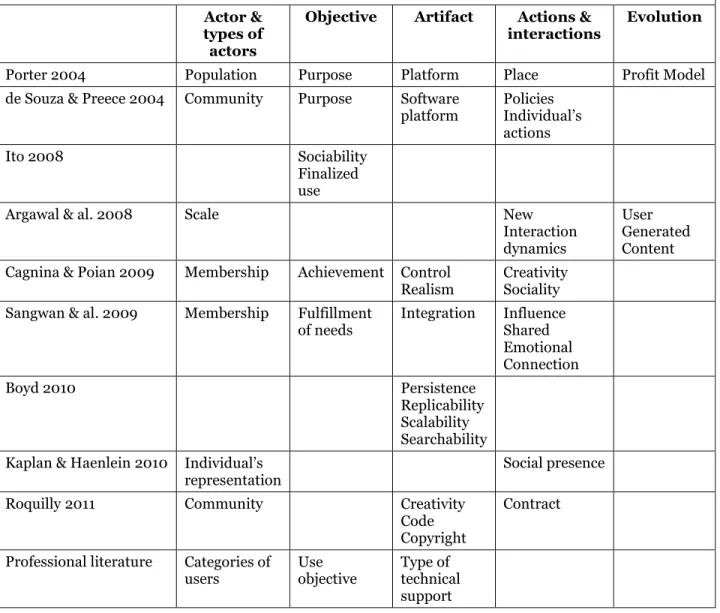
We drew a cross comparison of VSN dimensions with the characteristics covered by the literature. The characteristics mentioned by the literature may sometimes relate to two dimensions of our own reference framework. The main dimension which the characteristic refers to is reported in the Table 5 below. Therefore the evolution dimension is very often implicitly referred to through the artifact and interaction dimensions while the available tools (artifact) make some interactions possible.
Table 5. Cross comparison of VSN dimensions with the characteristics covered by the literature
Actor & types of actors
Objective Artifact Actions & interactions
Evolution
Porter 2004 Population Purpose Platform Place Profit Model de Souza & Preece 2004 Community Purpose Software
platform Policies Individual’s actions Ito 2008 Sociability Finalized use
Argawal & al. 2008 Scale New
Interaction dynamics
User Generated Content Cagnina & Poian 2009 Membership Achievement Control
Realism
Creativity Sociality Sangwan & al. 2009 Membership Fulfillment
of needs Integration Influence Shared Emotional Connection Boyd 2010 Persistence Replicability Scalability Searchability Kaplan & Haenlein 2010 Individual’s
representation
Social presence Roquilly 2011 Community Creativity
Code Copyright
Contract
Professional literature Categories of users Use objective Type of technical support