HAL Id: hal-02889804
https://hal.inria.fr/hal-02889804
Submitted on 5 Jul 2020HAL is a multi-disciplinary open access archive for the deposit and dissemination of sci-entific research documents, whether they are pub-lished or not. The documents may come from teaching and research institutions in France or abroad, or from public or private research centers.
L’archive ouverte pluridisciplinaire HAL, est destinée au dépôt et à la diffusion de documents scientifiques de niveau recherche, publiés ou non, émanant des établissements d’enseignement et de recherche français ou étrangers, des laboratoires publics ou privés.
Building a User-Generated Content North-African
Arabizi Treebank: Tackling Hell
Djamé Seddah, Farah Essaidi, Amal Fethi, Matthieu Futeral, Benjamin
Muller, Pedro Javier Ortiz Suárez, Benoît Sagot, Abhishek Srivastava
To cite this version:
Djamé Seddah, Farah Essaidi, Amal Fethi, Matthieu Futeral, Benjamin Muller, et al.. Building a User-Generated Content North-African Arabizi Treebank: Tackling Hell. ACL 2020 - 58th An-nual Meeting of the Association for Computational Linguistics, Jul 2020, Seattle / Virtual, Canada. �10.18653/v1/2020.acl-main.107�. �hal-02889804�
Building a User-Generated Content North-African
Arabizi Treebank: Tackling Hell
Djamé Seddah1 Farah Essaidi1 Amal Fethi1
Matthieu Futeral1 Benjamin Muller1,2 Pedro Javier Ortiz Suárez1,2 Benoît Sagot1 Abhishek Srivastava1
1Inria, Paris, France
2Sorbonne Université, Paris, France
Abstract
We introduce the first treebank for a romanized user-generated content variety of Algerian, a North-African Arabic dialect known for its fre-quent usage of code-switching. Made of 1500 sentences, fully annotated in morpho-syntax and Universal Dependency syntax, with full translation at both the word and the sentence levels, this treebank is made freely available. It is supplemented with 50k unlabeled sen-tences collected from Common Crawl and web-crawled data using intensive data-mining tech-niques. Preliminary experiments demonstrate its usefulness for POS tagging and dependency parsing. We believe that what we present in this paper is useful beyond the low-resource language community. This is the first time that enough unlabeled and annotated data is pro-vided for an emerging user-generated content dialectal language with rich morphology and code switching, making it an challenging test-bed for most recent NLP approaches.
1 Introduction
Until the rise of fully unsupervised techniques that would free our field from its addiction to anno-tated data, the question of building useful data sets for under-resourced languages at a reasonable cost is still crucial. Whether the lack of labeled data originates from being a minority language status, its almost oral-only nature or simply its programmed political disappearance, geopolitical events are a factor highlighting a language defi-ciency in terms of natural language processing re-sources that can have an important societal impact. Events such as the Haïti crisis in 2010 (Munro,
2010) and the current Algerian revolts (Nossiter,
2019)1are massively reflected on social media, yet
often in languages or dialects that are poorly
re-1https://www.nytimes.com/2019/03/01/world/
africa/algeria-protests-bouteflika.html
sourced, namely Haitian Creole and Algerian di-alectal Arabic in these cases. No readily avail-able parsing and machine translations systems are available for such languages. Taking as an ex-ample the Arabic dialects spoken in North-Africa, mostly from Morocco to Tunisia, sometimes called
Maghribi, sometimes Darija, these idioms
notori-ously contain various degrees of code-switching with languages of former colonial powers such as French, Spanish, and, to a much lesser extent, Ital-ian, depending on the area of usage (Habash,2010;
Cotterell et al.,2014;Saadane and Habash,2015). They share Modern Standard Arabic (MSA) as their matrix language (Myers-Scotton,1993), and of course present a rich morphology. In conjunc-tion with the resource scarcity issue, the code-switching variability displayed by these languages challenges most standard NLP pipelines, if not all. What makes these dialects especially interesting is their widespread use in user-generated content found on social media platforms, where they are generally written using a romanized version of the Arabic script, called Arabizi, which is neither stan-dardized nor formalized. The absence of standard-ization for this script adds another layer of varia-tion in addivaria-tion to well-known user generated con-tent idiosyncrasies, making the processing of this kind of text an even more challenging task.
In this work, we present a new data set of about 1500 sentences randomly sampled from the ro-manized Algerian dialectal Arabic corpus of Cot-terell et al. (2014) and from a small corpus of lyrics coming from Algerian dialectal Arabic Hip-Hop and Raï music genre that had the advan-tage of having already available translations and of being representative of Algerian vernacular ur-ban youth language. We manually annotated this data set with morpho-syntactic information (parts-of-speech and morphological features), together with glosses and code-switching labels at the word
level, as well as sentence-level translations. Fur-thermore, we added an additional manual annota-tion layer following the Universal Dependencies annotation scheme (Nivre et al., 2018), making of this corpus, to the best of our knowledge, the first user-generated content treebank in romanized dialectal Arabic. This treebank contains 36% of French tokens, making it a valuable resource to measure and study the impact of code-switching on NLP tools. We supplement this annotated corpus with about 50k unlabeled sentences extracted from both Common Crawl and additional web crawled data, making of this data set an important mile-stone in North-African dialectal Arabic NLP. This corpus is made freely available under a Creative Commons license.2
2 The Language
As stated byHabash(2010), Arabic languages are often classified into three categories : (i) Classical Arabic, as found in the Qur’an and related canon-ical texts, (ii) Modern Standard Arabic, the offi-cial language of the vast majority of Arabic speak-ing countries and (iii) Dialectal Arabic, whose in-stances exhibit so much variations that they are not mutually understandable across geographically distant regions. As space is missing for an exhaus-tive description of Arabic language variations, we refer the reader to Habash (2010), Samih (2017) and especially toSaadane and Habash(2015) for a thorough account of Algerian dialectal Arabic, which is the focus of this work. In short, the key properties of North-African dialectal Arabic are:
• It is a Semitic language, non codified, mostly spoken;
• It has a rich-inflexion system, which quali-fies this dialect as a morphologically-rich lan-guage (Tsarfaty et al., 2010), even though
Saadane and Habash(2015) write that many properties present in Classical Arabic are ab-sent from this dialect (e.g. it has simplified nominal and verbal case systems);
• It displays a high degree of variability at all levels: spelling and transliteration conven-tions, phonology, morphology, lexicon; • It exhibits a high degree of code-switching;
due to historical reasons and cultural influ-ence of French in the media circles, the Alge-rian dialect, as well as Tunisian and Morocco, is known for its heavy use of French words.
2http://almanach-treebanks.fr/NArabizi
Gloss Attested forms Lang
why wa3lach w3alh 3alach 3lache NArabizi all ekl kal kolach koulli kol NArabizi many beaucoup boucoup bcp French
Table 1: Examples of lexical variation in NArabizi
As stated above, this dialect is mostly spoken and has even been dubbed with disdain as a Creole language by the higher levels of the Algerian po-litical hierarchy.3 Still, its usage is ubiquitous in
the society and, by extension, in social media user-generated content. Interestingly, the lack of Arabic support in input devices led to the rise of a roman-ized written form of this dialect, which makes use of alphanumeric letters as additional graphemes to represent phonemes that the Latin script does not naturally cover. Not limited to North-African di-alectal Arabic, this non-standard “transliteration” concurrently emerged all over the Arabic-speaking world, and is often called Arabizi. Whether or not written in Arabizi, the inter-dialectal divergences between all Arabic dialects remain.
The following list highlights some of the main properties of Arabizi compared to MSA written in the Arabic script.
• Unlike in MSA written in the Arabic script, where short vowels are marked using optional diacritics, all vowels are explicitly written; • Digits are used to cope with Arabic phonemes
that have no counterpart in the Latin script; for instance, the digit “3” is often used to de-note the ayin consonant, because it is graphi-cally similar to its rendition in Arabic script; • No norms exist, resulting in a high degree of
variability between people writing in Arabizi. From now on, we will call NArabizi the Algerian dialect of Arabic when written in Arabizi, thereby simultaneously referring to the language variety and to the script itself. Table 1 presents several examples of lexical variation within NArabizi. In-terestingly, this variability also affects the code-switched vocabulary, which is mostly French in the case of NArabizi. A typical example of
NAra-bizi that also exhibits code-switching with
non-standard French spelling can be seen in Example1. (1)
Source: salem 3alikoum inchalah le pondium et les midailes d’or
3https://www.lesoirdalgerie.com/articles/
Norm.: Assalamu alaykum inshallah le podium et les médailles d’or
Trans.: Peace be on you God willing [we will
get] the podium and the gold medals
3 Corpus
As other North-African Arabic dialects, NArabizi is a resource-poor language, with, to the best of our knowledge, only one available corpus developed by Cotterell et al. (2014) for language identifica-tion purposes.
3.1 Data Collection
Cotterell et al. (2014)’s corpus was collected in 2012 from an Algerian newspaper’s web forums and covers a wide range of topics (from discussion about football events to politics). We collected the 9973 raw sentences from its GitHub reposi-tory4 and sampled about 1300 sentences. In addi-tion, because they were available with translations in French and English, we included lyrics from a few dozen recent popular songs of various genres (Raï, hip-hop, etc.), leading to an additional set of 200 sentences. These 1500 sentences form the core of our NArabizi treebank annotation project. In order to make our corpus usable by modern, resource-hungry natural language processing tech-niques, we also used data-driven language identifi-cation models to extract NArabizi samples among the whole collection of the Common-Crawl-based OSCAR corpora (Ortiz Suárez et al.,2019) as well as 2 millions sentences of additional crawled web-data, resulting in 50k NArabizi sentences of high quality, to date the largest corpus of this language. This makes this collection a valuable test bed for low-resource NLP research.
3.2 Annotation Layers
Our NArabizi treebank contains 5 annotations lay-ers: (i) tokenization, (ii) morphology, (iii) code-switching identification, (iv) syntax and (v) trans-lation.
Tokenization Following Seddah et al. (2012) and their work on the French Social Media Bank, we decided to apply a light tokenization process where we manually tokenized only the obvious cases of wrongly detached punctuations and “miss-ing whitespaces” (i.e. cases where two words are
4https://github.com/ryancotterell/arabic_
dialect_annotation
contracted into one token).5
Morphological Analysis This layer consists of two sets of part-of-speech tags, one following the Universal POS tagset (Petrov et al., 2011) and the other the FTB-cc tagset extended to deal with user-generated content (Seddah et al.,
2012). In cases of word contractions, we fol-lowed their guidelines and used multiple POS as incetait (`itwas')/PRON+VERB/CLS+V. In
addition, we added several morphological fea-tures following the Universal Dependency annota-tion scheme (Nivre et al.,2018), namelygender, number, tense and verbal mood. Note that instead of adding lemmas, we included French glosses for two reasons: firstly for practical reasons, as they helped manual corrections done by non-native speakers of NArabizi, and secondly because of the non-formalized nature of this language, which makes lemmatization very hard, almost akin to et-ymological research as in the case of garjouma/the
throat which can either originate from French gorge or be of Amazigh root.
Code-Switching identification Unlike other works in user-generated content for minority languages (Lynn and Scannell, 2019), we do not distinguish between inter- and intra-sentential switching and consider word-level code-mixing as lexical borrowing. We annotate code-switching at the word level with information about the source language, regardless of the
canonical-ness of spelling.
Syntactic Annotations Here again we follow the Universal Dependencies 2.2 annotation scheme (Nivre et al., 2018). When facing se-quences of French words with regular French syntax, we followed the UD French guidelines; otherwise, we followed the UD Arabic guidelines, following the Prague Arabic Dependency UD Treebank.
Translation Layer Our final layer is made up for sentence-level translations in French. It shall be noted that the validation of these translations often led to massive rewording, as the annotators came from different regions of Algeria and could diverge in their interpretations of a given sentence.
5We corrected in average one tokenization error (less fre-quently two) per sentence on the web forum parts. We noticed a high degree of variance. Some users displayed this behav-ior much more than others. This led some of our annotators to believe it resulted from an ill-functioning input device.
mouto Die VERB ya you INTJ les the DET égyptiens Egyptian NOUN rana we are VERB fi at ADP la the DET coupe cup NOUN de of the ADP monde world NOUN m3a with ADP wladna our children NOUN erajala men NOUN les the DET vrais real ADJ algeriens Algerian NOUN discourse det vocative parataxis case det obl case nmod case obl nmod det amod nmod root
Figure 1: Annotation example: “mouto ya les égyptiens rana fi la coupe de monde m3a wladna erajala les vrais algeriens” [Die Egyptians! We are at the world cup with our children of Algeria, the real men!]. Code-switching is highlighted in blue.
A sample of 200 sentences was blindly translated (without access to the morpho-syntactic analysis) in order to favor further research on the fluency of machine translation for this dialect.
All annotations layers are displayed in Figure1. 4 Extending Our Data Set With Noisy
Unlabeled Data
The need for more data has never been more strik-ing as they are needed for important tasks such as handling lexical sparseness issues via word embed-dings, lexicon acquisition, domain adaptation via self-training, or fine-tuning pre-trained language models, its modern incarnation. The trouble with
NArabizi is that it is a spoken language whose
pres-ence can be mostly found in informal texts such as social media. More importantly, the Arabizi transliteration process is also used by other Ara-bic dialects, making the data collection a needle
in a haystack search task. We therefore present
in this section the process we used to mine an ad-ditional set of 50k NArabizi sentences from two large corpora, one based on search query-based web-crawling and the other from a cleaned version of the CommonCrawl corpora, developed by Or-tiz Suárez et al.(2019).
4.1 First method: SVM-based classifier Using keywords-based web scrapping tools, we collected a raw corpus of 4 million sentences, called CrawlWeb, that in fine contained a mixture of French, English, Spanish, MSA and Arabizi texts. Since we are only interested in NArabizi, we designed a classifier to extract proper sentences from that raw corpus. The corpus we used as gold standard is made of 9k sentences of attested
NAra-bizi from our original corpus and 18k of French
and English tweets. Using language identification (Lui and Baldwin,2012), we convert each sentence from the gold-standard corpus to a feature vector containing language-identification scores and use it as input to a SVM classifier with a classical 80/10/10 split. With a precision and recall score of 94%, we filtered out 173k code-mixed sentences out of the CrawlWeb corpus. Preliminary experi-ments showed promising initial results, but further analysis pointed out a high level of noise in this ini-tial set, both in terms of erroneous language identi-fication and on the amount of remnant ASCII arti-facts that could not easily be removed without im-pacting the valid NArabizi sentences.
4.2 Second method: Neural-based classification
The objectives of this method are twofold: (i) se-lecting data from CommonCrawl using a neural classifier and (ii) using this data set to intersect the data collected with the previous method. The idea is to ensure the quality of the final resulting unla-beled corpus.
Given the large number of noisy data in Com-monCrawl, a “noise” class is added to the language classification model and is built according to sev-eral heuristics.6 That “noisy” class corpus is made of 40k sentences randomly selected among the re-sult of the application of these rules to a short, 10M-sentence sample of CommonCrawl. We then trained a classifier using Fasttext (Joulin et al.,
2016) on 102 languages, 40k sentences each, ex-tracted from the CommonCrawl-based, language-classifed OSCAR corpus, to which we added the 9k sentences of the NArabizi original corpus and
6These heuristics are presented in the Appendix for repro-ducibility.
the “noise” class. The final dataset is composed of 4,090,432 sentences and is split into 80% train, 10% development and 10% test sets. The classi-fier consists in a linear classiclassi-fier (here logistic re-gression) fed with the average of the n-gram em-beddings. n-grams are useful in this case as they enables the model to capture specific sequences of
NArabizi characters such aslah, llah, 3a, 9a, etc. We choose to embed 2- to 5-grams. These param-eters lead to precision and recall scores of 97% on the NArabizi test set.
After an intensive post-processing step (cf. Ap-pendix A.2), this process results in a dataset of 13,667 sentences extracted from half the Common-Crawl corpus.7 To evaluate the quality of the re-sulting data set, we randomly picked 3 times 100 sentences, and genuine NArabizi sentences were manually identified, which allowed us to assess the accuracy of our corpus as reaching 97%. Ta-ble2 presents the results of the evaluation of the two classification methods performed on both the development and test sets of the original NArabizi corpus.8 Results show that the fastText classifier and its n-gram features is more precise than its non-neural counterpart and its language-id feature vec-tors.
4.3 Corpus intersection
When applied to the CrawlWeb corpus, the Fast-text model extracted 44,797 unique Arabizi sen-tences while the SVM model extracted 83,295 unique Arabizi sentences. The intersection of both extractions amounts to 39,003 Arabizi sentences (with a 99% precision). This means that 44,292 sentences were classified as Arabizi by the SVM model and not by Fasttext. Among them, by ran-dom sampling, it can be stated approximately that 55% are indeed NArabizi. Mistakes are misclas-sified sentences (Spanish and English sentences, for instance) or sentences with only “noise” (such as symbols). 5,794 sentences were classified as
NArabizi by the Fasttext model and not SVM.
Among them, by random sampling, it can be stated that approximately 60% are indeed Arabizi. Errors are long sentences with only figures and numbers or sentences with many symbols (e.g. “ { O3 } ” or “!!!! !!!!”).
7
Due to computing power limitation, we were not able to run our selection on the whole CommonCrawl.
8Note that the precision and recall are slightly different in both methods, but the rounding at the second decimal made them equal.
F1-Score Arabizi
Fasttext 0.97
SVM Classifier 0.94
Table 2: F1-scores of both language classification mod-els on the Arabizi class.
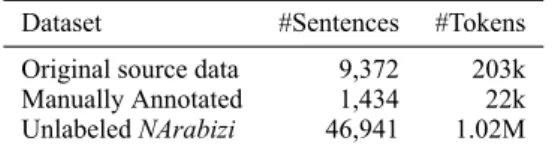
In order to ensure that the collected corpus con-tains as little non-NArabizi data as possible, we only release the intersection of the data we classi-fied, to which we add the original NArabizi corpus (Cotterell et al.,2014) (after having removed the annotated data we extracted from it). Table3 pro-vides quantitative information about our corpora.
Dataset #Sentences #Tokens
Original source data 9,372 203k
Manually Annotated 1,434 22k
Unlabeled NArabizi 46,941 1.02M
Table 3: Corpus statistics
5 Pre-annotation Tool Development via Noisy Transliteration of an Arabic UD Treebank
In order to speed up the annotation process of our data, we decided to create a pre-annotation mor-phosyntactic and syntactic annotator trained on quasi-synthetic data obtained by “transliterating” a pre-existing Arabic (MSA) treebank, the Prague Arabic Dependency Treebank (PADT), into the
NArabizi Latin script, together with data from the
French GSD UD treebank. Both are taken from the UD treebank collection (Nivre et al.,2018).
Before it can be used as training data, the PADT needs to first be transformed into a form similar to
NArabizi. Since the PADT corpus is a collection
of MSA sentences with no diacritics, it is impos-sible to directly “transliterate” into NArabizi. We first diacritized it, in order to add short-vowel in-formation, and then “translitterated” it into an
Ara-bizi-like corpus. We describe this process in this
Section. The results of the pseudo-NArabizi parser trained on the “translitterated” corpus are then pre-sented in Section6.2.
Random diacritics As vowels are always writ-ten in Arabizi, the PADT corpus needs to be dia-critized before transliteration. Using an equiprob-able distribution, diacritics were added randomly, and the text then transliterated using the
probabil-ity distributions we describe below. The BLEU score (Papineni et al.,2002) of this method on the small parallel corpus provides a baseline of 0.31. Proper diacritization Using the Farasa soft-ware (Abdelali et al.,2016), PADT sentences are diacritized with 81% precision rate,9 then tokens aligned with corresponding diacritized words. The text is then transliterated the same way as before. The BLEU score of this version is 0.60. An ex-ample showing how this system visibly improves the transliteration can be seen in the “Prop. Diac.” output in Example2.
(2)
Source: berlin tarfoudhou 7oussoul charika amrikia 3ala ro5sat tasni3 dabbabat ”léopard” al almania
Trans.: Berlin refuses to authorize an Amer-ican firm to produce the ”Leopard” German tank.
Random diac.: brouliyani trfidh 7iswla chiroukou amiyirikyoui 3alia rou5soui tasaniya3i dhabouaboui louyiwibiaridha alalmaanouyou
Proper diac.: birlin tarfoudhou 7ousolou charikatin 2amiriqiatin 3alaa rou5sati tasni3i dabbatin ” lyuberid ” el2almeniati
System BLEU score
Random diacritization 0.31 Proper diacritization 0.60
Table 4: BLEU score of both transliteration systems.
Transliteration Once diacritized, the corpus can be properly transliterated. Arabic letters are either consonant sounds or long vowels, each one may have several different transliterations in NArabizi, depending on the writer’s age, accent, education and first learned Western language. For example, the letterث10 can be transliterated as “t” or “th”.
A probability must be assigned for each possibil-ity, and to make it as close as possible to what is produced by NArabizi speakers, a small parallel corpus of PADT sentences and their transliteration
9
Other diacritization systems have better performances
(Belinkov and Glass,2015) but are either not maintained with
the proper python packages, or come with a fee. 10Theh, U+062B.
by ten NArabizi speakers was assembled, and then each letter aligned with all its possible matches to get probability distributions.
6 Usability
In this section we describe preliminary experi-ments on part-of-speech tagging and statistical dependency parsing that show promising results while highlighting the expected difficulty of pro-cessing a low-resource language with a high level of code-switching and multiple sources of variabil-ity.
6.1 POS Tagging
The baseline POS tagger we used is alVWTag-ger,11a feature-based statistical POS tagger, which ranked 3rd at the 2017 CoNLL multilingual pars-ing shared task (Zeman et al.,2017). It is briefly described in (de La Clergerie et al., 2017). In short, it is a left-to-right tagger that relies on a set of carefully manually designed features, includ-ing features extracted from an external lexicon, when available, and a linear model trained using the Vowpal Wabbit framework.12 In our case, we simply created an “external” lexicon by extracting the content of the training set. It contributes to im-proving the POS accuracy because it provides the tagger with (ambiguous, partial) additional infor-mation about words in the right context of the cur-rent word.13
Dev Test
All OOV all OOV
OOV % 32.28 32.75
UPOS (a) 78.74 55.85 80.37 57.42 MFEATS (b) 88.10 70.04 87.17 69.12 (a)+(b) 72.61 40.94 73.87 43.50
Table 5: POS tagging results.
6.2 Early Parsing experiments
As stated earlier in this paper, NArabizi contains a high-level of code-switching with French and is closely related to MSA. We described in Sec-tion5how we built a mixed treebank based on the
11
Note that we performed a set of baseline experiments with UDPipe 2.0 (Straka and Straková,2017) as well on a pre-vious version of this data set. It reached only 73.7 of UPOS on the test set.
12https://github.com/VowpalWabbit/vowpal_
wabbit/wiki
13Without this endogenous lexicon extraction step, the tag-ger performed slightly worse, although the difference is small.
French GSD UD treebank and our Arabizi version of the Prague Arabic Dependency Treebank. We trained the UDPipe parser (Straka and Straková,
2017) on various treebanks obtained by combin-ing different proportions of the French GSD and our PADT-based pseudo-Arabizi treebank. We ran these parsers with already annotated gold parts-of-speech. The best scores were obtained with a model trained on a mix 30% of pseudo-Arabizi and 70% of French, which we call the MIX treebank, totaling 5,955 training sentences. We split this treebank into training, development and test sets, called MIXtrain/dev/test, following a 80/10/10 split. We used a very small manually annotated NArabizi development dataset of 200 NArabizi sentences, called Arabizidev, to evaluate our parser. As shown in Table 6 (line “Mix”), despite good results on MIX’s development and training sets, MIXdevand MIXtestrespectively (see Table6), this first parser did not performed very well when evaluated on Arabizidev. This performance level proved insuf-ficient to speed up the annotation task. We there-fore manually annotated 300 more NArabizi sen-tences (Arabizitrain300), to be used as additional training data. When added to MIXtrain, parsing per-formance did improve, yet not to a sufficient ex-tent, especially in terms of Labeled Attachement Score (LAS). It turned out that training UDPipe on these 300 manually annotated NArabizi sentences only (Arabizitrain300) produced better scores, result-ing in a parser that we did use as a pre-annotation tool in a constant bootstrap process to speed up the annotation of the remaining sentences.
Training corpus Dev Test Test Arabizi LAS UAS LAS UAS LAS UAS MIX 87.67 89.42 87.69 89.44 39.28 51.52 MIX+Arabizi300 87.42 89.20 87.44 89.22 55.54 65.36
Arabizi300 39.11 49.62 39.14 49.65 63.03 71.21
Table 6: Results of UDPipe (trained 100 epochs) on the preliminary test set.
7 Discussion
How interleaved are French and NArabizi? As stated before, NArabizi takes its root in Classical Arabic and in multiple sources of integration of French, MSA and Berber, the Amazigh language. As the NArabizi treebank contains more than 36% of French words, it is of interest to use recent meth-ods of visualization to see how interleaved it is
(a) dimension = 50 (b) dimension = 100
(c) dimension = 200
Figure9: Word embbeddings de 300 mots (100 arabe translittéré, 100 français, 100 arabizi) calculés avec l’algorithme FastText (jaune : français, bleu : arabe, rouge : arabizi)
29
(a) dimension = 50 (b) dimension = 100
(c) dimension = 200
Figure9: Word embbeddings de 300 mots (100 arabe translittéré, 100 français, 100 arabizi) calculés avec l’algorithme FastText (jaune : français, bleu : arabe, rouge : arabizi)
29
(a) dim: 50 (b) dim: 100
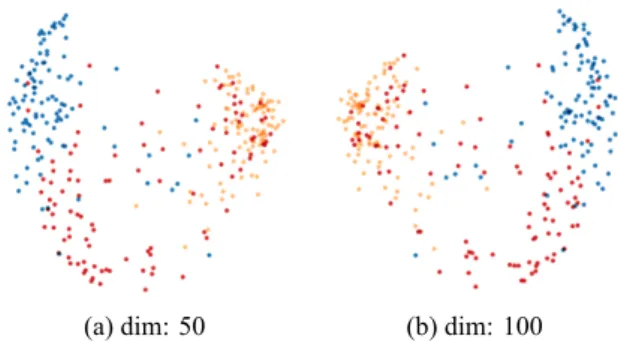
Figure 2: Two-dimensional representation of Fasttext word embeddings for 300 words (100 for transliterated MSA - blue -, French - yellow - and NArabizi - red -) after PCA analysis
with some of its source languages. To this end, we extract words embeddings using fastText (Joulin et al.,2016) from a corpus made of the “translitter-ated” PADT described in Section5, the French UD GSD and NArabizi original corpus (Cotterell et al.,
2014). Two-dimensional representations of the re-sulting embeddings space for 300 selected words are shown in Figure2 for embeddings of size 50 and 100.
We notice that the overall shapes of both repre-sentations are very similar, apart from a non signif-icant x-axis reversal. On the first components, in-creasing the embedding size does not provide more information.
We also see that French and transliterated Ara-bic words are clearly separated into two clusters of low standard deviation, while NArabizi words are very spread out. Some fall within the French cluster, they correspond to French words present in this Algerian dialect. Others are in the mid-dle of the Arabic cluster, these are the purely Ara-bic words of the dialect. Between the two, there are Amazigh words (rak, mech), arabized French words (tomobile < French automobile), Arabic words whose Berber pronunciation has resulted in an unexpected NArabizi rendering (nta instead of expected enta ‘you’, mchit instead of expected
machayt ‘to go-2SING’).
What is the Impact of Code-Switching in POS--tagging performance? Given the large degree of interleaving between French and NArabizi, it is interesting to assess the impact of the French vocabulary on the performance of a POS-tagger trained on French data only. For these experi-ments, we use the StanfordNLP neural tagger (Qi et al.,2019), which ranked 1st in POS tagging at the 2018 UD shared task, trained on the UD French
ParTUT treebank, using French fastText vectors (Mikolov et al.,2018). In order to perform a mean-ingful evaluation, we split the NArabizi training set into 4 buckets of approximately 25% of it size in tokens, with a increasing proportion of identified
NArabizi tokens. Results in Table7show a clear drop of performance between the sentences that contain more code-switching (59.55% of UPOS accuracy) and those with none (16.84%). This suggests that low-resource languages with a high-level of code-switching such as NArabizi can bene-fit from NLP models trained on the secondary lan-guage. The level of performance to expect from these cross-language approaches is yet to be deter-mined.
% of NArabizi per sent. <60 60-78 78-100 100 bucket set size (sent.) 322 286 283 276 StanfordNLP (French) 59.55 35.93 25.41 16.84 Table 7: POS tagging Performance with regard to code-mix proportion trained on UD French Partut treebank
8 Treebanking Costs
FollowingMartínez Alonso et al.(2016), we pro-vide here the cost figures of this annotation cam-paign. We do not include the salaries of the per-manent staff, nor do we include the overhead. These figures are meant as an indication of the ef-fort needed to create an annotated data set from scratch. It shall be noted that even though the inter-annotator agreement gave us early indications on the difficulty of the tasks, it also acted as a metric in terms of language variability among annotators. None of them come from the same part of North-Africa and none of them has the same familiarity with the topics discussed in the web-forums we annotated. We had to constantly re-annotate sen-tences and update the guidelines every time new idiosyncrasies were encountered and most impor-tantly accepted as such by the annotators. Com-pared to what was reported in (Martínez Alonso et al., 2016), the figures are here much higher (about 5 times higher), because unlike their work on French treebanks, we could not use preexisting guidelines for this language and because we could not keep the same team all along the project, so that new members had to be trained almost from scratch or to work on totally different layers.
Phase 1st 2nd 3rd 4th 5th p.m Costs (ke)
Annotators 8 2 2 3 15 45
Jr Researcher 2 5 7 21
Confirmed 6 6 21
total 8 4 7 3 6 28 87
Table 8: Treebanking costs. The annotation phases are (i) Morphology/tokenization, (ii) Translation, (iii) Pre-annotation Syntax, (iv) Correction, (v) Final Syntax. P.M stands for person.month
9 Related Work
Research on Arabic dialects is quite extensive. Space is lacking to describe it exhaustively. In re-lation to our work regarding North-African dialect, we refer to the work of (Samih,2017) who along his PhD covered an large range of topics regarding the dialect spoken specifically in Morocco and gen-erally regarding language identification (Samih et al.,2016) in code-switching scenario for various Arabic dialects (Attia et al.,2019).
Unlike NArabizi dialects, the resource situation for Arabic dialects in canonical written form can hardly be qualified as scarce given the amount of resources produced by the Linguistic Data Consor-tium regarding these languages, see (Diab et al.,
2013) for details on those corpora. These data have been extensively covered in various NLP as-pects by the former members of the Columbia
Ara-bic NLP team, among which Mona Diab, Nizar
Habash, and Owen Rambow, in their respective subsequent lines of works. Many small to medium scale linguistics resources, such as morphological lexicons or bilingual dictionaries have been pro-duced (Shoufan and Alameri, 2015). Recently, in addition to the release of a small-range par-allel corpus for some Arabic dialects (Bouamor et al., 2014), a larger corpus collection was re-leased, covering 25 city dialects in the travel do-main (Bouamor et al.,2018).
Regarding the specific NLP modeling chal-lenges of processing Arabic-based languages, as part of the morphologically-rich languages, recent advances in joint models have been addressed by Zalmout and Habash (2019) that recently ef-ficiently adapted a neural architecture to perform joint word segmentation, lemmatization, morpho-logical analysis and POS tagging on an Arabic di-alect. Recent works on cross-language learning us-ing the whole massively multilus-ingual pre-trained language models artillery have started to emerge
(Srivastava et al.,2019). If successful, such mod-els could help to alleviate the resource scarcity is-sue that plagues low-resources languages in the
more-than-ever data hungry modern NLP.
10 Conclusion
We introduced the first treebank for an Arabic di-alect spoken in North-Africa and written in ro-manized form, NArabizi. More over, being made of user-generated content, this treebank covers a large variety of language variation among na-tive speakers and displays a high level of code-switching. Annotated with 4 standard morpho-syntactic layers, two of them following the Univer-sal Dependency annotation scheme, and provided with translation to French as well as glosses and word language identification, we believe that this corpus will be useful for the community at large, both for linguistic purposes and as training data for resource-scarce NLP in a high-variability sce-nario. In addition to the annotated data, we provide around 1 million tokens (over 46k sentences) of un-labeled NArabizi content, resulting in the largest dataset available for this dialect. Our corpora are freely available14under the CC-BY-SA license and the NArabizi treebank is also released as part of the Universal Dependencies project.
Acknowledgments
The work was partially funded by the French Re-search Agency projects ParSiTi (ANR-16-CE33-0021), SoSweet (ANR15-CE38-0011-01) and by the French Ministry of Industry and Ministry of Foreign Affairs via the PHC Maimonide France-Israel cooperation programme, as well as by the Sagot’s chair in the PRAIRIE institute funded by the French national agency ANR as part of the “In-vestissements d’avenir” programme under the ref-erence ANR-19-P3IA-0001.
References
Ahmed Abdelali, Kareem Darwish, Nadir Durrani, and Hamdy Mubarak. 2016. Farasa: A fast and furious segmenter for arabic. In HLT-NAACL
Demos.
Mohammed Attia, Younes Samih, Ali Elkahky, Hamdy Mubarak, Ahmed Abdelali, and Ka-reem Darwish. 2019. POS tagging for improv-ing code-switchimprov-ing identification in Arabic. In
14http://almanach-treebanks.fr/NArabizi
Proceedings of the Fourth Arabic Natural Lan-guage Processing Workshop, pages 18–29,
Flo-rence, Italy. Association for Computational Lin-guistics.
Yonatan Belinkov and James Glass. 2015. Arabic diacritization with recurrent neural networks. In
Proceedings of the 2015 Conference on Empir-ical Methods in Natural Language Processing,
pages 2281–2285, Lisbonne, Portugal. Associa-tion for ComputaAssocia-tional Linguistics.
Houda Bouamor, Nizar Habash, and Kemal Oflazer. 2014. A multidialectal parallel cor-pus of Arabic. In Proceedings of the Ninth
In-ternational Conference on Language Resources and Evaluation (LREC’14), pages 1240–1245,
Reykjavik, Iceland. European Language Re-sources Association (ELRA).
Houda Bouamor, Nizar Habash, Mohammad Salameh, Wajdi Zaghouani, Owen Rambow, Dana Abdulrahim, Ossama Obeid, Salam Khal-ifa, Fadhl Eryani, Alexander Erdmann, and Kemal Oflazer. 2018. The MADAR Ara-bic dialect corpus and lexicon. In
Proceed-ings of the Eleventh International Conference on Language Resources and Evaluation (LREC 2018), Miyazaki, Japan. European Language
Resources Association (ELRA).
Ryan Cotterell, Adithya Renduchintala, Naomi Saphra, and Chris Callison-Burch. 2014. An Algerian Arabic-French code-switched corpus. In Workshop on Free/Open-Source Arabic
Cor-pora and CorCor-pora Processing Tools Workshop Programme, page 34.
Mona Diab, Nizar Habash, Owen Rambow, and Ryan Roth. 2013. LDC Arabic treebanks and as-sociated corpora: Data divisions manual. Tech-nical Report CCLS-13-02, Center for Computa-tional Learning Systems, Columbia University. Nizar Habash. 2010. Introduction to Arabic
Nat-ural Language Processing. Morgan and
Clay-pool.
Armand Joulin, Edouard Grave, Piotr Bojanowski, Matthijs Douze, Hérve Jégou, and Tomas Mikolov. 2016. Fasttext. zip: Compress-ing text classification models. arXiv preprint
Éric de La Clergerie, Benoît Sagot, and Djamé Sed-dah. 2017. The ParisNLP entry at the ConLL UD shared task 2017: A tale of a #Parsing-Tragedy. In Proceedings of the CoNLL 2017
Shared Task: Multilingual Parsing from Raw Text to Universal Dependencies, pages 243–252,
Vancouver, Canada. Association for Computa-tional Linguistics.
Marco Lui and Timothy Baldwin. 2012.langid.py: An off-the-shelf language identification tool. In
The 50th Annual Meeting of the Association for Computational Linguistics, Proceedings of the System Demonstrations, July 10, 2012, Jeju Is-land, Korea, pages 25–30. The Association for
Computer Linguistics.
Teresa Lynn and Kevin Scannell. 2019. Code-switching in irish tweets: A preliminary analy-sis. In Proceedings of the Celtic Language
Tech-nology Workshop, pages 32–40.
Héctor Martínez Alonso, Djamé Seddah, and Benoît Sagot. 2016. From Noisy Questions to Minecraft Texts: Annotation Challenges in Ex-treme Syntax Scenarios. In The 2nd Workshop
on Noisy User-generated Text (W-NUT).
Tomas Mikolov, Edouard Grave, Piotr Bo-janowski, Christian Puhrsch, and Armand Joulin. 2018. Advances in pre-training dis-tributed word representations. In Proceedings
of the International Conference on Language Resources and Evaluation (LREC 2018).
Robert Munro. 2010. Crowdsourced translation for emergency response in haiti: the global collaboration of local knowledge. In AMTA
Workshop on Collaborative Crowdsourcing for Translation, pages 1–4.
Carol Myers-Scotton. 1993. Common and un-common ground: Social and structural fac-tors in codeswitching. Language in Society,
22(4):475–503.
Joakim Nivre, Mitchell Abrams, Željko Agić, Lars Ahrenberg, Lene Antonsen, Maria Jesus Aranz-abe, Gashaw Arutie, Masayuki Asahara, Luma Ateyah, Mohammed Attia, Aitziber Atutxa, Liesbeth Augustinus, Elena Badmaeva, Miguel Ballesteros, Esha Banerjee, Sebastian Bank, Verginica Barbu Mititelu, John Bauer, Sandra Bellato, Kepa Bengoetxea, Riyaz Ahmad Bhat,
Erica Biagetti, Eckhard Bick, Rogier Blok-land, Victoria Bobicev, Carl Börstell, Cristina Bosco, Gosse Bouma, Sam Bowman, Adri-ane Boyd, Aljoscha Burchardt, Marie Candito, Bernard Caron, Gauthier Caron, Gülşen Ce-biroğlu Eryiğit, Giuseppe G. A. Celano, Savas Cetin, Fabricio Chalub, Jinho Choi, Yongseok Cho, Jayeol Chun, Silvie Cinková, Aurélie Col-lomb, Çağrı Çöltekin, Miriam Connor, Marine Courtin, Elizabeth Davidson, Marie-Catherine de Marneffe, Valeria de Paiva, Arantza Diaz de Ilarraza, Carly Dickerson, Peter Dirix, Kaja Dobrovoljc, Timothy Dozat, Kira Droganova, Puneet Dwivedi, Marhaba Eli, Ali Elkahky, Binyam Ephrem, Tomaž Erjavec, Aline Etienne, Richárd Farkas, Hector Fernandez Alcalde, Jen-nifer Foster, Cláudia Freitas, Katarína Gaj-došová, Daniel Galbraith, Marcos Garcia, Moa Gärdenfors, Kim Gerdes, Filip Ginter, Iakes Goenaga, Koldo Gojenola, Memduh Gökırmak, Yoav Goldberg, Xavier Gómez Guinovart, Berta Gonzáles Saavedra, Matias Grioni, Normunds Grūzītis, Bruno Guillaume, Céline Guillot-Barbance, Nizar Habash, Jan Hajič, Jan Hajič jr., Linh Hà Mỹ, Na-Rae Han, Kim Harris, Dag Haug, Barbora Hladká, Jaroslava Hlaváčová, Florinel Hociung, Petter Hohle, Jena Hwang, Radu Ion, Elena Irimia, Tomáš Jelínek, Anders Johannsen, Fredrik Jørgensen, Hüner Kaşıkara, Sylvain Kahane, Hiroshi Kanayama, Jenna Kan-erva, Tolga Kayadelen, Václava Kettnerová, Jesse Kirchner, Natalia Kotsyba, Simon Krek, Sookyoung Kwak, Veronika Laippala, Lorenzo Lambertino, Tatiana Lando, Septina Dian Larasati, Alexei Lavrentiev, John Lee, Phương Lê Hồng, Alessandro Lenci, Saran Lertpra-dit, Herman Leung, Cheuk Ying Li, Josie Li, Keying Li, KyungTae Lim, Nikola Ljubešić, Olga Loginova, Olga Lyashevskaya, Teresa Lynn, Vivien Macketanz, Aibek Makazhanov, Michael Mandl, Christopher Manning, Ruli Ma-nurung, Cătălina Mărănduc, David Mareček, Katrin Marheinecke, Héctor Martínez Alonso, André Martins, Jan Mašek, Yuji Matsumoto, Ryan McDonald, Gustavo Mendonça, Niko Miekka, Anna Missilä, Cătălin Mititelu, Yusuke Miyao, Simonetta Montemagni, Amir More, Laura Moreno Romero, Shinsuke Mori, Bjartur Mortensen, Bohdan Moskalevskyi, Kadri Muis-chnek, Yugo Murawaki, Kaili Müürisep, Pinkey Nainwani, Juan Ignacio Navarro Horñiacek,
Anna Nedoluzhko, Gunta Nešpore-Bērzkalne, Lương Nguyễn Thị, Huyền Nguyễn Thị Minh, Vitaly Nikolaev, Rattima Nitisaroj, Hanna Nurmi, Stina Ojala, Robert Olúòkun, Adé-dayọ̀ọstling, Lilja Øvrelid, Niko Partanen, Elena Pascual, Marco Passarotti, Agnieszka Patejuk, Siyao Peng, Cenel-Augusto Perez, Guy Perrier, Slav Petrov, Jussi Piitulainen, Emily Pitler, Barbara Plank, Thierry Poibeau, Mar-tin Popel, Lauma Pretkalniņa, Sophie Prévost, Prokopis Prokopidis, Adam Przepiórkowski, Tiina Puolakainen, Sampo Pyysalo, Andriela Rääbis, Alexandre Rademaker, Loganathan Ra-masamy, Taraka Rama, Carlos Ramisch, Vinit Ravishankar, Livy Real, Siva Reddy, Georg Rehm, Michael Rießler, Larissa Rinaldi, Laura Rituma, Luisa Rocha, Mykhailo Romanenko, Rudolf Rosa, Davide Rovati, Valentin Ro�ca, Olga Rudina, Shoval Sadde, Shadi Saleh, Tanja Samardžić, Stephanie Samson, Manuela Sanguinetti, Baiba Saulīte, Yanin Sawanaku-nanon, Nathan Schneider, Sebastian Schuster, Djamé Seddah, Wolfgang Seeker, Mojgan Ser-aji, Mo Shen, Atsuko Shimada, Muh Shohibus-sirri, Dmitry Sichinava, Natalia Silveira, Maria Simi, Radu Simionescu, Katalin Simkó, Mária Šimková, Kiril Simov, Aaron Smith, Isabela Soares-Bastos, Antonio Stella, Milan Straka, Jana Strnadová, Alane Suhr, Umut Suluba-cak, Zsolt Szántó, Dima Taji, Yuta Taka-hashi, Takaaki Tanaka, Isabelle Tellier, Trond Trosterud, Anna Trukhina, Reut Tsarfaty, Fran-cis Tyers, Sumire Uematsu, Zdeňka Urešová, Larraitz Uria, Hans Uszkoreit, Sowmya Vaj-jala, Daniel van Niekerk, Gertjan van Noord, Viktor Varga, Veronika Vincze, Lars Wallin, Jonathan North Washington, Seyi Williams, Mats Wirén, Tsegay Woldemariam, Tak-sum Wong, Chunxiao Yan, Marat M. Yavrumyan, Zhuoran Yu, Zdeněk Žabokrtský, Amir Zeldes, Daniel Zeman, Manying Zhang, and Hanzhi Zhu. 2018. Universal dependencies 2.2. LIN-DAT/CLARIN digital library at the Institute of Formal and Applied Linguistics (ÚFAL), Fac-ulty of Mathematics and Physics, Charles Uni-versity.
Adam Nossiter. 2019. Algeria protests grow against president bouteflika, ailing and out of sight. In New York Times (March 01, 2019). Pedro Javier Ortiz Suárez, Benoît Sagot, and
Lau-rent Romary. 2019. Asynchronous Pipeline for Processing Huge Corpora on Medium to Low Resource Infrastructures. In 7th Workshop on
the Challenges in the Management of Large Corpora (CMLC-7), Cardiff, United Kingdom.
Leibniz-Institut für Deutsche Sprache.
Kishore Papineni, Salim Roukos, Todd Ward, and Wei-jing Zhu. 2002. Bleu: a method for auto-matic evaluation of machine translation. In
Pro-ceedings of the 40th Annual Meeting of the As-sociation for Computational Linguistics, pages
311–318.
Slav Petrov, Dipanjan Das, and Ryan McDonald. 2011. A universal part-of-speech tagset. arXiv
preprint arXiv:1104.2086.
Peng Qi, Timothy Dozat, Yuhao Zhang, and Christopher D Manning. 2019. Universal de-pendency parsing from scratch. arXiv preprint
arXiv:1901.10457.
Houda Saadane and Nizar Habash. 2015. A con-ventional orthography for Algerian arabic. In
Proceedings of the Second Workshop on Arabic Natural Language Processing, pages 69–79.
Younes Samih. 2017.Dialectal Arabic processing Using Deep Learning. Ph.D. thesis, Düsseldorf, Germany.
Younes Samih, Suraj Maharjan, Mohammed At-tia, Laura Kallmeyer, and Thamar Solorio. 2016.
Multilingual code-switching identification via LSTM recurrent neural networks. In
Proceed-ings of the Second Workshop on Computational Approaches to Code Switching, pages 50–59,
Austin, Texas. Association for Computational Linguistics.
Djamé Seddah, Benoît Sagot, Marie Candito, Vir-ginie Mouilleron, and Vanessa Combet. 2012. The French Social Media Bank: a Treebank of Noisy User Generated Content. In CoLing, Mumbai, India.
Abdulhadi Shoufan and Sumaya Alameri. 2015.
Natural language processing for dialectical Ara-bic: A survey. In Proceedings of the Second
Workshop on Arabic Natural Language Process-ing, pages 36–48, BeijProcess-ing, China. Association
Abhishek Srivastava, Benjamin Muller, and Djamé Seddah. 2019. Unsupervised Learning for Handling Code-Mixed Data: A Case Study on POS Tagging of North-African Arabizi Dialect. EurNLP - First annual EurNLP. Poster.
Milan Straka and Jana Straková. 2017. Tokeniz-ing, pos taggTokeniz-ing, lemmatizing and parsing ud 2.0 with udpipe. In Proceedings of the CoNLL
2017 Shared Task: Multilingual Parsing from Raw Text to Universal Dependencies, pages 88–
99, Vancouver, Canada. Association for Compu-tational Linguistics.
Reut Tsarfaty, Djamé Seddah, Yoav Goldberg, Sandra Kübler, Marie Candito, Jennifer Fos-ter, Yannick Versley, Ines Rehbein, and Lamia Tounsi. 2010. Statistical parsing of morpholog-ically rich languages (spmrl): what, how and whither. In Proceedings of the NAACL HLT
2010 First Workshop on Statistical Parsing of Morphologically-Rich Languages, pages 1–12.
Association for Computational Linguistics. Nasser Zalmout and Nizar Habash. 2019. Joint
di-acritization, lemmatization, normalization, and fine-grained morphological tagging. arXiv preprint arXiv:1910.02267.
Daniel Zeman, Martin Popel, Milan Straka, Jan Hajič, Joakim Nivre, Filip Ginter, Juhani Lu-otolahti, Sampo Pyysalo, Slav Petrov, Mar-tin Potthast, Francis Tyers, Elena Badmaeva, Memduh Gokirmak, Anna Nedoluzhko, Silvie Cinková, Jan Hajič jr., Jaroslava Hlaváčová, Václava Kettnerová, Zdeňka Urešová, Jenna Kanerva, Stina Ojala, Anna Missilä, Christo-pher D. Manning, Sebastian Schuster, Siva Reddy, Dima Taji, Nizar Habash, Herman Le-ung, Marie-Catherine de Marneffe, Manuela Sanguinetti, Maria Simi, Hiroshi Kanayama, Valeria de Paiva, Kira Droganova, Héctor Martínez Alonso, Çağrı Çöltekin, Umut Su-lubacak, Hans Uszkoreit, Vivien Macketanz, Aljoscha Burchardt, Kim Harris, Katrin Marhei-necke, Georg Rehm, Tolga Kayadelen, Mo-hammed Attia, Ali Elkahky, Zhuoran Yu, Emily Pitler, Saran Lertpradit, Michael Mandl, Jesse Kirchner, Hector Fernandez Alcalde, Jana Str-nadová, Esha Banerjee, Ruli Manurung, Anto-nio Stella, Atsuko Shimada, Sookyoung Kwak, Gustavo Mendonça, Tatiana Lando, Rattima
Ni-tisaroj, and Josie Li. 2017.CoNLL 2017 shared task: Multilingual parsing from raw text to uni-versal dependencies. In Proceedings of the
CoNLL 2017 Shared Task: Multilingual Pars-ing from Raw Text to Universal Dependencies,
pages 1–19, Vancouver, Canada. Association for Computational Linguistics.
A Appendix
A.1 Class-noise for our language classifier Given the large number of noisy data in Common Crawl, a class noise is added to the classification model we presented section 4.2 and is built accord-ing to the followaccord-ing empirical rules :
• If the word ”url” appears more than two times,
the sentence is added to class noise.
• If the sentence has more than four ” [ ” , the
sentence is added to class noise.
• The same rule as above works for ”
”, ” ”, ” { ” or ” } ” symbols.
• If the word ”http” appears more than two
times, the sentence is added to class noise.
• If more than two ”@” character, the sentence
is added to class noise in order to capture sen-tences with email address or tweets with only mentioned people.
• If the phrase ”WARC-Refers-To” appears, the
sentence is added to class noise. A.2 Post-processing steps
• Get unique sentences (about 20K sentences). • The model is likely to classify as Arabizi
sen-tences which contain any letter repeated a lot of times in a row (e.g. ”iiiiiiii..”, ”uuuuuuu..”, ”ffffff...”). These sentences are deleted from
the dataset.
• Due to the n-gram embeddings, ”lah” is con-sidered as a marker of Arabizi, so a lot of sen-tences containing ”blah” are classified as Ara-bizi. If this phrase appears more than 5 times, the sentence is deleted.
• Figures and numbers are widespread in Ara-bizi (particularly ”3” and ”9”), so the model classifies too many sentences which contains only numbers. Therefore, sentences which have more ”number of figures” characters than 80% of the number of characters (ex-cluded figures) are deleted.
![Figure 1: Annotation example: “mouto ya les égyptiens rana fi la coupe de monde m3a wladna erajala les vrais algeriens” [Die Egyptians! We are at the world cup with our children of Algeria, the real men!]](https://thumb-eu.123doks.com/thumbv2/123doknet/14296988.493446/5.892.115.750.99.288/figure-annotation-example-égyptiens-algeriens-egyptians-children-algeria.webp)