ISRAEL JOURNAL OF MATHEMATICS 124 (20{)1), 125 141
QUANTITATIVE ESTIMATES OF
DISCRETE HARMONIC MEASURES
BY
E . B O L T H A U S E N A N D K . M U N C H - B E R N D L * Institut ]iir Mathematik der Universitdt Ziirieh Winterthurer Str. 190, 8057 Ziirich, Switzerland e-maiL [email protected], [email protected]
ABSTRACT
A t h e o r e m of B o u r g a i n s t a t e s t h a t t h e h a r m o n i c m e a s u r e for a d o m a i n in ](d is s u p p o r t e d o11 a set o f H a u s d o r f f d i m e n s i o n strictly less t h a n d [2]. W e a p p l y B o u r g a i n ' s m e t h o d to tile discrete case, i.e., to t h e d i s t r i b u t i o n of t h e first e n t r a n c e p o i n t of a r a n d o m walk into a s u b s e t of Z d, d _> 2. B y refining t h e a r g u m e n t , we prove t h a t for all fl > 0 t h e r e exists p(d,~) < d a n d N(d, fi), s u c h t h a t for a n y n > N(d,/~), a n y x E ~.d, a n d a n y A C {1 . . . . ,n} d
I{Y E zd: UA,~(Y) _ n-/~}J __ n p(d'z),
w h e r e UA,z(y) d e n o t e s t h e p r o b a b i l i t y t h a t y is t h e first e n t r a n c e p o i n t of t h e simple r a n d o m walk s t a r t i n g at x into A. F u r t h e r m o r e , p m u s t converge to d a s / ~ -+ c~.
1. I n t r o d u c t i o n
Let
(S,~)neN
be a simple r a n d o m walk in Z d s t a r t i n g at x E Z d, i.e., So = x a n d 1~ x ( s n + l -
s~
= ~) = ~ , LI~II = 1, n ~ N.(11 • II denotes the Euclidian distance, i.e., Ilxll = v/x 2 + . . . + x2.) For A C Z 4, A ~ O, we denote by TA the time of the first entrance of S into A:
7 A = inf{n >_ 0: Sn E A}.
• Supported by Swiss NF grant 20-55648.98.
Received August 4, 1999 and in revised form May 2, 2000
126 E. BOLTHAUSEN AND K. MUNCH-BERNDL Isr. J. Math.
T h e h a r m o n i c m e a s u r e for A of a set B C Z d evaluated at x E 7/,d is defined as
w ( A , B , x ) = P~(TA < co, S~ A E B).
Clearly, for x E A, w(A, B, x) = llB(x). For fixed A C Z d and x E Z 4, w(A, . , x)
is a m e a s u r e on Z d with t o t a l m a s s w(A, Zd, x) = w ( A , A , x ) = P~(TA < OC) E
(0,1]. We denote by ua,x(y) = w ( A , { y } , x ) its density. For x E A c = z d " . A , w( A, B, . ) is a h a r m o n i c function,
=
II~ll=l We shall prove the following theorem:
THEOREM: (A) For all/~ > 0 there exists p(d, fl) < d and N ( d , fl), such t h a t for any n > N(d, fl), any x E Z d, and any A C Qd(n) = { 1 , . . . , n } d,
I{y E Z~: ~A,~(Y) > n-~}l < n ~(d'~).
(B) For all p < d there exist fl < cc and sequences nK -+ oc, X g E Z d, and A K C Q d ( n g ) such that for all K
Remarks: (1) If x E A, the s t a t e m e n t of T h e o r e m (A) is trivial. Therefore we only consider x E A c. T h e p r o o f of T h e o r e m (A) is to a large extent an
a d a p t a t i o n of B o u r g a i n ' s p r o o f [2] t h a t the h a r m o n i c m e a s u r e for a d o m a i n in •d is s u p p o r t e d on a set of Hausdorff dimension strictly less t h a n d to the discrete case, a n d the p r o o f of T h e o r e m (B) is inspired by Jones and M a k a r o v [5] who also t r e a t continuous h a r m o n i c measure.
(2) T h e analogous t h e o r e m holds for h a r m o n i c m e a s u r e conditioned on the event t h a t A is reached, and also for h a r m o n i c m e a s u r e f r o m infinity: Let
and
PA,~(y)= lira
F'A,x(y).
(See, for example, [6], Chapter 2.1 for the existence of #A,~.) Then we have
(A') For all ~ > 0 there exists p(d, fl) < d and N ( d , ~ ) , such that for any n > N(d, fl), any x E Z d, and any A C Qd(n) = { 1 , . . . , n } d,
Vol. 124, 2001 ESTIMATES OF DISCRETE HARMONIC MEASURES 127 and
(A") For all fl > 0 there exists p(d,~) < d and N(d, fl), such that for any n > N(d, fl) and any A C Qd(n) = { 1 , . . . , n } ~,
I{y • z~: ~A,~(Y) _> n-QI _< n p(~'~)
For (At), note first that for d = 2, P~(TA < Co) = 1 for all x and A by recurrence and therefore ~A,x = L'A,x. For d _> 3, we have a lower bound on the hitting probability P~ (VA < oo) for x in a neighborhood of Qd(n),
(1)
•x(7 A < oc) > ]l~X(T{z} < OC) -- G(X -- Z)-
c(o)
C2
>- c ~ l l x - ~ii~-~ _>
e(a,d),~ ~-~for all z E A and x C Ud(an) = { - - a n , . . . , (a + 1)n} d, where G is the Green's function which satisfies (9); see Section 2.3 below. For more distant x, F'A,x
doesn't change a lot any more: For d >_ 2, there exist constants Cl(d) and C2(d)
such that for all A C Qd(n), y C A, x • (Ud(an)) ~ with a > 2v~,
(2)
C~r,A,~(U) <_ ~A,oo(U) <_
C 2 n A , ~ ( U ) ;see [6], Chapter 2.1. From (1) and (2), (A') follows, and (A") follows from (A') with (2). Similarly we have the analogs of Theorem (B).
(3) Our theorem improves a result of Benjamini [1]. In fact, it implies the following weaker statement (which is still stronger than [1]): There exists p(d) <
d, such that for any e > 0 there is an N(c) such that for any n > N(c), any x • Z d, and any A C Qd(n) = { 1 , . . . , n } d, there is a set A C A with
w(A, ft, x) > w(A, A, x) - e and IAI < cno.
The analogous statements hold for harmonic measure conditioned on the event that A is reached, and also for harmonic measure from infinity. Note that it is in general impossible that A carries the fidl mass: Considering for example (for even n) A = {1, 3, 5 , . . . , n - 1} d, the only set having fiall mass (for x ¢ A) is A, and IA[ = ( n / 2 ) d.
(4) The dependence of the exponent p on ~ for 2-dimensional simple random walk paths A (the "nmltifi'actal spectrum of the harmonic measure for A") has been studied by LaMer [8]. Also for d = 2, there is another result of Lawler [7] which gives more information on the support of harmonic mea~sure from infinity
128 E. BOLTHAUSEN AND K. MLTNCH-BERNDL Isr. J. Math. 2. P r o o f
2.1 PROOF OF THEOREM ( B ) . T a k e
n g = 2 g.
Delete from {1, 2 , . . . ,nK}
the central 52 g points, from the remaining two intervals of length (1 - 5)2 g - 1 the central 6(1 - 5)2 g - 1 points, and so on, k (< K ) times. In the j - t h step, we have deleted 6(1 -5)J-12 g-j+l
points and obtained intervals of length (1 -5)J2 g - j .
Let nowAK
be the product of d copies of the resulting set. It consists of2 kd
squares of side length (1 -
5)k2 K-k.
The total number of boundary points is[OAK] = 2 kd.
2d.
[(1 - 5 ) k 2 K - k ] d-1To estimate the harmonic measure of the points of
OAK
we use the discrete Harnack inequality; see for example [6], Thin. 1.7.2: There exists a c < oo such that if f : Z d -+ [0, oc) is harmonic on B,~,(3)
f(xl) < of(x2),
IIx, ll, Ilx2[t < n/2,
with B,~ = {z • z d : HZ[[ < n}.Consider an arbitrary point
y • OAK,
and letx g
be (for example) the cen- tral point ofQd(nK),
i.e., X g = ( 2 K - 1 , . . . , 2 K - 1 ) .Qd(ng) \ AK
consists of cylinders, called j-cylinders, of width 6(1 -5)J-12 K-j+1, j =
1 , . . . , k, in one component, and of widthn g
in the other components, y lies on the boundary of a j0-cylinder for some J0 _< k. Let z0 be the point closest to y lying in the center of the j0-cylinder. Let zl be the point closest to Zo lying in the center of a (jo-1)-cylinder. The distance from z0 to zl is _< ( 1 - 5 ) J o - 2 2 K - j ° + 1 . Continue in- ductively to define points zi lying closest tozi-1
in the center of a (J0-/)-cylinder up to i = j0 - 1. [zi - Zi-l[ _< (l - 5 ) J ° - i - 1 2 K - j ° + i andIXK
- Z j o _ l l~
2 K-1.Applying (3) gives
PAK,xK(Y) Z C--1/~PAK,Z~o_1 (Y) ~ C--1/~ C--2/(5(1--~))PAK,z3o_~(Y)
>>_... > c - 1 .[c
o(y ) >
We may estimate
VAK,zo(Y)
simply byPA~:,zo(Y) >-- cllzo -- YII 1-d >--
c2 - g ( d - 1 ) (see [6], Lemma 1.7.4). Therefore"AK,xK (Y) ~ ¢-4k/~C2-g(d-1)"
Now we want
]OAK[ > 2 Kp
and "A~,~K(Y) > 2-K~. This is achieved for large enough K by putting 5 such that p = d -t- 3(d - 1) log(1 - 6 ) / l o g 2 , Z such that fl - d + 1 = 41ogc/(Slog 2), and k = "yK withVol. 124, 2001 ESTIMATES OF DISCRETE HARMONIC MEASURES 129
2.2 DISCRETE HAUSDORFF MEASURE. For bounded sets A C Z d, consider coverings of A by a countable number of balls Ba in Z d with center za and radius r~, A C U~ B~ with
= { . zd: [Ix - z hl _< r . } .
For 0 < p _< d we define
hp(A)
=inf { ~ ,B~,O/d; B~ ball, A c
U Ba •}
Furthermore, consider a net o f / - a d i c cubes: C0 = Z d, C1 = {cubes C c Z d with side length
[CI I/d = l
and lower corner c =(kll, k2l,..., kdl)
withki E g},
C j = { C c Z d : C = { z ¢ Z d : k i l
j <_ zi < (ki + l)l j,ki 6 Z , i = l . . . d } } ,
and C = [Jje• Cj. Analogously to hp we define
mp(A) = inf { ~'Cc~[P/d;C(~ e C, A c U C a } .
Clearly, there exist two positive constants
tl(d)
andt2(d, l, p)
such t h a t for allA C Z d
(4)
hp(A) <_ tl(d)mp(A)
and
(5)
me(A) < t2(d, I, p)hp(A).
By considering, for example, a ball of radius x/~, one sees t h a t the dependence of t2 on 1 cannot be removed. A possible choice is
(6) t2 =
8dl d-p.
Analogously to T h e o r e m 1 in Carleson [3], p. 7 (see also [9], C h a p t e r III.4) we have the following Lemma:
LEMMA 1: There are
constants t3
and t4,depending only on d,
suchthat
for everybounded
set A c Z d there is adiscrete
measure psupported on A with
(7) # ( B )
<_ t3[B[ p/d for all balls
B CZ d
and
130 E. BOLTHAUSEN AND K. M/~INCH-BERNDL Isr. J. Math.
Proof: Start the construction of # by putting #o({X}) = 1 for all x E A and #o({x}) = 0 for x c A c. Choose your favorite l and consider the cubes of C1. If, for some C E C1, #o(C) > ICI p/d, reduce the density on the points of C uniformly such that itl(C) = ]C] p/d. Continue in this way. After finitely many steps no further reduction will occur, since #k(C) <_ IAI for all C and k and IA[ < l Kp for K large enough. P u t # = #K.
p satisfies
it(C) ~
ICI p/d for all C c Cand therefore we have (7).
From the construction of #, each point a E A is contained in a cube Ca with
i t ( c . ) = Ic,~l p/d. If there are several such cubes, choose the largest one. With this (disjoint) covering {Ca} we obtain
1 hp(A) it(A)-- ~ it(C~) -
~-~. lC,~l p/d
>_ rap(A) _>with (4). This proves (8). |
# puts more mass on boundary points than on interior points. Thus it is useflfl for estimating the harmonic measure, which is concentrated on the boundary.
2.3 ESTIMATE OF THE TRAPPING PROBABILITY. Another useful quantity to estimate the harmonic measure in d > 3 is the Green's function G, G(x) being the expected number of visits to x of the random walk starting at 0,
v ( z ) = g o n ~ x ~ ( s j ) = ~ ( s j = x ) .
- j=0 - j=0
G is harmonic in Z d \ { 0 } , A G ( x ) = - 5 ( x ) , and G has the following asymptotic behavior:
lira G(x) I I ~ l l ~ a~ll~ll ~ - ~ - 1,
where ad = 2 / ( ( d - 2)Wd), and Wd is the volume of the unit ball in R d (see for example [6], p. 31). This implies that there are constants Cl and c2 (0 < c2 < Cl) depending only on dimension such that we have the following upper and lower bounds,
(9) G(x)<_Cll]Xl[ 2-d and G(x)>c2llxll z-d f o r x e Z d \ { 0 } .
In d = 2, G is infinite, but there exists a quantity with similar properties, namely the potential kernel
:
0 ) -
x ) )
Vol. 124, 2001 E S T I M A T E S O F D I S C R E T E H A R M O N I C M E A S U R E S 131 A a ( x ) =
5(x),
and a has the following a s y m p t o t i c behavior:lira ( a ( x ) - 2 1 o g l l x l l - - k ) = 0, I l x l l - ~ ~r
where k is some c o n s t a n t (see for e x a m p l e [6], p. 38). Therefore there exists a c o n s t a n t c such t h a t we have the following u p p e r and lower b o u n d s for x C
Z e \ { 0 } ,
(10)
a(x)
_< _2 log Ilxll + k + c a n da(x)
> _2 log Ilx}l + k - c'.9- 9
Consider now a cube Q c Z d, and let Q . c Z d be a cube of size
IQ.I l/d <_
qlQI */a,
where q is a c o n s t a n t (0 < q < 1) to be d e t e r m i l m d below. Q . is placed such t h a t its center is as close as possible to the center of Q: If{Q. [1/d
and[Qi1/d
are b o t h even or b o t h odd, Q and Q . have the s a m e center, and in the o t h e r cases, the distance of the centers is v ~ / 2 . T h e next l e m m a gives an e s t i m a t e of the p r o b a b i l i t y t h a t a r a n d o m walk s t a r t i n g in Q . reaches a set A C Z d before leaving
Q, ]?a(r A < rQc) = w(A UQC, A N Q , a):
LEMMA 2:
Let p > d - 1. Then for q small enough (depending only on d) there
exists ~(d, q) > 0
such that for all a E
Q . ,(11)
c o ( A u Q ~ , A N Q , a) > 5 hp(ANQ*)
-
iQ,iP/d
Proof:
If A N Q . = 0, (11) holds trivially.Let now A n Q . ~ 0 and let It be the m e a s u r e on A N Q . from L e m m a 1. We t r e a t first the case d > 3. Consider the function u: Z d -+ R + ,
= Z c ( . - y) yEANQ.
u is h a r m o n i c in (A f3 Q.)~. For x • Q . and
y • Q., ]Ix - y]] < IQ.il/dv~,
and therefore with (9)(12)
u(x) >_ c2d(2-d)/21Q.](2-d)/d#(A n Q.)
for x • Q , .F o r x c Q C a n d y c Q . ,
I1* - yll > IQl /d -
IQ*I'/"- 2
and therefore with (9)
(13)
> l qlQ,
I1/d
"1
q . 2 - d
132 E. B O L T H A U S E N AND K. M O N C H - B E R N D L Isr. J. M a t h . Furthermore, for all x • Z d,
(14)
~(~) _< c3 IQ, I (~÷"-d)/d,
where c3 depends only on d. This is seen as follows: First of all, with (9),
sup ~(~) = sup
~(~),
xEZ d xEB(Q.)
where
B(Q,)
is a ball with the same center as Q, and radiusa/2x/dlQ,I lid
with suitably chosen a (a = 1 +2(cl/c2)1/(d-2)).
Now, forx • B(Q,),
u(x)=
~
Z
a ( ~ - y ) . ( ( y I ) ,
k=l ye~k(~)
where
[~k(X)
= {y • zd: k - 1 _< I]x - Yl] < k}. Thus~(x) <__ a(0)u(B~(~)) +
av'-dlQ, ll/'~
cl(k -
1)2-dtt(Bk(x)).k=2 W i t h
Bk(x)
= {y e zd: ]Ix -- Yl] < k} we obtainav"~lQ.ll/~
(k - l)2-d#(Bk(x)) --
(av/d]O, ll/d)2-d#(Ba..f~lO.ll/,(xl) -
#(Ul(x)) k=2av/'diO.ll/a
+ Z ((k - 1) ~-~ - k ~-~) ,(B~(x)). k----2
From (7) we have
#(Bk(X)) <_ t3k p
for a suitable t3 depending only on d. Thenav~]Q.I lid E ( ( k - 1) 2-d k=2 av'-dlQ. I1 / d - k 2-~) ,(Bk(X)) < t~ ~ k 1-~+" k=2 eavfdlQ.]l/d+l
<_ t'3 /n
xl-e+Pdx
- 2-d+tt3p (av'-d]Q*]l/d +
1)2-d+P <t'3(av~LO,I lid +
1)2-~+.
for p _> d - 1 , where t~ depends only on d. P u t t i n g everything together, we obtain (14).
Vol. 124, 2 0 0 1 ESTIMATES OF DISCRETE HARMONIC MEASURES 133
Consider now
~(x) -- 1 ( _ sup
u(y)}.
\
supyez~
u(y) ,u(x)
y E Q ~ ]
~(x) <_ 1 for all x E Z d, and ~(x) < 0 for x E QC. C o m p a r e ~(x) with
w(A
U QC, A A Q, x): Application of the m a x i m u m principle (see for example [6], p. 25) t o g - w o n A ~ O Q y i e l d s ~ _ < w t h e r e , a n d o n A A Q w e h a v e w = l > ~ .Therefore
w(AuQC, A A Q , x) > ~t(x)
for all x E Q.Together with (12), (13), (14), and (8), we obtain for a E Q .
c3lQ,](2+o_d)/d
2d (2-d)/2 - ci
]Q,I (2-d)/d
> ho(A n q , )
- iQ, ip/d
if we choose q so small t h a t
c2d (2-d)/2 - c l
((1 -q)/2q) 2-d
is positive. This proves L e m m a 2 in the case d _> 3.For d -- 2, the analogous construction using instead of the Green's function G the potential kernel a with the estimates (10) does the job. |
Choose now q so that L e m m a 2 holds.
2.4 AN ALTERNATIVE FOR THE CUBES OF C. The estimate of the trapping probability (11) leads to an alternative for the cubes C of C: Either we have a local estimate of the Hausdorff measure of A N C or the harmonic measure is localized on the outer shells of C. Cubes of the first kind will be called (H)-cubes, those of the second kind (L)-eubes.
Consider now some
A C Qd(n)
and some x E Z d. We abbreviatew(B) =
w(A, B, x).
For C ECj,
x E (A U C) ~, define (see Fig. 1)Ci = C \ outer subcubes Q E
Cj_l, Q c C,
C2 = C1 \ outer Q's in C1,
. . . Cf -- C[_ i \ outer Q ' s in Cf_i,
with [ =
l/6.
For x E C \ A, define the Ck by successively removing layers of Q-cubes aromid the cube Q with x E (2, and, if the boundary of C is reached, remove also successively layers of outer cubes like above.134 E. BOLTHAUSEN AND K. MONCH-BERNDL Isr. J. Math. LEMMA 3: Let 5 > 0 be small enough. Then for all l there exists p < d such that each cube C E Cj, j > 2, satisfies one of the following conditions:
(H) mo(A N C) < ICI p/d, (1 - C4(~) r - 1 (L) w(Cr) <_
C4(~
5g(C),where c4 is some constant depending only on d, 0 < c4 < 1.
Proo~ Let Q 6 Cj-1 be a subcube of C, and let Q. be the cube of size IQ.I 1/d = [qlQI 1/d] in the middle of Q. From Lemma 2, one of the following alternatives holds:
(15) w ( A U Q C , A n Q , a)>_5 for all a 6 Q.,
iQ.l,/d.
(16)
ho(A n Q.) <
We shall show that if (15) holds for all subcubes Q c C, i.e., if we have a lower bound for the trapping probability, then (L) holds for C, because the harmonic measure will be concentrated on the outer shells. On the other hand, if there is one subcube Q with (16), we can estimate mp of A A C.
FIRST CASE: There is a subcube Q c C, Q E Cj-1, satisfying (16). Then with
(5),
m p ( A V) Q . ) < tz(d, l, p) 5 [Q,ip/d, 5 andmAA n C) <_ . p(C
\ Q) + m A Q \ Q.) +mAA n Q.)
<_ (l d - 1)/(J-I), + ld(1 - q/2)dl(J-2), + t25qPl(J-1)P. c Now (H) follows if (17) I d - 1 + ld-P(1 -- q/2) d + t2(d, :l' p) 5qp < ip" cPlug in (6) and choose 5 so small that (17) for p = d is satisfied, i.e., such that (1 - q/2) d + 8d~qd/~ < 1. Then for all l there exists p < d such that (17) still holds. Note that for large l and small d - p, (17) leads to
b
(18) d - p ~ ldlog l
with b -- 1 - [(1 - q/2) d + 8dSqd/@ We shall later choose l very large and increasing with ft. Thus our d - p goes to 0 as fl --+ c~.
Vol. 124, 2001 E S T I M A T E S O F D I S C R E T E H A R M O N I C M E A S U R E S 135
SECOND CASE: All subcubes Q c C, Q • Cj-1, satisfy (15). Since the prob-
ability of running into A before leaving Q is everywhere high, it is hard for the random walk to enter nmch into the cube before having run into A, i.e., the harmonic measure of the cubes deep inside C will be very small. From the strong Markov property (see for example [6], Theorem 1.3.2) we obtain
w ( A U C k , C k , x ) = ]P~(TAuC~ < oO, S~-A~ck • Ck)
yEOCk-1
• ~b-AuC,. , < ~ , S~oc~ , = y) _< sup w ( A U C k , C k , y ) w ( A U C k - l , C k _ l , x ) .
yEOCk 1
(Here, OA = {x • A: By E A c with II x - yll = 1}.) Iterating this estimate, we get
[
(19) w ( Q ) _ < w ( A u Q , Q , x ) < _ w ( A u c 1 , C l , X ) I I sup w(AUCk, Ck, y).
k = 2 yEOC~.- 1
On the other hand, using TAuC~ <_ TA and the strong Markov property, o2(C) ~ E ~:~W(TA < (ix), STA • d n C, S~-A~<. ~ = y)
yEOC1
= ~ eY(TA < oo, S~. A • A n C ) e ~ ( T A u c , < o o , S~-A~c, = Y )
yEOC1
(20) _ inf w(A, A N C, y) w(A U C1, C1, x). yEOC~
We shall show below that there exists a constant c4 (d, q) such that (21) w(A, A n C , y) >_ c4~ for all y • 0C1,
and for k = 2 , . . . , [
(22)
w(AUCk,Ck, y) <_ 1 --C4• f o r a l l y E O C k _ l .These estimates, together with (19) and (20), yield (L).
It remains to prove (21) and (22): Let y • 0C1. Consider the cube Q formed
from 2 d subcubes Q E Cj-1 of C "around" y, i.e., the side length of (~ is 21 j- l ,
and the distance of y from the center of (~ is _< lJ-1/2 + 1 (see Fig. 1). We have
C C, (~ r~ C2 = 0. Enumerate the Q-cubes in Q:
2 d
136 E. BOLTHAUSEN AND K. MUNCH-BERNDL Isr. J. Math.
and let
2 d
(~*
= U
O!k).k = l
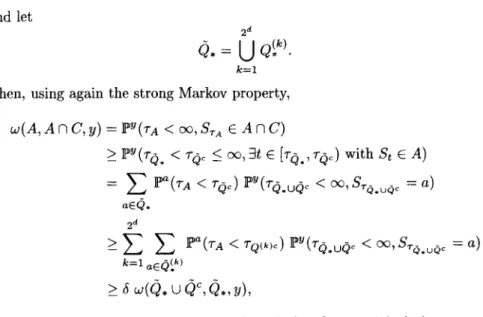
Then, using again the strong Markov property,
w(A, A A C, y) = >_
where we have used
PY(T m < CK),STA E AnC)
PY (TO,
< ~@ ___ c~, 3t E [TO, T@) withSt E A)
= < oo) PY( O.uO < = a)
aEQ.
2 4
Z
~
~a(Ta < TQ(k)c) ~Y(TO,.UOC <
(:K),S-r~.u0 c : a )k=l ~eO(2)
>_
u
that all subcubes Q c C, Q E Cj-1, satisfy (15).
t
m
I
.-I
Figure 1. For d = 2 and I = 8, this is a sketch of a cube C E Cj (for
some j ) together with its subcubes of dj-1. By removing the outer layer of subcubes, one obtains C1. For y E 0C1, ~) is the union of
the 4 nearest subcubes.
To see that there exists c4, independent o f / a n d j, with w(Q, u Q c, Q,, y) >_ c4, remember that as a function of y, w ( Q , u Q c, Q,, y) is (lattice) harmonic on (~,AQ with boundary values w = 1 on (~, and w = 0 on (~c. Hence, the scaled function
a m ( x ) = w(O,, U Q, ~, 0,,, m x + z) with m = 21 j- 1 + 1, 21 j- 1 the side length of Q,
and suitable shift z, converges as m ~ oc to the unique solution of A f = 0 on
B, f ( x ) = 0 on the outer boundary of B and f ( x ) = 1 on the inner boundaries
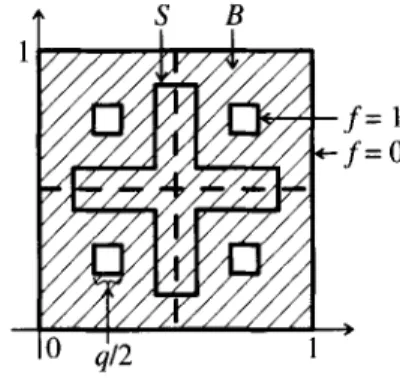
of B, where B is the "limit" of the scaled domains m - l ( ( ~ , A ( ~ - z) as m ~ c~; see Fig. 2. Since the convergence is uniform oi1 compact subsets of B [4], we have a lower bound c4 for w((~, U (~c (~,, y) for all l, j, and all y = m x + z with x in
Vol. 124, 2 0 0 1 ESTIMATES OF DISCRETE HARMONIC MEASURES 137 a region S around the middle halves of the middle axes of B (see Fig. 2). This proves (21).
, S B
1
- - 0
I0 d/2 1
Figure 2. For d = 2, this is a sketch of the domain B (hatched) = (0, 1) 2 \ the 4 little squares of side length q/2. B corresponds to \ (~., i.e., (rob + z) N Z d, for suitable scale m and shift z, equals \ (~.. The dashed middle axis lines correspond to the boundaries of the subcubes making up Q. The region S is a neighborhood of the points x = m -1 ( y - z ) for those y's which are possible for Q, i.e., points on the middle half of a middle axis. The harmonic function f on B with boundary values f = 0 on the outer boundary of B and f = 1 on the boundaries of the inner squares is bounded away from 0 o n S .
The proof of (22) is analogous: for y E OCk-x, put Q to be the cube consisting of 2 d subcubes of C "around" y. Then Q A Ck -- 0 and (~ c C. Thus
w ( A U C k , C k , y) = PY(TAuC k < OO, STAuCk E C k )
~- PY(TAuCk < 00) -- PY(TAuCk < O0 S r A u c k E A \ Ck) <_ 1 - F Y ( v Q . < 70/ < o~,3t E [TQ ,TQc) with St E A) ~ 1 - c 4 6 ,
with the same argument as above. |
2.5 PROOF OF THEOREM (A). Let now fl > 0 and n > N ( f l ) (to be chosen below). Let A C Qd(n), x E Z d, and let k* E N be such that I k" >_ n > l k ' - l .
To the lower bound N ( f l ) there will correspond a K* such that N(fl) = l K• . We construct Bom'gain's tree T: starting with Co = { 1 , . . . , I k" }d E £k', we associate to each (L)-cube C E Cj its l d subcubes in Cj_~, and to each (H)-cube we associate a family {Ca} with Ca C C, A n C C U , c a , and ~ a IC~I p/d < ICI p/d (which
138 E. BOLTHAUSEN AND K. MUNCH-BERNDL Isr. J. Math.
exists according to Lemma 3). The elements of the tree are labeled by complexes 7 = (~1,-.-, 7k): Co has the label ~/= (~/1) = (0), its descendants have the label
= (71, 72) = (0, ~2)~ and so on.
We stop the decomposition when the cube is in C1 or Co (because then Lemma 3 doesn't apply any more). Thus each branch is at most k* long. Denote by ylk the restriction of ~, to the first k digits. If k is the length of ~, we call
C~I~ , C~12,..., C~I~_ ~ the "ancestors" of C~. Let 7-* denote the set of the labels of the final cubes. We have
(23)
A c U q .
vET*
Given a maximal element ~/E T* of length ]q we denote by Tk the length of the label of the k-th (L)-cube appearing in the sequence C~11, C~12,... of ancestors of C~, i.e., C~I~ k is the k-th (L)-cube, and 71 < T2 < . . . < k. ( T k : O0 and ~lrk = 7 if there are less than k (L)-cubes in the sequence C~11, C~12,... of ancestors of
(a) I n n e r c u b e s . The subcubes C~l~k+ 1 of an (L)-cube C~I~ k are distinguished according to whether they lie in (C~l~k)/or not. If x E (A U C) ~, the number of subcubes which lie in (C~l~k)~ is ( l - 2 [ ) 4 = (2/3)414, and if x E C \ A, the number of subcubes which lie in (C~I~ k )[ is simply estimated as >_ (I - 2[) 4 - (2•+ 1) 4 > pl d
with p = (2/3) 4 - (1/2) 4. To have a fixed proportion of "inner" subcubes (this simplifies the argument in part (c) below), we shall choose for any (L)-cube pl 4
subcubes from those subcubes C~l~k+l C (C~l~k) i to call them "inner" subcubes. Let kl = k * / 3 and k2 = ( p / 2 ) k l . Let
T< = { v E T * : =
at least k2 of C~ln+l, C~1r2+1,..., C~l~kl+l are inner},
and To = T* \ ( T < u Ti). If C~l~k+ 1 is inner, we have from Lemma 3
~d(C~lTk+l )
~ W ((C~]rk)[) ~
(1 -- C4(~) [-1c45
Vol. 124, 2001
Then for y • U,~e~ C.~ we have (with 3' such that y c C.y)
UA,x(y) < w(C.~) < w(CTIrk~ +l) < ( ( 1 - c45)[-1)
_
_
c45
[ 1 \ k 2 <
(1
-- C4(~ ) -- c45 ] " Now choose 1 such that
i.e., E S T I M A T E S O F D I S C R E T E H A R M O N I C M E A S U R E S Then (1 -
c45) i-1 ~ k~
c ~ ] < l - k ' ~ ' P ( ~ - l ) log 1 Plog 11 - c45
6
~ > fl
log I.U
C7 C { y • z d :UA,x(y) < n-Z}.
7ET~ With (23) we obtain { y • z d :.A,x(y) >_ n -f~} c
139U c~.
"TO'T< UTowe shah show that E - ~
IC-,I _< n-~/2 and E - , ~ IC~l <_
n-~/2
with ,,; =
(p + d)/2,
where p < d comes from Lemma 3. This then proves Theorem (A). (b) E s t i m a t e of ~TET< IC71 • If C~ is of type (n), thenIC(-,,-,~)l ~/~ < IC.,I ~/~,
"Tk = 1,...;('T,3'k)ET
and if C~ • Cj is of type (L), then we have
IC(-,,-,~)l ~/d
=ld#-~),
=WolC~lP/~.
140 E. BOLTHAUSEN AND K. M[INCH-BERNDL Isr. J. Math.
T h u s
a n d therefore
ICol o/~ ~
~
IC~l.,(~)l °/d
71rl(7);Ter<> l-(d-p)
~_,
IC.yI.,(.y)+ll
p/d
71r~(7)+1;TcT<> 1-(~-~)
~
IC-~l~-~(-~)l
°Id
> I-~(d-~)
~_,
IC~,.2(~)+~l
°/d
"YIr2 (7)+l;'yeT< "'" >- l-(kt-1)(d-P) EIC',l old
7ET< veT< 7ET<For our choice of kl a n d t~ we have indeed
1 ~
1 l(k*-l)~ < _ n #
lk~(d-P)Ik*P ~ 2
-- 2
for k* larger t h a n some K * .
(c) E s t i m a t e o f
~,yeTo ICTI •
R e m e m b e r t h a t To = {~' C T*: Tkl (~') < ce, less t h a n k2 of C71~1+1, C71r2+1,..., CTl~k~+ 1 are inner}. It is easy to see t h a tE
"~ET*: Vkl <:oo, k of C.~I~.I+I,CTIr2+L,
...,C.~lrk 1 ~_lare i n n e r
ICTl <_ b(k;kl,p)lCol = ( k ~ ) p k ( 1 - p)kl-klCol,
k l
b(k; kl, p)
being the b i n o m i a l distribution, i.e., the distribution of ~-]4= 1 Xi, where the X i are i n d e p e n d e n t {0, 1}-valued r a n d o m variables withP ( X i =
1) = p for all i. For 0 < a < p, we have f r o m application of M a r k o v ' s inequality tok l
exp(~ ~-:~i= 1 Xi)
P
Xi <_ akl
_< e -k~I~(~)w i t h
Y/ 1 a .
I~(a)
= a l o g = + (1 - a ) l o gVol. 124, 2 0 0 1 ESTIMATES OF DISCRETE HARMONIC MEASURES 141
(This is an e l e m e n t a r y case of C r a m ~ r ' s theorem.) W i t h a = k 2 / k l = p/2, Ip(a) d e p e n d s only on d. T h e n
k2-1
ICvI <_ ~ b(j;kl,p)lCol <_ e - k , I I k'd,
~eTo j=0
and with our choice of the constants, noting also (18),
1 l(k._l) ~ < ~ n ~ '
e-klllk*d ~-- 2
for k* larger t h a n some K * . |
References
[1] I. Benjamini, On the support of harmonic measm'e for the random walk, Israel Journal of Mathematics 100 (1997), 1-6.
[2] J. Bourgain, On the Hausdorff dimension of harmonic measure in higher dimension, Inventiones Mathematicae 87 (1987), 477-483.
[3] L. Carleson, Selected Problems on Exceptional Sets, Van Nostrand, Princeton, 1967.
[4] R. Courant, K. Friedrichs and H. Lewy, ~/ber die partiellen Differenzengleichungen der mathematischen Physik, Mathematische Annalen 100 (1928), 32 74.
[5] P. W. Jones and N. G. Makarov, Density properties of harmonic measure, Annals of Mathematics 142 (1995), 427-455.
[6] G. F. LaMer, Intersections of Random Walks, Birkh&user, Boston, 1991.
[7] G. F. LaMer, A discrete analogue of a theorem of Makarov, Combinatorics, Probability and Computing 2 (1993), 181-199.
[8] G. F. LaMer, Multifractal nature of two dimensional simple random walk paths, in Random Walks and Discrete Potential Theory (M. Picardello and W. Woess, eds.), Cambridge University Press, 1999, pp. 231-264.