. . . .
. . . .
Novel genetic markers improve measures
of atrial fibrillation risk prediction
Brendan M. Everett
1,2*
, Nancy R. Cook
2, David Conen
3, Daniel I. Chasman
2,
Paul M Ridker
1,2, and Christine M. Albert
1,21
Division of Cardiovascular Medicine, Department of Medicine, Brigham and Women’s Hospital and Harvard Medical School, Boston, MA 02115, USA;2
Division of Preventive Medicine, Department of Medicine, Brigham and Women’s Hospital and Harvard Medical School, 900 Commonwealth Avenue, Boston, MA 02115, USA; and3
Department of Medicine, University Hospital, Basel, Switzerland
Received 11 October 2012; revised 29 November 2012; accepted 17 January 2013; online publish-ahead-of-print 26 February 2013 See page 2227 for the editorial comment on this article (doi:10.1093/eurheartj/eht106)
Aims Atrial fibrillation (AF) is associated with adverse outcome. Whether recently discovered genetic risk markers
improve AF risk prediction is unknown.
Methods and results
We derived and validated a novel AF risk prediction model from 32 possible predictors in the Women’s Health Study (WHS), a cohort of 20 822 women without cardiovascular disease (CVD) at baseline followed prospectively for in-cident AF (median: 14.5 years). We then created a genetic risk score (GRS) comprised of 12 risk alleles in nine loci and assessed model performance in the validation cohort with and without the GRS. The newly derived WHS AF risk algorithm included terms for age, weight, height, systolic blood pressure, alcohol use, and smoking (current and past). In the validation cohort, this model was well calibrated with good discrimination [C-index (95% CI) ¼ 0.718 (0.684 – 0.753)] and improved all reclassification indices when compared with age alone. The addition of the genetic score to the WHS AF risk algorithm model improved the C-index [0.741 (0.709 – 0.774); P ¼ 0.001], the category-less net reclassification [0.490 (0.301 – 0.670); P , 0.0001], and the integrated discrimination improvement [0.00526 (0.0033 – 0.0076); P , 0.0001]. However, there was no improvement in net reclassification into 10-year risk
categor-ies of ,1, 1 – 5, and 5+% [0.041 (20.044–0.12); P ¼ 0.33].
Conclusion Among women without CVD, a simple risk prediction model utilizing readily available risk markers identified women at higher risk for AF. The addition of genetic information resulted in modest improvements in predictive accuracy that did not translate into improved reclassification into discrete AF risk categories.
-Keywords Women † Atrial fibrillation † Genetics † Risk prediction † Epidemiology
Introduction
Atrial fibrillation (AF) is the most common sustained cardiac ar-rhythmia and is associated with enormous societal costs, including
an increased risk of stroke, heart failure (HF), and death.1–3The
prevalence of AF is increasing even among those individuals thought to be at low risk, such as women or those without
cardio-vascular disease (CVD) or HF.4,5Treatment of AF remains
challen-ging and associated with risk; therefore, prevention is an important public health objective. Recently, investigators working in the Fra-mingham Heart Study (FHS) and the Atherosclerosis Risk in
Communities (ARIC) study derived separate AF risk prediction models among individuals with and without heart disease, but neither study considered routine blood biomarkers or genetic
markers for inclusion in those models.6–11These prediction
algo-rithms also require electrocardiograms (ECGs), which may not be readily available among individuals without clinical heart disease.
The first aim of this study was to derive and validate an AF risk prediction algorithm that could be employed in our healthy popu-lation of 20 822 women without prevalent CVD, HF, or ECGs at baseline. The second aim of the study was to determine whether a genetic risk score (GRS) based on recently published risk
*Corresponding author: Tel:+1 617 732 4969, Fax: +1 617 232 3541, Email:[email protected]
&The Author 2013. Published by Oxford University Press on behalf of the European Society of Cardiology.
This is an Open Access article distributed under the terms of the Creative Commons Attribution License (http://creativecommons.org/licenses/by-nc/3.0/), which permits non-commercial use, distribution, and reproduction in any medium, provided that the original authorship is properly and fully attributed; the Journal, Learned Society and Oxford University Press are attributed as the original place of publication with correct citation details given; if an article is subsequently reproduced or disseminated not in its entirety but only in part or as a derivative work this must be clearly indicated. For commercial re-use, please contact [email protected]
alleles could improve AF risk prediction beyond traditional risk factors and biomarkers among this population without established CVD, where genetic factors might contribute a greater proportion of risk.
Methods
Study participants
Study participants were American female health professionals enrolled in the Women’s Genome Health Study (WGHS), a subset of the Women’s Health Study (WHS), and included 20 822 women of Euro-pean ancestry for whom genetic information was available and who did not have CVD, HF, or AF at baseline. Details of the design of the WHS and the WGHS are contained in the Supplementary material online. All participants provided written informed consent, and the study complies with the Declaration of Helsinki and was approved by the institutional review board of the Brigham and Women’s Hospital.
Endpoint ascertainment
The methods of AF ascertainment have been reported previously3and are described in detail in the Supplementary material online. Briefly, women were asked to report date of any AF diagnosis at enrolment, at 48 months, and then annually thereafter. Those reporting an AF event were asked for permission to obtain medical records, which were then reviewed by a physician endpoint committee to confirm AF. Only confirmed events are included in the present analysis.
Laboratory evaluation and genotyping
Assay characteristics for plasma biomarkers and details of the genotyp-ing and imputation methods are contained in the Supplementary material online.
Derivation and validation of a novel atrial
fibrillation prediction algorithm
Of the 20 822 WGHS participants eligible for this study, two-thirds (n ¼ 13 743) were randomly assigned to the model derivation data set, and the remaining one-third (n ¼ 7079) were reserved as an inde-pendent validation data set. Variables considered for inclusion in the AF risk prediction algorithm are displayed in Table1and include trad-itional and lifestyle risk factors easily measured in clinical practice as well as available biomarkers. In the model derivation set, participants without complete information on these variables were excluded (n ¼ 682), for a total sample size of 13 061, including 404 validated cases of AF. The best model was fit using Cox proportional hazards models with both forward and backward stepwise procedures for vari-able selection. Minimization of the Bayes Information Criteria (BIC)12 was utilized to select covariates for inclusion. Because the BIC imposes a penalty for each additional covariate added to a model, the number of covariates included was also limited. The final WHS AF risk prediction model was then tested for discrimination (Harrell c-index)13and calibration (Nam and D’Agostino modification of the Hosmer – Lemeshow goodness-of-fit statistic)14 in the validation set. Participants without complete information on the covariates selected for inclusion in the final WHS model were excluded (n ¼ 200) for a total sample size in the validation set of 6879, including 212 cases of AF. In exploratory secondary analyses, the GRSs described below were added to the list of variables considered for inclusion in the derivation cohort.
Genetic risk score
Twelve single-nucleotide polymorphisms (SNPs) in nine loci reported to associate with AF were included in the GRS.11,15,16Seven of the SNPs (rs13376333, rs2200733, rs10033464, rs3853445, rs3807989, rs7164883, and rs7193343) were directly genotyped, while the rest (rs3903239, rs17570669, rs10821415, rs10824026, and rs1152591) were imputed. In the primary analysis, a weighted GRS was created by summing the product of the natural logarithm of the published risk ratio for each SNP (Supplementary material online, Table S1) times the gene dose at that SNP for each participant. Because allele weights were calculated by taking the natural logarithm of published risk ratios, alleles with risk ratios .1 had positive weights, while those with risk ratios ,1 had negative weights. In order to eliminate bias, risk estimates from replication (rather than discovery) cohorts were used wherever possible. As a secondary analysis, an unweighted GRS was constructed to evaluate the sensitivity of our results to these published risk estimates. For this score, the allele associated with increased AF risk at each SNP was identified, and the measured or imputed allele dose at each of the 12 SNPs was then summed for each participant.
Clinical reclassification of atrial fibrillation
prediction models
The models developed in the derivation set were used to estimate the 10-year risk of AF in the validation set (n ¼ 6879) and improvement in measures of discrimination and calibration with the addition of clinical and/or genetic covariates were calculated in this cohort. While there is no broad consensus on what risk categories are clinically informative, 10-year clinical risk categories of ,1, 1 to ,5, and 5% and higher were utilized on an a priori basis given the low-risk nature of this healthy population.6,17,18To test whether the WHS score and/or the addition of genetic information improved clinical risk classification across cat-egories, the net reclassification improvement (NRI) and the reclassifi-cation calibration test were calculated.19 To address potential finer
increments in reclassification, the continuous NRI and the integrated discrimination improvement (IDI) were calculated for each base model with and without genetic information.18Modifications appropri-ate for survival data were used.18,20Bootstrap resampling was used to
calculate confidence intervals and P-values for each discrimination and reclassification statistic. As a sensitivity analysis, changes in WHS AF risk prediction algorithm performance after the addition of genetic in-formation were calculated in all available women in the WGHS cohort with complete information on all model covariates (n ¼ 20 222). Stat-istical analyses were performed using SAS version 9.1 (SAS Institute Inc., Cary, NC, USA).
Results
Study characteristics
The derivation and validation cohorts were similar with respect to the baseline characteristics and variables considered for inclusion
in the AF risk prediction algorithm (Table1). Established AF risk
factors such as age, body mass index, weight, height, hypertension, and alcohol use were similar in the two cohorts. Levels of biomar-kers previously associated with AF such as marbiomar-kers of inflamma-tion, haemoglobin A1c, creatinine, and lipids were similar in the two cohorts.
Women’s Health Study atrial fibrillation
model derivation and validation
In the derivation cohort, 32 potential variables outlined in Table1
were evaluated for model inclusion. Univariable association between each potential variable and incident AF in the derivation cohort are presented in Supplementary material online, Table S2. Of these, the inclusion of terms for the natural logarithm of age,
weight, height, systolic blood pressure, ≥2 alcoholic drinks per
day, and a history of either current or past smoking (ever smokers) resulted in the best fitting prediction model with the smallest BIC (7319.7). Model coefficients from the derivation
cohort for these variables are presented in Table2. The BIC for
a model including the body mass index instead of height and weight was 7347.8, and the BIC for a model including age instead of the natural logarithm of age was 7321.8. Although none of the blood-based biomarkers were included in the final model, high-sensitivity C-reactive protein (hsCRP) would have been the next variable included (P ¼ 0.02), but inclusion resulted in a small increase in the BIC (BIC ¼ 7320.7 with hsCRP).
We then tested this AF prediction model in the validation cohort. Using coefficients calculated in the derivation set, the c-index (95% CI) for the WHS predictive model [0.718 (0.684 –
. . . .
Table 1 Baseline characteristics and covariables considered for inclusion in the atrial fibrillation risk prediction
algorithm among women in the derivation and validation cohorts
Characteristic Derivation cohort (n 5 13 061) Validation cohort (n 5 6879)
Events/person-years of follow-up 404/181 350 212/95 253 Incidence rate, per 1000 person-years of observation 2.23 2.23
Age [median (IQR), years] 52.9 (48.9 – 58.8) 52.9 (48.9 – 58.8) Body mass index [median (IQR), kg/m2] 24.8 (22.5 – 28.3) 24.9 (22.5 – 28.3) Weight [median (IQR), kg] 67.1 (59.9 – 77.1) 68.0 (59.9 – 77.1) Height [median (IQR), cm] 165.0 (159.9 – 167.5) 165.0 (159.9 – 167.5) Systolic blood pressure [median (IQR), mmHg] 125 (115 – 135) 125 (115 – 135) Diastolic blood pressure [median (IQR), mmHg] 80 (70 – 80) 80 (70 – 80) Physical activity [n (%)]
1 – 3 times per week 4193 (32.1) 2263 (32.9)
4+ times per week 1520 (11.6) 798 (11.5)
Ever smoker [n (%)] 6375 (48.8) 3338 (48.5)
Alcohol use, 2+ drinks/day [n (%)] 527 (4.0) 289 (4.2) History of hypertension [n (%)] 3143 (24.1) 1640 (23.9) History of treatment for high blood pressure [n (%)] 1618 (12.4) 874 (12.7) History of treatment for high cholesterol [n (%)] 387 (3.0) 246 (3.6)
History of diabetes [n (%)] 314 (2.4) 163 (2.4)
History of menopause [n (%)] 7005 (53.6) 3729 (54.3)
Hormone therapy use [n (%)] 5827 (44.6) 3008 (43.8)
Aspirin use [n (%)] 6553 (50.2) 3458 (50.3)
Vitamin E use [n (%)] 6502 (49.8) 3500 (50.9)
Beta carotene use [n (%)] 6535 (50.1) 3450 (50.2)
Cholesterol [median (IQR), mmol/L]
Total 5.39 (4.74 – 6.11) 5.39 (4.77 – 6.09)
Low-density lipoprotein 3.13 (2.59 – 3.72) 3.14 (2.61 – 3.74) High-density lipoprotein 1.35 (1.13 – 1.62) 1.35 (1.12 – 1.62) Non-high-density lipoprotein 3.98 (3.33 – 4.69) 3.99 (3.34 – 4.71) Triglycerides [median (IQR), mmol/L] 1.33 (0.94 – 1.95) 1.33 (0.95 – 1.97) Apolipoprotein B100 [median (IQR), g/L] 0.995 (0.834 – 1.208) 1.001 (0.841 – 1.207) Apolipoprotein A-I [median (IQR), g/L] 1.494 (1.329 – 1.683) 1.498 (1.325 – 1.684) Lipoprotein(a) [median (IQR), mmol/L] 0.37 (0.15 – 1.13) 0.37 (0.15 – 1.15) hsCRP [median (IQR), mg/L] 2.0 (0.8 – 4.4) 2.0 (0.8 – 4.2) s-ICAM-1 [median (IQR), mg/L] 341.2 (300.2 – 393.0) 343.2 (302.8 – 394.5) Fibrinogen [median (IQR), mmol/L] 10.29 (9.02 – 11.77) 10.21 (8.97– 11.75) Homocysteine [median (IQR), mmol/L] 10.4 (8.7 – 12.9) 10.5 (8.7 – 12.8) Creatinine [median (IQR), mmol/L] 54.1 (48.0 – 61.0) 53.9 (48.2 – 60.7) Haemoglobin A1c [median (IQR), %] 4.99 (4.83 – 5.17) 4.99 (4.83 – 5.17)
0.753)] was significantly better than that for age alone [0.671 (0.636 – 0.710), P , 0.0001], and the model was well calibrated (P ¼ 0.43). The WHS AF risk score substantially improved
classifi-cation into 10-year risk categories of ,1, 1 to ,5, and 5+%, with
an NRI of 0.211 (P , 0.0001) and resulted in a significant
improve-ment in the continuous NRI and IDI (Table3, Figure1).
Genetic risk scores and atrial fibrillation
risk
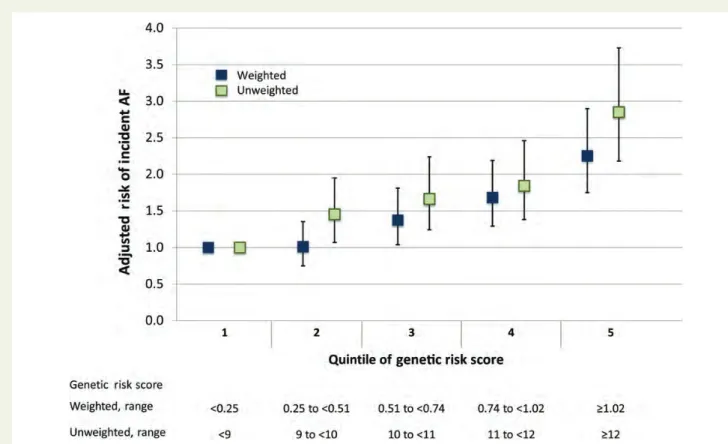
The association with incident AF across quintiles of the weighted and unweighted GRS in the entire WHS (n ¼ 20 347) is displayed
in Figure2. As shown, women in the top quintile of the weighted
and unweighted score had a 2.25-fold (95% CI: 1.75 – 2.90, P-trend , 0.0001) and a 2.85-fold (95% CI: 2.18 – 3.73, P-trend , 0.0001) increase in the risk of AF, respectively, after adjustment for the WHS prediction model covariates. The per-allele relative risks for each of the individual SNPs included in the GRS are dis-played in Supplementary material online, Table S3. When modelled as continuous variables, both the weighted and the unweighted GRS were significantly associated with incident AF in the validation
and entire cohort (each P , 0.0001). When either the weighted or unweighted score was included among the candidate AF risk pre-dictors considered for inclusion in a secondary, exploratory AF risk prediction model, each score was chosen for inclusion.
Clinical reclassification of atrial
fibrillation with and without genetic
information
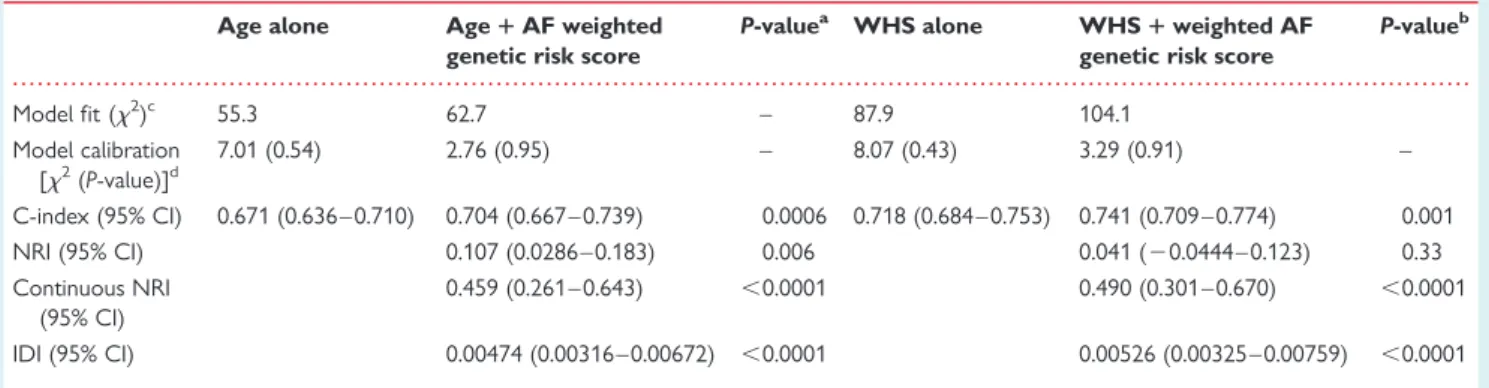
When tested in the validation set, the addition of the weighted GRS to a model including age alone improved the C-index [0.704 (0.667 – 0.739), P ¼ 0.0006], the NRI [0.107 (0.0286 – 0.1830), P ¼ 0.006], the continuous NRI [0.459 (0.261 – 0.643),
P , 0.0001], and the IDI [0.00474 (0.00316 – 0.00672),
P , 0.0001] (Table 4). The addition of the weighted GRS to
the WHS AF risk prediction algorithm improved AF risk predic-tion as measured by the C-index [0.741 (0.709 – 0.774), P ¼ 0.001], the continuous NRI [0.490 [0.301 – 0.670), P , 0.0001],
and the IDI [0.00526 (0.00625 – 0.00759), P , 0.0001].
However, reclassification into our pre-specified clinical risk categories did not improve after the addition of the weighted
. . . .
Table 2 Beta-coefficients and multivariable adjusted hazard ratios for atrial fibrillation for each covariate selected for
inclusion in the WHS atrial fibrillation risk prediction model
Base model covariables Beta (SE) Adjusted HR (95% CI) P-value
Age 0.0924 (0.0060) 1.10 (1.08 – 1.11) ,0.0001
WHS model
Ln(age)a 5.480 (0.40) 239.79 (109.96– 522.94) ,0.0001
Weight (per 10 kg) 0.157 (0.035) 1.17 (1.09 – 1.25) ,0.0001
Height (per 10 cm) 0.306 (0.082) 1.36 (1.16 – 1.60) 0.0002
Systolic blood pressure, (per 10 mmHg) 0.155 (0.037) 1.17 (1.09 – 1.26) ,0.0001
2+ drinks per day 0.491 (0.20) 1.63 (1.10 – 2.43) 0.015
Ever smoker 0.254 (0.10) 1.29 (1.06 – 1.57) 0.01
Coefficients displayed here were calculated in the derivation cohort and were used to test the model in the validation cohort.
a
For context, a 10-year increase in age (e.g. from age 50 to 60) would be associated with a 2.72-fold increase in atrial fibrillation risk.
. . . . . . . .
Table 3 Fit, calibration, and discrimination statistics for the age and WHS atrial fibrillation risk prediction models in
the validation cohort
Risk prediction algorithm
Age alone WHS P-value
Model fit (x2)a 55.3 87.9 —
Model calibration [x2(P-value)]b 7.01 (0.54) 8.07 (0.43) —
C-index (95% CI) 0.671 (0.636 – 0.710) 0.718 (0.684 – 0.753) ,0.0001
NRI (95% CI) 0.211 (0.117 – 0.303) ,0.0001
Continuous NRI (95% CI) 0.578 (0.406 – 0.751) ,0.0001
IDI 0.0064 (0.0045– 0.0088) ,0.0001
CI, confidence interval; IDI, integrated discrimination improvement; NRI, net reclassification improvement; WHS, Women’s Health Study.
a
Each likelihood ratio x2
statistic was highly significant (P , 0.0001).
b
Figure 2 Adjusted relative risk of incident atrial fibrillation for increasing quintiles of the weighted and unweighted genetic risk scores in the entire Women’s Health Study cohort (n ¼ 20 437). Estimates of relative risk and 95% confidence intervals are adjusted for the covariates included in the Women’s Health Study atrial fibrillation risk prediction algorithm [ln(age), weight, height, systolic blood pressure, alcohol use (≥2 drinks per day) and ever smoking status].
Figure 1 Clinical reclassification of participants in the validation cohort for the age alone model when compared with the novel Women’s Health Study atrial fibrillation risk prediction algorithm (WHS Model). In total, 1546 participants were reclassified, 1546 (100%) correctly. Re-classificationx2calibration statistics calculated from this table were 25.3 (P ¼ 0.0001) for the age alone model and 4.51 (P ¼ 0.48) for the novel Women’s Health Study atrial fibrillation risk prediction algorithm.
genetic score to the WHS AF risk prediction algorithm [NRI: 0.041 (20.0444 – 0.123), P ¼ 0.33]. Nevertheless, many (591, 58.5%) of the 1011 reclassified participants were
reclassi-fied correctly on the basis of the genetic information (Figure3).
In a secondary analysis, we observed similar results for the unweighted GRS when it was added to the WHS AF risk
prediction algorithm (Supplementary material online, Table S4 and Figure S1). Finally, in a sensitivity analysis conducted in the entire WGHS, we observed similar changes in the indices of re-classification after the addition of the GRS to the WHS AF risk prediction algorithm (Supplementary material online, Table S5 and Figures S2 and S3).
Figure 3 Clinical reclassification of participants in the validation cohort for the Women’s Health Study model plus the atrial fibrillation weighted genetic risk score, when compared with the Women’s Health Study model without genetic information. In total, 1011 participants were reclassified, 591 (58.5%) correctly. Reclassification x2calibration statistics calculated from this table were 6.12 (P ¼ 0.30) for the Women’s Health Study model and 3.96 (P ¼ 0.56) for the Women’s Health Study model plus the atrial fibrillation genetic risk score.
. . . .
Table 4 Indices of model fit, calibration, discrimination, and reclassification in the validation cohort after the addition
of genetic information to the age alone and WHS atrial fibrillation risk prediction algorithm
Age alone Age 1 AF weighted genetic risk score
P-valuea WHS alone WHS 1 weighted AF
genetic risk score
P-valueb Model fit (x2 )c 55.3 62.7 – 87.9 104.1 Model calibration [x2 (P-value)]d 7.01 (0.54) 2.76 (0.95) – 8.07 (0.43) 3.29 (0.91) – C-index (95% CI) 0.671 (0.636 – 0.710) 0.704 (0.667 – 0.739) 0.0006 0.718 (0.684 – 0.753) 0.741 (0.709 – 0.774) 0.001 NRI (95% CI) 0.107 (0.0286 – 0.183) 0.006 0.041 (20.0444– 0.123) 0.33 Continuous NRI (95% CI) 0.459 (0.261 – 0.643) ,0.0001 0.490 (0.301 – 0.670) ,0.0001 IDI (95% CI) 0.00474 (0.00316 – 0.00672) ,0.0001 0.00526 (0.00325 – 0.00759) ,0.0001
Coefficients used to test the models were calculated in the derivation cohort.
CI, confidence interval; IDI, integrated discrimination improvement; NRI, net reclassification improvement; WHS, Women’s Health Study.
a
P-value for comparison with the age alone risk prediction algorithm.
b
P-value for comparison with the WHS risk prediction algorithm.
c
All model fit likelihood ratio x2statistics were highly significant (P , 0.0001).
d
Discussion
In this prospective cohort of 20 822 women without CVD at base-line, we derived and validated a novel WHS AF risk prediction al-gorithm, which despite being relatively simple, demonstrated good discrimination, calibration, and improved reclassification into 10-year risk categories when compared with age alone. We then tested whether our ability to predict incident AF was improved by the addition of a weighted or unweighted GRS to the risk pre-diction algorithm. The addition of either GRS improved the c-index and other continuous measures of risk discrimination, but did not appreciably improve the ability to classify participants into pre-specified 10-year risk categories.
Our AF risk prediction model derived among women without pre-existing CVD shares many AF risk predictors with those derived in the FHS and ARIC populations, which included men
and women with and without established CVD.6,7The exceptions
included physical exam findings and electrocardiographic variables, which were unavailable in this cohort. Despite the absence of this information, our model performed well and was able to reclassify 22.5% of women in a separate validation cohort. The six variables selected for inclusion in the AF risk prediction model—age, weight, height, systolic blood pressure, alcohol use, and past or current smoking—are readily available in nearly every primary prevention population. In addition, several of these variables are modifiable through lifestyle interventions. Therefore, patients can be coun-selled regarding lifestyle changes that might lower their 10-year risk of AF. Potential future clinical applications of this simple AF risk prediction algorithm could include identification of populations where targeted screening for asymptomatic AF might be cost-effective and/or where interventions designed to lower AF risk might be tested in randomized trials. Given the expanding
indica-tions for anticoagulation in lower risk populaindica-tions21,22 and
advances in rhythm monitoring devices,23 targeted screening for
asymptomatic AF may have clinical utility in the near future. When compared with the traditional AF risk factors described above, none of the 14 blood biomarkers we considered met our pre-specified criteria for inclusion in the WHS AF risk prediction algorithm, even though several, such as CRP and haemoglobin A1c, have previously been associated with AF in this or other
cohorts.9,10 While our inclusion of these biomarkers in the
model derivation process is a strength of our study, B-type uretic peptide levels were not available for analysis. B-type natri-uretic peptide levels have been strongly associated with incident
AF24,25 and improved the measures of discrimination when
added to the FHS AF risk algorithm.8Whether they would offer
similar improvements in risk prediction in our relatively healthy cohort of women is unclear and requires further study.
Data are sparse regarding the contribution of genetic data to AF risk prediction. Recently, investigators from the Malmo Diet and Cancer Study did not find an improvement in AF risk prediction, as measured by the C-statistic, when two genetic variants at two loci strongly associated with AF (4q25 and 16q22) were added
to traditional risk factors.26 In contrast, we found that a risk
score comprised of 12 variants at nine AF loci improved several measures of AF risk prediction including the c-index, the continu-ous NRI, and the IDI in our population of women without
established CVD. These data suggest that genetic information has the potential to improve the identification of individuals at higher risk for AF among healthy populations and raise the possibility that the inclusion of more genetic risk markers may improve our ability to predict AF in the future. Although the present GRS did not improve our ability to classify women into discrete 10-year AF risk categories, the continued search for additional genetic var-iants associated with AF may improve discriminatory ability in the future. Also, since there is currently no consensus regarding clinic-ally meaningful AF risk categories, the continuous NRI and IDI may be more appropriate measures of model performance since they
are not based upon arbitrary risk categories.18,27,28 Regardless,
the data presented here are not yet strong enough to justify wide-spread genetic screening to assess AF risk.
The strengths of our study include the size of the study popula-tion, the duration of follow-up, the number of prospectively ascer-tained and physician-validated AF cases, and the breadth of risk factors and biomarkers considered for inclusion in the model. In addition, we were able to validate both the AF risk prediction model and the contribution of genetic information to risk predic-tion, in a reserved validation cohort of women. To our knowledge, this has not been done previously with prior AF risk prediction scores.
Our study also has important limitations which merit consider-ation. The generalizability of our findings may be limited to women with a low prevalence of CVD and HF and to those of European an-cestry. As such, the WHS AF risk score may not perform as well in other populations. This is a limitation common to risk scores and was found to be the case when the FHS AF risk score was applied
to external populations.29 Future studies are needed to validate
our model in other populations and to determine if our strategy of using the BIC to select a small number of covariates for the model translates to good performance outside of the WHS.
Second, we did not collect baseline ECGs, and therefore, we were unable to evaluate whether information on PR interval, left atrial enlargement, and left ventricular hypertrophy, which have
been included in other risk prediction algorithms6,7would add to
AF risk prediction among women without CVD. Thus, we were unable to compare our model performance to that of the FHS and ARIC scores. We also did not perform screening ECGs during follow-up and some asymptomatic cases of AF may have gone undetected. Third, we did not collect information on the family history of AF at baseline and thus were unable to compare the predictive value of this information to that provided
by the GRS.17Fourth, as mentioned above, although we were able
to test numerous blood biomarkers for inclusion in our model, we were not able to test all blood biomarkers that have been asso-ciated with AF in our study population.
In conclusion, in this large-scale, prospective cohort of initially healthy women of European ancestry, we derived and validated a novel, simple AF risk prediction algorithm utilizing six easily mea-sured AF risk factors (age, weight, height, systolic blood pressure, alcohol use, and smoking). Beyond this information, a GRS based on recently published risk alleles showed potential for improving the ability to identify individuals at higher risk for AF; however, we did not find definitive evidence that the currently identified AF risk alleles can be utilized as a clinically meaningful risk
stratification tool at present. Discovery of additional genetic var-iants and/or application to targeted populations may improve the clinical performance of GRSs. At the same time, research directed at developing effective AF screening and prevention strategies will increase the clinical impact of AF risk prediction scores.
Supplementary material
Supplementary material is available at European Heart Journal online.
Funding
This work was supported by the American Heart Association (0835304N to B.M.E.), the National Heart Lung Blood Institute (HL-093613 to C.A. and HL-043851, HL-080467, and HL-099355), the National Cancer Institute (CA-047988), the Donald W. Reynolds Foundation, and Amgen, Inc.
Conflict of interest: B.M.E. reports receiving investigator-initiated re-search grants from the American Heart Association, the Brigham and Women’s Hospital, and Roche Diagnostics. N.R.C. has no relevant conflict of interest to report. D.C. reports receiving research grants from the Swiss National Science Foundation (PP00P3_133681) and the University of Basel. D.I.C. reports receiving investigator-initiated research grants from the NIH. P.M.R. reports receiving investigator-initiated funding from the National Institutes of Health, the Leducq Foundation, Roche Diagnostics, Amgen, Inc., AstraZeneca, Novartis, Merck, Abbott, and sanofi-aventis; consulting fees from AstraZeneca, Novartis, Merck Schering-Plough, sanofi-aventis, Isis, Siemens, and Vas-cular Biogenics. P.M.R. is listed as a co-inventor on patents held by the Brigham and Women’s Hospital that relate to the use of inflammatory biomarkers in cardiovascular disease that have been licensed to Siemens and AstraZeneca and has served as a consultant to AstraZe-neca. C.M.A. reports receiving investigator-initiated grant support from the National Institutes of Health/National Heart, Lung, and Blood Insti-tute (NHLBI), American Heart Association, Siemens Healthcare Diag-nostics, and St Jude Medical, consultancy fees from Novartis and GlaxoSmithKline. No other conflict of interest disclosures were reported.
References
1. Wolf PA, Mitchell JB, Baker CS, Kannel WB, D’Agostino RB. Impact of atrial fib-rillation on mortality, stroke, and medical costs. Arch Intern Med 1998;158: 229 – 234.
2. Miyasaka Y, Barnes M, Gersh B, Cha S, Bailey K, Abhayaratna W, Seward J, Tsang TM. Secular trends in incidence of atrial fibrillation in Olmsted county, Min-nesota, 1980 to 2000, and implications on the projections for future prevalence. Circulation 2006;114:119 – 125.
3. Conen D, Chae CU, Glynn RJ, Tedrow UB, Everett BM, Buring JE, Albert CM. Risk of death and cardiovascular events in initially healthy women with new-onset atrial fibrillation. JAMA 2011;305:2080 – 2087.
4. Benjamin EJ, Levy D, Vaziri SM, D’Agostino RB, Belanger AJ, Wolf PA. Independ-ent risk factors for atrial fibrillation in a population-based cohort. The Framing-ham Heart Study. JAMA 1994;271:840 – 844.
5. Psaty BM, Manolio TA, Kuller LH, Kronmal RA, Cushman M, Fried LP, White R, Furberg CD, Rautaharju PM. Incidence of and risk factors for atrial fibrillation in older adults. Circulation 1997;96:2455 – 2461.
6. Schnabel RB, Sullivan LM, Levy D, Pencina MJ, Massaro JM, D’Agostino RB Sr, Newton-Cheh C, Yamamoto JF, Magnani JW, Tadros TM, Kannel WB, Wang TJ, Ellinor PT, Wolf PA, Vasan RS, Benjamin EJ. Development of a risk score for atrial fibrillation (Framingham Heart Study): a community-based cohort study. Lancet 2009;373:739 – 745.
7. Chamberlain AM, Agarwal SK, Folsom AR, Soliman EZ, Chambless LE, Crow R, Ambrose M, Alonso A. A clinical risk score for atrial fibrillation in a biracial
prospective cohort (from the Atherosclerosis Risk in Communities [ARIC] study). Am J Cardiol 2011;107:85 – 91.
8. Schnabel RB, Larson MG, Yamamoto JF, Sullivan LM, Pencina MJ, Meigs JB, Tofler GH, Selhub J, Jacques PF, Wolf PA, Magnani JW, Ellinor PT, Wang TJ, Levy D, Vasan RS, Benjamin EJ. Relations of biomarkers of distinct pathophysio-logical pathways and atrial fibrillation incidence in the community. Circulation 2010;121:200 – 207.
9. Conen D, Ridker PM, Everett BM, Tedrow UB, Rose L, Cook NR, Buring JE, Albert CM. A multimarker approach to assess the influence of inflammation on the incidence of atrial fibrillation in women. Eur Heart J 2010;31:1730 – 1736. 10. Huxley RR, Alonso A, Lopez FL, Filion KB, Agarwal SK, Loehr LR, Soliman EZ,
Pankow JS, Selvin E. Type 2 diabetes, glucose homeostasis and incident atrial fib-rillation: the Atherosclerosis Risk in Communities study. Heart 2012;98:133 – 138. 11. Ellinor PT, Lunetta KL, Albert CM, Glazer NL, Ritchie MD, Smith AV, Arking DE, Muller-Nurasyid M, Krijthe BP, Lubitz SA, Bis JC, Chung MK, Dorr M, Ozaki K, Roberts JD, Smith JG, Pfeufer A, Sinner MF, Lohman K, Ding J, Smith NL, Smith JD, Rienstra M, Rice KM, Van Wagoner DR, Magnani JW, Wakili R, Clauss S, Rotter JI, Steinbeck G, Launer LJ, Davies RW, Borkovich M, Harris TB, Lin H, Volker U, Volzke H, Milan DJ, Hofman A, Boerwinkle E, Chen LY, Soliman EZ, Voight BF, Li G, Chakravarti A, Kubo M, Tedrow UB, Rose LM, Ridker PM, Conen D, Tsunoda T, Furukawa T, Sotoodehnia N, Xu S, Kamatani N, Levy D, Nakamura Y, Parvez B, Mahida S, Furie KL, Rosand J, Muhammad R, Psaty BM, Meitinger T, Perz S, Wichmann HE, Witteman JC, Kao WH, Kathiresan S, Roden DM, Uitterlinden AG, Rivadeneira F, McKnight B, Sjogren M, Newman AB, Liu Y, Gollob MH, Melander O, Tanaka T, Stricker BH, Felix SB, Alonso A, Darbar D, Barnard J, Chasman DI, Heckbert SR, Benjamin EJ, Gudnason V, Kaab S. Meta-analysis identifies six new susceptibility loci for atrial fibrillation. Nat Genet 2012;44:670 – 675.
12. Harrell FE Jr. Regression Modeling Strategies. New York: Springer-Verlag; 2001. 13. Harrell FE Jr, Lee KL, Mark DB. Multivariable prognostic models: issues in
devel-oping models, evaluating assumptions and adequacy, and measuring and reducing errors. Stat Med 1996;15:361 – 387.
14. D’Agostino RB, Nam B-H. Evaluation of the performance of survival analysis models: discrimination and calibration measures. In: Balakrishnan N, Rao CR, eds, Handbook of Statistics. Amsterdam, Netherlands: Elsevier; 2004, p1 – 25.
http://www.amazon.com/Handbook-Statistics-Volume-23-Advances/dp/0444500 790/ref=sr_1_fkmr1_2?s=books&ie=UTF8&qid=1359560017&sr=1-2-fkmr1&key words=balakrishnan+handbook+of+statistics+2003
15. Gudbjartsson DF, Arnar DO, Helgadottir A, Gretarsdottir S, Holm H, Sigurdsson A, Jonasdottir A, Baker A, Thorleifsson G, Kristjansson K, Palsson A, Blondal T, Sulem P, Backman VM, Hardarson GA, Palsdottir E, Helgason A, Sigurjonsdottir R, Sverrisson JT, Kostulas K, Ng MC, Baum L, So WY, Wong KS, Chan JC, Furie KL, Greenberg SM, Sale M, Kelly P, MacRae CA, Smith EE, Rosand J, Hillert J, Ma RC, Ellinor PT, Thorgeirsson G, Gulcher JR, Kong A, Thorsteinsdottir U, Stefansson K. Variants conferring risk of atrial fibril-lation on chromosome 4q25. Nature 2007;448:353 – 357.
16. Lubitz SA, Sinner MF, Lunetta KL, Makino S, Pfeufer A, Rahman R, Veltman CE, Barnard J, Bis JC, Danik SP, Sonni A, Shea MA, Del Monte F, Perz S, Muller M, Peters A, Greenberg SM, Furie KL, van Noord C, Boerwinkle E, Stricker BH, Witteman J, Smith JD, Chung MK, Heckbert SR, Benjamin EJ, Rosand J, Arking DE, Alonso A, Kaab S, Ellinor PT. Independent susceptibility markers for atrial fibrillation on chromosome 4q25. Circulation 2010;122:976 – 984. 17. Lubitz SA, Yin X, Fontes JD, Magnani JW, Rienstra M, Pai M, Villalon ML, Vasan RS,
Pencina MJ, Levy D, Larson MG, Ellinor PT, Benjamin EJ. Association between fa-milial atrial fibrillation and risk of new-onset atrial fibrillation. JAMA 2010;304: 2263 – 2269.
18. Pencina MJ, D’Agostino RB Sr, Steyerberg EW. Extensions of net reclassification improvement calculations to measure usefulness of new biomarkers. Stat Med 2011;30:11 – 21.
19. Cook NR, Ridker PM. Advances in measuring the effect of individual predictors of cardiovascular risk: the role of reclassification measures. Ann Intern Med 2009;150: 795 – 802.
20. Chambless LE, Cummiskey CP, Cui G. Several methods to assess improvement in risk prediction models: extension to survival analysis. Stat Med 2011;30:22 –38. 21. Fuster V, Chinitz JS. Net clinical benefit of warfarin: extending the reach of
antith-rombotic therapy for atrial fibrillation. Circulation 2012;125:2285 – 2287. 22. Friberg L, Rosenqvist M, Lip GY. Net clinical benefit of warfarin in patients with
atrial fibrillation: a report from the Swedish atrial fibrillation cohort study. Circu-lation 2012;125:2298 – 2307.
23. Charitos EI, Stierle U, Ziegler PD, Baldewig M, Robinson DR, Sievers HH, Hanke T. A comprehensive evaluation of rhythm monitoring strategies for the de-tection of atrial fibrillation recurrence: insights from 647 continuously monitored patients and implications for monitoring after therapeutic interventions. Circulation 2012;126:806 – 814.
24. Patton KK, Ellinor PT, Heckbert SR, Christenson RH, DeFilippi C, Gottdiener JS, Kronmal RA. N-terminal pro-B-type natriuretic peptide is a major predictor of the development of atrial fibrillation: the Cardiovascular Health Study. Circulation 2009;120:1768 – 1774.
25. Wang TJ, Larson MG, Levy D, Benjamin EJ, Leip EP, Omland T, Wolf PA, Vasan RS. Plasma natriuretic peptide levels and the risk of cardiovascular events and death. N Engl J Med 2004;350:655 – 663.
26. Smith JG, Newton-Cheh C, Almgren P, Melander O, Platonov PG. Genetic polymorphisms for estimating risk of atrial fibrillation in the general population: a prospective study. Arch Intern Med 2012;172:742 – 744.
27. Pencina MJ, D’Agostino RB, Pencina KM, Janssens AC, Greenland P. Interpreting incremental value of markers added to risk prediction models. Am J Epidemiol 2012;176:473 – 481.
28. Cook NR. Clinically relevant measures of fit? A note of caution. Am J Epidemiol 2012;176:488 – 491.
29. Schnabel RB, Aspelund T, Li G, Sullivan LM, Suchy-Dicey A, Harris TB, Pencina MJ, D’Agostino RB Sr, Levy D, Kannel WB, Wang TJ, Kronmal RA, Wolf PA, Burke GL, Launer LJ, Vasan RS, Psaty BM, Benjamin EJ, Gudnason V, Heckbert SR. Validation of an atrial fibrillation risk algorithm in whites and African Americans. Arch Intern Med 2010;170:1909 – 1917.
CARDIOVASCULAR FLASHLIGHT
. . . .
doi:10.1093/eurheartj/eht173
Online publish-ahead-of-print 22 May 2013
Granulomatous mass adherent to a patent foramen ovale occluder
Yann Ancedy*, Anne Bernard Brunet, Laurent Quilliet, Alain Mirza, and Laurent Fauchier
Service de Cardiologie, Poˆle Cur Thorax Vasculaire, Centre Hospitalier Universitaire Trousseau et Faculte´ de Me´decine, Universite´ Franc¸ois Rabelais, Tours, France *Corresponding author. Tel:+33 247474650, Fax: +33 247475919, Email:[email protected]
A 70-year-old woman with a history of repeated cerebrovascular events and patent foramen ovale (PFO) closure with PREMERE occluder (St Jude Medical, St Paul, MN, USA) had a recur-rence of transient left hemi paresis. Transoeso-phageal echocardiography (TOE) revealed an intracardiac mass on the left side of the PFO
closure system (8× 8 mm) (Panel A). Despite
oral anticoagulation, TOE performed 2 months later found persistent mass (Panel B). Surgical removal of the PFO occluder with the linked mass (Panel C, arrow) and the closure of the atrial communication were, therefore, per-formed. Histology concluded to a granuloma-tous formation. Exogenous structures (Panel D) that may come from the occluder were found in the tissue and participated to an inflammatory reaction associated with fibrosis. To our knowledge, this is the first report of a granulomatous mass which needed removal of a PFO occluder. Beyond its debated indication, this highlights that the PFO closure may have rare but still unknown and not negligible complications.