
Université de Neuchâtel Faculté des Sciences
Institut de Chimie – 2016
Calix[n]tetrahydrofuran[4-n]pyrrolidines:
Optimized synthesis
via hydrogenation of
calix[n]furan[4-n]pyrroles, conformational study
and preliminary work on their transition
metal complexes
Thèse soutenue le 23 septembre 2016 à l’Université de Neuchâtel pour
l’obtention du titre de Docteur ès Sciences par
William Maupillier
Ingénieur Chimiste diplômé de l’École Nationale Supérieur de Caen
(ENSICAEN)
Membres du jury :
Prof. Reinhard Neier
(Directeur de thèse)
Prof. ass. Bruno Therrien
(Rapporteur interne)
Prof. Helen Stoeckli-Evans
(Rapporteur interne)
Prof. Christophe Thomas
(Rapporteur externe)
Remerciements
Ce travail a été effectué d’octobre 2012 à septembre 2016 à l’institut de Chimie de l’université de Neuchâtel sous la direction du Prof. Reinhard Neier. Je tiens tout particulièrement à le remercier pour m’avoir donné l’opportunité de travailler au sein de son groupe de recherche et la confiance qu’il m’a apportée avec l’objectif de conclure un sujet qui lui tient à cœur : le sujet « calix ». Je voudrais le remercier pour la liberté de travail qu’il m’a offerte et son enthousiasme pour la recherche.
J’adresse mes sincères remerciements aux Prof. Helen Stoeckli-Evans, Prof. Bruno Therrien et Prof. Christophe Thomas qui ont pris part à mon jury de thèse, pris le temps de lire et corriger le manuscrit ainsi qu’apporter de précieux conseils concernant mon manuscrit lors de la présentation privée de thèse. Je remercie tout particulièrement le Prof. Helen Stoeckli-Evans pour l’élucidation de nouvelles structures rayon X, sa disponibilité, sa gentillesse ainsi que sa patience pour l’analyse répétitive d’une même structure lors de la recherche de polymorphe.
Je tiens à remercier chaleureusement le Dr. Aurora Cruz-Cabeza pour avoir réalisé les calculs d’énergies de mes composés ce qui a donné une nouvelle dimension au projet grâce à cette étude conformationelle.
Je tiens à remercier tous les apprentis que j’ai encadrés lors de ces quatre années pour leur implication et leur sérieux dans leur travail ainsi que leur bonne humeur : Csilla Horvath (nos incompréhensions linguistiques ont provoqué de nombreux fous rires entre nous), Line Wehren, Loic Da Costa, Sébastien Capelli, Tracy Rosselet et Edy Flückiger.
J’adresse mes remerciements aux membres du service analytique de Neuchâtel (NPAC) : Dr. Armelle Vallat, Dr. Gaétan Glauser et Laurence Lachat (spectrométrie de masse) ainsi que Dr. Claudio Dalvit et Dr. Diego Carnevale (spectroscopie RMN). Merci pour leur travail de caractérisation analytique indispensable à la synthèse organique.
Je tiens à adresser un énorme merci à tous les membres de notre groupe pour les moments passés ensembles à l’institut ou en dehors autour d’une bonne bière : Dr. Damien Thevenet, Dr. Christian Invernizzi, Dr. Sara Santi, Ewa Banach, Dr. Christelle Schenk ainsi que les anciens que j’ai pu croiser lors de plusieurs événements comme Dr. Guillaume Journot, Dr. Christophe Letondor, Dr. Inga Zaitseva et Dr. Anca Pordea.
Je remercie tout particulièrement toutes les personnes que j’ai rencontrées à Neuchâtel et qui ont égayés ma vie ici: mes colocataires Thomas et Mendes pour toutes les soirées passées dans le salon, sur la console ou les sorties en ville, Damien avec qui j’ai partagé mon labo et de nombreuses fondues chinoises, mes italiens préférés Christian, Sara et Matteo, Julien (a.k.a bûcheron) pour m’avoir motivé au fitness, Minghui et la nouvelle génération Marie, Fan, Cristina, Giau et Yassine.
Mes pensées vont également à tous les autres étudiants doctorants et post-doctorants de l’université de Neuchâtel.
Iano, Paulo, Ben & Jess, Flow, Stéphanie, Jérémy, Baptiste ainsi qu’à ma team de l’ENSICAEN avec Marine, Élodie, Christelle, Adèle, Sandra, Simon, Din, Tony et Ben. Je tiens à remercier chaleureusement Zsofia Tatar qui partage ma vie pour m’avoir supporté et épaulé durant toutes ces années. De nouvelles perspectives s’offrent à nous maintenant et je sais que tu te réjouis de me retrouver les weekends.
Enfin, ces remerciements se concluent par un énorme merci à toute ma famille, particulièrement à mes parents Christine et Marc ainsi qu’à mon frère Thomas pour leur soutien tout au long de ces années et leur précieuses visites à Neuchâtel.
“Every chemical substance, whether natural or artificial, falls into one of two major categories, according to the spatial characteristic of its form. The distinction is between those substances that have a plane of symmetry and those that do not. The former belong to the mineral, the latter to the living world.”
Kewords
Calix[n]furan[4-n]pyrrole, calix[n]tetrahydrofuran[4-n]pyrrolidine, macrocycle, optimized synthesis, hydrogenation, plate and bowl conformations, transition metal complexes, ligand
Abbreviations
AcOH: Acetic acid
AcONH4: Ammonium acetate CHCl3: Chloroform
CH2Cl2: Dichloromethane CH3CN: acetonitrile
DFT: Density Functional theory DNA: Deoxyribonucleic acid Equiv.: Equivalent
EtOAc: Ethyl acetate GC: Gas Chromatography HCl: Hydrochloric acid
HIV: Human Immunodeficiency virus
UPLC: Ultra Performance Liquid Chromatography IR: Infrared
IUPAC: International Union of Pure and Applied Chemistry MS: Mass Spectroscopy
NMR: Nuclear Magnetic Resonance spectroscopy r.t.: Room temperature
SCE: Saturated calomel electrode TFA: Trifluoroacetic acid
THF: Tetrahydrofuran
Summary
An hydrogenation method for the reduction of the easy accessible meso-octaalkylporphirinogen (calix[4]pyrrole) has previously been reported in our group. This “standard method” leads to an unsatisfactory conversion to the saturated analogue, calix[4]pyrrolidine (18% yield determined by GC). However using large excess of the catalyst leads to total conversion. In order to study the sequence of the reduction reaction, the replacement of one or several pyrrole ring(s) by furan ring(s) in the macrocycle was proposed and studied. For this study an access to the mixed calix[n]furan[4-n]pyrrole analogues had to be developed. Some of these macrocycles mixing furan and pyrrole rings have been reported in the literature by French almost 60 years ago: the yields reported were extremely low. No other method leading to the four isomers was described in the literature and only six studies were reported on these products. The previously developed procedure was fully optimized giving access to the four isomers by a selective ring-opening of calix[4]furan followed by a ring-closing reaction to form the pyrrole rings. This optimized procedure led to sufficient amounts of the four isomers to study their hydrogenation under our previously developed “standard conditions”. Hydrogenation of these isomers gave good to excellent yields compared to the hydrogenation of calix[4]pyrrole with an impressively high diastereoselectivity. Computational and NMR in solution conformational studies were carried out to characterize the conformational equilibria of these fully saturated calix[n]tetrahydrofuran[4-n]pyrrolidines as observed in solution and in the solid state. In a preliminary study the synthesis of a series of transition metal complexes using these macrocycles was undertaken.
Table of Contents
Chapter 1. Introduction ... 1
1. Macrocycles present in Nature ... 1
2. “Pigments of life” ... 5
3. Calix[4]arenes and heterocyclic calix[4]arenes macrocycles ... 8
4. Simple synthetic nitrogen- and oxygen-containing macrocycles ... 12
4.1. Synthetic polyazamacrocycles ... 12
4.2. Crown ethers and azacrown ethers... 14
4.3. Bridged azamacrocycles and cryptands ... 16
5. Known hydrogenations of heterocyclic calix[4]arenes ... 17
5.1. Hydrogenation of calix[4]furan 2 ... 17
5.2. Hydrogenation of calix[4]pyrrole 1 ... 18
6. Goals ... 20
Chapter 2. Synthesis of calix[n]furan[4-n]pyrroles ... 23
1. Introduction ... 23
2. Our synthetic approach ... 24
3. First results (Thesis of Guillaume Journot)[108] ... 26
3.1. Synthesis of calix[2]furan[2]pyrroles 8 and 9 ... 26
3.2. Synthesis of calix[3]furan[1]pyrrole 10 ... 28
4. What had to be improved ... 28
5. Optimization of the synthesis of calix[n]furan[4-n]pyrroles 7 – 10 ... 29
5.1. Oxidation of calix[4]furan using m-CPBA ... 29
5.2. Synthesis of 15b via the bromine oxidation ... 34
5.3. Reduction of the unsaturated 1,4-diketone ... 35
5.4. Synthesis of calix[n]furan[4-n]pyrroles 7 – 10 ... 37
5.4.1. Synthesis of calix[2]furan[2]pyrrole 9 ... 38
5.4.2. Synthesis of calix[n]furan[4-n]pyrroles 7, 8 and 10 ... 39
6. Electrochemical properties ... 40
7. Conclusion ... 45
Chapter 3. Synthesis of calix[n]tetrahydrofuran[4-n]pyrrolidines ... 47
4. Hydrogenation of models 24 and 25 ... 55
5. Conclusion ... 60
Chapter 4. Conformational study of the calix[n]tetrahydrofuran[4-n]pyrrolidines 11 – 14 ... 61
1. Conformations of calix[4]arenes and heterocalix[4]arenes ... 61
1.1. Conformations of calix[4]arenes ... 61
1.2. Conformation of heterocalix[4]arenes ... 62
1.2.1. Aromatic heterocalix[4]arenes ... 62
1.2.2. Saturated heterocalix[4]arenes ... 64
2. Introduction to conformational study and polymorphism ... 65
3. Methods ... 66
3.1. Shorthand nomenclature of the studied compounds ... 66
3.2. Computational methods (calculations done by Prof. Aurora Cruz-Cabeza) ... 66
3.3. Experimental methods ... 69
4. Conformal aspects of the calix[n]tetrahydrofuran[4-n]pyrrolidines 11 – 14 ... 70
4.1. Stabilities of bowls and plates ... 70
4.2. Why does the oxygen/nitrogen content affect the stability of the plate conformation? ... 76
4.3. Summary of conformer’s stabilities ... 77
5. Crystallographic aspects of the calix-compounds ... 77
5.1. Previously known forms ... 77
5.2. Crystal structures of the calix[n]tetrahydrofuran[4-n]pyrrolidines 11 – 14 ... 78
5.3. Microscopic morphologies of the calix-compounds ... 80
5.4. Behavior of the compounds upon heating and melting... 81
5.5. Is polymorphism and conformational polymorphism possible for these compounds? ... 83
6. Conformational studies by 1H NMR analysis in solution ... 84
7. Search for polymorphs for calix-NOOO 14 ... 92
7.1. Crystallizations experiments ... 92
7.1.1. Crystallizations in different solvents ... 92
7.1.2. Seeding experiment ... 93
7.2. Polymorphic form found ... 94
8. Conclusion ... 95
Chapter 5. Preliminary work on the synthesis of transition metal complexes using calix[n]tetrahydrofuran[4-n]pyrrolidines as ligands ... 97
1. Introduction ... 97
1.1. Tetraazamacrocycles as ligand... 97
1.2. Reported complexes of heterocalix[4]arenes ... 97
2. Synthesis of transition metal complexes ... 99
2.1. Calix-NONO 13 as ligand ... 100
2.2. Calix-NOOO 14 as ligand ... 102
3. Conclusion ... 103
Chapter 6. Ring opened intermediates with 1,4-diketone function: a platform for synthetic modifications ... 105
1. General introduction ... 105
2. Synthesis of calix-1,4-diol ... 108
2.1. Inspiration ... 108
2.2. First synthesis of calix-1,4-diols 34a and 34b ... 109
2.3. Screening conditions ... 113
3. Synthesis of pyrrolidine function via reductive amination of compound 21 ... 115
3.1. Context of the reaction in the project ... 115
3.2. Synthesis of compound 36 ... 115
4. Synthesis of unsymmetrical calix[n]furan[4-n]pyrroles ... 116
4.1. Isolation and characterization of side product 37 ... 116
4.2. Ring closing reaction on compound 37... 119
4.3. Synthesis of substituted calix[3]furan[1]pyrrole 41 ... 120
5. Conclusion ... 122
Chapter 7. Conclusion and perspectives ... 123
Chapter 8. Experimental part ... 127
1. General information ... 127
Heating/cooling ... 128
Melting points ... 128
Thin layer chromatography (TLC) ... 128
Columns chromatography ... 128
Gas chromatography (GC) ... 128
Ultra performance liquid chromatography (UPLC) ... 129
Infrared Spectroscopy (IR)... 129
Nuclear Magnetic Spectroscopy (NMR) ... 129
Mass Spectroscopy (MS) ... 130
X-ray crystallography ... 130
2. Synthetic procedures and characterizations ... 131
Chapter 9. Annex ... 161
1. Cyclic voltammograms ... 161
2. Characterization of a salt of calix-NNNO 11 with TFA ... 162
3. X-ray determination of side products ... 163
4. Photos of crystals taken under the microscope during melting point experiments ... 168
Chapter 1
1
Chapter 1. Introduction
1. Macrocycles present in Nature
Nature, during its evolution over billions of years, has created an incredible and seemingly unending variety of different molecular structures. Chemists have since the very beginning of their science been interested in understanding and explaining the biological phenomena that surrounds us based on a molecular description. In order to have a chance to understand what nature has to offer, organic chemists developed a variety of tools for the isolation, detection and structure characterization of important natural products involved in biological processes. As extraction of molecules directly from nature usually starts from complex mixtures, the development of chromatographic techniques such as HPLC and GC allowed more rapid isolation of pure compounds starting from natural sources. In parallel the development of efficient techniques such as NMR and mass spectroscopy allowed the identification and characterization of complex unknown molecules with a high degree of certainty.
Nature generates with ease both small active molecules, e.g. alkaloids, as large and much more complex structures, e.g. DNA or large proteins, thanks to programmed biological synthesis. One of the surprising features analyzing highly active natural compounds and pharmaceutical products is the presence of a macrocyclic unit in a large proportion of these functionally important structures. Molecules are usually classified as macrocycles when their central core contains a cyclic framework of twelve or more atoms. The classification is based on the ease or reversely the difficulty of access encountered by the synthetic chemist during the first part of the 20th century. Chemists classified cyclic structures as small rings, three and four membered rings, normal rings, five and six membered rings, medium sized rings, ring sizes between seven and eleven and macrocycles equal or bigger then twelve membered rings. For a long time, macrocycles were extremely challenging to synthetize in laboratory. An additional obstacle to the synthesis of the natural macrocycles was the number of stereocenters contained in this class of compounds. Chemists had to develop powerful methods to make these macrocyclic molecules synthetically accessible. To our knowledge the first examples of natural products with macrocyclic structures are muscone with one stereocenter and civetone with a (Z)-double bond (Figure 1). Both compounds revealed to be difficult to synthesize. Muscone and civetone are two compounds with strong odor used in perfumery coming from glandular secretion of animals, the musk deer and the civet respectively. Until the late 19th century, natural musk was extensively used until economic and ethical motives led to the adoption of synthetic musk. Although muscone was known for a long time, only its first synthesis described by Leopold Ruzicka in 1926[1-2] elucidated and secured the constitution. Nowadays, synthetic racemic mixture is on the market and chemists work on efficient and scalable synthesis of the enantiopure form.[3]
2
Figure 1. Structure of two macrocyclic musks. a) Muscone; b) Civetone
Macrocycles have been intensively explored by many synthetic groups as challenging goals for total synthesis[4-12] and in medicine in modern drug discovery.[13-16] One of the largest classes of macrocycles found in Nature are the macrolides. These molecules are used in medicine as natural products or chemically modified derivatives of the natural products are sold as drugs. They typically contain a large macrocyclic lactone ring to which one or more deoxy sugars may be attached. Usually, the lactone ring is composed of a 14-, 15-, or 16-membered ring. One of the high points for the use of this type of molecules came with the discovery of erythromycin (Figure 2) in the early 1950s, isolated from the bacteria
Saccharopolyspora erythraea. This macrocycle became the first macrolide antibiotic applied
for the treatment of a number of bacterial infections, including upper and lower respiratory tract infections, soft tissue infections and syphilis (especially for penicillin-allergic individuals). Due to frequent side effects such as abdominal cramps and gastrointestinal intolerance, chemists developed advanced macrolide antimicrobials by altering the basic structure of erythromycin resulting in compounds with extended spectrum of activity and tolerability. For example, beginning of the 1990s, the US Food and Drug Administration (FDA) approved the use of clarithromycin (the 6-O-methylerythromycin analogue) and azithromycin, for clinical use as second generation of macrolides.[17] The increased acid stability of clarithromycin reduced gastrointestinal intolerance.[18]
Chapter 1
3
Figure 2. Natural and advanced macrolides used as antibiotic. Modified section in the 2nd
generation compared to their predecessors are shown in red
Ketolides, structurally related to the 14-membered macrolides, characterized by a keto group at the C-3 position (position shown in blue on erythromycin, Figure 2), were developed to include good antibacterial activity against Gram-positive organisms which are resistant to classical macrolides.
Several other macrocycles isolated from natural sources such as plants, fungi, and mainly from bacterial sources present drug-like physicochemical and pharmacokinetic properties and offer popular targets for developing novel therapeutic derivatives, most notably as anti-tumor and antibiotics derivatives (Figure 3).[15, 19]
4
Figure 3. Selected natural macrocycles employed as therapeutic agents (Vancomycin is the
antibiotic of last resort in the case of resistant strains)
Macrocycles are not limited in their use as drugs. Indeed, some macrocyclic structures show notable abilities to ion-binding. These macrocycles play the role of ionophores by reversibly binding cations, thereby facilitating the transport of these cations through membranes. Two well-known macrocyclic ionophores found in nature are nonactin[20], a representative of the macrotetrolide family, and valinomycin[21], a dodecadepsipeptide (Figure 4).
While both of them exhibit high cation selectivity for potassium ion over sodium or rubidium ions, nonactin also possesses the highest selectivity for ammonium ions, which gave it the nickname of “ammonium ionophore”. Taking nonactin as example, the eight oxygen atoms coming from the tetrahydrofuran rings and the four carbonyl groups bind the potassium ion in the center of a structure which resembles a “tennis ball”. All the non-polar methyl groups and the methylene groups from the tetrahydrofuran rings point outside, building a hydrophobic surface making the complex soluble in lipidic membranes.[20]
Chapter 1
5
Figure 4. Natural potassium selective ionophoric macrocycles, technically used in ion
selective electrodes
2. “Pigments of life”
Nature has achieved the stable binding of cations, mainly transition metals using another family of macrocyclic ligand. Many important processes of life like the transport of electrons, oxygen and photosynthesis depend on the presence of these metal complexes with tetrapyrrolic macrocycles.[22-26] These metal complexes have been called “pigments of life” thereby indicating the fundamental roles played by these metal complexes (Figure 5).[27-29] The structural parent of the tetrapyrrolic natural product family is the porphin. Porphin is not present in nature but several substituted porphins, called porphyrins, are natural products. Porphyrins are fully conjugated 16-membered macrocycles containing four modified pyrrole subunits connected to each other at the α–positions by four methine bridges (one-carbon bridges formed by a C-H unit). Several related heterocycles are well-known members of this family: the reduction of one double bond leads to chlorins (represented by chlorophyll), of two double bonds leads to bacteriochlorophylls while if one of the bridging carbons is missing, creating a direct link between rings A and D to the skeleton, the corrin system is obtained. The corrin chromophore, a highly reduced version of this basic structure, is present in vitamin B12. Another highly reduced tetrapyrrolic product sharing the core of porphyrins with a 16-membered structure is Factor F430, a co-enzyme which catalyzes one step in the conversion of carbon dioxide to methane in methanogenic Archaea.
6
Figure 5. The structures of four “pigments of life”, the processes they perform and the trivial
name given to their heterocyclic basic system
Due to their particular electronic structure (relatively long extended or even cyclic -systems) all of these compounds strongly absorb visual light. For the natural products derived from chlorins and bacteriochlorophylls the capacity to absorb visual light is a compulsory precondition to function as chromophores in photosynthesis. The scientific community broadly explored the utility of these structures as photosensitizers in photodynamic detection (PDD) and photodynamic therapy (PDT). In photodynamic therapy a photosensitizer is used to elicit cancer cell death, when excited by light energy in presence of oxygen. The first photosensitizer to gain regulatory approval for clinical PDT was Photofrin, a porphyrin macrocycle (Figure 6). A second and a third generation of photosensitizers has been
Chapter 1
7 developed to overcome the disadvantages of skin sensitivity and weak absorption of light of the first generation.
Figure 6. Selection of well-studied photosensitizers
To quote just a few, Foscan, based on chlorin core (Figure 6), is approximately 100 times more photoactive than photofrin but it is not selective enough against cancer cells. Zinc phthalocyanine CGP55847 and photosense, phthalocyanines derivatives, also entered clinical trials against squamous cell carcinomas of the upper aerodigestive tract and malignancies, respectively. With the ageing of populations, some diseases are becoming more prevalent such as age-related macular degeneration (ARMD), a disease of the retina causing significant weakening of the visual capacities. Visudyne is a treatment in PDT to treat blood vessels disorders in the eyes and other ocular diseases. Several porphyrins, chlorins and phthalocyanines derivatives are nowadays in different phases of clinical trials.[30-33]
8
3. Calix[4]arenes and heterocyclic calix[4]arenes macrocycles
In order to mimic the active site of enzymes, chemists intensively studied synthetic macrocycles, capable to form Werner complexes and later host-guest complexes using artificially created cavities. The discovery and the studies of the calixarenes and then heterocalixarenes represent pioneering work in the area of creating artificial biomimetic enzymes.
Calix[4]arenes
In 1872, Adolf von Baeyer mixed phenols with formaldehyde in strong acidic solution resulting in the formation of a resinous product, suggesting a polymerization process.[34-35] Beginning of the 1900s, Baekeland exploited this process and manufactured a hard moldable early plastic under the name of Bakelite.[36-37] In the 1940s, Zinke and Ziegler first described the formation of a cyclic tetramer using p-tert-butylphenol and formaldehyde (Figure 7).[38-40] Gutsche developed a procedure allowing large scale synthesis of these types of molecules.[41] He recognized the calix shape of the cyclic tetramer and introduced the name of calix[n]arene: “calix” from the Greek name of a chalice, “arene” for the presence of aromatic rings and [n] inserted between the two components to specify the number of aromatic rings incorporated into the macrocycle.[41] The presence of a bulky alkyl group in the para-position of the phenol in conjunction with the presence of the phenolic H-bonding groups on the opposite site blocked the conformation of the macrocycles into a cone-like arrangement (see Chapter 4 for the different conformations of calix[4]arenes and heterocyclic calix[4]arenes).
Figure 7. Structure of p-tert-butylcalix[4]arene and a Greek chalice
Certain derivatives were synthetized from differently p-substituted phenolic precursors or by stepwise syntheses allowing forming non symmetrical calixarenes. However, p-tert-butylphenol remains the best reactant. Larger calix[n]arenes were reported in the literature (n = 5 – 20). These compounds could be classified depending on the ease of closing the macrocycle. Calix[n]arenes (n = 4, 6 and 8) are called “major calixarenes” and are the most represented in literature. The cyclic pentamer and heptamer are obtained with lower yields and are named “minor calixarenes” and finally the others (n > 9) are called “large calixarenes”.[42]
Chapter 1
9 interactions has been used applying adequate derivatives as ionophores, sensors, ion selective electrodes, enzyme mimetics and in catalysis.
Calix[4]pyrroles
In 1886, von Baeyer and his group extended their systematic studies on condensation reactions by mixing pyrrole and acetone in the presence of HCl. Von Baeyer called this product “acetonepyrrole”. The product precipitates out of the solution in pure, crystalline form. The ease of the reaction and of the isolation are remarkable but the structure characterization proofed to be tedious. Indeed, it took more than 40 years until Chelintlev et
al. first proposed the correct structure in 1916 (Figure 8a).[43] Hans Fischer had given the name α, β, γ, δ-octamethylporphyrinogen suggesting the close structural similarity of compound 1 to the porphyrins, more especially to the uroporphyrinogen III (Figure 8b), the first macrocyclic intermediate in the biosynthetic pathway to heme and as known today to all other natural tetrapyrrolic macrocycles.
Figure 8. a) meso-octamethylporphyrinogen 1 (calix[4]pyrrole); b) uroporphyrinogen III
In 1955, Rothemund finally proved the α, α’-linkage between the pyrrole rings.[44]
It was not until 1996 that the X-ray structure determination was presented by Sessler revealing the alternating conformation of adjacent pyrroles in the solid state.[45] In this 1,3-alternating conformation the pyrrole rings opposite to each other were nearly parallel forming a cavity (Figure 9). In the same paper, the X-ray structures of these macrocycles binding anions like fluoride and chloride disclosed a significant change of conformation. In the complexes, all the –NH were pointing towards the anion and the anion is taking up a position between the pyrrole rings. The conformation adopted by these complexes is the cone-like conformation previously observed for calixarenes (Figure 9 and see Chapter 4).
10
Figure 9. Calix[4]pyrrole 1: Conformation of the free ligand and influence of an anion
Based on this observed conformation induced by anion binding and the fact that meso-octamethylporphyrinogen were not bona fide precursors of porphyrins, Sessler proposed to change the name of macrocycle 1 to calix[4]pyrrole or meso-octamethylcalix[4]pyrrole. Although the term meso-octaalkylporphyrinogen remains commonly used in the literature. “Calix[4]pyrroles” in the plural form includes all the macrocycles with four pyrrole rings independent of the type of the alkyl chains present in the meso position.
The pioneering work published by Sessler in 1996[45-47] on the anion binding properties of calix[4]pyrroles stimulated an intense activity on the use of this macrocycle as anion transporters. In the same period, the use of calix[4]pyrroles as macrocyclic ligands was also explored by Floriani but the synthesis of metal complexes appeared to be difficult.[48-51] While porphyrins and porphyrins derivatives form Werner complexes (transition metal complexes) with great ease, the lone pairs of the four pyrrole rings of calix[4]pyrroles are not available for coordination as they are involved in the aromaticity of the heteroaromatic ring. The tetraanion intermediate needs to be prepared using four equivalents of n-butyllithium before adding the metal source in order to introduce the metal cation into the macrocycle. This was in line with observations made with uroporphyrinogen III which does not form metal complexes at this stage in the biosynthesis of heme. In contrast to porphyrin and their derivatives who are widely used as catalysts for various reactions, calix[4]pyrroles have mainly (almost exclusively) found applications as anion receptors.
Calix[4]furans
The oxygen version calix[4]furan 2 also interested chemists. Its first synthesis was described by Ackman et al in 1955.[52] The reaction conditions are similar to the conditions used for the synthesis of calix[4]pyrrole 1. However the yields are generally lower. This can be attributed to the increased solubility of the macrocycle, which leaves greater quantities of linear condensation products in the solution. The best conditions were reported by Chastrette using a large excess of LiClO4 to enhance the reaction and reach a 25% yield via a template effect (Scheme 1).[53-54]
Chapter 1
11
Scheme 1. Synthesis of calix[4]furan 2 by Chastrette
In 1985 de Sousa Healy and Rest reported a study of the role of metal salts in the synthesis of furan-ketone condensation claiming that the template effect is not the major effect influencing the formation of the tetramer.[55] They support their assumption of an acidity effect on the condensation as a direct consequence of the presence of the different metal salts. They performed the reaction in the absence of salts by varying the amount of hydrochloric acid added and managed to have 30% yield of product of condensation. In the presence of transition metal and alkaline-earth metal salts, good yields situated between 12 and 33% of the macrocycle 2 were obtained. In all cases, best yields were obtained using perchlorate as the anion. Condensation of furan with other ketones to vary the alkyl chain in the meso- position was also reported but leads to lower yields. Recently, new procedures were described for the synthesis of sterically demanding calix[4]furans. Lee et al.[56] reported the cyclization of arylalkenes to calix[4]furans with the aid of iodonium ion coming from N-iodosuccinimide (NIS) (Scheme 2a) and Banerji et al.[57] used stannic chloride as Lewis acid (Scheme 2b).
Scheme 2. Recent synthesis of calix[4]furans. a) Lee et al.; b) Banerji et al.
Calix[4]arenes and heterocyclic calix[4]arenes 1 and 2 are easy to make but the synthesis of larger macrocycles and the variability of the alkyl groups on the meso-position has stayed limited. Other synthetic macrocyclic structures emerged as “competitors” allowing to remove these limitations.
12
4. Simple synthetic nitrogen- and oxygen-containing macrocycles
Synthetic macrocyclic chemistry has expanded phenomenally since the 1960s making a broad catalogue of structures available. The goal of chemists in this field was to synthesize novel and much simpler purely synthetic macrocycles varying systematically the compounds and thereby adapting the structure to specific applications. The goal to develop these ligands was to find a cheap route to synthesize in a modular way macrocyclic ligands which allows to reach the following goals: 1) Vary the size of the central “hole” in order to optimally adapt the ligand to the metal which has to be incorporated. 2) Vary and mix the donor atoms in the macrocycle in order to extend the structural “alphabet” explored by Nature by introducing in the same macrocycle both nitrogen and oxygen atoms. The known natural products contain either only nitrogen or oxygen atoms but they are not mixing the donor atoms. 3) Vary systematically the flexibility of the structures exploring the influence of substituents or types of connectivity between the donor atoms on the stability and properties of the complexes. In the synthesis of aza- and oxa-macrocycles metal ion template effects are often used to facilitate their synthesis. The number of studies of these macrocycles has grown constantly in literature, especially since the Nobel-prize winning discovery of crowns ethers (see page 16 Chapter 1). The thia- and phospha-macrocycles have been less studied in literature probably due to difficulties in the synthetic procedure.[58] With the presence of four (or more) donor sites located in a macrocyclic structure, these ligands present high affinity for many metal ions. Applications to such metal complexes range from catalysis to medicine.[58] The coordination chemistry of such macrocyclic ligands has been widely reported in literature. Several reviews described hundreds of different structures, ranging from the simplest, bare macrocycle to more elaborated compounds.[58-62] As it is impossible to summarize all the field the discussion here will exclusively focus on the literature of aza and oxa-macrocycles containing typically four heteroatoms. These structures are directly related to our project.
4.1. Synthetic polyazamacrocycles
In the 1930s, J. van Alphen worked on the synthesis of aliphatic polyamines and first described the synthesis of 1,4,8,11-tetraazacyclotetradecane (IUPAC name), known as cyclam (Figure 12a).[63-64] The appeal of these nitrogen-containing ligands will only be revealed in the 1960s with the introduction of the “Curtis macrocycles”: nickel(II) Schiff bases efficiently synthesized by the mediated condensation of [Ni(en)3]2+ with acetone (Figure 10b). [65]
In 1960, Curtis knew that no primary amine remained in the compound. He isolated the metal complex and suggested the formation of four isopropyl imino functions (Figure 10c). The reaction was quickly extended to other amines, carbonyls, copper(II) and the correct structures where the acetone residues link the amine groups to form amine-imine chelate rings was elucidated.[66-70]
Chapter 1
13
Figure 10. First synthetic azamacrocycle. a) Cyclam; b) Synthesis of the first Curtis ligand; c)
initially proposed structure.
Since then, a large member of other synthetic polyazamacrocycles like cyclens1, [16]aneN42 and then bigger polyazamacrocycles have been reported (Figure 11).[61-62] These structures are the most studied and widely used. Their resemblance of the connectivity between the nitrogen donor atoms to the natural tetraazamacrocycles, the porphyrins and the corrins, was certainly critical for the increased interest in these classes of compounds. These nitrogen donor macrocycles appear to complex well with transition metals and form more stable complexes than the open-chain polyamines containing the same number of amino groups. The increase of the stability has been called macrocyclic effect.[71] The topological similarity of cyclam and [16]aneN4 to the inner rim of the porphinoid ligand system inspired chemist to study metal complexes of these polyazamacrocycles and their small derivatives in various applications as example as contrast agents and as oxidation and bleaching catalysts, to cite just a few.[72-75]
Figure 11. Classes of synthetically studied azamacrocycles close to porphin
To avoid the oxidative degradation of cyclam metal complexes by deprotonation of the amine, azamacrocycles often contain tertiary amines. The N-tetramethylcyclam (or TMC, Figure 11), readily synthesized by methylation of cyclam using formaldehyde and formic acid, has been widely studied.[76]
Further generations of synthetic macrocycles containing nitrogen or both nitrogen and oxygen atoms have typically used tertiary amines as donor ligand in order to avoid the stability problem mentioned above.
1
IUPAC name: 1,4,7,10-tetraazacyclododecane 2 IUPAC name: 1,5,9,13-Tetraazacyclohexadecane
14
4.2. Crown ethers and azacrown ethers Crown ethers
In 1967, Pedersen published an investigation describing the synthesis of thirty three cyclic polyethers of varying sizes from nine to sixty atoms including three to twenty oxygen atoms in the ring (Figure 12).[77] The use of the IUPAC nomenclature revealed to be difficult for these cyclic structures. For convenience, Pedersen gave a name to this class of molecules, “crown” compounds, and established a systematic rule to name the different analogues.3
The main types of crown ethers are represented in Figure 12. The most common crown ethers are cyclic oligomers of ethylene oxide with repeating –CH2CH2O– units.
Figure 12. Common crown ethers and the cation for which they have affinity. a)12-crown-4;
b) 15-crown-5; c) 18-crown-6; d) dibenzo-18-crown-6
The term “crown” was coined to express the resemblance of the macrocycle complexed to a cation with a crown sitting on a person’s head. Pedersen not only reported the synthesis of these compounds he also described the capacity of most crown ethers to form stable complexes with different metal cations. It is for this property that this class of compounds was studied and used as ionophores and as phase-transfer agents.
A phase-transfer agent, or phase-transfer catalyst, is according to IUPAC an agent allowing the phenomenon of rate enhancement of a reaction between chemical species located in different phases (immiscible liquids or solid and liquid) by extraction of one of the reactants across the interface into the other phase so that reaction can proceed.[78] Cations are highly soluble in polar solvents like water and methanol. When the cation is forming a complex with the crown ether through the oxygen atoms, only the hydrophobic outside of the ring is exposed and thereby migration through organic phases becomes possible.
In term of metal coordination, oxygen donor containing macrocycles like crown ethers strongly bind alkali and alkaline earth metal ions whereas nitrogen containing macrocycles preferentially complex transition metals. A few metal ions such as Pb2+ and Hg2+ bind to both oxygen and nitrogen containing macrocycles. The investigation of macrocycles containing both oxygen and nitrogen atoms was the logical next step in coordination chemistry.[79]
3 Nomenclature for crown ethers proposed by Pedersen: 1) the name of the external substituent (in case there is a substituent); 2) the total number of atoms in the polyether ring; 3) the term “crown” for this class of compound; 4) the number of oxygen atoms in the macrocycle.
Chapter 1
15
Azacrown ethers
In the simplified nomenclature used by the community, azacrown ethers, or azacrown macrocycles, are macrocycles containing both oxygen and nitrogen donor atoms. Two nomenclatures can be used for these structures. The first is the crown ether nomenclature proposed by Pedersen in 1967,[77] where the position of the nitrogen atom replacing the oxygen atom is indicated. As an example of using this nomenclature, the 18-membered macrocycle (Figure 13a) is named 1,10-diaza-18-crown-6. The second nomenclature was proposed by Busch4.[80] The position of the nitrogen atoms is not stated so three isomers could be drawn for this molecule, named [18]N2O4 with this method.
Figure 13. Selection of some small azacrown macrocycles. a) 1,10-diaza-18-crown-6; b)
1,7-diaza-15-crown-5; c) 1,7-diaza-12-crown-4; d) 1,4-diaza-12-crown-4; e) 3,4:9,10-Dibenzo-1,12-diaza-5,8-dioxacyclotetradecane
The azacrown ethers have also been studied extensively and several structures have been synthesized (Figure 13).[60] As for the synthesis of the crown ethers, the influence of the template effect was also studied for their synthesis. In the case of azacrown ethers the template effect revealed to be less pronounced because the nitrogen donor atoms formed weaker complexes with alkali metal cations. Azacrown macrocycles revealed to possess proprieties and thereby found applications related to their analogues containing either exclusively oxygen on nitrogen donor atoms.[81]
In order to increase the thermodynamic strength of the complexation constants of some crown ethers a subclass of these molecules was developed by Gokel: the lariat ethers (Figure 14a). [82-83]
These molecules are crown ethers with flexible sidearms which could create an additional interaction with the metal cations. For synthetic reasons, the sidearm for lariat ethers coming from azacrown ethers is often connected to the nitrogen atoms (Figure 14b and 14c). Compound 1,10-diaza-18-crown-6 (Figure 13a) was an important starting material for the synthesis of these lariat ethers.
4
Nomenclature for crown ethers proposed by Busch: the size of the macrocycle is given in a bracket followed by the number and types of heteroatoms.
16
Figure 14. Examples of lariat ethers
4.3. Bridged azamacrocycles and cryptands
In order to induce topological constraints and enhance the complex stability, additional bridges were added to form polycyclic multidentate structures to encapsulate metal ions in a cage-like structure. This concept was designed by Jean-Marie Lehn in 1969 with the synthesis of cryptands (or cryptates), the three dimensional analogues of crown ethers.[84] The name came from the latin crypta meaning “cavity, cave”. The main protagonist of this family is the 1,10-diaza-4,7,13,16,21,24-hexaoxabicyclo[8.8.8]hexacosane (also called [2.2.2]cryptand5) [85]
presented below (Figure 15a). A huge effort has been dedicated to the synthesis of bridged or strapped tetraazamacrocycles and the study of their metal complexes (Figure 15c).[86-87]
Figure 15. Bridged or strapped macrocycles reported and studied. a) Lehn’s cryptand; b)
Examples of strapped tetraazamacrocyles
The synthetic strategies limited and directed the design of the structures synthesized. Better complexations were observed using bridged macrocycles compared to their non-linked analogues but their synthesis was often difficult, thereby limiting the availability of these interesting structures. The most famous compound of this class of molecules remains the [2.2.2]cyptand.
The 1987 Nobel Prize in Chemistry awarded Pederson, Lehn and Cram “for their
development and the use of molecules with structure-specific interactions of high selectivity”.[88] Their work led to dramatic advancement in coordination chemistry followed by broader applications of the metal complexes formed from these macrocyclic structures.
5
Nomenclature for cryptands: cryptands are assumed to be macro-bicyclic compounds and nitrogen is assumed to be the bridgehead. The number of heteroatoms in each ethylenoxy chain is assigned in bracket.
Chapter 1
17 Nowadays several crown ethers, azacrown ethers and [2.2.2]cryptand are common reagents commercially available from various suppliers.
5. Known hydrogenations of heterocyclic calix[4]arenes
The two heterocyclic calix[4]arenes calix[4]pyrrole 1 and calix[4]furan 2 are easy to synthesize in one step via the procedure pioneered by von Baeyer. For this reason, the two macrocycles were well studied contrary to the analogue calix[4]tiophenes containing four sulfur atoms which is more difficult to obtain.[89]
Although tetrapyrrole macrocycle 1 is easy to synthesize its applications were limited. The synthetically easiest way to reduced macrocycles breaking the aromaticity is the exhaustive hydrogenation of the corresponding heterocyclic calix[4]arenes. Only the transformation of the calix[4]furan 2 to the calix[4]tetrahydrofuran 4 has been reported in the literature before our studies on the hydrogenation of calix[4]pyrrole to the calix[4]pyrrolidine 3 in 2009 (Figure 16).[90]
Figure 16. Synthesis of reduced heterocyclic calix[4]arenes by hydrogenation
5.1. Hydrogenation of calix[4]furan 2
The catalytic hydrogenation of the calix[4]furan 2 was mentioned by Chastrette in 1973 using Raney nickel but no experimental data were given.[53] The hydrogenation was first fully described by Kobuke et al. in 1976 using ruthenium on carbon as catalyst.[91] High H2 -pressure and temperature (respectively 120 atm of H2 and 190 °C for 6 h) were needed to obtain the totally reduced macrocycle 4 in 73% yield. Other groups were interested in this transformation and procedures using Pd/C were reported by Chastrette[54] and by Wiegers and Smith.[92] The pressure reported for the reduction varied from 110 to 170 atm of hydrogen at 105 °C for yields of 4 between 57 and 72%. Using these conditions, de Sousa Healy and Rest[55] were not able to carry out the reduction in ethanol. They only recovered starting materials. Changing to THF as solvent and Raney Ni as catalyst while maintaining similar conditions of temperature and H2-pressure they isolated and separated a mixture consisting of
18
38% of the fully reduced macrocycle 4 and 18% of the half reduced intermediate 5 by successive recrystallization (Scheme 3).
Scheme 3. Catalytic hydrogenation of calix[4]furan 2 according to Sousa Healy and Rest
These different conditions led to uncharacterized isomeric mixtures of calix[4]tetrahydrofuran
4 until van Beylen et al. reported the isolation and separation of two isomers 4a and 4b
(Scheme 4).[93] The authors also reported the reaction under significantly milder conditions for the hydrogenation (Pd/C, 1 atm of H2, r.t., 48 h) leading to the two isomers 4a and 4b in a 70/20 ratio. The remaining 10% corresponded to a mixture containing other isomers and partially reduced products. After the isolation of 4a and 4b in 49% and 14% respectively they secured the stereostructure of the two isomers by obtaining crystals suitable for an X-ray structure determination for both compounds. These two diastereoisomers are reminiscent of simplified version of the natural product nonactin presented in Figure 4 (with four tetrahydrofuran rings) and crown ethers.
Scheme 4. Catalytic hydrogenation of calix[4]furan 2 and separation of the two
diastereoisomers 4a and 4b according to van Beylen
5.2. Hydrogenation of calix[4]pyrrole 1
To the best our knowledge only one report on the hydrogenation of calix[4]pyrrole 1 has been published in 1955 by Rothemund and Gage[44] before our work on this transformation. At this time, the authors wanted to confirm the structure of calix[4]pyrrole 1 called “acetonepyrrole” by von Bayer. Using harsh conditions, the goal was to degrade the starting material and analyze the resulting fragments to justify the position of the linkage connecting the neighboring pyrrole rings in the macrocycle. They proofed the position of the links in the 2 and 5 positions of the pyrrole rings since the fragments were exclusively substituted in these
Chapter 1
19 two positions (Scheme 5). In an investigation of heterocyclic calix[4]arenes as ligands, Corsini mentioned the hydrogenation test of calix[4]pyrrole 1 (177 atm of H2, 160 °C, 12 h, Raney Ni). He only commented that the reaction had failed.[94]
Scheme 5. Degradation of calix[4]pyrrole 1 under heterogeneous catalytic hydrogenation
reported by Rothemund and Gage
Since we were interested in the synthesis of the fully saturated calix[4]pyrrolidine 3, we started to screen reduction conditions with the hope of finding an experimental procedure which would allow the reduction of calix[4]pyrroles. After a considerable screening effort (catalysts, hydrogen pressure, temperature, solvent) we could report the first successful hydrogenation of calix[4]pyrrole 1 to a small but reproducible amount of the totally reduced macrocycle 3 (Scheme 6).[90, 95]
Scheme 6. Optimized catalytic hydrogenation of calix[4]pyrrole 1 giving the macrocycles 6a
– 6b and 3.[95]
20
To achieve the reduction of the four pyrrole rings of the calix[4]pyrrole 1, harsh conditions were needed. Our optimized “best” conditions are the following: 10% Pd/C (34 mol% of Pd compared to the substrate) as catalyst, 100 atm of H2, AcOH, 100 °C, 24 h. A GC method using n-eicosane as internal standard was developed to analyze the complex mixtures obtained and calculate the GC yields of the different products of the transformation. The totally reduced calix[4]pyrrolidine 3 was the minor product of the transformation (18% GC yield) accompanied with the two half-reduced isomers 6a and 6b as major compounds (40% and 25%, respectively) where the two pyrrole rings located opposite to each other were reduced while the two others did not react. Higher hydrogen pressure or longer reaction time did not lead to a better formation of macrocycle 3.
As expected, our novel tetraazamacrocycle 3 proved to be a good ligand allowing the smooth, high-yielding synthesis of several transition metal complexes such as CuII, NiII, PdII and MnII (see Chapter 5).[90] In order to test potential applications of this type of complexes, the catalytic epoxidation of alkenes was studied using the MnII complex as catalyst with reasonable to good yields.[96]
6. Goals
The hydrogenation of calix[4]pyrrole 1 was only a half success considering the low yield of isolated totally reduced calix[4]pyrrolidine 3. Hydrogenations of pyrroles into heterocyclic calix[4]arene structures seem to require more stringent conditions than the hydrogenations of corresponding furan derivatives.
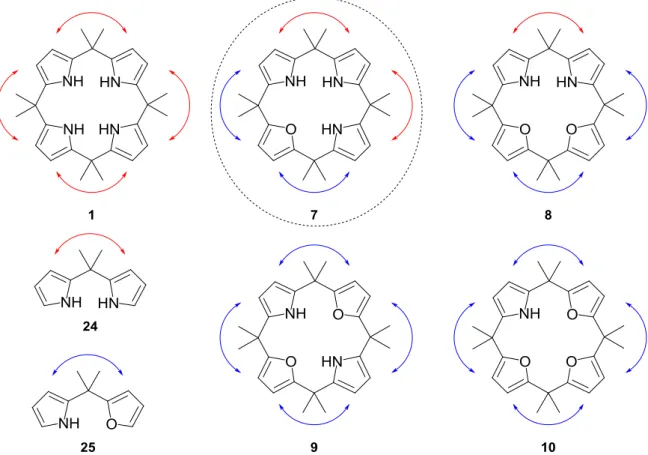
We decided to study the hydrogenations of the series of mixed calix[n]furan[4-n]pyrrole 7 –
10 (Figure 17). The following two reasons motivated our studies: 1) Since furan rings
revealed to be hydrogenated more easily than the pyrrole rings, the hydrogenation of the mixed macrocycles should allow a better conversion to the fully reduced analogues 11 – 14. 2) The products of the hydrogenation 11 – 14 are in themselves attractive ligands for studying the capacities to complex metals and finally to study their potential catalytic activity. Keeping the connectivity and the constitution of the heterocyclic calix[4]arenes, but removing the π-system creates structural analogues, which will allow studying the interplay of the geometrical, stereoelectronic and electronic factors. The “exocyclic” addition of four five
membered rings introduces conformational restrictions, keeping a degree of rotational freedom not available to the aromatic porphyrins. These target compounds will allow the experimentally based comparison between the influences exercised by the topology and by the π-system on the physical chemical properties of the compounds, on the complexation behavior and on the catalytic activity of the macrocyclic metal complexes.
Chapter 1
21
Figure 17. Targeted calix[n]tetrahydrofuran[4-n]pyrrolidines 11 – 14 by catalytic
Chapter 2
23
Chapter 2. Synthesis of calix[n]furan[4-n]pyrroles
1. Introduction
To be able to study the hydrogenation reaction leading to the calix[n]tetrahydrofuran[4-n]pyrrolidines 11 – 14 we had to have an efficient synthetic access to the calix[n]furan[4-n]pyrroles 7 – 10. Only few publications were reported in the literature on the synthesis of one or several macrocycles of the type described by structures 7 – 10. Three different approaches for the synthesis of calix[n]furan[4-n]pyrroles have been described in the literature.[97-100] Among these procedures, one provided macrocycles 8 – 10 while the two others afforded exclusively calix[2]furan[2]pyrrole 9. To the best of our knowledge, calix[1]furan[3]pyrrole 7 was not reported in the literature so far. The difficulty of the access to the different macrocycles may explain the lack of studies on their anion and cation binding compared to the simple calix[4]pyrrole 1 and calix[4]furan 2. Besides publications on the synthesis, only six studies have been reported so far including the anion-[101] and cation-[94] binding abilities, the synthesis of a cobalt-complex with molecule 9 as ligand,[98] the use of these macrocycles as ionophores in silver ion-selective electrodes[102-103] and recently a DFT study on macrocycle 9 to form host-guest type complexes with alkali and alkaline-earth metal ions.[104] French et al. reported in 1958 the first syntheses of caliy[n]furan[4-n]pyrrole 8 – 10.[97] They proceeded by stepwise condensation of a substituted furylcarbinol at the α–position of furan or pyrrole ring (Scheme 7a). The overall yields observed for these transformations are extremely low (1 – 4% for four steps depending on the final macrocycle). The authors specified that they did not succeed to obtain compound 7 with their method. More than forty years later Lee et al. described the synthesis of calix[n]furan[n]pyrroles and calix[n]thiophene[n]pyrroles (n = 2, 3, 4) using a similar synthetic strategy based on the “3 + 1” condensation between furyl- or thiophenylcarbinol and oxa- or thiatripyrromethane (Scheme 7b).[99-100] Compound 9 was reported in a considerably improved 30% overall yield. Their method required a cumbersome separation and purification procedure to isolate the desired macrocycle 9 from the other larger macrocycles. Moreover this method gave access to only one member of the calix[n]furan[4-n]pyrrole family. The third procedure was reported by Floriani et al. again with the synthesis of only macrocycle 9.[98] It was based on the substitution of furan by pyrrole rings in the calix[4]furan 2. The method consisted first in the selective ring-opening of calix[4]furan 2 to a tetraketone with the trans/trans-configuration of the two double bonds positioned one opposite to the other followed by the reduction of these unsaturations described by LeGoff et al. (Scheme 7c).[105] A Paal-Knorr ring closing reaction afforded the macrocycle 9 in around 60% overall yield.
24
Scheme 7. Synthesis of calix[n]furan[4-n]pyrroles reported in the literature. a) First stepwise
synthesis of 8 – 10 by French using a “2 + 2” macrocyclization; b) The synthesis of 9 using a “3 + 1” macrocyclization reported by Lee. c) The synthesis of 9 using the LeGoff’s ring-opening procedure as applied by Floriani
The synthetic route described by French et al. is the only one affording the synthesis of three of the four possible calix[4]furan[4-n]pyrroles but the very poor yields observed in the condensation reactions could not provide appropriate quantities for our studies. Although macrocycle 9 aroused interest and could be selectively synthesized, no improved experimental procedures were reported in the literature for the synthesis of the other three calix[n]furan[4-n]pyrroles 7, 8 and 10.
2. Our synthetic approach
An approach allowing the preparation of all four possible calix[n]furan[4-n]pyrrole regioisomers 7 – 10 was developed inspired by the work of LeGoff et al.[105] and Kohnke et
al.[106-107] using a sequence of transformations starting from the all-furan macrocyclic structure 2 (Scheme 8). Our approach is based on a mono, bis or tris oxidative furan ring-opening reaction of calix[4]furan 2 allowing to obtain sufficient quantities of the selectively opened macrocycles, followed by a reduction of the C–C double bond to form the
Chapter 2
25 corresponding 1,4-dicarbonyl compounds reported by LeGoff in his work on the oxidative ring-opening of calix[4]furan and calix[6]furan.
Scheme 8. The retrosynthetic sequences for the synthesis of calix[4]furan[4-n]pyrroles taking
macrocycle 7 as example
The controlled oxidation of calix[4]furan 2 using adequately chosen amounts of meta-chloroperbenzoic acid (m-CPBA) has been reported to form di- and tri-ring-opened macrocycles with cis-configurated double bonds (Scheme 8). Alternatively, if bromine was used as oxidative agent, the selective ring-opening of two opposite furan rings of calix[4]furan 2 leading to a compound with the trans/trans-configuration of the two double bonds has also been reported by LeGoff and applied in the synthesis of macrocycle 9 by Floriani (Scheme 7c). The pyrrole ring(s) was (were) then formed using the Paal–Knorr condensation reaction after the reduction of the double bonds. This sequence has been successfully applied for the synthesis of calix[n]furan[6-n]pyrroles (17 – 41% yield)[106] and calix[5]pyrrole (1% yield).[107]
Using this strategy, the starting material for all the mixed calix[n]furan[4-n]pyrroles 7 – 10 was the calix[4]furan 2. This approach should for the first time allow the synthesis of calix[1]furan[3]pyrrole 7 (Scheme 9). The efficient alternative oxidation method using bromine as oxidative agent was chosen for an easy and selective access to calix[2]furan[2]pyrrole 9 once the reaction conditions had been optimized. The m-CPBA based oxidative ring-opening was chosen for the synthesis of the three other macrocycles 7, 8 and 10. In contrast to the reaction with bromine, which yielded exclusively the bis-ring opened product, the oxidation with m-CPBA did not show any appreciable selectivity. The oxidation of the furan rings was “quasi” independent of the number of furan rings, which had already been ring opened. Using m-CPBA, we could therefore not avoid the formation of side products due to over-oxidation or to incomplete oxidation. As we were forced to separate these side products by chromatography we recovered them and they could be used in parallel syntheses of the corresponding alternative calix[n]furan[4-n]pyrrole analogues.
26
Scheme 9. The four calix[n]furan[4-n]pyrroles 7 – 10 coming from calix[4]furan 2 and the
oxidation process involved. a) use of m-CPBA as oxidative agent; b) selective oxidation via the bromine procedure
The work of LeGoff and Kohnke has been already cited by Jae Sang Kim as procedure for the synthesis of macrocycles 8 – 10 for their study as ionophores in silver ion-selective electrodes but no experimental data could be found.[102] Surprisingly, macrocycle 7 was not synthesized whereas the ring-transforming method should allow its synthesis. The full optimization on the synthesis of the four calix[n]furan[4-n]pyrroles will be reported.
3. First results (Thesis of Guillaume Journot)
[108]3.1. Synthesis of calix[2]furan[2]pyrroles 8 and 9
In our first studies Guillaume Journot concentrated on a proof-of-principle approach, which allowed us to prove the feasibility of the whole sequence and give access to the aromatic calix[n]furan[4-n]pyrroles for the further investigation on their ability to be hydrogenated. The synthesis of calix[4]furan, our starting material for all the four isomers, was investigated with the goal to obtain the product in large scale. An experimental procedure described by Jurczak et al.[109] in 2000 reported to afford calix[4]furan with 70% yield was used. The authors reported the influence of the concentration of sulfuric acid on the yields of calix[4]furan. The condensation between furan and acetone in dioxane using a 90.5% solution of sulfuric acid afforded calix[4]furan in 35% yield in our case, after recrystallization of the crude material. Despite a low yield the reaction is cheap, easy to manage in large scale and sufficient amount of starting material could be quickly and efficiently obtained.
Chapter 2
27 The oxidative ring-opening of 2 was carried out with 2.2 equivalents of m-CPBA in cold CHCl3. This reaction provided three different products: two di-ring-opened tetraketones 15a and 16 and one tri-ring-opened unsaturated hexaketone 17 (Scheme 10). Compounds 15a and
16 were obtained as a mixture, after column chromatography in 45/55 ratio respectively and
60% combined yield. Compound 17 has been isolated after column chromatography with 28% yield. In their experimental part, French et al. succeeded in isolating each product by column chromatography. In his hands Guillaume Journot was not able to separate compound 15a and
16 following their conditions. Nevertheless, he continued with the mixture in the aim to
separate the two regioisomers in a later step. The mixture of 15a and 16 was submitted to the reduction of the α,β-unsaturated ketones using zinc dust and glacial acetic acid at 100 °C to provide the mixture of compounds 18 and 19 in 92% yield after chromatography. Unfortunately the separation by column chromatography of the regioisomers was still impossible. When trying to perform the next step from the mixture of regioisomers, he realized that only one of the two compounds, compound 19, was soluble in ethanol, the solvent used for the reaction, even at 80 °C.
Scheme 10. Summary of the synthesis of macrocycles 7 – 9 coming from the same oxidation
28
Thanks to this difference of solubility, the separation of the regioisomers was achieved by successive washing with 80 °C ethanol. Using this procedure he successfully separated the reduced tetraketones 18 and 19 from each other, isolating the two isomers with respectively 85 and 72% yield. The next step is the formation of pyrroles by Paal-Knorr reaction. A special effort optimizing the reaction conditions had to be done, especially for the reaction using 18 as starting material. The synthesis of calix[2]furan[2]pyrrole 8 was carried out using 5 equiv. of ammonium acetate (AcONH4) as source of ammoniac in a mixture of EtOH/CHCl3 (1/1) at 65 °C overnight. After reducing the solvent volume in the rotavap, compound 9 was filtered off in 84% yield (>99%, GC). The reduced tetraketone 19 smoothly reacts with ammonium acetate, in ethanol at room temperature, to afford after filtration the calix[2]furan[2]pyrrole 8 with 91% yield.
The reduction of the three double bonds of the macrocycle 17 by adding zinc dust in a warm solution of 17 in glacial acetic acid provides the hexaketone 20 in quantitative yield without purification. In his thesis, the Paal-Knorr reaction on compound 20 provides, surprisingly, only the unsaturated macrocycle 8 in 60% yield. No traces of compound 7 have been detected in this reaction.
3.2. Synthesis of calix[3]furan[1]pyrrole 10
This reaction has been done using 1.2 equiv. of m-CPBA in chloroform at 0 °C. This reaction unfortunately affords also a non-negligible amount of side products from the multiple opening. The reduction of the double bond was performed directly after a simple workup of the reaction mixture, without separating the desired product from the side products. The two consecutive steps afforded the macrocycle 21 in 28% overall yield after chromatography (Scheme 11). The ring closing reaction to pyrrole was carried out very smoothly at room temperature giving calix[3]furan[1]pyrrole 10 in 90% after a simple filtration, in a high purity.
Scheme 11. Synthesis of macrocycle 10
4. What had to be improved
Once it was clear that the proposed retrosynthesis could be successfully carried out efforts had to be focused on making the individual steps efficient and scalable. Indeed, in order to claim
Chapter 2
29 that our compounds could potentially become novel ligands or compounds of interest we must propose an efficient, reproducible and scalable procedure with as high selectivity as possible. The treatment of calix[4]furan (700 mg scale) with 2.2 equiv. of m-CPBA afforded the three intermediates 15a, 16 and 17 leading to the synthesis of 9, 8 and 7 respectively (Scheme 10). This protocol was a good starting point but the reaction is complicated to implement on a larger scale since we have to separate by chromatography three compounds with similar structures. The quantity of m-CPBA used should be related to number of rings opened. The synthesis of calix[1]furan[3]pyrrole 7 should therefore start with the oxidation of calix[4]furan with around three equivalents of the peracid. To achieve our goal we need to obtain the formation of this calix[1]furan[3]pyrrole 7 never observed so far. In case of failure we should be able to explain the reasons why this compound could not be obtained with this method. Since the addition of bromine could selectively open two furan rings located in front of each other in the macrocycle, this method was obviously selected for the synthesis of calix[2]furan[2]pyrrole 9.
Obtaining the tetraketone 16 without the presence of its regioisomer 15a seemed from the outset of our studies to be difficult. Even if the amount of m-CPBA is carefully adapted to the required bis-ring opening, it seemed to be difficult to avoid the concomitant formation of a significant quantity of hexaketone 17. An important goal of our studies was to improve the purification of the mixture with the prime objective to isolate compound 16, the most difficult to selectively synthesize. The formation of the diketone 21 with 28% yield over two steps on 500 mg scale without intermediate purification is as well not optimal. These two steps should also be improved.
5. Optimization of the synthesis of calix[n]furan[4-n]pyrroles 7 – 10
Our observations on the first two steps (ring-opening of calix[4]furan 2 and reduction of the unsaturated 1,4-diketone function) were similar to the results described by LeGoff.[105] Our work further includes procedures on larger scales compared to the previously reported experimental procedures of LeGoff, the synthesis of the mono ring-opened diketone 22a (Scheme 12c) and modifications in the purification step of the treatment of calix[4]furan 2 with 2.2 equivalents of m-CPBA leading to the di-ring-opened compounds 15a and 16.
5.1. Oxidation of calix[4]furan using m-CPBA
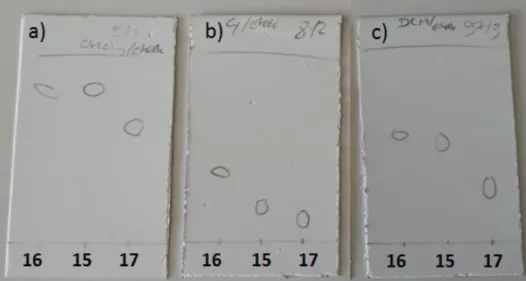
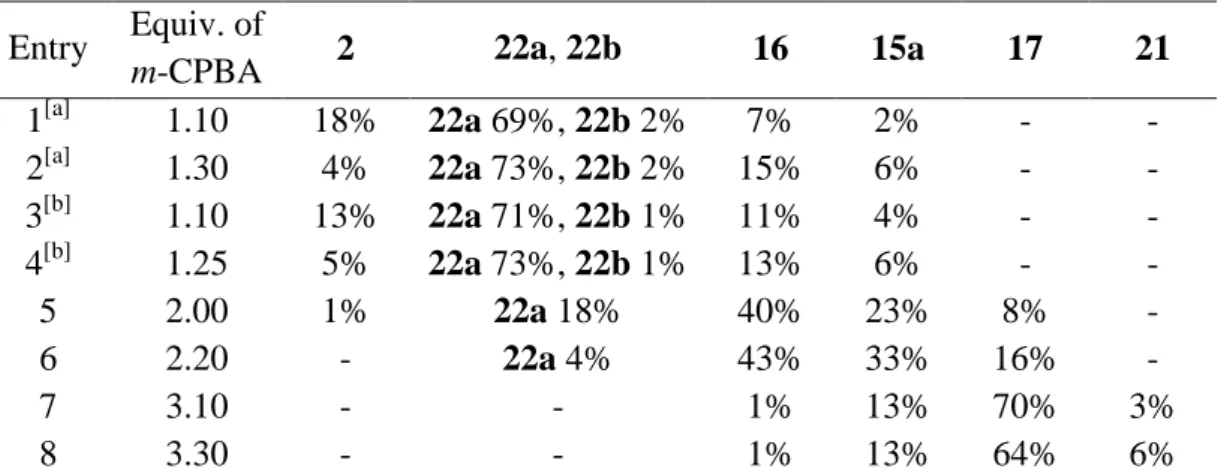
To optimize the reaction conditions, the crude materials obtained from the reaction without purification were analyzed by GC to determine the optimal amount of m-CPBA to be added. The attribution of the GC peaks to the structures of the intermediates is based on GC-MS and 1
H NMR data. The analysis of the crude materials of different reaction conditions are compiled at the end of this chapter (Table 1). The remaining percent were attributed to uncharacterized products.

![Figure 26. Calix[n]tetrahydrofuran[4-n]pyrrolidines 12 – 14 and their quantities reported by Guillaume Journot](https://thumb-eu.123doks.com/thumbv2/123doknet/14884417.646023/64.892.179.718.529.743/figure-calix-tetrahydrofuran-pyrrolidines-quantities-reported-guillaume-journot.webp)
![Figure 34. Scheme of the four conformational isomers of calix[4]pyrrole 1 and the change of conformation in presence of anion sources as described by Sessler](https://thumb-eu.123doks.com/thumbv2/123doknet/14884417.646023/78.892.119.777.680.949/figure-scheme-conformational-isomers-conformation-presence-described-sessler.webp)
![Figure 36. Structural formula and molecular structures determined by X-ray diffraction of: a) Isomers 4a and 4b of calix[4]tetrahydrofuran; b) calix[4]pyrrolidine 3](https://thumb-eu.123doks.com/thumbv2/123doknet/14884417.646023/80.892.101.783.364.726/structural-molecular-structures-determined-diffraction-isomers-tetrahydrofuran-pyrrolidine.webp)
![Figure 37. Nomenclature of the calix[n]tetrahydrofuran[4-n]pyrrolidines used in this chapter](https://thumb-eu.123doks.com/thumbv2/123doknet/14884417.646023/82.892.172.719.469.888/figure-nomenclature-calix-n-tetrahydrofuran-pyrrolidines-used-chapter.webp)