ةعماج 08 يام 1945 . ةملاق University Of 8 Mai 1945. Guelma
ةيلك بادلآا تاغللاو Faculty Of Letters And Languages
مسق بادلآا ا ةغللا و ةيزيلجنلا
Department of Letters and English Language
A Dissertation Submitted to the Department of Letters and English Language in Partial Fulfillment of the Requirements for a Master Degree in Anglophone Language,
Literatures, and Civilizations
Students: Supervisor:
BOUSSADIA Radhia Mrs. HENAINIA Hasna OULEDIEF Hiba
Board of Examiners
Chairwoman: Mrs. CHEKAT Ilhem ( MA/A) University of 8 Mai 1945/ Guelma Supervisor: Mrs. HENAINIA Hasna (MA/B) University of 8 Mai 1945/ Guelma Examiner: Mrs. BOUDRAA Amina (MA/B) University of 8 Mai 1945/ Guelma
June 2016
The Gap between Theory and Practice in Students’ Oral
Presentations
Case Study of Master One Students’ English Department
Guelma University
DEDICATION
I have the honor to dedicate this work to:
My parents and especially my admired mother, who is always by my side.
DEDICATION In the Name of Allah, Most Gracious, Most Merciful,
This dissertation is dedicated to my beloved parents for their prayers, patience and for who I am today.
ACKNOWLDGEMENTS
We wish to express our sincere thanks and appreciations to namely those who aided us to achieve our goal.
We would like to sincerely thank our supervisor Mrs. Henainia. H, for her support and guidance she has provided throughout this study.
Special thanks to Mrs. Abdaoui. M,and Miss. Haridi. S, for their unhesitant, constructive help and advice.
Great thanks go to Mr. (s): Zemmouri. L, Alizeoui. M, Bengraite. N, Abdaoui.F, Chekkat.I. Oumeddour. A, and Kribes. A.
We must place on record our sincere gratitude to the members of the English Teaching body who have answered our questionnaire, in addition to Master One students of Guelma University‟s English Department for their fruitful contributions to this research.
ABSTRACT
This study aims at detecting the gap between theory and practice in oral presentations. Accordingly, the sample of the research was randomly selected from Master One students of English at the English Department. The hypothesis is stated as: students‟ oral presentations display a gap between the LMD system‟s theoretical principles and their application in reality. In conducting the research, the Descriptive Method was utlized. Questionnaires devoted to both teachers and students have been distributed; teachers‟ questionnaire has been handed to 30 teachers at Guelma University‟s English Department; while students‟ questionnaire has been provided to 50 Master one students. Research results displayed that Oral presentations pave the students‟ way towards educational and work professionalism. From early stages in higher education, the LMD system‟s students are required to perform oral presentations both as a lesson delivery and assessment form, yet students are not provided with norms, rules and guidelines on how to deliver oral presentations. Consequently, few Oral presentations indicate a real mastery of the norms of presenting, which leads to a new area of concern: the fracture between theory and practice in students‟ oral presentations. The hypothesis is therefore confirmed, neither teachers nor students are satisfied with students‟ oral presentations. Accordingly, some pedagogical implications are greatly recommended, guiding teachers as well as students in oral expressions modules at the one hand, and in the modules that deal with students‟ oral presentations as a form of evaluation on the other hand, the thing that might enhance students‟ performance.
LIST OF ABBREVIATIONS AC: Abstract Conceptualization
AE: Active Experimentation CE: Concrete Experience
CLL: Cooperative Language Learning ECTS: European Credit Transfer System EFL: English Foreign Learners
ELT: English Language Teaching FL: Foreign Language
LMD: License Master Doctorate RO: Reflective Observation SAW: Speaking Arguing Writing SCI: Student-Centered Instructions SCL: Student-Centered Learning
LIST OF TABLES
Table 1: Cooperative, Competitive and Individual Learning……….17
Table 2: Oral Presentation Evaluation Form……….28
Table 3: Students‟ Experience in Studying English………...38
Table 4: Students‟ definition to the Learner- Centered Approach………....39
Table 5: Students‟ Perceptions about the LMD System‟s Reflection of the Learner- Centered Approach………..39
Table 6: Lesson Delivery Forms………40
Table 7: Students‟ Work Preferences in Oral Presentations………...41
Table 8: Students‟ Preparation of Oral Presentations……….41
Table 9: Students‟ Verification of the Credibility and the Reliability of Information..…….42
Table 10: Student‟s Verification Strategies………42
Table 11: The Use of Visual Aids………...43
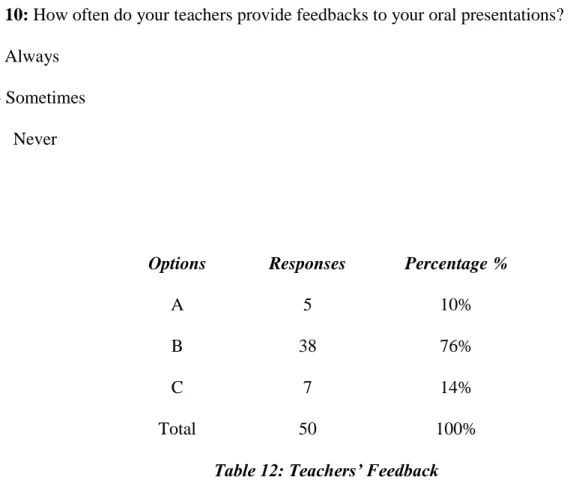
Table 12: Teachers‟ Feedback………44
Table 13: Students‟ Attitudes towards Oral Presentations as a Lesson Delivery Technique……….44
Table 14: Students‟ Opinions about the Importance of Oral Presentations………45
Table 15: Correlation between Oral Presentations and students‟ Oral Proficiency…………46
Table 16: Students‟ Opinions towards Oral Presentations and Teaching………...46
Table 17: Correlation between Oral Presentations and Critical Thinking………..47
Table 18: Students‟ State while Delivering Oral Presentations………..47
Table 19: The Effect of Anxiety, Feear and/ or Shyness on Students‟ Performance……….48
Table 20: Problems that Students Face Before, During and After Orally Presenting………49
Table 22: Handouts‟ Supply………..…50
Table 23: Kinds of Teachers‟ Feedback……….51
Table 24: Degree (s) Held……….54
Table 25: The Number of Years Teaching English………55
Table 26: Teachers‟ Definition to the Learner-Centered Approach………..55
Table 27: Teachers‟ Perceptions about the LMD System‟s Reflection to the Learner Centered Approach………..55
Table 28: Teachers‟ opinions about the necessity of clarifying the way oral presentations should be………..56
Table 29: Teachers‟ view point about whose Job is Teaching the Effective Norms of Oral Presentations………...…….57
Table 30: Teachers‟ Perceptions of the Importance of Technology in the Delivery of Oral Presentations………57
Table 31: Teachers‟ opinions about students‟ motivation to deliver oral presentations……58
Table 32: Teachers‟ Opinions about the Significance of Motivation to Students‟ Oral Presentations………59
Table 33: The Major Characteristics of Effective Oral Presentations………59
Table 34: Teachers‟ most used Techniques in Oral Presentations……….60
Table 35: Teachers‟ Rating to Students‟ Oral Presentations………..61
Table 36: Teachers‟ Choice of the Problems Facing Students in Oral Presentations………62
LIST OF FIGURES
CONTENTS DEDICATION……….. ACKNOWLEDGEMENTS……….. ABSTRACT……….. LIST OF ABBREVIATIONS……… LIST OF TABLES………. LIST OF FIGURES……… INTRODUCTION Introduction……….……….1
Statement of the Problem……….……….1
Aims of the Study………..2
Research Questions………..……….2
Research Hypothesis……….………3
Research Methodology and Design……….……….3
Structure of the Dissertation………..3
CHAPTER ONE: Oral Presentations between Theory and Practice Introduction……….. 4
1.1. Oral Presentations between Theory and Practice………...………..4
1.2. The Student-Centered Learning………..…5
1.2.1. The Parameters of Student-Centered Learning……….. ………..….6
1.2.1.1. Innovative Teaching……….6
A. Team-Cooperative Learning……….……….. 6
C. Student- Self Regulated………...6
1.2.1.2. The Learning Outcomes………7
1.2.1.3. The System of Transfer an Accumulation of Credits………7
1.2.1.4. Flexible Curricula and Learning Paths ……….8
1.3. The License Master Doctorate System………8
1.4. Oral Presentations……….……..9
1.5. Effective Oral Presentations………...10
1.6. The Basic Requirements Of Efficient Oral Presentations………..11
1.6.1. Oral Proficiency………...11
1.6.2. Oral Communication………11
1.6.3. Communicative Competence………...11
1.7. Types of Oral Presentations………12
1.7.1. The Informative Presentations……….…….12
A. Chronological Structure………..…….13
B. Location Structure……….…..…….13
1.7.2. The Instructional Presentations……….……13
1.7.3. The Persuasive Presentations……….…...14
1.7.4. The Attention Grabbing Presentations……….…….14
1.8. Forms of Oral Presentations………...14
1.8.1. Individual Oral Presentations………...14
1.8.2. Group Work………..15
1.8.3. Role play………..18
1.8.4. Problem Solving………..18
1.9. The Purposes of Oral Presentations………..19
1.9.2. Training………19
1.9.3. Teaching and Learning……….19
1.10. Preparation of Students for Oral Presentations………19
1.10.1. Teaching Oral Presentations……….20
1.10.2. Running an In-Class Workshop of Oral Presentations………21
1.11. The Teacher‟s Roles in Oral Presentations………..21
1.12. The Delivery of Oral Presentations……….23
1.12.1. Time Allocated for Delivering an Oral Presentation ………..23
1.12.2. Visual Aids in Oral Presentations………23
A. Types of Visual Aids……….24
1.12.3. The Structure of an Oral Presentation……….24
A. The Introduction………..24
B. The Body………..25
C. The Conclusion……….26
1.13. Evaluating Oral Presentations………...26
1.13.1. Oral Evaluation……….27
A. Immediate feedback……….27
B. Delayed feedback………27
1.13.2. Written Evaluation………28
1.14. The Importance of Oral Presentations………..39
1.14.1. Oral Presentations and Experiential Learning………..30
1.15. Problems of Oral Presentations……….32
1.15.1. Lack of Preparation………...32
1.15.2. Performance Anxiety………....33
1.15.4. Inhibition and Fear………33
1.15.5. Group Boredom………34
1.15.6. Mother Tongue Use………..34
Conclusion……….…..……….35
CHAPTER TWO: Description and Analysis of the Questionnaires Introduction……….36
2.1. Students‟ Questionnaire………36
2.1.1. Aim of the Questionnaire………36
2.1.2. Administration and Description of the Questionnaire………...36
2.1.3. Results and Main Findings………….………51
2.2. Teachers‟Questionnaire……….52
2.2. 1. Aim of the Questionnaire ……….………52
2.2. 2. Description and Administration of the Questionnaire………..53
2.2.3. Analysis of the Results and Findings……….54
2.2. 4. Results and Findings………..………64
Conclusion ………...………64
CHAPTER THREE: Pedagogical Implications Introduction………..………65
3.1. Suggestions for Teachers………...………65
3.1.1. Discourse Markers………..65
3.1.2. Feedback………65
B. Individual Differences………..66
3.1.3. Body Language………..66
3.1.4. Motivation………..66
3.1.5. Teaching Students How to argument……….67
3.1.5.1. The Situation………68
3.2. Suggestions for Students………69
3.2.1. Tips to Prepare Oral Presentations……….69
3.2.2. Strategies to Overcome Performance Anxiety………...70
3.2.3. Assessment……….71
GENERAL CONCLUSION
Conclusion………73
1. Aim of the Study………..73
2. Summary of the Results………73
3. Limitations of the Study………...74
4. Suggestions for Future Research………..74 References………...75-78 Appendices
Appendix One: The Students‟ Questionnaire Appendix Two: The Teachers‟ Questionnaire
General Introduction
In the traditional approaches of teaching, most class time is spent with the tutor lecturing and the students listening. However, the Student-Centered Learning (SCL) shifts the focus of learning from the teacher to the students.
Student-Centered Learning (SCL) is based on the philosophy that the student is at the heart of the learning process, but the teacher‟s role remains paramount, since he is the guide and the facilitator of the task. The Student-Centered Learning (SCL) strategies and approaches aim to increase the students‟ capacities by making them more aware of what skills, knowledge and competences they can develop through their studies.
The Student-Centered approach to Learning makes the core of the License Master Doctorate (LMD) system; it permits direct interactions between the teacher and the students. Accordingly, the teacher guides, advices and orients his students throughout their learning process. Oral presentations represent the essence of the LMD system, since the student is the one who makes researches, selects the appropriate information, prepares them under the form of an oral presentation, and performs them and manages the discussions that follow.
Oral presentations pave the students‟ way towards professionalism in both their academic life as students and in their future career as teachers. However, the students are not equipped with norms, rules, and guidelines on how successful oral presentations should be. The net result is inefficient oral presentations. The fact that leads to a new area of concern: the gap between theory and practice in students‟ oral presentations.
1. Statement of the Problem
Oral presentations, which considers the students at the center of the learning process as an alternative to teachers oriented classrooms, are paid a considerable attention in the English department of Guelma‟s University, since they dedicate a whole module called „oral expressions‟, yet this module is not restricted in matters of content; consequently, students
still encounter difficulties before, during and after delivering an oral presentation, such as anxiety, the lack of sources, and the shortage of teachers‟ guidance.
2. Aims of the Study
The current study aims to raise awareness about the existence of a gap between theory and practice in students‟ oral presentations and seek to provide the possible solutions to overcome the problems students encounter in performing their expositions. In doing so, the study first attempts to investigate the students‟ awareness about the criteria of efficient oral presentations, then it tries to examine whether the students‟ oral presentations really reflect their academic level.
3. Research Questions
This study aims at investigating the gap between theory and practice in students‟ oral presentations. In order to explore such an issue, different questions are asked at the beginning of the study:
1-Do students know the characteristics of effective oral presentations? 2- Do students actually apply the norms of effective oral presentations? 3-Are the audience actively involved in oral presentations?
4-How do teachers respond to students „oral presentations and how do they grade them? 5- How do teachers involve the other students in the delivered presentations?
6-What are the obstacles and the difficulties faced by both the teachers and the students during oral presentations?
4. Research Hypothesis
Based on the pre-mentioned research questions the hypothesis is stated as follows:
H1: The students‟ oral presentations display a gap between the LMD system‟s theoretical principles and their application in reality. However, H0 implies that there is no gap between LMD system‟s theoretical principles and their application in reality. Hence, H0 is: the
students‟ oral presentations do not display a gap between the LMD system‟s theoretical principles and their application in reality.
5. Research Methodology and Design
In order to investigate the gap between theory and practice in students‟ oral presentations, this study follows a descriptive method based on questionnaires to evaluate and analyze students‟ oral presentations with correspondence to their current year of study. In order to inspect this issue, two questionnaires are delivered to both master one students and teachers, followed by in-depth analysis of the results, designed to check their awareness about the oral presentations‟ norms, question the fruitfulness of their presentations, and try to detect the causes of the inefficient oral presentations.
6. The Structure of the Study
This study falls into three main parts preceded by a general introduction. The first chapter is theoretical in issue, it deals with the theoretical orientation of the research. The second chapter is dedicated to two questionnaires distributed to both teachers and students. The third chapter includes the pedagogical implications, followed by a general conclusion.
Chapter One:
Oral Presentations between
Theory and Practice
Chapter One: Oral Presentations between Theory and Practice Introduction
The present chapter covers: the Student-Centered Learning approach; the License Master Doctorate system (LMD); oral presentations, their basic requirements, types, forms, purposes, structure, evaluation forms, as well as the major problems and difficulties faced by the students in oral presentations.
1.1. Oral Presentations between Theory and Practice
The gap between theory and practice exists in every field and every domain; for instance medicine, mathematics, Physics and chemistry as sciences are difficult to be applied. The teaching-learning process also reveals a gap between what is learned (theory) and what is applied (practice). According to Merrill (2002), “most instructional design theories advocate application of knowledge and skill as a necessary condition for effective learning” (p. 6). In this regard, learning is enhanced when students are provided with courses, instructions and opportunities to learn effectively and to apply and practice appropriately.
This study is interested in considering the theoretical side of education in the Algerian context and its practical side in the language classroom. In Algeria, the Student-Centered Learning is adopted. The LMD system is its reflection, and oral presentations are one of its applications. Oral presentations as a form of lesson delivery and assessment are of critical importance in the learning process. This presentation technique, if done appropriately, will enhance students‟ oral proficiency, develop their critical thinking and argumentative skills, and thus, prepare the students academically and professionally. Even this form of lesson delivery and assessment, which represents the adequate image of the Student-Centered
Learning displays a gap between theory and practice because its application does not reflect its theory.
1.2. The Student-Centered Learning
The Student-Centered Learning was created as a concept within the field of educational pedagogy and has been a topic of discussion within many higher educational institutions and within national policy-making for over the past few decades. Whilst the concept of „student-centered‟ learning in its most recent form is relatively new, the idea of looking at the way in which teaching is conducted and how learning processes work has spanned over almost two centuries (Attard, Di Ioio, Geven, & Santa, 2010).
The term Student- Centered Learning is widely utilized by a number of higher education policy- makers; however, it does not have a universally- agreed upon definition.
The Student-centered learning approach is diametrically opposed, in its ethos, to the philosophy underlying the conventional method of learning. By its very nature, SCL allows students to shape their own learning paths and places upon them the responsibility to actively participate in making their educational process a meaningful one. By definition, MacHemer and Crawford (2007), argued that the Student - Centered Learning experience is not a passive one, as it is based on the premise that „student passivity does not support or enhance … learning‟ and that it is precisely „active learning‟ which helps students to learn independently (as cited in Attard, Di Ioio, Geven, & Santa, 2010, p. 11).
“Student- Centered Instructions (SCI) is an instructional approach in which students influence the content, activities, materials, and pace of learning. This learning model places the student (learner) in the center of the learning process. The instructor provides students with opportunities to learn independently and from one another and coaches them in the skills they need to do so effectively” ( Collins & O‟ Brien, 2003).
The students‟ various needs as a result of the different higher education programmes applied in distinct cultures and contexts make it difficult to provide a holistic definition of Student-Centered Learning.
1.2.1. The Parameters of Student- Centered Learning
Despite the multiplicity of possible methods of the Student- Centered Learning application, one can nevertheless point out some key features of SCL:
1.2.1. Innovative Teaching
Innovative teaching focuses on promoting teaching methods, which allow teachers to create the best supportive learning atmosphere for students. A recent study advocates that teacher- training plays a vital role in ameliorating the teaching- learning process. According to Gibbs et al (2004), “… Training can change teachers such that their students improve their learning” (p. 98). Innovative teaching aims at enhancing students‟ critical thinking, preparing “individuals to become independent lifelong learners” (Tsui, 2002, p. 740).
As believed by Attard, Di Ioio, Geven, & Santa (2010, p. 11), Innovative teaching takes different forms:
A. Team/ Cooperative Learning
Team Learning requires students to be responsible for their own learning (Felder et al., 1996), which gives them the opportunity to interact and share ideas with their classmates. B. Problem- Based Learning
The Problem- Based Learning, acknowledged as a method that is based on the assumption that the application of the students‟ early gained knowledge during the learning process enables them to learn more effectively and exposes them to real-life situations outside the classroom.
This process confirms that the students do not only learn independently, but also are responsible for their own monitoring, motivation, and feedback process during and after learning (Van Eekelen et al., 2005, p. 451).
As maintained by Zimmerman (2002), Student Self- Regulated Learning comprises eight indispensable skills (p. 66):
1. Setting specific goals.
2. Adopting powerful strategies for attaining these goals. 3. Monitoring one‟s performance.
4. Restructuring one‟s learning environment to make it compatible with one‟s goals. 5. Managing one‟s time effectively.
6. Self-evaluating one‟s method. 7. Attributing results to causation. 8. Adapting future methods.
1.1.1. The Learning Outcomes
According to cf. European communities (2009), the Learning Outcomes can be described as the student‟s expected knowledge, skills, and understanding to be acquired as a result of their learning experience. The Learning Outcomes enable students to better administer their studies and pave their way to handle their own learning.
Generally, the learning outcomes should be stated in the future tense, point out crucial learning demands, use clear language, be achievable and understandable (Attard, Di Ioio, Geven, & Santa, 2010).
1.1.2. The System of Transfer and Accumulation of Credits
According to European Commission (2010), European Credit Transfer and Accumulation System (ECTS) “… is a tool which enables students to collect credits for learning achieved
through higher education. ECTS is a learner-centered system which aims to increase transparency of learning outcomes and learning processes”.
The transferability and accumulation of credits makes the heart of the student centered learning, in order to get access into a higher education programmes.
1.1.3. Flexible Curricula and Learning Paths
This final parameter provides the students with the ability to make their own decision in constructing and taking responsibility for their own learning, which results from maintaining flexible curricula that grants the students the opportunity to draw their own paths. This can be related to the concept of lifelong learning in permitting the students to build their own learning process based on their needs.
Student- Centered Learning requires both a shift in focus from what is taught to how and why it is taught, in addition to the shift from teacher performance to student learning.
1.3. The License Master Doctorate (LMD)
Globalization, the formation of a unified space, and the competitiveness in the labour market were the main reasons behind the embracement of the License/bachelor Master Doctorate (LMD) system in higher education in Algeria.
The Classical system, i.e., four years bachelor, two years magister - four years doctorate system, did not respond favorably to the various demands constrained by the growth of economy, of politics, and of the society in Algeria. In 2004, the Algerian government and education policy makers decided to adopt the European educational system known as LMD, to respond and coincide to socio-economic growth contributing to a significant evolution of the country (Arab World English Journal, 2012).
Among other European languages English is the most dominant and useful language, it is a required subject at all levels of university education which paves the way to students to
take a part in the globalization. Thus, the Algerian education policy makers implemented different policies to develop ELT. (Arab World English Journal, 2012, p.181)
Nowadays, education policy makers emphasize the importance of English as a foreign language. Coleman (2010) reviews the functions of English in development by classifying its four roles: employability, international mobility, unlocking development opportunities and accessing information as an impartial language.
The LMD system, as the latest new reform applied in the Algerian universities, aims at bringing the Algerian diploma to the universality and the Algerian student to a higher level of learning on the one hand and to the business world on the other. According to Arab World English Journal (2012),‟‟The introduction of LMD into the Algerian universities should be accompanied by these new ideas for innovative teaching practices to improve the performance of the university system but also lead to greater employability of graduates‟‟(p.181) .
Theoretically speaking, oral presentations, along with discussions and other learning/ teaching forms which require the learners‟ autonomy and motivates the students to take a part in their learning, reflect the principles of the Student-Centered Approach and the LMD system. In this sense Oral presentation as a practical face of Learner-centered approach and the LMD system is applied in Foreign Language Teaching.
1.4. Oral Presentations
Oral presentations are one of the most common requirements in university courses. Scholars, professionals, and students in all fields desire to share the new topics and knowledge they confront, and this is often accomplished by delivering oral presentations
Duke University’s Thompson Writing Program.
Oral presentations represent the students‟ first step towards the student- centeredness, they allow the students to alter the memory and transmission-based learning, which is still
operating in various educational systems in the developing world (Al-Issa, 2007a, 2007b), with a dynamic, interactive, independent learning based on students‟ innovation, discovery and critical thinking.
Oral expression skills are essential to students‟ learning and academic success. With oral expression students are able to express ideas, explain thinking in a critical manner, retell stories, contrast and compare concepts or ideas.
1.5. Effective Oral Presentations
When teachers ask students to prepare and deliver an oral presentation on any topic, most of them have not the clear image of an effective oral presentation. In addition, they do not know how to present the work in a correct way. “In speaking …you must read and research 100 words for every word you speak, or the listener will know that you are speaking off the top of your head” (Tracy, 2008, p. 18).
According to Chivers and Shoolbred (2007), “Effective presentations achieve their objective and usually bring some benefit and learning to all the people Involve them whether presenters, audience or tutors” (p. 22). Furthermore, sometimes students cannot remember things they have learned from lectures; however they can easily remember it if they learn it in a form of a presentation. Chivers and Shoolbred (2007), claim that in order to prepare and deliver the presentation, there are some characteristics, which are important to make it effective (p. 21-22):
Careful planning and preparation Good time management
Relevant and interesting content Good communication skills Appropriate use of technologies Clear supporting documentation
A suitable audience participation
Therefore, it is necessary for students to realize the structure of oral presentation. In addition, they need to know how to prepare it and to deliver it because this will make its content and structure more and more effective.
1.6. The Basic Requirements of Efficient Oral Presentations
In order to deliver successful oral presentations students need to possess: oral proficiency skills, oral communication skills and a communicative competence.
1.6.1. Oral Proficiency
Research by Omaggio (1986), illustrates that oral proficiency includes the ability to communicate verbally in a functional and accurate way in the target language. A high degree of oral proficiency implies having the ability to apply the linguistic knowledge to new contexts (topics) and situations. (as cited in Stein, 1999, p. 1).
1.6.2. Oral Communication
Oral presentations involve a communicative ability of producing and receiving information. Byrne (1986) states that, “Oral communication is a two-way process between speaker and listener and involves the productive skill of speaking and the receptive skill of understanding (or listening with understanding)” (p. 8).
Oral communication involves the negotiation of meaning between two persons; when we speak the listener should be able to comprehend what is being said. Both speaker and listener have a role to play, because speaking is an interactive process of constructing meaning that involves producing, receiving, and processing information.
1.6.3. Communicative Competence
Communicative competence is originally derived from Chomsky‟s distinction between competence” a speaker‟s intuitive knowledge of the rules of his native language‟‟, and performance‟‟ what he actually produces by applying these rules”. According to Hymes
(1972), the communicative competence is the ability to use grammatical competence in a variety of communicative situations. Backlund (1977) offers a wider definition of communicative competence, “the ability of art interactant to choose among available communicative behavior in order that he (she) may successfully accomplish his (her) own interpersonal goals during an encounter while maintaining the face and line of his (her) fellow interactant within the constraints of the situations“(p. 16).
Canale and Swain (1980) and Canale (1983) explain the communicative competence as a synthesis of an underlying system of knowledge and skill needed for communication. In their concept of communicative competence, knowledge refers to the (conscious or unconscious) knowledge of an individual about language and about other aspects of language use. According to them, there are three divisions of knowledge: knowledge of underlying grammatical principles, knowledge of how to use language in a social context in order to achieve communicative functions and knowledge of how to combine utterances and communicative functions with respect to discourse principles.
Oral communication involves the negotiation of the intended meaning between two persons. It is the students‟ ability to express meaning properly and adequately.
1.7. Types of Oral Presentations
There are many types of oral presentations. Catherine (2010) suggests different types among them: The informative presentation, the instructional presentation, the persuasive presentation, and the attention grabbing presentation.
1.7.1. The Informative Presentations
Informative presentations require students to deliver information and knowledge. According to Catherine (2011),”The purpose of informative presentation is to communicate information, facts, and data‟‟. For this reason, Catherine sees that students need to precede the following structures to transmit the information successfully:
A. Chronological Structure
In this type of structures students are demanded to: Explain when things should happen.
Work with visual students who can see the overall sequence of events. Use words to list order such as: first, second, third.
B. Location Structure
In the location structure students need to: Clarify when things should happen.
Use words like region 1, 2, 3 to display order.
C. Cause and Effect Structure
To display cause and effect information, the students in their oral presentations need to: Explain and clarify how things should happen
Utilize phrases like: because of, in order to…. List information in their order of importance. 1.7.2. The Instructional Presentations
Instructional presentations, which purpose is to provide precise regulations or orders, this type of presentations will presumably be longer, since it deeply “covers” the presented topic, the outcomes are new knowledge in the audience‟s package. The presenter of this type explains the importance and value of the information, defines the learning objective of this program of instructions, and gives the audience the chance to ask questions on the one hand, and to exchange feedback with the presenter as well as their peers on the other hand.
Persuasive presentations aim at convincing and persuading the audience i.e. the teachers and the students. Catherine (2010) claims that successful persuasive presentations are achieved only if students “… present sufficient logic, evidence, and emotion to sway the audience … “. Furthermore, students need to:
Open the presentation with a considerable introduction. Grab the audience‟s attention.
Create a desire by providing arguments for the audience to be convinced. Close the persuasive presentation with a call to make a decision.
1.7.4. The Attention Grabbing Presentations
The main aim of this type of presentations is to stimulate people‟s thinking on a particular problem or situation via activating their emotions towards the subject matter, the presenter makes use of „vivid‟ language in order to display excitement and seriousness. To fulfill his purpose, the presenter of this type first illustrates the issue with an attention grabbing story that may be sometimes exaggerative, then demonstrates the urge to provide a solution for the problem being presented, suggest the solution and compare the world with and without the problem to finally arrive at urging the audience‟s reaction to help solving the issue.
1.8. Forms of Oral Presentations 1.8.1. Individual Oral Presentation
According to Oral Preparation and Presentation Guide, each student has the freedom to select a topic with the guidance of the teacher. For the guide, the topics selection may reflect the student‟s personal interests and needs.” Topics may be based on any aspect(s) of the work(s) studied, including:
Cultural setting of the work (s) and related issues Thematic focus and characterization
Techniques and style
Interpretation of particular elements from different perspectives. 1.8.2. Group Work
Group work is a way to develop interaction between students. It is the most used strategy in oral presentations. Adrian Doff (1991) describes group work as follows “In group work, the teacher divides the class into small groups to work together (usually four or five students in each group). As in pair work, all the groups work at the same time” (p. 138).
Research by Richards and Nunan (1996-1999), support that group-work together with pair-work change the interactional dynamics of the classroom. However, Harmer (1992) argues that group-work is even more dynamic and productive than pair-work and individual work: There are more people to react with and against in a group and, there is a greater possibility of discussion. There is a greater chance that at least one member of the group will be able to solve a problem when it arises, and working in groups is potentially more relaxing than working in pairs, for the latter puts a greater demand on the students‟ ability to co-operate closely ( p. 245-246)
For Olson and Kagan, Cooperative Language Learning requires learners to learn from each other in pairs or small groups. In this sense Group work stresses the learners‟ accountability in which each member of the group is responsible for his own contribution to activity. As for Olsen and Kagan as cited in Richard & Rodgers, 1992), CLL is is an activity in which learning depends on the information exchange between the learners working in groups, where everyone is responsible for his own learning and possesses enough motivation to develop others‟ learning. Group work aims to promote cooperation between students, and develops their communicative competence.
Deutsch (1949) classifies three goal structures: cooperative, in which each individual‟s goal-oriented efforts contribute to others goal attainment; competitive, in which each
individual‟s goal-oriented efforts prevent others from reaching their goals; and individual, in which individual‟s goal-oriented efforts have no connection with others goal attainment. The table below points out a comparison between cooperative learning, competitive learning, and individual learning:
Goal structure Cooperative learning
Competitive learning
Individual learning
Learning goals To have an objective is essential
It is important for students to have an
objective. What they care more is to
win or to lose
An objective and individual are both
important. Everyone‟s last expectation is to
reach his own objectives Teaching activities It implies to any
subjects of teaching task. The more complicated and the
more abstract the task is, the more it needs cooperation.
It focuses on practice and drills of skills as well as
memory and review of knowledge.
Acquisition of simple skills and
Interaction between teachers and
students
Teachers supervise and participate in the
groups so as to instruct cooperative
skills
Teachers are the main resources of
reconciliation, feedback reinforce
and support. Teachers posit questions and clear up rules. They play a reconciliatory role in a disputed point and they are judges of connect
Teachers are the main resources to assist, feedback, reinforce and support. Interaction among students Encourage students to interact, help and share with each other as the relationship to positive interdependence. The homogeneous group maintains fair competition, which is a type of negative interdependence. There is no interaction among students.
Teaching materials The arrangement of teaching materials is
based on the goal of the courses. It is to arrange teaching materials for group or individual. The arrangement of teaching materials
and teaching are simply for individual. Table1: Slavin (1995); Johnson & Johnson (1998) based on the research of Dr. Tzu-Pu Wang
(2009: 114)
A group work is a classroom situation where students are working within smaller units or groups. It is the most used activity in oral presentations to negotiate and exchange information.
1.8.3. Role play
Revel (1979), sees role play as “an individual‟s spontaneous behavior reacting to other in hypothetical situation” (p. 16). This signifies that role play invites students to speak through a fictitious identity in an imagined situation
In oral presentations, students gain a great benefit from role-play, since they are not passive recipients of the instructor‟s knowledge. Rather, they take an active part. In this respect, Poorman (2002) sees that “integrating experiential learning activities in the classroom increases interest in the subject matter and understanding of course content” (p. 32).
1.8.4. Problem Solving
Research by Barker and Gaut (2002, p. 160) explains problem solving as follows “A problem- solving group is a group of people who work together to solve a problem by collecting information about the problem, reviewing that information, and making a decision based on their findings‟‟. Problem solving is a method that requires students to make suggestions and give reasons.
In this sense, Henry.J (1991) states that: “Many curriculum theories for elementary as well as secondary education exemplify a primary of method within the proposed school program‟‟. This method usually consists of some form of problem solving procedures as the basis for most, if not all, teaching- learning activities”(p. 299).
Most of the problem-solving tasks require pair or group work. Thus, students can be asked to solve the problem individually or collectively.
1.9. The Purposes of Oral Presentations
Students are asked to deliver oral presentations for different purposes. According to Barbara and Michael (2007), student‟s presentations may be given for the purposes of: Advocacy/ Persuasion, Training and Teaching and learning.
1.9.1. Advocacy/ Persuasion
Advocacy presentations commonly involve influencing and persuading members of the audience to take actions or make a decision. The students in this context deliver presentations to make the audience adopt a certain position.
1.9.2. Training
This type of presentation requires students to demonstrate their skills as trainers or teachers. It helps the “students to demonstrate professional practice such as an interview technique, counseling skills, or classroom management techniques” (Barbara & Michael,
2007). Furthermore, oral presentations are considered as occasions and chances for students to practice and rehearse.
1.9.3. Teaching and Learning
The purpose of oral presentations is to teach students skills of teaching and learning. For Barbara and Michael (2007),” presentations are used for developing a deeper understanding of a topic, covering a specific areas of the curriculum … and inviting a visiting expert to speak on a given topic” (p. 4).
1.10. Preparation of Students for Oral Presentations
The communicative approach emphasizes how to make the students master the language and cultural rules. Teachers focus more on activities, which help students to improve their speaking skills. The oral presentation is one of these activities that students do in oral communication courses. According to King (2002): “having students give oral presentation in a front of their class is one of the learner centered activities that has been widely included in teachers‟ lesson plans to improve students‟ oral proficiency”(p. 402).
Many students do not know how to prepare an oral presentation. Meloni and Thompson (1980, p. 503) state that when learners do oral presentation with a correct preparation and organization, this will be beneficial to them in academic settings and help them later in all their carriers.
In this sense, teachers need to inform the students on the importance of oral presentation. In addition, they need to teach them the effective norms of efficient oral presentations.
1.10.1. Teaching Oral Presentations
Many students have a negative attitude towards oral presentations; they do not have the required skills and most of them do not find oral presentation an enjoyable activity. Their affective filter rises when teachers ask them to prepare an oral presentation. According to
Chivers and Shoolbred (2007, p. 31), “Many students feel highly nervous about undertaking class presentation.”
Besides, students have a fear from delivering an oral presentation because they do not have enough background and they do not master the required norms of effective oral presentations. Furthermore, students do not have confidence in their abilities. It has been stated that ”When students were been asked about what is a good presentation, they related it to a clear speech, correct language and when the audience gets the main idea” (King, 2002, p. 406). Accordingly, it is significant to teach students how to deliver an oral presentation because most of them do not have a clear idea and an exact format about how to do it.
1.10.2. Running an In-Class Workshop on Oral Presentations:
Teaching students the norms of effective oral presentation improves their performance and helps them to overcome the different problems they may encounter. Speaking, Arguing, & Writing (SAW) Program gives some suggestions for teachers to run an in-class workshop on public speaking and oral presentations.
Hand out copies of a criteria form.
Discuss the criteria on the form so that the language becomes meaningful to everyone. Show a video of a sample presentation (perhaps of a student from a previous year). Show how you would apply the criteria by giving examples.
Ask students to apply and to practice what they have learned.
Running an in-class workshop gives the teacher a chance to clarify the criteria and the form of effective oral presentations and the students the opportunity to learn how to deliver effective oral presentations.
The role of the teacher is critical for the success of students‟ oral presentations. It differs considerably from the role of the teacher in traditional teacher-directed teaching. The teacher‟s role changes from a deliverer of information to a facilitator of learning.
In oral presentations, teachers have to create highly structured and well-organized environments for classroom instruction. Harel (1992) defines the teacher‟s role in the classroom as follow:
During this time the teacher interacts, teaches, refocuses, questions, clarifies, supports, expands, celebrates, and empathizes. Depending on what problems evolve, the following supportive behaviors are utilized. Facilitators are giving feedback, redirecting the group with questions, encouraging the group to solve its problems, extending activity, encouraging thinking conflict, observing student and supplying resources (p. 169).
According to Xinaming (2005), “teachers … still play a key role in the background, as a facilitator, research guides, ultimate references, and as source of encouragement” (p. 120). The role of the teacher in oral presentations may change according to the activity or from one-step to another. Harmer (2001, p.57) suggests the teachers‟ roles in the learning process. The role is changing according to the lessons; thus it is changing in oral presentation since it is a form of lesson delivery. In this regard the teacher can be:
Organizer: the role of the teacher in oral presentations is organizing students to do various activities: giving them information setting the main objectives and the appropriate time, telling them how they are going to do the activities and putting them into pairs or groups.
Prompter: in oral presentations, the teacher should become prompter when students get lost and cannot think about what to say next .teacher should be careful because if he helps the student all the time this will hinder their learning and their motivation to
speak. In this context, the role of the teacher is to encourage and to motivate students to speak, to clarify their opinion, and to promote their proficiency.
Participant: in oral presentations there is a chance for the teacher to take a part; for example; in discussions. The role of the teacher here is to introduce new information or to clarify a given idea.
At the end of oral presentations teachers need to engage in discussions with students to
examine their knowledge, to clarify information, and to inquest their understanding of the topic.
1.12. The Delivery of Oral Presentations
The delivery of oral presentation is different from writing a report, because in an oral presentation if things are not clear and the audience do not understand the presenter, the presentation becomes uninteresting and senseless. Consequently, the way of giving an oral presentation should be standardized to make the audience understand the objective of the work which can be achieved with the respect of time.
1.12.1. Time Allocated for Delivering an Oral Presentation
A proficient presenter is the one who knows how to use and to respect the time allocated for his/ her presentation.. According to Chivers and Shoolbred (2008, p. 22), the use of time during the presentation has relation with the content. Also sometimes, the audiences get some of this time in asking questions so the speakers should be organize themselves according to the time and try to use it effectively, if the speakers do not have much time to present, they can give just the important points to the audience. In this sense the presenter needs to pay attention to the time allocated for his/her presentation.
1.12.2. Visual Aids in Oral Presentations
Presenters can use many visual aids in their presentation. According to to king (2002,p.402) “with the availability of technology video cameras, slide, project, power point,
VCD/DVD and other visual aids could be much more exciting and interesting than traditional ones.”
The use of visual aids in oral presentation is to make the topic more effective, so students need to be careful in their choice of these aids, because the aim of it is to help them in their presentation. In addition, much use of visual aids makes the hearers focus in it more than its focus on the topic (baker, 2000, p.127).
A.Types of Visual Aids
There are many types of visual aids, which are available to speakers. Ixaniming (2007:120) states that “There some kinds of oral presentation will require one kind of visual aids” fellow some of this types of visual aids:
Handouts
It is sheets of prepare which include a summarizing of information that the speakers will tackle. Handouts are one of the most effective forms of visual aids, including a brief explanation about the topic.
Maps , Charts and Graphs
They are very effective tools because; the audience gets much information in an easily visual formal. In addition, the presenter can use colors to grab the audiences‟ attention
Power Point
This tool is dependent on the use of computer. Power point is enabling the presenter to create visual slides that speakers want to use. These slides include the power information of the topic.
In order to affect the hearer, the speaker provides a clear framework and structure of his topic. According to Chivers and Shoolbred (2008, p. 22), “a clear structure usually helps the audience to gain a quick understanding of the content of the presentation.” If presentation is well organized and well structured; the listeners can easily understand the content of the presentation. Storz et Al (2002, p.5) decide that are three parts to typical presentation:
A. The Introduction
The introduction is the crucial part of the oral presentation. The presenters need to grab the listeners‟ attention. In English countries when speakers want to get the audience attention sometimes they start with a joke or make a statement to surprise them and raise their interesting (Storz et al., 2002). In this respect, the presenters have to be intelligent to hook and to attract the teachers and the students‟ attention.
Greet the Audience
It is important to great the audience by saying something like: hello, ladies and gentlemen, good morning, good afternoon …etc
Give the Title and Introduce the Subject
It is necessary for the speakers before starting any presentation to inform the audience about the title of the presentation and the details included in the content
Give an Objective ( purpose, aim ,goal )
The primary goal of introducing an oral presentation is to provide information about the topic. Accordingly, the speakers need to make the audience keep an intention to all what they are saying, in order to establish and understand, the message that they want to clarify. In academic presentations it is very important to start by the aims and objectives of the research (Storz et al., 2002).
The audience needs to be aware with speakers‟ outline and the major points that will be discussed during the oral presentation.
B. The Body
Content
Speaker gives information, which is relevant to their topic. Quantity/ Quality
The speaker should focus on the quality rather than how much information he includes in the presentation.
Sequence
The information should be given in an organized manner for instance from general to specific, cause to result…etc.
Linking Ideas
The speaker should make a connection between information. This will help the audience to follow and to understand.
Voice and Pronunciation
In order to attract the audience and to be understood the presenters need to give a great importance to their pronunciation as well as to their voice (tone, pitch, speed and slow speech). the voice is important in giving the audience the exact meaning. If the speaker raise his/ her their voice, he/ she will put their audience in the subject. (Storz et al., 2000).
C. The Conclusion
It is more important to inform the audience that the presentation is finished. There are different ways to announce the end of an oral presentation. According to Storz et al (2002,p. 11) “ the end of the conclusion of your talk should include four parts: a brief reminder of what
you tried to show in your speech and how you tried to do so , a short conclusion , make comments or open a discussion.”
At the end of the presentation, the presenters try to answer all the audiences‟ questions and try to clarify ambiguous information.
1.13. Evaluating Oral Presentations
Because public speaking is very complex for many students and since evaluation and feedback is a crucial step in oral presentations, it is especially important to point out the negative aspects of the presentation as well as areas for improvement when evaluating students‟ presentations.
According to Speaking, Arguing, & Writing (SAW) Program, teachers need to remember their goals and objectives when deciding how to evaluate the students‟ oral presentations. The program distinguishes between oral evaluation and written evaluation:
1.13.1. Oral Evaluation
“Student speakers receive immediate feedback and teachable moments become part of the schedule”(SAW Program p. 8). In this sense, teachers need to play the role of feedback provider, and oral evaluation may be given during (immediate feedback) and after (delayed feedback) each presentation to know both areas of strength and weaknesses.
A. Immediate feedback
Many studies have revealed better performance when feedback is immediately given. For example, research by Kulik (1988) reported a meta-analysis of 53 studies. The conclusion to the meta-analysis was that, “although delayed feedback was often found to produce better results in laboratory studies, immediate feedback resulted in better performance in applied studies in actual classrooms”.
B. Delayed feedback
Two laboratory studies (Butler, et al., 2007; Butler & Roediger, 2008) found that delayed feedback leads to better performance on the follow-up cued recall test than immediate feedback. Butler and his colleagues pointed out that distributed repetition of delayed feedback leads to better comprehension.
It is important that studies investigating differences in the timing of feedback take special care to ensure that the feedback is processed and attended to the participants Whether feedback is given immediately or at a delay, teachers need to give more and great interest to the type of feedback displayed to the presenters.
1.13.2. Written Evaluation
Written feedback is “helpful by providing a record of response for each speaker, and it encourages those responding to be more thoughtful and deliberate”.
The Speaking, Arguing, & Writing (SAW) Program claims that, “using evaluation forms rather than free-form comments facilitates consistency in feedback”. p 8.
The program also finds that it is preferable to combine both oral and written responses to motivate and to enhance students „performance. The program also suggests the table below to facilitate evaluation for the teacher:
Table2: Oral Presentation Evaluation Form
By following the table of evaluation, the presenters will know their presentations‟ points of strength and weaknesses and as a result they will make more efforts to develop their
performance.
1.1. The Importance of Oral Presentations
Effective oral presentation skills are essential in education, social and professional life. According to Meloni and Thompson (1980, p.503), if the oral presentation is appropriately
Delivery Excellent Good Needs Improvement Introduction clear and understanding
Related topic to audience
Used standard English grammar
Communicated sincerity & enthusiasm
Maintained strong eye-contact
Presented visual aids well
Seemed knowledgeable & confident
Completed speech within time limit
Content
Clear thesis
Main points well-organized
Used supporting evidence & examples
Written Work
Outline well-written and complete
guided and structured, it will be beneficial to EFL in all their learning subjects and later in their future professions. Students need more practice before they graduate. In this sense, Chivers and Shoolbred (2007, p. 4) claim that “There are many reasons why students are asked to give presentation and these will be influenced by their academic course and situational and organizational factors” So, one of the purposes of assigning oral presentations is to give an information with a formal way.
Oral presentation is a good way to develop the students‟ abilities to practice. They will be able to inform report and illustrate. In addition, when students listen to the presenters, this develops and enhances their abilities in performance. Students give an oral presentation in front of the class is one of activities that learners have, and it is included in the lessons to improve the students‟ proficiency level (king, 2002, p. 401).
In general, when students learn how to make an effective oral presentation, they will develop their ability to communicate with others. Furthermore, Learning the Foreign Language will become easier and more effective for them. According to Emden and Beker (2004, p.1), “developing the abilities to speak to an audience is one of the greatest benefits you‟ll ever get from your time in further or higher education.”
Then, the oral presentation is one of the most important parts of teaching a foreign language, especially in the university environment since it develops the students‟ oral performance and it prepares them as future teachers.
1.14.1. Oral Presentations and Experiential Learning
Experiential learning stands on the conception of the unfixedness of understanding, which can be formed and reformed by experience. It is an extending process which indicates that students‟ learning is influenced by the knowledge, ideas, beliefs, and practices that should successively be shaped by experience. For Kolb (1984), experiential learning is a process in which knowledge is created through the transformation of experience. Specht and Sandlin
(1991), believe that experiential learning focuses on “doing” in addition to the “hearing” and “seeing” that occur in traditional learning. (as cited in Fri, Ketteridge, & Marshall, 2009) Classroom-based experiential learning methods need to be more effective than the traditional methods of teaching, they are active, experienced based and related to the students‟ former and potential experiences. Chickering (1977), states that " It turns us away from credit hours and calendar time toward competence, working knowledge, and information pertinent to jobs, family relationships, community responsibilities, and broad social concerns"(p. 86). Research by Kolb (1984) stresses the importance of a development of competence-based methods that have identifiable outcomes of learning from experience.
Oral presentations prepare students professionally and academically. It is recognizable that experience and practice enhance learning; this can be associated with David Kolb‟s 1984 model, which ideas are extracted from earlier models of experiential learning. The handbook
for teaching and learning in higher education, p.15
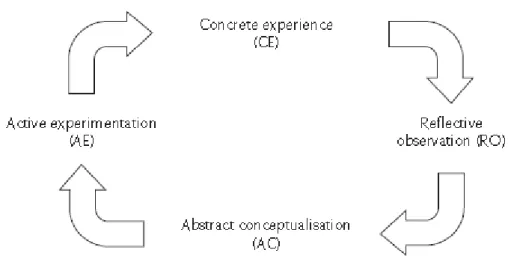
The “Kolb Learning Cycle” encompasses four kinds of abilities required for a successful learning (see Figure 1.1).
First, the students‟ full and free involvement in novel experience (CE). Second, the creation of the appropriate time and space to be able to reflect on their experiences from different viewpoint (RO). Third, the students‟ ability to form, reform and process their ideas, integrating their new ideas and understanding into sound, logical theories (AC). These middle two elements in the cycle can be strongly influenced by feedback from others. The fourth point (AE) implies the use of the required understanding for decision-making and problem-solving, implication testing and the adaptation to new situations.
The teacher needs to be aware that in practice learners do not cycle smoothly through the model, but may get stuck, fail to progress or „jump about‟. The way in which the learner resolves these tensions will have an effect on the learning outcome and the development of different types of strength in the learner and, as will be seen, may pertain to personality traits and/or disciplinary differences. (Fri, Ketteridge, & Marshall, 2009)
Experiential learning embraces the second step i.e. reflection as a key point. Boud et al (1985) argue that “[reflection] turns experience into learning”. In order to learn from experience, students are demanded to investigate and analyze the experience; reflection in this context means its conscious or subconscious use when taking a deep approach to learning. "Reflection consists of those processes in which learners engage to recapture, notice and reevaluate their experience, to work with their experience, to turn it into learning" (Boud et al.,1993, p. 9). The reflection process helps the students to improve the students‟ active involvement.”The reflective activities such as the keeping of learning portfolios, debriefing sessions, guided reflection and periods of quiet contemplation following experience-based classroom activities‟‟(Boud & Walker, 1992, p. 165).
An oral presentation is the result of the accumulation of different studies, surveys and practices. However, different studies show that students face many problems in oral presentations. The following problems are considered amongst the major problems:
1.15.1. Lack of Preparation
Many studies stress the importance of preparation before delivering an oral presentation. According to Tracy (2008), “ fully 90 percent of your success as a speaker will be determined by how well you plan your speech” (p. 18). In this respect students need all the time to prepare an effective oral presentation; however, students ignore and overpass this crucial step. As a result students face many problems like: choosing the irrelevant information, forgetting the outline of the presentation, overtaking time and not providing links for further information. Cambridge University Press cites the different obstacles induced by lack of preparation as follows:
More information than available speaking time. Difficulty for the audience to understand.
1.15.2. Performance Anxiety
Public speaking causes many difficulties especially for students who feel shy and less confident. Speech anxiety is a natural reaction that everyone can have. According to Tury (2008): “51 percent of adults rate fear of public speaking a head of the fear of death” (p. 14). The listeners and the teacher can easily notice the speech anxiety in the voice of the presenter; however, teachers can deal with students‟ anxiety by telling them it is a normal behavior. Furthermore, students will more encouraged and less stressed if teachers rise their awareness about anxiety (King 2002, p. 404- 405).