HAL Id: hal-02661199
https://hal.inrae.fr/hal-02661199
Submitted on 30 May 2020HAL is a multi-disciplinary open access archive for the deposit and dissemination of sci-entific research documents, whether they are pub-lished or not. The documents may come from teaching and research institutions in France or abroad, or from public or private research centers.
L’archive ouverte pluridisciplinaire HAL, est destinée au dépôt et à la diffusion de documents scientifiques de niveau recherche, publiés ou non, émanant des établissements d’enseignement et de recherche français ou étrangers, des laboratoires publics ou privés.
Characterization of Vitis vinifera L. somatic variants
exhibiting abnormal flower development patterns
Philippe Chatelet, Valerie Laucou, Lucie Fernandez, Lekha Sreekanta, Thierry
Lacombe, José Miguel Martinez-Zapater, Mark R. Thomas, Laurent
Torregrosa
To cite this version:
Philippe Chatelet, Valerie Laucou, Lucie Fernandez, Lekha Sreekanta, Thierry Lacombe, et al.. Char-acterization of Vitis vinifera L. somatic variants exhibiting abnormal flower development patterns. Journal of Experimental Botany, Oxford University Press (OUP), 2007, 58 (15-16), pp.4107-4118. �10.1093/jxb/erm269�. �hal-02661199�
Journal of Experimental Botany, Page 1 of 12 doi:10.1093/jxb/erm269
This paper is available online free of all access charges (see http://jxb.oxfordjournals.org/open_access.html for further details) RESEARCH PAPER
Characterization of Vitis vinifera L. somatic variants
exhibiting abnormal flower development patterns
Philippe Chatelet1,2, Vale´rie Laucou2, Lucie Fernandez3, Lekha Sreekantan4, Thierry Lacombe2,
Jose´ Miguel Martinez-Zapater3, Mark R. Thomas4and Laurent Torregrosa2,*
1INRA-UMR DAP, 2 place Viala, 34060 Montpellier Cedex 01, France
2INRA/SupAgro-UMR DIA-PC, 2 place Viala, 34060 Montpellier Cedex 01, France
3CNB, Gene´tica Molecular de Plantas, C/Darwin 3 Cantoblanco, 28049 Madrid, Spain
4CSIRO Plant Industry, PO Box 350, Glen Osmond, SA 5064, Australia
Received 6 July 2007; Revised 3 October 2007; Accepted 8 October 2007
Abstract
Mutants have proven to be a key resource for func-tional genomic studies in model annual plant species. In perennial plant species where mutants are difficult to generate and to screen, spontaneous somatic vari-ants represent a unique resource to understand the genetic control of complex developmental patterns. The morphological and histological characterization of six Vitis vinifera L. somatic variants that display four different abnormal phenotypes of flower development are described here. A phenotype of reiterated repro-ductive meristems (RRM), with both flower and petal reiteration, was observed in a somatic variant of the cultivar Carignan. An abnormal development of re-productive organs was displayed by the unfused car-pels (UFC) somatic variant of cv. Bouchale`s, while a somatic variant of cv. Mourve`dre named carpel-less (CLS) developed abnormal ovules in the absence of carpels. Finally, three independent somatic variants in cvs Gamay, Morrastel, and Pinot displayed a pheno-type of multiple perianth whorls (MPW). Gene expres-sion studies showed that the expresexpres-sion profiles of VvMADS-box 1, 2, and 3 (putative orthologues of Arabidopsis flowering genes AG, SEP, and AGL13), were altered during grapevine flower development in the somatic variants, whereas the corresponding origi-nal cultivars displayed similar VvMADS-box gene expression profiles. Phenotypic and molecular charac-terization of these variants allowed the development of hypotheses on genetic functions that might be altered
in most of the variants in light of the current ABCDE flower model.
Key words: Flower development, grapevine, MADS-box, reproductive organs, somatic variants.
Introduction
Genes involved in flower development have been exten-sively studied in the Angiosperms using Arabidopsis and Antirrhinum as genetic models, leading to the identifica-tion of genes and gene networks controlling these pro-cesses (Theißen, 2001; Ausı´net al., 2005). Among them, the MADS-box gene family has been shown to play a central role in the determination of flower meristem and flower organ identity. The current genetic model explaining the specification of the flower organ identifies five genetic functions (A-B-C-D-E) mainly specified by MADS-box genes with specific roles in the initiation and development of flower organs in the different flower whorls, from sepals to carpels (Ferrarioet al., 2004). While spectacular progress has been made in the understanding of the molecular reg-ulation of flower development in model herbaceous plants, an increasing number of reports show differences in the regulation and the function of homeotic genes in other plant species (Ferrarioet al., 2004).
We are interested in the regulation of reproductive development in grapevine (Vitis vinifera L.), a woody perennial vine with a pattern of organ formation and * To whom correspondence should be addressed. E-mail: [email protected]
Abbreviations: CLS, carpel-less; DF, double-flowered; MPW, multiple perianth whorls; RB, ramose bunch; RRM, reiterated reproductive meristems; UFC, unfused carpels.
ª 2007 The Author(s).
This is an Open Access article distributed under the terms of the Creative Commons Attribution Non-Commercial License (http://creativecommons.org/licenses/by-nc/2.0/uk/) which permits unrestricted non-commercial use, distribution, and reproduction in any medium, provided the original work is properly cited.
development distinct from those previously described for other plants (Mullinset al., 1992; Boss et al., 2003; Carmona et al., 2007). Grapevine flowers, with four whorls from sepals to carpels, belong to the regular flower type of Eudicot plants and have been well described at the anatomical and morphological level (Pratt, 1971; Hardie et al., 1996). However, the underlying molecular genetic mechanisms regulating flower development are poorly understood. Some putative orthologues of genes control-ling flower initiation and development inArabidopsis have been isolated and characterized (Bosset al., 2001, 2002; Carmona et al., 2002, 2007; Calonje et al., 2004; Boss et al., 2006; Sreekantan et al., 2006), and their expression analyses have suggested some functional differences in this species compared with model plants (Boss and Thomas, 2002; Calonjeet al., 2004; Sreekantan et al., 2006). Still, expression of some of these genes in Arabidopsis trans-genic plants displayed phenotypes similar to those pro-duced by overexpression of the endogenous Arabidopsis genes (Bosset al., 2006; Carmona et al., 2007). However, their role in grapevine flower development remains unknown since genetic transformation is still a lengthy and tedious process in this species (Bouquetet al., 2003).
The use of natural genetic variation and induced arti-ficial mutations can be very informative in establishing gene function in the absence of genetic transformation (Emmanuel and Levy, 2002; Jack, 2004; Koornneefet al., 2004). This genetic variation can be used in forward and reverse genetic approaches to support causal relationships between gene sequences and phenotypes. Natural genetic variation is starting to be exploited in the identification of genomic regions responsible for specific quality traits in grape (Cabezas et al., 2003; Doligez et al., 2006) and could also be used in both forward and reverse ap-proaches. However, phenotypic variations for early de-velopment of reproductive organs have not been described in grapevine and although induced mutagenesis could be an alternative approach to generate phenotypic variation for this trait, mutagenesis studies are scarce in grapevine (Kuksova et al., 1997) and have not been reported to induce flowers with altered formation patterns. One in-teresting alternative to be considered in grapevine and other woody perennial species is somatic genetic variation, which can be maintained through vegetative propagation. In grapevine, somatic genetic variation has been success-fully used so far in three cases to identify genes involved in gibberellic acid signalling (Boss and Thomas, 2002), anthocyanin production (Kobayashi et al., 2004; Walker et al., 2006), and berry early morphogenesis (Fernandez et al., 2006).
The goal in this work was to characterize grapevine somatic variants altered in flower development that could serve as genetic tools to identify the roles of genes involved in this developmental process. The phenotypic description of six somatic variants is presented here, as
well as the corresponding RNA expression analysis of three MADS-box genes, previously reported to be related to the formation of the innermost floral whorls throughout flower development (Bosset al., 2001, 2002). The results allowed the development of working hypotheses on the role of genes that could be altered in each case.
Materials and methods
Plant material
The collection of grapevines at the INRA Domaine de Vassal (Marseillan, France, http://www.montpellier.inra.fr/vassal) was ex-amined and found to include six accessions with developmentally aberrant flowers, with or without cluster architecture modifications. These were studied in comparison with the original variety grown under the same field conditions. Abnormal flowers were found in clonal mutants derived from the international cultivars Pinot and Gamay, and from the Southern Europe traditional cultivars Bouchale`s, Carignan (known as Mazuelo in its country of origin Spain), Mourve`dre, and Morrastel (similarly known as Monastrel and Graciano, respectively). Early descriptions led to the introduc-tion of these variants in the collecintroduc-tion as double-flowered (DF) Gamay, Morrastel, and Pinot, ramose bunch (RB) Carignan, female Bouchale`s, and female Mourve`dre. The genetic identity of cultivars and somatic variants was confirmed through genotyping the plants with 20 unlinked microsatellite loci; VVMD5, VVMD7 (Bowers et al., 1996), VVMD21, VVMD24, VVMD25, VVMD27, VVMD28, VVMD32 (Bowers et al., 1999), VVS2 (Thomas and Scott, 1993), VVIB01, VVIH54, VVIN16, VVIN73, VVIN73, VVIP31, VVIP60, VVIQ52, VVIV37, VVIV67 (Merdinogluet al., 2005), VMC1b4 (unpublished), and VMC4f3 (Di Gaspero et al., 2000). PCR conditions were as described in Lacombeet al. (2003). Microscopy analyses
Inflorescence samples were taken at anthesis from the original clones and simultaneously from the corresponding somatic variant of at least two of the five representatives established in the field. Alternatively, sampling used greenhouse-grown fertile cuttings according to Mullins et al. (1966). Samples were preserved in a 0.2 M phosphate buffer (pH 7.2), with 10% paraformaldehyde and 2.5% glutaraldehyde for a minimum of 48 h at 4!C, and stored at the same temperature in 70% ethanol until further processing. For scanning electronic microscopy, after dehydration through a graded ethanol series, explants were critically-point dried with CO2,
sputtered with platinum, and observed with a JEOL JSM 6300F microscope.
Histological observations were performed on flowers embedded in Technovit Historesin"after dehydration as described above and following the manufacturer’s specifications. For improved sample embedding, an extra step was introduced after ethanol dehydration using three successive (4, 24, and 24 h) 1-butanol baths before impregnation with resin. Semi-thin sections (3lm) were stained with periodic acid–Schiff to reveal polysaccharide-rich structures and further stained with Naphthol Blue Black to reveal protein-containing bodies.
RNA extraction for gene expression studies
Sampling was done for several stages of inflorescence development defined as follows: stage 1, inflorescence primordium still enclosed within the bud; stage 2, inflorescence clearly separated from the vegetative axis; stage 3, first flower buds visible in the top of the
inflorescence; stage 4, initiation of new inflorescence primordia finished, all flowers well separated; stage 5, all flowers formed on fully expanded pedicels; stages 5+, cap drop starting. Flowers and inflorescences were randomly sampled for each clone from the five representatives cultivated in the field.
Total RNA was extracted from 1–2 g of inflorescence tissue as described by Tesnie`re and Vayda (1991). To get sufficient material, stage 1 and 2 samples were combined before extraction processing. A 100lg aliquot of crude RNA was further purified using the Qiagen RNeasy cleanup mini-protocol including a DNase treatment, resulting in 10–30lg of clean RNA. Quality and quantity were evaluated by both electrophoresis and spectrofluorometry.
Real-time PCR analysis
Real-time PCR analyses were performed as described in Fernandez et al. (2006). Using Primer3 software, specific primers (Tm¼58–
60!C) were designed (Rozen and Skaletsky, 2000) to amplify 100– 200 bp in the 3# untranslated region of theVvMADS1 (GenBank ID: AF265562),VvMADS2 (GenBank ID: AF373601), VvMADS3 (GenBank ID: AF373602), and ubiquitin extension proteinVvUBI (GenBank ID: CF406001) genes (see Table 1). The expression levels of the MADS-box genes were determined for three technical replicates and corrected using the corresponding expression level of ubiquitin,VvUBI.
Results
Origin of the somatic variants
The somatic variants analysed were collected from a wide range of geographical origins and over a long period of time. DF Gamay was introduced from the Ravaz collec-tion (France) in 1949, DF Pinot from the Champagne area in 1951, and DF Morrastel from a French grower in 1956. RB Carignan was introduced from Perpignan Research Station (France) in 1955. Female Bouchale`s and female Mourve`dre were introduced more recently from SEPPIC Montauban (France) in 1973 and from the Magaratsh col-lection (Crimea) via the Oberlin Institute (Colmar, France) in 1979, respectively. The somatic variants, established as five plants for each accession (as were their putative orig-inal clones), were recorded as displaying stable pheno-types after repeated vegetative propagation and over successive reproductive cycles. The genetic identity of cultivars and somatic variants was confirmed by genotyp-ing 20 independent microsatellite loci. All the somatic vari-ants displayed genotypes identical to those of the plvari-ants from which they were derived (data not shown).
Grapevine flower development
The reproductive development of V. vinifera has been extensively described (Srinivasan and Mullins, 1981). While most of the Vitis species are dioecious, in almost allV. vinifera cultivars, the flower assumes a classical her-maphrodite floral organization with a whorl of five fused sepals followed by a five-petal whorl, five stamens, and the gynaecia being composed of an ovary with two carpels each containing two ovules (Fig. 1A–D).
Flower development in somatic variants
The vegetative development of the somatic variants was similar to that of the corresponding original plants in each case. No differences in inflorescence number or position were observed between the cultivars and the respective variants. Based on initial morphological examinations, the variants were classified in three major phenotypic groups: (i) reiteration of reproductive meristems (RRM; Carignan variant); (ii) reiteration of perianth whorls (Gamay, Morrastel, and Pinot variants), and (iii) abnormal de-velopment of the reproductive whorl (Bouchale`s and Mourve`dre variants). Scanning electronic microscopy and histological observations further confirmed this prelimi-nary phenotypic classification and led to the suggestion of specific denominations better suited to the actual flower defects extensively explained below. The Carignan variant was described by the name RRM and all the variants showing reiteration of perianth whorls were described as ‘multiple perianth whorls’ (MPW). Somatic variants dis-playing abnormal development of the reproductive whorls and initially known as female variants were more spe-cifically described as ‘unfused carpels’ (UFC) for the Bouchale`s and ‘carpel-less’ (CLS) for the Mourve`dre variants. Flower development within each one of these phenotypic groups is described below.
Reiterated reproductive meristems (RRM)—Carignan variant
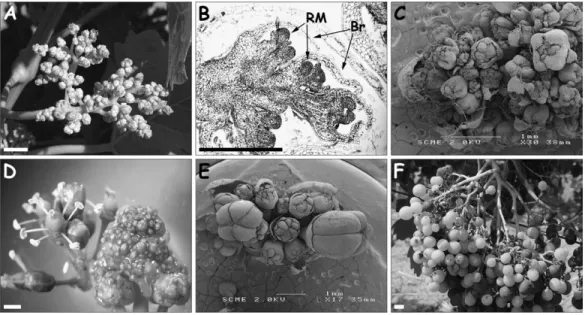
This variant was characterized by an alteration of early inflorescence architecture. After the early stages of inflo-rescence development, the differentiation of flower mer-istems (stages 1–2) was impaired and primordia reiterated the development of inflorescence ramifications (Fig. 2A). Histological observations showed reiteration of adjacent bract-floral meristems in tandem, with at least two floral
Table 1. Primers used for real-time PCR
Target gene Primer A sequence Position relative
to stop
Primer B sequence Position relative
to stop
Product length
VvMADS1 TGTGGGTCTCTTCGTGGAGT +16 TGTGGCAGGCAACAGAGTTA +200 184
VvMADS2 ATGCCCTTGTATGGTGATGA +55 GAAAGCAAGTATCATAGGTTTCCA +216 161
VvMADS3 ATCCAAGGGTGGGTTCTTTG –18 TGTCAACACAATACACACATTACACA +91 112
meristems being formed (Fig. 2B). These formations col-lapsed a few weeks after their initiation. This reiteration was probably the origin of the high number of inflores-cence ramifications, hence the ‘ramose bunch’ (RB)
description (Fig. 2C, E). This reiteration process caused a delay of ;30 d in the cluster development of the variant with respect to its corresponding cultivar (Fig. 2D). By the end of cluster development some flowers could reach full regular development, although it was frequently observed that the basic floral organization was altered with some reiteration of petals or formation of petaloid anther filaments.
In general, most regular flowers eventually differenti-ated at the most distal inflorescence positions that corre-sponded to the ones developing later. Regular mature flowers were fertile and some berries developed normally up to the ripening stage, although with the delay accumu-lated in the previous developmental phases. At ripening, mutant vines were therefore observed to bear long, very large bunches with a high number of ramifications and berries (Fig. 2F).
Multiple perianth whorls (MPW)—Gamay, Morrastel, and Pinot variants
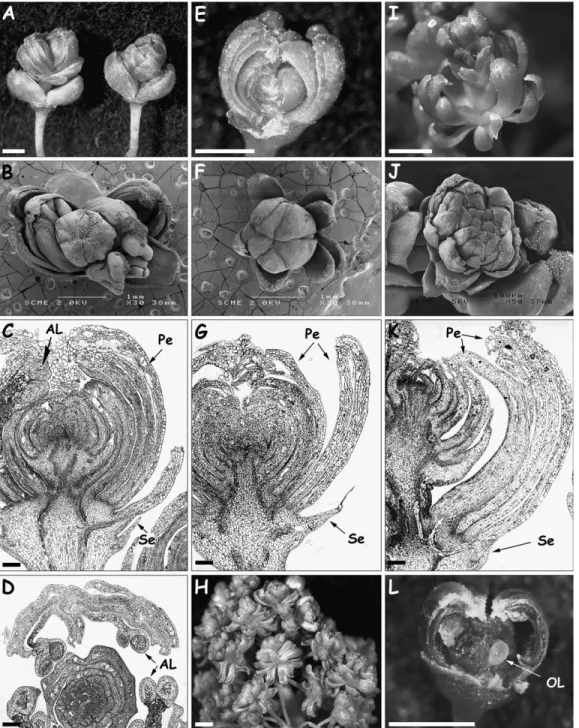
Inflorescence and flower primordia initiation in these variants followed the regular pattern observed in normal plants (data not shown). However, in these variants, after the flower primordia differentiated (stages 2–3), the organ primordia generated by the flower meristem reiteratively differentiated as whorl 1 (double, short sepals could some-times be observed in Pinot) and especially whorl 2 organs. Furthermore, the number of whorls produced was not limited to four, as the flower meristem continued to generate additional whorls of perianth organs (Fig. 3A, E, I, H). As a result of this altered developmental pattern,
Fig. 1. Wild-type V. vinifera inflorescence, flower, and grapes. (A)
Fully expanded inflorescence just before anthesis (bar¼1 cm). (B) Side
view of a flower bud (petals partially removed) just before anthesis
displaying petal cap (Pe), folded anthers (An), and ovary (Or) (bar¼1
mm). (C) Fully opened flower (bar¼1 mm). (D) Berry cluster 6 weeks
after flower set (bar¼1 cm).
Fig. 2. Phenotype of the RRM Carignan somatic variant. (A) General view of the inflorescence (bar¼1 cm). (B) Longitudinal section in a terminal
cluster with supernumerary bracts (Br) and reiterated floral meristems (RM) (bar¼2 mm). (C) SEM view of a cluster with multiple buds (bar¼1 mm).
(D) A comparison of wild-type (left) and RRM variant (right) flower clusters (bar¼2 mm). (E) Part of an inflorescence displaying regular flowers
these somatic variants generated flower structures consist-ing of multiple reiterations of sepal and petal whorls lacking reproductive organ whorls (Fig. 3B and C, F and G, J and K). In addition to these common features, anther-like structures were occasionally found fused to the upper part of inner petals of MPW Pinot (Fig. 3C, D) and some ovule-like formations appeared in the innermost organs of
MPW Gamay (Fig. 3L). Moreover, the MPW Gamay inflorescence exhibited additional specific features such as lack of secondary rachis and very short main rachis and pedicels. Sometimes, MPW Gamay flowers displayed the formation of a secondary pedicel separating reiterated flowers in the position of whorls 3 and 4 (Fig. 3K). Somatic variants reached their most advanced
Fig. 3. Flower phenotypes of MPW Pinot (A–D), Morrastel (E–H), and Gamay (I–L) somatic variants. (A, E, I) Close-up of flowers showing
multiple petals with occasional flower reiterations (A, left flower; I) (bar¼1 mm). (B, F, J) SEM illustrations showing multiple petals in all three
variants. Note the presence of a reiterated, central flower in Pinot (B). (C, G, K) Longitudinal sections of isolated flowers showing anther-like
structures (AL), sepals (Se) and multiple petals (Pe) (bar¼0.1 mm). (D) Cross-section in a variant Pinot flower showing an abnormally positioned
anthers-like structures (AL) (bar¼0.1 mm). (H) Exacerbated petal formation in Morrastel flowers (bar¼1 mm). (L) Isolated ovule-like (OL) structure
inflorescence and flower development at the anthesis time of the corresponding wild-type plants. After this stage, somatic variant inflorescences necrosed within a few weeks without berry formation.
Abnormal reproductive whorl development variants
UFC Bouchale`s: Inflorescence and flower primordia
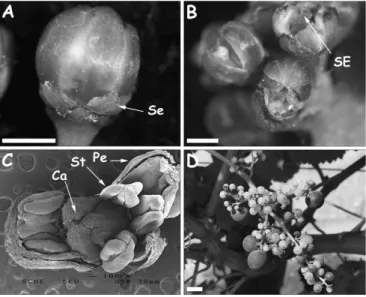
de-veloped normally in this mutant. However, later flower development was altered as some flowers displayed a double sepal or petal whorl (Fig. 4C), while all of them showed anomalies in the development of stamens and carpels. Stamens were normal in number and position but filaments were shorter than in the wild type or sometimes absent with anthers fused to ovaries. The abnormal anther structure did not allow a normal closure of the petal cap (calyptra). Furthermore, ovary development was also com-promised and most ovaries exhibited only partially fused carpels (Fig. 4C). The most conspicuous phenotypic modi-fication in this variant was premature flower opening (Fig. 4A, B) as a result of abnormal stamen and carpel devel-opment. The premature opening of flowers prevented com-plete development and decreased flower set. Still, after open pollination, some ovaries were able to develop into normal, seeded berries but, at ripening, bunches were mainly composed of small seedless berries as sometimes observed for female grapevine genotypes with stamens or pollen not fully functional (Fig. 4D).
CLS Mourve`dre: This somatic variant displayed larger
flower buds than its wild-type plant counterpart (Fig. 5A). Microscopic analysis did not reveal alterations in the
initiation of inflorescence and flower primordia, which initiated in regular positions and developed normally in the first and second whorls. However, primordia in whorls 3 and 4 did not differentiate regular reproductive organs but only carpelloid structures (Fig. 5B, D). Regular car-pels with normal ovaries could not be observed, but ovule-like structures were often found fused to carpelloid structures in the fourth central whorl. These ovule-like structures displayed some normal ovule features such as rec-ognizable integuments (Fig. 5C). Anthers were absent or displayed a completely abnormal shape, although micro-spores could be observed (Fig. 5E, F). Developed flowers were not functional and necrosed a few weeks after full development of the inflorescence. This variant was com-pletely sterile and did not develop fruit, even under open pollination, indicating that the carpelloid structures were not functional.
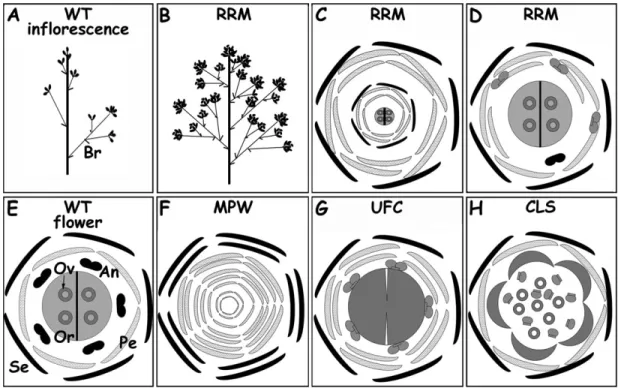
A synoptic view of the main morphological alterations observed in the six somatic variants described herein is presented in Fig. 6.
Expression of VvMADS- box genes during flower development of somatic variants
VvMADS1, VvMADS2, and VvMADS3 were initially iden-tified as the putative orthologues ofAG/SHP, SEP1/2, and AGL13, respectively (Boss et al., 2001, 2002). In Arabidopsis, SEPALLATA genes are involved in the speci-fication of petal, stamen, and carpel identity (Pelazet al., 2000), AGAMOUS is required to establish the identity of reproductive organs (Drews et al., 1991), while SHAT-TERPROOF seems to be more involved in carpel de-velopment (Savidge et al., 1995). Finally, the role of AGL13 is not yet clear, although based on its expression pattern it could be involved in ovule formation. Expres-sion of the corresponding grapevine orthologous genes was analysed by real-time PCR in the somatic variants to obtain information on the molecular events associated with the described flower developmental phenotypes. The results are shown in Fig. 7.
The correspondence between inflorescence development stages used for RNA extraction sampling and floral organ development was: stage 1, formation of first flower meri-stems and initiation of outermost whorl primordia; stage 2, more advanced flower primordia initiating sepals; stage 3, most flowers developing petals and stamens, and initi-ating ovary development; stage 4, sepals fully developed in most flowers, petals and stamens finishing development, and ovaries developing; stage 5, petals and stamens formed and ovary development completing in most flowers; stages 5+, most flowers with dehiscing anthers. Stages 1 and 2 were analysed together as the corresponding inflorescence samples were combined.
Expression profiles and levels ofVvMADS1, VvMADS2, and VvMADS3 were very similar in the six original cul-tivars. VvMADS1 and VvMADS2 showed a clear increase
Fig. 4. Phenotype of a UFC Bouchale`s somatic variant. (A) Unfused
sepals (Se) on an oversized bud (bar¼1 mm). (B) Premature petal
opening exposing the stylar extremity (SE) (bar¼1 mm). (C) SEM view
of an opened bud displaying a double petal whorl (Pe), abnormal stamens (St), and unfused carpels (Ca). (D) Bunch displaying mainly
in their expression from inflorescence initiation to the mature flower stage (Fig. 7). On the other hand, the expression profile of VvMADS3 showed a maximum at developmental stages 4–5 (Fig. 7).
The RRM somatic variant of Carignan was character-ized by an overexpression of all VvMADS-box genes at stage 3 of flower development as well as at stage 5 for VvMADS1. All the MPW variants, independently of their
Fig. 5. Phenotype of a CLS Mourve`dre somatic variant. (A) Variant bud (right) with size increased compared with the wild-type bud (left)
(bar¼1 mm). (B) SEM view of a flower (most petals removed) displaying a carpelloid anther and ovule-like structures. (C, F) Variant flower
cross-sections displaying a nude ovule-like structure with integuments (In) and anther-like structures with microspores (bar¼0.1 mm). (D) Mature flower
(petals moved aside) to reveal carpelloid anthers, anther-like and ovule-like structures (bar¼1 mm). (E) An isolated carpelloid anther with attached
ovule-like structure. Carpelloid anthers (CA), anther-like (AL), and ovule-like (OL) structures, petals (Pe).
Fig. 6. Summary of the wild-type (WT) and somatic variant reproductive organ schemes. (A) WT inflorescence with bracts (Br), terminal and secondary flowers; and (E) WT floral diagram showing the position of sepals (Se), petals (Pe), anthers (An), ovary (Or), and ovules (Ov). (B) Inflorescence type of RRM Carignan variant. (C, D) Floral diagram of RRM Carignan. (F) Floral diagram of MPW variant type (Pinot, Morrastel, and Gamay). (G) Floral diagram of UFC Bouchale`s variant. (H) Floral diagram of CLS Mourve`dre variant.
origin, were characterized by a strong reduction in VvMADS1 expression throughout flower development. They also shared coincident expression of VvMADS2, which was expressed at levels similar to the corresponding original cultivars during the initial stages of flower devel-opment but showed a significant reduction during late stages (4–5). Finally, these three different somatic variants displayed slightly different phenotypes regarding the expression ofVvMADS3. Expression of this gene did not seem affected in the MPW Morrastel somatic variant, with respect to its wild-type cultivar. However,VvMADS3 was overexpressed in the initial flower developmental stages of MPW Gamay and throughout flower development in the MPW Pinot variant (Fig. 7).
Expression patterns of VvMADS-box genes in the two somatic variants altered in the development of reproduc-tive organs, i.e. CLS Mourve`dre and UFC Bouchale`s, differed significantly, as did the morphology of their flowers. CLS Mourve`dre displayed reduced expression of VvMADS1 expression during early flower developmental stages. In contrast to this VvMADS1 expression profile, VvMADS2 and VvMADS3 appeared to be overexpressed in earlier stages (1–2 and 3 for VvMADS2 and 3–4 for VvMADS3). In the case of VvMADS2, there was a strong reduction in its expression in the later stages of 5 and 5+. For UFC Bouchale`s, the expression of all three VvMADS-box genes was found to be very close to that of the corresponding wild type.
Discussion
It is significant that out of the 200 variants contained in the 4500V. vinifera accessions of the Vassal repository, the largest grapevine collection of Vitaceae germplasm, only six variants displayed altered flower morphology (Thiset al., 2006). This could indicate that little attention so far has been paid to flower development and/or that such perturbations are rare events in Vitis. Indeed, while many reports describe somatic variation for leaf morphol-ogy (Durquety and Houbart, 1982), berry form, or colour (Pires et al., 2003; Kobayashi et al., 2004; Fernandez et al., 2006), few authors have reported Vitis variants with abnormal flower morphology. Previous reports have mentioned the existence of multiple whorled flowers (Oprea, 1965; Branas, 1974), but lacked detailed descrip-tions. Caporali et al. (2003) described flowers with abnormal development of anthers in wild, hermaphrodite V. vinifera Additionally, the Mourvedre and Bouchale`s
variants have been only briefly reported recently (Sreekantanet al., 2006).
The genetic basis of somatic variants
The utility of somatic grapevine variants in the study of gene function depends largely on the understanding of the mechanisms involved in the generation of somatic vari-ation. In the highly probable case that the described phenotypes are the result of somatic mutations, several considerations are required when interpreting the variant phenotypes. First, the somatic mutation takes place in a single cell belonging to a specific cell layer (L1 and L2 layers are distinct in grapevine shoot apical meristems; see Thompson and Olmo, 1963; Frankset al., 2002; Fernandez et al., 2006). For the mutant phenotype to be observed, the mutant cell has to ‘colonize’ the corresponding cell layer in at least one shoot apical meristem and derived organs. However, unless the mutant cell layer colonizes the other cell layer and this situation is again stabilized, the somatic variant will be a chimera. This in fact has been the case in most grapevine somatic variants de-scribed previously (Boss and Thomas, 2002; Frankset al., 2002; Ageorgeset al., 2006; Fernandez et al., 2006). This situation means that the observed phenotype results from chimerism and cannot be directly associated with the phe-notype of solid mutant plants. Secondly, somatic muta-tions will only take place in one copy of the target gene. Unless the mutation takes place in the functional allele of a heterozygous locus, an unlikely situation, the resulting phenotypes are more likely to be due to the occurrence of gain-of-function mutations causing an observable change. This has been the case in the two somatic variants that have so far been characterized at the molecular level in grapevine [GAI1 by Boss and Thomas (2002) and the berry colour MYBA1 gene by Kobayashi et al. (2004)]. Thus, it is highly probable that the phenotypes observed in the described variants are the result of gain-of-function mutations in a chimeric state, something that should be considered when attempting to understand the phenotypes under current genetic models of flower development. Thirdly, it is not known which molecular mechanisms are responsible for the generation of these mutant phenotypes and so far the available information is scarce. At least for berry colour, retrotransposable elements through homolo-gous long terminal repeat (LTR) recombination or ille-gitimate recombination are responsible for a large proportion of the somatic variation observed for the trait (Lijavetzky et al., 2006). If these mechanisms were responsible for some of the flower phenotypes described,
Fig. 7. VvMADS1–3 real-time PCR expression profiles during inflorescence and floral development of six somatic variants versus their respective
wild-type counterpart. Thex-axis shows reproductive organ development with stages 1–2 (young inflorescence a few days after bud burst) to stages
5+ (flowers opening). They-axis shows arbitrary expression units for each variant/wild-type pair. SE bars correspond to the variation for technical
one would expect some phenotypes to appear repeatedly in specific cultivars as well as in genetically related cultivars. The MPW phenotype, found in Pinot and Gamay, a derived hybrid variety, would be in agreement with this possibility. Slight phenotypic differences be-tween both variants could be attributed to different genetic backgrounds. The similarity of phenotypes observed even in non-closely related cultivars such as Morrastel and Pinot could also be explained by the presence of those mutable loci in the genome.
Mutant phenotypes and altered gene functions in grapevine flower development
The somatic variants presented here are affected in the specification of identity, of either flower meristems or organ primordia. However, no earlier events regulating flower initiation appear to be affected. The RRM variant exhibited the earliest phenotypic alteration, apparently causing a delay in flower meristem specification. This alter-ation resulted in clusters with exacerbated ramificalter-ations and delayed development. InArabidopsis, a similar pheno-type is caused by lack-of-function mutations in genes required for flower meristem specification such as AP1 (Bowman et al., 1993), LFY (Parcy et al., 2002), FUL (Ferrandiz et al., 2000), or more extremely in the double mutantap1 cal (Kempin et al., 1995). Similar to what was observed in the Carignan variant, in the Arabidopsis mutants the phenotype of the basal flowers is more strongly affected than that of the uppermost flowers that are almost normal and fertile. In fact, even strong cauliflower (ap1 cal) phenotypes are eventually able to elongate their inflorescence and produce regular, fertile flowers (Kempinet al., 1995). This suggests that both in the Arabidopsis mutants and in the Carignan variant the genes required for floral organ formation are fully func-tional. The RRM phenotype could also be explained as a result of overexpression or ectopic expression of TFL-like genes in the inflorescence and flower meristems, as has been shown in transgenic Arabidopsis using either Arabidopsis TFL genes or genes from other species, including grapevine (Bosset al., 2006).
Grapevine MPW variants are able to develop perianth organs requiring A and B functions, but are impaired in the specification of anther and carpel identity. This pheno-type is consistent with a loss-of-function mutation in class C genes such as AGAMOUS (Coen and Meyerowitz, 1991) which is also required to prevent reiteration of whorl formation (Yanofsky et al., 1990). In agreement with this possibility, the expression of theVvMADS1 gene, a putative AG/SHP homologue (Boss et al., 2001), was strongly reduced in the three variants during all stages of flower development.
The CLS Mourve`dre variant did not exhibit clear homeotic transformations of the ovary into other floral or-gans as commonly observed inArabidopsis. Instead, this
mutant developed normal sepals and petals, but exhibited alterations in the innermost whorls with the development of carpelloid structures. These whorls displayed ovules together with abnormal, stamen-like tissues. The fact that alterations were restricted to the two inner whorls suggests malfunction in class C or downstream genes. Interestingly, VvMADS1 was found to be repressed in this mutant during early flower development, but later expression was found to be similar to the wild type, and ovule-like structures could develop.
The UFC Bouchale`s displayed less severe flower morphology defects and similar expression patterns for VvMADS1, 2, and 3 compared with the wild type. Sreekantan et al. (2006) recently showed a delayed over-expression of VvMADS9 (PI homologue) in the UFC variant compared with the wild type. Interestingly, a PI temporal deregulation was also shown to be associated with some alterations of ovary shape in the fleshless grapevine mutant (Fernandezet al., 2006).
The grapevine genome sequence was recently com-pleted (Jaillon et al., 2007), facilitating the identification and cloning of candidate gene sequences. Grapevine somatic variants exhibiting unusual patterns of flower or berry development represent unique material to enable the investigation of the regulation of reproductive develop-ment in grapevine (Fernandez et al., 2006, 2007). However, because of the origin of these phenotypes, the dissociation of L1 and L2 cell layers, through either sexual propagation (as gametes arise from the L2 cell layer) in the fertile mutants or somatic embryogenesis (Franks et al., 2002), will be required for subsequent ge-netic analysis. This report is the first comprehensive de-scription of grapevine somatic variants showing altered early development of reproductive organs. Further inves-tigations, based on our hypotheses, should eventually result in the identification of the gene(s) responsible for the mutant phenotypes and lead to a better understanding of their function in grapevine flower development.
Acknowledgements
Scanning electron microscopy and light microscopy observations were performed, respectively, at the Montpellier UMII Joint Electronic Microscopy Laboratory and PHIV Montpellier Rio Imaging facilities (http://www.mri.cnrs.fr). The authors thank D Vare`s, Dr J-M Boursiquot, and Domaine INRA de Vassal staff for the access to somatic variants, passport data, and useful comments. Thanks are extended to G Lopez for plant care and to C Brachet for RNA extractions.
References
Ageorges A, Fernandez L, Vialet S, Merdinoglu D, Terrier N, Romieu C. 2006. Four specific isogenes of the anthocyanin metabolic pathway are systematically co-expressed with the red colour of grape berries.Plant Science 170, 372–383.
Ausin I, Alonso-Blanco C, Martinez-Zapater JM. 2005. Envi-ronmental regulation of flowering. International Journal of Developmental Biology 49, 689–705.
Boss PK, Buckeridge EJ, Poole A, Thomas MR. 2003. New insights into grapevine flowering.Functional Plant Biology 30, 593–606.
Boss PK, Sensi E, Hua C, Davies C, Thomas MR. 2002. Cloning and characterisation of grapevine (Vitis vinifera L.) MADS-box genes expressed during inflorescence and berry development. Plant Science 162, 887–895.
Boss PK, Sreekantan L, Thomas MR. 2006. A grapevine TFL1 homologue can delay flowering and alter floral development when over-expressed in heterologous species.Functional Plant Biology 33, 31–41.
Boss PK, Thomas MR. 2002. Association of dwarfism and floral induction with a grape ‘green revolution’ mutation.Nature 416, 847–850.
Boss PK, Vivier M, Matsumoto S, Dry IB, Thomas MR. 2001. A cDNA from grapevine (Vitis vinifera L.), which shows homology to AGAMOUS and SHATTERPROOF, is not only expressed in flowers but also throughout berry development. Plant Molecular Biology 45, 541–553.
Bouquet A, Torregrosa L, Chatelet P. 2003. Grapevine genetic engineering: tool for genome analysis or plant breeding method? Which future for transgenic vines?AgBiotechNet 5, 1–10. Bowers J, Boursiquot JM, This P, Chu K, Johansson H,
Meredith C. 1999. Historical genetics: the parentage of Char-donnay, Gamay and other wine grapes of Northeastern France. Science 285, 1562–1565.
Bowers JE, Dangl GS, Vignani R, Meredith CP. 1996. Isolation and characterization of new polymorphic simple sequence repeat loci in grape (Vitis vinifera L.). Genome 39, 628–633.
Bowman JL, Alvarez J, Weigel D, Meyerowitz EM, Smyth DR. 1993. Control of flower development inArabidopsis thaliana by APETALA1 and interacting genes. Development 119, 721–743. Branas J. 1974. Viticulture. Montpellier, France: Dehan Imp. Calonje M, Cubas P, Martı´nez-Zapater JM, Carmona MJ.
2004. Floral meristem identity genes are expressed during tendril development in grapevine. Plant Physiology 135, 1491–1501.
Cabezas JA, Cervera MT, Arroyo-Garcia R, Ibanez J, Rodriguez-Torres I, Borrego J, Cabello F, Martinez-Zapater JM. 2003. Garnacha and Garnacha Tintorera: genetic relationships and the origin of teinturier varieties cultivated in Spain.American Journal of Enology and Viticulture 54, 237–245. Caporali E, Spada A, Marziani G, Failla O, Scienza A. 2003. The arrest of development of abortive reproductive organs in the unisexual flower of Vitis vinifera ssp silvestris. Sexual Plant Reproduction 15, 291–300.
Carmona MJ, Calonje M, Martinez-Zapater JM. 2007. The FT/ TFL1 gene family in grapevine. Plant Molecular Biology 63, 637–650.
Carmona MJ, Cubas P, Martı´nez-Zapater JM. 2002. VFL, the grapevine FLORICAULA/LEAFY ortholog, is expressed in meristematic regions independently of their fate.Plant Physiology 130, 68–77.
Coen ES, Meyerowitz EM. 1991. The war of the whorls: genetic interactions controlling flower development.Nature 353, 31–37.
Di Gaspero G, Peterlunger E, Testolin R, Edwards J, Cipriani G. 2000. Conservation of microsatellite loci within the genusVitis. Theoretical and Applied Genetics 101, 301–308. Doligez A, Audiot E, Baumes R, This P. 2006. QTLs for muscat
flavor and monoterpenic odorant content in grapevine (Vitis vinifera L.). Molecular Breeding 18, 109–125.
Drews GN, Bowman JL, Meyerowitz EM. 1991. Negative regulation of the Arabidopsis homeotic gene AGAMOUS by the APETALA2 product.Cell 65, 991–1002.
Durquety PM, Houbart JP. 1982. Two Tannat sports: ‘meunier’ and ‘ bulle´’.Progre`s en Agricole Viticole 99, 83–87.
Emmanuel E, Levy AA. 2002. Tomato mutants as tools for func-tional genomics.Current Opinion in Plant Biology 5, 112–117. Fernandez L, Romieu C, Moing A, Bouquet A, Maucourt M,
Thomas MR, Torregrosa L. 2006. The grapevine fleshless berry mutation: a unique genotype to investigate differences between fleshy and non-fleshy fruit.Plant Physiology 140, 537–547. Fernandez F, Torregrosa L, Terrier N, Sreekantan L, Grimplet J,
Davies C, Thomas MR, Romieu C, Ageorges A. 2007. Identifica-tion of genes associated with flesh morphogenesis in grapevine (V. vinifera L.) berry. Plant Molecular Biology 63, 307–323. Ferrandiz C, Liljegren SJ, Yanofsky MF. 2000. Negative
regulation of the SHATTERPROOF genes by FRUITFULL duringArabidopsis fruit development. Science 289, 436–438. Ferrario S, Imminck RGH, Angenent GC. 2004. Conservation and
diversity in flower land.Current Opinion in Plant Biology 7, 84–91. Franks T, Botta R, Thomas MR. 2002. Chimerism in grapevines: implications for cultivar identity, ancestry and genetic improve-ment.Theoretical and Applied Genetics 104, 192–199.
Hardie WJ, O’Brien TP, Jaudzems VG. 1996. Morphology, anatomy and development of the pericarp after anthesis in grape, Vitis vinifera L. Australian Journal of Grape and Wine Research 2, 97–142.
Jack T. 2004. Molecular and genetic mechanism of floral control. The Plant Cell 16, 1–17.
Jaillon O, Aury JO, Noel B, et al. 2007. The grapevine genome sequence suggests ancestral hexaploidization in major angiosperm phyla.Nature 449, 463–467.
Kempin SA, Savidge B, Yanofsky MF. 1995. Molecular basis of the cauliflower phenotype in.Arabidopsis. Science 267, 522–525. Kobayashi S, Goto-Yamamoto N, Hirochika H. 2004.
Retro-transposon-induced mutations in grape skin color. Science 304, 982.
Koornneef M, Alonso-Blanco C, Vreugdenhill D. 2004. Natu-rally occurring genetic variation inArabidopsis thaliana. Annual Review of Plant Biology 55, 141–172.
Kuksova V, Piven N, Gleba Y. 1997. Somaclonal variation and in vitro induced mutagenesis in grapevine. Plant Cell, Tissue and Organ Culture 49, 17–27.
Lacombe T, Laucou V, Di Vecchi M, et al. 2003. Contribution a` la caracte´risation et a` la protection in situ des populations de Vitis vinifera L. ssp. silvestris (Gmelin) Hegi, en France. Quatrie`me colloque national du BRG, La Chaˆtre 14–16 Octobre 2002.Les Actes du BRG 4, 381–404.
Lijavetzky D, Ruiz-Garcia L, Cabezas JA, De Andres MT, Bravo G, Ibanez A, Carreno J, Cabello F, Ibanez J, Martinez-Zapater JM. 2006. Molecular genetics of berry colour variation in table grape.Molecular Genetics and Genomics 276, 427–435.
Merdinoglu D, Butterlin G, Bevilacqua L, Chiquet V, Adam-Blondon A-F, Decroocq S. 2005. Development and characteriza-tion of a large set of microsatellite markers in grapevine (Vitis vinifera L.) suitable for multiplex. Molecular Breeding 15, 349–366.
Mullins MG, Bouquet A, Williams LE. 1992. Biology of grapevine. Cambridge: Cambridge University Press.
Oprea DD. 1965. Lucr!ari pratice di viticultur!a. Bucarest: Didactica Sxi Pedagogica.
Parcy F, Bomblies K, Weigel D. 2002. Interaction of LEAFY, AGAMOUS and TERMINAL FLOWER1 in maintaining floral meristem identity inArabidopsis. Development 129, 2519–2527.
Pelaz S, Ditta G, Baumann E, Wisman E, Yanofsky M. 2000. B and C floral organ identity functions require SEPALLATA MADS-box genes.Nature 405, 200–203.
Pires EJP, Sawazaki HE, Terra MM, Bothelho RV, Conagim A, Nogueira NAM. 2003. Redimeire: a natural mutation of cv. Italia in Brazil.Vitis 42, 55–56.
Pratt C. 1971. Reproductive anatomy in cultivated grapes: a review. American Journal of Enology and Viticulture 22, 92–101. Rozen S, Skaletsky HJ. 2000. Primer3 on the WWW for general
users and for biologist programmers. In: Krawetz S, Misener S, eds.Bioinformatics methods and protocols: methods in molecular biology. Totowa, NJ: Humana Press, 365–386.
Savidge B, Rounsley SD, Yanofsky MF. 1995. Temporal relationship between the transcription of two Arabidopsis MADS-box genes and the floral organ identity genes.The Plant Cell 7, 721–733.
Sreekantan L, Torregrosa L, Fernandez L, Thomas MR. 2006. VvMADS9, a class B MADS-box gene involved in grapevine flowering, shows different expression patterns in mutants with abnormal petal and stamen structures.Functional Plant Biology 33, 877–886.
Srinivasan C, Mullins MG. 1981. Physiology of flowering in the grapevine: a review.American Journal of Enology and Viticul-ture 32, 47–53.
Tesniere C, Vayda MEV. 1991. Method for the isolation of high quality RNA from grape berry tissues without contaminating tannins or carbohydrates. Plant Molecular Biology Reporter 9, 242–251.
Theißen G. 2001. Development of floral organ identity: stories from the MADS house. Current Opinion in Plant Biology 4, 75–85.
This P, Lacombe T, Thomas MR. 2006. Historical origins and genetic diversity of wine grapes.Trends in Genetics 22, 511–519. Thomas MR, Scott NS. 1993. Microsatellite repeats in grapevine reveal DNA polymorphisms when analysed as sequence-tagged sites (STSs).Theoretical and Applied Genetics 86, 985–990. Thompson MM, Olmo HP. 1963. Cyto-histological studies of
cytochimeric and tetraploid grapes. American Journal of Botany 50, 901–906.
Walker AR, Lee E, Robinson S. 2006. Two new grape cultivars, bud sports of Cabernet Sauvignon bearing pale-coloured berries, are the result of deletion of two regulatory genes of the berry colour locus.Plant Molecular Biology 62, 623–635.
Yanofsky MF, Ma H, Bowman JL, Drews GN, Feldmann KA, Meyerowitz EM. 1990. The protein encoded by the Arabidopsis homeotic gene agamous resembles transcription factors.Nature 5, 35–39.