HAL Id: halshs-02317416
https://halshs.archives-ouvertes.fr/halshs-02317416
Preprint submitted on 16 Oct 2019HAL is a multi-disciplinary open access
archive for the deposit and dissemination of sci-entific research documents, whether they are pub-lished or not. The documents may come from teaching and research institutions in France or
L’archive ouverte pluridisciplinaire HAL, est destinée au dépôt et à la diffusion de documents scientifiques de niveau recherche, publiés ou non, émanant des établissements d’enseignement et de recherche français ou étrangers, des laboratoires
From downcoding to upcoding: DRG based payment in
hospitals
Carine Milcent
To cite this version:
Carine Milcent. From downcoding to upcoding: DRG based payment in hospitals. 2019. �halshs-02317416�
WORKING PAPER N° 2019 – 53
From downcoding to upcoding: DRG based payment in hospitals
Carine Milcent
JEL Codes:
Keywords: Hospital stays, Diagnosis-related groups (DRGs), Upcoding, manipulated database, heterogeneity in responses
From downcoding to upcoding: DRG based payment in hospitals Carine Milcent (CNRS – PSE)
From downcoding to upcoding: DRG based payment in hospitals
Carine Milcent
CNRS - PSE
Abstract
A prospective disease group-based payment is a reimbursement rule used in a wide array of countries. It turns to be the hospital’s payment rule to imply. The secret of this payment is a fee payment as well as a hospital’s activity based payment. There is a consensus to consider this rule of payment as the least likely to be manipulated by the actors. However, the defined fee per group depends on recorded information that is then processed using complex algorithms. What if the data itself can be manipulated? The result would be a fee per group based on manipulated factors that would lead to an inefficient budget allocation between hospitals. Using a unique French longitudinal database with 145 million stays, I unambiguously demonstrate that the implementation of a finer classification led to a up-coding. The end result has been a budget transfer from public non-research hospitals to for-profit hospitals. This budget reallocation did not correspond to any change in the actual production of care.
Résumé
Les établissements hospitaliers français sont tous tarifés par Groupe Homogène de Séjours (GHS) depuis 2008. Ce mode de tarification est aujourd’hui largement adopté par l’ensemble des pays de l’OCDE. Toutefois, une tarification à 100% par forfait par séjour fait aujourd’hui débat en France. Les indicateurs de qualité semblent orthogonaux à la rémunération définie. Afin de prendre en compte plus finement la sévérité des patients, la classification des GHS a été multipliée par 3. A partir d’une base de données originale de 145 millions d’observations, nous sommes à même de comparer le comportement de codage avant la mise en place de cette nouvelle classification et après la mise en place de cette nouvelle classification. Nous montrons
From downcoding to upcoding: DRG based payment in hospitals Carine Milcent (CNRS – PSE)
comportement de codage. Ce changement de codage est intervenu sans modification de la production réel de soins. Suivant le type d’établissement, l’adaptation au codage diffère. La tarification étant à enveloppe fermée, nous montrons une réallocation du budget vers les établissements à but lucratifs au détriment des établissements publics hors établissements de recherche.
key findings/implications of the manuscript
1- implementation of a finer classification led to a up-coding
2- At short term, a budget transfer from public non-research hospitals to for-profit hospitals
3- This budget reallocation did not correspond to any change in the actual production of care
Keywords: Hospital stays, Diagnosis-related groups (DRGs), Upcoding, manipulated database,
From downcoding to upcoding: DRG based payment in hospitals Carine Milcent (CNRS – PSE)
From down-coding to up-coding:
DRG based payment in hospitals
Introduction
Manipulating the data from patient’s health record during their stay in hospital is one way of
shifting from one disease group (called DRG) to a more profitable one. Indeed, raw information
manipulation allows coding changes to generate additional payment unrelated to the needs of
patients (Steinwald and Dummit, 1989). In this paper, I use a database that has undergone a
change in the logic of construction of DRGs, the number of groups increasing from around 800
to 2,200. This shift in classification logic created a natural experiment for testing whether French
hospitals tend to enhance profit by taking advantage of regulatory loopholes through a behavior
of upcoding (from an initial down-coding context). I also examine the heterogeneity in the
response of hospitals to this change in coding structure.
While DRG-based hospital payment systems may provide adequate reimbursement for the
average patient within each DRG, they overpay hospitals for patients with below-average
resource consumption and underpay for patients with above-average cost. In order to avoid
creating perverse incentives, which could lead to patient selection or a priori treatment choices,
DRG payments are adjusted to the expected cost of a patient stay. But studies in various
countries, including France, have found that DRG classification did not explain all of the
From downcoding to upcoding: DRG based payment in hospitals Carine Milcent (CNRS – PSE)
2017). While upcodingi behavior is widely studied with the US hospitals, we know almost
nothing when healthcare is mainly provided by the public sector, as it is the case in France.
To improve the granularity of reimbursement, DRG classifications have often been refined over
time. Refinements usually consist in splitting a single DRG category into more DRG categories
related to the same primary diagnosis. The current debate in the United States on the potential
impact of further refinement of DRGs for certain hospitals is instructive. A study carried out for
MedPAC in 2005 demonstrated, for a given DRG, large variations in profitability: DRGs relating
to surgery were found to be more profitable than those for medical treatments, notably for
orthopaedic and cardiovascular care. On one hand, this led to the idea that a refinement in the
classification would improve the payment system by better capturing differences in the severity
of treated cases. The logic is straightforward. Highly disaggregated payment systems only offer
an incentive to produce the highly disaggregated product at minimum cost. There is no incentive
to make efforts to economize on the number or variety of disaggregated services (Newhouse,
2002; Newhouse, 2003; Cash et al., 2003). On the other hand, refinement increased the
complexity of the DRG classification, requiring a very detailed and sophisticated information
system, with an increased risk of mispayment if the information is not accurate.
This article studies the impact of a decision by French policy makers to refine the DRG
classification in 2009 by introducing levels of severity, and, as a consequence multiplying by
three the number of DRG groups. For internal purposes, the French health statistics agency used
the new 2009-classification of the algorithm to classify stays before and after the implementation
of this new classification. With this unique database, I identify changes in hospitals’ coding
From downcoding to upcoding: DRG based payment in hospitals Carine Milcent (CNRS – PSE)
change in behavior, i.e. changes of the raw information only due to change in the DRG
classification. Besides, I distinguished this behavior change according to the type of hospitals.
I find an unambiguous upcoding of the raw information as hospitals’ response to a refinement of
the DRG classification. This upcoding consists in changes in hospital record-keeping practices in
order to increase case-mix indices and reimbursements. The probability of being coded as
non-severe decreased by about 2.1%. These results are consistent when controlling for pathology
indicators and hospital fixed effects: hospitals are sensitive to the financial incentives created by
the DRG classification. I also find that hospitals’ response to the refinement of the DRG
classification system depended on hospital ownership. For-profit hospitals were more sensitive to
the financial incentives created by this change in DRG classification logic. Public non-research
hospitals were the least sensitive to the change. An implication of these results is a budget
reallocation that went to for-profit hospitals at the expense of public non-research hospitals.
The paper is organized into five sections. Section 2 presents the implications of activity-based
pricing (T2A). It introduces a hospital objective function, which provides the theoretical
framework for the empirical sections that follows. Section 3 presents the database, and the results
in Section 4. Section 5 presents robustness checks. Finally, Section 6 presents concluding
remarks.
The implications of activity-based pricing
This research contributes to the literature on providers in healthcare (Ellis and McGuire, 1986;
Pope, 1989; Ma, 1994, 1998; Chalkley and Malcomsom, 2000; Mougeot and Naegelen, 2008;
From downcoding to upcoding: DRG based payment in hospitals Carine Milcent (CNRS – PSE)
coding of secondary diagnoses and procedures is an intended effect of the introduction of
DRG-based hospital payment systems, but the risk is that hospitals attempt to increase revenues
through fraudulent coding practices, leading to unjustified payments (Simborg, 1981; Steinbusch
et al., 2007; Silverman and Skinner, 2004). Kuhn and Sicilliani (2008) assume that providers can
increase demand by increasing quality but can also inflate activity through a manipulative effort.
Most of the attention in the empirical literature has focused on how hospitals respond to price
changes (Silverman et al., 1999; Silverman and Skinner, 2004 ; Xirasagar, 2006; Brekke et al.
2012). Gilman (2000) investigated the impact of a 1994 reform of Medicaid DRGs for HIV
diagnoses in New York. He found that DRG fee changes led to changes in length of stay. These
results suggest that hospitals make DRG-specific changes in intensity of care in response to price
changes. Researchers have attempted to measure the role of upcoding in increased case-mix
indices in US Medicare (Carter and Ginsburg, 1985; Hsia et al., 1988; Carter et al., 1990). Dafny
(2005) exploited a 1988 policy reform that generated large price changes in Medicare
admissions. She found that the upcoding response was stronger among for-profit hospitals.
Barros and Braun (2013), following Dafny (2005), explored the link between upcoding and price
increases in the context of a national health service (that of Portugal). Sacarny (2016) uses the
change in billing categories to estimate a model of technology adoption. Geruso and Layton
(2015) used upcoding data to learn about the game between payers and providers. Using the
French natural experiment, I study differences across hospitals in how they respond to the 2009
policy, with the introduction of the severity level in the DRG classification, tripling the number
of groups.
From downcoding to upcoding: DRG based payment in hospitals Carine Milcent (CNRS – PSE)
The French national health insurance scheme (Sécurité Sociale) is a single-payer system: this
eliminates any concerns about potential cost-shifting behavior by providers, negotiation between
providers and payers, or different reimbursement schemes for different patients. Reimbursements
cover almost all medical services in hospitals, except an additional fixed fee per day for catering
and accommodation in for-profit hospitals.
How is the French hospital system structured? It consists of three types of hospitals: public,
private for-profit, and private not-for-profit. Healthcare for in-patient is mainly provided by the
public sector. This paper focuses on stays in acute care units. For these, for-profit private
hospitals represent 25% of beds, while public hospitals make up two thirds of total beds. The
remaining 8% of beds are in private non-profit institutions. In terms of stays, 36% of admissions
are to for-profit private hospitals (DREES, 2012).iiUntil the 2000s, the public sector was largely
immune from standard market forces pushing for production efficiency. Since 2008, a
DRG-based payment (T2A) has been the sole mode of reimbursement of health care institutions for all
acute care stays, regardless of hospital type. However, according to the literature, for a same
reimbursement rule, the hospital behavior differs. Dafny (2009, 2005) and Silverman (2004) find
that for-profit hospitals or for-profit managers upcode more than hospitals of other ownership
forms. It suggests that the upcoding strategies of for-profit hospitals vary from non-profit or
government-owned hospitals, a prediction we consider in the empirical work that follows.
Yardstick Competition in practice
From downcoding to upcoding: DRG based payment in hospitals Carine Milcent (CNRS – PSE)
ex post. Ex ante, the regulator announces to hospitals that they will receive a lump-sum transfer
per DRG, whose amount is not yet established but which will correspond to the mean cost. This
model thus makes payments dependent on the mean cost for a given DRG. Assuming hospitals
and stays to be homogeneous, the cost variable that differs between stays is the hospital level of
cost reduction effort. The unique feature of this model is its calculation of the transfer, consisting
of the mean cost in all hospitals except the one receiving the payment. The lump-sum transfer
received is thus exogenous to the hospital’s activity. Rational behavior in the context of payment
by lump-sum transfer is to minimize costs in order to capture the rent between the lump sum and
the actual cost. Here, this involves making the maximum effort for the minimum cost. All
hospitals having the same rational behavior, the cost paid by all hospitals will be the minimum
cost. The lump sum thus corresponds ex post to the minimum cost for a given DRG g.
The pricing model currently in effect in France is defined for periods of one year. The rule is the
following: at the end of the period, each hospital receives an amount of funding for the next
period calculated on its activity over the past year. More specifically, each stay is associated to a
DRG, which defines a certain quantity of care and a mean cost;iii i.e., a certain amount of
hospital activity. A lump sum is associated to each stay classified under this DRG. At the end of
the period, the hospital thus receives the total of the lump sums corresponding to its activity for
the period.
I now present the calculation of lump sums by DRG. Assuming hospitals to be rational agents, I
explicitly derive the incentives that result from this financing mechanism. Let shg denote stay s
associated to DRG g in hospital h; Shg denote the total number of admissions associated to DRG
From downcoding to upcoding: DRG based payment in hospitals Carine Milcent (CNRS – PSE)
hospital h having admitted at least one patient for a stay associated to DRG g; and Hg denote the
number of hospitals having admitted at least one patient for a stay associated to DRG g.
The mean cost for a DRG g is defined by:
On the basis of the mean cost per DRG, a relative cost scale for the different DRGs can be
defined. DRGs are thus ordered on a scale from the least costly to the most costly. DRGs can be
expressed as a function of a reference DRG. The choice of reference DRG has no impact on the
budget that the hospital receives at the end of the period. Then, a relative index is associated to
each DRG. Let 𝐶! denote the mean cost of a stay s associated to DRG g; 𝐶!"#$denote the mean cost of a stay s associated to the reference DRG, called gref . The relative index ig of a DRG g is
defined by: 𝑖! = 𝐶! /𝐶!"#$
Payment per DRG & a fixed annual envelope
Such a pricing system offers no way to control the volume of care. In France, we are in a context
where the financial situation of the public system has declined since the 80s. The regulator
cannot thus risk an uncontrolled increase in the volume of care. Besides, the period of pricing by
global budget that preceded the implementation of PPS was a period of blind rationalization. The
extent to which an insufficient supply of hospital care led to a rationing of demand cannot be
determined.
The pricing model currently in e↵ect in France is defined for periods of one year. The rule is the following: at the end of the period, each hospital receives an amount of funding for the next period calculated on its activity over the past year. More specifically, each stay is associated to a DRG, which defines a certain quantity of care and a mean cost4; i.e., a certain amount of hospital activity. A lump sum is associated to each stay classified under this DRG. At the end of the period, the hospital thus receives the total of the lump sums corresponding to its activity for the period.
I now present the calculation of lump sums by DRG. Assuming hospitals to be rational agents, I explicitly derive the incentives that result from this financing mechanism. Let shg denote stay s associated
to DRG g in hospital h; Shg denote the total number of admissions associated to DRG g in hospital h;
Cshg denote the cost of a stay s associated to DRG g in hospital h; hg denote hospital h having admitted
at least one patient for a stay s associated to DRG g; and Hg denote the number of hospitals having
admitted at least one patient for a stay s associated to DRG g. The mean cost for a DRG g is defined by: Cg =
PHg hg PShg shg =1Cshg PHg hg =1Shg
On the basis of the mean cost per DRG, a relative cost scale for the di↵erent DRGs can be defined. Hospital pricing rests on a comparison of the relative costs of di↵erent DRGs and not on their absolute cost. The lump sums per DRG are evaluated relative to one another. One DRG serves as a reference (the DRG for vaginal delivery without complications). The other DRGs are situated with respect to this reference DRG on the basis of their cost. DRGs are thus ordered on a scale from the least costly to the most costly. DRGs can be expressed as a function of this reference DRG. For example: the ratio of the cost of the DRG “hepatic transplants, level 1” to the cost of the reference DRG is calculated, yielding a relative index. The relative index for the DRG “hepatic transplants, level 1,” for example, might be equal to 3 times that of the DRG “vaginal delivery without complications.” A relative index is associated to each DRG. The choice of reference DRG has no impact on the budget that the hospital receives at the end of the period.
Let Cg denote the mean cost of a stay s associated to DRG g; Cgref denote the mean cost of a stay s
associated to the reference DRG, called gref. The relative index ig of a DRG g is defined by: ig= CCg
gref
2.3 Payment per DRG in the French context
Such a pricing system o↵ers no way to control the volume of care. In France, we are in a context where the financial situation of the public system has declined since the 80s. The regulator cannot thus risk an uncontrolled increase in the volume of care.
4A transformation of the mean cost is actually used
From downcoding to upcoding: DRG based payment in hospitals Carine Milcent (CNRS – PSE)
As a result, the logic of DRG-based pricing was joined by a fixed budget envelope mechanism.
The law on the financing of social security (LFSS) determines the total budget for hospital
spending over the course of the year. Thus, the mechanism is characterized by two lump sums:
an exogenous, arbitrarily chosen global lump sum F for all hospitals, and a lump sum per stay s
associated to a given DRG g, noted as fg.
A hospital activity corresponds to the sum of the number of relative units for all stays. Total
national hospital activity is defined in the same way, as the sum of relative units for all health
care institutions in France. The value of the index is calculated as a simple ratio of the total sum
of relative units produced by all health care institutions to the size of the overall envelope
distributed to all institutions for the period. G represents the number of DRGs in the
classification.
According to Equation (1), the greater the amount of care produced by all healthcare institutions
over the period, the lower the value of v, and thus the lower the reimbursement for a stay, ceteris
paribus. The amount of the lump sum per DRG is the relative index multiplied by its monetary
value: fg = igv. This lump sum per DRG thus depends on the activity of all healthcare institutions
combined.
Let gh denote DRG g associated to stays in hospital h, and Gh denote the total number of DRGs
associated to stays in hospital h. On the basis of these definitions, the budget received by hospital
h is thus:
Besides, the period of pricing by global budget that preceded the implementation of PPS was a period of blind rationalization. The extent to which an insufficient supply of hospital care led to a rationing of demand cannot be determined. Healthcare authorities thus cannot anticipate what the volume of demand would be under a pricing system that did not constrain it. Once again, the regulator cannot risk an uncontrolled increase in the volume of care.
As a result, the logic of DRG-based pricing was accompanied by a fixed budget envelope mechanism. The law on the financing of social security (LFSS) determines the total budget for hospital spending over the course of the year. Thus, the mechanism is characterized by two lump sums: an arbitrarily chosen global lump sum F for all hospitals, and a lump sum per stay s associated to a given DRG g, noted as fg.
The key to the determination of this payment (the lump sums fg) is the fixed budget (or envelope)
defined by the law on the financing of social security (LFSS) and the activity of all hospitals.
Since hospital activity is a set of stays and each stay is associated to a DRG, the hospital’s total activity can be quantified as a number of relative units. A hospital’s activity corresponds to the sum of the number of relative units for all stays. Total national hospital activity can be defined in the same way, as the sum of relative units for all health care institutions in France. The value of the index can be calculated as a simple ratio of the total sum of relative units produced by all health care institutions to the size of the overall envelope distributed to all institutions for the period. This envelope F is determined by a vote in the French National Assembly. It is exogenous. G represents the number of DRGs in the classification. F = G X g=1 Hg X hg Shg X shg=1 igv which implies v = P F G g=1 PHg hg PShg shg=1ig (1)
According to Equation (1), the greater the amount of care produced by all health care institutions over the period, the lower the value of v, and thus the lower the reimbursement for a stay, ceteris paribus. The amount of the lump sum per DRG is the relative index multiplied by its monetary value: fg= igv.
This lump sum per DRG thus depends on the activity of all healthcare institutions combined.
Let gh denote DRG g associated to stays in hospital h, and Gh denote the total number of DRGs
associated to stays in hospital h. On the basis of these definitions, the budget received by hospital h is thus:
From downcoding to upcoding: DRG based payment in hospitals Carine Milcent (CNRS – PSE)
The hospital’s objective function (with Ch the total costs of hospital h over the period) is:
Here, all types of hospitals (state-owned hospitals, for profit hospitals and non-profit hospitals)
are considered to have a single objective, revenue maximization. iv
Implications
The 2009-shift of classification with the DRG groups’ refinement was aiming at reducing the
consequences of within-DRG cost heterogeneity, providing an alternative to outlier costs to the
hospitals. The more DRGs are in the classification, the greater the distinguishability of the
severity of cases. Consequently, the more refined the classification, the more closely relative
units reflect the gravity of cases. The hospital, behaving rationally, seeks to maximize the
number of relative units per stay. As a result, the more the classification system takes severity
into account, the greater the incentive for hospitals to optimize the coding of admissions to
associate them to DRGs which present the highest possible level of severity. The refinement
issue has been theoretically studied in papers by Siciliani (2006), Hafsteindottir and Siciliani
(2009), and Kuhn and Siciliani (2013). They provide a clear analysis of the upcoding
phenomenon: Healthcare providers have interest in declaring more diagnoses which lead stays to
be associated to high-severity DRGs when low-severity patients are less costly than high-severity
patients. Bh= Gh X gh=1 Shg X shg=1 fg= Gh X gh=1 Shg X shg=1 igv = F ⇤ PGh gh=1 PShg shg=1ig PG g=1 PHg hg PShg shg=1ig (2)
The hospital’s objective function (with Ch the total costs of hospital h over the period) is:
Max F ⇤ PGh gh=1 PShg shg=1ig PG g=1 PHg hg PShg shg=1ig | {z } Bh Gh X gh=1 Sgh X sgh=1 Csgh | {z } Ch with Ch6 Bh (3)
Here, all types of hospitals (state-owned hospitals, for profit hospitals and non-profit hospitals) are considered to have a single objective, revenue maximization5
2.4 Implications: Upcoding
There are some limitations on the applicability of Shleifer’s model to the French context. Yardstick competition solves the moral hazard problem, but not the adverse selection problem due to patient heterogeneity. In 2009, the French DRG classification system changed. In the shift of classification, the number of groups increased from around 800 to 2200. This change of classification is characterized by a change in the logic of the construction of DRGs. The refinement of the classification introduced four levels of severity. This refinement was a way to reduce the consequences of within-DRG cost heterogeneity, providing an alternative to outlier costs to the hospitals.
The more DRGs are in the classification, the greater the distinguishability of the severity of cases. Consequently, the more refined the classification, the more closely relative units reflect the gravity of cases. The hospital, behaving rationally, seeks to maximize the number of relative units per stay. As a result, the more the classification system takes severity into account, the greater the incentive for hospitals to optimize the coding of admissions to associate them to DRGs which present the highest possible level of severity. The refinement issue has been theoretically studied in recent papers by Siciliani (2006), Hafsteindottir and Siciliani (2009), and Kuhn and Siciliani (2013). They provide a clear analysis of the upcoding phenomenon: Healthcare providers have interest in declaring more diagnoses which lead stays to be associated to high-severity DRGs when low-severity patients are less costly than high-severity patients.
5The French reimbursement system is discussed in Section 5. Bh= Gh X gh=1 Shg X shg=1 fg= Gh X gh=1 Shg X shg=1 igv = F⇤ PGh gh=1 PShg shg=1ig PG g=1 PHg hg PShg shg=1ig (2)
The hospital’s objective function (with Ch the total costs of hospital h over the period) is:
Max F ⇤ PGh gh=1 PShg shg=1ig PG g=1 PHg hg PShg shg=1ig | {z } Bh Gh X gh=1 Sgh X sgh=1 Csgh | {z } Ch with Ch6 Bh (3)
Here, all types of hospitals (state-owned hospitals, for profit hospitals and non-profit hospitals) are considered to have a single objective, revenue maximization5
2.4 Implications: Upcoding
There are some limitations on the applicability of Shleifer’s model to the French context. Yardstick competition solves the moral hazard problem, but not the adverse selection problem due to patient heterogeneity. In 2009, the French DRG classification system changed. In the shift of classification, the number of groups increased from around 800 to 2200. This change of classification is characterized by a change in the logic of the construction of DRGs. The refinement of the classification introduced four levels of severity. This refinement was a way to reduce the consequences of within-DRG cost heterogeneity, providing an alternative to outlier costs to the hospitals.
The more DRGs are in the classification, the greater the distinguishability of the severity of cases. Consequently, the more refined the classification, the more closely relative units reflect the gravity of cases. The hospital, behaving rationally, seeks to maximize the number of relative units per stay. As a result, the more the classification system takes severity into account, the greater the incentive for hospitals to optimize the coding of admissions to associate them to DRGs which present the highest possible level of severity. The refinement issue has been theoretically studied in recent papers by Siciliani (2006), Hafsteindottir and Siciliani (2009), and Kuhn and Siciliani (2013). They provide a clear analysis of the upcoding phenomenon: Healthcare providers have interest in declaring more diagnoses which lead stays to be associated to high-severity DRGs when low-severity patients are less costly than high-severity patients.
5The French reimbursement system is discussed in Section 5.
From downcoding to upcoding: DRG based payment in hospitals Carine Milcent (CNRS – PSE)
While demand is price-responsive in Shleifer’s model, French social security is a system of fully
reimbursed insurance for inpatients, which leads to price-inelastic demand. The patient’s
out-of-pocket cost is negligible and independent of the level of DRG. This inelasticity may induce an
increase in the number of stays. To limit this adverse effect, the French regulator has
implemented a fixed budget (or envelope) mechanism, as presented in Section 2.2. Because of
the fixed budget mechanism, there is no way for total cost to increase. Therefore, another way
for a hospital to increase its budget is to increase the number of relative units per stay, that is
upcoding.
The objective function outlined above can easily be expanded to include upcoding effects. The
number of relative units in hospital h can be redefined as an increasing function of the degree of
upcoding. Upcoding can then result from maximization of the left hand member of equation (3)
(hospital revenue), i.e., maximization of the relative index per stay ig. The practices of
competitors may affect upcoding indirectly through pressure on hospital profits. Returning to
equation (3), it is from the numerator of the left-hand member of Equation 3: the number of
relative units of hospital h increases with the degree of upcoding (indirect channel); Or it may
affect directly via the dissemination of upcoding practices. It means, from the denominator of the
left-hand member of equation 3, the total number of relative units increases with the degree of
dissemination of upcoding practices (direct channel). In the US, one former manager from the
largest for-profit hospital chain, Columbia/HCA (now HCA), reported that hospital managers
were rewarded for upcoding patients with these diagnoses into the more remunerative “with
complications” codes (Lagnado, 1997).
From downcoding to upcoding: DRG based payment in hospitals Carine Milcent (CNRS – PSE)
Original data
Whatever the hospital’s ownership, for each in-patient, primary diagnosis, the list of all
secondary diagnoses, co-morbidities, and procedures performed, as well as all exploratory acts,
are registered. This information is then sent to the national health statistics agencyv providing an
exhaustive record of French hospitals. On the basis of this information, the national health
statistics agency uses a grouper program to assign each stay to a DRG. Each year there is
adaptive change of the grouper program. But, in 2009, there was a political decision of a
rethinking of the French DRG classification. This classification switched from around 800
groups to 2,200 groups. For internal purposes, the health statistics agency used the
2009-classification of the algorithm to classify stays over the years 2006-2011.
The database used here covers the period 2006 to 2011 with a total of 145 million stays.
Preliminary statistic on the 2009-logic of the French DRG classification
This new (2009) DRG classification is organized in a nested fashion. DRGs are coded by a series
of 6 characters. The sixth character defines the level of severity —4 levels— or the absence of
severity, as in the case of exploratory acts (for instance, chemotherapy sessions). viIn this paper,
we focus on in-patient with level of severity from 1 to 4. The level of severity is independent
from the procedures performed on the patient.
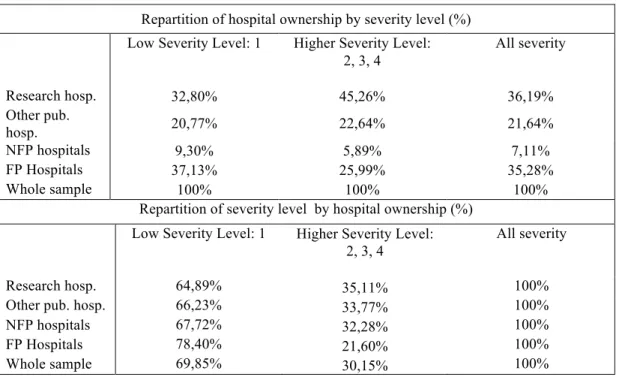
The distribution by severity is as follows: 70% in level 1, 20% in level 2, 9% in level 3 and 2%
in level 4. Public hospital stays were more spread out among severity levels than those in
From downcoding to upcoding: DRG based payment in hospitals Carine Milcent (CNRS – PSE)
stays in public healthcare institutions were of low severity, while in contrast, nearly four fifths of
stays in for-profit hospitals were for a level of severity without complications (Table 1).
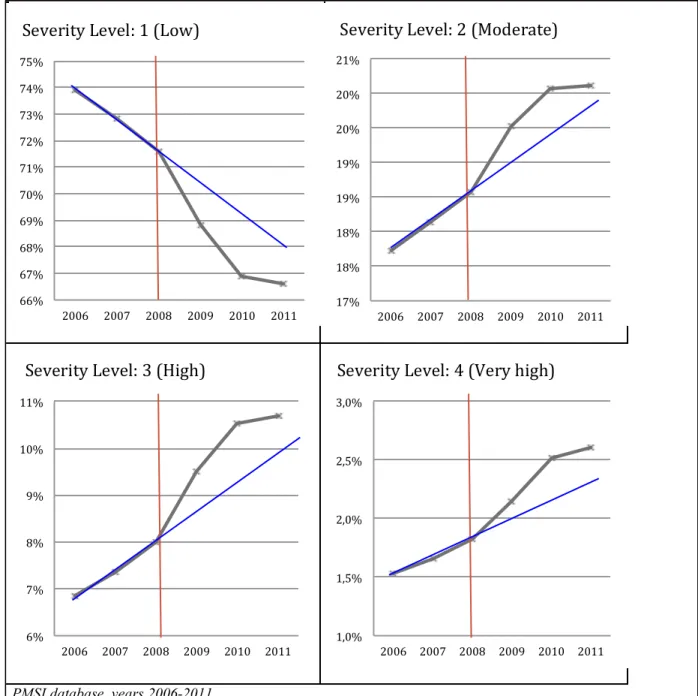
The proportion of stays coded as low-severity decreased over time (Figure 1). An inflection – an
acceleration in the downward tendency – can be observed in 2009. In parallel, the proportion of
stays classified as moderate to very high severity increased over time, an increasing trend that
became steeper after the reform. This change in the declining slope of 2009 is observed for all
types of hospitals (research, other public, private non-profit, and private for-profit).
---
Insert Table 1 about here
---
Insert Figure 1 about here
---
Empirical strategy and results Econometric models
In this paper, I check whether the refinement of a hospital stay classification system leads to
upcoding from a possible initial situation of downcoding. As mentioned in Introduction, the data
make it possible to “go back in time” and observe the consequences of the logic change in the
DRG classification. For the years before 2009, the data include not only the diagnoses and
From downcoding to upcoding: DRG based payment in hospitals Carine Milcent (CNRS – PSE)
according to the 2009-shift in classification. Therefore, the analyses here are based on the level
of severity that would have been associated to the stay in the 2009-change in the logic of
classification, before it actually came into effect. Analysis of data from a 2006-2011 period is
used to examine a potential upcoding independently of any changes in treatment.
The explained variable Yiht is an indicator of the level of severity of stay i at hospital h at time t.
Yiht = 1 if stay i is associated to a DRG of severity level 1.
• Temporal effects are controlled by a trend variable t, coded from 0 to 5 (for years from 2006 to 2011). Any macro changes that are common to hospital stays are picked up by
this trend coefficient. The reference year is 2006.
• The effect of the change in classification may also be explained by hospital-specific behaviors. βh are hospital effects.
• Some hospitals may change in terms of activity or size over the period. To control for this, hospital fixed effects crossed with the trend (βh * t) are also included in the
regression model.
• As there may have been changes over the period in the practices recommended by physicians for some pathologies which could affect classification regardless of other
incentives, I also control for pathology effects. βp are pathology effects.
• I(.) is an indicator for the post-classification change period, which takes the value 1 for years where the refined DRG classification system was applied (from 2009 onward) and an additional quarter of admissions. In private non-profit institutions a high level of admissions for exploratory stays is also observed (59.89%). A portion of these institutions are cancer centers, which mainly perform chemotherapy sessions, which are coded as exploratory acts.
4
Empirical strategy and results
4.1 Econometric models
In this paper, I check whether the refinement of a hospital stay classification system leads to upcoding. As mentioned in the Introduction, these data make it possible to “go back in time” and observe the consequences of the change in the DRG classification. For the years before 2009, the data include not only the diagnoses and exploratory procedures reported at the moment of the stay, but also the associated DRG according to the new (2009) classification. Therefore, the analyses here are based on the level of severity that would have been associated to the stay in the new classification, before it actually came into e↵ect. Analysis of data from this period is used to determine the trend in the percentage of low-severity stays independently of changes in the behavior of health care providers due to changes in the DRG classification. I am then able to examine whether, after the reform, the percentage of low-severity stays is lower than the previous trend would predict.
The explained variable Yiht is an indicator of the level of severity of stay i at hospital h at time t.
Yiht= 1 if stay i is associated to a DRG of severity level 1.
Yiht= ↵ + 1t + 2I(t> 2009) + h+ h⇤ t + p+ ✏iht (4)
• Temporal e↵ects are controlled by a trend variable t, coded from 0 to 5 (for years from 2006 to 2011). Any macro changes that are common to hospital stays are picked up by this trend coefficient. The reference year is 2006.
• The e↵ect of the change in classification may also be explained by hospital-specific behaviors. h
are hospital e↵ects.
• Some hospitals may change in terms of activity or size over the period. To control for this, hospital fixed e↵ects crossed with the trend ( h⇤ t) are also included in the regression model.
• As there may have been changes over the period in the practices recommended by physicians for some pathologies which could a↵ect classification regardless of other incentives, I also control for pathology e↵ects. p are pathology e↵ects, which can again be either fixed or random.
From downcoding to upcoding: DRG based payment in hospitals Carine Milcent (CNRS – PSE)
16
by controlling for any other changes over the period. viiThis effect may depend on
hospital’s ownership status. To control for this, an alternative model is to include
hospital’s ownership crossed with the indicator for the post-classification change period.
• εiht is random noise.
The linear models do not take into account the correlation between the different levels of
severity. In the following, I therefore, used an ordered probit model controlling for the
interdependency of coded severity levels. I define a categorical variable y ∈{1, ..., 4} indicating the observed levels of severity. The discrete probability function of y conditional on all
explanatory variables is commonly specified as an ordered probit model. This latent variable y*
is assumed to be generated by a normal regression structure.
where y* is unobserved. What is observable is the coded level of severity y. ε is a normally
distributed random term, with variance normalized at 1. Threshold parameters determine the
estimates for different observed values of y.
Besides, there are many reasons why upcoding behavior may differ across hospitals. There are a
number of theories of the effect of hospital ownership on upcoding, but few consensus
predictions (see Silverman and Skinner, 2000 for a comprehensive discussion). Several recent
studies document this indirect channel. Duggan (2002) found that for-profit hospitals respond
more strongly to financial incentives to treat indigent patients in markets with greater for-profit
penetration. In the French context, the DRG classification changes were based on diagnoses
rather than interventions. These DRG classification changes were then set up independently from • I(.) is an indicator for the post-classification change period, which takes the value 1 for years where
the refined DRG classification system was applied (from 2009 onward) and 0 otherwise. I(.) is thus the pure impact of the 2009 DRG classification policy obtained by controlling for any other changes over the period.12 This e↵ect may depend on hospital’s ownership status. To control for this, an alternative model is to include hospital’s ownership crossed with the indicator for the post-classification change period.
• ✏iht is random noise.
The linear models do not take into account the correlation between the di↵erent levels of severity. I therefore used an ordered probit model controlling for the interdependency of coded severity levels. I define a categorical variable y 2 {1, ..., 4} indicating the observed levels of severity. The discrete probability function of y conditional on all explanatory variables is commonly specified as an ordered probit model. This latent variable y⇤ is assumed to be generated by a normal regression structure.
y⇤iht= ↵ + 1t + 2I(t> 2009) + h+ h⇤ t + p+ ✏iht (5)
where y⇤ is unobserved. What is observable is the coded level of severity y. ✏ is a normally distributed random term, with variance normalized at 1. Threshold parameters determine the estimates for di↵erent observed values of y.
4.2 Results
Table 3 displays results of Least Square models. The chances that a stay would be coded as low-severity (Y ) decreased over time. This may indicate either increases in the severity of the health status of admitted patients over time, or a learning e↵ect: hospitals adapting to the incentives of the T2A system. After the reform, they coded comorbidities and diagnoses as a whole in a more exhaustive fashion. All else being equal, the probability that a stay would be associated to a low-severity DRG strongly decreased with the 2009 reform of the DRG classification. This result is robust: the same result is obtained whether or not types of pathologies, hospital fixed e↵ects, and hospital fixed e↵ects multiplied by the trend are controlled for. Therefore, the coding behavior of health care actors was modified by the change in DRG classification independently of any e↵ect on the actual production of care.13 Could the result be explained by more
12In the robustness checks (Section 5), the model was run using a more restricted sample from the 2008-2010 period. 13The only potential impact of the 2009 DRG change in coding on the actual production of care could have been through a increase in the length of stay (see Appendix B). The empirical literature does not find support this assumption. A variety of papers have found a decrease of the length of stay over the observed period (DREES (2012), Or et al. (2013), and Gobillon
From downcoding to upcoding: DRG based payment in hospitals Carine Milcent (CNRS – PSE)
the intensity of care, by construction. The responses to changes in classification were thus
established independently of any changes in treatment. Newhouse (1989) found evidence that
private hospitals shifted patients in unprofitable DRGs to public hospitals following the
implementation of PPS. Silverman and Skinner (2000) found strong evidence of upcoding
between 1989 and 1996. They found that for-profit hospitals upcode the most, and that
not-for-profit hospitals are more likely to engage in upcoding when the market share of for-not-for-profit
hospital in their area is high. Dafny (2005) also found strong evidence of upcoding, a response
that was particularly strong among for-profit hospitals.
Public hospitals cover two very different groups of institutions. University hospital centres and
regional hospital centres (research hospitals) are distinguished by their research and development
activity as well as by their size. Thus, I distinguish between research hospitals and “other public
hospitals.” As explained in Section 2, the French healthcare market also includes both for-profit
and not-for-profit private hospitals. As a result, 4 types of hospitals are considered: Research
hospitals, other public hospitals (except the research ones), non-profit hospitals and for-profit
hospitals.
Results
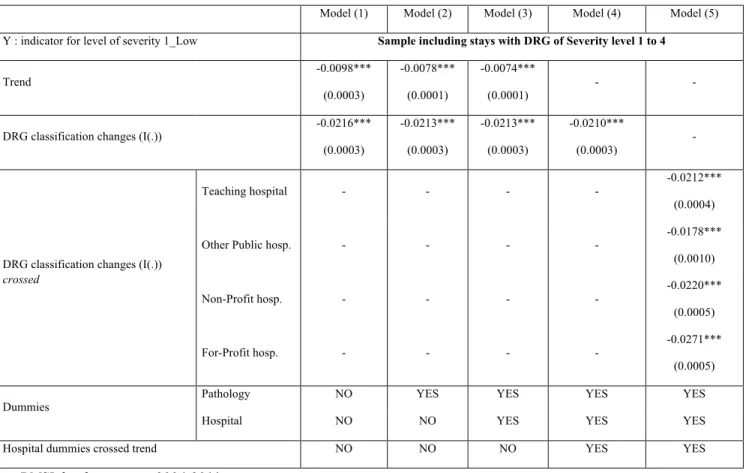
Table 3 displays results of Least Square models. The chances that a stay would be coded as
low-severity versus higher low-severity (Y ) decreased over time. This indicates either an increase in the
severity of the health status of admitted patients over time, or a learning effect: hospitals
adapting to the incentives of the DRG-based reimbursement system gradually introduced from
From downcoding to upcoding: DRG based payment in hospitals Carine Milcent (CNRS – PSE)
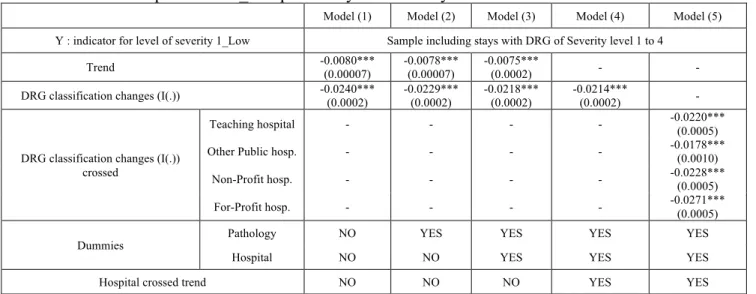
All else being equal, we show a steeper slope of this probability with the 2009-shift of DRG
classification. The probability that a stay is associated to a non-severe DRG decreases by about
2.1% over the period. This result is robust: whether or not types of pathologies, hospital fixed
effects (or hospital fixed effects multiplied by the trend) are controlled for, I obtain the same
result. Therefore, the coding behavior of healthcare actors was modified by the change in DRG
classification. viiiCould the result be explained by more intensive patient care? The answer is no,
since severity levels are established exclusively on the basis of diagnoses and not treatment.
Thus, what I show here is a coding of more severe patient diagnoses, attributable only to
upcoding effects possibly due to a initial situation of downcoding. This change in coding
generated no change in hospital production.
I now present the results of the model controlling for interactions between hospital type and I(.),
the indicator for the post-classification change period. The effect of the 2009-shift in DRG
classification differs according to the type of hospitals. It appears that the policy makers’
decision led private for-profit hospitals to more massively manipulate raw information compared
with other types (Table 3). The coding behavior of public hospitals changed to a lesser degree.
Non-profit institutions fell between private for-profit hospitals and research public hospitals.
Regarding public hospitals, “other public hospitals” were disadvantaged in comparison to
research hospitals.
---
Insert Table 3 about here
---From downcoding to upcoding: DRG based payment in hospitals Carine Milcent (CNRS – PSE)
I now present Model (2), the ordered probit model. From Model (2), I capture the presence of
time invariant heterogeneity with a fixed effects procedure. Note that estimating such models
with fixed effects typically introduces an incidental parameter problem. Here, because of the
large size of the sample, one can estimate these models without having this concern.
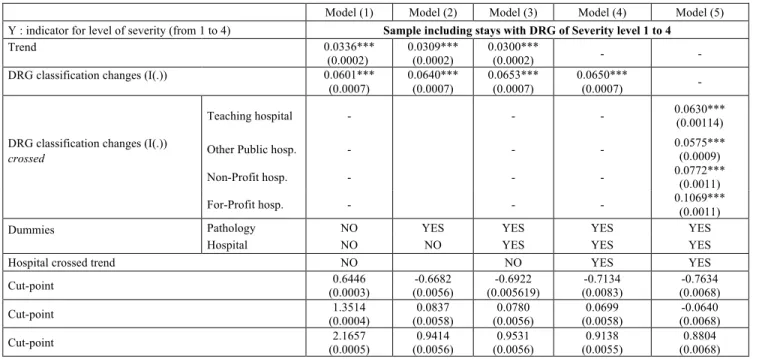
Considering the ordered probit model, the results are similar to those of Least Square models
with respect to statistical significance.ix The reference is severity level 1, the lowest level. Note
that a positive sign of any coefficients implies a higher probability of belonging to the higher
category, corresponding in principle to greater severity. Controlling for types of pathology
(Table 4, Column (2)), fixed hospital effects (Table 4, Column (3)) and fixed hospital effects
multiplied by trend (Table 4, Column (4)) did not change the pattern of results. The probability
of being coded as higher-severity increased with time. There was a sharp increase due to the
2009 policy. The marginal effects indicate how the probability of level of severity changes with
the 2009 change in coding for average individual.x I find that the probability that a stay would be
coded as severe increased by about 2% after the reform (compared with before the reform),
controlling for all of the independent variables (Table 5, Column (4)). Furthermore, as with least
squares models, the change in classification led to a greater change in coding behavior in private
for-profit healthcare institutions (Table 4, Column (5)). Non-teaching public hospitals changed
their coding behavior to a lesser degree.
These results clearly demonstrate a purely exogenous effect of a finer DRG classification leading
to a upcoding, whether or not types of pathologies and hospital fixed effects were controlled for.
From downcoding to upcoding: DRG based payment in hospitals Carine Milcent (CNRS – PSE)
independently of any changes in the production of care. Also, these results clearly highlight a
differential effect of a refined DRG classification system on the behavior of actors in healthcare
provision depending on the type of institution.
---
Insert Table 4 and Table 5 about here
---
How to explain these results? As a fact, for-profit hospitals were more active with a very early
use of coding optimization softwares in some for-profit institutions. More recently, University
hospital centres have made use of such tools. Based on the theoretical and empirical literature,
Silverman and Skinner (2004) advocate three potential explanations why for-profit hospitals
were more active in upcoding using the Malani et ali (2003)’s simplified taxonomy of theoretical
models of not-for-profit hospital behavior: i) the altruism model, ii) the signaling model, iii) the
last type of model is based on evidence on the market interaction of hospitals with regard to
upcoding. Focusing on the signaling model, if for-profit hospitals were able to increase marginal
revenue through upcoding, they could force not-for-profit firms to compete through upcoding
(for instance). To some extent, the altruism model may also receive empirical support. If
non-for-profit managers instilled a strong ethical norm (Horwitz, 2003), and these standards could
extend to conservative billing practices, then it may explain why non-for-profit institutions
upcode less than for-profit hospitals. Georgescu and Hartmann (2013) studied the effects of
healthcare decision pressure from the hospital’s administration and from the professional peer
group on physician’s inclination to engage in upcoding. They find that the source of pressure is a
relevant predictor of physicians’ inclination to engage in up coding (from an potential initial
From downcoding to upcoding: DRG based payment in hospitals Carine Milcent (CNRS – PSE)
hospitals, the pro-competitive reform that was introduced gradually from 2004 to 2008 implied a
big change in managerial behavior that may be slowed down by the civil servant status of the
hospital staff. Moreover, upcoding requires not simply administrators who direct coders to target
profitable DRGs, but also physicians responsible for filling in the medical charts with the critical
clinical information that can be used to claim the more generous DRG. There was no increase in
physicians’ revenue that would have created powerful incentives to manipulate the raw
information.
This upcoding has direct positive effect on the payment received by the hospital.
Above all, in a fixed-envelope mechanism, the value of the index depends on the total number of
index units. A higher level of severity is associated to a higher value of ig. This situation leads
automatically to a decrease in the value v of the index (Equation (1)). This in turn leads to a
decrease in the lump-sum transfers associated to each DRG. This result has a number of
consequences.
• The “upcoding” led to a public budget reallocation that increased the share of budget allocated to for-profit hospitals, at the expense of non-research public hospitals.
• As this mechanism leads to a tendency for any diagnosis to be coded at a higher level of severity, heterogeneity is shifted to higher severity levels. Thus, heterogeneity is shifted
to higher-paying DRGs. This regulatory mechanism led to greater homogeneity in stays
From downcoding to upcoding: DRG based payment in hospitals Carine Milcent (CNRS – PSE)
I do not presume to give the exact financial impact of the data-manipulation on the hospital
healthcare budget. data-manipulation means here to switch from a possible downcoding initial
situation to a upcoding situation. However, I propose here a simple method to get an
approximation of this amount. The additional budget computed is done for the year 2009.
Context A, I consider the case where there is no fixed annual budget at the national level
determined by the regulator. Data-manipulation then leads to an increase in the global hospital
healthcare expenditure. Context B is a context where a fixed annual envelope is set up. In the
French case, a fixed annual budget at the national level is determined by a vote in the French
National Assembly.
Being 2 hospitals, Hospital A with a funding x and hospital B with a funding y. With
“data-manipulation”, Hospital A now claims a funding x+α. Hospital B’s that does not “manipulate
data”. We can see the hospitals’ funding as a percentage of the total funding.
With Context A,
• Without “data-manipulation”, Hospital B receives [y/(x + y)] % of the total funding
• With “data-manipulation”, Hospital B receives [y/(x + y +α)] % of the total funding In absolute value, the hospital B receives the same amount whatever the behavior of the hospital
A. This latter receives more budget. In relative value, the hospital B receives less in presence of
data-manipulation from the hospital A. The global hospital healthcare expenditure can be
expressed as Equation (6). With pop DRG-Li: population of patient coded as DRG level i; means
From downcoding to upcoding: DRG based payment in hospitals Carine Milcent (CNRS – PSE)
This data-manipulation is estimated to account for nearly 560 million euros in additional annual
hospital healthcare cost, so approximately 1.4% of the annual budget countrywide.
With Context B, the fixed-envelope is equal to x+y.
• Hospital A gets a funding [(x+α)/(x+y+α)]*(x+y) = x+[(x+αy)/(x+y+α)] > x
• Hospital B gets a funding [y/(x+y+α)]*(x+y) = y − [(αy)/(x+y+α)] < y
The “data-manipulation” behavior of Hospital A increases the funding of this hospital by
decreasing the funding of Hospital B from the same amount. The total budget for acute activities
(T2A budget)xi in French hospital was around 40 billion euros. For the non-teaching public
hospital, the cost of a lesser tendency to data-manipulation was 38 million euros.xii This amount
appears to be quite not significant. However, here, we discuss on the budget of small size
hospitals that already have financially to struggle to survive.
Discussion The DRG basis prospective payment reform
As the big shift in classification took place in 2009, the database includes periods both before
and after the change in classification. I was thus able to study the effect of an exogenous shock
on upcoding practices__ from a possible initial situation of downcoding__ with regard to
severity. However, the T2A mechanism was applied to all stays in for-profit hospitals beginning A higher level of severity is associated to a higher value of ig. In a fixed-envelope mechanism, the value
of the index depends on the total number of index units. This situation leads automatically to a decrease in the value v of the index (Equation (1)). This in turn leads to a decrease in the lump-sum transfers associated to each DRG. This result has a number of consequences.
• The “upcoding” led to a public budget reallocation that increased the share of budget allocated to for-profit hospitals; at the expense of non-research public hospitals.
• This regulatory mechanism led to greater homogeneity in stays coded as not severe (severity level 1). As this mechanism leads to a tendency for any diagnosis to be coded at a higher level of severity, heterogeneity is shifted to higher severity levels. Thus, heterogeneity is shifted to higher-paying DRGs.
4.3 Financial impact
I do not presume to give the exact financial impact of the upcoding on the hospital healthcare budget. However, I propose here a simple method to get an approximation of this amount. The additional budget computed are done for the year 2009. First, I consider the case where there is no fixed annual budget at the national level determined by the regulator. The “upcoding” then leads to an increase in the global hospital healthcare expenditure.
Additional budget = 2% * (pop DRG-L1) * [mean’s fee DRG-L2 - mean’s fee DRG-L1] (6) With pop DRG-L1: population of patient coded as DRG level 1; mean’s fee DRG-L1: mean of fee for patient coded as DRG level 1; mean’s fee DRG-L2: mean of fee for patient coded as DRG level 2.
I estimated “upcoding” accounted for nearly euros 560 million euros in additional annual hospital healthcare costs, so approximately 1.4% of the fixed national annual budget.
Now, considering the real context where a fixed annual budget at the national level determined by a vote in the French National Assembly. Considering 2 hospitals, Hospital A (with a funding x) and hospital B (with a funding y), the global budget is equal to x + y. With “upcoding”, Hospital A claims a funding x + ↵ but the global budget remains equal to x + y. We can see the hospitals’ funding as percent of the total funding. Considering hospital B’s that does not “up-code”, for sake of simplicity,
• Without “upcoding”, Hospital B receives y/(x + y) % of the total funding • With “upcoding”, Hospital B receives y/(x + y + ↵) % of the total funding
Hence, in a context of a fixed annual budget and with “upcoding”, the fundings are the following:
From downcoding to upcoding: DRG based payment in hospitals Carine Milcent (CNRS – PSE)
It was not until 2008 that the T2A mechanism was applied to 100% of acute care stays in all
types of hospitals. As a robustness check, I here focus only on the period from the year 2008
(before the 2009 policy change but when financing was 100% based on the T2A in all hospitals)
to the year 2010 (after the change). This econometric analysis is thus conducted on a period of
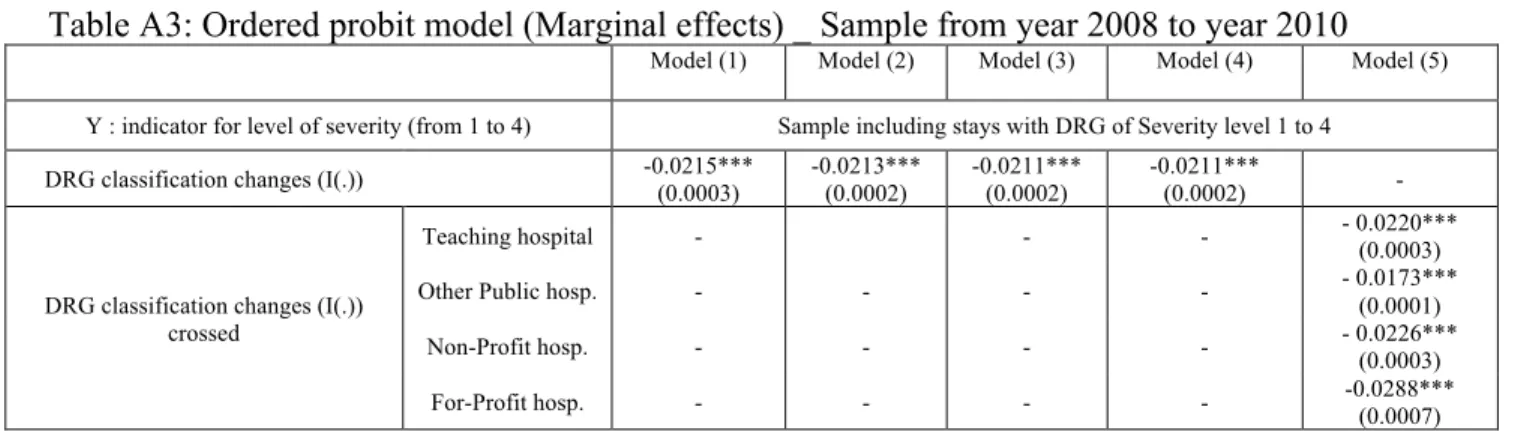
time where all hospitals were financed through the same DRG-based mechanism. The results are
presented in Appendix A, Tables A1, A2 and A3. The results are unchanged.
I now turn to the formalization presented in this paper. The description of the reimbursement
system in Section 2 assumes that all hospitals are priced in the same way, but the formalization
presented above is a simplification. DRG-based reimbursement follows the exact same logic for
all sectors but there exists differences in the calculation of lump-sum transfers. The national
health insurance system yields a fixed price for every DRG,xiii but there are two pricing grids:
one for the public sector and one for the private sector.xiv As a consequence, prices do not
converge, although there is competition between health care institutions in the two sectors. In
this paper, econometric analysis is conducted controlling for hospital fixed effects crossed with
the trend. Then, I control for this difference in pricing grids.
In 2008, the percentage of financing based on the T2A prospective price mechanism reached
100% of acute care stays, but the fee was corrected by a so-called transition coefficient which
was specific to each hospital, and which was aimed at correcting inequalities due to the previous
global budget mechanism. This coefficient was eliminated in March 2011. In this paper, first the
From downcoding to upcoding: DRG based payment in hospitals Carine Milcent (CNRS – PSE)
analysis is conducted controlling for hospital fixed effects. Because this transition coefficient is
specific to each hospital, it is captured by the hospital fixed effect.
In the simple theoretical model used here, the same objective function is applied to all hospitals.
This assumption is debatable. A more flexible assumption would be to introduce altruism
coefficients: a specific altruism coefficient for each hospital type. Actually, in the econometric
model, I opted for a more flexible framework, considering that hospital responses to 2009 policy
may differ by hospital type.
Yardstick competition works when the regulator can credibly commit not to cover hospital
deficits, which is only partially credible in the French system. While the extreme scenario of
closing an hospital due to deficits is not totally credible, getting into a difficult financial situation
can have very severe and concrete consequences for hospitals: elimination of units or
transformation into a long-term care center. It may also lead to postpone investments, to stop
recruitment including not replacing leaving employees.
Why not use a probit or logit model? Least-squares coefficients measure changes in expected
levels of severity, while logistic coefficients measure changes in the log odds that the level of
severity is equal to 1. The interpretation of a measure of changes in the expected values of the
level of severity is direct. However, a probit model was also used to regress the model
parameters (results available on request). Of course, the results of least squares and probit
From downcoding to upcoding: DRG based payment in hospitals Carine Milcent (CNRS – PSE)
hypotheses for least squares and probit models are identical. As Pohlman and Leitner (2003)
pointed out, both models can be used to test relationships with a binary criterion.
To take into account the correlation between the different levels of severity, we used an ordered
profit Model. The constancy of threshold parameters is here assumed. However, we have to
check whether the model violates the parallel regression assumptions or proportional odds
assumption. In such a case, we should consider other models as a generalized ordered logit
model. Table A5 presents the BIC’s test and the AIC’s tests. All of the tests agree that the
proportional odds assumption is not violated with such large dataset.
Ambulatory surgery
Thus far, I have considered the four levels of severity. One objective of the French Health
Ministry has been to encourage recourse to ambulatory surgery. Patients at a low level of
severity, under specific conditions, are eligible for ambulatory surgery. The downward trend
observed in admissions for stays coded as low-severity could thus have been due to the rise in
ambulatory surgery. To give a general overview, Table 2 presents the distribution of hospital
stays by hospital type for stays. In private for-profit establishments, more than 26% of stays were
associated to day surgery, and more than 25% were associated to severity level 1. Stays with
DRGs coded as ambulatory surgery represent between 5% and 7% of stays in the other types of
hospitals. In Appendix A, Table A4 displays the results obtained with a set of stays associated to
DRGs of severity levels 1 to 4 and DRGs for ambulatory surgery.xv
The inclusion of ambulatory surgery does not change the previously observed pattern of results
From downcoding to upcoding: DRG based payment in hospitals Carine Milcent (CNRS – PSE)
associated to a DRG of low severity versus a higher level of severity (2, 3 or 4) or day surgery.
---
Insert Table 2 about here
---
Conclusion
The analysis here is based on the level of severity that would have been associated to the stay in
the new classification, before it actually came into effect. My focus is to assess how far the 2009
classification change in coding offered hospitals opportunities to upcode; I also examined the
role of hospital ownership status.
The empirical literature on upcoding is almost exclusively focused on the United States. It is thus
natural to ask whether upcoding is a US phenomenon, or whether it can be found in other health
systems as well. This question is particularly important given that many countries have opted for
a refined DRG classification system over the last decade. This paper examines hospital responses
to changes in DRG classification in the context of a DRG payment system.
As the single-payer public health insurance system strengthens financial incentives for hospital
efficiency in healthcare production, this question is crucial. The DRG system of fixed prices at
the stay level combined with a fixed national envelope for all stays in all hospitals creates
incentives for hospitals in both the public and private sectors to increase the volume of
From downcoding to upcoding: DRG based payment in hospitals Carine Milcent (CNRS – PSE)
This study illustrates how a simple change in the French DRG classification system in 2009
generated large and exogenous changes in the coded level of severity of in-patient stays.
Hospitals responded to this policy by manipulating the coding on patients to get DRGs
associated to larger reimbursement. This practice is not an issue when coding practices are
uniform across hospitals. Differential upcoding could be seen as attenuation in ‘downcoding”
caused by more efficient billing systems. Here, the big issue is that the upcoding behavior differs
in function of the hospital’s ownership whereas hospitals under the same reimbursement system,
have the same incentive to manipulate the raw information. Therefore, we find support that the
observed effect of a change to the DRG coding system is beyond a reduction in “downcoding”
but rather an opportunity to manipulate the coding and hence, the data.
Following the policy change, for-profit facilities availed themselves of this opportunity to the
greatest extent. An implication of these results is that upcoding led to a budget reallocation that
increased the share of total health spending going to for-profit hospitals at the expense of public
non-research hospitals. I also find that the hospitals the least equipped with high-tech
equipment—non-teaching public hospitals—were the least likely to engage in upcoding data,
with corresponding negative effects on their share of total health spending. Taken together, these
findings echo those of studies such as ProPAC (2005) and Scanlon (2006). According to
Scanlon, DRG refinements favor research hospitals at the expense of smaller ones, mainly
hospitals in rural areas. This may jeopardize the financial situation of the latter, which often
struggle to remain financially viable.
A second implication of these results relates to in-patients with low-severity diagnoses. I find