HAL Id: hal-01683707
https://hal.archives-ouvertes.fr/hal-01683707
Submitted on 25 May 2019
HAL is a multi-disciplinary open access
archive for the deposit and dissemination of
sci-entific research documents, whether they are
pub-lished or not. The documents may come from
teaching and research institutions in France or
abroad, or from public or private research centers.
L’archive ouverte pluridisciplinaire HAL, est
destinée au dépôt et à la diffusion de documents
scientifiques de niveau recherche, publiés ou non,
émanant des établissements d’enseignement et de
recherche français ou étrangers, des laboratoires
publics ou privés.
Tailoring perpendicular exchange bias in [Pt/Co]-IrMn
multilayers
J. Sort, Vincent Baltz, F. Garcia, B. Rodmacq, B. Dieny
To cite this version:
J. Sort, Vincent Baltz, F. Garcia, B. Rodmacq, B. Dieny. Tailoring perpendicular exchange bias in
[Pt/Co]-IrMn multilayers. Physical Review B: Condensed Matter and Materials Physics (1998-2015),
American Physical Society, 2005, 71, pp.054411. �10.1103/PhysRevB.71.054411�. �hal-01683707�
of the Co layers共tCo兲 inside the ML and/or 共ii兲 inserting a Pt spacer between the ML and the antiferromagnetic
共AFM兲 layer. An unusual peak in the ferromagnetic 共FM兲 thickness dependence of exchange bias properties is
observed. This is ascribed to a reduction of the perpendicular effective magnetic anisotropy for either very small or too large values of tCo. Moreover, for low values of tCo, the insertion of an ultrathin Pt spacer between
the关Pt/Co兴 ML and the IrMn brings about a significant increase of HEand HC. However, such an effect is not
observed for thicker Co layers. This behavior is explained by the two-fold role of the Pt spacer, i.e., it strengthens the perpendicular orientation of the Co magnetization in the ML but it also tends to reduce exchange bias due to the short-range character of the FM-AFM interactions.
DOI: 10.1103/PhysRevB.71.054411 PACS number共s兲: 75.70.Cn, 75.30.Gw, 81.15.Cd
I. INTRODUCTION
Exchange coupled ferromagnetic- 共FM-兲 antiferromag-netic共AFM兲 bilayers typically exhibit a shift of the hyster-esis loop along the magnetic field axis, i.e., exchange bias,
HEand an enhancement of coercivity HCwhen they are field cooled from above the blocking temperature of the AFM or deposited under the presence of a magnetic field.1–4During the last decades, these systems have been extensively inves-tigated mainly due to their technological applications in magnetic sensors based on spin valves or magnetic tunnel junctions structures.5,6
Usually, exchange bias is observed in FM-AFM bilayers with in-plane anisotropy. However, recently, exchange bias effects have also been induced along the perpendicular-to-film direction, in both continuous7–16 and nanostructured17
multilayers. Some systems can exhibit either in-plane or out-of-plane exchange bias, depending on the field cooling direc-tion. This is of particular interest since it allows probing the three-dimensional spin structure of the AFM layer.8–11
Re-markably, in some cases, perpendicular exchange bias is ob-served at room temperature, hence making these structures appealing for the implementation of spin valves or tunnel junctions with perpendicular anisotropy.11–14
Among the systems which exhibit perpendicular exchange bias are 关Pt/Co兴 or 关Pd/Co兴 multilayers 共ML兲 exchange coupled to an AFM, such as CoO, FeCl2, FeF2, NiO, FeMn,
or IrMn. The perpendicular anisotropy of these ML depends on several parameters, such as the number of Pt/Co or Pd/Co repeats comprised in the ML, the relative thickness of the Pt, Pd, and Co layers or the thickness of the buffer layer.18,19
Although the role of these parameters on the magnetic prop-erties of unbiased关Pt/Co兴 and 关Pd/Co兴 ML 共coercivity, rema-nence to saturation magnetization ratio, nucleation field, etc.兲 has been extensively investigated,20,21a systematic
investiga-tion on how these parameters affect the magnitude of ex-change bias is still lacking. In particular, it has been shown that perpendicular exchange bias increases with the number of 共Pt/Co兲 repeats, becoming maximum when the loops
ac-quire a complete square appearance, hence suggesting that a well-defined perpendicular magnetic anisotropy is required to maximize exchange bias.12 In addition, it has been
re-cently shown that a significant increase of HE can be ob-tained in exchange biased关Pt/Co兴 - FeMn ML by inserting an ultrathin Pt layer between the关Pt/Co兴 ML and the AFM.13
This behavior has been attributed to the role of the thin Pt spacer in reinforcing the perpendicular orientation of the Co magnetization in the ML leading to an enhanced spin projec-tion between the FM and the AFM after the perpendicular field cooling process.
In this article we investigate perpendicular exchange bias effects in关Pt/Co兴 ML exchange coupled to IrMn. It is found that, for a fixed number of Pt/Co repeats in the ML, the magnitudes of both HEand HCcan be tailored by varying the thickness of the Co layers in the ML tCo. Interestingly, the
usual inversely proportional relationship between HEand the FM thickness is only observed for intermediate values of tCo, between 0.6 and 0.9 nm, where a relatively large perpendicu-lar effective anisotropy is preserved. For either very thin
共艋0.6 nm兲 or relatively thick 共艌0.9 nm兲 Co layers, a
de-crease of the out-of-plane magnetic effective anisotropy oc-curs, which drastically reduces perpendicular exchange bias. Moreover, it is observed that by inserting a Pt layer between the关Pt/Co兴 ML and the AFM, HE and HCare only enhanced for low values of tCo, i.e., lower than 0.6 nm. However, as a
general trend, for larger tCo values, the insertion of a Pt
spacer only leads to decreases in HE and HC. This effect is interpreted by taking into account the interplay between the enhancement of the perpendicular orientation of the ML magnetization, brought about by the Pt spacer, and the short-range character of FM-AFM exchange interactions.
II. EXPERIMENTAL PROCEDURE
Several series of multilayers with compositions
关Pt共2 nm兲/Co共tCo兲兴3/ Pt共tPt兲/IrMn共5 nm兲/Pt共2 nm兲, were
de-posited on thermally oxidized Si wafers by dc magnetron
sputtering. The values of tCoranged from 0.38 to 1.5 nm and those of tPt from 0 to 1.5 nm. The base pressure was 5.3
⫻10−6Pa, whereas the Ar pressure during deposition was
0.25 Pa. All depositions were performed at room tempera-ture. The samples were annealed at 550 K共above the block-ing temperature of all systems兲 for 1 h and subsequently cooled under a field of⫺2.4 kOe, applied perpendicular to the film plane, to set the unidirectional exchange anisotropy in this direction. Hysteresis loops, with the magnetic field applied perpendicular to the thin film direction were mea-sured using extraordinary Hall effect 共EHE兲, a technique which is particularly sensitive to the perpendicular compo-nent of the magnetization.22 The magnetic effective
aniso-tropy was determined from the area between the easy and hard axis hysteresis loops recorded either by EHE or using a vibrating sample magnetometer 共VSM兲.18 Hysteresis loops were also recorded at temperatures above room temperature, up to T = 500 K, by polar Kerr effect. High resolution trans-mission electron microscopy images, together with x-ray dif-fraction, revealed that both the 共Pt/Co兲 ML and IrMn are polycrystalline and exhibit a weak共111兲 texture.
III. RESULTS AND DISCUSSION
Typical hysteresis loops of the 关Pt共2 nm兲/Co共tCo兲兴3/
IrMn共5nm兲/Pt共2nm兲 systems measured at room temperature along the perpendicular to film direction by EHE are shown in Fig. 1, for tCo= 0.45, 0.6, 0.8, and 1.1 nm. Note that, in
these samples, no Pt spacer is introduced between the
关Pt/Co兴 ML and the AFM. For low values of tCothe loops are
rather square. However, the remanence to saturation ratio decreases as tCo is progressively increased. For tCo= 0.8 nm,
the loop becomes tilted and for larger tCo共e.g., 1.1 nm兲, the
out-of-plane loop progressively becomes a hard axis loop. This indicates that for low and intermediate values of tCo, the
system exhibits a perpendicular to plane magnetic effective anisotropy, which reorients towards in-plane for sufficiently thick Co layers. In addition, the hysteresis loops are dis-placed along the magnetic field axis. The loop shift is par-ticularly pronounced for intermediate values of tCo.
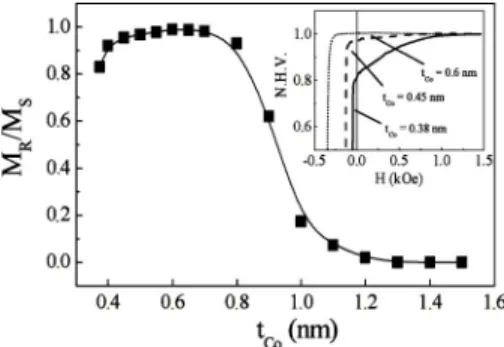
The dependence of the remanence to saturation magneti-zation ratio MR/ MS, measured from the perpendicular to plane hysteresis loops, on tCois shown in Fig. 2. The values
of MR/ MS are obtained after recentering the loops for the exchange bias field. As can be seen in the figure, MR/ MS increases from 0.83 共for tCo= 0.38 nm兲 to 0.99 共for tCo
⬃0.6 nm兲. For larger tCo, MR/ MS tends to decrease again and it drastically drops at tCo= 0.9 nm, confirming that the
perpendicular anisotropy of 关Pt/Co兴 multilayers is lost for exceedingly thick Co layers. The inset of Fig. 2 shows an enlargement of a part of the hysteresis loops共after recenter-ing them along the field axis兲 for tCo= 0.38, 0.45, and 0.6 nm,
which illustrates the increase of squareness ratio as tCo is
increased to its optimum value.
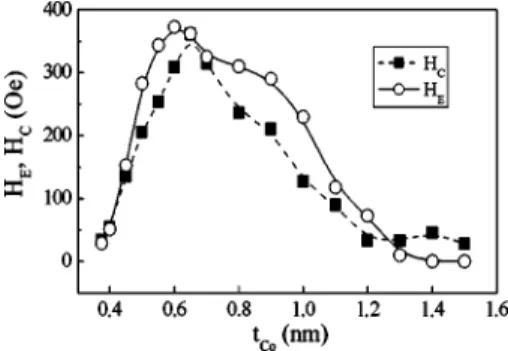
The dependences of HE and HCon tCoare shown in Fig. 3. Similar to MR/ MS, the magnitudes of HE and HCare also maximum for intermediate values of tCo, i.e., HE= 375 Oe for
tCo= 0.6 nm and HC= 360 Oe for tCo= 0.65 nm. This is in
contrast to most exchange bias systems, where, due to the interfacial character of the FM-AFM interactions, HE is larger for thinner FM layers.1 It is noteworthy that for the
majority of tCo values HE is larger than HC and, conse-quently, only one remanent state is obtained. This is of prac-tical interest in order to use these structures as a reference layer in spin valves or tunnel junctions with perpendicular anisotropy.
In order to get deeper understanding on the dependences of HC, HE, and MR/ MSon tCo, the effective magnetic
aniso-tropy Keffwas determined for the different samples, from the area between easy and hard axis hysteresis loops.18The de-pendence of Keffon tCois shown in Fig. 4. It can be seen that,
FIG. 1. Hysteresis loops corresponding to the
关Pt共2 nm兲/Co共tCo兲兴3/ IrMn共5 nm兲/Pt共2 nm兲 systems with tCo= 0.45,
0.6, 0.8, and 1.1 nm, measured at room temperature along the per-pendicular to film direction, by extraordinary Hall effect, after cool-ing from T = 550 K in the presence of a⫺2.4 kOe magnetic field applied along the perpendicular to film direction.
FIG. 2. Dependence of the remanence to saturation ratio MR/ MS
on the Co thickness, tCo, for perpendicular exchange biased multi-layers with compositions 关Pt共2 nm兲/Co共tCo兲兴3/ IrMn共5 nm兲/
Pt共2 nm兲. Note that, in order to determine MR/ MS, the loops were centered for the exchange bias field. The inset shows an enlarge-ment of a part of the centered hysteresis loops for tCo= 0.38, 0.45, and 0.6 nm. The lines are guides to the eye.
SORT et al. PHYSICAL REVIEW B 71, 054411共2005兲
analogously to HC and MR/ MS, Keffalso exhibits its maxi-mum value around tCo⬃0.65 nm. A similar dependence of Keff on tCo has been reported in 关Pt/Co兴 ML without
AFM.18,19For unbiased关Pt/Co兴 ML, the effective anisotropy
is, in fact, the result of several anisotropy contributions and it can be expressed as Keff= Kv+ 2Ksurf/ tCo+共3/2兲 − 2Ms,eff2 , where MS,eff= MS,Co关tCo/共tCo+ tPt兲兴. The first term
is the volume anisotropy, which is mainly related to the crys-tallographic structure of the ML, the second term is the sur-face anisotropy, arising from the hybridation between the electronic d states of Pt and Co at the Pt/Co interfaces,23the third term is the magnetoelastic contribution共where is the magnetostriction constant and the stress兲,18,24and the last
term is the shape anisotropy contribution, which favors an easy-plane anisotropy. Since in this study the关Pt/Co兴 ML is exchange coupled to an AFM, additional anisotropy terms are also present, particularly a unidirectional anisotropy term along the perpendicular to film direction, which is respon-sible for the exchange bias.25 The decrease of K
efffor large
values of tCo has been reported in the literature19,24 and is
related to the decrease of the surface anisotropy contribution for larger tCo and the increase of the volume and shape
anisotropies. Indeed, for thick Co layers, the easy axis mag-netization tilts and tends to fall in the film plane, indicating that the interface anisotropy共responsible for the perpendicu-lar effective anisotropy兲 is no longer strong enough to
over-defined Pt/Co interfaces parallel to the film plane in order to have a large perpendicular anisotropy. The presence of inter-face roughness or intermixing between Pt and Co have been shown to play a detrimental role on Keff.28If the intermixing
is larger, Keff decreases due to a diluted spin density and
smaller orbital moments of Co at the interfaces.29 For low
values of tCo, the effects of interdiffusion between Pt and Co
are enhanced and in the limit case where a random disor-dered solid solution of Co and Pt would be formed, this would lead to an fcc matrix which would not support uniaxial anisotropy.29 Hence, for too thin or too thick Co
layers, if the perpendicular anisotropy is not large enough, the out-of-plane hysteresis loops tend to resemble hard axis loops and, consequently, HC is reduced. However, it should be noted that although HC is similar for tCo= 0.4 nm and tCo= 1.2 nm共see Fig. 3兲, the effective magnetic anisotropy in the two cases is very different共for tCo= 1.2 nm, Keffbecomes
even negative, indicating an in-plane magnetic anisotropy, see Fig. 4兲. Hence, the relationship between HC and Keffis
not so straightforward in exchange biased关Pt/Co兴 ML. This could be due to the coupling between the关Pt/Co兴 ML and the AFM. Namely, if the AFM spins are partially irreversibly dragged during magnetization reversal of the FM, this yields an enhancement of HC, which is another fingerprint of FM-AFM exchange interactions.1–4
The relationship between Keff, MR/ MS, and HE is some-what complex. In fact, due to the interface nature of FM-AFM exchange interactions it is usual to observe a decrease of HE for larger FM thickness. An inverse dependence be-tween HE and the FM thickness共tFM兲 has been reported in many FM-AFM bilayers.1This effect is commonly explained by arguing that when the magnetization of the exchange bi-ased layer switches, the volume Zeeman energy brought by the applied field balances the FM-AFM interfacial coupling energy共ex兲, so thatex= HEMS,ContCo, where n is the num-ber of Pt/Co repeats in the ML and MS,Cothe saturation mag-netization of Co. The exchange bias energy is a priori ex-pected to be independent of tFMwhich is indeed confirmed in
many systems considering the usually observed 1 / tFM
thick-ness dependence of HE. Yet, as can be seen in Fig. 5, ex
shows a progressive unusual increase with tCo, tending to level off for tCo= 0.6 nm and starting to decrease for tCo
艌0.9 nm. It can be argued that during the perpendicular field
cooling, as the temperature is reduced to below the blocking temperature, the spins in the different IrMn crystallites will tend to orient along their easy axes closer to the field cooling
共FC兲 direction. However, once at room temperature, when
the field is removed, the spins in the Co layers will tend to relax at a certain angle towards in-plane if the perpendicular anisotropy is not large enough. This occurs for either very
FIG. 3. Dependence of the hysteresis loop shift, HE共--兲 and
the coercivity HC共-䊏-兲 on the Co thickness, tCo, for perpendicular exchange biased multilayers with compositions
关Pt共2 nm兲/Co共tCo兲兴3/ IrMn共5 nm兲/Pt共2 nm兲. The lines are guides to
the eye.
FIG. 4. Dependence of the effective anisotropy Keffon the Co
thickness tCo for perpendicular exchange biased multilayers with compositions 关Pt共2 nm兲/Co共tCo兲兴3/ IrMn共5 nm兲/Pt共2 nm兲. The
low or relatively large values of tCo. It is well known that
exchange bias is roughly proportional to the FM-AFM spin projection at the interface.30 Hence, H
E is optimised when the FM and AFM easy axes are completely parallel to each other. A situation close to this one is probably accomplished for tCoaround 0.6 nm, when the magnetic anisotropy in the
ML is sufficiently large to keep MR/ MS close to 1共see Fig. 2兲. For low values of Keff, where MR/ MSis found to reduce the FM-AFM spin projection共and consequently HE兲 will de-crease. However, it should be noted that this effect is not the only cause for the difference in HE for different tCo values.
For example, HEis found to be similar for tCo= 0.45 nm and tCo= 1.1 nm共see Figs. 1 and 3兲, although in the latter case
MR/ MS is much lower. Hence, other mechanisms must be simultaneously influencing exchange bias. Actually, similar to the effective magnetic anisotropy,关Pt/Co兴 multilayers also exhibit a strong reduction of the Curie temperature TC for low values of tCo共Ref. 29兲 basically due to intermixing
be-tween Pt and Co at the interfaces. This phenomenon is ob-served in our case. Namely, for tCo= 0.38 nm TCis about 450 K. However, TC is much higher 共larger than the maximum temperature achievable in the polar Kerr setup兲 for larger values of tCo. In addition, the high-temperature hysteresis
loops reveal that the blocking temperature of these systems
共i.e., for tIrMn= 5 nm兲 is also around 450 K 共considering the
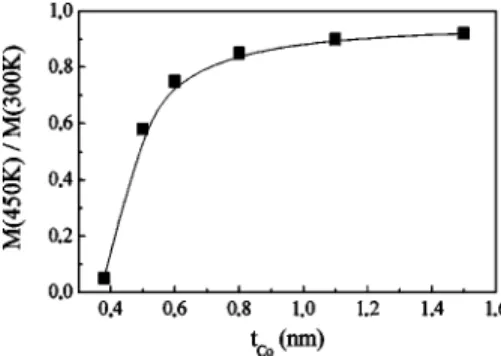
blocking temperature TBas the temperature at which HE van-ishes completely upon heating兲. Figure 6 shows the depen-dence of the ratio between the saturation magnetization mea-sured at 450 K, and that measured at 300 K,
MS共450 K兲/MS共300 K兲, on tCo. This figure gives an idea of
how much magnetic moment in the FM is lost at T = TBdue to thermal activation. It can be seen that, although
MS共450 K兲/MS共300 K兲 practically vanishes for tCo
= 0.38 nm, for tCo艌0.65 nm the saturation magnetization at T = 450 K is still rather large. Although exchange bias has
been occasionally reported in systems with TC lower than
TB,31 it is well accepted that HE is induced by the net FM moment acting during the FC process. Therefore, the condi-tion TC⬎TB is generally required to induce HE.1–4 If TC is lower or about the same order of magnitude as TB 共as it occurs for thin Co layers兲 the alignment of the AFM spins during the FC is probably less effective and, consequently,
HE is expected to be reduced. Finally, although it was not observed by x-ray diffraction, some structural effects 共e.g., improvement of texture in the AFM due to better AFM growth兲 could also be partially responsible for the HE en-hancement for the HEenhancement for large FM thickness. It should be noted as well that the maximum of HC for tCo
⬃0.65 nm is also probably related to the enhanced FM-AFM
exchange coupling, since an enhancement of HC is another fingerprint of FM-AFM coupling.
Inserting a Pt spacer between the 关Pt/Co兴 ML and the AFM is another way to significantly modify HE. This effect was investigated for four series of samples, with tCo= 0.38,
0.6, 0.8, and 1.1 nm, with the aim of further enhancing HE. Shown in Fig. 7 are the dependences of HEand HCon tPt共the
thickness of the inserted Pt spacer兲 for the four sets of samples. As can be seen in the figure, completely different behaviors are obtained depending on tCo. Namely, for tCo
= 0.38 nm, large enhancements of HE and HC are observed for small Pt thickness, both of them becoming maximum for
tPt= 0.3 nm and progressively decreasing when tPt is further
increased. Conversely, for tCo= 0.6 nm, only decreases in HE and HCare observed for all values of tPt. For tCo= 0.8 nm and
low values of tPt HE decreases but HC slightly increases. Finally, for tCo= 1.1 nm both HE and HC decrease with in-creasing tPt. The large enhancement of HEand HCwhen an ultrathin Pt spacer is deposited between the关Pt/Co兴 ML and the AFM has been recently reported in 关Pt/Co兴 - FeMn.13
However, in the present work we show that this behavior is not universal, but is only observed for low values of tCo.
Similar arguments to those given to interpret the variations of HEand HCwith tCocan be used to understand the role of
the Pt spacer in these systems. The HEand HCenhancements for tCo= 0.38 nm can be understood taking into account that
when the Pt layer is introduced, the perpendicular orientation of the Co layers in the ML is improved, as can be seen from the 15% increase in MR/ MS shown in Fig. 8共a兲. Indeed, when no Pt spacer is inserted, MR/ MSis reduced because of both a lack of a Pt/Co interface on top of the last Co layer and the fact that the Co/IrMn interface is not so effective in keeping the perpendicular orientation of the last Co layer in the ML. Actually, the MR/ MS enhancement is accompanied by a slight increase in the perpendicular effective anisotropy
FIG. 5. Dependence of the exchange bias energyexcalculated from the shift of the hysteresis loops measured along the perpen-dicular to film direction, on the Co thickness tCo for perpen-dicular exchange biased multilayers with compositions
关Pt共2 nm兲/Co共tCo兲兴3/ IrMn共5 nm兲/Pt共2 nm兲. The lines are guides to
the eye.
FIG. 6. Dependence of the ratio between the saturation magne-tization measured at 450 K, MS共450 K兲 and that measured at 300 K,
MS共300 K兲, on the Co thickness tCo for perpendicular
exchange biased multilayers with compositions
关Pt共2 nm兲/Co共tCo兲兴3/ IrMn共5 nm兲/Pt共2 nm兲. The lines are guides to
the eye.
SORT et al. PHYSICAL REVIEW B 71, 054411共2005兲
关see Fig. 8共b兲兴. However, Figure 7 shows that for tCo
= 0.38 nm, HEincreases from⬃40 Oe 共for tPt= 0 nm兲 to 130
Oe共for tPt= 0.3 nm兲. This means that HE increases by more than a factor of 3. It should be noted that even in the limit case where the three Co layers were completely uncoupled from each other and that only the last Co layer in the ML was tilted towards in-plane, the observed 15% decrease in
MR/ MS would mean that the tilt of the last Co layer should be of no more than 60° from the perpendicular to plane di-rection. Hence, assuming that HE is directly propotional to
the FM-AFM spin projection at the interface and that the AFM spins are completely oriented along the perpendicular direction during the field cooling process, this would roughly lead to an HEenhancement of only a factor of 2 between the value at tPt= 0 and HEmaximum. Since the Co layers in the ML are not completely uncoupled one from another, the three Co layers probably contribute to the 15% decrease of
MR/ MS, i.e., the three of them are somewhat tilted. This implies that the angular tilt is less than 60° and, conse-quently, the resulting HE enhancement would be even less than a factor 2. Therefore, since the observed HEincrease is larger, this suggests that other mechanisms should be also considered as partially responsible for the HE enhancement when the Pt spacer is inserted. For instance, it has been
re-ported that some kind of defects near or at the FM-AFM interface may induce an enhancement of HE due to local increases of the site anisotropy in the AFM as a consequence of the strains created by these defects, or because of a local decrease of the FM-AFM exchange coupling strength.32,33
Interestingly, the strain induced anisotropy can be up to an order of magnitude larger than bulk values for strain levels of 1–2 %.34Since the Co and Pt cell parameters are not exactly
the same, it is indeed likely that the insertion of a Pt spacer at the FM-AFM interface will cause local variations in the IrMn structure, particularly near the interface. Some authors have also observed enhancements of HE by inserting impu-rities in the AFM 共Ref. 35兲 or by ion irradiating the FM-AFM structure.36 In both cases, the effect is to modify the
domain configuration of the AFM in such a way that HE is enhanced, for example creating more AFM domain walls, which enhance the net AFM moment being coupled to the FM. Finally, there could also be some improvement in the texture of the AFM when the Pt is inserted, meaning that the growth of IrMn would improve. However, this effect was not observed by x-ray diffraction.
Contrary to tCo= 0.38 nm, for tCo= 0.6 nm, HE and HC only decrease when the Pt spacer is introduced. Remarkably, although the anisotropy also slightly increases in this case
关see Fig. 8共b兲兴, MR/ MS is already close to 1 for tPt= 0 nm
FIG. 7. Dependence of the hysteresis loop shift HE共--兲 and
coercivity HC共-䊏-兲, measured along the perpendicular to film direc-tion, on the thickness of the Pt spacer inserted between the关Pt/Co兴 multilayer and the AFM layer tPtfor perpendicular exchange biased multilayers with compositions 关Pt共2 nm兲/Co共tCo兲兴3/ IrMn共5 nm兲/
Pt共2 nm兲 for tCo= 0.38, 0.6, 0.8, and 1.1 nm. The lines are guides to the eye.
FIG. 8. Dependence of 共a兲 the remanence to saturation ratio
MR/ MS,共b兲 the effective magnetic anisotropy, Keff, and共c兲 the
nor-malized hysteresis loop shift, HE 共see text兲, on the thickness of the inserted Pt spacer layer tPt, for perpendicular exchange
biased multilayers with compositions 关Pt共2 nm兲/Co共tCo兲兴3/ IrMn共5 nm兲/Pt共2 nm兲 for tCo= 0.38共-쎲-兲, 0.6 共-䉲-兲 and 0.8 共--兲
nm. Note that in共a兲 and 共b兲, the lines are guides to the eye, whereas in共c兲 the line is an exponential fit.
关see Fig. 8共a兲兴. Hence, for tCo= 0.6 nm, the Pt spacer does not
seem to play a role in reorienting the last Co layer in the ML and it merely causes a decrease of the exchange bias strength due to its short-range character. This result confirms that the HEenhancement observed for tCo= 0.38 nm is mainly due to
the existing tilt of the Co layers in the ML when no Pt is inserted, rather than simply to the slight increase of perpen-dicular effective anisotropy. Moreover, since HC decreases with increasing tPtin spite of the slight increase in Keff, this
demonstrates that FM-AFM exchange interactions play in-deed an important role in the observed HC values of the different samples.
For tCo= 0.8 nm, HE also decreases whereas HC slightly increases for low values of tPt. For thicker Pt spacers, both
HE and HC decrease. The dependence of HC on tPt is the
result of the interplay between the increase of perpendicular orientation of the magnetization共i.e., MR/ MS兲 in the ML as
tPt increases 关see Fig. 8共a兲兴 and the decrease of FM-AFM
exchange interactions共i.e., HE兲 with increasing tPt.
Interest-ingly, if the HEvs tPtdependences for tCo= 0.38, 0.6, and 0.8
nm are plotted together normalizing at the large spacer thick-ness regime关see Fig. 8共c兲兴, it can be observed that the de-crease of HEis more pronounced for tCo= 0.6 nm, where the
main effect of the Pt spacer is to isolate the FM and the AFM while no improvement of MR/ MS is observed. The line in Fig. 8共c兲 is a fit using an exponential law of the decrease of
HEfor tCo= 0.6 nm. As it occurs for other FM-AFM systems where a nonmagnetic spacer is inserted at the FM-AFM in-terface, the experimental points for tCo= 0.6 nm are well fit-ted using this law.37 However, deviations are observed for
lower tCovalues which, as already commented, are due to the
improvements of the perpendicular orientation of the关Pt/Co兴 ML magnetization.
Finally, for tCo= 1.1 nm, the 关Pt/Co兴 ML maintain an
in-plane magnetic anisotropy, even when the Pt spacer is intro-duced, with MR/ MS values always lower than 0.15 共not shown兲. This is due to the increasing relative contribution from shape anisotropy when the thickness of the magnetic layer is increased. Therefore, as for tCo= 0.6 nm, the main
role of the inserted Pt spacer is to simply reduce the FM-AFM exchange coupling effects.
IV. CONCLUSIONS
The magnitudes of the exchange bias field and coercivity in关Pt/Co兴 multilayers exchange coupled to IrMn, measured along the perpendicular to film direction, have been tailored by共i兲 varying the thickness of the Co layers inside the ML and/or 共ii兲 inserting a Pt spacer between the ML and the AFM layer. An unusual dependence of the exchange bias properties on the FM layer thickness has been observed. Namely, the existence of a peak in the dependence of HEand
HC on tCo is in contrast with the commonly reported
in-versely proportional relationship between HE and the FM thickness. Such atypical behavior is ascribed to the reduction of the FM effective anisotropy and the concomitant reduction of MR/ MSfor either very thin or exceedingly thick FM lay-ers, evidencing that magnetic reorientation transitions in the FM have a strong influence on exchange bias effects. The insertion of a Pt spacer between the 关Pt/Co兴 ML and the AFM layer results in totally different effects depending on the thickness of the Co layers in the ML. Namely, for low values of tCo, HE and HC increase and exhibit maximum values for very thin Pt spacers 共tPt= 0.3 nm兲, progressively
decreasing for larger tPt values. This is due to the twofold
role of the Pt spacer. Namely, it enhances the perpendicular orientation of the Co layers in the ML but, additionally, it tends to reduce exchange bias properties due to the short-range character of the FM-AFM interactions. However, for thicker Co layers, both HEand HCmainly decrease when the Pt spacer is introduced. In this case the gain in perpendicular anisotropy brought about by the Pt spacer is not sufficient to overcome the concomitant decrease of the short-range ex-change bias properties.
ACKNOWLEDGMENTS
This work was supported by the European Community through the NEXBIAS Grant No. HPRN-CT-2002-00296.
*Email address: [email protected]
1J. Nogués, and I. K. Schuller, J. Magn. Magn. Mater. 192, 203
共1999兲.
2A. E. Berkowitz and K. Takano, J. Magn. Magn. Mater. 200, 552
共1999兲.
3R. L. Stamps, J. Phys. D 33, R247共2000兲. 4M. Kiwi, J. Magn. Magn. Mater. 234, 584共2001兲.
5B. Dieny, V. S. Speriosu, S. S. P. Parkin, B. A. Gurney, D. R.
Wilhoit, and D. Mauri, Phys. Rev. B 43, 1297共1991兲.
6S. Tehrani, J. M. Slaughter, M. Deherrera, B. N. Engel, N. D.
Rizzo, J. Slater, M. Durlam, R. W. Dave, J. Janesky, B. Butcher, K. Smith, and G. Grynkewich, Proc. IEEE 91, 703共2003兲.
7B. Kagerer, Ch. Binek, and W. Kleemann, J. Magn. Magn. Mater.
217, 139共2000兲.
8S. Maat, K. Takano, S. S. P. Parkin, and E. E. Fullerton, Phys.
Rev. Lett. 87, 087202共2001兲.
9S. M. Zhou, L. Sun, P. C. Searson, and C. L. Chien, Phys. Rev. B
69, 024408共2004兲.
10Z. Y. Liu, J. Magn. Magn. Mater. 281, 247共2004兲. 11C. H. Marrows, Phys. Rev. B 68, 012405共2003兲.
12F. Garcia, J. Moritz, F. Ernult, S. Auffret, B. Rodmacq, B. Dieny,
J. Camarero, Y. Pennec, S. Pizzini, and J. Vogel, J. Exp. Mar. Biol. Ecol. 38, 2730共2002兲.
13F. Garcia, J. Sort, B. Rodmacq, S. Auffret, and B. Dieny, Appl.
Phys. Lett. 83 3537共2003兲.
14L. Sun, S. M. Zhou, P. C. Pearson, and C. L. Chien, J. Appl. Phys.
93, 6841共2003兲.
15Z. Y. Liu and S. Adenwalla, J. Appl. Phys. 94, 1105共2003兲. 16Z. Y. Liu and S. Adenwalla, Phys. Rev. Lett. 91, 037207共2003兲. 17J. Sort, B. Dieny, M. Fraune, C. Koenig, F. Lunnebach, B.
Bes-SORT et al. PHYSICAL REVIEW B 71, 054411共2005兲
C. L. Canedy, X. W. Li, and G. Xiao, J. Appl. Phys. 81, 5367
共1997兲.
23N. Nakajima, T. Koide, T. Shidara, H. Miyauchi, H. Fukutani, A.
Fujimori, K. Iio, T. Katayama, M. Nývlt, and Y. Suzuki, Phys. Rev. Lett. 81, 5229共1998兲.
24M. T. Johnson, R. Jungblut, P. J. Kelly, and F. J. A. den Broeder,
J. Magn. Magn. Mater. 148, 118共1995兲.
25T. Mewes, H. Nembach, M. Rickart, S. O. Demokritov, J.
Fass-bender, and B. Hillebrands, Phys. Rev. B 65, 224423共2002兲.
26D. Weller, A. Carl, R. Savoy, T. C. Huang, M. F. Toney, and C.
Chappert, J. Phys. Chem. Solids 56, 1563共1995兲.
Appl. Phys. 94, 6678共2003兲.
34C. H. Lee, H. He, F. J. Lamelas, W. Vavra, C. Uher, and R.
Clarke, Phys. Rev. B 42, 1066共1990兲.
35J. Keller, P. Miltenyi, B. Beschoten, G. Güntherodt , U. Nowak,
and K. D. Usadel, Phys. Rev. B 66, 014431共2002兲.
36J. Juraszek, J. Fassbender, S. Poppe, T. Mewes, B. Hillebrands, D.
Engel, A. Kronenberger, A. Ehresmann, and H. Schmoranzer, J. Appl. Phys. 91, 6896共2002兲.
37N. J. Gökemeijer, T. Ambrose, and C. L. Chien, Phys. Rev. Lett.