On the contingent nature of language-learning tasks
John Hellermanna* and Simona Pekarek DoehlerbaDepartment of Applied Linguistics, Portland State University, USA
bCenter of Applied Linguistics, University of Neuchâtel, Switzerland
10.1080/19463011003750657 Classroom Discourse 1946-3014 (print)/1946-3022 (online) Original Article 2010 Taylor & Francis 1 1 0000002010 JohnHellermann [email protected]
Using methods from conversation analysis, this paper explores ways that teacher-designed language-learning task interactions can vary in their performance due to the nature of face-to-face interaction. The analysis describes three task interactions from language-learning classrooms, showing how the contingencies that are necessitated by learners working in small groups provide for different task performance as well as different potentials for language learning. The video-recorded interactions come from two different classroom contexts: adult English-language learners in the USA and adolescent learners of French in Switzerland. In each context, the learners are engaged in a directions-giving task. Participants’ individual and group orientations to these similar teacher-designed tasks lead to different co-constructed performances of the task and, in each case, unique learning potentials.
Keywords
language-learning tasks; classroom interaction; conversation analysis; small group teaching
Introduction
Understanding the role of tasks in language learning has become a central concern for research on language learning and pedagogy. Researchers have explored, in great detail, the design and performance of tasks, thereby contributing to a better knowledge of the pedagogical and interactional value of language-learning tasks in classroom settings. In the areas of language learning and pedagogy, the language-learning task has evolved from a mere context for topical and grammatical interaction into a construct within a programme of research. The research programme has become so well established that a biennial conference has convened since 2005 to focus on research on language-learning tasks (task-based language teaching).
The empirical studies carried out so far have most prominently been interested in exploring the relationship between task design and task performance, task repetition, how tasks activate particular cognitive learning capacities (attention, cognitive load, working memory), and how tasks encourage comprehensible input through negotiation of meaning (for extensive overviews of existing research, see Skehan 2003; Samuda and Bygate 2008). As these topics of investigation suggest, research that is character-ised as ‘task-based’ focuses primarily on the relationship between task types and learn-ing potentials, definlearn-ing the latter mainly in terms of internal cognitive processlearn-ing and linguistic structure. In task-based research, typically, learning outcomes are measured
as a function of the task as designed in advance, although there is increased recognition of the importance of understanding both the task as designed in advance, and the task as implemented and performed in interaction (Ellis 2003, ch. 5; Samuda 2001; Skehan and Foster 1999).
Researchers interested in understanding language-learning tasks and the constructs that are part of tasks from the perspective of the learners participating in the task have recommended more descriptive empirical investigations of task perfor-mance (Seedhouse 2005; Jenks 2009). Our own previous research suggests the value of more basic descriptive, empirical, pre-theoretical research (Hellermann 2007, 2008; Mondada and Pekarek Doehler 2004). Through the use of more advanced video-recording technologies, important details of task performance can be docu-mented that offer valid insights into how tasks are actually accomplished, how they are understood by the people involved in their accomplishment and what learning potentials emerge out of the course of that accomplishment.
Since Breen’s now classic distinction between workplan and task-as-process (Breen 1989), a series of studies has explored the detailed interactional mechanisms that establish and progressively transform tasks (Coughlan and Duff 1994; Kasper 2004; Mondada and Pekarek Doehler 2004; Mori 2002; Seedhouse 2005). Interactionally oriented research has made clear for some time that we cannot expect different learners doing the same task to perform the task identically nor to learn the same thing from the same task given at different times (Coughlan and Duff 1994; Harris 2005). Also, task interactions may result in learning that is not part of the intention of the task (Eckerth 2008).
Following this line of investigation, our focus in this paper is on how participants’ orientation to tasks and their co-constructed interaction create a locally-organised and situated task. We agree with Dörnyei and Kormos (2000) that tasks provide language-learning researchers, a priori, with discrete points for analysis: what we commonly design as ‘task’ has an overt, stated goal and a fairly discrete beginning and ending point. Students with experience in classrooms readily orient to such activity in the classroom as a task. By doing so, however, they continuously co-construct the course of accomplishment of the task, they adapt the task to local interactional contingencies, or transform it throughout the course of their interaction.
Our interest in this paper is in this process of task accomplishment as a contingent, co-constructed phenomenon. In the analysis section, we first will show how two different dyads perform the same task in substantially different ways. We will then document how three participants engaged in the same task interaction orient differ-ently to that task. This analytic focus allows us to uncover the language practices that participants in tasks use to orient to the task and to jointly organise the task on a moment-by-moment basis. This orientation is not simply to tasks, but to local and contingent competences for language and interaction that are part of performing language-learning tasks and result in differently configured occasions for learning.
Tasks and learning potentials as interactional accomplishments
Our analysis of task interactions is grounded in a theoretical perspective on language and language learning emanating from socio-cultural theories of language and human interaction, particularly ethnomethodology (Garfinkel 1967; Heritage 1984) and conversation analysis (CA) (Drew 2005). Ethnomethodology and CA see language as an indigenous practice for micro-level social organisation that emerges through
mundane human interactions. The talk and social order of interactions is a local co-constructed phenomenon. While there may be a priori regularities in talk-in-interaction (e.g. adjacency pairs or the fact that someone must start an interaction), other resources used by participants for interaction are seen as contingent on the local co-texts and contexts, and in particular the sequential moment-by-moment unfolding of talk-in-interaction.
A CA perspective has as a guiding question ‘why that now’? It considers that social interaction is accomplished step by step, through the sequencing of turns and actions, and it sets out to analyse the meaning of turns and actions as a function of where they occur within the sequential unfolding of talk; that is, how they relate to preceding turns and actions, and how subsequent turns and actions relate to them. Even though the interactions that students are involved in may be more or less heavily mediated by the task as instructed by the teacher and by print and other materials available to the students, our observations of different groups doing the same task simultaneously have shown us repeatedly that the foci of the interaction vary greatly (Harris 2005; Markee 2005) and that the organisation of the turns in the tasks is done quite differently by different pairs. A CA analysis looks at the details of how turns are constructed and how sequences are organised to describe the language resources used by learners to organise their task interactions in different ways.
CA methods bring to bear an emic perspective on the data (Firth and Wagner 1997; Markee and Kasper 2004). An emic perspective attempts to understand what the inter-action is for the participants involved in it, how they treat each other’s contributions to that interaction and how they orient to potential moments of learning as they are configured through the moment-to-moment deployment of talk (Macbeth forthcom-ing). An emic perspective on tasks hence focuses on how participants engaged in performing a task treat that task and (re)configure it through the course of its local accomplishment. Therefore, our focus is on the mundane practices for interaction that occur as part of tasks in language-learning classrooms.
But what can such a focus tell us about learning or learning potentials? Although it may be that learning can be seen in the discrete linguistic products that are measured by after the fact assessments, learning can also be seen in an active way, in the process of performing tasks. Students doing tasks in classrooms manage contingencies, not only because of intentional task designs by teachers but also because of the nature of talk in face-to-face interaction: such talk requires improvisation. Some research has suggested the adaptation to local contingencies is in itself learning (Meyer 1990; Hellermann 2008).
The data we have worked with and which we present in this paper show us that the locally co-constructed nature of face-to-face talk allows for different potentials for learning even when participants engage in the same or similar tasks. These learning potentials include grammatical structures, lexical items, as well as methods for turn construction, the sequential order of turns, and recipient design work. Most impor-tantly for our purpose here, crucial moments related to learning that have been cast in cognitive terms as ‘attention focus’, ‘noticing’ or ‘understanding’ can be analysed as embodied in the sequential organisation of talk, through such observable elements as word searches, repair, acknowledgements, and so on (Kasper 2009; Pekarek Doehler, 2010). Accordingly, we look for the visible evidence of learning potentials that are jointly constructed in context.
From this perspective, our goals are not to directly address the efficacy of tasks types or the degree to which task-as-workplan is transformed within task-as-activity.
Rather, our goals are more basic. We are interested in uncovering the possible language practices used to organise the task interactions of learners. And we are inter-ested in exploring how task-specific learning potentials emerge from the turn-by-turn collaborative accomplishment of a given task by participants. For this paper, we will only have space to focus on the contingencies that occur near the very start of the task; that is, during transitioning from instructions to performance of the task. This is a key moment, however, as much of the student’s orientation to the task crystallises and is negotiated at the very start of task accomplishment. It is our hope that the data-driven and discovery-oriented practices of ethnomethodology/CA can provide better under-standings for researchers and teachers of the agentive work of students in language-learning classrooms.
Data
The data for our study come from video recordings of classroom interaction in two contexts. The first context is a classroom for adult immigrant learners of English in the United States, where two dyadic interactions of learners simultaneously perform the same task.1 The learners have beginning level of proficiency and are participating in non-credit all-skills community college classes.
The second context is one small group interaction in a secondary school lower-intermediate-level French language classroom in the German-speaking part of Switzerland. The class was also all-skills and the learners are 13–14 years of age.
The particular task of focus in our investigation is a common task type in language-learning classrooms: ‘directions giving’. In such a task, students are to provide spoken instructions to a hypothetical person looking for a particular destina-tion. Our primary interest is in the critical moment of a task (which can spread across several minutes) in which instruction from a teacher is taken up by students in the performance of the task. The problem for students of all classrooms and for anyone following instructions of any kind is how to take instructions for a task, even instruc-tions that were modelled with practice of the task, and do the task (Amerine and Bilmes 1983). A most interesting question for ethnomethodology/CA is: at this junc-tion, how do students co-construct the practice of the task?
In what follows, we will analyse what resources and mechanisms are used by different students to organise their task interactions. We will show that the tasks are oriented to quite differently by different dyads and by individual participants in the same triad, and we will show that these different orientations yield different learning potentials.
Same task, different interactions: two contrasting dyads
In this section, we will compare two dyads accomplishing the same task at the same time, in response to instructions provided by the teacher jointly to both dyads. In Data Set 1, before the dyadic task interaction starts, the teacher provided a model dialogue for asking for and giving directions to destinations in the area. This model dialogue is written on the white board at the front of the classroom.
The teacher had provided students with a worksheet on which they had the model dialogue written with scrambled word order (see Figure 1). Some preliminary work involved the students writing out the correct word order at the bottom of the work-sheet, the correct word order creating the model dialogue written on the white board.
The teacher practiced performing the model dialogue with students and then asked them to use the model to make a conversation; but instead of using the destination she had written for the dialogue, to think of other destinations in the immediate vicinity for use in the dialogue.
Figure 1.Student paper with reconstructed dialogue.
The analysis shows that even in a task heavily mediated by instructor-provided language, there is creative work involved in negotiating the transition from the teacher-fronted instructional phase of the lesson to the performance of the task itself. We will see how the teacher instructions are oriented to in unique ways by each dyad and that the orientation to the performance of the task is progressively co-constructed.
The first dyadic interaction in the English second-language (L2) data involve Gongyi (Mandarin first language [L1]) and Julia (Portuguese L1). The transitioning from teacher instructions to task in this interaction is very direct (not uncommon in data for beginning learners; Hellermann 2007). The task itself is performed as an oral language practice task using language for the task based on the teacher-provided writ-ten and practiced language frame. During the task performance, students work on substituting hypothetical, generic locations into the teacher dialogue frame.
As the teacher finishes her instructions to students, in line 30 of Excerpt 1, we see Gongyi giving receipt to the teacher’s instructions. In line 34, both students orient to the printed page as part of or support for the task. For 16 seconds after the teacher finishes the instructions for the task, the students’ focus on their notebooks and work-sheets on their desks. Gongyi finishes writing the last part of the teacher model dialogue in her notebook.
Excerpt 1
8/5/03, 206, 1:23:47
23 T: area here. around this building. you could say maybe
24 excuse me:: how do I get to the:: bank. how do I get to
25 McDonalds. or how to I get to the deli. okay
26 (.)
27 T: use this example. But make a conversation. >together<,
28 (.)
29 with places (.) here. Around this °building° okay?
30 G: okay
31 T: question?
32 (.)
33 T: °okay°.
34 (16.0) ((J & G looking at notes; G copying model
dialogue))
35 ((J & G put down pens, shift posture toward one
another))
36 J: excuse me (0.5) how do you <get to the> (.) deli? After this preparation time spent with the written resource, in line 35, each student places their pen on their desk and accomplishes a posture shift to align toward one another. Again, this has been noted to be an important interactional signal characteris-ing classroom task starts (Hellermann 2007; Mori and Hasegawa 2009). After the mutual posture alignment, we see Julia directly launch the task in line 36 without any other negotiation for doing the task.
In this launch, Julia uses the language form from the dialogue supplied by the teacher. The slower-paced talk and hesitations in her turn construction might be considered prefatory work to a trouble-source (Schegloff 1979) as it marks the substi-tution for destination (‘deli’) that Julia is making in the dialogue.
After a repair initiation by Gongyi in line 37 (Excerpt 2), we see how this contin-gency in the task (lack of recognition of the word ‘deli’) provides a place in the task where the participants’ country of origin or cultural heritage is made relevant in the co-construction of the task. After the lack of mutual orientation to the first place selected by Julia (‘deli’), Julia selects a destination for the task that she may see as aligning with Gongyi’s background, a Chinese restaurant (lines 44–5). This destina-tion is oriented to by Gongyi, who offers direcdestina-tions to the hypothetical restaurant starting in line 46:
Excerpt 2
36 J: excuse me (.5) how do you <get to the> (.) deli?
37 G: de::li?=
38 J: =deli. how do you (.) HO- >okay< how do you <how> excuse
39 me how do you get to the:
40 uh li-? (life restaurants.)
41 G: ( )
42 J: mm hm?
43 G: ( [ )]
44 J: => [(I know)] how do you excuse me how do you get to
45 => CHInese restaurant
46 G: mm (.) eh °so° (.) go straight, go straight, mm (.8)
The repair initiation by Gongyi in line 37 entails the necessity for the asker of directions (Julia) of naming an alternative destination. The alternate destination (Chinese restaurant) is responded to by Gongyi. In such a response, she, too, has a number of options – among them to ask for specification of the Chinese restaurant to
which Julia is referring. Instead, Gongyi treats the destination as unproblematic and uses the model given by the teacher to respond.
The details highlighted in this interaction show the methods used by Gongyi and Julia to co-construct the transition from teacher instructions to the performance of their task interaction. Key points in the transition to the task performance are as follows:
(1) students’ orientation to and acknowledgement of the teacher’s instructions for the task;
(2) students’ work with the written support material (reading and writing) before the start of the transition into the task performance; and
(3) students’ co-construction of a mutually understood first destination.
While Gongyi, Julia and other students in the class performed the task as an oral skills task and practiced reading the dialogue with substitutions for places the teacher had given in the model, at least one dyad – Jorge and Andrea – co-constructed the task quite differently. For them, the task itself became the crafting of a dialogue similar to the teacher’s, using new routines for giving directions. The negotiation of the task start is heavily mediated by the use of the students’ shared lingua franca (Spanish).2
As with the dyad just discussed transitioning from the teacher instructions, during the teacher’s instructions both Andrea and Jorge display receipt of the instructions to show mutual orientation to the upcoming task (lines 21, 24, 27, and 31 of Excerpt 5):
Excerpt 5 1:23:47
20 Te: now, (.5) at the bottom you have other (.) lines.
21 J: jye[s
22 Te: [make another conversation. you can use this example,
23 but not post office.
24 J: ((nods))
25 Te: maybe- think abou:t, (.) think about this area here.
26 around this building.
27 J: mm hm
28 Te: you could say maybe excuse me:: how do I get to the::
29 bank. how do I get to the McDonalds. or how do I get to
30 the deli. o[kay
31 A: [((looks at J)) uhmhh ((taps her forehead))
Also similar to Gongyi and Julia’s interaction, Andrea and Jorge display their mutual orientation to the task and to one another in lines 31–32 when the pair shifts their posture to orient their posture toward a more face-to-face position (Excerpt 6):
Excerpt 6
30 the deli. o[kay
31 A: [((looks at J)) uhmhh ((taps her forehead))
32 J: [((shifts posture toward A))
33 Te: [use this example. but make a conversation. >together<,
34 (.)
35 Te: with places (.) here. around this °building° okay?
After this physical alignment, Andrea orients in two ways to the task that have relevance for the particular way it is continued in lines 41 and 42 (Excerpt 7). In line 41, the use of Spanish starts in Andrea’s stance display assessing the upcoming task as difficult (on the meditational function of L1 use in student–student interaction, see Swain and Lapkin 2000). Immediately following, in line 42, the first move toward orienting to the task as ‘crafting a written dialogue’ occurs when Andrea completes the first line of the dialogue before doing any collaborative task work:
Excerpt 73
38 Te: question?
39 A: ↑nhnn ((shakes head))
40 Te: °okay°
41 A: o santo dios. no tengo ( ) para poner ( ) oh my holy god, I don’t have ( ) to use.
42 (6) ((A is writing first line of dialogue))
43 A: qué hay cerca de aquí. ((writing))
what is near here.
44 (3)
Andrea then (Excerpt 8, line 43) solicits participation from Jorge (again, in Spanish), asking about a nearby destination to use for the task. Jorge orients to this question by embodying thinking by holding up his index finger and expressing a ‘thinking face’ (line 45) before giving a list of generic places (line 46):
Excerpt 8
43 A: qué hay cerca de aquí. ((writing))
what is near here.
44 (3)
45 J: ((raises right hand index finger, ‘thinking face’))
46 °( ) La tienda, la tienda, el hoteline No sé.°
( ) The store, the store, the hotel I don’t know.
47 A: él que está en la calle de allá. ((points))
on that street over there.
The students continue brainstorming local destinations and mention a large local department store. We see here another example of the contingencies in situated task completion providing a learning potential: alternative wording for alternative direc-tions giving. After the mention of the department store as a possible destination to use in the task, the pair decides that it is rather far. Andrea then makes a candidate sugges-tion (Excerpt 9, line 83: ‘well, I’ll tell him to take the bus’) displaying an ironic stance, a suggestion that is treated as laughable but then taken up by Jorge as a good solution to the directions-giving problem. The humour is due to the fact that such a directive (‘take the bus’) subverts the instructions of the teacher, it would be the easy way out for the students rather than giving directions to someone travelling by foot as the teacher had modelled.
Excerpt 9
80 A: [algo más cerca?
something closer?
82 J: no, está bien.=está bien. ( ) para practicar. no, it’s ok. it’s ok. ( ) for practice. 83 A: =>$pues le digo que tome el bus$
well, I’ll tell him to take the bus
84 J: ((laughs))
85 A: ((laughs))
Together with the humour, another contingency at play here for the students is what transportation options (bus, street car, walking) are appropriate in Portland and what suggested options are appropriate for this particular task. The students decide at this point to deviate slightly from the teacher’s model and construct a version in which they provide instructions on how to take the bus to the department store.
Now that a destination has been agreed upon, the start of the task itself is oriented to by both participants in Excerpt 10 when Andrea uses the pan-lingual discourse marker ‘okay’ to frame her query regarding how to give the instructions in English (line 100). Jorge responds with a different discourse marker, which is followed by negotiation of how to phrase the first line of the dialogue (lines 102 and following). The rest of the task performance continues to be a co-constructed crafting of a written dialogue in English:
Excerpt 10
100 A: okay. a ver, cómo le dirías entonces.
okay. let’s see. how would you say it then.
101 J: bueno.
okay.
102 A: take the bus. toma el camión derecho.
take the bus straight.
103 J: go. take the bus.
104 A: entonces sería take?
then it would be take?
105 J: mm hmm.
106 A: the bus?
107 J: take the bus. (.) going.
The co-construction of the written dialogue continues in Excerpt 11. In lines 113– 4, in response to Andrea’s query ‘cómo se dice take the bus’ (lines 108–109), Jorge offers what can be glossed as ‘take the bus … go to the downtown Portland’ (lines 110–2). Andrea reformulates this in a somewhat more target-like manner as ‘take the bus to downtown’ (line 114):
Excerpt 11
108 A: toma el camión para el centro. cómo se dice
take the bus downtown. how do you say
109 take the bus.
110 J: take the bu:s, and the >take the bus< take the bus (.)
111 no. take the bu:s, go (.) go to the downtown Portland
112 to the downtown Portland,
113 tómate el camión y vas al centro de Portland,
take the bus and go to downtown Portland,
114 A: entonces take the bus to downtown,
115 J: to downtown
116 A: cómo se escribe downtown downtown.
how do you spell downtown downtown
There are several notable differences in the contingencies that are taken up during the start of this particular task by Andrea and Jorge compared with that of Gongyi and Julia. First of all, the use of Spanish is notable. For Gongyi and Julia, a lingua franca other than English was not available. Andrea and Jorge seem to use Spanish for task management rather than for task accomplishment. It occurs at the very start of the task and is used for transitioning into the task while choosing a focal destination, an exist-ing destination in the area. Gongyi and Julia, on the other hand, do not need to nego-tiate the choice of local places as they choose hypothetical destinations for their task performance.
Second, Andrea and Jorge orient to the task as collaborative written dialogue craft-ing. We see that English is used during the task performance to say the lines of dialogue that Andrea writes down and the negotiation of those lines is done in a mixture of Spanish and English. Although Gongyi and Julia are oriented physically to their written worksheets at the start of the task, they launch the task by practising a spoken dialogue as they provide substitutions to the teacher’s written model dialogue. The written text serves as an aid in the spoken performance, while for Andrea and Jorge the spoken text provides a model to follow in the construction of a new written dialogue.
Finally, Andrea and Jorge incorporate an aspect of the phatic part of their interac-tion into the task itself. This particular ironic humour may be due to the fact that they are interacting in a more comfortable lingua franca. For Gongyi and Julia, culture becomes relevant in Julia’s selection of a destination (a generic Chinese restaurant) for their dialogue practice – an orientation to Gongyi’s Chinese heritage.
In the data from English L2, we see learning potentials occurring in the contingen-cies of face-to-face task interaction as students transition from teacher instructions to their task performance. With Gongyi and Julia, the written form of a model dialogue was seen as a meditational device for the task in the students’ orientation to that writ-ten dialogue before the start of the mutual task orientation. It appears that Gongyi and Julia may use this written form for task planning. Once their interaction started, the students co-constructed an appropriate first destination after a repair initiation and the orientation of Julia to Gongyi’s ethnic identity.
Jorge and Andrea, on the other hand, do not orient to the written form of a dialogue as a script to follow. Rather, they use a lingua franca (other than English) to negotiate the first destination for their task. The use of humour also makes available providing directions via a different mode of transportation (‘taking the bus’) than that provided by the teacher in her model dialogue.
In both dyadic interactions, we see that in the transition from teacher instructions to student task performance there were a number of contingencies that could not be counted on during task design. We saw that these contingencies were managed and became learning potentials while the progressivity of the task was maintained.
Same task, same interaction: different participant orientations to the task The task interaction from the second data context (French L2) allows us to see the contingencies for tasks and learning that can be found with more advanced learners
doing tasks that turn out to be less guided by teacher-provided language support. The single interaction from this context shows how participants can orient differ-ently to a teacher-assigned task even when co-participating in the same interaction. We saw in the preceding section that convergent orientations allow joint task accomplishment, even though that accomplishment differed from task design. In this section, we will see that a lack of convergent orientation by participants critically blocks task accomplishment.
As with the first two interactions from an English L2 classroom, students here have been instructed to give directions to particular destinations: a hypothetical lady is lost in the city of Basel (where the students live) and the students are to explain to her how to get from point X to point Y. Each participant has an instruction sheet with three itineraries (see Figure 2 for the English translation). Unlike the first set of excerpts, students do not have a model dialogue. They are instructed explicitly to prepare and practice.
Figure 2.Instructions for student task.
We will see that the three participants (Thobias, Ugo and Peter) show different orientations to this task and very different ways of moving into the task. The data show a misalignment between the students after explicit distribution of task roles had occurred. This is seen both in students’ verbal and non-verbal behaviour: Thobias and Ugo start engaging with the task as designed by the teacher (although through parallel, individual projects) while Peter pursues a project oriented more to commenting on the task.
Distributing roles and rationalising the task
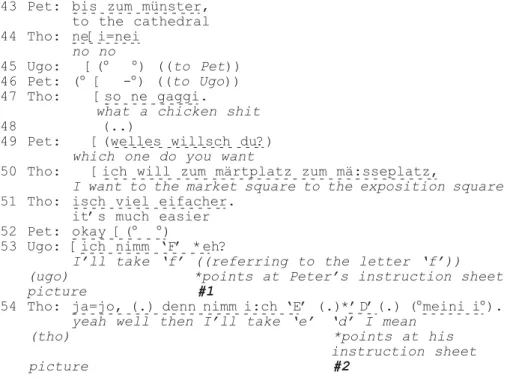
Excerpt 12 shows the start of the group work, after the teacher had specified ‘If possi-ble each of you should explain one itinerary. The others can still help out’. This makes relevant a negotiation about who will accomplish which itinerary, done here all in Swiss German (marked by dotted underlining in the transcript):
Excerpt 12
tschu-210606-TG3-group2 - a
40 Pet: (ich nimm) münster zum mässeplatz. isch guet? I take cathedral to the exposition square is that okay
41 Tho: ich nimm de mässeplatz. I take the exposition square
42 Pet: (aso) vom münster- ah denn- denn nimm ich marktplatz. (okay) from cathedral uh then then I’ll take market square
43 Pet: bis zum münster, to the cathedral 44 Tho: ne[i=nei
no no
45 Ugo: [(° °) ((to Pet))
46 Pet: (° [ -°) ((to Ugo))
47 Tho: [so ne gaggi.
what a chicken shit
48 (..)
49 Pet: [(welles willsch du?)
which one do you want
50 Tho: [ich will zum märtplatz zum mä:sseplatz,
I want to the market square to the exposition square 51 Tho: isch viel eifacher.
it’s much easier 52 Pet: okay [(° °)
53 Ugo: [ich nimm ‘F’ *eh?
I’ll take ‘f’ ((referring to the letter ‘f’))
(ugo) *points at Peter’s instruction sheet
picture #1
54 Tho: ja=jo, (.) denn nimm i:ch ‘E’ (.)*’D’(.) (°meini i°). yeah well then I’ll take ‘e’ ‘d’ I mean
(tho) *points at his
instruction sheet
picture #2
Two points are noteworthy here. On the one hand, the segment shows how the movement into task accomplishment is mediated by the instruction sheet, which structures not only the negotiation of who is to perform which part of the task, but also the turn-by-turn organisation of this negotiation. Throughout lines 40–54 we see the repetition of the linguistic format ‘I take X’ across the three speakers (lines 40–2 and 53–4), each of which quotes one or several of the three items on the instruction sheet, which is also physically oriented to by the participants by means of their pointing gestures (lines 53 and 54; see pictures 1 and 2 in Figure 3).
Figure 3.Students pointing.
On the other hand, this lengthy transition into task accomplishment also shows the students’ different rationalisations of the task. First, we see a change in how the itineraries are identified. While between lines 40 and 50 the participants use logo-nyms such as market-square or exposition-square to reference the three itineraries, this technique changes in line 53 to the use of the letters ‘d’,‘e’, ‘f’ for the same purpose. This is interesting as it shows two different orientations of the partici-pants: one is to the reality of the city’s geographic landscape as encoded in place names; the second is to the task to be accomplished as indexed by the letters ‘d’ to ‘f’ on the instruction sheet and embodied in pointing gestures (Figure 3). Task rationalisation can further be observed in Thobias’ comment ‘it’s much easier’ (line 51), which he presents as an account for his choice of a specific itinerary from the list.
Coordinated transitioning from task management to task accomplishment
More central for our purpose is the actual transitioning from task management to task accomplishment. In order for the achievement of a collaborative task, there needs to
be joint orientation to the fact that the preceding task management sequence is over, and that task accomplishment can start. This transition – a key element in classroom tasks – emerges from the mutual coordination of participants’ actions. It is hence inter-esting to ask from an emic perspective: how do participants come to a joint under-standing of the point where the preliminary organisation of the task (distribution of roles) ends and task accomplishment can begin? In the data under analysis, we can locate that beginning between lines 53 and 59:
Excerpt 13
53 Ugo: [ich nimm ‘F’ *eh?
I’ll take ‘f’ ((referring to the letter ‘f’))
(ugo) *points at Peter’s instruction sheet
picture #1
54 Tho: ja=jo, (.) denn nimm i:ch ‘E’ (.)*‘D’ (.) (°meini i°). yeah well then I’ll take ‘e’ ‘d’ I mean
(tho) *points at his
instruction sheet
picture #2
55 Tho?: >°(das da)°< this one Figure 3. Students pointing.
56 Tho: =*wo isch **‘D’? (isch das xneimedsxx) where is ‘d’ (is this xsomewherexx)
(tho) *bends over map, puts his hand on map with index extended as if searching
(pet) **gazes at where Tho is pointing
picture #3
57 Pet: *( ) hhh ((laughing))
(pet) *leaning over map and gesticulating
58 (.)
59 Tho: eh VOUS LAUFE JETZ *DO [DURE? uh you go now this way
*deictic gesture, indicating path 60 Ugo: [(vous allez) pren/e/ le tram, (.)
you are going take the tram
61 [eh:( )
In lines 53–4 Ugo suggests that he will prepare itinerary ‘f’ and Thobias yields in the negotiation, eventually accepting to prepare itinerary ‘d’. The orientation toward task accomplishment is enacted both physically and verbally. Just after Thobias accepted to take over itinerary ‘d’ in line 54, the three participants jointly bend over the map laid out on the table in front of them (line 56 and picture 3 in Figure 3). The body-postures of the participants converge and align with the talk, displaying students’ joint orientation to the task at hand (Figure 3).
Thobias’ posture change is previous to and more pronounced than the body movements of the other participants. This may be interpreted as Tobias’ anticipating a self-selection for the first step in task accomplishment.
Gesture is closely coordinated with verbal behaviour here in the transitioning work to task performance. After accepting to present itinerary ‘d’ (line 54), Thobias also orients verbally to task performance: he accomplishes a subsidiary action to task accomplishment, clarifying the precise location of some place (line 56). He then starts a first formulation (line 59), raising his voice and using French with German. The second-person polite form vous (‘you’ in French) indexes a deictic shift away from the present interactional situation to the imaginary dialogue perspective. The increase in volume, the use of the second language, deictic shift plus the content of the talk func-tion together to display Thobias’ words as a first step in task accomplishment. This move is subsequently aligned to by Ugo (line 60), who proposes an alternative dialogue piece, also in French.
Diverging orientations to task accomplishment
Despite the participants’ acute physical and verbal coordination, this moment does not lead into a joint agenda. While their body language converges at the very moment when task accomplishment gets started, the further course of talk shows competing orientations between Peter on the one hand, and Thobias and Ugo on the other.
While Thobias and Ugo have each started the imaginary dialogue (lines 59–60 supra), Peter acts as a disruptive force. He intersperses Thobias’ and Ugo’s attempts at co-constructing itineraries for the imaginary lady with a parallel communicative project (Excerpt 13, line 57). Here – although his wording is not understandable – Peter produces exaggerated gesticulation, displaying the non-seriousness of his stance. Peter’s project is further evidenced in his conduct in the following events.
Excerpt 14
60 Ugo: [(vous allez) pren/e/ le tram, (.)
you are going take the tram 61 [eh: ( )
62 Pet: [(vous allez) pren/e/ le tram(h).((laughing)) you go take the tram
63 (sie gehen nehmen) das t(h)ram. ((laughing, to Ugo))
you go take the tram
64 (..)
65 (ugo) silent laughing/mimics ‘being caught’ 66 Tho: *vous vous was heisst [(laufe)?
you you how do you say walk (tho) *still leaning over map
67 Pet: [*(oh das isch )
oh that is
(pet) *touches Ugo’s arm
(ugo) *looking at map
68 Ugo: *(ja) yes
(ugo) *momentarily turns toward Pet 69 Pet: *ich find das tiptop?
I find this perfect (pet) *looking at Ugo (ugo) *looking at map
70 (..)
71 Pet: *was meinsch [( -) what do you mean ( ) (pet) *looking at Ugo (ugo) *looking at map
72 Tho: ‘ [*vous allez au BARfüsserplatz,=
you’re going/walking to the Barfüssersquare
(tho) *still leaning over map
73 Pet: =*was meine sie- [was meinsch kieg’mr]
what do you think what do you think are we going to get (pet) *looking at Ugo
(ugo) *looking at map
74 ? : [*(° °)]
75 Pet: geld für dass das mer de de weg beschribe money for describing the itinerary
76 (..)
77 Pet: *so fünf franke pro w(h)äg. ((joking tone)) like five franks per itinerary
(pet) *looking at Ugo (ugo) *looking at map
At lines 62–3 Peter orients to Ugo’s dialogue piece ‘vous allez prendre le tram’ ‘you are going to take the tram’ (line 60) by mocking Ugo’s wording. He first repeats Ugo’s words while laughing and then presents a mock-translation into German, repro-ducing word-by-word the French idiomatic expression ‘aller prendre’, still laughing. While his translation as well as his laughter index Peter’s ridiculing stance, it is not clear whether they also display some language expertise. Is Peter pointing out Ugo’s incorrect form of the verb ‘prendre’ ‘to take’ (the target language form being ‘vous allez prendre’ not ‘vous allez prennez/er’), or is he mocking the idiomatic expression itself? Peter’s laugher and falling intonation on the end of the repetition (and the trans-lation) suggests that this is not a repair initiation, and Ugo visibly does not orient to
Peter’s turns as repair initiation. Rather, he aligns with Peter’s laughter (line 65), which possibly indicates that, for him too, the direct translation sounds odd in German. Clearly both participants orient to Ugo’s wording as funny in the light of its word-to-word German translation, but they do not appear to treat it as a non-target language (French) format.
Thobias continues his attempts at formulating an itinerary description and, when encountering a lexical problem (line 66), solicits his co-participants’ help. This call for help, however, is passed over by both Ugo and Peter.
Peter’s meta-situational comments (lines 67 and 69) continue to display disalign-ment and even resistance to the task at hand. These comdisalign-ments are clearly addressed to Ugo: Peter first touches Ugo’s arm (line 67) and then keeps his gaze on him (line 69). Peter then makes fun of the situation by asking whether they will receive payment for giving directions (lines 71, 73, 75 and 77). Peter’s continuous laughter and his consistent use of Swiss German instead of French index his off-task stance. His comments, however, are not oriented to by his co-participants. There is no uptake on Peter’s turns and Ugo, to whom Peter is turned, consistently looks at the map in front of him (line 69, 71, 73 and 77). This obstinate looking at the map can be read here as ‘doing being occupied’; that is, displaying that he is not orienting to Peter.
During this stretch of talk, Thobias remains leant over the map attempting to propose an itinerary to the imaginary lady. His communicative project, however, is run solitarily, as Peter is occupied attempting to distract Ugo, and Ugo himself is occupied with averting attention from Peter. Not only Thobias’ asking for help (line 66) but also his further dialogue piece (line 72) remain unattended to.
In this way, potential occasions for learning, or at least for attention to focus on language forms, remain unexplored: neither Ugo’s non-target language form nor Thobias’ call for help with a lexical item are oriented to by the other participants, let alone taken up as occasions for working on language form. This shows how much learning potentials (or absence of these) in talk-in-interaction hinge on local interac-tional contingencies and on processes of co-construction.
Backing out of the task
From this moment on, Thobias, possibly due to his being a solitary rider throughout what was designed as group work, also starts to back out of the task as seen in Excerpt 15:
Excerpt 15
79 Tho: *ich sag ich weiss(h) es ni(h)d, (.) I’ll say I don’t know
(tho) *starts leaning back
80 *I DON’T KNOW(h).((laughing))
(tho) *sits down, lifts head, gives Pet a short glance 81 Pet: (*°°hey xmegax gnärvt eh°°)
totally unnerved
(pet) *looks at Tho, points with his chin towards Tho 82 Tho: *°wa°?
what
The pivotal element here is Thobias’ metacommunicative comment: ‘I’ll say I don’t’ know’ – in English (lines 79–80). His words, his laughter and the re-orientation of his gaze toward Peter suggest that he joins in with Peter’s distancing stance toward the task. His moving out of task accomplishment is embodied in his physically moving away from the map and sitting down. At this point, both Thobias and Peter turn toward off-task social talk (cf. Markee 2005) and engage in a private conversation in Swiss German, which Ugo will eventually also join in.
The interpersonal task dynamics between the three participants have been slowly corroded by Peter, leading up to a reconfiguration of participants’ mutual orientation that goes hand in hand with the re-orientation of the interaction toward off-task busi-ness. This reconfiguration in turn blocks task accomplishment.
To sum up
What we observe throughout this stretch of talk is an initial joint, closely coordinated orientation to task accomplishment, which, however, immediately splits into compet-ing agendas. Ugo, and more centrally Thobias, engage with the accomplishment of the task as designed by the teacher – although they do this each on his own, not collabo-ratively. Peter, by contrast, enacts through words, laughter and gesture, his distancing from and mocking stance toward the task. Three parallel actional trajectories are deployed here rather than a co-constructed course of interaction. And in the end, the task is simply given up by the triad.
The micro-analysis of participants transitioning into task and task performance within one triadic interaction reveals several major points. First, cooperative moves into the task are coordinated verbally (by means of selection of particular aspects of the task) and non-verbally (by means of orientation to material support such as instruction sheet and map). Both physical and verbal alignment are key resources in this coordination.
Second, differentiated rationalisations of the task and of their complexity are enacted observably through talk-in-interaction. This may be done explicitly, for instance when students qualify the task or its components as difficult or easy. This may also be done implicitly, when the transition into the task shows participants’ differentiated orientation to the meaningfullness of the task (here accepted as worth-while by Ugo and Thobias, but rejected as non-serious by Peter). This rationalisation itself can be (and is here) transformed in the further course of actions.
Third, the transition into the task critically hinges on locally enacted power and solidarity. This observation supports Seedhouse’s (2005) argument that task accom-plishment can be affected by group dynamics. In the data, we observe participants’ displays of alignment and solidarity (between Thobias and Ugo) as well as disalignment and the enactment of power (Peter), eventually leading up to Thobias’ and Ugo’s giving in to Peter’s agenda of resistance.
Finally, regarding potentials for learning, the whole sequence shows students’ inability to move around an agenda that competes with task accomplishment as designed by the instructor. It is their inability to cooperate in the task that eventually blocks the very possibility of task accomplishment for any one of the three. It is due to this non-cooperation that possible occasions for L2 learning remain unexplored. This is not only true for the learning of linguistic forms, as shown in the non-sequitur on Thobias’ call for lexical help, but also for the mere routinisation of patterns of language use through language practice: in the whole quoted sequence, a total of only
two utterances are produced in the target language, one by Ugo (line 66) and one by Thobias (line 72).
Discussion and conclusion
In this paper we have analysed processes of task accomplishment as they are locally enacted through the moment-to-moment deployment of talk and the mutual orientation of participants. We have shown how students co-construct different task trajectories in a locally contingent way, and how task-specific learning potentials emerge from the turn-by-turn collaborative accomplishment and transformation of a task.
Data Set 1 (English L2 classrooms) included two different dyadic interactions, which each transformed the task and enacted a different way of accomplishing the same task. Each, however, succeeded in some sense, as the participants in each dyad mutually coordinated the transitions into the tasks. By contrast, Data Set 2 (the French FL classroom) has shown how one triad within the same task does not advance in task accomplishment, as lack of mutual coordination blocks that accomplishment.
These observations show how much learning potentials in task construction hinge on the participants’ joint understanding of the task and on how they coordinate their mutual orientations to the task by means of a multitude of verbal and non-verbal resources (words, gestures, gaze, posture, but also other semiotic resources, such as print resources). Such observations highlight the analytic importance of looking at joint action, at processes of co-construction, rather than at individual performance, as mutual coordination of actions will create the conditions for what each individual participant will do.
Our analyses complement earlier studies that document how task accomplishment is embedded in the micro details of the moment-to-moment deployment of talk-in-interaction, the mutual organisation of participants and the sequential organisation of their turns at talk (Coughlan and Duff 1994; Hellermann 2008; Kasper 2004; Mondada and Pekarek Doehler 2004; Mori 2002; Seedhouse 2005; Eckerth 2008). The data also demonstrate that task accomplishment is embedded in a complex web of institutional and interpersonal orientations of participants, of group and power rela-tions between them, providing a stage where such relarela-tions are both enacted and constructed, and where tasks are configured in a way that is congruent with these processes of enactment and co-construction.
We have specifically focused on transitions into the task. The data show that such transitions are moments where orientation to and departure from classroom normativity can be observed, where normal expectations of routine events as well as rationalisations of these events and deviations from routine can be documented. Transitions into the task are privileged moments where the process of transforma-tion of task-as-workplan into task-as-process begins. As such, transitransforma-tions into the task are interactionally complex moments. They require coordination of actions in order to move from task negotiation to task accomplishment. Sometimes, parallel agendas are implemented by the participants, which materialise through multiple misalignments. Sometimes, also, multitasking can be observed: the coordinated move back and forth between different aspects of a task and sub-tasks, or between different communicative agendas.
Most importantly, transitions into the task offer privileged moments for observ-ing tasks from an emic perspective, as they display participants’ explicit or implicit
rationalisations of the task. Task complexity and its sub-tasks are oriented to often before students actually engage in the accomplishment of the tasks (comments such as ‘this is difficult’). Students’ understanding of the task and their motivation for the task are made explicit and are interactionally enacted in these transition moments and hence become empirically observable in the data. This opens an important window on tasks, allowing us to understand what the task is for the people engaged in its accomplishment.
And learning? We have not evidenced learning and have not set out to do so. What we hope to have documented, however, is that learning potentials are eminently locally configured, through the moment-to-moment co-construction of talk-in-interac-tion and on the basis of participants’ orientatalk-in-interac-tion to each other, to each others’ language expertise and to larger institutional routines and interpersonal relations of power or solidarity. Such learning potentials emerge in a way that for a substantial part escapes task design. They result from how participants re-appropriate tasks, how they make them their own in order to exploit them for their very specific current (learning) needs and preoccupations. It is because such reconfigurations of tasks may imply re-adapta-tions of their learning potentials to the students’ current needs that their detailed unfolding deserves our attention.
Notes
1. Some of the data collection for this paper (Reder, Harris, and Setzler 2003) was funded and is supported, in part, by grant R309B6002 (Stephen Reder, PI) from the Institute for Educa-tion Science, US Department of EducaEduca-tion, to the NaEduca-tional Center for the Study of Adult Learning and Literacy.
2. Jorge’s self-reported L1 is Maya.
3. We would like to thank Elizabeth Cole for her work on the Spanish transcription and trans-lation.
Notes on contributors
John Hellermann is assistant professor of applied linguistics at Portland State University. His research has used conversation analysis to understand the prosodic organisation of classroom discourse and language learning by adult immigrants to the USA.
Simona Pekarek Doehler is professor of applied linguistics at the University of Neuchâtel, Switzerland. A central focus of her research is on how the micro-details of social interaction shape second language acquisition. She is also interested in the relation between grammar and social interaction.
References
Amerine, R., and J. Bilmes. 1983. Following instructions. Human Studies 11: 327–39. Breen, M. 1989. The evaluation cycle for language learning tasks. In The second language
curriculum, ed. Robert K. Johnson, 187–206. Cambridge, UK: Cambridge University Press. Coughlan, P., and P. Duff. 1994. Same task, different activities: Analysis of SLA task from an activity theory perspective. In Vygotskian approaches to second language research, ed. J.P. Lantolf and G. Appel, 173–93. Norwood, NJ: Ablex.
Dörnyei, Z., and J. Kormos. 2000. The role of individual and social variables in oral task performance. Language Teaching Research 4: 275–300.
Drew, P. 2005. Conversation analysis. In The handbook of language and social interaction, ed. K. Fitch and R. Sanders, 71–102. Mahwah, NJ: Lawrence Erlbaum.
Eckerth, J. 2008. Investigating consciousness raising tasks: Pedagogically-targeted and non-targeted learning gains. International Journal of Applied Linguistics 18: 119–45.
Ellis, R. 2003. Task-based language learning and teaching. Oxford, UK: Oxford University Press.
Firth, A., and J. Wagner. 1997. On discourse, communication, and (some) fundamental concepts in SLA research. Modern Language Journal 81: 285–300.
Garfinkel, H. 1967. Studies in ethnomethodology. Englewood Cliffs, NJ: Prentice Hall. Harris, K.A. 2005. Same activity, different focus. Focus On Basics: Connecting Research and
Practice 8A: 7–10.
Hellermann, J. 2007. The development of practices for action in classroom dyadic interaction. Focus on task openings. The Modern Language Journal 91: 83–96.
Hellermann, J. 2008. Social actions for classroom language learning. Clevedon, UK: Multilingual Matters.
Heritage, J. 1984. Garfinkel and ethnomethodology. London: Polity Press.
Jenks, C. 2009. Exchanging missing information in tasks: Old and new interpretation. The Modern Language Journal 93: 185–94.
Kasper, G. 2004. Participant orientations in German conversation-for-learning. The Modern Language Journal 88: 551–67.
Kasper, G. 2009. Locating cognition in second language interaction and learning: Inside the skull or in public view? International Review of Applied Linguistics in Language Teaching 47: 11–36.
Macbeth, D. Forthcoming. Understanding understanding as an instructional matter. Journal of Pragmatics.
Markee, N. 2005. The organization of off-task classroom talk in second language classrooms. In Applying conversation analysis, ed. K. Richards and P. Seedhouse, 197–213. Basingstoke, UK: Palgrave Macmillan.
Markee, N., and G. Kasper. 2004. Classroom talks. An introduction. The Modern Language Journal 88: 491–500.
Meyer, L. 1990. ‘It was no trouble’: Achieving communicative competence in a second language. In Developing communicative competence in a second language, ed. R.C. Scarcella, E.S. Andersen, and S.D. Krashen, 195–215. New York: Newbury House.
Mondada, L., and S. Pekarek Doehler. 2004. Second language acquisition as situated practice: Task accomplishment in the French second language classroom. The Modern Language Journal 88: 501–18.
Mori, J. 2002. Task design, plan and development of talk-in-interaction: An analysis of small group activity in a Japanese language classroom. Applied Linguistics 23: 323–47. Mori, J., and A. Hasegawa. 2009. Doing being a foreign language learner in a classroom:
Embodiment of cognitive states as social process. International Review of Applied Linguistics 47: 65–94.
Pekarek Doehler, S. 2010. Conceptual changes and methodological challenges. On language, learning and documenting learning in conversation-analytic SLA research. In Conceptual-ising learning in applied linguistics, ed. P. Seedhouse, C. Jenks, and S. Walsh. Basing-stoke, UK: Palgrave Macmillan.
Reder, S., K. Harris, and K. Setzler. 2003. A multimedia adult learner corpus. TESOL Quarterly 37: 546–57.
Samuda, V. 2001. Guiding relationships between form and meaning during task performance. The role of the teacher. In Researching pedagogic tasks: Second language learning, teach-ing and testteach-ing, ed. M. Bygate, P. Skehan, and M. Swain, 119–40. Harlow, UK: Pearson. Samuda, V., and M. Bygate. 2008. Tasks in second language learning. Basingstoke, UK:
Palgrave.
Schegloff, E.A. 1979. The relevance of repair to syntax-for-conversation. In Syntax and semantics: Discourse and syntax, ed. Talmy Givon, 261–86. New York: Academic Press. Schegloff, E.A. 2000. Overlapping talk and the organization of turn-taking for conversation.
Language and Society 29: 1–63.
Seedhouse, P. 2005. ‘Task’ as research construct. Language Learning 55: 533–70. Skehan, P. 2003. Task-based instruction. Language Teaching 36: 1–14.
Skehan, P., and P. Foster. 1999. The influence of task structure and processing conditions on narrative retellings. Language Learning 49: 93–120.
Swain, M., and S. Lapkin. 2000. Task-based second language learning: The uses of first language use. Language Teaching Research 4: 253–76.
Appendix 1. Transcription conventions
Some transcript conventions in conversation analysis (adapted from Schegloff 2000). [ ] the start and end of overlapping or simultaneous talk
= ‘latched utterances’ no break or pause between utterances
(1.5) Numbers in parentheses indicate silence, represented in tenths of a second. (..) Period in parentheses indicate a micropauses less than .5 seconds.
. A period indicates a falling intonation contour, not necessarily the end of a sentence ? Question marks indicate high rising intonation.
¿ Inverted question marks indicate rising intonation, not as high as regular question mark.
, A comma indicates ‘continuing’ intonation.
:: Colons are used to indicate the stretching of the sound just preceding them. The more colons, the longer the stretching.
- A hyphen after a word or part of a word indicates a cut-off or self interruption wordy Underlining is used to indicate pitch accent.
↑↓ The up and down arrows mark sharper rises or falls in pitch. WORdy Capital letters are used to indicate increased volume.
°we° Markedly quiet or soft stretches of talk are included between degree signs
>< The combination of ‘more than’ and ‘less than’ symbols indicates that the talk between them is compressed or rushed.
<> Used in the reverse order, they can indicate that a stretch of talk is markedly slowed or drawn out.
hhh audible out-breath .hh audible in-breath
(( )) Descriptions of events: ((cough)), ((sniff)), ((telephone rings)), ((footsteps)) * Indicates the onset of more extensive descriptions (on a separate line) of non-verbal
behaviour.
(word) All or part of an utterance in parentheses indicates transcriber uncertainty
( ) empty parentheses indicate something was said but the transcriber cannot recover it in any way
# creaky voice
$ smile voice
weisch no In the French L2 data, the broken underscoring indicates stretches of talk that are spoken in L1 Swiss German.