HAL Id: tel-01827280
https://hal-enpc.archives-ouvertes.fr/tel-01827280
Submitted on 2 Jul 2018HAL is a multi-disciplinary open access
archive for the deposit and dissemination of sci-entific research documents, whether they are pub-lished or not. The documents may come from teaching and research institutions in France or abroad, or from public or private research centers.
L’archive ouverte pluridisciplinaire HAL, est destinée au dépôt et à la diffusion de documents scientifiques de niveau recherche, publiés ou non, émanant des établissements d’enseignement et de recherche français ou étrangers, des laboratoires publics ou privés.
Mémoire d’Habilitation à Diriger des Recherches From
microstructure to macroscopic properties: Some
applications of the Hashin–Shtrikman principle
Sébastien Brisard
To cite this version:
Sébastien Brisard. Mémoire d’Habilitation à Diriger des Recherches From microstructure to macro-scopic properties: Some applications of the Hashin–Shtrikman principle. Mechanics of materials [physics.class-ph]. Université Paris-Est, 2017. �tel-01827280�
Sébastien Brisard
From microstructure to macroscopic properties:
Some applications of the Hashin–Shtrikman principle
Soutenue le 20 novembre 2017 devant le jury composé de :
Pierre Gilormini
Président
Samuel Forest
Rapporteur
Christian Hellmich
Rapporteur
From microstructure to macroscopic
properties: some applications of the
Hashin–Shtrikman principle
Sébastien Brisard
July 2, 2018
Contents
List of Figures 7 Remerciements 9 Abstract/Résumé 11 Curriculum vitæ 13 1 Introduction 191.1 Bridge engineer at Sétra . . . 19
1.2 PhD student at Laboratoire Navier . . . 20
1.3 Research scientist at Laboratoire Navier . . . 24
1.4 Teacher at École des Ponts ParisTech . . . 28
1.5 Outline of this report . . . 30
2 General framework 31 2.1 A brief overview of homogenization . . . 31
2.1.1 Mathematical description of the microstructure of heterogeneous ma-terials . . . 31
2.1.2 Apparent and effective properties – Statistical and representative vol-ume elements . . . 32
2.1.3 Computation of apparent properties: boundary conditions . . . 33
2.1.4 Discussion of the various boundary conditions . . . 35
2.2 The fourth-rank Green operator . . . 35
2.2.1 The fourth-rank Green operator for essential boundary conditions . . 36
2.2.2 The fourth-rank Green operator for periodic boundary conditions . . 36
2.2.3 The fourth-rank Green operator of the whole space . . . 36
2.2.4 Properties of the fourth-rank Green operators . . . 37
2.3 Polarization techniques for linear elasticity . . . 37
2.3.1 The Lippmann–Schwinger equation . . . 37
2.3.2 The Hashin–Shtrikman principle . . . 38
3 Bounds on the effective properties 41 3.1 Classical bounds – The “modified” Green operator . . . 41
3.1.1 The modified Lippmann–Schwinger equation . . . 42
3.1.2 The underlying corrector problem . . . 44
3.1.3 The modified Hashin–Shtrikman principle . . . 46
3.1.5 The classical Hashin–Shtrikman bounds revisited . . . 48
3.2 The (hopeless?) quest for improved bounds . . . 50
3.2.1 Failing to account for the particle-size distribution . . . 52
3.2.2 Considering alternative probes of the microstructure . . . 53
3.2.3 Evaluation of the Hashin–Shtrikman functional . . . 55
3.2.4 Towards improved bounds on the effective moduli? . . . 56
3.3 Nanocomposites . . . 57
3.3.1 The interface model of Gurtin and Murdoch . . . 59
3.3.2 The equivalent interphase . . . 59
3.3.3 Homogenization of nanocomposites . . . 60
3.3.4 Bounds on the effective properties of nanocomposites . . . 60
3.3.5 Bounds based on morphologically representative patterns . . . 61
3.3.6 Hashin–Shtrikman bounds and Mori–Tanaka estimates . . . 63
3.3.7 Closing remarks . . . 64
3.4 The case of eigenstressed materials . . . 65
3.4.1 Effective properties of eigenstressed materials . . . 66
3.4.2 The Hashin–Shtrikman principle for eigenstressed materials . . . 68
3.4.3 Variational estimates of the eigenstrain influence tensors . . . 68
3.4.4 Closing remarks . . . 69
3.5 Stress-gradient materials . . . 70
3.5.1 The stress-gradient model . . . 72
3.5.2 Homogenization of stress-gradient materials . . . 74
3.5.3 Hashin–Shtrikman bounds for composites with spherical inclusions . 77 3.5.4 Closing remarks . . . 80
4 Galerkin discretization of the Lippmann–Schwinger equation 81 4.1 General setting . . . 81
4.1.1 The Lippmann–Schwinger equation as a variational problem . . . 82
4.1.2 Galerkin discretization of the Lippmann–Schwinger equation . . . 82
4.1.3 Galerkin approximation and the Hashin–Shtrikman principle . . . 84
4.2 Uniform grid, periodic Lippmann–Schwinger solvers . . . 85
4.2.1 Fourier series and discrete Fourier transforms . . . 86
4.2.2 Overview of the “basic scheme” . . . 88
4.2.3 Consistent discretization of the periodic Lippmann–Schwinger equation 90 4.2.4 Asymptotically consistent discretization of the periodic Lippmann– Schwinger equation . . . 93
4.2.5 Asserting the quality of the solution . . . 95
4.2.6 Closing remarks . . . 99
4.3 A variational form of the equivalent inclusion method . . . 101
4.3.1 Overview of the method . . . 102
4.3.2 Application to assemblies of disks and spheres . . . 105
4.3.3 Application to variance reduction . . . 108
Contents
5 Perspectives 115
A On the fourth-rank Green operator
The case of isotropic reference materials 117
A.1 Expression for periodic boundary conditions . . . 117
A.2 Expression for boundary conditions at infinity . . . 117
B On the evaluation of the Hashin–Shtrikman functional 119
B.1 Proof of TheoremB.1 . . . 121
List of Figures
Figure 1.1 Franchissement aval de la Durance par la LEO . . . 20
Figure 1.2 Finite element computation of influence surfaces . . . 21
Figure 1.3 Orientational correlations . . . 22
Figure 1.4 Typical scattering pattern of cement pastes . . . 23
Figure 1.5 Soft X-ray microscopy transmission image of a hydrated cement paste . . . 24
Figure 1.6 Homogenization methods laid out on a complexity scale . . . 24
Figure 3.1 Mixed boundary conditions . . . 45
Figure 3.2 HS bounds are identical for isotropic microstructures w/ same volume fractions 51 Figure 3.3 Classical HS trial stress-polarizations are blind to neighborhood . . . 53
Figure 3.4 Solution to Eshelby’s spherical inhomogeneity problem . . . 76
Figure 3.5 MT estimates of the effective moduli . . . 77
Figure 3.6 HS bounds and MT estimates of the effective moduli . . . 79
Figure 4.1 Basic scheme vs. consistent discretization combined with CG iterations . . 93
Figure 4.2 Simple application of the Janus library . . . 96
Figure 4.3 Example of SVEs considered in section4.3.2 . . . 105
Figure 4.4 Relative error on apparent shear modulus vs. number of degrees of freedom 107 Figure 4.5 Microstructure considered in section4.3.3 . . . 110
Remerciements
Je souhaiterais remercier avant tout mon ami Yukio. Il ne le sait peut-être pas, mais c’est grâce à lui que je suis aujourd’hui un chercheur. En effet, c’est lui qui, en me racontant l’atmosphère exaltante du laboratoire d’économie dans lequel il préparait lui-même un doctorat à Chicago, m’a convaincu en 2006 de m’inscrire en thèse.
En ce qui concerne mes activités d’enseignement, ma gratitude va vers Philippe Bisch, Patrick de Buhan, Olivier Coussy, Luc Dormieux et Alain Ehrlacher. Je les considère comme les gardiens d’une certaine école française de mécanique. Ce ne sont pas des mandarins pour autant : ils n’hésitent pas à se remettre en question tous les ans pour tenir compte des évolutions des étudiants. J’aimerais pouvoir dire un jour que je m’inscris dans leur lignée.
Qui dit enseignement, dit étudiants. Je voudrais remercier tous mes étudiants : mes doctor-ants bien sûr, auxquels je suis sincèrement attaché, mais aussi tous les élèves ingénieurs qui ont suivi mes cours. Vous m’avez tous énormément apporté. Mes collègues savent à quel point je ressors euphorique d’un cours, et c’est grâce à vous.
Pour ce qui est de mon parcours de chercheur, quelques personnes m’ont apporté (et con-tinuent à m’apporter) une aide très précieuse par leur bonne connaissance du monde de la recherche.
Olivier Coussy a guidé mes premiers pas dans le monde de la recherche. Lors de ma soute-nance de thèse, j’avais déjà eu l’occasion de dire à quel point j’aurais aimé qu’il soit présent. C’est encore plus vrai aujourd’hui. Je pense que s’il était encore parmi nous, mon parcours de chercheur aurait été très différent, car il m’aurait sans doute encouragé à sortir de ma zone de confort. Pierre Levitz est devenu un ami très cher et je ne néglige jamais ses conseils, prodigués au cours de joyeux déjeuners pris en terrasse dans le Quartier Latin, en compag-nie de son compère Laurent Michot. Bien que toujours très occupé, Michel Bornert me laisse toujours sa porte grande ouverte. J’ai beaucoup d’admiration pour sa culture scientifique très vaste, qui donne toujours une grande valeur à ses commentaires. Karam Sab et moi partageons de nombreuses thématiques scientifiques. Nous avons également l’occasion d’échanger sur le monde de la recherche en général. Sa phrase fétiche, « c’est ça qu’il faut faire », en dit long sur la clarté de son esprit !
Au laboratoire Navier, j’ai la chance d’avoir de nombreux collègues que je considère main-tenant comme des amis. Vouloir les citer tous serait s’exposer au risque d’en oublier, aussi vais-je me contenter de citer mes voisins de bureau : Denis, Ghazi, Patrick, Gwendal, avec bien sûr une mention spéciale pour Camille : j’aurais difficilement pu trouver une voisine de bureau plus agréable. Merci également à Siavash pour avoir immortalisé avec talent ma sou-tenance.
Si le laboratoire Navier fonctionne aussi bien, c’est largement dû à nos assistantes qui sont des perles. Je voudrais en particulier remercier Marie-Françoise, qui contrairement à moi
es-pérait que mon épouse ne pourrait pas assister à ma soutenance. Elle aurait eu notre fille Clarisse pour elle toute seule ! Également, un grand merci à Rachida, Sabrina et Catherine, dont l’aide m’a été précieuse pour organiser cette soutenance (mais pas seulement).
Une petite pensée pour mes amis. Cela fait presque 20 ans que nous nous connaissons, et quelques uns d’entre vous étaient présents à ma soutenance. Vous ne savez pas à quel point cela me touche.
Je voudrais également remercier ma fille Clarisse, qui a une façon bien à elle de me faire comprendre lorsque mon travail empiète trop sur notre vie. Merci de m’aider à reprendre contact avec la réalité !
Pour finir, il m’est impossible d’exprimer ici toute la gratitude que j’éprouve pour mon épouse Pascale et son soutien indéfectible tant sur le plan professionnel que dans mes combats personnels. « Merci » est très en-dessous de ce que je te dois, mais il vient du fond de mon cœur.
Abstract/Résumé
Abstract
The present report is submitted in partial fulfilment of the French habilitation degree
(Habil-itation à Diriger des Recherches). Covering the period 2011–2017, it gives an overview of a
selection of my research activities, conducted essentially at Laboratoire Navier1.
Most of my research has been devoted to understanding how the macroscopic properties of random, heterogeneous materials relate to their microstructure. To investigate this question, I used almost systematically a variational approach based on the Hashin–Shtrikman principle, which results in a fairly consistent report. The reason for selecting such a tool lies in its high versatility; indeed, any trial field is admissible. This is extremely valuable for highly hetero-geneous materials, where it can be difficult to propose e.g. admissible stress or strain fields.
The Hashin–Shtrikman principle is applied here in two different situations: i. in a statisti-cal (theoretistatisti-cal) setting, and ii. in a numeristatisti-cal setting relying on Galerkin discretizations. In the former situation, the Hashin–Shtrikman principle leads to closed-form (or at least, semi-analytical) bounds or estimates of the effective properties. In the latter situation, the Hashin– Shtrikman principle allows to revisit a few existing full-field techniques. My contributions in both areas are discussed in two separate chapters.
For the sake of consistency of the present document, some of my research activities (relating to X-ray tomography and image analysis) have been purposely discarded. They are briefly discussed in the last chapter as a part of my prospective research project.
Résumé
Le présent mémoire est soumis pour l’obtention du diplôme d’Habilitation à Diriger des Recherches. Il couvre la période 2011–2017, et donne un aperçu de mes activités de recherches, conduites pour l’essentiel au Laboratoire Navier1.
Mes recherches ont pour l’essentiel été consacrées à l’étude des relations entre microstruc-ture et propriétés macroscopiques des matériaux hétérogènes aléatoires. Pour étudier ce prob-lème, j’ai utilisé quasi-systématiquement une approche variationnelle basée sur le principe de Hashin–Shtrikman. Cette méthodologie unifiée conduit à une certaine cohérence de ce mé-moire. La raison pour laquelle j’ai très tôt choisi cet outil est son extrême souplesse. En effet, tout champ test est admissible pour le principe de Hashin–Shtrikman. C’est un atout majeur
pour les matériaux fortement hétérogènes, pour lesquels il peut être difficile de construire des champs statiquement ou cinématiquement admissibles.
Le principe de Hashin–Shtrikman est ici appliqué dans deux situations différentes : i. dans un cadre statistique (théorique), et ii. dans un cadre numérique s’appuyant sur des discrétisa-tions de type Galerkin. Dans la première situation, le principe de Hashin–Shtrikman conduit à des bornes ou estimations analytiques ou au moins semi-analytiques des propriétés macro-scopiques. Dans la deuxième situation, le principe de Hashin–Shtrikman permet de revisiter un certain nombre de techniques dites en champ complet. Mes contributions dans ces deux domaines sont discutées dans deux chapitres distincts.
Afin de garantir la cohérence du présent document, certains de mes travaux de recherche ont volontairement été mis de côté. Il s’agit en particulier de mes travaux relatifs à l’imagerie par tomographie aux rayons X et à l’analyse d’images. Ces thématiques de recherches sont discutées brièvement dans le dernier chapitre de cette thèse, où elles sont réintégrées à mon projet de recherche à venir.
Curriculum vitæ
Sébastien Brisard
Born in August 1978 in Toulouse, France
Laboratoire Navier (UMR 8205), CNRS, ENPC, IFSTTAR Université Paris-Est, Marne-la-Vallée F-77455, France +33 (0)1 64 15 37 51 [email protected] http://navier.enpc.fr/BRISARD-Sebastien IdHAL:sbrisard ORCID:0000-0002-1976-6263
Curriculum
November 2011 – now Research scientist at Laboratoire Navier1
September 2010 – October 2011 Research scientist at IFSTTAR (French Institute of Science
and Technology for Transport, Development and Networks, Paris, France), MACS lab-oratory
September 2007 – August 2010 PhD at École des Ponts ParisTech, Morphological analysis and numerical homogenization: application to cement paste, under the supervision of
Prof. Dormieux1and Dr. Levitz2
March 2007 – August 2007 Visiting scholar at UC Berkeley, Characterization of the orien-tation of fibers by Digital Laminography in Ultra-High Performance, Fiber Reinforced Concrete, under the supervision of Prof. Monteiro
September 2003 – February 2007 Bridge engineer at Sétra (French Highway
Administra-tion)
Teaching
September 2012 – now Assistant Professor at École des Ponts ParisTech: Shells and Ad-vanced Structures, Towards Structural Mechanics (since 2016), Introduction to the Dy-namics and Stability of Mechanical Systems (since 2016)
1Laboratoire Navier, UMR 8205, CNRS, ENPC, IFSTTAR, Université Paris-Est (Marne-la-Vallée, France)
September 2008 – September 2012 Assistant Professor at École des Ponts ParisTech: Struc-tural Analysis and Shells and Advanced Structures
September 2003 – September 2008 Teaching Assistant at École des Ponts ParisTech: Struc-tural Analysis and Shells and Advanced Structures
Education
September 2000 – August 2003 École des Ponts ParisTech (Marne-la-Vallée, France), Civil
Engineering dpt.
September 1997 – August 1999 École Polytechnique (Palaiseau, France), Mechanics dpt.
Fi-nal rank: 11/398.
Academic prizes
2017 Jean Mandel Prize Delivered by Laboratoire de Mécanique des Solides (École
Poly-technique) and Centre des Matériaux (Mines ParisTech) – Tied with T. Morgeneyer
2012 PhD Award Delivered by Fondation de l’École des Ponts – Tied with N. Oppenchaim
Publications
[17] M. H. Khalili, J.-N. Roux, J.-M. Pereira, S. Brisard, and M. Bornert. “Numerical study of one-dimensional compression of granular materials. II. Elastic moduli, stresses, and microstructure”. In: Physical Review E 95 (3 2017), p. 032908
[16] M. H. Khalili, J.-N. Roux, J.-M. Pereira, S. Brisard, and M. Bornert. “Numerical study of one-dimensional compression of granular materials. I. Stress-strain behavior, mi-crostructure, and irreversibility”. In: Physical Review E 95 (3 2017), p. 032907
[15] M. H. Khalili, S. Brisard, M. Bornert, P. Aimedieu, J.-M. Pereira, and J.-N. Roux. “Dis-crete Digital Projections Correlation: A Reconstruction-Free Method to Quantify Lo-cal Kinematics in Granular Media by X-ray Tomography”. In: Experimental Mechanics (2017), pp. 1–12
[14] S. Brisard. “Towards improved Hashin–Shtrikman bounds on the effective moduli of random composites”. In: Mechanics & Industry 18.2 (2017), p. 214
[13] S. Brisard. “Reconstructing displacements from the solution to the periodic Lippmann– Schwinger equation discretized on a uniform grid”. In: International Journal for
Curriculum vitæ
[12] N. Mayercsik, S. Brisard, M. Vandamme, and K. Kurtis. “Using Fractal Geometry to Recover the 3D Air Void, Scale-Independent, Microstructure Information From 2D Sec-tions of Mortars”. In: Advances in Civil Engineering Materials 5.2 (2016), pp. 1–21 [11] V.-P. Tran, J. Guilleminot, S. Brisard, and K. Sab. “Stochastic modeling of mesoscopic
elasticity random field”. In: Mechanics of Materials 93 (2016), pp. 1–12
[10] S. Brisard, L. Dormieux, and K. Sab. “A variational form of the equivalent inclusion method for numerical homogenization”. In: International Journal of Solids and
Struc-tures 51.3-4 (2014), pp. 716–728
[9] F. Bignonnet, K. Sab, L. Dormieux, S. Brisard, and A. Bisson. “Macroscopically con-sistent non-local modeling of heterogeneous media”. In: Computer Methods in Applied
Mechanics and Engineering 278.0 (2014), pp. 218–238
[8] S. Brisard, K. Sab, and L. Dormieux. “New boundary conditions for the computation of the apparent stiffness of statistical volume elements”. In: Journal of the Mechanics and
Physics of Solids 61.12 (2013), pp. 2638–2658
[7] S. Brisard and P. Levitz. “Small-angle scattering of dense, polydisperse granular porous media: Computation free of size effects”. In: Physical Review E 87.1 (2013), p. 013305 [6] S. Brisard and L. Dormieux. “Combining Galerkin approximation techniques with the principle of Hashin and Shtrikman to derive a new FFT-based numerical method for the homogenization of composites”. In: Computer Methods in Applied Mechanics and
Engineering 217-220.0 (2012), pp. 197–212
[5] S. Brisard, R. S. Chae, I. Bihannic, L. Michot, P. Guttmann, J. Thieme, G. Schneider, P. J. M. Monteiro, and P. Levitz. “Morphological quantification of hierarchical geomate-rials by X-ray nano-CT bridges the gap from nano to micro length scales”. In: American
Mineralogist 97.2 (2012), pp. 480–483
[4] S. Brisard, L. Dormieux, and D. Kondo. “Hashin–Shtrikman bounds on the shear mod-ulus of a nanocomposite with spherical inclusions and interface effects”. In:
Computa-tional Materials Science 50.2 (2010), pp. 403–410
[3] S. Brisard and L. Dormieux. “FFT-based methods for the mechanics of composites: A general variational framework”. In: Computational Materials Science 49.3 (2010), pp. 663–671
[2] S. Brisard, L. Dormieux, and D. Kondo. “Hashin–Shtrikman bounds on the bulk mod-ulus of a nanocomposite with spherical inclusions and interface effects”. In:
Computa-tional Materials Science 48.3 (2010), pp. 589–596
[1] O. Coussy and S. Brisard. “Prediction of drying shrinkage beyond the pore isodeforma-tion”. In: Journal of Mechanics of Materials and Structures 4.2 (2009), pp. 263–279
Supervision of postdoctoral fellows
Michaël Bertin Variance Reduction Techniques for the Homogenization of Random Materi-als3(co-supervised with: C. Lebris and F. Legoll; March 2015 – February 2016).
Linlin Wang ANHYMA research project (hydromechanical couplings within the clay matrix
of argilites), for which I am PI (co-supervised with: M. Vandamme; September 2013 – August 2014). This work was financially supported by Défi NEEDS MiPor.
Fatma Allouche Methodologies and tools for the analysis of X-rays and electron tomogra-phy images; Application to nanostructured materials and geomaterials3(co-supervised with: M. Bornert, N. Lenoir, E. Leroy, F. Dalmas; January 2013 – December 2013).
Supervision of PhD students
The french research system requires researchers to pass the so-called HDR (habilitation to supervise research) before they can formally advise PhD students. As a consequence, I am not the formal advisor of the students listed below, even if I am involved with their research work on a weekly basis.
Othmane Zerhouni Solids with a microstructure: imaging, virtual multi-scale microstruc-tures and 3D printing (advisor: Dr. K. Danas; October 2016 – now)
Vinh Hoang Tan Le Micromechanical modeling of cracking induced by hydromechanical stresses in heterogeneous porous materials by means of joint finite elements and inhomo-geneity models with partial bonding of the interface3(advisor: Dr. A. Pouya; October 2016 – now).
Mohamed Hassan Khalili Combining micro CT and DEM to study the micromechanical ori-gins of creep of granular materials3(advisor: Dr. J.-N. Roux; October 2013 – November 2016).
Vinh Phuc Tran Multiscale a priori probabilistic modelling of random heterogeneous mate-rials3(advisor: Prof. K. Sab; October 2013 – October 2016).
Yassine El Assami Modelling time-dependent behaviour of concrete with the equivalent in-clusion method (advisor: Prof. L. Dormieux; February 2012 – May 2015)
Reviewing activities
I have been reviewing articles for the following journals: Applied Mathematics Research Ex-press, Archive for Rational Mechanics and Analysis, Cement and Concrete Research, Com-putational Materials Science, Géotechnique Letters, International Journal for Numerical and
3This work has benefited from a French government grant managed by ANR within the frame of the national
Curriculum vitæ
Analytical Methods in Geomechanics, International Journal for Numerical Methods in En-gineering, International Journal of Solids and Structures, Journal of Computational Physics, Journal of the Mechanics and Physics of Solids, Materials and Structures, Mechanics of Ma-terials, Zeitschrift für Angewandte Mathematik und Mechanik.
I have also been reviewing project proposals for the following funding agencies: COFECUB (French Comity for the Academic Cooperation with Brazil), NWO (Netherlands Organization for Scientific Research).
Organization of seminars, conferences, and mini-symposia
Organizer of the monthly seminar of the Multiscale research team at Navier Laboratory:http://navier.enpc.fr/Seminaire-d-equipe-Team-seminar
Co-organizer (with F. Willot) of the mini-symposium Stochastics and Material Mechanics
at the 14thEuropean Mechanics of Materials Conference, Gothenburg, Sweden (August
27–29, 2014)
Co-organizer (with S. Meulenyzer) of the workshop on Imaging of Construction Materials and Geomaterials at École des Ponts ParisTech, Marne la Vallée, France (July 7–8, 2016) Co-organizer (with J. Yvonnet) of the mini-symposium Multiscale modeling of microstruc-tures and their macroscopic properties at the 2016 EMI International conference, Metz,
France (October 25–27, 2016)
Member of the local organizing committee of the 6thBiot Conference on Poromechanics at
École des Ponts ParisTech, Marne la Vallée, France (July 9–13, 2017)
Member of the local organizing committee of the ECCOMAS thematic conference on Com-putational Modeling of Complex Materials Across the Scales, Paris, France (November
7–9, 2017)
Participation to boards – Other services to the community
Elected member of Navier’s Laboratory BoardElected member of the Teaching and Research Board at École des Ponts ParisTech Strong involvement in a working group on pedagogy at École des Ponts
Maintainer of the doubs computing server:
Involvement in open or collaborative projects
I maintain a blog dealing with scientific computing, micromechanics and imaging:
http://sbrisard.github.io/.
I am the main developer of the Janus project (FFT-based numerical homogenization):
https://github.com/sbrisard/janus.
I have been involved (as committer) in the Apache Commons-Math open source project:
Chapter 1
Introduction
The aim of this chapter is to give a brief overview of my professional and academic activities since my graduation as a civil engineer in 2002. Although not academic per se, my first pro-fessional experience as a bridge engineer had a decisive influence on my ensuing activities; besides, it allowed me to acquire an extremely valuable practical experience which I still find useful today. As such, it is presented in section 1.1. I then joined Laboratoire Navier, first as a PhD student (see section1.2), then as a research scientist (see section1.3). I have been fortunate enough to have the opportunity to teach at École des Ponts ParisTech immediatly after my graduation. Teaching is truly a vocation for me, and my teaching activities are briefly summarized in section 1.4. This chapter then closes with an outline of the remainder of this document in section 1.5, as well as a review of my publications, and how they relate to the different parts of the present report.
1.1 Bridge engineer at Sétra
I have been working at Sétra from 2003 to 2007. At that time, Sétra stood for “Service d’études techniques des routes et autoroutes”1, and was providing technical support to the Ministry of Transportation as well as local authorities in matters pertaining to the design, maintenance and construction management of (large) bridges. I believe it was at that time somewhat comparable in scope (although certainly not in size) to the US Federal Highway Administration (FHWA). Sétra has since been merged into a larger entity,Cerema(“Centre d’études et d’expertise sur les risques, l’environnement, la mobilité et l’aménagement”).
I acquired in this department a solid background in structural mechanics and bridge design. In particular, I was in charge of the preliminary design as well as validation of the contractor’s final design of a large two-girder composite bridge near Avignon (“viaduc de franchissement aval de la Durance par la LEO” – Liaison Est-Ouest), see figure 1.1. This bridge had a wide, curved deck. It was the first large bridge in France to be designed according to the then fairly new “Eurocode 4” standard. This contributed a lot to strengthening my background in struc-tural mechanics, in particular the post-critical behavior of steel plates.
I soon developed at Sétra a taste for methodological issues. For exemple, I developed an automated procedure for the finite element calculation of the influence surface of a bridge deck (see figure 1.2, left). Combining this calculation with a genetic algorithm to optimize
Figure 1.1: The “viaduc de franchissement aval de la Durance par la LEO à Avignon” (credits N. Janberg and
Structurae).
the location of moving loads allowed me to produce charts for the design of standard two-girder composite bridges (see figure1.2, right). These charts were published in the Bulletin
Ouvrages d’Art (num. 54, march 2007)2. I have been recently informed by practising engineers that these charts are still used today (which I find a bit distressing!). Having access to a larger body of bibliographical resources, I later realized that the method I had proposed for computing influence surfaces had already been published fifteen years earlier [MW91], thus learning at my expense the importance of carrying out a thorough literature survey!
I also got involved in a research project on the fatigue of orthotropic bridges. Indeed, at that time, two large lift bridges were being designed and constructed in France (in Rouen and Bordeaux). In order to keep the overall weight of the deck to a minimum, the standard wearing course was replaced with a thin wearing course. What was overlooked at that time was the fact that a thick wearing course contributes significantly to the local bending stiffness of the bridge deck. As a consequence of reducing the thickness of the wearing course, the deck became extremely susceptible to fatigue.
I carried out a preliminary finite element study of this potential pathology. Then, I man-aged in 2006 the proposal for an ANR research project (Génie Civil et Urbain (RGCU)) called
OrthoPlus, which was awarded a 576 k€ funding over 36 months. This project gathered both
academic (Céréma, ENTPE, Ifsttar, …) and industrial (Arcadis ESG, Eiffage, …) partners. Unfortunately, I left Sétra before this project actually started.
1.2 PhD student at Laboratoire Navier
In 2006, my activities were increasingly theoretical, and I grew more and more isolated from my other colleagues at Sétra. It was only too natural for me to try and go back to academia. I should like to thank the late O. Coussy (then director of Institut Navier) and J.-C. Pauc (then director of Sétra) for supporting this undertaking. Following O. Coussy’s advice, I registered
2http://www.setra.fr/html/boa/Data_Base_BOA/Collection_Numeros/boa_54.pdf, last retrieved
1.2 PhD student at Laboratoire Navier 2.5 3.0 3.5 4.0 4.5 2.5 3.0 3.5 4.0 4.5 -100 -110 -120 -130 -140 -150 -160 -170 -180 -190 -200 -210 -220 -230 -240 -250 -260 -270 -280 -290 -300 -310 -320 -330 -340 -350 -100 -110 -120 -130 -140 -150 -160 -170 -180 -190 -200 -210 -220 -230 -240 -250 -260 -270 -280 -290 -300 -310 -320 -330 -340 -350 Longueur de l’encorbellement [m] M om en t d ’e n ca st re m en t [k N .m /m ] LM 1 ca ract ´eris tique LM 1 fr´equ ent
Fig.7 – Abaque du moment d’encastrement, trafic de premi`ere classe (E = 20 cm).
8
Figure 1.2: Finite element computation of the influence surface of the hogging moment of a two-girder composite bridge (left). Chart of this bending moment, for a class I traffic, as defined by Eurocode 1 (right).
for the Master of Science Materials Science for Sustainable Construction at École des Ponts ParisTech.
I conducted my research project under the supervision of Prof. P.J.M. Monteiro3. The aim was to use X-ray laminography (a 3D imaging device meant to be portable) for the analysis of the distribution of reinforcement in fiber reinforced concrete. This research project was for me an excellent opportunity to develop my skills in image analysis and 3D image reconstruction techniques. I later had the opportunity to again explore these topics(see section1.3).
From 2007 to 2010, I prepared my PhD under the supervision of Prof. L. Dormieux4and P. Levitz5. The title of my dissertation is: Morphological Analysis and Numerical
Homog-enization: Application to Cement Paste [Bri11]. The original mix of micromechanical (L. Dormieux) and physical (P. Levitz) approaches was for me a permanent, exciting challenge that largely contributed to my work being awarded (together with N. Oppenchaim) the 2012 École des Ponts ParisTech Best Thesis Prize6.
The main goal of this work was the characterization of the microstructure of C–S–H and the connections with its macroscopic properties. C–S–H (calcium silicate hydrate) is one the products of the hydration of cement pastes. It is widely agreed that it is responsible for the overall mechanical strength of hydrated cement pastes. Understanding the properties of C–S– H is therefore key to optimizing cement pastes (in order to e.g. reduce their extremely high CO2footprint).
3Department of Civil & Environmental Engineering, University of California, Berkeley
4Laboratoire Navier, UMR 8205, CNRS, ENPC, IFSTTAR, Université Paris-Est (Marne-la-Vallée, France)
5Laboratoire PHENIX (UMR8234), Sorbonne Universités, UPMC University, CNRS, Paris, France
6http://en.enpc.fr/les-prix-de-these-de-lecole-des-ponts-paristech, last retrieved
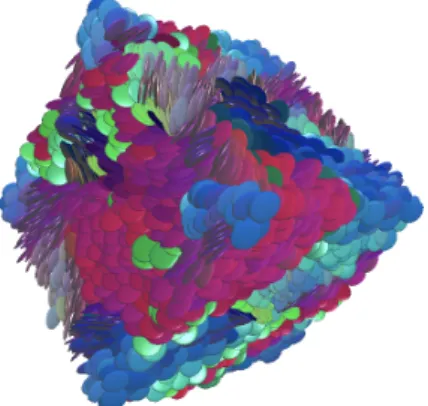
Figure 1.3: In a compact assembly of flat objects, strong orientational correlations are likely to develop. In the present case, 10 000 oblate spheroids were placed in a simulation box. The solid volume fraction is 60 %, and the aspect ratio of the spheroids is 1/8. Particles are colored according to their orientation: large, quasi-uniform color patches can be observed, which shows that particles tend to align themselves.
Back when I started my PhD, the microstructure of C–S–H remained widely mysterious. Various authors had proposed various morphologies, all of them relying on the notion of a basic building block: “globules” [All+87]; [Jen00]; [Jen08], “platelets” [GBN06], “needles”
[Ric04]… This diverse zoology is largely due to the near impossibility of unbiased, direct
observation of C–S–H at the relevant scale (a few tens of nanometers). Still, clarifying this microstructure is a real issue. Indeed, the porosity of C–S–H is relatively small (about 30 %). Anisotropic basic building blocks (such as platelets) must then induce strong local orientational correlations (as illustrated on figure1.3). In turn, these correlations might induce noticeable effects on the macroscopic mechanical properties of C–S–H.
In this project, P. Levitz proposed a critical review of the above mentioned zoology relying on small-angle X-ray scattering (SAXS). Indeed, this experimental technique has various valu-able assets: appropriate resolution, large scale samples (typically, 10 mm × 10 mm × 0, 1 mm), no need to work under vacuum conditions, intrinsically three-dimensional information (no pro-jection effects), … The major drawback being that SAXS is an indirect observation technique, that only provides the spectral density of the local electron density [DAB57]; [Por82]. It is therefore not possible to reconstruct the 3D local electron density, since only the modulus of its Fourier transform is known (the phase is missing).
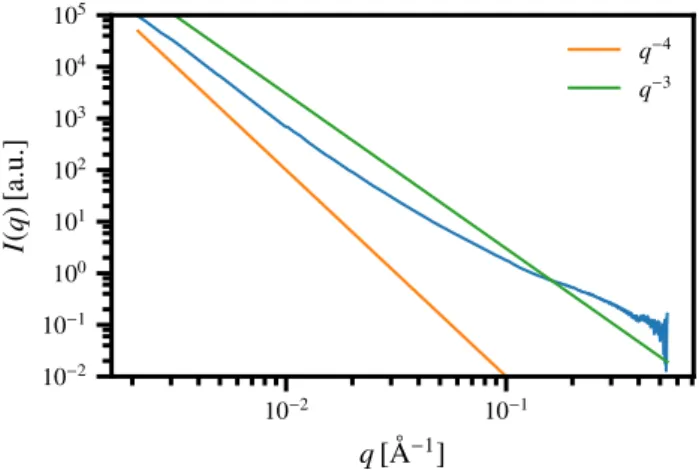
Nevertheless, this technique is very interesting for cementitious materials. Indeed, it is well-known since the eighties [All+87] that cement pastes exhibit a characteristic SAXS pattern which is difficult to explain (see figure1.4). Some authors consider that this pattern is the sig-nature of a fractal microstructure [All+87]. However, it is difficult to reconcile this assumption with the relatively low porosity of C–S–H (fractals being generally open).
To tackle this issue, I adopted an inverse approach: is it possible to construct a (virtual) mi-crostructure which reproduces the SAXS pattern of cement pastes? This led me to develop a numerical method for the computation of the SAXS pattern. The proposed method minimizes size-effects induced by truncation in the real space (the generated microstructures being rela-tively small from the perspective of SAXS). A first version of the method was proposed in my PhD thesis (see chapter 4 in reference [Bri11]). It was further improved in reference [BL13].
1.2 PhD student at Laboratoire Navier 10−2 10−1 q [Å−1] 10−2 10−1 100 101 102 103 104 105 I( q) [a.u.] q−4 q−3
Figure 1.4: Small-angle X-ray scattering pattern of a CEM-I, 1.5 years old, hydrated cement paste (𝑤/𝑐 = 0.35). The algebraic behavior as a fractional power of the scattering vector 𝑞 has been reported by many teams. Its origin remains unclear.
Using this forward simulation tool, I was able to invalidate some microstructural hypotheses, showing that neither “globules”, nor “platelets” could result in the typical SAXS pattern shown in figure1.4.
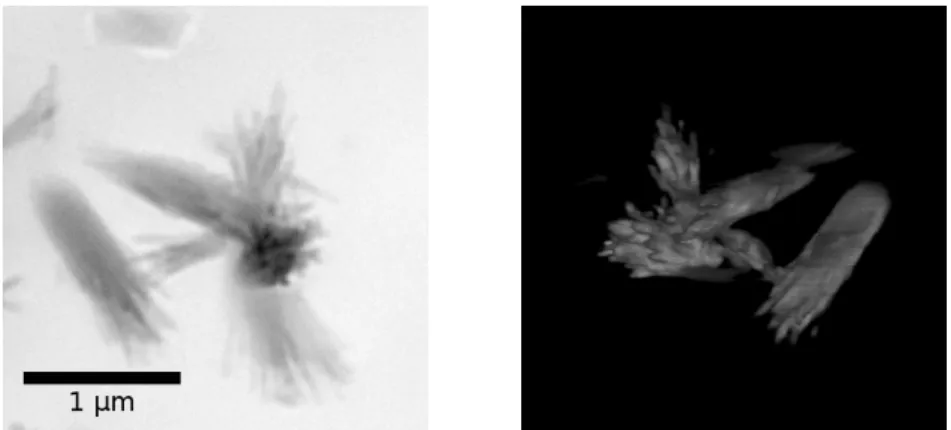
During the course of my PhD, I also had the opportunity to carry out soft X-ray microscopy observations of C–S–H grains. This work was conducted in collaboration with Prof. P.J.M. Monteiro at the Bessy-II synchrotron in Berlin, Germany (beamline U41). Since the sample is mounted on a rotating stage in this microscope, it is in principle possible to carry out what should effectively be called nanotomography, thus providing three-dimensional insight into the microstructure of cement pastes at unprecedented scales (about 20 nm). However, reconstruct-ing the 3D volume turned out to be a formidable task, that required to account for misalignment of the projections and the so-called “missing wedge” (since the sample cannot be fully rotated in this setup). Besides, the images produced by the soft X-ray microscope at Bessy-II/U41 are polluted by a number of artifacts, including: limited depth of field as well as non-uniform and non-stationary source. Although I was in the end able to produce a 3D reconstruction of the sample (see figure1.5), the analysis of the microstructure that we were able to carry out was rather limited, due to these artifacts [Bri+12]. Still, this part of my PhD was extremely formative, as I had to implement state-of-the-art image analysis and reconstruction algorithms. Meanwhile, I set out to investigate, under the supervision of Prof. L. Dormieux, the connec-tions between microstructure and macroscopic properties. The –somewhat optimistic– goal was to try and come up with a mechanical model of C–S–H that would account for the mi-crostructural characterization carried out with P. Levitz.
Of course, this goal turned out to be far too ambitious, and I was hardly able to bridge these two parts of my dissertation. However, the polarization techniques that I started to use then are still at the heart of my current research. Discussion of this topic is therefore deferred to the next section.
Figure 1.5: Soft X-ray microscopy transmission image of a hydrated cement paste (CEM-I, 𝑤/𝑐 = 0.35) (left). Three-dimensional reconstruction of the same grain (right). The lack of sharpness of the reconstructed volume is caused by the various artifacts inherent to the setup at Bessy-II/U41.
Statistical Full field
Mean field
Effective field EIM FEM, FFT
Complexity
Figure 1.6: Homogenization methods can be laid out on a complexity scale: from the left-hand side to the right-hand side, the complexity increases.
1.3 Research scientist at Laboratoire Navier
I joined Ifsttar (Institut français des sciences et technologies des transports, de l’aménagement
et des réseaux) immediately after the defense of my PhD. I worked for a year at the MACS
department (Mesures, Auscultation et Calcul Scientifique). In fall 2011, a position opened at Laboratoire Navier and I had the good fortune to join the newly created Multiscale team.
Since then, my research has been focused on the homogenization of random, heterogeneous materials. More precisely, I explore the connections between microstructure and macroscopic properties. In theory, this problem can be considered as solved. Indeed, as will be discussed in chapter2, solving the so-called corrector problem “suffices” to determine the macroscopic properties of a given microstructure. Unfortunately, solving this problem can be a formidable task, for which various methods have been devised. These methods can be laid out on an “complexity scale” (see figure1.6). At the two ends of this complexity scale lie the two most famous families of homogenization techniques.
On the low-complexity side lie mean field/effective field methods, which are based on the solution to Eshelby’s inhomogeneity problem [Esh57]. In this problem, a unique (ellipsoidal) inhomogeneity is embedded in an infinite matrix and subjected to a uniform strain at infinity. The resulting estimates of the macroscopic properties cannot really account for correlations, since the inhomogeneity is isolated in the underlying auxiliary problem. As a consequence, the microstructural information that these methods can account for quantitatively is rather limited. As an example, the total porosity of a porous medium is within the reach of these models, while the pore-size distribution is not [CB09]. Still, these methods should not be dismissed.
1.3 Research scientist at Laboratoire Navier
Indeed, they are extremely versatile, and can readily account for various kinds of material nonlinearities. Also, these methods are usually successful in reproducing global trends with respect to some material/microstructural properties.
At the other end of the complexity scale lie full field methods, where the corrector problem is solved numerically, either by means of standard (finite elements, boundary elements) or de-voted numerical techniques. Provided that the various sources of errors are kept under control (these sources are briefly listed in section4.3.3), full-field methods can be considered as “ex-act”; they are however rather cumbersome. For example, classical finite elements require a conforming mesh, which can be difficult to produce for highly heterogeneous microstructures. Extended finite element techniques (X-FEM) devoted to heterogeneous materials have been proposed in order to overcome this limitation [Tra+11]. Execution of the simulation is also generally a challenge, since a large number of degrees of freedom is generally involved; this usually calls for the implementation of high-performance computing (HPC) techniques. Rather than resorting to general-purpose numerical tools, which are sometimes ill-suited to the task, various authors have proposed devoted methods, specifically tailored to solving the corrector problem. Owing to their flexibility, so-called “FFT-based techniques” ought to be singled out. Initially proposed by Moulinec and Suquet [MS94] and Moulinec and Suquet [MS98], these methods have gained in popularity from the early 2010s: nowadays, many research groups accross the world are actively involved in the development and application of such techniques. Quite surprisingly, the middle-range of the complexity scale is not well populated. Morpho-logically representative patterns [BSZ96] aim at improving Eshelby-based estimates through a finer description of the microstructure. However, it should be emphasized that the microstruc-ture considered in these approaches is an idealization of the true microstrucmicrostruc-ture. Again, the correlations are not introduced explicitly.
For very specific microstructures, it is possible to devise extremely efficient full-field meth-ods that take advantage of the specific geometry. Only two examples of such problem specific methods will be cited here. As a first example, the equivalent inclusion method [MM75] really ought to be considered as an “approximate” full-field method, as it would be highly imprac-tical to let the discretization parameter (the order of the interpolating polynomials) grow to large values (this will be discussed in chapter4, section4.3). As a second example, the recent work of Cancés and collaborators [Can+18] stand out as a remarkable combination of various efficient numerical techniques for assemblies of spherical inhomogeneities. A modified cor-rector problem is reformulated as a boundary integral equation [Can+15], which is discretized with spherical harmonics. Domain decomposition and multipole expansions then allow for an efficient implementation of the solver.
Numerical homogenization techniques have so far been classified by degree of complexity. Another interesting classification relies on the nature of the input of the method.
Full field methods (even approximate) require realizations of the microstructure as an in-put. Within the framework of random homogenization, it is necessary to solve the corrector problem for a large number of such realizations (statistical volume elements). Averaging the apparent properties of these statistical volume elements then delivers an estimate of the effec-tive properties of the random heterogeneous material under consideration.
properties from statistical descriptors of the microstructure. From this perspective, mean field/effective field methods, Hashin–Shtrikman bounds, higher order bounds [BM66]; [McC70];
[Mil81]; [Mil82]; [MP82] and exact series expansions[Tor97] can all be seen as statistical.
Even if they generally deliver estimates rather than approximations with controlled numer-ical error, I personally tend to favor statistnumer-ical approaches over full-field methods. I do think that the former offer a deeper insight into the connections between microstructure and macro-scopic properties. Indeed, it is fairly easy within this framework to vary some microstructural parameters and observe the results on the macroscopic properties. Full-field methods, on the other hand, result in an extremely rich output, but they also require a rich input, to the extent that it is sometimes difficult to filter out this massive quantity of data. Identifying what details of the microstructure had the most significant impact on the macroscopic properties is not a trivial task within the framework of field methods. However, for many applications, full-field simulations are in fact the only option, and both classes of methods should really be seen as serving different purposes.
I think it is clear from the above discussion why the development of improved statistical methods has always been the focus of my research. My goal is the derivation of statistical esti-mates of the macroscopic properties that would account for a more detailed statistical descrip-tion of the microstructure than standard, Eshelby-based methods, while remaining less costly than full-field methods. I also do not want to introduce any idealization of the microstruc-ture. To do so, I soon selected the Hashin–Shtrikman principle [HS62b] as the appropriate, systematic framework, for two main reasons.
First, this variational principle is extremely flexible, since any trial stress-polarization is admissible7. This is at odds with the more classical minimum potential and complementary energy principles, for which admissibility conditions are sometimes difficult to fulfill with the rather simple trial fields that are required by theoretical derivations.
Second, the estimates resulting from this principle can be worked out without any idealiza-tion/simplification of the microstructure. The exact geometry is taken into account (see for example reference [Wil77]), while the quality of the approximation is controlled by the rich-ness of the trial stress-polarization. Under some mild additional assumptions, this allows the derivation of rigorous bounds on the true effective properties.
The celebrated Hashin–Shtrikman bounds [HS62a] on the effective elastic moduli of isotropic heterogeneous materials are a classical example of how the variational Hashin–Shtrikman prin-ciple can be applied to derive bounds/estimates on the macroscopic properties. These bounds result from selecting the most simple (phase-wise constant) trial stress-polarization. Somewhat naively, I imagined that I only had to apply the same principle with more complex (enriched) trial stress-polarizations to improve on these estimates/bounds. However, selecting a “good” trial stress-polarization turned out to be rather difficult. In other words, the classical Hashin– Shtrikman bounds are extremely robust (difficult to improve upon).
Fairly recently, I have devised a general framework to account for a local description of the microstructure within the framework of the Hashin–Shtrikman principle (see chapter 3,
7The stress-polarization will be defined more precisely in chapter2, section2.3. Suffice it to say for the time
being that the trial field that is involved in the variational principle of Hashin and Shtrikman is a second-rank, symmetric tensor field that is called “stress-polarization”.
1.3 Research scientist at Laboratoire Navier
section3.2), with fairly good prospects.
My quest for improved bounds on the macroscopic properties has been rather frustrating so far. Meanwhile, I soon realized that the Hashin–Shtrikman principle could also be used in a numerical setting, for the derivation of numerical methods. Quite surprisingly, this research topic (although not the one I favored initially) turned out to be the area where I have been most productive.
Although extremely simple, the idea was rather original, as I believe I was the first to ap-ply Galerkin-like discretizations to the variational form of the Lippmann–Schwinger equation (which is equivalent to the Hashin–Shtrikman principle, as will be discussed in chapter 2, section2.3). Using an appropriate discretization of the trial stress-polarization delivers an es-timate of the true stress-polarization at equilibrium. I have explored two possible discretization schemes: voxel-wise constant stress-polarizations, and stress-polarizations that are polynomial over each inhomogeneity.
The former choice allowed me to revisit FFT-based techniques initially introduced by Moulinec and Suquet [MS94] and Moulinec and Suquet [MS98], as discussed in chapter4, section4.2. A significant part of my research has been devoted to this topic. I was able to propose a formu-lation that results in rigorous bounds on the apparent properties. I also clarified the distinction between discretization of the underlying continuous integral equation, and solution to the dis-crete problem. Introducing this separation of concerns allowed me to prove that FFT-based techniques actually converge to the desired solution upon refining the grid, and to replace the fixed-point iterations initially proposed by Moulinec and Suquet with more efficient Krylov-subspace iterative linear solvers. In order to reduce Gibbs-like spurious oscillations in the numerical solution, I also introduced so-called filtered discrete Green operators. My recent work in this area is devoted to the development of a posteriori error estimators for FFT-based homogenization techniques.
The latter choice led to a variational form of the classical equivalent inclusion method, ini-tially proposed by Moschovidis and Mura [MM75]. In that case, the variational setting is clearly superior to the classical approach based on collocation, as will be discussed in chapter4, section4.3. As a by-product of this work, I was also able to propose a rigorous mathematical justification of the approximation of the Green operator for strains introduced heuristically by Willis [Wil77] (see chapter3, section3.1).
***
To close this section on my research activities, I would like to mention topics related to image analysis and 3D imaging techniques. As already mentioned in section1.2, these topics represented a significant part of my PhD work. Since the defense of my PhD however, I have only marginally contributed to this field, which will therefore not be presented in detail in this report. However, I do want to dedicate a more significant share of my (post-Habilitation) research time to these topics (as will be discussed in chapter5).
Regarding 3D imaging, first. I recently took an active part in the PhD work of M.H. Khalili, who developed the so-called discrete digital projection correlation method (D-DPC). This method allows the identification of the rigid body motion of each individual grain in a granular material. The main asset of the proposed technique is the fact that a limited number of
radio-graphs of the current configuration suffice to compute estimate these motions. This allows for rapid acquisition (even in a laboratory setting). The price to pay is a relatively high compu-tational cost, requiring the use of HPC techniques. M.H. Khalili was able to prove that the method had the potential to deliver accurate results. I would like to pursue this work towards more realistic experimental conditions (involving a large number of grains).
During the course of the PhD work of M.H. Khalili, we also questioned some of the funda-mental asumptions that standard reconstruction techniques rely upon. We were able to show that these simplifying asumptions could have a significant impact on the accuracy of the re-construction. I would like to explore these issues more thoroughly.
Regarding image analysis, now. With P. Levitz, we proposed a technique allowing to esti-mate the small-angle scattering spectrum of a esti-material from a transmission image (radiograph). This technique is very simple and requires minimal preparation of the image (thus inducing only a limited loss of information). It allows to compare two seemingly very different imaging techniques8that operate at complementary resolutions. However, this technique is not devoid of artefacts, that we would like to investigate theoretically. Meanwhile, I have recently been involved in a joint work with C.A. Davy9, P. Levitz10 and L. Michot10 for the application of this technique to cementitious materials.
To conclude this brief section on image analysis, I should like to mention that I was the main organizer in july 2016 of a workshop on Imaging of Construction Materials and Geomaterials, which gathered about 90 participants at École des Ponts ParisTech. Following this workshop, I have been asked by the editor in chief of Cement and Concrete Research to coordinate a review paper on X-ray tomography of cementitious materials, for which I will be more specifically in charge of writing the theoretical sections.
1.4 Teacher at École des Ponts ParisTech
My teaching activities are extremely dear to me. I like preparing courses and classes, think-ing of the “best” way to introduce complex notions, writthink-ing lecture notes, interactthink-ing with students… and feeling that maybe they learned something from me!
I was fortunate enough to be in a position to teach immediatly after my graduation from École des Ponts ParisTech in 2003. I should like to take the opportunity to thank Prof. P. Bisch11, with whom I have been working for so many years, as well as Prof. A. Ehrlacher12. At that time, both placed their trust in a young engineer with no teaching experience whatsoever!
Owing to my initial professional activities, most courses I took part to are related to struc-tural mechanics: Strucstruc-tural Mechanics, Shells & Advanced Structures, Towards Strucstruc-tural
Mechanics, Introduction to the Dynamics and Stability of Mechanical Systems, …, all at the
8It should be recalled that transmission imaging operates in the real space, while small angle scattering operates
in the Fourier space.
9Laboratoire de Mécanique de Lille (LML, FRE CNRS 3723), L2MGC EA 4114, Université de Cergy-Pontoise,
Centrale Lille, Villeneuve d’Ascq, France
10See footnote5in the present chapter.
11EGIS Industries
1.4 Teacher at École des Ponts ParisTech
MEng level. After I received my PhD degree, I also got involved in two courses on
Imag-ing of Random Heterogeneous Materials (at the MSc level). In these courses, I was in charge
of the following topics: statistical tools for the description of random heterogeneous media, numerical scale bridging, image analysis, small-angle scattering of X-rays.
Of course, it is impossible to sum up in a few lines all the personal lessons I learned from these multiple teaching experiences. I will therefore focus on my longest experience within the course Shells & Advanced Structures, as it might have an influence on my future research activities as well.
The course on Shells & Advanced Structures mainly addresses the theory of plates and shells, although some other advanced notions such as beams with high curvature or Vlasov’s theory of torsion might also be touched upon. I have been involved in this course (which is taught by Prof. P. Bisch) since 2003. I am in charge of half of the 12 sessions of 2.5 hours (both lectures and tutorials). Owing to its reputation of being difficult, the students that enrol for this optional course are usually highly motivated, which results in an extremely agreeable atmo-sphere. However, I must own that some students are dispirited by the mathematical difficulties induced by the use of curvilinear coordinates.
My long-term involvement in this course has naturally resulted in a very rich experience, which allows me to better anticipate the questions of the students, and select the problem-solving techniques that I find most accessible. To cite but one exemple, I never invoke during tutorial sessions the general equilibrium equations of shells in curvilinear coordinates. Rather, I derive these equations from the principle of virtual work for each new problem specifically. Such approach indeed allows to account at a very early stage for the simplifications that might be induced by the geometry of the shell under consideration (cylinder, sphere, …).
Meanwhile, it is only too natural that I developed my own vision of how a course on the the-ory of plates and shells might be taught. For example, I would favor an intrinsic formulation. Indeed, the students are usually still struggling with covariant and contravariant indices at the end of the 12 sessions, while they are much more comfortable with intrinsic notations (to which they were introduced during the course on Continuum Mechanics at École des Ponts Paris-Tech). As another example, rather than the classical displacement-based approach, I would introduce the various theories through a stress-based approach. Indeed, the former leads to the concurrent invocation of plane stress and plane strain hypotheses (both being of course mutually exclusive!), while the latter does not result in such contradictions.
Besides the pedagogical aspects, I have also benefited from this experience at the theoretical level. Indeed, I have investigated for my own sake such difficult issues as boundary layers and the boundary conditions for the Kirchhoff–Love model or the formulation of plate and shell finite elements. I have a fairly up-to-date knowledge of the theoretical literature on (homoge-neous) plates and shells, to the extent that I am now considering investigating these topics at research level (see chapter 5) and get recognition from the academic world. I have recently been asked by K. Sab13 to be the coauthor of three chapters on the classical theories of plates in the Encyclopædia of Mechanics to be published by Springer; this certainly constitutes a first step towards this goal.
1.5 Outline of this report
For the sake of conciseness and coherence, this document is focused on the various applica-tions I have proposed of the Lippmann–Schwinger equation and Hashin–Shtrikman principle to capture the connection between microstructure and macroscopic properties. The structure of this document is briefly overviewed below; for each section, my relevant publications are also listed. Although the topics discussed in this document represent the major part of my post-PhD research work, such selection means that some other works have also been purposefuly left out (see references [BL13]; [Bri+12]; [Kha+17a]; [Kha+17b]; [Kha+17c]; [May+16]). Some of these topics will however be briefly discussed in chapter5.
Chapter2sets up the general framework for this report. It gives a brief overview of homog-enization and classical polarization techniques (namely, the Lippmann–Schwinger equation and the Hashin–Shtrikman principle). This chapter is not intended as a treatise on these topics. It is rather used to define the essential tools and notations that are to be used throughout this document. Being essentially reference material, this chapter is not directly connected to any of my publications.
Chapter3 then discusses applications of the Hashin–Shtrikman principle in a (semi-) an-alytical setting. This chapter describes a few applications that fall into the category of sta-tistical methods as defined in section 1.3 of the present chapter. It opens with the classical Hashin–Shtrikman bounds (see section3.1) the derivation of which is recalled so as to serve as a basis for the derivation of improved bounds. More importantly, section 3.1 discusses the approximation of the fourth-rank Green operator of a bounded domain, for which I pro-posed a mathematical justification in reference [BSD13]. The (hopeless?) quest for improved bounds is discussed in section3.2, which presents a possible approach that was initiated in ref-erence [Bri17b]. The chapter then closes with three applications for which I was indeed able to propose Hashin–Shtrikman like bounds on the macroscopic properties, namely nanocom-posites (see section 3.3 and references [BDK10a]; [BDK10b]), eigenstressed materials (see section3.4and references [BG17]; [BG18]) and stress-gradient materials (see section3.5and references [Tra+18a]; [Tra+18b]).
Chapter4is the numerical counterpart of the previous chapter. It discusses two strategies for the Galerkin discretization of the Lippmann–Schwinger equation (see section 4.1). The first strategy relies on a discretization of the trial stress-polarization over a uniform, cartesian grid in a periodic setting (see section4.2, references [BD10]; [BD12]; [Bri17a] and some use-cases in references [BD14]; [Tra+16]). It results in a variational form of the celebrated FFT-based methods introduced by Moulinec and Suquet. The second strategy uses (for simple matrix– inclusions microstructures) trial stress-polarizations that are polynomial over each inclusion (see section4.3and references [BDS13]; [BDS14]). This approach leads to a variational form of the equivalent inclusion method of Moschovidis and Mura.
Finally, chapter5offers a general conclusion and some perspectives to the work presented in this report. It also outlines the research topics I would like to investigate and that define my vision of my research work for the next few years.
Chapter 2
General framework
This chapter introduces the general framework that is to apply throughout this report. Rather than a self-contained reference work on heterogeneous materials, it should be understood as a brief list of known definitions and essential mathematical results that will be invoked in chapters3and4. Section2.1gives a short and practical overview of homogenization within the framework of linear elasticity. Then, section2.2introduces the fourth-rank Green operator for various types of boundary conditions. This operator is the essential tool underlying polarization techniques, which are described in section2.3 and will be extensively used in the subsequent chapters.
2.1 A brief overview of homogenization
The present section defines some concepts that are essential to the homogenization of linearly elastic, random heterogeneous materials. A mathematical description of the microstructure of such materials is proposed in section 2.1.1. Sections 2.1.2and 2.1.4then address the de-termination of the apparent and effective properties of statistical and representative volume elements.
2.1.1 Mathematical description of the microstructure of heterogeneous
materials
We consider a heterogeneous material that occupies the geometrical domain Ω ⊂ ℝ𝑑 (𝑑 = 2, 3). For any local quantity 𝒬, ⟨𝒬⟩ denotes its volume average over Ω
⟨𝒬⟩ = 1
|Ω| ∫𝐱∈Ω𝒬(𝐱) d𝑉𝐱. (2.1)
Most of this report is devoted to linear elasticity; 𝐂(𝐱) denotes the local stiffness tensor at 𝐱 ∈ Ω. The linear elastic stress-strain relationship then reads for 𝐱 ∈ Ω: 𝝈(𝐱) = 𝐂(𝐱) ∶ 𝜺(𝐱), where 𝝈 (resp. 𝜺) denotes the stress (resp. strain) field.
So-called 𝑁-phase materials are a specific class of heterogeneous materials. They are de-fined by the regions Ω1, … , Ω𝑁 ⊂ Ω occupied by phases 1, … , 𝑁, or, equivalently, by the indicator functions 𝜒1, … , 𝜒𝑁 of these phases.
Unless otherwise stated, Greek indices always refer to phases, and sums over Greek indices always run over the whole range 1, … , 𝑁. Obviously, the 𝜒1, … , 𝜒𝑁 satisfy the partition of
unity property (∑𝛼𝜒𝛼 = 1). For any local quantity 𝒬, ⟨𝒬⟩𝛼 denotes its volume average over phase 𝛼 = 1, … , 𝑁
⟨𝒬⟩𝛼 = 1
|Ω𝛼| ∫𝐱∈Ω𝛼
𝒬(𝐱) d𝑉𝐱, (2.2)
and we obviously have ⟨𝒬⟩ = ∑𝛼𝑓𝛼⟨𝒬⟩𝛼, where 𝑓𝛼 = |Ω𝛼|/|Ω| denotes the volume fraction of phase 𝛼 = 1, … , 𝑁.
Within the framework of linear elasticity, 𝐂𝛼 denotes the elastic stiffness of phase 𝛼 = 1, … , 𝑁, so that for a 𝑁-phase material, 𝐂 = ∑𝛼𝜒𝛼𝐂𝛼. The local stress-strain relationship now reads, for 𝐱 ∈ Ω𝛼: 𝝈(𝐱) = 𝐂𝛼 ∶ 𝜺(𝐱).
2.1.2 Apparent and effective properties – Statistical and representative
volume elements
For statistically homogeneous and ergodic microstructures, it is well-known that the effective properties are retrieved from the solution to a boundary value problem posed on a infinite domain. This is of course highly impractical. Instead, we first compute the apparent stiffness 𝐂app(Ω) (to be defined below) of a finite volume element Ω, and estimate the effective stiffness as the limit of the apparent stiffness for large volume elements Ω
𝐂eff = lim
|Ω|→+∞𝐂
app(Ω), (2.3)
provided that appropriate boundary conditions are applied to 𝜕Ω. In practice, due to the ran-domness of the microstructure, 𝐂app(Ω) is a random variable that depends not only on the geometry of the domain Ω ⊂ ℝ𝑑, but also on the realization of the microstructure under con-sideration. It is then customary to take the ensemble average in equation (2.3)
𝐂eff = lim
|Ω|→+∞𝔼[𝐂
app(Ω)]. (2.4)
In turn, this ensemble average is evaluated empirically in a standard Monte-Carlo setting. To emphasize the random nature of the apparent stiffness, the domain Ω will be called, following Ostoja-Starzewski [Ost06], a Statistical Volume Element (SVE). The SVE is considered as a
Representative Volume Element (RVE) when the fluctuations of its apparent stiffness are below
a user-defined threshold. In that case, the apparent stiffness of the RVE (only one realization) delivers an accurate estimate of the effective stiffness.
We are now in a position to define the apparent stiffness of the SVE Ω as the linear operator that maps the average strain ⟨𝜺⟩ to the average stress ⟨𝝈⟩
⟨𝝈⟩ = 𝐂app(Ω) ∶ ⟨𝜺⟩, (2.5)
where 𝜺 and 𝝈 are the local strains and stresses that solve the so-called corrector problem
2.1 A brief overview of homogenization
where 𝝐[𝐮] denotes the symmetric part of the gradient of the displacement 𝐮.
The above field equations (in Ω) are complemented with appropriate boundary conditions (on 𝜕Ω), to be discussed below. It should first be observed that for homogenization purposes, the exact displacement 𝐮 from which the strain 𝜺 derives does not matter (provided that it exists!). This is emphasized by introducing the spaces of compatible (ℰ ) and divergence-free (𝒮 ), second-rank, symmetric, tensor fields
𝜺 ∈ ℰ (Ω) ⟺ 𝜺 = 𝝐[𝐮] for some 𝐮 and 𝝈 ∈ 𝒮 (Ω) ⟺ div 𝝈 = 𝟎, (2.7) where the above differential operators should be understood in the sense of generalized func-tions. Equations (2.6) may then be rewritten as follows
Find 𝜺 ∈ ℰ (Ω) and 𝝈 ∈ 𝒮 (Ω) such that 𝝈 = 𝐂 ∶ 𝜺, (2.8) or, equivalently
Find 𝜺 ∈ ℰ (Ω) such that 𝐂 ∶ 𝜺 ∈ 𝒮 (Ω). (2.9) For problem (2.9) to be well-posed, 𝜺 and/or 𝝈 should in fact be seeked in subspaces of ℰ (Ω) and 𝒮 (Ω), respectively. This is discussed in section2.1.3below, where the classical Dirichlet, Neumann and periodic boundary conditions are introduced.
Remark 2.1. Equation (2.5) should really be understood as a series of 𝑑(𝑑 + 1)/2 calculations
(with linearly independent prescribed macroscopic strains or stresses).
Remark 2.2. For the sake of clarity, functional spaces will not be specified in the remainder of this work. It should however be understood that elements of ℰ (Ω) and 𝒮 (Ω) are at least component-wise square integrable. In physical terms, this means that only finite energy strains and stresses will be considered.
It will be useful to introduce the space 𝒯2(Ω) of symmetric, second-rank tensors with square
integrable components. Then, ℰ (Ω) ⊂ 𝒯2(Ω) and 𝒮 (Ω) ⊂ 𝒯2(Ω).
2.1.3 Computation of apparent properties: boundary conditions
In this section, various classical boundary conditions that must complement the field equa-tions (2.6) are listed. For a finite-size SVE Ω, each of these boundary conditions defines a different apparent stiffness 𝐂app(Ω). Consistency of these definitions (as |Ω| → +∞) is dis-cussed in section2.1.4.
Essential (Dirichlet) boundary conditions We introduce the subspace ℰess(Ω) ⊂ ℰ (Ω) of compatible strain fields with essential (Dirichlet) boundary conditions
𝜺 ∈ ℰess(Ω) ⟺ 𝜺 = 𝝐[𝐮] for some 𝐮 such that 𝐮|𝜕Ω= 𝟎, (2.10) and it is observed that ⟨𝜺⟩ = 𝟎 for all 𝜺 ∈ ℰess(Ω). The apparent stiffness 𝐂ess(Ω) is then defined from the solution to the following problem