ELSEVIER
PALAEO
Pdlaeogeogrdphy, Palaeoclimatology, Palaeoecology I35 ( 1997) 163-l 77
Environmental
evolution during the Late Jurassic at Lavarone
(Trento Plateau, Italy)
Jestis E. Caracuel a,*, Federico Olbriz b,l, Carlo Sarti c,2
a Dpto. de Ingenieria, Cartogr@ca, Geod&ca y Fotogranretria, E.P. S., Universidad de Jwk, Ata. Virgm de la &&=a 2,
E-23071 JaPn, Spain
b Dpto. de Estratigrafh y Paleontologia. Fat. de C‘iencias, Uuiversidad de Granuda, An. Furn&vweva s,in,
E-18002 Grunada, Spain
’ Dip. Science Geologiche, Univrrsitir di Bologna, Viu Zamhoni 67, i-40127 Bologna, Ital? Received 30 May 1996: accepted 3 February 1997
Abstract
Four sections have been studied in the Monte Rust area (Lavarone, northern Italy) for the interpretation of depositional conditions. The biostratigraphic subdivision is based on more than 1400 stratigraphically controlled ammonite specimens, which enabled the recognition of five biozones in the Kimmeridgian and three in the Lower Tithonian.Three basic lithofacies are identified in the upper unit of the Rosso Ammonitico Veronese (nodular-marly, nodular-calcareous, and pseudonodular-calcareous-massive), which developed according to relative sea-level condi- tions. The depositional dynamics were closely related to increasing energy and winnowing during sea-level lows (nodular-calcareous ammonitico rosso), and the opposite during sea-level highs (nodular-marly ammonitico rosso). The highest energy conditions are assumed for the pseudonodular-calcareous-massive ammonitico rosso, revealing a probable interaction between tectonics and eustasy, and an increased mean rate of carbonate sedimentation.The cluster analysis of selected components of microfacies shows only minor fluctuations in a low-energy environment, and thus a rather variable relationship between micro- and macrofeatures in the ammonitico rosso facies studied. The correlation analysis between relative abundances of selected variables (components in the cluster analysis) has proven useful in interpreting fluctuations in energy conditions.
For the Kimmeridgian, deposits formed during sea-level highs (Uhlandi and Beckeri Chrons) are especially well correlated in the area, as well as elsewhere in the Western Tethys. The progressive, long-term sea-level fall during the Early Tithonian does not diminish the possibility for correlation in the epioceanic area studied. 0 1997 Elsevier Science B.V.
Keywrds; Ammonitico Rosso; depositional environment; Late Jurassic; Tethys; Trento Plateau
* Corresponding author. Phone: + 34-53-212375; fdX: + 34-53-212343; e-mail: [email protected] ‘Phone and fax: + 34-58-243345; e-mail: [email protected]
‘Phone: + 39-51-354556: fax: + 39-51-354522; e-mail: [email protected]. 0031-0182:97/S 17.00 0 I997 Elsevier Science B.V. All rights reserved.
164 Jestis E. Curacuel et al. / Palaeogeograplly, Pahroclin~arology, Pularorcolo~y 135 (1997) 163-I 77
1. Introduction and geological setting
This paper deals with biostratigraphy
and the
interpretation
of depositional
conditions
in the
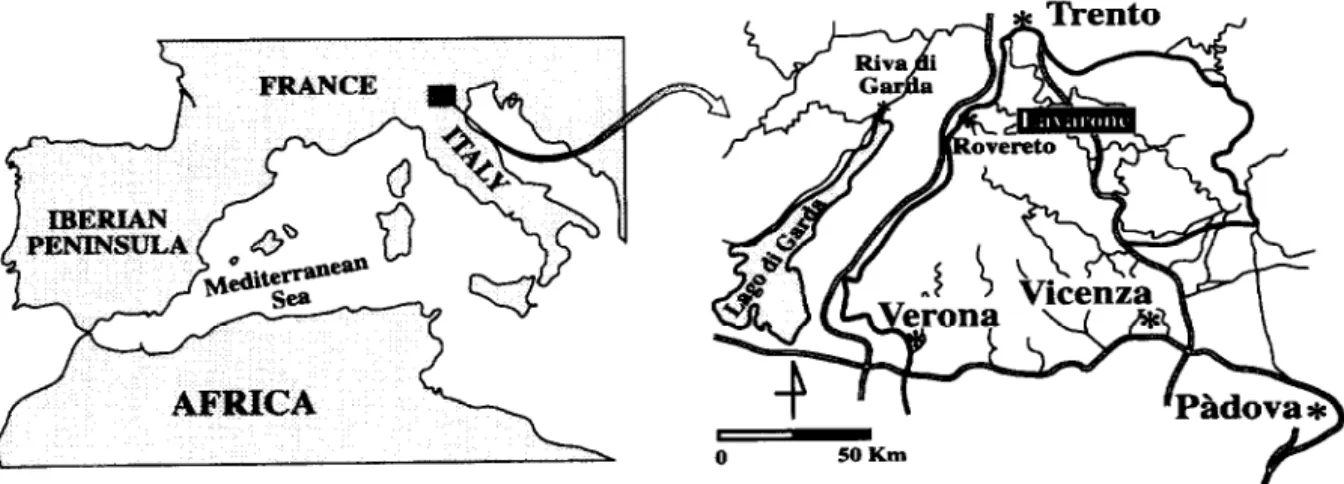
central part of the Trento Plateau, recorded in
four sections located near Monte Rust (Lavarone,
Province of Trento) (Fig. 1). We revisited some
sections studied by Sarti (1986), Sarti (1993),
whilst the section at the Bus di Pissavacca (BPV)
at Bertoldi has been studied for the first time.
The succession studied belongs to the Rosso
Ammonitico
Veronese Formation
(RAV),
which
is composed of ammonite-rich
nodular marly lime-
stones of the Middle-Late
Jurassic. Outcrops are
located in the Prealpi Veneto-Trentine
(southern
Alps). These facies are characterized by omission
surfaces and hardgrounds
on which ferruginous
crusts and Fe-Mn nodules occasionally developed
during condensation
events. The RAV reaches a
maximum thickness of 30 m, and ranges from Late
Bajocian to Late Tithonian in age. Three units can
be recognized in this formation:
a lower unit
(Calcari nodulari massicci), Bajocian-Bathonian
in age; an intermediate
unit (Calcari selciferi) of
the Late Callovian (Erba, in Martire et al., 1991)
to Oxfordian and/or earliest Kimmeridgian
(Sarti,
1993); and an upper unit (Calcari nodulari) which
is Kimmeridgian-Tithonian
in age. The RAV crops
out mainly between the Lago di Garda and Monte
Grappa (northern Italy). This facies was deposited
onto a distal pelagic-swell system or epioceanic
plateau
(Trento
Plateau, Ruga di Trento
or
Piattaforma
atesina).
The Trento
Plateau was a structural
high
(Bahamian-type
carbonate platform) until the late
Early Jurassic. Subsequent platform drowning led
to sedimentary starvation and pelagic carbonate
deposition
(Bosellini
and
Martinucci,
1975;
Zempolich,
1993). Thus, the RAV marked the
beginning of pelagic sedimentation
on the plat-
form,
replacing
shallower-water
carbonates.
Bosellini and Winterer (1975), and Winterer and
Bosellini ( 198 1) estimated the initial deposition
depth for the RAV to be around 500 m, based on
present-day examples with similar depositional set-
tings, and the character of sedimentation
itself in
the VenetiauFriulian
area; these authors took into
account the fact that distal turbidites
from the
Friuli Platform
occasionally reached the Trento
Plateau. Therefore, assuming a distance of about
50 km between the drowning Trento Plateau and
the sublittoral Friuli Platform, and a mean dip of
1’ in the talus, they estimated a depositional depth
of around 500 m.
The RAV shows a significantly decreased car-
bonate sedimentation rate, which increased during
deposition of the Maiolica (Biancone) facies -
a
Nannoconus and calpionellid-rich
white-grey mud-
stone with episodic incipient nodularization
and
cherty nodules and horizons (Castellarin,
1972;
Ferrari, 1982; Clari and Pavia, 1987; Cecca et al.,
1992).
Jesais E. Caracuel et al. / Palaeogeograph;. Palaeoclimatolog~, Pulaeoecology 135 (1997) 163-I 77 165
Some present-day examples of nodular-calcare-
ous deposits have been reported from the Ionian
Sea (Mtiller and Fabricius, 1974; Biju Duval et al.,
1983). These authors stressed the role of early
sedimentation
during nodule formation
through
direct precipitation
of Mg-rich
seawater. Acc-
ording to Mtiller and Fabricius (1974), this should
be favoured by high salinity and temperature, and
low to non-sedimentation.
Mullins et al. ( 1980)
stressed nodular submarine cementation of carbon-
ate sediment as a way to produce nodularization
favoured by combined bioturbation
and bottom-
current winnowing, which slows the sedimentation
rate while increasing porosity.
Ancient, nodular limestones (ammonitico
rosso
and related facies) are assumed to have originated
in a number of ways and environmental
settings
[see Farinacci and Elmi ( 1981) for extended treat-
ment]. In such a context, the RAV resulted from
slow sedimentation,
slight bottom
currents and
bioturbation,
which provoked hiatuses of different
magnitudes between episodes of active deposition.
One of the more significant
hiatuses appears
between the RAV and the underlying Calcari Grigi
Formation
(late Early Jurassic), or the Oolite
di San Vigilio
(Toarcian-Aalenian),
spanning
the Domerian,/Aalenian
to the Late Bajocian.
Condensed deposits and stratigraphic gaps in the
RAV (the latter especially developed in the upper
unit, to which the sections studied at Monte Rust
belong), determine the variable thicknesses of the
identified
ammonite
biozones
in the Trento
Plateau, even when sections close together are
considered.
At Monte Giovo, located on the western margin
of the Trento Plateau, the base of the upper unit
of the RAV (Middle Oxfordian,
Transversarium
Zone) directly overlies Toarcian-Aalenian
deposits
of the Oolite di San Vigilio (Sarti, 1993). In this
case, not only the previously mentioned persistent
hiatus appears, but also another significant one
covering the Bajocian-Oxfordian,
as well as other
minor ones within the RAV.
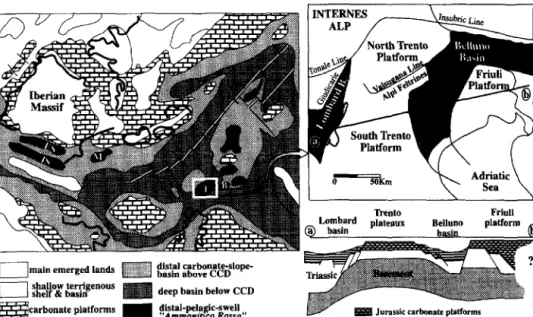
The RAV was deposited on a distal pelagic-
swell system located in the northern Apulian Block
(Fig. 2) which represented a part of the North
African continental margin. Within the epioceanic
fringe, this distal pelagic-swell system was sur-
rounded by basins extending hundreds of kilome-
tres, receiving pelagic marls and mudstones with
occasional siliceous horizons.
This pelagic-swell
system therefore constituted
a palaeogeographic
unit free from terrigenous inflow and allochtho-
nous carbonates that accumulated in surrounding
troughs
(Lombard
Basin westwards
and the
Belluno Trough eastwards). The latter, especially,
received sedimentation
from the adjacent Friuli
carbonate
platform.
Deposition
in the Trento
Plateau was thus exclusively pelagic and subject to
oceanic currents.
The thickness of the upper unit in the Trento
Plateau varies from 16 m in the east at Monte
Grappa to 2 m in the west at Monte Giovo. The
RAV succession in the Trento Plateau has been
differentiated
in type “A” and “B” successions
(Sarti, 1985). Between the lower Calcari nodulari
massicci and the upper Calcari nodulari, the type
“A” succession shows a significant, mineralized
hardground
in which neomorphic shells of ammo-
nites and belemnite rostra are concentrated (Cima
di Campo di Luserna section, Sarti, 1993). On the
other hand, in the type “B” succession seen in the
Lavarone sections, cherty limestones (the interme-
diate unit of the RAV: Calcari selciferi) are interca-
lated between the Calcari nodulari massicci and
the overlying Calcari nodulari. Thickness in these
siliceous deposits varies along the Trento Plateau,
locally reaching 10 m. At the top of this unit is a
bentonite-rich horizon (Bernoulli and Peters, 1970;
Bernoulli and Peters, 1974).
I. 1. Studied sections and remarks on
biostratigraphy
In the Monte Rust area, Comune di Lavarone
(Caldonazzo topographic
sheet 36-I) in the prov-
ince of Trento, four sections (MR-1, MR-2, FAU,
and BPV) were studied, making complementary
observations at many other points. All sections
were located in the central Trento Plateau; the
eastern BPV section was located 2.5 and 2 km east
from the FAU and the MR-1 and MR-2 sections,
respectively. The succession studied (upper unit of
the
RAV)
dates
from
the
Early
Kimm-
eridgian
(Strombecki
Chron)-Early
Tithonian
(Verruciferum/Semiforme
Chron) and has a maxi-
Fig. 2. L <e/f: Palaeogeographic sketch of the Western Tethys in the Kimmeridgian (modified from Cecca et al., 1992). shol areas of outcropping ammonitico rosso facies in epioceanic environment which are here considered; T=Trento Plateau; B Mts.: M ‘= Mallorca Island; ES= External Subbetic: IS= Internal Subbetic.
Righr: : Regional map and synthetic profile for the Trento Plateau and adjacent basins (Lombard and Belluno). and the Friuli
nlmain emerged lands 0 shallow terrigenous shelf & basin i!iz!3 carbonate platforms
distal carbonate-slope- basin above CCD deep basin below CCD distal-pela@c-swell “Ammonihco Rosso”
o-
50Kmmum thickness of 7 m in the FAU section. The
westernmost section, MR-2, 6.35 m thick, is the
most complete and therefore was more intensively
sampled and used as the reference section. In the
MR- 1 section, the lower boundary with the Calcari
selciferi does not crop out, but the upper section
( VerruciferumjSemiforme
Zone) is the most com-
plete. The BPV section shows the most condensed
Kimmeridgian,
especially in the Herbichi
and
Acanthicum
Zones.
In the MR-2, BPV, and FAU sections, the upper
unit of the RAV overlies the Calcari selciferi, the
top of which (bentonite-rich
horizon) served as a
guide-level
for litho-correlation
and biostrati-
graphic sampling. The contact of the RAV with
the overlying Biancone was found in situ in the
MR-I
and BPV sections alone. According to the
data obtained, the lithostratigraphic
and biostrati-
graphic correlations are reliable between sections.
Around
1500
megainvertebrate
specimens.
mainly ammonites,
have been collected with a
lo-15 cm sampling-interval
(Fig. 3). The ammo-
nite assemblages show the Mediterranean
charac-
ter typical in Upper Jurassic ammonites from the
epioceanic Western Tethys in the Umbria-Marche
Ning main = Bakony
Platform.
(Cecca et al., 1990), Venetian Alps (Sarti, 1988,
1993), southern Spain (Subbetic Zone, Enay and
Geyssant, 1975; 016riz, 1978; 016riz and Tavera,
1981,
1989; Caracuel,
1996),
and
Hungary
(Bakony
Mts., FGzy, 1990), and dominant
in
Bulgaria (Sapunov, 1977a,b).
Based on subdivisions proposed by Sarti ( 1988.
1993), the following ammonite-defined
bio-chron-
ostratigraphic
units have been identified:
the
Strombecki,
Herbichi. Acanthicum,
Cavouri and
Beckeri/Pressulum
Zones in the Kimmeridgian,
and the Hybonotum,
Albertinum
and Semiformej
Verruciferum
Zones in the Lower
Tithonian
(Fig. 3).
Selected
ammonites,
among
those
recorded, which are significant for bio-chronostrat-
igraphy in the study area and enable correlations
within the epioceanic Western Tethys, include:
Strombecki Zone.
Metustreblitessp..
Nebroditesmacerrimus
(recorded for the first time in the
Trento Plateau), and
Lessinicerussp., all of these
recorded below ammonite assemblages belonging
to the Divisum Chron in the standard bio-chron-
ostratigraphic
scale (columns
1 and
3-6
in
Hantzpergue et al., 1991).
Jestis E. Carucuel et al. / Palarogeography. Pulueoclinlarolog,, Pulaeoecology 135 ( 1997) 163-l 77 169
part, Stenonis Subzone), Presimoceras spp. and
Metuhuplocerus (cf. nodosiusculum, semibarbarum).
Increasing abundance of Presimoceras and
Nebrodites characterizes the upper part of this
zone (Divisum Chron, see above). Aspidocerus
uhlundi characterizes the uppermost Herbichi
Zone, the upper boundary of which is well iden- tified by the replacement of Sowerb_vceras silenum by loryi.
Acanthicum Zone. Aspidoceras longispinum, A.
sesquinodosum, and A. ucanthicum (recorded in the
upper part), the highest Nebrodites and the lowest
Schuireriu and Discosphinctoides. Sowerbycerus
loryi is very abundant at the middle part of this
zone.
Cavouri Zone. Mesosimocerus cavouri and risgo- viense, as well as the first record of Hemihuplocerus
and perisphinctids, which characterize the upper- most Kimmeridgian.
BeckerQPressulum Zone. The first record of
Hybonoticerus defines the lower boundary.
Hybonoticerus (pressulum and beckeri groups),
Aspidocerus uppenninicum, Hemihuplocerus, Puru-
linguluticerus and the uppermost Sowerbycerus
loryi characterize this zone, together with typical
Upper Kimmerigian Turumellicerus, Pseudo- waugenia and perisphinctids.
Hybonotum Zone. Hybonoticeras (group of
hybonotum), Huploceras (elimutum, stuxycii),
together with Lower Tithonian perisphinctid assemblages (Lithucocerus, Pseudodiscosphinctes,
Subplunitoides, Purukeratinites, Pseudokutro-
licerus). Tithonian Schuireriu are common and the
species episu was recorded for the first time in the epioceanic Tethys.
Semiforme/Verruciferum Zone. Huplocerus ver-
rucijerum s.str., less common Semijormiceras semi-
j&me and then Simocerus uesinense. Lower
Tithonian epioceanic perisphinctids were common. Albertinum Zone. First record of Virgu-
tosimocerus (ulbertinum; rothpletzi from the upper
part) and less common Semiformicerus durwini,
together with Huplocerus cussijhrum, Pseudo-
discosphinctes pseudorhodunicus, Subphnitoides
schivertschlugeri (upper part), “Suhplanitoides”
and related macroconchs.
2. Facies and depositional environments
In the sections studied, three main lithofacies were recognized and correlated on the basis of ammonite biostratigraphy (Figs. 3 and 5): (1) the Nodular-Marly-Facies/NMF (wackestones and
Plate I
a. Close-up view of bioerosion (micritized tubes) on mollusk shell at right (b): MR.2 section. Horizon 2, NCF. Strombecki Zone (x 169).
b. Mollusk shell showing bioerosion (white rectangule enlarged in (a)). and microbial pellets at the top: MR-2 section. Horizon 2. NCF, Strombecki Zone (x 17).
fi.
Micritized pellet or microbioturbation; MR-2 section, Horizon 25, NCF. Verruciferum Zone (x 85).
Euhedral dolomite rombs in wackestone of the upper part of the Rosso Ammonitico Veronese; BPV section, Horizon 20. NCF, Verruciferum Zone (x 17).
e. Pellet-rich wackestone showing intensive bioerosion of bioclasts (aptychus); MR-2 section, Horizon 12, PSCMF, Hybonotum Zone (x 30).
f. g.
Bioclast-rich wackestone showing mineralized Protoglohigrrina; BPV section, Horizon 2, NCF, lower Herbichi Zone (x 42). Bioclast-rich packstone showing random orientation of Saccocomti and filaments; BPV section, Horizon 8, NMF. lower Beckeri Zone (x 42).
h. Bioclasts-rich wackestone (ground-facies) showing mainly radiolaria, Glohochuete. and pellets; MR-2 section. Horizon 2, NC’F, Strombecki Zone (x 21).
i. Oblique section of small Tintinnopsella car-pathica (bottom) and small isometric Calpionella alpina (top); BPV section, Horizon 23, Biancone facies, earliest Berriasian (x 212).
j. Sub-isometric Calpionella alpina of intermediate size; BPV section, Horizon 23, Biancone facies, earliest Berriasian ( x 212).
k. Crassicollaria colomi; BPV section, Horizon 22, Biancone facies, earliest Berriasian ( x 212).
I. Small Cmwicolluria intermedia: BPV section, Horizon 22, Biancone facies, earliest Berriasian (x 212) m Small Cru.r.sicolluriu massutiniana; BPV section, Horizon 22, Biancone facies, earliest Berriasian ( x 212). n. Crassicollarin purvula: BPV section, Horizon 23, Biancone facies. earliest Berriasian ( x 212).
occasionally packstones), which are well repre- sented in the Herbichi Zone (Uhlandi Subzone), in the Beckeri Zone, and in some intervals in the Hybonotum and Albertinum Zones (Lower Tithonian); (2) the Nodular-Calcareous- Facies/NCF (mainly packstones, and some wacke- stones), which could be considered the typical facies, is widespread in all sections, and may have stromatolitic overgrowths; and (3) the Pseudonodular-Calcareous-Massive-
Facies/PSCMF (mainly packstones, and some wackestones), which developed only at the base of the Hybonotum Zone (Lower Tithonian).
As usual in ammonitico rosso (Oloriz et al., 1995b), textures are mainly wackestones, second- arily packstones, and occasionally grainstones when intraclast-rich (Succocorna- and filament-rich horizons) bed tops are considered; mudstones are commonly related to intensive bioturbation. More significant microfossils are Globochuete. filaments (both especially from the Middle Kimmeridgian upwards; Plate Ig), Protoglobigerinu (Lower- Middle p.p. Kimmeridgian; Plate If ), radiolaria (top of the intermediate unit and bottom of the upper unit; Plate Ih), Succocor?ta (Plate Ig), early growth stages of ammonites and aptychi. Less common are Stomiosphurra, Cudosinu, bivalves, gastropods, pedunculate crinoids, and foramini- fera (including Spirillinidur, Trocholinidur, and occasionally microgranular ones).
In the microfacies analysed, Fe- and Mn-oxyhydroxides, aggregate grains and common to abundant pellets are persistently recorded, but pellet-poor horizons as well as microbial pellets (Massari, 198 1) have been identified at the base of the succession. In general, Lower and Middle Kimmeridgian fabrics show microbially active bio- sedimentation resulting in stromatolitic crusts and bothrolitic overgrowths, similar to those studied by Massari ( 1981), Massari ( 1983). Bioclast micritization is widespread throughout the succes- sion, as is bioerosion (Plate Ia, b and e) and/or subsolution (sensu Hollmann, 1962. 1964). In the upper part of the succession, recrystallisation and scarce euhedral dolomite rhombs developed below horizons with incipient dolomitization in the over- lying Biancone (Plate Id).
Microfacies in the lowermost Biancone in the
BPV section show calpionellid-rich wackestones, with common Stomiosphucru and Cudosinu, few radiolaria, and rare foraminifera (Spirillinu);
scanty echinoid plates and aptychi are also present. Calpionellid assemblages evolved from relatively diversified Crussicolluriu (mussutiniunu, colomi, and
gr. intermediu: Plate Ik-m) of small to intermediate size (55-80 x 35-55 urn), together with scarce and mainly isometric forms of Culpionellu ulpinu
of intermediate size (50-70 x 50-70 urn), as well as rare, small Tintinnopsellu (Plate Ii) of the cur-
puthicu group (60-65 x 35540 urn), to increasing
isometric forms of mid-size (60 x 60 um)
Culpionellu ulpinu (Plate Ij) in co-dominance with
Crussicolluriu purvulu ( 70-75 x 45-50 urn)
(Plate In) and uncommon and slightly larger
Tintinnopsellu curputhicu. These two calpionellid
assemblages show the well-known turnover between the upper Crussicolluriu and lowermost
Culpionrllu zones. Similar, small-sized calpionellid
assemblages from Mallorca have recently been interpreted as being typical epioceanic populations (Oloriz et al., 1995a). According to calpionellid biostratigraphy in neighbouring areas in the Western Tethys (Oloriz and Tavera, 1981; Tavera et al., 1994; Oloriz et al., 1995a), the most probable age for the base of the Biancone in the BPV section is the earliest Berriasian.
The numerical analysis of microfacies compo- nents in ammonitico rosso facies was first approached by Oloriz et al. ( 1995b) to interpret relationships between micro- and macrofeatures in these condensed deposits. This analysis showed not only microfdcies groupings according to stra- tigraphy and depositional conditions, but also dense clustering caused by synsedimentary and diagenetic dissolution as well as by differentiated bioturbation and time-averaging. For alternating resedimented/condensed deposition (macrofea- tures; type-facies in Oloriz et al.. 1995b). these authors applied principal-components analysis. which indicated a homogeneous skeletal composi- tion but heterogeneous fabric (microfeatures).
Without significant resedimentation phen- omena, we carried out numerical analyses (cluster Q-mode) on the RAV, based on quantification of
Protoglobigerinrr, Glohochuetc, pellets, bioturba-
Jesk E. Caracuel et al. / Palaeogeography. Palaeoclimatology, Palaeoecology 135 (1997) 163-l 77 171
aptychi (S+ F + A) under the microscope, in terms of rare (<5%), scarce (lo-15%), common (20-30%) and abundant (> 30%).
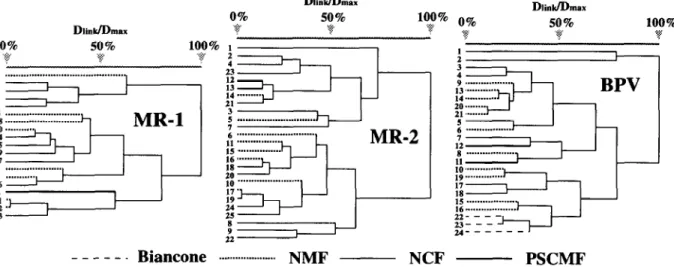
The MR-1 dendrogram in Fig. 4 shows separate clustering of NCF according to reversal Proto-
grobigerina/Globochaete ratio (bunch 2-5), and
then increasing radiolaria and decreasing bioturba- tion for separating bunches 10-l 7 and 1 l-l 3. Separate clustering also affects NMF throughout variation in content of pellets and of the combina- tion of S+F+A in bunches 1-5, 6-18 and 7-16. The MR-2 dendrogram reveals a major bunching which is based mainly on floating-bioclast abun- dance, and thus is controlled by energy. With some exceptions, the major bunch l-7 broadly correlates with low-energy conditions (Fig. 5). Similar com- position for the NMF, directly over PSCMF, in sections MR-1 and MR-2, contrasts with variable bioclast composition in the PSCMF, depending on energy. The clustering of lithofacies in bunch
12-21 in the MR-2 dendrogram is consistent with lower-energy conditions for deposition of PSCMF in this section. Intermediate-energy conditions are assumed for the BPV section according to the clustering of variable lithology in bunch 7-l 1. Nevertheless, the BPV dendrogram shows a clear
clustering of NMF (9-21, lo-19 and 15-16), as well as a major clustering (3-l 1 vs. 10-24) con- trolled by floating-bioclast abundance, thus indi- cating generally higher energy throughout the BPV section.
The cluster analysis (Fig. 4) revealed the following: (a) uniformity in microfacies composi- tion; (b) slight effect of the reversal in the Proto-
globigerina/Globochaete ratio (Acanthicum-
Cavouri Zones), although the age discrimination for these microfacies components has not pre- viously been demonstrated for the Kimmeridgian (this can be obscured by the significance of floating bioclasts in the BPV section); and (c) a relatively high clustering of NCF occurs, with local varia- tions (MR-1 vs. MR-2 sections), admitting trans- ition to NMF (lo-17 in MR-1 section; 3-7, 16-20 and lo-25 in MR-2 section; 3-9, 5-6 and lo-18 in BPV) as well as to PSCMF (8-13 in MR-1 section;
12-21 in MR-2 section; 7-12 in BPV section); (d) the clustering obtained points to subtle changes in low-energy conditions as the main factor con- trolling distribution of microscopic components in lithofacies; and (e) the restriction of cluster analysis to only 6 workable variables fits well with the low- energy conditions inferred, and contrasts with the
D~indDmnx 0% 50% ‘:;< :* 1 . . . , i- 6 * . . . . ,* . . .
MR-2
,s . . .
. . .
100% v ---.Biancone
. . . NMF
NCF
PSCMF
Fig. 4. Dendrograms of cluster analysis obtained from the study of 6 variables (semiquantitative estimation by microscope of percen- tage of: Profoglohigerina, Globochaete, pellets, bioturbation, orientation of bioclasts. and the Saccocoma + Filaments +Aptychy) and 19 cases in the MR-I section, 25 in the MR-2 section, and 24 in the BPV section. Missing data were casewide deleted. Amalgamation criteria were clustered as weighted pair-group averaged, considering Euclidean metric distances. NMF, NCF, and PSCMF, for recognized type-facies in the studied Ammonitico Rosso Veronese. See text for explanation.
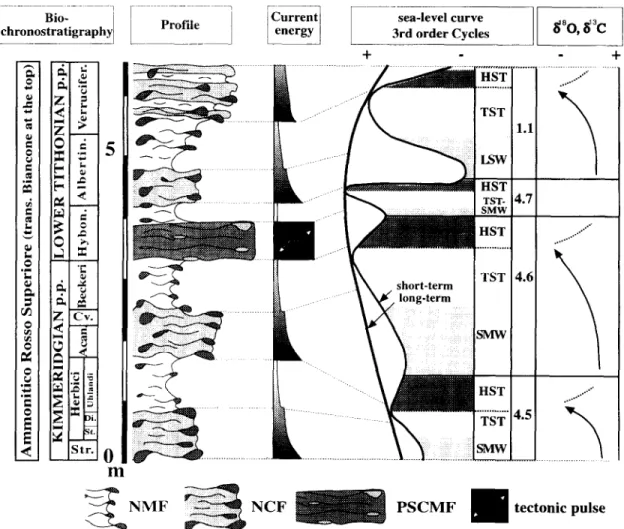
+ _ ,,,,,,,,,,, . HST . . . ,...” ,... /’ 4.6 ‘, . . . ..- . ...‘. 1.5 _. ,.,‘\ NMF NCF PSCMF
? ?
tectonic pulseFig. 5. Svnthetic lithostratigraphic profile of the Kimmeridgian Lower Tithonian studied. and proposed correlation to the sea-level
curve as’proposcd by Haq et al. ( 1988) slightly adapted for Iberia in Marqucs et al. ( 1991 ): facies distribution (NMF. NCF, and PSCMF); and energy
of
currents as lnfcrred from microfacies analysis. Note higher-energy conditions inferred for PSCMF, probably due to a tectonic pulse. Trends to lighter ii”0 and 3°C‘ isotopes correlate well with sea-level rises. See text for explanation. .4hhrr~ktrorr.~ as in Fig. 3.cluster analysis on 17 variables made by 016riz et al. (1995b) in higher-energy ammonitico rosso from the Tithonian in Mallorca.
Complementary information was obtained applying correlation analyses to relative abun- dances of the variables PW to~k,h;~~r,‘i??~l, G/ohoclxwtc~, pellets, bioturbation, bioclast orienta- tion and the combination of S+ F + A. The scarce but constant record of radiolaria would have reduced correlation indices, and was therefore removed. More relevant results from the correla- tion analyses were: (a) the negative and low-range
lluctuating correlation between bioclast orienta- tion and bioturbation (-0.698, -0.682. and
-0.766 in sections MR-I, MR-2 and BPV, respec- tively); (b) the negative correlation of bioclast orientation and abundance (not only presence/ absence) of S+ F+A in the close MR-I (--0.209) and MR-2 (-0.207) sections, and the slightly positive correlation (0.177) in the separate BPV section; (c) the positive correlation between a large number of Glohoclmetc and the S+F+A in the MR-1 (0.546), MR-2 (0.438), and BPV (0.282) sections; and (d) the negative correlation of
Jestis E. Caramel et al. / Palaeogrography, Palaeoc~limatolo~~, Palaroecwlog~ 135 i 1097) 163-I 77 173
Globochaete (-0.544, -0.628, and -0.390) and the S+F+A (-0.434, -0.124, and -0.016) with respect to Protoglobigerina, which disappeared around the Middle Kimmeridgian.
All these features are interpreted as having been caused by fluctuations in energy levels [except for point (d)], the fluctuations being related to differential sea-bottom topography for a given relative sea level (see below). Higher-energy condi- tions forcing bioclast orientation persistently inhib- ited bioturbation (a), thus bringing about an active sweeping of the S+ F +A that lead to low but differential S + F + A concentrations at particular horizons and settings (b). Conversely, bioturba- tion increased under low-energy conditions (a), favouring random bioclast orientation, as well as deposition of easily transportable bioclasts such as
Globochaete and the S+F+A (c). Strati- graphically, Protoglobigerina was replaced by
Globochaete and Saccocoma, but later than pos- tulated by Dromart and Atrops (1988). Only minor fluctuations seem to balance the record of
Protoglobigerina and Globochaete, where these coexisted.
One of the factors assumed to force lithofacies evolution is the fluctuation in the relative sea level. Proposed global sea-level curves can be generally accurate but distorted in detail due to imprecise biostratigraphy and local/regional tectonics (Hallam, 1988). If high biostratigraphic resolution is available (e.g., at the ammonite zone/subzone level ), biostratigraphy (“procedure inverse” in Vail et al., 1987, p. 1315) is one way to test the possi- bility of a correlation between local strata1 pat- terns, and facies, and those expected from published global eustatic curves. Interactions between tectonics and eustasy during the Late Jurassic are usually recognized in the Western Tethyan Iberian palaeomargins (Marques et al.,
1991; Oloriz et al., 1991, 1993, 1996; Rodriguez- Tovar, 1995; Caracuel, 1996).
Studying epioceanic ammonitico rosso from southern Spain, Oloriz et al. (1993, 1995b, 1996) analysed ecostratigraphic and depositional signals in relation to expected trends according to the eustatic curve by Marques et al. ( 1991; adapted from Haq et al., 1988). Eastwards in the Tethys (Venetian Alps), lithofacies evolution in Upper
Jurassic ammonitico rosso has been investigated by Martire ( 1988,1989, 1992) through the compar- ative analysis of the facies studied with the expected trends in deposition according to the eustatic curve in Haq et al. (1988). In the case study, assuming the model proposed by Martire (1992) for the Altopiano di Asiago (VI) and on the basis of refined biostratigraphy and correla- tions (Fig. 5), it is possible to recognize relation- ships between facies distribution (NMF, NCF, and PSCMF) and expected depositional trends according to third-order eustatic fluctuations pro- posed by Marques et al. (1991). By analysing megainvertebrate-assemblage evolution, isotopic and geochemical data, as well as taphonomic and ichnologic observations, Caracuel ( 1996) has sup- ported the validity of the application of the eustatic curve to this case study.
Martire (1989. 1992), and Martire et al. (1991) interpreted hiatuses and hardgrounds in epioceanic plateaux as being controlled by wind-driven cur- rents sweeping off plateau bioclasts during sea- level lows. Even admitting the limitation in recog- nizing productivity cycles, these authors implies that productivity was crucial to carbonate sedi- mentation in ammonitico rosso. In Martire’s model, sedimentation was restricted to third-order relative sea-level highs. Second-order sea-level fluctuations can be registered as depositional shifts to intraclast-rich limestones during regressive trends, due to more active winnowing of fine particles.
In this study, it is also possible to recognize the effect of relative sea-level Auctuations, through the associated changes in carbonate productivity and hydrodynamics. However, during relative sea-level lows, the combination of deeper bottoms and/or lower energy determined the lack of biostratigraph- ically recognizable hiatuses in the upper unit of the RAV at Monte Rust. This idea is valid assum- ing that there are no significant changes in nutri- ents, productivity, and fine elastic inflows. Thus, we found that relative sea-level highs (deposition of NMF, Uhlandi Subzone and Beckeri Zone in Fig. 5) were related to maximum floodings at the interpreted third-order eustatic cycles (Haq et al., 1988). These maximum floodings appear to repre- sent lower-energy conditions with little or no possi-
bility for the winnowing of the scanty fine-grained sediments which reached swell areas at a more or less constant rate. In such a situation, fine elastics would be caught on epioceanic plateaux. In the case of relatively deeper swells, facies compara- tively rich in floating bioclasts (i.e., Sclccocon?a and filaments) also developed. In contrast, during sea-level lows, potentially floating (easily trans- portable) bioclasts were selectively swept off pla- teaux, together with fine muddy sediments, as a result of the expected higher-energy conditions. During sea-level highs, there was little sorting or orientation of elongate bioclasts. The recognition of selective sweeping off plateaux was the only effective criterion for identifying active currents in these depositional environments, but this identifi- cation was partially obscured by bioturbation and nodulation.
A complementary interpretation based on stable-isotope analyses is available in Caracuel (1996; and unpublished data by J.E. Caracuel and F. Oloriz). The S’*O and 613C data obtained from belemnite rostra throughout the sections (cycles 4.5, 4.6, and 1.1 in Fig. 5) show shared trends to lighter values within a total range of 613C=
- 1.02 to + 1.71!%, and 6”0= ~ 1 to -0.03%. These data indicate cold temperate waters for the belemnites studied. Moreover, a shared trend is recorded to cooler and lower productivity condi- tions towards high sea-level. This is in accordance with a low rate of bioclast input during sea-level highs. Nevertheless, two possibilities exist to deter- mine low skeletal content during sea-level highs: (a) lower winnowing of fine-grained sediments; and (b) lower input of skeletals resulting from slower productivity. Whatever the case, depth appears to be a complementary and crucial factor determining the possibility for wind-driven cur- rents to influence deposition.
Despite the fact that the deposition of relatively marly sediments (NMF) is in good agreement with the model by Martire ( 1989, 1992) for sea-level highs, some deviations have been identified for eustatic or relative sea-level lows. In contrast to the model applied in the Altopiano di Asiago (VI ) (Martire, 1989, 1992), deeper and/or lower-energy environments (protected environment in Monte Rust area) favoured the development of relatively
calcareous sedimentation (NCF) during sea-level lows, instead of hiatal deposits, with or without hardgrounds, which characterized higher platform sectors or sites under higher-energy conditions, such as the Altopiano di Asiago (VI ). Moreover, in the case at hand, comparatively well-exposed areas, or sites under persistent energy increases during sea-level lows, should result in the depos- ition of PSCMF. This facies has been recognized in the lowermost Tithonian (lower Hybonotum Zone). Haq et al. ( 1988) proposed that this level corresponds to a relative eustatic low (short-term) superimposed on a long-term sea-level high. Taking into account the biotic and abiotic features in the PSCMF, as well as their restricted strati- graphic range (PSCMF are recognized only at the base of the Tithonian in the area), we infer that local factors cancel and even reverse the effects of long-term eustasy, emphasizing those of short- term eustasy. In short, environmental energy increased when the PSCMF was deposited. Due to this increase, fine sediments were swept off the plateau, and probably ammonite carcasses also by increasing post mortem transport; this could be the reason for the persistent meagre megainverte- brate record in the PSCMF.
The upwards increase in thickness of ammonite biozones in the Lower Tithonian is interpreted as having been caused by the interaction between tectonics and eustasy, starting with deposition of PSCMF (Figs. 3 and 5). This is in accordance with the increased tectonic activity recognized in separate areas during the latest Jurassic ( Brookfield, 1970; Hillebrandt, 1973; Hallam, 1978, 1988; Rawson and Riley, 1982; Marques et al., 1991; Salvador et al., 1992).
3. Conclusions
Kimmeridgian-Tithonian sections at Monte Rust ( MR- 1. MR-2), the Forte Austro-Ungarico ( FAU ), and the Bus di Pissavacca (BDV), provide valuable data for biostratigraphic subdivision and the interpretation of depositional conditions of ammonitico rosso facies.
Nodular-marly, nodular-calcareous, and pseu- donodular-calcareous-massive ammonitico rosso
Jestis E. Carucuel et (11.1 Pdaeogeography, Palaeoclimatology, Palueoecology 135 (1997) 163-I 77 115
facies provide reliable information about deposi- tional conditions in the area according to environ- mental energy, which was related mainly to relative sea-level conditions.
Under generalized low-energy conditions, increasing energy operated during slowing sea- level (regressive phases), determining the depos- ition of nodular-calcareous ammonitico rosso, and of pseudonodular-calcareous-massive ammonitico rosso under extreme energy conditions, probably related to interactions between tectonics and eus- tasy. Energy decreased during rising sea level (transgressive phases), leading to the deposition of nodular-marly ammonitico rosso facies.
Numerical analysis (cluster and correlation analysis) of semiquantitative estimations of selected components by microscope shows only minor but recognizable fluctuations in depositional energy, as well as rather variable relationships between micro- and macrofeatures in the ammonit- ice rosso studied. On this basis, the reverse trends in the record of bioclast orientation, and both the bioturbation and the abundance of easily transportable bioclasts, are in agreement with episodic disturbances of background low-energy conditions.
The relationships interpreted between deposi- tional dynamics and changes in relative sea level is ensured by a zone/subzone level ammonite bio- stratigraphy, based on more than 1400 specimens collected in situ. During the Kimmeridgian, depos- its pertaining to sea-level highs (Uhlandi and Beckeri Chrons) are especially well correlated on the basis of ammonite biostratigraphy and lithofa- ties. Correlations for deposits affected by the pro- gressive long-term sea-level fall during the Early Tithonian are quite consistent.
Acknowledgements
This research has been supported by financial contribution from the Spanish-Italian Research Cooperation Programme (Project 18 A), and car- ried out within the framework of Projects PB91-0733 DGCYT, PICG 343, and the EMMI Group (RNM 0178 Junta de Anduluciu, Spain). We are grateful to A. Ceragato for field assistance
in Lavarone (Trento), as well as to F. Surlyk (Copenhagen) and A. Hallam (Birmingham) for critical revision of this paper and linguistic assis- tance. In the final version of this manuscript, the English was looked over by David Nesbitt.
References
Bernoulli, D., Peters, T‘., 1970. Traces of rhyolitic-trachitic vol- canism in the Upper Jurassic of the Southern Alps. Eclogae Geol. Helv. 63, 609-621.
Bernoulli, D., Peters, T., 1974. Traces of rhyolitic-trachytic vol- canism in the Upper Jurassic of the Southern Alps: Reply. Eclogae Geol. Helv. 67, 209-213.
Biju Duval, B., Morel, Y., Baudrimont, A., Bizon, G., Bizon, J.J., Borsetti, A.M., Burollet, P.F., Clairefond, P., Clauzon, G., Colantoni, P., Mascle, G., Montadert, L., Perrier, R., Orsolini, P., Ravenne, C., Taviani, M., Winnock, E., 1983. Exemples de sidimentation condenske sur les escarpements de la Mer Ionienne (Mkditerranbe Orientale) ~ Observa- tions g partir du submersible “Cyana”. Rev. Inst. Fr. P&t. 38 (4), 427-438.
Bosellini, A., Martinucci, M., 1975. Annegamento delle piatta- forme carbonatiche. Ann. Univ. Ferrara, IX (5), (lo),
181-193.
Bosellini, A., Winterer, E.L., 1975. Pelagic limestones and radiolarites of the Tethyan Mesozoic: A genetic model. Geol- ogy 3,279-282.
Brookfield, M.E., 1970. Eustatic changes of sea-level and orog- eny in the Jurassic. Tectonophysics 9, 347-363
Caracuel, J.E., 1996. Asociaciones de megainvertebrados, evo- lucibn ecosedimentaria e interpretaciones ecoestratigrificas en umbrales epioceiinicos del Tethys Occidental (JurLsico Superior). Ph.D. Thesis, Dissertation, University of Gra- nada, Granada, i-x + 414 pp.
Castellarin, A. (toll. Ferrari, A.), 1972. Evoluzione paleotetton- ica sinsedimentaria del limite tra “Piattaforma Veneta” e “Bacino Lombardo”, a nord di Riva del Garda. G. Geol. II 38 (l), I I-212.
Cecca, F., Cresta, S., Pallini. G., Santantonio, M., 1990. II Giur- assico di Monte Nerone (Appennino marchigiano, Italia Centrale): biostratigrafia, litostratigrafia ed evoluzione paleogeografica. In: Pallini, P.A., Cecca, F., Cresta, S., San- tantonio, M. (Eds.), Atti del Second0 Convegno Internazio- nale Fossili, Evoluzione, Ambiente. Pergola, pp. 63-139. Cecca, F., Fourcade, E., Azisma, J., 1992. The disappearance
of the “Ammonitico Rosso”. Palaeogeogr., Palaeoclimatol., Palaeoecol. 99, 55--70.
Clari, P., Pavia, G., 1987. Superfici di interruzione di sedimenta- zione e lacune biostratigrafiche nel Cretaceo inferiore di Miz- zole (Lessini Veronesi). Boll. Sot. Paleontol. Ital. 26 (l/2), 21-38.
Dromart, G., Atrops, F., 1988. Valeur stratigraphique des bio- microfacitis pClagiques dans le Jurassique supPrieur de la
T&hys occidentale. C.R. Acad. SC]., Paris 306 (II).
1365%1371.
Enay, R.. Geyssant. J.R.. 1975. Faunes tithoniques des chaines bctiques (Espagne m&idiom&). In: Colloque sur la limite Jurassiqu+CrPta&, Lyon- Neuchitel. MCm Bur. Rcch. Giol. Min. 86. 39-55.
Farinacci, A., Ehm, S. ( Eds.). 1981. Rosso Ammonitico Sympo- sium Proceedings. Tecnohcienza, Rome. 602 pp.
Fcrrari. A.. 1982. Note stratigrafiche sull’area vcneto trcntina (da1 Triassic0 superiore al Crctacico). In: Castellarin, A., Vai. G.B. (Eds.), Guida alla geologia del Sudalpino centro- orientale. Guide Geol. Reg., Sot. Gcol. Ital.. pp. 59 66. Fiiry, 1.. 1990. Ammonite succession from three Upper Jurassic
sections in the Bakony Mts. (Hungary). In: Pallini, P.A.. Cecca. F.. Cresta. S.. Santantonio. M. (Eds.). Atti del Second0 Convegno lnternarionale Fossili. Evolurione. Ambicnte. Pergola. pp. 323 339.
Hallam. A., 1978. Eustatic cycles in the Jurassic. Palaeogeogr., Palaeoclimatol., Palaeoecol. 23. I -32.
Hallam. A.. 1988. A reevaluation of Jurassic euhtasy in the light of new data and the revised Exxon curve. In: Wilgus, C.K.. Hastings, B.S., Kendall. C.G.St.C.. Posamcntier, H.W.. Ross. C.A.. Van Wagoner. J.C. (Editors). Sea-Level Changes ~~ An lntegratcd Approach. Sot. Econ. Paleontol. Mineral., Spec. Publ. 42. 261-274.
Hantzpergue. P., Atrops. F.. Enay, R.. 1991. Kimmeridgien. In: R&ctualisation des &hclles d’Ammonites. 3rd Int. Symp. on Jurassic Stratigraphq. Poitiers, p. I33
Haq. B.U., Hardenbol. J.. Vail, P.R.. 1988. Mesozoic and Ceno- zoic chronostratigraphy and eustatic cycles. In: Wilgus. C.K.. Hastings. B.S.. Kendall. C.G.St.C.. Posamcntier. H.W.. Ross. C.A.. Van Wagoner. J.C. (Eds.). Sea-Level Changes ~ An Integrated Approach. Sot. Econ. Paleontol. Mineral., Spcc. Publ. 42. 71 89.
Hillebrandt, A.V., lY73. Ncue Ergebnisse iibcr den Jura in Chile und Argentinien. Miinstcr Forsch. Geol. Pal;~ontol. 31.32. I67 199.
Hollmann, R., 1962. uber Subsolution und die “Knollenkalke” des Calcarc Ammonitlco Roaso Superiore im Monte Baldo (Maim: Norditalien). Neues Jahrb. Gcol. Pal%ontol.. Monatsh., pp. 163-179.
Hollmann. R.. 1964. Subsolutions-Fragmente (Zur Biostratino- mic der Ammonoidea im Maim des Monte Baldo:Nordita- lien). Neues Jahrb. Geol. Palaontol., Abh. I 19 ( I ). 22 82. Marques, B., Olbriz, F.. Rodriguez-Tovar. F.J., 1991. Inter- actions between tectonica and eustasy during the Upper Jur- assic and lowermost Cretaccous Examples from the South of Iberia. Bull. Sot. Gkol. Fr. I62 (6). 1009 1024. Martire, L.. 1988. Eti. dinamica deposizionale c possibile
organizzazione sequenziale del Rosso Ammonitico dell’Al- topiano di Asiago (VI ). Rend. Sot. Geol. Ital. I I, 231 236. Martirc. L.. 1989. Analisl biostratigratica e sedimentologica del Rosso Ammonitico Veroncsc dell’Altopiano di Asiago (VI). Ph.D. Thesis. Dissertation, University of Torino. Torino. 166 pp.
Martlre. L.. 1992. Sequence stratigraphy and condensed pelagic sediments ~~ An example from the Ammonitico Rosso Vcr-
onesc, northern Italy. Palaeogeogr.. Palaeoclimatol.. Palaeo- ecol. 94, 169 191.
Ma-tire. L., Clari. P.A., Pabia. G.. 1991. II significato strati- grafico della sezione di Cima Campo di Luserna (Giurassico delle Alpi Meridionale. Italia nord orient&): Palaeopelagoa
I. 56-65.
Massari. F.. 1981. Crypyalgal fabrics in the Rosso Ammonitico sequences of the Venetian Alps. In: Farinacci. A., Elmi. S. (Eds.), Rosso Ammonitico Symposium Proceedings. Tecnos- cienza. Rome. pp. 435-469.
Massari, F.. 1983. Oncoids and stromatolites in the Rosso Ammonitico sequences ( MiddleeUpper Jurassic) of the Venetian Alps. Italy. In: Peryt. T.M. (Ed.). Coated Grains. Springer. Berlin, pp. 358 -366.
Miiller. J.. Fabricius. F.. 1974. Magnesia-calcite nodules in the lonian deep sea: an actualistic model for the formation 01 some nodular limestones. In: Hsii. K.J., Jenkyns, H.C.
( Eds.). Pelagic Sediments: On Land and Under the Sea. Int. Assoc. Scdimentol.. Spec. Publ. I. 235~ 247.
Mullins. H.T.. Newmann, A.C.. Wilber. R.J., Boardman, M.R.. 1980. Nodular carbonate sediment on Bahamian slopes: Pos- siblc precursor to nodular limestones. J. Sediment. Petrol. 50(l). II7 131.
Oldriz. F., 1978. KimmeridgicnseeTithonico inferior en cl sector central de las Cordilleras BCticas (Zona Subbt-tica) ~ Paleontologia ~ Biostratigrafia. Ph.D. Thesis. Dissertation, University of Granada. Granada. 184, i-x\ii + 758 pp. 016riz. F., Tavera. J.M.. 1981. El Jurrisico Superior en el Sector
Central de la Zona SubbCtica Introducci6n al conoci- miento de las facies ~ Indices y correlaciones. R. Acad Cien. Fis. Nat.. PIGC 2. 207 239.
016riz. F., Tavern. J.M.. 1989. The significance of Meditcrra- nean ammonites with regard to the traditional Jurassic-Cret- aceous boundar). Cretaceous Res. IO. 221 237.
Olbriz, F.. Marques. B.. Rodriguez-Tocar. F.J., 1991. Eustatism and fauna1 associations - Examples from the South Iberian margin during the Upper Jurassic (Oxfordian Kimmerid- gian). Eclogae Geol. HeI\. 84 (I ). 83-106.
016riz. F., Rodriguez-Tovar. F.J.. Marques, B., Caracuel, J.E.. 1993. Ecostratigraphy and sequence stratigraphy in high fre- quency sea level fluctuations: Examples from Jurassic macro- invertebrate assemblages. Palaeogeogr., Palaeoclimatol., Palaeoecol. 101, 131-145.
Olcirir, F.. Caracuel, J.E.. Marques. B.. Rodriguez-Tovar. F.J.. lYY5a. Asociaciones de tintinnoides cn facies ammonitico rosso de la Sierra Nortc (Mallorca). Rev. Ehp. Paleontol.. No. Homen. Dr. G. Colom. pp. 77-93.
Olbriz. F., Caracuel. J.E.. Rulz-Heras. J.J.. 1995b. Numerical analysis of sedimentary components: A key for interpretation of macroscopic and microscopic features in Ammonitico Rosso facies ( Uppermost Jurassic-Lowermost Cretaceous). J. Sediment. Res. A65 (I). X%243.
01&z, F.. Caracuel. J.E., Ruiz-Herds. J.J.. Rodriguez-Tovar, F.J., Marques. B., 1996. Ecostratigraphic approaches. sequence stratigraphy proposals and block tectonics: Exam- ples from epioceanic swell areas in South and East Iberia. Palaeogcogr.. Palaeoclimalol.. Palaeoecol. 121. 273 295.
J&s E. Curucuel et al. / Paiueogeography. Pulueoclimutology, Palaeoecology 135 (1997) 163-l 77 111
Rawson, P., Riley, L.A., 1982. Latest Jurassic-Early Cretaceous Events and the “Late Cimmerian Unconformity” in North Sea Area. Am. Assoc. Pet. Geol. Bull. 66 (12), 2628-2648. Rodriguez-Tovar, F.J., 1995. Evolution sedimentaria y
ecoestratigrafica en plataformas epicontinentales del margen Sudiberico durdnte el Kimmeridgiense inferior. Ph.D. Thesis, Dissertation, University of Granada, Granada, i-x+ 374 pp. Salvador, A., Westermann, G.E.G., Oloriz, F., Gordon, M.B., Gursky, H.-J., 1992. Meso-America. In: Westermann, G.E.G. (Ed.), The Jurassic of the Circum-Pacific. Cambridge University Press, New York, NY, pp. 93-121.
Sapunov, LG., 1977a. Ammonite stratigraphy of the Upper Jurassic in Bulgaria, III. Kimmeridgian: Substages, zones and subzones. Geol. Balcanica 7 ( 1 ), 63380.
Sapunov, I.G., 1977b. Ammonite stratigraphy of the Upper Jurassic in Bulgaria, IV. Tithonian: Substages, zones and subzones. Geol. Balcanica 7 (2), 43364.
Sarti, C., 1985. Biostratigraphie et faune a ammonites du Juras- sique superieur de la plate-forme atesine (Formation du Rosso Ammonitico Veronais). Rev. Paleobiol. 4 (2), 321-330.
Sarti, C., 1986. Fauna e biostratigrafia del Rosso Ammonitico de1 Trentino centrale ( Kimmeridgiano-Titoniano). Boll. Sot. Paleontol. Ital. 23 (3), 4733514.
Sarti, C., 1988. Biostratigraphic subdivision for the Upper Jur- assic of the Venetian Alps (northern Italy) on the base of
ammonites. 2nd Int. Symp. on Jurassic Stratigraphy, Lisbon, pp. 4599416.
Sarti, C., 1993. II Kimmeridgiano delle Prealpi Veneto-Tren- tine: Fauna e Biostratigrafia. Mem. Mus. Civ. Stor. Nat. Verona, (II Ser.) Sez. SC. Terra 5, 145 pp.
Tavera, J.M., Aguado, R., Company, M., Olbriz, F., 1994. Integrated biostratigraphy of the Durdngites and Jacobi Zones (J/K boundary) at the Puerto Escafio section in South- ern Spain (Province of Cordobd). Geobios, Mtm. Spec.
17,4699476.
Vail, P.R., Cohn, J.P., Jan Du Chene, R.J., Kuchly, J., Mediavilla, F., Trifilieff, V., 1987. La stratigraphie sequentielle et son application aux correlations chronostrati- graphiques dans le Jurassique du bassin de Paris. Bull. Sot. Geol. Fr. 8/III (7), 1301-1321.
Winterer, E.L., Bosellini, A., 1981. Subsidence and sedimentd- tion on a Jurassic passive continental margin, southern Alps, Italy. Am. Assoc. Pet. Geol. Bull. 65, 3944421.
Zempolich, W.G., 1993. The drowning succession in Jurassic carbonates of the Venetian Alps, Italy: A record of supercon- tinent breakup, gradual eustatic rise, and eutrophication of shallow-water environments. In: Loucks, R.G., Sarg, J.F. (Eds.), Carbonate Sequence Stratigraphy: Recent Develop- ments and Applications. Am. Assoc. Pet. Geol., Mem. 57, 63-105.