23rdWORLD CONGRESS OF POLITICAL SCIENCE
RC02POLITICAL ELITES -‘METHODOLOGICAL ASPECTS OF ELITE STUDIES’
Montréal, Québec, Canada, 19-24 July 2014
What, how, and why to mix research methods in the study of career patterns?
Methodological aspects of a combination of ‘survival analysis’ and ‘life story interviews’ Abstract
Political careers have become more diversified in multi-level systems over the last decades. In ‘classic’ federations (e.g. the US, Canada, and Germany), regional offices have become attractive positions with the process of professionalization. In newly regional political systems (e.g. Belgium, Spain, and the UK), the regional level has been quickly perceived by ambitious candidates as a professionalized political arena. Overall, regional positions in multi-level contexts are no longer conceived as amateur positions or mere stepping stones towards the national level. Despite the growing literature on the topic, several methodological questions remain nonetheless opened. This paper discusses the benefits and limitations of a mix-methods research design relevant for the study of elites’ career patterns. Specifically, the paper presents how and why mixing two quantitative and qualitative methods: survival analysis and life story interviews (for the purpose of illustration, the paper relies on empirical data: 1.831 careers and 84 life stories). Firstly, I introduce separately the added-value of each research methods (I especially discuss the benefits of these approach to collect and analyze longitudinal data in a context of multi-level system). Secondly, I demonstrate how these two methods permit to better understand elites’ career patterns in the context of multi-level systems.
Jérémy Dodeigne
Research fellow F.R.S.-FNRS, PhD candidate Université de Liège, Spiral
Université catholique de Louvain, CESPOL Boulevard du Rectorat, 7 - Bat. 31
B-4000 Liège, Belgium
****
Work in progress. Please do not quote without author’s permission.
2
1. Introduction
Political careers have become more diversified in multi-level systems over the last decades. In ‘classic’ federations (e.g. the US, Canada, and Germany), regional offices have become attractive positions with the process of professionalization. In newly regionalized political systems (e.g. Belgium, Spain, and the UK), the regional level has been quickly perceived by ambitious candidates as a professionalized political arena. Overall, regional positions in multi-level contexts are no longer conceived as amateur positions or mere stepping stones towards the national level (Borchert and Stolz 2011b, 108). In other words, some politicians express – a more or less important degree of – progressive ambition which causes level-hopping movements (e.g. incumbent regional MPs wish to end up in the national parliament whereas some national MPs seek to reach a position in the regional political arena). In other political systems, ambition is best described by the high degree of static ambition: most politicians start at the regional/national level without ever trying to move forward to another level. Why do some candidates display progressive ambition while others present a static ambition? In the literature, there is a lack of knowledge on what motivates MPs to pursue a regional, a national or a multi-level career. This is the goal of my doctoral research to give tentative answers to that question.
On this matter, this paper discusses some of the methodological choices adopted for the research design of my doctoral research, and in particular the recourse to a mixed methods research design. Political science – that used to be deeply divided between qualitative and quantitative research – has witnessed a notorious increase in the use of mixed methods. The explicit and acknowledged recourse to mixed methods research design has indeed been increasingly popular since the 2000s in social sciences. As (Bergman 2011, 100) stated, it became “unexceptional and unremarkable” to use both quantitative and qualitative methods in a single study. This sharply contrasts with the “paradigm wars” that prevailed two decades before between quantitative and qualitative purists who adopted the strong and extreme position of the “incompatibility thesis” (Howe 1988).
In this paper, I firstly review briefly the object of my enquiry, namely career patterns in multi-level systems. In the next section, I then justify the choice to adopt a mixed methods research design. Then, the paper describes in the fourth and fifth sections the two quantitative and qualitative methods that are used: survival analysis and life story interviews. To do so, I introduce separately the added-value of each research methods (I especially discuss the benefits of these approach to collect and analyze longitudinal data in a context of multi-level system).
3 For the purpose of illustration, my methodological choices are illustrated by brief empirical results based on a quantitative analysis of 1.831 careers and a qualitative analysis of 84 life stories. I finally present some concluding remarks.
2. Research goals: understanding and explaining career patterns in multi-level systems
Career patterns in formerly unitary democracies have been deeply transformed. The establishment of regional parliaments in Belgium (Wallonia), United Kingdom (Scotland) and Spain (Catalonia) – the three regions studied in my thesis – offered new opportunities for ambitions politicians to conduct professionalized political careers. The processes of regionalization and Europeanization have contributed to a renewed interest in conceptual and empirical studies of political careers in European democracies (Fiers 2001, Stolz 2003, Best 2007, Pilet, Fiers, and Steyvers 2007, Stolz 2011, Real-Dato, Rodríguez-Teruel, and Jerez-Mir 2011, Vanlangenakker, Maddens, and Put 2013, Edinger and Jahr In press). The professionalization of regional legislatures has also urged researchers to re-examine former assumptions on career patterns in established federations, notably in the US, Canada and Germany (Docherty 2011, Atkinson and Docherty 1992, Moncrief 1994, Borchert and Stolz 2011a, Squire 1988).
At present, it is largely recognized that “professional political careers are no longer restricted to the federal (or national) level” (Borchert and Stolz 2011b, 108). Researchers have demonstrated that political trajectories are far from merely goal-oriented to the national level. There are political systems where distinct levels of government are hermetic to each other (the “alternative career pattern” in Quebec and Scotland), interconnected (the “integrated career pattern” in several Spanish and Belgian regions), dominated by the national level (the “classic springboard” in the US) or by the regional level (the “inverse springboard” for which empirical evidence is more ambiguous) (Stolz 2003). In a recent article (Dodeigne 2014), I demonstrate that the mere analysis of level-hopping movements is nonetheless to narrow to genuinely study career patterns in multi-level systems. Based on a micro-analysis of political careers, I propose four ideal-types of career patterns in multi-levels systems: the national career pattern, the regional career pattern, the multi-level career pattern and the discrete career pattern. It is based on a matrix (figure 1) that accounts for the duration of political careers at the national level (Y-axis) and at the regional level (X-(Y-axis). Contrary to previous typologies, the unit of analysis is the political trajectory itself, not merely level-hopping movements.
4
Figure 1. Career patterns in multi-level systems
Source: (Dodeigne 2014)
National and regional careers are probably the most intuitive political trajectories that can be inferred from the figure. They represent careers with a significant amount of political experience spent exclusively at the national or regional levels (without any other political experience at another level). What is defined as significant political experience? For comparative purposes, the threshold adopted is (at least) two complete legislative terms which represent a political experience of about a decade in most advanced democracies. One legislative term is without any doubt far too limited to enable the emergence of professionalized politicians. On the other hand, politicians who have already completed (at least) two legislative terms start to distance themselves from amateur politicians. Furthermore, it is a limit similar to the rules fixed by political parties that seek to ensure (in principle at least) the rotation of offices to restrict the professionalization of politics (see for instance the Green parties in Europe, Burchell 2001).
In contrast, the discrete career pattern represents politicians with very short political experience, be it at the national or the regional levels. This category of politicians is rather understudied, even though it echoes former analyses (see ‘discrete ambition’ in Schlesinger 1966). According to my criterion, they spend less than two complete legislative terms in office (and often much less). The final category is the multi-level career pattern. The key feature of the latter is that it identifies political careers with a trajectory across territories, namely politicians who have experience at several levels of government. Those are politicians who conducted level-hopping movements between two elections, defined by (Vanlangenakker, Maddens, and Put 2013, 161) as “the resignation of one office to take up a mandate at the other level”. Those careers are expected to be quite numerous in integrated political systems with
5 permeable institutional boundaries (e.g. Spain and Belgium), while quasi-absent in political systems where there is a clear-cut separation between political arenas (e.g. the UK and Canada)1.
In other words, some politicians express – a more or less important degree of – progressive ambition which causes level-hopping movements (e.g. incumbent regional MPs wish to end up at the national parliament whereas some national MPs seek to reach a position at the regional political arena). In other political systems, career patterns are best described by the high degree of static ambition: most politicians start at the regional/national level without ever trying to move forward to another level. Why do some candidates display progressive ambition while others present a static ambition? In the literature, there is a lack of knowledge on what motivates MPs to pursue a regional, a national or a multi-level career. In line with the “analytic narrative” theoretical framework (Bates et al. 2000, 696), I assume that actors have preferences framing their ambition. I however do not assume that those preferences are exogenously given (which is the case in rational choice theory). In other words, analytic narrative aims to combine the robustness of deductive and theoretical approach of rational institutionalism with the strength of detailed empirical analysis of socio-historical analysis (Bates et al. 1998, 10).
In others words, politicians try and develop certain career patterns according to their preferences. The latter are formed within specific structures of opportunities where candidates’ preferences are in direct interaction with the institutional environment. For instance, an aspirant to national parliamentary offices who was forced to accept his/her nomination at regional elections (or he/she would have been in disgrace within the party) might change his/her view regarding the advantages of being a regional MP. This might be caused by institutional evolution (e.g. greater regional authority after a new process of devolution) but also to psychological processes (cognitive dissonance where individual values are altered in order to be congruent with current offices held). Another possible example is an incumbent regional MPs who was supposed to be nominated at a top national position, but he/she might finally realize that the political experienced acquired and the network built at the regional level overcome the benefits of moving towards the national level.
Overall, as it will be developed at length in the fifth section, I more specially argue that actors’ preferences are reflected by the concept of territorial imaginary. But first let me
1 The pattern of multi-level careers described in this article slightly broadens Vanlangenakker et al.’s definition encompassing politicians who have a former experience at one level, but who were no longer in office upon being elected at another level
6 introduce in the next section the research design adopted, namely a mixed methods research design.
3. Mixed methods design
Although there is a long and well established tradition of mixing both quantitative and qualitative methods in social sciences (Guest 2012, 2), the explicit and acknowledged recourse to mixed methods research design has been increasingly popular since the 2000s. As (Bergman 2011, 100) stated, it became “unexceptional and unremarkable” to use both quantitative and qualitative methods in a single study. This sharply contrasts with the “paradigm wars” that prevailed two decades before between quantitative and qualitative purists who adopted the strong and extreme position of the “incompatibility thesis” (Howe 1988). According to purist researchers, quantitative and qualitative research is grounded on incompatible ontological and epistemological accounts that cannot – and should not – be merged because they are simply incommensurable in nature. The positivist nature of social reality that quantitative researchers aim to uncover oppose the constructivist and interpretivist work of qualitative research.
In contrast to this radical point of view, several voices emerged to make the qualitative-quantitative debate advance. First of all, epistemological and ontological considerations do not entail a priori any particular methods (Howe 1992). The recourse to quantitative methods (e.g. survey) is surely a feature of most positivists but data can also be collected through qualitative instruments (e.g. interviews) and then analysed and treated from a positivist perspective. Secondly, and more importantly, some argue that combining distinct approaches is not intrinsically incompatible. Hence, (Greene 2008, 10-3) reviews five philosophical assumptions (in addition to the purists’ view) that justify mixed methods: the complementary strengths stance, the dialectic stance, the alternative paradigm stance, the a-paradigmatic stance, and the substantive theory stance.
In line with the complementary stance, I also argue that “the assumptions of traditional paradigms are not fundamentally incompatible, rather different in important ways. These differences are valuable and should be preserved to maintain methodological integrity while expanding the scope of the study” (Greene 2008, 12). In other words, social and political behaviour are multi-faceted and complex phenomena. In some cases and when research questions are suitable, post-positivism and constructivist approaches help to uncover and better understand different faces of the social phenomenon under investigation. Therefore, when quantitative and qualitative methods are adequately combined, mixed methods help to
7 disentangle the complexity of social reality. This is the epistemological stance adopted in my thesis.
Beyond epistemological considerations, it remains to detail how I mix qualitative and quantitative methods in practice. Because mixed methods research designs are as distinct as research contexts, there is no universal prescription for such research design. For the sake of clarity and transparency, it is nevertheless worthwhile stating explicitly when, why and how quantitative and qualitative are mixed according to existing typologies. Firstly, the ‘why’ question can be answer according to the seminal five mixed-method purposes established by (Greene, Caracelli, and Graham 1989, 258-260): the authors distinguished triangulation, complementarity, development, initiation, and expansion aims. For my research, the mixed methods research is justified by both complementarity and development aims.
Firstly, the idea of complementarity corresponds to the analogy of peeling an onion. According to (Greene, Caracelli, and Graham 1989, 258-260), “[i]n a complementarity mixed-method study, qualitative and quantitative mixed-methods are used to measure overlapping but also different facets of a phenomenon, yielding an enriched, elaborated understanding of that phenomenon”. Indeed, analysing a comprehensive quantitative dataset of all political careers in the three multi-level democracies under investigation gives me a very precise idea of the nature of career patterns in those three polities. As it will be developed further in the next section, it allows me to identify different and robust career patterns. It also permits to detect that career duration is correlated to distinct types of political parties (state-wide and ethno-regionalist parties) as well as the level of government (the national and the regional levels). Yet, it reveals only one aspect (the macro dynamics) of the electoral and political behaviours under investigation. At this stage, it explains very little in terms of individual experience and the meanings of action which will be complementarily explored through qualitative analysis (life story interviews).
A second major motivation of the mixed methods research is the idea of development. This strategy “seeks to use the results from one method to help develop or inform the other method, where development is broadly construed to include sampling and implementation, as well as measurement decisions” (Greene, Caracelli, and Graham 1989, 259). Indeed, the analysis of all political careers from a quantitative perspective enables me to produce a general picture of the dynamics at work in the three multi-level democracies. To some extent, it proposes a global ‘mapping’ of all tendencies observed in political trajectories. This mapping subsequently guides the stage of interview selection, even though the goal is not to obtain a
8 ‘representative’ sample statistically speaking2. The goal is really about guiding interviews
selection: the general mapping of career patterns shed light on electoral and political behaviour that appear to be a priori relevant for my research questions. For instance, I noticed that MPs from ethno-regionalist parties in Catalonia had the longest political career at the national level. Intuitively, we could expect candidates from state-wide parties to be in that position whereas candidates from ethno-regionalist parties would have more incentive to conduct careers at the regional parliament. In other words, the quantitative analysis reveals that “something might be at work” and deserves a special attention. Without this quantitative knowledge, I could miss interesting profiles to be interviewed during my qualitative data collection and/or overlook key aspects during my qualitative data analysis. Despite the fact that the quantitative part helps the phase of interview selection, I nevertheless insist on the fact that this is ultimately the principle of “saturation” (Glaser and Strauss 2009) that defines the number of interviews required as well as the profiles of MPs to be interviewed. It thus entails that ‘random’ profiles of MPs were also selected in order to “saturate” my field.
Overall, the timing of integration of the qualitative and quantitative methods is thus primarily sequential (Creswell et al. 2003) with a first quantitative part followed by a qualitative analysis. Of course, this is not a fixed order of sequences: new and rich qualitative analysis opened new doors for the quantitative data collection (e.g. the importance of including municipal offices in Wallonia for instance) while qualitative data analysis permits to (re)-formulate certain hypotheses explaining career trajectories.
Let’s now turn to the fourth and fifth sections where I detail the specificities of the quantitative (descriptive statistics and survival analysis) and qualitative methods used (concept of territorial imaginary and life story interview).
4. Quantitative analysis: identifying and understanding the diversity of career patterns
4.1. Mapping the diversity of career patterns: descriptive statistics
The first issue of the quantitative analysis is about data collection as there is no updated database on political careers available for the three democracies under investigation. Hopefully, most data is available through official electoral results and parliamentary archives. The dataset is hence made of all Catalonian, Scottish and Walloon regional and national political careers since the first direct elections of regional parliaments (that were respectively hold in 1980, 1999, and
2 In that case, the goal of the mixed research design would not be ‘development’ but rather ‘triangulation’ or ‘confirmation’.
9 1995)3. Considering the high number of extremely short careers in Wallonia and Catalonia
(career duration is inferior to two complete legislative terms), I considered more appropriate to record career duration in months rather than in years. The data furthermore distinguishes government and parliamentary positions. While government members are appointed among parliamentarians in Westminster-style parliaments (Scotland), this is a worthwhile distinction for continental-style parliaments (Catalonia and Wallonia) where government members are not always elected MPs. Actually in Spain, and to a lesser extent in Belgium, it is very common to appoint non-elected politicians as ministers4.
In addition, three variables control individual socio-political attributes: age, gender, and electoral districts. Age is the age of politicians when they entered parliament for the first time. Data for electoral districts is of two kinds. On the one hand, I coded the magnitude of the districts which directly impact the kind of candidates recruited and thus may affect political careers in Belgium and Spain (see André, Depauw, and Deschouwer 2012). On the other hand, I recorded electoral districts as a categorical variable to control for territorial origins. Recent studies have indeed underlined the great intra-territorial variations of nationalist mobilization in Catalonia (Muñoz and Guinjoan 2013) or sub-regionalism in Wallonia. Those geographical differences may in return affect party organisation and political sub-culture affecting career patterns.
The final type of data that I collected is electoral candidacy. One the one hand, electoral candidacies permit to analyze how much regional and national political arenas are integrated or hermetic to each other (e.g. incumbents national MPs running for regional elections, and vice-and-versa). On the other hand, and more importantly, it permits to differentiate the causes of career ending. Are incumbents MPs retiring politics voluntary or involuntary? To answer this question, I need to know whether MPs retire after having been defeated at elections (at a winnable, marginal or unwinnable positions), after having decided not to stand at elections, or after having been elected at another level government. Overall, my dataset is made of 1.831 individual political careers and about 60.000 electoral candidacies5.
3 At the national level, it includes members of the lower chamber of the national parliament as well as directly elected members of the upper chamber. This excludes the Community senators in Belgium and Spain and members of the Chamber of Lords at Westminster.
4 In this paper, the terms ‘government members’ and ‘parliamentarians’ are therefore used to describe specific groups of politicians whereas the terms regional and national ‘politicians’ are used to refer to all political careers. 5 The unit of analysis are political careers and each individual politician is thus recorded only once in my dataset. Electoral candidacies are however multiple during one’s political career whilst I also recorded non-elected candidates. This explains why there are so many electoral candidacies coded.
10 A simple look at the descriptive stsatistics already permits to observe and better undersand some important dynamics of political trajectories in Catalonia, Scotland, and Wallonia. Indeed, the three political systems have quiet dissimilar career pattenrs. On the one hand, the Walloon and the Catalonian systems present “integrated political arenas” (Stolz 2003) where boundaries between the national and the regional levels are fairly opened. In those two political systems, it is thus frequent to observe politicians moving from one level to another (for a detailled empirical account, seeDodeigne 2013b). On the other hand, the Scottish political system presents alternative political arneas where there is a clear boundary drawn between the national and the regional levels. Level-hopping movements are thus rare in Scotland. Therefore, the most important percentages of multi-level political careers are found in Wallonia and Catalonia (table 1).
Table 1. Career patterns in Catalonia, Scotland and Wallonia
Catalonia Wallonia Scotland
Career patterns n % n % n %
Multi-level careers 119 11.4 50 13.4 10 2.7 National level careers 95 9.1 65 15.9 83 22.6 Regional careers 240 23.0 50 12.2 140 38.0 Discrete careers 482 46.2 110 26.8 54 14.7 Others/current careers 108 10.3 119 33.9 81 22.0
Total 1044 419 368
A second important conclusion of this preliminary analysis is that Scottish careers tend to be professionalized (60.6 percent all regional and national careers are – much – longer than two legislative terms). In contrast, politicians with very short careers (the discrete career pattern) constitute the most important group in Catalonia (46.2 percent) and in Wallonia (26.8 percent). In other words, the emergence of a regional and/or national political class is a priori more likely to emerge in Scotland (where there are much more professionalized careers) than in Catalonia and Wallonia (even though the percentages of regional and national careers remain substantial).
These first two brief conclusions based on simple statistics of career patterns already reveal important features of political trajectories in Scotland, Catalonia and Wallonia. The use of survival analysis permits to go one step further in particular due to the longitudinal nature of the data.
11
4.2. Understanding the diversity of career patterns: survival analysis
“Time is of the essence” titled (Box-Steffensmeier and Jones 1997) in their famous article. Indeed, social scientists often have to handle data that is time-related. The unit of analysis of my study – political careers– is a very good illustration of the kind of longitudinal data that researchers have to analyze. In this respect, survival analysis (also called event history analysis) is attractive for researchers who are interested in the time required to move from one social state to another. In the case of political career analysis, the question is thus: what is the time spent between entering parliaments (social state 1) and leaving politics (social state 2)? What interests most researchers is of course not the mere time spent between two social states, but the effects of one or several independent variables on that duration. For instance, for students of regional and federal studies interested in the effect of party affiliation on career patterns, a question that can be addressed by survival analysis is the following: do parliamentarians from ethno-regionalist political parties stay longer in regional parliaments in comparison to parliamentarians from state-wide political parties (all other things being equal)? And vice-and-versa, do we observe distinct career duration between candidates from ethno-regionalist parties and state-wide parties at the national parliament (all other things being equal)?
Researchers who use OLS regressions are equally equipped to estimate the effect of one or several independent variables (e.g. the type of political parties) on the dependent variable (e.g. career duration in my example). Nevertheless, the longitudinal nature of data such as political career cannot adequately be dealt with those ‘traditional’ regressions, at least without introducing severe bias. Indeed, research based on longitudinal data requires specific statistical models because of the so-called censored data. Censored data is data with partial information available at the stage data collection and very often the problem is about right-censoring (Blossfeld and Rohwer 2001, 39-42). With right-censored data, all information is known at the moment of recording the social state 1 (e.g. the starting date of the political career)6 but is missing for the social state 2 (e.g. the date of career ending). Information is missing due to data unavailability (no official results, loss of information in archives, etc.) but more frequently because researchers have to end their own research.
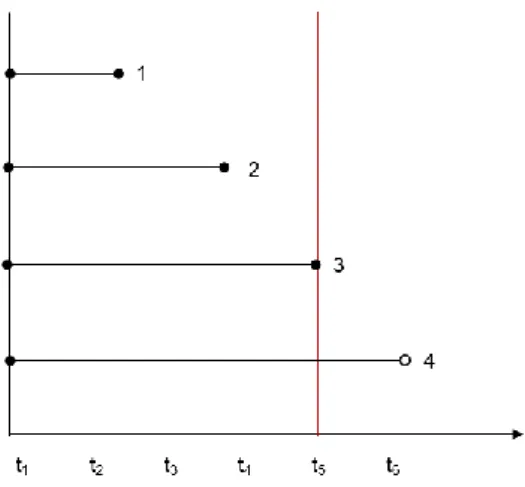
The problem of right censoring is probably best described in the figure 2. In this figure, there are four observations recorded (the four horizontal black lines). Let’s say for the purpose
6 In opposition to right-censoring, left-censoring is also problematic because the starting time of the event under investigation is unknown.
12 of illustration that the four lines represent career duration of four regional MPs. All of them started their political career at time t1 when the first regional elections were organized in their
country. In figure 2, the vertical red line situated in time t5 (beginning of the fifth regional
legislative term) represents the end of my enquiry in terms of data collection. At that time, I can perfectly assess career duration for three MPs (which are represented by lines 1, 2 and 3)7. The first MP served a unique legislative term, the second MP was popular and served four legislative terms whilst the third MP was even more successfully and served her ultimate days during the fifth legislative term. After the fifth regional elections, I had to finalize my dataset due to the restrictions of my own research agenda. In this context, the fourth MP is unfortunately right censored (blank spot): I know he was re-elected after those fifth elections but I do not know – at the moment – for how long he will remain in office (the blank spot denotes this incertitude).
Figure 2. Examples of right-censoring
Studies based on longitudinal data always face this problem8. Therefore, several career duration recorded in my database are inevitably censored. Some MPs may stay another 20 years in parliament whereas others may be defeated right after the next elections or even retire during legislative term. Previous studies used less-appropriate statistical techniques such as logistic and OLS regressions (see problems with those techniques in Box-Steffensmeier and Jones 1997, 1415-7), by simply ignoring right-censored data. The problems is that it entails to ignore important parts of the dataset. In my own study, it would require to put apart 25.4 percent of all the Scottish and Walloon political careers recorded.
7 Career duration can be determined assuming that retiring MPs do not return to parliaments afterwards. Although they are very rare in my study, it is yet possible to observe ‘political returns’ from time to time.
13 Another problem with longitudinal data that can be adequately addressed by survival analysis is time-varying covariates. When researchers analyze data over a given period of time, some independent variables are very likely to evolve over time. For instance, some parliamentarians are called in government which traduced a change of political status; the power and authority of newly established assemblies often increase over time (see for instance the regional authority index of Marks, Hooghe, and Schakel 2008); MPs are often part of the government majority an then are in the opposition during their career, etc. But while “[t]raditional modeling approaches cannot easily account for TVCs [i.e. time-varying covariates], event history methods can (Box-Steffensmeier and Jones 2004, 19). This is thus another good reason to use survival analysis9.
Let’s now briefly review two interesting results – among others – obtained with the survival analysis technique (for all details see Dodeigne 2013a). Firstly, in comparison to all other political careers, political careers of candidates from ethno-regionalist parties tend to have (a much) better survival rate in regional parliaments. For instance, the Scottish National Party has the strongest survival rate at the Scottish parliament (i.e. on average candidates from this party stay in office longer than candidates from any other party). However, political careers of candidates from state-wide-parties do not present on average a better survival rate in national parliaments. For instance, at the Cortes Generales (the national parliament), the survival rate for candidates from Convergència i Unió (ethno-regionalist party) are actually almost identical to the Partido Popular and the PSC-PSOE (state-wide parties).
A second interesting result are the effects of career duration for MPs with a former experience at another level of government. The results demonstrate that national MPs who firstly served at regional parliaments have a significantly reduced survival at the national level afterwards. By contrast, having a former national experience makes almost no difference for the political career of regional MPs. This suggests that the regional level is a priori not used as a stepping stone towards the national parliament whereas the national level is arguably used as a springboard towards the regional political arena. In Wallonia, the effects of a former regional experience are particularly pronounced. Irrespective of the kind of political parties, the probability of conducting a professionalized national career – after having primarily served in
9 In terms of particular techniques of survival analysis, there are the parametric (the Weibull and the exponential models) and non-parametric models (Cox proportional hazards model, (Cox 1972)). “[t]he appeal of the [Weibull and the exponential] models is highest when there is a strong theoretical reason to expect one distribution function over another.” Yet, it is rare to have a theoretical reason to find a given parametric function of social and political phenomena. In this research, I use therefore the non-parametric Cox model which has been increasingly applied in social and political sciences, and especially for the study of political careers (see Kerby and Blidook 2011)9.
14 regional legislature – is almost null. Most former regional MPs end their national career after having served less than a unique national legislative term.
In conclusion, this first quantitative analysis gives a preliminary key understanding of career patterns from a ‘macro’ perspective in the three regions under investigation. The descriptive statistics shed light on the diversity of career paths not only in terms of links between political arenas (many level-hopping movements in Catalonia and Wallonia whereas there are almost inexistent in Scotland), but also on the professionalized nature of political careers (higher professionalization in Scotland in comparison to short term careers in Catalonia and Wallonia). The recourse to survival analysis furthermore helps to understand the effects of some key variables (e.g. the type of political party or the former legislative experience significantly affect career patterns). Although a very good knowledge of these macro phenomena undoubtedly helps the researcher to pay attention to this macro trends during the subsequent qualitative analysis of interviews (something appears “to be at work” that should not be overlooked a priori); it is not to say that a genuine constructivist approach is sacrificed in the qualitative part of my research. Indeed, it remains to assess how those macro dynamics are experienced by political actors at the micro level. The qualitative analysis developed in the next section enables me to probe interviewees’ narratives of context and experience which ultimately provide and elucidate the meanings that MPs attribute to their practices and actions.
5. Qualitative analysis: understanding career path 5.1. Concept: Territorial imaginary
In the wake of the “analytic narrative” approach (see section 2), this paper acknowledges that political candidates behave rationally according to their preferences. Consequently, they try and develop certain career patterns although not all of them manage to get elected where they want to get an office. Those preferences are yet formed within specific structures of opportunities where candidates’ preferences are in direct interaction with the institutional environment. In this respect, I argue that actors’ preferences can be captured by their territorial ambition which is reflected by the concept of territorial imaginary. Therefore, “imaginary helps produce systems of meaning that enable collective interpretations of social reality (Castoriadis 1987); it forms the basis for a shared sense of belonging and attachment to a political community (Anderson 2006); it provides the gaze through which ‘the Other’ is constructed and represented (Said 1977); and it guides the simplification and standardization of human subjects so as to govern them more efficiently (Foucault 1979, Bowker and Star 2000, Scott 1998). In short, imagination, viewed as ‘an organized field of social practices’, serves as a key ingredient in
15 making social order (Appadurai 1996, Taylor 2004)10. Furthermore, the concept of territorial
imaginary, encompasses explicitly both sociological and rational perspective as it is defined as ‘an important cultural resource that enables new forms of life by projecting positive goals and seeking to attain them’” (Jasanoff and Kim 2009, 122).
Imported in the literature of political career, the concept of political imaginary permits to assess why and how political candidates seek to pursue a regional career, a national career, a discrete career, or a multi-level career pattern. A territorial imaginary has to be understood as ‘cognitive short-cuts’ that guide candidates in the assessment of the structure of opportunity as well as help them to make their choices. In other words, the content of the territorial imaginary affects actors’ preferences and explain why they try and pursue specific political trajectories (instead of any other political paths). It also permits to explain how they justify their current position and political trajectory. The content of this imaginary have to be inductively constructed. Nevertheless, it is safe to assume that the concept of territorial imaginary is certainly a multifaceted notion which encompasses several components: material factors (e.g. staff resources or greater/smaller income at the regional/national level), cultural factors (e.g. strength of regionalism and ‘prestige’ of offices), and institutional dimension (e.g. scope and depth of regional/national authority or accessibility to offices according to party electoral strategy). Above all, a territorial imaginary is not frozen at t-timebut is on the contrary subject to be challenged over time.
In this respect, the territorial imaginary permits to reflect real evolutions of a formal structure of opportunity affecting candidates’ preferences. It is in fact well known that there is often a gap between the formal and the informal structures of institutions (Homans 1950, Dalton 1959, Downs 1994). Precisely, the concept of territorial imaginary permits to identity and isolate the real ‘rules of the games’ as perceived by political actors and, thus, the genuine attractiveness of offices for ambitious candidates. This is my objective to map those imaginaries. This would certainly help to explain why career patterns changed despite the relative stability of structures of opportunity (i.e. there is a change in the territorial imaginary). Conversably, it would contribute to understand why certain career patterns remain peculiarly stable in a context of institutional transformation (i.e. legacy and stability of territorial imaginary).
Finally, a territorial imaginary presents both subjective and intersubjective dimensions. It is subjective in the sense that a territorial imaginary reflects individual preferences based on
16 subjective appreciation of a given environment. Therefore, it varies according to individual candidates: some may value certain aspects rather than others in their assessment of offices. Yet, assuming this subjective appreciation does not imply mere individualistic values, on the contrary. A territorial imaginary is fundamentally intersubjective as it is a cognitive shortcut reflecting past behaviours and information transmitted to one generation of politicians to another (Di Maggio and Powell 1991). Candidates evaluate the attractiveness, accessibility and availability of offices based on incumbents’ past experiences. Certainly, electoral campaigns do not start from a ‘blank paper’: current territorial imaginaries already frame future incomers’ preferences. In this respect, the content of a territorial imaginary is surely not a vague idea: it offers concrete information which affects candidates’ preferences. For instance, aspirants receives tangible advices and warnings from incumbents and party officials through formal contacts (e.g. direct discussion before applying for nomination) and informal contacts (e.g. observation in media coverage) (on this aspect, see also Borchert 2011, 118). Let’s now see how to gather those territorial imaginaries thanks to life story interviews.
5.2. Technique: Life story interview
The collection of interviews is based on ‘life story interview’ or ‘narrative interview’. Why using life story interviews? Storytelling is part of our daily life, for the past and the future; we see our experiences as narratives. For individuals prospecting on their professional career, for communities and nations entrenching their foundational myths (Bottici and Challand 2006), “narratives represent storied ways of knowing and communicating” (Riessman 2002, 706). In this respect, narratives constantly deliver cognitive information and provide ‘meaning-making’, ‘sense-making’ to help one to situate him/herself in the reality as well as guide him/her into this reality (Bruner 1996). “In short, how we think and what we think is rooted in the particular set of meaning-saturated signs and symbols we inherit in a given political setting” (Hammack and Pilecki 2012, 82). Accessing and understanding these narratives constitute therefore a particularly good methodological tool to understand territorial imaginaries: what people tell us about specific events or specific experiences are not mere stories but reveals a certain perception of his/herself, a certain conception of his/her political environment (Patterson and Monroe 1998, 317). Exploring parliamentarians’ stories is thus entering the MPs’ worlds, entering their political imaginaries.
Life story is a specific kind of interview. The fact that the method is used in diverse fields of social sciences – e.g. history, ethnology, anthropology, or sociology – has produced a terminological confusion: life story, life history, biographical interview, etc. (Bertaux 1981). Following (Atkinson 2001, 125), the term life story is here used as the “story a person chooses
17 to tell about the life he or she has live, told as completely and honestly as possible [...] usually as a result of a guided interview by another”. Contrary to structured or semi-structured interviews, this techniques is not deductive, with researchers seeking to obtain specific answers to specific questions, but purposively inductive. The main objective is to gather information, to collect “narratives about one's life or relevant parts thereof” (in our cases, their political universes) focusing deliberately on “actors’ subjective point of view” (Bertaux and Kohli 1984, 216-8). Final advantage is that information collected through life stories provides a diachronic perspective of political career and parliamentary experiences.
For this research, the protocol of interviews was similar for all three fields of investigation (Catalonia, Scotland and Wallonia). After having presented the goal of my research, I guaranteed the confidentially of the interview (names are anonymized in the results) and asked the permission to record the meeting. Then, I always started with this clear and simple question: ‘how did you get into politics, from the very beginning?’11. Although most interviews
took place at the national/regional parliaments, some of them were conducted at home with former national MPs and regional MPs. All interviews were conducted in face-to face meetings, whenever possible in private and quiet office although parliamentarians’ agenda sometimes only permitted face-to-face interviews in presence of staff members (due to promiscuity of offices) and/or in lobby and parliamentary restaurant. The latter was not the best place to conduct narrative interviews but it was often presented as a ‘take it or leave it’. Although MPs’ availability was sometimes the final criteria used for interviews selection, I managed to successfully gather a diversity of profiles on three principal criteria that guided my research in the three fields of research: (1) territorial origins (distinct electoral districts), (2) career patterns (political career at the regional level only, at the national level only, and multi-level political career), and finally (3) political generation (those who were in office since the regional elections and those who were more recently elected). Furthermore, two additional variables were controlled for the diversity of politicians, namely political party and gender. Overall, I collected 84 interviews of (former) national MPs and (former) regional MPs totalizing for more than 4.500 minutes and, when fully transcribed (verbatim transcription), it produces a corpus of about 750.000 words to be analysed.
The method of analysis is based on a “thematic analysis” performed in two steps. Firstly, I read all interviews in order to incrementally set up a coding scheme based on the various themes emerging from the interviews. All similar themes were then restructured and regrouped
11 All interviews were conducted in the mother tongue of the interviewees: French (Wallonia), English (Scotland), and Spanish (Catalonia, although Catalan is the genuine native langue of Catalonian politicians).
18 in order to create a unique and coherent coding scheme. In a second step, I coded all interviews in order to produce a systematic analysis that led me to identify three major dimensions of the territorial imaginaries explaining political trajectories, namely “identity” factors, “power” factors and “contingent” factors.
5.3. Brief results
At this stage, I can only give preliminary results based on the ongoing analysis of my Walloon and Scottish data (the fieldwork in Catalonia has just been completed in May 2014 and the transcription of interviews is still in process). More specifically, I present two interesting conclusions that illustrate how the qualitative analysis – with the understanding of MPs’ practices and experience at the micro level – permits to complement and extend the quantitative analysis that identified and described global dynamics.
In Wallonia, qualitative interviews firstly demonstrated that there is a notorious differentiation between a regional and a national political class, despite the integrated political arena. Nevertheless, the rise of the regional political class is clearly under process. Indeed, contrary to national MPs who justify and defend the importance of politics at the national level, regional MPs do not always express a genuine ‘regional’ political ambition. Because a large proportion of regional MPs held municipal executive office – with strong grassroots – during their parliamentary office (simultaneity of offices), they can still pursue their political career at the municipal offices after their parliamentary experience. In terms of job security, the parliamentary position is thus a temporary position; their political center is located at the municipal level. Executive municipal offices provide a relatively well-professionalized status in terms of income, local popularity, and personal as well as political rewards. Politicians are therefore predominantly locally-oriented: “amateur legislators but professional [municipal] politicians” as depicted by Jones (2002). The recent decision of the Walloon Parliament to limit the accumulation of local and parliamentary offices (Dodeigne and Vandeleene 2013) demonstrates that a Walloon political class is yet under development and seeks to reserve the regional political arena to regional politics and not to locally-oriented politicians. To sum up, the quantitative analysis demonstrated that the regional and national political arenas are pretty integrated in Wallonia (there is a lot of level-hopping movements). Nonetheless, the qualitative interviews proved that a territorial differentiation is at work (a differentiation between a national and a regional political class), even though the rise of the regional political class is still under development.
In Scotland, there is also a territorial differentiation between a regional and national political class. But in contrast to the Walloon case, the qualitative analysis shows that the
19 regional political class strongly legitimates its own political arena. Interestingly this territorial differentiation is based on different territorial imaginaries. Westminster is seen as “the place of power” (power factors) whereas Holyrood is best described by the moto “my country, my parliament” (identity factors). The first 1999 Scottish elections were indeed seen as a historical momentum. The opening of the first session presided by Winnie Ewing – prominent SNP politician who was a former MP and a former MEP before being elected as MSP at the 1999 elections – is surely an explicit and exemplary illustration of the political momentum at that moment. She opened the session stating: “The Scottish Parliament, adjourned on the 25th day of March in the year 1707, is hereby reconvened”. In 2013, at the moment of conducting my interviews, the establishment of the Scottish parliament in 1999 was still seen as a moment of great excitement and the feeling of ‘making History’. Interestingly, in contrast to their colleagues at Holyrood, MPs at Westminster describe their political universe with the ideas of influence and authority. One the one hand, national MPs express a rather patronizing viewpoint regarding the limited capacity of the Scottish Parliament. Indeed, for Scottish MPs in office at Westminster, it appears that the Scottish Parliament cannot pretend to become a “proper Parliament” unless it has reached a sufficient range of powers. Furthermore, the devolved matters are perceived as second-order policy area that are not key ‘national powers’. On the other hand, Westminster is presented as a “place of influence” because of the individual power that MPs enjoy, especially regarding the structure of the committee systems. In other words, there is a territorial differentiation of the political class in Scotland that is based on distinct territorial imaginaries. The latter not only justify the existence of each level of government, but it also affirms the superiority of each of these political arenas (i.e. Holyrood is the “political centre for Scottish politicians interested in Scottish politics” according to regional MPs whereas Westminster “is the genuine place of power and influence” for national Scottish MPs).
6. Conclusion
This paper aimed to offer some methodological reflections on the utility of a mixed-methods research design for the study of career patterns in three multi-level systems, namely Catalonia (Spain), Scotland (United Kingdom) and Wallonia (Belgium). In particular, I aimed to show that the quantitative understanding of macro dynamics can be adequately combined with a qualitative analysis of MPs’ experience and practices at a micro level. In that respect, the mixed methods research design pursue two aims, namely “complementarity” and “development” {Guest, 2012 #1548}.
20 Indeed, the quantitative analysis provides a comprehensive mapping of all political trajectories as well as identify career patterns in the three multi-level democracies analyzed. Furthermore, survival analysis – which is a statistical tool particularly suited to analyze longitudinal data such as political careers – permits to assess the effects of some key variables (type of political parties, former legislative experience at another level of government, gender effect, electoral district, etc.). The identification of macro dynamics in the quantitative analysis can subsequently guide interviews selection (“development” aim). The quantitative analysis shed indeed light on electoral and political behaviours that appear to be a priori relevant for the understanding of career patterns in multi-level systems. Without this quantitative information, pertinent profiles could be forgotten in interview selection (qualitative data collection) and/or key aspects could be overlooked in the qualitative data analysis. Despite the fact that the quantitative part helps the phase of interview selection, it is ultimately the principle of “saturation” (Glaser and Strauss 2009) that defines the number of interviews required as well as the profiles of MPs to be interviewed. The goal is thus not to set up a sample statistically representative.
Finally, the mixed methods design serves “complementary” purposes. Quantitative and qualitative methods permits to study distinct faces of the same social reality. In this respect, the constructivist analysis of interviews allows to understand how macro dynamics identified in the quantitative analysis are experienced by political actors at the micro level. The qualitative analysis developed enables me to understand interviewees’ experiences which ultimately provide and elucidate the meanings that MPs attribute to their practices and actions.
21
References
Anderson, Benedict. 2006. Imagined Communities: Reflections on the Origin and Spread of Nationalism. Revised ed. London; New York: Verso.
André, Audrey, Sam Depauw, and Kris Deschouwer. 2012. "Legislators’ local roots: Disentangling the effect of district magnitude." Party Politics. doi: 10.1177/1354068812458617.
Appadurai, A. 1996. Modernity at large: Cultural dimensions of globalization. Minneapolis: University of Minnesota Press.
Atkinson, Michael M., and David C. Docherty. 1992. "Moving Right along: The Roots of Amateurism in the Canadian House of Commons." Canadian Journal of Political Science / Revue canadienne de science politique no. 25 (2):295-318.
Atkinson, Robert. 2001. "The Life Story Interview." In Handbook of Interview Research. Context & Method, edited by Jaber F. Gubrium and James A. Holstein, 121-40. Thousan Oaks, London, New Delhi: Sage Publications.
Bates, Robert H. , Avner Greif, Margaret Levi, and Jean-Laurent Rosenthal, eds. 1998. Analytic Narratives. Princeton: Princeton University Press.
Bates, Robert H., Avner Greif, Margaret Levi, Jean-Laurent Rosenthal, and Barry Weingast. 2000. "The Analytical Narrative Project." The American Political Science Review no. 94 (3):696-702. doi: 10.2307/2585843.
Bergman, Manfred Max. 2011. "The Politics, Fashions, and Conventions of Research Methods." Journal of Mixed Methods Research no. 5 (2):99-102. doi: 10.1177/1558689811408318.
Bertaux, Daniel ed. 1981. Biography and Society: The Life History Approach in the Social Sciences. CA. : Sage Publications.
Bertaux, Daniel, and Martin Kohli. 1984. "The Life Story Approach: A Continental View." Annual Review of Sociology no. 10 (ArticleType: research-article / Full publication date: 1984 / Copyright © 1984 Annual Reviews):215-237.
Best, Heinrich. 2007. "New challenges, new elites? Changes in the recruitment and career patterns of European representative elites." Comparative Sociology no. 6 (1-2):85-113. doi: 10.1163/156913307x187414.
Blossfeld, Hans-Peter, and Götz Rohwer. 2001. Techniques of Event History Modeling: New Approaches to Casual Analysis. 2nd ed. Mahwah,New Jersey & London: Psychology Press.
Borchert, Jens. 2011. "Individual Ambition and Institutional Opportunity: A Conceptual Approach to Political Careers in Multi-level Systems." Regional & Federal Studies no. 21 (2):117-140.
Borchert, Jens, and Klaus Stolz. 2011a. "German Political Careers: The State Level as an Arena in its Own Right?" Regional & Federal Studies no. 21 (2):205-222. doi: 10.1080/13597566.2011.530017.
Borchert, Jens, and Klaus Stolz. 2011b. "Introduction: Political Careers in Multi-level Systems." Regional & Federal Studies no. 21 (2):107 - 115.
Bottici, Chiara, and Benoît Challand. 2006. "Rethinking Political Myth." European Journal of Social Theory no. 9 (3):315-336. doi: 10.1177/1368431006065715.
Bowker, G.C., and S.L. . Star. 2000. Sorting things out: Classification and its consequences. Cambridge, Massachusetts: MIT Press.
Box-Steffensmeier, J. M., and B. S. Jones. 1997. "Time is of the essence: Event history models in political science." American Journal of Political Science no. 41 (4):1414-1461.
22 Box-Steffensmeier, Janet M, and Bradford S Jones. 2004. Event history modeling: A guide for
social scientists: Cambridge University Press.
Brannen, Julia. 2005. "Mixing Methods: The Entry of Qualitative and Quantitative Approaches into the Research Process." International Journal of Social Research Methodology no. 8 (3):173-184. doi: 10.1080/13645570500154642.
Bruner, Jerome S. 1996. The Culture of Education. Cambridge, MA.: Harvard University Press. Burchell, Jon. 2001. "Evolving or conforming? Assessing organisational reform within European green parties." West European Politics no. 24 (3):113-134. doi: 10.1080/01402380108425455.
Castoriadis, Cornelius. 1987. The Imaginary Institution of Society: MIT Press.
Cox, David R. . 1972. "Regression models and life-tables." Journal of the Royal Statistical Society (Series B) no. 34 (2):187-220
Creswell, John W., Vicki L. Plano Clark, Michelle L. Gutmann, and William E. Hanson. 2003. "Advanced mixed methods research designs." In Handbook of mixed methods in the social and behavioral science, edited by Abbas Tashakkori and Charles Teddlie, 209-240. Thousand Oaks, London & New Delhi: Sage Publications.
Dalton, M. 1959. Men who manage: fusions of feeling and theory in administration. New York: Wiley.
Di Maggio, P. , and W. Powell. 1991. The New Institutionalism in Organisational Analysis. Chicago: Chicago University Press.
Docherty, David. 2011. "The Canadian Political Career Structure: From Stability to Free Agency." Regional & Federal Studies no. 21 (2):185-203. doi: 10.1080/13597566.2011.530018.
Dodeigne, Jérémy. 2013a. Career Patterns in Multi-level Systems. A Survival Analysis of Political Careers in Catalonia, Quebec, Scotland, and Wallonia. In 7th ECPR General Conference. Bordeaux.
Dodeigne, Jérémy. 2013b. Les carrières politiques dans les systèmes politiques multi-niveaux. Une analyse microscopique de deux décennies de trajectoires politiques en Catalogne, en Écosse, au Québec et en Wallonie. In 5th Conference of the French-speaking Political science associations network. Luxembourg.
Dodeigne, Jérémy. 2014. "(Re-)Assessing Career Patterns in Multi-Level Systems: Insights from Wallonia in Belgium." Regional & Federal Studies no. 24 (2):151-171. doi: 10.1080/13597566.2013.865605.
Dodeigne, Jérémy, and Audrey Vandeleene. 2013. New Rules, New Political Class? Analysis of the Impact of the Electoral Reforms in Belgium on the 2014 Elections and Aftermath. In Second edition of the Conference 'Belgium: The State of the Federation'. Louvain-La-Neuve, Belgium.
Downs, A. 1994. Inside Bureaucracy. Long Grove, Illinois: Waveland Press, Incorporated. Edinger, Michael, and Stefan Jahr, eds. In press. Political Careers in Europe: Career Patterns
in Multi-level Systems Baden-Baden: Nomos.
Fiers, Stefaan. 2001. "Carrièrepatronen van Belgische parlementsleden in een multi-level omgeving (1979-1999)." Res Publica no. 43:171-92.
Foucault, M. 1979. Discipline and punish: The birth of the prison. New York: Vintage.
Glaser, B.G., and A.L. Strauss. 2009. The Discovery of Grounded Theory: Strategies for Qualitative Research. Chicago: Aldine Transaction.
Greene, Jennifer C. 2008. "Is Mixed Methods Social Inquiry a Distinctive Methodology?" Journal of Mixed Methods Research no. 2 (1):7-22. doi: 10.1177/1558689807309969. Greene, Jennifer C., Valerie J. Caracelli, and Wendy F. Graham. 1989. "Toward a Conceptual
Framework for Mixed-Method Evaluation Designs." Educational Evaluation and Policy Analysis no. 11 (3):255-274. doi: 10.3102/01623737011003255.
23 Guest, Greg. 2012. "Describing Mixed Methods Research: An Alternative to Typologies."
Journal of Mixed Methods Research. doi: 10.1177/1558689812461179.
Hammack, Phillip L., and Andrew Pilecki. 2012. "Narrative as a Root Metaphor for Political Psychology." Political Psychology no. 33 (1):75-103. doi: 10.1111/j.1467-9221.2011.00859.x.
Homans, George C. 1950. The Human Group. New York: Harcourt, Brace.
Howe, Kenneth R. 1988. "Against the quantitative-qualitative incompatibility thesis or dogmas die hard." Educational Researcher no. 17 (8):10-16.
Howe, Kenneth R. 1992. "Getting Over the Quantitative-Qualitative Debate." American Journal of Education no. 100 (2):236-256.
Jasanoff, Sheila , and Sang-Hyun Kim. 2009. "Containing the Atom: Sociotechnical Imaginaries and Nuclear Power in the United States and South Korea." Minerva no. 47:119–146.
Jones, Mark P. 2002. "Amateur legislators - professional politicians: The consequences of party centered electoral rules in a federal system." American Journal of Political Science no. 46 (3):656-669.
Kerby, Matthew, and Kelly Blidook. 2011. "It's Not You, It's Me: Determinants of Voluntary Legislative Turnover in Canada." Legislative Studies Quarterly no. 36 (4):621-643. Marks, Gary, Liesbet Hooghe, and Arjan H. Schakel. 2008. "Measuring Regional Authority."
Regional & Federal Studies no. 18 (2-3):111-121. doi: 10.1080/13597560801979464. Moncrief, Gary F. 1994. "Professionalization and Careerism in Canadian Provincial
Assemblies: Comparison to U. S. State Legislatures." Legislative Studies Quarterly no. 19 (1):33-48.
Muñoz, Jordi, and Marc Guinjoan. 2013. "Accounting for internal variation in nationalist mobilization: unofficial referendums for independence in Catalonia (2009–11)." Nations and Nationalism no. 19 (1):44-67. doi: 10.1111/nana.12006.
Patterson, Molly, and Kristen Renwick Monroe. 1998. "Narrative in Political science." Annual Review of Political Science no. 1 (1):315.
Pilet, Jean-Benoit, Stefaan Fiers, and Kristof Steyvers. 2007. "Des élus multi-niveaux. Carrière politique et recrutement des élites en Belgique." In L’action publique à l’épreuve des changements d’échelle, edited by Alain Faure, Jean-Phillipe Leresche, Pierre Muller and Stephan Nahrath. Paris: PUF.
Real-Dato, Jos, Juan Rodríguez-Teruel, and Miguel Jerez-Mir. 2011. In Search of the ‘Ladder Model’: Career Paths of Spanish Diputados (1977-2010) In ECPR General Conference. Reykjavik, Iceland.
Riessman, Catherine J. 2002. "Analysis of personal narratives." In Handbook of interview research : context & method, edited by Jaber F. Gubrium and James A. Holstein, 695-710. Thousand Oaks, CA: Sage Publications.
Said, Edwar W. 1977. "Imaginative Geography and Its Representations: Orientalizing the Oriental." The Georgia Review no. 31 (1).
Schlesinger, Joseph A. 1966. Ambition and Politics. Political Careers in the United States. Chicago: Rand McNally & Company.
Scott, J.C. 1998. Seeing like a state: How certain schemes to improve the human condition have failed. New Haven: Yale University Press.
Squire, Peverill. 1988. "Career Opportunities and Membership Stability in Legislatures." Legislative Studies Quarterly no. 13 (1):65-82.
Stolz, Klaus. 2003. "Moving up, moving down: Political careers across territorial levels." European Journal of Political Research no. 42 (2):223-248. doi: 10.1111/1475-6765.00081.
24 Stolz, Klaus. 2011. "The Regionalization of Political Careers in Spain and the UK." Regional
& Federal Studies no. 21 (2):223 - 243.
Taylor, C. . 2004. Modern social imaginaries. Durham: Duke University Press.
Vanlangenakker, Ine, Bart Maddens, and Gert-Jan Put. 2013. "Career Patterns in Multilevel States: An Analysis of the Belgian Regions." Regional Studies no. 47 (3):356-367. doi: 10.1080/00343404.2012.753144.