OATAO is an open access repository that collects the work of Toulouse
researchers and makes it freely available over the web where possible
Any correspondence concerning this service should be sent
to the repository administrator:
[email protected]
This is an author’s version published in:
http://oatao.univ-toulouse.fr/25278
To cite this version:
Campbell, Kerry A. and Vaca Medina, Guadalupe
and Glatz, Charles E. and
Pontalier, Pierre-Yves
Parameters affecting enzyme-assisted aqueous
extraction of extruded sunflower meal. (2016) Food Chemistry, 208. 245-251.
ISSN 0308-8146
Parameters affecting enzyme-assisted aqueous extraction of extruded
sunflower meal
Kerry
A.Campbell
a,b.Guadalupe Vaca-Medina
c,Charles E. Glatz
a,Pierre-Yves Pontalier
c,* • Depamnent of Chemiœl and Biological Engineering, Iowa State University, United Statesb The Solae Company, 4272 S Mendenha/1 Rd, Memphis, TN 38141, United States
< Laboratoire de Chimie Agro-industrielle (LCA), Universiœ de Toulouse, INRA, INPT, Toulouse, France
ARTICLE INFO ABSTRACT
Keywords: Aqueous extraction Protease Cellulase Oil Sun0ower Enzymes
Microscopie observation of sunflower meal before and after extraction indicated that extensive cellular disruption was achieved by extrusion, but that unextracted oil remained sequestered as coalesced oil within the void spaces of disrupted cotyledon cells. A full factorial design experirnent was defined to develop aqueous extraction processing (AEP) with and without enzymes to improve vegetable oil ex trac lion yields of extruded sunflower rneal. This experimental design studied the influence of four parame ters, agitation, liquid/solid (L/S) ratio, and cellulase and protease addition, on extraction yield of lipid and protein. Agitation and addition of cellulases increased oil extraction yield, indicating that emulsification of oil and alteration of the geornetry of the confining cellular matrix were important rnechanisms for improving yields. Protease and liquid solid ratio of the extraction mixture did not have significant effects, indicating key differences with previously established soy oil extraction rnechanisms. Maximum yields attained for oil and protein extraction were 39% and 90%, respectively, with the aid of a surfactant.
1. Introduction
Pressing, with single screw extruders, is usually the first step of
oil production For seeds with high oil content such as sunflower,
extraction yields of 70 85% can be achieved (
Evon
&[Dissertation] Toulouse Université de Toulouse, 2008; Kartika,
Pontalier,
&Rigal, 2006
). However, to maximize yields, residual
oil in the extruded meal is extracted with an organic solvent, most
commonly hexane. An important part of the Green Chemistry
(
Anastas &
Wamer, 1998
) movement is to develop technologies
that are environmentally friendly and reduce the use of
petroleum derived materials. Aqueous extraction processing
(AEP) and enzyme assisted aqueous extraction proœssing (EAEP)
are safe water based extraction processes that, with the use of
enzymes, have sucœeded in achieving free oil yields as high as
88% in soybean oil extraction (
Moura
&Johnson, 2009; Moura
et al., 2008
).
In an immiscible oil water system, the ability to extract oil is
dependent on its mobility within the solid matrix confining the
unextracted portion (Campbell
&Glatz, 2009). Therefore, one
*
Corresponding author at: LCA. ENSIACET, 4 allée Emile Monso, F-31029 Toulouse, France.E-mail address: [email protected] (P.-V. Pontalier}
http://dx.doi.org /10.1016/j.foodchem2016.03.098
important factor in AEP/EAEP is the geometry of the confining
matrix as determined by the nature of the oilseed itself, as well
as the mode of comminution used to disrupt cells. In soy, grinding
and extruding produced substrates with very different physical
geometries from which the oil must escape (
Campbell
&Giatz,
2009
). In the case of extrusion, oil was released from a matrix of
insoluble denatured protein, white in flour from flakes; oil was
released from partially disrupted cells.
Cellulases increase the extraction yield of oil from ground sun
tlower in EAEP by cellular disruption (
Dominguez, Nunez,
&Lema,
1995; Sineiro, Dominguez, Nunez,
&Lema, 1998
) but could also act
by modifying the geometry of cells previously disrupted, thus facil
itating oil transfer out of the remaining matrix. Furthermore,
Campbell and Glatz have established that emulsification is a key
parameter in the extraction mechanism for EAEP of soybean flour
(
Campbell
&Glatz, 2009
). In an aqueous environment, where the
extract (oil) is immiscible with the solvent (water), extraction is
increased when coalesced oil entrapped within ruptured cells can
be emulsified into smaller, more mobile droplets by turbulent
forces in the extraction medium.
Another important factor for soy oil extraction is the nature of
the oil water interface. Campbell and Glatz proposed that the
mechanism, by which protease increases oil yields in soy flour
extraction, is by disruption of a viscoelastic interfacial protein film
at the oil water interface, facilitating emulsification. Badr and Sitohy demonstrated that at pH 5 proteases can also increase the yields of sunflower oil from dehulled chopped seeds, which they attributed to a disruption of lipid protein complexes (Bair & Snyder, 1980).
The objectives of this work were to identify the conditions to increase the oil recovery yield from extruded meal, using aqueous extraction or enzyme assisted aqueous extraction instead of the classical hexane extraction procedure.
2. Materials and methods
2.1. Preparation of extruded sunflower meal
Common variety sunflower kernels (with hulls) obtained from Toulgrain, Inc. (Toulouse, France) were extruded in an Omega 20 single screw bench top press extruder (Eurl Laplace Co., Pau, France), equipped with a heated collar around the die housing. Steady state exit temperature of the extruded cake was measured to be around 100°C (±5 °C) with an infrared thermometer. Expressed oil was collected, weighed, and centrifuged. The result ing precipitate was rinsed three times with cylcohexane, dried, and weighed to determine the fraction of foots in the expressed oil. The resulting cake was cooled and then ground in a Pulverisette 19 (Fritsch Ltd. Idar Obersteen, Germany) knife mill with a 2 mm out let screen. Extruded meal was stored at 20°C until use. 2.2. Extraction
The appropriate quantity of extruded meal was added to 1 L of DI water in a 2 L jacketed reactor with an agitator, maintained at 50°C with a water bath and at constant pH 6.5 using a 716 DMS Titrino autotitrator (Metrohm Ltd., Herisau, Switzerland) with 1 N NaOH. Samples were collected by siphon into a 500 mL bottle, weighed, and centrifuged (Sigma 6 16 k) at 3000g for 15 min at 20°C. The supernatant was discarded and the remaining residual solid was weighed, freeze dried, and weighed again for moisture determination. Freeze dried precipitate was ground in a coffee grinder for approximately 30 s and then stored in a dessicator until oil and protein content determination. Yield was calculated as one minus the fraction of total material remaining in the residual frac tion. Protein dissolution was defined as the protein extraction yield plus the fraction of dissolved protein entrained in the solid fraction, estimated by multiplying the liquid fraction protein con centration by the mass of water in the solid fraction. The liquid fraction protein content was determined by mass balance based on the protein content of the residual fraction.
For microscopy experiments, extraction was carried out by placing extruded meal in 500 mL centrifuge bottles with DI water for a solid liquid ratio of 1:10. Bottles were placed on a stir plate in a water bath maintained at 50°C, and agitated with a magnetic stir bar at 1000 rpm. Centrifugation (3000g 15 min at 20°C) resulted in two distinct layers in the centrifuge bottles. Therefore, samples for microscopy were from the bulk mixture before cen trifugation and from each of the two layers after centrifugation. 2.3. Full factorial design experiment
To elucidate the effects of enzyme, solid liquid ratio, and agita tion, a randomized full factorial design experiment was conducted using two continuous two level parameters: solid liquid ratio (0.05 and 0.10) and agitation rate (160 and 350 rpm), plus two dis crete parameters: with and without protease Protex 7L and with and without cellulase Multifect CX 13L, kindly provided by Genen cor (Rochester, NY), both 2% w/w solid, giving a total of 16 possible
experimental conditions. Cellulase Multifect CX 13L, with a specific activity of 3900 CMC/g, exhibits significant activity towards cellu lose, hemicelluloses,b glucans and arabinoxylans. The Protex 7L (also named Multifect Neutral) has an activity of 1600 AU (Azo Unit)/g define by hydrolysis of Azo casein substrate at pH 7.5 for 5 min at 30°C. The active pH ranges of these enzymes overlap in the pH 6 7 region, and so pH 6.5 was selected for all of these experiments. Measured responses were oil extraction yield, protein dissolution, and non lipid material dissolution. Trials for the full factorial design experiment were not replicated, while all other tri als reported were made in triplicate. Error estimation for analysis of variance (carried out using JMP 7 software from SAS Institute, Inc. Cary, NC) was based on the assumption of interactions of an order higher than two, being nonsignificant.
2.4. Analytical methods
Oil was extracted from residual samples four times for 10 min, at 105°C and 95 bar with cyclohexane using an ASE 200 Acceler ated Solvent Extractor (Dionex Corp, Sunnyvale, CA). Extract was transferred from vials to preweighed glass beakers (dried 1 h at 103°C, cooled to room temperature on the bench top), rinsing twice with cyclohexane. Cyclohexane was evaporated by placing beakers in a boiling water bath and then drying them for 1 h in a 103°C oven. Beakers were cooled to room temperature on the bench top, and weighed again to determine mass of oil. Protein content was determined by the Kjeldahl total nitrogen method using a nitrogen to protein conversion factor of 6.25 g protein per g nitrogen. Residual moisture content was determined by loss of mass upon freeze drying. Moisture gained during sample stor age was analyzed simultaneously with oil content determination, by measuring the loss of mass upon drying samples at 103°C for 24 h. This was used to correct the oil content determination.
2.5. Particle size distribution of extruded meal
Particle size distribution of extruded meal was determined by sieving. 250 g of extruded meal was placed in a sieve shaker equipped with four different sieve sizes: 1.25 mm, 0.80 mm, 0.50 mm, and 0.25 mm. Material was fractionated for 15 min at a frequency of 50 s 1, and then weighed from each screen. As the
entire meal was used for the experiments, specific extrusions were done for particle size distribution determination.
2.6. Differential Scanning Calorimetry (DSC)
The extent of protein denaturation was determined by measur ing the heat absorbed by 12 mg samples of dry material, heated at a rate of 10°C per minute from room temperature to 190 °C using a Pyris 1 differential scanning calorimeter (Perkin Elmer, Waltham, MA).
2.7. Microscopy
Samples were fixed and embedded following Bair and Snyder (Boy & Snyder, 1980) with minor modifications, at the Centre de Microscopie Electronique Appliquée in Toulouse, France. Sections were made at the Iowa State University NanoImaging Facility using a Reichert Ultracut S ultramicrotome (Leeds Precision Instruments, Minneapolis, MN). Thick sections were contrast stained using 1% toluidine blue. Light microscopy images were made using a Zeiss Axioplan 2 light microscope (Carl Zeiss MicroImaging, Inc., Thorn wood, NY).
3. Results and discussion
3.1. Extruded meal characterization
Suntlower kernels were extruded at bench scale with a single
screw press extruder. The composition of the extruded meal used
in ait experiments was determined as 9.0% (±0.1) moisture, 20.6%
(±0.1) oil (dry basis), and 30.1% (±0.4) protein (dry basis). Based
on the mass of oil expelled during extrusion, the oil content of
the entire seed (kemel plus huit) prior to extrusion was 44% and
oil extraction yield was 68%.
The mass weighted particle size distribution profile of the
extruded meal has been determined (data not shown). The only
fraction where hulls were not clearly visible was the smallest
one, <0.25 mm. The largest fraction appeared to be mostly hulls,
with the other fractions containing a mix of seed particles and huit.
The high oil content of the extruded meal caused considerable
dumping, making sieve separation ineffective for the smaller par
ticle size ranges.
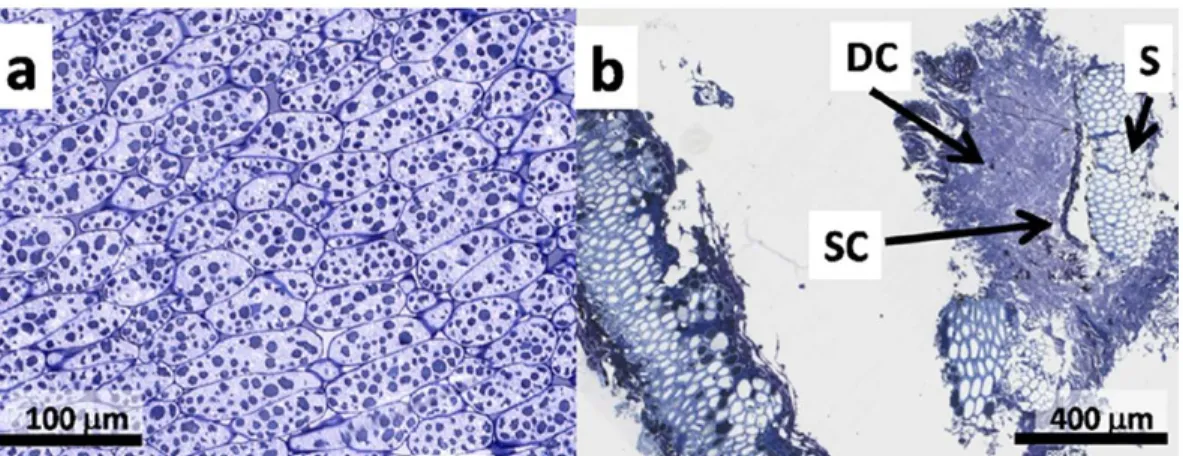
The destruction of the ce lis was defined by microscopie analysis
before and after extrusion (
Fig
.
1
). Before extrusion (
Fig. l
a) cotyle
don cells ranged from 50 to 100 µm in length, and 20 40 µm in
diameter white protein bodies' ranged from 1 to 10 µm in diame
ter. The protein bodies filled a smaller proportion of the cytoplas
mie volume compared to soy protein bodies (
Bair & Snyder, 1980;
Mantese, Medan, & Hall, 2006
). Oil bodies, that is oil storage orga
nelles delimited by a protein phospholipid membrane, occupied
the space between protein bodies.
After extrusion, intact cotyledon cells were not observed
(
Fig. 1
b i Regions of disrupted cotyledon ce lis, with few recogniz
able structures, are seen between regions of intact sclerenchyma
cells, the hollow structural and vascular tissue making up the bulk
of the sunflower pericarp (
Mantese et al., 2006
). Sorne disrupted
cell wall material can be seen on the outer regions of the disrupted
cotyledon tissue (images not shown). Lipid was observed mostly as
coalesced oil, in the outer regions of the extruded cellular matrix
inside and outside disrupted œlls. No intact oil bodies are visible.
Sorne lipid is also observed in the interior of sclerenchyma cells
of the pericarp. Sunflower pericarp is low in lipids (generally less
than 5%) and it is unlikely that the lipid observed here occurs
in vivo.
A likely explanation for this observation is that the heat
and pressure during extrusion causes some oil to fill the void
spaces in the sclerenchyma cells.
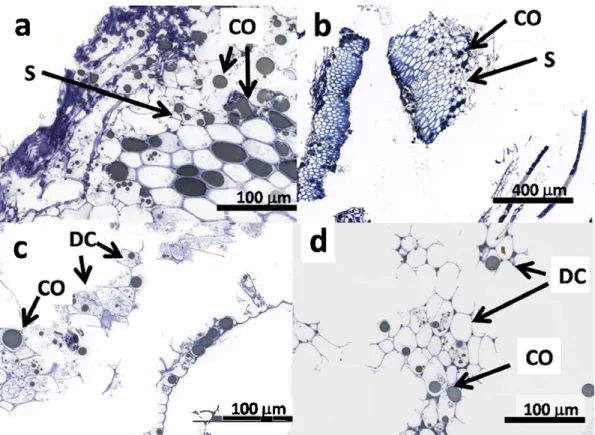
After centrifugation, residual material settled into two distinct
layers in the centrifuge bottles: a lower coarse layer making up
about 80% of residual volume, and an upper layer of fine gray mate
rial making up the remainder. The lower layer consisted of a mix
ture of pericarp and disrupted cotyledon tissue, white the upper
layer contained only cotyledon cells with some seed coat particles
(
Fig. 2
)
.
As before, no intact cotyledon œlls were observed; ait cells
have undergone at least some extraction of the cytoplasmic mate
rial but oil remains in some cells as coalesced oil droplets. Further
more, coalesced oil is again prominent in sclerenchyma cells. These
results are similar to those observed in soybean, where unex
tracted oil is sequestered inside disrupted œlls as coalesced dro
plets too large to pass out of the matrix (
Campbell & Glatz,
2009
). A notable difference from soybean, however, is the entrap
ment of oil in the void spaces of the pericarp sclerenchyma cells.
The extent of protein denaturation and solubility has a cruàal
influence on the oil yield with aqueous extraction in soybeans
(
Campbell & Glatz, 2009; Rosenthal, Pyle, Niranjan, Gilmore, &
Trinca, 2001
). Therefore, the conformational state of suntlower
protein in the extrudate was analyzed, and compared to a contrai
sample of pressed, ground sunflower seeds which had not been
exposed to the heat of extrusion. The heat absorption profile of
the extrudate is shown in
Fig. 3
. An obvious peak occurs at
150 °C, which is slightly lower than the 155 °C denaturation tem
perature determined by
Rouilly, Orliac, Silvestre, and Rigal (2003)
for untreated sunflower of similar moisture content (10%). The
peak area divided by the protein content of the samples, both
extruded and pressed, gives a specific heat of denaturation of 9.7
(±0.4)J/g protein. By comparison, Rouilly et al. report denaturation
enthalpies of 8.6 J/g protein. Therefore, the extrusion conditions
used here did not affect the conformational state of the suntlower
proteins (
Rouilly et al., 2003
).
3.2. Aqueous extraction and enzyme assisted aqueous extraction
3.2.1. Full factorial design experiment results
The measured responses for oil extraction yield, protein dissolu
tion, and non lipid material dissolution are shown in Table 1. The
results indicate that in aqueous extraction conditions (trial 6, 7,
12 and 13) this is about 30% for oil (with the exception of Trial
12), comparable to similar extraction conditions from Bayberry
(Zhang et al., 2012), 56% for proteins and 27% for the others. The
highest recovery yields are obtained when extraction is managed
with both enzymes, with an oil recovery yield of 40% and a protein
recovery yield of 85%.
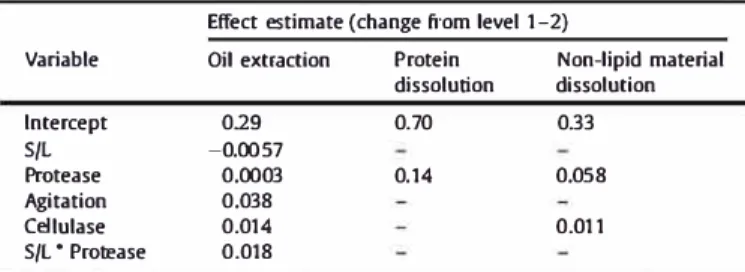
Significant parameters were identified by ANOVA
Table 2
sum
marizes the parameter estimates determined after elimination of
the insignificant terms, the resulting analysis of variance, and sta
tistical significanœ. For oil extraction yield, only agitation and
Fig. 1. { a) Image of native sun0ower cotyledon cells. Protein bodies are dari< blue globules <20 µm in length. Oil bodies fi U the cytoplasmic space between protein bodies, 40x magnification. {b) Image of tissue after extrusion with features indicated: OC, region of disrupted cotyledon cells; S, region of intact sclerenchyma cells; SC, seed coat, t0x magnification
..,.. .
.
-�
a
C
,'
7
100um
Fig. 2. Images of sun0ower meal residue after extraction: (a) AEP Coarse layer sample (extracted without enzyme) showing intact sclerenchyma cells, 40x magnification; (b) EAEP coarse layer sample (extracted with cellulase) showing intact sclerenchyma cells, 10x m<lgnfication; (c) AEP fine layer sample 40x m<lgnification (no enzyme); (d) EAEP fine layer sample, 40x magnification. CO, coalesced oil; S, region of sclerenchyma cells; OC, region of disrupted cotyledon cells (extracted with cellulase).
0.65 0.60
�
--Pressed-ground sunflower..
- - - Extruded-ground sunflower .€_ 0.55�
0.50 iii 0.45 ' ·.:; 0.40 QI ' C. ' V, ' ' 0.35 0.30 50 100 150 Temperature ('C)Fig. 3. Differential scanning calorimetry profiles of sunflower meal that was extruded at 100 °C and then ground and meal that was pressed at room temperature and then ground. Denaturation temperatures were near 150 °C with denaturation enthalpies of 9.7 J/g protein for both treatments.
cellulase had significant main effects, while solid to liquid ratio and
protease had significant interaction effects. Dissolution of non
lipid material, on the other hand, was not affected by agitation at
all, with protease having the most important effect. The effect of
cellulase was also significant, but the increase in dissolution
caused by cellulase was much smaller than that of protease. Only
protease had a significant effect on protein dissolution with an
average increase of 28%. The goodness of fit and significance for
the three responses after elimination of the insignificant parame
ters, are shown in
Fig. 4
. Each of the models fit the data well, with
actual values plotted against predicted values randomly dis
tributed around a line of a slope of one on the fit test plot. The
p values for all models were Jess than 0.02.
3.2.2. Influence of parameters
Sunflower protein from defatted meal generally has low nitro
gen solubility, Jess than 30% at pH 6.5 and low ionic strength, but
this increases with sait addition (
Canella, Castriotta, Bemardi,
&
Boni, 1985; Kabirullah
&
Wills, 1983
) and hydrolysis (
Kabirullah
&
Wills, 1981
). A protein solubilization of 85% with protease indi
cates a very high degree of disruption. Assuming protein can only
be extracted from disrupted cells, as has been previously estab
lished (
Campbell
&
Glatz, 2009
), at most 15
%
of the cells remained
intact after extrusion, and it could be even Jess considering the low
solubility of sunflower proteins under these conditions.
Cellulase addition was made to facilitate the oil's exit from the
solid residue, by promoting disruption of cells that were still intact
after extraction and by promoting the modification of the dis
rupted structures. Comparisons between the significant parame
ters, for the three different responses, indicate that œllulases
affected both oil extraction yield (3%) and dissolution of non
lipid material, but not dissolution of protein. Cellulose degradation
occurs but was limited and did not change the dissolution and the
transfer of the entrapped molecules. As no intact sunflower cotyle
don cells were observed in microscopie images of extruded sun
tlower meal, one possible explanation could be that extrusion
succeeded in achieving near complete cellular disruption prior to
extraction. There are no noticeable differences in these images
between material extracted with and without cellulase. Nonethe
Jess, the entrapment of oil droplets inside the confines of the cell
wall of disrupted œlls, suggests that the effect of œllulase is to dis
rupt this confining matrix.
Table 1
Results of the sunflower meal extraction trials from the 24 factorial design arranged in the randomized order in which the trials were conducted. Trial S/L Agitation rate Protease concentration Cellulase concentration
{rpm) {w/w) {w/w) 1 0.10 160 0.00 0.02 2 0.05 350 0.02 0.02 3 0.05 160 0.02 0.02 4 0.05 350 0.00 0.02 5 0.10 350 0.02 0.00 6 0.10 350 0.00 0.00 7 0.10 160 0.00 0.00 8 0.10 160 0.02 0.02 9 0.05 350 0.02 0.00 10 0.10 160 0.02 0.00 11 0.05 160 0.02 0.00 12 0.05 160 0.00 0.00 13 0.05 350 0.00 0.00 14 0.10 350 0.00 0.02 15 0.05 160 0.00 0.02 16 0.10 350 0.02 0.02 Table 2
Estimation of those elfects still significant {p < 0.05) after elimination of terms not found to be significant either as a main elfect or as a two-factor interaction in the full ANOVA {not shown). These elfect estimates paired with the coded values of the variables, provided the linear mode! parameters for the mode! fit tests seen in Fig. 4; where no value is provided, the associated variable did not appear in the mode(.
Elfect estimate {change from level 1-2)
Variable Oil extraction Protein Non-lipid material dissolution dissolution lntercept 029 0.70 0.33 S/L -0.0057 Protease 0.0003 0.14 0.05 8 Agitation 0.038 Cellulase 0.014 0.011 S/L • Protease 0.018
Agitation can increase oil yield through several physical mech
anisms depending on its intensity, and at the highest levels it can
increase oil release by rupturing intact cells. The shear and turbu
lence created by agitation can also break up the solid matrices that
entrap oil within the confines of disrupted cells. A third possibility
is that the turbulence of agitation increases the emulsification of
oil within the cells, creating smaller oil drop lets that exit more effi
ciently out of the cellular matrix into the bulk fluid. Since agitation
did not affect dissolution of protein or other non lipid material, it is
unlikely that it caused significant additional cell rupture, since
extrusion alone achieved a high degree of cellular disruption as
H ,::�. _
-
__
-
__
-
__
-
_
-: '.
_
-
:
--,,
-
-
--
-
-
�
-
-
-_-__
-
_
__
-
__
-
-
__
�
__
·
0 -� 0.25 0.2"§
e
0.J
ô "C.,
C:�
0·a
:ë ::,�
0 u. (JI 0.9 0.85 0.8 0.75 0.7 0.65 0.6.
.
0.55.
.
.
Oil extraction Fraction of non-lipid Fraction of protein
yield solubilized solubilized
0.30 0.30 0.59 0.40 0.44 0.85 0.30 0.39 0.85 0.35 0.27 0.55 0.33 0.39 0.85 0.32 0.26 0.57 0.30 0.28 0.55 026 0.38 0.84 0.36 0.36 0.84 023 0.38 0.85 027 0.36 0.84 020 0.27 0.56 0.33 0.25 0.56 0.35 0.27 0.54 028 0.27 0.57 0.33 0.38 0.85
indicated by microscopie observation. Consequently, as increasing
agitation from 160 rpm to 350 rpm increased oil extraction yields
by an average of 8%, it can be assumed that this effect cornes from
modification of the droplet sizes.
Campbell and Glatz (2009)
showed that emulsification is an
important extraction mechanism for AEP of soybean oil. To illus
trate the level of droplet disruption that can be achieved in the
given mixing system a turbulent inertial droplet breakup mode!
from Vankova et al. has been used to estimate the maximum stable
drop let diameter of oil in AEP of soybeans (
Campbell
&
Glatz, 2009;
Vankova, Tcholakova, Oenkov, Jvanov
&
Vulchev, 2007
)
.
According
to this mode! and the agitator power number, the maximum stable
droplet diameter would be in the range of 15 20 µm for the
160 rpm condition and 3 5 µm for the 360 rpm condition, assum
ing no viscoelastic protein film at the interface, and an interfacial
surface tension of 5 mN/m, as measured for soy protein oil systems
(
Campbell
&
Glatz, 2009
)
.
Experiments designed to alter the oil water interfacial candi
tians during extraction, confirm the influence of the droplet struc
ture on oil recovery yield. The addition of 3
%
(w/w solid) sodium
dodecyl sulfate (SOS) increased the extraction yield of oil from
28.4% (±1 .4) to 39.0% (±0.6) at 160 rpm, S/L = 0.10 (±95% confidence
interval, n = 3 ). At the same time, protein extraction increased from
57% (±1) to 90% (±2), which is even more than the increase with
protease, which was 86.2% (±0.1 ). The addition of protease
increased protein extraction almost as much as SOS addition, but
protease had no effect on oil extraction yield.
/
. ;I ;- -0 ::,'"
a.!l
� "O 0 Q) C: N0 :5
C: ::, 0 0·s
(JI�
75
u. E 0.45---0.4 0.35 0.3 0.25...
::
·
:
·
.
'·... .
:·..
o.5 ... �-��-�---�-0.2 0.25 0.3 0.35 0.4Oil extraction yield Predicted P=0.0003 RSq=0.87 RMSE=0 0219
o.5 o.55 o.s o.65 0.1 o.75 o.8 o.85 o.s
Fraction of protein solubilized Predicted P<.0001 RSq=0.99 RMSE=0.0112
0.25 0.3 0.35 0.4 0.45
Fraction of non-lipid mat'I solubüized Predicted P<.0001 RSq=0.93 RMSE=0.0187
Fig. 4. Fit tests of the multiple linear regression mode! for oil extraction yield, protein solubilization, and solubilization of non-lipid material using estima tes deterrnined after elimination of the insignificant effects {Table 2). E.g. predicted oil extraction yield • 029-0.0057 • S/L + 0.0003 • protease + 0.038 •agitation+ 0.014 • cellulase + 0.0 18 • S/L • protease. Actual values are plotted against predicted values overlaid on a line of a slope of one. Response mean values are shown as horizontal dashed lines. Prediction intervals are indicated by dashed lines on either side of the fine of the slope of one.
3.3. Extraction model
The mechanism of protease action for oil yield enhancement in AEP of soybean is due to alteration of the oil water interface by two possible mechanisms: (1) disruption of a viscoelastic protein film, or (2) creation of protein hydrolysates that are better emulsifiers than native proteins (Campbell & Glatz, 2009; Latif & Anwar, 2013). The same authors also hypothesized that higher solid liquid ratios (S/L) reduced soybean oil extraction by increasing interfacial protein coverage, and therefore viscoelastic effects.
Unlike soybean extraction, neither proteases nor S/L had a mea surable effect on oil extraction yield from sunflower, suggesting different release mechanisms for the two materials. Sunflower has lower protein content than soy, 30% compared to 40% for sun flower extrudate and soy flour, respectively. Nonetheless, the resulting protein extract concentrations are similar to concentra tions seen in soybean extractions, ranging from 8 mg/ml for S/L of 0.05 and no protease, to 25 mg/ml for S/L of 0.10 with protease, for sunflower extrudate. For soybean under the same conditions, protein concentrations were 19 mg/ml and 38 mg/ml, respectively (Campbell & Glatz, 2009). If the formation of a viscoelastic film impedes oil release in soy, this does not appear to be the case in sunflower, as neither increasing the protein concentration (and, hence, interfacial coverage) nor disrupting a film by hydrolysis, affects yield. This sunflower extrudate result also differs from that found for extraction of dehulled ground sunflower seeds, where S/L did affect oil extraction [1]. However, the ground seeds had much higher oil content (>40%) and were subjected to a larger range of S/L (0.05 0.2) and pH, although the latter had no effect.
If disruption and diffusion of oil droplets were important mech anisms for extraction, a greater oil concentration in the bulk would cause S/L to have a measureable effect. Droplets much smaller than the dimensions of a rupture in a cell wall would be able move into as well as out of disrupted cells. Therefore, the volume of disrupted cells with which the droplets can exchange, relative to the total volume, would affect yield. As relative cell volume increased (i.e. at higher S/L), so would the entrained fraction of oil in those cells, and the amount would be proportional to the concentration of freely exchanging bulk oil droplets. Evon hypothesized that increasing the relative amount of water (i.e. decreasing S/L) increased the amount of oil that could be stabilized in an emulsion, a phenomenon that would also be more apparent in material with higher oil content (Evon, 2008; Evon, Vandenbossche, Pontalier, & Rigal, 2007). Since S/L effects were not observed here, it is possible that the oil concentration in this case was too low to have a mea sureable effect.
If hydrolyzed soy proteins increase extraction yield, because of improved emulsification properties over native soy proteins, this does not appear to be the case for the present sunflower material. In other studies of sunflower protein stabilized emulsions, hydrol ysis of up to 10% of the peptide bonds did not have an effect on the droplet diameter under conditions similar to those used in these experiments (Karayannidou et al., 2007). Sunflower protein hydrolyzates may not therefore be able to increase yield through enhanced emulsification.
However, other studies have found significant increases in oil yield using proteases with chopped, rather than extruded, sun flower seeds (Badr & Sitohy, 1992). This contrast may be a result of differences in geometry of the matrices entrapping unextracted oil. In order for the turbulent forces to cause droplet breakup, eddies in the medium must be free to impinge on oil droplets, cre ating local pressure gradients around them. In sunflower extru date, much oil was observed completely filling the sclerenchyma tissue void spaces, reducing the surface area available for energy transfer between turbulent eddies and oil droplets. The fraction of oil contained within the sclerenchyma tissue, would therefore
be a theoretical limit to the amount of extraction that could take place in an aqueous environment without cellulolytic treatment, because of the geometrical barriers against emulsification.
It appears that the mechanism for oil transfer out of the matrix is different for sunflower extrudate. The results showed that intro ducing SDS leads to both increased oil and protein yield, while pro tease only increases protein yield. It could be that oil remained entrapped, after extrusion of sunflower kernel, in large structures involving proteins, and that these were too large to diffuse out of the solid residue. Protease addition could modify these structures, but as the hydrolyzed proteins have low emulsifying properties, only they are recovered while the lipids remain fixed on the resi due. SDS addition seems to induce geometry changes in these structures, allowing solubilisation of protein but also creation of smaller oil droplets that can then diffuse out. Changing the size of these structures can also be achieved with stronger agitation, but this action remains minimal since the oil recovery yield increase is only 3%.
The presence of insoluble protein inside the sunflower seed cotyledon cells could pose a major barrier to oil release and would explain this observation, and this insolubility may be caused by the extrusion (Jung, 2009). Hulls can also hinder the extraction because they contain mucilage that reduces the release of oil into the aqueous phase (Tabtabaei & Diosady, 2013).
4. Conclusions
Oil remaining in extruded sunflower meal after AEP/EAEP, was contained as coalesced oil droplets inside disrupted cotyledon cells and in void spaces of pericarp sclerenchyma cells. Agitation and cellulase treatment increased oil extraction yields, but protease and solid liquid ratio did not affect yields, contrary to observations for soybean. While emulsification may be an important extraction mechanism produced by agitation, the geometry of the cellular matrix entrapping coalesced oil may also be an important factor determining extraction yield, and is a possible explanation for the differences between sunflower and soybean oil extraction determination. Based on these observations, the extraction yields from both extrusion as well as AEP/EAEP could be improved if the kernels could be extruded in the absence of hulls.
Acknowledgements
The authors would like to thank the USDA CREES Grants #2005 34432 1406 and 2006 34432 17128, the Iowa State University Plant Science Institute, and the US Department of Education Renewable Resources and Clean Technology grant for funding this research. We would also like to thank the Centre de Microscopie Electronique Appliquée in Toulouse, France, as well as Tracey Pep per and Randall DenAdel at the NanoImaging Facility at Iowa State University for the microscopy.
References
Anastas, P. T., & Warner, J. C. (1998). Green Chemistry: Theory & Practice.New York: Oxford University Press.
Badr, F. H., & Sitohy, M. Z. (1992). Optimizing conditions for enzymatic extraction of sunflower oil. Grasasy Aceites, 43(5), 281–283.
Bair, C. W., & Snyder, H. E. (1980). Electron-microscopy of soybean lipid bodies. Journal of the American Oil Chemists Society, 57(9), 279–282.
Campbell, K. A., & Glatz, C. E. (2009). Mechanisms of aqueous extraction of soybean oil. Journal of Agricultural and Food Chemistry, 57(22), 10904–10912. Canella, M., Castriotta, G., Bernardi, A., & Boni, R. (1985). Functional-properties of
individual sunflower albumin and globulin. LebensmittelWissenschaft und -Technologie, 18(5), 288–292.
Dominguez, H., Nunez, M. J., & Lema, J. M. (1995). Aqueous processing of sunflower kernels with enzymatic technology. Food Chemistry, 53(4), 427–434. Evon, P. Nouveau Procédé de Bioraffinage du Tournesol Plante Entière par
L’Extraction Aqueuse des Lipides et de la Mise en Forme du Raffinat en Agromatériaux par Thermomoulage, [Dissertation] Toulouse Université de Toulouse, INP, 2008.
Evon, P., Vandenbossche, V., Pontalier, P. Y., & Rigal, L. (2007). Direct extraction of oil from sunflower seeds by twin-screw extruder according to an aqueous extraction process: Feasibility study and influence of operating conditions. Industrial Crops and Products, 26, 351–359.
Jung, S. (2009). Aqueous extraction of oil and protein from soybean and lupin: a comparative study. Journal of Food Processing and Preservation, 33, 547–559. Kabirullah, M., & Wills, R. B. H. (1981). Functional-properties of sunflower protein
following partial hydrolysis with proteases. LebensmittelWissenschaft und -Technologie, 14(5), 232–236.
Kabirullah, M., & Wills, R. B. H. (1983). Characterization of sunflower protein. Journal of Agricultural and Food Chemistry, 31(5), 953–956.
Karayannidou, A., Makri, E., Papalamprou, E., Doxastakis, G., Vaintraub, I., Lapteva, N., & Articov, G. (2007). Limited proteolysis as a tool for the improvement of the functionality of sunflower (Helianthus annus L.) protein isolates produced by seeds or industrial by-products (solvent cake). Food Chemistry, 104(4), 1728–1733.
Kartika, I. A., Pontalier, P. Y., & Rigal, L. (2006). Extraction of sunflower oil by twin screw extruder: Screw configuration and operating condition effects. Bioresource Technology, 97(18), 2302–2310.
Latif, S., & Anwar, F. (2013). Aqueous enzymatic sesame oil and protein extraction. Food Chemistry, 125, 679–684.
Mantese, A. I., Medan, D., & Hall, A. (2006). Achene structure, development and lipid accumulation in sunflower cultivars differing in oil content at maturity. Annals of Botany, 97, 999–1010.
Moura, J., Campbell, K., Mahfuz, A., Jung, S., Glatz, C. E., & Johnson, L. (2008). Enzyme-assisted aqueous extraction of oil and protein from soybeans and cream de-emulsification. Journal of the American Oil Chemists Society, 85(10), 985–995.
Moura, J., & Johnson, L. A. (2009). Two-stage countercurrent enzyme-assisted aqueous extraction processing of oil and protein from soybeans. Journal of the American Oil Chemists Society, 86(3), 283–289.
Rosenthal, A., Pyle, D. L., Niranjan, K., Gilmore, S., & Trinca, L. (2001). Combined effect of operational variables and enzyme activity on aqueous enzymatic extraction of oil and protein from soybean. Enyzme and Microbial Technology, 28, 499–509.
Rouilly, A., Orliac, O., Silvestre, F., & Rigal, L. (2003). Thermal denaturation of sunflower globulins in low moisture conditions. Thermochimica Acta, 398(1–2), 195–201.
Sineiro, J., Dominguez, H., Nunez, M. J., & Lema, J. M. (1998). Optimization of the enzymatic treatment during aqueous oil extraction from sunflower seeds. Food Chemistry, 61(4), 467–474.
Tabtabaei, S., & Diosady, L. L. (2013). Aqueous and enzymatic extraction for the production of food grade proteins and industrial oil from dehulled yellow mustard flour. Food Research International, 52, 547–556.
Vankova, N., Tcholakova, S., Denkov, N. D., Ivanov, I. B., Vulchev, V. D., & Danner, T. (2007). Emulsification in turbulent flow: 1. Mean and maximum drop diameters in inertial and viscous regimes. Journal of Colloid and Interface Science, 312(2), 363–380.
Zhang, Y. L., Li, S., Yin, C. P., Jiang, D. H., Yan, F. F., & Xu, T. (2012). Response surface optimisation of aqueous enzymatic oil extraction from bayberry (Myrica rubra) kernels. Food Chemistry, 135, 304–308.