HAL Id: tel-01171301
https://tel.archives-ouvertes.fr/tel-01171301
Submitted on 3 Jul 2015HAL is a multi-disciplinary open access archive for the deposit and dissemination of sci-entific research documents, whether they are pub-lished or not. The documents may come from teaching and research institutions in France or abroad, or from public or private research centers.
L’archive ouverte pluridisciplinaire HAL, est destinée au dépôt et à la diffusion de documents scientifiques de niveau recherche, publiés ou non, émanant des établissements d’enseignement et de recherche français ou étrangers, des laboratoires publics ou privés.
Lexical-semantic system organization in the monolingual
and bilingual developing brain
Louah Sirri
To cite this version:
Louah Sirri. Lexical-semantic system organization in the monolingual and bilingual developing brain. Psychology. Université Sorbonne Paris Cité, 2015. English. �NNT : 2015USPCB066�. �tel-01171301�
L’organisation du système lexico-sémantique dans le cerveau monolingue et
bilingue en développement
Lexical-semantic system organization in the monolingual and bilingual
developing brain
Thèse de Doctorat, Psychologie Cognitive
Louah Sirri
Directrice de Thèse : Pia Rämä
Laboratoire Psychologie de la Perception CNRS-UMR 8242
Date de soutenance Vendredi 13 Mars, 2015
Membres de Jury :
Nivedita Mani Rapporteur
Eugenio Parise Rapporteur
Pierre Hallé Examinateur
Sylvain Moutier Examinateur
Pia Rämä Directrice de thèse
Ecole Doctorale 261
Comportement, Cognition, Conduites
Humaines
Page | 2
Abstract
The present doctoral research explored the developing lexical-semantic system in monolingual and bilingual toddlers. The question of how and when word meanings are first related to each other and become integrated into an interconnected semantic system was investigated. Three studies were conducted with monolingual French learning children which aimed at exploring how words are organized, that is, according to taxonomic relationships (e.g., pig – horse) and to semantic similarity distances between words (e.g., cow – sheep versus cow – deer), and whether cognitive mechanisms, such as automatic activation and controlled processes, underlie priming effects. An additional two studies conducted with children learning two languages simultaneously, aimed at determining, first, whether taxonomically related word meanings, in each of the two languages, are processed in a similar manner. The second goal was to explore whether words presented in one language activate words in another language, and vice versa. In an attempt to answer these questions, lexical-semantic processing was explored by two techniques: eye-tracking and event-related potentials (ERPs) techniques. Both techniques provide high temporal resolution measures of word processing but differ in terms of responses. Eye-movement measurements (Study III) reflect looking preferences in response to spoken words and their time-course, whereas ERPs reflect implicit brain responses and their activity patterns (Study I, II, IV, and V).
Study I and II revealed that words are taxonomically organized at 18 and 24-month-olds. Both automatic and controlled processes were shown to be involved in word processing during language development (Study II). Study III revealed that at 24-month-olds, categorical and feature overlap between items underpin the developing lexical-semantic system. That is, lexical-items in each semantic category are organized according to graded similarity distances. Productive vocabulary skills influenced word recognition and were related to underlying cognitive mechanisms.
Study IV revealed no differences in terms of semantic processing in the bilinguals’ two languages, but the ERP distribution across the scalp varied according to the language being processed. Study V showed that words presented in one language activate their semantic representations in the second language and the other way around. The distribution of the ERPs depended, however, on the direction of translation. The results suggest that even early dual language experience yields distinct neural resources underlying lexical-semantic processing in the dominant and non-dominant languages during language acquisition.
Page | 3
Résumé
L’objectif de cette thèse est d’étudier le développement du système lexico-sémantique chez les enfants monolingues et bilingues. La question posée est la suivante : quand et comment les significations des mots commencent à être reliées entre elles et à s’intégrer dans un système sémantique interconnecté. Dans un premier temps, trois études ont été menées chez des enfants monolingues français. L’Etude 1, a pour but d’observer si les mots sont organisés selon des liens taxonomiques (e.g., cochon – cheval). L’Etude 2 explore si l’effet d’amorçage sémantique est sous-tendu par des mécanismes cognitifs, comme les processus d’activation automatique et contrôlé. Puis enfin, l’Etude 3 observe si les mots sont organisés en fonction de leur distance de similarité sémantique (e.g., vache – mouton versus vache – cerf). Dans un deuxième temps, deux études ont été conduites chez des enfants apprenant deux langues simultanément. L’Etude 4 vise à déterminer si les mots sont taxonomiquement liés dans chacune des langues. L’Etude 5 explore si les mots présentés dans une langue activent leurs représentations sémantiques dans l’autre langue. Dans le but de répondre à ces questions, le traitement lexico-sémantique a été étudié en utilisant deux techniques : l’eye-tracking et les potentiels évoqués (PEs). Ces deux techniques enregistrent lors de la présentation des mots des réponses comportementales (Etude 3) et neuronales (Etude 1, 2, 4 et 5) de haute résolution temporelle.
Les Etudes 1 et 2 montrent que chez les monolingues les mots sont liés taxonomiquement à l’âge de 18 et 24 mois. Durant le développement du langage, les deux processus d’activation automatique et contrôlé sont impliqués dans le traitement des mots (Etude 2). L’Etude 3 montre qu’à 24 mois, les mots sont organisés dans le système lexico-sémantique en développement selon la distance des similarités sémantiques.
L’Etude 4 montre que chez les enfants bilingues, le traitement sémantique ne diffère pas selon les deux langues, mais la topographie des PEs varie selon la langue traitée. L’Etude 5 montre que les mots présentés dans une langue activent leurs représentations sémantiques dans la deuxième langue et vice versa. Toutefois, la topographie des PEs est modulée selon la direction de traduction. Ces résultats suggèrent que l’acquisition de deux langues, bien qu'elle soit très précoce, requière deux ressources neuronales bien distinctes, sous-tendant ainsi le traitement lexico-sémantique des langues dominante et non-dominante.
Page | 4
Table of content
Abstract ... 2
Résumé ... 3
General Introduction ... 6
1. Chapter I: Semantic memory and word processing ... 11
1.1. How to tap into the lexical-semantic organization? ... 11
1.1.1. On-line word recognition ... 11
1.1.1.1. Lexical and semantic decision tasks... 11
1.1.1.2. Eye-movement measurements... 13
1.2. Theories interpreting semantic processing ... 14
1.3. Cognitive mechanisms underlying the semantic priming ... 15
1.4. Event-related potentials (ERPs) and language processing ... 16
1.4.1. Semantic processing as measured by the N400 ... 18
1.4.2 Modulations of the N400... 19
1.5. Conclusion ... 20
2. Chapter II: The developing semantic system ... 21
2.1. Vocabulary development ... 21
2.2. Exploring language processing ... 22
2.3. Word recognition ... 25
2.3.1. Behavioural evidence ... 25
2.3.2. Electrophysiological correlates of word processing ... 26
2.4. The developing lexical-semantic system ... 26
2.4.1. Tackling the lexicon structure over the second year ... 27
2.4.1.1. Primed IPL tasks ... 27
2.4.1.2. N400 priming effect ... 29
2.5. Productive vocabulary skills influence on lexical-semantic processing ... 30
2.6. Conclusion ... 31
3. Chapter III: Lexical-semantic processing in bilinguals ... 32
3.1. Defining a bilingual individual ... 32
3.2. Bilingual lexical-semantic processing ... 33
3.2.1. Within-language semantic priming ... 33
3.2.2. Cross-language activation ... 34
3.3. Interpreting the bilingual language processing ... 35
3.5. Conclusion ... 37
4. Chapter IV: What do we know about language processing in bilingual toddlers? ... 38
Page | 5
4.1.1. Parental language input ... 38
4.1.2. Code-mixing during dual language acquisition ... 39
4.1.3. Similarities and differences between mono- and bilingual infants ... 40
4.1.3. Bilingual experience and cognitive development ... 41
4.1.3.1. Benefits and costs ... 41
4.2. Word processing and lexicon structure ... 43
4.2.1. Semantic processing in bilingual toddlers ... 44
5. Conclusion ... 45
The goals of our studies ... 46
[Study I: Published] ... 49
Development of lexical-semantic language system: N400 priming effect for spoken words in 18- and 24-month old children ... 49
[Study II: Published] ... 80
Cognitive and neural mechanisms underlying semantic priming during language acquisition ... 80
[Study III: In preparation]... 110
Semantic similarity effects during word recognition in 24-month-old toddlers ... 110
[Study IV: In preparation] ... 141
Two languages, one mind: Within language priming in French-Spanish bilingual toddlers ... 141
[Study V: In revision] ... 152
Different distribution of N400 translation priming effect for dominant and non-dominant languages in bilingual children ... 152
Summary of results ... 170
1. Taxonomically organized lexicon during early language development ... 171
2. Taxonomic categories as organized by semantic similarity distances ... 174
3. Cognitive mechanisms involved in lexical-semantic processing ... 179
4. Two languages, one mind ... 181
4.1. Assessing bilingualism ... 181
4.2. Within-language semantic processing ... 182
4.3. Cross-language priming ... 183
5. ERPs and language processing during early linguistic acquisition ... 184
5.1. N2 component ... 184
5.2. Semantic processing as indexed by the N400 ... 186
6. The effect of productive vocabulary skills on the lexical-semantic organization ... 187
7. Conclusion ... 189
Page | 6
General Introduction
Even before they are capable of producing their first words, infants demonstrate a considerable understanding of basic-level word meanings by matching correctly a spoken word to its visual referent. As infants attain about 50 to 100 words in their productive lexicon, they enter the ‘vocabulary spurt’, a phase marked by an accelerate rate of word learning and producing, thus becoming faster and more efficient in recognizing familiar words (for a review, see Nazzi & Bertoncini, 2003 and Ganger & Brent, 2004). Several studies have shown that by their second birthday, children progress rapidly towards adult-like manner of word processing (e.g., Fernald, Pinto, Swingley, Weinberg, & McRoberts, 1998; Fernald, Swingley, & Pinto, 2001; Fernald, Perfors, & Marchman, 2006). Yet, whether their lexicon is structured according to semantic relationships between words and whether this organization affects on-line word processing is a question that has not been raised until recently. Answering this question would provide further information about the how and when during language development words relate to each other based on their shared meanings and are integrated into an interconnected semantic system. With adults, the lexical-semantic system has been investigated in numerous studies and few models of word processing have been proposed, illustrating that in the long-term memory, lexical items are organized according to different semantic relationships, such as associative, taxonomic, thematic, functional, and shared features. This semantic organization is suggested to affect word recognition during language processing. Hence, exploring the lexical-semantic organization during language acquisition will allow us to tap into the (progressive) development of the semantic system.
In monolingual children, there is recent evidence that by the second year of life associative (e.g., cat – dog) and taxonomic (e.g., cat – horse) relationships might underpin the developing lexical-semantic structure (Torkildsen, Syversen, Simonsen, Moen, & Lindgren, 2007; Styles & Plunkett, 2009; Arias-Trejo & Plunkett, 2009, 2010, 2013). Still, many questions remain under-determined and further studies are needed to better understand how and when the lexical-semantic system develops. Does sensitivity to taxonomic relatedness in children appear prior to their second birthday? If yes, are automatic activation and controlled processes involved in word processing? At 24-months of age, is the lexicon organized according to another semantic relationship than taxonomic? Yet, even less is known about the developing lexical-semantic system in bilingual
Page | 7
children acquiring simultaneously two languages from birth. How related word meanings are processed in each of the bilingual’s languages and do words in one language activate their equivalent representations in the other language?
The present doctoral research was motivated by these questions with an overall objective of achieving an insight to the developing lexical-semantic system in typically developing monolingual and bilingual children. In the current studies, electrophysiological and eye-movement measurements were chosen as techniques for they provide a precise time course of responses to spoken word processing. These techniques have proved suitable for young children and do not require overt motor behavioral response, such as pointing out or producing words. Two linguistic groups were recruited for our studies, 18- and 24-month-old French monolingual learning children and 2 to 4 years old bilingual children, learning simultaneously two languages from birth (French and Spanish or French and English).
The first two chapters of this dissertation detail a general overview about the lexical-semantic organization, word processing and its underlying mechanisms in monolingual subjects, both in adults (Chapter I) and in toddlers (Chapter II), thus providing the theoretical background for our endeavor. The succeeding two chapters present a review about dual language acquisition, semantic processing and language activation in bilingual subjects, adults (chapter III) and toddlers (chapter IV). The following two chapters include our experimental studies, three conducted with monolingual children (chapter V; Study I, II, and III) and two with bilingual children (chapter VI; Study IV and V). Finally, the present dissertation concludes with a general discussion and perspectives for future studies.
Study I (published article) aimed at determining whether words are taxonomically linked to each other at 18- and 24-months of age and whether productive vocabulary skills contribute to this organization. The results showed that at 24-months, semantic priming effect was reflected by more negative amplitudes of the N400 ERP (known to occur in response to semantic violations) for unrelated (e.g., chicken – bike) than for related (e.g., train – bike) spoken word pairs. The N400 component was distributed over the right posterior recording sites and the effect was reversed over the frontal recording sites. Similar effects were observed in the 18-month-olds group, but only in those children with high productive vocabulary skills, suggesting that expressive skills contribute to the taxonomic organization. Study II (published article) explored further the semantic
Page | 8
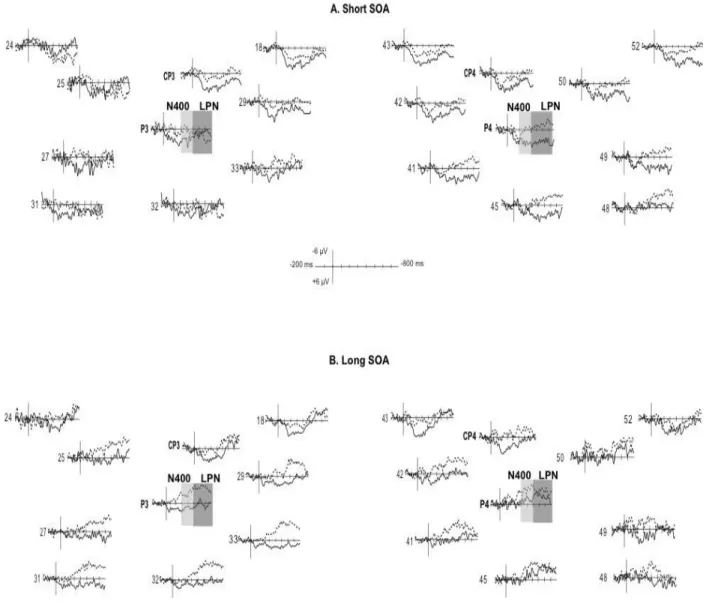
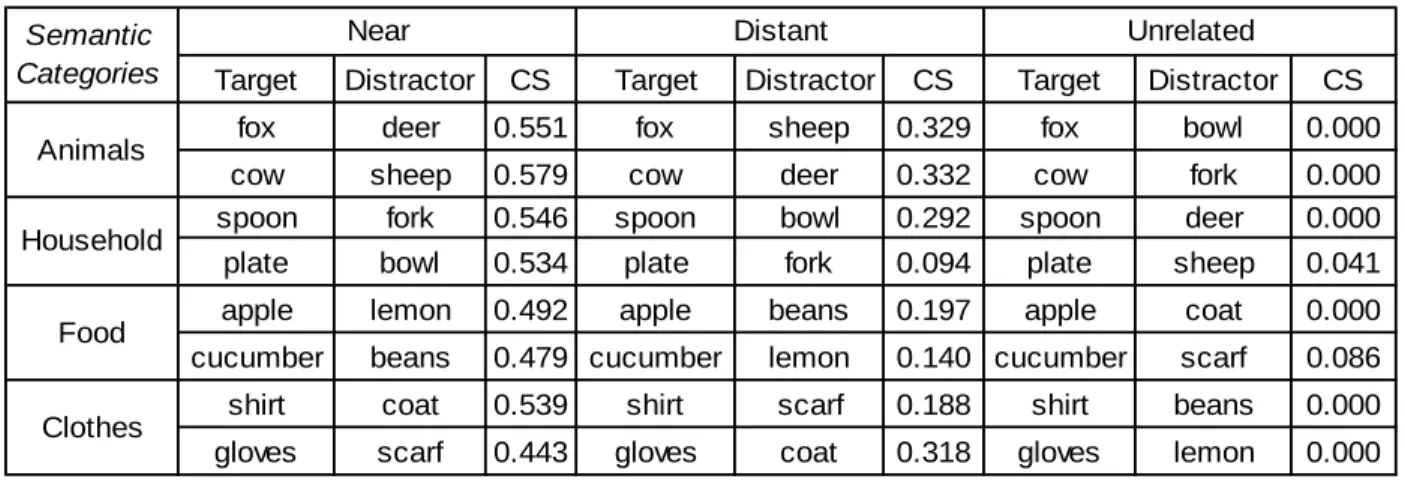
relatedness at 18-months of age and yielded sensitivity to taxonomic relationships at this age already. Language-related ERPs (N2 and LPN, but not the N400) were modulated in terms of amplitudes, distribution, and lateralization, by the time interval separating the onsets of the prime and target words. The results suggest that automatic activation and controlled processes are engaged during semantic priming, but that the neural mechanisms involved might be different. Study III (article in preparation) investigated whether at 24-months, the simultaneous presence of a visual competitor, sharing different amount of features with the target, interfered with the target word recognition, in a looking while listening task. Children viewed two images on a visual display - a named target and a semantic competitor – illustrating either concepts that were near (e.g., cow – sheep) or distant (e.g., cow – deer) competitors from the same taxonomic category, or unrelated concepts drawn from different taxonomic categories (e.g., cow – fork), while their eye-movements were being measured. The results showed that the likelihood of fixating the competitor was affected by the degree of its semantic feature similarity to the target, with distant competitor interfering less near competitor, suggesting that semantic similarity affects word recognition in a graded manner.
Study IV (in preparation) investigated the within-language semantic priming in French-Spanish bilingual children, who were exposed to word pairs in French (e.g., chien (dog) – âne (donkey) versus ventre (tummy) – âne (donkey)) and their translations in Spanish. The results showed a symmetrical N400 priming effect, but its hemispheric distribution varied according to the language. The N400 effect was left-lateralized for the dominant (French) and right-lateralized for the non-dominant (Spanish) language. Study V (article in revision) explored cross-language translation priming in French-English bilingual children, in attempt to determine whether words in one language activate their translation equivalents in the other language. Children were presented with prime and target words in two experimental conditions. In the forward translation, primes were in the dominant (French; e.g., ours) and targets in the non-dominant (English; e.g., bear) language. On the contrary, in the backward translation, primes were in the non-dominant and targets in the dominant language. The N400 effect occurred over the left posterior recording sites for forward translation and over the frontal recording sites for backward translation. The results revealed that the N400 priming effect was more prominent for translation equivalents than for unrelated target words. Additionally, the ERP distribution varied according to the direction of translation (posteriorly distributed effect for forward translation versus frontally distributed effect
Page | 9
for backward translation). The differences between the dominant and non-dominant languages found in both studies, in terms of ERPs distribution and lateralization, indicate that distinct neural resources might underlie the lexical-semantic processing in each language.
Page | 10
Page | 11
1. Chapter I: Semantic memory and word processing
Semantics, in linguistics, is the study of relationships between signs or symbols. That is, the link between words and their meanings, the way we interpret and mentally represent them. It can be applied to entire sentences, concepts, or to single words. Understanding word meanings is essential for it allows us to understand the world, our surrounding, and thus, ourselves. The last decades have been marked with a striking increase of studies that aimed at investigating how word meanings are related to each other in our memory and form a lexicon, and the way they are processed. That is, when reading or hearing speech, what kind of representations do we construct and how they are linked to each others? Organizing words and their meanings helps structuring a single lexical network, called ‘lexical-semantic system’, a system that can be based on different relationships, such as associative (when one word follows another very frequently; e.g., needle – thread), taxonomic (same category co-ordinates but not associated; e.g., bread – cake), thematic (refers to an event schema; e.g., tulip – vase), functional (e.g., knife – scissors), or perceptual (e.g., snake – rope). Words can be also defined as similar in meaning according to their features overlap (e.g., categorical membership, perceptual, functional), thereby creating an organization based on similarity distances. For instance, tomato and strawberry are closely related and share more features (e.g., both are fruits, have the same colour and shape) compared to tomato and potato (e.g., a fruit versus a vegetable, less similar perceptually).
1.1. How to tap into the lexical-semantic organization?
1.1.1. On-line word recognition
1.1.1.1. Lexical and semantic decision tasks
To tap into the semantic system organization, ‘on-line’ word processing was tested in Meyer and Schvaneveldt's (1971) pioneering study, by using for the first time a primed lexical decision task. In their lexical decision task, participants were presented with prime-target word pairs and were to decide whether the target is a word or a non-word. Reaction times were measured in order
Page | 12
to investigate how quickly participants recognize words. The results showed that participants responded faster and more accurately to target words (e.g., butter) preceded by associatively related primes (e.g., bread) compared to target words preceded by a semantically unrelated primes (e.g., doctor). This was defined as the “semantic priming effect”, demonstrating that if information has been accessed, the time to retrieve its related information from memory is accelerated. The authors hypothesized that in the semantic memory, two associated words are located closer to each other compared to two unassociated words, thereby being rapidly accessed and their retrieval is facilitated.
Since, semantic priming paradigms have been adopted in a considerable number of studies that aimed at determining the basic lexical-semantic structure and exploring the nature of semantic relationships between words (e.g., associative and/or taxonomic, semantic similarities). Because Meyer & Scvaneveldt (1971) used only associates (considered as basic relations between lexical items) to investigate word processing, studies that followed tried to include other potential semantic relationships to provide deeper information about words organization and their retrieval (e.g., for an extensive review, see Neely, 1991). In few studies, semantic priming occurred only for associates but not for words that were taxonomically related (e.g., Shelton & Martin, 1992), while others found priming effects for both associatively (e.g., arm – leg) and taxonomically (e.g., bread – cake) related word pairs (e.g., Fischler, 1977; Neely, 1977; Seidenberg, Waters, Sanders, & Langer, 1984), suggesting that both relations, taxonomic and associative, underpin the semantic structure. However, semantic priming was shown to be sensitive also to the degree of semantic similarity between words. In lexical decision (e.g., word versus non-word) and semantic decision (indicate whether a word is concrete or abstract) tasks, reaction times were shown to be faster for taxonomically related and perceptually similar word pairs (e.g., jar – bottle; e.g., McRae & Boisvert, 1998; Cree, McRae, & McNorgan, 1999), compared to less similar word pairs (e.g., plate – bottle; Cree et al., 1999), for which priming effects were not significant (McRae & Boisvert, 1998). In a further study, faster reaction times were obtained for highly similar (e.g., horse – donkey) than for less similar (e.g., bear – donkey) and unrelated (e.g., thimble – donkey) word pairs. Also, reaction times were faster for less similar than for unrelated word pairs (Sanchez-Casas, Ferré, Garcia-Albea, & Guasch, 2006). These findings suggest that priming effects occur in the absence of associative relations and that similarity distance is an organizing principle of word meanings in the semantic memory (e.g., Vigliocco, Vinson, Lewis, & Garrett, 2004).
Page | 13
1.1.1.2. Eye-movement measurements
Recently, semantic processing has been also measured by using eye-tracking technique to investigate the relationship between eye-movements and word recognition, in order to provide another aspect to the semantic structure. This approach has allowed studies to analyse the time course of ‘on-line’ word comprehension (e.g., McRae & Boisvert, 1998; Cree et al., 1999).
The idea of using eye-tracking is to explore further what has been hypothesized by Cooper (1974): “When people are simultaneously presented with spoken language and a visual field containing elements semantically related to the informative items of speech, they tend to spontaneously direct their line of sight to those elements which are most closely related to the meaning of the language currently heard”. Accordingly, the aim of using cross-modal paradigm was to determine whether the presence of relevant and simultaneous non-linguistic information (e.g., image illustrating an object), sharing different amount of features with the target influences subject’s processing of spoken words. In accordance with the featural model (Smith, Shoben, & Rips, 1974), the meaning of a word is based upon a set of semantic features (Vigliocco et al., 2004). Words are considered as semantically similar if they share many features. Thus, the membership to a semantic category is determined by the number of shared features between items belonging to that same category. As items become more abstract, the number of their defining features decreases. The similarity effect is reflected by stronger activation of words with high amount of shared features compared to a weaker activation of words with lower amount of shared features.
Cooper (1974) demonstrated that upon hearing the word “Africa”, participants were more likely to look at images illustrating semantically related members, such as lion, zebra or a snake, than other images illustrating semantically unrelated objects. Based upon these results and advancements in the eye-tracking technology, researchers have developed the visual world paradigm (VWP) to measure eye movements and their latencies in response to a spoken word (for a review, see Huettig, Rommers, & Meyer, 2011). Typically, in a VWP, participants hear a spoken word while looking at a visual display containing several objects and they are instructed to click or point out on the target object. If one of the objects (e.g., lock) illustrated in the display is semantically related to the spoken target word (e.g., key), participants tend to look longer the related (e.g., lock) than the unrelated (e.g., deer or apple) objects (Huettig & Altmann, 2004, 2005;
Page | 14
Yee & Sedivy, 2006; Yee, Overton, & Thompson-Schill, 2009). When the competitor images were presented simultaneously with the target image (e.g., cake) and illustrated either near (e.g., pie), distant (e.g. pear) or unrelated (e.g., stone) concepts, looking times to the competitors reflected a graded semantic competition. That is, fixations to near neighbors were greater than to distant and unrelated and fixations to distant neighbors were greater than to unrelated concepts (e.g., Huettig & Altmann, 2005; Mirman & Magnuson, 2009). These findings suggest that the likelihood of fixating a competitor object is predicted by the amount of feature similarities shared with the target concept, demonstrating that semantic system is organized by semantic similarity rather than by categorical relations (Mirman & Magnuson, 2008, 2009).
1.2. Theories interpreting semantic processing
Different theories were suggested to describe the underlying mechanisms of priming and word retrieval from memory depending on the semantic relationships. For example, associative and similarity relatedness are thought to be driven by automatic spreading activation (Collins & Loftus, 1975), compound-cue (Ratcliff & McKoon, 1988), and distributed memory (Masson, 1991, 1995) models. According to the automatic spreading activation model, nodes (words) are linked in a lexical network according to their shared meanings and are hierarchically organized. The strength of their links is not equal among words (Quillian, 1962), meaning that two concepts sharing many properties in common become closely related. As a word is processed, activation spreads through the network and other closely related words are activated, thereby facilitating their access. Hearing or reading, for example, the word ‘dog’ will rapidly activate the node ‘cat’. This process is effortless, fast acting, occurs without awareness (Quillian, 1962; Collins & Loftus, 1975), and is strategy independent (Posner & Snyder, 1975; Neely, 1977; Shiffrin & Schneider, 1977). This theory assumes that weak priming effects might be due to bigger distance between two nodes. The compound-cue model assumes also that when a word is processed, its associates are also activated. But, these two models, spreading activation and compound-cue differ in terms of retrieval. In the former, activation of a word spreads from the representation of that word to other nearby word in long-term memory whereas in the latter activation occurs in short-term memory, since words are joint together into compounds and are passively matched. On the other hand, the
Page | 15
distributed memory model presumes that activation spreads between features rather than between words (the nodes), meaning that words with features overlap are activated. The time to recognize a target word preceded by a semantically related prime is short because of the high probability that their shared features (prime and target words) were activated in the semantic system.
On the contrary, controlled processes, including expectancy and semantic matching, are characterized as slow acting and high demanding in terms of attentional capacity (e.g., Posner & Snyder, 1975; Becker 1976; Neely, 1977, 1991). The expectancy occurs when participants extract the semantic information provided by the prime to generate expectancies for potential target words. Their reaction time to target words depends on the size of the expectancy set. When the expectancy set is small (e.g., black-white), reaction times are reduced, whereas for large expectancy set (e.g., fish-shrimp) the reaction times are slowed. The semantic matching is a process that occurs when participants use the relationships between prime and target words to guide their lexical decision. After the semantic representations of the prime and target have been activated but even before the lexical decision is completed, participants match the semantic relatedness between the prime and target words. Controlled processes are the result of attentional mechanisms, and reflect post-lexical integration of a spoken or a written word into a meaning representation.
1.3. Cognitive mechanisms underlying the semantic priming
It has been suggested that priming effects might be driven by automatic activation and/or controlled processes. Several studies have attempted to dissociate these processes by manipulating either the proportion of related word pairs or the stimulus onset asynchrony (SOA; the time between the onset of the prime and the onset of the target word). Yet, the question of which process is more engaged during priming is still under debate. It has been shown that decreasing the proportion of related pairs or the SOA length (e.g., < 400 ms) within an experimental block would involve the automatic spreading activation process (e.g., Becker, 1980; Neely & Keefe, 1989; Neely, Keefe, & Ross, 1989; Seidenberg et al., 1984;Hutchison, Neely, & Johnson, 2001; Bodner & Masson, 2003). Nevertheless, it has been argued that the automatic activation produces facilitatory effects only when both prime and target words are associatively related or share many features, since results have shown that when prime and target words are associatively unrelated,
Page | 16
reaction times are slowed due to inhibition process (for a review, see Neely 1991). Thus, automatic activation process may occur under specific circumstances: when experimental block lists contain low proportion of related word pairs and when words are associatively related (e.g., Shelton & Martin, 1992). Conversely, increasing the relatedness proportion or the SOA (e.g., > 400 ms) would increase the engagement of controlled processes. In other words, when participants are exposed to more related pairs, they are tempted to direct their attention to the semantically related words. However, it has been shown that relatedness proportion effects are eliminated when the SOA is lower than 300 ms (e.g., Stolz & Neely, 1995; Perea & Rosa, 2002), whereas in other studies, the relatedness proportion effect was shown at a SOA lower than 100 ms (e.g., Bodner & Masson, 2001, 2003), suggesting that priming effects are not influence by the subject’s strategies.
These findings suggest that in the low proportion condition, any strategic responses are eliminated and automatic processes are engaged, while in the high proportion condition controlled processes are involved. In the latter condition, participants became aware of the relatedness between word pairs and oriented intentionally their attention to the semantically related target words. Other studies, in which the SOA length was manipulated, have also shown that reaction times are faster at a short than long SOA, where prime and target words occur consecutively or overlap (Neely, 1977; De Groot, 1984), suggesting that priming effect reflects automatic process. At a long SOA automatic processes decay over an extended time interval, and controlled processes are activated (e.g., Tweedy, Lapinski, & Schvaneveldt, 1977; Neely, 1977; den Heyer, Briand, & Dannenbring, 1983; Seidenberg et al., 1984; Neely & Keefe, 1989; Neely, et al., 1989) to allow deeper semantic processing of word meaning occurs when more time is allowed.
1.4. Event-related potentials (ERPs) and language processing
Language processing has been also studied by measuring event-related potentials (ERPs) in response to a complex cognitive event, such as auditory or visual linguistic stimuli. ERPs are extracted from a continuous electroencephalogram (EEG) recording, which is a non-invasive neurophysiological technique and measures the voltage fluctuations resulting from neural current flows. Since ERPs cannot be recognized on a raw EEG recording, they are extracted by averaging over a very large number of stimuli from the same stimulus category. ERPs reflect modulations of the electrical activity in response to an external event and are ‘time-locked’ to event. ERP
Page | 17
measurements provide high temporal resolution that allows monitoring millisecond by millisecond the cognitive processes. They are characterized for their polarity (negative (N) versus positive (P)), amplitudes, onset, peak latency, and topography (distribution across the scalp). The scalp distribution is of importance because its variation demonstrates the differences in spatial configuration of the neural activity. Aside from their precise time scale, ERPs afford insight to implicit responses without any external behaviour (McCarthy & Wood, 1985; for reviews, see Osterhout, McLaughlin & Bersick 1997 and Bressler & Ding, 2006). ERP characteristics were also shown to be sensitive to the type of referencing chosen, average-reference or linked mastoids that might modulate the distribution of the component of interest, and its amplitudes (for a review, see DeBoer, Scott, & Nelson, 2007).
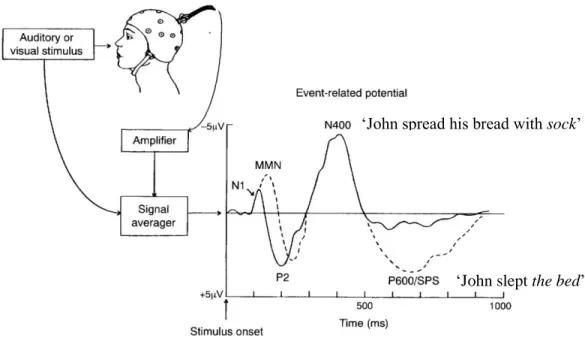
Several ERP components (amongst others that will not be mentioned here), have been associated with gradual stages of word processing (Fig. 1). For instance, it has been shown that N1 and P2 components are the first to appear and are sensitive to physical variations of a given stimulus (e.g., volume, frequency, intensity, duration, and phonetic changes). The auditory mismatch negativity (MMN), occurring between 150 – 250 ms post-stimulus, is an automatic and pre-attentive response to a stimulus that physically deviates from previously presented stimuli (for a review, see Näätänen, Paavilainen, Rinne, & Alho, 2007). The P3 component typically peaks between 300 and 400 ms in response to ‘oddball’ stimuli (low frequency stimuli) that are embedded in standards (non-target stimuli). That is, the P3 is associated with the detection and evaluation of deviant stimuli and reflects subjective probability of predicting the stimuli (e.g., for a review, see Nieuwenhuis, Aston-Jones, & Cohen, 2005). The N400 component is modulated by the semantic relationship between the target word and the previously presented information (for a review, see Kutas & Federmeier, 2011) whereas the P600 (late positive shift) component is modulated by the syntactic anomalies (for a review, see Kaan, Harris, Gibson, & Holcomb, 2000).
Page | 18
Figure 1. An illustration of obtaining event-related potentials, adapted from Osterhout et al., 1997. ERPs are extracted from the EEG by averaging across numerous presentations of visual or auditory stimuli. The N1-P2 complex occurs in response to the physical features of the stimuli. The MMN is elicited by the presentation of physically deviant stimuli. The N400 and P600 components are elicited when other aspects of words are processed, such as semantic and syntactic. While the amplitudes of the N400 are modulated by the semantic relationship between the target word (e.g., sock) and its preceding semantic context (e.g., John spread his bread with…), the amplitudes of the late positive shift (P600) are influenced by syntactically anomalous words (e.g., John slept the bed).
1.4.1. Semantic processing as measured by the N400
Here, the N400 component is in the main focus, for it reflects semantic processing of words. In Kutas and Hillyard’s (1980) study, participants read sentences that ended either with a congruent (e.g., I shaved off my mustache and ‘beard’) or with an incongruent word (e.g., I take coffee with cream and ‘dog’). The discovery was a negative component that peaked around 400 ms post stimulus, namely, the N400, and was more negative for incongruent compared to congruent terminal words, revealing an incongruency effect (Kutas & Hillyard, 1980; for a review, see Kutas & Federmeier, 2000). The N400 amplitudes were also shown to be more negative to single target words (e.g., nurse) preceded by unrelated (e.g., bread) than by related (e.g., doctor) prime words. This is called the N400 priming effect. Since, numerous studies have shown that N400 amplitudes are evoked in response to any semantic violations and reflect the meaningful/non-meaningful dimension of both linguistic and non-linguistic (e.g., drawings, pictures, faces) stimuli (Federmeier & Kutas, 1999; for an extensive review, see Kutas & Federmeier, 2011).
‘John spread his bread with sock’
Page | 19
Typically, the N400 appears over the centro-parietal recording sites (at the posterior areas of the scalp; Bentin, McCarthy, & Wood, 1985), but its latency (the time between the stimulus and the occurrence of the N400) and distribution vary according to the modality of the stimulus presentation. In the auditory modality, as opposed to the visual modality, the negativity occurs earlier, last longer, and symmetrically distributed over the left and right hemispheres (e.g., Holcomb & Neville, 1990; Bentin et al., 1985; Kutas, Van Petten, & Besson, 1988; Van Petten & Luka, 2006). These findings demonstrate that the N400 priming effect represents how related-meanings are represented in the semantic memory and that it is modality sensitive rather than modality specific.
1.4.2 Modulations of the N400
Both automatic activation and controlled processes were shown to modulate the N400 priming effects (e.g., Holcomb, 1988; Balota, Black, & Cheney, 1992; Brown & Hagoort, 1993; Anderson & Holcomb, 1995;Chwilla, Brown, & Haggort, 1995; Deacon, Uhm, Ritter, Hewitt, & Dynowska, 1999; Silva-Pereyra, Harmony, Villanueva, et al.,1999; Brown, Hagoort, & Chwilla, 2000; Hill, Strube, Roesch-Ely, & Weisbrod, 2002; Hill, Ott, & Weisbrod, 2005). There is some evidence that automatic process underlines the N400 and that controlled processes modulate its amplitudes, with larger priming effect. The N400 was shown to be more pronounced in the high than in the low relatedness proportion lists, suggesting that even if automatic processes are involved in the N400 priming effect, controlled processes contribute to its magnitude (e.g., Holcomb, 1988; Chwilla et al., 1995; Brown et al., 2000). On the other hand, Silva-Pereyra et al. (1999) found that relatedness proportion did not modulate the amplitudes of the N400, suggesting that in both conditions controlled rather than automatic processes underline the N400 effect.
While few authors suggest that automatic processes do not decay at a long SOA, such as two seconds (e.g., Deacon et al., 1999, 2000), others showed that controlled mechanisms underline the N400 priming at both short and long SOAs (Brown & Hagoort, 1993; Anderson & Holcomb, 1995; Hill et al., 2002). Anderson and Holcomb (1995) found N400 priming effects in both short and long SOAs in the visual modality but in the auditory modality priming effects were larger at the long SOA.
Page | 20
1.5. Conclusion
All in all, the above-mentioned studies indicate that associative, semantic feature similarities and taxonomic relationships underpin the adults’ semantic structure. This structure was shown to affect word processing, but the involvement of cognitive mechanisms occurs under specific circumstances, such as, the nature of relationship between items, the proportion of related word pairs in the experiment and the length of time separating the prime and the target, thereby modulating the semantic priming magnitudes. Furthermore, the organization according to semantic similarity distances was shown to affect word recognition when it is presented simultaneously with a visual competitor reflecting thus activation in the semantic network of neighbour words sharing different amount of features.
Despite these controversies found in some studies, sufficient knowledge about shared meanings between words and their integration into an interconnected semantic network has been evidenced. Yet, whether constructing a lexicon organized by semantic relatedness is a gradual process that occurs during infancy remains unclear. There is little evidence that children are sensitive to thematic, associative and taxonomic relationships. Still, how and when during language acquisition the semantic system is developed remains under-investigated.
Page | 21
2. Chapter II: The developing semantic system
‘How word meanings relate to each other in the lexicon during language acquisition?’
‘When do young children start to build their lexical-semantic system?’
2.1. Vocabulary development
A few months after their first birthday, infants express a dramatic improvement in their vocabulary skills, with the capacity of learning up to ten new words per day that occurs without any formal training and independently of the speaker and context variability. This accelerated rate of word acquisition is described as a burst in noun learning and producing, namely, the vocabulary spurt (Bloom, 1973; for a review, see Ganger & Brent, 2004). The vocabulary spurt has been suggested to reflect striking changes in word production especially, as infants reach 50-100 words in their productive lexicon (for a review, see Nazzi & Bertoncini, 2003). It is associated to object permanence knowledge, solved word segmentation (infants are able to pick out words from running speech), naming insight (young children understand that a word refers to an object and that every object has a name), object concepts (children begin to represent and use words learnt), and categorization (children sort objects based on category membership), which enlarge the child’s lexicon and induces a better understanding of words (e.g., Bloom & Markson, 1998; for a review, see Ganger & Brent, 2004; Fernald et al., 2006). The vocabulary spurt has been repeatedly interpreted in developmental studies as a sharp transition from a slow rate to an explosion in word learning. Indeed, watching the speed in which a child acquires new words is impressive. Even so, it has been argued that the increase of word learning is not sudden; rather, it is gradual linear increase (Elman, Bates, Johnson, Karmiloff-Smith, Parisi, & Plunkett, 1996; Bloom, 2001). As infants get more experienced with words, they become more efficient in extracting them from speech and understand their meanings. Moreover, a recent study have shown that even prior to their first birthday, infants relate spoken words to their visual referents, suggesting that learning word meaning occurs at early stages of language acquisition (Bergelson & Swingley, 2012).
Page | 22
Earlier studies investigating language development during the second year of life have focused mainly on word production (e.g., naming, pointing out) and less on word comprehension. Such studies have been considered to be biased because of the young children’s behaviour. If a child refuses to respond, the comprehension of words remains undetermined. Also, a child may produce words she does not necessarily understand; thus production is based on a simple repetition of a word that has been heard. Another related issue in early production is the ‘overextension’ (e.g., Bloom, 1973; Clarck, 1973; Huttenlocher, 1974; Thomson & Chapman, 1977; Anglin, 1977; Rescorla, 1980). The overextension is common across children and is prototypical of early word acquisition. It is defined as the use of a single word for a range of different referents from the same category. It has been argued that overextensions occur when word meanings are not well established. Clarck (1973) and Thomson and Chapman (1977) argued that overextensions are based on perceptual similarities between referents. For example, a child who produces the word ‘dog’ will use it for all four-legged animals, and a child who is learning the word ‘apple’, will apply it to ‘tomato’ or any other referent that is round, red and of a certain size. It can be thus inferred through the authors’ observations that the relationship between comprehension and production skills is not clear. Since production seems to be biased due to the reasons cited, assessing comprehension seems to be more plausible. To do so, new methods have been developed to tap into word processing and explore how word meanings relate to each other.
2.2. Exploring language processing
Several techniques have been commonly used to enlighten these questions: intermodal preferential looking (IPL; e.g., Golinkoff, Hirsh-Pasek, Cauley, & Gordon, 1987; Reznick, 1990), looking while listening procedure (LWL; e.g., for a review, see Fernald, Zang, Portillo, & Marchman, 2008), head turn preference procedure (HPP; e.g., Willits, Wojcik, Seidenberg, & Saffran, 2013; Delle Luche, Durrant, Floccia, & Plunkett, 2014) and ERP measurements (e.g., Mills, Coffey-Corina, & Neville, 1993, 1997; Mills, Plunkett, Prat, & Schafer, 2005; Friedrich & Friderici, 2004, 2005, 2010, 2011; Torkildsen et al., 2006, 2007, 2008). These techniques measure the online comprehension of speech and have proven to be well adapted to infant studies because no speech production or pointing out to images is required and they are easy to use.
Page | 23
During an experimental trial, in HPP, the infant is seated on his caregiver’s laps, facing a green center light. The green center light blinks until the infant’s attention is at the midline, then it is turned off and a red flashing light at only one of the two sides indicates the availability of an auditory stimulus. As the infant turns his head to that side, the stimulus begins to play and continues until the infant turns his head away for at least 2 seconds, indicating a loss of interest. The side on which experimental trials are delivered is randomized or counterbalanced. The preference of one stimulus upon another is indexed by the average length of the infant’s total looking time to the two different kinds of auditory stimuli presented on each side (e.g., Jucszyk, Cutler, & Redanz, 1993a; Nelson, Jusczyk, Mandel, Myers, Turk, & Gerken, 1995).
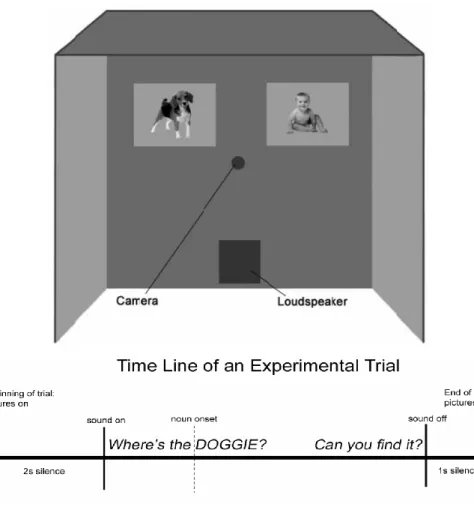
In both LWL and primed IPL tasks, children look at pairs of images while listening to speech naming one of the images, and their eye-movements and looking times are monitored. Word recognition is reflected by the speed of shifting gazes from the distracter to the target, while accuracy reflects the reliability of the response (Fig. 2). For example, children hear a carrier phrase ‘Where’s the baby?’ while looking at paired images illustrating a baby, the target, and a dog, the distracter. Both procedures allow investigating the precise time course of child’s gaze patterns in response to the named target. Also, these procedures reveal similar sensitive temporal measures as in eye-tracking studies conducted with adults.
Page | 24
Figure 2. Configuration of a test booth and schematic time line of a typical LWL trial, adapted from Fernald et al. (2008). An experimental trial starts by presenting pairs of images for 2 seconds, during which the child explores both pictures. After 2 seconds, the sound is played and eye-movements are filmed (e.g., Where’s the) and coded from the target noun onset (e.g., Doggie). On average, a trial lasts 6 to 8 seconds. The speed of reaction time in response to the named target noun is obtained from those trials where the child was looking at the distracter and then shifted to the target within the reaction time window (e.g., 300-1800 ms).
Though these behavioural procedures are easy to use with infants, some constraints are to be considered. Occasionally, it is difficult to capture the child’s eye gaze for a long time because of ‘fussiness’ or refusal to turn the head or look at the visual display. For this reason, experiments should contain a certain amount of trials and should be limited to few minutes. It is at this point that the use of ERPs technique is the most pertinent, for it offers insight into the brain implicit responses to external auditory stimuli, such as spoken words, even when behavioural responses are not required, such as head turn or eye-movements (e.g., for reviews, see Fernald et al., 2008 and Thierry, 2005). Although obtaining considerable ERP responses requires an important amount of trials, they can be measured even during passive listening and without any visual support, affording the infant with increased mobility. Trials containing artefacts caused by eye-blinks or
Page | 25
movements are cleaned with artefact rejection tool and are rejected in case of excessive noise. ERP measurements provide high temporal resolution, monitoring thus brain responses millisecond by millisecond. Even though some of the ERP components in young children were shown to be functionally similar to those of adults’, differences exist in terms of their characteristics. In young children, ERPs are often delayed can be inverted in polarity, and their topography might vary across studies (for a review, see Thierry, 2005).
2.3. Word recognition
2.3.1. Behavioural evidence
Both accuracy and speed of familiar word recognition were shown to increase significantly over the second year, and children were shown to progress rapidly towards an adults-like pattern of language processing (e.g., Fernald et al., 1998; Swingley, Pinto, & Fernald, 1999; Fernald et al., 2001; Swingley & Fernald, 2002; Fernald et al., 2006; Hurtado, Marchman, & Fernald, 2008; Bergelson & Swingley, 2013). Children are also able to associate a familiar word to the correct image, even when presented with partial acoustic information (first 300 ms of the spoken word; Swingley, et al., 1999; Fernald et al., 2001). Moreover, efficiency in processing word is correlated with age and productive vocabulary skills of each child. Those children who are faster in shifting their gaze to the named target image have larger vocabulary. As children mature, so does their vocabulary and their ability to recognize words (e.g., Zangl, Klarman, Thal, Fernald, & Bates, 2005;Fernald et al., 2006; Hurtado et al., 2008). In other words, during early stages of language acquisition, infants recognize familiar words and as they grow older, their vocabulary is increased, thus contributing to the speed and accuracy of spoken word processing. However, a recent study showed that infants recognized familiar words even prior to their first birthday, at 6 to 9-months, suggesting that relating a basic-level word to its referent occurs at this age already. This finding indicates further that at this age, word learning in not limited to sound structure of the native language but also to some of the word meanings (Bergelson & Swingley, 2012).
Page | 26
2.3.2. Electrophysiological correlates of word processing
Several components (e.g., N2, N350, N400, N600-900) were found to be associated with language processing during development. It has been suggested that the N2, a negativity occurring at 200 ms post-stimulus reflects the adults’ MMN (Thierry, Vihman, & Roberts, 2003). The N2 in 11-month-old infants was shown to be more sensitive to familiar words compared to rare (unfamiliar) words, indicating an automatic orientation of the attention to frequently heard words (Thierry, et al., 2003). The N2 was more negative over the right than over the left recording sites, assuming an early right-hemispheric involvement during language acquisition. While at 13 to 17-months, N2, N350, and N600-900 ERPs were broadly and bilaterally distributed, at 20-17-months, the effects were distributed over the temporal and parietal recording sites and left lateralized (Mills, Coffey-Corina, & Neville, 1993, 1997). These changes in ERPs distribution across age, from broadly distributed to more focal patterns, are suggested to reflect changes in the way lexical items are processed with increased language experience and a left hemispheric specialization for language (Mills, et al., 1993, 1997). The N600-900 component was larger for known than unknown words, over the right frontal recording sites at 13- and 17-months. The N400 priming effect in response to incongruent picture-word pairings was shown to occur in 19-month-olds and was broadly distributed (Friedrich & Friederici, 2004). In all these studies, language-related ERPs were also shown to be more pronounced in children with high comprehension skills, suggesting that receptive vocabulary contribute to the brain activity patterns.
2.4. The developing lexical-semantic system
Whether newly acquired words are semantically related to each other and integrated into an interconnected lexical-semantic system remains to be determined. It has been earlier suggested that word meanings are learnt in isolation and represented independently of each other (e.g., Anglin, 1970). For instance, young children learn and use ‘cat’ and ‘dog’ but they do not yet relate them to each other based on their semantic relationship. This question is of great importance because to date, the nature of semantic relations structuring the lexical memory during language acquisition, is under-determined. There is little evidence that pre- and school-aged children are sensitive to thematic, associative, and taxonomic relationships, indicating that these relationships
Page | 27
might underpin the lexical memory structure as in adults (e.g., Schvaneveldt, Ackerman, & Semlear, 1977; McCauley, Weil, & Sperber, 1976; Nelson, 1985; Blewitt & Toppino, 1991). Moreover, it has been suggested that over childhood there is an early (up to 6 years old) preference for thematic relations (e.g., eggs – cereals: breakfast schema) that is shifted later (from 8 years old and on) into a dominant preference of taxonomic relations (e.g., ice-cream – toast) considered to be more abstract (e.g., Hashimoto, McGregor, & Graham, 2007). In line with earlier theories (e.g., Inhelder & Piaget, 1964), these findings demonstrate that the developing conceptual system is structured according to thematic relationships and only later in childhood taxonomic relationships are integrated (for a review see Lin & Murphy, 2001). However, a study by Waxman & Namy’s (1997) showed that there is no preference of thematic (e.g., tiger – cage) over taxonomic (e.g., tiger – panda bear) relations, at younger ages as 4-, 3-, and even 2 years, suggesting that sensitivity to taxonomic relationships between items occurs much earlier than originally assumed (Markman & Hutchison, 1984).
2.4.1. Tackling the lexicon structure over the second year
2.4.1.1. Primed IPL tasks
It has been recently suggested that word meanings are semantically organized in a lexical-semantic system towards the second year of life (Styles & Plunkett, 2009; Arias-Trejo & Plunkett, 2009, 2013; Johnson, McQueen, & Huettig 2011). In these studies, an adaptation of the IPL procedure to priming paradigm was applied (Arias-Trejo & Plunkett, 2009, 2010, 2013; Styles & Plunkett, 2009). In the primed IPL paradigm, children hear a carrier phrase containing a prime word (e.g., “yesterday I bought a cat”) followed by an isolated target word, either semantically related (e.g., dog) or unrelated (e.g., plate) to the prime word. A few hundred milliseconds after the spoken target word onset, a pair of images, composed of the named target and a distracter, appears on the screen (Fig. 3). The priming effect is expressed by an increased looking time at the named target when it is preceded by a semantically related as opposed to unrelated prime word.
Page | 28 Figure 3. An illustration of a trial in a primed IPL task, adapted from Style & Plunkett’s study (2009). Each trial starts with a priming phrase (e.g., Yesterday I bought a cat), followed by an inter-stimulus interval (ISI) of 200 ms. Then the target word is delivered in isolation (e.g., Dog) and the presentation of target and distracter images begins at an SOA of 200 or 400 ms from the onset of the target word. The paired pictures remain on the screen for 2500 ms. Priming effect is reflected by longer looking to the target (e.g. dog) as opposed to the distracter (e.g. boat), indicating recognition of and preference to the target word.
The results of primed IPL tasks revealed that at 24-month-old, but not younger, children were sensitive to different semantic relationships between lexical items (Styles & Plunkett, 2009; Arias-Trejo & Plunkett, 2013). Priming effects were found for taxonomically related (e.g., rabbit – horse), associatively related but drawn from different semantic categories (e.g., carrot-bunny), and for both taxonomically and associatively related (e.g., cat – dog). Furthermore, when named target was absent (e.g. monkey), 24-month-olds were more likely to look at a taxonomically related (e.g., dog) than an unrelated image (e.g., apple) (Johnson et al., 2011). At 21-months, priming effects depended on ‘associative boost’, that is, priming occurred only when primes and targets were both taxonomically and associatively related (e.g., cat – dog). In addition, 18-month-olds looked at the named target irrespectively of its semantic relationship to the prime. At this age, priming effects occurred under specific circumstances, that is, when the prime and target were repeated and when the target word was named. The authors suggest that 18-month-olds are sensitive to the relationships between two identical words but that word meanings are not yet related to each other. Rather, lexical items are represented as isolated ‘islands’ in the semantic network. These findings reveal that only 24-month-olds, but not younger, integrate words into an interconnected lexical-semantic system according to different relations suggesting that taxonomic, associative, or both relation combined underpin the semantic organization.
Page | 29
2.4.1.2. N400 priming effect
The N400 ERP component has been associated to semantic processing also in young children. In picture-word priming tasks, the N400 was elicited at 19-months and was more negative for incongruent (e.g., word dog – picture of a car) than for congruent (e.g., word dog – picture of a dog) matching, over the left temporal and parietal recording sites (Friedrich & Friedrici, 2004; 2005b; Torkildsen et al., 2006). When the vocabulary size was included as a factor, the N400 effect was found to be larger over the right than the left hemisphere, as in adults (Friedrich & Friedrici, 2004). Studies have shown that the N400 effect was also obtained at 14- to 24-month-olds (Friedrich & Friederici, 2004, 2005a, 2005b, 2006), but not in younger infants as 12-month-olds, demonstrating that even though the mechanisms of N400 are mature already at 6-months (Friedrich and Friedrici, 2011), lexical-semantic representations are not yet consolidated at 12-months (Friedrich & Friederici, 2010). At 14-month-olds, children are able to integrate visual and auditory information based on their semantic relationship (Friedrich & Friederici, 2004, 2005a, 2005b, 2006, 2010).
It should be noted that the previously mentioned results were interpreted as a semantic integration of relationships between words. Still, the incongruity between a picture and a spoken word does not indicate whether words are organized into superordinate categories. To date, one study investigated the lexical-semantic structure in cross-modal priming (Torkildsen, Sannerud, Syversen, Thormodsen, Simonsen, Moen, Smith, & Lindgren, 2006). At 20-month-olds, the N400-like effect was obtained in between-category (e.g., a picture of a dog with the word “car”) and within-category (e.g., a picture of a dog with the word “cat”) violations, but it was larger for between- than for within-category violations (Torkildsen et al., 2006), suggesting that children were capable of discriminating between two basic-level words from the same superordinate category.
Although these studies indicate that by the end of the second year, the N400-like response reflect semantic integration of related picture-word pairs, even less is known about processing semantically related spoken words. There are only a few studies in which language-related ERPs in response to spoken words were investigated to explore the semantic memory structure (e.g., Friedrich & Friedrici, 2005c; Silva-Pereyra, Klarman, Lin, & Kuhl, 2005; Torkildsen et al., 2007). The results indicated that N400 ERP occurred in response to spoken incongruent terminal words (Friedrich & Friedrici, 2005c) and to taxonomically unrelated spoken word pairs (Torkildsen et
Page | 30
al., 2007), suggesting that words might be semantically organized in the developing lexicon However, further investigation is needed to clarify these findings.
2.5. Productive vocabulary skills influence on lexical-semantic processing
As discussed earlier, larger vocabulary size during the second year contributes to a better and more efficient processing of words (Zangl, Klarman, Thal, & Bates, 2001; Fernald et al., 2001, 2006). In the previously mentioned primed IPL tasks, receptive (Style & Plunkett, 2009) or receptive and productive vocabulary size (Arias-Trejo & Plunkett, 2009; Arias-Trejo & Plunkett, 2010) at all ages studied (18-, 21-, and 24-months) did not predict the magnitude of priming effects. The authors suggested that word recognition is not affected by the number of words in the child’s lexicon. Rather, priming effects were correlated to the familiarity with the words used during the experiment (e.g. Arias-Trejo & Plunkett, 2010), since children were tested with words that parents reported as known.
Productive vocabulary has been shown to modulate the brain pattern activity associated with word familiarity and processing novel word-picture associations. The N200-500 component, at 20-months, was found to be associated to learning novel word and novel word – object pairs (Mills, Plunkett, Prat, & Schafer, 2005) and to the congruity violations of these new learnt mappings (Torkildsen, Svangstu, Hansen, Smith, Simonsen, Moen, & Lindgren, 2008). When associating novel words to referents, the N200-500 was broadly and symmetrically distributed (Mills et al., 2005). The more the spoken words were repeated within the novel-object pair trials, the larger the N200-500 became, revealing a process of learning the new word meanings. The magnitudes of the N200-500 effect were not modulated by the children’s vocabulary skills. Still, a (non-significant) left hemispheric bias was found in high producers who have just acquired new word-object pairing (Mills et al., 2005), indicating that asymmetrical ERPs distribution emerges earlier when learning is accelerated. On the other hand, when the newly acquired picture-word associations were violated, the N200-500 effect was stronger in 20-month-old high producers than in the low producers, indicating that increased vocabulary enhances the establishment of new word meanings (Torkildsen, 2008). In the low producers group, the effect was weaker than in the high producers group and occurred later, supporting previous behavioural findings that productive skills contribute to the speed of word processing. These findings demonstrate that 20-month-olds can
Page | 31
integrate a spoken word to its visual context and rapidly familiarize with new pairings, especially when productive skills are increased.
Furthermore, it has been shown that increased vocabulary size modulated the lateralization and the timing of the N400 ERP, with a right hemispheric bias (Friedrich & Friedrici, 2004; 2005b) and earlier effect (Torkildsen et al., 2006) in those children whose vocabulary was larger. Similarly, the N400 effect at 12-months depended on the productive skills of infants and occurred only in infants with an accelerated rate of word production (four words and more), suggesting that the neural mechanisms indexing the N400 effect might not yet be triggered by the existing lexical-semantic representations in infants with normal language development. In those 12-month-old high producers, the N400 effect yielded a right hemispheric as in 19- and 14-months and in adults (Friedrich & Friederici, 2005a, 2005b, 2008) but with longer latencies, suggesting slower semantic processing. Thus, the occurrence of the N400 priming effect might be related to a certain state of brain maturation and the strength of lexical-semantic representations (Friedrich & Friederici, 2010).
2.6. Conclusion
Altogether, the previously mentioned studies reveal that over the second year of life children become more efficient at recognizing familiar words and progress towards adult-like word processing. There is also some evidence that word meanings are associatively and/or taxonomically related to each, suggesting that these semantic relationships might underpin the developing lexical-semantic structure. Even though productive skills were shown to contribute to the speed of word processing and modulate brain pattern activity, it is still unclear whether high productive skills contribute to the developing lexical-semantic organization.