The Language of the Rochester School:
Positive Accounting Theory Deconstructed
Nihel Chabrak
GET - INT (National Institute of Telecommunications) DRM- CEREG, University Paris IX Dauphine INT - 9
Ashley Burrowes1
Department of Accountancy, College of Business Administration University of Wisconsin, La Crosse
Summary:
This paper critically examines the basic tenets of positive accounting theory. We subject the language of Watts and Zimmerman’s 1986 definition of positive accounting theory to the activity of proof reading, in accordance with Derrida’s concept of deconstruction. We highlight traces of "logocentrism" in the words of the Rochester School and question them on their presuppositions and conclus ions. The description of these discourse characteristics in regard to the audience to which it is addressed makes it possible to draw theoretical conclusions on the ideological import according to Marx. The article is founded on a review of the critical literature of accounting, making use explicitly or implicitly of Derrida’s theory of deconstruction.
Key words: Positive Accounting Theory, deconstruction, ideology, supplements
The Language of the Rochester School:
Positive Accounting Theory Deconstructed
Abstract:
This paper presents a critical reading of Positive Accounting Theory. The article submits the language of Watts and Zimmerman (1986) to deconstruction, the object of which is to highlight traces of "logocentrism" in the discourse of the Rochester School and to question its presuppositions, worth and conclusions. The article is founded on state of the art critical accounting research, using explicitly and implicitly the Derridian concept of deconstruction.
1. INTRODUCTION
Deconstruction2 has overflowed from its discipline of origin to touch literature, painting, psychoanalysis and even accounting. While considerable ambiguity surrounds the concept, Derrida presents it as an advanced reading activity. Deconstruction stems from the conviction of the philosopher whereby what one can say of a thing is not enough to define such a thing. This is explained by structural flaws within language which prevent assessment of an infinite size gap, between “the stated” and "the non-stated”. In addition, a word can say what it is, as well as its opposite. Thus, the différe(a)nce becomes a reference to the undefined which therefore delays the true determination of that which brings identity or the articulated delineation of the issue. By dismissing the rigid stereotype, by tackling the Hegelian postulate on the true meaning of thought and of an system closure3and by rejecting the argument of the German idealistic philosophy from Kant to Hegel, and other philosophic theories on the dogma of identity, différance proposes that each identity has an inherent dynamism and is therefore postponed for all time.
By setting in motion the various facets of identity, deconstruction dwells on writings which have been the subject of secular discussion; oppositions between nature and culture; presence and absence etc…. This task evidences Derrida’s militancy in his quest for meaning. Derrida’s writing style which is semantically saturated and often criticized for being unclear, opaque and obscure (Vandendorpe, 1999), is the hall-mark of post-structuralism and the advent of a logic which goes beyond a two-subject opposition and the scientific ambition to satisfy a mechanical resolution.
2 Jacques Derrida is regarded as the father of deconstruction. The idea of deconstruction was taken by Derrida from Heidegger, for whom deconstruction is related to the tension between l’être and l’étant. Authenticity supposes an escape from the ordinary to contemplate its own finitude, under the imp ulsion of the anguish of the existence and the intellectual exercise of destruction. On the concept of Heideggerian destruction, see (Salanski, 1997).
3
Research programs in general and accounting research programs in particular often have obscure meanings. Thus, deconstruction aims to question assumptions, conclusions and their often arrogant attitude in order to reveal what underlies and predetermines them. It consists of detecting in a language the rhetorical elements4, and necessary to legitimize and persuade, (Chabrak, 2002) by which reasoning is provided with an hypothetical base with key concepts and basic premises (Searle, 1992). By untangling plots and exposing conspiracy, and by describing evidence of “logocentrism” and “full discourse”, deconstruction becomes the tool which allows an internal dialogue (interaction) with the text from within the text and challenges certainty. It questions all established corpus at the level of its theoretical base and its implicit definition of a certain set of priorities as well as its assertion to express a “Truth”. A theory cannot concurrently proclaim an all encompassing definition while at the same time permitting exclusions. Deconstruction, as a reading activity , thus invites the identification of supplements; either by digging for layers inside the theory itself, or by reassessing what was placed knowingly outside the theoretical corpus, in other words by restoring the "inset plate" (Bennington and Derrida, 1991). According to Derrida deconstruction and devised supplements are concepts that cannot be separately considered from the original idea. Indeed, the initial thought (original idea) never precedes the language. For Derrida, writing should no longer be regarded as a dangerous effort for the symbolic re-appropriation of the original natural presence, this truth former to all, which in its inaugural direction, can occur only once, at the beginning of all, to give direction to all. Moreover, according to Derrida, the origin would be the repetition of a first, a copy because it is recognizable only after the appearance of the second, whose delayed appearance, is the necessary condition so that it is first, which is finally only third. Writing is not a sign of another sign (discourse or speech) which would be a sign of the origin. In this case, the writing would be additional or supplementary, just like speech; it is the supplement for the original world which is beyond all (Derrida, 1967b). The concept of supplement makes it possible to think of origin, as a place where the originating idea doesn’t exist, and as a supplement which is a surplus, an extra which is added to a unit, supposedly complete, outside himself. Derrida took this idea of supplement from Rousseau who regarded it as extra,
4
They are the acts of communication by which individuals seek to convince "the audience" of the reality and the truth of their remarks (Hunter, 1990).
additional, “non essential” added to a complete unit. According to Derrida, the supplement is foreign to the subject and is added to complete it so as to add what’s missing within that subject (Derrida, 1967b). In fact, if the unit were complete, then nothing should be added to it. If the supplement is something "essential" and not a null concept, then it must reveal the deficiency of this unit. The supplement thus appears only when there is an initial lack; an absence in a thing which enables it to be supplemented.
To find meaning one needs an exit towards a place which is neither a "withdrawal from the case" nor another world, because one cannot think the unthinkable and cannot reduce to reason that which is other than reason. It is therefore necessary to go beyond the structures of a language or a text in order to better determine “the soul of the meaning” (Derrida, 1967a). The search for meaning infers that one thinks between the lines, the unstated and the remainder from a language to restore the "inset plate" (Bennington and Derrida, 1991), the invisible within. (Derrida, 1967a) states, "To write it is not only to know by the writing..., nor that the consigned expresses infin itely the universe, resembles it and always gathers (contains) it. It is also the impossibility of having the writing preceded by its meaning" (Derrida, 1967a, p.21). Thoughts do not guide the language from outside, because the meaning "must wait to be said or written to live itself and become that which differs from what it, itself, is." (Derrida, 1967a, p.21).
Finally, deconstruction is a process, whereby the insufficiency of a research method is revealed. It does not claim to be an absolute criticism imbued with negativity and emptiness as in nihilism. On the contrary, it leads one to realize the translation possibilities within language and an attitude of dialectical reflection. Thus, deconstruction is not a simple practice undermined by polit ical impetuses that reduces freedom and action. It seeks neither to prove, refute, nor to even bring answers or truths since it keeps on questioning and perpetuates a conversation (Searle, 1992). Therefore, deconstruction is not a phase of demolition which an precedes rebuilding. The concept of steps does not, in fact, exist in the Derridian reasoning. Deconstruction is an effort exerted to keep one’s own freedom (liberty) to question, resist and disobey (Derrida, 2000). It is an exhibition of the demand for the right to be different and to think it.
Research in accounting is marked by a hegemonic and elitist positive accounting theory. While presented as the dominant accounting theory, positive accounting theory presents itself as an iconoclastic force that immobilizes and negates any inquiries that opposes it and its ontological basis. (Arrington and Schweiker, 1992; Chua, 1986; Laughlin, 1995). It “ostracizes" all those who think differently and reduces their efforts to a “state of nirvana". Considered as sacrilege, their speech is abolished, like writings destined for extinction in a "dead" letter-box, such is the tragedy described by Derrida. Scientific dialogue reaches an end when reasoning is a repetitive commentary of the main theory. In this case, the scientific community appears to be nothing but a gathering of researchers having a single and monolithic view, a large scheme where the role of each one is to rehash what’s legitimate (Clarke et al., 1999), supposedly in conformity with the rules of "scientifically correct" (Chabrak, 2002).
How was this monopoly built? How was positive accounting theory mystified? An important body of work in critical accounting research was established with the application of deconstruction to the discourse of the Rochester School.
This article proposes to use deconstruction to critique positive accounting theory in order to highlight the strategy which led to the near monopolistic and n acceptance of the theoretical position of a positive accounting theory despite the structural inconsistency of the language of its precursors: Watts and Zimmerman. Within this framework, this paper presents a synthesis not only of work directly inspired by the Derridian method but also writings which, to us, implicitly use this line of reasoning. Criticism drawn up against positive accounting theory goes beyond the limits formulated by the positivists themselves and such criticism in fact preserves the hegemonic status of the theory and therefore limits the extension of the fields for accounting research. The purpose of this work is less to evaluate the results of the positive school, which can be solid from the point of view of theory, but rather to question the arrogant attitude of positivist researchers particularly that pertaining to their theories. For that, we will start with the analysis of the definition of Positive Accounting Theory by Watts and Zimmerman (1986). Then, we will question the presuppositions and the conclusions of this theory while highlighting its ideological dimensions.
2. A DECONSTRUCTION OF THE LANGUAGE OF THE ROCHESTER
SCHOOL: ANALYSIS OF SUPPLEMENT S
In this section, we address three important aspects of the definition of positive theory as defined by Watts and Zimmerman (1986); Identifying the theory which studies accounting practice (1) Within a descriptive framework or "positive" approach (2), In order to explain and to predict the behavior of accountants (3).
2.1. THE POSITIVE THEORY THAT STUDIES ACCOUNTING PRACTICES…
Positive accounting theory claims to be interested in accounting practice. Admittedly, the concept of accounting practice is basically dependent on who conceives it. It contains a "cultural load" (Lecointre, 2000) and testifies to a true human experience (Colasse, 2000a). Consequently, it is essential to understand the aspirations of accountants in order to build a theory of accounting. However, does positive accounting theory offer an adequate theoretical framework to study such behavior? Its authors seem to present their theory as being the analytic framework reference for the behavior of accountants.Analysis of the theoretical corpus of positive accounting theory shows its attachment to an economic dimension, with particular emphasis on the economic model of the Chicago School (Whithley, 1988). This "inset plate", affects the theory and constitutes a fundamental presupposition on positive accounting theory.
Thus, to claim to be able to explain accounting behavior, Positive Accounting Theory ought to be able to prove not only that the observation of economic facts is sufficient but also from the
Initially, we will analyze the reasons for which the Rochester School chose to be affiliated with the Chicago School; by supposing that economic aspects could explain all phenomena rela ted to behavior. Then, we will examine the basis for the concept of the relation between economic and social phenomena.
The Rochester School was heavily influenced by the Chicago school of economic thought but this was not always well identified. Certain authors think that it is mostly rhetoric5, since it made it possible for positive theory to constitute a certain legitimacy and to consolidate its strategy of persuasion. Indeed, by claiming a certain complementarity (Mouck, 1992) between the two currents of thought and by invoking names such as Friedman, with its fame and later notoriety, positive accounting theory attempted to legitimize itself even though not scientific ally founded. Moreover, this identification with Milton Friedman and the emergence of positive accounting theory in the year Friedman was awarded the Nobel Prize could explain its success. In addition, the undeniable advantage drawn from this affiliation to the Chicago School lies in the possibility of offering a theoretical delimitation located outside the theory itself. This makes it possible to condition the fields of observation and, consequently the research conclusions, and to continue to distinguished itself from the normative approaches accused of carrying value judgments. Indeed, as already determined by Friedman, in specifying from the beginning of the foundation of the theory all value judgments determining the choices and orientations of the theory, then the results of "positive" research could preserve the requisite objectivity and neutrality. Consequently, the theory formulation is no longer prone to criticism because of the supplement placed inset plate (Tinker et al., 1982). This attachment to the Chicago School reinforces the language of the Rochester School, its arrogance and its claim to non-normative positive posturing which presents the second challenge in the definition of the theory. Before considering this aspect, we will analyze the relationship between the economic and social phenomena to judge if the knowledge of the former would be sufficient to understand the latter. From
5
Demski (1988), Sterling (1990) and Reder (1982) support the idea according to which, the use by positive accounting theory of the assumptions and the models of the school of Chicago is basically rhetoric. They raise some discordance between the choices made by the school of Rochester and certain positions of some authors of the school of Chicago like Paul Samuelson and Herbert Simon (Sterling, 1990). By way of example, Reder (1982) raises the variation on the level of the choice of the data for empirical tests .
the point of view of the neo-classic al economists, knowledge of relations and social structures affecting economic relations makes it possible thereafter to have an explanation only from the economic viewpoint. In such a case, social influence is regarded as an external force which, defined once, can be neglected thereafter. This vision unfortunately does not recognize the overlap between the various phenomena and their basis in a social reality (Granovetter, 1985). With the negation of the relationship between economic phenomena and social facts, critical accounting researchers introduced the philosophy of practical reflexivity or the negation of negation (Tinker, 1985; 2001). Tinker alerts us to the distinction made by Marx between market phenomena and the accompanying social structure. It shows that economic facts alone can fail to identify social conflict and volatility (Tinker, 1985, p.28). In other words, it is necessary to study social phenomena in order to explain economic dimensions and not the opposite (Chabrak, 2005). Thus, it is of primary importance to reconsider in our theoretical reflections the social dimensions of practice and to bypass the structural negation of the role of the subject inherent with realistic philosophy. According to Tinker et al. (1982), this negation, through the schism between the subject and the object was fundamental in guaranteeing the credibility of the language of positive accounting theory. This established their claim to a positive posture, but they were unaware of the fact that the observer is the product of the reality which he observes and contributes to modeling it by his knowledge and actions. The accounting number is not on standby to be discovered like an atomic particle; it must be invented and created (Chabrak, 2005).
2.2.... WITHIN THE FRAMEWORK OF A DESCRIPTIVE OR "POSITIVE"
APPROACH...
The positive accounting theory of Watts and Zimmerman, which systematically uses recourse, is allegedly founded on a scientific positive approach, contrary to the normative approaches which carry value judgments and presuppose ideals (Colasse et al., 2001). The positive posture is supported by three fundamental characteristics: objectivity, neutrality and critical rationalism. This relatively positive approach represents a positioning within the basis of science which conditions the definition
of accounting theory. It is a position borrowed from John Stuart Mill who thinks neutrality is the catalyst of autonomy (Christia ns, 2000). A science consists of describing observed phenomena and the operation of the world; it should not define how the world must function nor model an ideal. Objectivity is also a repercussion of induction which, according to Francis Bacon, is the antidote of prejudicial claims to any knowledge (Boland and Gordon, 1992). Actually, the model of production of knowledge according to positive theory is a little more complex because it is founded on a dialectical step between reason (hypothetical-deductive approach) and observation (positive approach), a step which allows the rationalization of reality at the same time as the realization by reality. The role of science is to study reality according to its own immutable laws and in the search for discovery. The movement in the experiment thus aims at the adaptation of our reasoning (assumptions), thanks to inductive logic, and natural phenomena in order to give our intelligence access to rational positivity. Auguste Count speaks "about establishment of the natural laws in the constant subordination of imagination to observation, to see in order to envisage". The natural laws would be, therefore, a construction on the basis of external materials and using our perception by means of interior and external images standardizing itself around a normal image (Kremer-Marietti, 1982).
Is it possible that a theory based on an objective observation, before language (pre-linguistic), can exist? Can language be a mimetic representation of reality, as positive accounting theory claims? Is it possible that an absolute realistic language, describing the real operation of the world, can exist? We feel that the positioning of the researchers from the Rochester School as to the question of the language was not always easy to discern. In the 19th century, positive science was associated with the concept of positivism. In addition, several authors of positive accounting theory declared themselves to be logical positivists, by recognizing the epistemological implications of the language. This position was clearly refuted by Jensen who regards a theory as a mimetic representation of behavior. This highlights the current controversy surrounding logical positivism in that it does not recognize the privilege of observation. Actually, logical positivism, historically considered as being a correction of positivism, has been controversial since the linguistic revolution of the Fifties (Arrington and Francis, 1989). Watts and Zimmerman (1986) seem to agree with Jensen’s position by distinguishing their theory from the logical positivism of the Thirties. They estimate that there can be only rough elements
in positive or scientific theories (Boland and Gordon, 1992). To answer this assertion, a question can be raised: are the materia ls from which the universe is formed really the atoms and the molecules of physical theory (Barreau, 1998)? In addition, because of the impossibility of dualism and of the separation between subject and object, a theory can no longer claim to be objective or neutral. Kuhn (1970) underlines the deeply social and political character of knowledge and its production. Knowledge is initially spoken, and then becomes text, a human production which cannot be separated from the language in which it is formulated (Arrington and Francis, 1989). Further knowledge reflects our fabric of values, our theoretical predispositions, our current knowledge (Hunter, 1990), and the political beliefs and ideologies (Arrington, 1997; Smith and Deemer, 2000) which transcend it. Science is more the projection of the social and linguistic world (Arrington and Francis, 1989; Tinker et al., 1982) than a simple pure and rational observation within the meaning of objectivity and neutrality (Lodh and Gaffikin, 1997). Science as an activity implies the fallibility of human beings and their interaction with the real world. And reality would be thus more metaphorical than rough (material) on standby to be discovered (Hunter, 1990). Any claim for the universality or ahistoricity of knowledge is nothing but the rhetoric of science (Hunter, 1990). In the same way, the practice and research of accountants is the expression of a social behavior, of the cultural and political environment as well as characteristics of the group which produces it (Riahi-Belkaoui, 1997). It would be consequently a social and reflexive construction, the institutional incarnation of the values of its partisans (Morgan and Willmott, 1993; Tinker, 1980; 1988; 1991; Tinker et al., 1982). The realistic position of positive accounting theory thus raises an intellectual naivety, that of a deliberate action to impose a certain set of priorities and a political vision of social conflict. (The realistic position of positive accounting theory arises less from intellectual naivety, than from deliberate action imposing a certain set of priorities and a political vision of social conflict.) The evidence of a suspect positivist attitude, we feel the interest of the Rochester School was the study of real practice, instead of prescribing what must be accountable practice, which is a contradiction with its espoused intention to improve the decisions taken by managers and by standardization bodies, attitudes which propose ideals and which are consequently prescriptive and normative. Moreover, by its attachment to
neo-2000b; Colasse et al., 2001), according to which, the pursuit by individuals of their own interests would be a necessary condition for public interest. Thus, if all individuals act within the framework of the assumption of maximization then the social optimum would be reached. Without stating it explicitly, this assertion describes a particular social order. Indeed, accountants consider that the maximization of wealth would be the proxy of social ric hness, excluding in fact all goods which do not have a monetary equivalent, such as health and the regard of oneself (Cooper and Sherer, 1984). Moreover any concept of order is related to a concept of balance which is essentially normative, because it is the antithesis of chaos and anarchy (Chabrak, 2002). In this order, individuals act individually and are in free competition on the market, without being able to consider that they are affiliated to unequal social classes. So exchanges are not structurally unequal which minimizes the importance of analyzing the processes and historical dynamic of wealth development and accumulation and benefits the study of rational expectations, the object of positivist research (Tinker, 1985). In addition, the postulate of opportunism represents an economic reading in which the interests of shareholders prevail since it expresses the conflict relationship between management and shareholders from the point of view of the Chicago School (Reiter, 1997; Williams, 2004). This bias is contradicted by the neutrality and the alleged objectivity of the Rochester School, which is at the core of positive accounting theory.
In addition to this alleged neutrality and objectivity of their theory, Watts and Zimmerman advance the Popperian criterion6 of refutation which makes it possible to dissociate "science" from "pseudo-science". Indeed, the advantage of a positive step, according to the Rochester School, lies in the possibility of refuting proposals particularly by observation. However, Watts and Zimmerman (1986) seem to make an erroneous and confused reading of Karl Popper’s standards of falsification (Christenson, 1983). Initially, the core of the positivist research program, namely; the postulate of opportunism, was by nature, unfalsifiable . It presented the character of a tautology not allowing its negation (Sterling, 1990). Indeed, some assumptions which diametrically oppose one another result
6
The dogmatism which characterizes certain normative assertions does not lend itself to the refutation of Popper’s critical rationalism.
from this7. Moreover, positive accounting theory by delimiting the object of the research to only economic behavior circumvents criticisms addressed to this postulate. Watts and Zimmerman do nothing but reinforce its dogmatic character since the definition of economic behavior is nothing other than the maximization of utility. So the maintenance of the postulate is not inevitably justified by its explanatory power. Reder (1982) drew a parallel by showing that by instituting the ornithological principle according to which birds fly and by defining as a characteristic of a bird its capacity to fly. The first principle becomes unfalsifiable because of the delimitation of the field of observation. Indeed, the observation of a kiwi does not constitute a falsification of the principle because its incapacity to fly eliminates it, in fact, from the field of observation8. Then, irrefutability could be inherent to the limits of empiricism, where observation is often conditioned by theory. Indeed, observation and visual experiment in particular can be strongly conditioned by the presuppositions of those doing the observation. Thus the observation would be more the projection of our ideas. According to Merleau-Ponty (1945), "empiricism is not occupied by what one sees, but by what one must see". The observation is guided and rarely encased in the world which surrounds it , and is not simply forced by it. Varela et al. (1993) examined the study of Held and Hein which raised kittens in darkness to expose them later to light under controlled conditions to illustrate these proposals. According to the authors, the first group of kittens was allowed to circulate normally while being harnessed to a car transporting the second group. They shared the same visual experience as the second group which was entirely passive. Once in the light, the kittens of the first group behaved normally whereas the others, which had been conveyed in a car, behaved as if they were still blind, knocking themselves on objects and falling over edges. The authors show through this experiment that the vision of objects does not consist of extracting some of the visual features, but to visually guide the action directed towards them (Varela et al., 1999). Thus, the visual experiment can mislead and direct our theories by the weight of tradition, which is opposed in particular to change. The researchers tend
7
Sterling (1990) takes the example of the fireman who, by abstaining from or saving a victim, acts opportunis tically in both situations.
to adapt to the dominating theoretical framework rather than to allow failure to challenge it9. Moreover, the history of science shows that the majority of projections appear more in a context of crisis of a discipline or adjacent social system. According to Tinker et al. (1982), Marxism would never have had its success if the worrying consequences of capitalism had not been felt.
Another aspect allowed Watts and Zimmerman to overcome the test of falsification: There are slips in their definition of a theory. As Boland and Gordons (1992) underline, Watts and Zimmerman stipulate in 1979 that assumptions must be confined to form a theory. These remarks were corrected in 1980, by limiting the requirement to the simple fact of being able to test the assumptions. In 1990, they launched a new challenge by stating that only the methodology which produces useful theories will survive! …and that time will prove that the positive approach is suitable (Boland and Gordon, 1992). This language reinforces the conventionalist character of positive theory which does not correspond to the standards of falsification. Indeed, the doctrine of conventionalism stipulates that a theory cannot be completely true (nor distorted), but that it can be regarded as being the best in comparison with the criteria and conventions at a given time (Boland and Gordon, 1992).
Lastly, the structural10 construction of the assumptions of positive theory contributes to dissimula ting statements of the field of the Popperian refutation. In the construction of their assumptions, the researchers often tend to omit the hypothetical character of the postulates and starting formulations and seem to attach more importance to the methodological questions. Obsessed by a statistical preoccupation with rigour (Baker and Bettner, 1997) and by techniques, positive researchers are drowned in the method instead of testing paradigmatic construction. The conventional a priori which
9 While proceeding to a redefinition of their variables in order to erase the anomalies observed between the empirical theories and results (Williams, 1989), they allot sometimes the empirical not-validation to their incapacity with formulating the assumptions. If not, how does one explain the maintenance of the assumption of Market efficiency in spite of the fact that the empirical studies failed to prove it?
10
The structural construction of knowledge (Moigne, 1999) finds its best illustration in the theory of the cognitive development of Piaget. Indeed, the child evolves by exploration of his world which enables him to improve his knowledge by extension (increase of the number of explored cases) and by reorganization (refinement of the comprehension of the cases already explored thanks to the new discoveries). The child becomes more methodical and acts in a way more structured to make progress his knowledge by integration and accumulation, in a structural way, while passing from a stage of development to another. This design of the evolution of knowledge presupposes a given reality, preexistent which we must rediscover. Indeed, the genetic epistemology of Piaget is a naturalist epistemology, wh ich recognizes a continual construction of knowledge while admitting that the object exists independently of us without ever being completely reached (Piaget, 1970). We consider that positive research espouses a structural and successive formation of knowledge, following for example that of genetic psychology.
is relative to a given time, is established as immune evidence which is not subjected to evaluation of its relevance. In short, the claim of the Rochester School in being able to meet the standards of critical rationalism is not proven. This is in total contradiction to what constitutes a methodological basis of science according to positivist researchers. Critical rationalism would be more an alibi and an instrument to dissociate positive accounting theory from nonscientific normative approaches.
Lastly, it seems that Watts and Zimmerman confuse a descriptive approach with an objective and neutral positivist posture. Indeed, it is always possible to observe the phenomena, to interpret them and contribute to their comprehension without being dissimulated behind an approach deprived of value judgments. What experts and academicians have need of is research which tries to describe and interpret the behavior of accounting and accountants in the environment in which they are historically located as well as the institutions, the social and political structures and the cultural values which characterize it (Cooper and Sherer, 1984).
2.3.... IN ORDER TO EXPLAIN AND TO PREDICT THE BEHAVIOR OF
ACCOUNTANTS.
The Rochester School seems to assert exclusivity as regards the prediction and the explanation of the behavior of accountants and accounting information. Actually, Watts and Zimmerman insist on the explanatory capacity of their theory, while betting on reciprocity between the act of prediction and that of explanation. In other words, any theory having an explanatory capacity can be used thereafter to build predictions. The question that remains is to know for which reasons the authors of the Rochester School took this "realistic" position? Zimmerman (1995) affirms that the objective of positive research is to develop a theory which makes it possible to explain the observed phenomena. This position constitutes actually a strategy of defense against criticisms of the instrumentalist vision defended by their inspirer Milton Friedman, according to whom, the scientific utility of a theory resides in its capacity of prediction and that even if it does not account for real practices (Cooper, 1980). But, it seems that the realism of positive theory is only rhetoric, since in other discourses, Watts and
Zimmerman seem to approach the instrumentalist position of the Chicago School by affirming that when theories are imperfect, the criterion of selection would be the capacity of the theory to give the best forecasts (Boland and Gordon, 1992). Subsequent to this debate (to explain/predict), certain authors like Demski (1988), call into question the explanatory capacity of positive accounting theory considering it to be purely and simply a descriptive theory. Demski thinks that the explanation should be to analyze motivations rather than report the evolution of the accounting choices. Positive theory is not able to explain or to predict because of its nomothetic research protocol where only systematic and sophisticated approaches can grasp the modeled universe, through the discovery of the relations of causality between the different variables of the model. Initially, by establishing causalities, a theory can only apprehend the operation of a given system. Physical science seeks, through causalities, less to explain or predict the natural laws than to provide an approximate ideal model of reality (Tinker et al., 1982). According to Manicas (1993), physical theory, under the terms of Duhem, would be an abstract system the goal of which is to summarize and to classify in a logical way a group of experimental laws without asserting to explain them. Explanation strips away the nature of all misleading appearances which cover and veil it. This is the object of metaphysics (Manicas, 1993). Therefore, modeling reduces, even disfigures the system which is the organization. Indeed, in addition to the necessary condition presupposing the existence of a model world which does not need radical change and which is waiting to be discovered (Laughlin, 1995), the question of modeling quantification arises. Modeling and quantification are expressions of the same identity. This has major implications, for any phenomenon escaping from measurement will be purely and simply ignored (Stamp, 1993). Modeling implies a principle of inclusion thus - exclusion, by paraphrasing Colasse (2000a) which can lead to extreme situations, in particular on the ethical level. Then, the causal protocol, related to this modeling, can be applied only if the studied system is closed and composed of objects, which can be discriminated, and whose mechanical relations are isolated (Tomkins and Grove, 1983). Accounting practices concern decision-making processes which arise from individuals, animated by continuously revised motivations, when dealing with complex organizations and their environment. Thus it is difficult to draw conclusions starting from observation of correlations between variables and to establish the consequence of causal relations, without analyzing the intermediate processes. Indeed, it
is possible to raise a simultaneous evolution of two variables without there being a relationship of cause and effect between them (Tinker, 1988). Moreover, the relationship between two social phenomena depends on intermediate networks which would be necessary to identify to appreciate the nature of the relationship and its possible evolution. The mechanical nature of causality cannot be applied to human and social reality because it is built on the basis of Newtonian mechanism, according to which there is an ontological separation between cause and effect on the one hand and on the other hand the change of other relationships that do not deteriorate the studied relationship. Human and social reality is dynamic and complex. Because of the existence of internal relations, causal mechanisms can produce a particular phenomenon in a given context which can deteriorate or change in another configuration (Whithley, 1988). It would be more judicious to explain social phenomena starting from their context. The problem of causality is that it seeks to attribute a capacity and energy to the explanatory factors, by regarding them as "the causes" of the studied phenomena. According to Manicas (1993), it is the salt which dissolves in water but neither salt nor water are not solely "NACL" and "H2O", theoretically definite as "salt" and "water". There are other substances and the theory of dissolution of "NACL" in "H2O" is only one approximation of the phenomenon. For social facts, often the complex and contingent context explains one of the possible configurations of the relationship. Lastly, the tests of causality suppose the definition of proxy for the variables which can be indicators for several variables simultaneously, like the example of size for the implementation of the assumption of the political costs (Williams, 1989). In short, the nomothetic methodological rules of positive accounting theory, handle invariant quantitative variables in a mechanical way, and preach universal declarations expressing external relationships This is a technocratic and restrictive explanation of accounting choices (Baker and Bettner, 1997; Laughlin, 1995; Laughlin and Lowe, 1990) which do not have any application in the social sciences (Mumford, 1993; Whitley, 1988). This scientism prevents all "familiarity" with social phenomena (Lindsay, 1993) and the comprehension of such requires a major investigation.
of demarcation and legitimization, which made it possible for the Rochester School to claim to be scientific in accounting research. By defending the integrity of a theory based on the independence and neutrality of empirical observations, because they are external and are referred to an objective reality, the originators of the positive accounting theory show a philosophical failure by being unaware of the capacity to build reality within the framework of social intersubjectivity (Arrington and Francis, 1989; Arrington and Schweiker, 1992). Their language, marked by a positive proselytism, misses intellectual credibility and is only allegation. Positive accounting theory is thus far from being a prophetic gesture (Arrington and Francis, 1989) and consequently it is necessary to question it on its presuppositions and conclusions.
3. PRESUPPOSITIONS AND CONCLUSIONS
OF POSITIVE
ACCOUNTING THEORY: ITS IDEALOGICAL DIMENSIONS
In the first part we showed the suspect character of the language of Watts and Zimmerman on the positive accounting theory. This language was more of a persuasive nature than a true reflection of the research program of the Rochester School. What are, therefore, the presuppos itions and the finalities of positive accounting theory? What is the real agenda which motivates the pioneers of this theory and the implicit set of priorities which they defend? (1) Does cognitive reorientation as practiced by the current proponents of positive accounting theory, - while making certain phenomena more visible, building values, and avoiding perceptions, - constitute proof of its will to promote and legitimize particular interests? In this exercise, has it operated, by the adaptation of its language to the audience characteristics? Finally, even if it is supposed that the theory does not lack basis or rationality; can it then constitute an ideology and a political instrument within the framework of social conflict? (2)
3.1 PRESUPPOSITIONS AND CONCLUSIONS OF POSITIVE ACCOUNTING
THEORY…
Faced with the absence of opposition between normative and positive, the concept of positive science is more instrumental in a strategy of legitimization. It distances itself from other current accounting research which is reduced to its opposite of "pseudo-science". This discovery encourages us to analyze the true agenda of the Rochester School and the set of priorities which it wants to defend. For that, we visit the and constitution of the matrix of beliefs, values and attitudes shared by the dominant groups of its time. Thus, we will refer positive accounting theory to the socio new-historical and institutional context of its appearance.
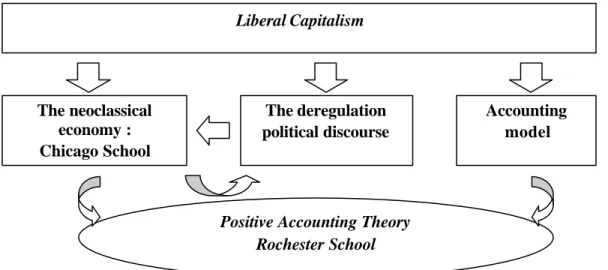
This period was characterized by the coexistence of four forces whose interactions allowed its appearance (figure 1). The existing accounting model encourages the positivist tendency. Indeed, by getting a follow-up of the complete cycle of the capital, in particular new through the representation of wealth creation and the concept of profit, accounting provides a particular reading of the consequences of the organizational actions which support the capitalist economic vision (Lecointre, 2000). The accounting model regards wages as a cost and not as a form of sharing whereas the reserves are added to the capital as the only possible allocation of these funds. Moreover, the accounting model considers the question of maintenance only for financial capital and never for the human one (Cooper, 1980). In short, the accounting model shows the size of the cake and the means which make it possible to enlarge it (among others the incentive to control workers costs), without allowing any questioning of the way in which it is allocated (Tinker, 1985, p.172) which depends on structural relations and on the institutional forms characteriz ing contemporary capitalism (Neimark and Tinker, 1986). The accounting model thus does not make it possible to question the actual order on any social justice. Indeed, the unequal transactions can be profitable to the company whereas they are the very essence of modern exploitation and alienation. Accounting would be thus unable to detect this expropriation in the exchange and, consequently, to call into question this logic inherent to capitalism, offering to one class better opportunities to remain to the detriment of others (Tinker, 1985, p.174). In short, the current accounting model made less visible and less comprehensible the
various forms of alienation conveyed by capitalism and the contradictions of the existent social system (Tinker, 1985). The philosophical basis of positivist accounting work transcends its research program and prevents it from developing an emancipatory accounting model. Positive accounting theory becomes thus the instrument of research in accounting which makes it possible to perpetuate the status quo.
Figure 1. Context of emergence of Positive Accounting Theory (Chabrak, 2002)
Then, the glorification of the viewpoint of the positivist economists known as the Chicago School was fundamental for the completion of the new political geometry for capitalism (Williams, 2004). The attachment of accounting researchers to marginalism is explained by the fact that it considers the questions of allocations those of institutional relations configuration as being exogenous which do not take place to be in their model of analysis (Cooper, 1980). Moreover, by drawing aside from the debate any question relating to how the exchanges can be structured, through the current state of
The neoclassical economy : Chicago School The deregulation political discourse Accounting model
Positive Accounting Theory Rochester School Liberal Capitalism
institutional arrangements and the social relations, neo-classic theory perfects the theoretical argument to darken the debate about the desirability of the existing order (Tinker, 1980; Cooper, 1980; Cooper and Sherer, 1984). Neo-classic al theory consecrates the idea of the free market and its success is attributed to its capacity to provide the required rationality for the political language of conservatism of the Reagan administration of the United States and Thatcher in Great Britain. By imputing to interventionism the responsibility for the mediocrity of economic growth, the economy of laissez-passer became the unique alternative for prosperity and economic development (Tinker, 1988). This context pushed Watts and Zimmerman to take up again this political revolt against the interference of the State in economic affairs (Mouck, 1992) and the prohibition of official interventionism encouraging citizens to adhere to a particular belief to the detriment of all others. Thus, positive accounting theory is a histor y, which describes the world as it is , in the context of regulation of accounting practices and how it would be in the absence of this regulation (efficiency of the market, by way of example). According to Watts and Zimmerman, the regulation of accounting practices can interfere in the efficient operation of the market and slow down thereafter the increase of wealth according to Pareto. This concept, centered on the notion of efficiency, is preoccupied only with utility, translation of utilitarianism and neo-classic al design of ethics. To conclude, we can say that the political origins of positive accounting theory are illustrated by its justification of deregulation in the accounting sphere. It constitutes less a neutral construction of reality than a genuine instrument within a social conflict and a struggle for intellectual control (Chabrak, 2002).
3.2.... AND ITS IDEOLOGICAL DIMENSIONS.
This last section is devoted to the analysis of the ideological range of the positive accounting theory. According to the Marxist definition of ideology, the false is insinuated into the process of construction of a theory and its diffusion, an untruth which can attack even the contents of this theory. According to Hunter, the assertions do not have the character of absolute truth since all is negotiation and construction in rhetoric and social interaction which develops between researchers and audience. In the light of what was presented in the preceding parts, we will try to see whether the construction of
the discourse arises from a process of adjustment of the features of the theory to the characteristics of the audience. In other words, do aspects advanced by Watts and Zimmerman as being the bases of positive accounting theory have the necessary force and the capacity to please the audience concerned? Initially, according to Watts and Zimmerman their theory is founded on a positive approach which would be thus neutral and objective. According to Christians (2000), it is judicious to advance an element with an audience which tried out its opposite for a long time in the new. Thus, the search for neutrality emanates from the perfect knowledge of the intellectual and ideological positions of the audience to which it is addressed, since it constitutes a logical alternative to a society familiar with different beliefs and attitudes. Moreover, Watts and Zimmerman claim to want to build a scientific theory. They start from a particular vision of science, defended by their precursors of the Chicago School, who wanted to build a theory like those of hard sciences, in particular physics (Casta, 2000). The examination of historical parallels shows that the founders of the neo-classical economy copied the theories of physics of 1870. This can be observed through several demonstrations, like the proposal for a modeling of reality or the concern of economists of the Chicago School for the states of equilibrium. Individuals in an economy are quickly selected, after a process of training, to behave in an optimal way. The economic environment changes sufficiently slowly, so that these individuals no longer need to continue to learn. In addition, the concept of the firm as nexus of contracts illustrates the focus of Jensen on the concept of stable equilibrium (Arrington and Francis, 1989) even if this concept is opposed to a vision of the economy as adaptive complex systems that are not converging inevitably towards a standard economic equilibrium (Kirman, 1999), and even if it contradicts the very essence of behavior which is necessarily dynamic. A second manifestation of the will to appear like the mother science would be the choice of an ordinary individual to recall the behavior of the economy. The recourse to optimal behavior, translated by the replacement of any structure in the economy by the behavior of a typical agent, makes it possible to arrive at a general equilibrium (Kirman, 1999). Scientism is thus the adequate response, taking into account the characteristics of the period when positive theory appeared, in particular with the scientific developments in finance and economy. Moreover, as Mouck (1992) specifies, the work of Watts and Zimmerman was intended to be used by students in 2nd year of MBA or PhD. Thus, the attitude of the Rochester School is dictated
by the will to raise research in accounting to a scientific level, but it represents an erroneous reading of the evolution of physical science, where projections were designed on a more calculative logical basis than starting from often misleading observations. History showed that it is inconceivable to give properties to physical entities based on observed material aspects.
Then, the realistic position of the Rochester School reveals a tendency to naturalization of phenomena. The origins of naturalist thinking in social sciences come from the works of Auguste Comte, which consists of making the phenomena inalterable, by presenting them as being purely natural, inevitable and universal. The formulation of the theoretical framework, the postulates and the assumptions of the Rochester School takes again the neo-classical rhetoric which supports this tendency of naturalization. Thus, we can read "the anticipations made by the market" as if the market were a clean entity. The operation of the market and its self-regulation recalls the natural selection of Darwin, and indirectly it defends the idea according to which, the current order is that which could overcome the test of time and would be thus the best. The law of supply and demand has become as natural as the law of gravitation (Tinker et al., 1982). The firm is a nexus of contracts between agents considered as objects or resources (Tinker, 1988). The passive mode used in the drafting of articles such as "the data show", "the diagram confirms", devocalizes researchers and consequently mystifies the phenomenon described because depersonalization returns to immutable and immortal truths (Hunter, 1990). This strategy of naturalization in particular makes it possible to exclude questions from the theoretical debate and causes a certa in inertia in research (Tinker, 1988). The fundamental idea behind this tendency of naturalization is thus to insinuate that the existing institutional agreements express the only possible social configuration (Cooper, 1980) and consequently that there is a truth beyond all speech or discourse. In addition to the conservatism which is inherent and which makes it possible to maintain the soc ial, economic and political order which defends the interests of powerful groups, naturalization has a virtue in Western thought (Chabrak, 2002). It reveals a kind of impulse towards an external base, the point of Archimedes, an original knowledge, which is of a religious and nostalgic nature, in order to find the singularity of the representation of the world, former to its production by man and the functions of language (Arrington, 1997; Arrington and Francis, 1989). The metaphysics
in the Western thought which was summarized by the quotation of Varéla et al. (1993): "the truth reigns in a magic country where all is clear and, finally, founded. But beyond this small island howls the vast and tumultuous ocean of darkness and confusion, the hearth of illusion ". Thus, either our knowledge has one fixed and stable base; or we cannot escape from a kind of darkness, chaos and of confusion. Either there is an absolute base or everything collapses. Naturalization is a response to this anguish which comes from a morbid need for a sure base to fight nihilism and anarchy. It consolidates the melancholic atmosphere of Western thought and its ideal of the spirit as a mirror of nature. According to this ideal, knowledge should relate to a pre-given independent world. Thus, naturalizatio n reassures an audience in search of order and stability (Kvale, 1996; Lincoln and Guba, 2000). Behind the formulation of positive accounting theory and the neo-classic al economy, we find a vision of a free and pluralist world where equal opportunity and a form of democracy reign. In pluralist terms, society is presented as greedy individuals in free and egalitarian competition to maximize their own interests. Thus, no person or social category is invested with a capacity which gives him a particular advantage in exchanges on the open market. This vision does not recognize the existence of struggles and coalitions nor even the structural inequalities which underlie the current order. Not only, does it undermine any attempt to identify them (Lowe and Tinker, 1977) and make it possible to perpetrate the status quo, but essentially it answers perfectly the expectations of a society in search of justice, of equality and democratic values.
4 CONCLUSION
In this paper, we used Derrida’s deconstruction to show that significant differences and meanings are not absolute. They result from a perpetual displacement by bringing back the object studied to the forces placed consciously or unconsciously outside history and to the structures which surround it. The essence is built by recalling all the ways which produce it even if they exist beyond the object itself (Tinker and Neimark, 1987). Order cannot be defined by maintaining a dichotomy with anarchy. Indeed, "nothing in each element is "present" but the other element," the absent"... all meaning returns
to others meaning, one never arrives at one meant which returns only to itself "(and Bennington and Derrida, 1991). Positive accounting theory is theory which is infected by value judgments (Lehman, 1992). By the analysis of its language, it appears more like product from a particular period, from a dominating group, than a theory which claims to be ahistoric and universal. Its appearance coincides with the need for promoting a theory of accounting supporting a particular social, economic and political order. In orienting research in accounting, it makes it possible to mystify this order and to darken any questioning on its desirable character. Supported by the emblematic figure of Milton Friedman and by the policy of deregulation of Ronald Reagan, positive accounting theory is merely ideological. Watts and Zimmerman hold a normative discourse, by maintaining a positive posture. Thanks to the choices of vocabulary and images, their discourse is very politicized making use of a rhetoric of revolt within a strategy of "denigration" to degrade and stigmatize the opposite research programs incarnated by the normative school of thought (Mouck, 1992; Tinker, 1988; Tinker et al., 1982). Their attachment to the economy which transcends all aspects of human existence is only instrumental and emancipatory. The philosophy of practical reflexivity of Gramsci or "the negation of the negation" made it possible to break this dogmatic opposition. It gives rise to a need, raised in the idea of deconstruction, to temporize the closed realization of identity, and made this awakening, a principle of action for change, a praxis. Positive theory introduced us into an illusory world and required us to believe in it in order to be able to remain in accounting research, just like the story of "Flatland", this mythical world of a perfect square which was torn off from its reality of two dimensions to visit a three dimensioned one. This experiment enabled it to have a critical look at its own world and its structural defects. Turning back to its world, its origins, anxious to transmit the nuances of its new discoveries, its speech is taken for sacrilege and the square is imprisoned by its priests (Baker and Bettner, 1997).
5
References
Arrington, C. E. (1997), « Tightening One’s Belt: Some Questions About Accounting, Modernity, and the Postmodern », Critical Perspectives on Accounting, Vol. 8, pp. 3-13.
And Arrington, C.E., Francis, J. (1989), « Letting the Chat out of the new Bag: Deconstruction, Priv ilege and Accounting Research », Accounting, Organizations and Society, Vol. 14, Nos. 1/2, pp. 1-28. knew
Arrington, C.E., Schweiker, W. (1992), « The Rhetoric and Rationality of Accounting Research », Up Accounting, Organizations & Society , Vol. 17, N°. 6, pp. 511-533.
Assoun, P. L. (1990), L’école de Francfort, Edition Presses Universitaires de France, Série : Que sais-je ? Paris, France, édition consultée : Troisième édition mise à jour (2001).
Baker, C., Bettner, M. S. (1997), « Interpretive and Critical Research in Accounting : a Commentary on its absence from Mainstream Accounting Research », Critical Perspectives on Accounting, Vol. 8, No. 4, pp. 293-310. And in new new new new
Barreau, H., (1998), L’épistémologie, Edition : Presses Universitaires de France, Collection : Que sais-je ? Paris, France, 4ème édition corrigée.
Bennington, G., Derrida, J. (1991), Jacques Derrida, Editions du Seuil, Collection : Les Contemporains, Paris, France.
Boland, L. A., Gordon, I. M. (1992), « Criticizing Positive Accounting Theory », Contemporary Accounting Research, Vol. 9, N°. 1, pp. 142-170.
Buchell, S., Clubb, C., Hopwood, A., Hugues, J., Nahapiet, J. (1980), « The Roles of Accounting in Organizations and Society », Accounting, Organizations and Society, Vol. 5, N°. 1, pp. 5-27.
Burgstahler, D. (1987), « Inference from Empirical Research », The Accounting Review, Vol. LXII, N°. 1, January, pp. 203-214.
Casta, J. F. (2000), « Théorie Positive de la Comptabilité », dans Encyclopédie de Comptabilité, Contrôle de Gestion et Audit, dirigé par Bernard Colasse, Edition : Economica, Paris, pp. 1223-1232. Chabrak, N. (2002), Etude des politiques comptables dans les organisations : vers une théorie cognitive de l’enaction. Thèse de doctorat en sciences de gestion, Université Paris IX Dauphine, France.
Chabrak, N. (2005), « Tony Tinker : un comptable radical », dans Les grands auteurs en comptabilité , dirigé par Bernard Colasse, Edition EMS Management et société, Paris, France.
Christenson, C. (1983), « The Methodology of Positive Accounting », The Accounting Review, Vol. VIII, No.1, January, pp. 1-22.
Christians, C. G. (2000), « Ethics and Politics in Qualitative Research », dans Handbook of Qualitative Research, dirigé par Denzin, N. K., Lincoln, Y. S., Editions : Sage Publications, 2ème édition, UK.
Chua, W. (1986), « Radical Developments in Accounting Thought », The Accounting Review, Vol. 41, No 4, pp. 601-632.
Clarke, F. L., Craig, R. J., Amernic, J. H. (1999), « Theatre and Intolerance in Financial Accounting and Research », Critical Perspectives on Accounting, Vol. 10, No.1, pp. 65-88.
Colasse, B. (2000a), Comptabilité générale, Edition : Economica, Paris, France.
Colasse, B., (2000b), « Théories Comptables », dans Encyclopédie de Comptabilité, Contrôle de Gestion et Audit, dirigée par Bernard Colasse, Edition : Economica, Paris, France, pp. 1233-1244. Colasse, B., Saboly, M., Turillo, B. (2001), « De la Scientificité des Théories Issues de la Recherche en Comptabilité Financière », dans Faire de la Recherche en Comptabilité Financière, dirigé par Dumontier, P., Teller, R., Edition Vuibert (FNEGE), pp. 3-18.
Cooper, D. (1980), « Discussion of Towards a Political Economy of Accounting », Accounting, Organizations and Society, Vol. 5, No. 1, pp. 161-166.
Cooper, D, J., Sherer, M. J. (1984), « The value of Corporate Accounting Reports: Arguments for a Political Economy of Accounting », Accounting, Organizations and Society, Vol. 9, No. 3/4, pp. 207-232.
Demski, J. S. (1988), « Positive Accounting Theory : A Review », Accounting, Organizations and Society , Vol. 13, N°. 6, pp. 623-629.
Derrida, J. (1967a), L’écriture et la différence, Edition du Seuil, Série : Essais, Paris, France, Edition consultée (2001).
Derrida, J. (1967), De la grammatologie , Edition : Minuit, Paris, France.
Derrida, J. (2000), « Jacques Derrida, au-delà des apparences », entretien de Jacques Derrida dans le Monde de l’éducation n° 284, septembre.
Granovetter, M. (1985), « Economic Action and Social Structure : The Problem of Embeddedness », American Journal of Sociology, Vol. 91, N°. 3, November, pp. 481-510.
Hunter, A. (1990), « Introduction : Rhetoric in Research, Networks of Knowledge », dans The Rhetoric of Social Research Understood and Believed, dirigé par Hunter, A., Rutgers University Press, USA.
Kaplan, R. (1983), « Comments on Wilson and Jensen », The Accounting Review, April, Vol. LVIII, No. 2, pp.340-346.
Kincheloe, J. L., McLaren, P., (2000), « Rethinking Critical Theory and Qualitative Research », dans Handbook of Qualitative Research, dirigé par Denzin, N. K., Lincoln, Y. S., Editions : Sage Publications, 2ème édition, UK.
Kirman, A. (1999), « Quelques réflexions à propos du point de vue des économistes sur le rôle de la structure organisationnelle dans l’économie », Revue d’économie industrielle, N°88 – 2ème trimestre, pp. 91-110.
Kremer-Marietti, A. (1993), Le Positivisme, Edition : Presses Universitaires de France, Collection : Que sais-je ?2ème édition corrigée, Paris, France.
Kuhn, T. S. (1970), The Structure of Scientific Revolution, édition consultée : La Structure des révolutions scientifiques, traduction de Laure Meyer, (1983), Edition Flammarion, Paris, France. Kvale, S. (1996), InterViews : An Introduction to Qualitative Research Interviewing. Sage Publications, London, UK.
Laughlin, R. (1995), « Empirical Research in Accounting: Alternative Approaches and a Case for ‘Middle Range’ Thinking », Accounting, Auditing and Accountability Journal, Vol. 8, N°. 1, pp. 63-87.
Laughlin, R.C., Lowe, E.A. (1990), « A Critical Analysis of Accounting Thought : Prognosis & prospects for understanding and changing accounting systems design », dans Critical accounts, dirigé par Cooper, D.J., Hopper, T.M., Edition Macmillan.
Lecointre, G. (2000), « Pouvoir et Comptabilité », dans Encyclopédie de Comptabilité, Contrôle de Gestion et Audit, dirigé par Bernard Colasse, Edition Economica, Paris, pp. 977-991.
Lehman, C.R. (1992), Accounting’s Changing Role in Social Conflict, Markus Wiener Publishing, Inc. New York & Princeton, Paul Chapman Publishing, London.
Le Moigne, J. L. (1999), Les épistémologies constructivistes, Edition : Presses Universitaires de France, Collection : Que sais-je ? 2ème édition corrigée, Paris, France. We knew we
Lincoln, Y. S., Guba, E. G. (2000), « Paradigmatic Controversies, Contradictions, and Emerging Confluences », dans Handbook of Qualitative Research, dirigé par Denzin, N. K., Lincoln, Y. S., Editions : Sage Publications, 2ème édition, UK.
Lindsay, R.M. (1993), « Achieving Scientific Knowledge : the rationality of scientific method », dans Philosophical perspectives on accounting : Essays in honour of Edward Stamp, dirigé par Mumford, M.J., Peasnell, K.V., Edition Routledge.
Lodh, S. C., Gaffikin, J. R. (1997), « Critical Studies in Accounting Research, Rationality and Habermas : A Methodological Reflexion », Critical Perspectives on Accounting, Vol. 8, No. 5, pp. 433-474.
Lowe, E. A., Tinker, A. M. (1977), « Sighting the Accounting Problematic: Towards an intellectual Emancipation of Accounting », Journal of Business Finance and Accounting, Vol. 4, No.3, pp. 263-276.
Manicas, P. (1993), « Accounting as A Human Science », Accounting, Organizations and Society, Vol. 18, N°. 2/3, pp. 147-161.
Merleau-Ponty, M. (1945), Phénoménologie de la perception, Edition : Bibliothèque des idées, édition consultée, Gallimard, Série : Tel, (1999), Paris, France.
Morgan, G., Willmott, H. (1993), « The New Accounting Research : On Making Accounting More Visible », Accounting, Auditing and Accountability Journal, Vol. 6, N°. 4, pp. 3-36.
Mouchot, C. (1990), « Décision et Sciences Sociales », dans Epistémologies et Sciences de Gestion, new and and dirigé par A. C. Martinet, Edition : Economica, Collection : Gestion, Série : Politique générale, Finance et Marketing, Paris, France.
Mouck, T. (1992), « The Rhetoric of Science and the Rhetoric of Revolt in the Story of Positive Accounting Theory », Accounting, Auditing & Accountability Journal, Vol.5, N0.4, pp.35-56.
Mumford, M.J. (1993), « Users, Characteristics and Standards », dans Philosophical perspectives on accounting : Essays in honour of Edward Stamp, dirigé par Mumford, M.J., Peasnell, K.V., Edition Routledge.
Piaget, J. (1970), L’Epistémologie Génétique, Edition : Presses Universitaires de France, Série : Que Sais-Je ? Edition consultée : 5ème édition (1996), Paris, France.
Popper, K. (1981), La Quête Inachevée, Agora, Paris, France.
Reder, M. W. (1982), « Chicago Economics : Permanence and Change », Journal of Economic Literature, Vol. XX, March, pp. 1-38.
Reiter, S. A. (1997), « Storytelling and Ethics in Financial Economics », Critical Perspectives on Accounting, Vol. 8, No. 6, pp. 605-632.
And
Riahi-Belkaoui, A. (1997), The Nature and Determinants of Disclosure Adequacy : An International Perspective, Quorum Books, London, UK.
Rossi, J. G. (1999), Les grands courants de l’empirisme, Edition : Armand Colin, Collection : Philosophie, Paris, France.
Salanski, J. M. (1997), Heidegger, Edition : Les Belles Lettres, Série : Figures Du Savoir, Paris, France.
Searle, J. R. (1992), Déconstruction : Le langage dans tous ses états, Edition de l’Eclat, Collection : tiré à part, Paris, France.
Smith, J. K., Deemer, D. K., (2000), « The Problem of Criteria in the Age of Relativism », dans Handbook of Qualitativ e Research, dirigé par Denzin, N. K., Lincoln, Y. S., Editions : Sage Publications, 2ème édition, USA.
Stamp, P. (1993), « In Search of Reality », dans Philosophical Perspectives on Accounting, Essays in Honour of Edward Stamp, dirigé par Mumford, M.J. & Peasnell, K.V., Routledge.
Sterling, R. R. (1990), « Positive Accounting: An Assessment », Abacus, Vol. 26, N°. 2, pp.757-796. Tinker, A. M. (1980), « Towards a Political Economy of Accounting : an Empirical Illustration of the Cambridge Controversies », Accounting, Organizations and Society, Vol. 5, N°. 1, pp.147-160.
Tinker, T. (1985), Paper Prophets: A Social Critique of Accounting, Praeger Special Studies, New York, USA.
Tinker, T. (1988), « Panglossian Accounting Theories : The Science of Apologising in Style », Accounting, Organizations and Society, Vol. 13, N° 2, pp. 165-189.
Tinker, T. (1991), « The Accountant as Partisan », Accounting, Organizations and Society, Vol. 16, N°. 3, pp. 297-310.
Tinker, T. (2001), « Paper Prophets: an autocritique », British Accounting Review, Vol. 33, No. 1, pp. 77-89.
Tinker, T., Neimark, M. (1987), « The Role of Annual Reports in Gender and Class Contradictions at General Motors 1917-1976 », Accounting, Organizations and Society, Vol. 12, No. 1, pp. 71-88.
Tinker, T, Merino, B. D., Neimark, M. D. (1982), « The Normative Origins of Positive Theories : Ideology and Accounting Thought », Accounting, Organizations & Society , Vol. 7, No.2, pp. 167-200. Tomkins, C., Grove, R. (1983), « The Everyday Accountant Researching his Reality », Accounting, Organizations and Society, Vol. 8, N°. 4, pp. 361-374.
Vandendorpe, C. (1999), « Rhétorique de Derrida », Littératures (Mc Gill), No. 19, pp. 169-193. Varéla, F., Thomson, E., Rosch, E., (1993), L’Inscription Corporelle de l’Esprit : Sciences Cognitives et Expérience Humaine, Edition du Seuil, Série : La couleur des idées, Paris, France.
Watts, R. L., Zimmerman, J. L. (1986), Positive Accounting Theory, Prentice-Hall, USA.
Watts, R. L., Zimmerman, J. L. (1990), « Positive Accounting Theory: a Ten Year Perspective », The Accounting Review, Vol. 65, N°. 1, January, pp. 131-156.
Williams, P. F. (1989), « The Logic of Positive Accounting Research », Accounting, Organizations and Society, Vol. 14, N°.5/6, pp. 455-468.
Williams, P. F. (2004), « You reap what you sow: the ethical discourse of professional accounting», Critical Perspectives on Accounting, Vol. 15, Nos. 6-7, pp. 995-1001.
Whitley, R. D. (1988), « The Possibility and Utility of Positive Accounting Theory », Accounting, Organizations and Society, Vol. 13, No.6, pp. 631-645.
Whittington, G. (1987), « Positive Accounting: A Review Article », Accounting and Business Research, Vol. 17, No. 68, pp. 327-36.
Wolk, H.I., Francis, J.R., Tearney, M.G. (1992), Accounting Theory: a Conceptual and Institutional approach,. South-Western Publishing Co. 3ème édition.
Zimmerman, J.L. (1995), « Positive Research in Accounting », dans Issues in Accounting Policy, dirigé par Bloom, R., Elgers, P.T., Edition The Dryden Press.