DISSOCIATION ENTRE TRAITEMENT SPATIAL ET VISUO-PERCEPTIF DANS L'AUTISME DE HAUT NIVEAU
THÈSE PRÉSENTÉE
AU DÉPARTEMENT DE PSYCHOLOGIE EN VUE DE L'OBTENTION
DU GRADE DE PHILOSOPHIAE DOCTOR (PRO.)
PAR
MARIE-JOSÉE CARON
Avertissement
La diffusion de cette thèse se fait dans le respect des droits de son auteur, qui a signé le formulaire Autorisation de reproduire et de diffuser un travail de recherche de cycles
supérieurs (SDU-522 - Rév.01-2006). Cette autorisation stipule que «conformément à l'article 11 du Règlement no 8 des études de cycles supérieurs, [l'auteur] concède à l'Université du Québec à Montréal une licence non exclusive d'utilisation et de publication de la totalité ou d'une partie importante de [son] travail de recherche pour des fins pédagogiques et non commerciales. Plus précisément, [l'auteur] autorise l'Université du Québec à Montréal à reproduire, diffuser, prêter, distribuer ou vendre des copies de [son] travail de recherche à des fins non commerciales sur quelque support que ce soit, y compris l'Internet. Cette licence et cette autorisation n'entraînent pas une renonciation de [la] part [de l'auteur] à [ses] droits moraux ni à [ses] droits de propriété intellectuelle. Sauf entente contraire, [l'auteur] conserve la liberté de diffuser et de commercialiser ou non ce travail dont [il] possède un exemplaire.»
Je tire d'abord ma révérence à Dr. Laurent Mottron, brillant chercheur et homme de passion, pour m'avoir proposé ce merveilleux projet de recherche et fait découvrir et apprécier la (dure) vocation de chercheur. Laurent, je te remercie de m'avoir accueillie dans ton laboratoire et de m'avoir accordé ta confiance, celle-ci ayant été un moteur important de ma réussite. Je te suis reconnaissante pour ta patience, tes encouragements et tes conseils avisés, qui m'ont permis de mûrir ce projet de recherche et de le mener à terme. Chercheur, clinicien et pédagogue exemplaire, j'ai beaucoup appris à ton contact, tout en prenant un immense plaisir à être ta thésarde. Je te témoigne ici ma profonde gratitude.
Je tiens ensuite à remercier ceux qui ont bien voulu s'atteler à la lourde tâche de la relecture de cette thèse: mon co-directeur monsieur François Richer, ainsi que monsieur Claude Braun et mesdames Boutheina Jemel et Liz Pellicano, qui m'ont fait l'honneur d'accepter d'être membres de mon jury. J'aimerais également accorder une mention toute spéciale à Monsieur Peter Scherzer qui, tout en étant une personne ressource autant du point de vue clinique qu'universitaire, a su apporter chaleur humaine et réconfort dans cette longue aventure.
Je ne voudrais pas oublier les membres de l'équipe avec qui j'ai eu le plaisir de collaborer tout au long de ce travail. Mes remerciements vont d'abord à monsieur Claude Berthiaume, savant statisticien, pour ses conseils judicieux et son soutien constant. Je tiens également à remercier monsieur Constant Rainville avec qui j'ai beaucoup appris dans le domaine théorique et pratique de l'orientation spatiale, et avec qui j'ai grandement apprécié de nombreuses discussions scientifiques et amicales. Une mention particulière à Patricia Jélénic, bras droit du Dr. Mottron, qui m'a encadrée et soutenue dans toutes les étapes de l'élaboration de mes projets et avec qui le rire s'est parfois propagé à J'ensemble du département! Merci aux assistants de recherche de l'équipe, notamment Geneviève Martel, qui m'a apporté une aide inestimable au niveau de l'expérimentation et de la compilation des données du projet. Je tiens aussi à remercier messieurs Eric Fimbel et François Bélanger, génie-informaticiens, qui ont participé au développement des logiciels nécessaires à la
concrétisation de mes expérimentations. J'adresse aussi toute ma sympathie et mes encouragements aux doctorants et doctorantes que j'ai côtoyés, compagnons de souffrances, mais surtout de discussions chaleureuses. La bonne humeur et l'ambiance au sein du groupe m'ont permis de mener mes travaux de recherche de manière fort agréable. Les discussions, les remarques et les commentaires de mes collègues ont été source d'idées et d'inspiration, et ont contribué au développement et à l'amél ioration de cette recherche.
Je suis aussi très reconnaissante envers les institutions qui m'ont soutenue financièrement tout au long de ma traversée doctorale. Mes remerciements s'adressent notamment aux CRSNG (1 le cycle), FRSQ (2e cycle) et IRSC (3e cycle).
J'ai conservé pour la fin les êtres qui me sont chers, sans lesquels la vie serait un désert! Une salutation à mon père qui m'a appris à ne pas baisser les bras, et une mention honorifique à ma mère qui m'a inculqué l'impoltance de l'instruction et m'a offert sans relâche soutien affectif et moral. Une pensée toute spéciale à mes ami(e)s, plus particulièrement Mélanie et Karine, à mes frères, ainsi qu'à Danny. Ces personnes ont su apporter du soleil dans ma vie et m'entourer d'une inestimable affection tout au long de cette épopée.
Si la vie est un long fleuve tranqui Ile, ces six années de thèse ont représenté pour moi un affluent important.
LISTE DES TABLEAUX viii
RÉSUMÉ ix
CHAPITRE 1: CONTEXTE THÉORIQUE ]0
1.1 -L'autisme: notions de base 10
1.2 - Caractéristiques cognitives dans l'autisme 12
1.3 - Modèles de surfonctionnements cognitifs dans l'autisme
13
lA -Objectifs généraux des deux études 17
CHAPITRE II : PREMIÈRE ÉTUDE 20
2.1 - Abstract. 22
Introduction 23
2.2 - Methods 26
Experiment 1. Route learning 29
Experiment 2. Reversing a route 31
Experiment 3. Pointing toward an imperceptible direction 33 Experiment 4. Map drawing in cued recall and free recall 35 Experiment 5. Execution of a route learned on a map 39
2.3 - General discussion 41
References 47
CHAPITRE III : DEUXIÈME ÉTUDE 64
3.) - Abstract 66
Introduction 68
3.2 - Methods 71
Experiment 1: Effect of perceptual cohesiveness on performance in a BDT ... 74 Experiment 2: Holistic visual processing through a "reversed" computerized BDT 77 Experiment 3: Long tenn visual memory for block design figures 79 Experiment 4: Visual Search using block design components 81 Experiment 5 : Perceptual encoding speed and persistence in iconic memory 84
3.3 - Discussion 86
References 94
Figure captions 102
CHAPITRE IV : DISCUSSION GÉNÉRALE.. 108
4.1 - Première étude: traitement spatial 108
4.2 - Deuxième étude: traitement visuo-perceptif.. 110 4.3 - Implications générales pour les modèles cognitifs et neuronaux de l'autisme. 1 II 4.4 - Répercussions cliniques et rééducatives 114
CONCLUSION 116
Figure 1. Example ofstimuli used in the route learning task 58
Figure 2. Example of the pointing task 59
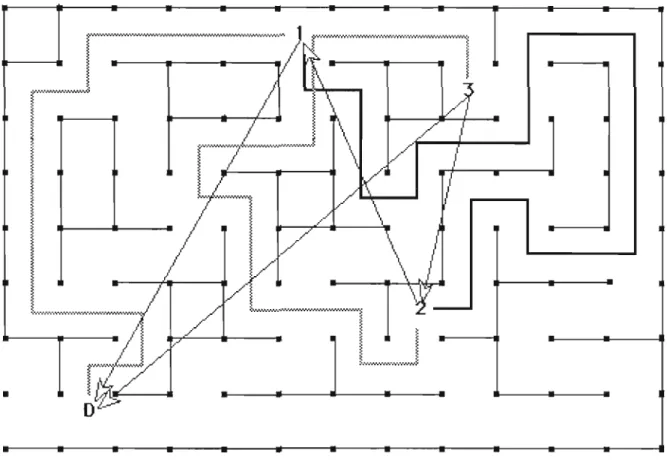
Figure 3a. Map drawing task: stimulus 60
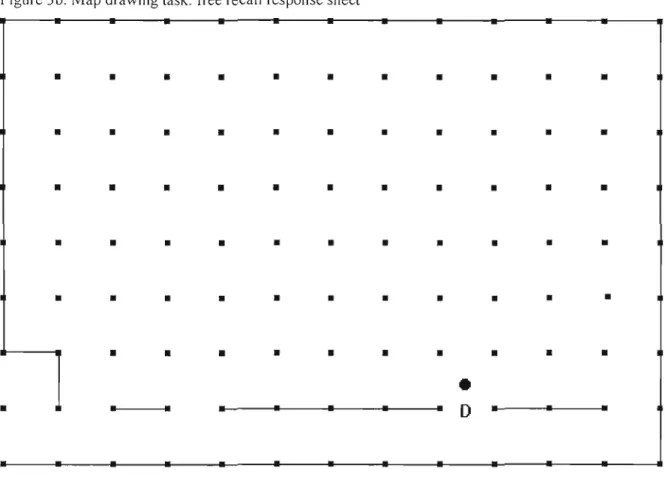
Figure 3b. Map drawing task: free recall response sheet... 61
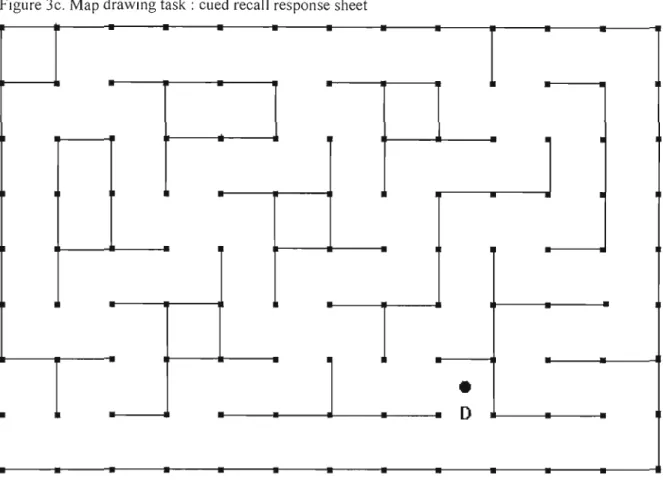
Figure 3c. Map drawing task: cued recalt response sheet 62
Figure 4. Map learning task: stimulus 63
DEUXIÈME ÉTUDE
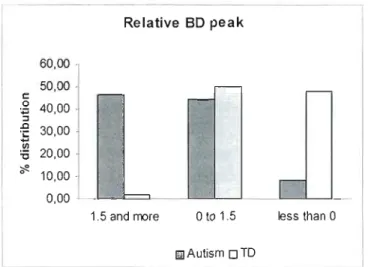
Figure 1. Relative BDT peak distribution in autistic and typically developing individuals .. 102
Figure 2. Examples of the block design task 102
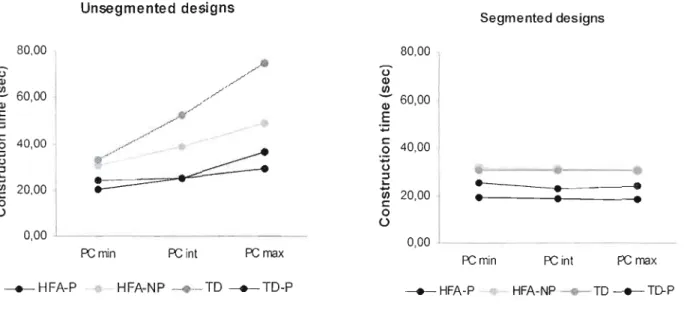
Figure 3. Construction time for unsegmented and segmented designs 103
Figure 4. Example of stimuJ i and distractors used in experiment 2 103
Figure 5. Local vs global processing matching speed \ 104
Figure 6. Long term visual memory for local and global BDT figures 104
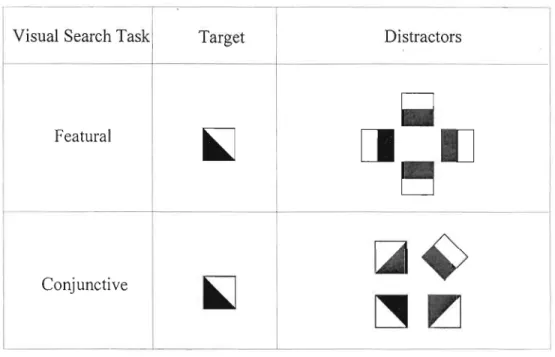
Figure 7. Targets and distractors used in the 'featuraJ' and 'conjunctive'
visual search task 105
Figure 8. Visual search task: example of stimulus, featural and conjunctive search 105
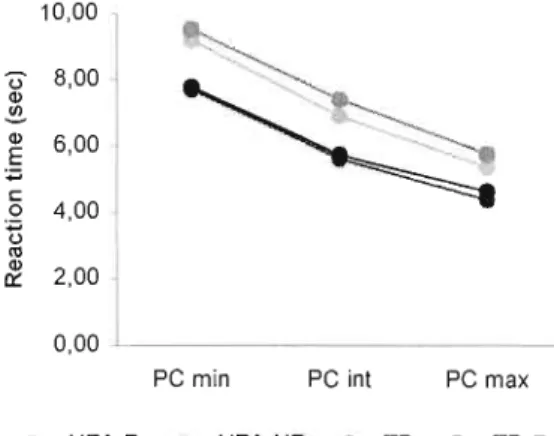
Figure 9. Average reaction time to detect target in visllal search task 106
Figure 10. Example ofstimuli lIsed in experiment 5 106
PREMIÈRE ÉTUDE
TABLE 1. Characteristics ofhigh functioning participants with autism (HFA) and typically
developing (TD) participants 56
DEUXIÈME ÉTUDE
TABLE 1. Characteristics of high functioning pal1icipants with autism with (HFA-P) and without (HFA-NP) block design peak, typically developing participants (TD) and control
manifestent dans le domaine de la communication, de la socialisation et de la vie imaginative. S'y ajoutent des compol1ements répétitifs et des intérêts restreints. (American Psychiatrie Association, 1994)
Le tableau clinique de l'autisme varie considérablement selon l'âge, le quotient intellectuel et, s' i1 y a lieu, les cond itions méd icales associées. Faute d'un modèle neurologique validé des signes présents dans l'autisme, de nombreux travaux de recherche se sont orientés vers l'identification des pal1icularités cognitives associés aux symptômes cl iniques de l'autisme (Frith & Happé, 1994; Rumsey & Hamburger, ]988; Baron-Cohen,
1985). Pl usieurs travaux ont révélé, chez des personnes autistes, un profi 1cogn itif caractérisé par des dissociations significatives (atteintes vs fonctionnement normal ou supérieur), largement répliquées, que ce soit à l'intérieur d'un même « domaine» cognitif (Shah &
Frith, 1993) ou entre des traitements de matériels distincts (Sous- tests du Wechsler: Rumsey & Hamburger (1988) ; Objets entre eux: Cipolotti, Robinson, Blair & Frith (1999); Visage vs. objets: Behrman et al. (2006)). Le but de ce travail de recherche était de caractériser les surfonctionnements spatiaux et perceptuels chez les personnes autistes et, le cas échéant, de déterminer les fonctions dont la supériorité entraîne un accroissement de la performance dans un nombre étendu de domaines (Morton & Frith, 1995). Cette thèse représente la première investigation systématique de la relation entre le traitement perceptif général et les pics d' habi letés visuo-spatiales chez les personnes autistes.
Après avoir succinctement présenté les caractères generaux de l'autisme, les principaux résultats concernant les caractéristiques cognitives de ce trouble et les modèles qui en rendent compte seront présentés. Parmi les modèles de surfonctionnement cognitif, les habi letés spatiales et perceptuelles rappol1ées chez les personnes autistes seront exposées. Enfin, à l'aide des cadres théoriques de la neuropsychologie cognitive, le présent travail présentera deux études de groupe avec des pm1icipants autistes de haut niveau dans lesquelles les principales dimensions cognitives évaluées seront abordées. Le premier volet sera consacré à l'étude des habi letés d'orientation spatiale des personnes autistes. Le deuxième volet se penchera sur l'évaluation des habiletés perceptuelles chez cette population. Enfin, les implications des résultats obtenus seront discutées en relation avec les modèles actuels de surfonctionnements cognitifs en autisme.
1.1 L'autisme: notions de base
L'autisme, tel qu'il est décrit et caractérisé dans le DSM-IV (1994), appartient à la catégorie des troubles envahissants du développement (TED) et est caractérisé par une altération du fonctionnement dans plusieurs sphères du développement dont les capacités d'interactions sociales réciproques, les capacités de communication et la présence de comportements, d'intérêts et d'activités stéréotypés (DSM-IV, American Psychiatrie Association, 2000; Volkmar et Pauls, 2003). L'autisme atteint la cognition de manière envahissante, i.e. il entraîne le déficit précoce d'un certain nombre d'opérations cognitives qui se traduit cliniquement par l'atteinte de fonctions apparemment non reliées entre elles dans les domaines sociaux, communicatifs, du jeu et de la diversité des intérêts. Ce trouble doit aussi être considéré selon une perspective développementale. En effet sa symptomatologie change avec l'âge quel que soit le niveau intellectuel. Certains symptômes disparaissent, d'autres persistent et se modifient. Ainsi, chaque porteur d'un TED peut être situé sur un continuum de sévéritéitypicité où viennent se greffer des facteurs liés à l'âge chronologique, le niveau intellectuel et la présence de conditions médicales associées.
L'autisme ne peut plus être considéré comme un trouble neurodéveloppemental rare puisque sa prévalence est maintenant établie à 3.8 cas d'autisme et 11,6 cas de TED pour )000 naissances (Baird et al. 2006). Il y aurait trois fois plus de garçons autistes que de filles (Fombonne, 2003), et le ratio garçon/fille augmente lorsque l'on considère l'ensemble des TED Uusqu'à dix garçons pour une fille; Miles & Hillman, 2000). Le niveau d'intelligence générale varie dans l'autisme; il s'étend de la déficience sévère à l'intelligence vive (Minshew, Goldstein, Muenz, & Payton, 1992; Ozo noff, Pennington, & Rogers, 1991; Rumsey, 1985; 1992; Rumsey et Hamburger, 1988; 1992). Contrairement à ce qu'on croyait auparavant, l'évaluation des capacités intellectuelles des personnes autistes a permis d'estimer à seulement
26% les cas d'autisme associés à une déficience intellectuelle (autisme de bas niveau) (Chakrabarti & Fombonne, 2001). Par opposition, les personnes autistes de quotient global supérieur à 70 sont désignées par l'appellation de l'autisme de haut niveau (AHN).
On distingue deux sortes d'autisme, l'un dit primaire ou idiopathique, dans lequel le tableau clinique n'est pas associé à une affection médicale associée. 11 est attribué à une cause génétique dont le mode de transmission est inconnu. L'autre, dite fraction étiologique de l'autisme ou autisme secondaire, ne représente que 10 à 15% des cas et désigne les cas d'autisme dont le tableau clinique est associé à des maladies identifiées. De tels désordres incluent les anomalies génétiques (principalement le syndrome de l'X fragile) ou la sclérose tubéreuse, aussi bien que les a\Jtres formes d'anomalies telles que les maladies infectieuses (rubéole congénitale, encéphalopathie aiguë...) ou l'apparition de symptômes autistiques, coïncidant avec une vaccination ou une infection, suggérant le rôle possible d'une réponse inflammatoire ou immunologique dans l'autisme. Nous ne nous attarderons pas ici sur le rôle causal unique de ces incidents anatomiques ou environnementaux, étant donné que les personnes avec autisme secondaire sont écartées de la présente étude, et du fait que l'identité entre autisme primaire et secondaire est discutable.
Les arguments principaux en faveur d'une ongll1e nature génétique de l'autisme primaire sont avant tout épidémioJogiques (Rutter et al, 1999). D'abord, il existe un sexe ratio en faveur des garçons d'au moins 3 pour 1 (Fombonne, 2003), mais qui augmente considérablement lorsqu'on se limite au cas d'autisme primaire, et sans déficience intellectuel le. Ensuite, le risque d'autisme dans la fratrie d'un enfant autiste est d'environ 3 %,
soit à peu près 50 fois plus que dans la population générale (Smilley, 1989). Ce risque augmente significativement lorsque l'on considère la concordance pour les jumeaux monozygotes (de 60 à 100 %) et dizygotes (près de 10%). Une proportion significative de parents d'autistes montrerait aussi une certaine atteinte des fonctions exécutives. La prévalence de plusieurs caractéristiques de la personnalité, d'anomalies langagière et de désordres psychiatriques au sein des fam iIles d'autistes ont aussi été rapportées. Nous savons aussi que l'autisme est polygénique et qu'une dizaine de gènes pourraient être impliqués, mais l'identification des gènes responsables n'en est qu'à ses débuts (pour une revue, voir
Muhle, Trentacoste & Rapin, 2004 ou Nicolson & Szatmari, 2003). Il s'agit d'un travail considérable à cause de la multiplicité des gènes constituant le génome humain mais aussi à cause de l'hétérogénéité évidente de l'autisme. La diversité de l'autisme se reflète logiquement dans le nombre de gènes en cause et dans leur éventuelle combinaison pour créer une prédisposition. Ainsi, l'ensemble des études conduites auprès des familles et des jumeaux converge vers une origine génétique à la base d'un vaste "spectre autistique".
1.2 Caractéristiques cognitives dans J'autisme
L'étude des troubles envahissants du développement par la neuropsychologie cognitive consiste à dégager un profil des fonctions intactes et des fonctions préservées, tout en essayant de ramener l'inventaire des déficits et des surfonctionnements observés à des anomalies les plus élémentaires et les plus caractéristiques de ce groupe. Les travaux de recherche, effectués en majeure partie auprès des personnes AHN, ont permis de dégager un certain nombre de caractéristiques cognitives chez cette population, du traitement des informations les plus élémentaires aux opérations les plus complexes selon la neuropsychologie cognitive: perception, attention, mémoire, fonctions exécutives (pour une revue: Minshew, Webb & Williams, 2006). Le regroupement par niveau de traitement opposerait donc les processus perceptifs d'un côté, de l'extraction de traits jusqu'à l'identification et la nomination de configurations, aux processus non perceptifs de l'autre, regroupant les processus de manipulation consciente de plusieurs informations simultanées ou les fonctions exécutives. À l' heure actuelle, le domaine perceptif paraît regrouper les tâches pour lesquelles les autistes sont supérieurs aux non-autistes.
Au niveau empirique, plusieurs études ont révélé l'existence de capacités cognitives supérieures à celles de participants appariés en âge développemental ou en niveau d'intelligence générale chez des autistes. Ces capacités supérieures ont été démontrées notamment dans le domaine auditif et visuo-perceptif. C'est le cas, dans la modalité auditive, de la détection de modifications mélodiques (Mottron et al., 2000), de la discrimination de sons purs (Bonnel et aL, 2003), mais aussi de l'indiçage phonologique. Dans la modalité visuelle, on retrouve des surfonctionnements dans la tâche de dessins avec blocs (Shah &
1.3
Frith, 1983; Shah & Frith, 1993; Jolliffe & Baron-Cohen, 1997), la détection de cibles visuelles simples (Plaisted, O'Riordan, & Baron-Cohen, 1998; 1998b; O'Riordan, 1998, Jarrold, Gilchrist, & Bender, 2005) et de figures géométriques cachées par leur inclusion dans un contexte visuel plus complexe (Joliffe & Baron-Cohen, 1997), ainsi que la reproduction de figures impossibles (Mottron, Belleville, & Ménard, 1999) (pour une revue, voir Mottron et aL, 2006). On observe ces surfonctionnements comme « effet de groupe» chez une population de personnes avec autisme.
Modèles de surfonctionnements cognitifs dans l'autisme
Les travaux visant à caractériser le fonctionnement cognitif des personnes avec autisme cherchent à expliquer la présence de symptômes en apparence très différents entre eux à travers divers domaines de la cognition et du comportement (Baron-Cohen, 1985, Mottron & Burack, 2001). Il existe actuellement trois modèles cognitifs principaux qui expliquent les surfonctionnements en autisme: la faiblesse de la cohérence centrale, le modèle de généralisation réduite et le modèle de surfonctionnement perceptif.
Théorie de la faiblesse de la cohérence centrale (FCC)
Les premières études sur la perception dans l'autisme ont concerné la hiérarchisation perceptive ou construction d'une représentation perceptive. Ces recherches étudient les rapports de priorité qu'entretiennent entre eux les aspects globaux, configurationnels et locaux lors du traitement perceptif des stimuli visuels ou auditifs. Lorsqu'une forme est constituée de parties, on distingue ses aspects locaux, comme ses détails ou sa texture, ses aspects globaux, comme le contour de cette forme, et ses aspects configurationnels, que sont les propriétés qui émergent des relations entre ses parties. Pour les personnes non autistes, il existe un 'biais' pour les aspects globaux et configurationnels par rapport aux aspects locaux, c'est-à-dire une orientation spontanée ou une performance supérieure pour le traitement de ces aspects. Toutefois, les persorines autistes auraient tendance à traiter les informations et stimuli localement et auraient de la difficulté à les traiter dans leur aspect global. Une telle anomalie expliquerait par exemple les forces des personnes autistes dans des tâches où la
détection d'une cible est facilitée par sa segmentation vis-à-vis du fond sur laquelle elle est posée. Ainsi, U. Frith (1989) a proposé un modèle de « Faiblesse de Cohérence Centrale» (FCC, Weak Central Coherence) pour tenter d'expliquer les surfonctionnements visuo spatiaux dans J'autisme (Frith, 1989, Happé, 1999). Les tâches requérant d'intégrer plusieurs informations en un tout cohérent seraient, selon ce modèle, pal1iculièrement exigeantes pour les ind ividus autistes. Shah et Frith (1983) ont ainsi démontré la capacité supérieure des autistes (par rapport à des participants de même âge développemental), à détecter des « figures cachées ». Ils ont également démontré la supériorité de ce groupe au sous-test de dessins avec blocs de l'échelle de Weschler (Shah et Frith, 1993), une tâche dans laquelle la détection de l'identité entre des pal1ies de la cible et des faces des blocs constitue un avantage. Dans chacun de ces paradigmes, le modèle de la FCC explique une supériorité dans une tâche « locale» par l'avantage paradoxal apporté à la réalisation de cette tâche par un déficit du traitement des aspects globaux de l'information présentée. Le même modèle, appliqué au traitement sémantique, expliquerait les difficultés documentées des autistes à extraire la signification à partir du contexte d'un texte lu ou l'incapacité à désambiguïser des mots homographes en fonction de leur contexte verbal (Happé, 1997).
Ce modèle a eu le mérite de rassembler l'ensemble des connaissances au moment où il a été proposé et de générer beaucoup d'avenues de recherches. Néanmoins, la théorie de la faiblesse de la cohérence centrale a récemment été remise en question par plusieurs résultats. Par exemple, plusieurs groupes indépendants ont montré à l'aide de stimuli hiérarchiques (e.g. grandes lettres formées de petites lettres) que les aspects globaux de l'information étaient normalement perçus, même en présence d'une supériorité du traitement local dans l'autisme (Ozonoff et al., 1994; Mottron, Burack, Stauder & Robaey, 1999; Plaisted et al, 1999 ; Rinehart et al., 2000; Wang, Mottron, Peng, Berthiaume, Dawson (2007).
Modèle de généralisation réduite et d'hyperdiscrimination
Un modèle plus récent, celui de la généralisation réduite et de l'hyperdiscrimination proposé par Plaisted et son équipe (2001), propose des mécanismes pouvant expliquer, en pal1ie du moins, l'origine des particularités cognitives des personnes autistes. En effet, la 1.3
supériorité du traitement local des personnes autistes peut provenir d'une meilleure perception de bas niveau comme tel, indépendamment de l'inclusion ou non d'ull pattern élémentaire dans une configuration complexe. Plaisted (1998) a ainsi montré dans une tâche d'apprentissage perceptif que la discrimination perceptive visuelle chez des adultes autistes de haut niveau était supérieure à celle des individus typiques. Ce modèle a proposé une perception réduite des similarités chez les individus autistes, ces derniers étant portés à traiter davantage les traits uniques à chaque stimulus que les traits partagés avec les autres stimuli. Ceci aurait pour conséquence une meilleure discrimination, mais une difficulté à traiter les simil itudes et donc à catégoriser l'information. Les personnes autistes auraient donc une supériorité dans le traitement des aspects différentiels des éléments composant un ensemble. Ceux-ci pourraient avoir davantage tendance à traiter les caractéristiq ues uniques d'un stimulus que les caractéristiques qu'il partage avec d'autres stimuli. Ces auteurs ainsi ont mis en évidence la supériorité des personnes autistes dans la tâche de recherche visuelle (Plaisted et aL, 1998; O'Riordan & Plaisted, 2001). La tâche consiste à détecter la présence ou l'absence d'une cible définie par la co-présence de 2 caractères (e.g. X + rouge) dans un champ de distracteurs partageant avec la cible une dimension (e.g. T + rouge). La manipulation du niveau de similitude entre cibles et distracteurs n'a affecté que le groupe de comparaison. Ceci suggère que la performance supérieure du groupe clinique dans cette tâche est expliquée par une meilleure discrimination. Par ailleurs, cette même équipe a montré que les personnes avec autisme sont supérieures à un groupe de comparaison pour discriminer des figures qui diffèrent par la position de points, et ceci aux diverses étapes de l'apprentissage (Plaisted et al, 1998b). Un des mécanismes avancés par Plaisted pour expliquer la perception réduite des similarités concerne une inhibition latérale excessive dans les réseaux d'activation neuronaux chez les personnes autistes (d'abord suggérée par Gustafsson, 1997). Plus grande est la région où les collatérales sont excitatrices, plus le réseau sera enclin à la généralisation. Au contraire, plus cette région est petite, plus le réseau sera en mesure de discriminer. On peut donc penser qu'une hausse de l'inhibition latérale (i.e. des régions d'excitation latérale restreintes) aura pour conséquence une hausse des capacités de discrimination.
Le modèle de surfonctionnement perceptif
On peut par ailleurs faire l'hypothèse d'un surfonctionnement, non seulement de la discrimination, mais de l'ensemble des processus perceptifs de bas niveau dans l'autisme. En effet, le caractère très élémentaire des tâches perceptives visuelles dans lesquelles des performances des personnes autistes sont su périeures et l'absence de déficit dans la perception des aspects globaux de stimuli visuels hiérarchiques ont conduit Mottron & Burack (2001, 2006) au modèle de surfonctionnement perceptif (Enhanced Perceptual Functioning; EPF). Ce modèle propose que le traitement perceptif de bas niveau, depuis le traitement des dimensions psychophysiques (ex: hauteur tonale) jusqu'à la discrimination (e.g. : la capacité de détecter des différences entre deux dimensions presque identiques), la vitesse d'encodage, la trace mnésique et l'appariement perceptif entre des éléments simples (lettres, sons isolés, figures géométriques simples) sont intrinsèquement meilleurs dans l'autisme (Mottron & Burack, 2001, 2006). Selon ce modèle, il existerait dans l'autisme un biais en faveur du traitement de bas niveau (i.e. traitement perceptif). Les premiers résultats d'imagerie fonctionnelle obtenus lors de tâches perceptives de stimuli non sociaux dans l'autisme montrent d'ailleurs que certaines de ces tâches sont associées à une surface d'activation cérébrale plus importante chez les personnes autistes que dans le groupe de comparaison. Cette activation supérieure concerne les aires visuelles primaires occipitales et déborde sur les aires occipito-temporales durant une tâche de recherche de figure cachée (Ring et al 1999).
lA Objectifs généraux des deux études
Les personnes autistes sont considérées porteuses d'habiletés visuo-spatiales, allant de leurs très bonnes performances dans la réalisation de dessins avec blocs, aux casse-tête ou des dessins en trois dimensions jusqu'à leurs bonnes capacités en orientation spatiale. Le terme visuo-spatial rassemble donc des tâches cognitivement hétérogènes, mais que les personnes autistes paraissent réussir de manière supérieure à la moyenne. L'objectif des études réal isées dans cette présente thèse est de décomposer les deux fonctions maj eures sous jacentes à ces performances pour déterminer si c'est dans le composant perceptif et ou dans le composant spatial que les personnes autistes sont effectivement supérieures. Au niveau fondamental, il importe de déterminer le rôle respectif de ces deux composants (lorsqu'ils sont présents dans une même tâche) dans le succès à cette tâche. Ainsi, dans la tâche d'orientation spatiale mesurée à l'aide de la performance aux labyrinthes, la perception visuelle entre en ligne de compte dans la capacité de détecter au niveau perceptif l'homologie entre une configuration représentée sur une carte et cette même configuration sur le terrain. Une supériorité dans cet aspect seulement de la performance aux labyrinthes nous indiquerait donc que seu 1le composant perceptif est supérieur dans l'autisme et non l'orientation spatiale
à proprement parler.
La deuxième étude a eu pour objectif d'expliquer de façon plus fine les mécanismes sous-jacents responsables de l'hyperfonctionnement à la tâche de dessins avec blocs. Cette étude doit être considérée comme mesurant à la fois les capacités perceptives visuelles de bas niveau de façon globale et, à un niveau d'investigation supérieur, le rôle de plusieurs sous composants perceptifs visuels dans la réussite à cette tâche (discrimination visuelle, durée de la trace visuelle, recherche visuelle). Toutefois, comme l'étude sur les processus visuo perceptifs nécessite de sélectionner des sujets autistes ayant des performances exceptionnelles à la tâche de dessins avec blocs, il n'a pas été possible d'utiliser la même population dans les deux études. La synthèse entre les deux études se fera donc entre deux groupes comparables en âge, QI et sexe mais ne peut se faire, comme il aurait été idéal, en utilisant la performance à une tâche comme co-variable de l'analyse des résultats de l'autre tâche.
La présente thèse a donc pour objectif d'explorer les possibles dissociations entre le traitement spatial et visuo-perceptif dans l'autisme. Les expérimentations présentées se divisent donc en deux volets.
Étude 1 : Les habiletés spatiales en autisme
La présente étude représente la première évaluation systématique des habiletés spatiales propres à l'autisme. Plus précisément, elle consiste à déterminer si les individus atteints d'autisme ont une habi leté supérieure dans l'apprentissage spatia 1 d'un
environnement exploré ou d'une carte. II est en effet bien connu des cliniciens que les personnes autistes, quel que soit leur niveau d' intell igence, présentent des aptitudes remarquables dans certaines tâches de nature spatiale. Plus particulièrement, elles ont des habiletés particulières à s'orienter facilement dans un nouvel environnement, à détecter des modifications de trajectoires et à mémoriser des plans. Malgré les nombreux cas documentés du syndrome savant avec capacité spéciale de mémoire de trajet et les observations cliniques qui montrent un intérêt particulier pour les cartes géographiques, la cognition spatiale a très peu été étudiée dans l'autisme. En effet, il est fréquemment observé que les autistes mémorisent des adresses postales, des numéros de routes, des itinéraires de trains ou d'autobus. Les informations de nature spatiale semblent représenter un type d'informations privi légiées par les autistes. Néanmoins, aucune investigation empirique n'est venue étayer cette impression cl iniq ue.
Une habileté spatiale supérieure chez les individus autistes peut également être prévue à paltir d'une mémoire de reconnaissance supérieure pour les points de repères topographiques tels que les édifices, les paysages ou les décors extérieurs (Blair et al., 2002, Cipolotti et al. t999). De plus, des rapports anecdotiques d'intérêt restreint pour les cartes géograph iques et les trajets d'autobus, ainsi que l' habi leté à détecter des changements de position dans l'environnement (Wing, t976) suggèrent que les habi letés spatiales sont accrues chez les personnes autistes. Or les études empiriques ont SUltOUt montré jusqu'ici des capacités perceptives visuelles (discrimination, détection) mais, en dehors de la notion
clinique que l'orientation spatiale est supérieure, il n'y a aucun argument empirique dans le sens d'une supériorité spécifique au niveau des processus purement cognitivo-spatiaux.
Étude 2: La supériorité visuo-spatiale dans l'autisme: tâche de dessins avec blocs
La deuxième étude a pour but d'étudier les mécanismes responsables de la supériorité des personnes autistes au sous-test visuo-spatial « dessins avec blocs» du test d'intelligence de Weschler (WAIS, WISC : Wechsler, 1981, 1994). La performance des personnes autistes au test de dessins avec blocs est, nous le savons, souvent supérieure à celle des individus typiques (Shah & Frith, 1983; Shah & Frith, 1993; Happé, 1994, Jolliffe & Baron-Cohen, 1997). Les expériences de cette étude sont donc construites de façon à évaluer indépendamment les différentes étapes de traitement nécessaires à la réalisation de cette tâche (notamment la vitesse d'encodage, discrimination, mémoire des figures, recherche visuelle des blocs, vitesse psychomotrice). Ceci permettra de mettre en concurrence les modèles cognitifs explicatifs des surfonctionnements perceptifs en autisme en manipulant les dimensions auxquelles chacun d'entre eux attribue la performance des personnes autistes.
Référence:
Caron Ml, Martron L, Rainville C, Chouinard S. (2004). Do high functioning persans with autism present superior spatial abilities ? Neuropsychologia, 42, 467-81 .
DO HIGH FUNCTIONING PERSONS WITH AUTISM PRESENT SUPERIOR SPATIAL ABILITIES?
M J 1,2 M tt L 1,.1 R' '11 C4,5 Ch . d S 2 Caron, -. ,oron, . , alllvi e, . , oUlllar, .
IC1inique Spécialisée des Troubles Envahissants du Développement, Hôpital Rivière-des Prairies, Montréal, HIE 1A4, Canada
2 Département de Psychologie, Université du Québec à Montréal, H3C 3P8, Canada
J Département de Psychiatrie, Université de Montréal, H3C 317, Canada
4 Centre de recherche, Institut Universitaire de Gériatrie de Montréal, H3W 1W5, Canada
5 Centre de recherche Interdisciplinaire en Réadaptation du Montréal Métropolitain, Hôpital
Juif de Réadaptation, Laval, H7V ]R2, Canada
Send correspondance ta: L. Mottron, Clinique spécialisée des Troubles Envahissants du Développement, Hôpital Rivière-des-Prairies, 7070 Bou!. Penas, Montréal (PQ), Canada, H1E IA4, Tel: (514) 323-7260 (2143), Fax: (514) 328-3530, E-mail: mottronl(a)'istar.ca
2.1 Abstract
This series of experiments was aimed at assessing spatial abilities in high-fllnctioning individuals with alltism (HFA), using a human-size labyrinth. ln the context of recent
findings that the performance of individuals with HFA was superior to typically developing individuals in several non-social cognitive operations, it was expected that the HFA group would outperform a typically developing comparison group matched on full-scale lQ. Reslilts showed that individuals with autism performed ail spatial tasks at a level at least equivalent to the typically developing comparison group. No differences between groups were found in route and survey tasks. Superior performance for individuals with HFA was found in tasks involving maps, in the form of superior accuracy in graphie cued recall of a path, and shorter learning times in a map learning task. We propose that a superior ability to detect [57], match [73] and reprodllce [50] simple visual eiements yields superior performance in tasks relying on the detection and graphic reproduction of the visual elements composing a map. Enhanced discrimination, detection, and memory for visually simple patterns in autism may account for the superior performance of persons with autism on visuo-spatial tasks that heavily involve pattern recognition, either in the form of recognizing and memorizing landmarks or in detecting the similarity between map and landscape features. At a neuro-anatomicallevel, these findings suggest an intact dorso-Iateral pathway, and enhanced performance in non social tasks relying on the infera-temporal pathway.
Key words : Autism; Cognitive map; Spatial orientation; visual-spatial; "What" pathway, "Where" pathway; Primary visual cortex.
domains, while, in other domains, affected individuals exhibit performance that exceeds that of typically developing individuals. This enhanced performance characterizes individuals with autism as a group, and should therefore be distinguished from the outstanding performances exhibited by "savant" individuals with autism, which are found only in a restricted subgroup of individuaJs with autism [44].
Superior performance has been demonstrated by individuals with autism in pitch processing and memory [10,25,51,52], pattern discrimination [67], the block-design subtest of the WAIS [73,83], the graphic reproduction of impossible figures [50] and detecting embedded figures [30,72]. An enlarged surface of activation in the occipital primary visual areas and an enhanced activation in the ventral occipito-temporal regions during the embedded figures task was found in individuals with autism in a study using fMRI [68]. ln addition, an atypical activation of the primary visual cortex during face perception [65,71] and significantly more dorsal electrophysiological response during visual selective attention task [28] have also been observed. These tindings suggest that autistic individuals use different neural structures in the early processing ofvisuo-spatial stimuli.
The current study represents the tirst systematic assessment of spatial abilities in ind ividuals with autism. More precisely, it ai ms to estab 1ish if ind ividuals with autism
possess a superior ability to learn the spatial layout of the environment built from an explored environment or from a map. Superior spatial ability in high functioning individuals with autism (HFA) may be expected on the basis of empirical evidence for preserved or superior visual spatial abilities [46,59 ,69,36] and from superior recognition memory oftopographical landmarks such as buildings, landscapes, and outdoor scenes [9,13]. In addition, anecdotal reports ofrestricted interest in maps and bus routes, as weil as the ability to detect minimal positional changes in the environment [87] suggest that visuo-spatial abilities are enhanced among persans with autism. The visuo-spatial tasks in which persans with autism present enhanced abi lities (e.g. block design) consist typically of reproducing a 2 or 3-D model by
manipulation of its components and require a high degree of spatio-constructive abi 1ity. However, this superiority should not be manifested in those spatial tasks drawing heavily on executive functions, because operations that require conscious manipulation of information, such as planning or switching from one mental set to another, are impaired in autism [4].
Spatial ability can be decomposed into multiple interrelated functions that will be presented from the more complex to the more elementary. Only the spatio-cognitive aspect of spatial navigation tasks, cognitive mapping, will be investigated in the current study.
Cognitive mapping is the process by which an individual acquires, codes, stores, recalls, and decodes information about the relative locations and attributes of the spatial environment [15]. A cognitive map may be grouped under two subheadings: survey map and route map [e.g. 6,19,27,80]. These two types of maps differ in the sources from which they are primari Iy acquired, the aspects of the environment that they represent, and the tasks in which they are most usefuJ. A survey map is characterized by the knowledge of the global spatial layout from an external perspective, such as a standard road map. This knowledge reflects the individual's ability to generalize beyond learned routes and to locate the position of objects within a general and fixed frame of reference [21,27]. One easy way to obtain survey knowledge is to look at a plan that provides an overview of a space otherwise too large to be seen in a glance. Frequent travels on a particular route can also lead to survey knowledge [76,81]. A route map refers to the knowledge of the spatial layout from the ground level observer's perspective. It refers to the knowledge of sequential locations, or sequence of actions, required to follow a particular route. It includes an explicit representation of decision points along the route where turns occur , as weil as a representation of the decisions to be taken at each of these points. This knowledge is acquired by navigating through the environ ment.
FM RI studies during spatial navigation tasks perfonned in virtual reality
environments are informative about the neural networks involved in survey and route map tasks [74,43,29,66]. Route tasks are associated with activation of the bilateral medial
temporal lobes, including parahippocampal cOliex and posterior hippocampus, as weIl as the bi lateral postcentral gyrus (BA 5, 7), the right su peri or (BA 7) and inferior (BA 40) parietal
cortices. Survey tasks are associated with activation of the bilateral fusiform, inferior
temporal Gyri (BA 37, 19), bilateral superior parietal cortex (BA 7) and left insulalclaustrum (BA 13). Thus, in both route and survey processing, a common network of brai n areas is recruited; the survey mapping is associated with a subset of areas also involved by route encoding, though the former operation results in a greater activation in the inferior temporal cortex, postcentral gyrus and posterior superior parietal cortex. These results do not support the hypothesis that route and survey information rely on different neural systems, but suggest a hierarchical relationship between these two spatial functions.
At a lower integration level, spatio-cognitive processes are under the dependence of visuo-perceptual activity. Neuroimaging studies demonstrate two distinct neural pathways that subserve topographical learning. The ventral, occipito-temporal (or "what") pathways, and more specifically, the inferior temporal cortex in the region of the fusiform gyms [49] is involved in the recognition of objects. The temporal activation observed in survey knowledge may reflect greater object processing because of the map-like nature of the survey encoding [79]. Accordingly, maps can be treated as physical objects pel' se, in addition to providing spatial information. The dorso-Iateral, occipito-parietal (or "where") pathway, and more specifically, the right inferior parietal lobule in the region of the supramarginal gyrus [49], is involved in the processing of spatial relations between objects and of spatial locations [24]. In addition, the medial temporal lobe is involved in space integration. Specifically, the
parahippocampal gyrus is implicated in the encoding of object features and their locations within space [1,38,39,40].
The current research consisted of five spatial tasks. The first set of tasks was performed in a human-size labyrinth and investigated route map learning (experiment 1; route learning), route map manipulation (experiment 2; reversing a route) and survey map learning (experiment 3; pointing toward unseen location). The level of information manipulation required by these three tasks ranged from minimal (route learning) to intermediate (reversing a route) and high (reorganizing spatial information to produce a survey map). In addition, each ofthese tasks was performed at severallevels of difficulty in order to assess how the level of difficulty interacts with the spatial cognitive functions
involved. The level of difficulty -and therefore, the performance level- of the task is dependent on the storage and manipulation components of working memory [58].
The scale of represented space was manipulated in the second set of tasks in order to assess the abi lity to transfer spatial knowledge across different scales of space. When spatial layouts are not perceived ail at once (e.g., a human-size labyrinth), the subject is confronted with a macro-scale space. Spatial information has to be experienced by integration of perceptuaJ experiences over space and time through the use of memory and reasoning [48,75,62]. By contrast, spatial cognition at a micro-scale refers to situations where a person can perceive a spatial configuration (e.g.: a map) from a single point of view [see 41 for an overview]. It allows direct access to survey knowledge. Experiment 4 involved transforming knowledge acquired through macro-scale learning into a micro-scale representation, through memorizing a human-size path and then drawing it on a sheet of paper. Experiment 5, a route execution task, required the transfer of spatial knowledge acquired from a micro-scale space where global relationships were simultaneously perceived and learned (a map) toward a macro-scale space (human-size labyrinth).
2.2 - Methods Participants
Two groups of adolescent and adult individuals participated in the study. The clinical group was comprised of 16 participants with autism (HFA; N= Il males) or Asperger
syndrome (N=5, 4 males, 1 female) with IQ scores in the average range, randomly chosen from the database of the Specialized Clinic for diagnosis and evaluation of Pervasive Developmental Oisorders of Rivières-des-Prairies Hospital (Montreal, Canada). The
diagnosis ofautism was made on the basis of the Autism Diagnosis Interview-Revised [ADI R; 36], a diagnostic instrument operationalizing the DSM-IV [APA]criteria for autism. The ADI-R was administered by one of the authors (LM) who obtained a reliability score of.9 with the creators of the instrument.This diagnosis was confirmed by an explicit assessment of OSM-IV criteria through clinical observation, using the Autism Diagnosis Observation Schedule - Generic (ADOS-G, module 3 or 4) [37]. Ali participants scored above the cut-offs of the algorithms of the two instruments, except one partici pa nt who scored under the
communication cut-off of the ADJ. This participant was nevertheless included, considering his high score at the other sub-scales of the ADI and at the ADOS-G algorithm.
A pilot study using typical individuals of increasing age was conducted to establish the lowest age at which children could read the map used in the experiment. This resulted in including only participants older than 9 years of age. It should be emphasized that at the time of recruitment of the clinical participants, the experimenters were blind to individuals' ADI-R scores that assess visuospatial abilities (item 106) or to their block design scores, which assess spatio-constructive abi 1ities. AIthough the cl inical group under study presented the classical superiority in block design (see table 1) as compared to the typically developing group [73], this group is representative of the generaJ population of high functioning persons with autism and does not represent a subgroup with "special abi lities" in this domain. Ail participants attended school, were verbal, and were able to read and write. At the time of testing, none of the participants were taking medication. They ail had normal or corrected-to normal vision, tested bya Snoellen Eye Chart prior to the experiment.
The comparison group was comprised of 16 typically developing participants (TD), matched with the clinical group on gender, chronological age, education, performance IQ (WAIS or wIsq and laterality [55]. No statistically significant differences were found between the two groups on these variables. In addition, a posteriori analyses comparing verbal IQ and full scale IQ among these groups did not reveal differences among groups. The typically developing individuals and their first-degree relatives were screened for current or past neurological, developmental, or psychiatric disorder. The experiment was formally approved bya local ethics committee. Ail participants were given financial compensation for their participation. Table 1 shows the individual values, means and standard deviations for chronological age, PIQ, VIQ, FSIQ, level of education and block design.
TABLE 1
Apparatus .
An indoor, life-sized (12 x 8 meters) labyrinth was used for the entire set of experiments. The alleys were one meter wide and bounded by white configuration panels 2 meters high. It was relatively soundproof and diffusely lit. The white, removable panels of the labyrinth enabled the experimenters to J) control for the dimensions involved in the spatial tasks, 2) control task difficulty, 3) limit extraneous perceptllal factors, which might interfere with the measllre of spatial-cognitive abil ities, and 4) minimize the visual cues lIsed for the bui Id-up of spatial knowledge in natural settings. Close to the experimental labyrinth, a reduced labyrinth (5 x 4 meters) was used for practice trials. The experimental layout has been used in previous research testing spatial orientation and wayfind ing abi 1ities of persons with visual impairments [60] and patients with Alzheimer's disease [61].
General Procedure
The nature of the experiment was explained to ail participants (or to their representing parent) before signing the research consent. After infonned consent was
obtained, ail participants were individually administered the five tasks in the same order. The instructions relevant to each particular task were presented and practiced in a smaillabyrinth before the experiment. The entire testing session lasted approximately 1h30 min.
Experiment 1. Route learning
This task was used to assess route mapping skills. The encoding of spatial
information in a route learning task is based on the sequential memorization of the starting point, the decision points, and the destination of the route. This cognitive process is considered to be simple [82] because it does not require a reorganization of spatial
information. However, it varies in difficulty according to the number of decision points (OP) of the route to be learned [26,56,63, 85,62]. Accordingly, the memory load [58], and the magnitude of spatial interference [lI, 12,35] are negatively affected by the number of OPs; performance increases when the number of OPs is decreased. Enhanced spatial ability in participants with autism could manifest itself in one oftwo ways. Participants with autism could exhibit superior performance at each level of difficulty. Alternately, the performance of the participants with autism could exhibit less influence than typically developing
participants from increasing the levels of difficulty, being less affected by the increase of spatial memory load.
Stimuli
Three experimental routes of increasing level of difficulty were tested (see example fig.I). Path difficulty was manipulated by varying the totallength of the path (37, 41 and 45 m), and number ofturns (23, 24 and 26). Regarding the number of decision points, the intersections where the participant has to choose among two or three possible directions, a pilot experiment revealed that paths with less than 6 decision points were memorized without errors. As a result, OP= 8, 10 and 12 were used. The total number of OP with 2 and 3 choices was held constant across paths in order to control for the number of choices, which might have intelfered with assessing the impact of the previous variables. Paths wete constructed in a manner to avoid salient sequences that could be used as mnemonic cues during the encoding phase. Thus, the patJls did not conta in repetitions of a sequence of directions (e.g. right-front-left-right-front-Ieft), identifiable gestalts (round, square), or more than two consecutive turns in the same direction. Possible intelference between the target path and recently memorized spatial information was minimized by experimental routes beginning and ending at the outer border of the labyrinth.
Figure 1 Procedure
For each path, the testing was comprised of a learning phase, five successive recalls, and a pause during which the configuration panels of the labyrinth were moved. In the learning phase, participants were told that their ability to learn a route in the labyrinth would be assessed. Then, the experimenter guided individual participants along the path from the point of departure to the point of arrivai at a fixed walking speed. After completion of the learning phase, participants were accompanied to the point of departure, where they had to execute the path by themselves. The experimenter foHowed the participants approximately five to seven feet behind. The participants were informed oftheir errors, within a few steps in a wrong direction, by asking them to backtrack five feet. When they approached the decision point, the examiner pointed in the appropriate direction while saying" the route goes this way". Errors and speed of the participants to reach the end of the path were recorded on-line by the observer.
Results
Route learning performance was analyzed using a Group (HFA, TD) x Condition (8, 10, 12 D.P.) analysis ofvariance (ANOV A), performed on errors and execution time. The ANOVA revealed a main effect of condition for both variables (errors: F (2, 60) = 6. 61, p< .005; execution time: F (2, 60) = 33.39, p< .00001), but no main effect of group (errors: F (1,30) = 0,20, p= .6553; execution time: F (1,30) = 0,74, p= .3956). No Group x Condition interaction was found, indicating that increases in difficulty had a simiJar effects on both the clinical and comparison groups. Both groups dispJayed similar increases in the number of errors and took more time to complete the task as the difficulty of the path increased (DPs = DP lo < DP I2). The mean number of errors ranged from 1.0 errors (s.d.: 0.7) to 1.5 errors (s.d.:
1.0) in the HFA group and from 1.1 errors (s.d.: 0.8) to 1.6 errors (s.d.: 1.31) in the TD group. Similarly, tbe mean execution time ranged from 39.3 sec (s.d.: 11.7) to 48.6 sec (s.d.: 15.4) in the HFA group and from 42.7 (s.d.: 8.7) to 52.8 sec (s.d.: 12.2) in the TD group.
Additional analyses compared the performance ofthe two groups on each trial (1 to 5) within one level of difficulty (8, 10, 12 OP), and the learning effect across trials. This last variable was examined throllgh a group x trial ANOY A perfonned on decreases in errors (e.g.: Errors trial 2- Errors trial 1) and relative decreases in execution time [(T trial 2 - T trial
1) / trial 1] between two consecutive trials. The two groups did not differ on these variables.
Discussion
Individuals with HFA performed the route learning task with the same accuracy and at the same speed as the comparison group, indicating that route mapping skills are
preserved, but not sllperior, in individllals with HFA. The variability of performance was large in both groups of participants, ranging from poor to outstanding levels of performance (HFA= 6- 41 errors, TD= 4- 41 errors). This variability, along with the absence ofa group x level of difficulty interaction, suggests an identical vulnerability of spatial working memory to memory load and to interference in the two groups, while the lack of a Group x Trial interaction suggests an identical learning curve.
Experiment 2. Reversing a route
Reversing a route requires the manipulation of spatial information by updating this spatial information according to a new sequence of decisions and associated directions. As demonstrated by studies with adults [32] and children [64], reversed recall of a route is at a higher level of complexity than direct route learning. Superior spatial abilities, if revealed only at a high leveJ of complexity, should result in the clinical group perfonning better than the comparison group in this task. However, inasmuch as manipulation of information is impaired in autism [4], increased manipulation of spatial information may result also result in an inferior performance in this task.
Task, stimuli and procedure
This one-trial task consisted in returning backwards from the arrivai point of a path to its departure point and was accomplished at the end of the fifth trial of each route performed in experiment 1 (see Figure 1). Recording procedures were the same as in experiment 1. Results
A two-way analysis of variance (ANOVA) Group (HFA, TD) X Condition (8, )0, )2 OP) performed on errors and execution time revealed a main effect of condition [errors: F (2,60) = 5.84, p< 0.005; execution time: F (2,60) = 12.69, p< 0.000 1)], but no main effect of group. 80th groups committed similar or more errors and took more time to complete the task as the difficulty of the reverse path increased. The mean number of errors ranged from 1.6 errors (s.d.: 1.4) to 2.2 errors (s.d.: 1.3) in the HFA group and from 2.3 errors (s.d.: 1.6) to 2.7 errors (s.d.: 1.2) in the TD group. Similarly, the mean execution time ranged from 45.7 sec. (s.d.: 13.9) to 52.5 sec. (s.d.: 11.6) in the HFA group and from 51.4 sec. (s.d.: 10.6) to 60.4 sec. (s.d.: 9.9) in the TD group. No group x condition interactions and no group effect were found.
Discussion
This task is a difficult one for the TD group. Accordingly, their error rate increased from 0.5 en'ors (fifth trial of direct learning) to 2.0 en'ors (reverse recall), which was almost identical to the first trial of the direct learning route (2.4 errors).
This decline in performance may be attributable to the impossibility of solving this task by merely memorizing the spatial context of each of the DPs, as reversing the route modifies the visual perspective of the DPs. In addition, manipulating memorized spatial information in order to map current (reversed) and previous (forward) routes creates a higher demand on the executive system. Whatever mechanism is involved, this spatial task does not appear to be easier for participants with autism, at least at the various levels of difficulty assessed here. Finally, in accordance with Experiment l, performance decreased as the difficulty level of the path increased, thus suggesting that the spatial working memory of the participants with HFA is at a comparable level to the comparison group, a finding consistent with recent literature on intact spatial working memory in autism [4].
Experiment 3. Pointing toward an imperceptible direction
The pointing task assesses the survey mapping skill of individuals with HFA. In order to perform this task, individuals must combine and reorganize spatial information Jearned along the route, and elaborate an integrated representation of the labyrinth. Survey knowledge is typically acquired after repeated navigation in an environment. According to animal studies [84,18,42,88], this task may also rely on path integration (or "dead'
reckoning"). Path integration is a form of navigation in which perceived self-motion is integrated over time without the elaboration of a cognitive map. This knowledge derives from the cues generated by a point of reference (e.g.: starting point), and subsequent self
movement. There is evidence that this abi lity depends on the integrity of the right temporal regions [88] and the hippocampal formation [86]. As it does not make use of external cues, this path integration process leads to rapid accumulation of errors involving both the direction and distance of the goal [17]. Consequentially, it should be highly sensitive to an increase in the number of turns and of the segment lengths of the paths.
Task, stimuli and procedure
The task consisted of pointing tO\,yard the departure point of a path from the arrivai point of this path. This task was perfonned after experiment 1 & 2. The same configuration panels (except one) used in the 12 OP path of ex periment 1 & 2 were used in experiment 3 in order to benefit from the knowledge of the spatial layout acquired in the previous experiment. However, different paths were used in order to maximize the acquisition of information on this configuration. Participants were first asked to memorize the depalture point of a new path. Then the participants were asked to follow the experimenter to the arrivai point. The participants were told that, in contrast to experiments 1 & 2, the purpose ofthis experiment was not to memorize the route traveled in the labyrinth. The participants were also told they could not keep track of the target by pointing to the departure point as they walked through the path. Once at the arrivai point, the participants had to point as accurately as possible toward the departure point, which was not visible from this position. Four pointing trials of increasing difficulty level (PI, P2, P3, P4) were performed. Trial difficulty was manipulated by increasing the number ofturns (8, 14, Il and 33), and length (15,23, 17 and 55 meters) of the path taken. The point of arrivai on each trial was the point of departure of the subsequent pointing task, except for the last pointing task, where the participant had to point toward the first point of departure (Fig. 2). The examiner stood behind the participant and recorded pointing accuracy.
Figure 2
Results and discussion
The mean absolute error (degrees) was compared across groups using a Mann Whitney test. Although the participants with autism performed more poorly (mean: 26.3 degrees, s.d.: 31.6) than the comparison group (mean: 15.3 degrees, s.d.: 19.6), the difference did not reach significance. Considering that the error averaging gives an excessive weight to the participant's performance whose pointing was at random, in comparison to those whose pointing is approximate, a binary scoring (passed/failed) was used. We considered a correct answer to lie within a plus/minus 15 degree errar margin from the target. A chi-square
comparing the proportion of passing paliicipants (HFA=O,516, TD=O,578) among groups did not show significant difference between the groups. This indicates that survey knowledge is acquired at an identical level in the two groups.
ln order to assess the possible use of the path integration strategy, pointing
performance was analyzed bya Group (HFA, TD) x Condition (P l, P2, P3, P4) ANOV A. No main effect of condition was found between P2, P3, P4, indicating that the increase in
segment lengths and number of turns did not significantly decrease the performance of the two groups. Similarly, no group x condition interaction was found, indicating that this effect was simiJar for the clinical and the comparison group, a result which does not support the use of path integration strategy in the participants.
Experiment 4. Map drawing in cued recalJ and free recall
Map-drawing tasks involved the graphie recall of spatial knowledge. This task investigated the content and structure of cognitive maps, and required a scale translation from macro to micro scale. As a recall task, map-drawing tasks may be realized in a free recall or a cued recall condition. ln the free recall condition, (Experiment 4a) the participant had to draw a path from memory on a blank sheet. This condition assessed the processing of spatial mental imagery wh en the visual input is no longer present. Performance on such a task is modulated by graphie and planning skills. In the cued recall condition (Experiment 4b), the participant was asked to draw the learned path on a reduced map of the labyrinth. Due to the support of recall eues (see Fig. 3c), this task is less dependent on graphie or planning skills. Participants with autism generally exhibit impaired performance on free recall tasks [4], but preserved performance on cued recall tasks [53]. Therefore, the clinical group should exhibit impaired performance relative to the typically developing participants in the free recall condition unless these findings do not extend tospatial information. For the same reason, they should perform at a normal or superior leveJ in the cued recall condition.
Procedure Learning phase
Participants were required to learn a path in the labyrinth (see Fig. 3a) and perform five successive recalls ofthis path, using the same procedure as in Experiment 1. The path to be learned in this experiment included a long straight segment in the middle, in order to simplify the coding of the free recall drawings. A pilot ex periment determined that most of the participants shouJd be able to memorize this path errorlessly within 4 or 5 trials.
RecalJ phase
After the learning phase, the participants where asked to reproduce as accurately as possible the learned path on two 8.5" xii" sheets of paper containing a 13 by 9 dot matrix (Experiment 4a; free recall; Fig. 3b) or a reduced-scale reproduction of the labyrinth (Experiment 4b; cued recall; Fig. 3c). In both tasks, the departure point was indicated on the sheet. No time limit was imposed on patiicipants for completion of the drawing tasks. The participants were allowed to erase in case of errors until completion of the task. The time required to complete each drawing task was recorded on-line by the experimenter.
Control task
After the recall phase, a timed copying task was performed to control for the motor drawing abilities of the participants. Participants were asked to copy a model of the target path on a blank matrix.
Figure 3a, 3b and 3c Results
Learning task.
As the purpose ofthis experiment was to test the graphic production ofa weil known route, only participants accumulating less than one error for the fourth and the fifth trial of this task (15 HFA, 13 TD) were incJuded in the analyses.

![Figure 3a. Map drawing task: stimulus - -1 • -• • • -A : : ] • • D -~](https://thumb-eu.123doks.com/thumbv2/123doknet/3723346.111223/61.903.168.834.222.686/figure-a-map-drawing-task-stimulus-a-d.webp)
![Figure 4. Map learning task: stimulus -• • - • 1 • -1 D : : ] -• -• A](https://thumb-eu.123doks.com/thumbv2/123doknet/3723346.111223/64.901.166.836.249.714/figure-map-learning-task-stimulus-d-a.webp)