U
P
& D
OWN
: Improving Provenance Precision by Combining
Workflow-and Trace-Level Information
Saumen Dey
∗Khalid Belhajjame
†David Koop
‡Tianhong Song
∗Paolo Missier
§Bertram Lud¨ascher
∗Abstract
Workflow-level provenance declarations can improve the precision of coarse provenance traces by reducing the number of “false” dependencies (not every output of a step depends on every input). Conversely, fine-grained execution provenance can be used to improve the pre-cision of input-output dependencies of workflow actors. We present a new logic-based approach for improving provenance precision by combining downward and up-ward inference, i.e., from workflows to traces and vice versa.
1
Introduction
Many scientific workflow systems have been instru-mented to capture workflow execution events as prove-nance. Typically, such events record the computational steps that were invoked as part of a workflow execu-tion as well as the data that were input to and output by each step. These recorded events can be used to trace data provenance by identifying the input values that con-tributed to an output data value generated as a result of the workflow execution. In practice, however, this appli-cation is limited by the black box nature of the actors— the computational modules that implement the steps of the workflow.
To illustrate this, consider the actor A shown in Fig.1. Assume that an execution of A uses the input values vI1
and vI2 for the input ports I1 and I2, respectively, and
output ports O1and O2produce values vO1 and vO2,
re-spectively. Because the actor is a black box we cannot assert whether the value vO1 was derived from (i) vI1, (ii)
vI2, (iii) both vI1 and vI2, or (iv) none of the inputs.
Sim-ilarly, we can not assert how the value vO2 was derived
from vI1 and vI2. By derivation, we refer to the
trans-formation of a data value into another, an update of a data value resulting in a new one, or the construction of
a new data value based on a pre-existing one [13]. All
we can safely conclude is that the invocation of the actor used the input values vI1and vI2 and generated the values
vO1 and vO2. While useful, this information is not
suf-ficient to trace fine grained dependencies of data values produced by workflow executions. For the actor A shown
∗University of California, {scdey,thsong,ludaesch}@ucdavis.edu †Universit´e Paris-Dauphine, [email protected] ‡New York University, [email protected]
§Newcastle University, [email protected]
A
I1 I2
O1 O2
Figure 1: An actor A with two input ports I1, and I2and two output ports O1and O2. Do the outputs depend on none, one, or both of the inputs?
I1 I2 O1 O2 (a) I1 I2 O1 O2 (b) I1 I2 O1 O2 (c)
Figure 2: Three examples of internal port dependencies
of the actor A shown in Fig.1. There could be 13 more
such dependencies.
in Fig.1, there could be 16 possible ways output ports are dependent on the input ports, three of which are shown
in Fig.2. If we determine that one of the input values
was incorrect, e.g., due to a malfunctioning sensor, we would potentially need to invalidate many useful results than if we knew that the input was only used for an in-significant output. This is one of many reasons showing the importance of finding fine-grained dependencies.
In general, if there are n input ports and m output ports
for an actor, then there are 2mn possible internal port
dependencies. With k such actors in a workflow, there are 2kmnpossible internal port dependency models of the workflow, i.e., possible models of the workflow.
In this paper, we propose a framework that takes a workflow specification and a set of provenance informa-tion to generate all possible data dependency models. By dependency models, we mean a graph in which the nodes represent the input and output ports of the actors, and the edges specify derivation dependencies between the ports. Notice that the framework generates multiple
de-pendency models, all of which are possible. Fig.2shows
three possible dependency models of the workflow with a single actor A shown in Fig.1. However, given the ex-ecution trace of a workflow exex-ecution, only one of the possible data dependency models reflects the true depen-dencies between the ports, whereas the remaining data
dependency models are false positives. Figure3depicts
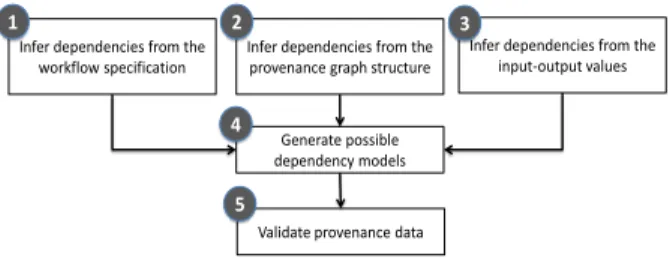
the overall framework of our proposal towards reducing the number of false positive data dependency models.
Infer dependencies from the workflow specification Generate possible dependency models 1 4
Validate provenance data
5
Infer dependencies from the provenance graph structure
Infer dependencies from the input-output values
2 3
Figure 3: Components of our solution for inferring de-pendencies.
During the design of a workflow, the designer knows some internal details of the actors, e.g., (i) data on an output port can only be produced only after using data from a specific subset of input ports, (ii) two outputs are generated using exact set of inputs, etc. In step 1 , we as-sume that our workflow model captures these additional design level information and analyze them to generate
additional dependencies. In 2 , we analyze the
prove-nance graph structure and infer further dependencies by computing the transitive closure of data dependencies. Given a set of provenances either by (i) collecting ac-tual workflow execution traces, or (ii) probing the in-put values, executing the workflow, and collecting prove-nances from the execution traces, in 3 we analyze input and output data values towards understanding the input-output dependencies. Steps 1 , 2 , and 3 generate ad-ditional dependency information, which this framework encodes as constraints and uses them while generating all the possible models of the workflow in step 4 . Each of these models is an “improved” version of the given workflow, i.e., they have more dependency information, and these models are in turn used in step 5 to validate a provenance graph of an unknown origin (i.e., workflow) and improve it by injecting more dependencies. This im-proved provenance then can be used to have better result analysis, debugging, etc.
Running Example. We use the Climate Data
Collec-tor workflow to showcase the features of the proposed
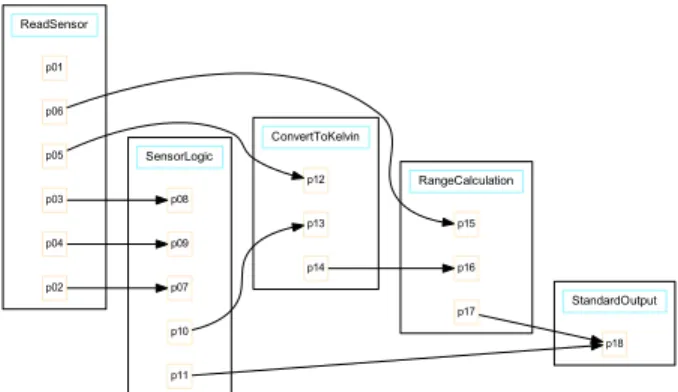
framework. We assume a set of sensors that collect tem-perature, pressure, and other climate observations includ-ing various flags. Given a sensor id, the ReadSensor ac-tor reads from the sensors and returns temperature, pres-sure, and three flags, flagA, flagB, and flagC. The sec-ond actor, SensorLogic, takes these three flags and re-turns two flags weatherCode and temperatureCode. The flag weatherCode specifies if the weather was normal or not and temperatureCode indicates if the tempera-ture was read in Celsius or in Fahrenheit. Another ac-tor, ConvertToKelvin, uses the temperatureCode flag and the temperature reading to convert the temperature to Kelvin. A final actor RangeCalculation accepts the
Figure 4: Climate Data Collector workflow, an example workflow that processes climate data read from a sensor.
pressure and temperature and computes a range. This workflow, defined in VisTrails, is shown in Figure4.
If we consider all these actors as black boxes, ReadSensor, SensorLogic, ConvertToKelvin, and RangeCalculation actors individually have 32, 64, 4, and 4 input-output dependency models and thus, the workflow as a whole has 32768 possible dependency
models. These many models makes it impossible to
make any specific claims about dependencies, but if we use provenance information, we can reduce the number of possibilities.
For example, all the outputs of ReadSensor depend on a single input and there is no output if the sensor is not available. These information reduces 32 possible depen-dency models to exactly one which makes result analysis easier. Unfortunately, neither the workflow specification nor the provenance clearly capture these dependencies. We use this example workflow and show how we can capture additional dependency information, how we can use this information, and how we can improve the
possi-ble dependency models in Section4.
The paper is organized as follows. We start by stating the assumptions needed for workflow model and
prove-nance model used in our approach in Section2. We then
explain our proposed framework and the logical archi-tecture in Section3. In Section4, we discuss our imple-mentation using the example workflow and then describe
related work in Section5. We conclude the paper and
discuss ongoing work in Section6.
2
Models
Workflow Model. We base our workflow model on [3,
4]. A workflow W = (Vw, Ew) is a directed graph whose
Provenance Workflow Constraint Generator Model Generator Model Constraint Model Reducer Workflow Provenance Workflow Provenance Validator Provenance
Figure 5: Logical architecture of how components inter-act to improve a workflow specification.
C. Actors (a.k.a. processes) are computational entities. An invocation of an actor reads data from channels and writes data into channels. The edges Ew= in ∪ out ∪ pdep
are either input edges in ⊆ C × P, output edges out ⊆
P×C, or port dependency edges pdep ⊆ P × P. We also
maintain an additional relation port(P, A, Pt) where P is a
port in actor A and Pt specifies the type of port (input or
output).
Provenance Model. The starting point for our
prove-nance model is [12]. A provenance graph is a directed
acyclic graph G = (Vg, Eg) where the nodes Vg= D ∪ I
represent either data tokens D or invocations I. The
edges Eg= used ∪ genBy ∪ derBy are either used edges
used⊆ I × D, generated-by edges genBy ⊆ D × I, or
derived-by edges derBy ⊆ D × D. Here, a used edge (i, d) ∈ Egmeans that invocation i consumes d as input;
a generated-by edge (d, i) ∈ Egmeans that d is an
out-puttoken, generated by invocation i; and a derived-by
edge (di, dj) ∈ Egmeans that data diwas derived using
data dj. We use two more relations data and invoc. The
relation data(D, P, A, R,V ) specifies that data D appeared at port P of actor A during the run R with a value V . The relation invoc(I, A) maps an invocation I to its actor A. In addition, we use the auxiliary relation ddep(X ,Y ) to specify that data Y depends on data X and ddep∗(X ,Y ) is the transitive closure of ddep(X ,Y ).
(1) ddep(X,Y) :- used(I,X),genBy(Y,I). (2) ddep∗(X,Y) :- ddep(X,Y).
(3) ddep∗(X,Y) :- ddep(X,Z),ddep∗(Z,Y).
3
Proposed Framework and Architecture
This framework takes a workflow specification W and a set of provenance graphs Gs and infers the internal (i.e.,
internal to an actor) port dependencies by analyzing W and Gs. It then encodes all these inferred dependencies as constraints, which are used to reduce the number of possible workflow models. It uses the Generate-and-Test
pattern from Answer Set Programming (ASP) [11], i.e.,
we use sets of stable models [9] to represent all possible models that are consistent with the generated constraints. Let us consider the snippet of ASP program we have used in this framework.
pd(X,Y) v pnd(X,Y):- in(X,A), out(A,Y).
Here, pd(X ,Y ) relation means that Y depends on X and npd(X ,Y ) relation means that Y does not depend on X. If there are n in(X , A) relations and m out(A,Y )
re-lations in W , then there would be 2mndependency
mod-els for the actor A. In one extreme possible model, we would have all the pd(X ,Y ) as “true” and in another ex-treme possible model, we would have all the npd(X ,Y ) as “true”. In all possible models, we would have some of pd(X ,Y ) as “true” and some npd(X ,Y ) as “true”. Now, this framework applies the constraints in the following way: if a possible model has one npd(X ,Y ) as “true” and for the same (X ,Y ) pair a constraint has been
ob-served to be “true” as discussed in Section1then its a
contradiction as the constraint specifies that node Y de-pends on node X . The framework applies the negation as failureprinciple and excludes this model.
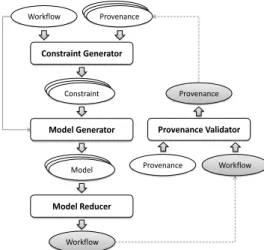
The proposed framework, as shown in Fig. 5, has
several components including the Constraint Generator, Model Generator, Model Reducer, and Trace Validator. The Constraint Generator takes a workflow W and a set of provenance traces Gs, and performs three analy-sis tasks to generate constraints using the techniques we present next.
We analyze provenance graphs and capture such in-ferred data dependencies and use them to reduce the
number of models. More specifically, in our
prove-nance model, we capture used(I, D), genBy(D, I), and derBy(D1, D2) edges. The used(I2, D), and genBy(D, I1)
edges along with the mappings invoc(I1, A1), and
invoc(I2, A2) unambiguously states that the actor A2
de-pends on actor A1. However, edges used(I, D1), and
genBy(D2, I) are unable to unambiguously state that
data artifact D2 depends on data artifact D1. The
derBy(D1, D2) edges describe dependencies among data
artifacts and thus these edges are able to infer internal port dependencies of an actor. This framework analyzes these derBy/2 (i.e., derBy is a two arity relation) rela-tions and infers further data dependencies.
We use the provenance graph shown in Fig. 6to
de-scribe how this framework analyzes these derBy/2) re-lations. This provenance graph has seven data artifacts
T though Z and two derBy/2 edges, derBy(Z,Y ) and
derBy(Z, T ) . Considering the derBy(Z, T ) edge we in-fer that Z depends on W . Thus, given the derBy(Z,Y )
T A1 U A2 A4 V W A3 X Z Y
Figure 6: A provenance graph with two derived-by
edges derBy(Z,Y) and derBy(Z,T). Circles and rectangles represent data artifacts and processes, respectively.
and derBy(Z, T ) edges, we conclude that output port as-sociated with Z depends on input ports asas-sociated with
W and Y , which reduces the number of possible
depen-dency models.
More generally, given provenance traces Gs, the derBy/2 relations in all the Gs are analyzed. A derBy edge could specify the dependency of (i) an output and an input of some actor or (ii) an output of one actor and an input of another actor. The framework infers these con-straints using an algorithm, which is represented by the datalog rules 4 and 5 as shown below. Based on these two inferences, we get that port P2 depends on P1, which is a workflow specification level information by analyzing the derBy/2 relation from the provenance graph. Note that (i) provide exact dependency, but (ii) provides an over estimate. (4) pdep(P1,P2) :-derBy(Y1,X1),data(X1,P1,A,R,_), data(Y1,P2,A,R,_). (5) pdep(P1,P2) :-derBy(Y1,X1),data(X1,P1,A,R,_), data(D,P2,A,R,_),ddep∗(D,Y1), ddep∗(X1,D).
Input port dependencies can also be inferred by ana-lyzing the input and output data values∗. The framework computes the constraints using an algorithm, which is represented using rule 6 shown below.
(6) pdep(IP,OP)
:-data(D1,IP,A,R1,IV1),data(D1,IP,A,R2,IV2), data(D2,OP,A,R1,OV1),data(D2,OP,A,R2,OV2), ¬ R1=R2, ¬ IV1=IV2, ¬ OV1=OV2.
The Model Generator computes all possible depen-dency models in which output ports may depend on input ports for an actor and removes the models that contradict the constraints generated by the Constraint Generator as discussed in the beginning of this section. This compo-nent returns only those models that have no contradic-tions. The Model Reducer takes all the possible work-flow models generated by Model Generator and com-bines them into one workflow model. This workflow model is an improved specification of the input workflow
∗In this work, we assumed a simple model for input and output data
value analysis. In this model, an output port of an actor depends on an input port if the values on the output port changes while changing values of an input and keeping the values for all other inputs same. In our future work, we plan to investigate further complexities of an actor.
ReadSensor p01 p02 p07 p03 p08 p04 p09 p05 p12 p06 p15 SensorLogic p10 p13 p11 p18 ConvertToKelvin p14 p16 RangeCalculation p17 StandardOutput
Figure 7: Climate Data Collector workflow represented by this framework. There are 32768 possible dependency models for this workflow.
model W , in which some of overestimates of the internal port dependencies have been removed. In Provenance Validator, the framework uses this improved workflow specification (i) to validate the provenance graph of un-known origin, (ii) to improve provenance graph by re-moving the inconsistencies.
4
Prototypical Implementation
In this section, we describe a prototypical implementa-tion of the proposed framework.
Fig. 7 shows the Climate Data Collector workflow
represented using this framework; actors are represented as rectangles and have ports “p01” through “p18”. The edges represent channels which connect output ports of one actor to input ports of another actor.
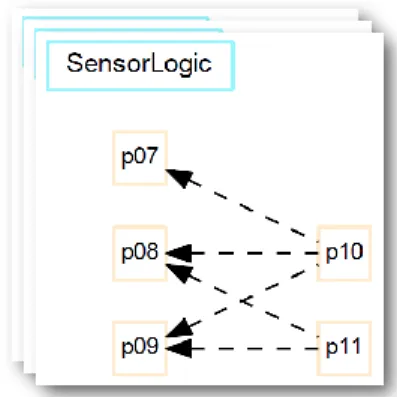
Fig. 8 shows that there are 32 possible dependency
models for the SensorLogic actor. Without additional in-formation, the framework will generate all 32 models. Similarly, other actors have many possible dependency models (as discussed in Section1), and are not displayed because they mirror the SensorLogic actor.
The framework analyzes the workflow specification, provenance traces, and user-specified constraints as
dis-cussed in Section 1, and generates the constraints as
shown in Fig.9which the framework applies while
gen-erating the possible dependency models. Fig.9(a) shows
the constraints generated based on the additional speci-fications†provided by the workflow designer. Fig.9(b) shows all the constraints generated by the framework by analyzing the input-output value dependencies. Fig.9(c)
and Fig. 9(d) show all the constraints generated by the
framework by analyzing the derBy/2 edges from the provenance graphs.
Fig. 10 shows the improved workflow
specifi-cation based on the given workflow, provenance
Figure 8: Possible dependency models for the
Sensor-Logicactor. There are 32 possible dependency models
for this actor alone.
graphs, and constraints. Based on the constraints
generated by the framework, there is only one
model for actors ReadSensor, ConvertToKelvin, and RangeCalculation. There are still 6 models for the
SensorLogic actor. Thus, there are total 6 possible
models for the Climate Data Collector workflow, and the framework generates all of them.
Using this example, we have demonstrated that the proposed framework can improve the workflow specifi-cation, and this information can be used to later validate provenance graphs with unknown origin.
pdep(p02,p01). pdep(p03,p01). pdep(p04,p01). pdep(p05,p01). pdep(p06,p01). pdep(p10,p07). pdep(p10,p08). pdep(p11,p09). pdep(p14,p12). pdep(p14,p13). pdep(p17,p15). pdep(p17,p16). (a) (b) (c) (d)
Figure 9: All of the constraints that are generated by the framework.
5
Related Work
The problem of defining or inferring data dependencies in scientific workflows has been investigated by a hand-ful of researchers. For example, Bowers et al. proposed a declarative language for specifying fine-grained depen-dencies at the level of the workflow definition, which are propagated and applied to workflow trace events
pro-duced as a result of the workflow execution [2]. Their
approach is complementary to ours, and we adopt a sim-ilar language to encode the dependencies that are dervied from workflow specifications and their corresponding
Figure 10: Improved workflow specification of the
Cli-mate Data Collectorworkflow after including one
pos-sible dependency model. There are be 6 such pospos-sible models, and this framework generates all of them.
trace events. However, that approach did not tackle the problem of inferring data dependencies.
Ghoshal et al. investigated the use of static
anal-ysis techniques to derive dependencies (or what they term mappings) between the inputs and outputs of an
ac-tor [10]. However, while they assume that the source
code of the program implementing an actor is available, we tackle the problem of deriving data dependencies when the source code for the actors is not avaiable.
Garijo et al. proposed a framework where they
identified data transformation and manipulation patterns (which they term motifs) that are commonly found in
scientific workflows [8]. They distinguish two types
of motifs: data intensive activities that are observed in workflows (data-oriented motifs), and different manners in which activities are implemented within workflows (workflow-oriented motifs). The first type is relevant to our work. However, in our framework, we are partic-ularly interested in identifying if there is a dependency between an input and an output of an actor rather than the kind of data manipulation performed by the actor.
The above work and others, e.g., [1], [14], are related because they aim to understanding the kind of manip-ulation carried out by workflows. However, none tackle the problem of identifying fine-grained dependencies be-tween input and output port for black box actors. In our
prior work [6], we used the same Generate-and-test ASP
based approach towards finding the possible orders of events. However, in this work we focus on finding the fine-grained dependencies using the same
Generate-and-test ASPbased approach.
6
Discussion
In this paper, we have presented a framework for infer-ring fine grained dependencies between the inputs and
output ports of actors. We have described a probing
so, we made the assumption that dependencies are static, in the sense that they hold across all invocations of the actors. In practice, however, dependencies may be dy-namic, in the sense they may change across invocations of the actor. For example, the VisTrails system [7] pro-vides a conditional actor (If) that uses modified dataflow logic to execute only one of two upstream workflows to generate an output based on a boolean input. There are also instances where two ports are provided to make the specification of an input possible in different formats, meaning only one port’s value will eventually be used but is dependent on which are provided.
The framework that we presented in this paper needs to be refined in order to cater for the identification of dynamic dependencies. In particular, the user should be able to understand the cases (conditions under which) a given output is likely to depend or not on a given in-put. Note also, that so far, we treated input-output port equally. A classification of dependencies is needed to provide the user (workflow designer or provenance user) with better understading on the kind of relationship be-tween the input and output ports. For example, distin-guishing control-flow dependencies from data-flow de-pendencies. The later can be further classified to specify the kind of contribution a given input value had in the construction of the output value.
Acknowledgments. Supported in part by NSF
ACI-0830944 and IIS-1118088.
References
[1] P. Alper, K. Belhajjame, C. A. Goble, and
P. Karagoz. Enhancing and abstracting
scien-tific workflow provenance for data publishing. In EDBT/ICDT Workshops, pages 313–318. ACM, 2013.
[2] S. Bowers, T. M. McPhillips, and B. Lud¨ascher. Declarative rules for inferring fine-grained data provenance from scientific workflow execution traces. In Proc. IPAW ’12, pages 82–96, 2012.
[3] V. Cuevas-Vicentt´ın, S. Dey, B. Lud¨ascher,
M. Li Yuan Wang, and T. Song. Modeling and
querying scientific workflow provenance in the d-opm. In 7th Workshop on Workflows in Support of Large-Scale Science (WORKS), 2012.
[4] V. Cuevas-Vicentt´ın, P. Kianmajd, B. Lud¨ascher, P. Missier, F. Chirigati, Y. Wei, D. Koop, and S. Dey. The PBase scientific workflow provenance repository. IDCC, 2014.
[5] S. Dey, S. K¨ohler, S. Bowers, and B. Lud¨ascher. Datalog as a lingua franca for provenance querying and reasoning. In TaPP ’12, 2012.
[6] S. Dey, S. Riddle, and B. Lud¨ascher.
Prove-nance analyzer: exploring proveProve-nance semantics with logic rules. In TaPP ’13. USENIX, 2013. [7] J. Freire, D. Koop, E. Santos, C. Scheidegger,
C. Silva, and H. T. Vo. The Architecture of Open Source Applications, chapter VisTrails. Lulu.com, 2011.
[8] D. Garijo, P. Alper, K. Belhajjame, ´O. Corcho,
Y. Gil, and C. A. Goble. Common motifs in scien-tific workflows: An empirical analysis. In eScience, pages 1–8. IEEE Computer Society, 2012.
[9] M. Gelfond and V. Lifschitz. The stable model se-mantics for logic programming. In Proc. 5th Int’l Conf. Logic Prog., volume 161, 1988.
[10] D. Ghoshal, A. Chauhan, and B. Plale. Static com-piler analysis for workflow provenance. In Proc. 8th Work. on Workflows in Support of Large-Scale Science, WORKS ’13, pages 17–27. ACM, 2013. [11] V. Lifschitz. What is answer set programming. In
Proceedings of the AAAI Conference on Artificial Intelligence, pages 1594–1597, 2008.
[12] L. Moreau, B. Clifford, J. Freire, J. Futrelle, Y. Gil, P. Groth, N. Kwasnikowska, S. Miles, P. Missier, J. Myers, B. Plale, Y. Simmhan, E. Stephan, and J. V. den Bussche. The open provenance model core specification (v1.1). FCGS, 27(6):743–756, 2011. [13] L. Moreau and P. Missier. PROV-DM: The PROV
data model, 2013.
[14] R. J. Sethi, H. Jo, and Y. Gil. Re-using workflow fragments across multiple data domains. In Proc. SCC ’12, pages 90–99, Washington, DC, USA, 2012. IEEE Computer Society.