UNIVERSITÉ DU QUÉBEC À MONTRÉAL
DIVERSITY MEETS DECOMPOSITION IN FRESHWATER STREAMS: TESTING FORA 'HOME FIELD ADVANTAGE' IN FRESHWATER
DECOMPOSER COMMUNITIES
IN A BOREAL VERSUS A TEMPERATE HARDWOOD STREAM
THESIS PRESENTED
AS A PARTIAL REQUIREMENT OF A MASTERS IN BIOLOGY
BY
NATALIE ELENA WESTWOOD
Avertissement
La diffusion de ce mémoire se fait dans le respect des droits de son auteur, qui a signé le formulaire Autorisation de reproduire et de diffuser un travail de recherche de cycles supérieurs (SDU-522 - Rév.07-2011 ). Cette autorisation stipule que «conformément à l'article 11 du Règlement no 8 des études de cycles supérieurs, [l'auteur] concède à l'Université du Québec à Montréal une licence non exclusive d'utilisation et de publication de la totalité ou d'une partie importante de [son] travail ·de recherche pour des fins pédagogiques et non commerciales. · Plus précisément, [l'auteur] autorise l'Université du Québec à Montréal à reproduire, diffuser, prêter, distribuer ou vendre des copies de [son] travail de recherche à des fins non commerciales sur quelque support que ce soit, y compris l'Internet. Cette licence et cette autorisation n'entraînent pas une renonciation de [la] part [de l'auteur] à [ses] droits moraux ni à [ses] droits de propriété intellectuelle. Sauf entente contraire, [l'auteur] conserve la liberté de diffuser et de commercialiser ou non ce travail dont [il] possède un exemplaire.»
UNIVERSITÉ DU QUÉBEC
ÀMONTRÉAL
LA RELATION ENTRE LA BIODIVERSITÉ ET LA DÉCOMPOSITION
DANS LES RUISSEAUX D'EAU DOUCE:
TESTER L'HYPOTHÈSE DE 'HOME FIELD ADVANTAGE' DANS LES
COMMUNAUTÉS DE DÉCOMPOSEURS DANS UN RUISSEAU BORÉAL
PAR RAPPORT UN RUISSEAU DE LA FORÊT FEUILLUE
MÉMOIRE
PRÉSENTÉ
COMME EXIGENCE PARTIELLE
DE LA MAÎTRISE EN BIOLOGIE
PAR
NATALIE ELENA WESTWOOD
years. I am very lucky to have had the support of so many people throughout this proj ect, who made it possible to do my thesis. First and foremost, I would like to thank my advisor, Alison Derry, for trusting me to take on this new branch of research. This experience has been challenging and she has always encouraged me to dive deeper into this topic and to explore the many aspects of to decomposition.
I would like to thank the many people who helped me with a number of the tests I had to do for this project, from fieldwork to DNA to water and leaf chemistry--Cristina Charette, Jorge Negrin Dastis, Gabriel Zocrato, Emmanuel Dodier, Marilyne Robidoux, Laurence Codebecq, and Melbert Schwartz. I especially want to thank Katherine Velghe and Gillian Martin, for their tremendous help in so many aspects of this project. Thank you, Katherine, for showing me how to run a field experiment. Without you, I' d probably still be stuck with my enormous amount of tubes and filters. And, thank you, Gillian. Without you, I would never have realized the love one can have for macroinvertebrate larvae. I wouldn't want to be stuck in frozen wader_s at -20°C with anyone else. Thanks also to the wonderful staff at Lac Duparquet Station, Parc Aiguebelle and Gault Nature Reserve for your support and for allowing us to access your facilities.
ii
I am very grateful for the wonderful support I received from my committee members Dr. Tanya Handa and Dr. Steven Kembel. Thank you for adding your experience and knowledge to make my project better. I would like to thank Dr. Martin Lechowicz for his help in identifying proper tree species for this project. I thank Jean Carreau for his assistance in identifying field sites that would work best for this project and his on-going support.
This research was supported by several organizations and grants: NSERC Discovery, NSERC Engage, QCBS seed, CFI, BMP NSERC-FRQNT industrial scholarship, ÉcoLac NSERC CREATE, WSP, and GRIL.
Finally, I would like to thank all my family and friends for all of their love and support, both those of you close by and those farther away. Without you, this project would have been much harder to do, and less satisfying to complete.
LISTE OF TABLES... vii
LIST OF"SYMBOLS AND UNITS... X RÉSUMÉ... xi
INTRODUCTION... 1
0.1 The link between biodiversity and ecosystem function... 1
0.2 Decomposer diversity and decomposition as an ecosystem function... 4
0.3 Stream effects on decomposition rate: temperature and nutrients... 6
0.4 Leaflitter quality effects on stream decomposition rate... 8
0.5 Stream and leaflitter quality effects on stream macroinvertebrate communities ... -... 10
0.6 'Home field advantage' effects in decomposer communities... 12
O. 7 Objective of my thesis... 16
CHAPTER I DIVERSITY MEETS DECOMPOSITION IN FRESHWATER STREAMS: TESTING FORA 'HOME FIELD ADVANTAGE' IN FRESHWATER DECOMPOSER COMMUNITIES IN A BOREAL VERSUS A TEMPERA TE HARDWOODS STREAM 1.1 Abstract... 20
1.2 Introduction... 21
1.3 Methods... 28
1.3.1 Study streams... 30
1.3.2 Leaf sources... 32
V
1.3.4 Macroinvertebrate decomposers... 34
1.3.5 Statistical analyses... 35
1.4 Results... 38
1.4.1 Characterization of study streams and leaf sources... 38
1.4.2 Ecosystem function: decomposition rate... 42
1.4.3 Macroinvertebrate community diversity decomposition... 42
1.5 Discussion... 62
1.5.1 Biodiversity-decomposition relationships ... ~... 63
1.5.2 No evidence for 'home field advantage'... 65
1.5.3 Local stream effects... 67
1.6 Conclusion... 70
1. 7 Acknowledgements... 71
CONCLUSION... 72
APPENDIX A... 78
Figure
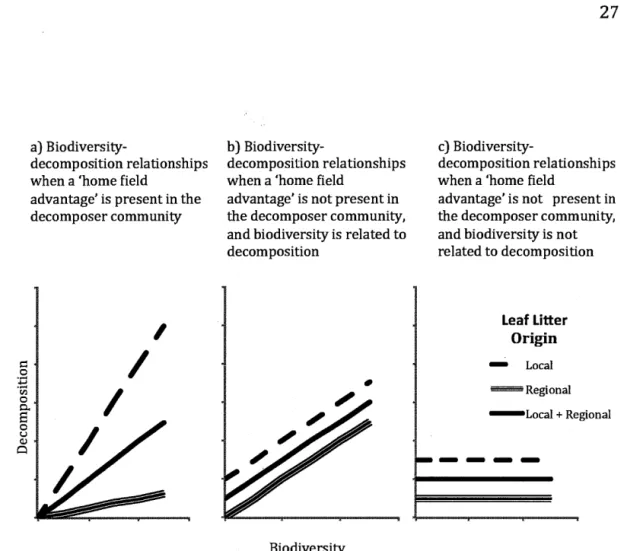
1.1 Conceptual diagram of thesis hypotheses that predict the relationship between biodiversity and decomposition: a) if there is a 'home field advantage' for the decomposer community, then a biodiversity-decomposition relationship will be apparent across leaf source types, but will be most pronounced on local source leaf litter compared to regional source leaf litter versus if there is no 'home field advantage' for the decomposer community, then there b) may or c) may not be a relationship between biodiversity and decomposition but there will be
Page
no difference in the biodiversity-decomposition function between local versus regional source leaves... 27
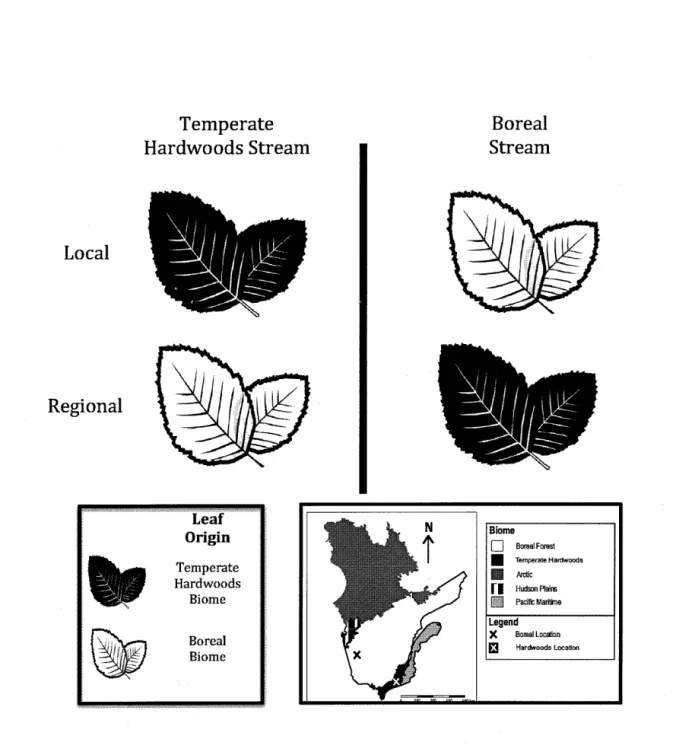
1.2 Schematic of regional-scale reciprocal transplant of speckled aider
(Alnus incana rugosa) in a boreal stream and a temperate hardwoods
stream in Québec, Canada... 29
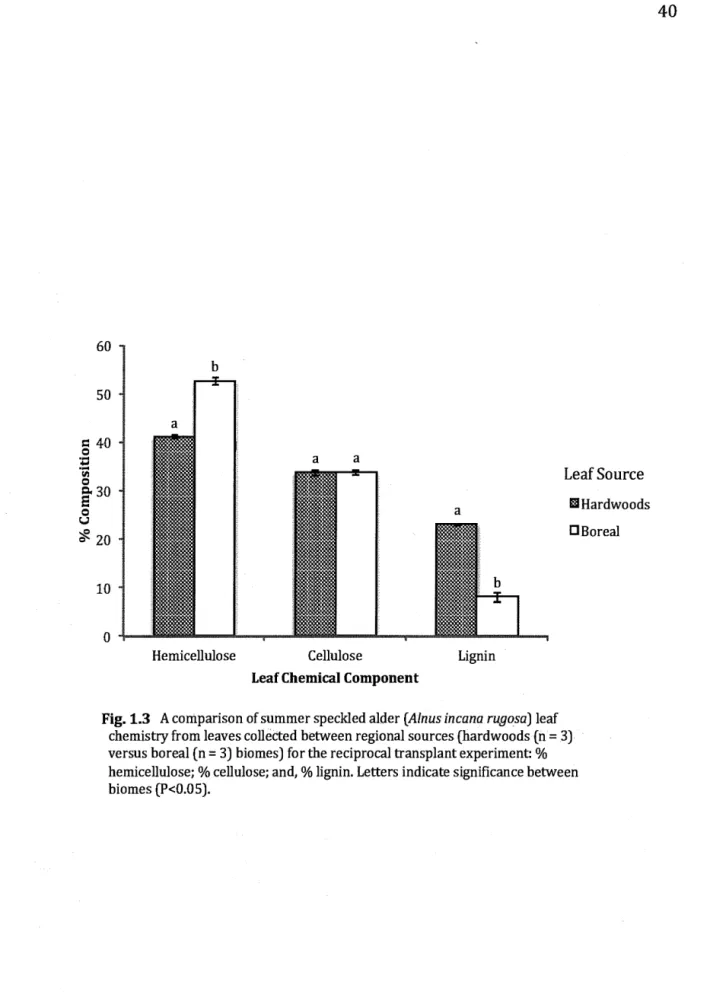
1.3 A comparison of summer speckled aider (Alnus incana rugosa) leaf
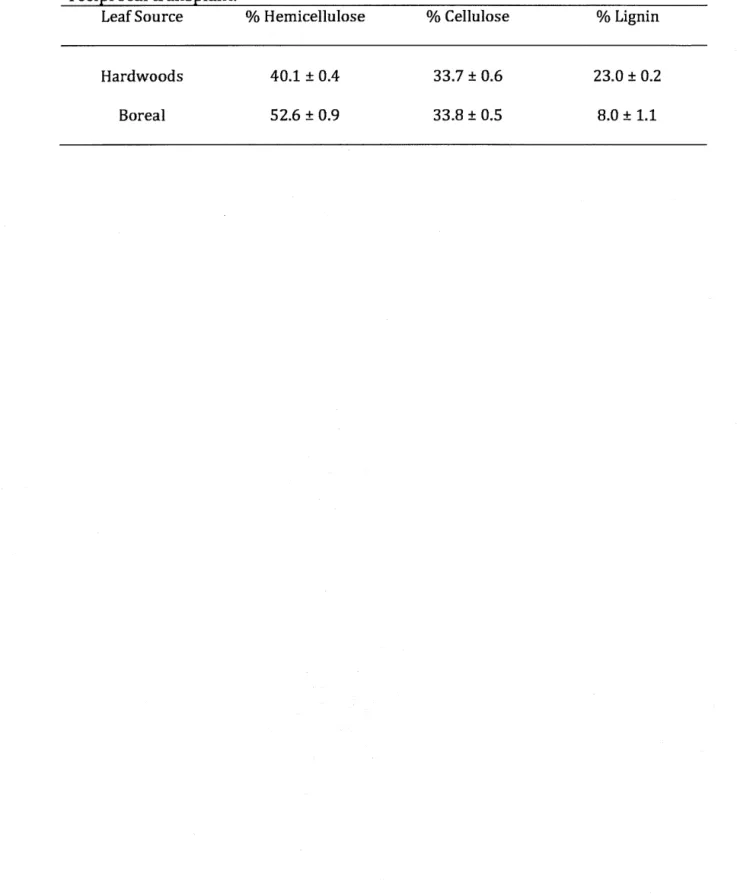
chemistry from leaves collected between regional sources (hardwoods (n = 3) versus boreal (n = 3) biomes) for the reciprocal transplant experiment: % hemicellulose; % cellulose; and, % lignin. Letters indicate significance between biomes (P<0.05)... 40
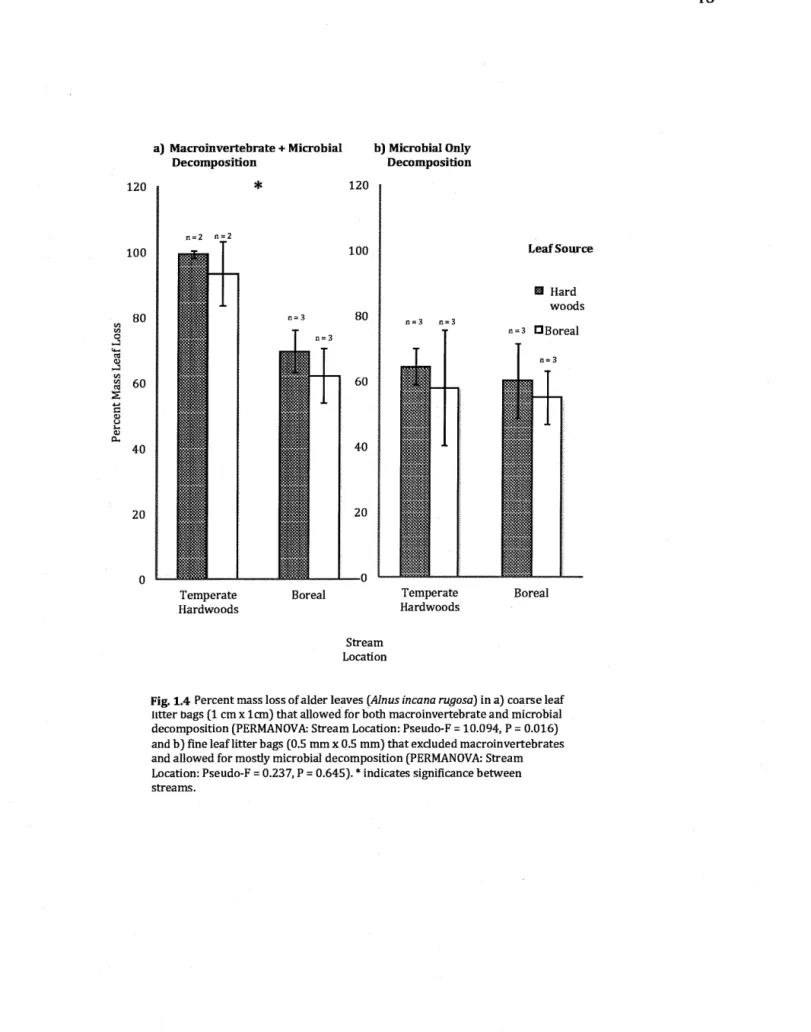
1.4 Percent mass loss of aider leaves (Alnus incana rugosa) in a) coarse leaf
litter bags (1 cm x 1cm) that allowed for both macroinvertebrate and microbial decomposition (PERMANOVA: Stream Location: Pseudo-F =
10.094, P = 0.016) and b) fine leaf litter bags (0.5 mm x 0.5 mm) that excluded macroinvertebrates and allowed for mostly microbial decomposition (PERMANOVA: Stream Location: Pseudo-F
=
0.237, P=
0.645). * indicates significance between streams... 46 1.5 Relationships between macroinvertebrate community diversity anddecomposition for families across taxonomie orders (total
macroinvertebrate community): (a) Shannon Diversity, c) a-diversity, e) Simpson's Evenness ), and for families within the order
Ephemeroptera: (b) Shannon Diversity; d) a-diversity; f) Simpson's
Evenness. Significant regressions (P<0.05) are given for diversity-decomposition relationships on local source leaves and regional source leaves. In cases where neither leaf source was important on its own,
regressions are given for both leaf sources combined ... 51
1.6 Non-metric multidimensional scaling (NMDS) of families across macroinvertebrate orders for which total abundance was enumerated in the coarse-mesh leaf litter bags (1 cm x 1cm). Overall community composition was distinguished according to stream (squares = hardwoods; circles = boreal) but not leaf litter source (solid = hardwoods; open= boreal; P = 0.022)... 58
1.7 PERMANOVA results of a) total macroinvertebrate Shannon Diversity b) total macroinvertebrate a-diversity, c) total macroinvertebrate Simpson's Evenness, d) Ephemeroptera Shannon Diversity, e) Ephemeroptera a-diversity, t) Ephemeroptera Simpson's Evenness, g) Odonata Shannon Diversity, h) Odonata a-diversity, i) Odonata Simpson's Evenness, j) Plecoptera Shannon Diversity, k) Plecoptera a-diversity, and 1) Plecoptera Simson's Evenness, where * indicate significant differences between stream location and letters indicate differences between leaf litter sources (P<0.05) (Table 1.6)... 59
1.8 Total abundance of families within the Ephemeroptera order ( #
individuals per 24 cm x 20 cm bag) in coarse leaf litter bags (1 cm x 1cm) between stream locations and leaf litter sources. * indicates significant difference between streams (P<0.05)... 61
Table
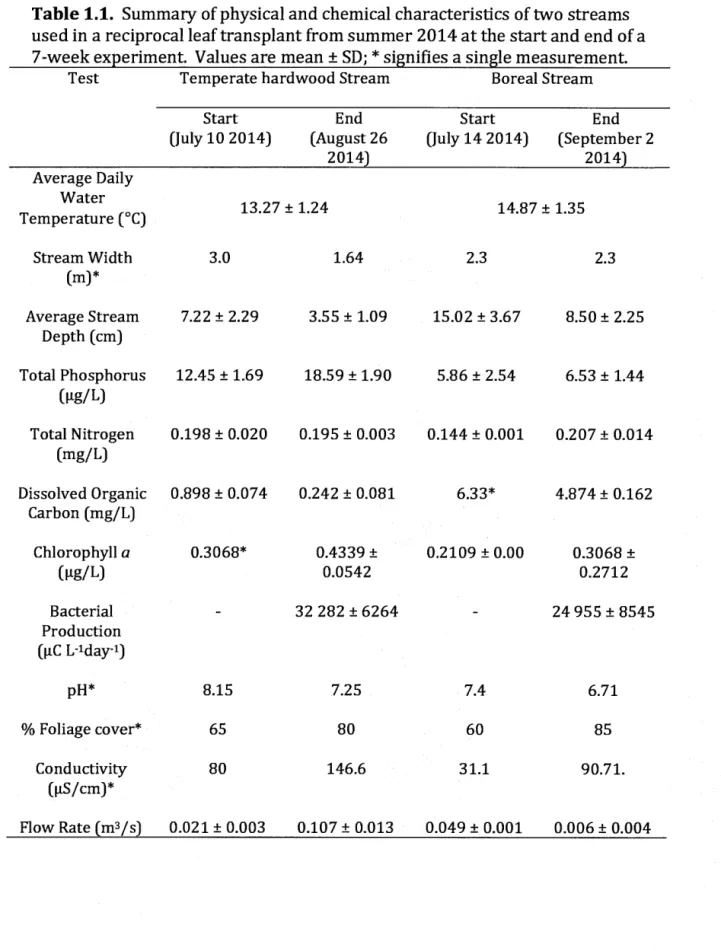
1.1 Summary of physical and chemical characteristics of two streams used in a reciprocal leaf transplant from summer 2014 at the start and end of a 7-week experiment. Values are mean ± SD; * signifies a
Page
single measurement... 39
1.2 Mean ± SD percentage composition of leaf chemistry used in
reciprocal transplant... 41
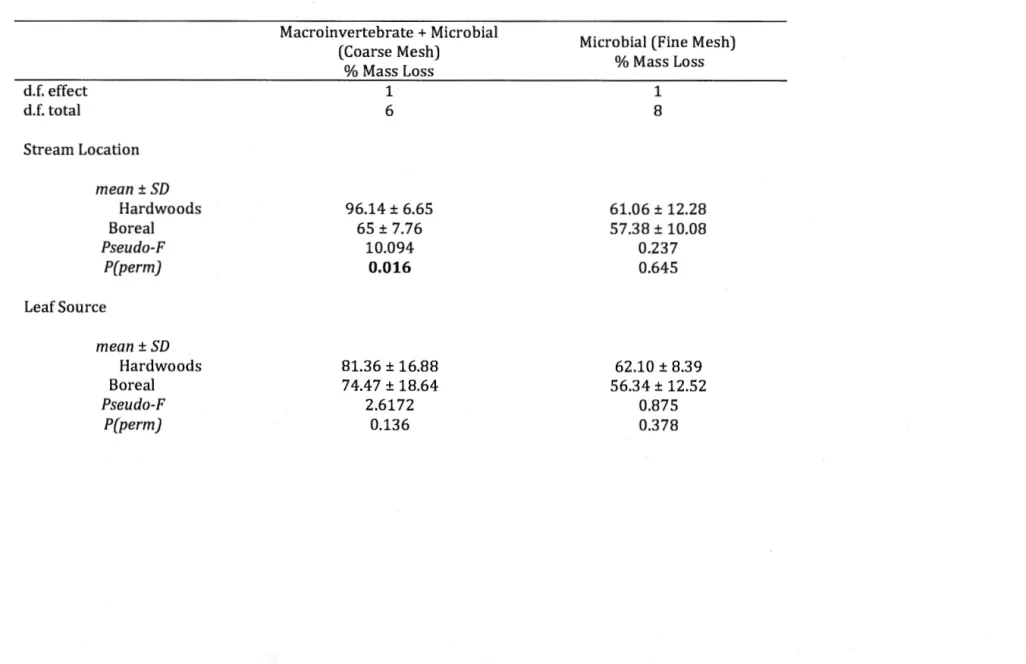
1.3 Results for % mass loss from leaf litter bags that allow for both macroinvertebrate and microbial decomposition and bags that only allow for microbial decomposition. Results are from a PERMANOVA with stream location and leaf source as fixed effects under 999 permutations... 44
1.4 Mean ± SD results for macroinvertebrate abundance, Shannon Diversity, Simpson's Evenness, and family richness ( a-diversity). Abundance and diversity measures were reported for total macroinvertebrates and the orders Diptera, Ephemeroptera, Odonata, Plecoptera, and Trichoptera... 4 7
1.5 Summary of simple regression results examining the correlation between percent leafloss and Shannon Diversity in only local leaves, only regional leaves, and both leaf types for total macroinvertebrates and Ephemeroptera... 50
1.6 Summary of simple regression results examining the correlation between percent leafloss and a-Diversity in only local leaves, only regional leaves, and both leaftypes for total macroinvertebrates and Ephemeroptera... 50
1. 7 Summary of simple regression results examining the correlation between percent leaf loss and Simpson's Evenness in only local leaves, only regional leaves, and both leaf types for total
1.8 Results for macroinvertebrate abundance, Shannon Diversity, Simpson's Evenness, and family richness ( a-diversity). Abundance and diversity measures were reported for total macroinvertebrates and the orders Diptera, Ephemeroptera, Odonata, Plecoptera, and Trichoptera. Results are from a PERMANOVA with stream location and leaf source as fixed effects under 999 permutations... 54
A.1 Summary of individual macroinvertebrates counted in fine mesh
(0.25mm2) leaflitter bags during reciprocal transplant... 78
A.2 Summary of macroinvertebrate community in coarse mesh (1cm2) bags in a reciprocal leaf litter transplant. Numbers indicate the
individuals counted in each family in each bag... 80
A.3 Summary of AICc model selection results where models explain leaf litter decomposition in a reciprocal transplant. Bold indicates
selected models... 82
A.4 Mean ± SD percentage composition of leaf chemistry from summer experiment and fall samples. Paired T-test ( df = 4) between seasons within biomes. Significant differences are bolded... 83
A.5 Summary of simple regression results examining the correlation between percent leafloss and Shannon Diversity, a-Diversity, Simpson's Evenness in only local leaves, only regional leaves, and
both leaf types for Plecoptera... 84 ix
BP Bacterial Production (µC L·1day·1) Chia Chlorophyll a (µg/L)
Conductivity Conductivity (µS/cm)
DOC Dissolved Organic Carbon (mg/L) TN Total Nitrogen (mg/L)
RÉSUMÉ
La décomposition en ruisseaux d'eau douce est un processus écosystémique reliant la végétation riveraine, l'environnement physico-chimique, et les communautés d'organismes décomposeurs. Cependant, le lien entre la décomposition et la diversité de la communauté des organismes décomposeurs n'est pas bien comprise. L'objectif de notre étude était de tester les relations entre la diversité de la communauté des décomposeurs et la décomposition sous des conditions locales en utilisant les sources regionals de feuilles mortes dans les cours d'eau. Nous avons testé si les macroinvertébrés sont localement optimisés pour décomposer la litière de feuilles locale en comparaison à la litière de feuilles de source regionale ( «home field advantage») dans deux petits ruisseaux similaires. Durant l'été 2014, nous avons mené une expérience de transplantation de terrain réciproque de patron factoriel 2 x 2 avec des sacs de feuilles mortes composés d'aulne rugueux (Alnus incana rugosa) de chacune des sources régionales suivantes: un ruisseau boréal vierge et un ruisseau de bois feuillus. Nous avons mesuré le pourcentage de perte de poids sec pour évaluer le taux de décomposition entre les sites des ruisseaux. Les macroinvertébrés entre les sites de ruisseaux x combinaisons de source de litière de feuilles ont été identifiés à la famille, et ont été dénombrés selon leur abondance relative taxonomique, leur richesse, leur uniformité ( evenness) et leur diversité. Nous n'avons trouvé aucune preuve globale d'optimisation locale de macroinvertébrés de ruisseaux en relation avec la décomposition locale de feuilles d'aulne. Les conditions locales des ruisseaux ont été le facteur le plus important qui explique la composition de communauté des macroinvertébrés · dans chacun des cours d'eau, ainsi que les différences de taux de décomposition entre les ruisseaux. Nos résultats sont cohérents avec d'autres études qui ont trouvé peu de preuves d'un
effet «home field advantage» pour les communautés d'organismes
décomposeurs de milieux aquatiques et terrestres lorsque les deux conditions d'habitat sont similaires.
Mots clés: macroinvertébrés, fonctionnement des écosystèmes, aulne rugueux, abundance taxonomique, richesse, uniformité de Simpson, diversité de Shannon
ABSTRACT
Decomposition in freshwater streams is an ecosystem process linking riparian
vegetation, the physico-chemical environment, and communities of
decomposing organisms. However, the link between decomposition and diversity of the community decomposer organisms is not well understood. The objective of our study was to test the relationships between the diversity of the decomposer community and the decomposition under local conditions with respect to regional sources of dead leaves in rivers. We tested whether macroinvertebrates are locally optimized to decompose local leaf litter in comparison to regional leaf litter ("field advantage") in two small streams. In the summer of 2014, we conducted a 2 x 2 factorial pattern reciprocal field transplanting experiment with bags of speckled aider (A/nus inca na rugosa)
leaves from each of the following sources: a boreal stream and a hardwoods stream. We measured the percentage of mass loss for assessing the rate of decomposition between creek sites. The macroinvertebrates between stream sites and leaf litter source combinations were identified to the family, and were counted according to taxonomie relative abundance, richness, Simpson's evenness, and Shannon Diversity. We found global tests for local optimization of brook macroinvertebrates in relation to the local decomposition of aider leaves. Local creek conditions were the most important factor explaining the composition of the macroinvertebrate community in each stream, as well as differences in decomposition loss. Our results are consistent with other studies have found little evidence of a "home field advantage" effect for communities of aquatic and terrestrial decomposer organisms.
Key words: macroinvertebrates, ecosystem functioning, speckled aider, taxonomie abundance, richness, Simpson's evenness, Shannon Diversity
INTRODUCTION
Biogeochemical processes permit the continuous cycling of elements between organic and inorganic forms, and are thus essential to life. A key step in biogeochemical cycles is decomposition, the breakdown of dead organic matter. Decomposition is one of the most important ecosystem processes that occurs in nature as it enables the recycling of carbon and nutrients, both essential to the maintenance of primary production (Wallace et al. 1997; Gessner et al. 2010). Most herbivorous material (90%) is consumed during decomposition rather than through herbivory, making it essential to understand both terrestrial and aquatic decomposition cycles (Gessner et al. 2010). As such, decomposition is a key ecosystem fonction, where ecosystem fonctions are defined as biologically-mediated processes that determine the flow of energy and nutrients through food webs (Duffy 2002). Here, I focus on decomposition of leaf litter in small temperate streams, because in such habitats detritus is typically more important than live plant biomass in terms of supporting diverse food webs.
0.1 The link between biodiversity and ecosystem fonction
The causal relationship between the biodiversity of organisms and the ecosystem functions they carry out has been debated over the last two decades. Biodiversity, in this context, has often been interpreted to mean number of species but can also refer to the evenness of abundance between species, functional diversity, genotype diversity or phylogenetic diversity (Mace et al.
2013). The effect of biodiversity on ecosystem functions is of particular interest, given negative effects of human activity on community-level diversity (Murphy and Romanuk 2014); in particular, if species loss results in reduced functioning of ecosystems, then there may be a growing fragility of food webs as well as reduction in the subset of functions which are essential to the wellbeing of humans (ecosystem services: Hooper et al. 2012).
A number of studies have shown strong support for biodiversity-ecosystem function relationships, starting with the Tilman et al. (1996) common garden experiments on grassland communities that have been followed by supporting studies (Tilman et al. 1997; van der Heijden et al. 1998; Balvanera et al. 2006; Cardinale et al. 2006; Cadotte et al. 2008; Cardinale et al. 2011; Isbell et al. 2011 ). These studies have suggested that biodiversity is linked to species traits, which when disturbed, may change how they function in their role in the environment (i.e. disturbance regimes, microclimate, etc.; Chapin III et al. 2000; Petchey and Gaston 2006). Tilman et al. (1996) ignited a series of experiments that linked biodiversity ( especially species richness: the number of species present) to ecosystem functions. In this experiment, Tilman et al. (1996) examined how having more grass species in a given plot led to more efficient use of nitrogen available in the system and higher plant productivity. Initially this and similar results were attributed to species having complementary niches (Chapin III et al. 2000). However, other researchers argued that the results could also be explained by sampling effects, because any particular species was more likely to occur in a high diversity plot than a low diversity plot, including species that are both dominant in abundance and functionally important (Loreau et al 2010). In addition, it was recognized that the species loss may disturb indirect and mutualistic interactions, indicating that species richness of a single trophic
3
level could not solely be used to predict how biodiversity influences ecosystem function (Zuppinger-Dingley et al. 2016).
Critiques of the biodiversity-ecosystem function studies have identified potential biases, such as a focus on simplified communities and functions, as well as on terrestrial plant communities (Schwartz et al. 2000; Duffy 2002; Srivastava and Vellend 2005; Tilman et al. 2012). Moreover, biodiversity-ecosystem function relationships may be weakened by increases in a dominant species that can act to counterbalance any decrease in species richness (Schwartz et al. 2000; Smith
"
and Knapp 2003; Grman et al. 2010). Smith and Knapp (2003) found that when they removed rare plant species but kept the abundance consistent by adding dominant grass species individuals, the dominant grasses offset any loss of productivity (Smith and Knapp 2003). Similar results were found in a grassland study by Grman et al. (2010) over an 18-year time series experiment of disturbed and undisturbed communities. As a result of these findings, there is building evidence that biodiversity measures other than species richness may be better at predicting ecosystem functions (Wohlegermuth et al. 2016; St-Gelais et al. 2017). More recent studies are investigating biodiversity - ecosystem function relationships in trophically-complex ecosystem communities, including animals, bacteria, and fungi, to better understand the relationship between biodiversity and key ecosystem fonctions, such as decomposition (Lefcheck and Duffy 2015; Andrade et al. 2016; Brophy et al. 2017).
0.2 Decomposer diversity, and decomposition as a key ecosystem fonction in freshwater streams
In freshwater systems, decomposing organic matter supports many trophic levels of the food web, beginning with decomposers such as fongi, bacteria, and macroinvertebrates (Wallace et al. 1997; GuUs and Suberkropp 2003; Gessner et al. 2010). Among freshwater ecosystems, streams are especially influenced by a close terrestrial-aquatic interface and consequently their food webs are largely based on these terrestrial detrital sources of nutrients and carbon (Dodds and Whiles 2010). When streams are narrow with a dense riparian zone, allochthonous litter inputs are typically the dominant carbon and nutrient source for aquatic food webs (Wallace et al. 1997), although autochthonous production of algae may still be important for certain essential fatty acids (Torres-Ruiz et al. 2007). Decomposition of leaf litter in streams involves initial processes of physical leaching, followed by microbial conditioning. Following the initial colonization of the litter by bacteria and fungi, macroinvertebrates are able to forther decompose leaf litter (Gulis and Suberkropp 2003). Those macroinvertebrates also support populations of larger insects or fish that feed on them, allowing nutrients to re-enter their respective cycles ( e.g. carbon, phosphorus, and nitrogen) (Wallace et al. 1997; Gessner et al. 2010).
A number of studies have manipulated decomposer communities to understand how decomposer diversity affects the ecosystem fonction of decomposition (Hâttenschwiler et al. 2005; Cardinale et al. 2006). This includes studies in both terrestrial (Scheu et al. 2002; Hâttenschwiler and Gasser 2005; Grizzle and Zak 2006; Handa et al. 2014) and aquatic systems (Jonsson et al. 2001; Pascoal et al. 2005; Schâdler and Brandi 2005; Balvanera et al. 2006, Cardinale et al. 2006; Srivastava et al. 2009; Handa et al. 2014).
5
Among the terrestrial studies, many have found support for a decomposer diversity-decomposition relationship (Scheu et al. 2002; Hattenschwiler and Gasser 2005; Grizzle and Zak 2006; Handa et al. 2014). In the aquatic
environment, the relationship between decomposer diversity and
decomposition has been detected in some studies but not others. For instance, decomposer diversity is positively associated with decomposition in some observational studies of streams (e.g. Jonsson et al. 2001) but not in others (Pascoal et al. 2005). Experimental manipulations of decomposer diversity have more often than not found positive effects on decomposition (meta-analyses: Balvanera et al. 2006, Cardinale et al. 2006, Srivastava et al. 2009), but there can be strong geographic differences in both the patterns and underlying mechanisms (McKie et al. 2008). Sorne of the differences between studies may be due to the metric of diversity used or the type of decomposer taxa considered. For example, effects of detritivore richness have been shown to differ from those of evenness (Boyero et al. 2007; McKie et al. 2008). Therefore, given the critical importance of decomposition for the ecosystem fonction of freshwater streams, there is a need to investigate how decomposer communities influence decomposition in streams from the perspective of both taxonomie and functional richness and evenness. Furthermore, some researchers have suggested that microbial communities have greater functional redundancy than metazoan communities, and so are less likely to show diversity-function relationships (Pascoal et al. 2005, Louca et al. 2016). Given the importance of both microbes and metazoans for leaf breakdown (Handa et al. 2014), this suggests that future research on decomposition should consider the role of the decomposer community as a whole.
0.3 Stream effects on decomposition rate: temperature and nutrients
Many different physical and chemical characteristics - most notably temperature and dissolved nutrients - can affect the decomposition rate of leaf litter in both terrestrial and aquatic ecosystems (Aerts 1997; Boyero et al. 2011; Bothwell 2014). However, the relationship between many of these characteristics and the decomposition rate is not often straightforward, since the relationships can be positive, negative, or negligible (Fierer et al. 2005; Hagan et al. 2006; Boyero et al. 2011).
Temperature can influence leaf decomposition differently, depending on whether the ecosystem is terrestrial or aquatic. Soil temperature is often positively related to the rate of decomposition (Moore 1986; McHale et al. 1998; Bothwell 2014), although this relationship is weaker at the beginning of the decomposition process, but increases with time (Fierer et al. 2005). By contrast, freshwater aquatic systems, the relationship is less clear. A number of studies have shown that increases in water temperature lead to higher rates of microbial decomposition (Dang et al. 2009; Fernandes et al. 2011; Ferreira and Chauvet 2011; Ferreira and Canhoto 2014; Ferreira et al. 2015). Past studies on macroinvertebrates have found that macroinvertebrate decomposition rates were greater at higher temperatures, potentially from increases in either the abundance of decomposers or the metabolic rate of the decomposers (Aerts 1997; Jonsson 2001; Ferreira and Canhoto 2014). For example, Ferreira and Canhoto (2014) found that temperature effects on decomposition were dependant on season: higher temperature increased decomposition in the winter but not in the summer. In this study, decomposition rate increased for
7
both microbial and invertebrate decomposition, although invertebrate decomposition increased more than microbial decomposition (Ferreira and Canhoto 2014). However, in a comprehensive global study by Boyero et al. (2011), an increase in microbial decomposition rate was met by a similar magnitude of decrease in macroinvertebrate decomposition rate, thereby cancelling out any overall change in decomposition. Therefore, although temperature is a strong determinant of decomposition rates, the effects of temperature are often context-dependent.
The relationship between decomposition rate and dissolved nutrients, nitrogen and phosphorus, is also complicated. Increases in phosphorus availability in lake waters have been linked with higher rates of decomposition (Xie et al. 2004). Similarly, low and moderately eutrophie streams are reported to have elevated decomposition rates compared to at pristine sites (Hagen et al. 2006). The positive influence of nutrients, especially phosphorus, on decomposition has been related to the positive effects of limiting nutrients on the abundance of decomposer populations, both macroinvertebrates (Elwood et al. 1981; Gulis et al. 2006; Hagen et al. 2006) and fungi (Gulis et al. 2006; Feio et al. 2010). However, too much of either type of nutrient can result in eutrophication that reverses positive effects of nutrients on decomposer community abundance and decomposition (Elwood et al. 1981; Gulis et al. 2006; Hagen et al. 2006; Feio et al. 2010).
Microbial decomposef's are key but understudied components of the decomposer community, and can be limited by both temperature (Irons et al. 1994) and nutrient availability (Gulis et al. 2008) in streams.
For example, microbial decomposition rate has been found to moderately increase when dissolved nutrients increase during spring and summer months
(Ferreira and Graça 2016). Moreover, a series of studies by Gulis and
Suberkropp (2003a; 2003b) found that there was an increase of microbial biomass and decomposition rate in streams with enriched nutrients. However, comparisons between streams in agricultural versus forested settings may be poor test of the effects of nutrients because gradients in temperature, nutrients, and light can co-vary between streams (Hagen et al. 2006), and so it can be difficult to disentangle these individual effects on decomposition and decomposer communities using observational approach. Experimental approaches can help disentangle the drivers. For example, in a mesocosm experiment, when effects of nutrient enrichment were manipulated independently of other factors that often characterize agricultural streams (pesticides, sediment deposition and low flow), there was no evidence that nutrient enrichment affected or decreased the microbial decomposition rate depending on the species of leaf litter used (Bruder et al. 2016).
0.4 Leaf litter chemistry effects on stream decomposition
The nutrient availability in leaf material can influence the rate of leaf decomposition in both the terrestrial (Meentemeyer 1978; Aerts 1997; Hattenschwiler et al. 2005) and the aquatic environment (LeRoy and Marks 2006; Bruder et al. 2016; Ferreira and Graça 2016). Higher levels of nutrients (i.e. nitrogen and phosphorus) and lower levels of secondary compounds (tannins, phenolics, lignin, etc.) have been associated with higher rates of
9
decomposition (Aerts 1997; LeRoy and Marks 2006). For example, Ostrofsky (1997) found that using leaf tannins, nitrogen, carbon:nitrogen, and lignin explained most of variation in the macroinvertebrate decomposition rate
between different tree species in streams. Others have found that leaf
phosphorus concentration better predicts early decomposition, but phenolic compounds are better predictors in macroinvertebrate decomposition past the one-year mark of decomposition (Aerts and de Caluwe 1997). Differences in leaf chemistry, as a key influence on decomposition, are found not only between species, but can be observed between populations. For example, Jackrel et al. (2016) found that macroinvertebrate communities were locally optimized to decompose the local litter comprised of differences in secondary defense compounds, such as tannins, on a subspecies of red aider leaf decomposition in streams. A similar pattern has been reported for hybrids of two cottonwood species, where genotypic differences in tannin concentrations effect both aquatic and terrestrial decomposition (Schweitzer et al. 2008)
Nutrients and secondary compounds in leaf litter can be particularly important in explaining differences in litter decomposition at. regional or smaller spatial scales. While climate explains much of the global pattern in the terrestrial decomposition of litter, within a climatic region, leaf litter chemistry is the best predictor of decomposition rate, especially the relationship between the secondary compound lignin and the nitrogen concentration (Meentemeyer 1978; Aerts 1997). For example, litter chemistry is a better predictor of decomposition in streams than stream condition, at least with the first month (LeRoy and Marks 2006).
Leaf litter chemistry may affect litter decomposition by determining the amount and type of litter nutrients accessible to decomposers. An important component of the decomposer community is fungi. A number of studies have elevated nutrient levels in streams and observed simultaneous increases in both decomposition and fungal biomass (Fernandes et al. 2014; Bruder et al. 2016; but see Ferreira and Graça 2016). However, there may be important differences between nitrogen and phosphorus enrichment; for example, Fernandes et al. (2014) found that increasing nitrogen but not phosphorus affected decomposition and fungi. Furthermore, nitrogen enrichment may only affect fungal communities in certain litter species, perhaps because litter species also differ in concentrations of secondary compounds that reduce nutrient accessibility (Ferreira and Graça 2016).
0.5 Decomposer community composition in relation to decomposition
Macroinvertebrates are a key component of stream decomposer communities (Gessner et al. 2010), and the taxonomie and functional community composition of stream macroinvertebrates bas long been studied in relation to leaf litter decomposition in streams (Cummins and Klug 1979; Merritt and Cummins 1996). Macroinvertebrate communities themselves can be directly structured by both conditions of the water such as temperature and chemistry (LeRoy and Marks 2006; Merovich and Petty 2010), as well as physical factors such as particle size and stream width (Heino et al. 2003; Mykrâ et al. 2007). However, the extent to which physico-chemical characteristics determine the community composition of stream macroinvertebrates can be highly context-dependent,
11
influenced both by the environmental gradient and the macroinvertebrate taxa (Heino et al. 2003; LeRoy and Marks 2006; Mykra et al. 2007). In addition to physico-chemical stream conditions, leaf litter chemistry can · also influence macroinvertebrate decomposer species richness (Yanoviak 1999) and community composition (LeRoy and Marks 2006). These findings are consistent with studies of leaf litter effects on decomposer communities in the terrestrial environment (Jewell et al. 2015, Hattenschwiler et al. 2005).
Although macroinvertebrates have historically been studied as the main agents of decomposition in streams, some studies suggest that the role of microbes has been overlooked. For example, stream conditions have been shown to affect decomposition rates in the absence of changes in the abundance of detritivorous macroinvertebrates (McKie and Malmqvist 2009, Ferreira et al. 2015), suggesting that microbial or physical breakdown of litter is also influenced by the stream environment. Often, studies have linked changes in decomposition to changes in macroinvertebrate detritivores without considering the potential for indirect effects of invertebrates on microbes (Graça 2001). However, macroinvertebrates can affect the microbial community. For example, Domingos et al. (2015) found that warming reduced the activity of a dominant
macroinvertebrate decomposer (the Trichopteran, Allogamus laureatus) in
streams, which had cascading effects on the response of the fungal community to warming. The focus on macroinvertebrate communities as the main drivers of leaf litter decomposition in streams has been replaced with more recent studies that characterize microbial components of decomposer communities (Duarte et al. 2006; Duarte et al. 2008; Duarte et al. 2009; Duarte et al. 2010). Although the taxonomie identify of microbial OTUs in decomposer communities can be ascertained by modern DNA sequencing methods, the ecological fonctions of
many microbial groups remain to be discovered. A promising approach here is using metagenomics to establish the relative abundances of genes, or metaproteomics to quantify the relative abundance of proteins, where these genes or proteins have known functional significance (Schneider et al. 2010; Louca et al. 2017). Findings such as these point to the ecological significance of other traditionally unexplored components of the decomposer community, namely the bacteria and fungi, and their relative importance for decomposition in streams. There remains a need to better integrate fungal and bacterial components into our understanding of stream decomposer communities, the abiotic and biotic factors that influence microbial decomposer communities, and how microbial decomposer community structure and composition influences leaf litter decomposition rates.
0.6 'Home field advantage' effects in decomposer communities
The 'Home field advantage' hypothesis predicts that local leaves should be preferred over regional leaves, regardless of chemical composition, by the decomposer community (Gholz et al. 2000). There is presently no overwhelming evidence that 'home field advantage' occurs commonly and consistently in terrestrial and aquatic decomposition (Wang et al. 2013; Veen et al. 2015b ). This is because while some studies do show evidence to support 'home field advantage' effects in decomposer communities in terrestrial ecosystems (Ayres et al. 2009; Strickland et al. 2009; Wallenstein et al. 2013; Chomel et al. 2015; Veen et al. 2015a) and in freshwater streams (Jackrel and Wootton 2014; Jackrel
13
and Wootton 2015a; Jackrel and Wootton 2015b; Jackrel et al. 2016), many other studies have found no support for this phenomenon in nature (terrestrial studies: Giegelmann et al. 2011; St. John et al. 2011; Makkonen et al. 2012; aquatic studies: Jewell et al. 2015).
There have been several meta-analyses of the terrestrial decomposition Iiterature that have shown both support for (Wang et a_l. 2013) and against (Veen et al. 2015b) 'home field advantage' effects. Wang et al. (2013) found that litter mass loss in certain forest ecosystems was significantly higher in most studies in home locations, leading to higher nitrogen releases into the environment and acceleration of nitrogen cycling. By contrast, in the meta-analysis by Veen et al. (2015b ), there were varying degrees of evidence for 'home field advantage' and Iittle linkage between either temperature or leaf litter chemical composition as drivers of 'home field advantage.' This suggests that 'home field advantage' is not ubiquitous throughout decomposition, nor are the mechanisms that cause it simple to understand.
Among terrestrial decomposition studies, there are several recent empirical papers that show inconsistencies in the level of support for 'home field advantage'. First, there are a series of papers that show no support for 'home field advantage' across a broad array of biomes globally. For example, a terrestrial reciprocal transplant involving mixes of leaf litter found no evidence
of a 'home field advantage' effect in macro- and meso-invertebrate
decomposition rates in the tropical rainforests of Brazil (Giegelmann et al.
2011). This finding was supported by a more comprehensive study by
from 16 species in forests spanning from the subarctic to the tropics. While this study found that there were certain litter traits that predicted variation in decomposition (i.e. magnesium and condensed tannins concentrations), the decomposition rates did not vary when looking at home versus away sites, showing little specialization by the decomposer community between sites (Makkonen et al. 2012). Veen et al. (2015a) examined terrestrial decomposition in the Arctic and found limited evidence of 'home field advantage' throughout the biome. Second, there may even be evidence that 'home field' effects can be disadvantageous rather than advantageous. St. John et al. (2011) addressed differences in decomposition rate between microinvertebrate and microbial decomposers in New Zealand found that decomposition rate was slower rather than faster at home sites compared to away sites (St. John et al. 2011). Thirdly, some studies show evidence for mixed support for 'home field advantage' that depends on leaf litter species and whether mono-species or mixed-species leaf litter types were considered. Chomel et al. (2015) detected mixed evidence for 'home field advantage' effects with spruce and poplar litter decomposition in the
boreal region of Québec, Canada. Only the spruce litter had a faster
decomposition rate at home sites compared to away sites, but also exhibited higher abundance of decomposers as compared to the poplar litter (Chomel et al. 2015). Jewell et al. (2015) provided further insight into understanding mixed support for 'home field advantage' between terrestrial decomposition studies: effects are much stronger when looking at mono-specific litter than litter mixed together.
Among terrestrial decomposition studies, there are also several recent papers that have found positive support for 'home field advantage' effects. In a terrestrial microcosm experiment that crossed the origin of soil microbial
15
communities with the origin of leaf litter (tree leaf litter versus grass litter), tree leaf litter decomposed more rapidly when exposed to home microbial communities but grass leaf litter was decomposed effectively by all microbial communities (Strickland et al. 2009). The authors suggest that 'microbial community under poor quality litter are filtered or selected to contain only those species able to persist on low quality litter, but not those under high quality litter (Strickland et al. 2009). A similar mechanism has been suggested to explain why lodgepole pine, a recalcitrant litter, benefits more from a home field advantage than aspen, a more labile litter (Wallenstein et al. 2013). Therefore, while many terrestrial decomposition studies have not found support for 'home field advantage', we cannot ignore that these effects do occur in certain study systems and under certain conditions in terrestrial ecosystems. More research is needed to understand the conditions under which 'home field advantage' effects do and do not occur in nature.
Less research has been done to test for 'home field advantage effects' in aquatic ecosystem decomposition compared to in terrestrial ecosystem decomposition. Even reviews of the home field advantage literature have been unable to include any aquatic studies (Wang et al. 2013; Veen et al. 2015b). In fact, the only studies to our knowledge to examine home field advantage in an aquatic system are recent and all based in Washington State, USA. This series of studies found evidence of 'home field advantage' in the decomposition of red aider (Alnus rubra) and Western Hemlock (Tsuga heterophylla) litter, as well as in subspecies of red aider (Jackrel and Wootton 2014; Jackrel and Wootton 2015b; Jackrel et al. 2016). However, when they looked at other species (i.e. big leaf and vine maple ), they did not see any differences in decomposition rate, despite intraspecific variation in chemical composition (Jackrel and Wootton 2015).
These results from streams contrast with many terrestrial studies in that the macroinvertebrates were explicitly included in the decomposer community, and that home field advantages were shown both for recalcitrant (Western Hemlock) and labile (red aider) litter. In the case of the intraspecific home field advantage, the authors suggest that the stream macroinvertebrate communities are specialized to the particular defensive chemical make up of their local aider population (Jackrel et al. 2016). For example, subspecies of red aider have varying degrees of defensive secondary chemicals, such as tannins (Jackrel and Wootton 2014; Jackrel et al. 2016). In summary, 'home field advantage' effects in stream decomposer communities may be limited to certain litter species, and could potentially be dependent on the community composition of riparian vegetation.
0.7 Objective of my thesis
Given mixed support for 'home field advantage' effects in the global terrestrial decomposition literature and the paucity of studies that have addressed this potential ecological mechanism in aquatic ecosystems, my thesis tested for 'home field advantage' effects in macroinvertebrate decomposer communities between two freshwater streams, one in the boreal forest and one in the deciduous forest, in Québec, Canada. I performed a reciprocal transplant experiment with speckled aider (A/nus incana rugosa) collected from each of the two biomes, and then examined relationships between leaf litter decomposition rate and taxonomie and functional macroinvertebrate community structure and
17
composition as a response to the effect of stream, leaf litter source, and stream x leaf litter source interactions. I also characterized the microbial decomposer community present in the two streams on leaf litter sources originating from the two different biomes.
The rationale for positive support of the 'home field advantage' hypothesis in my experiment was based on three principal assumptions: i) leaf litter quality would differ between the aider collection sites in the two forest biomes, ii) differences in leaf litter quality between the two forest biomes would result in differences in the stream community assemblages of macroinvertebrates, and possibly also
fungi and bacteria, and iii) differences in community assemblages of
macroinvertebrates on different leaf litter sources would result in 'home field' effects when measured as decomposition rates within each of the streams. There were three alternative predictions associated with testing the 'home field advantage' hypothesis in my study:
1) Ho: There will be no correlation between speckled aider leaf
decomposition rate and · any of taxonomie diversity, richness, and
evenness of stream macroinvertebrate communities. A possible
mechanism to explain this hypothesis is if stream abiotic effects have overriding effects on decomposition rates and macroinvertebrate communities.
2) H1: Macroinvertebrate community diversity, richness, and evenness will correlate with speckled aider decomposition rate, but independently of leaf litter source. If this is the case, there will not be evidence to support 'home field advantage', but there will be evidence to support the
importance of macroinvertebrate community properties on stream leaf litter decomposition.
3) Hz: Macroinvertebrate community diversity, richness, and evenness will positively correlate with speckled aider decomposition rate depending on leaf litter origin (home forest biome versus away forest biome). If this is the case, there will be support for the 'home field advantage' hypothesis because local leaf litter will decompose more rapidly with local macroinvertebrate community assemblages compared to regionally distant source macroinvertebrate community assemblages.
CHAPTER I
DIVERSITY MEETS DECOMPOSITION IN FRESHWATER STREAMS: TESTING FORA 'HOME FIELD ADVANTAGE' IN FRESHWATER DECOMPOSER
COMMUNITIES
IN A BOREAL VERSUS A TEMPERATE HARDWOOD STREAM
Natalie Elena Westwood1,z,4 and Alison Margaret Derry2,3
1Zoology Department, University of British Columbia, 140-2212 Main Mali, Vancouver, British Columbia, Canada, V6T 1Z4
2Department of Biological Sciences, University of Quebec at Montreal (UQAM), P.O. Box 8888, Suce. Centre-Ville, Montreal, Quebec, Canada, H3C 3P8 3Groupe de recherche interuniversitaire en limnologie et en environment
aquatiue (GRIL)
1.1 Abstract
The link between ecosystem function and biodiversity has been hotly debated in the past, as this relationship is not well understood. This relationship is often
complicated and frequently dependent on local factors and regional differences. Decomposition - an essential ecosystem process - is responsible for the recycling of nutrients and bridging aquatic and terrestrial ecosystems. Our study examined if macroinvertebrates are locally optimized to decompose locàl leaf litter over regional ('home field advantage'). Using speckled alder (A/nus incana rugosa), we performed
a reciprocal transplant between two streams in two different biomes. We measured percent dry mass loss to estimate decomposition and identified macroinvertebrates to family level. Using the macroinvertebrate data, we determined taxonomie
abundance, richness, evenness, and diversity. W e did not find any evidence for 'home field advantage' in either the leaf decomposition or in biodiversity of the macroinvertebrate community. However, both diversity and evenness were positively correlated with decomposition, with the highest diversity, evenness, and
decomposition occurring in the hardwoods stream. As our model selection showed that both diversity and stream location correlated with decomposition, we caution that these results may not be definitive, making it difficult to determine relative eff ects. These results are consistent with a number of other studies that have found little evidence of 'home field advantage' in decomposer communities, while supporting that there is a positive relationship between ecosystem function and biodiversity.
Key Words: macroinvertebrates, ecosystem function, speckled aider, taxonomie abundance, richness, Simpson's Evenness, Shannon Diversity
21
1.2 Introduction
The link between biodiversity and ecosystem function is a cornerstone principle in ecology because it underlies our understanding of ecological processes and how they may be conserved in face of environmental change (Tilman et al. 1996; Wardle et al. 1997; Schwartz et al. 2000; Duffy 2002; Hooper et al. 2005; Srivastava and Vellend 2005; Tilman et al. 2012; Tobner et al. 2014; etc.). Decomposition is a key ecosystem function that enables nutrient cycling and basal resources for higher trophic levels (Taylor et al. 2007; Roussel et al. 2008; Gessner et al. 2010; Milcu and Manning 2011). Many studies have debated the relationship between species biodiversity and ecosystem function (Schwartz et al. 2000; Duffy 2002; Smith and Knapp 2003; Srivastava and Vellend 2005; Roussel et al. 2008; Grman et al. 2010; Tilman et al. 2012), and the link between species biodiversity and decomposition is also unclear. While some studies have found no link or mixed outcomes between species taxonomie biodiversity and decomposition (Hattenschwiler and Gasser 2005; Pascoal et al. 2005; Schadler and Brandi 2005; Srivastava et al. 2009), other key works on decomposition have shown support for biodiversity-ecosystem function relationships (Balvanera et al. 2006; Handa et al. 2014). One factor that may enhance or inhibit relationships between decomposer diversity and decomposition are 'home field advantage' effects. The 'home field advantage' hypothesis (Gholz et al. 2000) is based on the idea that organic material will decompose faster in an area where the material has originated from, regardless of quality due to specialization by local decomposer communities to local conditions (Gholz et al. 2000; Schweitzner et al. 2004; Lecerf and Chauvet 2008, O'Brien and Krauss 2010; Makkonen et al. 2012; Jewell et al. 2015).
'Home field advantage' implies that one or several species within all or some functional or taxonomie groups are locally optimized to local leaf litter and this specialization overcomes other variables, such as temperature and leaf litter quality (Schweitzer et al. 2004; Makkonen et al. 2012; Jewell et al. 2015; Powell et al. 2015; Veen etal. 2015a, Veen ~t al. 2015b). Austin et al. (2014) propose that 'home field advantage' takes place when a local community is optimized to perform its function due to the complex interaction of surrounding conditions (i.e. temperature, nutrient availability, leaf litter chemical composition, pH, dissolved oxygen, etc.). The goal of our study was to test if 'home field advantage' effects are present in decomposer communities, and how these effects may potentially influence the relationship between decomposer community diversity and decomposition in freshwater streams.
The 'home field advantage' hypothesis has been tested in terrestrial and aquatic decomposition studies, where it has met mixed support (Schweitzer et al. 2004; Chapman and Koch 2007; Ayres et al. 2009; Chamel et al. 2015; Jewell et al. 2015; Veen et al. 2015a; Veen et al. 2015b). This is because local characteristics known to influence decomposition rate, such as temperature and leaf litter chemical composition, may not solely determine the presence and strength of 'home field advantage' effects in decomposer communities (Wallenstein et al. 2013; Austin et al. 2014; Powell et al. 2015; Veen et al. 2015b). There has been little to no support for 'home field advantage' effects at large scales (Makkonen et al. 2012; Veen et al. 2015a). When 'home field advantage' effects do appear to play out in decomposer communities, it can occur at smaller spatial scales. For example, 'home field advantage' effects in aquatic decomposition studies have been recorded among local sites where there are differences in the chemical
23
composition of leaves as a result of plant defense responses to predation damage from insects (Jackrel and Wootten 2014; Jackrel et al. 2016). Despite that there are clear differences in quality, leaves are still decomposed quicker in their local or 'home' environment (Strickland et al. 2009; Jackrel and Wootten 2014; Jackrel et al. 2016). In a common garden experiment by Strickland et al. (2009), they found that litter quality could not solely predict how communities , would respond to leaf litter, with some preferring their local litter source. However, few studies have tested for 'home field advantage' effects between biomes at a regional scale to see if these specializations to local conditions are ubiquitous in different ecosystems (Jackrel and Wootten 2014; Veen et al. 2015a; Jackrel et al. 2016).
Among the studies that have tested for regional effects, most have used different species of leaf litter that fulfill similar roles within the ecosystem or have used one common source of litter rather than a reciprocal transplant (Boyero et al. 2011). 'Home field advantage' in decomposition has been most prevalent in leaf litter decomposition studies that have used one species of leaf litter instead of a multi-species mixture, likely because of cancelling effects between leaf litter types that may occur in decomposer communities, regardless of what the leaf litter quality was recorded as (Chomel et al. 2015; Jewell et al. 2015; Veen et al. 2015b ). In general, intraspecific trait variation within a single species is increasingly recognized to have an important role in community ecology (Bolnick et al. 2011; Violle et al. 2012). One of these important roles may be in how intraspecific leaf litter traits mediate 'home field advantage' effects in decomposer communities, such as differences between cottonwood subspecies leaf litter ( cottonwood: Le Roy and Marks 2006; red aider: J ackrel and Wootton 2014; Jackrel and Wootton 2015; Jackrel et al. 2016).
However, it has been difficult to determine which intraspecific traits may be causing 'home field advantage' effects. For example, intraspecific differences in nutrient and secondary compound concentration of leaves have played an important role in determining a 'home field advantage' in some systems (cottonwood: Jackrel and Wootton 2014; Jackrel et al. 2016), but not others (subarctic tundra: Veen et al. 2015b). These different findings between studies and study systems highlight the need for more research on a variety of different ecosystems to gain a clearer understanding of the mechanisms governing 'home field advantage', and how it can influence biodiversity-ecosystem function relationshi ps.
In freshwater decomposer communities, macroinvertebrates and the mtcrobial community - composed of fungi and bacteria - are responsible for the chemical breakdown and recycling of the litter (Hynes 1970; Cummins 1973; Cummins and Kluns 1979; Graça et al. 2001; Gessner et al. 2010). Both groups have a closely linked relationship with one another: the microbial community helps to start the chemical breakdown while a number of macroinvertebrate families physically shred the leaves, further facilitating microbial breakdown of leaf litter (Hynes 1970; Cummins 1973; Cummins and Kluns 1979; Graça 2001; Gessner et al. 2010). The macroinvertebrates have a diversity of functional roles in leaf litter decomposition, including predators ( who eat other macroinvertebrates ), grazers-scrapers (feed on the biofilm covering leaves ), collectors (gather fine particulate organic matter), and shredders ( coarse particulate organic matter; Hynes 1970; Cummins and Kluns 1979; Graça 2001; Gessner et al 2010)~ Since taxonomie and functional groups of macroinvertebrates can respond to bath leaf litter as a decomposition substrate as well as to local environmental factors in streams, it is important to tease out the direct and indirect influences of these
25
local effects in understanding the potential presence and strength of 'home field advantage' effects in decomposer communities. Moreover, the composition and structure of decomposer communities can differ among habitats depending on regional influences such as biogeography (Hynes 1970; Gessner et al. 2010). Therefore, bath local and regional differences among habitats can potentially disrupt relationships between decomposer community diversity and decomposition when decomposer communities are not matched with their source decomposition substrate ('home field advantage'; Powell et al. 2015; Veen et al. 2015a; Veen et al. 2015b).
The objective of our study was to test for relationships between macroinvertebrate decomposer community diversity and decomposition under conditions of local versus regional sources of intraspecific leaf litter in freshwater streams. In the case of a 'home field advantage' - which predicts that local decomposer communities were optimized in terms of decomposition rate on local source leaf litter - we predicted that a relationship between macroinvertebrate decomposer diversity and decomposition between streams would be strongest.
Under this scenario, the biodiversity-ecosystem fonction relationship would be strongest for local decomposer communities on local source leaf litter and weakest for local decomposer communities on regional source leaf litter (Fig. 1.1a). Alternatively, if there is no home field advantage for decomposer communities on local source leaf litter, then we anticipated that biodiversity-decomposer relationships would be driven by between-stream differences in
macroinvertebrate community composition and family dominance (family evenness) rather than differences in leaf litter source (Fig. 1.1b, c).
Our study has a broader significance for biodiversity and ecosystem function relationships in a changing global environment because 'home field advantage' effects in decomposer communities have potential to limit the efficacy of
decomposition in freshwater streams at regional scales as riparian plant species and populations shift northwards in response to a warming climate (Chen et al. 2011; Veen et al. 2015a)
a)
Biodiversity-decomposition relationships when a 'home field
advantage' is present in the decomposer community
b)
Biodiversity-decom position relationships when a 'home field
advantage' is not present in the decomposer community, and biodiversity is related to decomposition
•
Biodiversity 27 c) Biodiversity-decomposition relationshi ps when a 'home fieldadvantage' is not present in the decomposer community, and biodiversity is not related to decomposition Leaf Litter Origin - Local =Regional -Local+ Regional
----Fig. 1.1 Conceptual diagram ofthesis hypotheses that predict the relationship between biodiversity and decomposition: a) ifthere is a 'home field advantage' for the
decomposer community, then a biodiversity-decomposition relationship will be apparent across leaf source types, but will be most pronounced on local source leaf litter compared to non-local source leaflitter versus if there is no 'home field advantage' for the decomposer community, then there b) may or c) may not be a relationship between biodiversity and decomposition but there will be no difference in the biodiversity-decomposition fonction between local versus regional source leaves.
1.3 Methods
We conducted a reciprocal transplant field experiment involving local and regional sources of a single species of aider (speckled aider: A/nus incana rugosa), a common riparian shrub (Fryer 2011), in leaf litter bags placed in a freshwater stream in each of two regional biomes (temperate hardwood versus boreal) in Québec, Canada (Fig. 1.2). The experiment was a 2 x 2 factorial design with study stream and aider leaf litter source from each of two biomes (temperate hardwood forest and boreal forest) as main effects. Aider leaf sources were reciprocally exchanged between the two biomes in the streams where local macroinvertebrate communities were allowed to colonize the leaf bags (Fig. 1.2). Leaf collection took place in early July 2014, followed by a 7-week incubation of the leaf bags in the streams from mid-July to late August 2014. The leaf bags were incubated in the streams in summer rather than in autumn to minimize between-stream physical differences in temperature and photoperiod during the interval of the experiment. We did this to maximize the opportunity to detect 'home field advantage' effects in local decomposer communities that were potentially related to differences between local and regional sources of leaf litter rather than regional differences in seasonality.
Local Regional Temperate Hardwoods Stream Leaf Origin Temperate Hardwoods Biome Boreal Biome Boreal Stream Biome D BorealForest • Temperate Hardwoods Ill Arctic f I Hudson Plains gJ Pacifi:Maritine Legend )( Boreal Locâion ~ Hardwoods Location
Fig. 1.2 Schematic of regional-scale reciprocal transplant of speckled aider [A/nus
incana rugosa) in a boreal stream and a temperate hardwoods stream in Québec,
Canada
1.3.1 Study streams
The two study streams were West Creek, located within the temperate
hardwood forest biome (Gault Nature Reserve, Mt. St. Hilaire:
45°32'41.SO"N, 73° 9'25.80"W) and Ruisseau des Peureux in the boreal forest biome (Parc Aiguebelle, Abitibi: 48°26'58.82"N, 78°47'15.32"W) (Fig. 1.2). Both study streams are pristine and located within nature reserves. Physico-chemical characteristics of each stream were measured at the beginning and at the end of the experiment. The % foliage cover and the % composition of bottom substrate were estimated visually. The bank width and water depth for all leaf litter bags was measured and averaged at each stream. Water velocity was calculated using a FlowTracker Handheld ADV flow meter (SonTek, San Diego, CA, USA). Water temperature was measured every hour for the duration of the seven-week experiment with two HOBO Water Temperature Pro v2 data loggers (Onset, Bourne, MA, USA) per stream that were attached to randomly selected leaf litter bags. Salinity, pH, conductivity, and specific conductivity were measured with a YSI Professional Plus Mulitparameter Water Quality Instrument (YSI Incorporated, Yellow Springs, OH, USA) at the beginning and end of the experiment for each experiment. Water samples were collected at the beginning and end of the experiment and analyzed for dissolved organic carbon (DOC; between 2-3 replicates), total nitrogen (TN; between 2-3 replicates), total phosphorus (TP; between 1-3 replicates), chlorophyll a (chla; between 1-2 replicates ), and bacterial production (BP; 3 replicates ), and refrigerated until analyses.
31
The DOC concentration for each stream was measured using water samples filtered through 0.45 µm filters (surfactant-free membrane filters) after acidification (5% phosphoric acid) followed by sodium persulphate oxidation using a 1010 TOC analyser (0.1. Analytical, College Station, TX, USA). TP was quantified by spectrophotometry using a 2-cm quartz cuvette in a BiochromUltrospec® 20100 pro spectrofluorometer using the molybdenum blue method after persulphate digestion (Griesbach and Peters 1991 ). TN samples were analyzed using a continuous flow analyzer (ALPKEM Flow Solution IV©) using an alkaline persulfate digestion method with a cadmium reactor, following a standard protocol by Patton and Kryskallà (2003). Chia was measured by filtering water using glass fibre filters (Whatman GF /F), then
extracting the chi a in hot ethanol and measuring the chlorophyll
spectrophotometrically on a BiochromUltrospec® 2100 pro with a 10-cm quartz cuvette (Winterman and de Mots 1965; Sartory and Grobelaar 1984). Bacterial production in each stream was estimated by measuring the rates of protein synthesis with radiolabelled leucine at the end of the experiment (Smith and Azam 1992; Kirchman and Ducklow 1993). These samples were incubated with
14C-leucine for one hour at ambient water temperature. Incubation was stopped
by adding 100% trichloroaceticacid (TCA), then stored at 4°C. Samples were then counted in a Packard Tri Carb Liquid Scintillation Analyser, model 2800 TR (Perkin Elmer, Waltham, MA, USA).
1.3.2 Leaf sources
Speckled aider leaf litter was collected in the temperate hardwood forest biome from Hudson, Québec ( 45°26'19.26"N, 74° 8'28.68"W and in the boreal forest biome from Abitibi, Québec (Lac Duparquet Field Station:48°31'9.91"N, 79°22'45.52"W) (Figure 1.2). The leaves were removed from the tree at different heights, with a preference for older leaves that were identified as being darker in colour, and refrigerated until they were processed.
In the labo ra tory, leaves were dried at 40°C for -- 24 hour, then separated into sections that weighed approximately 3 ± 0.03 g, and then packaged into 24 cm x 20 cm leaf bags. For each stream, half of the leaf bags (12 per stream) contained local source leaves and the other half contained regional source leaves from the
other biome (12 per stream). To tease out the relative influence of
macroinvertebrates in relation to the total decomposer community that also includes bacteria and fungi on aider leaf decomposition, we used two sizes of mesh for the leaf bags: fine mesh (0.25 mm2 ; 12 bags/stream, 6 of each litter source) and coarse mesh (1 cm2; 12 bags/stream, 6 of each litter source). The bags were individually anchored to the bottom of the stream using aluminum metal pegs attached by zip-ties along with a few rocks on top of the peg to keep it in place. Bags were placed in the centre of the stream in riffles, exposed to natural elements (i.e. changes in current, light travelled through the canopy). While the coarse mesh bags allowed for decomposition -by both macroinvertebrate and microbial decomposers, the fine mesh bags excluded macroinvertebrates from aiding in decomposition (Graça et al. 2005). One coarse leaf litter bags was lost during the experiment and another coarse leaf