HAL Id: hal-01443168
https://hal.archives-ouvertes.fr/hal-01443168
Submitted on 22 Jan 2017HAL is a multi-disciplinary open access archive for the deposit and dissemination of sci-entific research documents, whether they are pub-lished or not. The documents may come from teaching and research institutions in France or abroad, or from public or private research centers.
L’archive ouverte pluridisciplinaire HAL, est destinée au dépôt et à la diffusion de documents scientifiques de niveau recherche, publiés ou non, émanant des établissements d’enseignement et de recherche français ou étrangers, des laboratoires publics ou privés.
Distributed under a Creative Commons Attribution| 4.0 International License
Technical management of French harbour structures
-Part 2: Current practices, needs
Jérôme Boéro, Franck Schoefs, Bruno Capra, Nicolas Rouxel
To cite this version:
Jérôme Boéro, Franck Schoefs, Bruno Capra, Nicolas Rouxel. Technical management of French har-bour structures - Part 2: Current practices, needs: Experience feedback of owners. Revue Paralia, Editions Paralia CFL, 2009, 2, �10.5150/revue-paralia.2009.007�. �hal-01443168�
Technical management of French harbour structures
Part 2: Current practices, needs – Experience feedback of
owners
Jérôme BOERO 1,2, Franck SCHOEFS 2, Bruno CAPRA 3, Nicolas ROUXEL 4
1
OXAND S.A.,
49 avenue Franklin Roosevelt, 77210 Avon, France.
2
University of Nantes, Research Institute in Civil and Mechanical Engineering (GeM), UMR 6183 CNRS, Faculté des Sciences et des Techniques,
2 rue de la Houssinière, 44000 Nantes, France.
3
OXAND S.A.,
49 avenue Franklin Roosevelt, 77210 Avon, France.
4
CETE de l’Ouest,
5 rue Valles, 22015 Saint-Brieuc, France.
Abstract:
The French harbour system has an essential role: on the one hand for French business, tourism and industry; and on the other hand for European defence. Consequently, maintenance of harbour assets is a stake of major importance.
This paper focuses on the analysis of actual maintenance practices, associated constraints, but also capacities to fulfil maintenance programs of the built assets of French harbour owners. The needs in risk management and control are also highlighted. The results are presented by focusing the analysis on observed levels of heterogeneity.
1. Introduction
The challenge for the owners consists in guaranteeing the operation of ageing structures (wharves, dry docks, dikes, etc.) with necessary levels of safety, reasonable costs and acceptable availability conditions. Moreover, the opportunities for harbour development are more and more limited in the face of increasing environmental constraints and decreasing space available for development with low costs for building.
To deal with this problem, the GEROM project (Risk Management of maritime and river structures in harbours) was created within the GIS MRGenCi (Grouping of Scientific Interest “Risk management in Civil Engineering”) and lies on a partnership between Oxand and the Research Institute in Civil and Mechanical engineering of Nantes. The GEROM project was undergone from 2006 to 2009. In the first phase, with the support of the CETE de l’Ouest (Ministry of ecology, energy, sustainable development and town and country planning), a national inquiry was carried out with owners about the technical management of their harbour structures. This paper focuses on maritime harbours only.
The national inquiry was prepared with the aim of a risk analysis and the results are presented by centring the analysis on the observed levels of heterogeneity. Due to the multiple topics addressed during the national investigation, results are presented in two parts. This paper deals with the second part and is focused especially on:
a) Current practice of maintenance (policies and strategies). b) Organization, constraints.
c) Capacities to fulfil operations (maintenance programs).
2. Spatiotemporal perimeter of the national inquiry on the harbour assets management
This inquiry was performed from January 24th to May 12th 2006, and was completed in the first quarter 2007.
The geographical perimeter covers a total amount of 7 Autonomous Harbours (AH), 16 National Interest Harbours (NIH) and 3 Military Harbours (MH) located along the French metropolitan coast. The status of AH have changed since the law of July 4th, 2008 and since its implementing decrees, in particular those of October 9th, 2008. The 532 harbours, that have been decentralized since 1984, and managed by the General Councils of departments or Municipalities, were not integrated in this study because of their large number. However, some of them were interviewed in order to have an overall view.
Further to the recent decentralization of the NIH since January 01st 2007, the status of NIH no longer exists. In this article, this status was preserved to make the distinction with harbours already decentralized in 1984.
A very good level of return was obtained. In fact, of the 23 contacted harbours (AH, NIH, MH), 19 were interviewed, representing approximately 85% of the targeted owners.
3. Maintenance practices
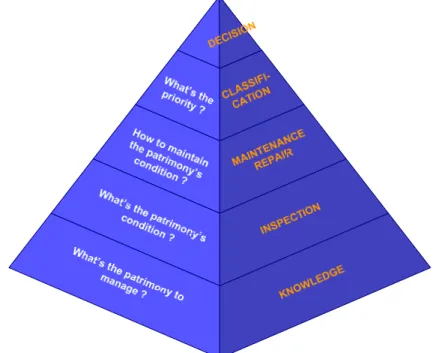
The stages which allow owners to ensure risk management of civil engineering infrastructure are presented in figure 1.
Figure 1. Simplified vision of the civil engineering infrastructure Risk Management pyramid.
According to this pyramid, the specific objectives concerning the harbour system are to expose:
a) The framework which governs the technical management of the harbour structures. b) The methods used by owners to build the previous pyramid.
c) The actions needed at every stage.
3.1 Framework for the technical management of harbour structures
The framework which governs the risk management of the harbour structures differs according to the status (MH, AH, NIH) and is more or less formalized (explicit or implicit).
MH have a framework for the levels 1 (Knowledge) and 2 (Inspection) of the pyramid. Inspection (various actions and rules of implementation) is required as defined in the Instruction n°125/DEF/TM/T relative to the inspection of the structures of civil
engineering of July 11th, 1996 established by the ministry of the Defence (DCTIM, 1996).
Contrary to military harbour structures, but also road assets, the French State does not impose a framework for the management of civil harbour structures (AH, NIH). However, more and more owners are inspired by the technical instruction of October 19th, 1979 (ITSEOA 79 modified 95) for the inspection, maintenance and repair of the infrastructures along the national road network (DIRECTION DES ROUTES, 1995) or recommendations which result from specific working groups (AIPCN, 2001 and 2007). 3.2 Methodologies of asset management
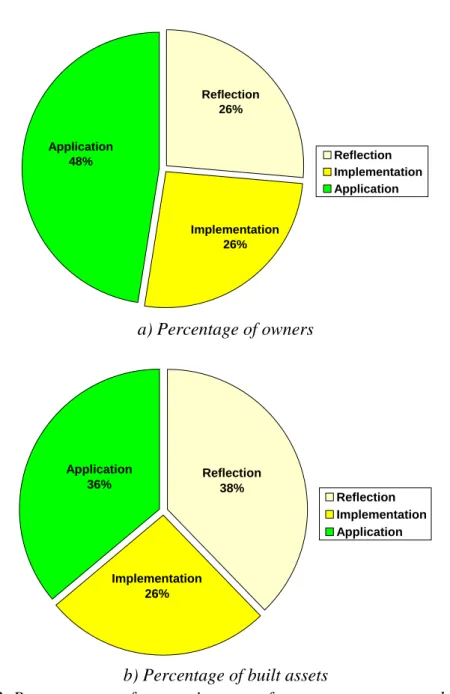
During the national inquiry, various methodologies of asset management were identified. Technical managers can be classified in three different degrees of advancement: "Reflection"; "Implementation"; "Application" (see figure 2a).
A quarter of the respondents (MH, AH, NIH) are working on the conception of best methodology adapted to the harbour structures, while another quarter is implementing it.
In both cases, they are dealing with formalized methodologies which are based on a risks approach or on notation systems, based on the structure’s state (estimated after inspections) and sometimes coupling with their strategic importance in the studied system.
The remaining half already applies a methodology of management: 50% use formalized methodologies and 50% use non formalized methodologies because they consider that the number of structures and the linear kilometres are not sufficient to look for more advanced decision-making tools.
For the three different degrees of advancement in terms of asset management methodology, the percentage of built assets concerned is appreciably the same (see figure 2b).
3.3 Inspection of harbour structures
Most owners continuously monitor their structures by the means of the harbour office staff, equipment staff or statutory undertaker (Chambers of Commerce and Industry, etc.). This type of inspection allows to identify the accidental events (ship collision), the failing fender systems or safety equipments (ladders), but also to detect the appearance of defects on the open area (misalignment of the rails and settlements, etc.). These defects can have heavy consequences ion the short-medium term for the security of the people, as well as the safety and the availability of the installations.
To prevent such events from occurring, approximately two thirds of the respondents began a periodic inspection of their harbour structures, completed if necessary by a particular inspection. The implementation of this type of inspection is relatively recent (in the past 10 years).
Implementation 26% Reflection 26% Application 48% Reflection Implementation Application a) Percentage of owners Implementation 26% Reflection 38% Application 36% Reflection Implementation Application
b) Percentage of built assets
Figure 2. Progress state of owners in terms of asset management methodology.
Since 1996 and the technical instruction n°125/DEF/TM/T, the MH started elementary periodic visits and detailed inspections of the structures. The elementary visits are carried out internally by engineers. They aim to detect visually the defects without specific means others than simple optical instruments, light means of control and common measuring instruments. Their frequency is annual, however according to the characteristics, the age and the state of the structure, a more important interval can be fixed, without exceeding 3 years. The detailed inspections are more complete than the elementary visits. They consist of a diagnosis which concerns all of the structure’s components. Specific means of measurements and tests can be implemented if necessary. For example, the immersed components are inspected by divers. This
specific task is usually performed by private companies. The frequency of detailed inspections is fixed at 5 years, but it can be modulated between 4 and 7 years or less in case of necessity.
For AH and NIH, the periodic inspection of all the structures is similar to the elementary periodic visits, and the frequency varies between 6 months and 1 year.
Results of inquiry show that the number of structures really inspected within the periodic inspection framework is a function of the budget and\or the available staff resources and periodicity is more and more spaced out in time. For this reason, half of the owners prioritize the periodic inspection according to the strategic interests associated with the structures.
If necessary, a localised inspection completes the inspection process. These actions are similar to the periodic inspection most of the time, but they are implemented in the following cases:
a) Accidental events (storms, collisions, etc.). b) Appearance of defects.
c) Diagnosis before repairs.
d) New needs (replacement of the harbour equipment) and exceptional events. e) Strategic stakes.
f) Recent constructions (before official acceptance of work, ten-year guarantee).
To complete their knowledge on the state of the structures, owners appeal to additional investigations. The most frequent investigations are:
a) Steel residual thickness measurements by ultrasound.
b) Chloride ion penetration profiles in reinforced or prestressed concrete components. c) Bathymetric measurements.
d) Ground investigation with sampling, laboratory and in situ testing (by geologic radar and/or pressuremeter tests) and groundwater observations.
e) Topographic survey.
f) Components instrumentation (tie-rods for example) during the first years after construction to follow the global behaviour of structures (vibrating wire sensors, electrical strain gauges, sensors measuring the water level (piezometers)).
In the case of MH, these actions are often included in the contents of the detailed inspections.
3.4 Common maintenance, repairs of harbour structures
The common maintenance and repairs are defined by owners according to the following criteria:
a) Accidental events (ship collision). In this case, the repair or the reconstruction of the damaged part is paid for by the ship owner’s insurance.
b) First urgency actions to avoid a global collapse of the structure. c) Detection of important defects.
d) Preventive maintenance to avoid the irreversibility of the phenomena on the mechanical performances of a structure.
e) For the mobile structures, the respect of conditional maintenance criteria (service rate) established by the owners’ experience feedback.
f) Strategic stakes associated with the structures. g) Efficiency of the actions.
h) Cost of the actions.
i) Available workforce to ensure the success of repair projects.
The different actions can be classified according to the impact measured on the performance of a structure. During the national inquiry, two intervention levels were chosen: common maintenance and repairs. Maintenance is the recurrent day-to-day, periodic, or scheduled work that is required for a facility to be used for its designed purpose. It includes routine work undertaken to prevent damage or deterioration of a facility that otherwise would be more costly to restore. Repair is the restoration of a facility to such a condition that it can be used for its designed purpose. The repair is done by overhaul, reconstruction, or replacement of deteriorated constituent parts or materials that have not been accomplished through maintenance (HQUSACE, 2001). The more common concerns in common maintenance waterfront facilities are: a) Routine painting, replacement of fender components and safety equipment. b) Filling of settlements on the open area.
c) Localized rejointing of masonry structures.
d) Routine patching of small concrete spalls and cracks. e) Painting and protective coating of some piers.
When the actions of common maintenance present a generalized character, they are considered as actions of repair.
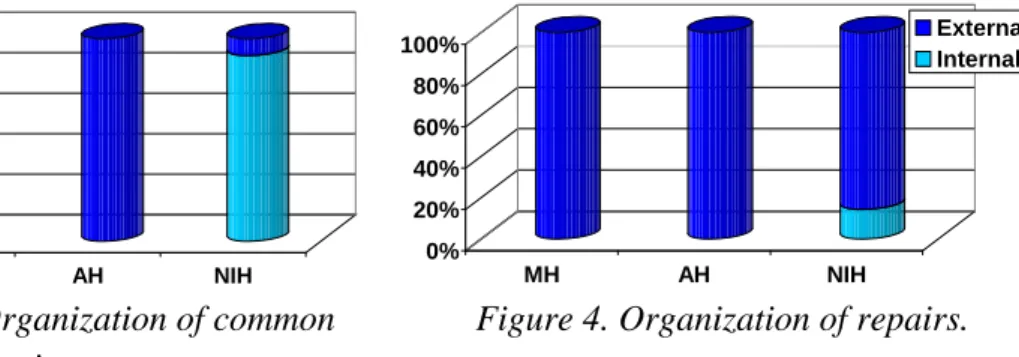
Common maintenance organization is presented in figure 3. Common maintenance of structures in the MH and AH is assigned to private companies through contracts with order forms. On the contrary, common maintenance is performed by internal workforce in the NIH. Only a single NIH breaks this rule. In this case, the statutory undertaker is in charge of common maintenance.
0% 20% 40% 60% 80% 100% MH AH NIH 0% 20% 40% 60% 80% 100% MH AH NIH External Internal
Figure 3. Organization of common maintenance.
The organization of repairs is presented in figure 4. Repairs are generally made by private companies because they require specific skills and means, but also important human resources during a long period. However, some NIH carry out specific works and they have at their disposal internal skills and technical means (materials) for carrying out operations such as:
a) Replacement of dolphins.
b) Careening of the lock’s gate except their painting.
In fact, in the case of painting, specific equipment and processes are required to ensure health and safety standards, but also to respect the environment: specialised private contractors are thus generally selected for this task.
With regards to the strategic importance of mobile structures (bridges, locks) for sea and urban transport, NIH benefits from additional means (workforce and budgets) to ensure the whole of common maintenance and repairs of mobile works.
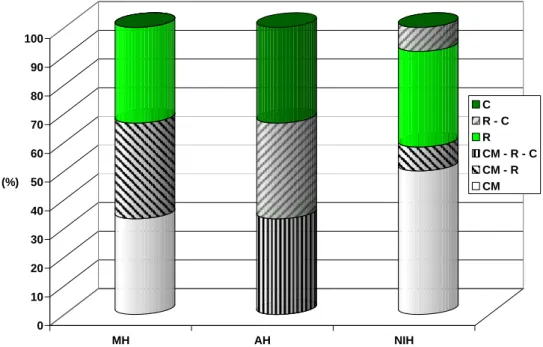
Types of actions (common maintenance, repairs or construction) most frequently performed by owners are detailed in figure 5.
0 10 20 30 40 50 60 70 80 90 100 (%) MH AH NIH C R - C R CM - R - C CM - R CM
Figure 5. Most frequent maintenance actions.
Legend: CM = Common Maintenance, R = Repair, C = Construction.
The MH have very few new constructions. They therefore limited their strategy to common maintenance and repair on important built assets. Unlike MH, even if they schedule common maintenance, AH follows a repair and construction logic, with projects such as Port 2000 (Le Havre) or Fos 2XL (Marseille) for adapting facilities to the new needs of sea transport. Concerning NIH, repairs or constructions are possible if
the statutory undertaker contributes to the financing of the projects and depends on the perimeter of the concession. However, because of limited budgets, only common maintenance is carried out depending on the workforce available internally. Note that for risk purposes, this analysis should be completed by an economical analysis on the cost of building-as-new of the several studied harbours. This study is not in the perimeter of the present paper.
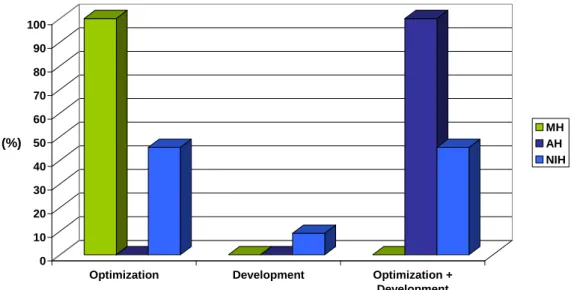
The maintenance strategies are coherent with the harbours’ strategies (see figure 6). MH are in an optimization process for management of the existing facilities, considering the policy of rationalization of needs defined by the ministry of defence. A part of the NIH also follows this logic. It is mainly the case of harbours with low goods traffic or with geographic constraints as the Saint-Malo harbour, which is enclosed in the city. AH and the other part of NIH combine at the same time optimization and development logics. Note that this figure illustrates the result of a combination of several complex factors (economic, environmental, political, etc.) at several scales (local, national, european, international). 0 10 20 30 40 50 60 70 80 90 100 (%)
Optimization Development Optimization + Development
MH AH NIH
Figure 6. Harbour strategies: optimization and/or development of the existing spaces.
4. Maintenance constraints
The quantitative patrimonial analysis displays heterogeneous and ageing harbour assets. The most recent part of the latter is essential for the local, national and European economic development because it is better adapted for the recent evolution of traffic. To maintain a required level of performance, the owners have to program and to carry out various maintenance actions. The respect of the established program depends on operation constraints, technical and financial constraints associated with the harbour structures and with their technical management.
The operation constraints mainly concern the structures which can’t be temporarily stopped, even if an activity transfer is possible on another structure. It is generally the case of locks, mobile bridges, specialized berthing and mooring structures (oil, containers, etc.). In these conditions, the definition of a preventive intervention must be established through dialogue with all users. Given the difficulties which it implies (partial interventions, between operations of load and\or unloading) the maintenance of these structures is frequently postponed, generating an increase of risks.
In marine environment (swell, tides, climatic hazards, physical and chemical actions of sea water), maintenance of structures requires specific means (underwater works, works in the tide, materials in the sea). These technical constraints, coupled with the length of the structures and operation requirements, increase the maintenance costs.
At the same time, the maintenance strategies drawn up by the owners are largely driven by the financial constraints: budgets and limited workforce.
The AH maintenance budget is more important than that of the NIH: this is due to a larger number of built assets and a higher turnover. It can be quantified by the ratio "million tons of raw goods by linear kilometre (Mt / km) ". On the contrary, workforce dedicated to the harbour maintenance is less important in the AH (3.5 persons fulltime equivalent) than in the NIH (8.5 persons on average: except staff allocated to the mobile structures).
Note that for NIH, the maintenance personnel comprise of staff from both the statutory undertaker (Chambers of Commerce and Industry, etc.) and the owners.
The staff of the AH organize the surveillance (detailed inspections) and the project management during the reparation projects whereas surveillance and maintenance actions are given to private enterprises. The NIH have a tendency to carry out a maximum number of actions under state control: surveillance of the visible parts, common maintenance and in certain cases major repairs on locks and mobile bridges for example. It explains the existence of differences between NIH which do not contain mobile works and NIH which do.
Budgets, limited workforce and high costs of maintenance actions, consolidate the fact that owners need simple and successful patrimonial management tools to optimize the maintenance. They also need global indicators to offer a vision of risks control for the decision-makers. This vision can be used to adjust or not the budget.
5. Expectations and needs in risk management and control
After describing the common practices of harbour structure asset management in the previous section, the reasons which motivate the owners to develop their own practices are highlighted. This evolution is translated by the expression of needs in terms of means (workforce and budgets), but also in terms of asset management methodologies. During the national inquiry, the technical managers had to classify several impacts
which lead to evolution of maintenance practices. A total amount of 11 impacts, classified in four categories were used:
a) Two Security impacts IS: safety of the people, environment.
b) Six direct and indirect economic impacts IC1: port dues, operating loss, built assets valuation, competitiveness preservation, brand image.
c) One Budgetary impacts IC2: maintenance costs.
d) Two organizational impacts IO: crisis situation, know-how transmission.
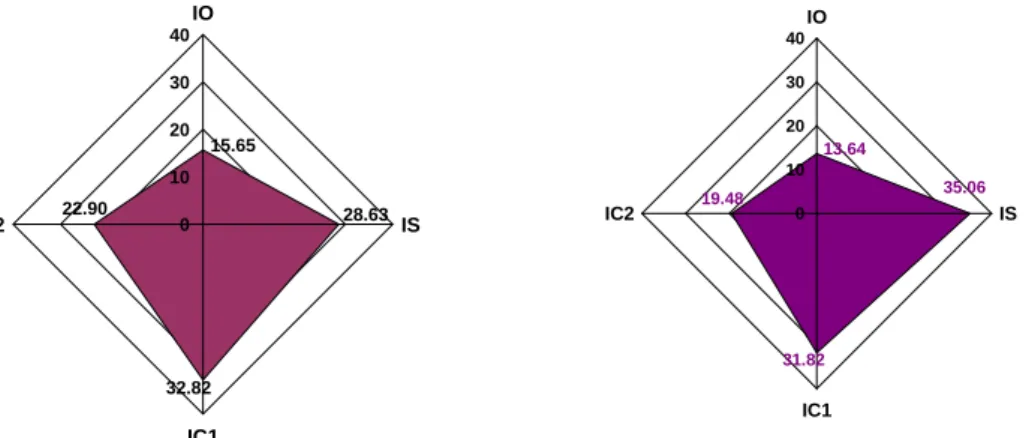
Only the first four impacts selected by each owner are taken into account. A lessening weight is applied on each: 25 for the first, 20 for the second, 15 for the third and 10 for the fourth. Then, for each of the 11 impacts, all the weights are added. Finally, for each of the four categories above (a, b, c, d), only the most important factor (i.e. with the maximum sum of weights) is kept. Then a percentage is computed and is presented on figure 7 left. Note that some results are very close (IS and IC1) and the discrepancy is sensitive to the selection of lessening weights. For use in a risk-based decision process, it is recommended to consider as equal index whose range can be inversed by modifying the assumption. It is the case for IS and IC1 if we select the following lessening weight with a power relationship (figure 7 right): 16 for the first, 8 for the second, 4 for the third and 2 for the fourth.
22.90 15.65 28.63 32.82 0 10 20 30 40 IO IS IC1 IC2 31.82 35.06 13.64 19.48 0 10 20 30 40 IO IS IC1 IC2
Figure 7. Weights computed (percentage) for the various impacts ranked technical managers during national inquiry with two weighting assumptions.
As a perspective, such results can be implemented into a multicriteria evaluation, such as the one developed within the French National research Project RERAU (for Renewal of Non Man Entry Sewer System – in French - Réhabilitation des Réseaux d’Assainissement Urbains), in order to define the built assets performance with regard to the owner’s expectations (BREYSSE et al., 2007).
6. Conclusions
This article presents the second part of the results of the national inquiry of maritime harbour structures technical management led in 2006-2007. Results show great heterogeneities between the current practices of maintenance (policy and strategies), organization, constraints and capacities to fulfil operations (maintenance programs). These differences depend mainly on the harbour status (MH, AH, NIH). Another important information is that a quarter of the owners are beginning to use formalized asset management methods but all show interest in better organizing this process with the aim of guaranteeing the operation of ageing structures with good safety, availability conditions and reasonable maintenance costs. The ranking of stakes (impacts of maintenance) available in this paper is suitable for a use in a multicriteria risk analysis. 7. Acknowledgements
This study is led within GEROM (contact: [email protected]), project financed by the company OXAND and led within the Grouping of Scientific Interest MRGenCi (www.mrgenci.org). The authors thank the CETE de l’Ouest for its contribution to the inquiry phase and all the owners who were kind enough to grant time to this project.
8. References
AIPCN (2001). Life cycle management of port structures - general principles. Marcom report of Working Group 31.
AIPCN (2007). Inspection, maintenance and repair of maritime structures exposed to
material degradation caused by a salt water environment. Marcom report of Working
Group 17.
BREYSSE D., VASCONCELOS E., SCHOEFS F. (2007). Management Strategies and
Improvement of Performances of Sewer Networks. Computer-Aided Civil and
Infrastructure Engineering, Volume 22, Issue 7, pp 462-477.
DIRECTION DES ROUTES (1995). lnstruction technique du 19 octobre 1979 pour la
surveillance et l’entretien des ouvrages d’art du réseau national routier (ITSEOA 79).
Circulaire révisée en 1995.
DCTIM -Direction Centrale des Travaux Immobiliers et Maritimes- (1996). Instruction
n°125/DEF/TM/T relative à la surveillance technique des ouvrages de génie civil et des bâtiments du 11 juillet 1996.
HQUSACE -Headquarters United States Army Corps of Engineers-, NAVFAC -Naval Facilities Engineering Command-, AFCESA -Air Force Civil Engineer Support Agency- (2001). Maintenance and operation: maintenance of waterfront facilities,
Unified Facilities Criteria (UFC 4-150-07). 19 June 2001.