11th Belgian Day on Biomedical Engineering December 7, 2012
SHOULDER INJURY PREVENTION IN SPORTS USING 3D
MOTION CAPTURE
C. Schwartz, A. Hazée, V. Denoël, O. Brüls, J.-L. Croisier, B. Forthomme LAMH, Laboratoire d'Analyse du Mouvement Humain, University of Liège, Belgium
Abstract
In sports, where regular and intensive training could progressively lead to traumatic situations, accurate measurement of kinematic parameters can help to predict and anticipate injuries. Overhead throwing athletes may develop an increased stiffness of the shoulder capsule. The resulting diminution of the gleno-humeral range of motion is usually associated with decreased performance and injury risks. This study illustrates the detection of these situations that put the athlete at risk.
Keywords: biomechanics
1 Introduction
Motion capture has been increasingly used and allows 3D non invasive and dynamic quantification of the bones motion. The accuracy of the measurements allows to detect subtle changes in subject movement. In sport, intensive training may lead to traumatic situations, and consequently decreased performance. For chronic illnesses, symptoms may appear progressively and if detected in time, rehabilitation programs and/or adapted training program may prevent injuries [1]. Overhead throwing athletes may develop an increasing stiffness of the shoulder posterior capsule. A loss of internal rotation, which is not compensated by an equivalent gain of external rotation (constant Range Of Motion - ROM) is supposed to be characteristic of symptomatic throwers [2].
2 Material and methods
Three groups of 10 subjects were compared: a reference population composed of sedentary subjects, active athletes with neither pain nor shoulder stiffness and active athletes with no pain but shoulder stiffness. Each subject performed maximal internal/external rotation with the arm abducted at 90°. The dominant arm range of motion was measured using a 3D motion capture system (Codamotion System, Charnwood Dynamics). Mean maximal active internal and external rotations as well as mean active ROM were compared between populations.
3 Results
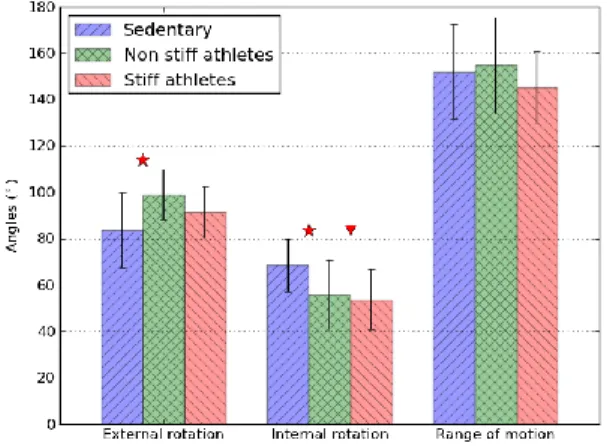
Results are presented in Figure 1.
Figure 1 - Mean maximal internal and external rotation and ROM.
Significant differences (p < 0.05) between “Sedentary” and “Non stiff athletes” are marked by a red star above the results and between “Sedentary” and “Stiff athletes” by a red triangle.
4 Discussion and conclusion
Athletes populations have larger external rotation and smaller internal rotation in comparison with the sedentary population. Non stiff athletes have identical ROM than the reference population whereas a decrease in the ROM is observed in the stiff-but-not-yet-pathological athlete population. Using motion capture, this latter population can therefore be easily identified and be specifically addressed to prevent potential injury.
References
[1] S. Seroyer and S. Nho, “Shoulder pain in the overhead throwing athlete,” Sports Health, vol. 1, no. 2, pp. 108–120, 2009.
[2] S. S. Burkhart, C. D. Morgan, and W. B. Kibler, “The disabled throwing shoulder: spectrum of pathology Part I: pathoanatomy and biomechanics.,” Arthroscopy : The
Journal of Arthroscopic & Related Surgery,