HAL Id: hal-00412090
https://hal.archives-ouvertes.fr/hal-00412090
Submitted on 31 Aug 2009
HAL is a multi-disciplinary open access
archive for the deposit and dissemination of
sci-entific research documents, whether they are
pub-lished or not. The documents may come from
teaching and research institutions in France or
abroad, or from public or private research centers.
L’archive ouverte pluridisciplinaire HAL, est
destinée au dépôt et à la diffusion de documents
scientifiques de niveau recherche, publiés ou non,
émanant des établissements d’enseignement et de
recherche français ou étrangers, des laboratoires
publics ou privés.
Virtualization of ancient technical objects: a new design
process and its inter-disciplinary team
Florent Laroche, Alain Bernard, Michel Cotte
To cite this version:
Florent Laroche, Alain Bernard, Michel Cotte. Virtualization of ancient technical objects: a new
design process and its inter-disciplinary team. CIRP Design Seminar, Apr 2008, Twente, Netherlands.
6p. �hal-00412090�
Virtualization of ancient technical objects:
a new design process and its inter-disciplinary team
F.Laroche1 2, A. Bernard1, M. Cotte2
1
Research Institute in Communications and Cybernetics of Nantes (IRCCyN), Ecole Centrale, Nantes, France
2
Centre François Viète for science and technical history, University, Nantes, France
[email protected], [email protected], [email protected]
Abstract
Contemporary engineering processes require numerous competences and knowledge using different semantics. Our research consists to design virtually ancient technical objects. The approach we have developed is a new kind of design process: it is a heritage reverse-engineering methodology. It requires a project team with many jobs which, until then, have never collaborate together or not yet: it is an inter-disciplinary team.
An example will demonstrate our proposal for making old technical objects alive again and how human sciences and technical sciences can merge together. The case study is a steam boat designed in 1861 by DCNS Propulsion.
Keywords:
CAD, reverse-engineering, technical heritage, industrial archaeology
1 INTRODUCTION
For simplifying its life, all along history humans have invented objects for living better. Those daily life objects can be considered as a "present" heritage but also as a "past" heritage. Conserving those objects by analyzing and understanding them can become a source of knowledge for anticipating our "future" and for creating objects of tomorrow. Unfortunately, the protection of this heritage remains questions about methods, tools and competences that have to be employed for capitalizing and valorising it. In fact, for 200 years, objects have become more and more complex; consequently, new methods and new tools have to be defined for this museology of the 3rd millennium.
Introduced in 2006 for the 16th CIRP Design Conference, we have explained our problematic. Domains involved have been described and the new matter created has been defined: Industrial Archaeology. [1]
Until nowadays, all projects performed belong to mechanical background. Most of the time, the starting point of the studies is the ruins of the objects. Numerous experiences are done all over the world by laboratories, universities or international comities. For example, the university of Technology of Poland had worked upon an hydraulic bending machine [2]. Moreover, notice that other domains as architectural archaeology also work with virtual tools: Houdin father and son have used 3D scanning and CAD design for understanding how Kheops pyramid have been built [3].
Facing this blow-out of experiments, during the 17th CIRP Design Conference in 2007, we have proposed a decision tree for using 3D digitalization technologies and knowledge capitalization applied for technical heritage.
Moreover, we have validated it thanks to two case studies. [4]
However, we have to question about what happen:
•
When we do not own the machine?•
When we only have one drawing that only seems to prove the object has been built?For example, we can interrogate about the availability of the technical drawings done by Leonard de Vinci: could the machine really operate? In this way, researchers of the Museum of Florence in Italy has designed virtually the automobile imagined by de Vinci in order to understand how it works. Next, they have built a prototype to validate the CAD model. [5].
Finally, we must take note that various ways exist for virtualizing and popularizing an object that belongs to our heritage. Consequently, it is necessary to formalize the approach and to build a new reverse engineering process reference: it is the main purpose of this communication.
Firstly, we will describe the global method we have developed for virtualizing old machines: Advanced Industrial Archaeology. We will also detail the main steps required for achieving a good comprehension of ancient technical meanings. But, in order to rich a better result, the project team must be interdisciplinary; so, we will detail the composition of the staff.
In a second time, we will illustrate our proposition by a pedagogical case study we have done. The interdisciplinary team was composed of student's actors with a scientific and technical background but also with professors and industrial experts.
2 GENERAL METHODOLOGY OVERVIEW According to:
•
what Kuhn said about the scientific Revolutions [6];•
the rupture observed between the technical and industrial contemporary systems and with the proto-industrial systems of the 18th century (Domestic system and Manufactory System);we can emphasize there is a lack in the contemporary methods for conserving heritage: sciences and techniques must be taken into account for their real value in the same way as architectural heritage is considered. Indeed, in a plant, there are the walls of the workshops but also motors and machines that create the products: taking into account this technical point of view and the
socio-economical context can lead to a better understanding of the past. However, as we spoke about mechanics and industry, it also involved kinematics, dynamics, flows and process. Consequently, converging engineer sciences approaches (the technical object) and social sciences (heritage context) can enrich both domains.
Moreover, as conserving physical object costs a lot for Museums, and sometimes dismantling is impossible (derelict machines), we propose a new kind of finality: making it alive again but virtually thanks to a numerical model.
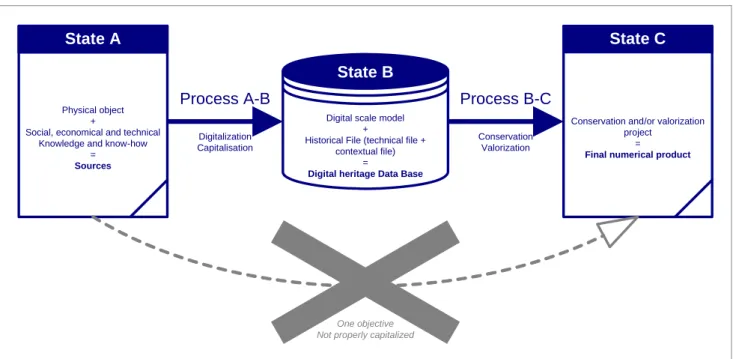
Figure 1 presents the global process we set up for capitalizing and valorising scientific, technical and industrial heritage.
Process A-B
Digitalization CapitalisationProcess B-C
Conservation Valorization Digital scale model+
Historical File (technical file + contextual file)
=
Digital heritage Data Base
State B
Physical object+
Social, economical and technical Knowledge and know-how
=
Sources
State A
Conservation and/or valorization project
=
Final numerical product
State C
One objective Not properly capitalized
Figure 1. General methodology for conservation and valorisation of technical and industrial heritage
Going directly from State A to State C is not recommended. Indeed, it can be found numerous possibilities for State C as enumerated below. Consequently, at the beginning of the heritage project, it is necessary to capitalize everything we can. This amount of data, information, knowledge and know-how is correlate for constituting an intermediary State B: it is the Digital Heritage Reference Model, DHRM.
The first step deals with data acquisition: it is the archaeological phase. At the beginning, the classical job of technical history helps to gather technical and contextual documentations:
1. plans, archaeological data, anthropological or ergonomic data, machine components;
2. economic, social, architectural, environmental data… [7].
Next, we have to capture physical data if existing. The first basic tools are: decametre, slide callipers, micrometer callipers. However, in order to optimize cost and time, for measuring complex machines, 3D digitalization can be employed: TMM laser radar, X-ray, 3D scanner laser with topographical reconstruction in real-time… [4]
Then, this step must be completed by an analysis of the digitized data in order to create a digital reference model for state B. In addition, an historical database is linked to it. Hypertext allows interacting with all scientific, technical and dynamic data: the knowledge of the machine.
From this new intermediary representation, several finalities are possible. Consequently, State C is a declination of the digital model. For example:
•
virtual thesaurus (digital archives);•
safeguards in industrial archaeology;•
didactic use for experts or students;•
reconstruction;•
museologic valorisation for any kind of public.For the last application case, thanks to exponential growth of Virtual Reality technologies, several approaches can be developed. This new way of thinking valorisation opens a new hope for Museums: the Techno-museums.
3 INVOLVING INTER-DISCIPLINARY TEAMS Nowadays, for creating and designing new products, new competences are required. Consequently:
•
multidisciplinary teams are constituted allowing to work with various competences;•
collaboration tools are created for simplifying engineering process.However, otherwise there is a multiplicity of the competences involved, all team members belong to a similar/same domain: design and/or engineering. Either they are designers, ergonomics or engineers, ideas and knowledge manipulated reach to a common semantic. It is the reference model of collaboration.
Researches we developed upon heritage reverse-engineering of ancient machines also require numerous competences. But, our team combines knowledge domains that generally do not work together. Then, there are some problems of communication and interpretation.
Main difficulties come from the language barrier between past and present. Indeed, old documents use old technical vocabulary which is difficult to understand for engineers of the 21st century. Therefore, historians must help them to translate and interpret technology's descriptions; they succeed it by taking into account the context of the object.
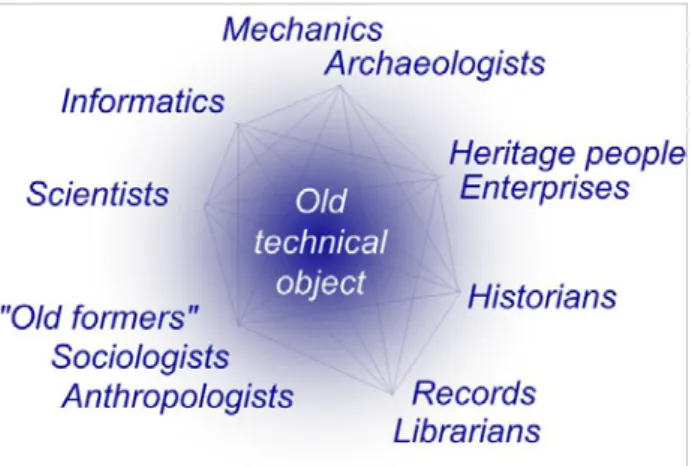
Experiences we have done need inter-disciplinary teams compound of jobs represented by figure 2. It is a new kind a cooperation process as some competences required jobs that do not exist yet; moreover, notice that most of the time there are no appellations for describing them. For example, we can imagine a new training for creating engineers-historians devoted to the understanding of product origins and their links with technologies: it will be the Industrial Archaeologist.
Figure 2. The collaboration network for creating an interdisciplinary team in a reverse-engineering process
Each competence will work at a precise step of the heritage reverse-engineering process for capitalizing and formalizing knowledge involved. However, tasks will be done in parallel and not discontinuously. For example: output data of job n° 1 is necessary for input data of job n°2 but same job n°2 is going to produce new knowledge which job n°1 is going to reuse; back-and-forth is perpetual and synchronized between all competences.
Generally, we can distinguish:
•
The technologist who is a specialist of scientific domains involved. He helps to understand the basic principles of the machine operating.•
The technologist with a mechanical background. He analyzes the object and is able to design a 3D model in order to simulate and validate the dynamic situations. Mechanical man also ensures the industrial archaeology phase on plant.•
The technologist who is an expert in computer science. He creates the knowledge data base and resolves interoperability problems from the 3D digitalization to the implementation in a virtual reality application.•
Persons that hold the know-how; most of the time they are ancient former of the company. They can be accompanied during their work by sociologists or anthropologists that will be able to adapt their speech to contemporary language.•
Persons that work in heritage domain; they are traditionally the sleeping partners. They have established special relationship with the enterprise in which the machine stays; consequently, they allow the inter-disciplinary team to access to numerous private records (when existing).•
Librarians and archivists. For example, they can found international standards or patent offices; those documents are indispensable for a better understanding of the technologies.•
The historians whoa re specialized of the domains involved. They do an interface between scientists, technologists and persons that hold the knowledge and/or the know-how. Historians also assume the role of translator for making ancient documents comprehensible by contemporary specialists. Moreover, they have a global overview of the object life evolution (they are the technological geneticists).4 EXPERIMENT: A STEAM BOAT OF 1861 4.1 Project context and objectives
In September 2001, the enterprise DCNS Propulsion (Nantes, France) decides to collect all its records. Indeed, since 1777, DCNS belongs to the French army ministry and is specialized into the design and construction of boat and submarine. Nowadays, the company produces nuclear motors. Due to its history, record conservation was an obligation; consequently, a new department has been created: the PHI, Indret Historical Service.
Among this enormous quantity of documents (drawings, reports, photography's…), they found an old drawing at scale 1:10 representing a 10-meters long steam boat. However, this freehand drawing does not mention any date… (figures 3 and 4)
First historian studies have revealed that it has been ordered by the French Ministry the 9th of December 1860. The 28th of August 1862, a report is written by the commission that has done the experiment. Therefore, we can affirm that this boat have been really manufactured in 1861-1862 and have been tested on the river La Loire, near Nantes, in France.
At the beginning of the project, only the 2D drawing and the report was found. Making correlations between those documents was difficult and many troubles remained. Then:
•
the first objective was to be able to explain the operating of the boat;•
moreover, we have had be able to understand its design; including the justification of the technological choices made in the past.As the final use of the boat was fuzzy, many hypotheses have been made:
•
A connection boat for carrying the Navy officers from the docks to their big ships as they can not tie up because of non deep water?•
A prototype boat for testing propellers profiles? Or other innovative technologies in 1860?Figure 3. Steam boat simplified drawing (1861)
4.2 Interdisciplinary project actions and heritage reverse-engineering process
Understanding this object at present time with modern tools and contemporary knowledge is not sufficient; we must also prospect into the past. Therefore, complexity of the boat had required the creation of an interdisciplinary team.
First of all, the industrial archaeology task has gathered:
•
technical historians who have studied written records;•
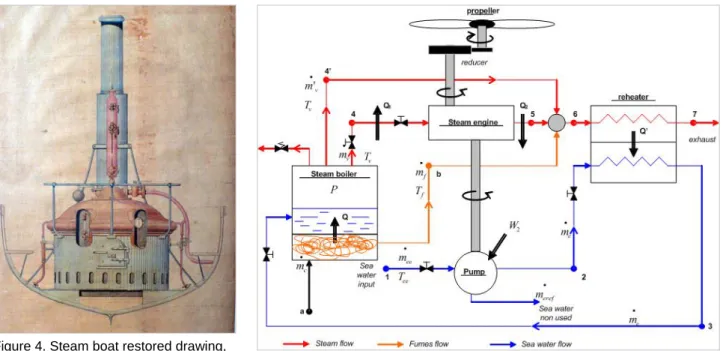
and students who are specialized in thermal exchanges.Technical data mentioned on the drawing have been validated. In addition, they have produced a thermal model of the steam flow (figure 5).
Figure 4. Steam boat restored drawing,
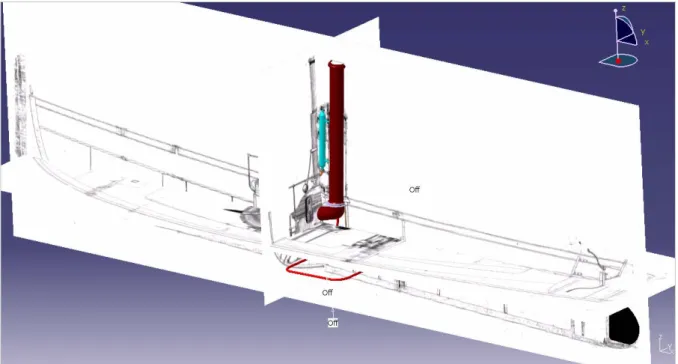
Figure 6. Integration of 2D drawings in the CAD model
Next, other students issued from mechanical school have produced a virtual model of the steam boat. But as the physical boat does not exist, it was impossible to measure the object or to digitalize it. However, this design step was replaced by integrating 2D drawings into the CAD environment (figure 6):
•
the original drawing of 1861 which has been digitalized in high quality;•
and other 2D drawings of similar mechanisms found in old book.But as there was nothing to disassembly, appropriation of the project by the student was very difficult: specific technical questions remain. Therefore, discussions with historians are very important.
In addition, people who are expert of steam engine machines have participated to the project. They know where it can be found knowledge about old mechanisms and manufacturing process.
Many old books have been gathered by historians. After having translated this old knowledge into present semantic, it was possible to understand better the operating and to design invisible details of the original drawing (engine, pumps…). For example, we have found:
•
calculations about the steam engine power;•
information about component manufacturer;•
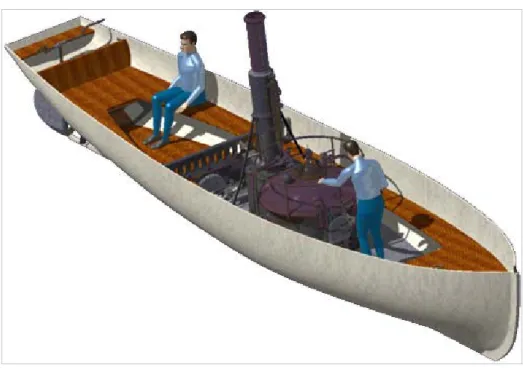
materials…The boiler is positioned in its centre and the fumes are exiting directly to the chimney. This last component is reinforced by metallic shells. The steam engine is situated at the back of the boiler. Control instruments and security systems are also installed.
4.3 Pedagogical assessment
This study of an ancient technical object is not a standard pedagogic subject. Achieving an industrial archaeological project is a new way for teaching.
At a mechanical and pedagogical point view, the main objective of this project was to complete the CAD courses of students (figure 7). But, instead of dismantling a contemporary object, students have learnt more thanks to old machines and thanks to the cooperation with other jobs as historians.
As advanced industrial archaeology required a high technical background, it allows students to discover more artfulness for their future jobs as:
•
they have never seen those machines operating,•
ancient design are different from contemporary design and they have never learnt it during courses,•
some ancient physical principles are not any more used today…Moreover, notice that taking into account various cultures and domains is also an important key point for the success of the project: curators, historians, technological specialists, scientists, multimedia specialists or computer scientists. Consequently, in order to achieve a better involvement of the actors in the project, weekly meetings were scheduled; they also allow following student works. Design teachers only play a role of experts for technical and methodological advices; moreover, we took note that there was no more hierarchical barrier between students and teachers.
To conclude, we have noticed that this kind of projects allows revising all competences obtained by students during their courses. Here is the testimony of two thermal engineer students who have worked in this project:
"We must have reminded our courses about thermal transfers, fluid flows, combustion, exchangers, numerical methods… We have used and applied fully knowledge obtained during our three years of courses."
Figure 7. Digital Mock-Up of the steam boat of 1861
5 SYNTHESIS AND PERSPECTIVES: A NEW METHOD FOR GENERATING INNOVATION?
Researches presented in this article propose to discover ancient technical object using a new matter which is going to arise: Advanced Industrial Archaeology.
For achieving a virtual design of old objects, the engineering cooperative process requires numerous and not commonly-used competences by contemporary industries. Therefore, merging engineering sciences and social sciences requires:
•
a large semantic by using various knowledge;•
new collaboration tools, methods and models. Nowadays, knowledge developed by enterprise belongs to explicit or implicit know-how. Daily innovations remain at a local state: about design or process.Indeed, breaking innovation is more difficult to accomplish as it requires new tools, new methods and, first of all, various knowledge and competences.
But using old technical knowledge can be a solution for creating new products. It is in this way of "thinking the future" that our team performs its scientific researches. However, instead of working with contemporary objects, we use technical objects belonging to the past.
6 ACKNOWLEDGMENTS
We would like to thank the project team of the steam boat:
•
IRCCyN, Ecole Centrale, Nantes, France•
Ecole Polytechnique, University of Nantes, France•
Centre François Viète, University of Nantes, France•
The mechanical school IUT, University of Nantes, France: Sébastien Le Loch, teacher and his three students•
The Indret Historical Service of DCNS Propulsion, Indret, France; and particularly Gilbert Dargent and Jean-Paul Fâche7 REFERENCES
[1] F. Laroche, A. Bernard, M. Cotte, S. Deniaud (2006), "A new methodology for a new life of old technical machines", CIRP Design Seminar Conference, Alberta, Canada, 12 p.
[2] Z. Weiss, M. Pankowski (2007), "Knowledge reengineering for reverse engineering purposes", CIRP Design Seminar Conference, Berlin, Germany, pp.421-430 – ISBN 978-3-540-69819-7
[3] J.-P. Houdin (2007), "3D Unveils the mystery of the great pyramid", http://www.3ds.com/introduction, web site seen the 3rd of March 2007
[4] F. Laroche, A. Bernard, M. Cotte (2007), "3D digitalization for patrimonial machines", CIRP Design Seminar Conference, Berlin, Germany, pp.397-408 – ISBN 978-3-540-69819-7
[5] G. Fiorenzoli (2004), "La 3D révèle le fonctionnement de l'automobile de Léonard de Vinci", Revue La Forge,
n°18, pp.44-45 -
http://brunelleschi.imss.fi.it/automobile/index.html
[6] T. Kuhn (1970) "La structure des révolutions scientifiques", 284 p.
[7] F. Laroche, A. Bernard, M. Cotte (2006), "Methodology for simulating ancient technical systems", International Review of Numerical Engineering, Integrated Design and Production, Vol. 2 n°1-2/2006, pp.9-28, Hermès-Science, Ed. Lavoisier, ISBN 978-2-7462-1679-2