HAL Id: tel-01983197
https://tel.archives-ouvertes.fr/tel-01983197
Submitted on 16 Jan 2019HAL is a multi-disciplinary open access archive for the deposit and dissemination of sci-entific research documents, whether they are pub-lished or not. The documents may come from teaching and research institutions in France or
L’archive ouverte pluridisciplinaire HAL, est destinée au dépôt et à la diffusion de documents scientifiques de niveau recherche, publiés ou non, émanant des établissements d’enseignement et de recherche français ou étrangers, des laboratoires
Using network resources to mitigate volumetric DDoS
Pierre-Edouard Fabre
To cite this version:
Pierre-Edouard Fabre. Using network resources to mitigate volumetric DDoS. Other [cs.OH]. Institut National des Télécommunications, 2018. English. �NNT : 2018TELE0020�. �tel-01983197�
i
THÈSE DE DOCTORAT DE TELECOM SUDPARISSpécialité : Informatique et Réseaux
École doctorale : Informatique, Télécommunications et Électronique de Paris Présentée par
Pierre-Edouard FABRE
Pour obtenir le grade de Docteur de Telecom SudParis
Utiliser les ressources réseaux pour atténuer les
attaques DDoS volumétriques
Directeur de thèse : Hervé DEBAR co-Encadrant de thèse : Jouni VIINIKKA
co-Encadrant de thèse : Gregory BLANC soutenue le 13 Décembre 2018
Composition du Jury
Rapporteurs : Isabelle Chrisment, Professeure,
Télécom Nancy, Université de Lorraine, France Guillaume Urvoy-Keller, Professeur,
Université Nice Sophia Antipolis, France
Examinateurs : Bruno Defude, Professeur, Télécom SudParis, France Guillaume Doyen, Maître de Conférences,
Université de Technologie de Troyes, France
Hervé Debar, Professeur, Télécom SudParis, France Jouni Viinikka, Docteur, 6cure SAS, France
Invité : Gregory Blanc, Maître de Conférences,
Télécom SudParis, France
i
PHD THESIS TELECOM SUDPARISSpeciality: Informatics and Networks
Doctoral School: Informatique, Télécommunications et Électronique de Paris Presented by
Pierre-Edouard FABRE
To obtain the degree of Doctor of Telecom SudParis
Using network resources to mitigate volumetric DDoS
Thesis Director: Hervé DEBAR Thesis co-Advisor: Jouni VIINIKKA
Thesis co-Advisor: Gregory BLANC Presented on December 13th, 2018
Members of Jury Reporters: Isabelle Chrisment, Professor,
Télécom Nancy, Université de Lorraine, France Guillaume Urvoy-Keller, Professor,
Université Nice Sophia Antipolis, France
Examiners: Bruno Defude, Professor, Télécom SudParis, France Guillaume Doyen, Lecturer,
Université de Technologie de Troyes, France Hervé Debar, Professor, Télécom SudParis, France Jouni Viinikka, Doctor, 6cure SAS, France
Guest: Gregory Blanc, Lecturer,
Télécom SudParis, France
Abstract
Massive Denial of Service attacks represent a genuine threat for Internet service, but also significantly impact network service providers and even threat the Internet stability. There is a pressing need to control damages caused by such attacks.
Numerous works have been carried out, but were unable to combine the need for mitigation, the obligation to provide continuity of service and net-work constraints. Proposed countermeasures focus on authenticating legiti-mate traffic, filtering malicious traffic, making better use of interconnection between network equipment or absorbing attack with the help of available resources.
In this thesis, we propose a damage control mechanism against volumet-ric Denial of Services. Based on a novel attack signature and with the help of Multiprotocol Label Switching (MPLS) network functions, we isolate ma-licious from legitimate traffic. We apply a constraint-based forwarding to malicious traffic. The goals is to discard enough attack traffic to sustain network stability while preserving legitimate traffic. It is not only aware of attack details but also network resource, especially available bandwidth.
Following that network operators do not have equal visibility on their network, we also study the impact of operational constraints on the efficiency of a commonly recommended countermeasure, namely blacklist filtering. The operational criteria are the level of information about the attack and about the traffic inside the network. We then formulate scenario which operators can identify with. We demonstrate that the blacklist generation algorithm should be carefully chosen to fit the operator context while maximizing the filtering efficiency.
Résumé
Les attaques massives par déni de service représentent une menace pour les services Internet. Ils impactent aussi les fournisseurs de service réseau et menace même la stabilité de l’Internet. Il y a donc un besoin pressant de contrôler les dommages causés par ces attaques.
De nombreuses recherches ont été menées, mais aucune n’a été capable de combiner le besoin d’atténuation de l’attaque, avec l’obligation de continuité de service et les contraintes réseau. Les contre mesures proposées portent sur l’authentification des clients légitimes, le filtrage du trafic malicieux, une utilisation efficace des interconnections entre les équipements réseaux, ou l’absorption de l’attaque par les ressources disponibles.
Dans cette thèse, nous proposons un mécanisme de contrôle de dom-mages. Basé sur une nouvelle signature d’attaque et les fonctions réseaux du standard Multiprotocol Label Switching (MPLS), nous isolons le trafic malicieux du trafic légitime et appliquons des contraintes sur la transmission du trafic malicieux. Le but est de rejeter suffisamment de trafic d’attaque pour maintenir la stabilité du réseau tout en préservant le trafic légitime. La solution prend en compte des informations sur l’attaque, mais aussi les ressources réseaux.
Considérant que les opérateurs réseaux n’ont pas une même visibil-ité sur leur réseau, nous étudions l’impact de contraintes opérationnelles sur l’efficacité d’une contre mesure régulièrement recommandée, le filtrage par liste noire. Les critères d’évaluation sont le niveau d’information sur l’attaque ainsi que sur le trafic réseau. Nous formulons des scénarios auxquels chaque opérateur peut s’identifier. Nous démontrons que la l’algorithme de génération des listes noires doit être choisi avec précaution afin de maximiser l’efficacité du filtrage.
Acknowledgements
First, I would like to thank my supervisor Prof. Hervé Debar for his support and guidance. I deeply appreciate the valuable time he always devoted to me, despite his extremely busy schedule. I would like to thank my advisor Gregory Blanc, for his extensive comments on my work. His rigor has been a great value in this work.
I express my gratitude to my manager and thesis instructor Jouni Viinikka for his time even personal, his insightful comments, encouragement and moral support throughout this work. I really appreciate the trust Jouni had in me by making me work on new topics. You will always be a model of intellectual integrity and perseverance to me.
I am also thankful to the whole 6cure team, starting with Fabrice Clerc for his trust since my last internship and for giving me the opportunity to grow within the company. Thanks to Vincent for his continuous help and understanding. You have the biggest heart. Thanks to the current colleagues: Justine, Emmanuel, Françoise, Antoine R. and Antoine P., Adrien, Baptiste, Ghislain, Frederic and to a former one : Quentin. It is a great privilege to work with each of you, you make working fun.
I owe my thanks to my parents for their endless support throughout my life and for their understanding of my decisions which sometimes induced sacrifices. I give a distinctive thank to my family: Papa D, Mama F, Etienne, Aurélie, Yaya, Alexandre, Fis, Grace, René, Israël and my nephew Noah for your patience, moral support and your kindness. I also think of my grandmother who would have been proud of this accomplishment.
Finally, my deepest gratitude goes to my lovely wife and best friend Bénédicte for your patience with my homework and continuous support even during difficult times. Finishing this work would not have been possible without you. Also, I give a very special loving thank to my sweet son who challenged me at the end of my Ph.D work.
Contents
Abstract i Résumé iii Acknowledgements v Contents vii List of Figures ix List of Tables xi 1 Introduction 11.1 Motivation and Challenges. . . 1
1.2 Hypothesis and Objectives . . . 2
1.3 Contributions . . . 3
1.4 Outline of the Dissertation. . . 3
2 State of the Art 5 2.1 Denial of Service and the Internet . . . 5
2.1.1 Introduction to Denial of Service attacks. . . 6
2.1.2 DoS Attack Characteristics . . . 8
2.1.3 Characterization of the Volumetric DoS Problem . . . 9
2.2 Assessing the Impact of DDoS Attacks . . . 12
2.2.1 Network-based metrics . . . 13
2.2.2 User centric metrics . . . 14
2.3 Admission Control for DDoS Mitigation . . . 15
2.3.1 Active Admission Control . . . 16
2.3.2 Passive Admission Control. . . 20
2.4 Detour-based mechanisms . . . 35
2.4.1 Traffic Diversion . . . 35 vii
2.4.2 Network link usage optimization . . . 37 2.4.3 Overlay networks . . . 39 2.4.4 Discussion . . . 40 2.5 Absorbing mechanisms . . . 40 2.5.1 Overprovisioning . . . 40 2.5.2 TCP-based mechanisms . . . 42 2.5.3 Discussion . . . 44 2.6 Conclusion . . . 44
3 Load-Balancing based Mitigation Technique 47 3.1 Mitigation Approach . . . 48
3.2 Off-the-shelf Cisco Router Load-Balancing . . . 49
3.2.1 Cisco 7200 load-balancing principles . . . 50
3.2.2 Study Approach . . . 52
3.2.3 Results . . . 53
3.3 MPLS-based Load-Balancing . . . 54
3.3.1 MultiProtocol Label Switching . . . 56
3.3.2 Labels dedicated to Load-Balancing . . . 56
3.3.3 Load-Balancing Mechanism . . . 58
3.3.4 Experimental Approach . . . 58
3.3.5 Experiments . . . 59
3.4 Mitigation Label: a MPLS -based DDoS mitigation mechanism 60 3.4.1 Concepts and Architecture . . . 61
3.4.2 Threshold-based Bloom Filter . . . 64
3.4.3 Mitigation Label-based Load-Balancing . . . 68
3.4.4 Security of the Mitigation Label . . . 70
3.5 Probabilistic Evaluation of Mitigation Label . . . 70
3.5.1 tBF False Positive and Negative Probabilities . . . 71
3.5.2 Two Steps Load-Balancing Probabilities . . . 72
3.5.3 Evaluation . . . 76
3.6 Experiments. . . 76
3.6.1 Experimental approach . . . 78
3.6.2 Variables and Metrics . . . 78
3.6.3 Results on the impact of T SL. . . 80
3.6.4 Results on bandwidth allocation . . . 83
3.6.5 Efficiency Evaluation . . . 85
3.7 Discussion . . . 86
4 Enhancing Blacklist-based Mitigation 89 4.1 Introduction to Blacklist: Limitations and Requirements . . . 90
4.1.1 Threat Landscape . . . 90
4.1.2 Typical Operating Environment . . . 92
4.1.4 Characterization of Attack Traffic: Granularity of
Mit-igation . . . 95
4.2 Blacklist Generation Problem Characterization . . . 97
4.2.1 Maximizing Filtered Attack Traffic . . . 98
4.2.2 Minimizing Collateral Damages . . . 99
4.2.3 Characterization of Network Visibility . . . 99
4.2.4 Network Visibility Cost . . . 101
4.3 Application: Blacklist Generation Approaches to IP level. . . 102
4.3.1 Definitions . . . 102
4.3.2 Assumptions and Induced Scenarios . . . 103
4.3.3 Fundamentals of Blacklists . . . 104
4.4 Blacklists Efficiency Evaluation . . . 108
4.4.1 Metrics and Variables . . . 108
4.4.2 Constant Bitrate Attack Traffic Model . . . 110
4.5 Discussion . . . 115
4.5.1 Results . . . 115
4.5.2 Dynamic Attack Traffic . . . 116
4.5.3 Detection Mechanism . . . 117
5 Conclusion 119 5.1 Contributions . . . 119
5.2 Future Work . . . 120
5.2.1 Mitigation Label Enhancement . . . 120
5.2.2 Decision Support . . . 121
5.3 Closing Words . . . 122
A French Summary 123 A.1 État de l’art . . . 123
A.1.1 Contrôle d’admission . . . 126
A.1.2 Techniques basées sur la modification de chemins ré-seaux . . . 128
A.1.3 Techniques d’absorption . . . 128
A.1.4 Conclusion . . . 128
A.2 Technique de mitigation basée sur le partage de charge . . . . 129
A.2.1 Partage de charge avec un routeur Cisco . . . 129
A.2.2 Partage de charge et protocole MPLS . . . 130
A.2.3 Mitigation Label : un mécanisme de mitigation des attaques par déni de service utilisant le MPLS . . . . 132
A.2.4 Discussion . . . 136
A.3 Mitigation à base de listes noires . . . 137
A.3.1 Génération de listes noires appliquée à la couche IP . 138 A.3.2 Évaluation du filtrage par liste noire . . . 139
A.3.3 Conclusion . . . 141
A.4 Conclusion . . . 141 ix
List of Figures
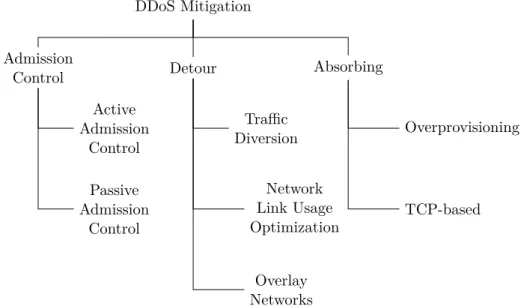
2.1 DDoS mitigation categories . . . 6
2.2 Denial of Service Timeline . . . 7
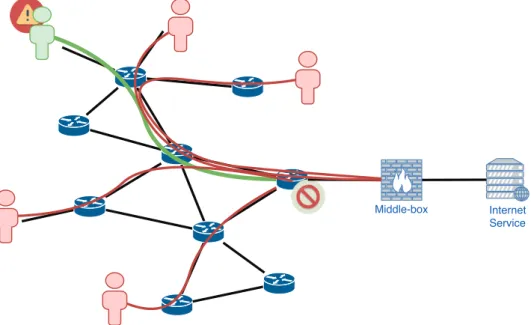
2.3 Example of volumetric DDoS attack attack against an Inter-net service that saturates Inter-network link . . . 11
2.4 ITU User-centric QoS recommendations . . . 15
2.5 Policing versus shaping mechanisms [83] . . . 30
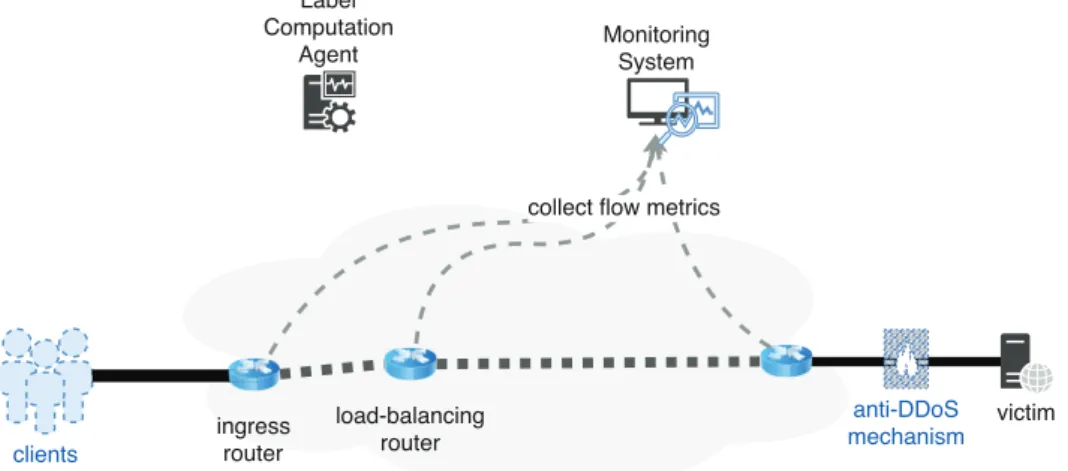
3.1 Multipath volumetric DDoS attack mitigation principle . . . 49
3.2 CEF polarization effect [133] . . . 50
3.3 MPLS datagram containing a Flow Aware Transport (FAT) label . . . 57
3.4 MPLS datagram containing an Entropy Label (EL). . . 58
3.5 Table-based Hashing with Thresholds Mapping [108] . . . 59
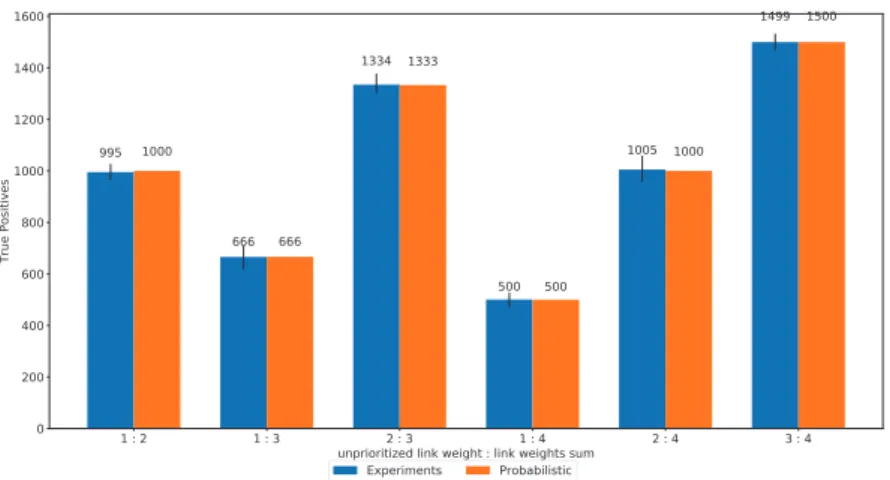
3.6 True positive count of a CRC16-based load-balancing based on an MPLS label and the source IP address (2000 malicious IPs) . . . 60
3.7 Nominal state without attack . . . 61
3.8 Detection of attack . . . 61
3.9 Computation of attack signature and mitigation configuration 62
3.10 Attack mitigation . . . 63
3.11 Example of threshold-based Bloom filter generation given a threshold of t = 200 . . . 67
3.12 MPLS header with Mitigation Label . . . 69
3.13 Twofold Filter Flowchart . . . 69
3.14 Probabilities of Simple tBF Load-Balancing considering the insertion of 4096 flows into a 20bits tBF . . . 72
3.15 Decision tree of the Mitigation Label conditional probabilities 74
3.16 Probability of false positives and negatives of Mitigation Label 77
3.17 Load-Balancing Measures . . . 79 xi
3.18 Impact of the Target Signature Size on the reception of legit-imate traffic on the priority link (Rpriority) according to the
attack volume expressed as a factor of the legitimate traffic
volume (AttackF actor) . . . 82
3.19 Impact of the mitigation allocation (BAmitigation) on the Le-gitimate Traffic Reception . . . 84
3.20 Comparison of the legitimate traffic reception with and with-out mitigation. . . 86
4.1 Example of dispersion of source IP addresses [154] . . . 91
4.2 Amplification attack traffic . . . 93
4.3 Generic security architecture . . . 93
4.4 Examples of mitigation configuration . . . 98
4.5 Workflow of ACL generation . . . 104
4.6 Example of source aggregation tree for a given destination . . 105
4.7 Selection of top 3 rules among potential source aggregates for a given destination . . . 108
4.8 ACL loading time as the function of the number of inserted rules on a router with no rules loaded . . . 109
4.9 Comparison of scoring functions (AL = 24) . . . 111
4.10 Comparison of scoring functions (AL = 8) . . . 112
A.1 Example d’attaque par déni de service distribué volumétrique contre un service Internet, causant la saturation d’un lien réseau124 A.2 Assignation du prochain saut, basé sur un table de hachage [108]131 A.3 Nombres de vrais positifs induit par un partage de charge basé sur la fonction CRC16 . . . 132
A.4 Détection de l’attaque . . . 132
A.5 Génération de la signature de l’attaque et configuration de la contre-mesure . . . 133
A.6 Atténuation de l’attaque . . . 133
A.7 Exemple de génération d’un filtre de Bloom avec un seuil t = 200. . . 135
A.8 Comparison of the legitimate traffic reception with and wi-thout mitigation . . . 136
A.9 Processus de génération d’une liste noire . . . 139
A.10 Comparaison des fonctions de scores (agrégation minimale des adresses IP sources : /24) . . . 140
List of Tables
2.1 Volumetric DDoS Attack Characterization . . . 12
2.2 Application Challenges [27] . . . 18
2.3 Synthesis of scheduling-based congestion control mechanisms 24 2.4 Synthesis of review on queuing-based congestion control mech-anisms . . . 26
2.5 Synthesis of Distributed and Combined mechanisms . . . 31
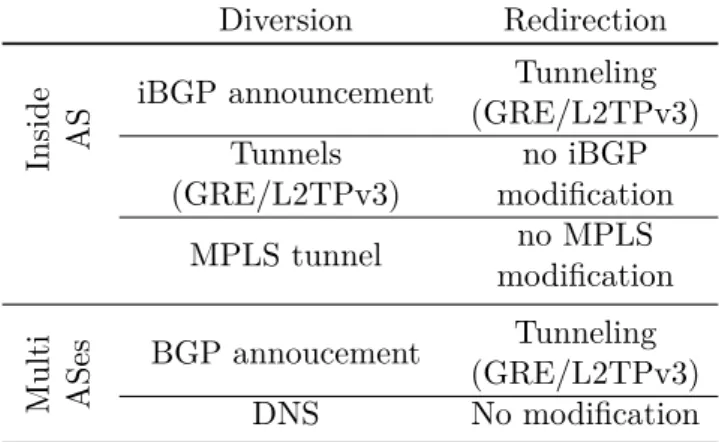
2.6 Possible combination of techniques used for traffic diversion and redirection . . . 37
3.1 Cisco original load-balancing algorithm hash values (not ex-haustive) . . . 55
3.2 Bloom Filter parameters definition . . . 65
3.3 Definition of evaluation metrics . . . 79
3.4 Definition of variables . . . 80
3.5 U sagepriority values dictated by MAWI captures in function of the BAmitigation . . . 80
3.6 Comparison of true positive probabilities (pT P) with IDR . . 88
4.1 Threat identification in some event signaling formats . . . 96
4.2 Filtering traffic terminology . . . 97
4.3 Generic information availability-driven scenarios . . . 100
4.4 Average statistics of dropped traffic for each scenario consid-ering a blacklist generation each 60s (N = 500) . . . 114
4.5 Potential impact of detection mechanism recall on true posi-tive number . . . 118
A.1 Scénarios reflétant les différents niveaux de visibilité d’un opé-rateur sur son réseau . . . 138
Chapter
1
Introduction
Contents
1.1 Motivation and Challenges . . . . 1
1.2 Hypothesis and Objectives . . . . 2
1.3 Contributions . . . . 3
1.4 Outline of the Dissertation . . . . 3
1.1
Motivation and Challenges
Network services are essential in the Internet, as they are the basis of almost all interactions. Their availability is, however, threaten by Denial of Service (DoS) attacks. Since 1974, which has seen the first DoS attack, DoS attacks have gained in strength, sophistication, complexity and frequency. Mitigat-ing such attacks and maintainMitigat-ing the availability of services is complex and sometimes requires actions upstream from the service, as the victim does not always have the resources to mitigate the attack. For example, massive DoS attacks, which involve huge amount of malicious traffic, can require large resources from upstream network providers to mitigate the attack.
Denial of Service attacks do not only affect the targeted service, but also impact other Internet stakeholders. That is especially true for volumetric Distributed Denial of Service attacks, which disrupt a service by causing congestion upstream from the service. The huge volume of traffic leveraged by attackers in recent attacks (up to Terabits per second in 2016 [1]) en-danger the stability of networks and also threaten the availability of all ser-vices using these networks. As demonstrated in these attacks the Internet of Things (IoT) paradigm paves the ways to even more powerful attacks. Mit-igation mechanisms have then to scale to the volume of such attacks, such that network stability and network traffic forwarding are not impacted.
As a consequence, from the point of view of service or network provider, mitigation should prevent the spread of the treat to other customers or services. In other words, mitigation should allow to control damages caused to 1) the network; 2) the other services built upon the impacted network, as it will also induce disruption for those services; 3) the legitimate customers of the targeted service which cannot access to the targeted service. The challenge is then summarized as follows: mitigation has to clean attack traffic in such a manner that network behavior is not altered, while it preserves legitimate traffic.
It is then crucial for service providers to benefit from relevant mitigation mechanisms integrated within their networks. It then has to interoperate with existing infrastructure, where interactions are twofold. At first, miti-gation retrieves contextual information about the situation, e.g. the attack details, so that it adjusts to the resources available within the network. Sec-ond, mitigation may require modification of networking functions, such as routing.
Past experience has shown that contextual information is dynamic, as for example, attack sources may shift along the attack timeline. A mitiga-tion that is unaware of those changes is likely to apply outdated acmitiga-tions or configurations to the traffic. Such obsolete reactions can worsen the situation
We can them depicts the challenges as following:
• mitigation should address the specific needs of volumetric DDoS at-tacks atat-tacks, that is the processing of high volume of malicious traffic; • mitigation should prevent damages caused to infrastructure and allows
legitimate clients to access service;
• mitigation should integrate and inter-operate with an existing opera-tional network infrastructure;
• mitigation should be kept up-to-date with the attack traffic.
1.2
Hypothesis and Objectives
In order to contribute to the volumetric DDoS attacks mitigation area, we made the following assumptions. Some contributions have their own hy-potheses, which are described in each chapter.
• A security component is responsible for the detection of attack vectors. The identification of attack flows is made available to the mitigation mechanisms through alert messages.
• Alert messages contain details about detected attack flows, such as flow telemetries.
• Network monitoring mechanisms provides information about the over-all traffic inside the network. This information encompasses the iden-tification of traffic as well as telemetries.
These hypotheses may seem, at first sight, strong. We expect, at least, to reasonably meet the first hypothesis. The last two ones are optional. We discuss in detail those three hypotheses in the Chapter 4.
The following objectives have been proposed to achieve the challenges we described in the previous section.
Objective A We propose a mitigation technique that make use of the net-work equipment capabilities, such that we benefit from the existing infrastructure resources and we can interact with them.
Objective B We study the ability to control damages caused by the attack, both in terms of filtered attack traffic and preserved legitimate traffic, of mitigation with regards of the operational constraints.
1.3
Contributions
Our proposed technique relies on multipath routing. Both legitimate and at-tack traffic are forwarded through different logical of physical path through-out the network. Mitigation is achieved by applying a differentiated quality of service treatment to each type of traffic and by prioritizing the and pri-oritizing the forwarding of legitimate traffic. We proposed a load-balancing based malicious traffic isolation technique. Build on top of Multiprotocol Label Switching (MPLS) network standard, we benefit from his network management and quality of services extension, namely Traffic Engineering and Differentiated Services. We propose the Mitigation Label, a special pur-pose MPLS label, which carry a signature of a Distributed Denial of Service attack. Malicious traffic is isolated in function of the Mitigation Label. The resulting technique allows network operator to segregate legitimate from ma-licious traffic using network forwarding function, i.e. without the overhead of traffic filtering.
We also study the efficiency of blacklists, a commonly advertised tech-nique against volumetric distributed denial of service. We formalize the op-erator’s context, i.e. the visibility he has on its network. The visibility refers to the amount on details the operator is able to gather about the overall traf-fic inside his network and particularly the malicious traftraf-fic. We study how such parameters impact the blacklist ability to successfully filter malicious traffic and to preserve legitimate traffic.
The contributions of this dissertation are summarized thereafter. • We provide a study of the ability of existing load-balancing techniques
to segregate malicious traffic from legitimate one. 3
• We propose a new load-balancing technique build on top of MPLS which allow isolating malicious traffic.
• We formalize the visibility of an operator on his network and study the efficiency of blacklists according to this model.
1.4
Outline of the Dissertation
The remainder of this dissertation is organized as follows:
Chapter 2 - State of the Art This chapter introduces the problem of Denial of Service (DoS) attacks. We briefly draw a review of DoS attacks and their characteristics. We then introduce the volumetric DDoS attacks area with regard of these aspects, namely the victim, the exploit leveraged to disrupt the service and the sources of the attack. We explore the met-rics proposed by the literature to assess the impact of these attacks. This chapter present a state of the art on the Denial of Service attacks miti-gation. We classify mitigation techniques in three categories: 1) admission control techniques, which decide whether a part of network traffic should pass or not; 2) detour-based mechanisms which benefit from the routing techniques; 3) absorbing mechanisms which aim at handling attack using existing resources. Lastly, we introduce our works by comparing it to exist-ing techniques.
Chapter 3-Load-Balancing based Mitigation Technique This chap-ter introduce our mitigation approach. Based on load-balancing and multi-path routing, we aim at isolating suspicious traffic and applying an unpri-oritized forwarding scheme to it. We study the ability of a Cisco router to achieve attack traffic isolation using load-balancing mechanisms. We also review the use of a literature advocated load-balancing algorithm, which is based on the CRC16 hash function, to perform the traffic segregation. Noting the inability of the existing load-balancing schemes to split both legitimate and malicious traffic, we propose a new mechanism. Our load-balancing technique consist of a signature of the attack which is carried in an MPLS label. We experiment to confirm the ability to segregate traffic according to legitimacy and compare results to the literature.
Chapter 4 - Enhancing Blacklist-based Mitigation This chapter deals with filtering techniques based on blacklists. We introduce the gen-eration problem of such mitigation, i.e. maximizing filtered attack traffic while reducing collateral damages and all with careful regard to the avail-able inputs. We then formalize scenario to evaluate the efficiency of blacklist
in terms of filtered attack and legitimate traffic, with regards of the avail-able data inputs, namely the identification and details of attack traffic and information about the overall traffic inside the network. We design simple blacklist generation algorithm that takes as input the information available. The efficiency of these functions is tested in experiments.
Chapter
2
State of the Art
Contents
2.1 Denial of Service and the Internet . . . . 5 2.1.1 Introduction to Denial of Service attacks. . . 6
2.1.2 DoS Attack Characteristics . . . 8
2.1.3 Characterization of the Volumetric DoS Problem . 9
2.2 Assessing the Impact of DDoS Attacks . . . . . 12
2.2.1 Network-based metrics . . . 13
2.2.2 User centric metrics . . . 14
2.3 Admission Control for DDoS Mitigation . . . . 15
2.3.1 Active Admission Control . . . 16
2.3.2 Passive Admission Control. . . 20
2.4 Detour-based mechanisms . . . . 35 2.4.1 Traffic Diversion . . . 35
2.4.2 Network link usage optimization . . . 37
2.4.3 Overlay networks . . . 39 2.4.4 Discussion . . . 40 2.5 Absorbing mechanisms . . . . 40 2.5.1 Overprovisioning . . . 40 2.5.2 TCP-based mechanisms . . . 42 2.5.3 Discussion . . . 44 2.6 Conclusion . . . . 44 This chapter first describes the Denial of Service security problem that this dissertation addresses. Then it describes network and security concepts applied to this problem by providing a review of literature on the detection methods as well mitigation methods such as filtering or effect alleviating. We then present metrics proposed by the literature to assess the impact of DDoS attacks.
We then review in details mitigation techniques for Denial of Service attacks. Mitigation mechanisms are divided into four categories according to how it prevents damages caused by the attack, as shown in Figure 2.1. Admission control mechanisms depicted inSection 2.3focus on determining which part of traffic (e.g., at the packet level or at the stream flow level) is permitted to flow inside the network. The mechanism can require traffic modifications (cf., active mitigation) or not, i.e. it only uses the current characteristics of the traffic (cf., passive mitigation). Detour-based mech-anisms (cf., Section 2.4) are often used in conjunction with another type of mitigation. They aim at reducing the DDoS congestion effect by taking advantage of the network meshing. Absorbing (cf., Section 2.5) maintains the availability of the network by dampening or dismissing congestion ef-fects at all costs. While some detouring mechanisms may serve a similar purpose, absorbing-based mitigations differ in that they are not based on path reconfiguration. DDoS Mitigation Admission Control Active Admission Control Passive Admission Control Detour Traffic Diversion Network Link Usage Optimization Overlay Networks Absorbing Overprovisioning TCP-based
Figure 2.1 – DDoS mitigation categories
2.1
Denial of Service and the Internet
This section first introduces the Denial of Service (DoS ) problem. It then reviews the different taxonomies of DoS attacks proposed by researchers to characterize attacks.
2.1.1 Introduction to Denial of Service attacks
As a part of information technology, the Internet is subject to the same fun-damental security properties, namely Confidentiality, Integrity and Avail-ability [2]. Each of the three terms defines a part of the attack surface. Con-fidentiality characterizes the fact that an information is not being viewed or accessed by unauthorized people. Integrity describes the capability to prevent an information from corruption or from being modified without au-thorization. Availability reflects the fact that authorized users can access information when they need it. In this respect, Denial of Service (DoS ) at-tacks are specifically and solely targeting the Availability property by trying to disrupt a service provided in the Internet.
September
CER
T Advisory on TCP SYN floods
1996 2000
February
Mafiaboy Attacks. Y
ahoo, CNN, eBay
, Dell & Amazon
2002
October
Root DNS Server Attack
2007
DDoS Attack against Estonia -
April -May
2008
Anonymous DDoS Attack Campaign against Scientology
- January
2010
WikiLeaks-related DDoS Attack
- December
2011
Sony Data Breach Camouflaged With DDoS
- April
2013
Largest Attack against Spamhaus (300 Gbps)
- March
2014
PlayStation Network & Xbox Live attacked
- December
2015
T
urkish Internet hit with massive DDoS attack
- December
2016
Krebsonsecurity W
ebsite Attacked (620 Gbps)
- September
Mirai IoT Botnet Attack against OVH (1 Tbps)
- September
DDoS Attack against DynDNS
- October 200 Gbps 400 Gbps 600 Gbps 800 Gbps 1 Tbps
Figure 2.2 – Denial of Service Timeline
Concern about DoS attacks increased over the years due to the increase of number, frequency, scale, criticality and the decrease of required knowledge
and needed resources to trigger such an attack. It then became, in recent years one of the top threats of the Internet as shown in the DDoS timeline (Figure 2.2). Data required to draw this timeline is extracted from [3]. The increasing frequency goes hand in hand with the popularization of the con-cept of DoS as a Service (DoSaaS ). It refers to websites that rent attack resources for a few minutes or hours. As a consequence, for a few dollars, people without network or security knowledge are able to launch such at-tacks.Figure 2.2also demonstrates the growth of traffic volume (expressed in bytes/seconds) as new records are regularly established. For example, vol-ume records reach 300 Gbps in 2013 and expand to successively 680 Gbps [4] and 1 Tbps [1] in 2016. A recent survey [5] stated that in 2015, half of data center respondents suffer from DoS attacks that completely saturated their Internet connectivity. In 2016, the emergence of Internet of Things (IoT ) based botnet, i.e. network of devices known as bots and controlled by an attacker, opened the way for more massive attacks as 1) the number of potential bots remarkably grows due to the lack of security enforcement within this kind of devices, and 2) the required and available bandwidth to devices such as webcams is considerable. Beyond the service disruption caused to the targeted Internet service, it may also endanger the multiple Internet players such as Internet service providers, data centers and causes damage to other service. For example, in 2016, the attack against the Dyn DNS service provider affected the availability of some well-known services such as Netflix, Spotify, Twitter, Paypal, Amazon or Ebay. However, DoS attacks do not always induce a large volume of traffic. The Arbor Networks survey [5] shows that in 2015, 74% of attacks had a relatively small volume, i.e. 500Mbps, which is significantly less than the peak of 1 Tbps reached in 2016. Nonetheless, attacks with such smaller volume still threaten the availability of unprotected or inadequately protected targets.
It is worth noting that these high-volume peaks refer to the cumulated throughput of attack traffic at each target point of presence on the Internet. In fact, the target service may be hosted on several geographical nodes (e.g., for enhancing its delivery), so that the attack can hit each node. The strike force would be more damaging if the attack concentrated on a single point.
2.1.2 DoS Attack Characteristics
Literature characterizes multiple aspects of Denial of Service attacks, such as attack sources, or means leveraged to achieve the service disruption. While some works provide a simple review of attack vectors such as protocol used and a list of common past and present attacks, some other works contribute to a better understanding of the problem by identifying and describing DoS attack characteristics.
Although we address a volumetric attack, i.e. a specific class of DoS attacks, a general review of the attack landscape allows us to enrich our
understanding of massive DoS attack distinctiveness. We start by reviewing exploits used by an attacker to achieve the service disruption. We then study attack sources and their capabilities, i.e. which exploit are available to them. Afterwards, we survey attack traffic details such as its rate dynamic or content validity. Finally, we provide a comprehensive characterization of existing attacks.
Victim
This attack does not only affect the final service, but multiple actors can also be hit and suffer from the effect of the attack.
Mirkovic and Reiher [6] differentiate between several victim types from most limited to important impact, namely application, host, resource, net-work and infrastructure. Application attacks only impact the victim’s ap-plication. In that case, other applications hosted by the same host are not impacted. Conversely, attacks against the host completely disable the host by consuming its resources, leading to a disruption of all services located on the host machine. Resource-depleting attacks target software (e.g. DNS server) or hardware (e.g. router) critical resources in a network. Bandwidth-depletion attack names attack that consumes the bandwidth of network upstream from the targeted service. It mostly benefits from the funneling effect of convergence of traffic towards the final destination. Finally, infras-tructure attacks refer to attacks that target some critical Internet services, such as DNS servers, routing protocols, etc. This last category reflects the attack synchronization of several attacks whose victim can be classified in another category, e.g. resource-depleting attacks.
Methods of Attack
Attack mechanism is closely related to the impact of attack as the different mechanisms are going to cause different effects.
Douligeris and Mitrokotsa [7] correlate the attack manifestation with the mechanism leveraged to disrupt the service. According to them the attack bandwidth or other resources depletion is achieved in different ways. On the one hand, the bandwidth is consumed by sending a massive amount of traffic either directly or indirectly to the target. On the other hand, other resources are depleted either by exploiting network protocol design weaknesses or protocol implementation flaws, e.g. using malformed packets. Asosheh and Ramezani [8] reword this classification and dig into details by citing protocols and flaws exploited in attacks.
Mirkovic and Reiher [6] eliminate the distinction of attack manifestation in the attack mechanism classification. As a consequence, a single category gathers the protocol design exploitation and implementation flaw mecha-nisms. Another category describes attacks that trigger large amount of traffic that might seem legitimate. Such attacks can aim at consuming bandwidth, as proposed by Douligeris and Mitrokotsa, or any other resources, e.g. pro-cessing capabilities, disk I/O, etc.
2.1.3 Characterization of the Volumetric DoS Problem
In this dissertation we focus on volumetric Denial of Service attacks. This section details the principle and characterization of such attacks.Figure A.1
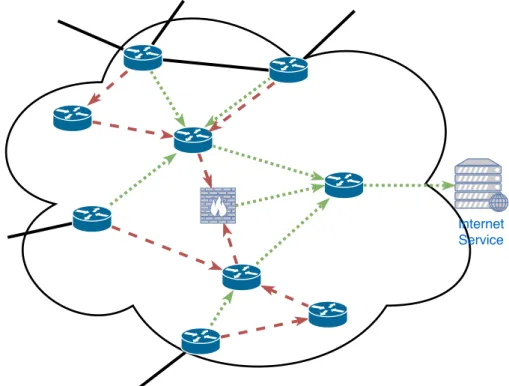
shows an example network infrastructure that is hit by such an attack. The legitimate client and its traffic towards the Internet service are depicted in green while the attackers and their traffic are drawn in red. A dedicated DDoS mitigation solution protects the Internet service, for example at the datacenter entrance. The mitigation solution may implement all filtering mechanisms described inSection 2.3to filter DDoS attack traffic.
In the case of a small attack, both the network infrastructure and the middle-box are able to cope with the volume of the attack. The middle-box filters out the attack traffic and forwards the legitimate traffic to the targeted service. When no filtering mechanism is available, both attack and legitimate traffic continue flowing towards the Internet service without causing adverse effects to equipment on the path towards the service.
A volumetric DDoS attack achieves the DoS condition by saturating the available bandwidth of a network link (cf., method of attack) and causing congestion. However massive attacks can also overwhelm undersized equip-ment processing capabilities, i.e. equipequip-ment which does not meet line-rate requirements. Such equipment, i.e. the middle-box and/or the available re-sources upstream, e.g. router, load balancer or firewall, can be the weak point. The exhaustion is mostly due to the funneling effect that concen-trates the attacks coming from distributed sources towards the target, as depicted in Figure A.1. In that case, the sum of volumes (or packets) of all traffic forwarded or routed through the same outbound interface exceeds the outbound interface bandwidth. As a consequence, exceeding packets are dropped at the bottleneck. The fact that the bottleneck is upstream from the middle-box renders filtering inefficient, as the legitimate traffic flooded among attack traffic is already lost due to congestion. The Internet service then becomes unavailable or degraded.
As a subset of traffic is still forwarded by the congested equipment through the output interface, legitimate traffic from some users may there-fore partially flow towards the target. Depending on the service, their per-ception of the disruption can differ. This user perper-ception of the service qual-ity is named Quality of Experience (QoE) [9]. For example, considering a
UDP-based streaming service, packets loss can result on degraded video, long buffering time, etc. Conversely, other services such as those based on TCP, may even worsen the congestion. TCP integrates integrity mechanisms such as retransmission, i.e. a lost packet is retransmitted several times after a configured timeout, maintaining equipment under pressure by legitimate clients. This is then important to assess the impact, either partial or com-plete, of the attack, as discussed inSection 2.2.
Figure 2.3 – Example of volumetric DDoS attack attack against an Internet service that saturates network link
Attack sources
As stated before, volumetric DDoS attacks leverage the distribution of at-tack sources to generate large amount of converging traffic. Atat-tackers have multiple options to send traffic from such a large number of sources. Litera-ture shows that given the source characterization, different countermeasures can be applicable.
Botnet-based attacks Botnets are groups of compromised devices (i.e. bots), e.g. servers or computers, under the control of the attacker. De-vices may have been infected or voluntarily enlisted in the botnet by their owner [10]. Accordingly, the attacker is able to trigger a coordinated attack from the group of bots. Recent years have seen the emergence of Internet of Things (IoT )-based botnets. Due to the weak security of IoT devices such as webcams, and the large bandwidth available, IoT-botnets have rapidly
entered into the arsenal of DDoS attackers. The attack against OVH [1], holding the record of 1Tbps of accumulated attack traffic, involved more than 145,000 simultaneous IoT devices.
Bots directly send packets to the target, so that they are able to leverage attacks that require bidirectional traffic (cf. Table 2.1). As a consequence, from the point of view of the victim, the number of sources is constrained by the number of devices an attacker is able to control. However, the ability for an attacker to control such number of potential bots, such as in an IoT botnet, makes massive application-layer attacks (e.g. floods of HTTP or HTTPS POST requests containing files to upload) more likely.
However, as depicted inTable 2.1 in order to evade both detection and mitigation, bots can also send simple garbage floods, i.e. traffic which pay-load does not matter. In that case, only the volume of traffic matters and this does not require the target to reply to the real source. These bots ex-ploit connectionless protocols, i.e. the protocol does not need to validate the source of traffic, such as UDP. So that they can make use of spoofing in order to evade both source detection and mitigation. In other words, they send datagrams with a faked source address. Finally, the victim may view an infinite number of sources. We do not consider such spoofed attacks in this dissertation.
Amplification DDoS More generally, Distributed Reflective DDoS at-tacks exploit the fact that the UDP protocol is connectionless. A bot then issues a request to a service with the source address of the UDP datagram spoofed to the target’s address, resulting in the service sending its reply towards the target. If the reply is larger than the request, the server can be used as an amplifier, and the attack is called an amplification DDoS attack. DNS is an example of such an exploited service, where DNS resolvers can be used as amplifiers. Many resolvers are, however, configured to respond only to a restricted set of clients, limiting the usability of the resolver as an amplifier. For example, ISPs typically allow requests only from source ad-dresses corresponding to their customers. Resolvers without such limitations are called open resolvers, and they can be and are exploited for amplification attacks.
Several services are likely to be exploited for amplification. Rossow [11] studied characteristics of the use of over 14 services for amplification. He stated that a request to an NTP service can result in a reply that is 550 times more voluminous. Although he found up to billions of potential amplifiers, the attack with the highest number of amplifiers reported only around 170k different IP sources involved.
Even if the attacker initially spoofs the source address of the request, the traffic from the amplifier to the target is unspoofed. This means that the number of sources seen on an attack is limited by the number of
am-Attack Protocol Sources Spoofed ? Payload Victims
UDP flood UDP Bots Mostly Garbage Network
Stateful flood GRE, TCP-based (e.g. HTTPS/S) Bots No Compliant Targeted service, filtering devices, network
Amplification UDP Internet
service No Reply Network
Table 2.1 – Volumetric DDoS Attack Characterization
plifiers (e.g. open resolvers for DNS) the attacker can find and use. In this dissertation, we position ourselves between the amplifier and the target, not between the attacker and the amplifier
Similarly, the amplification attack can be triggered by a botnet, i.e. bots are each issuing the request to services by spoofing the source address. How-ever, still from a victim point of view, the fact that the attack is originated from a botnet is therefore not visible.
2.2
Assessing the Impact of DDoS Attacks
Volumetric DDoS attack aim at causing congestion on network paths to-wards the targeted service by saturating a link. Generally, the probability that a packet is delivered can be approximated by the ratio between the outbound bandwidth (RO) and the sum of all incoming traffic (RI) that is going to be forwarded through the outbound interface [12], i.e.:
PD ≈ min(1,
RO
RI
) . (2.1)
Probabilities have their limits, as attacks may make a huge impact re-gardless of probability. Researchers then have defined several metrics to assess the impact of congestion on traffic. These range from network-based metrics to more user-centric metrics and include organizational metrics. In this section, we first detail network aspects of the impact on traffic. Second, we review user-centric aspects of the impact which are mostly specific to each targeted service.
2.2.1 Network-based metrics
The use of network metrics to assess the impact of a volumetric DDoS attack, especially its congestion effect, is straightforward. The congestion basically causes packet drops at intermediate equipment.
Hachem et al. [13] define the Percentage of Reception (POR) metric as the ratio between the inbound and outbound traffic of a location (e.g. network, equipment). This metric is computed for different classes of traffic defined by the degree of legitimacy of traffic, for example legitimate traffic, suspected spams, port scanning requests, DDoS traffic. This simple metric requires the ability to classify traffic in specific categories at inbound and outbound links. While it gives a macroscopic picture of the traffic losses, it does not take into account the impact of drops at a connection level. For example for a stateful protocol such as TCP, the impact of a packet loss may be more costly. It will trigger resilience mechanisms such as retransmission and can impact the TCP transmission window size, etc. It may then induce delays or even session resets in case of successive packet drops for a given connection. Accordingly, considering both TCP and UDP, TCP claims more packet losses than UDP in case of congestion [14].
Zhang et al. [15] and other researchers [16,17] assess the impact of con-gestion using the throughput metric. It reflects the number of packets per unit of time reaching the destination. However, considering TCP, packet losses induce packet retransmission from the sender. Each of those retransmitted packets are counted even if the information they carry does not reach the destination. Accordingly, the goodput metric does not include retransmitted packets. Notwithstanding, in order to give a good insight of the congestion impact, these two metrics require to be compared under the same context with and without congestion. In fact, their value is highly dependent on other conditions, e.g. the number of connections, the scheduling of packets on network equipments. As a consequence, their use is incompatible with a live assessment of volumetric DDoS attack impact.
Owezarski [18] study the effect of DDoS on Quality of Service (QoS ). Au-thors evaluated the QoS using the Long Range Dependency (LRD) metric. The LRD metric aims at depicting the dependence between packets of the same connection. The dependence is due to closed control loop congestion resilience mechanisms, such as congestion window or the flow control, inher-ent to TCP, i.e. the packet delivery (rate, retransmission, etc.) is dictated by feedback information between the client and the server [19]. TCP con-gestion control mechanisms adapt the communication throughput, e.g. by modifying the number of successive packets the client can send before receiv-ing an acknowledgment (congestion window), to fit the link bandwidth, so that it traffic throughput oscillates. However, when the range of oscillations increases, e.g. due to a long-term dependency, the oscillation amplitude also increases. This induces TCP connections throughput to reach even lower minima.
of the type of traffic, e.g. a packet loss for a given protocol does not lead to the same results for another one. The typical low-level example is TCP and UDP. While a packet loss for TCP induce throughput reduction to adapt the connection to the link bandwidth, it does not have such effect for UDP traffic. To be precise, UDP traffic may adapt to bandwidth constraints, e.g. streaming traffic. However, this mechanism is not implemented at the UDP layer, but this is an application-level mechanism.
2.2.2 User centric metrics
An attacker does not need to saturate a network to disrupt a service. He only needs to send a sufficient amount of traffic to degrade the availability of the service. As a consequence, the legitimate user will have a very poor experience of the service. Conversely, a user may not notice a degradation of its experience even if a few networks packets have been dropped [20]. In fact, the quantification of a poor user experience depends on the type of application and especially on the tolerance of the application to network losses.
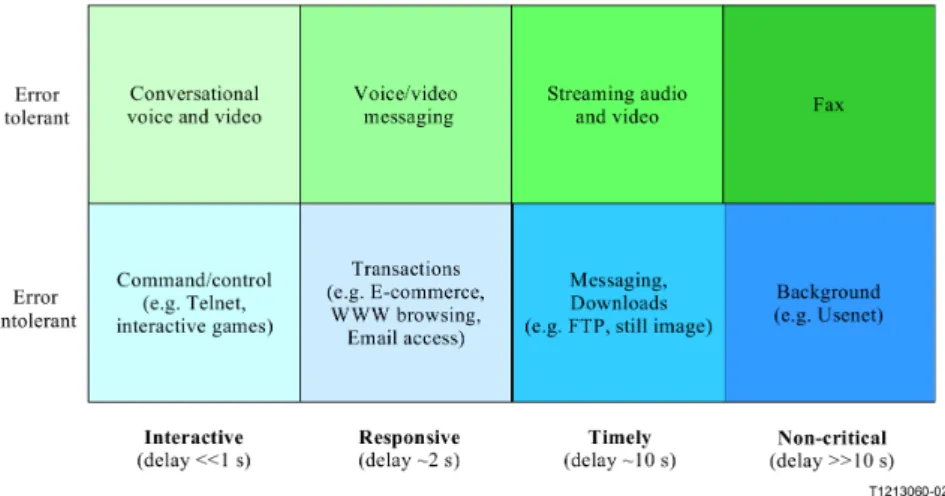
The International Telecommunication Union (ITU), for example [21] provides end-user oriented recommendations for multimedia QoS metrics. They define application categories shown in Figure 2.4, for which services are classified by type and QoS requirements. Requirements are assessed us-ing three QoS metrics that have been identified as reflectus-ing the impact on user perception, namely QoS delay, jitter and information loss. For exam-ple, a delay undoubtedly impacts the immediacy and interactivity of a telnet session, while a high jitter degrades the quality of a VoIP conversation. Fi-nally, a loss of packets leads to frame loss and / or inconsistent buffering for streaming related traffic. However, depending on the class of traffic they are applied to, these metrics have different meanings. For instance, delay ei-ther refers to the time between the arrival of two consecutive packets or the duration of a download. Similarly, these metrics are not clearly defined. For example, according to the ITU report, HTTP traffic does not tolerate losses. A loss is surely identified by the timeout of a TCP session, and induced by the loss of a packet and its re-transmission.
Mirkovic et al. [22] propose a set of metrics to measure the degradation of quality of service and thus the severity of a DDoS attack. Their work is based on a unified QoS metric for all different classes of traffic, i.e. the failure of an application transaction. The transaction, i.e. the core of their QoS evaluation, depicts an application-level task. Then, similarly to ITU, the QoS failure is evaluated using service tolerance to traffic errors, namely one-way delay, request-response delay, loss, duration and jitter. Although the method to capture these metrics also change regarding the type of traffic,
Figure 2.4 – ITU User-centric QoS recommendations
Mirkovic clearly states how to measure them. Finally, the severity of the attack is expressed using a combination of percentages of failed transactions per application.
2.3
Admission Control for DDoS Mitigation
Admission control describes mechanisms that decide if a service request should pass the mechanism or be blocked. The request can be identified at different OSI layer, e.g. layer 3 to layer 7, so that the decision is made on information contained in the fields of these layers.
This section presents a state of the art of admission control mechanisms that can be applied to mitigate DDoS attacks.Subsection 2.3.1presents ac-tive mechanisms, i.e. that require modification of the connection traffic and monitor the behavior of the client to make their decision. Subsection 2.3.2
then presents passive mechanisms that do not require modification of traffic.
2.3.1 Active Admission Control
We split research for active admission control into three categories. The first category aims at identifying suspicious clients by looking at their behav-iors when facing a challenge, i.e. a modification of the traffic. The second category uses client capabilities, i.e. authorization granted by a server to end-hosts. The last category is based on marks applied to packets along the path to the server, that are checked by routers.
Challenge-based mechanisms
Puzzle-based challenges Puzzles are challenges sent by a service to clients, that are moderately hard to solve, but simple to check. The basic idea of puzzles is that clients should pay a computational price, i.e. higher than just sending a request, so that an attacker would require more com-putational resources to carry out the attack. These challenges are mostly based on a brute-force search of an entire cryptographic pre-image given a partial pre-image and the image.
Juels and Brainard [23] first introduce the concept of puzzles to mitigate DDoS, and especially connection depletion attacks such as SYN floods. Such attacks aim at consuming the connection backlog of a server by multiply-ing connection attempts. In normal operation, clients ask for puzzles, then servers register them without sending them a challenge. During attacks, the servers reply to clients with a puzzle and only registers them after checking that the solution they replied is valid. Puzzles are time-based and stateless, so that, clients have limited time to solve the challenge and servers do not have to keep tracks of generated puzzles to verify the solutions. The size of challenges is computed in such a manner that it is theoretically impossible for an attacker that control a given number of bots to achieve a connection-depletion attack. As a consequence, in 1999, the puzzle is recommended to be a 128 Bytes bitstring. This means that today, according to Moore’s law, the puzzle’s size should be much larger, leading to an extra burden of traffic bandwidth. Moreover, the use of a puzzle protocol requires its implementa-tion in client machines. Although the authors argue that this could be built into browsers, e.g. as a plugin, such implementation would not be useful to fight against SYN flood attack as the TCP connection is established into the kernel before the information is transmitted to the browser.
In 2004, Wang and Reiter [24] proposed the use of puzzles to mitigate volumetric DDoS attack. During an attack, congested routers require clients to regularly solve puzzles with a rate commensurate with the bandwidth consumed by the client. A collaborative mechanism allows congested routers to require the help of downstream routers to deliver puzzles and check their solution. More recently, in 2011, Khor and Nakao [25] proposed the use of puzzle mechanisms as a cloud-based DDoS mitigation service. They focused on billing protected services for only legitimate traffic.
TCP challenges TCP challenges act as authentication methods that check the legitimacy of the source host. In particular, they aim at tackling spoofed attacks.
For example, TCP SYN proxies [26,27] are middle-boxes, through which all the traffic is going. In such a manner, they complete the TCP handshake in place of the TCP server. If the source is able to set up a connection, the proxy resets the initial connection and whitelists the source. Later
Verifies HTTP Redirect HTTP Cookie Javascript challenge CAPTCHA Non-spoofed Source IP X X X X HTTP Compliant Application X X X X Real Browser X X Real Human X Table 2.2 – Application Challenges [27]
tion attempts are directly forwarded towards the server. Other challenges have been proposed [27]. For example, instead of trying to complete the handshake, the proxy replies with an out of sequence SYN-ACK and waits for the reset from the client. Thus, the proxy avoids the burden of sending the reset, which could dramatically increase during an attack. Nevertheless, a SYN proxy is commonly implemented in off-the-shelf mitigation mech-anisms. These solutions shift the burden of establishing a first connection with the sources to the proxy. As a consequence, during an attack, the proxy may itself be vulnerable to attacks such as SYN floods.
Application challenges Application challenges mitigate applicative floods such as HTTP floods, HTTP floods consists in sending HTTP requests with a high rate to a server. Application challenges may be categorized into four sections, namely HTTP redirection, HTTP cookie, JavaScript challenges and CAPTCHA. As shown in Table 2.2, each mechanism checks different elements [27].
These challenges may be implemented on the victim side of a DoS 1. Nonetheless, this can also be embedded in middle-boxes together with a set of dedicated mitigations.
An HTTP redirection consists in replying to a client request with a 302 HTTP code, that redirects the client to a link that can also be intercepted by the proxy. Once the proxy detects that the client has followed the redi-rection, the source (or connection) is whitelisted. An HTTP cookie follows
1TestCookie Nginx module http://kyprizel.github.io/
the same principles and adds a cookie in the redirection announcement. The client then needs to follow the redirection with the embedded cookie to be authorized to fulfill the request. However, even basic downloading tools, such as the UNIX command wget 2 are able to successfully bypass these protections.
Javascript challenges go further and try to check that the environment of the client is a browser. Simple JavaScript challenges, e.g., mathematical calculations, are embedded into a dedicated HTTP content. Completing the challenge requires the client application to interpret and run the JavaScript code. Such mitigation is circumvented by some sophisticated botnets, that integrate a JavaScript interpreter.
CAPTCHA are tests that aim to differentiate humans from computers. The client has to answer a visual test, for example, to reproduce a text shown in a degraded image or to achieve a calculation depicted in a picture. Even if they have been designed to be costly to solve, they can be deceived using for example Optical Character Recognition, Artificial Intelligence, etc. as proposed in [28].
Capability-based mechanisms
Capabilities are tokens, carried by packets, which represents the entitlement of a client to send traffic. This authorization is granted by the service, which decides which client to serve. Although the principle is not restricted to client-server architectures, in this section, we respectively denote as client and server the initial sender and its receiver.
Yaar et al. [29] propose the Stateless Internet Flow Filter as a counter-measure to flooding DDoS attacks. It is based on the concept of privileged and unprivileged traffic, i.e. traffic which respectively carries valid state-less capabilities and no capability at all (legacy traffic). Capabilities are generated using the client IP address and marks generated by routers and delivered by the server if it decides to authorize the client. The server is then able to deny the capability for suspicious clients. Privileged traffic will be prioritized at routers after that the capability extracted from a modified IP header of the packet has been validated. Routers validate a capability by checking that the router mark is present. Packets with an invalid capability are dropped, while packets with no marks, are de-prioritized.
The use of capabilities allows mitigating floods of unprivileged traffic. As a consequence, the resilience of the mechanism is based on the fact that the server is able to detect malicious sources to deny their capabilities. However, in most cases, the service will classify a source as malicious after the source’s
2
Wget toolhttps://www.gnu.org/software/wget/
request hit the service. In other words, attacking sources are able to send at least a request before being identified as malicious.
Yand et al. [30] aim at solving the vulnerability of previous capabilities mechanisms during the time they grant or deny access to a client, as they require reading at least the first request to grant or not the capability. They introduce the Traffic Validation Architecture which is also based on capa-bilities checked by routers. They prevent servers from being vulnerable to flooding attacks during the capability granting phase by limiting requests per flows. Flows are identified at a router by the path taken by the packet towards the router, and the packet destination. Routers thus store a small flow state. However, this solution still requires an implementation of the capability protocol on end-hosts and routers. Moreover, the mapping of an identifier to flows is vulnerable to floods. In fact, legitimate and attack flows towards a given destination which hit the protected network at the same access point would get the same path identifier. As a consequence, they would be rate-limited jointly, and legitimate traffic is likely to be shadowed amongst the attack traffic.
Discussion
Challenge mechanisms focus on the idea that a client has to provide some-thing, either proof of its legitimacy or a payment, e.g., in the form of CPU usage. This, however, requires an additional step in service delivery. Indeed, the service replies to a client request with a challenge. It then waits for the challenge completion to answer the initial service request. This principle is not applicable to all services, especially those who require high availabil-ity. For example, UDP-based DNS service relies on the spontaneity of the stateless communication between the client and the server. As many other Internet services require domain name resolution, an increase of the latency in DNS resolution has a dramatic impact.
Capability-based mechanisms assume that the server can discriminate attack from legitimate traffic and grant capabilities to the legitimate traffic. However, especially in the case of volumetric attacks, choke point occurs upstream from the destination, so that legitimate traffic is already flooded amongst the attack traffic. Newer proposition provide enhancement by rate-limiting undetermined traffic but push the congestion at the network access point.
2.3.2 Passive Admission Control
Passive Admission control mechanisms broadly fall into three categories: fil-tering mechanisms, queuing-based congestion control mechanisms and com-bination of the two previous categories. Filtering focuses on matching traffic
that has been identified as unwanted according to either a pattern or a behavior. Conversely queuing-based congestion control mechanisms aims at using network resources as efficiently as possible in order to avoid congestion collapse [31]. Congestion collapse is a critical network state where packets are retransmitted (e.g. related to TCP traffic) several times before initial transmission leaves the network, i.e. is being effectively dropped or received by the destination [32]. This is the case in networks that first delay packets when facing link saturation to comply with bandwidth limitations, resulting in a rise of the Round Trip Time, i.e. the time for a packet to be sent to the destination and for the acknowledgment to be received by the sender. The Network contains several copies of the same packet, which make the matter worse.
Filtering mechanisms
Filtering mechanisms map a forwarding decision, i.e. either pass or drop, to a part of traffic matched by a pattern or a behavior. More complex actions can also be assigned to a traffic profile.
The use of existing and already deployed network equipment to achieve a first line of defense has been proposed by the industry. Blackholing, such as described by Cisco [33], provides a simple and resource-efficient method [34] to drop a collection of packets based on their destination or source prefix. Indeed, it uses the efficient routing mechanisms of routers to route packets, destined to a given destination IP address or prefix, to a null route. Traffic is then purely discarded. A destination-based blackhole would, however, disrupt the service by entirely dropping the traffic routed towards it. Access Control Lists (ACLs) are filters typically implemented in net-work equipment [35]. They consist of an ordered list of rules that define a part of the traffic using packets fields, such as IP addresses or TCP/UDP ports, and an action that is assigned to the matched traffic. Rules are se-quentially tested against the traffic until a match happens. If traffic does not match a rule, it is passed to the next forwarding step. Fields are often restricted to OSI Layers 3 and 4 [35]. The most prevalent actions are DENY or ACCEPT the packet that is matched by the rule, i.e. the packet is re-spectively blocked or passed to the next forwarding/routing step. Whitelists are a specific type of ACLs where the only available action is ACCEPT. Its last rule catches all the traffic and denies it. Filtering traffic with whitelists requires the identification and characterization of wanted traffic (e.g. le-gitimate traffic, or protected service). Conversely, blacklists only allow the DENY action in rules and accepts the remaining unmatched traffic. In that case, the unwanted traffic such as malicious traffic, has to be characterized. Today, ACLs are often implemented in hardware [36,37], for a reduced performance impact, instead of in the router software. On the other hand,
hardware implementation comes with size constraints [38]. Filtering lists are stored in a fast but expensive memory (TCAM) which is size-limited [39]. Maccari et al. [40] propose the use of a memory efficient structure (Bloom Filter [41]) to reduce the size occupied by a whitelist. [42, 36, 39, 43] con-sidered the memory limitation and aimed at reducing the size of lists using source prefix aggregation. Several aggregation schemes have been proposed in the literature.
Network Aware Clusters [44] identify topologically-closed sources using the BGP routing table. Authors assume that BGP route prefixes identify nodes (IP addresses) in the networks which are topologically close. The more those prefixes are long, the closest the nodes.
The Hierarchical Heavy Hitters [45] extends the heavy hitters algorithm, which produces clusters which rate (throughput, bandwidth, etc.) is greater than a configured threshold, and takes into account the hierarchical structure of IP prefixes. The Hierarchical Heavy Hitters algorithm produces aggregates with approximately equal rates of legitimate traffic.
Pack et al. [39] study the ability of filtering lists (whitelists, blacklists and a combination of both) to filter malicious traffic while preserving legitimate traffic. Aggregates are computed using a comparison between a baseline period of traffic and the last period of traffic.
Goldstein et al. [42] also propose a history-based algorithm to automati-cally generate filtering rules using Bayesian decision theory. Authors aim at constraining the number of rules. They achieve Bayesian classification with a given network prefix size. Adjacent produced clusters (e.g. 1.1.2.0/24 and 1.1.3.0/24) are aggregated. If clusters are still too numerous, classification is recalculated with a shorter prefix.
Soldo et al. [36] develop a framework to build optimal ACLs, where the definition of an optimum depends on the filtering goal, e.g. blocking all sources, some sources, preserving bandwidth, etc. The aggregate computa-tion is driven by weights assigned to each source. Although, they evoked a different method to assign weights to sources, the importance of these weights has not been assessed. In Chapter 4, we evaluate the impact of two weight assignment methods driven by the amount of information about traffic.
Dedicated filtering middle-boxes Network appliances, also known as middle-boxes, are widely used to mitigate DDoS attacks [5]. This generic term depicts various appliance types such as network and application fire-walls,IPS, proxies or dedicated appliances (i.e., anti-DDoS). Dedicated solu-tions, mostly commercial solutions (cf. those proposed by Arbor Networks3,
3
![Figure 2.5 – Policing versus shaping mechanisms [83]](https://thumb-eu.123doks.com/thumbv2/123doknet/11408953.288190/52.892.168.653.421.810/figure-policing-versus-shaping-mechanisms.webp)
![Figure 3.5 – Table-based Hashing with Thresholds Mapping [108]](https://thumb-eu.123doks.com/thumbv2/123doknet/11408953.288190/80.892.230.659.194.479/figure-table-based-hashing-thresholds-mapping.webp)